Tag: Kurdistan

  • US Forces Entered Sinjar Mountain, Iraq

    US Forces Entered Sinjar Mountain, Iraq

    On Friday, June 1, the US troops with military vehicle and heavy weapons entered the Sinjar area in western Mosul.


    According to Sinjar Governor Mohammad Khalil, 15 US military armored vehicles arrived in the area after the agreement with the Iraqi government and are now stationed near the Mira hill.

    Khalil said that the intention of the US forces to enter this strategic area is to create a military base in the Sinjar Mountains.


    Sinjar, a town in Nineveh Province of Iraq, is inhabited mainly by Izadi Kurds, with a Muslim Kurdish minority. Its population in 2013 was estimated at 88,023.


    It should be noted that, after Iraqi troops were retook the city and district of Kirkuk in 2017 from the Kurdish Peshmerga forces, US troops were also transferred their military assets to the K1 base in Kirkuk.

    After this US action, there were also reports of the transfer and deployment of a number of other US troops around the city of Tuz Khurmatu, south of the city of Kirkuk.


  • Russian game, Turkish opportunism and Iranian passivity in the north of Syria

    Russian game, Turkish opportunism and Iranian passivity in the north of Syria

    It is nearly three months ago in the article “The new level in Syrian war/ emphasize on Kurds’ situation and end of ISIS” that with finishing war against ISIS in east of Syria, it is Kurds’ turn to see how their lands are divided between fighting sides in Syria.

    It is still observable that political agreements are shaping the military confront. Same as several months ago that the competition between east and west of Euphrates river in Deir al Zur is based on agreement between US and Russia.


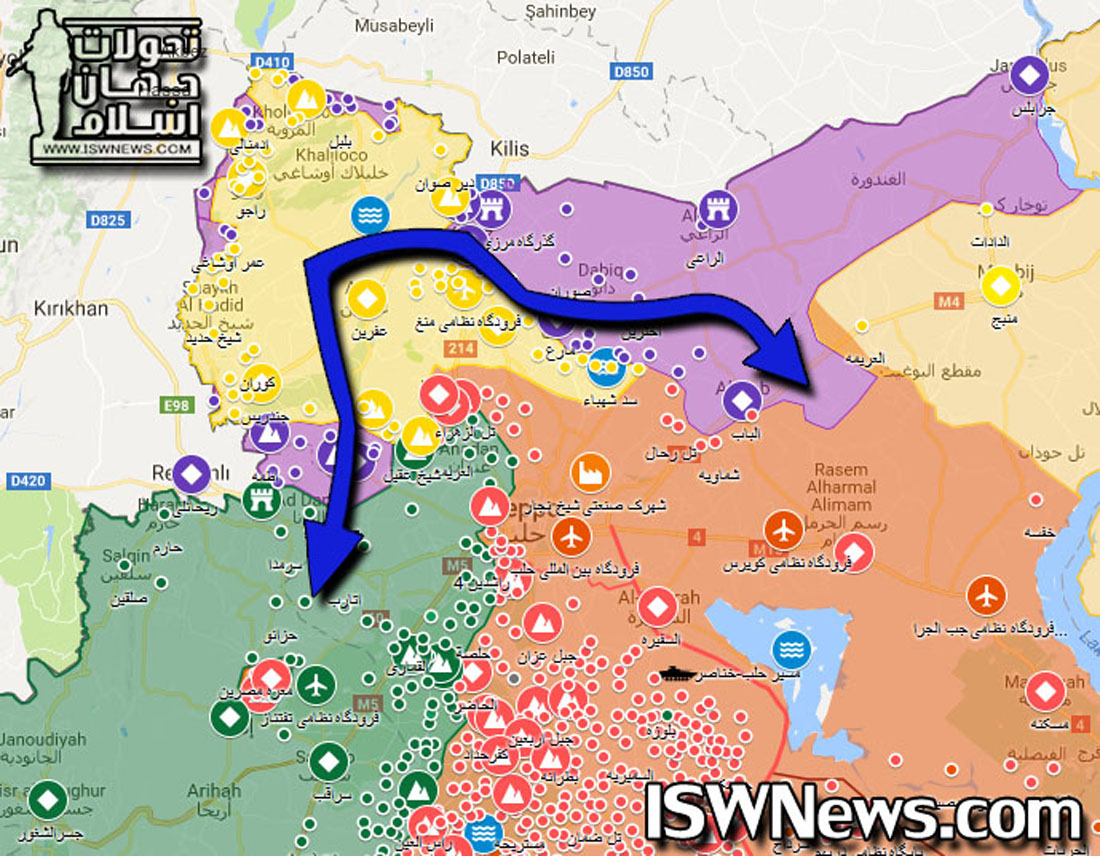
    Today the story of Abu Dohur confront is to fulfil Astana 6 agreement. So the final border of forces in “Idlib De-escalation zones” will be the Hijaz railway (which is the current border) or at most Aleppo-Damascus highway.

    At this border inspection posts of all sides (Turkish-Russian-Iranian) are going to be established and a “Idlib De-escalation zones” will be sustained.


    Recent incidents in Al Eis area in south of Aleppo which includes the artillery fire exchange between Moghawemat and Turkey, is caused by a nuance disagreement in details that Turkey wants to erect watch posts in Al Eis and east of Aleppo-Damascus highway but Moghawemat front is against it; the reason is that Al Eis is very close to Fuah Kafrya and to liberate Fuah & Kafrya the forces should pass through Al Eis.

    This does not mean a determination or plan to reach Fuah & Kafarya in near future necessarily; but a pressure point and replacement plan to tell terrorists that occupying Fuah & Kafrya is expensive for them or consider it as Moghawemat reaching Idlib walls..


    The fact that Turkish Army enters Al Eis again even with warning shots is due to green light from Russia, otherwise it would not be possible.


    Nevertheless, the latest news approves Turkish watch post establishment in Al Eis. On the other side, during the last few days Suhail Hassan’s forces famous as “Tigers” are transported to east of Hama from Saraqeb front to finish the remaining ISIS militia in besieged region and liberate it entirely. This is also another sign of harmony between Russia and Turkey specially if we know that Hassan’s forces act under Russians’ complete intelligence.


    On the other side, Turkey attacks Afrin and some observers consider it as a taken of Astana 6 and Sochi summits (Abu Dohur for Afrin). This Turkish occupation although not very unlikely but also was not agreed on in any summit (not in Astana nor in Sochi) and such audacity from Turkey would not happen without other sides’ (Iran and Russia) confirmation.

    But the main reason that Turkey did such a move is nothing except the Russians’ game of power and passivity and indifference of Iran.


    In simple words, Russia expects that by increasing the seriousness of Turkey’s attack, Kurds would give some privileges in other areas (such as Deir al Zur, Tabaqa, Raqa and Manbij…) and on the other hand Russia would prevent Turkey’s attack and Russian and Syrian flags in Afrin would be raised.


    Iran and Syria did not dislike the plan or at least did not feel bad about it, since if Russians could not convince the Kurds to raise the central government, at least the load on the fronts in Idlib and Aleppo by forces led by Turkey would be reduced.

    But the predictions were not correct. US pressures Kurds’ politicians in Syria and SDF commanders to oppose Syrian flag to be raised.

    US objection was also very natural, since US doctoring is to divide and destabilize the region (specially using the Kurdish race) and in Syria to weaken Iran’s influence and Assad’s government, who is an ally of Iran.


    Syrian Kurdistan also looks at US as their benefactor and is natural to order to fight back in Afrin and to call it a brave and epic resistance, even though they know it is doomed to be defeated !!


    US political oppositions end when Turkey claim the operation is limited to Afrin only.

    Another prediction which proved to be false is the reaction of Tahrir al Sham, who are in complete alliance with Turkey.


    Now we just can sit and see how it goes, Does Turkey satisfy to a border band or wants to occupy Afrin completely and become neighbor of Aleppo, Nubl and Zahra (where is Iran’s base) or even to make a way between Azaz (Al Bab region) and Idlib?

    It seems that the second plan to be more plausible which causes Iran to react and demand to stop the Operation Olive Branch and to get more serious by Turkish advances and on the other side Kurds in Afrin will get more logistic supports to stop Turkish Army…

  • Security condition in Sulaymaniyah governorate; seven protesters are killed.

    Security condition in Sulaymaniyah governorate; seven protesters are killed.

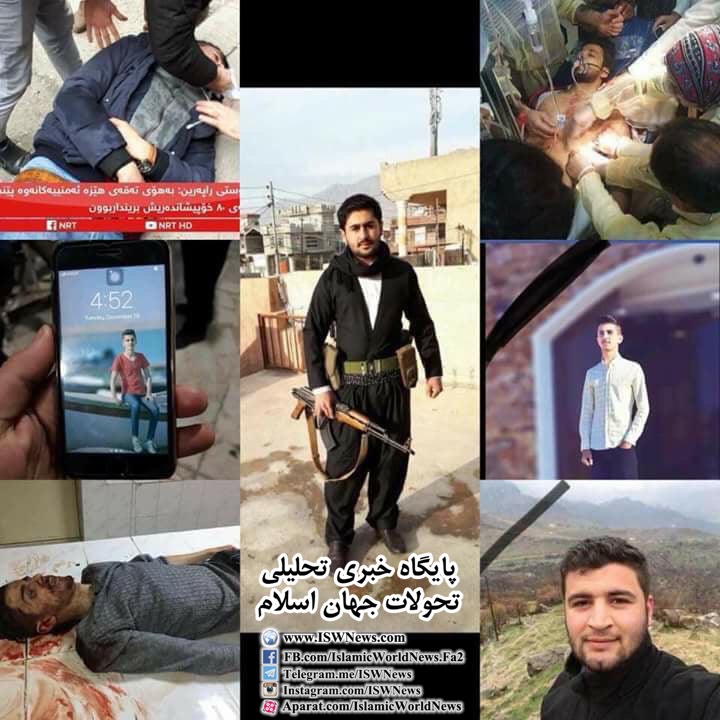
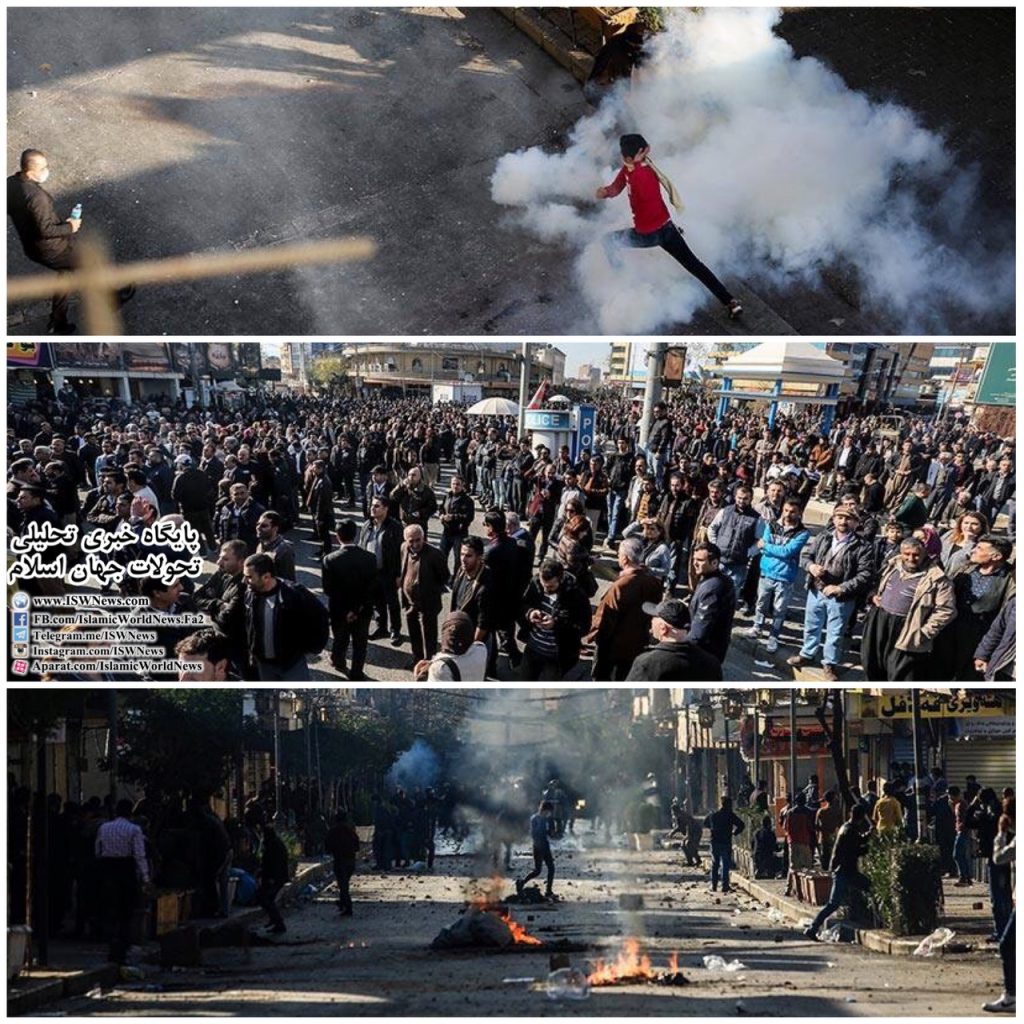
    In latest news from Kurdistan Iqlim (region), seven protesters are killed and more than 100 are injured due to fires of security forces.

    In some cities security forces are on alert and security condition is called which prevents commutes.


    NRT channel is stopped broadcasting by security forces.

    Shaswar Abdulwahid Qadir, leader of “New Generation” and owner of NRT and Hamdiya Ma’ruf Member of Parliament are arrested by these forces with the allegation of supporting protest.

    These two protested the Kurdistan independence referendum which was held on 29 September 2017 by leading a “Vote No” campaign.

  • Patience of people in Iraqi Kurdistan is over.

    Patience of people in Iraqi Kurdistan is over.

    The pressure of financial depression and delay in employment salary payments (It is almost 3 years that local government reduced the salaries by 30%) and lack of distribution of oil in winter and electricity make some people to come out and demonstrate widely.


    Yesterday, teachers in Sulaymaniyah governorate start demo in Sulaymaniyah, Kalar, Ranya Darbandikhan, Penjwin and other cities and other people join them.

    After a few hours, people start to use violation, which result in forces to use tear gas.


    In Penjwin, people attacked several Parties’ offices and set them on fire.


    Although this is not the first time, people in Sulaymaniyah governorate protest current living situation but due to high security level in Erbil and Dohuk governorates and threats of Barzani party that they will react severely and fire employees who take place in demos, could not gather and start any demo.


    Demonstrations are still going today and people were killed and injured by law enforcements.


  • How Barzani regime’s media ridiculed itself during the Kirkuk Crisis: the case of Rudaw and Kurdistan24

    How Barzani regime’s media ridiculed itself during the Kirkuk Crisis: the case of Rudaw and Kurdistan24

    The political circus received relatively wide coverage in the Western media, but many people find it easier to follow the English-language regional media whose teams of professional journalists reported from the field and published articles more frequently. Beside the well established news networks like the Qatar-based Al-Jazeera, the Saudi-owned Al-Arabiya and the Iranian Press TV, several new actors have emerged on various social media platforms, notably Rudaw and Kurdistan24. In this October, the first one has recorded more than 94,000 shares and 480,000 comments on Facebook posts, as well as over 20 million impressions on Twitter, reaching over 90 million people in total. Rudaw has over 3.2 million Facebook followers, compared to Kurdistan24 which has less than half.

    Media of tribal enterprise

    The ownership background and the differences between two networks are quite astonishing. In the authoritarian countries, the national media presents one-sided view, and in totalitarian systems, all outlets are owned by the ruling party. However, in the tribal enterprise of the Barzani clan, called Iraqi Kurdistan, they have gone even further. Rudaw and Kurdistan24 therefore do not only present a single view and propagate policies that support the Kurdistan Democratic Party (KDP), but they’re also owned by the same family. Rudaw was established in 2008 for the purpose of serving interests of current Kurdish prime minister Nechirvan Barzani, and competitive Kurdistan24 (K24) was launched in 2015 by his cousin Masrour Barzani, a son of president Masoud Barzani. That’s the concept of, as Kurdophiles like to say, a Western-minded flourishing democracy and its free press.

    In the mid 2000s, there was a brief period of the independent media in local languages, emerged in political chaos rather than a pluralistic environment. Information monopoly of ruling party was temporary staggered, so regional authorities quickly moved to stifle it. The first step of undermining was establishing a number of allegedly independent outlets, but de facto subservient to the regime. The second step was the severe repression of individuals and organizations. In 2008, journalist Soran Mama Hama was killed by unknown armed men, and later the same fate befell Sardasht Osman and Kawa Garmeyani. All were writing critically on the political situation and corruption in Iraqi Kurdistan. Numerous other independent reporters received death threats for reporting on corruption and discrimination. In 2011, a free satellite TV-station NRT was established, but was set on fire by armed men only three days after its official launch.

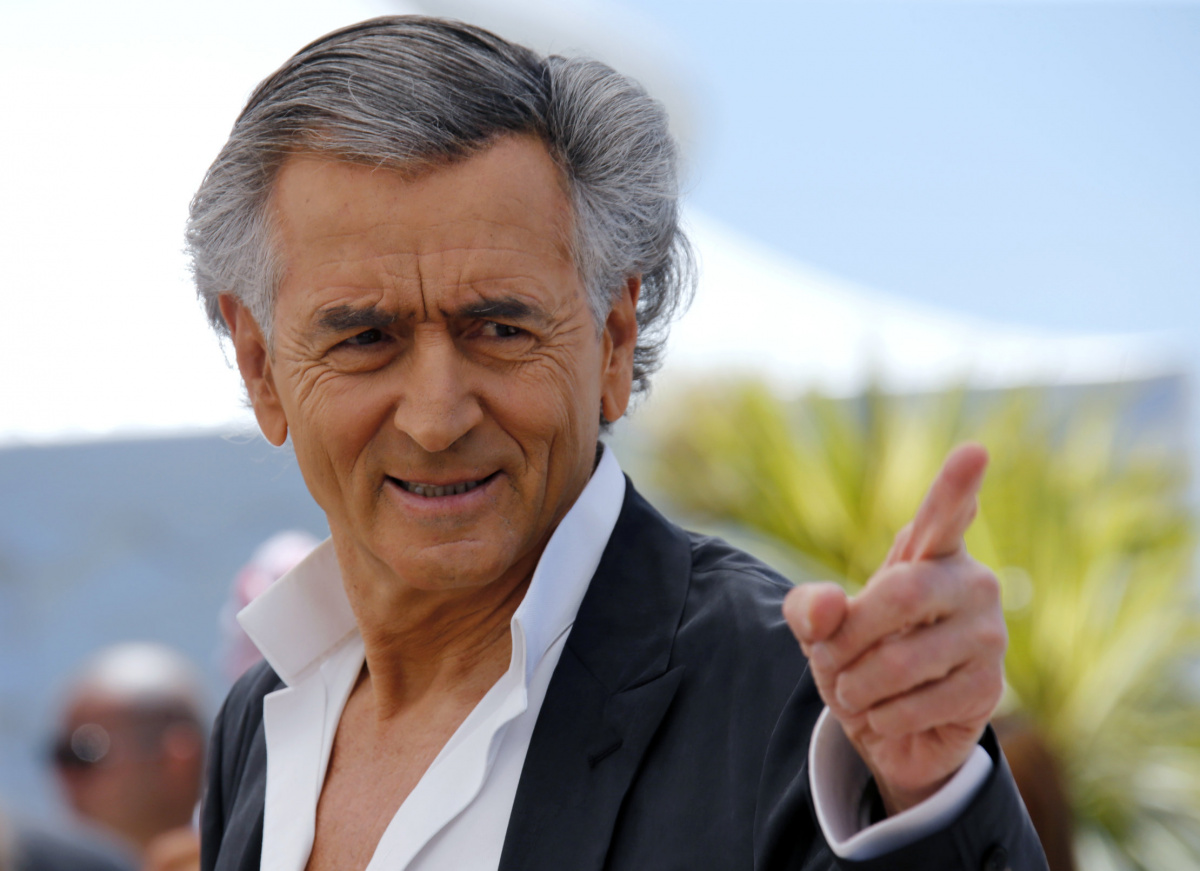
    Both Rudaw and Kurdistan24 do not enjoy popularity among neighboring countries and their Kurdish groups. Rudaw has been banned in PYD-led Syrian Kurdistan for conducing a ‘smear campaign’ against them, while the Turkey’s Kurdistan Communities Union also called for the boycott and accused the media group as being founded by Turkish Intelligence Organization. Turkey itself has removed both Rudaw and Kurdistan24 from its TurkSat satellite, due to broadcasting violations during the independence referendum. Both channels are also banned in Iran, and even Baghdad issued statements threatening to revoke their television license in Iraq. Neither the US Department of State has any words of praise for Rudaw, describing it as the KDP affiliated outlet rather than objective media. On the other hand, among very few of their foreign admirers is Bernard-Henri Levy who recently spoke against proposed Baghdad’s ban and stated that “every friend of freedom in the world should support Rudaw.” His objectivity is already well known, as we’re speaking about the same person who called Israeli forces as “the most democratic army in the world.”

    Referendum coverage

    By analyzing coverage during the thirty days following the referendum, it’s easy to conclude that Rudaw’s and Kurdistan24’s strategic and tactical approach was almost identical. The personal rivalries between Nechirvan and Masrour were set aside, as well as various economic issues. There was not a single word about disputed oil exports (illegal over-exploitation against constitution and an OPEC agreement), the KRG’s major customers (Italy and Israel), a few months’ delay in payment of salaries, or the region’s debt which may be upwards of $20 billion. For a region with population comparable to that of Croatia, oil reserves/exports larger than those of Libya, that’s truly an amazing achievement. Still, they happily pointed out and exaggerated Iraqi debts, and all their financial hardships were attributed to Baghdad. Duo published over a thousand articles during a month, subordinating everything to the positive outcome of the referendum and desperately desired international recognition.

    Their position regarding the referendum choices can be hardly described as a black-and-white dichotomy, since “no” vote option was not even considered possible. According to their reports, stances among participants could be divided only into “yes” and “not yet” categories. When it comes to specific political actors, the contrast between good and bad was more clear. On one side there’s the light forces, “One Leader, One Party, One Choice, One Country,” and on other side there are the dark forces of the inconvenient Gorran Movement, the traitorous Patriotic Union of Kurdistan (PUK), oppressive Baghdad and the regional bullies Turkey and Iran. In the hundreds of articles, there is not a single statement against separatism, either from an average citizen or some high-ranking politician. Counter-views obviously weren’t worth even of disproportionate treatment.

    Opposing arguments given by numerous international leaders were also ignored, and the Kurdish media instead rushed to find and present any publicly available support. The results are invaluable, as they gave us a clear picture of the nature of their apologists. Those ‘freedom lovers,’ in alphabetical order, include Ralph Abraham, Stephane Bergeron, Marsha Blackburn, Richard Blumenthal, John Bolton, Ted Cruz, Trent Franks, Peter Galbraith, Mike Gallagher, Jay Garner, Newt Gingrich, Franklin Graham, Lindsey Graham, Glenn Grothman, Fuad Hussein, Jim Inhofe, Jack Keane, Zalmay Khalilzad, Bernard Kouchner, Bernard-Henri Levy, John McCain, Benjamin Netanyahu, Jared Polis, Vesna Pusić, Marco Rubio, Chuck Schumer, and the Wilson Center. Beside a few energy lobbyists and conspiracy theorists, virtually all of them are Zionist extremists and the neoconservative warmongers. Thus, the alleged Iranian-Turkish ‘accusation’ or a ‘conspiracy theory’ of Zionist role in the referendum, turned out to be a verified fact.

    From heroes to victims

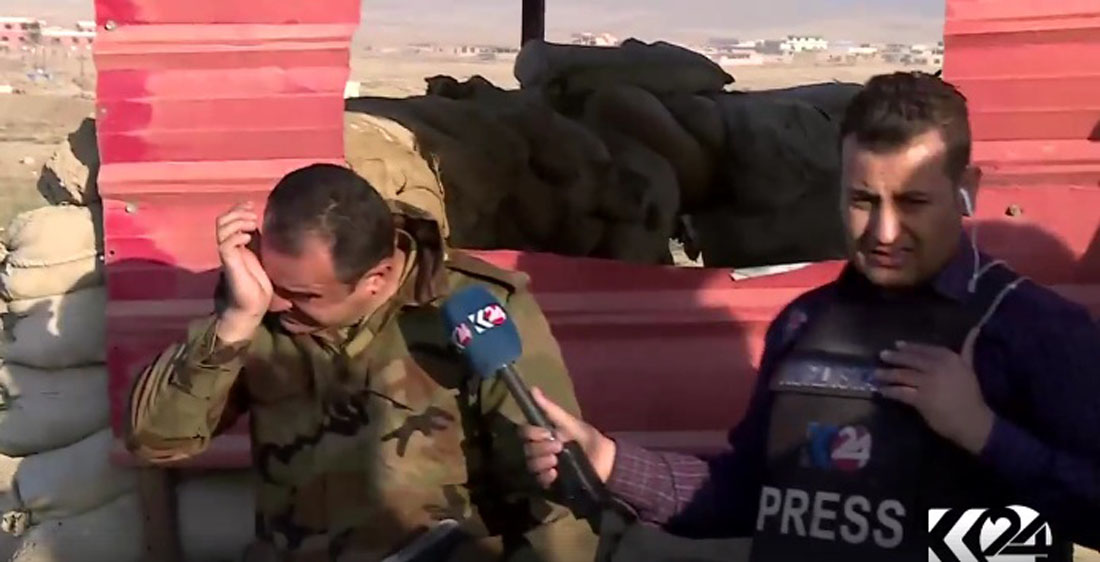
    Rudaw’s and Kurdistan24’s coverage has reached peak absurdity during the Kirkuk Crisis, when they clumsily balanced between the narratives of heroism and victimhood. Four days prior to the start of military operation, they reported that region’s Security Council is expecting a ‘major attack’ by the Iraqi Security Forces and Popular Mobilization Forces (Hashd Al-Shaabi), and in the following days numerous reports about Kurdish heroism appeared. President Barzani told to Baghdad that referendum won’t be annulled at any price, Peshmerga also rejected all Iraqi warnings and stood prepared to face them, the Kurdish authorities were allegedly united, and thousands of volunteers took up arms. They even published bizarre videos of children and old ladies carrying rifles, claiming “they would rather die than allow occupation.” According to such reports, a decisive battle was supposed to happen, the cataclysmic conflict between the forces of good and evil, between Peshmerga as the finest soldiers ever and the cowardly Iraqi army, with Glorious Leader declaring ‘not a step back’ order, and courageous civilian support. A new Stalingrad battle.

    The reality proved to be quite different. On 15 October 2017, the Iraqi military started a major operation and restored full control of Kirkuk City in just about 15 hours, with very little violence since Kurds mostly retreated without fighting. This fact passed unreported as both Rudaw and Kurdistan24 continued to report about minor skirmishes between smaller groups of disobedient soldiers, and phrase ‘fall of Kirkuk’ appeared only three days later. In the meanwhile, the desperate need for heroic scenes resulted in flooding their websites and social media by fake pictures and stories, intentionally posted to increase hatred and escalate tensions. They presented Saudi army vehicles burned in Yemen as ‘Iraqi’ equipment, killed Daesh terrorists in Fallujah as ‘Shia militia’ in Kurdistan, a controlled demolition of the bridge in Kansas as the ‘Peshmerga’s scorched-earth policy’ in Altun Kupri, etc. One rumor said that Abu Azrael, a famous Shia figher against Daesh, had been killed in fighting in northern Iraq, but the lie was refuted by himself who posted a YouTube video to show he was still alive and well. They also published unconfirmed and highly dubious data of ‘180 killed’ Iraqis, ‘400 killed’ Kurdish civilians and ‘200 missing’ in Kirkuk.

    A sudden shift in the reporting strategy has rigorously transformed the Peshmerga soldiers and the Kurdish people. On Sunday night, they were ‘fearless warriors’ who never retreat, but it was already Monday morning when they became ‘betrayed and abandoned,’ blubbering incoherently for help. The bitter confession about real outcome required shame and humility, denial that true heroes never fail, and for Rudaw and Kurdistan24 that was out of the question. Instead, they found the main reason for failure in a ‘treacherous elements’ within the rival PUK party, claiming their leaders ordered a retreat, while the second reason was role of merciless foreign powers, notably Iran. During the first day of operation, Kurdistan24 showed several videos of weeping Peshmerga members who allegedly wanted to fight, but commanders ordered to pull back. The Kurdish narrative of victimhood became fashionable once again. First they managed to convince own population that there’s a total war going on, and after many fled from Kirkuk, they showed crowded roads and claimed people are escaping due to persecution.

    Non-combatant Kurdish citizens also reportedly suffered ‘tremendous crimes,’ as the Kurdish language was barred from the Iraqi organized press conference in Kirkuk, and someone even put Iranian Khamenei’s photos inside governorate building. Such ‘horrors’ might remind us of Saddam’s al-Anfal campaign and the times when tens of thousands of the Kurds when gassed. It was Iran who helped Peshmerga and gave refugee to over 1.5 million Kurds, and it was the United States who supported Saddam’s regime and continued to aid it after receiving reports of chemical attacks. Still, in the perspective of Barzani ruling thugs, Iran is a major enemy, and the US should intervene in the KRG favor. Beside equalizing Iraqi prime minister Haider al-Abadi to Saddam, the Kurdish media also tried to present Iraqi Shia militias as no different than Daesh. A recently published video by Rudaw shows women with totally covered faces and smiling boys, claiming they have witnessed a beheading of a 12-year-old son and house burning. The footage shows no dead bodies, no destroyed houses, only empty stories. Perhaps Kurdish soldiers are not the bravest in the World, but Kurdish journalists definitely are. Not because they are not afraid of anything, but because they are not ashamed of anything.


    Source
  • A look of the Kurdistan Democratic Party media game on making tensions between Kurds, Hashd al-Shabi and the Iranian Revolutionary Guards

    A look of the Kurdistan Democratic Party media game on making tensions between Kurds, Hashd al-Shabi and the Iranian Revolutionary Guards

    In recent days, KDP affiliated media have claimed in widespread and false propaganda that the Iranian Revolutionary Guard and general Soleimani have a major role in making the Iraqi government and Hashd al-Shabi(PMU) attack Kirkuk. While the intensive meetings and ongoing consultations of general Soleimani and other Iranian representatives with the authorities of all parties of regional Kurdistan government indicate that the policy and objectives of Iran and the Revolutionary Guards have been avoiding conflicts and bloodshed between the two sides.

    There were concerns that civilian lives in Kirkuk could be threatened by getting into conflicts and the situation worse, but this did not happen with the rational and logical management of the Iraqi government, the army and the Hashd al-shabi and the elders of Iraq and, of course Kurds, including the authorities of the Patriotic Union party(PUK).

    The killing of Kurdish people in Iraq could have been a good option for gaining legitimacy for unlawful referendum for separation of Kurdistan.

    The Democratic-affiliated media deliberately by mentioning Hashd al-shabi and Revolutionary Guards as the main parts of the operation of Kirkuk is trying to divide and break the unity in Iraq and they highly counted on the support of the Western countries but the responses of western governments to the events of today indicate that they did not achieved their goal.

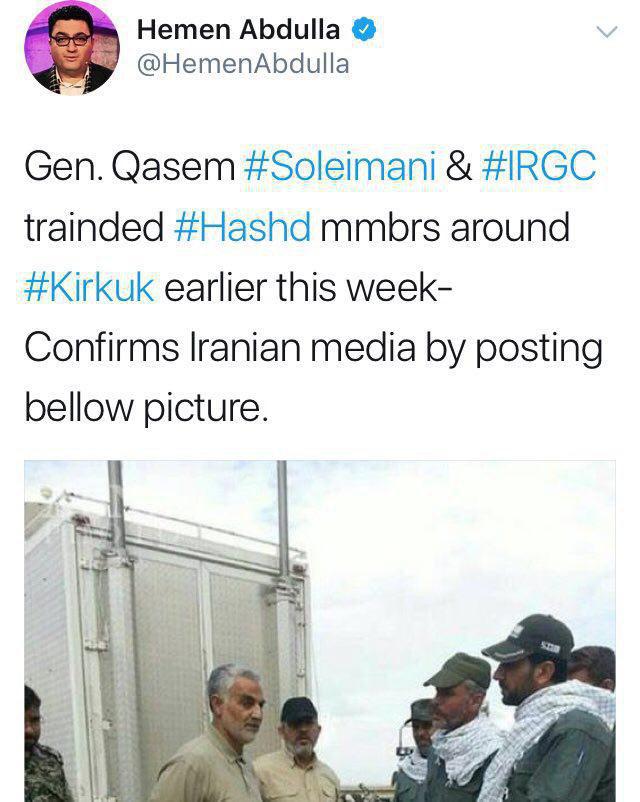
    A sample of these efforts was the tweet of Hemen Abdulla, the well-known correspondent of the Rodaw Network, who that by referring to Iranian anonymous media, showed the old image of general Soleimani’s presence in operation against ISIS in Iraq as his presence around Kirkuk for commanding the military attack on the regional Kurdistan government.

    In addition, the amateur and fake films that were produced and published as they have been called the shooting of the Hashd al-Shabi forces against the people of Kirkuk and similar titles like that had nothing but invalidity for these media.

  • Summary: Operation of the Federal Government of Iraq in disputed areas with the Iraqi Kurdistan Region

    Summary: Operation of the Federal Government of Iraq in disputed areas with the Iraqi Kurdistan Region

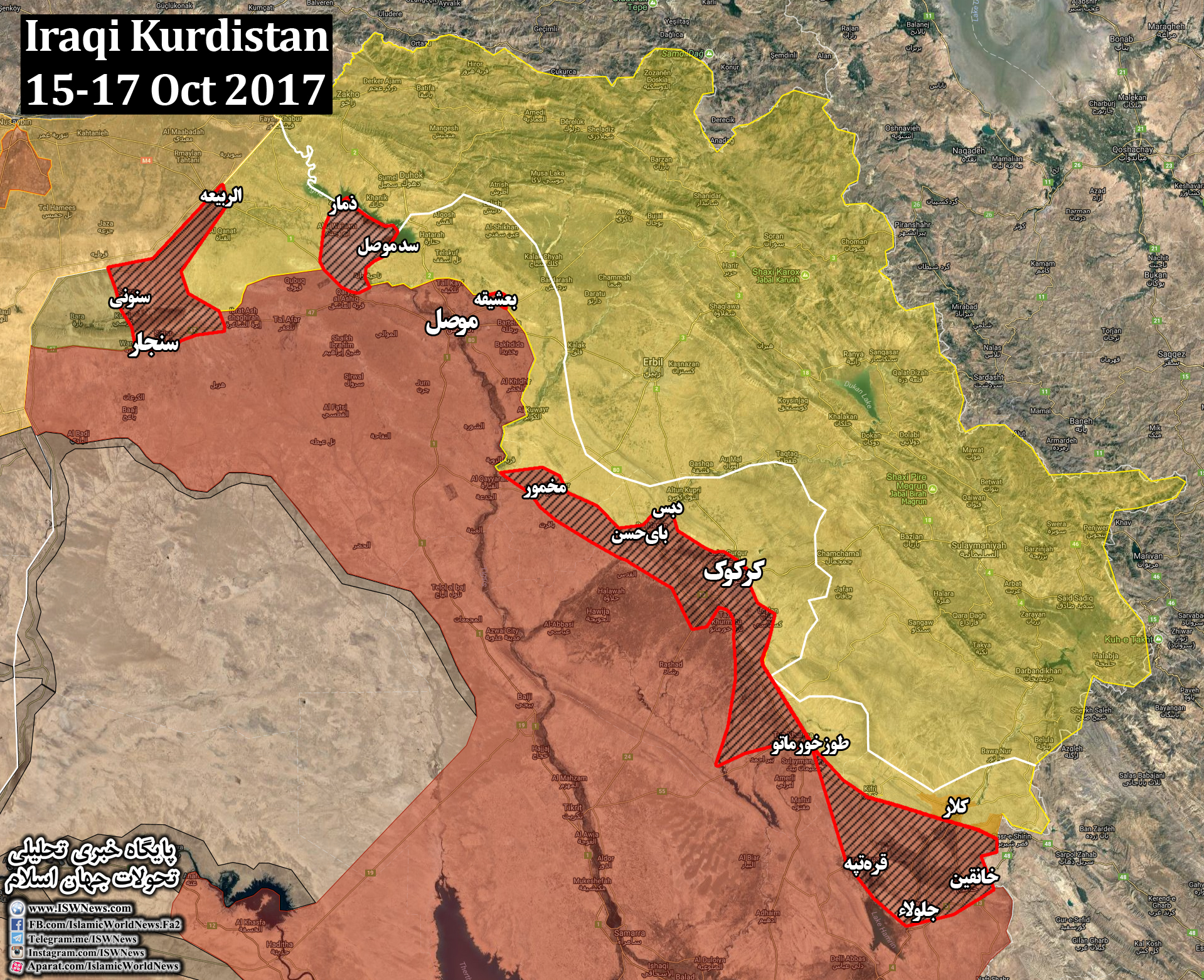
    In the first stage, anti-terrorism forces succeeded in entering and dominating in the general area of ​​the city of Kirkuk following the dispersal conflicts with the Peshmerga and PKK forces. On the same day, other federal police forces managed to dominate the North Oil Refinery.

    The results of the first day are these : the domination of the central government on the city of Kirkuk as well as the oil wells and oil facilities of the region.

    On the second day of the operation, the withdrawal of various forces from various Kurdish parties was obvious. The forces succeeded in domination over the various regions on five axes.

    First axis: Diyala province

    In this axis, the forces managed to dominate the cities of Jalola, Khanaqin and Qarat-Tepa. The Khosrawi border crossing was also controlled by Iraqi central government forces.

    Second axis: Kirkuk province

    In this axis, the forces managed to advance towards the important village of Bai Hassan and Debs. The importance of this village is located on the shore of the Zab River, as well as facilities and oil wells around the area.

    Third axis: Nineveh province, Mosul area

    In this axis, the forces succeeded in dominating the city of Ba`shiqah. The news of the troops’ arrival to Tel Oskof and Betnai is not confirmed.

    Fourth axis: Nineveh Province, Sinjar area

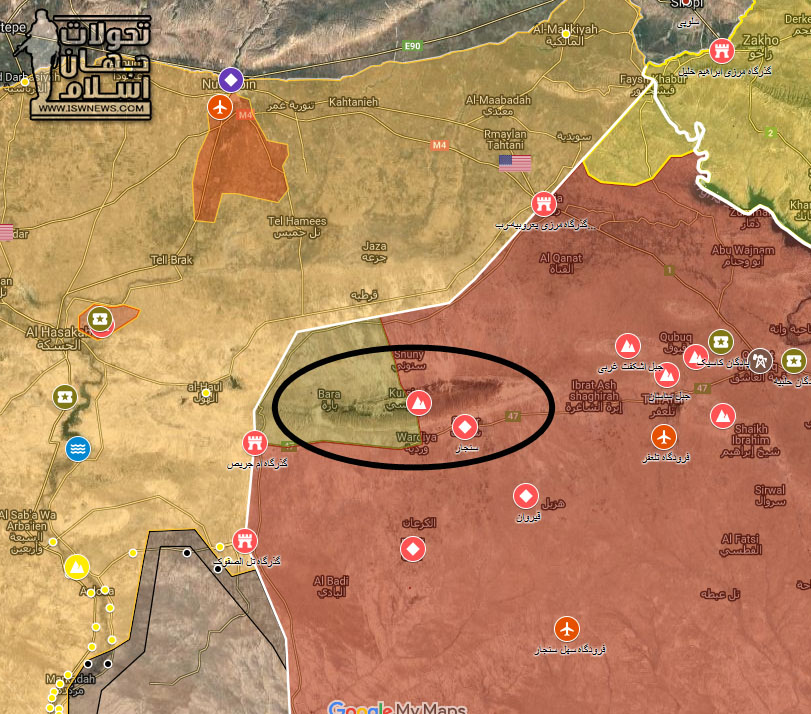
    In this axis, due to the large presence of PKK forces, the forces succeeded in dominating the city of Sinjar and part of its northern mountains, in order to control the important village of Senoni and the central al-Rabi`ah borderway . In this axis, the cooperation between the Izadi(Yazidi) forces and the central government of Iraq was very close and friendly.

    Fifth axis: Ninewa province, Mosul dam area

    In this axis, the Iraqi Army’s 16th Army Corps managed to control the Mosul Dam, the strategic city of Dhamar and  Aski village.

    Now with the withdrawal of various Kurdish forces has spread across the south of Diyala to the north of Sinjar, it must be seen that the forces under the Barzani control(KDP), will accuse PUK(Patriotic Union of Kurdistan) as a traitors! Or just the withdrawal of PUK forces was betrayal,and the retreat of the KDP forces was their tactics to prevent conflict and bloodshed!?


    HD MAP

  • Three main reasons which bind all kurds to Iran

    Three main reasons which bind all kurds to Iran

    An important point in the history of the Kurdish struggles is the remarkable difference between the Kurdish riots in Iran compared to the riots in Turkey and Iraq. The Iraqi Kurds had bloody clashes with the Iraq(central government) for a long time. in Anfal operation , which was launched by the Saddam Hussein against the Kurds.especially in 1988 that 180 thousands Kurds lost their lives.

    The war between the PKK and the Turkish government, which has been taking place in the country since 1984, caused nearly 50 thousand dead.

    But the war between the Iranian government and Kurdish armed groups is far less extensive. This is the result of the less friction(struggle) of the Kurdish society with the government compared to the Kurds of Iraq, Turkey and Syria, which makes the Kurdish insurgent groups unable to attract people’s support like the insurgents in three other countries did. This issue has so many reasons that most notable reasons are these:

    1. Differences in the national identity in Iran with other countries with Kurdish population.

    National identity in Iraq and Turkey is defined by ethnicity. Turkey has based its national identity on Turkism, and Turkey’s name comes from the Turkish word. According to the Turkish Constitution, all citizens of this country are considered to be Turkish. Turkey gave the Kurds the title of “Turk of Mountain” and by 1991, the use of words such as Kurdistan and Kurd in this country was prohibited even in personal life.

    In Iraq, the Ba’ath Party was an Arab nationalist party, which established the country’s identity on Arabs.

    In Syria, the same is true about the Arab Ba’ath Party, and its official name is the Syrian Arab Republic. On the contrary, Iran has not defined its identity on ethnicity.

    In Iran, different ethnic groups have lived together for a long time and have formed kind of historical identity, while Turkey, Iraq, and Syria all founded after the First World War and after the fall of Ottoman caliphate, especially Syria and Iraq have a short historical identity as new founded countries . In addition, from the time of Safavids, Iranian identity has been defined based on the religion of Islam and Shiite religion, not ethnicity. That is why in Iran, the Shiite Kurds have not shown any ethnocentric tendencies, and almost all Kurdish ethnic struggles have occurred in the Sunni areas. However, it should be noted that the root of the ethnocentric struggles of the Sunni does not return to the differences between the two Shiite and Sunni religions. Basically, in the regions with Sunni population in Kurdistan, political Sunni Islam has little power(influence), and the vast majority of Kurdish armed groups follow a leftist(left wing)or nationalist ideology. The cause of the emergence of ethnic identity in the Sunni Kurdistan of Iran is that the people of these areas are not part of Shiite religion, which is one of the most important elements of the unity of the majority of the people of Iran. Of course, this does not mean ignoring other unifying elements of Islam, the Iranian historical identity, and linguistic and ethnic similarities. As we have seen and will see, these factors have made the Kurdish ethnic conflict less in Iran than the neighboring countries.

    2-The close relation of ethnic and racial identities of the Kurds to the rest of Iranians

    The race of Kurds are among the Aryan tribes. Kurdish is also one of the branches of Persian language in linguistic divisions and is similar to Persian language and local languages ​​in Iran. Like other Iranians, the Kurds celebrate Nowruz and also Kurds & Iranians have many common culture and myths .But there are no similarities between Kurdish language, culture, and myths with the language, culture and myths of Arabs and Turks.

    In Turkey and Syria, Nowruz was a political event and a sign of Kurdish ethnic identity. Because of that, for a long time, severe restrictions were imposed by the governments of these countries on this celebration, and in some cases, Kurds were killed by the security forces. But Nowruz throughout Iran is a national celebration that various ethnic groups of Iran celebrate along with the government. Because of these reasons, the sense of belonging to the Iranian identity among Kurds is far more than their solidarity with Turkish and Arab identities.

    3-The Cultural and Political Approach of the Iranian Government towards the Kurds

    Iran has chosen a more liberal cultural and political approach to its ethnic groups, including the Kurds. Unlike Turkey, the use of Kurdish or the use of words had not been forbidden in Kurdistan in Iran. Kurdish language has long been used in local media, and in recent years, the teaching of ethnic languages ​​in schools has also been provided. Also, the Shiite Kurdish politicians did not have any obstacle to reach the highest political and administrative positions. Such conditions have not existed for a long time in Syria, Turkey and Iraq, or still does not exist. Before the Syrian civil war, the government refused even to issue birth certificate for Kurd residents and to recognize their citizenship. There were also obvious discrimination against Kurdish citizens in Turkey and Iraq.

    Although some of the dissatisfaction and independency tendencies in the Sunni regions of Kurdistan of Iran can not be denied, these reasons, plus the political and security problems, except in the first two decades of the revolution, and especially in the early years, the activities of the Kurdish rebel groups were mainly limited scattered attacks on the border areas from inside of the Iraqi Kurdistan and these attacks were stopped at some points.

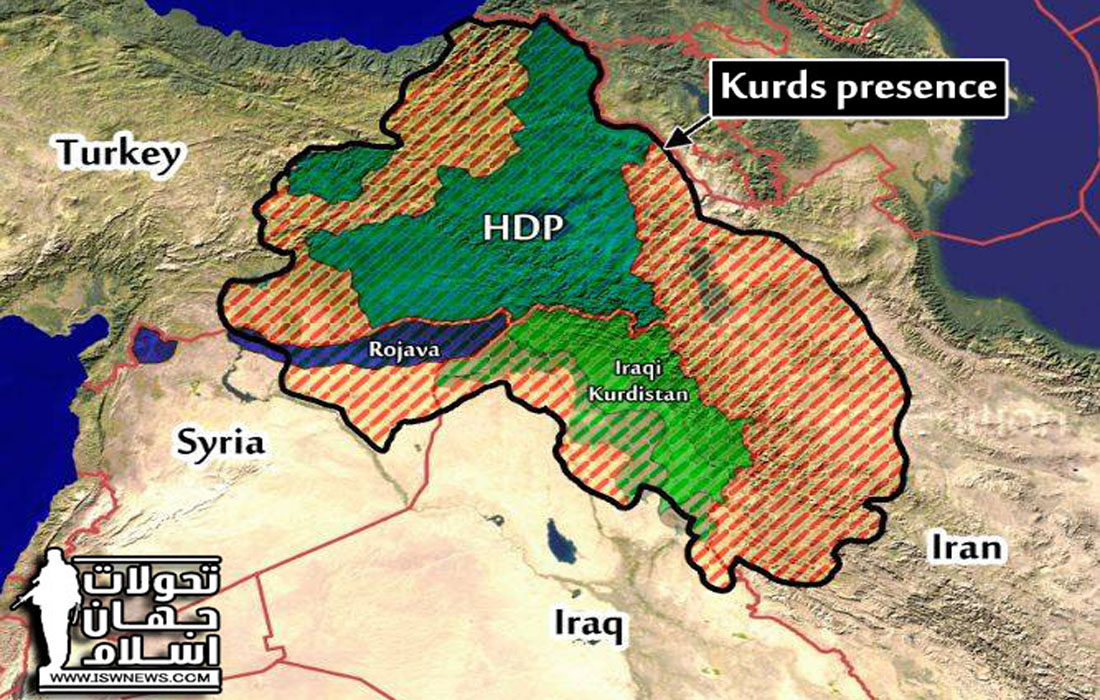
    PS: This map does not represent correct & exact boundaries, and it’s just the hypothetical range of Kurdish presence in region

  • Bernard Levy, a mysterious man who was hid in chaos of Iraqi Kurdistan referendum

    Bernard Levy, a mysterious man who was hid in chaos of Iraqi Kurdistan referendum

    Many analysts call him one of the main theoreticians of the “Arab Spring” in the region, and now his presence in Iraq and under such circumstances can not be for no reason!

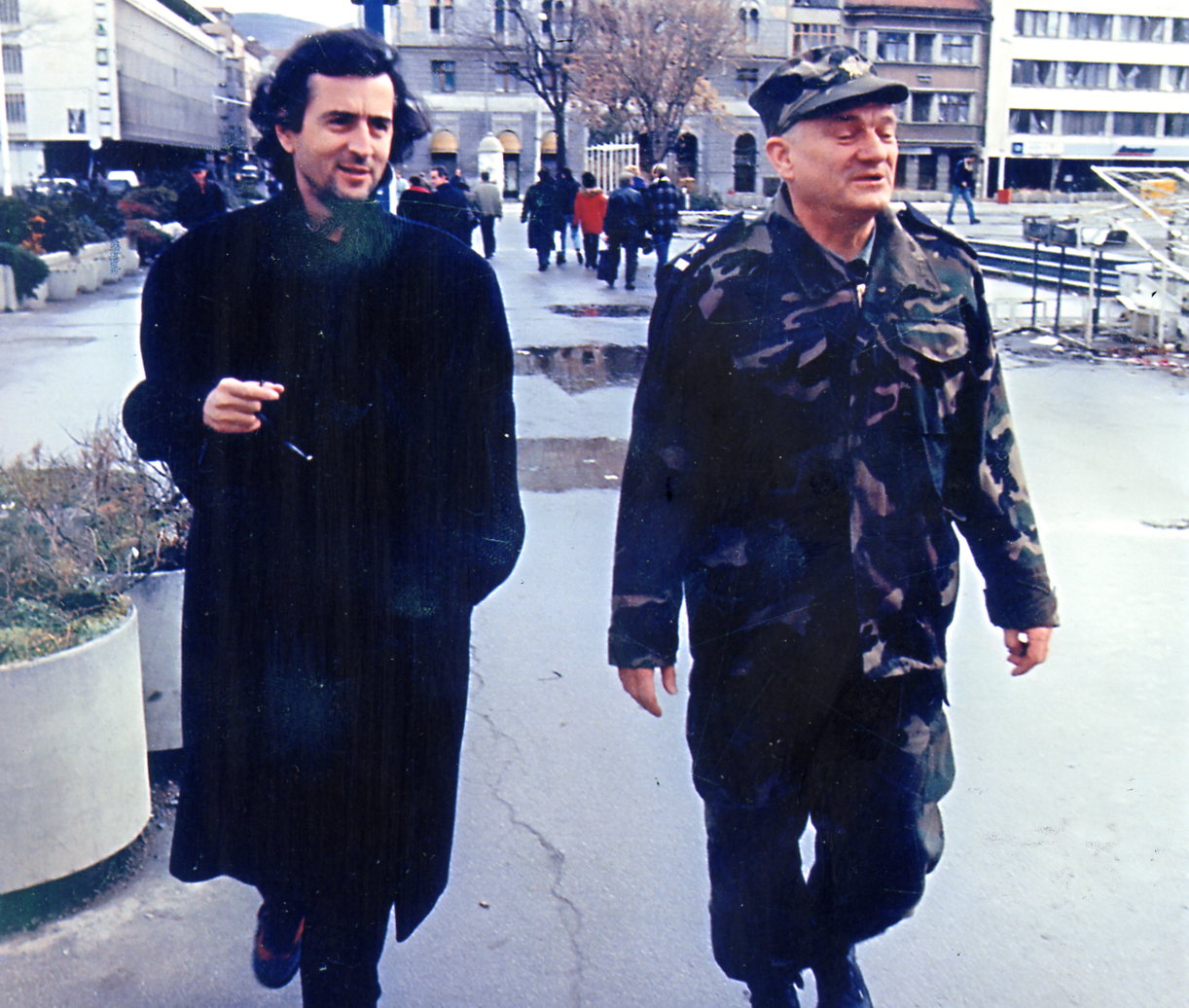
    Looking at the depths of the sensitive events of the region, you can clearly see the presence of Bernard, from Afghanistan to Sudan, from Egypt to Tunisia and Libya, from Bosnia to Ukraine, and … He is everywhere! in the anti-Muammar Gaddafi rebel room, along with Ahmad Shah Massoud, along with the leader of the South Sudan rebels, … And in his last major presence in the region in the Kurdish region of Iraq on the day of the referendum and meeting with the Barzani family.

    Bernard-Henri Lévy with Massoud Barzani, the Day After the Kurdistan Referendum

    Bernard-Henry Levy introduces himself as a proud Jew. Apart from more than forty years of intellectual and practical work in numerous books and numerous articles in the press with a variety of topics, his work record can be divided into three categories:

    1- Complete opposition to the political and legal manifestations of Islam

    Levy, who was named the forty-fifth most influential Jewish figure in the 2010 Israeli Jerusalem Post, and his followers believed he is the greatest current think-thanker of France

    In one of his latest books, “Left in Dark Times: A Stand Against the New Barbarism” has shown how he thinks of Islamism.

    Critics of the book believe that in this book, he has equated terrorism, Islamism, and Arab mentality to justifying the persistence of colonialist violence in the Middle East.

    In other words, Levy has tried to summarize the resistance of people in the colonized countries as a violence, and  make it irrational and justify its suppression

    Levi, who introduce the veil of Muslim women as a means of desegregation them, introduced their ideal Islam the kind of Islam that is in Kurdish region of Iraq.

    2- Unconditional support for the Israeli regime

    In 1967, when Bernard Henry Levy was 19, when he informed of the war between the Arabs and Israel, quickly went to the embassy in Paris to declare readiness to go to war, but the six-day war lasted less than that Levy couldn’t take the opportunity to go to the occupied territories.

    43 years later, Levy said that he “does not recognize any army more democratic than the Israeli army,” which showed that he still has an indefinite commitment to this regime, which is also apparent from the many images of his meeting with the senior officials of the regime.

    Meeting with Shimon Peres

    3- Constant presence in the bloody chaos of the Islamic world

    Levy wrote his first known book in 1973 two years after the break-up of Pakistan into two parts of Pakistan and Bangladesh about nationalism in Bangladesh and from that day on, not only commented and acted on the riots of the Islamic world but also he has been present in them.

    In the middle of the last decade of the twentieth century, Levy was present in Bosnia, then headed for Afghanistan, and met with Abdul Rashid Dostum and Ahmad Shah Massoud.

    He was present in southern Sudan in the era of separatism;

    In 2008, in Russian-Georgian conflict he supported the west-backed side in Georgia;

    in 2011 with rising conflicts in arab countries he participated in libyan war and convinced his old friend nicola sarkozy to military interfere in Libya; in the same years, he tried many times to justify military intervention in Syria and to overthrow the government of Syria;

    In 2014 and 2015 he pursued the goals of the Russian opposition in Ukraine;

    and his year he started filming to justify her favorite map, “breakdown of countries in region into smaller countries”

    Along with the South Sudanese rebels
    Meeting with South Sudanese rebel leader John Garang
    Meeting with Ahmad Shah Massoud
    In Bosnia
    Bernard Levy In Bamyan, Afghanistan
  • 13 Arab and 7 Turkmen Party of Kirkuk boycotted the referendum in Kirkuk due to the illegality

    13 Arab and 7 Turkmen Party of Kirkuk boycotted the referendum in Kirkuk due to the illegality

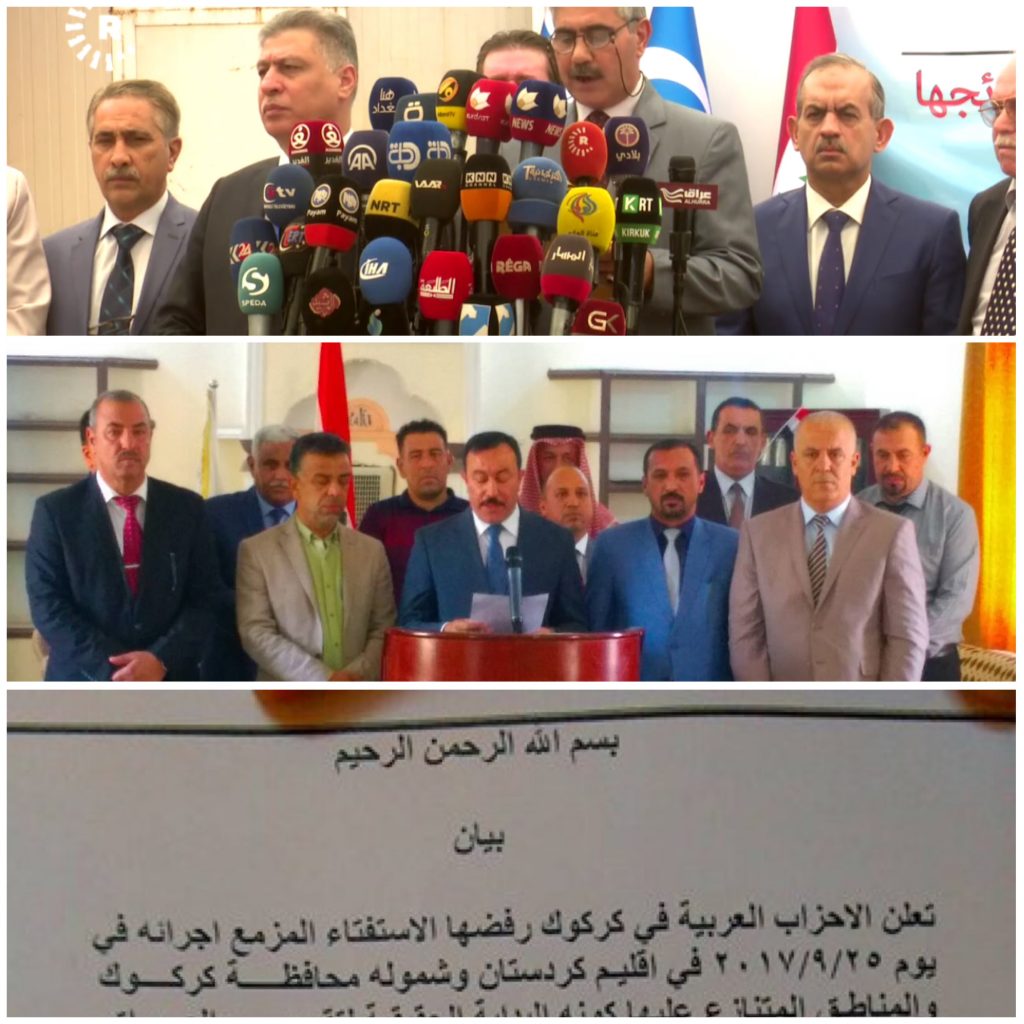
    In the statement that published by the Turkmen parties and the Kirkuk Arab parties on Saturday it has been mentioned that approving the referendum by the Kirkuk Provincial Council in the absence of the Turkmen and Arab parties of this province on 29/8/2017 is illegal and it is on the contrary to the constitution of Iraq.

    Meanwhile, Mas`oud Barzani has been conducting interviews with television agencies in recent days and interviewed with agencies such as Al Arabiyah, BBC Persian and several other agencies. The words used mostly by Barzani in these interviews was, “Kurdish readiness to use the weapons to hold Kirkuk,” “we want Kirkuk to be the symbol of ethnic and religious coexistence,” and perhaps it is most importantly, “the condition for postponing the referendum” .
    – “Kurdish readiness to use the weapons to hold Kirkuk,”
    These​ conditions and differences between parties and ethnic groups in Kirkuk, and since Kirkuk is now officially affiliated with and part of the central government of the country.
    With Barzani’s threat that they will use weapons to keep Kirkuk and his stubbornness the city will not have appropriate status after this referendum…

    – “We want the kirkuk to be the symbol of ethnic and religious coexistence.”
    The Kirkuk Provincial Council is composed of 41 seats, without the participation of Turkmens and the majority of Arabs on 29/8/2017, the Kurds of this association with 26 seats, were able to vote in a referendum in Kirkuk,  It is also one of the signs of the lack of coexistence and the abuse of being the majority in this province.

    – “The condition for postponing the referendum”
    While Barzani faced with a lack of international support (other than the Israeli, Saudi and Emirati regimes), and faced with the opposition of the central government of Iraq, Turkey, Iran, the United States and other European countries as they say this referendum should not be hold or should be postponed.
    Several times he has asked for a guarantee to postpone referendum to another time on another date, in reply to a journalist asked “how may you accept to postpone the referendum” he said that to approve of not holding a referendum setting another date in the Iraqi parliament can be one of these guarantees.
    *While the referendum has no legitimacy so far, it can be one of the same excuses that many believe is to gain interests like the previous years from the central government.


    Barzani’s-led party, by using Eqlim’s(Iraqi Kurdistan) parliament as a weapon more than two years ago, prevented  from adopting several laws to adjust Eqlim’s department and prevented the entry of the parliament’s chairman from the Guran (change) party into the city of Erbil and the Parliament building and In practice, the doors of this parliament remains closed until today And the government that holds the presidency and its key ministries, manages the parliament without supervision.

    But this time Barzani, in order to legitimize his referendum, is now trying to activate the same parliament that he has shut down, but on one condition that the presidential of the Eqlim should not be voted, which has been opposed by several other parties.

    The latest news is that Barzani intends to use the method used to approve the referendum in Kirkuk, and through the Eqlim’s parliament and by gathering a majority of the members, despite the absence of the chairman and vice president of Parliament, legitimize this referendum.