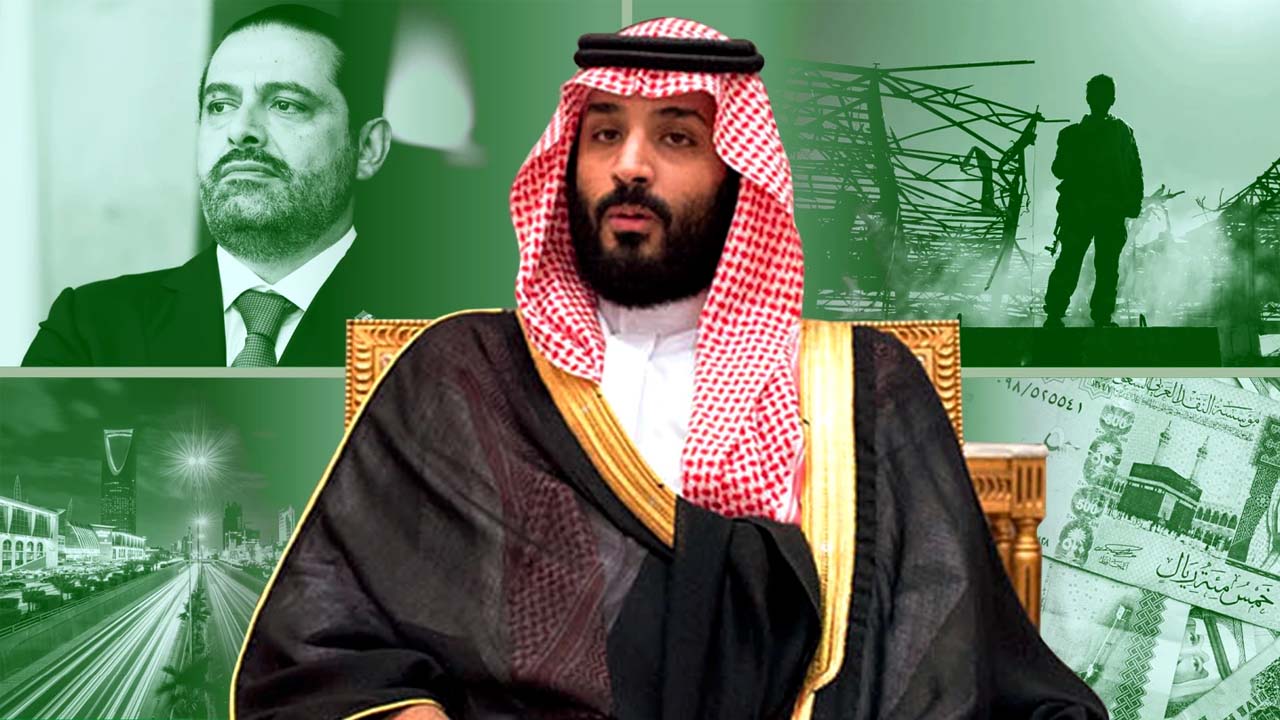
As Hariri is a Saudi-US asset, the ‘forced’ resignation seems more like the sacking of a company executive who has not lived up to expectations. Told to step out of office Hariri did what he was told, following through by issuing a Saudi-scripted statement accusing Hezbollah and Iran of sowing discord across the region, and talking of a plot to assassinate him.
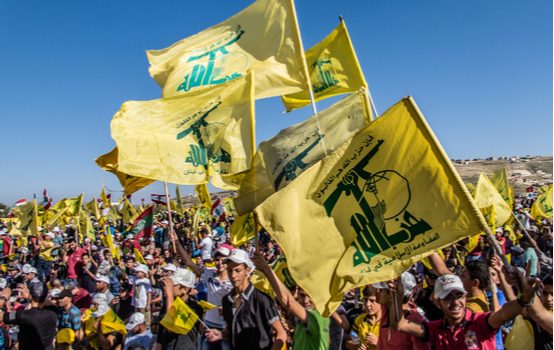
In fact, it was Saudi Arabia sowing discord, by blaming Hezbollah and Iran for Hariri’s resignation, with the apparent aim of throwing Lebanon into chaos. Predictably, Netanyahu jumped in immediately, saying the resignation was a call to the ‘international community’ to take action against Iranian aggression but no-one else bought it, not even Lebanon’s Sunni Muslims. Hezbollah reacted calmly and if anyone came out of it badly it was Saudi Arabia. In the Iranian view the removal of Hariri was a plot cooked up by Trump and Crown Prince Muhammad bin Salman.
Hariri himself did not return to Lebanon where he could have defied the Saudis and resumed his position but moved on to France, where he was welcomed by President Macron at the Elysee Palace. Soon after talking to Hariri, Macron was on the phone to Trump, discussing the Iranian ‘threat’ and how to deal with it. According to Lebanon’s President Michel Aoun, Hariri told him he would return to Beirut by Independence Day, November 22, marking the end of the French mandate. The Lebanese parties, including Hezbollah, still regard Hariri as the country’s Prime Minister so how all of this plays after Hariri’s return will be interesting to see.
What lies behind all this?
What is the connection between Hariri’s resignation (forced or otherwise) and the other events running concurrently in Saudi Arabia, namely the arrest of some of the most powerful figures in the kingdom and the confiscation of their assets, estimated at about $800 billion? One has to assume there is a connection. It seems far too much of a coincidence for there not to be one.
The claim that the purge of the princes was part of an anti-corruption drive is bunk, seeing that corruption is intrinsic to how the Saudi government operates, domestically and in its foreign policy. If corruption is a cover story, why were these princes removed? Could it be their opposition to Saudi Arabia’s policy failures, in Syria and Yemen, and their opposition to what is now clearly being moved from the drawing board to implementation, a war on Iran, involving the US, Israel and Saudi Arabia? They would hardly be alone in seeing Crown Prince Muhamad bin Salman as reckless, foolhardy and lethally dangerous to the stability of the Saudi kingdom: his accession to the throne they would regard, literally, as a crowning act of folly.
That another war is on the horizon is clear from all the signals coming out of Israel in the past six months. That not just the US but Saudi Arabia will be part of it is obvious. Intermittently, Israel and Saudi Arabia have been pushing for war on Iran for a decade. With the US refusing to bite, to the extent of launching an open military attack, Syria was chosen as the next best target: if the government in Damascus could be destroyed, the strategic alliance between Iran, Syria and Hezbollah would collapse at its central arch. This plan B was partly foiled by the refusal of the UN Security Council, thanks to the vetoes of Russia and China, to sanction an aerial war on Syria along the lines of the assault on Libya. Plan C had to come into effect, reliance on a war of attrition fought by takfiri proxies organised, financed and armed mainly by the US, Saudi Arabia, Qatar, Israel, Britain and France, and coordinated with the assistance of governments ranging from the Balkans to Central Asia. Seven years later Plan C has now ground to a halt. The ‘axis of reaction’ (the US, Israel and Saudi Arabia) has suffered a crushing defeat at the hands of the ‘axis of resistance’ (Iran, Syria and Hezbollah). Russian intervention has been critical, so the victory is Russia’s as well, and a particular humiliation for the US.
This does not end the list of defeats suffered by the ‘axis of reaction.’ Another severe blow has been suffered through the collapse of the Kurdish drive for independence in northern Iraq. Both the US and Israel have assiduously cultivated the Kurds for decades, seeing northern Iraq as a new strategic centre for military and intelligence operations across the Middle East. The US and British ‘no fly’ zone and ‘safe haven’ initiatives of 1990/91 were the first steps in the planned breakup of an Iraq that no longer suited imperial purposes. The invasion of 2003 and the imposition of a constitution dictated by the US, weakening the authority of the central government, led to Kurdish autonomy which, in time, would have been expected to end in independence and a new base for US/Israeli operations across the Middle East.
Even the US was against the referendum called by Masoud Barzani: seeing that it was already getting what it wanted, the referendum would be premature and cause more trouble than it was worth.
This proved to be the case. Turkey and Iran reacted viscerally, ending flights and closing border crossings: the Iraqi army retook Kirkuk and all the territory conquered by the Peshmerga in 2014. Barzani stepped down as president of the KRG: Jalal Talabani, the head of the Patriotic Union of Kurdistan (PUK), had died only recently, leaving the Kurds leaderless and at each other’s throats over who was responsible for this debacle. Iraq is now being reconstituted as a unitary state. The largely Shia Popular Mobilization Forces (PMF) has developed into a powerful annex to the regular army. Moreover, the government in Baghdad has a close working relationship with the government of the Islamic Republic in Tehran.
The paradox of these defeats is that they increase to a critical level the danger of a new attack by the ‘axis of reaction’ on the ‘axis of resistance.’ Russia, Iran, Syria and Hezbollah cannot be allowed to get away with these victories. The Israeli chief of staff, Gabi Eisenkot, hardly needed to say, as he did recently, that there is ‘complete agreement between us and the Kingdom of Saudi Arabia’ on the question of Iran’s spreading influence across the Middle East, or ‘control’ of the region as he put it. Unable to impose its will on one of the poorest countries in the world, Yemen, Saudi Arabia would be of little help on the front line in a war against dangerous targets such as Hezbollah and Iran. But it has money and according to Hasan Nasrallah, has offered to pay Israel billions of dollars for a new war on Hezbollah.
As Israel always has the next war on the drawing board, the central question is ‘when’ rather than ‘if’ it will be launched. In recent months it has held some of the largest-scale land and air exercises in its recent history in preparation for a new war on Hezbollah, including training for fighting in tunnels. It has warned repeatedly over the years that the next time around the ‘Dahiyeh strategy’ will be applied across Lebanon and is busy selling the propaganda package that there really is no Lebanon any more but only a Hezbollah enclave controlled by Iran.
Dahiyeh, of course, is the largely Shia Beirut suburb and urban HQ of Hezbollah that was pulverised from the air in 2006. Given the huge civilian casualties Israel is willing to inflict in the next war, Iran and Syria would be hard pressed to stay out but the moment they intervene, Israel, the US and Saudi Arabia will have their three primal enemies directly in their line of fire. The refusal of the US to withdraw its forces and dismantle its air bases in Syria now that the Islamic State has been ‘defeated’ (if still being used as an American tool) is probably connected with preparation for the coming conflict.
Israel’s existential struggle in the Middle East since 1948 has now reached the point of crisis. Israel may think it has all the time it needs to completely engorge the West Bank but it does not have such a luxury on the regional front. If Iran is stronger now than before the wars on Iraq and Syria, it will be even stronger in two or three years’ time. It has a large standing army, fought an extremely destructive war against Iraq (1980-89), has been deeply involved at the planning and combat level in the defence of Syria and has built up a large arsenal of locally developed short and long-range missiles.
By comparison, Israel has not even fought a regular army since 1973: in 2000 it was driven out of Lebanon by a guerrilla force and when it attempted to retrieve lost ground by launching a new war in 2006 its ground troops proved incapable of taking villages even a few kilometres from the armistice line. Its attacks on Gaza have been onslaughts on a largely defenceless civilian population.
Given that since 1948 its security/insecurity situation has ultimately been based not on diplomacy but on full spectrum military domination from the possession of nuclear weapons down to conventional warfare, Israel cannot allow the current situation of strengthening enemies to continue. Hostile to any kind of diplomatic settlement that would generate a real peace, Israel must go to war. It says it is much stronger and better prepared than in 2006 but so are Hezbollah and Iran. Hezbollah alone has a large stockpile of missiles able to reach any corner of occupied Palestine: Israel’s Iron Dome anti-missile system will stop some of them but not all.
If it does go to war Israel is certainly going to suffer civilian casualties unprecedented in its history but the politicians and generals around Netanyahu will argue that its existential situation will demand these sacrifices. The US would come in behind Israel, but Russia could not be expected to sit by while its diplomatic alliances and strategic assets in the Middle East are destroyed. The commentator Abd al Bari Atwan has warned that such a war would be the most destructive in the region’s history, developing into a global conflict, and has raised the question of whether Israel, having started it, could survive it. This is a truly apocalyptic scenario.
As usual the Palestinians find themselves caught in the middle. Mahmud Abbas is being told to go along with the Trump-Kushner-Israel ‘peace initiative’ or else, even by Saudi Arabia. This would involve Abbas publicly sharing the anti-Iranian, anti-Hezbollah and anti-Shia views of the Saudis at a time he is engaged in a reconciliation process with Hamas, which has refused to take a stand against Hezbollah. Furthermore, several of its senior leaders have recently been in Tehran. For the moment all eyes are on Hariri as he returns to Beirut: how will he explain himself, will he resume his position as Prime Minister and on what terms?
Source