Tag: Sayyid Hussein Badreddin al-Houthi

  • Audience Question: Houthis or Ansar Allah?

    Audience Question: Houthis or Ansar Allah?

    Answer:
    Ansar Allah movement is a Yemeni movement which was founded by martyr Sayyid Hussein Badreddin al-Houthi and was known as “the Believing Youth” before.

    The movement was known as Houthis as well between Yemenis and media at the early years of the activities. Houthis comes from the family of Sayyid Hussein Badreddin, the founder of the movement, which is the name of a district in Amran province, north of Yemen.

    What is wrong with using Houthis for Ansar Allah movement?

    Like other countries of west of Asia, Yemen also had many races and tribes, which was influential on the government of the area.
    This is used by western media mastermind to label a vast popular movement in Yemen by name of a tribe and to label the current war as a tribal war. Dividing Islamic countries is usually done using two methods: 1. Religion and 2. Race
    In Yemen the race is being used by Saudis.
    This doesn’t mean that the religious differences are not used for discord and dividing in Yemen but the racial and tribal differences are the main trick for warmongering.
    Therefore using Houthis for the popular vast movement of Yemeni Ansar Allah helps the MSM to overlook tens of parties, political movement and tribes and millions of people who joined Ansar Allah.

    To further read and understand about the demographics of different provinces of Yemen, it is highly recommended to read series of “Answering Key Questions” articles.

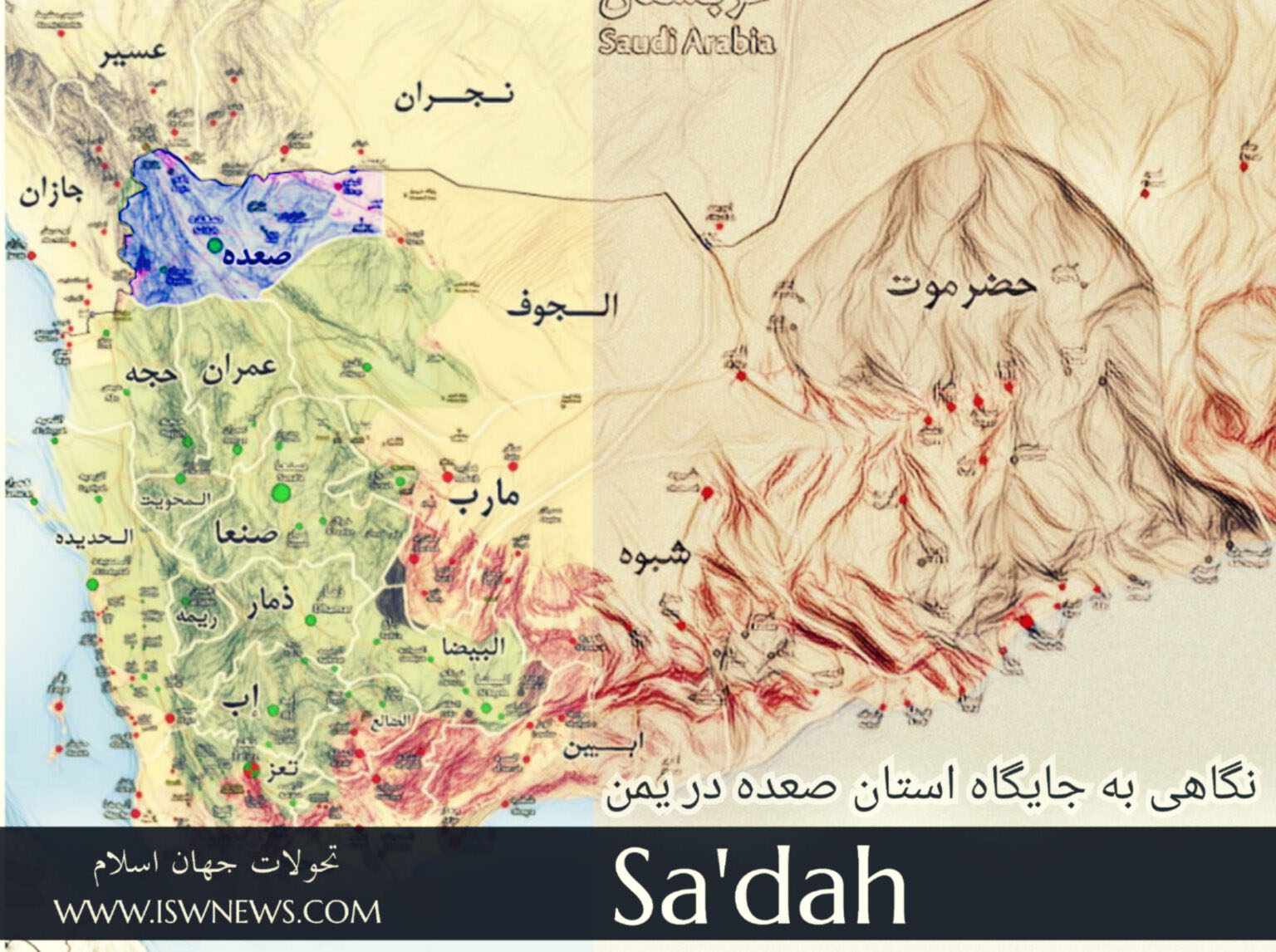
  • Know Yemen better: Looking at position for Saadah province in Yemen

    Know Yemen better: Looking at position for Saadah province in Yemen

    Saadah is a northern province in Yemen with more than 700 thousand population and 11,375 km2 area. The province has 15 districts including Hashwah, Safra, Zaher, Baqim, Hidan, Razih, Saqin, Saher, Shada, Saadah, Ghamar, Qatabar, Kitaf, Mujiz and Munbah.
    Agriculture and herding are the occupation of most of the people. Handicrafts and minerals in Saadah brought business opportunities for inhabitants of Saadah.
    Most of western part of the province are suitable for agriculture and has mines due to heights and suitable weather. The eastern part is desert and dry, in which herding is more suitable.

    Saadah districts


    Saadah used to be en route to Yemeni Hajj and trade caravans thus, had economic boom, cultural and art development.
    Saadah has several old bazaars including Soq al-Talh, Soq al-Qadin and Soq al-Asbu’ei, each of which has a daily trade schedule such as handicrafts, coffee, fruits, etc.

    Saadah is important in controlling the northern part of Yemen and its northern heights are obstacles for enemy’s invasion. During the Zaidi ruling, Saadah was their capital.

    Notable people of Saadah include martyr Sayyid Hussein Badreddin al-Houthi who is recognized as the leader and founder of Yemen’s revolution. Sayyid Hussein had a key role in enlightening and expanding the Islamic resistance idealogy in Yemen. He is among the founders of Ansar Allah in Yemen in 1986 as “Believing Youth Union” (اتحاد الشباب المؤمن).
    This movement founded under leadership of Shia scholar Salah Ahmed Falitah and pioneer youths such as Sayyid Muhammed Badreddin al-Houthi (Sayyid Hussein’s brother) and then in 1990 had Muhammed Yahya Azzan and then Sayyid Hussein Badreddin al-Houthi as secretary general.

    The expansion of the movement was known with the name of Sayyid Hussein Badreddin al-Houthi, thus it was famous as Houthis and after his martyrdom and leadership of Sayyid Abdul-Malik Badreddin al-Houthi and his strong management, it was called Ansar Allah Movement.

    Sayyid Hussein martyred on September 10, 2004 in heights of Saadah after several years of fight with Ali Abdullah Saleh since 1990. His body delivered to Ansar Allah after several years and buried in Marran heights, northwest of Hidan, which was bombed by Saudi coalition warplanes in 2015.

    Sayyid Hussein Badreddin al-Houthi tomb in Marran heights bombed by Saudi warplanes


    Important tribes of Saadah are three: Khulan, Bakil and Hashed, which have important role in fighting against Saudi coalition.
    In early years of Yemen’s revolution, Wahhabist immigrants of Dammaj village, southeast of Saadah, assaulted Ansar Allah. The intrigue was expelled by exiting Wahhabists from Saadah in early 2014. Al Abdin tribe also had conflict with Ansar Allah outskirts of Saadah which finished by victory of Ansar Allah.

    Since the invasion of Yemen started, Saadah become a main axis for Saudi coalition.
    Saudi coalition operation to occupy Saadah was launch from three axes:
    1. Northern axis (Alab-Saadah road in Baiqm district)
    2. Eastern axis (al-Boqa to Kitaf)
    3. Western axis (Malahit to Marran heights),
    which almost all of Saudi coalition operations were expelled by Ansar Allah so far.
    Among the reason of this defeat are the heights of north and special terrain of Saadah, Ansar Allah’s dominance on the region, Ansar Allah’s resistance and tactics against Saudi coalition, among which operation “Nasr Min Allah” is a famous example.

  • Answering Key Questions about Yemen War – Part Four

    Answering Key Questions about Yemen War – Part Four


    Read “Part 3” here: Answering Key Questions about Yemen War – Part Three


    10. Recent visit of Muhammad Abdulsalam, spokesperson and chief negotiator of Ansar Allah to Iran and meeting with Leader of Islamic Republic and Iranian officials, how do you analyze it?
    Generally it is stated in analyses that this meeting was an official announcement of Iran-AnsarAllah coalition. But we know that the coalition of Ansar Allah and Islamic Resistance was formed from the beginning of Ansar Allah and its leaders were always following Velayat-e faqih (top Shia scholar and leader) and martyr Sayyid Hussein Badreddin al-Houthi had the same stance.
    Important points regarding this trip:
    – Leader of Iran Revolution emphasized on neutralizing the plan of dissociation of Yemen and Ansar Allah’s firm response to it by independent Yemeni-Yemeni negotiations.
    – Muhammad Abdulsalam carrying Janbiya(Yemeni dagger) in meeting with Leader of Revolution, in addition to show the Yemeni gentility and courage and Iranians trusting Yemenis, is a symbol of Ansar Allah to jihad against enemies and show teeth.
    – Assigning Yemeni ambassador in Iran; means Iran considers ambassador of Rescue Government as official political representative of Yemen and Mansour Hadi’s resigned government (due to the resignation of the President and Prime Minister) is out of office according to law.
    – Three way negotiation between Iran, Ansar Allah and Europeans, which is more in the sense of Sweden’s agreement.
    – Sayyid Abdul-Malik Badreddin al-Houthi’s letter to Imam Khamenei, whose contents are not clear and there are several guesses about it.
     
    11. How was Iran and Ali Abdullah Saleh relationship? What are details of Ali Abdullah Saleh trip to Iran?
    Ali Abdullah Saleh supported Saddam, Iraqi dictator, during the eight years of holy defense and after it, to control Yemeni Shias who under influence of Iran, tried to fix his relationship with Iran.
    In that sense, Ali Abdullah Saleh visited Iran on 13 April 2000 and in his meeting with Leader of Revolution, there was words of general situation in the region and necessity of confronting Israel and USA. After this visit, Iran’s President visited Yemen in 2003. But these trips did not influence Saleh’s confrontation with Sayyid Hussein Badreddin al-Houthi’s revolution and due to martyrdom of Sayyid Hussein and Saleh’s support for Saudi family against Iran, the relationship went cold.
     
    12. Who is Hani Ben Brek?
    45 years old Hani Ben Brek is deputy of the Yemen’s Southern Transitional Council and the main coup maker in Aden.
    He was born in Addis Ababa, capital of Ethiopia, to a Yemeni father and an Ethiopian mother and migrated to Aden at 16. Later he joined Yemen’s Al-Qaeda and went to Afghanistan to fight against USSR and after 3 years came back to Aden.
    After that, Hani participated in Southerners confronting against Ali Abdullah Saleh and was arrested in 2010 due to planting a bomb in vehicles.
    After parole, he joined ISIS alley and representative, Ansar al-Sharia, in Abyan and after ISIS defeat fled to Aden and took refugees in Aidarus al-Zoubaidi’s home. In 2017, Aidarus al-Zoubaidi established the Southern Transitional Council with support of Hani Ben Brek and request to separate from northern part of Yemen.
    Using his cleverness and rhetoric speeches with the help of Emirates, he could take Aden from Mansour Hadi’s control.
    Hani Ben Brek is fond of his assassinations and terrorist acts and call them Jihad. Media consider him the military and political arm of Aidarus al-Zoubaidi, head of the Southern Transitional Council.
     
    13. Considering the recent evolutions of Aden and conflict between Emirati and Saudi proxies, how do you predict Yemen’s future?
    Future of Yemen will form due to many different reasons such as operations, leaders of different movements decisions, foreign countries interventions, tribes stances and people’s trends. Thus there is no certainty.

    As mentioned in previous articles, conflict between Emirati and Saudi proxies were predicted and coalition between any of Yemeni movements is predictable.
    Engagement between UAE and Saudi proxies, i.e., Southerners and Mansour Hadi’s government, has root in the contrast of their ideologies and ambitions.
    Southerners want separation and revive Southern Yemen and Mansour Hadi wants Ansar Allah’s neutralized and control the whole Yemen. Therefore, reaching a solution even with Saudi coalition’s enforcement seems impossible.
    They agree upon confronting Ansar Allah but have different goals and ways; their conflict was predictable.
    What can be said as analysis of the current situation is that South of Yemen Transition Council has support of most of the people in south and UAE and used Mansour Hadi’s government incompetence to reject them from Aden and other southern cities.
    Eastern tribes are also close to UAE and there’s possibility of them confronting Saudis.
    Hadi’s government does not have any base after losing Aden and has an unstable and exilic condition. More political or military blows from either Ansar Allah or Southerners will result in their abolition.
    On the other hand, Ansar Allah has an unknown situation in other fronts. Although their aerial capabilities has increased greatly but the operation to reclaim occupied lands has not started yet. Operations north of Al Dhale and recently west of Al Jawf shows Ansar Allah’s enough power to reclaim lost lands but Ansar Allah seems to be waiting for important changes in enemies campaign.