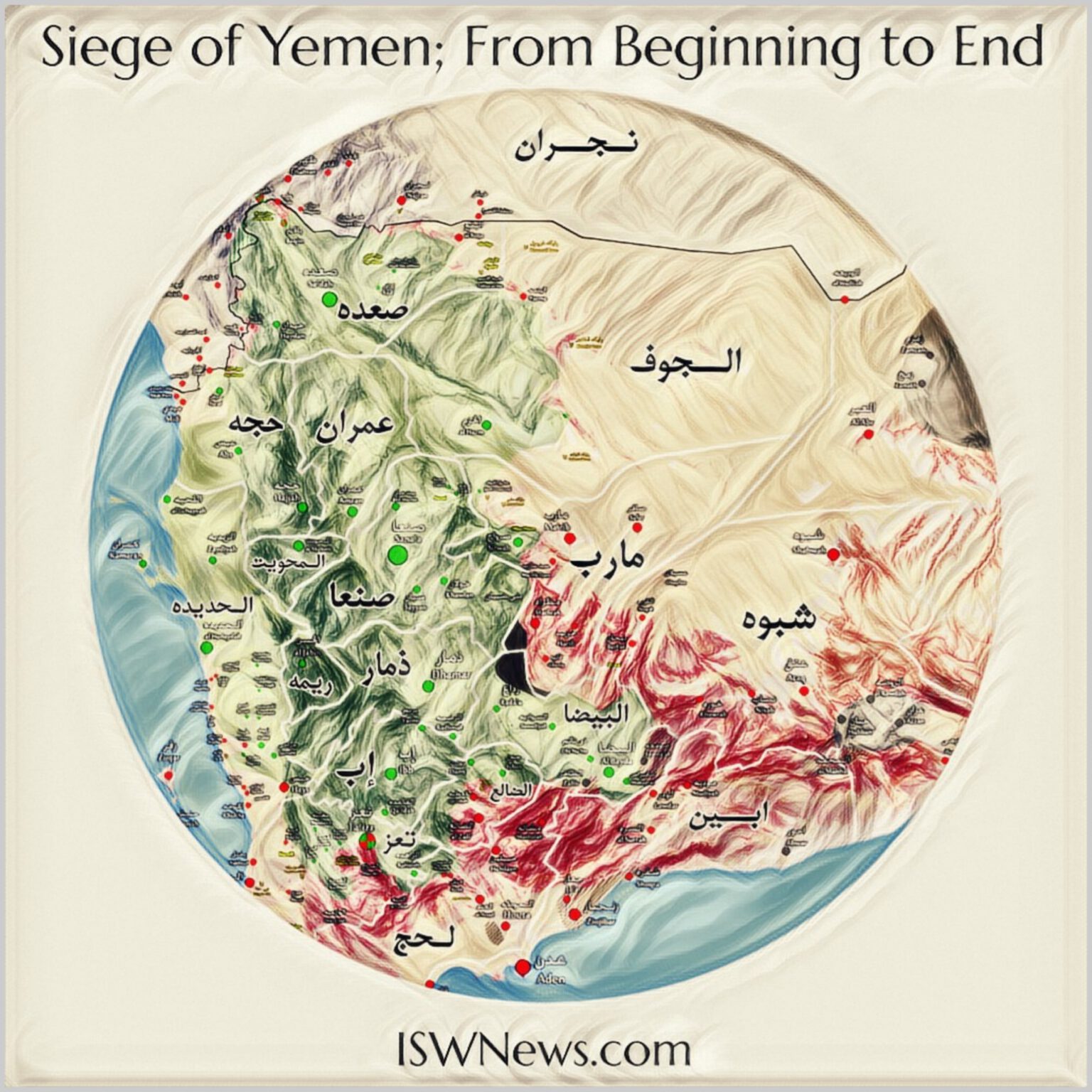
Following attack of Mansour Hadi forces commanded by Sheikh Amin al-Akimi (Mansour Hadi assigned governor of Al Jawf) and Ansar Allah retreat from al-Khanjar base area, the conflict directed to al-Maraziq and Ansar Allah took position on the heights overlooking the base. Ansar Allah launched attacks and not only cleansed al-Khanjar base and surrounding areas but also destroyed several military vehicles and AFVs of Saudi-led coalition forces. According to Saudi coalition media, more than 10 Saudi-led coalition forces killed and 6 injured and 5 AFVs and 8 vehicles and other equipment were plundered by Ansar Allah.
Saudi coalition warplanes bombed Khab and Shaaf district 54 times in the last 5 days and Ansar Allah retaliates by attacking Mansour Hadi forces gathering by a missile in east of Ber al-Mahashimah, north of al-Khanjar base, during which colonel Askar al-Mahshami, HR deputy of 1st border brigade, colonel Bashir Bin Sufah, intelligence deputy of northern axis, colonel Fayiz al-Dhale’i, training deputy of 1st border brigade, killed and brigadier general Haykal Hantaf, commander of 1st border brigade injured.
1- Marib – Saudi coalition heavy attack to Sufayrah until Tubayyin mountain in western axis of Madghal district was repelled by Ansar Allah. Saudi coalition media confessed the attack was fruitless and more than 6 killed and several injured. – Saudi coalition warplanes bombed Madghal district 7 times, Rahbah district 8 times, Sarwah district 3 times in the last 48 hours.
2- Saadah: Saudi coalition warplanes bombed Boqa’ area 3 times and al-Far’ area in Kitaf district 6 times in the last 48 hours.
3- Al Jawf: Saudi coalition warplanes bombed Khab and Shaaf district 2 times and Labanat area 1 time in the last 48 hours.
4- Al Hudaydah: Saudi coalition forces violated ceasefire 360 times in the last 48 hours.
5- Abyan: Sporadic conflicts between Mansoor Hadi’s and southern forces in the province.
6- Abu Ali al-Hakim (head of Ansar Allah intelligence), met with some of commanders and forces who returned from fronts Marib, west coast and border fronts in Raymah province.
1- Marib: – A number of Mansour Hadi’s forces were killed and wounded during a mistaken attack by Saudi coalition warplanes east of the Hilan Heights. – A child was martyred and a woman was injured when a roadside bomb exploded in the Wadi Hubab area in Sarwah district.
2- Saudi coalition airstrikes: In the past 48 hours, Saudi coalition warplanes have bombed Rahbah 2 times, al-‘Abdiyyah district 2 times, Mahliyah district 2 times, Sarwah area 4 times, Madghal and Majzar district 4 times and Khab and al-Shaaf 3 times.
3- Al-Hudaidah: – Saudi coalition forces have violated the ceasefire regime 106 times in the province in the past 24 hours. – Saudi coalition forces violated the ceasefire regime 4,086 times in the province in September 2020. – Saudi coalition forces fired more than 200 rockets and mortars at al-Durayhimi town.
4- Abyan: During the exchange of prisoners between the Southern Transitional Council and the Mansour Hadi government under the auspices of the Red Cross, 173 southern forces and 32 Mansour Hadi forces were exchanged.
5- Socotra: The UAE has deployed 600 Sudanese and Senegalese militias on the island of Socotra.
1. Socotra: UAE with the consent of Saudi Arabia, has built a base on the island of Socotra. The UAE has also transferred 100 to 500 militants from the Southern Transitional Council to the island.
2- Saudi coalition airstrikes: In the past 48 hours, Saudi-led coalition warplanes have bombed Rahbah district 8 times, Sarwah district 1 time, Al-Hazm district 11 times and Khab and Al-Shaaf district 2 times.
3- Al-Jawf: The attack of the Saudi-led coalition forces on the Al-Khasf and Al-Aqsha fronts on the eastern areas of the Al-Hazm district failed despite the heavy air support of the Saudi-led coalition warplanes.
4- Al-Hudaydah: Saudi-led coalition forces have violated the ceasefire regime in the province 405 times in the past 48 hours.
5- Some news sources reported that the representatives of the resigned government of Mansour Hadi and Ansar Allah agreed on the details of the exchange of prisoners during the Geneva talks. It is said that during the first phase of this exchange, 1,080 Saudi and Sudanese prisoners will be released by Ansar Allah and reciprocally by the same number from Saudi Arabia.
Yemeni Armed Forces spokesman Yahya al-Sari said on his Twitter page: “Yemeni people, the armed forces and popular committees were steadfast during 2,000 days of aggression against our country, certainly those who stood steadfast at this period are able, with God’s help, to withstand 4,000 days and even more. The situation during the first 100 days of aggression is different about the situations during 1,000 days of aggression and what it is today after 2,000 days of aggression is completely differnt ?! Let Yemen be an independent dignity.”
Saudi aggression against Yemen continues while so far no effective efforts have been made by the so-called international organizations and UN to stop Saudi Arabia’s war and crimes against Yemen, and this is negligence while even European countries and the United States continue to send various weapons and armaments to Saudi Arabia to kill Yemenis.
Statistics of the Saudi coalition aggression on Yemen after 2000 days: – Total martyrs and wounded: 43,181 people – 16,978 martyrs, including 3,790 children and 2,381 women – 26,203 people were injured, including 4,089 children and 2,780 women
– The total number of destroyed and damaged facilities and infrastructures is 9,135 – Destroyed or damaged 15 airports, 16 ports, 304 power plants and generators and 547 communication networks – Destroyed or damaged 2,098 warehouses and water supply network and 1965 government centers and 4,200 roads and bridges – The total number of damaged and destroyed houses is 565,973 – The total number of damaged and destroyed service centers is 576,528 – Destroyed or damaged 176 universities – Destroyed or damaged 1375 mosques, 356 tourist centers and 389 hospitals and medical centers – Destroyed or damaged 1095 schools and educational centers and 6732 agricultural lands, 132 sports centers, 244 ancient centers and 47 media centers
– The total number of destroyed and damaged economic centers is 22,404 – Destroyed or damaged 393 factories, 286 fuel trucks, 11,227 commercial centers and 407 poultry and livestock
Ansar Allah and popular committees forces, with the help of local tribes, expelled Saudi coalition mercenaries from the al-Maheliyah district in the south Marib province. Currently, clashes continue in the southern areas of al-Rahba district.
On the Al-Ruwik and Al-Alam Al-Abyadh fronts, Ansar Allah has increased its attacks to drain the Saudi-led coalition strength in the area. The coalition’s withdrawal from these two bases will mean a complete defeat at Al-Jawf province and the start of much more important clashes in northern Ma’rib.
Location of the “Taibat al-Ism” base in the north of Al-Jawf from the perspective of AnsarAllah fighters in the heights overlooking itVisual confirmation of video released by AnsarAllah with satellite maps in this frontMilitary map of Najran-Al-Hazm axis and overall situation and contact lines between AnsarAllah forces and Saudi-led coalition forces in the area (click to see the full size map)
YOUR SUPPORT IS CRITICAL TO KEEP ISWNews ALIVE!
I’d like to thank readers for their confidence and support. Thanks to your support we can continue to perform our duty on reporting the important events in the region. So If you like our contents, please don’t feel embarrassed to contribute and help our project, for as little as 1 Dollar. Your contribution, however small, will help ensure our project continuity. Thank you.
1. Marib and Al Jawf: – Ansar Allah missile attack to Saudi coalition in west of Marib (on 11 August) killed three and injured more than 10. – Ansar Allah launched a heavy attack toward Rayan and Ruwaik base in eastern desert of Al Jawf. As mentioned before, Ansar Allah should claim Saudi coalition bases first to liberate Marib. – Saudi coalition warplanes attacked Sarwah and Majzar districts 15 times in the last 24 hrs.
2. Abdulqader Murtadha, head of Yemen rescue government POW committee, reported of four army and people’s immobilization forces release in Al Jawf.
3. Al Hudaydah: Saudi coalition violated ceasefire in Al Hudaydah 114 times in the last 24 hrs.
4. Saudi Arabia committee to observe Riyadh agreement entered Aden. The committee came to get the administration buildings from southern forces and give it to resigned government forces.
YOUR SUPPORT IS CRITICAL TO KEEP ISWNews ALIVE!
I’d like to thank readers for their confidence and support. Thanks to your support we can continue to perform our duty on reporting the important events in the region. So If you like our contents, please don’t feel embarrassed to contribute and help our project, for as little as 1 Dollar. Your contribution, however small, will help ensure our project continuity. Thank you.
Arrival of Iranian tankers at Venezuelan harbors and breaching the embargo of the country is a huge leap in Iran’s foreign policy and a blow to US arrogance which can be helpful in future, specially about Yemen. Yemen had become the main battlefield between the Resistance and the West and both sides are reluctant to accept defeat in this arena.
The Resistance could destroy the cores of terrorism in Syria, Lebanon, Iraq and Gaza with help of Iran and its allies and now the only active front with main threats is Yemen. Therefore Saudi Arabia and UAE besieged Yemen from all aspects to cut Iran’s helps to Ansar Allah from the beginning of the assault. They even controlled or formed allegiance with Somalia, Djibouti, Sudan and Eritrea which could be helpful for Iran to support Ansar Allah. Americans hindered Iran aids using political tricks. All these oppressing acts resulted in unfair siege of Yemen and its people in several years.
We examine some points regarding this topic:
1. Iran’s mistakes in foreign policy toward horn of Africa: Sudan, Djibouti, Somalia and Eritrea were among states that Iran expanded relationship with to enhance maritime transportation safety in the Red Sea and Gulf of Aden. After the start of Yemen war, these countries changed their course an incredible amount of 180° and against Iran’s interests, started to follow Saudi coalition on sieging Yemen. Even though these countries cutting ties with Iran was considered as joke by many but it just shows Iran’s policy was not correct in horn of the Africa and resulted in Yemen full siege.
Iran’s mistakes are: a) Ignoring US influence on horn of the Africa: In addition to political and power influence, USA has a huge base “Camp Lemonnier” in Djibouti which hosts many warplanes and American soldiers. b) Taking wrong stances toward Somalia civil war. c) Media and political passivity against UN and Saudi Arabia accusations regarding transporting weapons to Somalia and training Ansar Allah troops. d) Opening relationship with low level and weak politicians such as Omar al-Bashir.
2. Guarantee of Iranian politicians to the United States to stop sending aid to Yemen: The only evidence is former US secretary of state, John Kerry, remarks at the council on foreign relations on Iran, on 24 July 2015 who said: “A few months – a couple of months ago, I guess it was, when you saw a convoy coming down out of Iran heading towards Yemen, I was on the phone in an instant to my counterpart, and made it very, very clear that this could be a major confrontation, that we were not going to tolerate it. And he called me back, indeed, within a short span of time and said, “They will not land, they are not going to unload anything, they are not going to go out of international waters,” and then they went home.” In fact such decisions without strategy helped Yemen’s siege.
3. Ansar Allah negotiation with Saudi coalition to lift the siege: Saudi coalition, who didn’t expect Yemen’s brave resistance, had to negotiate with Ansar Allah to achieve its political goals at the same time with military missions. The negotiations are: a) In Geneva, June 2015. b) In Muscat, September 2015. c) In Switzerland, December 2015. Which were all unsuccessful. d) In Saudi Arabia, spring 2016. It was the first negotiation in Saudi Arabia and was unsuccessful finally due to obstruction by resigned government of Mansour Hadi and Ali Abdullah Saleh. e) Kuwait negotiation which was not successful due to assigning Ali Mohsen al-Ahmar as vice president of Mansour Hadi resigned government.
After failure of talks in Kuwait and rejection of US and UN plans by Mansour Hadi resigned government, the plans by Persian Gulf Cooperation Council and National Dialogue Conference were introduced which was accompanied by UN security council resolution 2216 which entails “forming a committee to monitor drafting the new constitution”, “timetable to hold general election” and “holding of a referendum”. National talk conference emphasized on forming a federal government of several areas by Yemeni groups agreement and resolution 2216 also accepting these two plans emphasized on political solution and ceasefire.
These plans failed as well and battle in west o f Yemen coasts from Bab al-Mandab Strait to south of Al Hudaydah and north of Hajjah province intensified. On December 14, 2018, the resigned government and Ansar Allah agreed on ceasefire, exchanging POWs, lift of siege of Taiz and west of Yemen areas in Stockholm, Sweden. In this agreement the control of Al Hudaydah harbors were left to local joint forces and the income of oil export from Marib oil field was done by Sanaa central bank and the siege of Sanaa airport and Taiz to be lifted. But due to political discord and UN passivity in supervising the obligations of Mansour Hadi resigned government, Ansar Allah limited their obligations on joint forces controlling the harbors. After this, there were significant turn in the war by Ansar Allah’s drone and missile attacks on Saudi Arabia oil infrastructure, operations of north of Saadah and Al Jawf. After being passive and on weak side, Saudis started Muscat talks.
What has been released unofficially from Muscat talks, from delegates of both sides talks (Muhammad Abdulsalam and Khalid Bin Salman), Khalid Bin Salman direct call with Mahdi al-Mashat and UN convoys meeting with Ansar Allah officials, the following are topics of talks: a) Ceasefire in southern border of Saudi Arabia and DMZ along border. b) Lifting siege of Yemen and reopening Sanaa airport. c) Limiting Ansar Allah’s drone and missile attacks to Saudi Arabia. d) Ansar Allah cutting ties with Iran in return for Saudi support for Ansar Allah.
Ansar Allah leader in his meeting with UN special convoy Martin Griffiths, rejected cutting ties with the Resistance and conditioned any ceasefire to lift of siege of Yemen. As Ansar Allah stopped attacking Saudi Arabia oil infrastructures in return for several medicine cargo planes landed in Sanaa and some ships conveying oil products released. At the moment, most of the previous negotiations have failed which is due to the West pressure on Saudi Arabia, discord between Saudi coalition, continuation of air strikes and siege of Yemen.
YOUR SUPPORT IS CRITICAL TO KEEP ISWNews ALIVE!
I’d like to thank readers for their confidence and support. Thanks to your support we can continue to perform our duty on reporting the important events in the region. So If you like our contents, please don’t feel embarrassed to contribute and help our project, for as little as 1 Dollar. Your contribution, however small, will help ensure our project continuity. Thank you.
Clashes are now continuing in the suburb of the Sanaa-Marib road, and according to pro-Saudi coalition sources, Ansar Allah has blocked this road. Therefore, the al-Jufra region and its hospital are in a quasi-siege situation and there is a likelihood for imminent liberation of these regions.
Also, the released reports about the liberation of al-Salil, al-Sawda and Jabal Manama can not be confirmed by IWN, so far.
Ansar Allah’s advances on this axis is so important and in the recent days, the Saudi-led coalition warplanes have bombed these regions intensely to stop the Ansar Allah advances. Local sources have reported that during the last 24 hours, Saudi-led coalition warplanes struck these areas 49 times.
Maas base in west of Marib province and Kanayis base and command room of sixth zone in Al-Jawf desert were hit by several missiles and two drones, respectively.
Mansoor Hadi media confirming the attacks to Maas base reported of several Saudi and Mansoor Hadi soldiers injured and killed and transported to Marib using the coalition helicopters. They also reported of mistake bombing of Mansoor Hadi forces in southwest of Madghal but no details were released.
In the past 48 hours, Saudi-led coalition warplanes have targeted the Marab front more than 25 times and the al-Jawf front more than 9 times. Clashes are currently continue in the Al-Jufra front, Wadi Maas and the north and east of Sarwah, and if Ansar Allah’s advances and position in the Madghal is stabilized, the Saudi-led coalition forces will likely withdraw from the Maas base and Raghwan district.