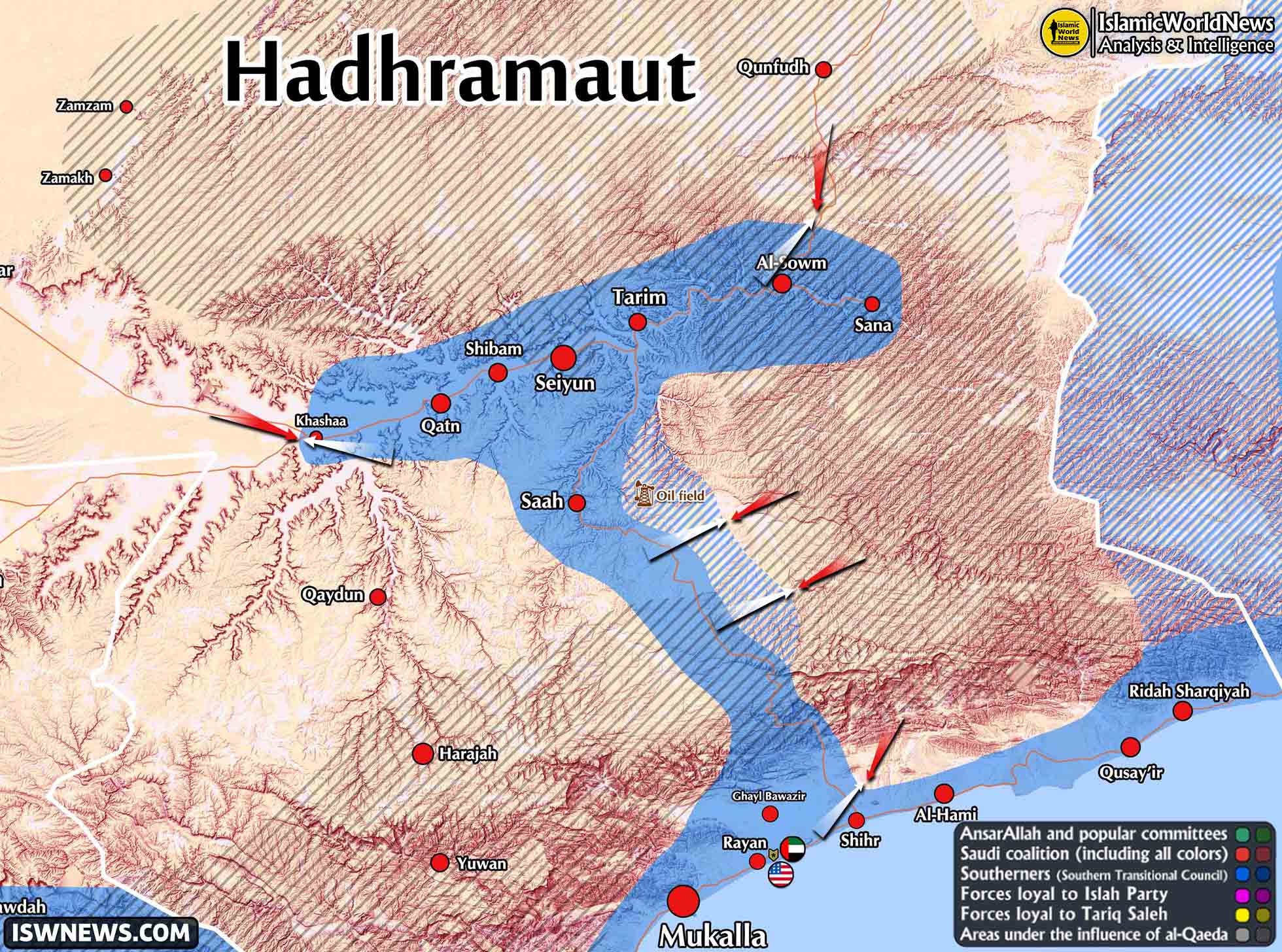
The operation, involving Al-Dara’ Al-Watan forces, armed tribal groups from Hadhramaut, and fighters from the Islah Party, began on Friday, January 3, with Saudi air support. Starting from the Al-Khasha area, they attacked positions of the Southern Transitional Council and advanced toward Al-Qatn in the Hadhramaut valley. By Saturday morning, Al-Qatn and Shibam had fallen to Al-Dara’ Al-Watan, while Southern forces retreated toward the Hadhramaut coast. By Sunday morning, Seiyun and other central districts of Hadhramaut were under government-in-exile control. The forces then moved to Al-Rayyan airbase (previously used by Emirati forces on the Hadhramaut coast) and, after hours of clashes, seized it from the Southern Transitional Council.
During these battles, at least 80 Southern fighters and an unspecified number of Saudi-backed troops were killed, with hundreds more wounded. Both sides have yet to release official casualty figures.
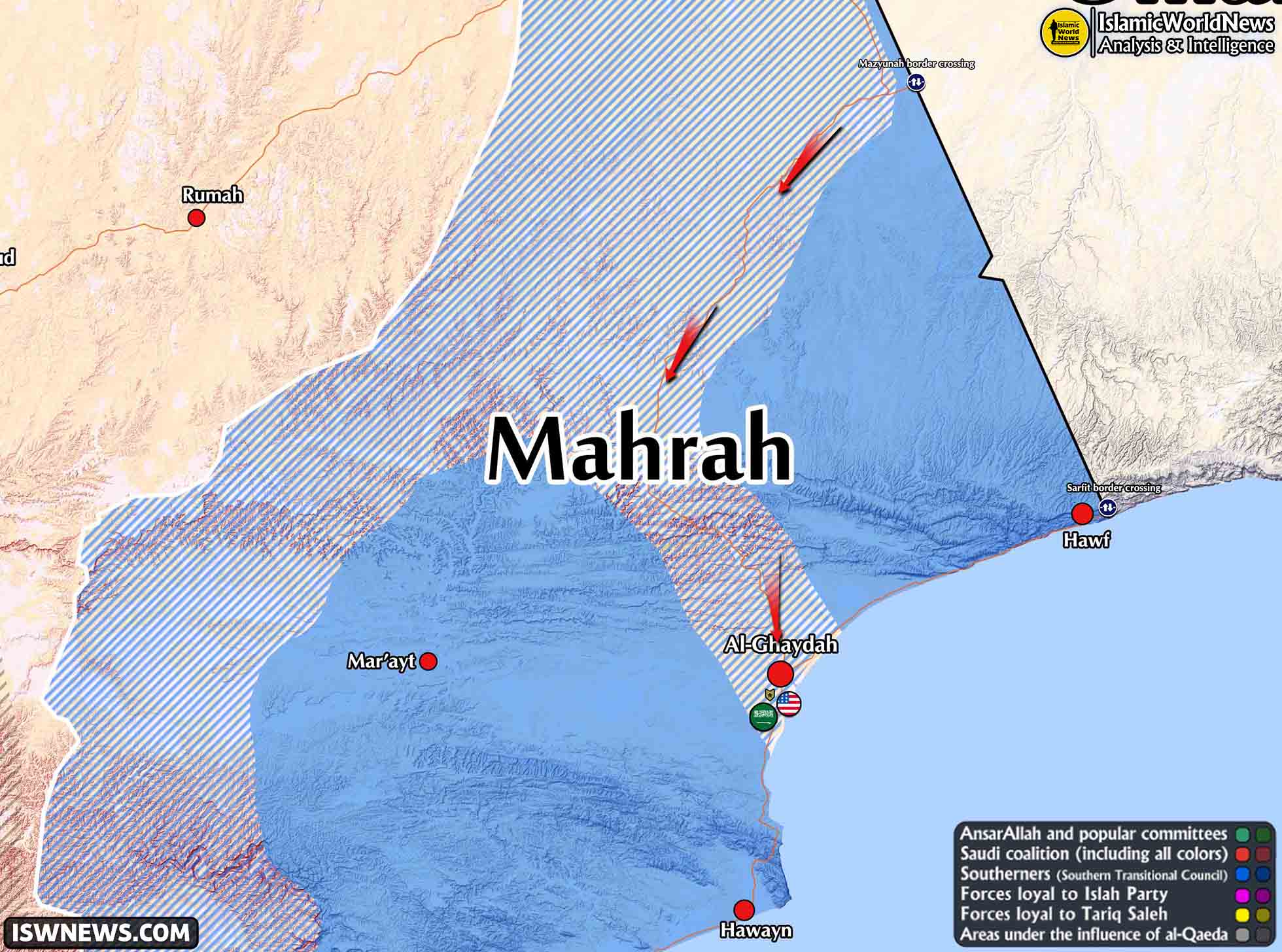
Al-Dera’ Al-Watan forces have since entered Mukalla, the capital of Hadhramaut, without resistance, taking control of all government and military facilities. They also advanced into Al-Mahra province, seizing Al-Ghaydah city and the port of Nishtun. Their objective is to secure Al-Ghaydah’s city and airport, border crossings, and remove Major General Talib Barjash, commander of the Second Military Region (Al-Mahra and Yemen’s southeastern coast), who recently defected to the Southern Transitional Council and rejected the authority of the Presidential Council of the government-in-exile.
Given the heavy defeat of the Southern Transitional Council in Hadhramaut valley and coastal cities, Al-Mahra is also expected to fall under government-in-exile control soon. Awad bin Al-Wazir Al-Awlaki, governor of Shabwa—previously supportive of Southern forces and backed by the UAE—has now announced cooperation with the Saudi-led coalition to deploy forces in oil-rich areas and military bases.
Overall, the Southern Transitional Council’s “Promising Future” operation collapsed with the UAE’s withdrawal and Saudi determination. The plan to partition southern Yemen has been sidelined. However, the Saudis have invited the Southern Transitional Council to participate in Yemen’s internal dialogue conference in Riyadh, and the [Persian] Gulf Cooperation Council’s federal plan for Yemen remains on the table. Still, the re-establishment of a separate South Yemen has failed, leaving Aidarus al-Zoubaidi’s efforts fruitless.
According to the latest reports on Yemen’s fronts — broken down by military zones and provinces — the situation is as follows:
Hadhramaut & Al-Mahra Fronts: In Hadhramaut, the front lines in the north remain unchanged, with Al-Khasha‘a serving as the main contact line. The cities of Al-Qatn, Tarim, and Seiyun in Wadi Hadhramaut are still under southern control. Al-Dara‘ Al-Watani (National Shield) forces have redeployed to Ramah and Thamud in the northeastern desert and taken positions along the Yemen–Saudi border, likely preparing to move toward Al-Sawm on the eastern side of Wadi Hadhramaut.
Hadhramaut map
Fighting continues between the UAE-backed Hadhrami Elite forces and tribal fighters from the Hadhramaut Tribal Council around Ghayl Bin Yamin, as well as in Wadi Khard and Al-Ays on the Hadhramaut coast. Recently, tribal fighters retook the Nohub base and pushed STC forces back from the outskirts of Wadi Khard and Al-Ays.
In Al-Mahra, Major General Barjash — commander of the 2nd Military Region — reaffirmed his support for the STC and declared he will not hand over his positions to National Shield forces backed by Saudi Arabia. He also urged civilians to stay away from military sites and installations.
Al-Mahra situation
Abyan Front: On northern Abyan axes, STC operations against Al-Qaeda elements are progressing slowly and have produced few tangible results. Al-Qaeda cells continue operating covertly. Beyond the integration of rapid-reaction forces from Jishan district, no major shifts have occurred.
Marib & Al-Jawf Fronts: Giants Brigade units have pulled out of Harib and Al-Abdiyah (south of Marib), as well as from the Kitaf and Al-Baqa fronts in northern Saada, redeploying to Hadhramaut and Shabwah. This redeployment has weakened the lines facing Ansar Allah, giving Yemeni resistance fighters an opportunity to resume advances from Harib toward western Shabwah in future clashes.
No significant changes have been recorded on other fronts, and the Yemeni Armed Forces (aligned with Ansar Allah) continue to observe the ceasefire that has been in place since 2023.
The UAE’s departure from Yemen marks a major setback and a turning point in the country’s civil war. Key consequences include fractures within the Saudi-Emirati coalition, a severe weakening of the exiled government, the strengthening of Ansar Allah, a growing power vacuum in the south, and the risk of deeper involvement by another outside actor — potentially the United States. The UAE’s separation from the Yemen file amounts to a failure of the “Arab coalition” project; in recent years, Saudi Arabia has lost two principal partners — Qatar and the UAE — in joint operations. Still, it is too early to draw final conclusions, and much remains unclear.
The UAE’s footprint on strategic Yemeni islands such as Socotra, Abd al-Kuri, Mayun, and others is part of a broader project to control maritime routes through the Gulf of Aden and the Red Sea — reinforced by formal agreements with the exiled government and backed by Western states and Israel.
Support operations by Yemen’s armed forces (backed by Ansar Allah) in solidarity with Palestine have continued until the final day of negotiations between the resistance and the Zionist regime. The latest actions include a precision cruise missile strike on the Dutch vessel MINERVAGRACHT and the entry of several suicide drones into the port of Eilat in southern occupied Palestine. According to Sayyed Abdul-Malik Badr al-Din al-Houthi, Yemen has carried out 1,835 support operations over the past two years using ballistic missiles, cruise missiles, hypersonic weapons, drones, and suicide boats.
In Hadhramaut province, tensions are rising between the UAE-backed Southern Transitional Council (STC) forces and the Saudi-backed Hadhramaut Protection Forces. Saudi Arabia is equipping three divisions under the Hadhramaut Protection Forces, aiming to seize oil resources and advance toward the Hadhramaut coast. Similar developments are unfolding in Al-Mahrah and Shabwah provinces, although in the city of Ataq, the capital of Shabwah, UAE-aligned forces currently hold control.
In Abyan province, guerrilla attacks by Al-Qaeda militants—including roadside bombings, drone strikes, sniper fire, and other harassment tactics—continue to target STC forces, inflicting significant casualties.
In Taiz province, tensions between the Islah Party and Tariq Saleh’s forces have escalated following the assassination of Afthan al-Mashhary, head of the sanitation and beautification office. Several failed assassination attempts have targeted local commanders from both sides. Islah militants have attempted to arrest and confront Tariq Saleh’s forces in the city of Al-Turba in southern Taiz, but these efforts have failed, and control of Al-Turba remains with Tariq Saleh’s forces.
In Lahij province, the Al-Subayha tribes—aligned with Saudi Arabia—are trying to gain control of the southwestern coast of Lahij. However, UAE-backed Al-Amaliqa forces, under the command of Brigadier General Hamdi Shukri, are blocking their advance and currently hold the area. The Al-Subayha tribes are independent tribes from southwestern Yemen, some of whose leaders have been recruited by Saudi Arabia. In recent years, Al-Subayha militants have clashed multiple times with Tariq Saleh’s forces, preventing their entry into southwestern Yemen.
Latest situation on Yemeni fronts – Click to view image in full size
Overall, Yemen’s internal front is facing numerous challenges that make the path to peace increasingly elusive. Saudi Arabia and the UAE, as influential Arab powers, have exploited Yemen’s dire economic conditions over the years, supporting proxy factions such as the STC, Islah Party, Al-Amaliqa, remnants of Ali Abdullah Saleh’s regime, and others to serve their strategic interests.
These dynamics have deepened divisions between Yemeni factions and the government in Sanaa, making national reconciliation or liberation from foreign-backed groups more difficult. Undoubtedly, once the Palestinian issue is resolved, Yemen’s government will have to confront this major challenge and adopt thoughtful and flexible strategies to overcome it.
1. Saada Governorate: As a result of the recent artillery attacks by the Saudi-led coalition on the border areas of the Sheda district in Saada Governorate, 10 Yemeni civilians were wounded.
2. The Warrior Maven website, one of the specialized media outlets on US military news reported: The multiple downing of MQ-9 Reaper drones in Yemen may prompt the Pentagon to re-evaluate the development plans for manufacturing of this drone, which has previously been valuable and successful in many missions.
3. The German newspaper Der Spiegel claimed that the European Union’s naval fleet in the Red Sea is facing a shortage of warships to counter the operations of the Yemeni Armed Forces.
This is happening as three months have passed since the start of the European operation in the Red Sea under the name Operation ASPIDES. Rear Admiral Vasileios Gryparis, the commander of this operation, said: After the departure of the German warship Hessen, only three warships remain in the operational area, making the continuation of the mission impossible. It is expected that the void left by the Hessen warship will be filled by the Hamburg warship, but this warship will reach the Red Sea in August.
4. Statement by the British maritime risk management company Ambrey after the recent threat from the Yemeni Armed Forces: Estimates show that Yemen has the military capabilities to target commercial ships in the eastern Mediterranean. Despite the air defense capabilities of the Israeli army and the coalition’s support for Israel, it cannot be guaranteed that all Yemeni threats will be detected and intercepted. Ships bound for Israel are advised to stop transmitting AIS destination information after entering the eastern Mediterranean. We recommend that these ships involve intelligence and security organizations to help with travel planning to counter Yemeni threats.
5. USNI News website (a specialized media outlet of the US Navy): The aircraft carrier Eisenhower is returning to the Red Sea after moving towards the US. The possible return of this US aircraft carrier is due to the military operations of the Israeli army in Rafah city, which will likely provoke a strong reaction from Yemen and the Lebanese resistance movement Hezbollah against Israel.
6. Sanaa Governorate: On May 8, 2024, the military maneuver of officials of the National Salvation Government of Yemen was held in the presence of Mahdi Al-Mashat, the President of the Supreme Political Council of the Arab country. The political and military officials of Yemen participated in the symbolic inauguration ceremony of the military maneuver in preparation and command of the general mobilization for the fourth stage of the escalation of tension in support of the Palestinian people and resistance.
7. A report of the Business Insider news website on the return of the US naval group to the Red Sea: The US aircraft carrier Eisenhower and the destroyer USS Gravelly quickly conducted supply operations in the Souda Bay in the Greek island of Crete after exhausting their ammunition in the Red Sea. The return of the Eisenhower aircraft carrier to the Red Sea comes after the crisis caused by the Yemeni missile attacks, which cannot be expected to come to an end. This US website quoted Rear Admiral Marc Miguez, the commander of the US naval group dubbed Carrier Strike Group in the Red Sea, as saying: “Our sailors have worked constantly for six months to keep us operational in the most challenging and dynamic battlespace the US Navy has seen in decades.”
According to the Business Insider report, the US Navy has spent nearly $1 billion to counter the Yemeni threats, a figure that reflects the increase in the West’s financial costs in the Red Sea. In addition, the US Navy has stated that it needs logistics ships to carry out operations and supply and replenish the naval group deployed to the Red Sea.
8. CENTCOM statements about the confrontation with the Yemeni Ansar Allah movement: – The terrorist United States Central Command in West Asia (CENTCOM) claimed in a statement that between 23:02 and 23:48 (Sana’a time) on May 6, 2024, the Ansar Allah movement launched three suicide drones towards the Gulf of Aden. One of the warships of the US-British coalition successfully shot down the first and second drones, and the third drone crashed into the sea. At 5:02 am on May 7, the Ansar Allah movement launched an anti-ship ballistic missile (ASBM) towards the Gulf of Aden. According to this CENTCOM report, these attacks did not cause any casualties or damage to commercial ships, US-UK coalition ships.
– The terrorist United States Central Command in West Asia (CENTCOM) claimed that at 20:45 (Sana’a time) on May 10, the Yemeni army launched a suicide drone towards the Gulf of Aden, and the US-British coalition fighter jet successfully intercepted and destroyed it. Also, between 4:30 and 4:45 am (Sana’a time) on May 11, US forces destroyed three suicide drones in the Red Sea. These attacks did not cause any casualties or damage to commercial ships and US-British coalition vessels.
9. The Center for International Maritime Security (CIMSEC): The Western naval coalition in the Red Sea is facing a new and difficult challenge in dealing with Yemeni unmanned surface vehicles (USVs).
10. Abyan Governorate: On May 13, according to local media reports, Al-Qaeda militants entered the Lawder district in Abyan Governorate and distributed their propaganda books and leaflets in the region.
11- Hudaydah: On May 13, the US coalition fighter jets bombarded Hudaydah airport.
1- Al Hudaydah Governorate: On March 23, US-UK coalition fighter jets conducted five airstrikes at Muneer district in Al Hudaydah Governorate in the western coastline of Yemen.
2- Sa’dah Governorate: On March 24, following the artillery attacks by the Saudi-led coalition on the border region of Al-Sheikh area in Munabah district, an African migrant was injured.
3- On March 22, the French Navy announced in a statement that one of the French warships was attacked by three anti-ship ballistic missiles by the Ansar Allah movement’s forces in the southern Red Sea. The French army also added that this attack also targeted a container ship escorted by the French warship.
4- On March 24, the US Navy announced that a sailor of the USS Mason destroyer named sailor Oriola Michael Aregbesola was killed as a result of falling overboard into the water in the Red Sea. According to Western media reports, this American serviceman was a second-class aviation mechanic who went missing on April 1st during an operation in the Red Sea and his body was found after four days.
The US army has a long history of concealing information and details about the deaths of its soldiers with the use of unrelated and non-combat incidents, a trend that has also been repeated during the conflicts in the Red Sea and the Gulf of Aden. Considering the attacks by the Ansar Allah movement on the USS Mason destroyer, it is possible that this person has been killed in Yemeni attacks.
5- Mohammad Abdul Salam, the spokesman for the Ansar Allah movement and the official in charge of negotiations for the Yemeni Salvation Government said: “The US attacks on Sanaa are the continuation of the aggressions carried out by the US and UK to protect Israel and encourage its continued brutal crimes against the people of Palestine in Gaza. We emphasize that as long as the airstrikes and siege of Gaza continue, they will not prevent the Yemeni people and armed forces from attacking Israeli ships or ships heading towards Palestinian ports. We stress Yemen’s right to defend itself and respond to threats until the attacks and siege of Gaza come to an end.”
6- On March 22, the people of Yemen held a widespread rally in support of the people and resistance of Palestine in the provinces under the control of the Ansar Allah movement. This rally was the 25th extensive gathering of Yemenis in support of Palestine since the onset of the recent war, held under the slogan “Our operations continue, stop the attacks.”
7- On March 23, President of the Supreme Political Council of Yemen Mahdi al-Mashat condemned the terrorist attack on the Crocus City Hall in the vicinity of Moscow in a message to the Russian President Vladimir Putin and offered condolences to the people of Russia and the families of the victims.
8- The terrorist forces of the United States Command in West Asia (CENTCOM) claimed in a statement that from 2:50 to 4:30 a.m. (Sanaa time) on March 23, forces of the Ansar Allah movement launched four anti-ship ballistic missiles (ASBMs) towards the Panamanian-flagged Chinese oil tanker “Huang Pu” in the Red Sea.
According to the statement, at 16:25, the fifth ballistic missile was detected when fired towards the Huang Pu. The ship issued a danger signal but did not request assistance. The Huang Pu suffered minimal damage and the fire on board was extinguished within 30 minutes. There was not any report of casualties in this attack, and the ship continued on its course.
Between 6:50 to 9:50 a.m. (Sanaa time), US military forces, along with the USS Carney destroyer, engaged in combat with six suicide drones in the southern Red Sea. According to CENTCOM, five drones crashed in the Red Sea and one flew into areas under controlled by the Ansar Allah movement in Yemen.
Given the fact that an unwritten ceasefire between the Ansar Allah movement and the Saudi coalition is in place, the conflict in Yemen shifted to occupied areas, and the Saudi-led factions are trying to gain more power and influence in the war-torn country.
The situation led to weakening of the resigned Yemeni government, and members of its presidential council are hopeless for success against Ansar Allah movement; so, they pursue implementing their ideal plans, including the partition of southern Yemen.
Moreover, the Takfiri terrorist group Al-Qaeda, which has a significant number of supporters in central and eastern Yemen, expanded its activities and returned to the Yemeni war.
Aden, Lahij and Taiz fronts:
On January 14, 2023, forces of Yemeni military commander and the nephew of the late President Ali Abdullah Saleh, Tareq Mohammed Abdullah Saleh, took control of the Ras al-Ara area on the coast of Lahij province. However, this advance was hampered by tribes, and Rashad Al-Alimi, head of the Presidential Council of the resigned Yemeni government, approved a plan to form a new brigade of Al-Daraa Al-Watan forces in the area under the leadership of Bashir Saif Al-Mazrabi Al-Sabih on February 1, 2023.
The city of Taiz is currently under the control of forces of the al-Islah Party, the resigned government and some independent militants. Tareq Saleh has also returned to the city despite opposition from al-Islah Party. One of the major tensions that occurred after Tareq’s entry into Taiz was the failed assassination attempt on Minister of Defense of the resigned government Mohsen Al-Daeri. These tensions question the resigned government’s claim that Taiz has been besieged by Ansar Allah movement for past eight years. Since the western road and southern areas of Taiz Governorate are under control of al-Islah Party and Tareq Saleh, tensions between these groups limited access to Taiz and prevented delivery of humanitarian aid. The Ansar Allah movement has repeatedly reopened Sana’a-Taiz road voluntarily, but al-Islah Party prevented non-military vehicles from entering Taiz.
On January 25, 2022, the forces of Al-Dara’ Al-Watan (backed by Saudi Arabia) took control of the important Al-Anad base in Lahij Governorate by expelling the militants of the Southern Transitional Council (STC) and evacuating Sudanese mercenaries. This action by Al-Daraa Al-Watan can be considered as Saudi Arabia’s first move to limit the STC.
Saudi media outlets announced that Riyadh intends to remove the STC from the political scene in southern and eastern Yemeni governorates, but this claim has not been seriously implemented so far, and in fact, Saudi Arabia intends to confront with Al-Daraa Al-Watan forces and create a national council for Hadramout Governorate to confront the STC and partition southern Yemen. The control of the resigned government and Saudi Arabian bases in Aden has also been transferred to Al-Daraa Al-Watan, and Saudi advisers are managing Aden’s security issues alongside them.
Latest military situation in Taiz, Aden and Lahij regions in the southwest of Yemen – click to view full size
Abyan front:
The terrorist group Al-Qaeda recruited hundreds of militants from some tribes in Shabwa and Abyan governorates, and Al-Qaeda has again transferred its activities to the north of Abyan Governorate and parts of Shabwa Governorate. Their attacks, which are mostly limited to roadside bombings and guerrilla attacks, have led to the withdrawal of STC forces from most areas of Al-Mahfad and Modiyah districts. Central areas of these areas are under the control of STC militants, but most mountainous areas are under Al-Qaeda control, and clashes between the two sides are ongoing in Wadi Omran.
The increase in Al-Qaeda’s movements on this axis may not be supported by Saudi Arabia, but since it weakens the positions of the Southern Transitional Council in Abyan province, it has not been opposed by Saudi Arabia either, and there is a possibility of covert support from Saudis for Al-Qaeda. Because Al-Qaeda has started using scarce weapons such as quadcopters, etc., which is not possible without external support.
Latest military situation in Abyan and the south Shabwa regions – click to view full size
Shabwa front:
The Southern Giants Brigades known as Al Amaliqah forces, drove out the Shabwa Defense forces on April 8, 2023 to control Bayhan district. The surroundings of the district are also under the control of Shabwa Defense forces; so, Al-Qaeda attacks mostly these forces.
Al-Qaeda terrorists attacked the town of Al-Masiniyah in Al-Saeed district on June 11, 2023 under the pretext of killing commander of al-Islah Party in Bayhan Abdullah Al-Bani. Al-Qaeda used quadcopters and also the US conducted drone attacks on al-Islah Party’s positions in support of the STC.
The US’s support for the STC strengthened their position and governor of Shabwa Awadh bin Al-Wazir Al-Awlaki, and it also reduced the likelihood of operations by Al-Daraa Al-Watan and al-Islah Party forces with Saudis’ support in Ataq city. Saudi Arabia stationed its forces on the northern axis of Ataq to Jardan district and it intends to expel the STC from Ataq city and Shabwa Governorate’s oil-rich areas.
Therefore, competition between Saudi Arabia and the UAE in Shabwa Governorate has been stopped following US intervention, and meetings between US Ambassador to Yemen Steven Fagin and Awadh Al-Awlaki, indicating the US plans to use Shabwa’s oil resources.
Marib front:
After mounting differences between al-Islah Party and the resigned government in late December 2022, Marib Governorate became the scene of tension between the forces of commander-in-chief of the Yemeni resigned government’s armed forces Major General Saghir bin Aziz and al-Islah Party militants. The clash led to the expression of dissatisfaction by tribes in eastern Marib. The root cause of the clashes is a dispute over the division of oil field revenues, and tribes claim parts of oil revenues.
The difference between Saghir bin Aziz and al-Islah Party in Marib continues, but Saudi Arabia temporarily stopped it and is concentrating on merging al-Islah Party militants into Al-Daraa Al-Watan forces; therefore, it appointed al-Islah Party’s field commander in Shabwa Governorate Brigadier General Abd Rabbo Laakb as commander of one of Al-Daraa Al-Watan brigades.
Latest military situation in Marib and north of Ataq regions – click to view full size
Yemen is currently facing several serious challenges such as plots for partitioning southern regions by the STC, exploiting oil and gas resources by the US, Europe and Arab states, stationing terrorist groups in central regions, and being occupied by Saudi Arabia and the UAE.
The Ansar Allah movement and the resigned government of Yemen are opposed to partitioning southern Yemen; so, they will not support the STC, which seeks to revive southern Yemen and the group will not succeed in implementing partition plan. But the issue of exploitation of oil and gas resources and handing over of islands to foreigners are challenges, which are being opposed only by the Ansar Allah movement.
The opposition to the issue prevented oil and gas exports, but did not create any danger for companies and military personnel from the US, Europe and other foreigners in Yemen. In fact, Western political pressures become a leverage so that Ansar Allah movement cannot hinder threats by foreigners.
The occupation by Arab states and presence of terrorist groups in Yemen will only be eliminated through serious confrontation by Yemeni army and Ansar Allah. The Ansar Allah movement must prepare itself for this scenario with support from Iran and resistance groups. Political negotiations at this stage are not very effective; so, peace negotiation is a claim to provide enemies with opportunity to renew strength.
Military situation in Yemen – click to view full size
The Ayn al-Ansaniyah Research and Statistics Center has released statistics on the crimes and atrocities committed by the Saudi coalition against Yemen during the 2920 days of war.
Statistics of the Saudi coalition aggression on Yemen after 2920 days: The total number of martyrs and wounded in these 8 years is 48,349 people, including 18,140 martyrs and 30,254 wounded. Out of this number, the total number of martyrs and injured children is 4079 martyrs and 4790 injured. The number of men martyrs and wounded is 11,603 martyrs and 22,476 wounded. The number of women martyrs and wounded is 2458 martyrs and 2988 wounded.
During the 2,920 days of aggression and siege, the Saudi coalition has damaged or destroyed 15 airports, 16 ports, 346 power stations and generators, and 617 communication networks and stations. Also, 3095 reservoirs and water supply stations, 2105 government facilities and 7293 roads and bridges have been targeted or destroyed.
During the eight years of aggression, 409 factories, 390 fuel tankers, 12,088 commercial units, 466 poultry and livestock farms, 10,279 means of transportation, 485 fishing boats, 1,020 food stores, 427 fuel stations, 704 markets and 1,040 food trucks were damaged or destroyed.
The number of destroyed and damaged civilian houses has also reached 603,110. 182 academic centers, 1714 mosques, 384 tourist centers and 417 hospitals and health centers have been damaged or destroyed by the Saudi coalition. The attacks of the Saudi coalition have also led to the destruction and damage of 1,265 schools and educational centers, 11,350 agricultural lands, 141 sports centers, 258 historical places, and 61 media centers.
The spokesman for the Yemen Armed Forces, Brigadier General Yahya al-Sari’, on the occasion of National Resistance Day presented the statistics of eight years of fighting with the Saudi coalition.
General Yahya al-Sari’: “With God’s help, our forces were able to stand firmly by our people and neutralize the declared and undeclared goals of the aggressors.
The number of attacks by aggressor fighter jets has been more than 274,302 attacks, including 59 attacks last year.
The invasion and siege of our country was carried out under the leadership and supervision of the US and with the participation of Westerners. In the past years, we have monitored the participation of each country in the aggressor coalition. We ask the educational, media and cultural institutions of our country to document all the crimes of the aggressors and the resistance of our people.
Our forces performed more than 13,229 military operations during the battle against the enemy’s brutal attack. Among these operations, we can mention 6702 offensive operations, 6527 defensive operations, neutralizing offensive efforts and enemy advances.
The missile force has carried out 1,828 military operations, including 1,237 operations targeting enemy gatherings inside Yemeni territory. 589 missile operations against the enemy were targeted outside of our geography, which included operations in the depth of the Saudi and Emirati enemies.
We continue to multiply our strategic missile stockpile as a deterrent that has proven effective over the years.
In the last 8 years, the Air Force has conducted 1,2009 operations, including 3,264 offensive operations and 8,745 reconnaissance operations. UAVs have carried out 2,267 operations inside Yemen and 997 operations abroad.
The total air defense operations in the last 8 years reached 4585 operations, including 2022 destruction and hits and 2565 defensive operations. Air defense managed to shoot down 165 reconnaissance and offensive drones.
13 fighter jets, 10 Apaches and 6 helicopters, including the Black Hawk helicopter, were shot down.
48 US Air Force drones were shot down and 123 other spy drones were shot down.
The Navy and Coastal Defense have carried out 38 special operations in the last 8 years, targeting Saudi and UAE naval vessels was a part of it.
The total number of operations performed by ground units in their different units has reached 25,000 different operations.
The total number of sniper operations since entering the battle line reached 71128 operations. The operations of the eighth year amounted to 5213 sniper operations, of which 3374 operations were recorded in audio and video form.
Among the operations of engineering units, 22,854 were enemy gatherings and 24,907 offensive and defensive operations. The number of operations of the engineering unit that targeted enemy tanks, personnel carriers and military vehicles was more than 4414 operations.
The total number of operations of the anti-armor unit during the last eight years amounted to 7942 operations.
From anti-armor operations, 3082 enemy fortifications, gatherings and barracks and 4860 vehicles were targeted by the enemy.
The total number of operations carried out by the artillery Unit during the last eight years amounted to 85,634 operations. Out of this number of operations, 1150 joint operations were carried out with UAVs and 15269 operations were carried out with Zilzal-1 missiles.
The losses of the Saudi enemy army have been more than 10,840 people killed and injured in eight years. We announce the killing of 36 Saudi officers and soldiers and the wounding of 45 others in the eighth year of the aggression. The losses of the Emirati enemy are more than 1,251 killed and wounded, including senior officers. The number of dead and wounded of the Sudanese army reached more than 9545. More than 40 Sudanese officers and soldiers were killed and 65 others were wounded in the eighth year of the aggression.
The casualties of Yemeni mercenaries have been more than 261,243 killed and injured in eight years. In the eighth year, the number of dead Yemeni mercenaries exceeded 2,500 and more than 5,550 were injured.
Our forces managed to destroy or set fire to more than 18,397 armored personnel carriers, tanks, vehicles, bulldozers and weapons. More than 10,618 cases have been documented including the operations that led to the destruction, damage and burning of enemy vehicles, bulldozers and armored vehicles.
During the eighth year, more than 1,000 vehicles, armored vehicles and military equipment were destroyed or damaged.
Continued aggression and blockade means that the aggressor countries and their followers will suffer more losses. Continuing the battle will only lead to more conflict and work on other legal options to defend our country. The regimes that started the aggression should learn lessons from the strengthening of Yemen and what happened in these years. We emphasize on redoubled efforts to prepare for future developments and increase combat readiness to deal with aggressor and enemy forces.
We reject any presence of foreign forces inside our territory and emphasize that the presence of foreigners is illegal and in line with the attempt to occupy our country. We emphasize that any foreign military presence inside the territory of Yemen is a legitimate goal for our forces and for all Yemeni people.
We send greetings to all the free people of our country and among them the proud tribes who rose up for defense.
We renew our agreement with our beloved people that the armed forces remain loyal to their duties and responsibilities, the most important of which is the liberation war.
We tell our Seyed leader that your people are more determined today to see the battle through to its end.
We emphasize our readiness to implement any order against foreign military presence in Yemen. We are ready to deal decisively with any scenario and neutralize any movement of the aggressors and their mercenaries.
We will continue to develop our military capabilities and increase our combat expertise. We will continue to monitor and deal appropriately with all attempts to loot the national wealth within the framework of our duties and responsibilities.”
In contradiction of several reports on an agreement between the Saudi-led coalition and Ansar Allah to extend the truce and agree Ansar Allah’s conditions; no agreement has been reached in this respect so far, and dialogs between the two sides are still ongoing mediated by the UN and Oman. Ansar Allah’s most vital conditions to reach the extension of the temporary ceasefire are subjects such as a comprehensive end of hostilities, prisoner swap, paying salaries of employees from oil incomes, lifting Yemen siege through reopening Sana’a Airport and Al Hudaydah Port. The conditions have been among the issues, which have been discussed in the last years negotiations, but the conditions have never been approved by Saudi Arabia and the UAE, or they proposed different conditions to accept the Yemenis’ suggestions.
Nonetheless, the circumstances of the Saudi-led coalition have deteriorated as a result of the past year tensions among the factions, who are backed by the coalition; thus, Ansar Allah has become more powerful. The feebleness of the Saudi-led coalition and the failure of their military operation pushed them towards pursuing negotiations. The situation forced the US, Russia and the European countries to follow the attitude of Saudi Arabia and the UAE to interact with Ansar Allah.
Potential provisions of agreement between Ansar Allah-Saudi-led coalition:
The most significant matters debated in the talks between Ansar Allah and the Saudi coalition are issues such as an all-inclusive truce, prisoner swap, paying employees’ salaries from oil incomes, lifting Yemen siege by reopening Sana’a Airport and Al Hudaydah Port.
Foreign media outlets quoted an Ansar Allah official as saying that the Saudis promised to pay all the remaining salaries of Yemeni employees; while a Saudi diplomat said that the payment of civil servants’ wages is conditional on accepting security assurances such as setting up a buffer zone on northwest border of Yemen with Saudi Arabia. Concerning the prisoner swap, the two sides offered their own lists in March 2022 and finalized the prisoner swap agreement of 2,223 inmates following personal visiting of the detainees, but despite Ansar Allah announced its willingness, the Saudis have not taken any step to enforce the deal. The issue of reopening and developing flights at Sana’a Airport and the lifting of limits at Al Hudaydah Port are also matters that have faced buts and ifs by the Saudi-led coalition, when it comes to inspection; so, the agreements have not been entirely implemented.
There are also similar disagreements in other issues, and as said by Ansar Allah officials, if the Saudis and Emiratis show willingness to reach an agreement, the process to achieve this goal and end of the conflict and establish peace in Yemen seems not be a hard work.
What are the impediments to the Ansar Allah-Saudi agreement?
Besides the Saudi-led coalition’s hesitation and lack of seriousness in reaching a peace agreement with Yemen, the tensions among the various groups under the Saudi-led coalition, from the Southern Transitional Council and the Reform Party to the militants of Tareq Saleh and other factions and influential figures, are stumbling block in the way of achieving an agreement. The struggle between the Islah Party and the militants of the resigned government has been spread to the Yemeni city of Sion in northern Hadhramaut Governorate and the city of Marib in Marib Governorate, and the struggle over controlling oil fields and administrative offices remain in an indirect way.
The Southern Transitional Council, following clashes with the Islah Party and the Al-Qaeda terrorist group in Abyan Governorate and their retreatment from the city of Al-Mukalla and the Al-Anad base and the Ras al-Ara area in Lahij Governorate, backed away from its claim to split the southern governorates and focused on maintaining its current position in order to aggregate its forces in the occupied areas of Yemen.
Another matter that gets in the way of the peace process in Yemen is the colonizing and usurping efforts made by foreign states, particularly the United Arab Emirates (UAE) and the United States, as well as the destructive role of European and Zionist companies, when it came to looting wealth in the war-torn country. For instance, the Emiratis have extended their presence on Yemen’s southern coastal areas.
They constructed numerous military bases between Aden and Abyan with the support of Abdul Latif al-Sayed militants on the beaches and oil-rich zones of Shabwah occupied with the support of Al-Amaliqa militants and in Al-Mahrah Governorate backed by Mohsen Mursa’s militants following their moves in Socotra Island, Mayun, Abdul Kori, Al-Rayan base and Ras Sherwin beaches in recent months.
The United States and Israel with the support of the UAE and some Yemeni factions are pushing forward their secret projects in Yemen’s eastern and central areas. The essence and details of the plans are not fully clear, but the continuation of the conflict, the looting of oil and other precious resources, the control of strategic locations and lastly the breakup of Islamic states are the outlines of their plot.
Concerning the Al-Ghaydhah Airport, Saudi Arabia is pursuing the plan of annexation of eastern Yemen to its territories and the construction of an oil pipeline from the Saudi kingdom to the coastal areas of the Al-Mahra Governorate, while the Saudi have experienced less success in pushing forward their objectives in the central and southern regions of Yemen. To this end, they have misused Europe’s requirement for oil resources and provided the European companies with the opportunity to contribute to the projects of exploration and extraction of crude oil in Yemen.
Given the unproductive experience of the Stockholm Agreement in December 2018 and the imperfect employment of the three truce periods from April 2 to October 3, 2022, the possibility of direct achievement of an inclusive agreement by Ansar Allah and the Saudi-led coalition seems to be unrealistic and out of reach. Seemingly, the two sides chose a temporary period of several months of ceasefire and after successful implementation of the plan, they would resolve Yemen’s external problems through signing an agreement, and then they would form a new government and resolve internal problems with the Saudi-backed factions to pave the way for reaching a comprehensive agreement.
Iran’s positive participation and the negotiations with Saudi Arabia seem to be complementary to the intra-Yemeni talks as well. Iran-Saudi Arabia negotiations’ development or stoppage would not change the framework of Ansar Allah’s demands, but the talks are expected to affect the process, and even Ansar Allah’s measures in this path would assist Iranians’ stances.
1- Sa’dah: – The Saudi-led coalition’s drones bombarded three times Sa’dah Governorate simultaneous with rocket attacks by the Saudi border guards on Shada district. The attacks left one Yemeni martyr. See on online map – As a result of the Saudi-led coalition’s shelling and shooting on Shada and Manba districts on January 12 and 13, a Yemeni person was martyred and 10 others were injured.
2- Al Hudaydah: – The Saudi-led coalition violated truce in Al Hudaydah city as much as 196 times in last 48 hours. – The drones of the Saudi-led coalition bombed Ansar Allah Movement’s positions 19 times in the same period. – Mine blast planted by the Saudi-led forces left two civilians martyred in al-Harb district, located between Al-Tahitah and al-Darihami cities.
3- Sana’a: Mahdi al-Mashat, President of the Supreme Political Council of Yemen, held talks with the royal delegation of Oman on January 12, conferring the existing issues in the Yemen peace talks. According to Mohammed Abdul-Salam, spokesman for Yemen’s Ansar Allah Movement, the meeting was held in continuation of the past meetings and with the aim of conveying a message from Sultan of Oman Haitham bin Tarik to the Ansar Allah officials.
4- Aden: On January 13, the military cargo plane of Lockheed C-130 Hercules transferred a military shipment of Saudi Arabia’s Air Force to the Aden International Airport. Saudi Arabia has recently started deploying pro-Saudi forces at its important bases and strongholds in southern Yemen in line with decreasing the role of the Southern Transitional Council (STC). The flights are being carried out to provide the forces with logistics.
5- Al Bayda’: On January 8, the attacks by the Southern Transitional Council on Ansar Allah’s strongholds in Al- Habaj area of Al-Zahir city in Al-Bayda Governorate as well as northeastern parts of Lahij Governorate left two Southern Transitional Council militants killed and some others wounded. See on online map
6- Hadhramaut: – On January 9, a bomb blast in Jathmah area of Seiyun city left a security staff of the resigned Yemeni government killed. No group has yet claimed responsibility for the attack. See on online map – A cargo airplane, belonging to the United Arab Emirates (UAE), unloaded weaponry cargo, including spare parts of vehicles, military equipment and large quantities of ammunition at the al-Rayan military airbase in Hadhramaut Governorate of Yemen on January 9. It is noteworthy that the al-Rayan military airbase is under the occupation of the UAE, American and Israeli mercenaries. See on online map
7- Socotra: According to local sources in Socotri Island, Awad Al-Junaibi, the representative of the ruler of the Emirati emirate of Ajman, along with the US advisers, arrived in Hadibo in Socotri Island and after holding a meeting with the employees of the “Khalifa Foundation”, the UAE intelligence arm and a number of militia leaders affiliated with the UAE, went to Abd al Kuri Island. This Emirati official along with foreign officers have visited the construction process of a military base on Abd al Kuri Island. See on online map
8- Abyan: On January 11, an attack by the supporters and militants of the Southern Resistance Movement, affiliated to the Al Islah political party, on a military base belonging to the forces of Hizam al-Amani, who are affiliated to the Southern Transitional Council, in Lawdar city, Abyan Governorate, left at least 10 killed and injured from both sides. The supporters of the Al Islah party looted the depot of the munitions and equipment of the military base, and set fire on vehicles and military tools after the Hazim al-Amni forces flee.
9- The US Navy claimed to seize a vessel carrying 2,100 Iranian weapons for Yemen in the Gulf of Oman. According to the US Navy’s statement, this operation was carried out by a USS CHINOOK patrol boat on the 6th of January.
1- Al-Hudaydah: The Saudi-led forces violated the ceasefire 270 times in the last 48 hours in the al-Hudaydah province.
2 Hajjah: The Saudi coalition arrested three Yemeni fishermen on the shores of Bahis region in Midi administration and confiscated their boats.
3- Saadah: On December 23, one person was martyred and 12 people were injured, including several African immigrants, as a result of the Saudi coalition’s artillery attack on al-Raqo border region.
4- Shabwah: – On December 24, Shabwah defense forces and the Southern Transitional Council (STC) militants clashed in al-Rawdha area located in the city of Ataq. As a result of this clashes, at least four militia members from both sides were wounded. – On December 28, as a result of clashes between the STC militants and the armed tribesmen of the Ayadh region, in the north of the city of Ataq, several militia members from both sides were killed and wounded.
5- Hadhramaut: – On December 26, the resigned government of Yemen, in response to the help request of Mabkhout Bin Madi, the governor of Hadhramaut, sent a large convoy of Amaliqa forces to the city of al-Mukalla, the capital of this province. Mabkhout Bin Madi has recently asked for help from the resigned government due to the increase of threats of Islah party militants in north of Hadhramaut province and also the unprecedented gathering of supporters of the Southern Transitional Council in the city of al-Mukalla. – On December 27, Mabkhout Bin Madi, the governor of the resigned government in Hadhramaut, approved the deployment of Tareq Saleh’s forces in al-Dhabah port and al-Rayan coast.
6- Abyan: – On December 26, two STC members were killed and several others were injured due to a roadside bomb explosion in the al-Mahfad district in Abyan province. Considering the increase of activities of the terrorist group Ansar al-Sharia in Abyan province, it is possible that this attack was carried out by this group. – On December 28, at least seven STC members were killed and injured due to a roadside bomb explosion in Mudiyah district in Abyan province.
Mudiyah and Mahfad districts in the Abyan province – Click to view full size
7- Aden: – The Sudanese army denied the rumor of the withdrawal of its forces from Yemen and confirmed that the forces that left the Al-Anad base retreated to the city of Aden a few days ago. This withdrawal has been done with purpose of replacing the forces and settling the Sudanese in another part of Yemen. – On January 29, local sources reported the transfer of Sudanese mercenaries from the southwest coast of Yemen to Perim (Mayyun) Island. This deployment was carried out by the order of Saudi Arabia and with the coordination of the UAE and Egypt.
8- Abdul Qadir Al-Murtada, head of the National Committee for Prisoners Affairs of the Yemeni Salvation Government: “The prisoners’ file has been blocked since last March and no progress has been made in it. Despite the signing of the agreement on the exchange of more than 2,200 prisoners from both sides under the supervision of the United Nations, the aggressive mercenaries refused to implement it and prevented its implementation by the order of the Saudi regime. The responsibility for this delay and this deliberate obstruction lies with the Saudi regime.
9- Iran’s Foreign Minister Hossein Amir-Abdollahian met with Muhammad Abdul Salam, the spokesman of Yemen’s Ansar Allah movement and the head of the negotiating team of the country’s national salvation government, in Muscat, the capital of Oman, and discussed domestic and regional political developments. While emphasizing Iran’s support for Yemen, Amir-Abdollahian considered removing the blockade of Yemen as a humanitarian right of the people of this country.
After the formation of the ceasefire agreement in Yemen on April 2, 2022 and three periods of extension and finally its expiration on October 3, 2022, the areas under the control of the Saudi coalition were affected by a forced change in the head of the presidency (Resignation of Abd Rabbu Mansour Hadi and formation of the Presidential Council). This issue caused a series of tensions between different factions, and finally a kind of political and military deadlock prevailed between different groups under the command of the Saudi coalition. Therefore, the control of each of the parties was established over the regions, and now it is possible to distinguish the regions under the control of the groups in Yemen with more precision.
The map of Yemen war has been accurately edited in accordance with the latest field situation until December 16, 2022 and with the following categories and it is as follows:
1- Ansar Allah and popular committees: (green color) The areas under the control of Ansar Allah and popular committees include presence in 15 provinces in the west and center of Yemen, which include the capital, big cities and the majority of the country’s population. Despite the expiration of the cease-fire agreement with the mediation of the United Nations, there is no conflict in any of these fronts, and Ansar Allah is monitoring the fronts by carrying out various reconnaissance operations, as well as confronting the looting of Yemen’s oil resources by foreign tankers. Ansar Allah Movement and the National Salvation Government of Yemen are supported by the majority of the Yemeni people and the General People’s Congress and other Yemeni parties, as well as the foreign support of Iran and Islamic resistance groups.
2- The Saudi coalition and the Saudi-backed government of Yemen (ie the resigned government of Mansour Hadi): (red areas and all map colors except green) The areas under the control of the Saudi-led coalition forces include presence in 13 provinces of Yemen, which includes the largest area of this country. But the majority of these areas include desert and uninhabited areas. Despite this, the oil resources, the southern coast of Yemen and several strategic points are under the control of the Saudi coalition. The Saudi coalition uses these cases as tools to pressure Ansar Allah in negotiations. Nevertheless, despite the access of the Saudi coalition to all the areas under the control of the anti Ansar Allah groups, the factions under this coalition have competition and armed conflict with each other to control these areas. The structure of the resigned government of (Mansour Hadi) Yemen, like other countries involved in civil war, is a structure that divides positions and ministries between powerful factions in order to use the human power and military facilities of these factions against the main enemy. These factions include: Islah Party, Southern Transitional Council, Yemeni National Resistance under the command of Tareq Saleh, each of them have managed to influence and control parts of Yemen in recent years, especially after the resignation of Abd Rabbu Mansour Hadi and the formation of the Presidential Council. Which is explained as follows:
3- Southern Transitional Council: (blue color) The “Southern Transitional Council” (STC) is the name of a council consisting of the main currents of South Yemen, including Al-Hirak Al-Janoubi (Southern Movement), Southern Resistance and the South Arabian League Party, which was established on May 4, 2017, and their goal is to divide south Yemen. Currently, based on the Riyadh agreement in November 5, 2019, this movement holds the post of prime minister and half of the 24 ministries of the government. The geographical area under their control also includes: Aden province, most areas of Lahij and Abyan provinces and parts of Al-Dhale’, Hadhramaut and Taiz provinces.
It should be noted that the forces of Hizam al-Amni (Security Belt), Al-Haba Al-Hadhramiyah, Southern Resistance and other southern armed brigades are sub-groups of the Southern Transitional Council and are under the support of the United Arab Emirates.
4- Islah party: (purple color) The Islah Party (Reform Party) is one of the largest and oldest parties in Yemen, and it acts as the representative of the Muslim Brotherhood in Yemen. This party was formed on September 13, 1990 by Sheikh Abdullah ibn Husayn al-Ahmar, one of the elders of the Hashid tribe, and has been operating since 2007 under the chairmanship of Mohammed Abdullah al-Yadumi. After the start of the Saudi coalition’s invasion of Yemen, the Islah Party announced its support for this operation on April 3, 2015, and entered into a battle with Ansar Allah.
Currently, the cities of Marib, Taiz, Seiyun and the desert areas of Al-Jawf province and parts of Shabwah and Hajjah provinces are under the control of this party’s militants.
5- Forces loyal to Tareq Saleh (Yemeni National Resistance): (yellow color) “Yemeni National Resistance” is the name of a military group led by Tareq Saleh, the nephew of Ali Abdullah Saleh, the former president of Yemen, which was formed in December 2017. This organization has more than 10,000 members and consists of several factions, including former members of Ali Abdullah Saleh’s presidential guard, the former army soldiers and security forces separated from the Sana’a government, Al-Amaliqah and Al-Tihamah Resistance forces.
The areas under the control of Tareq Saleh forces are the southwestern region of Yemen, including the district of Hays in the south of Hudaydah province, the western areas of Taiz province, as well as the districts of Bayhan and Ain in Shabwah province. It is worth noting that this military group (Tareq Saleh forces) is under the support of the United Arab Emirates, the Amaliqah and Tihamah forces receive their orders from the command of the Saudi coalition, especially the UAE, instead of Tareq Saleh…
6- Al-Qaeda, Ansar al-Sharia and ISIS terrorist groups: (gray hachure) The activities of the Al-Qaeda terrorist group in Yemen under the name of “Al-Qaeda in the Arabian Peninsula” (AQAP) began in 2009 and continued under the name of Ansar al-Sharia group since 2011. After the resignation of Ali Abdullah Saleh and the presidency of Mansour Hadi, this group acted in a more organized manner and took full possession of some points; But the advance of Ansar Allah and the intelligence of the field commanders of this movement in taking control of the cities of Sana’a, Saada, etc., prevented Al-Qaeda from advancing. Therefore, in order to survive their activities, Al-Qaeda forces were stationed in the remote areas of Yemen, including the deserts of eastern Yemen, the north of Al-Baydha province, and several other places. Currently, this group does not have any city or region completely under their control, and their sphere of influence includes the desert areas of Hadhramaut, Shabwah and Abyan provinces. Also, after the Ansar Allah operation in the north of Al-Baydha province, Al-Qaeda members were transferred to the city of Marib and placed under the command of Islah Party.
The Islamic State Wilayat al-Yaman (Yemen province) group (IS-YP) also announced its formation in November 13, 2014, and apart from bombings, assassinations, etc., no special activity has been seen so far. ISIS members in Yemen are generally from extremist tribes in the east and south of Yemen and people separated from Ansar al-Sharia and al-Qaeda terrorists groups.
It should be noted that the formation of terrorist groups in Yemen is closely related to the actions of Mansour Hadi, the former president of the resigned government, Ali Mohsen Ahmar, the former vice president of the resigned government, and several other heads of parties and security institutions. In this regard, the criminal court of Yemen has convicted and prosecuted these people.