The British Ministry of Defense issued a statement claiming responsibility for the drone attack on a target in the city of al-Bab, located in the Aleppo province of Syria on December 20.
“On Tuesday 20 December, a Reaper remotely piloted aircraft kept close observation on a building near Al Bab in northern Syria where at least one active Daesh terrorist was known to be present. Great care was taken to ensure that any potential risks to civilians were understood and minimised before the Reaper’s crew fired a salvo of two Hellfire missiles which both struck the target accurately.”
It should be mentioned that on December 20, a drone targeted a house in “Kholo” neighborhood in al-Bab city. Minutes after the incident, it became clear that one of the ISIS commanders, Basa’ Ahmed Al-Sawadi, AKA Abu Yaser Al-Yamani was targeted and seriously injured. After the attack, the body of this person was taken to the hospital, but no further information about his fate was released. Western media claim that he was killed.
Following the issuance of an order by the Saudi coalition command room for the withdrawal of Southern Transitional Council (STC) forces and Sudanese mercenaries from Al-And Airbase in Lahij province and the deployment of Al-Dara’ al-Watan (Nation Shield) forces in this important base, the tension between the South and Saudi Arabia increased. This tension increased when Al-Dara’s al-Watan forces prevented the 1st Brigade of Southern Transitional Council militants from entering Al-Anad base, and the armed forces of both sides went to the brink of battle.
Despite the increase of tensions, December 25, Sudanese forces have evacuated their positions in the Al-Anad base and handed over to the Dara Al-Watan forces. With this situation, the possibility of the southerners retreating from the suburbs of Al-Anad base also increases.
Al-Dara’ Al-Watan (Nation Nation) forces are militias that formed in November of this year with the support of Saudi Arabia and the key role of Sagheer bin Aziz and Tareq Saleh, from the pro-Saudi tribal armed forces in Hadhramaut province, the forces of Al-Yaman Al-Saeed (subordinate to Saghir bin Aziz) and part of Pro-Tareq Saleh forces in the west of Lahij province.
Undoubtedly, these developments are not unrelated to the house arrest of Aidarus al-Zoubaidi, the head of the Southern Transitional Council in Saudi Arabia, and indicate the implementation of the Saudi plan to limit the power of the southerners in the strategic points of southwest Yemen.
On December 20, the US aircraft targeted a house in the neighborhood of “Khalo” in al-Bab city, located in Aleppo province. Minutes after the incident, it became clear that one of the ISIS commanders, Basa’ Ahmed Al-Sawadi, AKA Abu Yaser Al-Yamani was targeted and seriously injured. After being injured, he was taken to a medical center, but no information about his health condition has been released yet.
Several other civilians were also seriously injured as a result of this attack.
Image attributed to “Basa’ Ahmad Al-Sawadi” AKA Abu Yaser al-Yamani
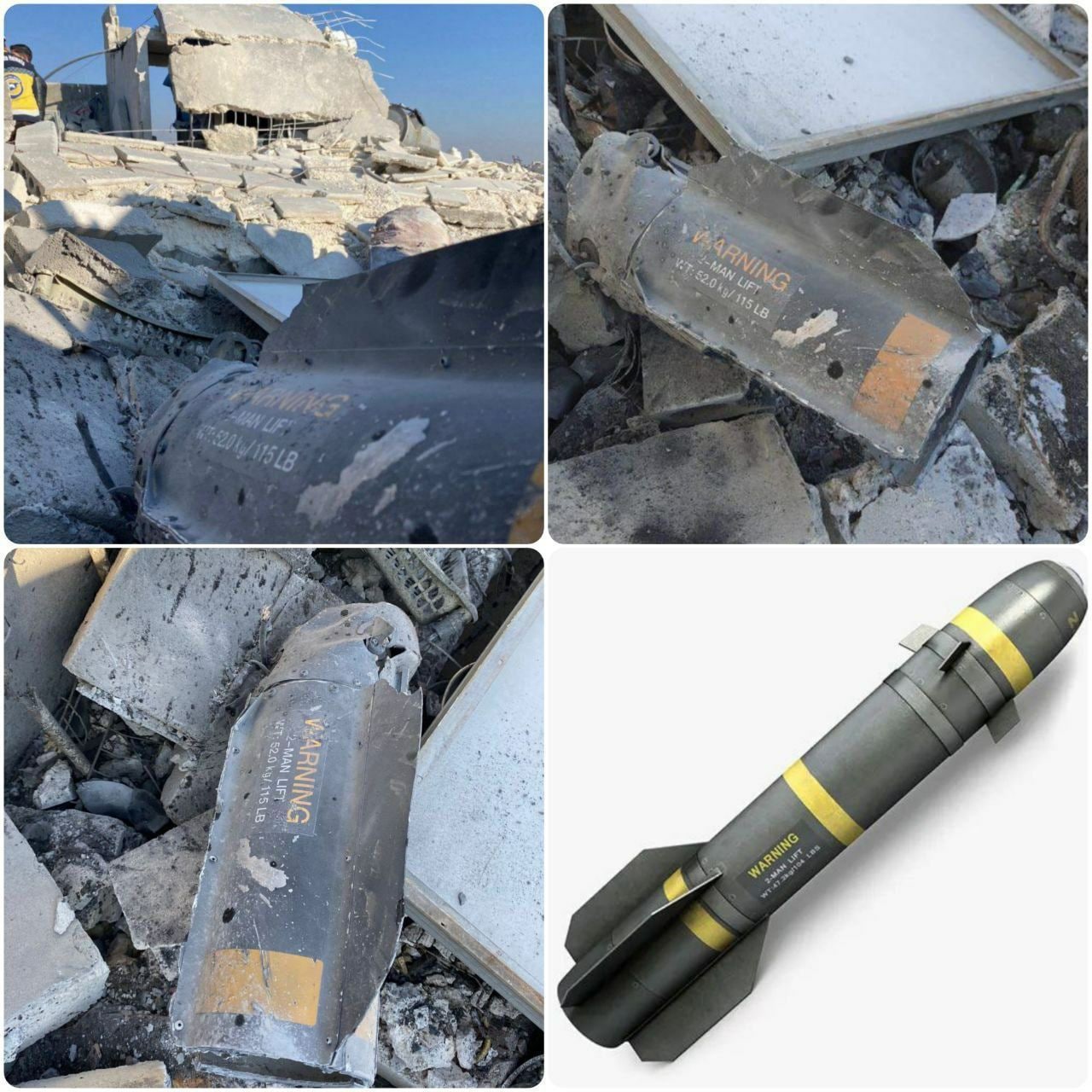
It is said that this attack was carried out by an American MQ-9 drone, and the remains of the missile at the scene of the incident show that this attack was carried out using an AGM-179 missile.
Remains of the missile at the scene of the attack
So far, the US officials and the US CENTCOM have not commented on the this attack.
Video of the attack siteTransfer of the injured to the medical center
On December 20, Bafel Talabani, the head of the Patriotic Union of Iraqi Kurdistan and Wahab Halabjai, the head of counter-terrorism of Sulaymaniyah, met and talked with Mazloum Abdi, the commander-in-chief of the Syrian Democratic Forces (SDF) in Syria’s Hasakah province.
In this meeting, which was also attended by Matthew McFarlane, the US CJTF-OIR commander, the latest political and military developments in the northeast of Syria, solving the problems of the region peacefully, the danger of ISIS and its hidden cells, maintaining good relations with neighboring countries and the strengthening of relations between the SDF and the PUK were discussed.
It is worth mentioning that this is the first time that Talabani has traveled to the areas under the control of the Syrian Democratic Forces in the northeast of Syria. Talabani’s visit to Hasakah in this sensitive time period and at the same time as the whispers of the start of the new Turkish operation in northern Syria, shows that he seeks to strengthen relations and support the Syrian Democratic Forces. Abdi also thanked Talabani for his trip to Hasakah for this reason and understanding this issue and the sensitivity of his trip.
After the formation of the ceasefire agreement in Yemen on April 2, 2022 and three periods of extension and finally its expiration on October 3, 2022, the areas under the control of the Saudi coalition were affected by a forced change in the head of the presidency (Resignation of Abd Rabbu Mansour Hadi and formation of the Presidential Council). This issue caused a series of tensions between different factions, and finally a kind of political and military deadlock prevailed between different groups under the command of the Saudi coalition. Therefore, the control of each of the parties was established over the regions, and now it is possible to distinguish the regions under the control of the groups in Yemen with more precision.
The map of Yemen war has been accurately edited in accordance with the latest field situation until December 16, 2022 and with the following categories and it is as follows:
1- Ansar Allah and popular committees: (green color) The areas under the control of Ansar Allah and popular committees include presence in 15 provinces in the west and center of Yemen, which include the capital, big cities and the majority of the country’s population. Despite the expiration of the cease-fire agreement with the mediation of the United Nations, there is no conflict in any of these fronts, and Ansar Allah is monitoring the fronts by carrying out various reconnaissance operations, as well as confronting the looting of Yemen’s oil resources by foreign tankers. Ansar Allah Movement and the National Salvation Government of Yemen are supported by the majority of the Yemeni people and the General People’s Congress and other Yemeni parties, as well as the foreign support of Iran and Islamic resistance groups.
2- The Saudi coalition and the Saudi-backed government of Yemen (ie the resigned government of Mansour Hadi): (red areas and all map colors except green) The areas under the control of the Saudi-led coalition forces include presence in 13 provinces of Yemen, which includes the largest area of this country. But the majority of these areas include desert and uninhabited areas. Despite this, the oil resources, the southern coast of Yemen and several strategic points are under the control of the Saudi coalition. The Saudi coalition uses these cases as tools to pressure Ansar Allah in negotiations. Nevertheless, despite the access of the Saudi coalition to all the areas under the control of the anti Ansar Allah groups, the factions under this coalition have competition and armed conflict with each other to control these areas. The structure of the resigned government of (Mansour Hadi) Yemen, like other countries involved in civil war, is a structure that divides positions and ministries between powerful factions in order to use the human power and military facilities of these factions against the main enemy. These factions include: Islah Party, Southern Transitional Council, Yemeni National Resistance under the command of Tareq Saleh, each of them have managed to influence and control parts of Yemen in recent years, especially after the resignation of Abd Rabbu Mansour Hadi and the formation of the Presidential Council. Which is explained as follows:
3- Southern Transitional Council: (blue color) The “Southern Transitional Council” (STC) is the name of a council consisting of the main currents of South Yemen, including Al-Hirak Al-Janoubi (Southern Movement), Southern Resistance and the South Arabian League Party, which was established on May 4, 2017, and their goal is to divide south Yemen. Currently, based on the Riyadh agreement in November 5, 2019, this movement holds the post of prime minister and half of the 24 ministries of the government. The geographical area under their control also includes: Aden province, most areas of Lahij and Abyan provinces and parts of Al-Dhale’, Hadhramaut and Taiz provinces.
It should be noted that the forces of Hizam al-Amni (Security Belt), Al-Haba Al-Hadhramiyah, Southern Resistance and other southern armed brigades are sub-groups of the Southern Transitional Council and are under the support of the United Arab Emirates.
4- Islah party: (purple color) The Islah Party (Reform Party) is one of the largest and oldest parties in Yemen, and it acts as the representative of the Muslim Brotherhood in Yemen. This party was formed on September 13, 1990 by Sheikh Abdullah ibn Husayn al-Ahmar, one of the elders of the Hashid tribe, and has been operating since 2007 under the chairmanship of Mohammed Abdullah al-Yadumi. After the start of the Saudi coalition’s invasion of Yemen, the Islah Party announced its support for this operation on April 3, 2015, and entered into a battle with Ansar Allah.
Currently, the cities of Marib, Taiz, Seiyun and the desert areas of Al-Jawf province and parts of Shabwah and Hajjah provinces are under the control of this party’s militants.
5- Forces loyal to Tareq Saleh (Yemeni National Resistance): (yellow color) “Yemeni National Resistance” is the name of a military group led by Tareq Saleh, the nephew of Ali Abdullah Saleh, the former president of Yemen, which was formed in December 2017. This organization has more than 10,000 members and consists of several factions, including former members of Ali Abdullah Saleh’s presidential guard, the former army soldiers and security forces separated from the Sana’a government, Al-Amaliqah and Al-Tihamah Resistance forces.
The areas under the control of Tareq Saleh forces are the southwestern region of Yemen, including the district of Hays in the south of Hudaydah province, the western areas of Taiz province, as well as the districts of Bayhan and Ain in Shabwah province. It is worth noting that this military group (Tareq Saleh forces) is under the support of the United Arab Emirates, the Amaliqah and Tihamah forces receive their orders from the command of the Saudi coalition, especially the UAE, instead of Tareq Saleh…
6- Al-Qaeda, Ansar al-Sharia and ISIS terrorist groups: (gray hachure) The activities of the Al-Qaeda terrorist group in Yemen under the name of “Al-Qaeda in the Arabian Peninsula” (AQAP) began in 2009 and continued under the name of Ansar al-Sharia group since 2011. After the resignation of Ali Abdullah Saleh and the presidency of Mansour Hadi, this group acted in a more organized manner and took full possession of some points; But the advance of Ansar Allah and the intelligence of the field commanders of this movement in taking control of the cities of Sana’a, Saada, etc., prevented Al-Qaeda from advancing. Therefore, in order to survive their activities, Al-Qaeda forces were stationed in the remote areas of Yemen, including the deserts of eastern Yemen, the north of Al-Baydha province, and several other places. Currently, this group does not have any city or region completely under their control, and their sphere of influence includes the desert areas of Hadhramaut, Shabwah and Abyan provinces. Also, after the Ansar Allah operation in the north of Al-Baydha province, Al-Qaeda members were transferred to the city of Marib and placed under the command of Islah Party.
The Islamic State Wilayat al-Yaman (Yemen province) group (IS-YP) also announced its formation in November 13, 2014, and apart from bombings, assassinations, etc., no special activity has been seen so far. ISIS members in Yemen are generally from extremist tribes in the east and south of Yemen and people separated from Ansar al-Sharia and al-Qaeda terrorists groups.
It should be noted that the formation of terrorist groups in Yemen is closely related to the actions of Mansour Hadi, the former president of the resigned government, Ali Mohsen Ahmar, the former vice president of the resigned government, and several other heads of parties and security institutions. In this regard, the criminal court of Yemen has convicted and prosecuted these people.
According to a Syrian military source, “at 00:30 Tuesday local time, the Israeli enemy fired several missiles from the north side of Lake Tiberias, targeting points around the city of Damascus. Air defense systems were activated to deal with missiles and intercepted a number of them. This attack resulted in the wounding of two Syrian soldiers and material damages.
It is worth mentioning that on November 22, the fighter jets of Israeli regime fired a number of missiles towards the central and coastal areas of Syria, during which four members of the Syrian army were martyred.
According to the public relations report of Quds headquarters in the southeastern region, the terrorist attackers left the area after heavy resistance from the Iranian forces and fled into Pakistan. No details have been published about the exact losses and damages inflicted on the terrorists. Colonel Hossein Ali Farahi, commander of the Saravan Border Regiment, referring to the prevention of the border guards stationed in the “Esfandak” region from the entry and sabotage acts of terrorist groups, said:
“Terrorists did not have the strength to resist the heavy fire of the border guards and fled towards the opposite country (Pakistan) using the mountain grooves. During the clearing of the conflict area, border guards also discovered 340 Kalashnikov bullets, 190 other bullets with two M16 magazines, eight hand grenades, 24 40 mm anti-personnel bullets, one 40 mm anti-armor bullet, one Kalashnikov bayonet, one wireless communication device, a compass, three sleeping bags, a blood supply pack and two tourniquets.”
It should be noted that during these clashes, four Iranian servicemen including 2nd Lieutenant Mohammad Gudarzi was martyred along with three members of the Basij, namely Rahim Bakhsh Paraki (Sunni), Hamidreza Abedi and Mahmoud Nikkhahzadeh.
Saravan is one of the cities of Sistan and Baluchistan province, which is located in the easternmost point of Iran and borders with Pakistan. Most of the residents of this city are Sunni Muslims, and this has caused terrorist and separatist groups based in the deserts of Pakistan to direct most of their activities to this city.
The Russian army launched a heavy attack on the positions and energy infrastructure of the Ukrainian forces in the Obukhiv area and other parts of Kyiv oblast with several Shahed-136 suicide drones this morning on December 19.
According to the sound of Russian drones heard in the sky of Mykolaiv and Dnipropetrovsk oblasts, it seems that the origin of the drone attack was from the southern regions of Ukraine, probably from the Crimean peninsula.
According to the statements by the Ukrainian military administration in Kyiv, this attack targeted important infrastructure facilities in the capital, however, the Ukrainian army air defense systems managed to shoot down 30 of the 35 drones used in this attack.
Ukrainian forces shot at Russian dronesA suicide drone hit the Ukrainian positions in KyivA suicide drone hit the Ukrainian positions in KyivContinuation of fire in electrical installationsImages of the explosion in Kyiv
After the implementation of intelligence-security operations of the Islah party in Marib and the occurrence of numerous conflicts between the forces loyal to the resigned government of Mansour Hadi (Sagheer bin Aziz forces) and the Marib tribes, tensions have increased over the control of oil fields in the Marib province. In this regard, Lt. Gen. Sagheer bin Aziz has ordered the expulsion of the Islah Party militants from the Sixth Military District. Also, some local sources have reported the intention of Saghir bin Aziz to attack Al-Safer oil field and refinery.
Islah Party has arrested or killed some people related to Saghir bin Aziz during intelligence-security operations in recent days.
At the same time as these tensions, the armed tribes of Al Fajij and Al Rashid Manif have clashed with each other in the Wadi Ubaidah region. This conflict has resulted in casualties and damages among the armed men of both sides.
Lieutenant General “Sagheer bin Hamoud Ahmed Aziz” is the current chief of the Saudi-backed Yemeni Armed Forces Staff (the resigned government Mansour of Hadi), who also has a history of being a member of the Yemeni People’s Congress Party. During the battles of Ansar Allah and the Saudi coalition in Marib, Sagheer bin Aziz was sent to Marib with the support of the UAE and Tariq Saleh and took control of some fronts. His presence in Marib continued after the announcement of the ceasefire in Yemen and entered a new phase with the tension between Islah Party and the forces loyal to the resigned government.
Sagheer bin Hamoud Ahmed Aziz, chief of the Saudi-backed Yemeni Armed Forces Staff (the resigned government of Mansour Hadi)
According to local sources, after the explosion, gunshots were heard from this base and the US aircraft made a reconnaissance flight over the area.
There is no information about the number of casualties and the details of this incident, and until this moment Iraqi and American authorities have not commented on this incident.
1- Donetsk: On December 12, following the Russian army’s new attacks on the eastern axis of Bakhmut city and the Soledar-Bakhmut road, the Russian-led forces succeeded in making minor advances near the Pidhorodne settlement. Some Russian media have published news about the complete withdrawal of Ukrainian forces from this settlement, which has the aspect of psychological warfare and is not true. According to their previous experiences, the Ukrainian forces are trying to stop the Russian army ground forces with the support of heavy artillery fire, and this tactic has been effective so far. Also, the AFU command has sent its auxiliary forces under the name of the 57th brigade from Chernihiv oblast to these fronts, and it seems that the Ukrainians still have no intention of withdrawing from Bakhmut.
– On December 13, following the Russian army attacks on the eastern front of Bakhmut, Artwinery factory was captured by the Russians. Clashes are currently taking place along along Fedora Maksymenka street in the east of Bakhmut city. View on the online map
– On December 16, Russian army artillery heavily shelled the positions and gatherings of Ukrainian forces in Bakhmut, Soledar and Opytne settlements.
2- On December 10, the Russian army attacked Ukrainian energy facilities in Odesa, Mykolaiv and Kherson oblasts with several suicide drones. Ukrainian southern command claims to have shot down 10 Shahed-136 suicide over the Kherson, Odessa and Mykolaiv oblasts. Local sources have also reported the sound of several explosions in these three oblasts and power and water cuts in the city of Odesa.
3- Kyiv: On December 14, the Russian army attacked positions of Ukrainian forces in the city of Kyiv with several Shahed-136 suicide drones.
4- According to Western media reports, the US officials are considering and making a final decision to send the Patriot air defense system to Ukraine. In response to this decision, Russia warned the US, calling it a “provocative” move that “can lead to unpredictable consequences.”
5- On December 16, the Russian army heavily targeted Ukrainian energy facilities in different cities of Ukrainie with dozens of Kha-101 and Kha-55 cruise missiles.
Russian missiles hit Zaporizhzhiapower plant facilities
6- On December 17, Russian President Vladimir Putin participated in the meeting of military commanders in the command room of the Russian military special operations in Ukraine. In this meeting, Putin was briefed on the latest military developments in Ukraine by General Sergei Surovikin, the commander of the Russian forces in Ukraine, And also he had a separate meeting with Defense Minister Sergei Shoigu and Valery Gerasimov, Chief of the Joint Staff of the Armed Forces and other Russian military commanders. According to Russian media reports, in this meeting, Putin reviewed the proposals of Russian commanders regarding immediate and mid-term actions in the Ukraine war.
7- Luhansk: On December 16, as a result of Ukrainian shelling on the town of Lantrativka, a settlement close to the border with Russia 11 people were killed and 17 others were injured. In this attack, a school, a post office and several residential buildings were damaged.
8- Zaporizhzhia On December 11, Ukrainian army struck positions of Russian forces in the city of Melitopol using HIMARS systems. According to local sources, 10 explosions were heard during this attack. Also, some of these rockets reportedly hit a recreation center. No information is available on the amount of damages.
9- Crimea: On December 11, Russian Army announced the neutralization of Ukrainian suicide drone attack on Simferopol and Sevastopol.