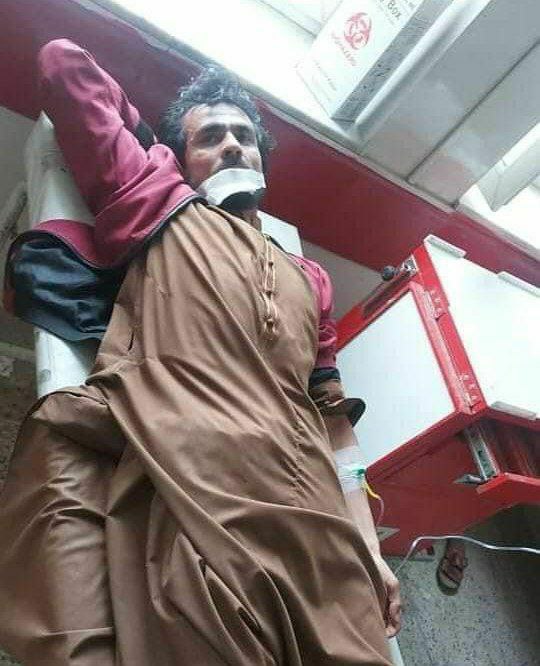
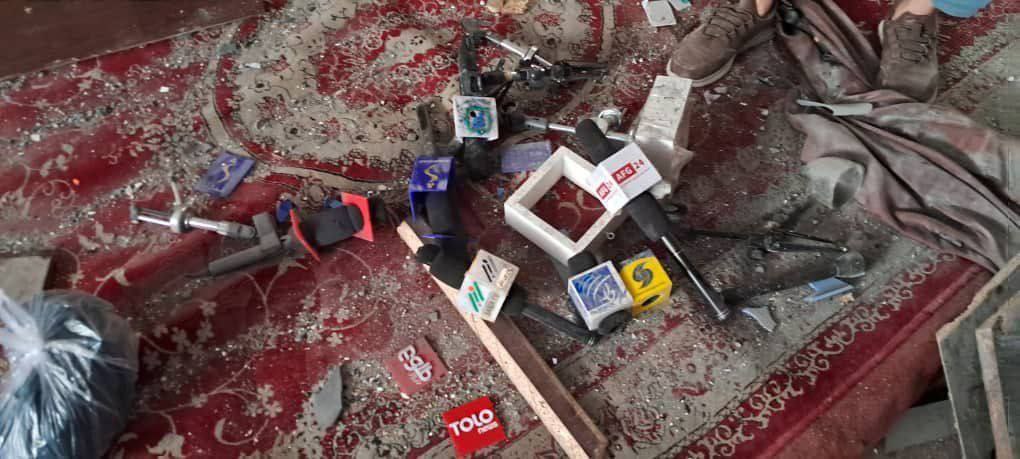
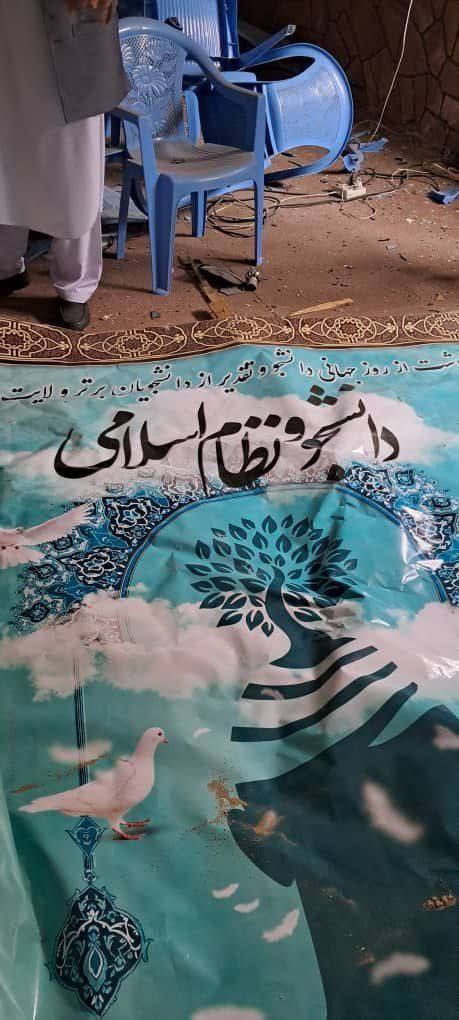
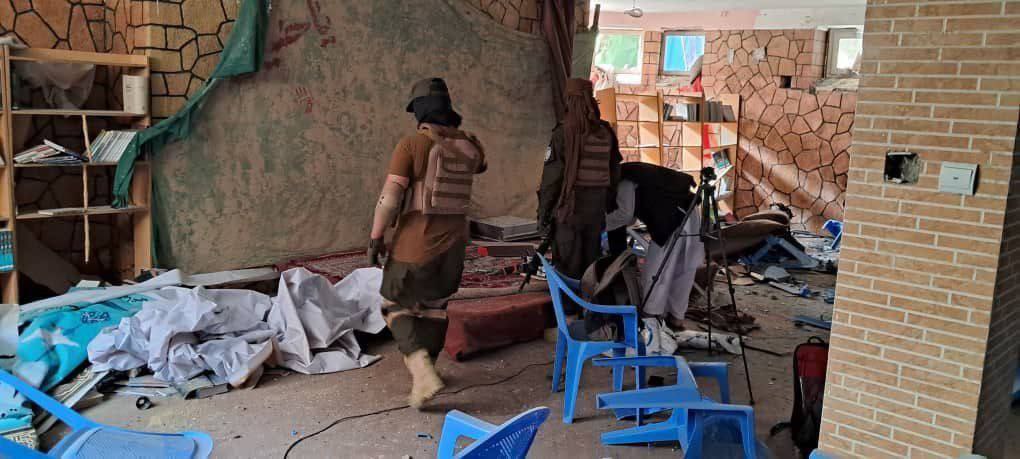
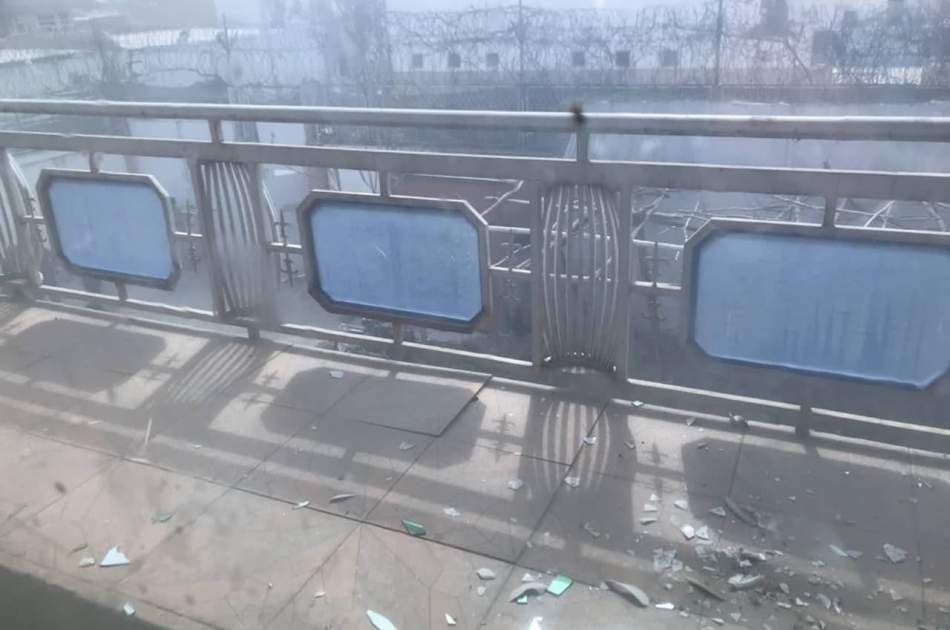
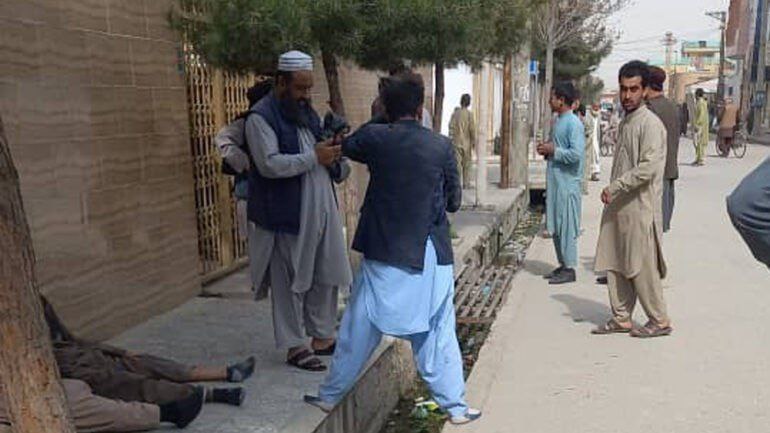
Abdul Nafi Takoor, Taliban’s spokesman for the Ministry of Interior, said that the terrorist attack left one dead and eight wounded. However, local sources quoted Ibn Sina Hospital as saying that the death toll of the terrorist incident mounted to three martyrs and 37 injured.
The Afghan Voice Agency (AVA) news agency and Tebyan socio-cultural center were holding a seminar to mark the National Journalist’s Day dubbed “Mahdism”, Media and Promotion of Culture” in order to hail reporters as well as cultural and civil operators in Balkh Province, when the terrorist attack happened.
It is worth mentioning that any individual or group has not yet taken responsibility of the terrorist and cowardice attack in the northern Afghan city of Mazar-i-Sharif.
Iran’s Foreign Ministry Spokesman Nasser Kanaani and the Iranian consul general in Balkh Province expressed sorrow for the martyrdom and injury of a number of journalists and cultural operators in the terrorist attack, voiced solidarity with the bereaved families of the victims of the incident, and strongly condemned such a heinous act.
The Afghan Voice Agency (AVA) news agency and Tebyan socio-cultural center form an independent cultural entity under the management of Seyyed Isa Hosseini Mazari. Terrorists attacked the headquarters of the institute in Kabul on December 28, 2017, which left 52 people such as staff members, religious scholars, students and elite martyred, and 140 others were injured.
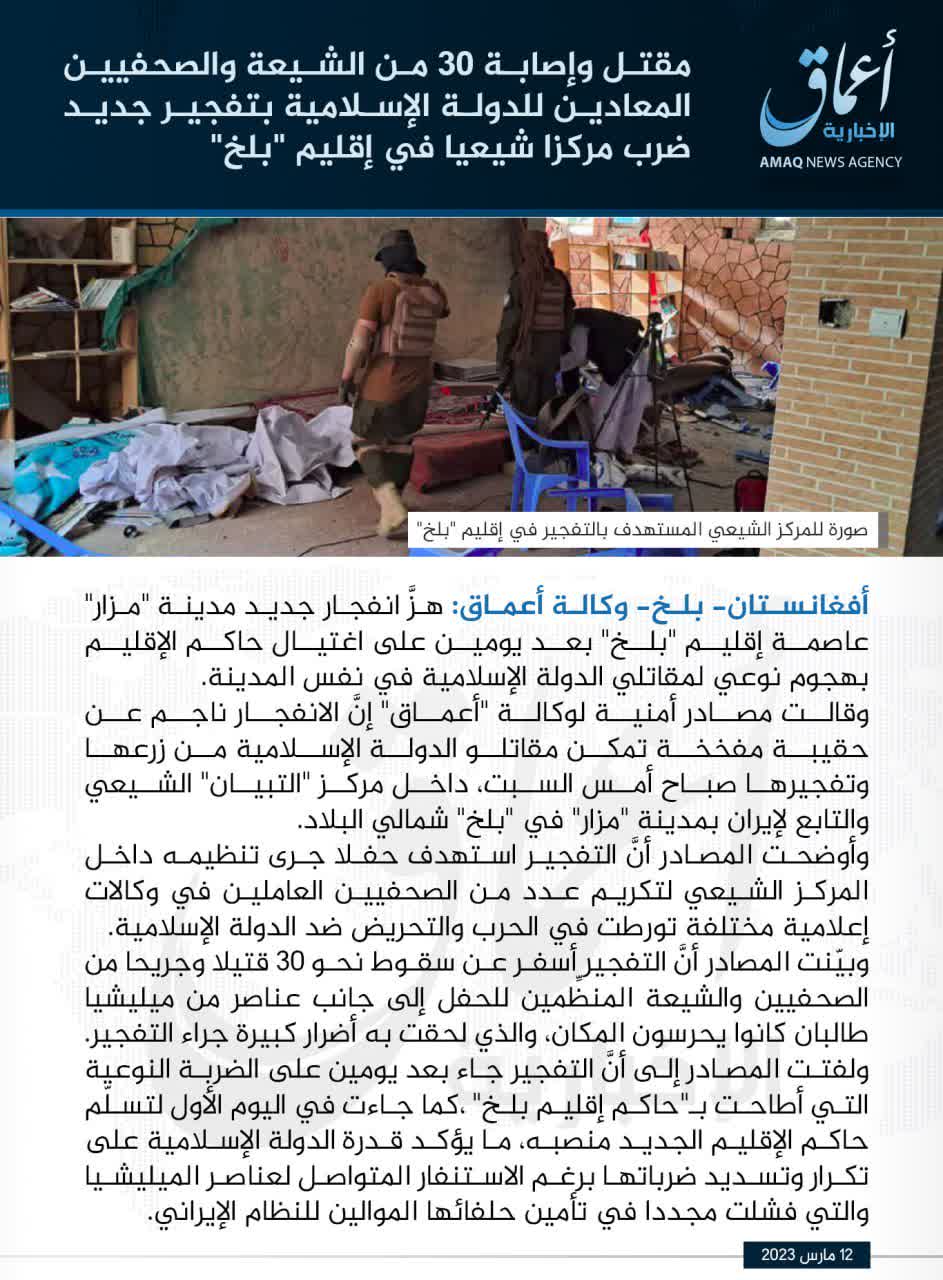
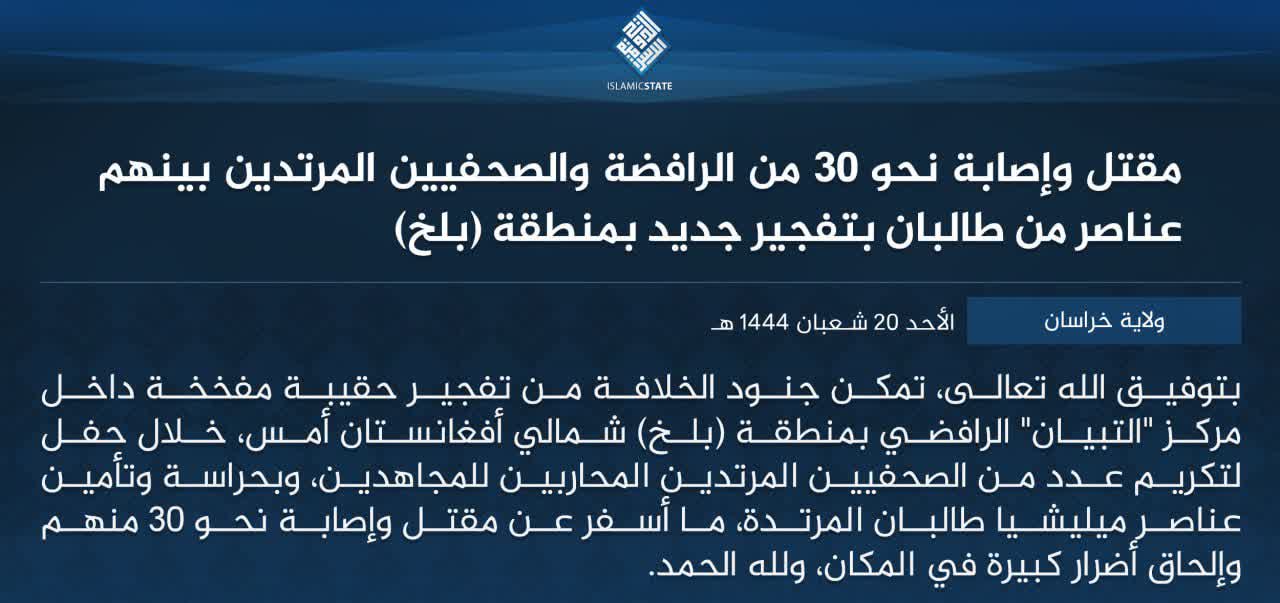
ISIS statement about the terrorist explosion in the center of Tebyan in the city of Mazar-e-Sharif
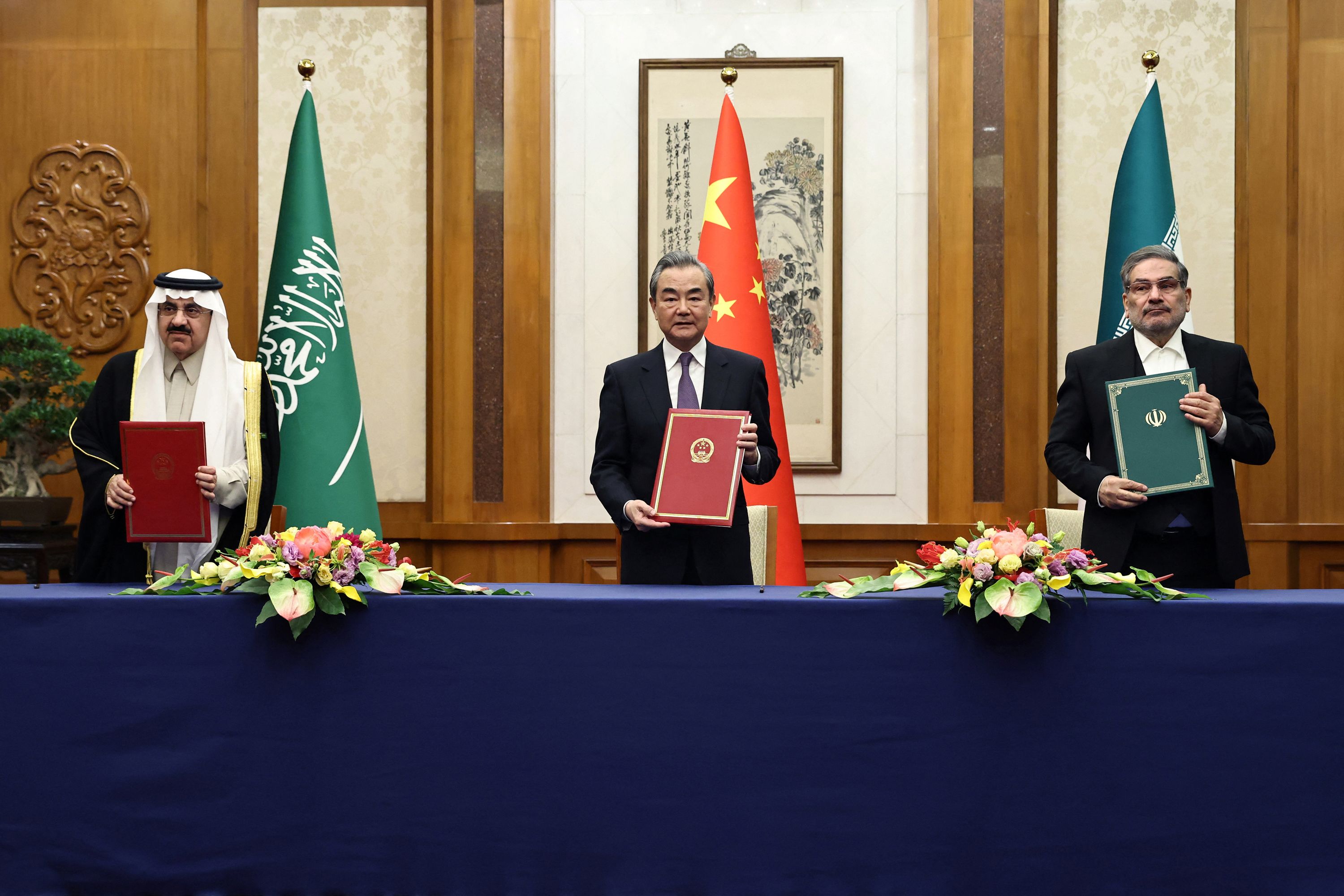
Following Iranian President Ebrahim Raisi’s visit to China in February and his talks with his Chinese counterpart Xi Jinping, the finalization of the agreement between Saudi Arabia and Iran was cemented. After the February consensus, Shamkhani left Tehran for Beijing on March 6 in order to carry out intensive talks with Al-Aiban. The two counterparts held negotiations to restore political relationship as well as resolve security and regional issues, but there have not been released the details of the talks in official sources. The agreement was declared on March 10, when China, Saudi Arabia and Iran issued a joint statement and signed the deal.
What was the other states’ reaction to Saudi-Iran deal?
The authorities of both Saudi Arabia and Iran as well as the most states in the West Asia region and the world welcomed the agreement and described it as a prelude to resolution of other disputes and regional issues, including the Yemen war.
Meanwhile, Coordinator for Strategic Communications at the US National Security Council John Kirby told correspondents that Saudi Arabia informed the United States of the talks with Iran, but Washington did not play any role in the negotiations. Kirby also adopted a hostile stance, when he said we should wait and see if Iran would respect the other side of the deal or not!
Secretary General of Lebanon’s Hezbollah movement Hassan Nasrallah depicted the agreement as an important development in the region, which will promise new horizons in the region and Lebanon.
Mohammad Abdul Salam, spokesman of Yemen’s Ansar Allah movement, who is in charge of negotiations of the National Salvation government, said that restoration of natural relations among regional states is necessary, noting that lack of security has its roots in foreign interventions in particular by the US and the Israeli regime. He said that Iranophobia project is in line with foreigners’ interests, who want to misuse internal rifts to create conflict and aggression in Yemen.
China’s Foreign Ministry issued a statement, announcing that the Iran-Saudi Arabia agreement is a victory for peace.
What are the benefits of the deal for China?
China could gain more credit at international arena and showed that it is a superpower in rivalry with the US after hosting the negotiations between Saudi Arabia and Iran. They also underlined that the United States’ policies and supports for Arab countries are inefficient. As part of its foreign policy, China has not been involved in hard competition with ultra-regional powers in any dispute so far, and the issue has been shown in the Ukraine war and the dispute with Taiwan, but their involvement in the Saudi-Iran agreement indicates that they pursue a special engagement in the West Asia region and they want to adopt soft competition and semi-hard competition with the US.
On the other hand, the resolution of conflict between Saudi Arabia and Iran would guarantee oil and other raw materials required by China.
What are the potential and undisclosed aspects of the deal?
Undoubtedly, the recent agreement between Riyadh and Tehran to restore relationship is a positive news for both countries and the West Asia region. It seems that Saudi Arabia has reached to the conclusion after eight years of war with Yemen that it cannot dominate a popular government and force by resorting to the most advanced and best Western and Eastern military equipment. The Saudis were of the opinion in the beginning of the war on Yemen that the Ansar Allah movement is a militia group, which would be weakened and forced to succumb following some classic operations and aerial bombardment, but the military and political support by Iran along with popular backing of people residing in western provinces of Yemen led to the consolidation of the National Salvation government and the preservation of strategic lands of the Arab country under the rule of Islamic resistance axis. Therefore, Saudi Arabia’s defeat in the war on Yemen is the main reason behind the Saudi’s intention to the negotiating table.
Given the significant role by Iran in Yemen’s developments, it is expected that the peace negotiations in the war-torn country would reach more important results in the coming months. The deployment of foreign forces in different regions and bases inside Yemen, the activities of the separatist groups such as the Southern Transitional Council (STC) and terrorist groups like al-Qaeda and the ISIS, as well as the dependence of anti-Ansar Allah movement factions to the United Arab Emirates (UAE) and Saudi Arabia are expected to be the potential hurdles in the formation of peace in Yemen.
Another issue, which can be mentioned as one of security aspects of the Saudi-Iran deal, is security threats and media activities of both sides against each other. Over the last years, Saudi-funded media apparatus established anti-Iran research centers such as Rasana and Iran International TV network in order to create propaganda campaign, which was along with fomenting unrest in Iran by the West. Seemingly, Saudi Arabia and Iran have reached agreements in this respect, but the details of the accords have not been announced yet.
In a bigger picture at the current regional and international levels, Iran has been facing more harsh tensions and threats by the Western states and Israel on its nuclear dossier and its regional influence comparing to the circumstances in the past years. The expansion of the Zionist regime’s influence in security periphery of Iran, the exacerbation of economic sanctions imposed by Europe, numerous military drills by the US and Israel as well as their joint threats against Iran’s nuclear and defense facilities are all among the West’s new plots against the Islamic Republic. Of course, Saudi Arabia showed via signing the agreement that it intends to get rid of potential Iranian response to the Western states’ strikes and it tries not to turn into a possible battle ground for potential future confrontation between the West and Iran.
In conclusion, the agreement between Saudi Arabia and Iran should be viewed as a mid-term ceasefire. The Saudis’ strategic measures and projects in the Central Asian states and in Azerbaijan Republic can violate Iran’s interests and security, and despite China’s assurances, there is not any guarantee for their sincerity in dealing with the Iranians.
On March 3, Cohen issued a statement declaring the establishment of a permanent embassy in Turkmenistan’s capital Ashgabat.
He explained that the relationship between Turkmenistan and Israel is important and strategic, which is part of the efforts to strengthen Israel’s ties with the whole region. We will keep on enhancing economic ties as well as cooperation in healthcare and cyber defense sectors between the two sides.
Cohen went on to say that the inauguration of the permanent embassy in Turkmenistan is another sign that indicates the consolidation of 30-year-old strategic ties between Israel and Turkmenistan.
The Zionist regime selected Shemi Tzur, who is considered as one of the most active diplomats of the regime, to become Israeli ambassador to Ashgabat.
Tzur was born in 1946 in the occupied Palestine and his family had been residing in Tabriz, East Azarbaijan Province, Iran. Tzur was ambassador of the regime in Cyprus, New Zealand, Turkmenistan, Finland, and Estonia.
The veteran diplomat has also been Consul at the Consulate General of the Zionist regime in Sydney, Acting Ambassador to Fiji, Acting Ambassador to Angola and Mozambique, Ambassador Non-resident to Armenia, Kyrgyzstan, Tonga, Samoa and Cook Islands and opened the Israeli embassy of in Uzbekistan.
Tzur also was in charge of Eurasia Department in Israel’s Foreign Ministry, and traveled to Turkmenistan 15 times over the last two years; so, he has been performing as special envoy of the Israeli regime to Ashgabat.
Turkmenistan’s capital city of Ashgabat is located 25 kilometers away from Iran’s borderline. Israel has recently shown attention to the Central Asian country, because Turkmenistan is located near Iran and has around 1,000 kilometers joint borders.
The establishment of permanent embassy of the Zionist regime in Turkmenistan would improve the regime’s influence near Iran’s security periphery and set up a stronghold for the Israelis to create different security and economic problems for the Iranian northeastern cities as well as get in the way of relationships between Iran and the Central Asian nations.
Representatives of Azerbaijan and the de-facto government of Artsakh met with each other in Khojaly on Wednesday, March 1, and discussed several technical issues. It was reported that Lachin Corridor and environmental monitoring issues were discussed at the meeting. Artsakh political officials stated that political and security issues were not discussed in this meeting.
This is the second meeting of its kind after the removal of Ruben Vardanyan, the state minister of Artsakh from his position on February 23.
It is said that Azerbaijan’s precondition for this meeting was the dismissal of Artsakh government minister Ruben Vardanyan. The Baku government and Ilham Aliyev conveyed this demand to the Armenian authorities of Nagorno-Karabakh through Armenian Prime Minister Nikol Pashinyan. Also, according to speculations, Armenia has played its mediating role.
It should be noted that last week, Arayik Harutyunyan, the president of Artsakh, dismissed Ruben Vardanyan, the state minister of Artsakh. Ruben Vardanyan, who is a dual citizen of Armenia and Russia, returned to Nagorno-Karabakh last year and it was said that he was supposed to smooth the process of Nagorno-Karabakh’s accession to the Russian Federation.
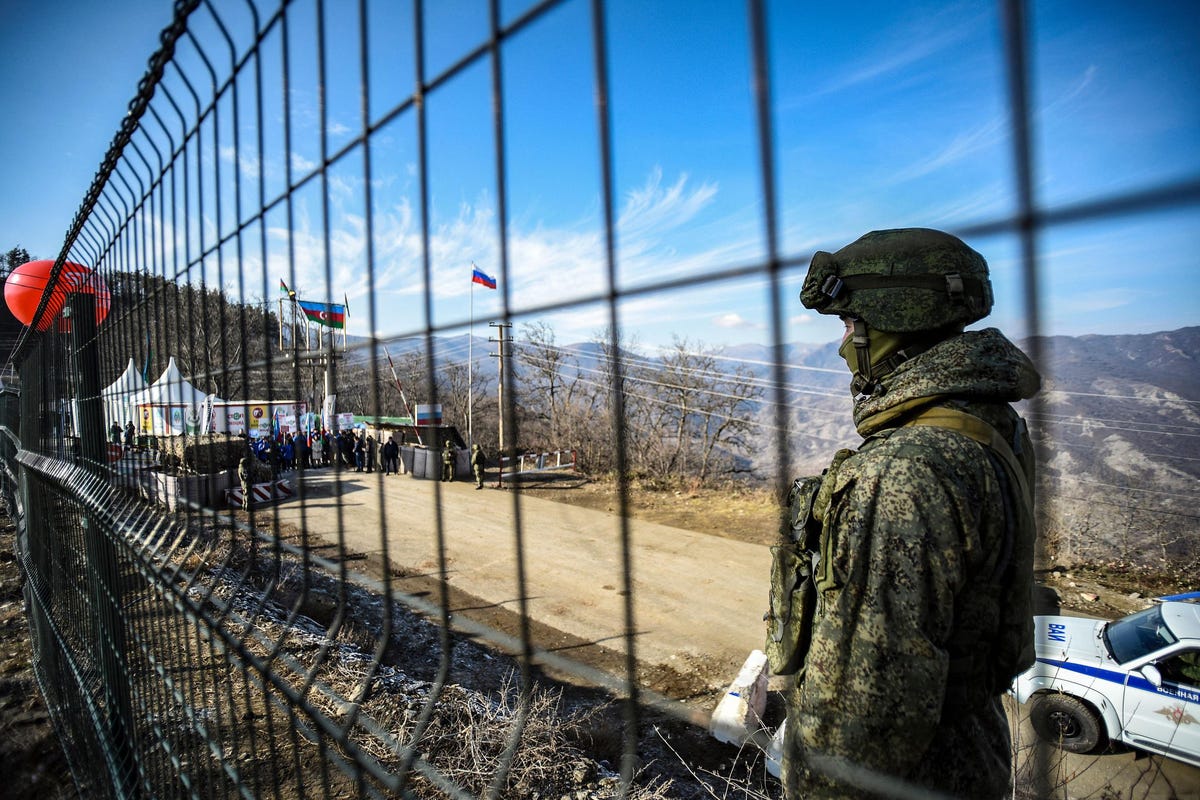
At the meeting, the issues of restoration of unhindered traffic through the Lachin corridor and purposeful use of the Lachin corridor were discussed. This was reported by the command of the Russian peacekeeping contingent to “Artsakhpress” agency.
The parties also discussed issues of regular electricity and gas supply.
In addition, within the framework of the meeting, the possibility of environmental monitoring of the representatives of the Azerbaijani side in the Drmbon and Kashen mines was discussed.
Lusine Avanesyan, spokesperson of the Nagorno-Karabakh president, called the meeting “constructive” in her statement to the Armenpress publication.
According to information provided by Karabakh Information Department, the DKR (Nagorno Karabagh Republic) President, Arayik Harutyunyan said at the government cabinet meeting on March 1 that “any integration process with Azerbaijan is excluded.”
“I want to emphasize once again that we will remain loyal to the Artsakh movement, despite the difficulties and pressures we are subjected to. I want to declare with full responsibility that any integration process with Azerbaijan is excluded. However, this does not mean that we will avoid contacts aimed at solving infrastructure and humanitarian problems. As I said in my address dated February 23, certain conditions and an international format should be provided for the negotiations on the settlement of the conflict”, Arayik Harutyunyan said in his speech.
The first meeting between the representatives of Azerbaijan and Nagorno-Karabakh took place on February 25, after Ruben Vardanyan, the state minister of state of Nagorno-Karabakh was removed from his post. On that time, the news of the first negotiation between the government of Baku and the de facto government of Artsakh was made public by the authorities of Nagorno-Karabakh, but the official authorities of Azerbaijan refused to announce it.
It is important to note that, although Arayik Harutyunyan, the president of Artsakh, which holds the power of Nagorno-Karabakh, was forced to oust Ruben Vardanyan from his position, he scored a point for the region in doing so. The negotiations between the government of Baku and the authorities of Nagorno-Karabakh mean recognition of the independent existence of Armenians in Nagorno-Karabakh. Since 32 years ago, when the Armenians of Nagorno-Karabakh and the Shahumyan region in the north of this region held a referendum on independence, the authorities of Azerbaijan, while dissolving the autonomous region of Nagorno-Karabakh in the divisions of the country, rejected any meeting and dialogue with the Armenian government known as Artsakh, and basically they did not recognize them. Therefore, recognizing Artsakh and negotiating with them is considered a win for the Armenian of Nagorno-Karabakh. Also, despite the dismissal of Ruben Vardanyan, Vardanyan is still in the Nagorno-Karabakh region and still maintains shadow power due to his relations with Russia and ensuring the security of Armenian officials and the needs of the people of this region.
A picture of the second meeting between representatives of the government of Baku and the government of Artsakh with the presence of Russian peacekeepers
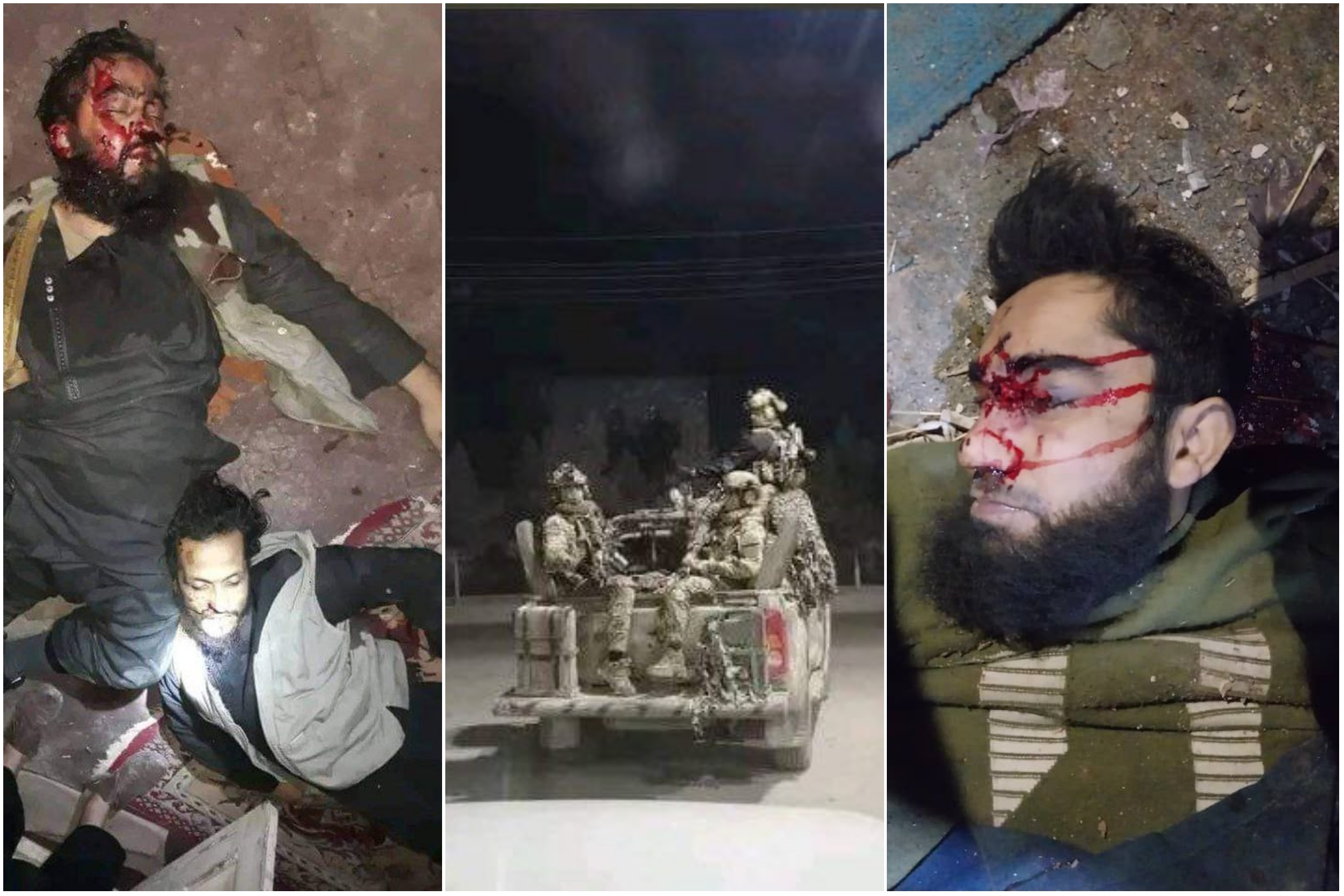
On February 26, the Taliban forces attacked the IS-KP (or ISIS-K) terrorists’ den in Zakerin town located in the 17th district of Kabul, which left three ISIS terrorists dead.
Taliban spokesman Zabihullah Mujahid issued a statement, confirming the news story, and said that all recent terrorist attacks on diplomatic, cultural and religious sites in Kabul have been ordered by Qari Fateh.
Qari Fateh was in charge of military wing of Khorasan branch of the ISIS terrorist group (IS-KP), and then, he was appointed as the IS-KP emir in Kunar, Nangarhar and Nuristan provinces of Afghanistan. He has been recently chosen as the intelligence chief of the IS in Khorasan Province, but he has been identified and then killed by Taliban.
He is the second Islamic State Khorasan Province’s top official, who has been hunted and killed by Taliban’s security forces in the past two months. On February 13, as a result of the operation by Taliban security forces against the hideout of IS foreign operatives in the 8th district of Kabul, 10 members of IS-KP, including Ejaz Hossein Ahangar, alias “Abu Othman Al-Kashmiri”, the leader of IS-KP in the Wilayat Hind, were killed, and 15 others including five women and nine children were arrested.
Ousting of state minister of Nagorno-Karabakh region
The first event was that President of Republic of Artsakh Arayik Harutyunyan, which is De Facto Armenian government of the Nagorno-Karabakh Region also dubbed Artsakh, issued a decree to oust State Minister of Artsakh Ruben Vardanyan. Independent sources believe that the ousting happened as a result of the intervention and pressure by Prime Minister of Armenia Nikol Pashinyan. Vardanyan, who possesses double nationality of Armenia and Russia, returned Karabakh last year and renounced his Russian citizenship. It is said that Vardanyan was to pave the way for the accession of the Nagorno-Karabakh region to the Russian Federation.
The Republic of Azerbaijan claims that Vardanyan is the root cause of crisis in Karabakh’s mines; the illegal excavation, the Baku government alleges, denies the rights of Azerbaijan people as well as causes environmental pollution. The recent protest by environmental activists in Shusha or Shushi, organized by the Baku government, has happened due to the reason.
Conviction of Aliyev’s environmental activists in ICJ
The second event of the past week was the failure of legal efforts by the Republic of Azerbaijan and the victory of Armenia in the International Court of Justice (ICJ) regarding the closure of the corridor between Lachin and Khankendi (Stepanakert), which is the de facto capital of Republic of Artsakh.
On February 22, The Hague Court of Justice found the Azerbaijan government guilty due to acts committed by so-called environmental activists, who closed the connection of the corridor to outside world, ruling that Azerbaijan must open Lachin Corridor. The verdict translates into the violation of human rights of Armenians by the Baku government.
The two governments of Armenia and Azerbaijan had filed lawsuits with the ICJ. The court issued the verdict in the 72nd day of the closure of the road.
The authorities of the government in Baku, including President of Azerbaijan Republic Ilham Aliyev, claimed that the environmental activists have not closed the corridor and the vehicles of the Russian peace-keepers and the Red Cross can transit there. But the Red Cross personnel confirmed statements by the Armenian officials of the Karabakh region on the difficult circumstances of the people there as well as all-out economic siege and the lack of electricity and gas in the region. The blockade kicked off on December 12, 2022 as a result of the presence of hundreds of people in the checkpoint of the north of Shusha city and it still underway. It is not clear, when the government of Aliyev will carry out the verdict of the ICJ.
Control of Karabakh by limiting transit
Orxan Məmmədov, an Azerbaijani analyst, told ISWNews that the point, where the environmental activists have gathered, is an area of 200 meters in the north of Shusha city in a crossroad, where the two roads of Lachin-Shusha and Khankendi-Armenia is located. The Russian peace-keeping forces have two checkpoints there and two other sides are controlled by Azerbaijan Republic. The peace-keeping forces and Azerbaijanis can use the crossroad, and the legal condition is so that the peace-keeping forces cannot uproot tents erected by the environmental activists.
Now, the government in Baku could create an unofficial checkpoint there by the use of the environmental activists in order to avoid the transit of the Armenians of the Karabakh region to Armenia and vice versa without the supervision of Azerbaijan Republic.
The next step by the Aliyev government is a negotiation to set up a customs office and a checkpoint in the area of about 200 meters in a bid to dominate the road, which is the only corridor of the Karabakh region with the outside world.
Following the Russian army operation to capture the important city of Bakhmut in the north of Donetsk Oblast, during the last four days, the Russian forces and its allies managed to advance in north of this city and captured the settlements of Berkhivka, Dubovo-Vasylivka and Yagidne. With the advances made, the Russian forces are only 3 kilometers away from the last supply route of the Ukrainian army to the city of Bakhmut. In this axis, the operation to advance towards the Bogdanivka settlement continues.
In the east of Bakhmut city, clashes continue in Zabakhmutka district. During the last week, Russian forces have managed to capture half of this district.
In the western and southern axis of the city, the Russian army has started a new operation to capture Ivanivske. Also, clashes continue in the south of the city and around the Mariupolske cemetery.
According to the progress of the Russian army around Bakhmut, it seems that the city of Bakhmut will be completely besieged in the near future or will be captured by Russia with the retreat of Ukrainian forces.
The publication of a footage of Kamov Ka-52 helicopter flying in the eastern Russian city of Vladivostok with a camouflage color proper for the West Asian or African states has reinforced the likelihood of selling this class of helicopter to Iran. Given the fact that the usage of that sort of camouflage color for the helicopters of the Russian Air Force seems not to be common and rational, it is probable that the helicopter has been prepared for selling to Iran or Algeria, who have collaborated and inked several military agreements with Russia in recent years.
The Kamov Ka-52 helicopter is an advanced Russian-made invasive multi-purpose one capable of flying in different weather circumstances. The Ka-52 helicopter has showcased satisfactory performance during the combats in Syria and Ukraine, and it seems to be an appropriate option for equipping and advancing the helicopter fleet of the Islamic Republic of Iran Armed Forces.
Kamov Ka-52 helicopter flying in the eastern Russian city of Vladivostok with a camouflage color proper for the West Asian or African countries
In recent days, there were various reports of military collaboration between Russia and Iran in selling Iranian-made ballistic missiles and suicide drones in return for Su-35 fighter jets, S-400 air defense systems, and Kamov helicopters (Ka-52), which have been confirmed by certain authorities in Iran. Shahriar Heydari, member of the National Security and Foreign Policy Commission of the Iranian Parliament, confirmed that Iran will buy Russian fighter jets, saying that “the Sukhoi 35 fighter jets that Iran ordered from Russia will enter the Islamic country early next Iranian calendar year (1402). We ordered defense systems, missiles and helicopters to Russia, and most of the arms will arrive in Iran as soon as possible.”
The Russia-Iran negotiations on the purchase of offensive, multi-purpose and light helicopters started among Iran Aviation Industries Organization, the JSC Kamov Company and other Russian military organizations in 2014, and the process sped up in the past months. The collaboration between Russia and Iran amplified following the continuation of the conflict in Ukraine as well as the Western sanctions on both states, leading to the enhancement of the might of the two countries in different military and economic arenas.
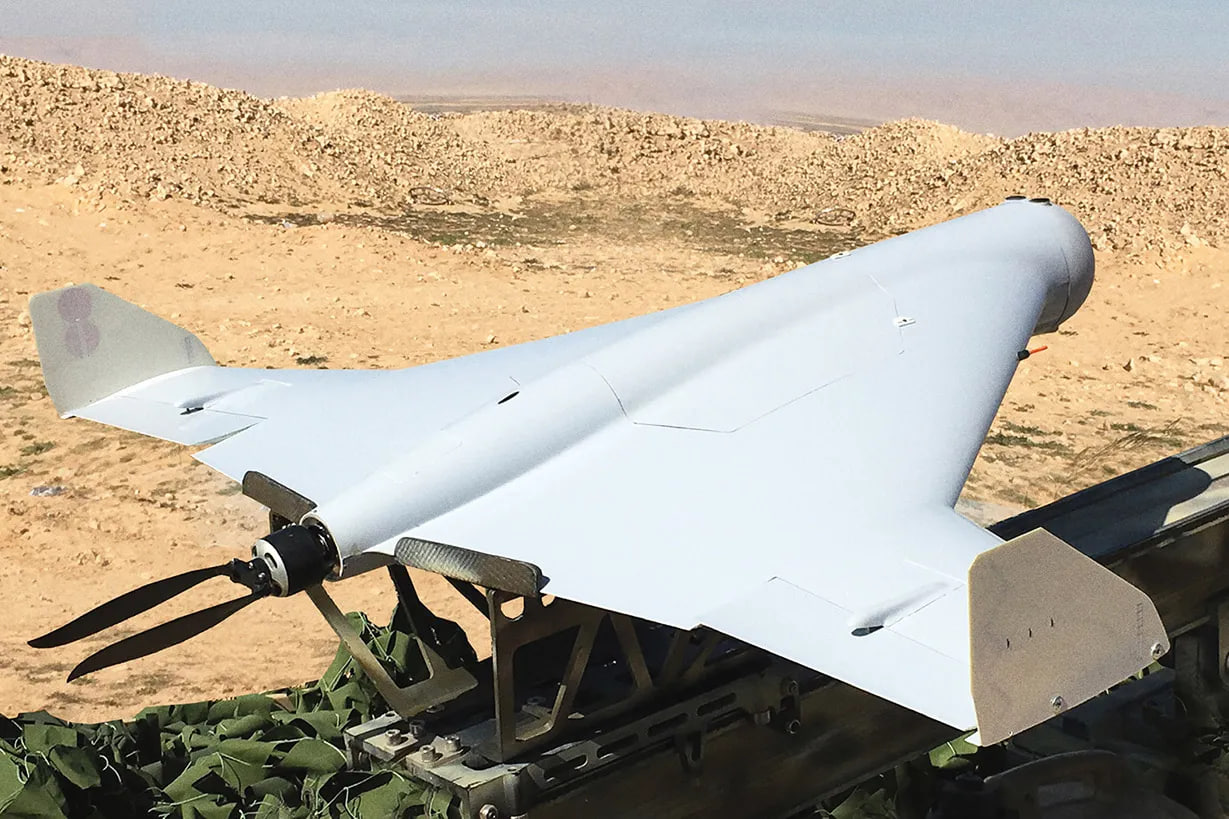
Following the onset of Russia-Ukraine war, orders for assault drones have remarkably increased. The Ministry of Defense of Russia is the main customer of the assault drones manufactured by the Kalashnikov Group. Thus, the production of the kamikaze drones “KUB-BLA” mounted in recent weeks, and the issue is one of the major priorities of the Kalashnikov Group.
KUB-BLA kamikaze drone was unveiled in the International Defence Exhibition & Conference (IDEX 2019) in Dubai, the UAE. The KUB-BLA drone’s speed is between 80 to 130 kilometers per hour and it can fly 30 minutes. The drone can carry three kilograms of explosive materials.
According to the group’s program to mount its production, it is probable that the company would put on agenda the increase of manufacturing Lancet drones, because they have been applied by the Russian forces in the war against Ukraine.
It is notable that both KUB-BLA and Lancet drones were manufactured by the Russian company named ZALA Aero affiliated to the Kalashnikov Group.
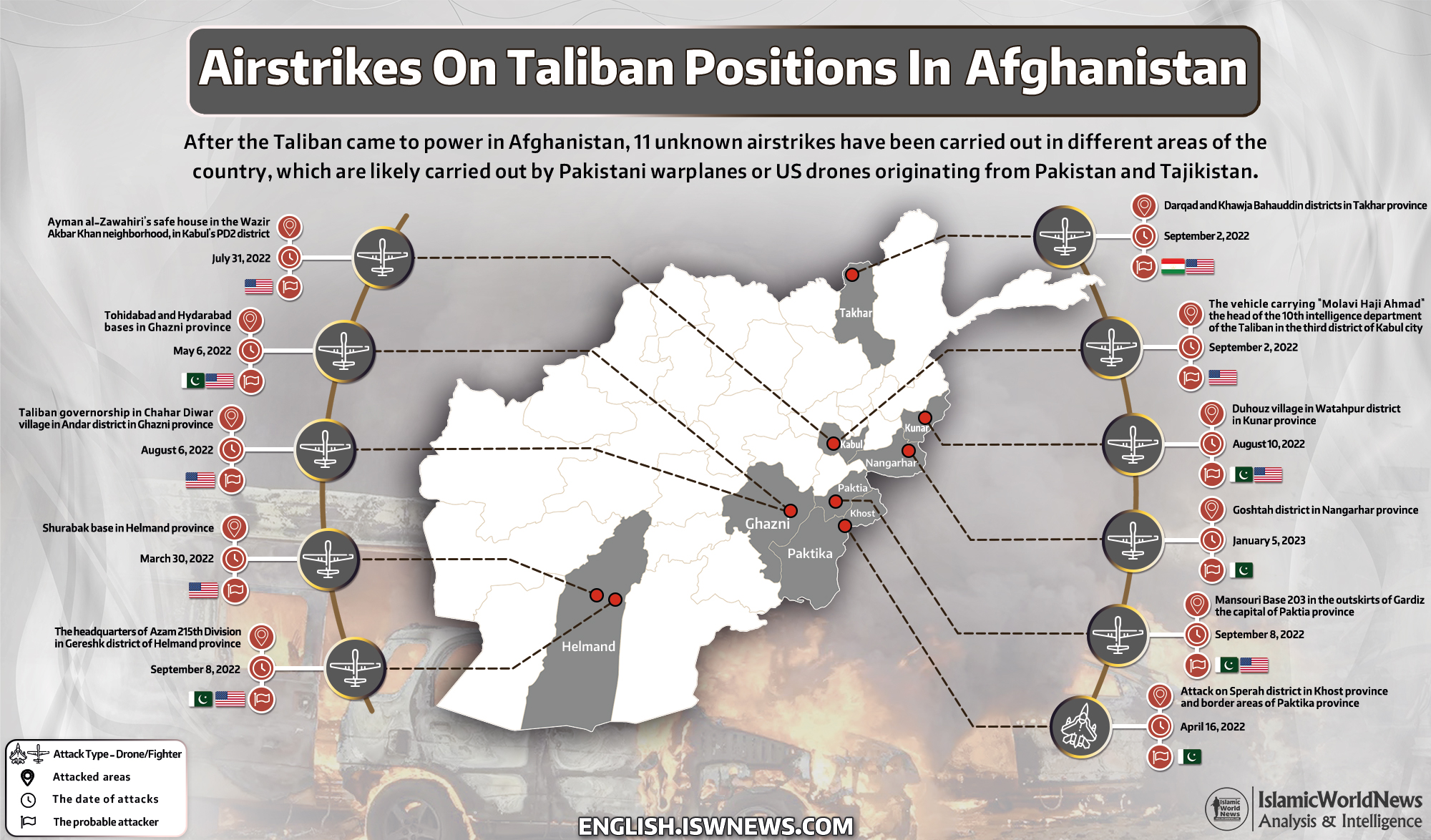
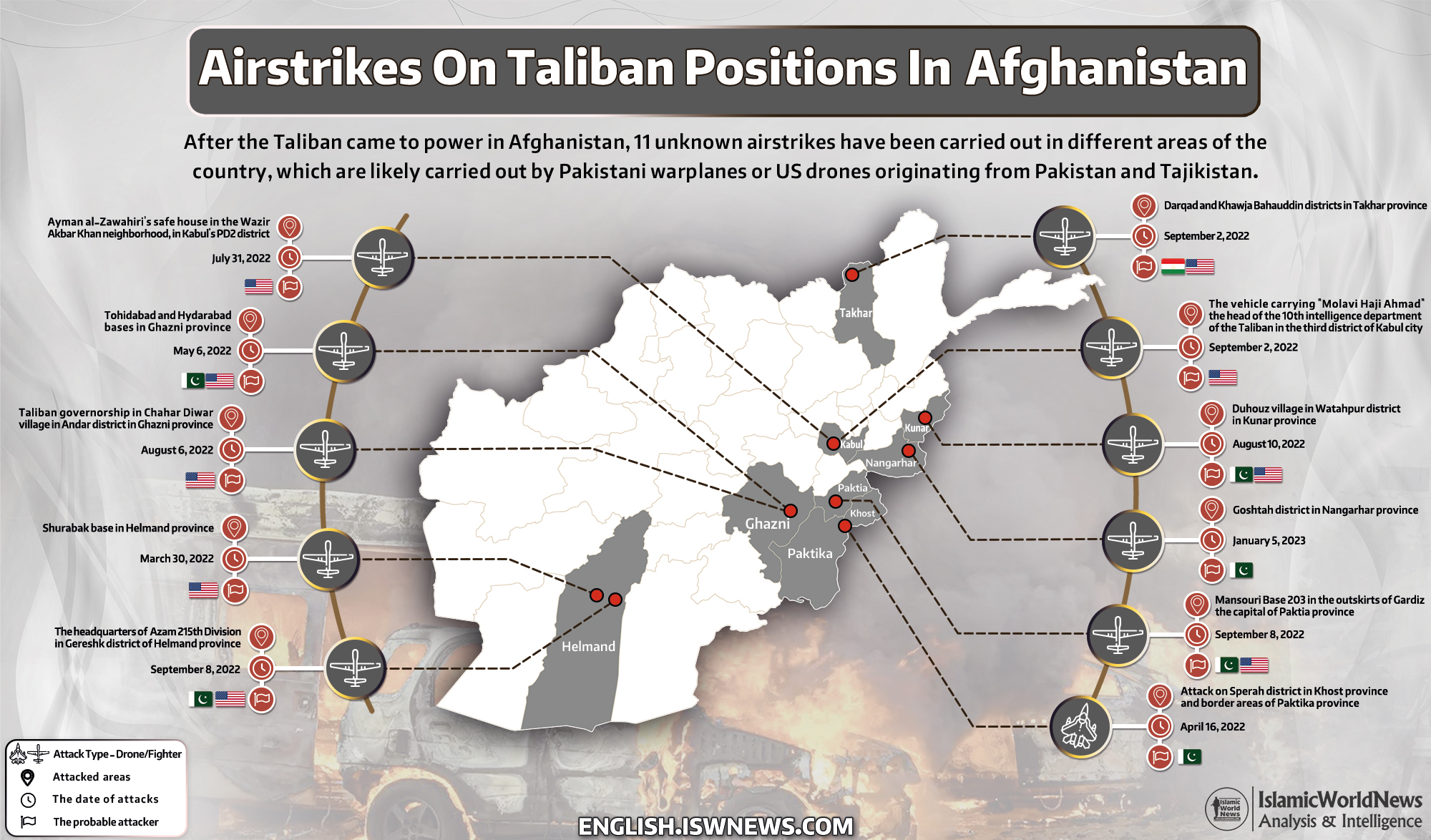
The sudden withdrawal of the US and NATO forces from Afghanistan led to a new chaos in this country, which, in addition to the collapse of Ashraf Ghani’s government and the rise of the Taliban, led to the strengthening of ISIS and increase of the activities of this terrorist group in Afghanistan. Although the US and NATO have apparently left Afghanistan, their previous and current actions are still plaguing this region, and the occasional attacks and flights of their drones have taken away peace from the people of Afghanistan.
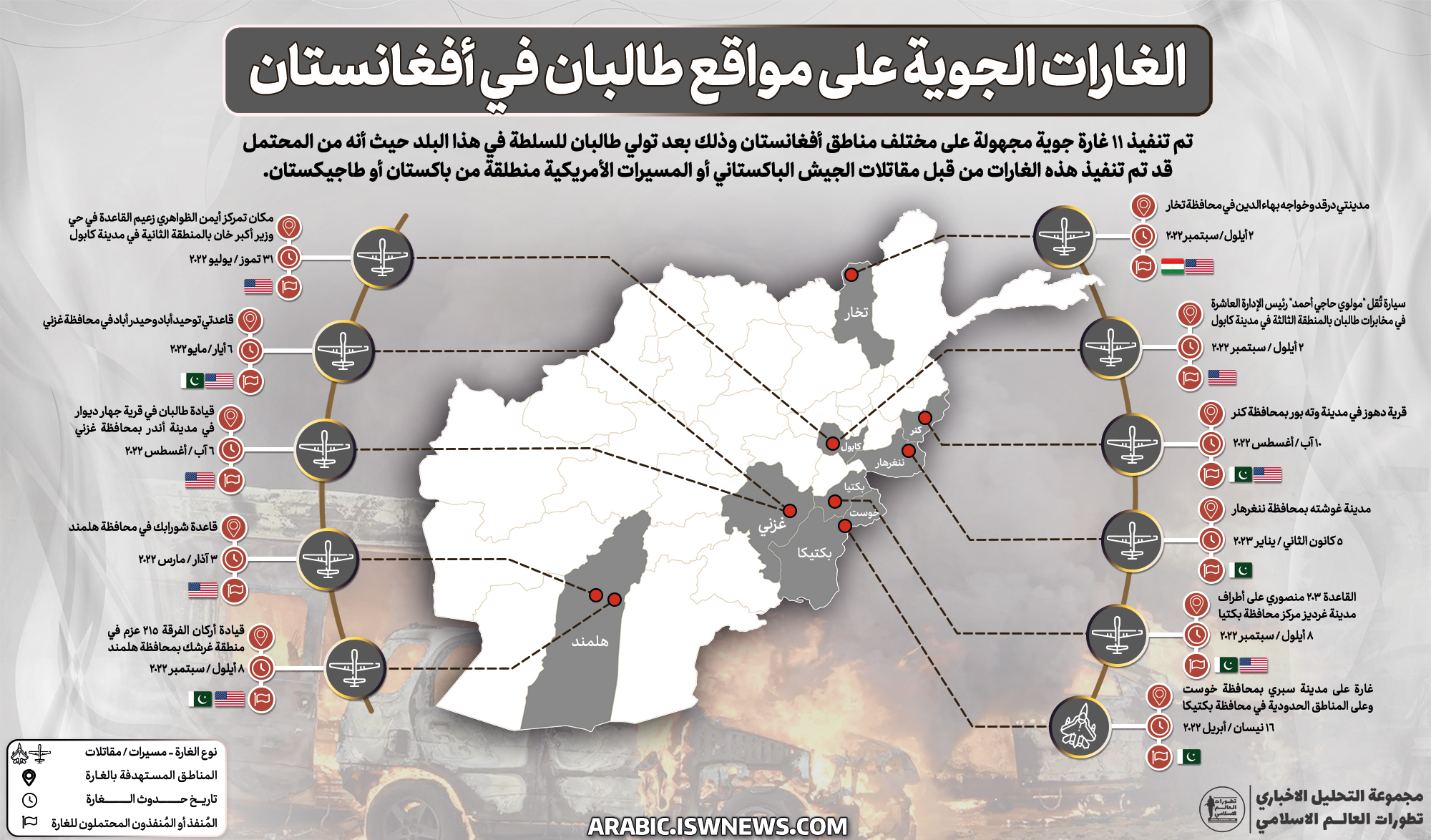
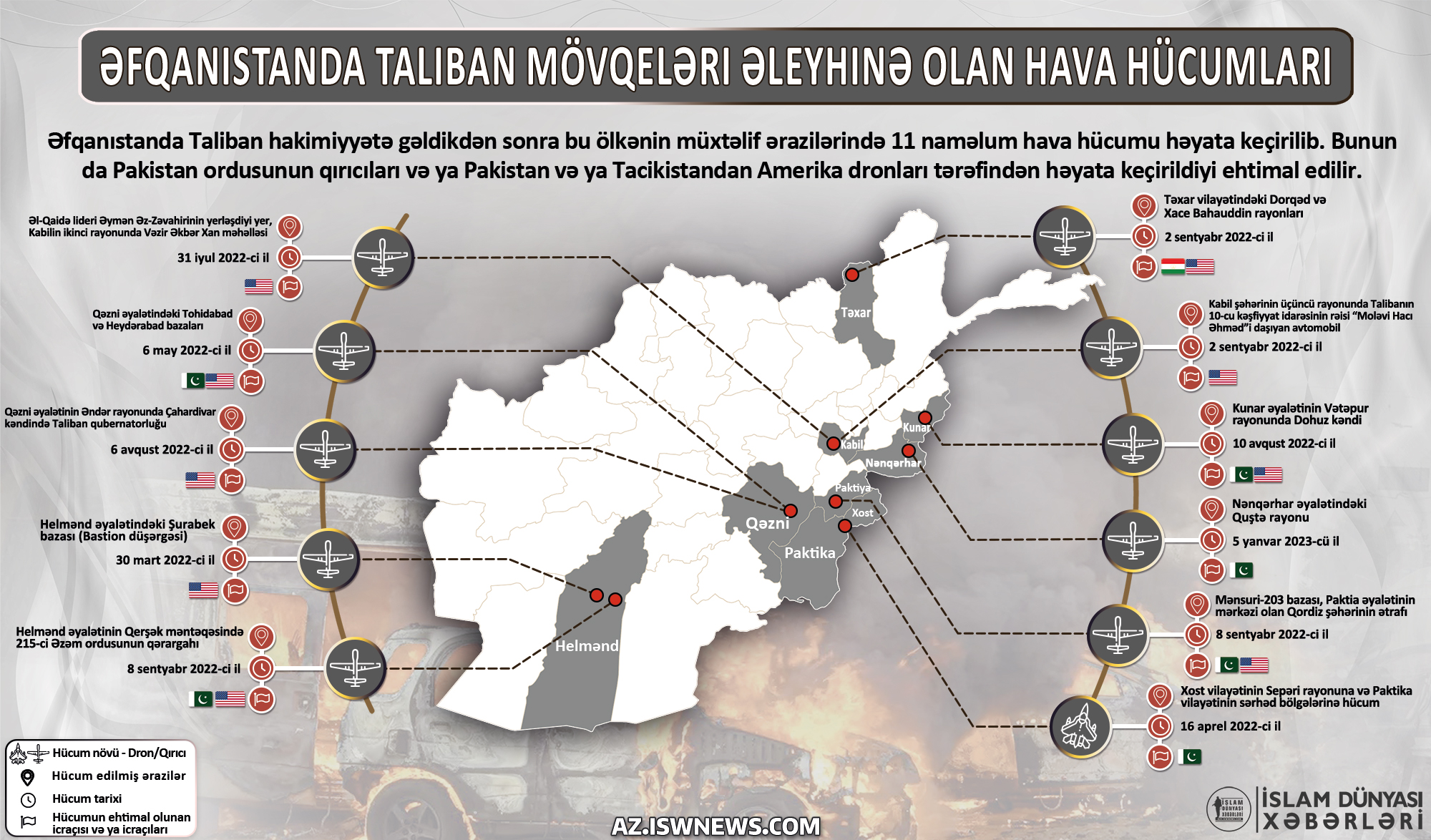
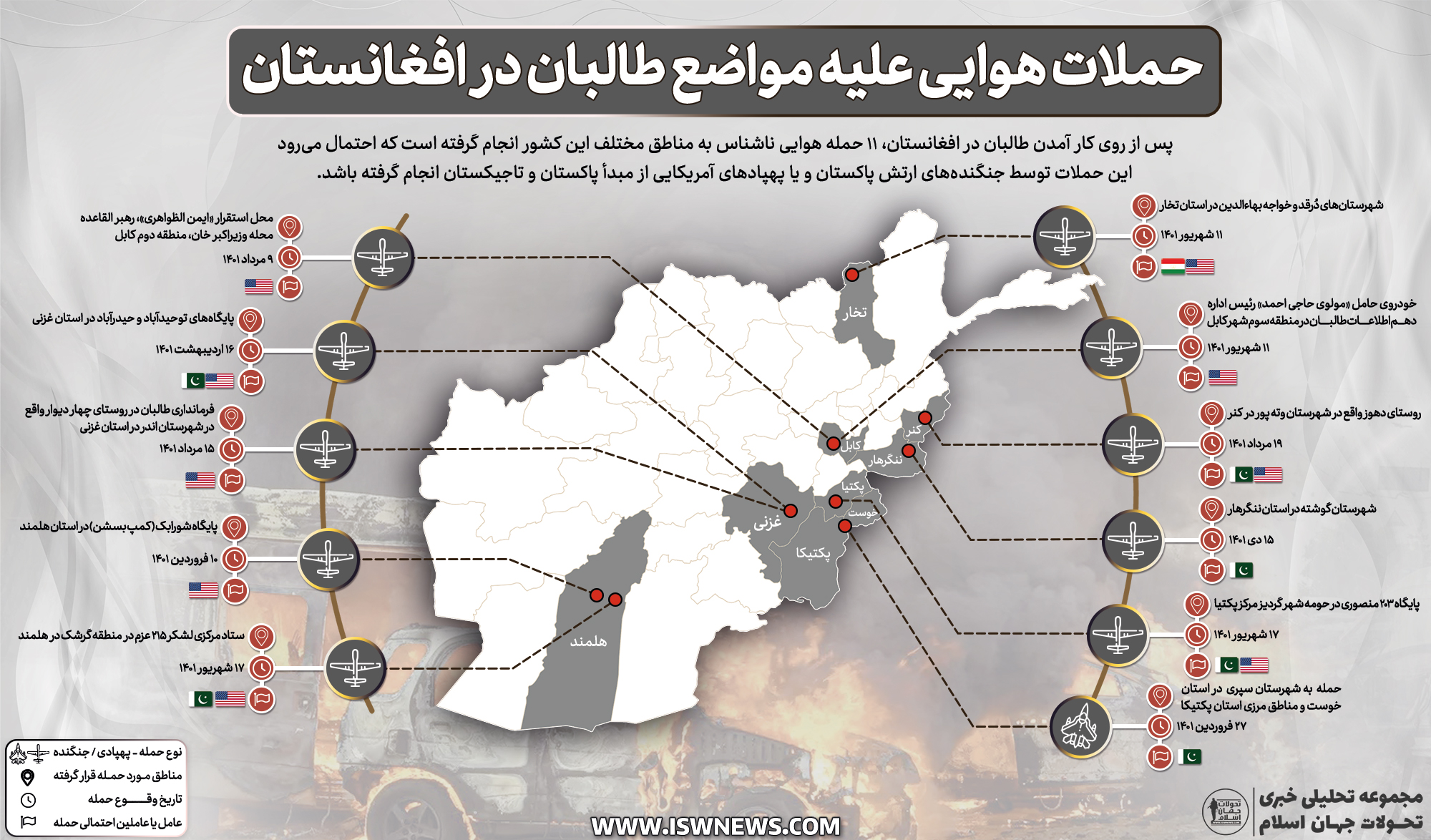
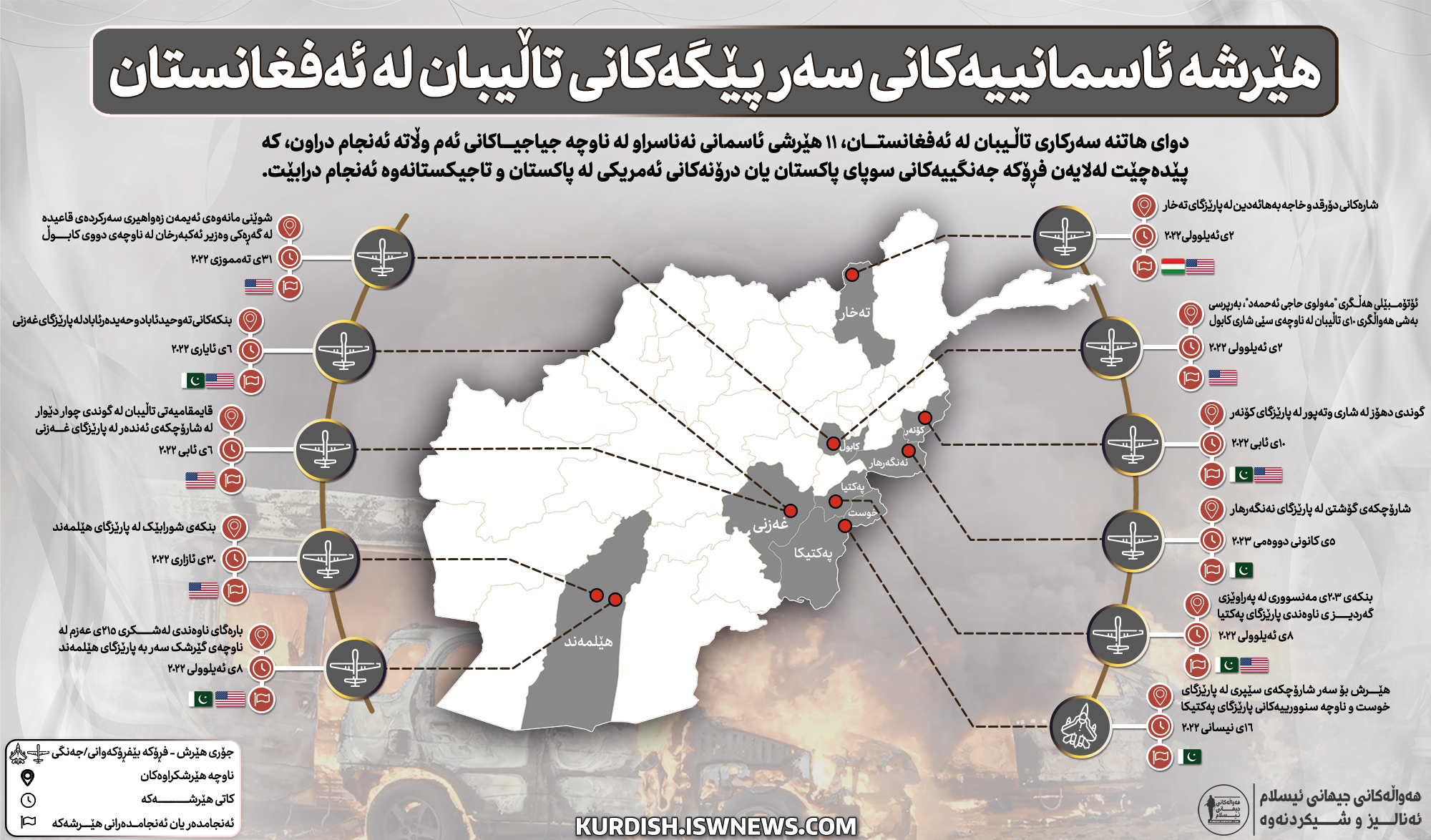
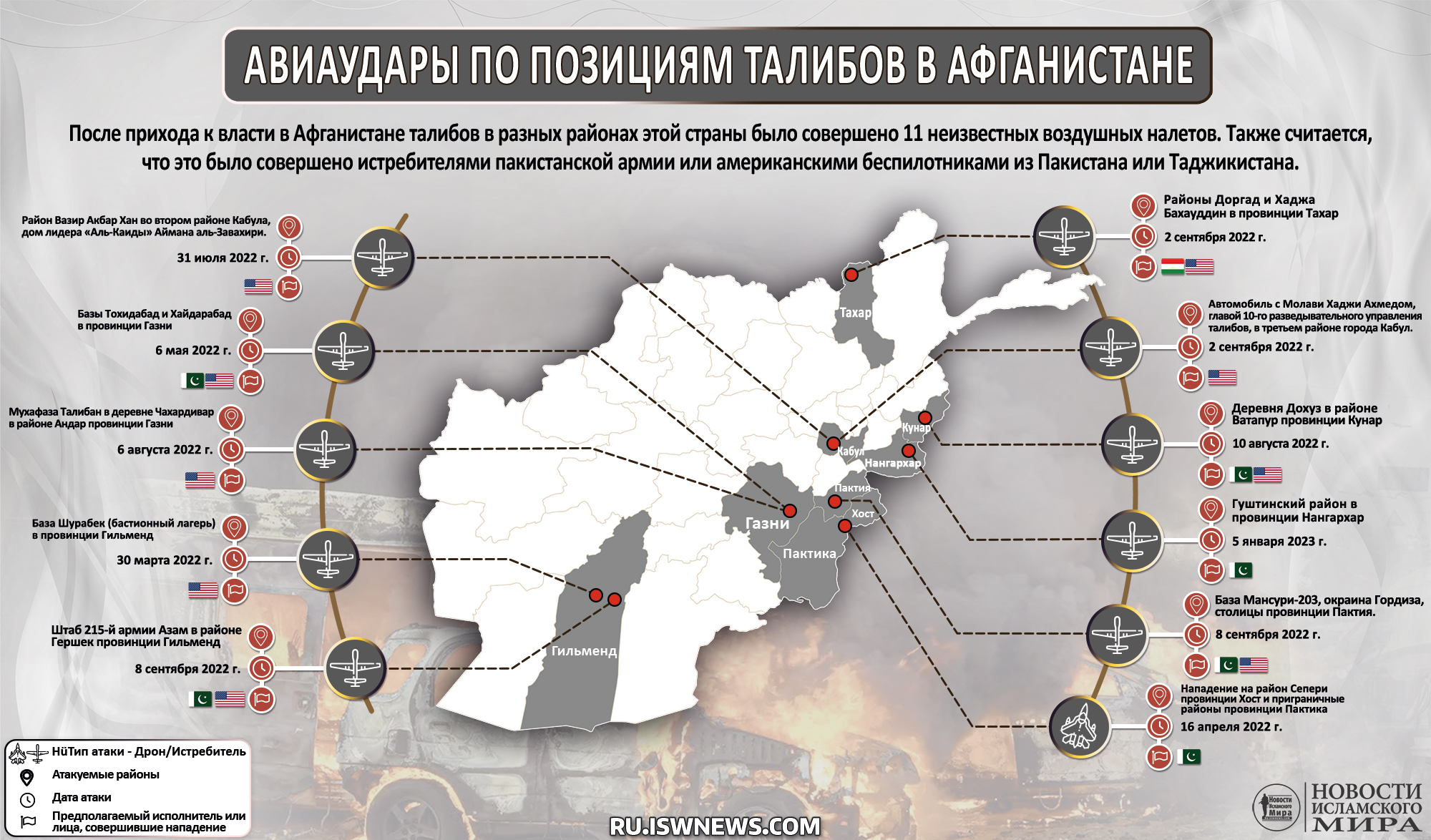
These attacks and flights have started since the spring of 2022 and have been carried out 11 times against different targets in different regions of Afghanistan. The exact cause and details of these attacks have generally not been disclosed to the media by the Taliban and the United States. However, according to available information and ISWNEWS reviews, the details of these attacks are as follows:
1- Drone attack on Shurabak base (Camp Bastion) in Helmand province, date: March 30, 2022. This attack led to several explosions in the weapons warehouse of this base and killed and wounded 30 members of the Taliban. (Possible attacker: the US)
2- Air attack by unknown fighters on Spera district in Khost province and the border areas of Paktika province, date: April 16, 2022. These attacks were carried out on the residences of Pakistani refugees from the North Waziristan region in the villages of Mir Safar and Kurai, and the positions of Pakistani Taliban militants in the areas of Mandete, Amir Sapar, Pakhi Mili and Shakuni in the Spera district of Khost province, which resulted in the death and injury of 40 people from Tehreek-e-Taliban Pakistan (TTP) militants. There are no details about the casualties and damages of the air attack on the border areas of Paktika province. (Possible attacker: Pakistan Army)
3- Drone attack on Tohidabad and Hydarabad bases in Ghazni province, date: May 6, 2022. Tohidabad base was called PRT and US troops base during the previous regime and was under the control of NATO forces. This attack was probably carried out to destroy the warehouse of ammunition and military equipment left by foreign forces. The Hydarabad base is also the headquarters of the Taliban reserve forces, and this attack has resulted in the death and wounding of 15 armed members of the Taliban reserve unit. (Possible attacker: the US or Pakistan)
4- Drone attack on Ayman al-Zawahiri, the leader of Al-Qaeda terrorist group, in Wazir Akbar Khan neighborhood located in the second district of Kabul, date: July 31, 2022 According to the US claim and the report of local sources, this attack was carried out to assassinate Ayman al-Zawahiri, which led to his death and the wounding of two officials of the Taliban Ministry of Interior. (Attacker: the US).
5- Drone attack on the Taliban governorate building in Chahar Diwar village located in Andar district of Ghazni province, date: August 6, 2022 During the previous regime, this place was the joint base of foreign troops and Afghan army soldiers, and during the Taliban period, it became the governorate of Andar district. The casualties and damages of this attack are unknown. (Possible attacker: the US)
6- Drone attack on Dahouz village in Watapur district in Kunar province, date: August 10, 2022 According to local sources and considering the previous US attacks on these areas, this village is the hideoutse of the members of Al-Qaeda group or Tehreek-e-Taliban Pakistan. (Possible attacker: the US or Pakistan)
7- Drone attack on a vehicle carrying “Molavi Haji Ahmad”, the head of the 10th intelligence department of the Taliban, in the three-way of the Habibie school located in the third district of Kabul city, date: September 2, 2022 This attack led to the death of five Taliban militants, including “Molavi Haji Ahmed”, the head of the 10th intelligence department of the Taliban, and five others, including “Abu Hassan Al-Mujahid” alias “Molavi Hanzala”, a prominent Egyptian member of the Al-Qaeda terrorist group. In this attack, four other members of al-Qaeda, namely Seyyed Mohammad Mobarez, Jahadollah Farahi, Hejrat Qureishi and Abu Omar Logari, who were accompanying “Abu Hasan Al-Mujahid” were also killed. (Possible attacker: the US)
8- Drone attack on Darghad and Khajeh Bahauddin disricts in Takhar province, date: September 2, 2022 These attacks were carried out in support of Ahmad Massoud’s forces and led to the death and wounding of several Taliban militants. (Possible attaker: the US or Tajikistan)
9- Drone attack on the headquarters of the Azam 215th Division in Gereshk district in Helmand province, date: September 8, 2022 This attack led to the death and wounding of several Taliban militants, including the general commander of the 215th Azam division. (Possible attacker: the US or Pakistan)
10- Drone attack on Mansouri base 203 in the outskirts of Gardiz, the capital of Paktia province, date: September 8, 2022 This attack led to an explosion in the weapons warehouse of this base and killed or wounded 10 Taliban militants. (Possible attacker: the US or Pakistan)
11- Drone attack on Goshtah district in Nangarhar province, date: January 5, 2023 This attack was carried out on the hideouts of Tehreek-e-Taliban Pakistan in Salala village located in Goshtah district in Nangarhar province. The casualties and damages of this attack are unknown. (Attacker: Pakistan Army)
On 18th of February, the Russian army captured the village of Paraskoviivka after several days of heavy fighting. The capture of the village of Paraskoviivka was not far from expected due to the increase of the Russian artillery fire and the semi siege imposed on this village in recent days.
With the domination of the Russians over this village, the Slavyansk-Bakhmut road was completely cut off.
After establishing their positions in the village of Paraskoviivka, the Russian military will probably advance to the area of Berkhivka, located in north of the city of Bakhmut, with the aim of completing the siege of this city.
It is worth mentioning that during the last few days, fierce battles between the Russian army forces and the Ukrainian soldiers were going on in the village of Paraskoviivka. The capture of this village is very important to complete the siege operation of Bakhmut city, and will increases the dominance Russian military over the logistics lines of the Ukrainian forces in the northern suburbs of Bakhmut city.
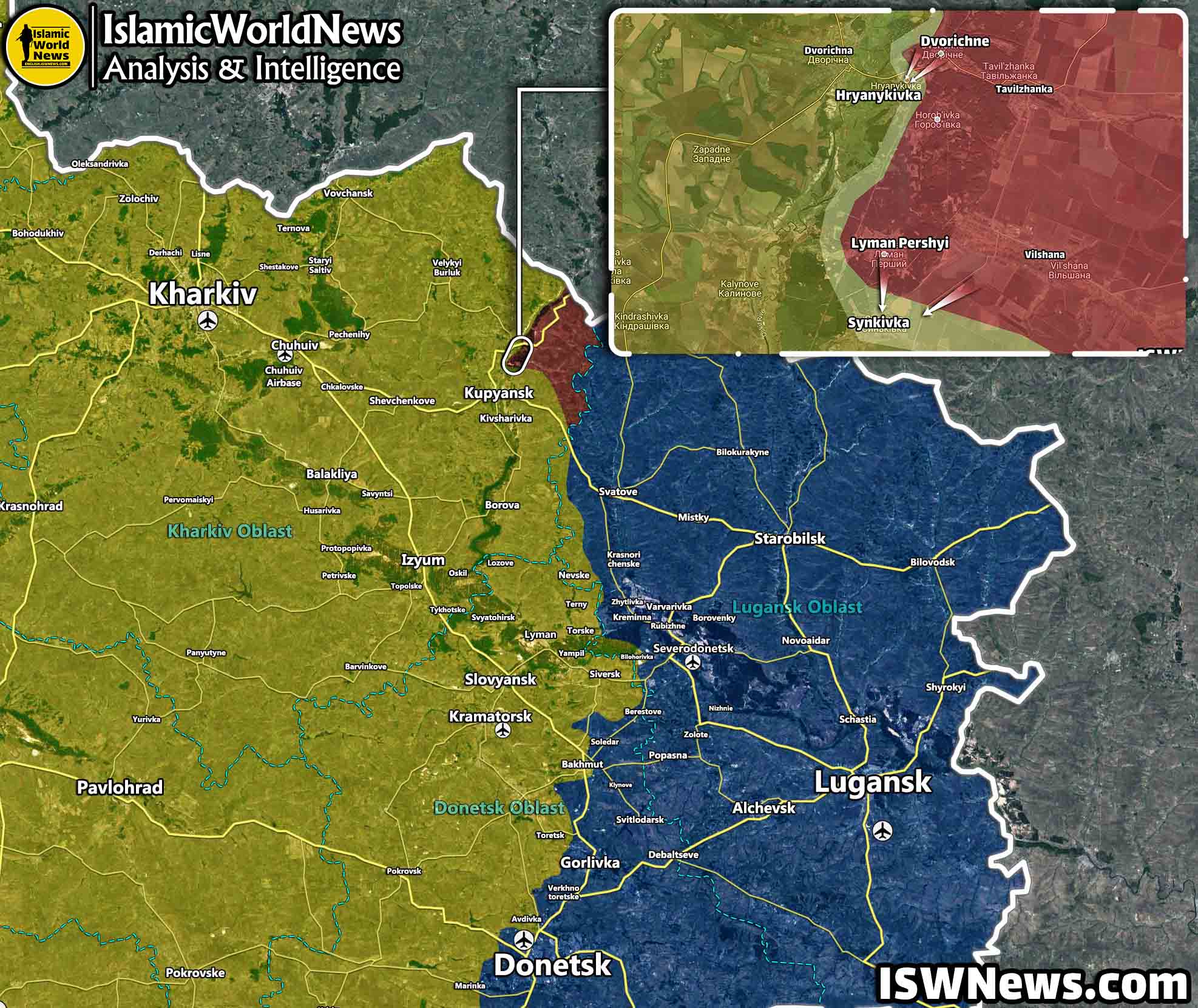
The confrontation between the Russian military forces and the Ukrainian troops keeps on in the northern and southern fronts of Kupyansk in Kharkiv Oblast, and the Russian forces continue to advance in those fronts gradually.
The Russian military forces have recently managed to enter the Gryanykivka residential area after they could stabilize their positions in Dvorichne; although, the two sides continue fierce battles in that region.
Additionally, the clashes and artillery fights kicked off in south of Lyman Pershyi for the seizure of Synkivka village. There were some reports last week, claiming that the Russian soldiers entered the Synkivka village, which were not authentic. The scale of Russian artillery fire on the Synkivka village has amplified significantly since last week, and it seems to be probable that the Russian army is going to start a ground offensive to capture the region soon.
Simultaneous with the operations and advances on the Synkivka and Dvorichne fronts, the Russian army intends to put pressure on the Ukrainian military in the north of Kupyansk in order to deter the Ukrainian army’s logistics focus from other fronts to the Kupyansk axis.
It is noteworthy that following five months of inactivity in the northern fronts of Luhansk and southern Kharkiv, the Russian army has started regaining the upper-hand in some areas of these axes. Earlier, the Russian army had entirely retreated from the northern and northeastern regions of Kharkiv oblast in September 2022. As a result of that retreatment by the Russian forces, approximately 8,800 square kilometers of Kharkiv province, which were under the control of the Russian troops at that time, were handed over to the Ukrainian military.