ISWNews Analysis Group: The Turkish Bashiqa military base in north of Mosul, was targeted by a rocket attack on July 21. So far, no group has claimed responsibility for this attack.
This is the third rocket attack against Bashiqa military base since the beginning of 2023.
It is worth mentioning that on June 6, Turkish Bashiqa military base in north of Mosul was attacked with several rockets fired by unknown groups.
History The story of Iranian Simorgh family drones began with hunting “The Beast of Kandahar”. On December 4, 2011, the Iranian Islamic Revolutionary Guard Corps Aerospace Force managed to take control of an advanced US drone named Lockheed Martin RQ-170 Sentinel, known as The Beast of Kandahar. The stealth RQ-170 drone had entered Iran’s airspace to collect information and espionage, and finally, through processes, Iran managed to override its controls and landed it near the town of Bardaskan.
Iran force-landed RQ-170 near Bardaskan
In May 12, 2014, during Iran’s Commander-in-Chief’s visit to the IRGC Aerospace Force’s Achievements Exhibition, it was stated that the Iranian Armed Forces had succeeded in obtaining all the software information of this bird and had obtained images from all the bases where this bird was present. During the same visit, it was also announced that a 15% scale version has flown successfully and two 40% and 100% scale versions will be flown in the same year. Also, General Hajizadeh the commander of IRGC Aerospace Force stated that this drone will also be armed with missiles. In November 2014, a video of the successful flight of this bird was published.
Three drones displayed in the IRGC achievements exhibition in 2014
In 2016, during Admiral Shamkhani’s visit to the IRGC Aerospace Force achievements exhibition, new variants of this series of UAVs named Shahed 181 were unveiled. Two years later, Shahed 191 was unveiled during the Eghtedar 40 exhibition. It should be noted that both Shahed 181 and Shahed 191 drones are 60% scale version of Shahed 171 drone.
Shahed 181 in Admiral Shamkhani’s visit to the IRGC achievements exhibitionShahed 191 drone at the Eghtedar 40 exhibitionClick to view full size
Different variants of Shahed stealth drones: The Shahed stealth drone family includes five combat and reconnaissance types, each of which is measured in terms of its size compared to the RQ-170 or Shahed-171 drone. In this way, the Shahed-171 drone, which is nicknamed Simorgh, is a 100% scale version and completely identical to the RQ-170 Sentinel, and the two Shahed-191 and 181 drones, which carry the nickname of Saegheh, are both 60% scale version of the Shahed 171. In addition to the previous three variants, there are two Shahed-141 and 161 drone, both of which are 40% scale version of Shahed 171 in terms of dimensions. It should be noted that there are also two civilian variants of this drone. The first variant is the initial 15% scale version used for flight testing and the second variant is a 60% scale version that is used for cloud seeding. In this way, the number of Shahed-171 stealth drones reaches seven.
The importance of downing of the RQ-170 was very high, so that after landing this drone, the Iranians realized how much modern technology was used in it at once. Advanced lightweight materials were used in the structure and body of this UAV, and there was a special coating and color on the body. The use of a very advanced engine, an advanced camera with high accuracy and range, and a very advanced synthetic-aperture radar (SAR) are among the other disclosed equipment of this extremely valuable American drone. These features, along with the use of flying wing design, made it one of the most advanced drones in the world. Therefore, this drone is considered the most important drone captured by Iran in the last few decades. It can even be considered one of the most important trophies obtained after World War II.
Shahed-171 (Simorgh): Shahed-171 also known as Simorgh, is a 100% scale version of RQ-170, and uses a Toloue-14 turbofan engine. Toloue-14 mini turbofan is the result of turning Toloue-4 mini turbojet engine into a turbofan. Thanks to its turbofan engine, Shahed-171 has reached a flight endurance of 10 hours and a maximum range of 4400 km. The flight ceiling of 40,000 feet (12,000 meters), the maximum take-off weight of 3070 kg and the maximum speed of 460 km/h are other specifications of this drone. Like the RQ-170 UAV, Shahed-171 uses a shield for its thermal camera, which reduces its radar cross section.
The similarity of camera cover in Shahed-171 and RQ-170
Shahed-171 specifications: Role: Reconnaissance Length: 4.75 meters Wingspan: 13 meters Height: 1.2 meters Reconnaissance range: 2200 km Maximum range: 4400 km Flight endurance: 10 hours Flight ceiling: 40,000 feet (12,000 meters) Engine: Turbofan Toloue-14 Thrust engine power: 6 kilonewtons Maximum speed: 460 km/h Cruise speed: Unknown Weight: Unknown Maximum take-off weight: 3070 kg
Shahed-171 (Simorgh)drone
Shahed-181 (Saegheh): Shahed-181 drone also known as Saegheh (Lightning), is a 60% scale version of Shahed-171 drone and uses a two-stroke propeller engine. Due to the expensiveness of the Shahed-171 stealth drone, in order to reduce the production cost and also easy mass production, the Shahed 181 drone has been mass produced by removing the landing gear and using a piston engine. Shahed-181 has the capability of carrying four Sadid-342 bombs under the body between its skates. Due to having folding wings, Sadid-342 bomb occupies the least space and four of them are easily placed next to each other, and for this reason, it is the best option for use on this drone.
Shahed 181 drone with four Sadid 342 bombsA banner containing the specifications of Shahed 181 droneClick to view full size
Shahed-181 takes help from a vehicle to take off. The drone is placed on a special pneumatic launcher on the vehicle. After the vehicle reaches the desired speed, the drone is launched and flies. For landing, Shahed-181 slides on the ground using his skates to stop.
Shahed-181 specifications: Role: Reconnaissance and combat Length: 2.7 meters Wing length: 7.3 meters Height: 0.7 meters Combat range: 1150 km Maximum range: 3450 km Flight endurance: 13 hours Flight ceiling: 15000 feet (4572 meters) Engine: 80 horsepower piston Maximum speed: 220 km/h Cruise speed: 150 km/h Weight: Unknown Maximum take-off weight: 480 kg Maximum weight of fuel and cargo: 165 kg Take off type: By vehicle Landing: By skate Armament: 4 smart bombs
Shahed-181 (Saegheh)drone
Shahid-191 (Saegheh 2): Shahed-191 drone also known as Saegheh 2, like the Shahed-181 is a 60% scale version of Shahed-171. But Shahed-191 uses a turbojet engine instead of a piston engine. The radar cross-section in Shahed-191 is smaller due to the use of a turbojet engine, and Sadid bombs are placed inside the body of the drone.
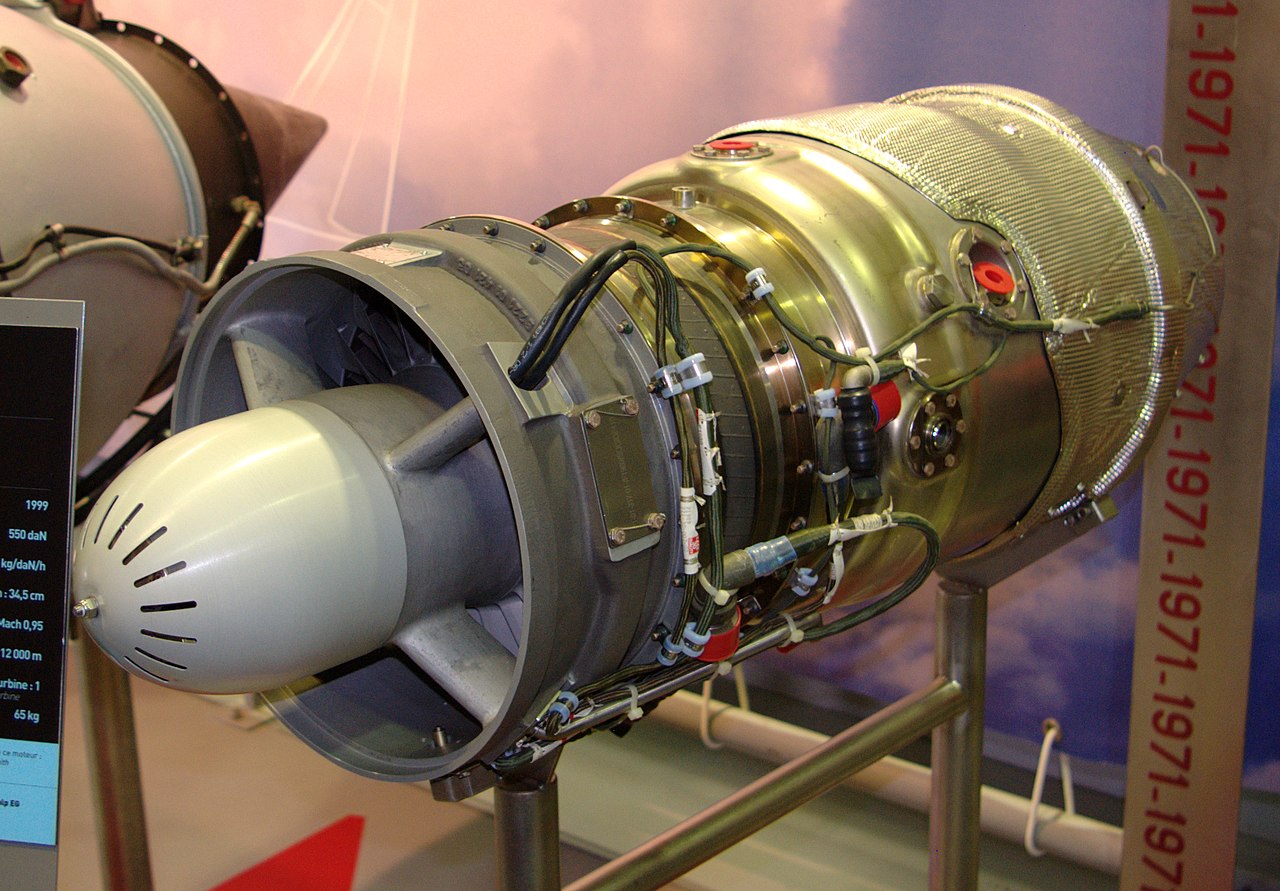
Shahed-191 uses a mini turbojet engine with a power of 1078.8 newtons, which is known as Turbojet 894, or a Toloue-10 turbojet engine with a power of 1100 to 1200 newtons. It is worth noting that the 894 turbojet engine was manufactured by the IRGC Aerospace Force and the Toloue-10 turbojet engine was manufactured by the Iran’s Ministry of Defense.
894 turbojet engine and Toloue-10 turbojet engine
Shahed-191 has a higher flight ceiling as well as greater stealth profile, and for this reason, an internal place for carrying weapons has been designed to help the stealthy features of this drone during combat missions. Saegheh 2 has the ability to carry two Sadid-342 bombs in its internal weapons bay.
Based on the published images, it seems that this drone uses the Oghab 4 electro-optic system.
The moment of releasing the Sadid-342 bomb from the Shahed 191 droneThe moment of separation of Shahed 191 drone from the launcher vehicleA view of the Shahed drone control roomClick to view full size
A type of SAR radar called Absar has been developed specifically for this drone, which is installed in camera place and provides the possibility of searching for objects in the form of 3D imaging.
Parts of Shahed 191 UAVABSAR SAR radarClick to view full size
Shahed-191 specifications: Role: Reconnaissance and combat Length: 2.7 meters Wing length: 7.3 meters Height: 0.7 meters Combat range: 500 km Maximum range: 1500 km Flight endurance: 4.5 hours Flight ceiling: 30000 feet (9144 meters) Engine: Turbojet 894 or Toloue-10 Thrust engine power: 110 kg of force (1078.8 newtons) Maximum speed: 350 km/h Cruise speed: 200 km/h Weight: Unknown Maximum take-off weight: 500 kg Maximum weight of fuel and cargo: 230 kg – 10 kg of optical cargo and 100 kg of weapons in weapon bay Take off type: By vehicle Landing: By skate Armament: 2 smart bombs
Shahed-191 (Saegheh 2)drone
Shahed-161: Shahed-161 is a 40% scale version of Shahed-171 drone. This drone uses a small and unannounced micro-turbojet engine. In the description provided for Shahed-161, the type of cargo is announced a seeker and warhead. This information strengthens the possibility that this variant is a suicide drone. If Shahed-161 is a suicide type of the Simorgh family, it must be said that this suicide drone is very a expensive one and therefor will be used to hit special targets such as air defense systems. The thermal seeker of Shahed-161 is installed on the wing and the right side of the engine, and when the UAV dives, it gets a better view of the ground. One of the characteristics of Shahed-161 is the possibility of different launch. Due to the lightness of this drone compared to other types, a pneumatic launcher has been used, which makes it possible to launch this drone faster from the vehicle. It is also possible to use this technique on other members of the Simorgh family that fly from the vehicle. This drone can also land with the help of a recovery parachute or skates.
Shahed-161 specifications: Role: Reconnaissance and suicide Length: 1.9 meters Wingspan: 5.13 meters Height: 0.71 meters Combat range: 150 km Maximum range: 300 km Flight enduracne: 3 hours Flight ceiling: 25000 feet (7620 meters) Engine: HKS microjet Engine power: 40 kg of power Maximum speed: 350 km/h Cruise speed: 150 km/h Weight: Unknown Maximum take-off weight: 170 kg Maximum weight of fuel and cargo: 40 kg Cargo: Seeker and warhead Take off type: Pneumatic launcher Landing: By skate, recovery parachute
Shahed-161 drone
Shahed-141: Shahed-141 drone has not been officially unveiled yet. This drone is a 40% scale version of Shahed-171. According to the information provided at the IRGC achievements exhibition in Isfahan, Shahed-141 has a Wankel 783 engine with a power of 32 horsepower, and thanks to the capacity of carrying 90 kg of cargo, it can carry a high-quality camera and a 12-hour flight endurance for reconnaissance missions.
Shahed-141 specifications: Role: Reconnaissance Length: 1.9 meters Wingspan: 5.13 meters Height: 0.4 meters Reconnaissance range: 1300 km Maximum range: 2600 km Flight endurance: 12 hours Flight ceiling: 15000 feet (4572 meters) Engine: Wankel 783 piston 32 hsp Maximum speed: 220 km/h Cruise speed: 150 km/h Weight: Unknown Maximum take-off weight: 200 kg Maximum weight of fuel and cargo: 90 kg Take off type: Pneumatic launcher Landing: By skate, recovery parachute
Shahed-141 drone
15% scale versionof Shahed-171: Information and a picture of this variant are not available, but it can be pointed out that this variant is the first sample made during the reverse engineering of the RQ-170 UAV. Making a 15% scale version of RQ-170 has helped to better understand the flight structure of this drone, and this has accelerated the build process and use of the Shahed family of stealth drones.
Samavat drone: The Samavat drone was showcased for the first time at the IRGC Achievements Exhibition in Birjand. This drone is equivalent to the Shahed-161 drone and is used for cloud seeding. According to published information, the Samavat drone can be used for surveillance and combat missions, and for this purpose, it is possible to separate the silver iodide holding rods from the drone. Except for the body length of 1.7 meters, which is given in the Samavat banner, the rest of the specifications are very similar to Shahed-161.
The banner and specifications of Samavat droneRods and holding tubes with silver iodide containers on Samavat droneClick to view full size
Combat history The Shahed family of stealth drones have been widely deployed in the IRGC Air Force and have carried out a large number of reconnaissance and combat operations so far. But the first combat operation that has been officially confirmed is related to the use of Shahed 181 and 191 drones on June 18, 2017 in Operation Laylat al-Qadr against ISIS in Syria. It should be noted that due to the confidentiality and sensitivity, most of the missions of this category of drones are not officially announced.
Shahed 171 And Shahed Stealth Drones Family – click to view full sizeClick to view full size
Posters of “Shahed 171 And Shahed Stealth Drones Family” in Russian (Шахед 171), Arabic, Kurdish, Azeri (Şahid 171), Hebrew (שאהד-171), Chinese (见证者-171) and Persian:
A photo that surfaced online showed a vehicle of the system near a base of the coalition located at the Conoco gas facility in the eastern Deir Ezzor countryside.
The FS-LIDS system uses a small, expendable drone dubbed the Coyote to intercept its target. The drone delivers a kinetic effect by crashing into enemy drones or exploding near them and dispersing blast fragments from its warhead.
The newest version of the interceptor drone, the Coyote Block 2, is propelled by a jet engine, equipped with an active radar seeker and armed with a proximity warhead. It can engage threats at a range of more than 15 kilometers, and can even re-attack if it misses on the first pass.
U.S.-led coalition bases in Syria’s northeastern region and its garrison in the southeastern area of al-Tanf were targeted with suicide drones on several occasions in the past.
Earlier this year, a suicide drone hit a base of the coalition in the northeastern governorate of al-Hasakah. The attack, which killed a U.S. contractor and wounded a number of service members, sparked a limited confrontation with Iranian-backed forces in Syria.
The U.S.-led coalition has been working to expand its presence in Syria for a while now, despite the disapproval of Damascus.
The appearance of the FS-LIDS system came amid high tensions between U.S. and Russian forces over aerial operations in Syrian skies. It also came as the coalition and its proxies were massing forces along the frontline with government forces in Deir Ezzor.
History In July 1996, the Storm Shadow design presented by two companies, Matra and British Aerospace, won a heavy competition among 6 other designs from powerful companies McDonnell Douglas, Texas Instruments/Short Brothers, Hughes/Smiths Industries, Daimler-Benz Aerospace/Bofors, GEC-Marconi and Rafael. A development and production contract was signed in February 1997, by which time Matra and BAe had completed the merger of their missile businesses to form Matra BAe Dynamics. France ordered 500 SCALP missiles in January 1998.
It is worth noting that since 2001 and after the merger of Matra BAe Dynamics with the Italian company Alenia, this missile is developed and produced under the multinational company MBDA.
This missile is known as “Storm Shadow” in UK and SCALP-EG in France. SCALP-EG in French stands for “Système de Croisière Autonome à Longue Portée – Emploi Général” and its English translation is “Long Range Autonomous Cruise Missile System General Purpose”.
The Storm Shadow missile was used for the first time in 2003 during the Iraq war by the Tornado GR4 fighter jet of the British Royal Air Force.
On November 27, 2013, this missile was tested on the Eurofighter Typhoon at the Decimomannu Air Base in Italy for a range of 250 km. This test was conducted by Alenia Aermacchi in the framework of a phase 2 improvement program for Germany, Italy, Spain and the United Kingdom.
Typhoon fighter jet carrying two storm shadow missilesTornado fighter jet carrying two storm shadow missilesClick to view full size
Design The Storm Shadow cruise missile was developed is based on French-developed Apache anti-runway cruise missile. These two missiles are similar in terms of aerodynamics and stealth, but the Storm Shadow missile uses a different engine and its warhead is integrated with high penetration power, while the warhead of the Apache cruise missile is a cluster munition.
Storm Shadow / SCALP-EG missileApache anti-runway cruise missileClick to view full size
The air-launched version of Storm Shadow missile has a weight of 1300 kg, of which 450 kg is the warhead. The maximum diameter of the body is 63 cm, the distance between its two wings is 3 meters and the length of the missile is 5.1 meters. This missile reaches a maximum speed of Mach 0.8 (equivalent to 980 km/h at sea level) and a range of 560 km using a French TRI 60-30 engine with a power of 5.3 kilonewtons. It should be noted that in export versions, the range of this missile is limited to 300 km.
This missile uses a two-stage warhead to penetrate the targets. This warhead, known as BROACH, is installed on two other missiles, AGM-154 Joint Standoff Weapon (JSOW) and AGM-86 ALCM, in addition to the Storm Shadow. The two stage warhead is made up from an initial shaped charge, which cuts a passage through armour, concrete, earth, etc., allowing a larger following warhead to penetrate inside the target.
BROACH warheadMicroturbo TRI 60-30 turbojet engineThe different components of Storm Shadow missileClick to view full size
Combat records As mentioned earlier, the Storm Shadow missile was first used in combat in 2003 by Tornado fighter jets belonging to the 617 Squadron of the British Royal Air Force during the international invasion of Iraq.
During the 2011 military intervention in Libya, SCALP-EG missiles were fired by French Air Force Rafale fighter jets and Storm Shadow missiles by Tornadoes of the Italian Air Force and the British Royal Air Force at targets including Al Jafra Air Base and a military shelter in Sirte, Muammar Gaddafi’s hometown. In December 2011, Italian defense officials noted that during the military intervention in Libya, Tornado fighter jets had fired between 20 and 30 Shadow Storm missiles, with a 97% success rate. This was the first time that Italian aircraft test-fired this missile in a real battle.
On December 15, 2015 and January 2, 2016, French fighter jets fired twelve rounds of SCALP missiles at ISIS targets in Syria.
On June 26, 2016, the British Royal Air Force, using a Tornado fighter jet, fired four Storm Shadow missiles at ISIS targets in Iraq.
In October 2016, the UK government confirmed that Storm Shadow missiles sold to Saudi Arabia had been used by Saudi Arabia in the conflict in Yemen.
In April 2018, the UK government announced that it had used Storm Shadow missiles (probably using Dassault Rafale fighters) to attack an alleged chemical weapons manufacturing facility in Himm Shinshar in Syria’s Homs province.
It is also said that during the second Libyan war, the Emirati Mirage and Egyptian Rafale fighter jets may have used Storm Shadow missiles to attack Al-Watia Air Base in July 2020.
In March 2021, two Royal Air Force FGR4 Typhoon jets attacked a group of ISIS caves near Erbil using a Storm Shadow missile, And the first combat use of the Storm Shadow was recorded by Typhoon fighter jet.
After the United Kingdom announced that it would deliver the Storm Shadow missile to Ukraine in 2023, this missile entered the Russian-Ukrainian battles. According to video documentation, these missiles are fired by Ukrainian Sukhoi-24 fighter jets.
An image of the combat use of Shadow Storm missile on the Ukrainian Sukhoi-24 fighter jet
Variants of Storm Shadow missiles Apart from the export version with a range of 250 km and the original version with a range of 560 km, which is in the service of the British and French armies, the Storm Shadow missile has other versions:
Black Shaheen: Developed by France for export to the United Arab Emirates for use with its Mirage 2000, modifications were made to reduce the range reportedly to 290 km (160 nmi; 180 mi) in order to comply with Missile Technology Control Regime guidelines.
MdCN or SCALP Naval cruise missile: In 2006, the French division of MBDA began the development of a long-range vertical-launch cruise missile to be deployed on a new series of French warships and complement the conventional SCALP missiles. This missile, which is called “Missile de Croisière Naval (MdCN)” in French, is called “Naval Cruise Missile” in English. The MdCN missile with a range of more than 1000 km plays the same role as the American Tomahawk for the French. In addition to longer range, MdCN naval cruise missile has independent navigation function and final phase guidance with the help of infrared detection. In terms of appearance, this missile has many differences with the conventional version of Storm Shadow. This missile is made in a cylindrical shape and the wings are also folded into the body. The SCALP Naval missile has a length of 6.5 meters, a diameter of 50 centimeters and a wingspan of 2.85 meters. The weight of this missile is 1400 kg, of which 200 kg is the warhead. The engine of this missile is micro-turbojet TR50 and the speed of the missile reaches 1000 km/h using this engine.
Specifications of MdCN Naval Cruise Missile: Type: Land-attack missile, Submarine-launched cruise missile Length: 6.5 meters Diameter: 50 cm Wingspan: 2.85 meters Weight: 1400 kg Warhead weight: 200 kg Speed: 1000 km/h Engine: Turbojet TRI50 Range: more than 1000 km Launch platforms: FREMM-class frigates, Barracuda-class submarines, and Scorpène-class submarines Produced: MBDA France
Missile de Croisière Naval (MdCN) / Naval Cruise Missile
The MdCN missile is installed on six French FREMM-class frigates, Barracuda-class submarines and smaller submarines such as the Scorpène-class. This missile is launched in frigates through the Sylver launcher and in submarines through the 533 mm torpedo launch tube.
SCALP Naval missile fired from the Sylver launcherContainer for cruise missiles to be launched from a submarineClick to view full size
The first successful launch of the MdCN missile was carried out in July 2013, at the Biscarosse test range, and it was able to pass all test stages in three launches.
The MdCN missile was used in the first real battlefield operation in 2018 against alleged Syrian chemical weapons production sites in Damascus and Homs. In this operation, France launched 10 SCALP cruise missiles using five Dassault Rafale fighters and three SCALP Naval missiles using FREMM class frigates. In this operation, due to technical problems and lack of coordination, two frigates failed to fire missiles and only one frigate managed to launch a missile, and out of 10 missiles, one missile had a problem and fell into the sea.
The first Barracuda-class submarine named FS Suffren, which was launched on October 20, 2020, successfully fired its first MdCN missile in the same year 2020. Considering the problems that arose in 2018 for the launch of the SCALP Naval missile, the successful launch of this missile was an indication of solving the coordination problems of this sea cruise with its marine launcher platforms.
Barracuda-class submarine FS Suffren that successfully test-fired SCALP Naval cruise missileA picture of the moment the SCALP Naval missile comes out from under the seaClick to view full size
Specifications of Storm Shadow/SCALP-EG cruise missile: Type: Air-launched cruise missile Length: 5.10 meters Width: 630 mm Wingspan: 3 meters Weight: 1300 kg Warhead weight: 450 kg Engine: Turbojet TRI 60-30 Speed: ~ 1000 km/h Range: 560 km (in export versions up to 300 km) Guidance: GPS – INS – IIR – TERPROM Launch platforms: Tornado, Mirage 2000, Rafale, Typhoon fighter jets Origin: France and UK (MBDA company)
Storm Shadow Cruise Missile – click to view full sizeClick to view full size
The Russian armed forces made partial advances in the west of the Dibrova region in recent days and reached the northern regions of Tors’ke village, and they even entered this village from the north; but later, following heavy counterattacks by the Ukrainian army, they were forced to retreat to the outskirts of Tors’ke.
At present, sporadic clashes and artillery shellings continue between Russian and Ukrainian forces. In general, the Russian forces are in a defensive position on the northern axes of Donetsk and Luhansk oblasts, and such attacks and advances are carried out to reduce the pressure of the Ukrainians’ attacks.
However, the situation is different on the Zaporizhia front. On this axis, the Ukrainian forces are in an offensive position and have made partial advances in some areas in recent weeks.
Following the attacks and advances of the last few weeks of the Ukrainian forces in the south of Velyka Novosilka, the Ukrainian forces intensified their attacks on Pryyutne and Staromaiors’ke settlements to break down the resistance of the Russian army on this axis and resume their advances; thus, they are carrying out daily sporadic and sometimes heavy attacks; but the Russian military forces are still resisting despite suffering casualties and damages.
Sporadic clashes and artillery attacks continue on the Goliapole, Orikhiv and Kamianske axes. In recent weeks, the village of Piatykhatky near Kamianske has been one of the main points of conflict between Russian and Ukrainian forces. Currently, Russian forces retreat from Piatykhatky and this area is under Ukrainians’ control.
Generally, Russia’s superiority in artillery and air power over Ukraine remains the main factor, which leads to the failure of most Ukrainian attacks in several fronts. In fact, Russia enjoys much stronger arms logistics, and aids from the US and Europe to Ukraine has not yet changed the balance of power in the Russia-Ukraine conflict.
It is also worth mentioning that the scale of Ukraine’s attacks against Russia’s logistics lines has recently decreased significantly, and the Russians can more easily rebuild their defense lines.
According to a Syrian military source, “around 00:25 (local time) on Wednesday, the Zionist enemy attacked targets in the suburbs of Damascus with several missiles from the occupied Golan. Syrian air defense systems shot down most of the missiles. This attack resulted in the wounding of two Syrian soldiers and the occurrence of material damages.”
It is said that the positions of the Syrian army in the west of Damascus have been targeted by Israeli fighter jets.
It is worth mentioning that on July 2, the Israeli regime fighter jets fired several missiles at Syrian army’s positions on the outskirts of the city of Homs.
Given the fact that an unwritten ceasefire between the Ansar Allah movement and the Saudi coalition is in place, the conflict in Yemen shifted to occupied areas, and the Saudi-led factions are trying to gain more power and influence in the war-torn country.
The situation led to weakening of the resigned Yemeni government, and members of its presidential council are hopeless for success against Ansar Allah movement; so, they pursue implementing their ideal plans, including the partition of southern Yemen.
Moreover, the Takfiri terrorist group Al-Qaeda, which has a significant number of supporters in central and eastern Yemen, expanded its activities and returned to the Yemeni war.
Aden, Lahij and Taiz fronts:
On January 14, 2023, forces of Yemeni military commander and the nephew of the late President Ali Abdullah Saleh, Tareq Mohammed Abdullah Saleh, took control of the Ras al-Ara area on the coast of Lahij province. However, this advance was hampered by tribes, and Rashad Al-Alimi, head of the Presidential Council of the resigned Yemeni government, approved a plan to form a new brigade of Al-Daraa Al-Watan forces in the area under the leadership of Bashir Saif Al-Mazrabi Al-Sabih on February 1, 2023.
The city of Taiz is currently under the control of forces of the al-Islah Party, the resigned government and some independent militants. Tareq Saleh has also returned to the city despite opposition from al-Islah Party. One of the major tensions that occurred after Tareq’s entry into Taiz was the failed assassination attempt on Minister of Defense of the resigned government Mohsen Al-Daeri. These tensions question the resigned government’s claim that Taiz has been besieged by Ansar Allah movement for past eight years. Since the western road and southern areas of Taiz Governorate are under control of al-Islah Party and Tareq Saleh, tensions between these groups limited access to Taiz and prevented delivery of humanitarian aid. The Ansar Allah movement has repeatedly reopened Sana’a-Taiz road voluntarily, but al-Islah Party prevented non-military vehicles from entering Taiz.
On January 25, 2022, the forces of Al-Dara’ Al-Watan (backed by Saudi Arabia) took control of the important Al-Anad base in Lahij Governorate by expelling the militants of the Southern Transitional Council (STC) and evacuating Sudanese mercenaries. This action by Al-Daraa Al-Watan can be considered as Saudi Arabia’s first move to limit the STC.
Saudi media outlets announced that Riyadh intends to remove the STC from the political scene in southern and eastern Yemeni governorates, but this claim has not been seriously implemented so far, and in fact, Saudi Arabia intends to confront with Al-Daraa Al-Watan forces and create a national council for Hadramout Governorate to confront the STC and partition southern Yemen. The control of the resigned government and Saudi Arabian bases in Aden has also been transferred to Al-Daraa Al-Watan, and Saudi advisers are managing Aden’s security issues alongside them.
Latest military situation in Taiz, Aden and Lahij regions in the southwest of Yemen – click to view full size
Abyan front:
The terrorist group Al-Qaeda recruited hundreds of militants from some tribes in Shabwa and Abyan governorates, and Al-Qaeda has again transferred its activities to the north of Abyan Governorate and parts of Shabwa Governorate. Their attacks, which are mostly limited to roadside bombings and guerrilla attacks, have led to the withdrawal of STC forces from most areas of Al-Mahfad and Modiyah districts. Central areas of these areas are under the control of STC militants, but most mountainous areas are under Al-Qaeda control, and clashes between the two sides are ongoing in Wadi Omran.
The increase in Al-Qaeda’s movements on this axis may not be supported by Saudi Arabia, but since it weakens the positions of the Southern Transitional Council in Abyan province, it has not been opposed by Saudi Arabia either, and there is a possibility of covert support from Saudis for Al-Qaeda. Because Al-Qaeda has started using scarce weapons such as quadcopters, etc., which is not possible without external support.
Latest military situation in Abyan and the south Shabwa regions – click to view full size
Shabwa front:
The Southern Giants Brigades known as Al Amaliqah forces, drove out the Shabwa Defense forces on April 8, 2023 to control Bayhan district. The surroundings of the district are also under the control of Shabwa Defense forces; so, Al-Qaeda attacks mostly these forces.
Al-Qaeda terrorists attacked the town of Al-Masiniyah in Al-Saeed district on June 11, 2023 under the pretext of killing commander of al-Islah Party in Bayhan Abdullah Al-Bani. Al-Qaeda used quadcopters and also the US conducted drone attacks on al-Islah Party’s positions in support of the STC.
The US’s support for the STC strengthened their position and governor of Shabwa Awadh bin Al-Wazir Al-Awlaki, and it also reduced the likelihood of operations by Al-Daraa Al-Watan and al-Islah Party forces with Saudis’ support in Ataq city. Saudi Arabia stationed its forces on the northern axis of Ataq to Jardan district and it intends to expel the STC from Ataq city and Shabwa Governorate’s oil-rich areas.
Therefore, competition between Saudi Arabia and the UAE in Shabwa Governorate has been stopped following US intervention, and meetings between US Ambassador to Yemen Steven Fagin and Awadh Al-Awlaki, indicating the US plans to use Shabwa’s oil resources.
Marib front:
After mounting differences between al-Islah Party and the resigned government in late December 2022, Marib Governorate became the scene of tension between the forces of commander-in-chief of the Yemeni resigned government’s armed forces Major General Saghir bin Aziz and al-Islah Party militants. The clash led to the expression of dissatisfaction by tribes in eastern Marib. The root cause of the clashes is a dispute over the division of oil field revenues, and tribes claim parts of oil revenues.
The difference between Saghir bin Aziz and al-Islah Party in Marib continues, but Saudi Arabia temporarily stopped it and is concentrating on merging al-Islah Party militants into Al-Daraa Al-Watan forces; therefore, it appointed al-Islah Party’s field commander in Shabwa Governorate Brigadier General Abd Rabbo Laakb as commander of one of Al-Daraa Al-Watan brigades.
Latest military situation in Marib and north of Ataq regions – click to view full size
Yemen is currently facing several serious challenges such as plots for partitioning southern regions by the STC, exploiting oil and gas resources by the US, Europe and Arab states, stationing terrorist groups in central regions, and being occupied by Saudi Arabia and the UAE.
The Ansar Allah movement and the resigned government of Yemen are opposed to partitioning southern Yemen; so, they will not support the STC, which seeks to revive southern Yemen and the group will not succeed in implementing partition plan. But the issue of exploitation of oil and gas resources and handing over of islands to foreigners are challenges, which are being opposed only by the Ansar Allah movement.
The opposition to the issue prevented oil and gas exports, but did not create any danger for companies and military personnel from the US, Europe and other foreigners in Yemen. In fact, Western political pressures become a leverage so that Ansar Allah movement cannot hinder threats by foreigners.
The occupation by Arab states and presence of terrorist groups in Yemen will only be eliminated through serious confrontation by Yemeni army and Ansar Allah. The Ansar Allah movement must prepare itself for this scenario with support from Iran and resistance groups. Political negotiations at this stage are not very effective; so, peace negotiation is a claim to provide enemies with opportunity to renew strength.
Military situation in Yemen – click to view full size
A young Palestinian gunman targeted a group of Israelis at the Tekoa Junction, south of Bethlehem, during which at least three Israelis were injured. It is said that the condition of one of the wounded is very serious and has been transferred to Shaare Zedek hospital in Jerusalem. Israeli sources announced that the operator of the operation left the scene safely.
Kan Hebrew channel reported: The operator of the operation shot at the settlers from a car that was moving at a high speed. The Israeli army announced in a short statement: 3 Israelis were injured in this operation and the army is pursuing the attackers.
In this regard, Hazem Qassem, the spokesman of the Islamic Resistance Movement of Hamas, in response to today’s shooting operation at the Tekoa junction, emphasized: The resistance in the West Bank continues to strike back at the Israeli occupation forces, this time targeting the Zionists in the south West Bank at Tekoa junction near Bethlehem. The resistance in the West Bank against the crimes of the Zionist enemy is expanding every day, and every time the enemy will be surprised by the way and location of the operations.
It is worth mentioning that on July 6, a 19-year-old Palestinian youth named “Ahmad Yasin Hillal Gheithan” targeted a group of Israeli soldiers near the Kedumim settlement. During this action, one Israeli soldier was killed and another was seriously injured.
The main demonstration was held on Kaplan Street in Tel Aviv. Also, massive demonstrations were held in the city of Haifa and other areas against the PM Netanyahu.
At the same time as the demonstrations, the Hebrew media announced that more than 100 pilots and reserve soldiers of the Zionist regime’s air force refused to join the air units in protest of the judicial reform plan that Benjamin Netanyahu’s cabinet is seeking to implement. Previously, a number of other Israeli military forces had also announced that they were not join in the various units of the Israeli army.
It is worth mentioning that on March 27, the Prime Minister of the Israeli regime announced the halt of his controversial plan regarding the judicial reform plan, however, Israeli demonstrations in various cities of occupied Palestine continue to protest against the judicial reform plan and some decisions and actions of Benjamin Netanyahu. This demonstration has now entered the 28th consecutive week.
ISWNews Analysis Group: On July 13, unidentified gunmen assassinated Qari Mohammad Dawezi, the highest field commander of the Tehrik-e Taliban Pakistan (TTP) and one of the close associates of leader of the (TTP) Omar Khaled Khorasani, in Sharan city, the center of Paktika province located in eastern Afghanistan.
Qari Mohammad Dawezi, known as Mohammad Ibrahim, comes from the Kurram District of Khyber Pakhtunkhwa province and is an important field commander of the Pakistani Taliban Movement.
He is trusted by the leader of the group and is also a member of the leadership council of the terrorist group Jamaat-ul-Ahrar Pakistan.
Mia Jafar and Qari Qadim were also his two brothers who were killed in Taliban clashes with US/NATO forces in Afghanistan.
The Pakistani government set a prize of one million Pakistani rupees for providing any information about his hideout.
It should be noted that the Taliban government has not commented on the killing of Qari Muhammad Dawezi, the commander of the Tehrik-e Taliban Pakistan in Paktika province.
Dawezi was probably assassinated by order of Pakistan’s Inter-Services Intelligence (ISI) with the aim of retaliating a terrorist attack on an army base by elements of the Afghan Taliban group or other factions opposed to him in the Tehrik-e Taliban Pakistan.
While attending a technology fair in Moscow, Putin was asked whether Wagner will continue operating as a combat formation.
Putin said: “Well, PMC Wagner does not exist; We don’t have a law on private military companies. So it simply doesn’t exist. The group exists, but legally it does not. It’s a separate issue, related to legalization, that needs to be taken up by the State Duma and the government. A complicated question.”
Led by their chief Yevgeny Prigozhin, Wagner fighters staged a mutiny on June 23 and attempted to advance towards Moscow. The mutiny ended the very next day, June 24, with an agreement brokered by Belarusian President Alexander Lukashenko. Under the agreement, many of the group fighters signed contracts with the Russian Ministry of Defense and the rest left for Belarus.
Earlier this week, Kremlin spokesman Dmitry Peskov confirmed that Putin had met with 35 members of Wagner on June 29, several days after the group engaged in an armed rebellion. Putin was asked about the meeting.
“I don’t have a version,” the Russian president replied. “You or NATO may have a version. I have what actually happened.”
According to Putin, he wanted to meet with Wagner commanders who had fought honorably, more than with Prigozhin, though he was present as well.
“At the meeting I gave an assessment of what they did on the battlefield, and what they did during the events of June 24,” Putin said. “Third, I showed them the possible variants of how they could continue their service, including in combat. That is all.”
Putin added that he offered the men gathered at the Kremlin to continue their military service under the same commander they had served with for the past 16 months, known by his call sign “Grayhair”. While many of them nodded, Prigozhin spoke up on their behalf and said they did not agree.
In a related development, the Russian MoD announced on July 12 that Wagner had surrendered more than 2,000 pieces of military hardware to the military. The ministry said in a statement that the transfer process is going “according to plan” and is nearing completion.
The hardware handed over by Wagner included hundreds of heavy weaponry pieces, including main battle tanks of various types, multiple rocket launcher systems, self-propelled and towed artillery, anti-aircraft systems, and other combat vehicles.
Dozens of combat vehicles transferred by Wagner “have never been used in a combat environment,” the ministry noted in its statement. The group also surrendered over 2,500 tons of ammunition of different types as well as around 20,000 firearms.
The equipment is currently being transferred to rear field sites for maintenance, the ministry said, adding that it will be transferred to Russian military units for its “intended use”.
The crisis provoked by Wagner has clearly come to an end. The group’s presence in Russia will likely dissolve in the near future as its fighters sign contracts with the Russian MoD, leave to Belarus or simply return to their civilian lives.
Five days after heavy attacks by Takfiri tribes and militant groups against Shia communities in the villages of Pawar, Boshra Bangash, Dandar, Khar Kalay and Balish Khel located in the Parachinar town, the mediation by the local tribal council (Jirga-e-Qaumi) consisted of 30 elders from Shia and Sunni tribes in the Kohat, Orakzai and Hangu regions led to a ceasefire and a five-article peace treaty was signed on July 14.
According to the peace treaty between Shia and Takfiri tribes in Parachinar town, all fronts and trenches of the warring parties will be handed over to the Pakistani army and every party, which violates the ceasefire, will not be forgiven.
Furthermore, in case of violation of one of the clauses of the peace treaty, the violating party will be fined 120 million Pakistani PKR.
The conflict between Shia and Takfiri tribes kicked off on July 9, and three days later. Following the arrival of more than a thousand Taliban militants from Afghanistan and other Takfiri groups from eastern border regions of Afghanistan into Kurram District, the clash was accompanied by an increase of attacks by Takfiri groups to most Shia-populated areas in Parachinar town.
As a result of the attacks, 14 Shia people, including several children, were martyred.