This trip was Aliyev’s first official visit to Khankendi (Stepanakert) since Nagorno-Karabakh surrendered to Azerbaijan in late September.
While trampling the flag of Artsakh, Ilham Aliyev visited Khankendi, Asgeran Castle, Fozuli, Khojali and Aghdara (Martakert), and gave two speeches and expressed important points.
Aliyev visited the administrative buildings of the Nagorno-Karabakh government (Artsakh) in the city of Khankendi (Stepanakert) and gave a speech in front of the building.
Most of the content of Aliyev’s speech was devoted to insulting the Armenian leaders of the Nagorno-Karabakh government and threatening those political figures in the Republic of Armenia who are thinking of revenge. He also praised the policies of his father Heydar Aliyev during the Soviet era and added: “Armenians and Azerbaijanis lived peacefully next to each other in the 60s and 80s and there was no difference between them. He did many measures for the economic and social prosperity of Karabagh.”
This phrase can be considered a kind of sarcasm to the competing political currents in Azerbaijan, of which the Popular Front of Azerbaijan Party is at the head. The explanation is that Aliyev has done this many times in the past years.
Ilham Aliyev raising the Azerbaijani flag in front of Nagorno-Karabakh’s former presidential administration on 15 October 2023 – Image via the Presidential Administration.
Immediately after this speech, political parties in Azerbaijan overtook each other in drafting supportive and laudatory statements addressed to the president of this country.
Also, the state media of Azerbaijan published a video of the conversation between Ilham Aliyev and a reporter in the city of Fozuli, which clearly shows Aliyev’s retreat from the issue of Zangezur Corridor. He said: “We are not greedy for anyone’s land and we will not return to Zangezur with a tank. Our return will be friendly.”
It is worth mentioning that, Azerbaijan by carrying out a one-day military operation on 19-20 September, forced the government of Nagorno-Karabakh to accept the conditions of Baku, and finally the Nagorno-Karabakh government was completely dissolved and all regions of the Nagorno-Karabakh returned to the control of the Republic of Azerbaijan.
After these events, about 100,000 Armenian residents of Stepanakert and other regions of Nagorno-Karabakh refused to accept the citizenship of the Republic of Azerbaijan and fled to Armenia. There is no exact information on the number of Armenians remaining in Nagorno-Karabakh, but it is said that around 1,000 Armenians remained in the region.
With the official decree of Samvel Shahramanyan, President of the government known as Artsakh, the Republic of Artsakh will no longer exist from January 1, 2024. Shahramanyan signed the decree for measures emerging from the ongoing circumstances.
After September 19, 2023, and the current difficult military and political conditions, ensuring the physical security and vital interests of the people of Artsakh have turned into a serious priority.
According to the agreement reached with the mediation of the Russian peacekeeping forces, along with the presence of representatives of the Republic of Azerbaijan, free and voluntary travel without obstacles for the residents of Nagorno-Karabakh region, including military personnel who have laid down their weapons, is guaranteed along the Lachin corridor, while moving their belongings and vehicles. According to Article 93 of the Constitution of Nagorno-Karabakh, the following decisions have been made:
1. All government institutions and organizations will dissolve their subordinate offices by January 1, 2024, and the Republic of Nagorno-Karabakh (Artsakh) will no longer exist.
2. The population of Nagorno-Karabakh, including residents outside the Artsakh Republic, will become familiar with the conditions for reintegration presented by the Republic of Azerbaijan in order to make an independent and individual decision regarding the acceptance of Azerbaijani citizenship and the possibility of returning to Nagorno-Karabakh.
This resolution is immediately binding after publication, and no decision has been made yet regarding the dissolution of the separatist parliament.
Contradictory news is also being published by the Nagorno-Karabakh media center. The Artsakh Information Center (official media of the separatists) continues its activities and it claims that Samuel Shahramanian was forced to take the decision to dissolve the Artsakh government; so, they do not comply with the decision. This media center had also published images of police cars and Azerbaijani army trucks entering the city of Khankendi or Stepanakert.
This media outlet has also reported that a truck carrying fuel for Russian forces collided with passing vehicles on the Shushi-Berdzor highway, and two vehicles belonging to Armenian people who were leaving Artsakh region were burned down. Independent reports on the casualties and damages of the incident have not been published so far.
Veronika Zonaband, his wife, confirmed this news and said that Vardanyan was on his way to Armenia along with thousands of other Armenians when he was arrested and captured.
Ruben Vardanyan is an Armenian-Russian businessman and billionaire who entered Nagorno-Karabakh in September 2022 and was appointed to the position of Minister of Interior of Artsakh by Arayik Harutyunyan. He was dismissed on February 23, 2023 after working in this position for four months. The removal of Vardanyan was one of the main demands of the Republic of Azerbaijan to end the siege of Nagorno-Karabakh.
Vardaniyan is accused by Azerbaijan of various crimes, including financial corruption, arms and drugs trade and opposition to the Republic of Azerbaijan.
ISWNews Analysis Group – According to Armenian media outlets, the military base belonging to the Russian peacekeeping forces in the north of Khankendi (de facto capital of Stepanakert) was attacked by the Azerbaijani army.
This attack was carried out by artillery or a combat drone of the Republic of Azerbaijan’s army; however, the details of possible casualties and damages of the strike have not been determined yet.
Meanwhile, Azerbaijani media outlets reported that the target of this attack was an ammunition depot belonging to the Nagorno-Karabakh forces, and the location of the Russian peacekeeping forces was next to this depot.
According to the reviews made by ISWNEWS, this attack took place on September 19, and Armenian media outlets published a video related to the strike on September 23.
The moment of the air attack by the Azerbaijani army near the Russian peacekeepers in the north of KhankendiLocation of Russian peacekeepers in the north of Khankendi – click to view in full size
From 13:00 local time on September 20, a temporary ceasefire was established as a result of Russian mediation between the Republic of Azerbaijan and the forces of the Republic of Artsakh or the Nagorno-Karabakh Republic. However, this ceasefire has been established at the repeated request of the Armenians of Nagorno-Karabakh, while the Azerbaijani army forces did not have much desire for it.
After the Azerbaijani army launched a widespread operation from land and air against Nagorno-Karabakh on Tuesday, the so-called Artsakh forces came under severe pressure and many of their military and defensive positions were destroyed. Also, the ground units of the Azerbaijani army easily captured new areas of Nagorno-Karabakh.
In the second Karabakh war, despite the air superiority of the Republic of Azerbaijan, the Azerbaijani army suffered very high casualties of about 2,700 people and on the other side about 3,700 people were killed. Azerbaijan learned from this.
In fact, after the second Karabakh war and due to the delivery of vast areas of western Nagorno-Karabakh and also Lachin corridor to Baku government, all logistical routes from Armenian soil to Nagorno-Karabakh region were cut off and Artsakh forces were completely besieged and became very weak in terms of logistics and forces. Therefore, it was predicted that in the future war, Nagorno-Karabakh would have no chance against a new onslaught and Azerbaijani army casualties would also be negligible.
This issue was clearly seen on the ground and during 24 hours of military operations of Azerbaijani army in Nagorno-Karabakh, significant areas came under Baku government control. In western Nagorno-Karabakh and on Kalbajar district, Azerbaijani army easily took control of Charektar and Getavan areas and advanced near Heyvali in central northern areas. In eastern Nagorno-Karabakh and on Agdam axis, Kashen mine came under control of Azerbaijani forces. On Fuzuli axis, the Amaras and its monastery came under control of Azerbaijani forces as well.
The latest military situation in Nagorno-Karabakh after the advance of the Azerbaijani army in the western, eastern and southern axis of Nagorno-Karabakh – click to view in full size
Therefore, before losing all areas in the Nagorno-Karabakh region with high casualties, Artsakh forces requested a ceasefire.
Now government in Baku has upper hand in negotiations. In these negotiations, Armenian government of Nagorno-Karabakh must be dissolved, its military forces must be disarmed and move to the Armenian mainland and deliver all their positions to Russian peacekeeping forces. And ultimately in continuation of this process, all Nagorno-Karabakh region must be annexed to mainland of Republic of Azerbaijan.
It is noteworthy that Iran and Russia also consider Nagorno-Karabakh region as part of Republic of Azerbaijan and support its annexation to Azerbaijani soil while respecting citizenship rights of Armenians in Nagorno-Karabakh.
At noon today, the Azerbaijani Ministry of Defense, by publishing a statement, officially announced the beginning of a “local anti-terrorist operation” against the Nagorno-Karabakh government. The government of Baku stated that the purpose of this operation is to disarm and drive out the Armenian armed forces present in Nagorno-Karabakh and restore security to the region. In this statement, it is stated that the operation was carried out with the coordination and information of Russia and Turkey.
The operation follows weeks of clashes and after three years of tension between Azerbaijan and Armenia over the Nagorno-Karabakh, also known as Artsakh. Azerbaijan has announced a new offensive in the breakaway region of Nagorno-Karabakh, a major escalation which could turn the simmering dispute into all-out war.
In the field and based on the available visual information, the artillery of the Republic of Azerbaijan Army targeted the Nagorno-Karabakh (Artsakh) air defense systems in Stepanakert (Khankendi) the center of Nagorno-Karabakh with several Israeli LORA missiles.
The targeting of Artsakh air defense systems in Stepanakert with the Lora missileThe launch of the Lora missile by the Republic of Azerbaijan towards Karabakh
At the same time as this attack, the drones of the Republic of Azerbaijan were also seen over the region; According to the sound of drones, it seems that the Azerbaijani army has carried out another attack against the Armenian positions using Israeli Harop suicide drones.
Suicide drones over Nagorno-Karabakh
Also, scattered clashes continue on the contact lines between the parties. There are also reports that some civilians were wounded in the exchange of fire near the contact lines.
Actually, a new war and the battles in the Karabakh region were a clear and expected event. After the Second Nagorno-Karabakh War, which was left with a chaotic situation and a vague ceasefire agreement and somehow became a bone within a wound, it was clear that the situation in the region would move towards a new war. During the past three years, Armenia has been involved in various internal chaos and wrong decisions, and on the other hand, the government of Baku was preparing for another war by strengthening its military and political ties with others and planning coherently.
Considering the current situation of Russia and the war in Ukraine and the differences that exist on the Armenian front, undoubtedly the Armenians of Nagorno-Karabakh will have nothing to say against the Azerbaijan threats, And its is clear that after the occupation of Nagorno-Karabakh by Azerbaijan, the so-called Zangezur corridor and the ambitious plans for the occupation of the southern regions of Armenia will be more on the agenda of the Baku government.
Military situation in Karabakh – click to view full size
The Russian-language service of the BBC paid heed to the issue in a report titled prisoners of war in Azerbaijan; terrorists or negotiation tools.
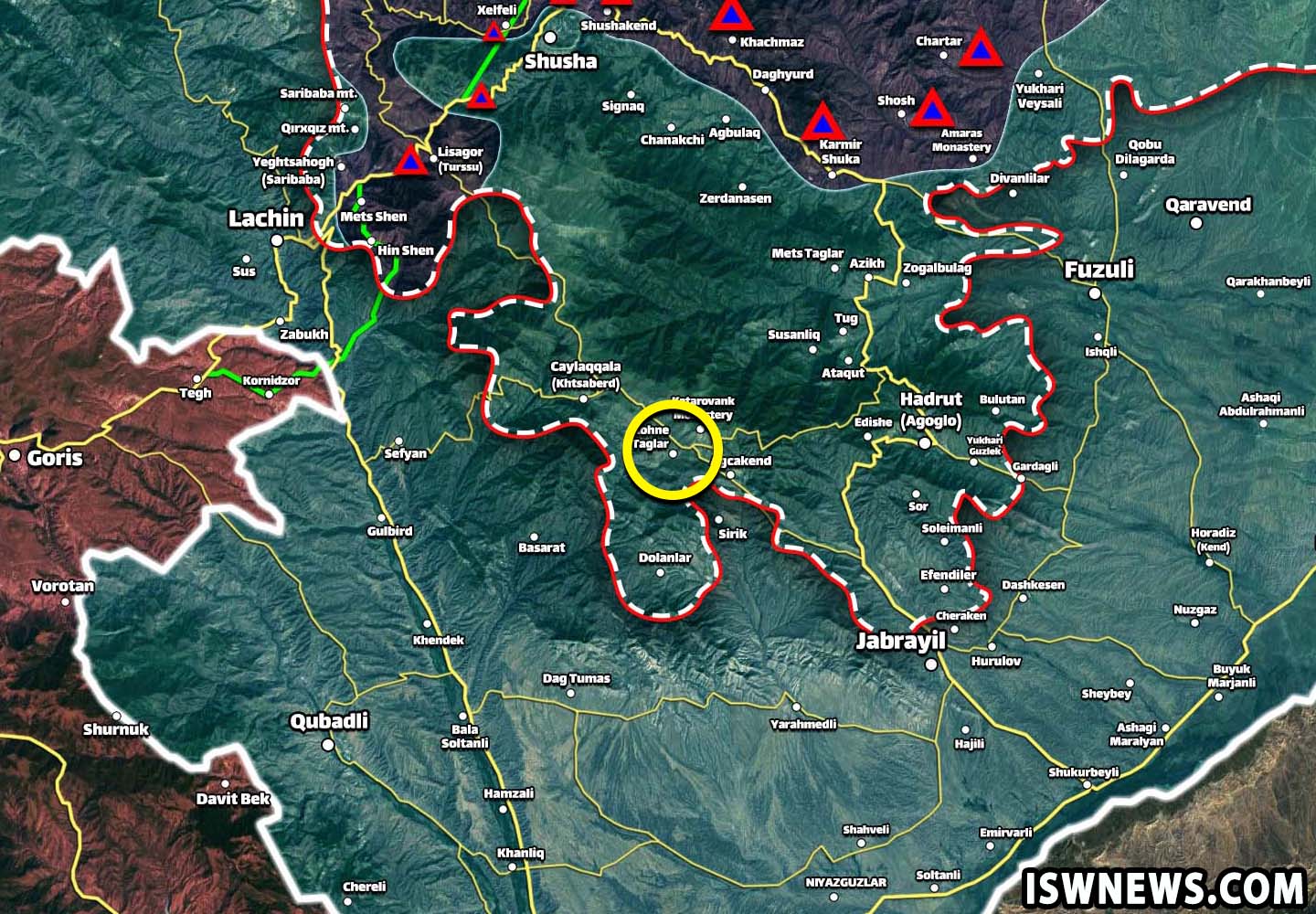
Following the signing ceremony of a tripartite statement among Russia, Republic of Azerbaijan and Armenia on November 9, 2020 and the official conclusion the Second Nagorno-Karabakh War, Azerbaijan’s army besieged and arrested Armenian soldiers, who were stationed in Hin Tagher village in the disputed region of Nagorno-Karabakh. The village is called Kohne Taghlar in Azerbaijani language and in accordance with Azerbaijan’s administrative division is part of the Khojavend County. At the time, when the Armenian soldiers were arrested, the areas controlled by any warring side were not clearly identified; so, the Armenian forces were besieged and then arrested.
In summer 2011, the Azerbaijan Republic sentenced 13 Armenian prisoners of war to six years behind bar on charges of terrorism, keeping and transporting of illegal arms as well as forming unlawful armed organization.
The government in Baku announced that only 33 prisoners of war are in custody. Siranush Sahakian, lawyer representing Armenian POWs in the European Court of Human Rights, believes that in addition to the mentioned number, there are also 90 other Armenian prisoners of war in Azerbaijan.
Arman Tatoyan, human rights defender in Armenia, said that the trial of the Armenian prisoners of war in Azerbaijan was held in contradiction to the international regulations.
Arif Yunusov, human rights activist in Azerbaijan, is of the opinion that the trial was held hastily and without paying heed to the prisoners’ cases. All knew that the people will turn into a case for exchanging and bargaining with Armenia, the United States, Syria and Lebanon. There are two Armenian nationals of Syria among the 13 trialed prisoners of war. Azerbaijan needs the prisoners of war in order to take advantage for different political postures. Earlier, Azerbaijan released 15 Armenian prisoners of war, when an American official visited Baku.
The BBC went on to say that the signing of peace deal between Azerbaijan and Armenia has been tied to the issue of supporting the rights of Armenians in the mountainous region of Nagorno-Karabakh. The Armenian nationals of the Nagorno-Karabakh region are worried about their security, because the Azerbaijani authorities foment hate speeches against the Armenians of the country.
According to the ISWnews, some Armenian sources said that Head of Communication and Prevention Programs at the Armenian Office of the International Committee of the Red Cross Zara Amatuni has released other news stories on the conditions of the Armenian prisoners of war with the of military and paramilitary background, who were active in the Hin Tagher village. The Azerbaijani government allowed Amatuni to meet Vigen Oljakchian, a Lebanese Armenian national, who was imprisoned in Baku. Oljakchian could have a phone conversation with his family members for the first time since the time when he was arrested by Azerbaijan. The Armenian national paramilitary force refused to give any information to the representative of the Red Cross.
The volunteer Armenian national paramilitary forces that came from different countries cooperated with the Armenian armed forces as well as other paramilitary forces during the Second Nagorno-Karabakh War against Azerbaijan’s army. The foreign Armenian national paramilitary forces are those, whose ancestors were massacred or displaced by the Ottoman Empire during the World War I.
A number of so-called environmental activists, who support Azerbaijan’s President Ilham Aliyev, stopped transit of Armenians in Shusha city towards the center of Nagorno-Karabakh (Artsakh) region. Azerbaijan’s armed forces, from March 25, have started advancing in some parts of northern corridor of Lachin and seized control of heights overlooking side roads from Lisagor (Turssu) village to Stepanakert (Khankendi) city, the center of Nagorno-Karabakh region. Therefore, residents of six villages of Lisagor (Turssu), Yeghtsahogh (Saribaba), Mets Shen (Buyuk Galadarasi), Hen Shen (Kichik Galadarasi), Kanach Tala (Goytala) and Tasy Verst that are Armenian settlements have been besieged, and the side roads, which are their last chance to maintain their connection with the center of the Nagorno-Karabakh have been blocked.
Challenge of living in Line of Contact
Radio Liberty of Armenia has prepared a report on regions that are near the Line of Contact and witnessing a hard situation following the closure of transportation ways. Lisagor in this region is the only residential area, where the Armenians have been resided in following the end of First Nagorno-Karabakh War from February 1988 to May 1994.
Qajik Nasibyan, head of Lisagor council, told a reporter of the radio that the village with 73 Armenian people has been situated in vicinity of the Line of Contact after the end of the Second Nagorno-Karabakh War (September 27, 2020 – November 10, 2020). Their presence zone on the road is 8 to 10 kilometers near Shusha. Now, the village comes under the fire of the observation post of the Azerbaijan Republic’s army. The Azerbaijan armed forces plan to control the only remained road for their connection to Stepanakert; so, they took it.
Artak Hakobyan, head of Saribaba council, explained the hardships of living under this condition, saying that aside from healthcare issues, other problems have happened. Students cannot commute to Stepanakert. The Azerbaijan army personnel have been deployed 500 meters away from the Saribaba village. The residents of the village can farm only near their houses. In August 2022, Azerbaijan Republic retook Lachin District, and the Azeri Army controlled heights around the village. Azerbaijanis have stolen 17 cows so far; so, if we neglect for only five minutes, our cattle would be stolen.
Azerbaijan does not intend to retreat
Siran Ayraptian, representative of the Armenian separatists of Artsakh, in an interview with Radio Liberty pointed to the inconclusive negotiations by Russian peacekeepers to urge Azerbaijan Republic to retreat from the heights overlooking Lisagor village, saying that Azerbaijan resorted to blocking the only transportation road in a bid to force the Armenian community there to stop their demand for independence. On one hand, the Azeri authorities speak of peace, and on the other hand, they resort to enforcing pressure in order to force us to do something else, but the performance would not bring positive result.
Pro-Aliyev environmental activists present in Shusha sit-in accuse Armenian people of illegal excavation of mines in Karabakh and pollution in that mountainous region; therefore, they resort to the excuse to block the road even for routine traffic. The authorities in Azerbaijan Republic say that the side roads are being applied for delivery of arms and military equipment. Thus, all roads should be closed for residents of central parts of the mountainous Karabakh region!
From checkpoint to border police station
Azerbaijan Republic is saying that they should build a border police station in Lachin Corridor. The Azeri officials first announced that an checkpoint should be erected in Shusha city, but now they say the post should be constructed in the borderline between Azerbaijan and Armenia.
It is worth mentioning that the Azerbaijan Army trespassed on Armenian soil, when they attempted to cut the old route of Tegh to Lachin Corridor, and they occupied hundreds of hectares of Armenian territories in east and northeast of Tegh. (Map below)
Checkpoint is contrary to Moscow statement
Russian foreign ministry spokesperson Maria Zakharova underlined the need for implementing provisions of the Nagorno-Karabakh ceasefire agreement, which is a tripartite statement signed by Russia, Azerbaijan and Armenia on November 9, 2020, saying that the establishment of a checkpoint is not among the provisions of the statement, but Moscow will observe the option.
Challenges of new path of Lachin Corridor
The Lachin Corridor links Armenians living in the Nagorno-Karabakh region to Armenia; so, the residents of the region can only meet their needs through this path.
The developments of the Lachin Corridor are also of importance. According to the Nagorno-Karabakh ceasefire agreement, the old route from Tegh village should be closed from April 1, 2023 and a new path towards the south should be used, which has a boundary of five kilometers. Azerbaijan constructed parts of the road, which is under its control prior to the end of last year (2022), and it has blocked the old route totally.
The substitute route, which passes across Kornidzor village in southern Tegh village, has not been completed yet by Armenia. 200 meters of the road near Kornidzor village is under construction; so, transport through the piece of road is hard. Armenia’s hesitance to construct the route seems to be a weird gesture!
Detailed map of the new and old routes of the southern part of Lachine Corridor
According to the information that has reached to “Islamic World News“, a few hours ago, several units of Azerbaijan’s armed forces closed the Goris-Stepanakert (Khankendi) road in the border strip with Armenia, between Zabukh and Tegh areas. Currently, the number of military trucks of the Azerbaijan Armed Forces has increased to more than 10 trucks, and the preparation of barricades on the road between Armenia and Artsakh has begun.
According to the agreement between the Russian Federation and Azerbaijan, the Armenian side will finish the construction of the new road from Armenia to Stepanakert by April 1st, and the old road will be under the control of Azerbaijan. Therefore, it is likely that the activity of Azerbaijan’s armed forces was related to this issue.
Representatives of Azerbaijan and the de-facto government of Artsakh met with each other in Khojaly on Wednesday, March 1, and discussed several technical issues. It was reported that Lachin Corridor and environmental monitoring issues were discussed at the meeting. Artsakh political officials stated that political and security issues were not discussed in this meeting.
This is the second meeting of its kind after the removal of Ruben Vardanyan, the state minister of Artsakh from his position on February 23.
It is said that Azerbaijan’s precondition for this meeting was the dismissal of Artsakh government minister Ruben Vardanyan. The Baku government and Ilham Aliyev conveyed this demand to the Armenian authorities of Nagorno-Karabakh through Armenian Prime Minister Nikol Pashinyan. Also, according to speculations, Armenia has played its mediating role.
It should be noted that last week, Arayik Harutyunyan, the president of Artsakh, dismissed Ruben Vardanyan, the state minister of Artsakh. Ruben Vardanyan, who is a dual citizen of Armenia and Russia, returned to Nagorno-Karabakh last year and it was said that he was supposed to smooth the process of Nagorno-Karabakh’s accession to the Russian Federation.
At the meeting, the issues of restoration of unhindered traffic through the Lachin corridor and purposeful use of the Lachin corridor were discussed. This was reported by the command of the Russian peacekeeping contingent to “Artsakhpress” agency.
The parties also discussed issues of regular electricity and gas supply.
In addition, within the framework of the meeting, the possibility of environmental monitoring of the representatives of the Azerbaijani side in the Drmbon and Kashen mines was discussed.
Lusine Avanesyan, spokesperson of the Nagorno-Karabakh president, called the meeting “constructive” in her statement to the Armenpress publication.
According to information provided by Karabakh Information Department, the DKR (Nagorno Karabagh Republic) President, Arayik Harutyunyan said at the government cabinet meeting on March 1 that “any integration process with Azerbaijan is excluded.”
“I want to emphasize once again that we will remain loyal to the Artsakh movement, despite the difficulties and pressures we are subjected to. I want to declare with full responsibility that any integration process with Azerbaijan is excluded. However, this does not mean that we will avoid contacts aimed at solving infrastructure and humanitarian problems. As I said in my address dated February 23, certain conditions and an international format should be provided for the negotiations on the settlement of the conflict”, Arayik Harutyunyan said in his speech.
The first meeting between the representatives of Azerbaijan and Nagorno-Karabakh took place on February 25, after Ruben Vardanyan, the state minister of state of Nagorno-Karabakh was removed from his post. On that time, the news of the first negotiation between the government of Baku and the de facto government of Artsakh was made public by the authorities of Nagorno-Karabakh, but the official authorities of Azerbaijan refused to announce it.
It is important to note that, although Arayik Harutyunyan, the president of Artsakh, which holds the power of Nagorno-Karabakh, was forced to oust Ruben Vardanyan from his position, he scored a point for the region in doing so. The negotiations between the government of Baku and the authorities of Nagorno-Karabakh mean recognition of the independent existence of Armenians in Nagorno-Karabakh. Since 32 years ago, when the Armenians of Nagorno-Karabakh and the Shahumyan region in the north of this region held a referendum on independence, the authorities of Azerbaijan, while dissolving the autonomous region of Nagorno-Karabakh in the divisions of the country, rejected any meeting and dialogue with the Armenian government known as Artsakh, and basically they did not recognize them. Therefore, recognizing Artsakh and negotiating with them is considered a win for the Armenian of Nagorno-Karabakh. Also, despite the dismissal of Ruben Vardanyan, Vardanyan is still in the Nagorno-Karabakh region and still maintains shadow power due to his relations with Russia and ensuring the security of Armenian officials and the needs of the people of this region.
A picture of the second meeting between representatives of the government of Baku and the government of Artsakh with the presence of Russian peacekeepers
Arayik Harutyunyan announced that Artsakh Defense Minister Jalal Harutyunyan is wounded and will be replaced by Mikael Albert Arzumanyan. According to available information, he was injured during one of the military operations. However, some sources report the death of the Minister of Defense and former commander of the army.
The so-called Republic of Artsakh refers to the Armenian forces that, with the help of Armenia, took full control of the Nagorno-Karabakh Autonomous Oblast as well as the surrounding lands after the military conflict with Azerbaijan.