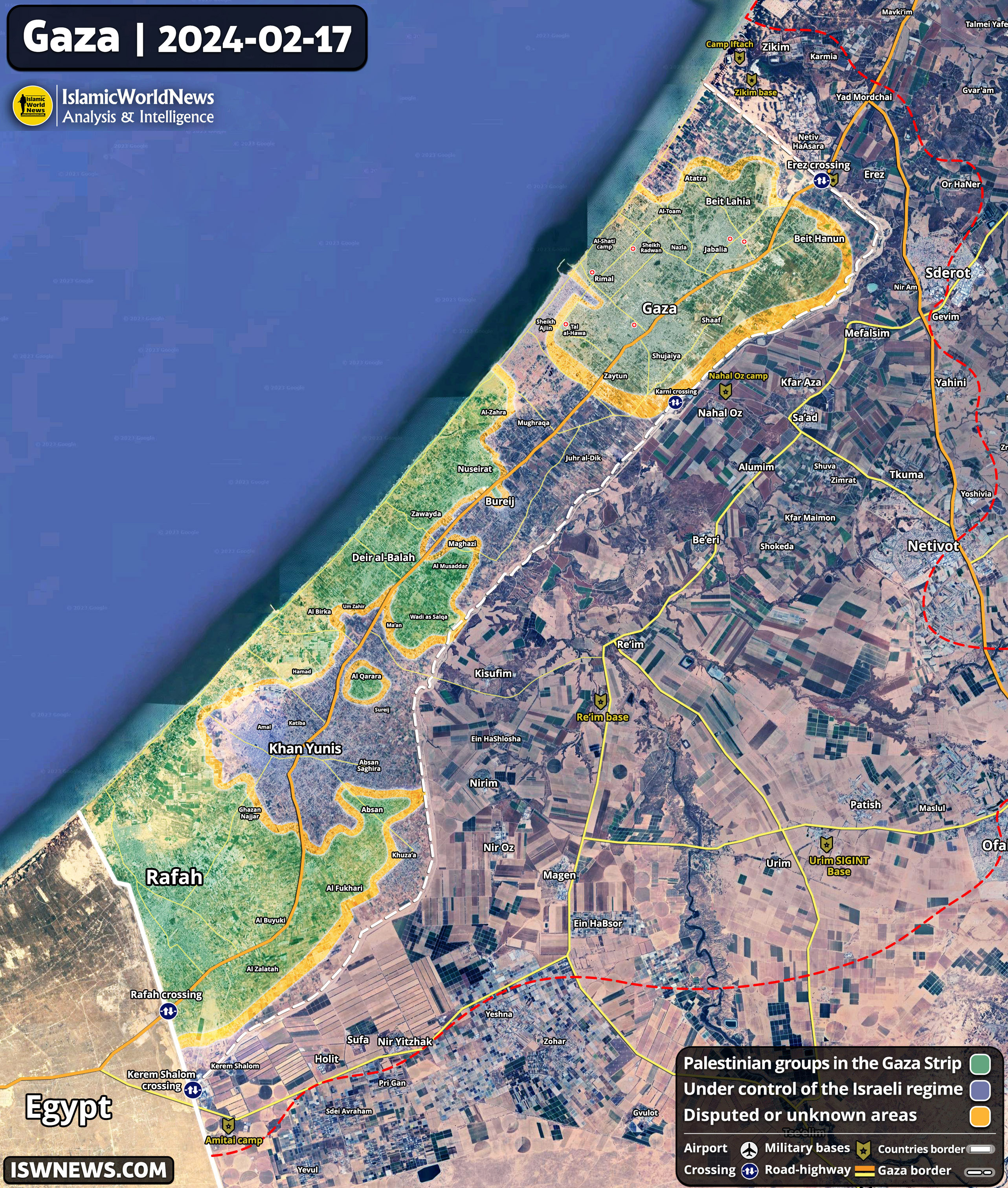
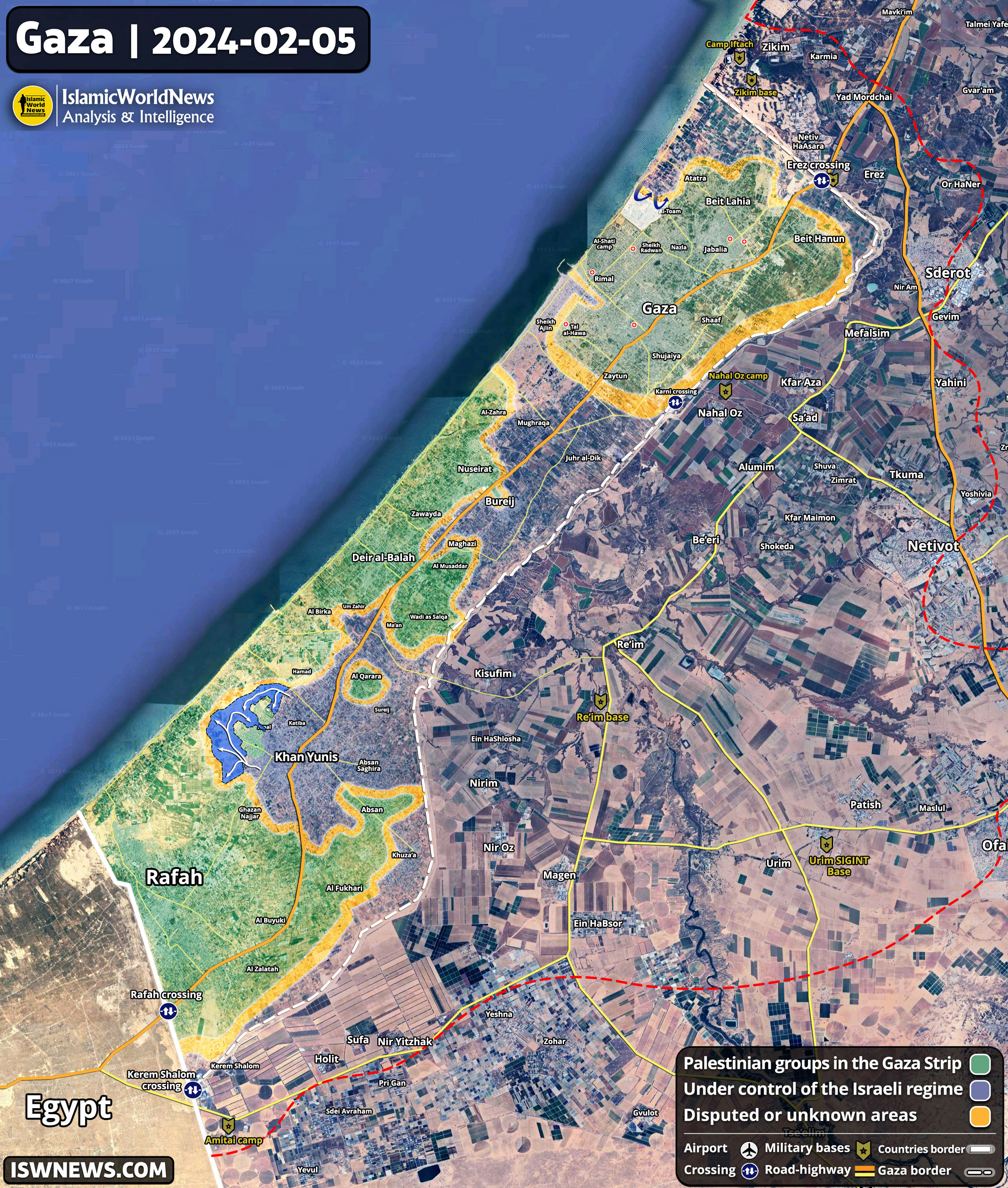
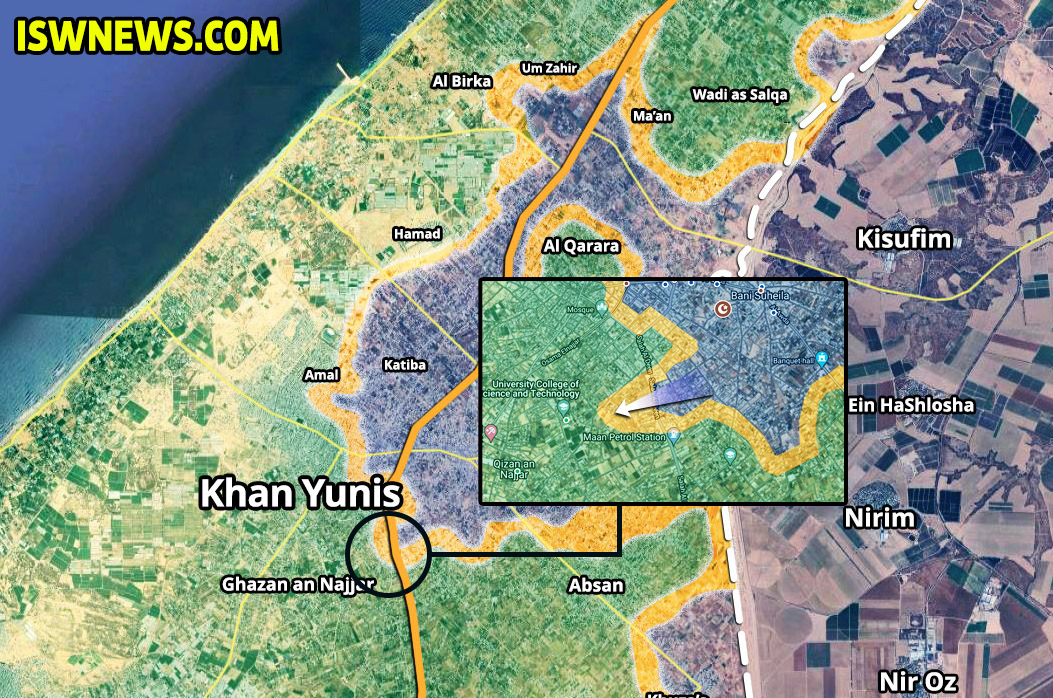
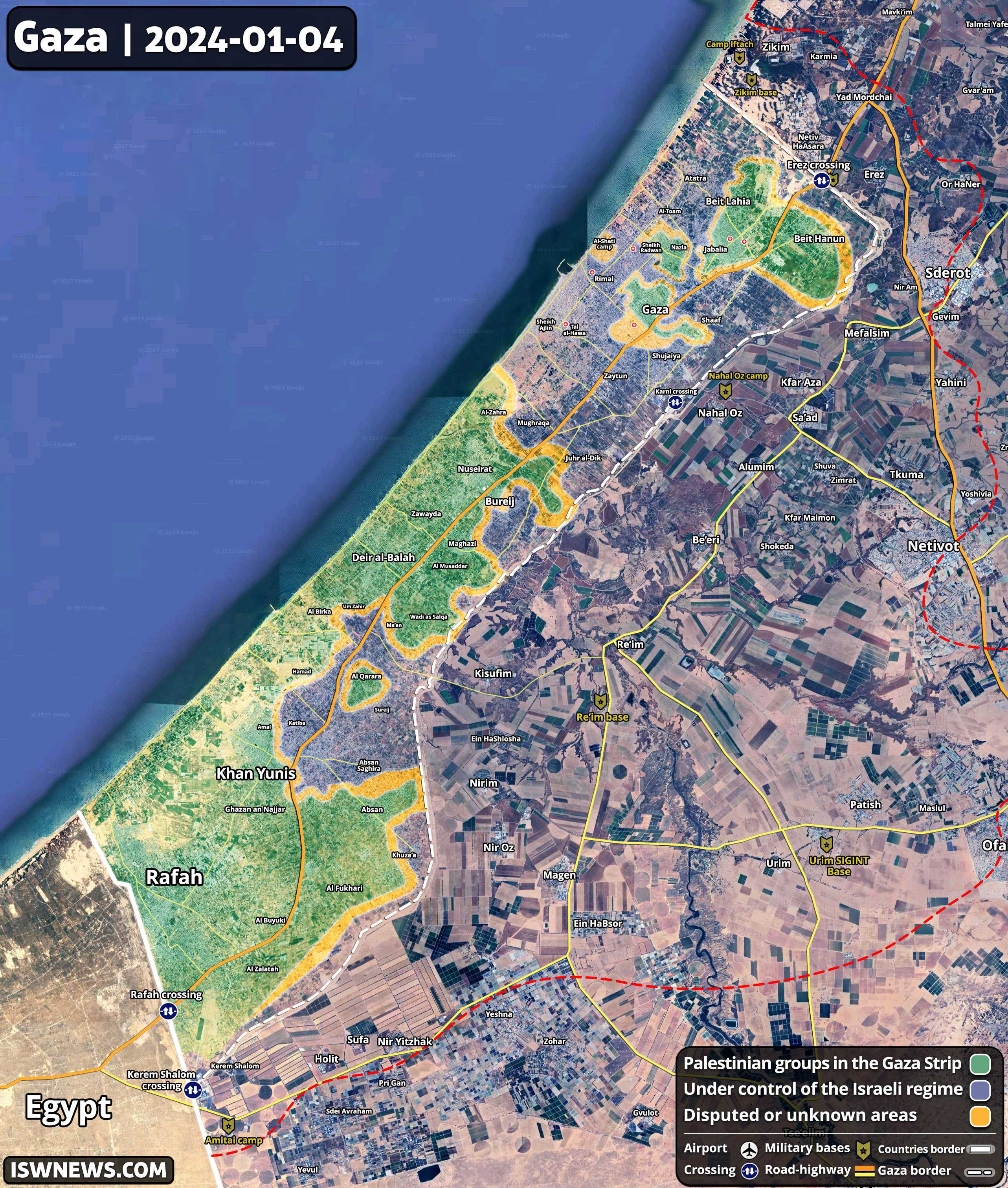
In the south of the Gaza Strip, during the last 10 days, Israeli forces gradually advanced in the encircled pockets in the city of Khan Yunis and succeeded in completely clearing the city, and practically the city of Khan Yunis was completely occupied by the Israeli forces. This morning (Feb 17), the Israeli occupying forces raided the besieged Nasser hospital in the northwest of Khan Yunis and arrested 100 people. The area around Nasser Hospital was one of the last areas where the resistance forces stood against the Israeli occupation.
Due to the occupation of Khan Yunis city, Israeli forces have now focused their attacks and operations on the western suburbs of Khan Yunis and Rafah city. According to the latest information, the Israeli regime is preparing to start a large-scale operation with the aim of destroying and occupying the city of Rafah. It is said that in recent days, new shipments of weapons and ammunition have been sent by the U.S. to the Israeli regime. Israeli reconnaissance drones are constantly flying in the sky of Rafah and are currently monitoring and collecting field information.
After the beginning of the Israeli regime’s ground attack on the Gaza Strip, the city of Rafah hosts thousands of Palestinian refugees from the northern and middle areas of the Gaza Strip who have taken refuge in this place. The new ground and air offensive against Rafah puts the lives of thousands of civilians at risk, and if the operation begins, many civilian will lose their lives.
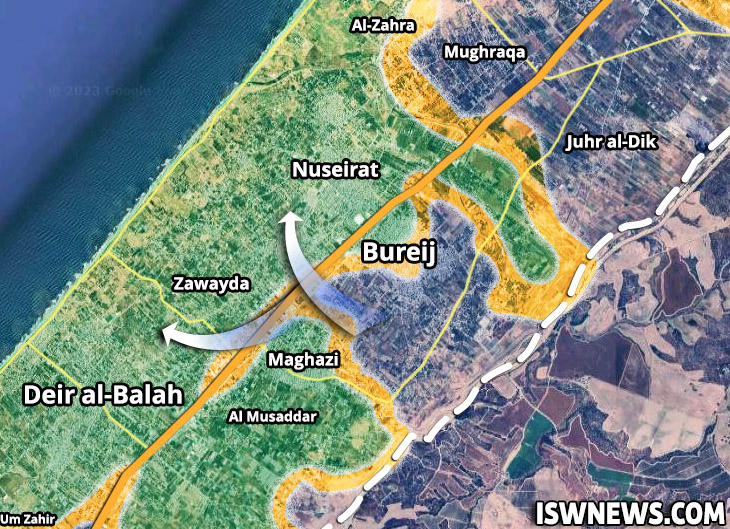
In the middle of the Gaza Strip, the battle fronts have not changed much. Bombings and clashes continue in Al-Maghazi, Al-Bureij, and Nuseirat areas. The area of Deir al-Balah is still under artillery fire and airstrikes by the Israeli regime.
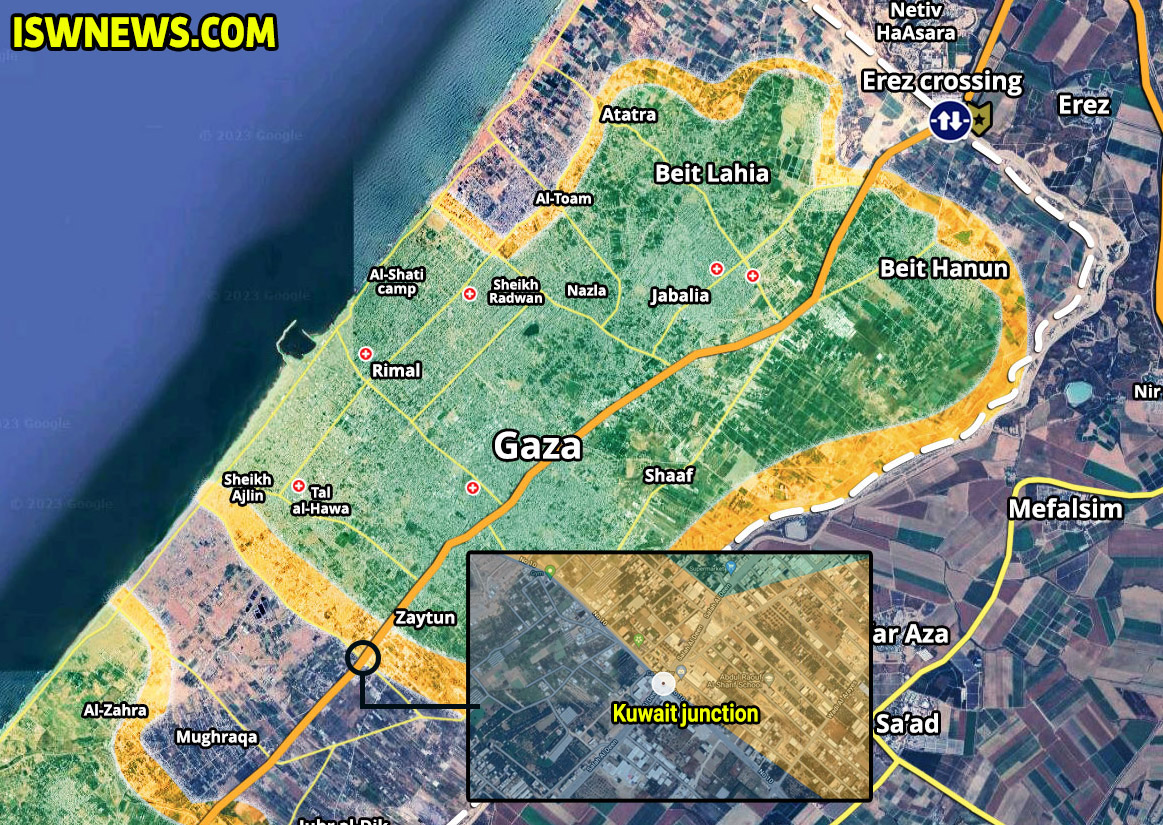
In the north of the Gaza Strip, there has been no significant change in the battle lines. Scattered clashes continue in the southwestern areas of Gaza City, and Israel’s artillery, drones, and fighter jets bomb various areas in the north of the Gaza Strip on a daily basis.
In the south of the Gaza Strip, during the last two weeks, the Israeli occupying forces slowly advanced in the western and northern areas of the city of Khan Yunis, and this city was completely surrounded. Currently, most of Khan Yunis city is under the control of Israeli forces, and only small parts of Al-Amal, Al-Nasr neighborhood and Khan Yunis camp are under the control of Palestinian forces.
In the middle of the Gaza strip, there has been no special change during the last two weeks and the Israeli forces have practically stopped in their previous positions.
In the north of the Gaza Strip, the situation has not changed. During the last few days, based on the field information, images and videos published from the north of Gaza, the Israeli forces have withdrawn from a number of other areas in the northwest of Gaza, from the al-Tawam area and its surroundings. Also, Israeli forces are still present in the southwestern areas of Gaza City along the coastline.
Another important point that should not be neglected is the presence of Palestinian fighters in the north of the Gaza Strip. In videos that have been published of the recent advance of Israeli forces in the Rimal area, it shows that the Palestinian fighters are welcoming Israeli battle tanks with RPGs. This issue once again proves that the “Islamic World News” maps from the north of the Gaza Strip were correct and Palestinian fighters are still present in Gaza City. After the Israeli army withdrew from most of northern Gaza, many mistakenly believed that the northern Gaza Strip had been cleared of all Palestinian fighters and Israel has withdrawn from Gaza for this reason.
In the political sphere, last Sunday, a meeting was held in Paris with representatives of the US, the Zionist regime, Egypt and Qatar, and the parties reached an agreement regarding the exchange of prisoners between the Hamas movement and the Israeli regime and the establishment of a ceasefire in the Gaza Strip. The contents of this proposal have been provided to the authorities of the Hamas movement, and Ismail Haniyeh is going to Cairo, the capital of Egypt, to review this agreement and proposals. Nevertheless, the Palestinian authorities are not optimistic about this issue and demand an end to the aggression of the Israeli regime and the complete withdrawal of the Zionist army forces from the Gaza Strip.
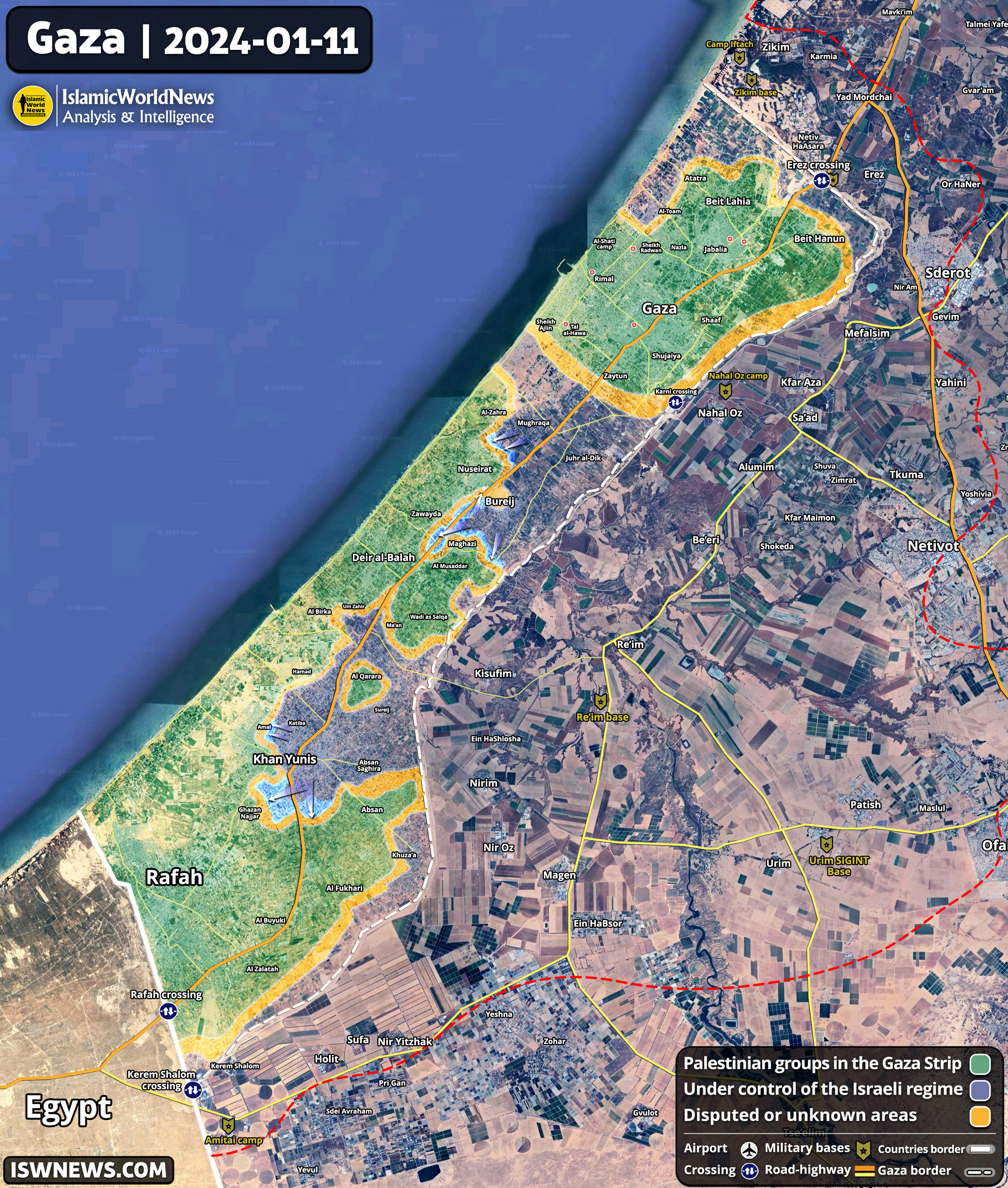
In the south of the Gaza Strip, during the last four days, Israeli forces increased the extent of their advances in the south and southwest of the city of Khan Yunis. In this axis, Israeli forces have reached Ghazan al-Najjar and clashes continue around this village. By advancing on this axis, the Israeli army plans to encircle the city of Khan Yunis from the south and cut off the roads leading to Rafah. Clashes continue in the north of Khan Yunis. The Israeli forces have made advances in this direction in the last few days, but due to the urban context and the fierce resistance by the Palestinian fighters, the amount of advances is limited.
In the middle of the Gaza Strip, Israeli forces are advancing slowly but steadily. On the Nuseirat front, Israeli forces slightly advanced in west of al-Maghraqa. On the al-Bureij front, Israeli forces have almost surrounded the al-Bureij camp and the fall of al-Bureij seems certain. On the al-Maghazi front, Israeli forces have advanced in the north and south of al-Maghazi and have bypassed this camp and are advancing on Salah al-Din road and its surrounding areas. The Juhr al-Dik front has obviously come under the control of the Israeli army after the recent advances of the Israeli army around al-Bureij and Nuseirat.
In the north of the Gaza Strip, after the withdrawal of Israeli forces from inside the Gaza City to the outskirts of the city, there is no specific clashes in the north of the Gaza Strip. Only some sporadic clashes were reported in the outskirts of the city.
Currently, the central and southern areas of the Gaza Strip are the most active fronts in the Gaza Strip.
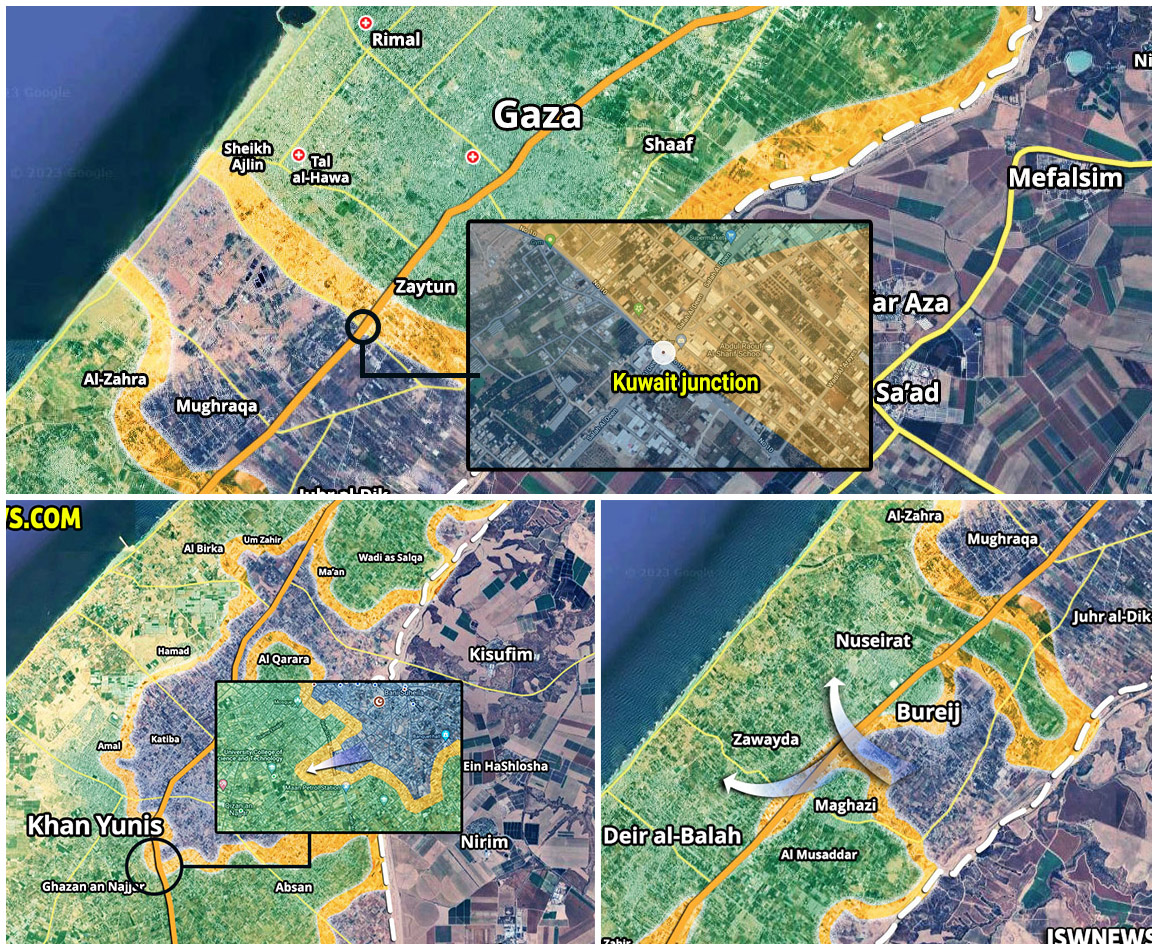
In the south of the Gaza Strip, clashes continued in the center and south of the city of Khan Yunis. According to field information, the Zionist occupying forces have destroyed the agricultural lands and the houses of the citizens in front of the Khan Younis Faculty of Science and Technology. This shows that the Israeli forces are advancing in the southwest of Khan Yunis city.
The military situation in the south of the Gaza Strip and Khan Yunis
In the middle of the Gaza Strip, clashes continued in Al-Bureij and Al-Maghazi and around Nuseirat as well as at the entrance of Al-Zawayda. Israeli artillery and fighter jets are severely targeting Al-Zawayda area. By putting pressure on Al-Zawayda and advancing on this axis, the Israeli regime plans to surround Nuseirat and approach Deir al-Balah.
The military situation in the center of the Gaza Strip
In the north of the Gaza Strip, after the withdrawal of Israeli forces from the inner areas of the city, there is no specific ground conflict in Gaza City and the Israeli regime has turned to airstrikes again. However, today clashes were reported near Kuwait junction in the southern suburbs of Al-Zaytoun neighborhood. Kuwait junction is located on the 10th street in the contact line between the Israeli and Palestinian forces. Earlier we announced that the Israeli forces have retreated to behind the 10th street in south of Gaza City. In fact, clashes around Kuwait junction once again confirms the correctness of the IWN map regarding the withdrawal of Israeli forces from the north of the Gaza Strip.
It is also said that the Israeli regime has completed its withdrawal from the northern areas of the Gaza Strip. If this claim is true, the few remaining areas in the north of Gaza should also be cleared of the Zionists.
As the IWN reported yesterday that the Israeli regime has been retreating from more areas in the northern Gaza Strip; this issue has been confirmed today following the publication of videos and images of battlefields from northern Gaza. Also, senior member of the Palestinian resistance movement Hamas Osama Hamdan emphasized this afternoon (Jan 7) that the Israeli regime has retreated from the northern Gaza Strip.
However, it is necessary to mention that Israeli army forces are present in small parts of western areas of Beit Lahia city and western Al-Tawam Street, but they will probably also retreat soon. Israeli forces entered the northern Gaza Strip during the first days of the war and will now leave those areas in the final stage of their retreat.
In the south of Gaza City, according to available information, the tenth street has been determined as the last line of retreat for the Israeli regime’s army forces. In other words, the Israeli regime’s military forces have retreated from neighborhoods such as Al-Zeitoun, Tel Al-Hawa, Al-Sheikh Ijlin, and so on, to behind the tenth street. It seems that these areas will remain under Israeli occupation until the end of the Israeli regime’s operation in the center of the Gaza Strip.
So, what did the Israeli regime achieve in the northern Gaza Strip?
Yesterday (Jan 6), the spokesperson for the Israeli regime’s army claimed that Israeli armed forces have completed dismantling Hamas’s military structure in the northern Gaza Strip! And that the Israeli regime’s military forces have done so many efforts and that how many commanders and fighters they have killed and how many tunnel networks we have destroyed, etc., and now the focus of the Israeli regime’s army is on operations in the center and south of the Gaza Strip.
However, contrary to the Israeli regime’s claim, the fact is that the Israeli regime did not even come close to achieve its main goal of destroying the Palestinian resistance movement Hamas even for a moment during the Gaza war and its only achievement in the northern Gaza Strip was destruction of buildings and mass murder. It is certain that the Israeli regime will not succeed in achieving its goal in the center and south of the Gaza Strip either.
On the other hand, it is true that so far, international observers have witnessed unprecedented destruction in northern Gaza and some Palestinian resistance commanders and fighters have been martyred, and a network of tunnels has been destroyed, but all of these can be replaced and repaired. Tunnels and buildings will be rebuilt, and forces will be replaced. The very important point is that during these three months, the Israeli regime never managed to take full control of the northern Gaza Strip, and now after the withdrawal of occupying forces from this region, Palestinian fighters are still present in Gaza and have control over the areas.
In the center of the Gaza Strip, clashes continue in Al-Bureij and Al-Mughazi refugee camps as well as around Al-Nuseirat refugee camp. The Israeli regime’s armed forces have made partial advances in the Juhr al-Dik area. Also, the Israeli regime’s military forces have advanced between Al-Bureij and Al-Mughazi refugee camps and have reached Salah al-Din Road, the main highway that runs through the strip from north to south and connects all of its towns. Given that the Israeli regime’s forces have been dispatched from the northern Gaza Strip to the central and southern axes of the Gaza Strip, ground battles in this axis are truly unequal, and Palestinian resistance fighters face a difficult task of preserving these areas.
In the south of the Gaza Strip, clashes continue in the central neighborhoods of Khan Yunis city, and the Israeli regime’s army is struggling to make progress in this area. The steadfastness and resilience of Palestinian resistance fighters in Khan Yunis are exemplary. According to the latest field information, the Israeli regime’s armed forces have advanced several blocks along Jamal Abdul Naser Street and Osama Al-Najjar Street.
Khan Yunis, like other areas, has witnessed a lot of destruction. After advancing in each area, the Israeli regime’s occupying forces explode and destroy buildings and homes as much as possible. Large parts of eastern Khan Yunis have been completely destroyed so far.
Three months have passed since the beginning of the war and during this time we have witnessed many events and many ups and downs. In these 90 days, the criminal regime of Israel has martyred 22,438 Palestinians living in the Gaza Strip and has set a new record of brutality in the history of mankind. The depth of this tragedy becomes more clear when we know that about 70% of the martyrs are children and women!
On the other side, according to the Israeli regime, about 500 Israeli servicemen were killed in the first days of the war and after the ground invasion of the Gaza Strip. But unofficial statistics claim that the casualties of the Israeli army are more than 3,500.
In the field and after the ground entry of the Israeli army into the Gaza Strip, so far something like 50% of the Gaza Strip has been occupied by Israeli forces. The Israelis are using the scorched earth policy to advance in different areas of the Gaza Strip, and after occupying new areas with the aim of destroying life in Gaza, they are again destroying the infrastructure as much as possible. Therefore, we see a lot of destruction. The extent of these destructions can be clearly seen in satellite images.
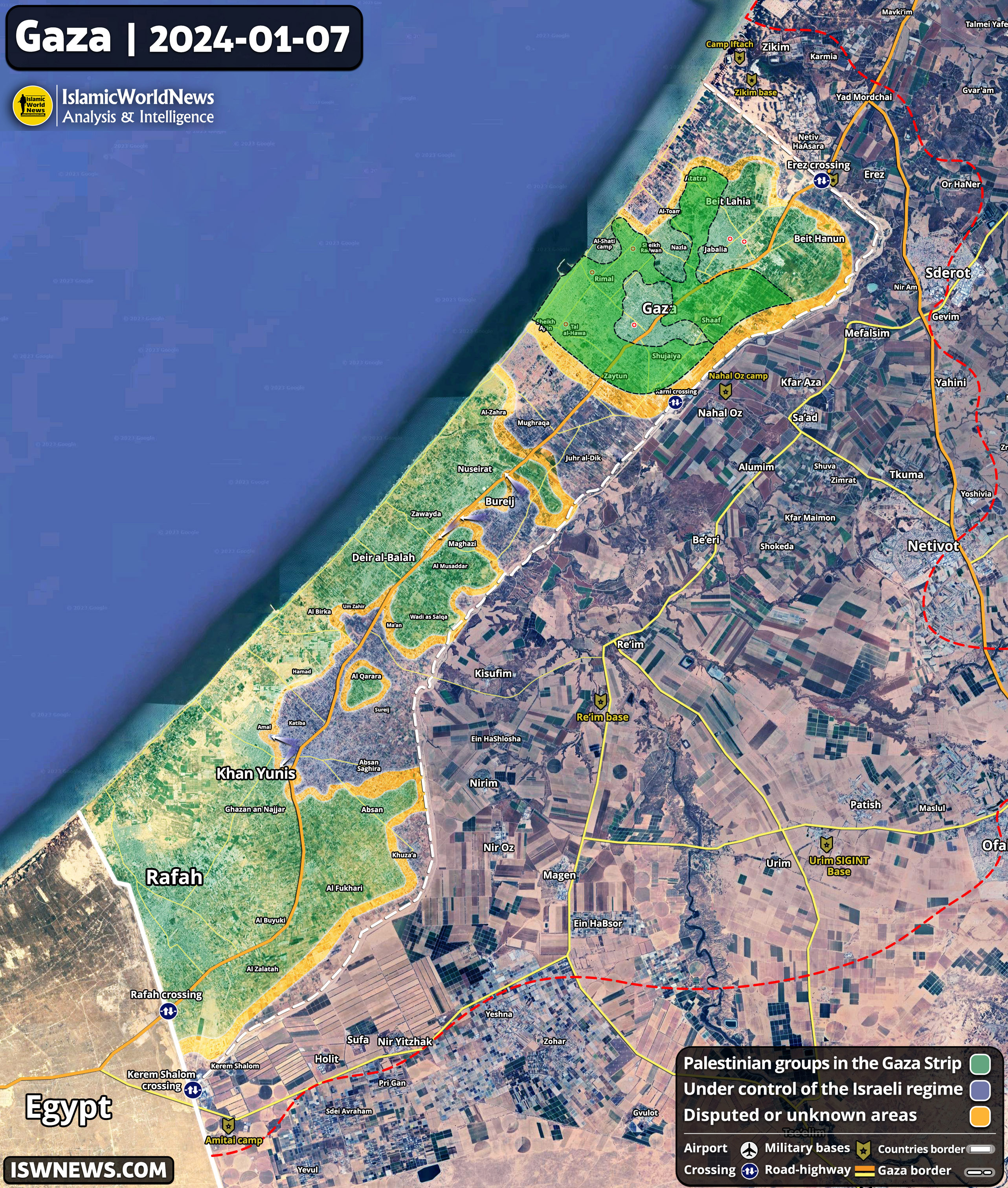
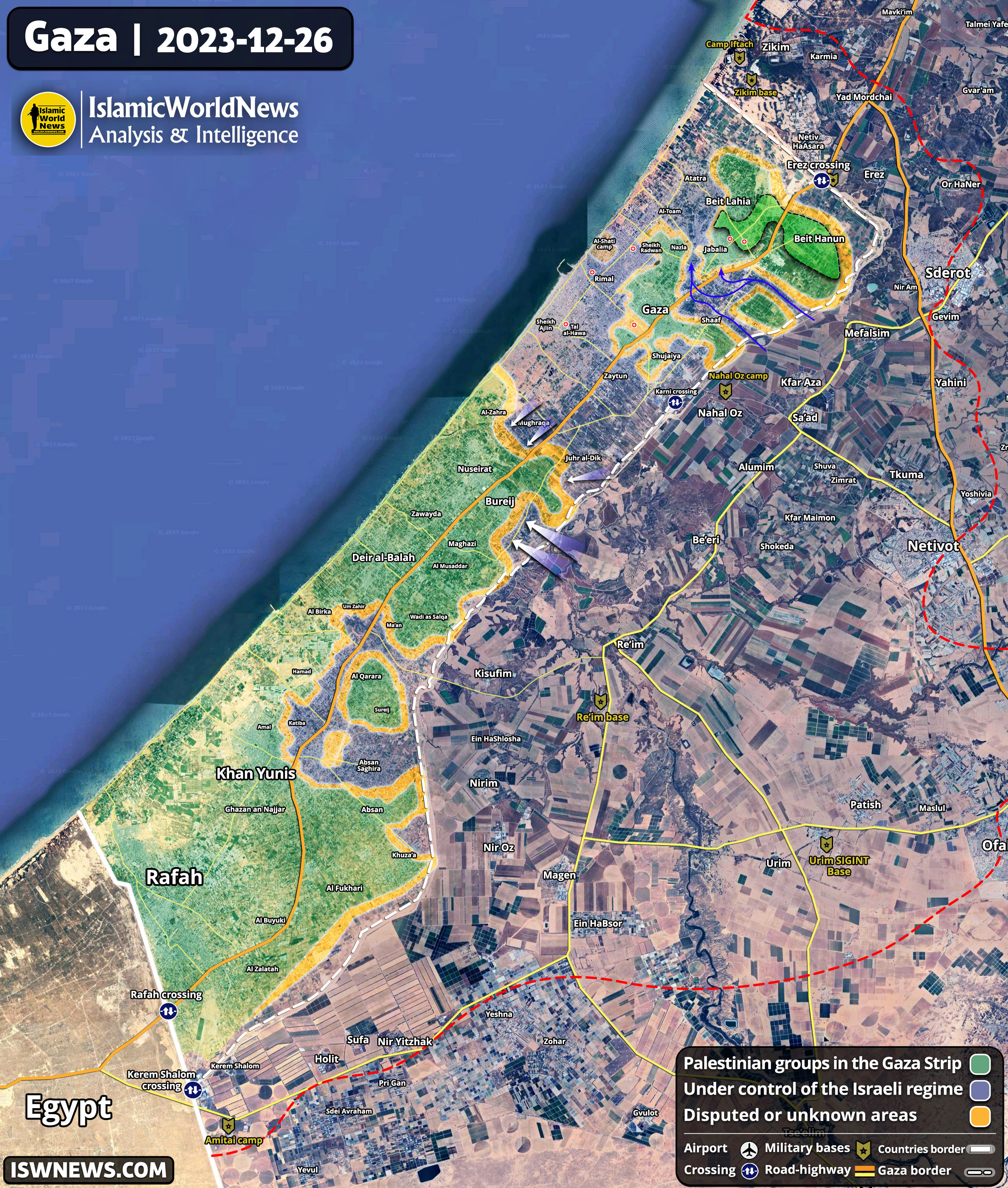
The latest military situation in the Gaza Strip is as follows: In general, the military situation in different areas of the Gaza Strip has not changed significantly compared to the last four days, and the conflicts continue sporadically in all axes. In the north of the Gaza Strip, clashes continue around the Jabalia camp and parts of Sheikh Radwan, Al-Tuffah and Al-Daraj neighborhoods. In the middle of the Gaza Strip, the conflicts in the south and east of al-Maghazi continue fiercely. In Al-Bureij, Israeli forces are still present in the southern parts of this town and the clashes continue inside Al-Bureij. In Nuseirat, clashes continue in the east and north of this camp. Based on field information, it seems that the Israeli army has succeeded in making limited advances in north of Nuseirat. In the south of the Gaza Strip, clashes continue in the central areas of the city of Khan Yunis. During the last four days, no progress has been reported, however, the only change is related to the Khan Yunis Municipality building. Israeli forces have occupied the Khan Yunis Municipality building near Abu Hamid square in the center of the city.
The latest military situation in the Gaza Strip – click to view in full size
Retreat and the start of intelligence and security operations: The Israeli regime appears to be trying to reduce its targeted aerial and ground attacks in the Gaza Strip in order to prevent or counter greater threats from the Islamic Republic of Iran or the Lebanese resistance front. Instead of destroying the remaining areas of the Gaza Strip, Israel aims to focus on its main objective of assassinating or capturing the leaders of Hamas. Additionally, there has been significant financial pressure on the Israeli regime’s cabinet, and the army must maintain its weapon reserves to confront larger threats. Therefore, in this stage of the war, the activities of Israeli intelligence and security organizations will become more prominent, and intelligence and security operations will increase. This trend has been highlighted by the assassination of martyr Seyyed Razi Mousavi, indicating that the Israeli army has prepared itself to act against all resistance groups.
Moreover, the ground clashes in the Gaza Strip have reached a serious deadlock, and the frontlines have not seen significant changes for about ten days. The heavy blows inflicted by Palestinian groups upon Israeli military forces, as witnessed in numerous videos, have caused considerable casualties and damage to Israel, prompting Israeli military officials to expedite the end of the second phase of ground operations. International pressure on the Western states has also increased, and the tendency of the administration of US President Joe Biden to support and cover up the Israeli regime’s crimes in the Gaza Strip has diminished.
Security Buffer Zone: The exact details of the security buffer zone are not precisely known. According to information from Israeli and Western media, the buffer zone will be approximately one kilometer wide (or alternatively, two to four kilometers) and will cover the entire Gaza Strip.
Ceasefire Negotiations: Perhaps, one of the reasons that led to the start of the third phase of Israeli operations in this period of time was the resistance of the Palestinians to agree to a temporary ceasefire for the second time. The main goal of the Israeli regime in conducting ground operations in the Gaza Strip was to free Israeli captives, which not only did not succeed but also resulted in multiple failed attempts by Israeli Special Forces to infiltrate the captives’ location, leading to heavy losses for the Israeli regime’s army.
Overall, Israel still enjoys the support of American and European Zionist lobbies and is willing to continue the war in the Gaza Strip. The timeframe for the implementation of the third phase of operations has been stated from nine months to two years; so, there is no urgency seen for negotiations and a cessation of the war. However, the issue of Israeli captives has put significant pressure and domestic consequences on the Israeli regime; although, these pressures have not yet resulted in any changes in the regime’s decisions regarding negotiations. The captives remain the most significant bargaining instrument in the hands of Palestinian resistance movement during any negotiations, and media coverage of the captive issue will have a significant impact on the shaping of the Israeli regime’s protest rallies and demands.
In general, the previous plan of the Israeli army to force the Palestinian resistance groups to surrender doomed to failure and despite the Israeli advance on the ground in the Gaza Strip, their main objectives, including freeing all captives, destroying Hamas, and eliminating the leaders of the resistance groups, have not been achieved. Undoubtedly, if the Palestinian resistance continues and external strikes on Israeli positions and interests increase, the third phase will come to an end much sooner than the announced deadline. However, this conclusion will not be through the destruction of the Palestinian resistance, but rather through victory and hope for the liberation of all of Palestine.
In the northern axis of Gaza Strip, according to the latest field information and videos released by field sources, the Israeli regime forces have retreated from Beit Hanoun and most of Beit Lahia, but the clashes continue around Jabalia and some areas of Sheikh Radwan. Also, Israeli forces have retreated from some places in Al-Shujaiyah area. On the other hand, the Israeli forces entered the Gaza Strip from two new axes from the south of Jabalia and reached the Israeli forces in the west of the Jabalia camp and tightened the siege of the Jabalia camp. It should be noted that until the moment of writing this text, the news of the complete withdrawal of the Zionist regime from the areas of Al-Rimal, Al-Zaitun, Al-Shujaiyah and other areas of Gaza City is not true and Israeli forces are present in different areas of the city. The map of the Gaza Strip will be updated or corrected if reliable field information of new changes is received.
In the central axis of the Gaza Strip, Israeli forces have entered the Gaza Strip from south of Al-Bureij during the last four days. Also, Israeli forces have taken control of most of Al-Maghraqa and have made advances in Juhr Al-Dik area. Currently, the most intense clashes are going on near Bureij and Nuseirat. In general, the middle front of the Gaza Strip is now the most active front of the strip.
In the southern axis of the Gaza Strip, there has been no significant change in the Khan Yunis front, and the control lines in this city have not changed compared to recent days.
The latest military situation in the Gaza Strip – click to view in full size
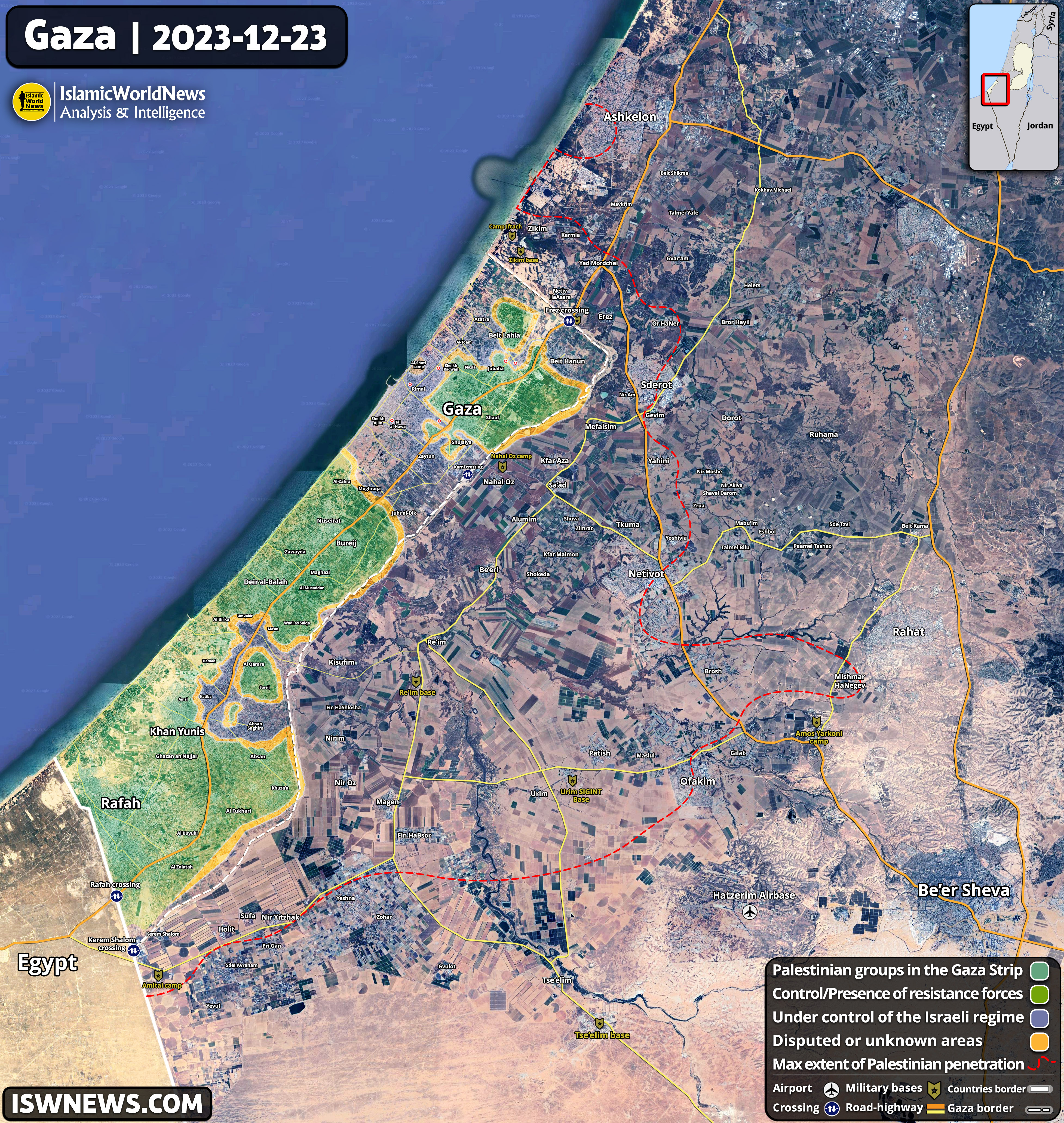
In the northern areas of the Gaza strip, scattered clashes continued along the axes of the Jabalia camp as well as around Al-Jalaa Street and Yarmouk Street. Also, Israeli forces carried out attacks against the areas of Al-Tuffah and Al-Daraj on Saturday.
Based on field information, it appears that Israeli forces have withdrawn from some points in the Gaza City. This withdrawal does not mean a complete withdrawal from the city; rather, the Israeli troops moved between several areas, several lines, or several streets. Generally, the Israeli regime’s army has established several points in the city as its main command center and from these areas, it advances or moves its forces to maintain control over the occupied areas.
It seems that the evacuation of some areas by the Israeli regime has been done for three reasons; first, the Israeli regime has achieved some of its goals, such as controlling key areas of the city of Gaza and destroying some of the most important tunnels and sections, both through aerial bombardment and through bombing and destruction. The second reason is that the prolongation of the war and the significant increase in casualties in recent days have forced them to make these withdrawals. The Israeli regime is forced to restrict or reduce the battlefronts in the Gaza City to prevent further casualties. And the third reason is that for now, the Israeli regime’s army has confined itself to its current conquests in the Gaza City and is now seeking to occupy the central and southern parts of the Gaza Strip.
Another important incident, which happened on Saturday, was the bombing of the Al-Shati refugee camp. After the initial advances of the Israeli regime’s forces in the Gaza City, the Al-Shati area was one of the first areas to be cut off from other parts of the city, and since then, no news has been reported from this area. However, the bombing of the Al-Shati refugee camp showed that the Israeli regime does not have complete control over this area. Also, an Israeli media outlet revealed for the first time on Saturday that over the course of the recent advances by the Israeli regime’s army, its forces did not fully enter Al-Shati refugee camp due to fear of heavy casualties and instead besieged this area.
In the middle of the Gaza Strip, clashes have intensified. According to field information, the Israeli regime’s military forces have launched new operations from Al-Mughraqa town, Al-Zahra, and Juhor ad-Dik village, and they are trying to advance towards Al-Bureij and Al-Nuseirat refugee camp. At this time, intense clashes are taking place in the Al-Mughraqa area. The Israeli regime’s warplanes are also heavily bombing the central areas of the Gaza Strip. So far, the Israeli regime’s military forces have not succeeded in making significant advances in this axis.
In the south of the Gaza Strip, scattered clashes continue in Khan Yunis city, and there has been no significant change in the control lines of this city.
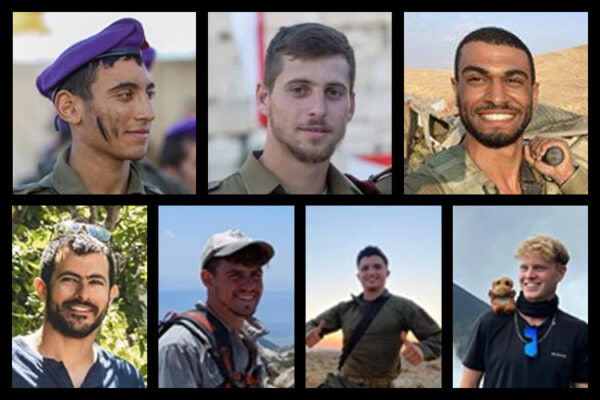
The names are Cpt. Yarin Gahali from the Givati Brigade’s reconnaissance unit, Cpt. (res.) Netanel Silberg, a team commander in the Combat Engineering Corps’ Yahalom unit, Sgt. First Class (res.) Lidor Yosef Karavani, from the Combat Engineering Corps’ 8163rd Battalion, Sgt. First Class Urija Bayer from the Commando Brigade’s Maglan Unit, Sgt. First Class Liav Aloush, from the Commando Brigade’s Duvdevan Unit, Master Sgt. (res.) Etan Naeh, from the Commando Brigade’s Duvdevan Unit, Master Sgt. (res.) Tal Filiba from the Combat Engineering Corps’ Yahalom unit.
With the death of these seven servicemen, according to the official announcement, the alleged death toll of the Israeli army since the launch of ground invasion of Gaza has increased to 129 servicemen, And the alleged total number of “military” deaths since the October 7 reached 461 servicemen.
The names are Staff Sgt. Boris Dunavetski from the 401st Armored Brigade’s 46th Battalion, Master Sgt. Joseph Avner Doran from the combat mobility Unit 444 and Sgt. Maj. Shalev Zaltsman from the 55th Reserve Paratroopers Brigade’s 6623rd Battalion.
With the death of these five servicemen, according to the official announcement, the alleged death toll of the Israeli army since the launch of ground invasion of Gaza has increased to 122 servicemen, And the alleged total number of “military” deaths since the October 7 reached 454 servicemen.
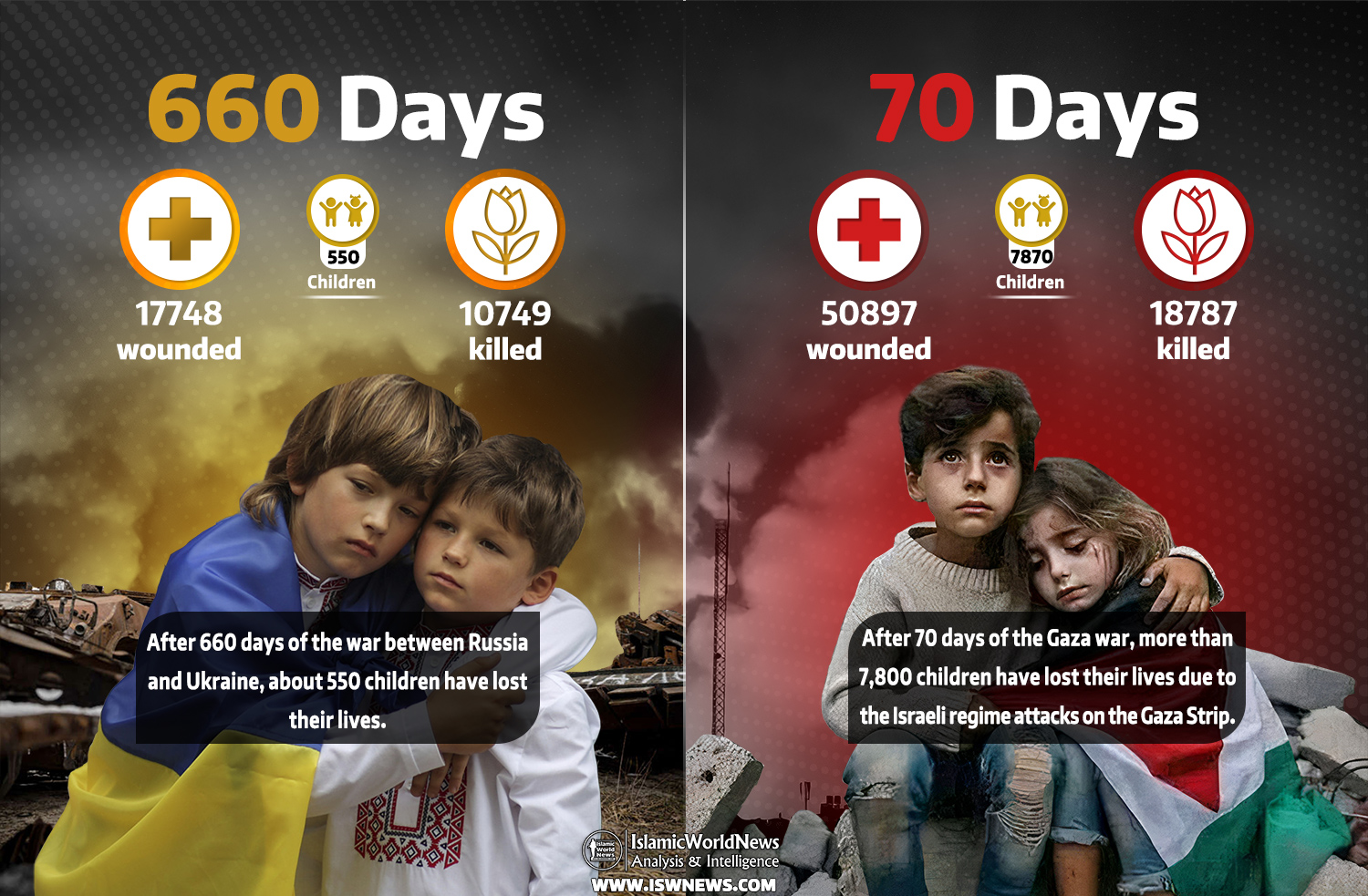
In the past 70 days, as a result of the Israeli regime’s attacks on the Gaza Strip, more than 18,787 Palestinians, including 7,870 children and more than 6,000 Palestinian women, have been killed, and more than 50,897 others have been injured. However, during the 660 days of the war between Russia and Ukraine, more than 10,749 civilians and about 550 children have lost their lives.
In other words, the number of civilian casualties in Gaza in just 70 days has been higher than the entire Russia-Ukraine war in 660 days!!
The World Health Organization (WHO) had announced a few days ago that about five children in Gaza are killed every hour.
The comparison of the number of children and women killed in the Gaza war with the conflict in Ukraine clearly indicates the extent and severity of the heinous crimes of the Israeli regime against the people of Palestine and is a clear example of the inefficiency of the United Nations.