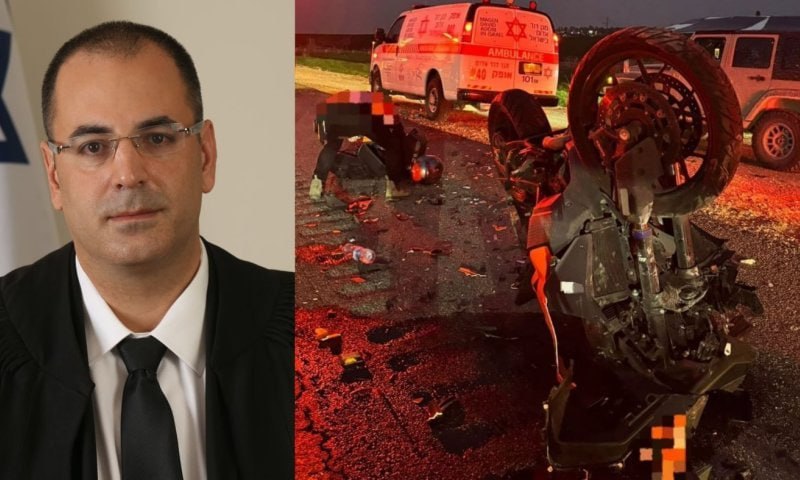
Shagai had joined the judiciary in 2007 and was appointed head of the Beersheba District Court in April 2025. Israel’s judiciary described him in a statement as “an outstanding judge, a capable manager, and a beloved figure,” calling his death “a great loss” for the judicial system.
Judge Beni Shagai was more than just a court administrator. He was a key figure in handling complex corruption cases and played a significant role in the so-called Case 3000, which involved the purchase of submarines and warships from Germany and links to associates of Benjamin Netanyahu. His position meant that his decisions had a direct impact on Israel’s political and judicial landscape.
His death occurred just as the main hearings in related cases had concluded and final verdicts were approaching. This timing has raised questions and doubts among the public. Under judicial procedure, the death of a presiding judge causes a delay of several months, allowing a new judge to review thousands of pages of documents and evidence. Such delays can effectively benefit defendants in major cases and ease public pressure.
Experts believe that the Israeli army does not have the ability to completely occupy the Gaza Strip, and most of these operations are carried out with the aim of clearing possible areas where Hamas forces are present.
Clashes continue in Rafah city and the southern areas of Gaza city, also known as the Netzarim corridor, amidst ceasefire negotiations.
Recently, the director of the American Central Intelligence Agency held talks with Israel, Qatar and Egypt to amend the details of the proposal. The Egyptian and Qatari mediators are pessimistic about the chances of reaching an agreement, and they estimate that Netanyahu does not want to reach an agreement before the US presidential elections.
On the other hand, after the discovery of the bodies of 6 Israeli prisoners in the Gaza Strip, internal pressure has increased on Netanyahu and his government to agree to a peace agreement with Hamas and return the Israeli prisoners.
Six Israeli dead prisoners found in southern Gaza Strip
On September 1, Israeli army announced that it recovered the bodies of six hostages, who were captured alive by the Hamas on October 7, from a tunnel in the southern Gaza Strip city of Rafah, shortly after they were murdered by their captors.
Hamas rejected the claim of the Israeli army. It is said that two of these prisoners were supposed to be released in the first phase of a possible ceasefire agreement and exchange of prisoners. It seems that Netanyahu will use this opportunity to continue the war in the Gaza Strip and put pressure on Hamas and achieve his so-called goals in the Gaza Strip.
Still, important problems such as the Philadelphia and Netzarim axis prevent a lasting ceasefire agreement in the Gaza Strip. Netanyahu and his hard-line cabinet are not willing to withdraw from these areas.
Actually, Netanyahu’s cabinet decision to remain in Philadelphia was a public blow to Defense Minister Yoav Galant and Chief of Staff Herzi Halevi, who recommended a temporary withdrawal from the strategic axis in order to free 20-30 prisoners.
As tensions persist in the Gaza Strip and internal divisions arise among Israeli officials regarding the strip, the Israeli Defense Minister is issuing threats to engage in a wide-scale conflict with Hezbollah on the Northern Front!
Israeli Defense Minister Yoav Gallant announced today while visiting the Netzarim axis, “While we are fighting in Gaza, we are preparing for anything that could happen in the north and we are ready to transfer the center of military gravity to the northern front immediately.”
Israeli Defense Minister Yoav Gallant in Netzarim corridor
The battles in the northern front have been going on for months and tensions along the northern borders have led to widespread evacuations of settlements. More than 250,000 Israeli citizens have been displaced by the war and the number of Israeli refugees increases daily.
The current situation in the northern front has caused the reverse migration of Israelis and huge political and financial losses to the Israeli regime. The security of the settlers in northern Palestine has been completely destroyed and it is difficult and unbearable for Israel to continue the current situation.
The Israeli army and Lebanese Hezbollah continue to exchange artillery fire on a daily basis. Hezbollah attacks Israeli army positions and bases in the region using light rockets, suicide drones, and anti-armor missiles. On the other hand, Israeli fighter jets target the eastern and southern towns of Lebanon using heavy bombs and Israeli drones conduct targeted assassinations against Lebanese resistance fighters and commanders.
Israeli warplanes targeting alleged Hezbollah targets in southern Lebanon
In recent months, Israeli authorities have repeatedly threatened Lebanon with a large-scale ground military operation. Gallant’s recent threat from the heart of the Gaza Strip is the latest example of these threats.
However, it seems very unlikely that the Israeli regime has the ability to fight on three fronts. Especially since the Israeli army recently opened a new front in the West Bank.
Therefore, the outcome of the ceasefire negotiations in the Gaza Strip is crucial for the Israeli regime and has a direct impact on the continuation of the war in the northern front. In fact, Hezbollah’s goal of waging war with Israel is about to secure a lasting ceasefire in the south. Hezbollah has announced the end of Israel’s aggression in the Gaza Strip as a condition for the cessation of the war and the end of insecurity on the northern front.
Israel stated that the purpose of the operation in the West Bank is to deal with the increasing insecurity of the last few months and to destroy the so-called Iranian terrorism.
It is said that the Israeli army has now classified the West Bank as the second most important and sensitive front after Gaza. This directive is currently in its early stages, and it is expected to take time to compile and finalize, but the Israeli military has organized a series of operations against resistance groups in areas of the West Bank. Israeli officials emphasized: “The operation in the West Bank is just the beginning.”
The Israeli operation is currently focused on the northern half of the West Bank and the cities of Jenin, Tulkarm, Tubas and Nablus. According to the Palestinian Ministry of Health, since the onset of the Israeli offensive in the West Bank, 39 Palestinians have been martyred and 145 others have been wounded.
However, after the start of military operations in the West Bank, the security situation in this area has worsened and anti-Israeli operations have greatly increased.
On August 31, an Israeli squad commander in the ranks of the Bislamach Brigade’s 906th Battalion was killed and three others were wounded during clashes with fighters from the Hamas Movement in Jenin. On September 1, three Israeli police officers were killed in a shooting attack near the city of Tarqumiyah. And the latest incident was today, on September 8, that three Israelis were killed in a shooting attack at the Allenby Bridge crossing between Jordan and the occupied West Bank.
Three Israelis killed in a shooting attack at the Allenby Bridge crossing
The recent developments in the West Bank clearly indicate that escalating pressure from the Israeli army on the people of the West Bank may have the opposite effect. Furthermore, the expansion of the conflict in this region could pose a serious threat to the security of Israel’s capital.
Many experts believe that the Israeli regime’s new military aggression in the West Bank, due to Netanyahu’s extremist and warlike cabinet, can eventually turn into something similar to the genocide that is going on in the Gaza Strip.
The Israeli aggression in Gaza has so far claimed the lives of more than 40,500 Palestinians, most of whom are women and children. The Israeli forces also killed more than 670 Palestinians in the West Bank since the start of the war on October 7.
According to Hebrew-language sources, Benny Gantz and Gadi Eisenkot, members of the Israeli war cabinet, as well as Chili Tropper, the Israeli minister from the National Unity Party, which is Benny Gantz party, and Avi Rosenfeld, the commander of the Gaza Division in the Israeli army, all resigned from their positions on Sunday. This sudden wave of resignations has sent shockwaves through the Israeli government, with many speculating about the reasons behind these sudden departures.
In response to Gantz’s resignation from the war cabinet, Netanyahu stated, “This is the time for unity, not for division.” However, his words have fallen on deaf ears, as many see his government as ineffective and lacking a clear direction.
Yair Lapid, one of Netanyahu’s opponents, commented on the situation, saying that Gantz’s resignation has ensured Netanyahu’s continued tenure as prime minister in this ineffective government. Lapid emphasized that Netanyahu’s government has no political goals in Gaza or Lebanon, and its inability to achieve these goals has led to widespread discontent.
The Israeli prime minister is well aware that if the war ends and the cabinet collapses, he will face numerous challenges, and even this collapse could mark the end of his political career. Therefore, he tries to continue the current battles for various reasons, including the release of prisoners, removing the shadow of war from occupied territories, and countering the threats of the resistance front, among others.
Despite the growing pressure and criticism, Netanyahu remains determined to continue his policies, even if it means facing the consequences of his actions.
The recent resignations and the ongoing political turmoil in the Israeli regime highlight the deep divisions within the government and the regime as a whole. As the situation continues to unfold, it remains to be seen whether Netanyahu will be able to maintain his grip on power or if his government will ultimately collapse under the weight of its own ineffectiveness.
The warning comes after a recent uptick in hostilities, including a drone strike by Hezbollah that injured 11 Israeli settlers in the northern town of Hurfeish. This attack followed a wave of Hezbollah fires that raged through the border region, causing widespread destruction and displacement.
“Anyone who thinks that they can harm us and we will sit on our hands is sorely mistaken,” Netanyahu said during a visit to the largely evacuated town of Kiryat Shemona. “We are prepared for a very strong action in the north. In one way or another we will restore security to the north,” he added.
Netanyahu during a visit to the town of Kiryat Shemona.
The prime minister’s rhetoric underscores the growing concerns on the Israeli side about the escalating situation. The Israeli occupation forces’ chief of staff, Herzi Halevi, warned that the military is approaching a point where it will have to make a decision, stating that “the IDF is ready for an offensive.”
The EU has also expressed alarm over the “ever-growing destruction and the forced displacement of civilians on both sides of the Israeli-Lebanese border,” calling on all parties to exercise restraint and avoid a broader regional conflict.
Hezbollah, for its part, has indicated that it is not seeking all-out war with the Israeli regime. The Lebanese resistance movement’s recent actions, including the unprecedented deployment of a squadron of drones, have further thrilled the Israeli officials; so, they resort to the threat of a potential conflagration.
Hezbollah has been carrying out near-daily attacks against Israeli military positions along Lebanon’s southern border. The purpose of these attacks is to alleviate the pressure on Palestinian resistance fighters who are engaged in combat against Israeli forces inside the Gaza Strip.
Meanwhile, human rights groups have also accused the Israeli regime of using white phosphorus incendiary shells in southern Lebanon, a report that the Israeli military has denied, claiming that such munitions were only used as a smokescreen and in accordance with international law.
The situation along the Israeli-occupied border of Lebanon remains highly volatile, with both sides seemingly poised for a potential escalation. As the war of words and military posturing continue, the threat of a wider conflict looms large, with the potential to engulf the broader region.
Analysts warn that a miscalculation or a single spark could rapidly spiral into a full-blown confrontation, the consequences of which could be devastating for all involved. The calls for restraint and diplomacy grow ever louder, as the international community anxiously watches the high-stakes standoff unfold.
According to Hebrew-language media outlets, hundreds of Israelis demonstrated in front of labor unions in Tel Aviv and demanded an immediate agreement on the exchange of captives with the Palestinian resistance in Gaza.
During this protest rally, three Israeli settlers were detained by the regime’s police forces. Following the protests, a vehicle ran over the protesters in Tel Aviv, injuring 5 people. This incident prompted a reaction from Yair Lapid, the head of the opposition movement in the Israeli regime.
He said that the incident on Saturday night’s protest against Netanyahu in Tel Aviv is a direct result of the cabinet’s provocations and manipulations.
Lapid emphasized that these incidents will not affect the protests, and we will continue our campaigns until the return of all Israeli captives from the Gaza Strip and the overthrow of this detestable government.
Thousands of Israelis protested on January 13 against the Israeli regime’s cabinet and officials’ indifference to the lives of captives. Protesters demanded immediate action from the Israeli regime to return the captives from the Gaza Strip.
Demonstrators chanted slogans against the policies of Netanyahu’s government and declared that the protestors’ demand to change the government is a real and moral demand.
During this demonstration, Benny Gantz, a member of the Israeli war cabinet, and Gadi Eisenkot, Israel’s former Chief of Staff, appeared in the Tel Aviv demonstration immediately after the end of the war cabinet meeting and demanded the release of Israeli prisoners in Gaza after 100 days of captivity.
It is worth mentioning that in recent weeks, thousands of settlers residing in occupied territories of Palestine also protested and demanded the resignation of the Israeli regime’s Prime Minister Benjamin Netanyahu.
On December 30, families of Israeli captives held in the Gaza Strip protested against the Israeli regime’s cabinet and officials’ indifference to the lives of captives.
Protesters demanded immediate action from the Israeli regime to return the captives from the Gaza Strip.
According to some Hebrew-language media outlets, the Palestinian resistance movement Hamas is now demanding a 20 to 30-day ceasefire in exchange for the release of 50 children, women, and elderly captives, while the Israeli regime is ready to negotiate a one-week ceasefire in the Gaza Strip, the release of Palestinian prisoners, as well as the return of about 40 Israeli captives.
It should be noted that on December 23, thousands of settlers residing in occupied territories of Palestine also protested and demanded the resignation of the Israeli regime’s Prime Minister Benjamin Netanyahu.
Benjamin Netanyahu, the Prime Minister of the Israeli regime, while attending the Knesset, officially announcing the state of war, said about the latest developments of the war: “All countries must confront Hamas and sanction the countries that host its leaders. If Hamas could, it would kill us all. We will use all our power for the victory of Israel and this war will end with only one result, the destruction of Hamas.
We have no choice but death or life before us and we are all united in this war for the victory of Israel and its immortality.
I asked President Biden to provide us with weapons to defend all our cities. Tomorrow I will meet with the Secretary of Defense of the United States. We received extensive aid and weapons from America.
The 7th of October will be recorded as a black day in the history of nations and the most terrible day for the Jews after the Holocaust.”
Benjamin Netanyahu, the prime minister of Israel, has stated that he will destroy the Gaza Strip in response to the heavy damage caused to Israel by the Palestinian Operation Al-Aqsa Storm.
In this regard, several towers, a mosque, an ambulance and other residential buildings were bombarded by Israeli warplanes since this morning. According to the statistics announced by the Palestinian Ministry of Health, the number of Palestinian martyrs has reached 256 martyrs and 1788 wounded.
On September 30, thousands of Zionist settlers demonstrated in the streets of various cities of the occupied territories of Palestine, including Tel Aviv and al-Quds, against Prime Minister Benjamin Netanyahu.
Hebrew-language media outlets reported that Israeli police clashed with demonstrators and arrested at least two Israeli settlers.
It is worth noting that the Israeli settlers’ Saturday demonstrations continue every week in various cities of occupied Palestine.
The rallies, which took place to protest Netanyahu’s judicial reform plan, have now entered the 39th consecutive week.
These protests were held while Hebrew-language media outlets had recently reported a decline in the popularity of Netanyahu’s coalition government due to the so-called judicial reform program, the discredit of the Israeli regime in its efforts to normalize ties with Libya, and statements made by the Israeli National Security Minister Itamar Ben-Gvir against the Palestinian people.
It is worth mentioning that the Israeli settlers’ protests continue every Saturday in various cities of occupied Palestinian lands.
These rallies, which were set up in protest against Netanyahu’s controversial judicial reform program, have now entered their 35th consecutive week.