Tag: Russia in Syria

  • Russian airstrikes on US positions in Syria!

    Russian airstrikes on US positions in Syria!

    U.S. military officials say Russian forces have launched a series of operations this month, including an airstrike on the al-Tanf base in southern Syria.

    US officials have expressed concern about Russia’s actions because they fear a miscalculation could turn into an unintended conflict between US and Russian forces in Syria. Given that tensions between the two countries have increased since the start of the war in Ukraine and the widespread US support for the Ukrainian army to counter Russian forces, it seems that the Russian side is trying to warn the United States that the consequences of the anti-Russian actions in Ukraine may affect the American troops stationed in Syria!

    On June 16, Russian fighter jets attacked Al-Tanf base. Following the attack, the US-backed Maghawir al-Thawra group released images announcing that their headquarters at al-Tanf base had been targeted by airstrikes.

    Read more: Drone attack on US base at Al-Tanf area in southern Syria + Images

    It is said that Russia informed the United States before the strike that it intended to launch an air strike in response to the attack on Syrian army forces, which could result in damage to troops and vehicles stationed at the base.

    “Shortly after the Russian message and before they attacked targets at Al-Tanf base, Russian fighters, including two Sukhoi-35s and one Sukhoi-24, flew over Al-Tanf base,” said a U.S. commander.

    This is not the first time that the Al-Tanf region has caused tensions between Russia and the United States. In 2016, Russian fighter jets bombed the Al-Tanf base. US troops were not stationed at the base at the time, and several US-backed militants were killed in that attack.

    In 2017, General Vladimir Zarodnitsky called on senior US military commanders to withdraw their troops from the Al-Tanf garrison within 48 hours. Gen. Stephen Townsend, the commander-in-chief of the US coalition, refused the Russian commander’s request, and after some tension, the Russian general withdrew his request.

    It is worth mentioning that according to the American media, about 900 American soldiers are present in different parts of Syria under the pretext of fighting terrorism, 200 of whom are stationed at Al-Tanf base, and even after the end of ISIS caliphate, these forces have not left the country.

    The Al-Tanf region in southeastern Syria has been occupied by US forces for years, and resistance forces are not allowed to approach within a 55-kilometer radius of the area. Al-Tanf base in the border triangle between Syria, Iraq and Jordan is a strategic base, and US officials do not intend to lose it easily.

    Read more:
    Drone and Rocket Attack on US Tanf Base
    Military exercises in Al-Tanf and CONOCO; There is no attack!
    Opinion: Al-Tanf Base; Joint Headquarters of Terrorists!

  • Construction of a new base in the west of Manbij by Russia

    Construction of a new base in the west of Manbij by Russia

    The base is located 20 km from the Turkish-occupied areas along the M4 highway. Syrian Army artillery and several Russian military vehicles have been stationed at the base for some time. This action was taken in order to strengthen the presence of Russian forces from the eastern suburbs of Aleppo to Ain Issa in the north of Raqqa province on the Aleppo-Hasakah road.

    After the withdrawal of American forces from some parts of northeastern Syria, Russian forces were stationed in some of those bases, such as al-Tabqa military airport on the outskirts of Raqqa, and strengthened their presence by establishing other bases in Raqqa and the eastern suburbs of Aleppo.

    The city of Manbij has been under YPG control since 2016, and in 2019, after US troops withdrew from the city, the Syrian army set up a network of military posts on the outskirts of Manbij to counter the possible offensive by Turkey and Ankara-backed militants.

  • Russia and Syria joint air drill in northeastern Syria + Images

    Russia and Syria joint air drill in northeastern Syria + Images

    On October 31, 12 Su-34 bombers and 5 Su-35 multirole fighters, which have been stationed in Qamishli airport, conducted air raids on pre-assigned targets. 12 Mi-8 and 5 Ka-52 helicopters also stationed in Sarin area.
    Sarin was occupied by Americans before and was one of US largest bases in Syria which was used for logistics for American coalition due to its long runway.

    Syrian air defense also drilled to confront enemy drones.

  • IED attack on Russian Military Police vehicle in Daraa

    IED attack on Russian Military Police vehicle in Daraa

    Due to the opposition of some militants to the national reconciliation plan, it is likely that the number of attacks against Russian and Syrian patrols and convoys in Daraa province will increase.
    Earlier, a number of militants declared that “those who join the reconciliation plan are traitors and deserve punishment and we continue operations against Syrian and Russian troops in Daraa province.”

  • Russian Air Force pounds ISIS in Syrian deserts

    Russian Air Force pounds ISIS in Syrian deserts

    Russian warplanes attacks on ISIS positions and hideouts in the Syrian desert began on Sunday, October 17th. In the last 48 hours, 55 airstrikes have been carried out against ISIS, killing at least 15 ISIS terrorists.

    The ground operations of the Syrian army and its allies with the air support of Russian and Syrian aircraft continue in the Syrian desert against the ISIS cells. These efforts made while the ISIS activities such as IED attacks and surprise attacks on the SAA positions and other types of hostile actions continue in the area.

  • Large Russian logistical convoy en route to Ain Issa

    Large Russian logistical convoy en route to Ain Issa

    The Russian convoy consists of 55 military vehicles, 200 Russian military police, electronic equipment and jamming systems. The convoy entered the city of Tabqah, which is controlled by the Syrian Democratic Forces (SDF), and will soon move towards Syrian Army positions in the Ain Issa area.

    Also on Monday, Russian forces sent reinforcements from their base in the city of Tal Tamar to the 93rd Brigade of the Syrian Army, located south of the town of Ain Issa.

  • Russian Army helicopter crashed in Hasakah

    Russian Army helicopter crashed in Hasakah

    According to local reports, the pilot of the helicopter was killed and other crews were injured.

    However, the Russian Ministry of Defense denied any casualties. In response to the news circulating, the Russian Ministry of Defense confirmed in its statement that all the cabin crew members are alive, adding that they have been taken to the airport immediately and that there is no danger to their lives.

  • Syria: Turkey and Russia agreement on Ain Issa

    Syria: Turkey and Russia agreement on Ain Issa

    According to Russian sources, Turkey and Russia agreed to reduce the tensions in Ain Issa and deployment of Russian military police in the area.

    Deputy director the Russian Reconciliation Center in Syria stated that with the aim of strengthening efforts to stabilize the Ain Issa region, additional units of the Russian Military Police arrived in the area. He asked the sides of the conflict to cease fire and to reduce the tensions in the area.

    The agreement is announced while Turkish-backed forces shelled areas Mushayrifa and Jahbal with artillery last night.

    No news if the control of Ain Issa town is going to be given to Russian or Syrian army yet. On the other hand, Ibrahim Mustafa, a Syrian democratic forces leader in Ain Issa denied all reports about the hand over of Ain Issa town to Syria government.

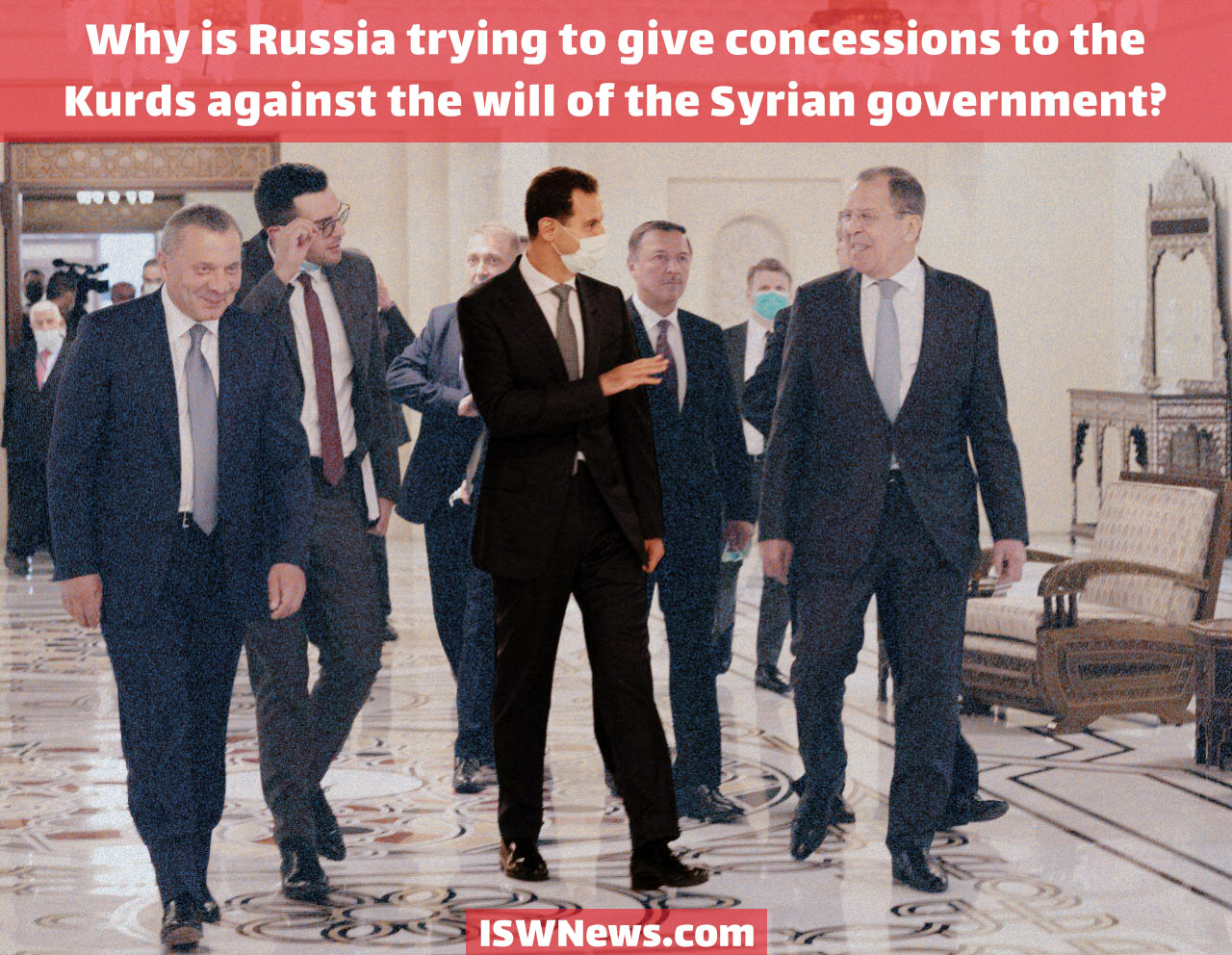
  • Why is Russia trying to give concessions to the Kurds against the will of the Syrian government?

    Why is Russia trying to give concessions to the Kurds against the will of the Syrian government?

    Since the beginning of the Syrian crisis, Russia, as a permanent member of the Security Council, has played a positive role in resolving the crisis. Until 2015, which was the time of Russia’s military intervention in the US-led war against Syria as one of the most important members of the Axis of Resistance, the role of this permanent member of the Security Council was merely to veto US and European resolutions against the Damascus government. Russia in cooperation with China has vetoed six of the seven Security Council resolutions against Syria since the crisis began in early 2011.

    Russia’s influence, however, increased dramatically after it entered the arena of the Syrian crisis in 2015, and in addition to the political sphere, it also extended to the military and economic spheres. There are various reasons for Russia’s involvement in the Syrian crisis, including the existence of a Russian naval base in the Syrian port of Tartus, confrontation with the US monopoly system, economic benefits including the activities of Russian oil and gas companies before the crisis in Syria, and Russia’s efforts to explore for gas in the Mediterranean to compete with competitors such as; Turkey, Israel, Greece and Egypt for exporting to Europe, as well as turning Syria into an economic gateway to the Middle East.

    Russia’s entry into the political and economic processes of Syria after the crisis subsides, preserving the structure or Bashar al-Assad?

    Now that the crisis has subsided and sovereignty has been established, the important challenge for the Syrian government and its allies is to rebuild and build political processes to unite to overcome the economic and political crisis. Russia is trying to play an effective role at this time as well.
    In this period, unlike during the war, Russia has commonalities with the Westerners, and that is the emphasis of both sides on the implementation of Resolution 2254, which in 2015 was not vetoed and approved by the Security Council, unlike other resolutions. The subject of this resolution is the creation of a political process in Syria for the transition period and the formation of a new constitution and political structure.
    The biggest weakness of this resolution is that it does not mention the fate of Bashar al-Assad.
    Russia also seems to agree with the policy of maintaining structure and changing the individual in order to attract capital for the reconstruction of Syria and to make a deal with the West. This is exactly the opposite of Iran’s position, which is to emphasize the preservation of Bashar al-Assad as a symbol of resistance and unity in Syria despite political reforms. Russia’s position was also reflected in the recent visit of a high-level delegation to Syria, emphasizing the need to hold elections under the new constitution, which, of course, was opposed by the Syrian government.

    Efforts to become international mediators and oil deals, most important Russian incentives to resolve Bashar al-Assad dispute with Kurds

    Another issue that Russia is trying to resolve in the Syrian political process by playing the role of mediator is the differences between the Syrian government and the Kurds. After the crisis in Syria began, the Kurds tried to secede from Syria and form an independent government, using the weakness of the government as well as US support; This issue was reduced to the formation of an autonomous region after the Turkish invasion and the lack of US support and support from the Syrian army. In fact, the Kurds realized that they could not survive without the support of the Syrian government. After the disappointment of the United States, the Kurds turned to Russia to solve their problems with the Syrian government and gain concessions from it, so that they might be able to use its influence in the Syrian government to gain concessions in the autonomous region.

    In this regard, a week before the Russian delegation’s visit to Syria, two Syrian Kurdish parties traveled to Moscow and signed an important five-point agreement there. The agreement, which was ratified by Russia, emphasizes the creation of a decentralized political system (creation of autonomous regions), work on Resolution 2254, the entry of Kurds into the Syrian constitutional negotiations, and the integration of Kurdish forces into the Syrian army. The agreement was one of the main points of Lavrov’s meetings with Bashar al-Assad and Syrian Foreign Minister Walid Muallem. Why Russia is trying to resolve the differences between the Kurds and the Syrian central government by granting them concessions does not seem to have a complicated answer. One of the reasons for this is the existence of oil resources in the Kurdish regions, which Russia has also signed agreements with the Syrian government to explore and extract, but due to the presence of the Americans, it is not possible to implement these agreements. In fact, the Russians are trying to drive the United States out of the region and gain economic benefits by making peace between the Kurds and the Syrian government.

    Russia is also trying to become an influential and trusted mediator in the world by resolving such issues politically. Another reason that can be mentioned in this issue; Russia’s efforts to build trust with the West to cooperate with Russia’s policies include efforts to rebuild Syria. In fact, Russia sees this as a concession to the West that they are willing to invest in Syria in return.
    So far, Russia has not been able to succeed due to the opposition of the Syrian government, but it remains to be seen whether in the future, with increasing economic pressures and in the absence of a cohesive economic and political presence of an important ally such as Iran, Bashar al-Assad’s government will be able to resist Russian policies or not.

  • The first joint Russian-Turkish military exercise in Syria

    The first joint Russian-Turkish military exercise in Syria

    According to the Hmeimim Center for Reconciliation in Syria, the joint military exercise was held in the Tarnbah area west of Saraqeb, with the aim of countering terrorist groups blocking the ceasefire process in the southern region of Idlib.
    Exercises included joint fire targeting of sabotage groups affiliated with armed groups that refuse reconciliation, withdrawing damaged military equipment and providing medical assistance to the injured.

    Recently, joint Russian-Turkish military patrols in southern Idlib have come under increasing suicide terrorist bombing and roadside bombs, and the Turkish and Russian armies have suffered casualties and material losses, and the continuation of these sabotages can completely destroy the ceasefire in the south of Idlib.

  • Presence of Russian warplanes at Deir Ezzor airport

    Presence of Russian warplanes at Deir Ezzor airport

    After the military entry of the Syrian and Russian armies to east of the Euphrates in the last year, the Russian army wants to expand its military influence in east of Syria. According to available information, the Russian army is setting up a new military base in the Maadan region in the east of Syria.
    Also, a part of Qamishli airport has been turned into the Russian air base, and the Russian fighter jets presence in Deir Ezzor is also interpreted in this regard.

  • Opinion: What is Syria’s new field for Russia and Iran?

    Opinion: What is Syria’s new field for Russia and Iran?

    The war was over and there were many conflicts in Syria between the opposition and the proponents. The Takfiri and Western media considered merely the cause of Russia and Iran presence material interests, and were considering both of them as the main reason of the chaos in Syria. These days, Syria bears the pressure for reforming its political structure, simultaneous with confronting with remains of ISIS, al-Nusrah, and Ahrar al-Shaam in Idlib, Homs, northwest with Turkey inside the country and foreign countries; and two main allies, Iran and Russia are  from the influential components in this field.

    Russia; internal difference and Moscow decision for supporting from Syria

    After the war with ISIS, many politicians in Russia believed that Russia should withdraw from the Syrian battlefield immediately, so that the Syrian people and protesters to decide about the continuation of Syrian process. They say the Syrian protesters that have now laid down their weapons, will never be destroyed by war and killing; and this gap between the people and the government will finally lead to the fall of Bashar al-Assad. The Russian politicians claim that Russia needs economic cooperation with Syria in the future, so it should act in the way that the next Syrian government does not oppose completely with Russians.

    Entering of the Russian researchers into the debate have had made significant progress. Russian researchers in international relations, Antuan Mordasov and Kirill Simonov have published a joint article with significant title of “Russia without Assad.”

    This article has done a comprehensive study about  the contracts between Moscow and Damascus, and have classified its phases between Russian merchant criticism; that the focus in it was on corruption and available barriers in developing of economic activity between Russia and Syria. This study represents the failure of the Syrian regime in managing of the current step and its inability for facing with the internal terrible situation. So, the suggestion of this article was that Moscow interests are in changing its relations with Syria, or the falling of Bashar al-Assad. But that’s not all. On the other hand, there are politicians and researchers that consider supporting from Bashar al-Assad’s Syria and reinforcement of economic cooperation with it, as the important strategy of Russia in the coming decade, and believe that this interaction should never be distorted.

    On Monday, May 25, Vladimir Putin appointed Alexander Yefimov, the ambassador of this country to Damascus, as his special envoy for the development of relations with Syria. This appointment is important, because in addition to the ambassador that is responsible for coordinating internal affairs and communicating between Syrian and Russian officials, the Russian deputy foreign minister Alexander Lavrentyev is his country’s special envoy in Syrian affairs and is supervisor of Russian delegation in peace talks.
    Also at a higher level, Mikhail Bogdanov, one of the other Russian deputy foreign minister, is Putin special envoy in the Middle East and North Africa region.
    In the section of developing the military presence, on May 29 Putin with signing an instruction, wanted the ministry of defense and foreign affairs that by negotiating with the Syrian government, Moscow can have more access to military facilities in Syria.

    So, apart from the lack of internal unity and the analysis that are opponent to Moscow function with Damascus, it seems that Russia has set a long-term perspective, so that beside showing itself as a peacemaker and anti-terrorism country, to keep itself in the western Asia region by cooperating with Syria; and gain the most of interest at the post-war suitable economic market. It is worth mentioning that China is one of the serious economic rivals for Russia in the markets such as Syria and Iraq; and therefore Russia should try to maintain its economic market, beside being successful in repelling the terrorists and keeping Bashar al-Assad.

    Will the Islamic Republic of Iran leave the Syria?

    We said before that Iran and Russia are two major allies of Syria, and due to the influential role they played in facing with ISIS terrorism, the Syrian government wants the continuation of activities and interactions between these three countries. Recently, there were rumors in the media that it was announcing of an agreement between Iran and Russia for puting aside Bashar al-Assad. The Western and Arab opposition media intensely blackmailed in this space, and some of activists and the Syrian people took a strong stance against this joint decision. Because the independence that they had fought years for it, is now between the foreign actors and they decide.

    Seyyed Hassan Nasrallah in his speech on Ramadan 19 called these rumors unrealistic and said: “Iran, Lebanese Hezballah and Resistance groups came and fought in Syria, but Iran does not enter into any conflict with anyone for increasing its infiltrate and has no problem with Russia and has no greed in Syria. Iran’s aim is keeping Syria’s identity and prevent it from accepting the hegemony, and Iran’s firm decision is supporting from the Syrian leadership and its decisions and stability. Also, Iran’s goal in Syria has been preventing  the US and Israel from dominating Syria, and this country has never intervened in Syria internal affairs.

    The Islamic Republic of Iran cooperation with the Syrian government in the fighting against terrorism and prevention from this religious sedition is clear for everyone. On the other side, Israel wants to pave the way for Iran’s withdrawal, by imposing pressure on the Syrian government. The alliance between Iran and Syria is a strong supporter for defensing of Hezballah against Israel, and the Resistance axis will have serious problems, with cutting the connection with Syria. So, it’s obvious that domination system, with the financial support of the Persian Gulf countries such as Saudi Arabia, the UAE and Qatar to revivr terrorists in Syria, and Israel is trying to achieve its aim that is Iran’s withdrawal from Syria by scattered airstrikes. So, the Islamic Republic of Iran’s ten years effort for failure of the Zionist-American ISIS project will be virtually destroyed.

    In the trade section, the Islamic Republic was doing significant exchanges with Syria. In 2010 (before starting of the civil war in Syria), the export range between Iran and Syria reached to 515 dollars million , that with the starting of civil war in Syria and its spreading to most of the country, caused that Iran’s exports to Syria in 2014, be reduced to about 100 thousand of dollars. Although, in 2016, exports between Iran and Syria recorded a little improvement and reached 145 million dollars; but there is still a long distance to reaching the 2010 record.

    So, the strategic cooperation between Iran and Syria in the security, political and the economic section will cause the failure of the enemies in the region and the growth of the Resistance axis, and this withdrawal will never occur.