Tag: Syria

  • Precision missile attack on illegal oil facilities south of Jarablus

    Precision missile attack on illegal oil facilities south of Jarablus

    The facility (between the villages of Al-Dabis and Al-Kousa) reportedly held large quantities of fuel transported from areas controlled by the Syrian Democratic Forces SDF, as well as dozens of fuel tankers parked there.
    Some pro-rebel sources believe the attack was carried out by Russia. However, last year, the Syrian army launched a similar attack on fuel smuggling convoys from Syria to Turkey in north of Aleppo, and this attack could possibly have been carried out by Syria or at the behest of Syria.

    It is also said that at least 5 people lost their lives in this attack and 15 others were injured.

  • 15 people killed in US attack on Idlib region

    15 people killed in US attack on Idlib region

    In a statement, the U.S. Central Command, CENTCOM, said the strike will disrupt al-Qaeda’s ability to further plot and carry out global attacks threatening U.S. citizens, partners and innocent civilians.

    According to local sources, the famous smuggler Samir al-Hassan Ibrahim and two of his brothers, Hamoud al-Saharah and Abu Talha al-Hadidi, former commanders of Tahrir al-Sham, and three tribal leaders of the Hama and Akidat tribes were killed in the attack.

  • Turkey is abandoning some of its observation posts in Syria’s Idlib

    Turkey is abandoning some of its observation posts in Syria’s Idlib

    The Morek observation post is the largest Turkish observation post in the north of Hama, which was established two years ago in the village of Morek. But after the latest operation by the Syrian army and allies, which led to the liberation of northern Hama and large parts of eastern and southern Idlib, as well as western Aleppo; this observation post, as well as a number of other Turkish military posts, were completely besieged. Since then, the Turkish military has refused to withdraw from the occupied Syrian territories and withdraw from these military posts.

    Currently, 8 observation posts and 4 to 5 Turkish military posts in the areas controlled by the Syrian government are under complete siege by the Syrian army. The observation posts that are currently under siege by the Syrian army are Morek observation post, Sher Mughar observation post, Surman observation post, Tal Al-Tawqan observation post, Al-Eis observation post, Al-Rashedin observation post, Andan observation post and Jabal Sheikh Aqil observation post. Military posts are also located in Ma’ar Hatat, around Saraqeb and in Al-Zarba.

    However, Turkey has so far denied any withdrawal from military and observation posts, but some believe that Turkey, realizing that the possibility of a military operation by the Russian and Syrian army in Idlib is imminent, it has given up its useless presence deep in the areas controlled by the Syrian government and is withdrawing from them and preparing more fortifications in the areas occupied by the militants in the Idlib region to deal with this danger.
    Hence in this regard, on October 17, the Turkish army established a new military post south of Idlib in the village of Qoqafin.

    In the past, Turkey has believed that the presence of military posts deep in areas controlled by the Syrian army could be used as leverage and a bargaining chip in future negotiations with the Syrian government, but this seems impossible.
    It is also noteworthy that in recent weeks we have witnessed a series of popular demonstrations in front of Turkish observation posts in northern Hama and eastern Idlib, and people have called for the withdrawal of Turkish troops from Syrian territory. These demonstrations, whether popular or organized by the Syrian government, can clearly affect the withdrawal of Turkish troops from Syrian territory and effectively undermine the security of Turkish forces deep inside Syrian army areas in the event of a new military operation.

    The besieged Turkish observation posts in the SAA-controlled areas – Click to see the full size map
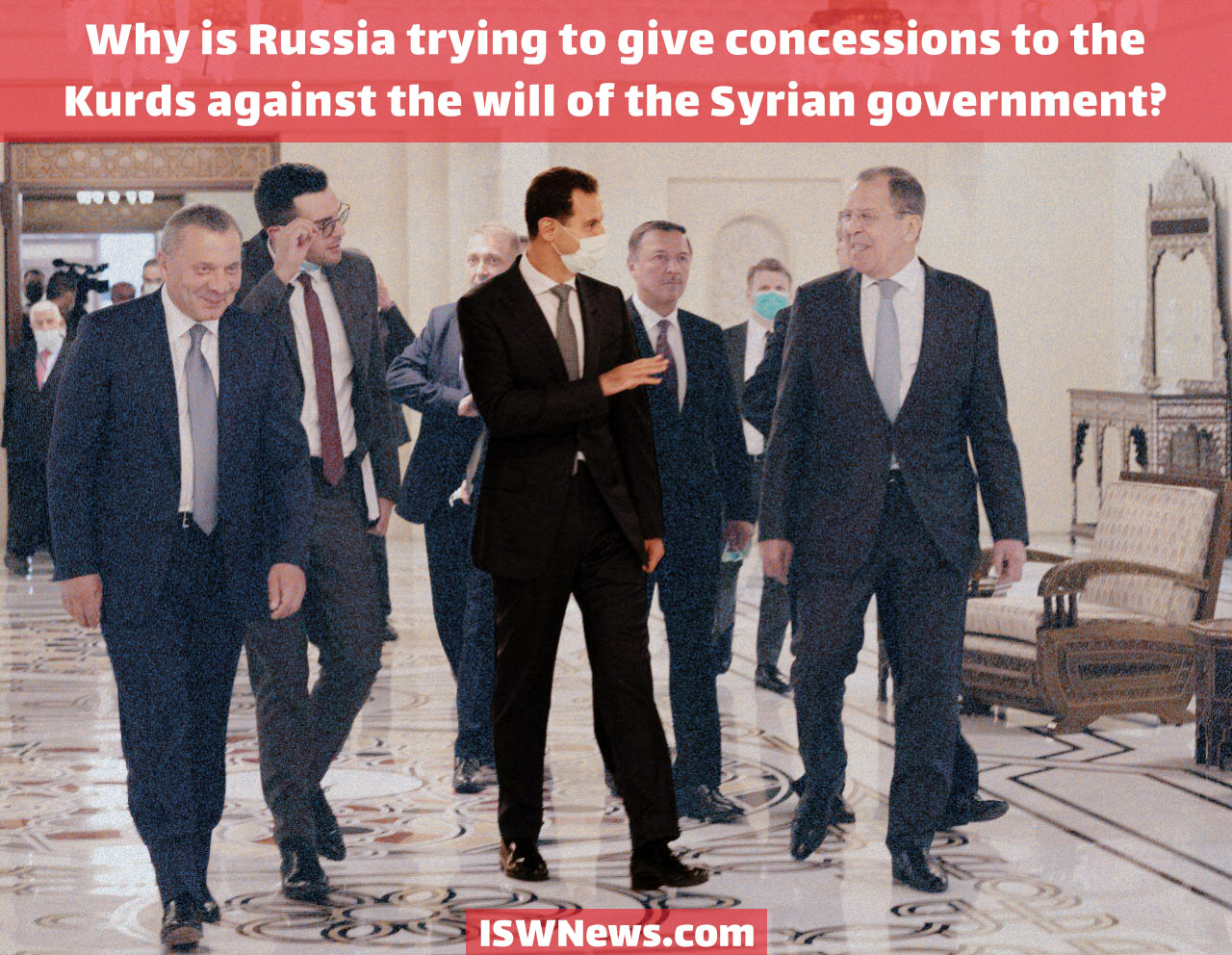
  • Why is Russia trying to give concessions to the Kurds against the will of the Syrian government?

    Why is Russia trying to give concessions to the Kurds against the will of the Syrian government?

    Since the beginning of the Syrian crisis, Russia, as a permanent member of the Security Council, has played a positive role in resolving the crisis. Until 2015, which was the time of Russia’s military intervention in the US-led war against Syria as one of the most important members of the Axis of Resistance, the role of this permanent member of the Security Council was merely to veto US and European resolutions against the Damascus government. Russia in cooperation with China has vetoed six of the seven Security Council resolutions against Syria since the crisis began in early 2011.

    Russia’s influence, however, increased dramatically after it entered the arena of the Syrian crisis in 2015, and in addition to the political sphere, it also extended to the military and economic spheres. There are various reasons for Russia’s involvement in the Syrian crisis, including the existence of a Russian naval base in the Syrian port of Tartus, confrontation with the US monopoly system, economic benefits including the activities of Russian oil and gas companies before the crisis in Syria, and Russia’s efforts to explore for gas in the Mediterranean to compete with competitors such as; Turkey, Israel, Greece and Egypt for exporting to Europe, as well as turning Syria into an economic gateway to the Middle East.

    Russia’s entry into the political and economic processes of Syria after the crisis subsides, preserving the structure or Bashar al-Assad?

    Now that the crisis has subsided and sovereignty has been established, the important challenge for the Syrian government and its allies is to rebuild and build political processes to unite to overcome the economic and political crisis. Russia is trying to play an effective role at this time as well.
    In this period, unlike during the war, Russia has commonalities with the Westerners, and that is the emphasis of both sides on the implementation of Resolution 2254, which in 2015 was not vetoed and approved by the Security Council, unlike other resolutions. The subject of this resolution is the creation of a political process in Syria for the transition period and the formation of a new constitution and political structure.
    The biggest weakness of this resolution is that it does not mention the fate of Bashar al-Assad.
    Russia also seems to agree with the policy of maintaining structure and changing the individual in order to attract capital for the reconstruction of Syria and to make a deal with the West. This is exactly the opposite of Iran’s position, which is to emphasize the preservation of Bashar al-Assad as a symbol of resistance and unity in Syria despite political reforms. Russia’s position was also reflected in the recent visit of a high-level delegation to Syria, emphasizing the need to hold elections under the new constitution, which, of course, was opposed by the Syrian government.

    Efforts to become international mediators and oil deals, most important Russian incentives to resolve Bashar al-Assad dispute with Kurds

    Another issue that Russia is trying to resolve in the Syrian political process by playing the role of mediator is the differences between the Syrian government and the Kurds. After the crisis in Syria began, the Kurds tried to secede from Syria and form an independent government, using the weakness of the government as well as US support; This issue was reduced to the formation of an autonomous region after the Turkish invasion and the lack of US support and support from the Syrian army. In fact, the Kurds realized that they could not survive without the support of the Syrian government. After the disappointment of the United States, the Kurds turned to Russia to solve their problems with the Syrian government and gain concessions from it, so that they might be able to use its influence in the Syrian government to gain concessions in the autonomous region.

    In this regard, a week before the Russian delegation’s visit to Syria, two Syrian Kurdish parties traveled to Moscow and signed an important five-point agreement there. The agreement, which was ratified by Russia, emphasizes the creation of a decentralized political system (creation of autonomous regions), work on Resolution 2254, the entry of Kurds into the Syrian constitutional negotiations, and the integration of Kurdish forces into the Syrian army. The agreement was one of the main points of Lavrov’s meetings with Bashar al-Assad and Syrian Foreign Minister Walid Muallem. Why Russia is trying to resolve the differences between the Kurds and the Syrian central government by granting them concessions does not seem to have a complicated answer. One of the reasons for this is the existence of oil resources in the Kurdish regions, which Russia has also signed agreements with the Syrian government to explore and extract, but due to the presence of the Americans, it is not possible to implement these agreements. In fact, the Russians are trying to drive the United States out of the region and gain economic benefits by making peace between the Kurds and the Syrian government.

    Russia is also trying to become an influential and trusted mediator in the world by resolving such issues politically. Another reason that can be mentioned in this issue; Russia’s efforts to build trust with the West to cooperate with Russia’s policies include efforts to rebuild Syria. In fact, Russia sees this as a concession to the West that they are willing to invest in Syria in return.
    So far, Russia has not been able to succeed due to the opposition of the Syrian government, but it remains to be seen whether in the future, with increasing economic pressures and in the absence of a cohesive economic and political presence of an important ally such as Iran, Bashar al-Assad’s government will be able to resist Russian policies or not.

  • Latest Updates on Syria, 23 September 2020 (Map Update)

    Latest Updates on Syria, 23 September 2020 (Map Update)

    1- US terrorist army position deployed new Bradley fighting vehicles and radar systems in northeast of Syria.
    In recent days US terrorist army imported M2 Bradley and Sentinel radars to protect its forces in northeast of Syria.
    Bradleys were sent out of Syria for a short time before with the excuse of American forces leaving Syria but came back again. These AFVs can fire TOW anti-armor missiles. Sentinel radar systems are used normally to detect mortar firing place or in general finding the artillery (counter-battery radar) and for the air defense. It seems importing them are to defend against Russian and Syrian armies forces and Syrian army proxies.

    M2 Bradley in Syria


    2- A Russian soldier killed in Idlib.
    Hayat Tahrir al-Sham (HTS) released images showing Russian military equipment and claimed they belong to a Russian soldier who was killed in a mine field in south of Idlib. Pro-Russian media claimed the mine explosion dates back to more than a month.


    3- Syrian army artillery shelled Turkish-backed militants in villages Baylun, Barah, and near Zayzun.

    4- Turkish-backed militia artillery shelled Syrian army positions in Kafr Nubl, Maarat al-Numan and Saraqib, and Bala village in west of Aleppo.

    5- A new Turkish military convoy entered Idlib province through Kafr Lusin crossing. The number of Turkish convoys coming to Syria increased significantly in this week compared to before.

    6- Turkish-backed militia deployed to Azerbaijan to fight with Armenia.
    Local sources in Afrin region reported that 1,000 of Turkish-backed militia are ready to be deployed to Azerbaijan. Although it was rejected by the militia, but there were news of deploying and positioning some of Turkish-backed militia specially Turkmens to Azerbaijan last month. There is no image evidence of presence of Turkish forces in Azerbaijan but considering the history of Turkey in doing acts like that, there will be more evidences in near future.

    7- Clashes between Turkish-backed militia and YPG forces around Maraanaz, north of Minagh airport, Aleppo province.

    8- Clashes between Turkish-backed militia and SDF in east of Ras al-Ain, Hasakah province.

    9- American terrorist forces launched a patrol near Tal Tamar, Hasakah province. Tal Tamar is jointly controlled by SDF and Syrian Army forces.

    10- ISIS ambush against Syrian army vehicles in Deir Ezzor.
    ISIS terrorists attacked a small caravan of Syrian army forces near Harabshah. Some of the soldiers killed. ISIS attacks against Syrian army in Deir Ezzor desert is while Russian and Syrian armies launched a joint operation to cleanse and secure these areas from ISIS in recent weeks.

    11- Two SDF elements killed due to a roadside bomb blast in the Omar oil field, east of Mayadin.

    Click to see the full size map
  • Killing two terrorists with ninja missiles!

    Killing two terrorists with ninja missiles!

    In this attack, similar to previous attacks, Hellfire R9X missiles known as Ninja missiles were used. The R9X is a non-explosive kinetic projectile that does not carry a warhead and opens when it hits a target with razor blades like it to penetrate the vehicle or destroy the target. Known as the US Secret Missile until years ago, it is used to carry out precision strikes and reduce the risk of civilian casualties in crowded places, despite its inhumane performance, which leads to the fragmentation of the target.

  • Rocket attack on Turkish military base in Aleppo

    Rocket attack on Turkish military base in Aleppo

    The rocket attack caused massive fires and injured several Turkish soldiers. In response to this attack, Turkish artillery also bombarded the areas of Burj Al-Qas and Aqiba in northern countryside of Aleppo.

    In recent days, Turkish-backed militants have repeatedly bombed YPG / SDF-controlled areas north of Aleppo, and clashes between the two sides have escalated. The Kurdish rocket and mortar attacks on the Turkish army points can be considered in response to these recent bombings.

    It is worth nothing that al-Ghazawiyah area has a commercial crossing between areas held by Turkish-backed factions and Tahrir al-Sham-held areas.

  • Israeli airstrikes on Aleppo, Syria

    Israeli airstrikes on Aleppo, Syria

    Syrian media reported that most of the missiles were intercepted and destroyed, however, several missiles hit the targets.
    The attack reportedly targeted Syrian army defense industry factories in the al-Safirah area, 21 km southeast of Aleppo.

    The Israeli regime also attacked SAA points in central and southern Syria on August 31 and September 2. The Israeli media and the Israeli army claim that these attacks are carried out against the positions of Iranian-backed forces in Syria, and the purpose of these attacks is to put more pressure on Iran to leave Syria; however, Israel’s goal has not been achieved so far, and it is highly unlikely that Iran will give up its support for its key regional ally.

  • Important visit of the Russian delegation to Damascus

    Important visit of the Russian delegation to Damascus

    A high-level Russian delegation arrived in the Syrian capital, Damascus, on Monday headed by Russian Foreign Minister Sergei Lavrov and Russian Deputy Prime Minister Yuri Borisov.
    During the meeting, possible new agreements between the two countries and the reduction of the effects of Western sanctions against Syria were discussed.

  • Breaking: New Israeli missile attacks against Syria

    According to Syrian military sources, at 22:23 local time, Israeli warplanes fired several missiles from over al-Tanf area, southeast of Syria, toward some targets in T4 airbase and Syrian air defense systems intercepted some of them. Some missiles hit the target which imposed damages.
    No news of casualties yet.

  • The first joint Russian-Turkish military exercise in Syria

    The first joint Russian-Turkish military exercise in Syria

    According to the Hmeimim Center for Reconciliation in Syria, the joint military exercise was held in the Tarnbah area west of Saraqeb, with the aim of countering terrorist groups blocking the ceasefire process in the southern region of Idlib.
    Exercises included joint fire targeting of sabotage groups affiliated with armed groups that refuse reconciliation, withdrawing damaged military equipment and providing medical assistance to the injured.

    Recently, joint Russian-Turkish military patrols in southern Idlib have come under increasing suicide terrorist bombing and roadside bombs, and the Turkish and Russian armies have suffered casualties and material losses, and the continuation of these sabotages can completely destroy the ceasefire in the south of Idlib.

  • Missile attacks to Southern Syria, Israel’s grimace to Hezbollah!

    Missile attacks to Southern Syria, Israel’s grimace to Hezbollah!

    Syrian army officials reported to intercept most of the missiles, however some of them hit the targets and martyred two and injured seven.

    Almost 40 days ago, in a similar attack to al-Kiswah area a Hezbollah member was martyred and after that the southern border of Lebanon was under high tension and Israeli regime army is in full alert scared of Hezbollah retaliation attack.

    Syrian air defense systems intercept one of the missiles

    Israel’s last night attack to Syria one day after Sayyid Hassan Nasrallah, Hezbollah secretary, speech on Ashura day, who said that the Hezbollah is seeking to dictate a new deterrent equation in the area. He said if a number of Hezbollah forces are killed by Israel, the same number will be killed from Israeli forces.
    He said: “We want to prove a point, an equation; When you kill one of our warriors, we kill one of your soldiers, the end! This is the equation. It can’t be that you kill one of us and we just destroy a hill, a base or some metallic equipment! You have the resources of the whole world, you replace it. They can’t deter Israel.”

    In this regard, the new attack by Israeli regime is considered a grimace and impudence to Hezbollah and resistance axis.