ISWNews Analysis Group – The Saudi Arabian Ministry of Defense announced in a statement that Lieutenant Colonel Pilot Majid bin Musa Awad al-Balawi and Chief Sergeant Yousef bin Reda Hassan al-Azouni, two military personnel under its command, were executed for committing major war crimes, treason, and failure to protect national interests.
These two individuals were arrested on September 16 and 17, 2017, and their sentences were carried out on Friday, September 14, 2023 in the Taif governorate located in western Saudi Arabia.
No further details about the execution of these two individuals have been released.
According to the information released by the Saudi Arabian Ministry of Defense, it is likely that the charges against these two military forces were related to some Saudi military personnel’s opposition to issues concerning the war in Yemen.
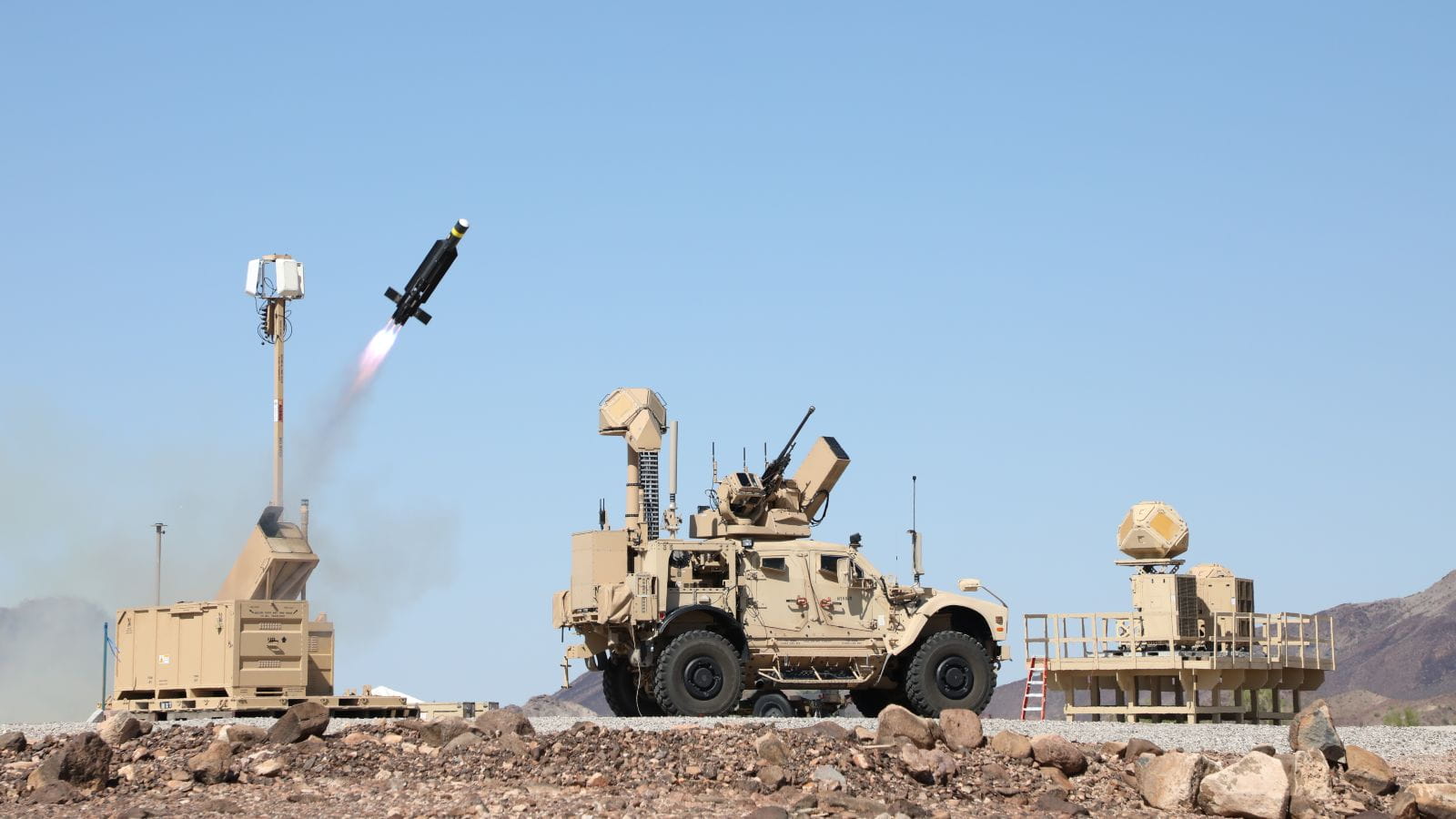
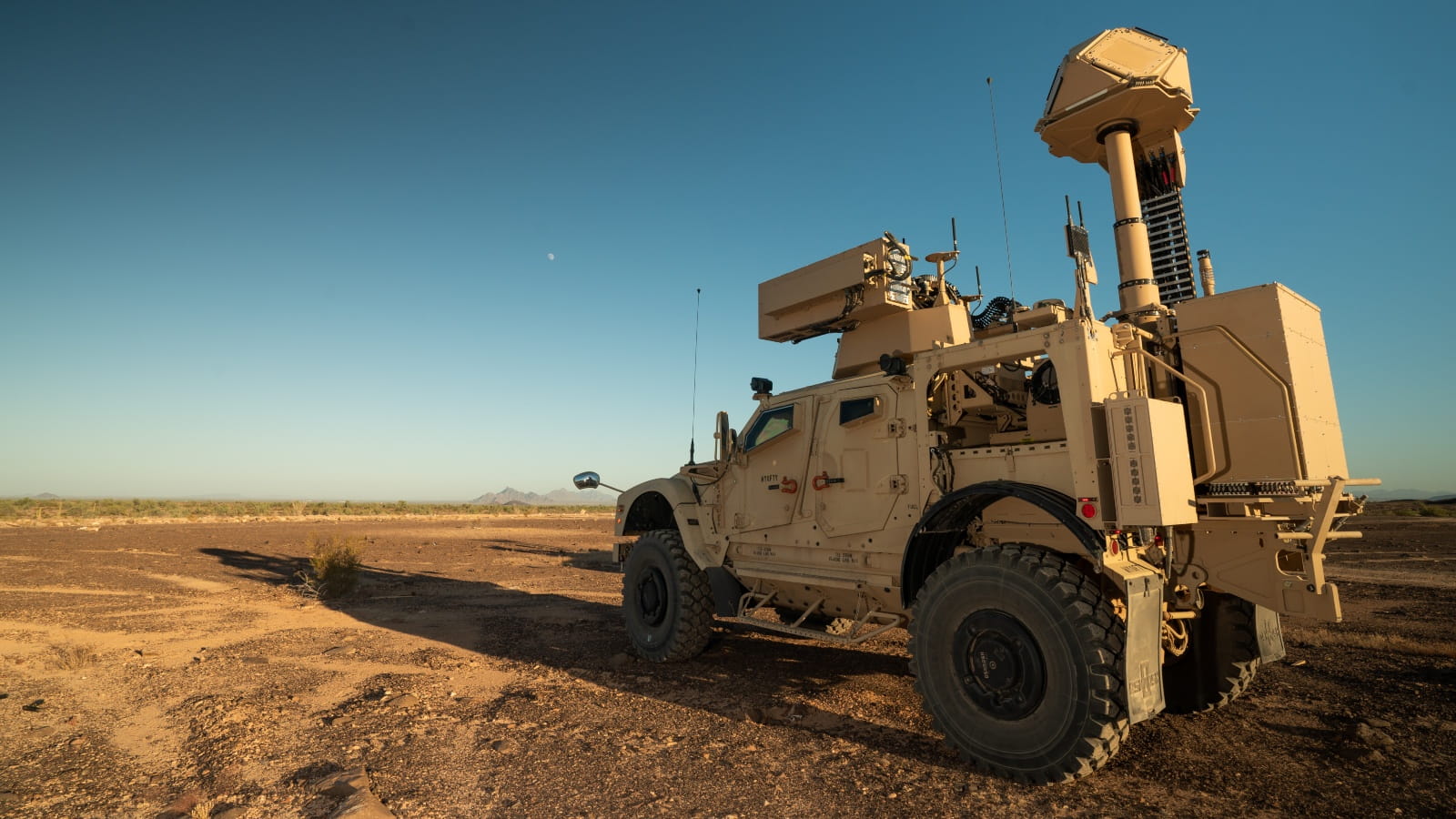
In January 2020, the US Department of Defense established the joint counter-small unmanned aircraft systems office to test more than 40 counter-UAS systems. Finally, this office proposed a solution in the form of FS-LIDS and M-LIDS for fixed and mobile missions to deal with micro-UAVs.
This system has two types: FS-LIDS stands for Fixed Site-Low, Slow, Small Unmanned Aircraft System Integrated Defeat System and M-LIDS stands for Mobile-Low, Slow, Small Unmanned Aircraft Integrated Defeat System. As their names suggest, FS-LIDS are fixed and M-LIDS are a mobile system; But both systems have common components.
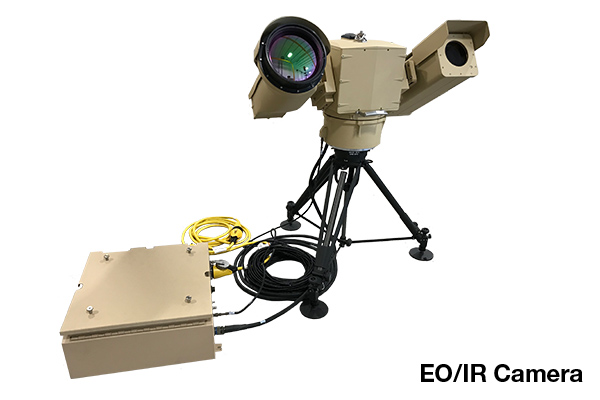
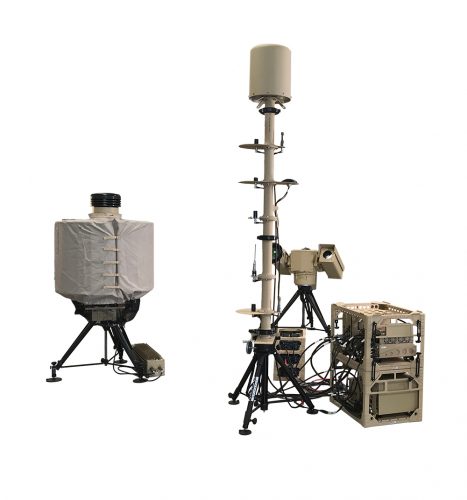
This system is made of a combination of AN/TPQ-50 air surveillance radar or KuRFS radar, as well as an anti-drone electronic warfare system, an electro-optical and infrared camera, and Coyote drones. All these parts help the system to identify small drones that are moving at a low altitude, classify them and act to destroy and shoot them down.
It should be noted that any of the fixed FS-LIDS models or the mobile M-LIDS models can use the aforementioned radars.
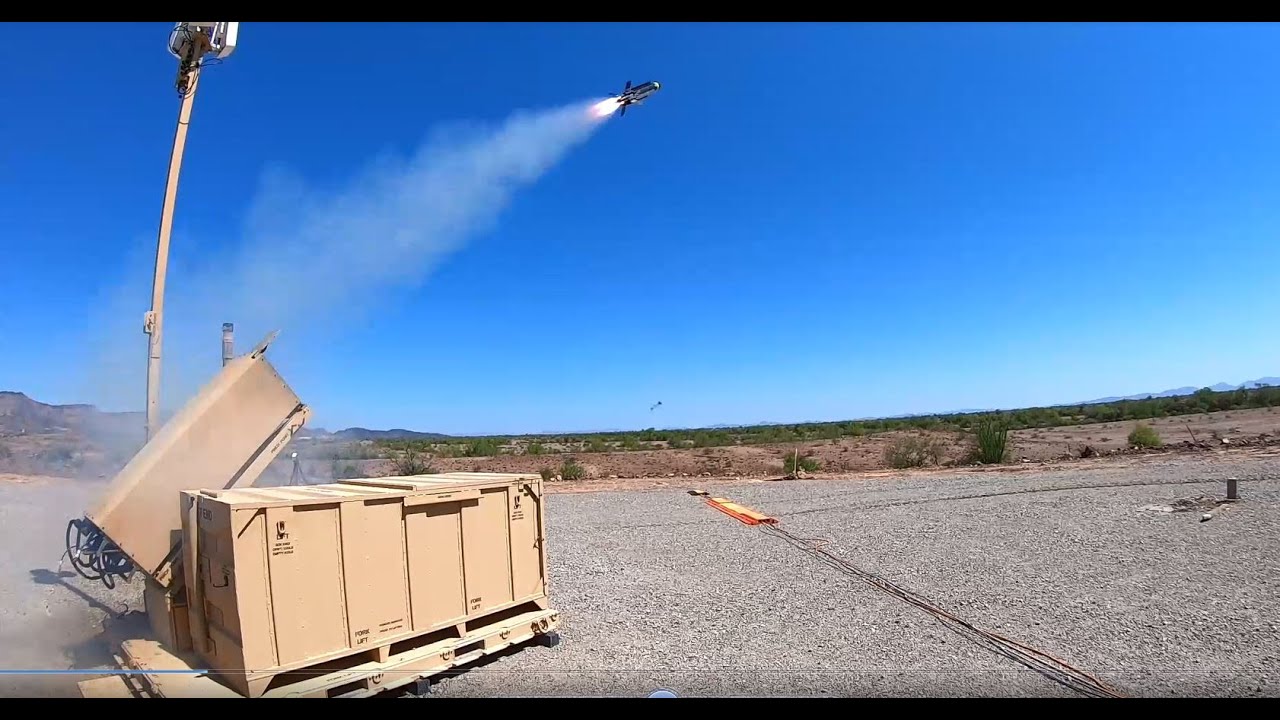
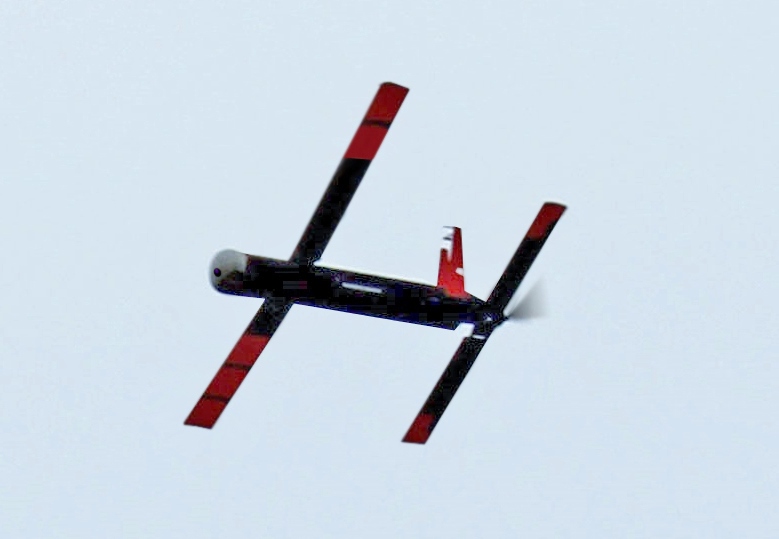
Electro-optical system used in LIDS systemThe set of radar, EW, camera and other components related to FS-LIDS version provided by SRC for this systemClick to view full sizeCoyote-2 UAV shot from FS-LIDS ground fixed system
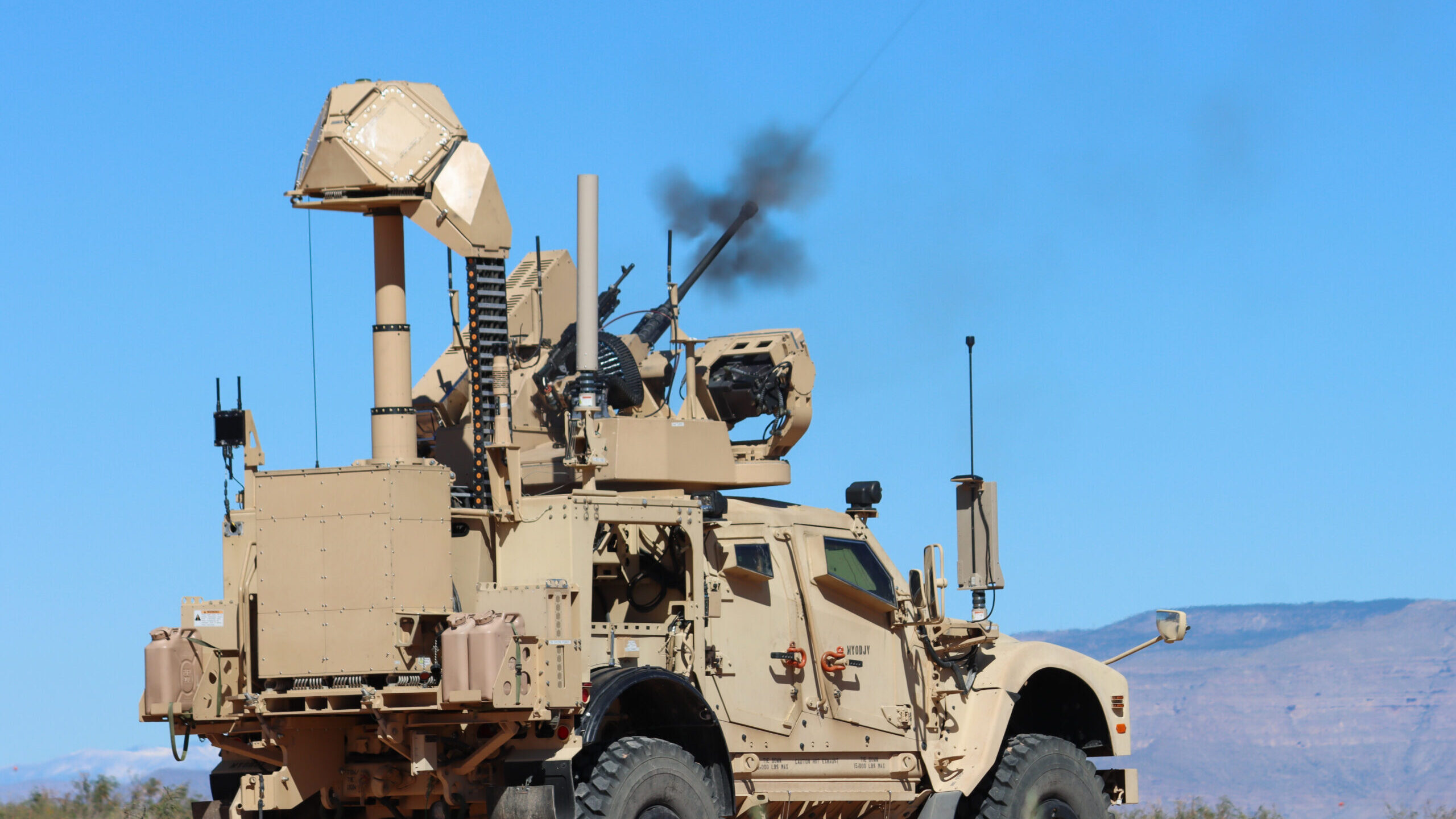
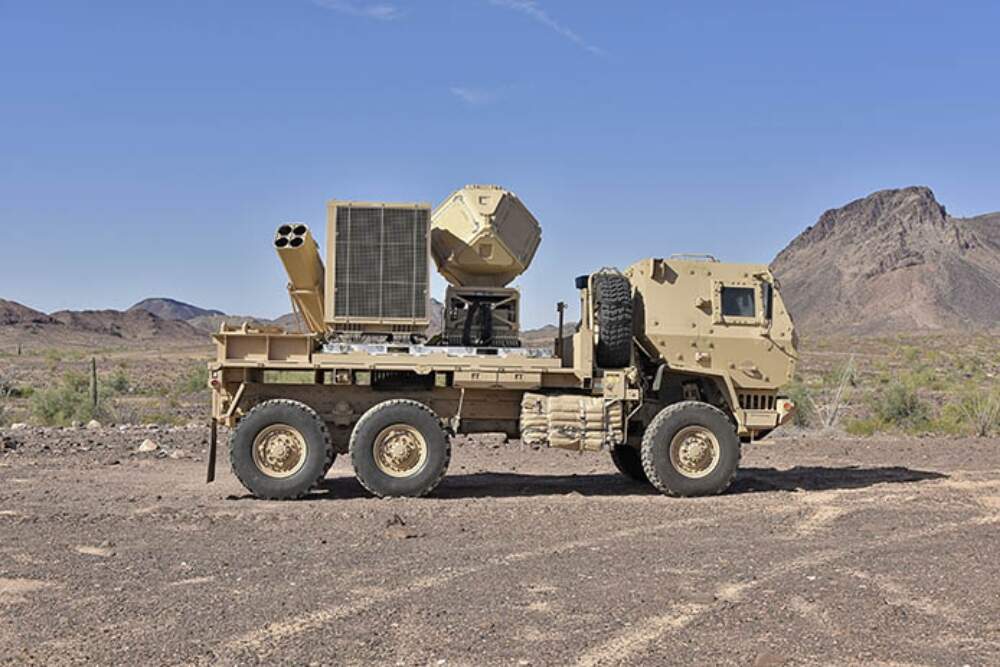
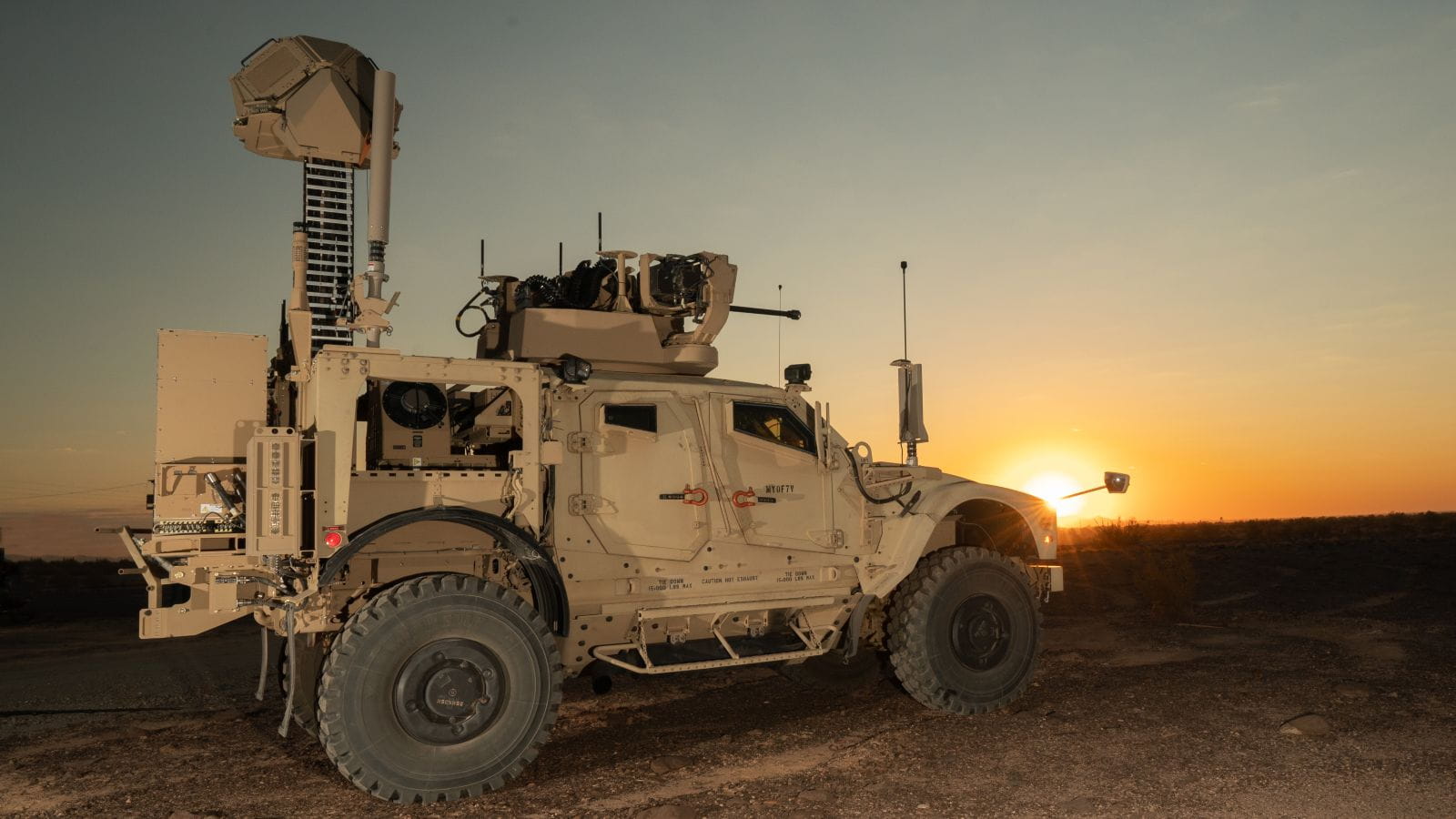
The M-LIDS has a 30 mm automatic cannon that is mounted on the Oshkosh armored vehicle. Due to the possibility of synchronizing the radar with the 30 mm cannon, it is possible to use this cannon to repel UAV attacks in the last layer.
30 mm cannon fire in the M-LIDS system
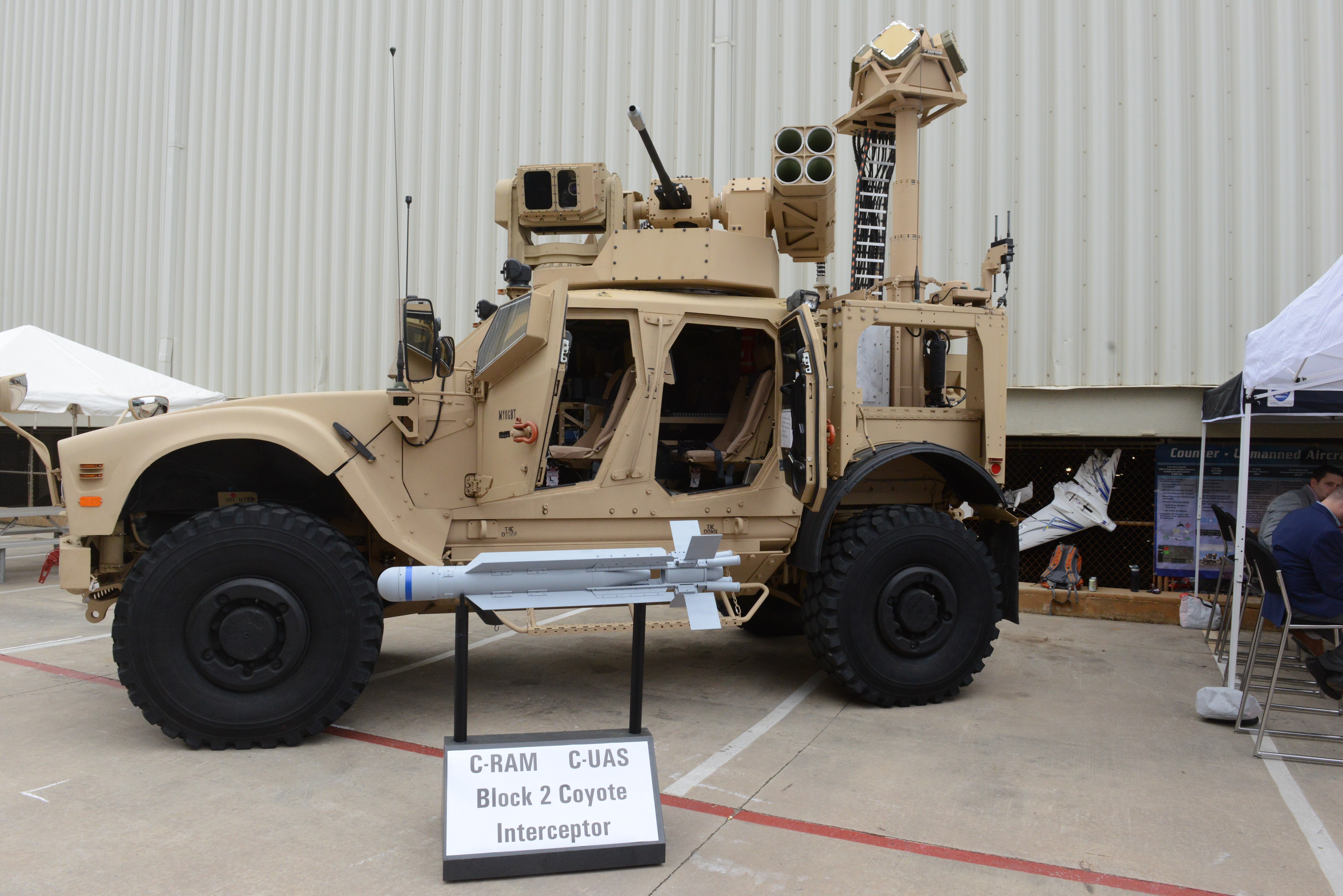
Also, in another model of this system, the ground-based model of the Phalanx close-in weapon system known as C-RAM has been used. In fact, the C-RAM anti-aircraft system is an independent protective layer that can be used in the last layer of interception.
C-RAM system, Coyote block 2, KuRFS radar (Ku-720-1 version) and electro-optical system in M-LIDS model installed on the Oshkosh armored vehicle
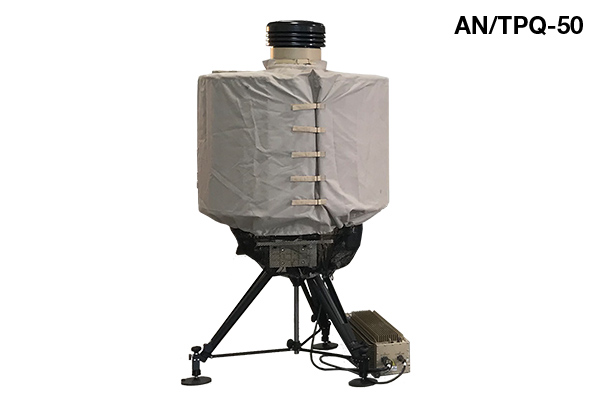
AN/TPQ-50 air surveillance radar: The AN/TPQ-50 is a lightweight counter-fire phased array radar manufactured by the American company SRC Inc. This radar, which was developed based on the AN/TPQ-48 radar, was made to detect artillery and mortar shells, rocket launcher systems such as MLRS, and to detect the firing location of all types of artillery. This radar provides continuous 3-D, 360 degree surveillance along with the ability to identify targets from a distance of 10 to 15 kilometers. This radar can be easily installed on armored vehicles or fixed tripods in the shortest possible time.
AN/TPQ-50 radar is installed and used on the FS-LIDS and M-LIDS system, which, due to its high detection power in detecting small artillery targets, also has a good detection ability in finding small drones.
AN/TPQ-50 radar
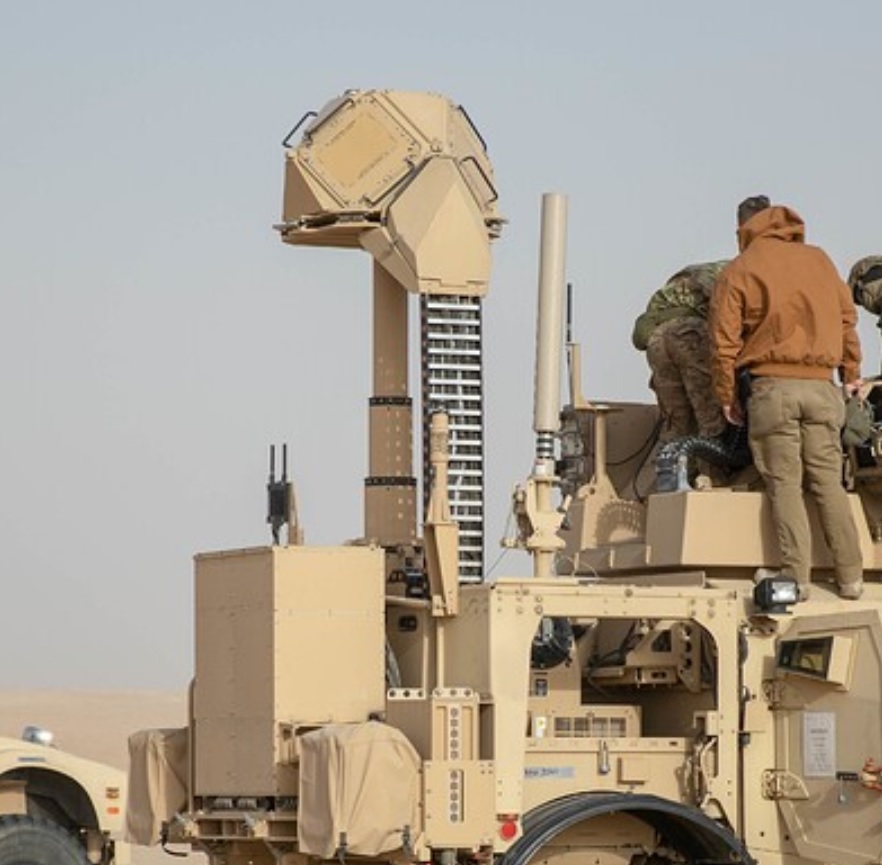
KuRFS air surveillance radar: KuRFS radar, short for Ku-band radio frequency system, is produced by Rayton company. This radar is a multi-mission, 3-D and 360-degree radar with continuous operation capability. This radar is designed to defend against rocket, artillery and mortar attacks and has been tested and used in the battlefields such as Iraq and Afghanistan wars. Today, the KuRFS radar is also used as an anti-drone air system radar. The radar is compatible with several weapon systems, including the C-RAM weapon system, 50-caliber cannons and 30 mm cannons, as well as support for high-energy lasers and Coyote drones.
The KuRFS radar uses a radar sensing technique called the Ku-band active electronically scanned array (AESA). This feature provides high resolution imaging and is an important part of tracking smaller flying objects. This radar uses many small antennas instead of one powerful antenna to allow better control. The KuRFS radar is deployed within 30 minutes, either at a fixed location or on a vehicle.
KuRFS radar (Ku-720-1 version) on the M-LIDS systemKuRFS radar (Ku-720-1 version) in the mobile version (M-LIDS) and installed on the Oshkosh armored vehicleKuRFS radar (original version) in mobile version (M-LIDS) and installed on FMTV truckKuRFS radar (original version) for use in fixed and ground-based (FS-LIDS) systemsClick to view full size
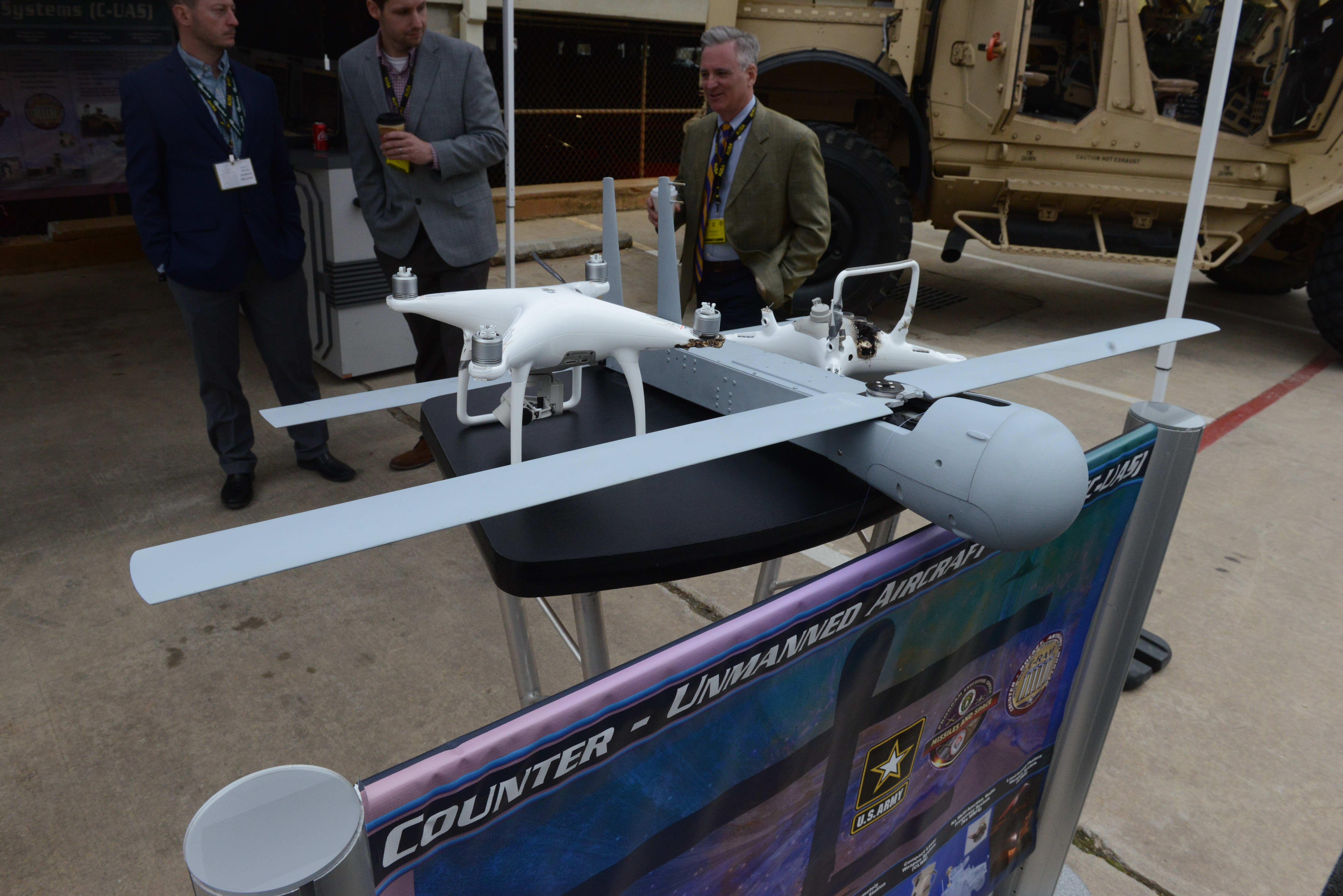
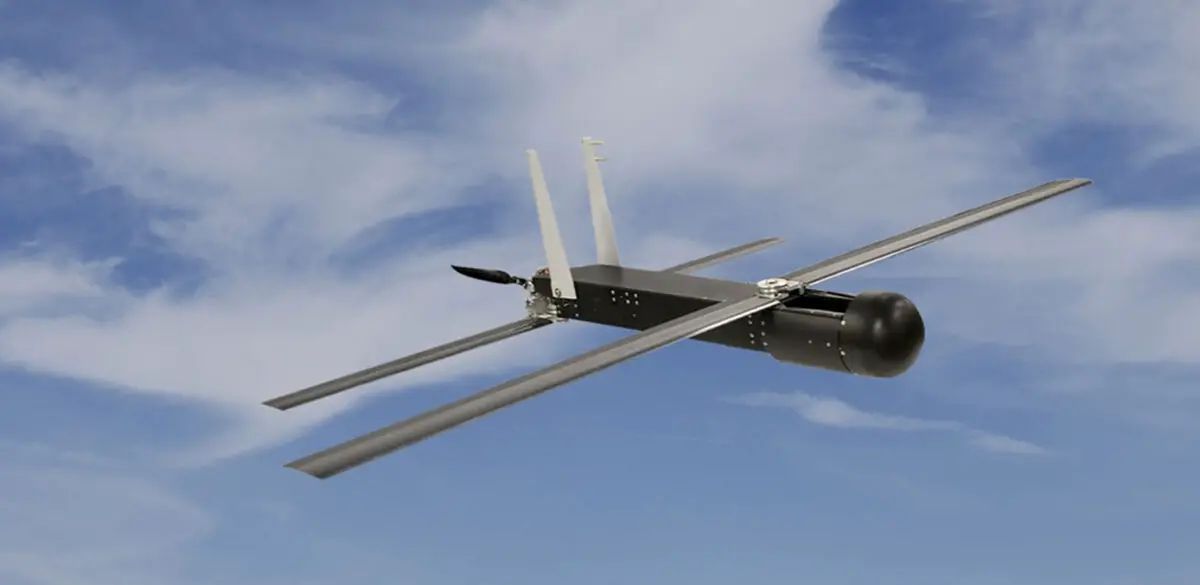
Coyote drone: Raytheon Coyote is a small, expendable, unmanned aircraft system with the capability of operating in autonomous swarms or used as part of a group of drones to perform missions such as electronic warfare, surveillance. This UAV is manufactured by Raytheon Company and is produced in three blocks 1, 2 and 3.
Coyote-1 has a weight of 5.9 kg, a warhead of 1.8 kg of kinetic energy, as well as a proximity fuse and a fragmentation explosive, a length of 60 cm and a wingspan of 1,473 meters, and with the use of an electric motor, the speed is equal to 130 km/h.
Coyote Block 1 – click to view full size
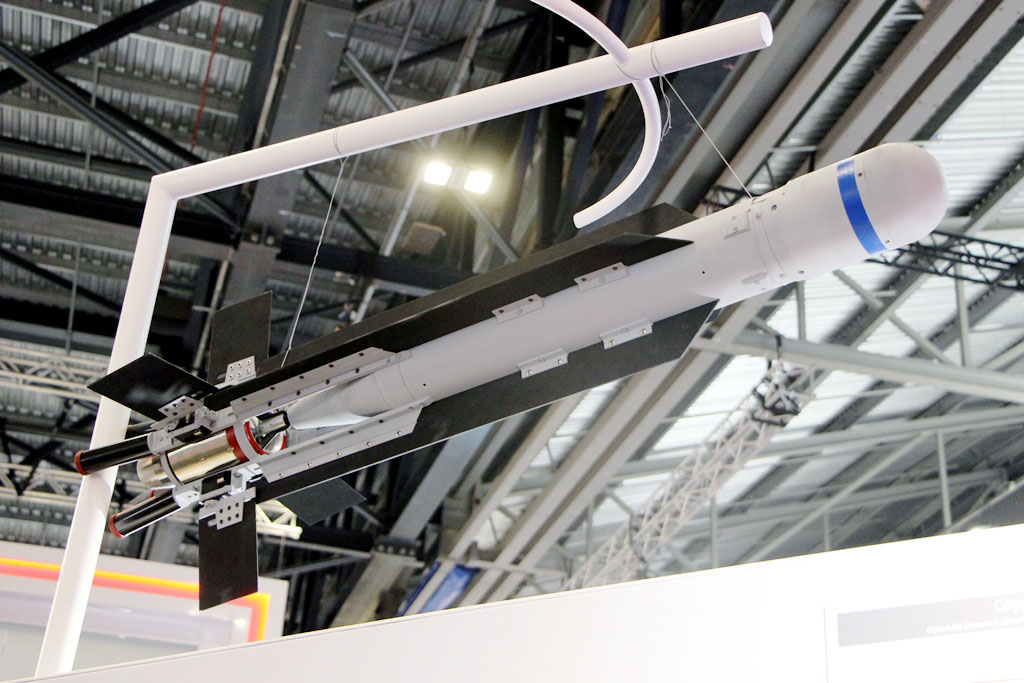
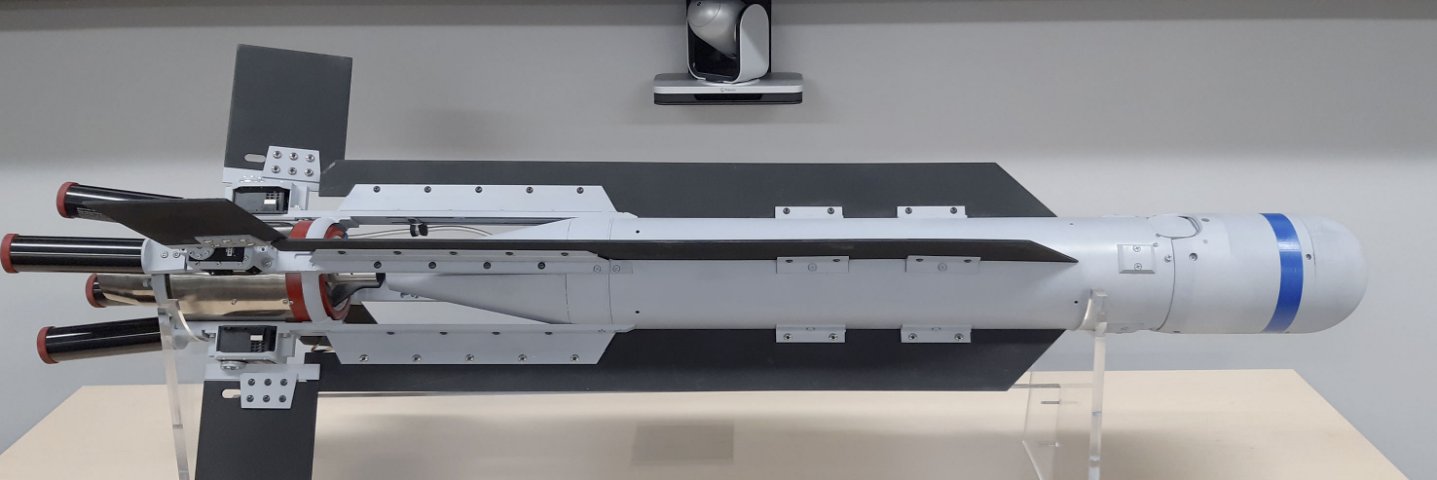
In Block 2 version or Coyote-2, a jet engine has been used instead of an electric engine, which has increased the speed of this drone to 555 km, its range to 15 km, and the flight ceiling to 30,000 feet (if the weather is favorable). As a result, Coyote-2 can neutralize threats at longer ranges and higher altitudes.
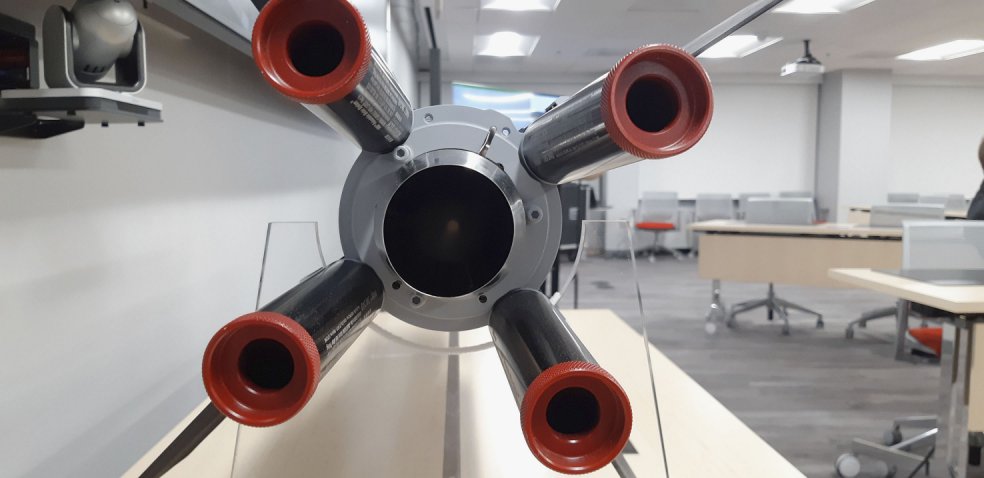
Turbine engine used in Cayote 2Coyote Block 2 – click to view full size
In Block 3 version or Coyote-3, a different and non-kinetic warhead is used. This type of warhead reduces the possibility of collateral damages and unlike the previous models which are disposable, it provides the possibility of recovery and reuse for Coyote 3. In fact, the Coyote 2 has a more traditional design similar to conventional drones with conventional wings. Coyote-3 uses an electric motor like the first version, but it is bigger than Coyote-1 in terms of dimensions and size.
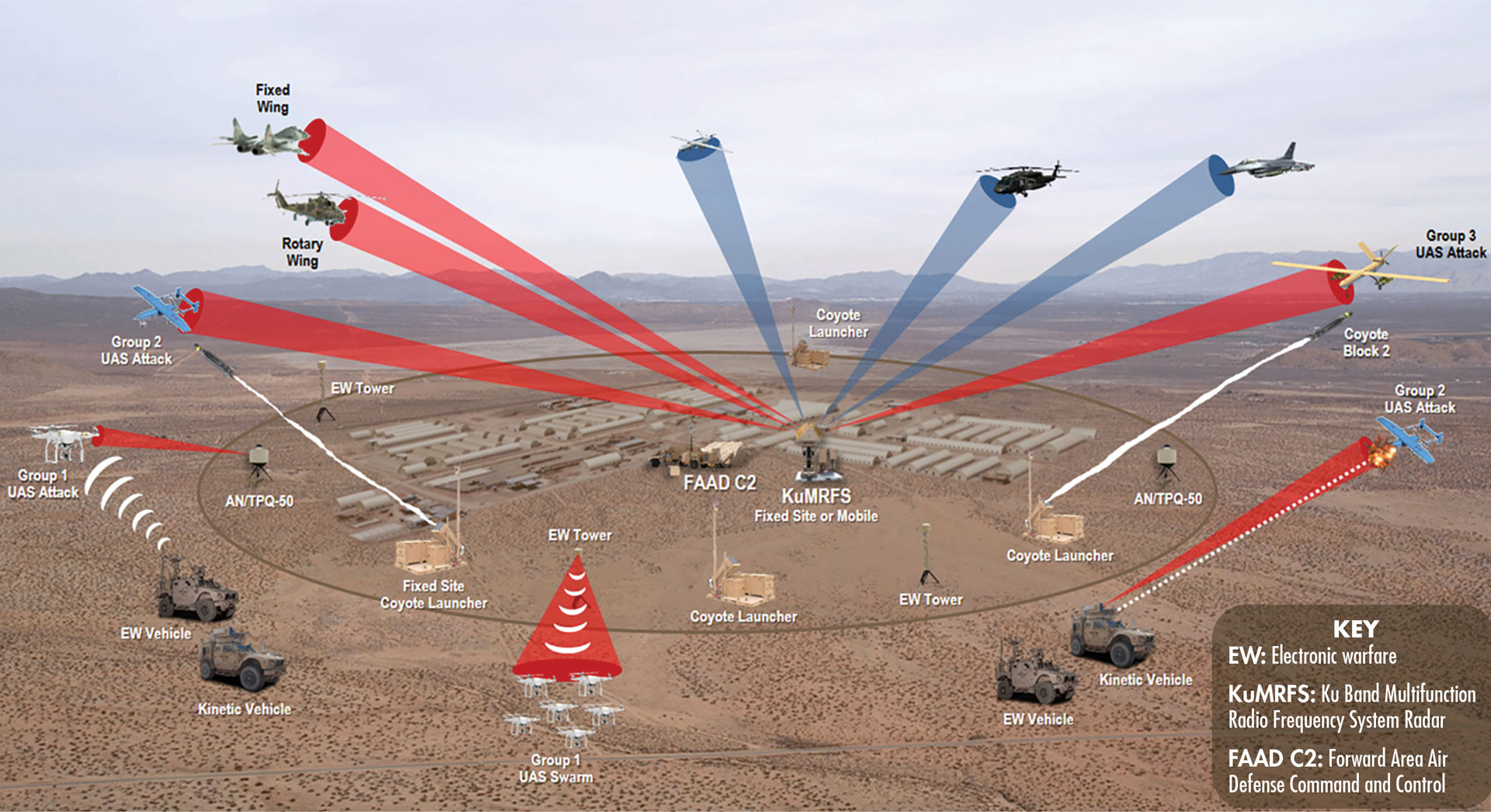
A video of FS-LIDS and M-LIDS systems and how to destroy targets by Coyote 2 drones (Block 2)A conceptual image of the use of LIDS systems for short-range defense of an area or base
Export In 2022, the US State Department announced Qatar’s request to purchase this system. According to the available information, Qatar is looking to purchase 10 LIDS systems, which include 200 Coyote drones, electronic warfare platforms, radars and other equipment of this system with the support of American contractors. The value of this contract is estimated at 1 million dollars, and the US Defense Security Cooperation Agency has stated that the main contractors of this contract will be Raytheon, Northrop Grumman and R&D SRC. In this way, Qatar became the first country to purchase the LIDS anti-aircraft system from the United States.
Technical specifications of FS-LIDS and M-LIDS system components: Coyote 1: Length: 60 cm Wingspan: 1,473 meters Speed: 130 km/h Weight: 5.9 kg Warhead: 1.8 kg Engine: Electric Coyote 2: Length: 0.91 meters Wingspan: 1,473 meters Speed: 550 km/h Warhead: 1.8 kg Coyote range: 15 km Flight altitude: 30,000 feet (6,000 meters) Engine type: Jet KuRFS radar: Role: determining the coordinates of the enemy’s artillery position, controlling the airspace in the form of an anti-UAV system Target detection range: against small drones up to 16 km and 100 km to detect aircraft and helicopters Radar type: continuous 3D and 360 degree phased array radar Operating frequency: 14.5 to 16 GHz Radar frequency: Ku AN/TPQ-50 radar: Role: determining the coordinates of the enemy’s artillery position, controlling the airspace in the form of an anti-UAV system Radar frequency: L Target detection range: up to 10 km (effective), up to 15 km (maximum). Launch position detection accuracy: 50 meters at a distance of up to 15 km, depending on the type of weapon and trajectory, the accuracy may deteriorate. Target tracking: Multiple targets in 3D Support for IP networks: Yes Power required: AC 110/240V, 3000W, 50-400Hz or 24V DC supply. Power consumption: 1200 watts Weight: less than 500 pounds (< 227 kg) Height: more than 2 meters (on a tripod) Diameter: about 102 cm
The M-LIDS mobile system – click to view full size
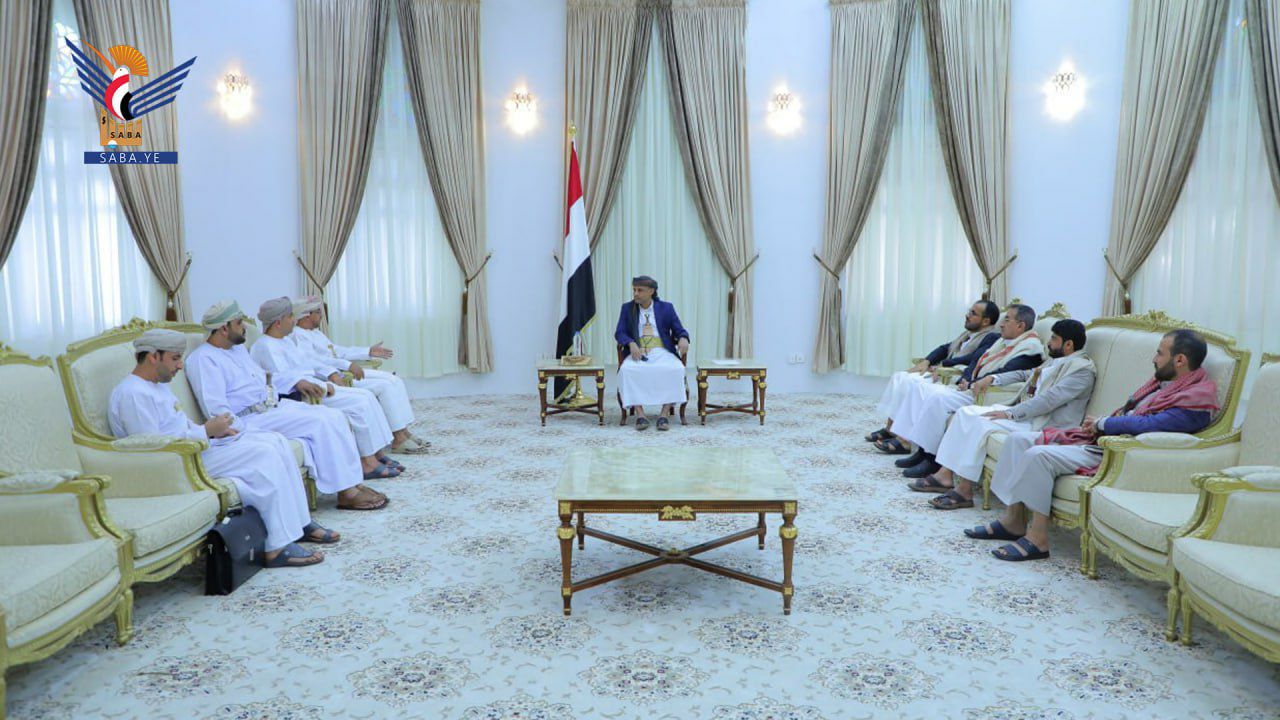
The Yemeni National Salvation Government’s negotiating team, led by Mohammed Abdulsalam, who is also the Ansar Allah movement’s spokesman, traveled to Riyadh, the capital of Saudi Arabia, after Omani representatives consulted officials of the Ansar Allah movement.
Following Oman’s liaison and talks during Mohammad bin Salman’s recent trip to Muscat, Omani representatives entered Sana’a on Friday, September 14. The meeting between the Omani delegation and Ansar Allah officials was held to convey Sultan Haitham bin Tariq’s message to Mahdi Al-Mashat, President of the Supreme Political Council of Yemen.
In general, the negotiation was welcomed by Ansar Allah leaders, and the Yemeni negotiating team, accompanied by Omani representatives, went to Riyadh, the capital of Saudi Arabia on Saturday.
According to Mohammed Abdulsalam’s statements, the priority of this round of negotiations is focused on lifting the siege, opening ports and airports, paying employees’ salaries from oil revenue, as well as prisoner swap.
Other issues such as the withdrawal of foreign forces and the reconstruction of war-torn country for achieving a comprehensive political solution have been raised but they have not yet been confirmed or denied by the other party.
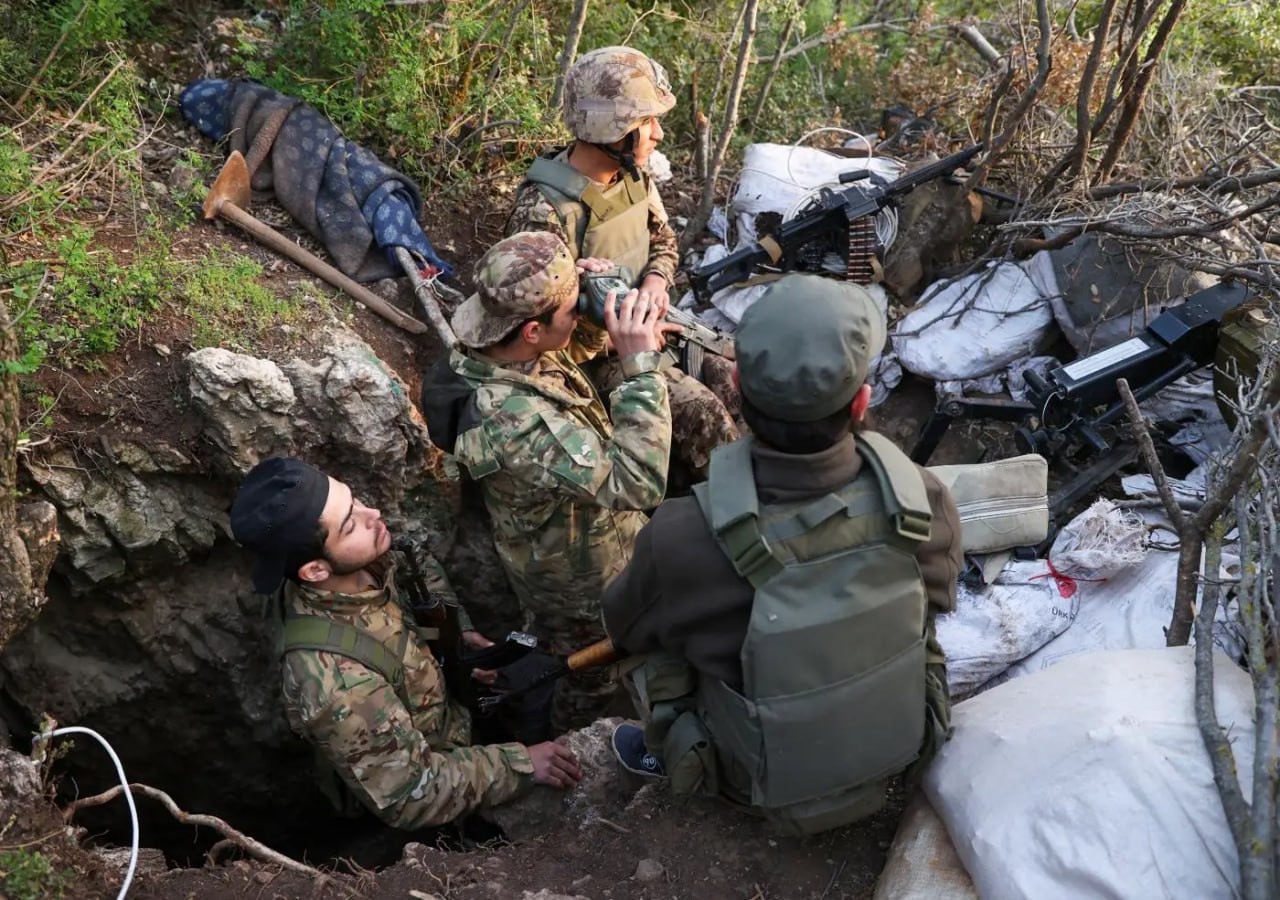
It is likely that the fighter jets of the Russian and Syrian army will organize a new series of attacks against the positions of Tahrir al-Sham in the coming days in response to this attack.
The Khorasan branch of ISIS (ISKP or ISIS-K) has taken responsibility for this attack by publishing a statement.
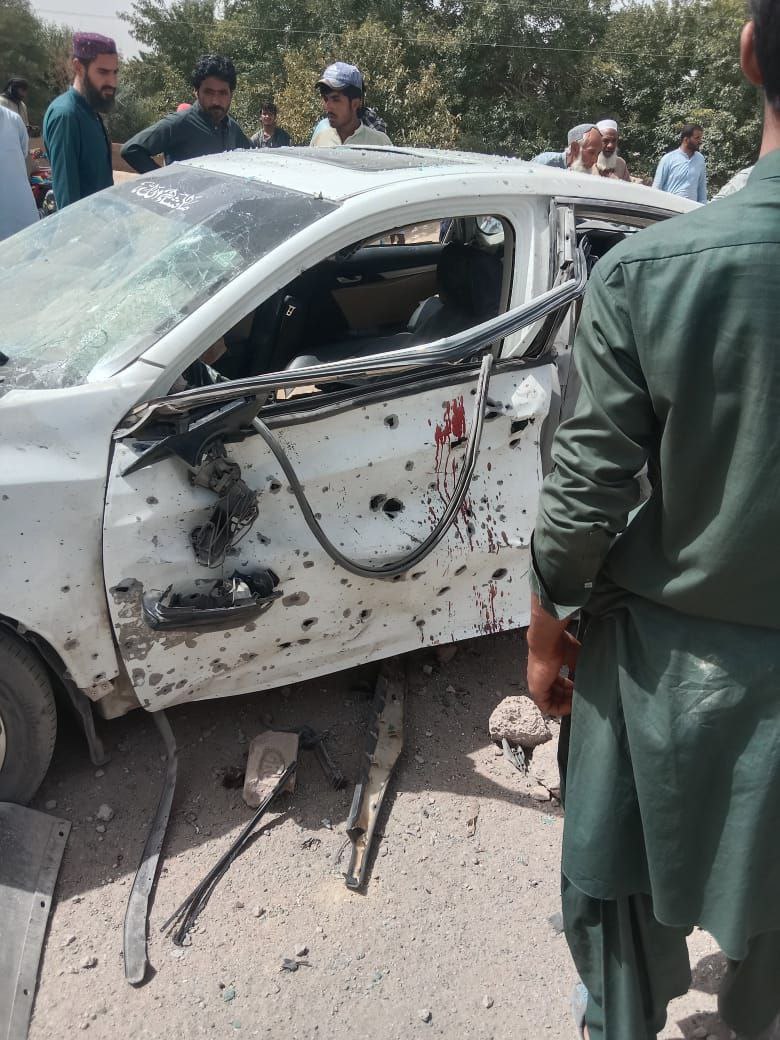
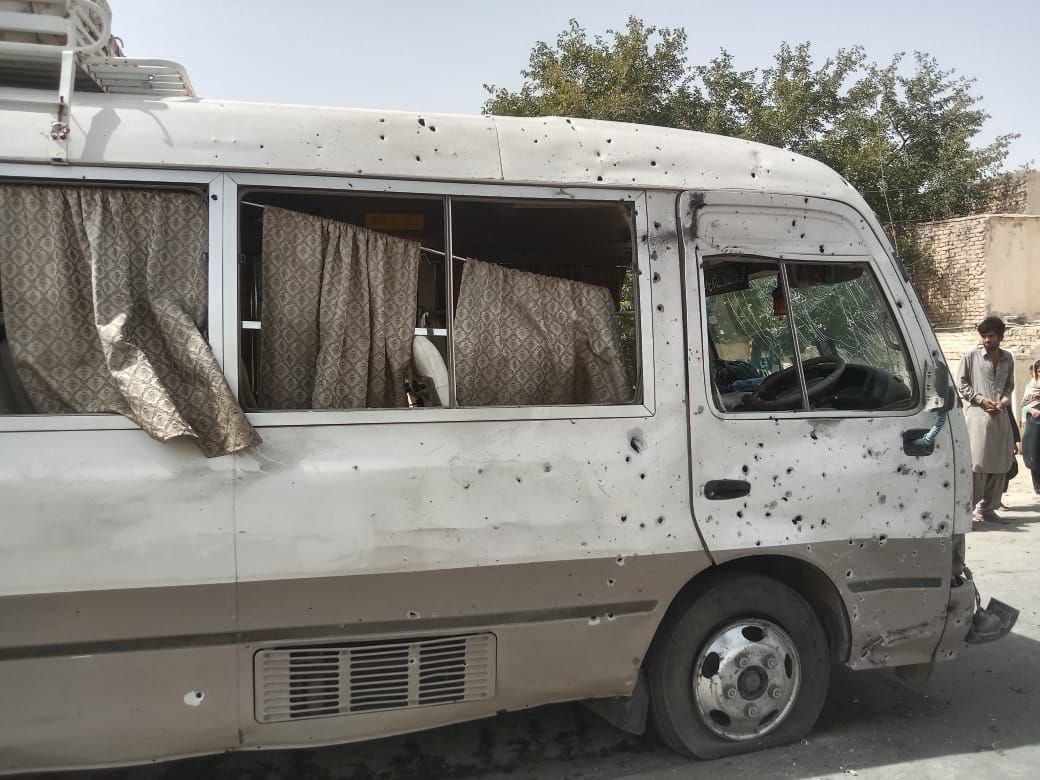
On July30, ISIS also targeted the gathering of Jamiat Ulema Islam supporters in Bajaur district by a suicide bomber, as a result of which more than 250 people were killed and injured.
The Channel 14 of Israel announced that the fighter jets of this regime bombed targets in Syria for the second time in a row in recent hours. Lebanon’s al-Mayadeen network also announced that the attack was carried out through Lebanese airspace.
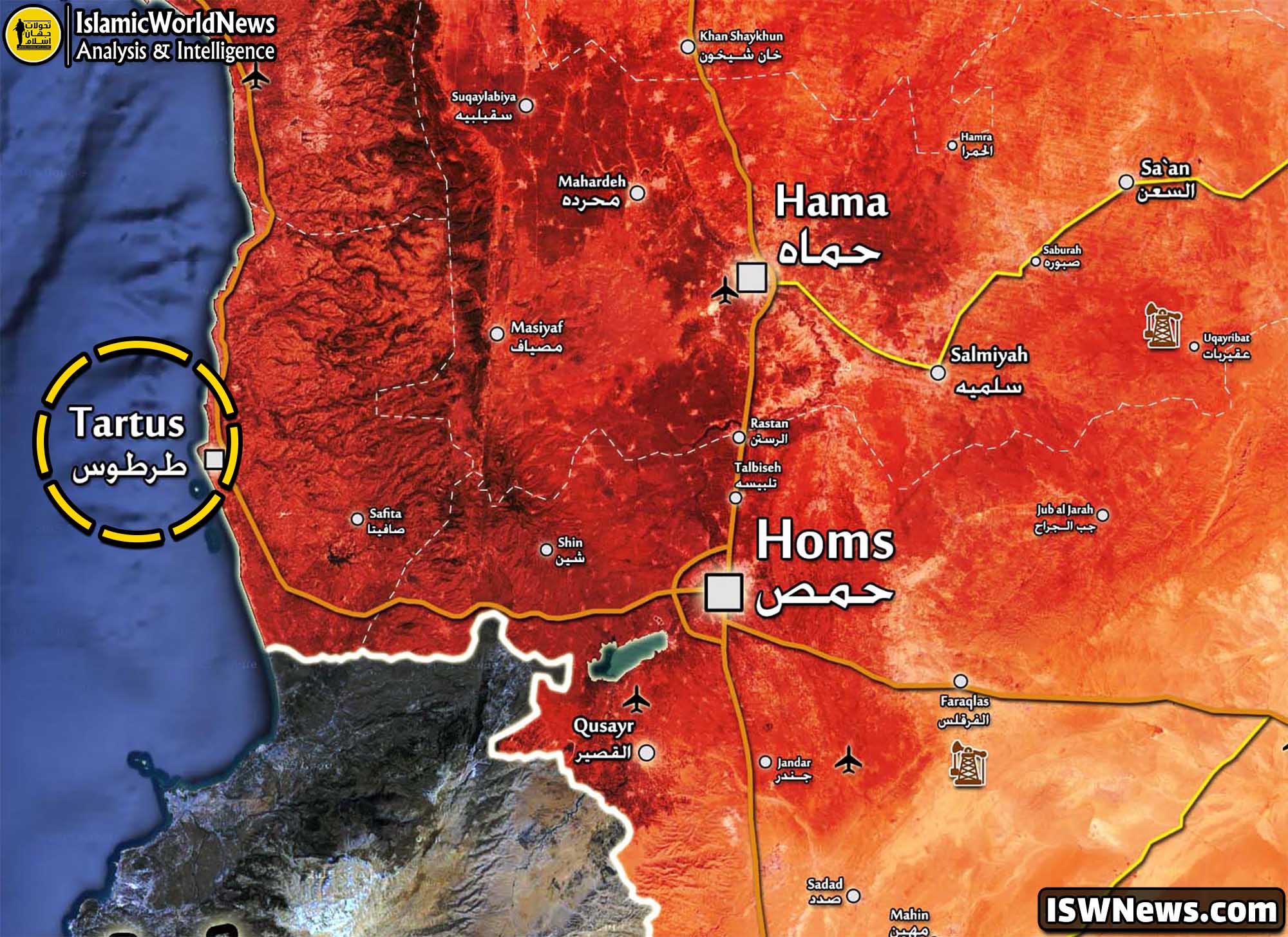
It is worth mentioning that hours before, Israeli fighter jets attacked targets in the outskirts of Tartus, during which two Syrian soldiers were martyred and six others were injured.
While there are talks about the plan to transfer anti-Iranian terrorist groups to the far west of Iraq in Anbar province, the representatives and heads of tribes and commanders of Hashd al-Shaabi (PMU) in this province emphasized their opposition to this plan.
The representatives, heads of tribes and commanders of the Popular Mobilization Organization in Anbar province of Iraq emphasized that this province is not ready to accept a new problem and the transfer of anti-Iran armed groups to this province.
Abdul Wahab Al-Bilawi, a member of the Anbar Tribal Sheik Council, also stated that such a plan is completely rejected and absolutely unacceptable and added: “We do not want the province to be involved in international conflicts, while these militants cause security problems in the province.”
These words were mentioned while the Iraqi Foreign Minister, Fuad Hussein, stated yesterday before his visit to Iran, that the Iraqi government has started the process of transferring anti-Iranian armed groups from areas close to Iran’s borders to camps far from the border as part of the security agreement between Tehran and Iran.
It is worth mentioning that the Iran’s deadline for the Iraqi government to disarm terrorist groups in the Kurdistan region ends on September 19, 2023.
Recently, the deputy commander of the IRGC said in an interview with an Iranian media outlet that “we [Iran] expect from our brothers in the Kurdistan region to show brotherliness, because providing terrorists with safe haven in that region, which has become a source of operations against our country, is not consistent with brotherliness or good neighborliness.”
In this regard, Iraqi Foreign Minister Fuad Hussein arrived in Tehran on September 13 and met and discussed with Hossein Amirabdollahian, Minister of Foreign Affairs of Iran. Fuad Hussein emphasized that the central government of Iraq has fully committed to the Iran-Iraq security agreement and the border security program and the withdrawal of terrorists from the border areas will be carried out by September 15.
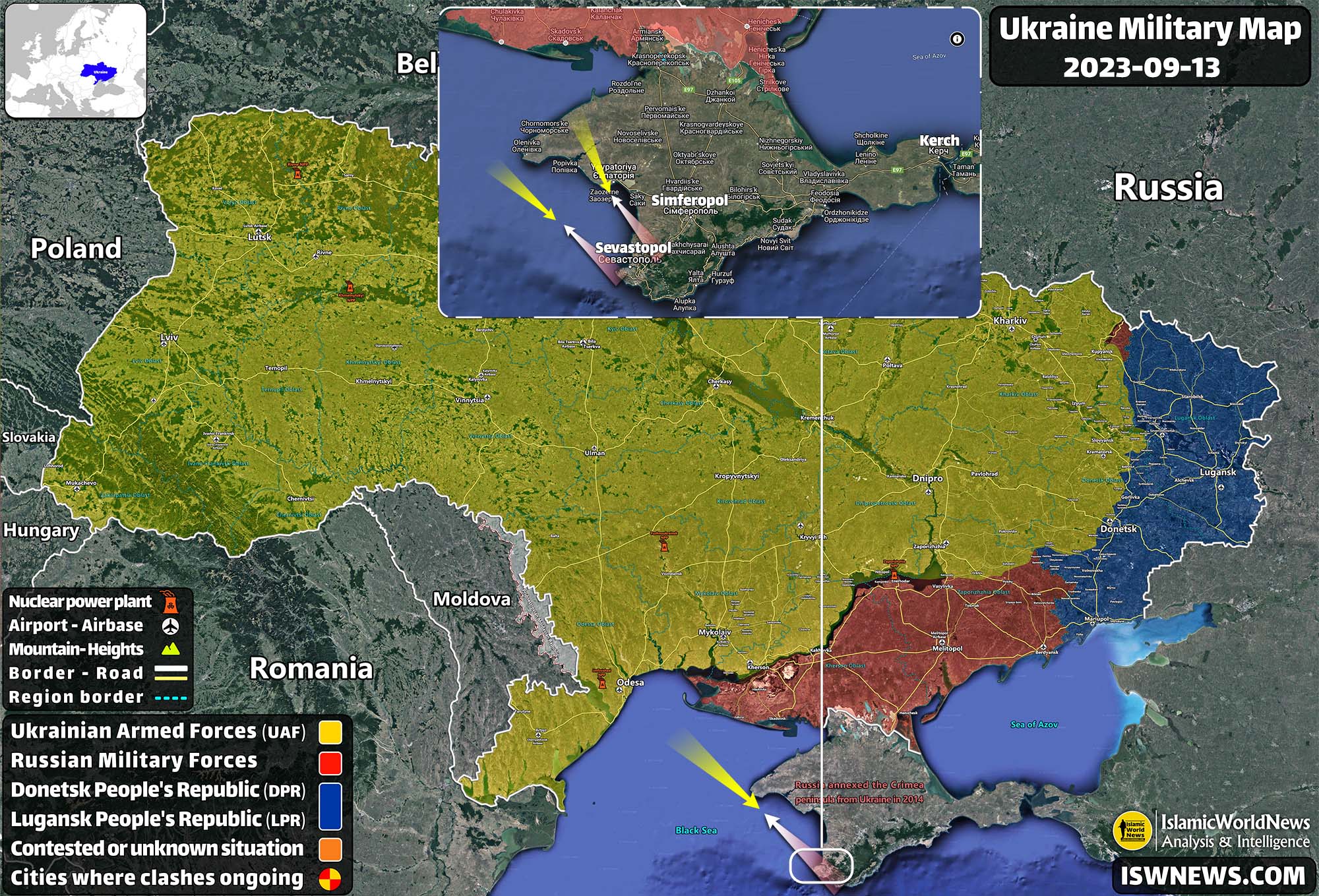
At 3:00 a.m. today, September 13, during an air operation, the Ukrainian army fighter jets attacked positions of the Russian army in the port of Sevastopol, in the west of the Crimean Peninsula, with at least 10 Storm Shadow cruise missiles.
According to Russian sources, the Russian Army, using the Pantsir S-1 and S-400 air defense systems, as well as the MiG-31 fighter jet, managed to deal with seven cruise missiles in the sky, but three another missile hit the Minsk amphibious assault ship and the Rostov-on-Don diesel-electric submarine, which were located on the coast of this port, causing damage to them.
Also, during the attack two people were killed and 26 others were wounded.
After a long break, it seems the Crimean peninsula has returned to the circle of Ukrainian missile attacks, and these attacks will probably continue more heavily in the coming days.
According to a Syrian military source, “at around 17:22 local time on Wednesday, the Zionist enemy targeted a number of air defense bases with several missiles from the Mediterranean Sea. This attack resulted in the martyrdom of two Syrian soldiers and the wounding of six others.”
It is worth mentioning that on the 28th of August, the Zionist regime fighter jets attacked the Aleppo International Airport by firing several missiles from the direction of the Mediterranean Sea in the west of Latakia.
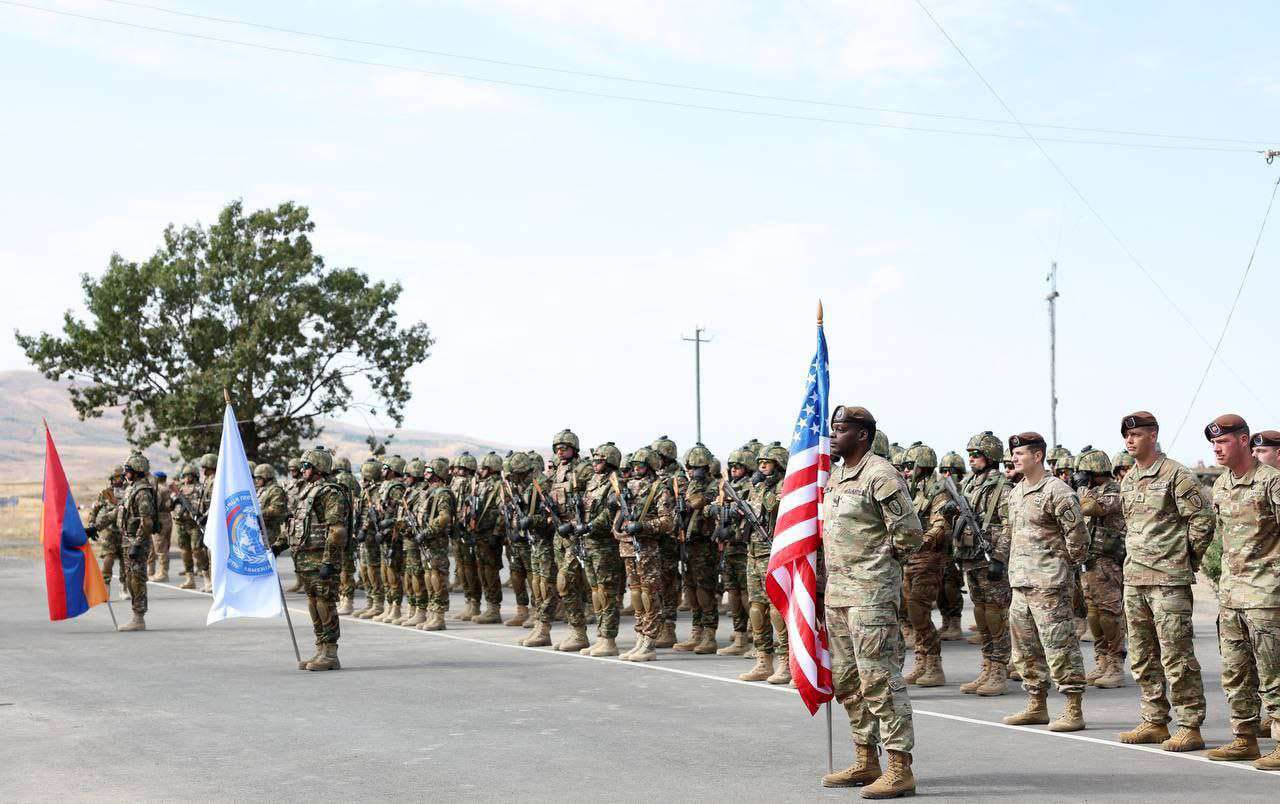
The joint military exercise between Armenia and America, called Eagle Partner 2023, kicked off on September 11 near the Armenian capital city of Yerevan.
The purpose of the military exercise is to increase the level of cooperation capabilities of the participating units in international peacekeeping missions and to increase the coordination of Armenian forces with NATO standards.
The Kremlin warned that the military exercise has caused concern for Russia.
Dmitry Peskov, a spokesman for the Kremlin, said: Of course, such a news story is particularly worrying in the current situation. Therefore, we will deeply analyze this news report and monitor the situation.
Currently, groups of Russian peacekeepers are present in the disputed border areas between Republic of Armenia and the Republic of Azerbaijan.
Since November 30, 2020, when a ceasefire was signed between Armenia and Azerbaijan, about 2,000 Russian forces have been deployed in the region in order to shoulder the responsibility for maintaining peace and tranquility.
However, the military exercise is being held amid increasing Armenian despair over Russia’s failure to guarantee and secure the establishment of a peace agreement and ceasefire in Karabakh region.
Both the Republic of Azerbaijan and the Republic of Armenia are dissatisfied with the performance of Russian peacekeepers in Karabakh region, and it is feared that this trend will ultimately lead to foreigners entering the Caucasus region.
With the rekindling of tensions with Baku, Armenians have expressed disappointment at Russia’s lack of military and political support.
Furthermore, Armenia’s Prime Minister Nikol Pashinyan recently said that Moscow “cannot or does not want” to control and manage the Lachin corridor, which provides access from Nagorno-Karabakh to Armenia.
Pashinyan stated that Armenia’s historical security reliance on Russia was a “strategic mistake.”
Some analysts believe that Russia, due to the war in Ukraine, has focused all its attention on Ukraine and therefore, Moscow lacks a clear plan and strategy in the Caucasus region.
It seems that Russia may have become isolated on the international scene and it is losing its influence in its Soviet era backyard, namely the Caucasus region.
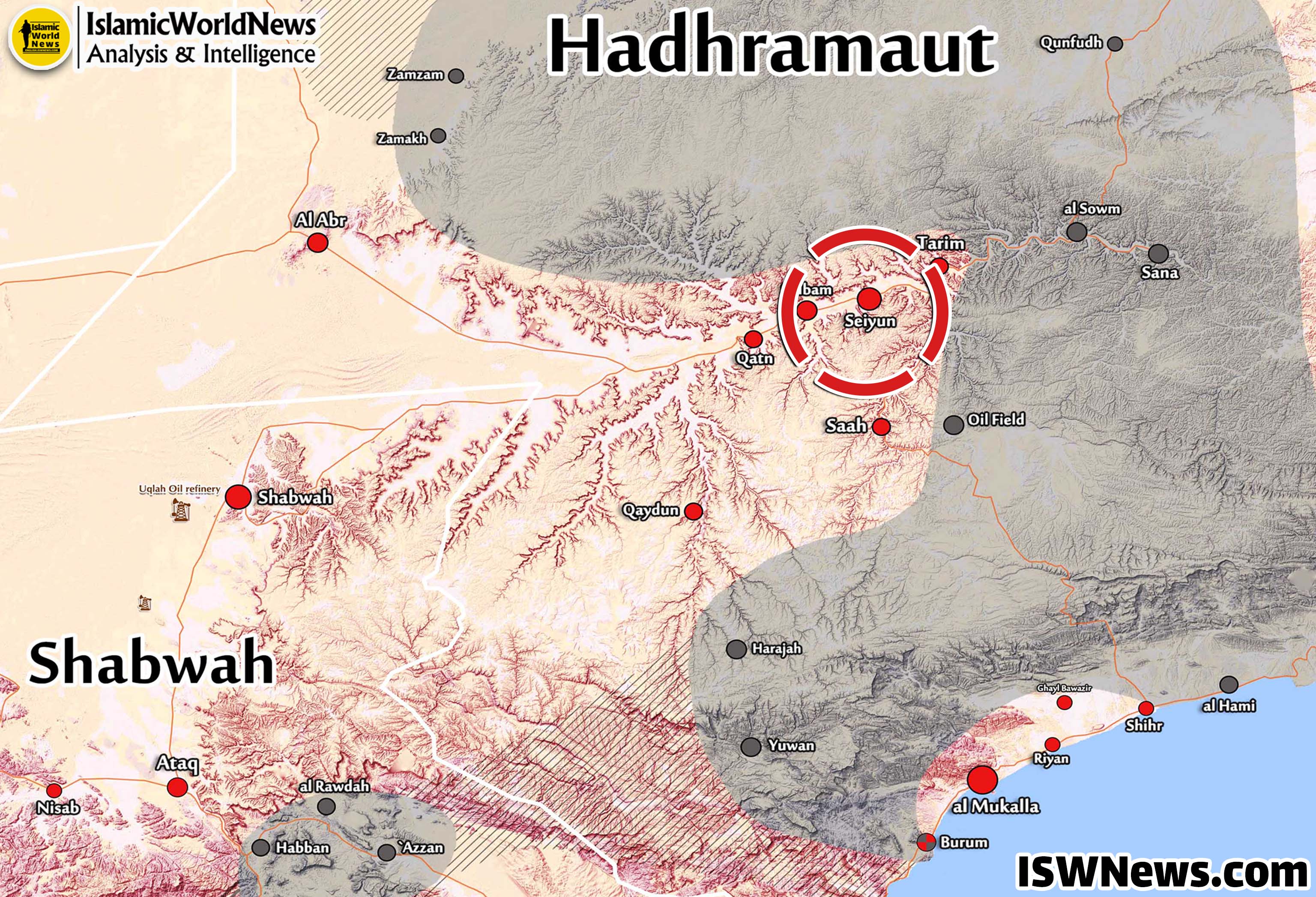
On September 12, the US forces was attacked by unknown armed men in Wadi Hadhramaut in the in the east of Yemen. This attack was probably carried out by armed tribesmen opposed to the Saudi-backed government of hadi or by the Al-Qaeda terrorist group.
So far, the details of the damage and possible casualties have not been published.
The exact area of the ambush is not known; However, considering the previous activities of the American forces in Hadhramaut province, it is likely that the incident took place on the outskirts of Al-Ghurfa.
According to the published video, the US forces have air support, and from this point of view, it can be said that the attack by unknown armed men was ineffective.
History: Due to Iran’s armored requirements and the increasing advancement of anti-armor weapons and armor technology throughout the world, there was a need for a tank at the level of modern tanks in the Islamic Republic of Iran Armed Forces. Despite allocation of limited budget, the armed forces embarked on upgrading the existing T-72S tank. Although in the past, Zulfiqar 1 and 3 tanks had been built as prototypes in the country, they were never widely adopted due to the inability to produce them in large numbers given the country’s budget limit.
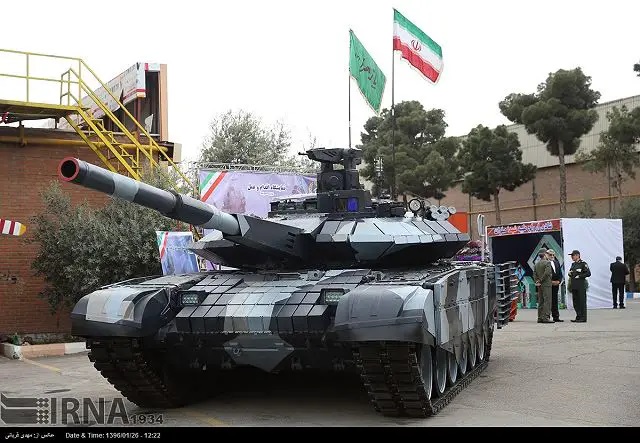
The Karrar tank was unveiled on March 12, 2017, in a ceremony attended by the then-Minister of Defense, General Hossein Dehghan. It was emphasized in the ceremony that the production line for the Karrar tank is also located in the Bani Hashem Armor Industrial Complex in Doroud County, Lorestan province. However, the introduction of this tank into service began slowly several years later. The production line was reopened in August 2020, and since then, the delivery process has been faster than before. The operational version of the Karrar tank differs from the unveiled version.
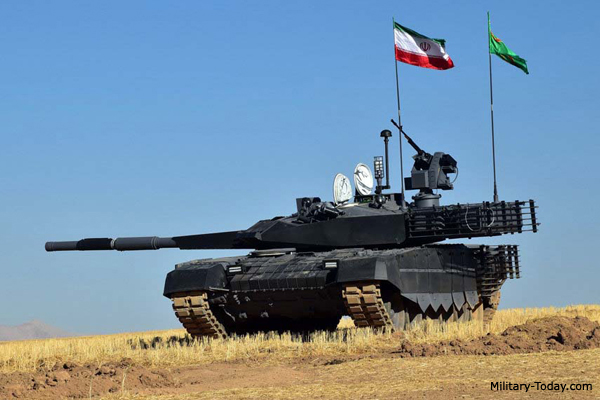
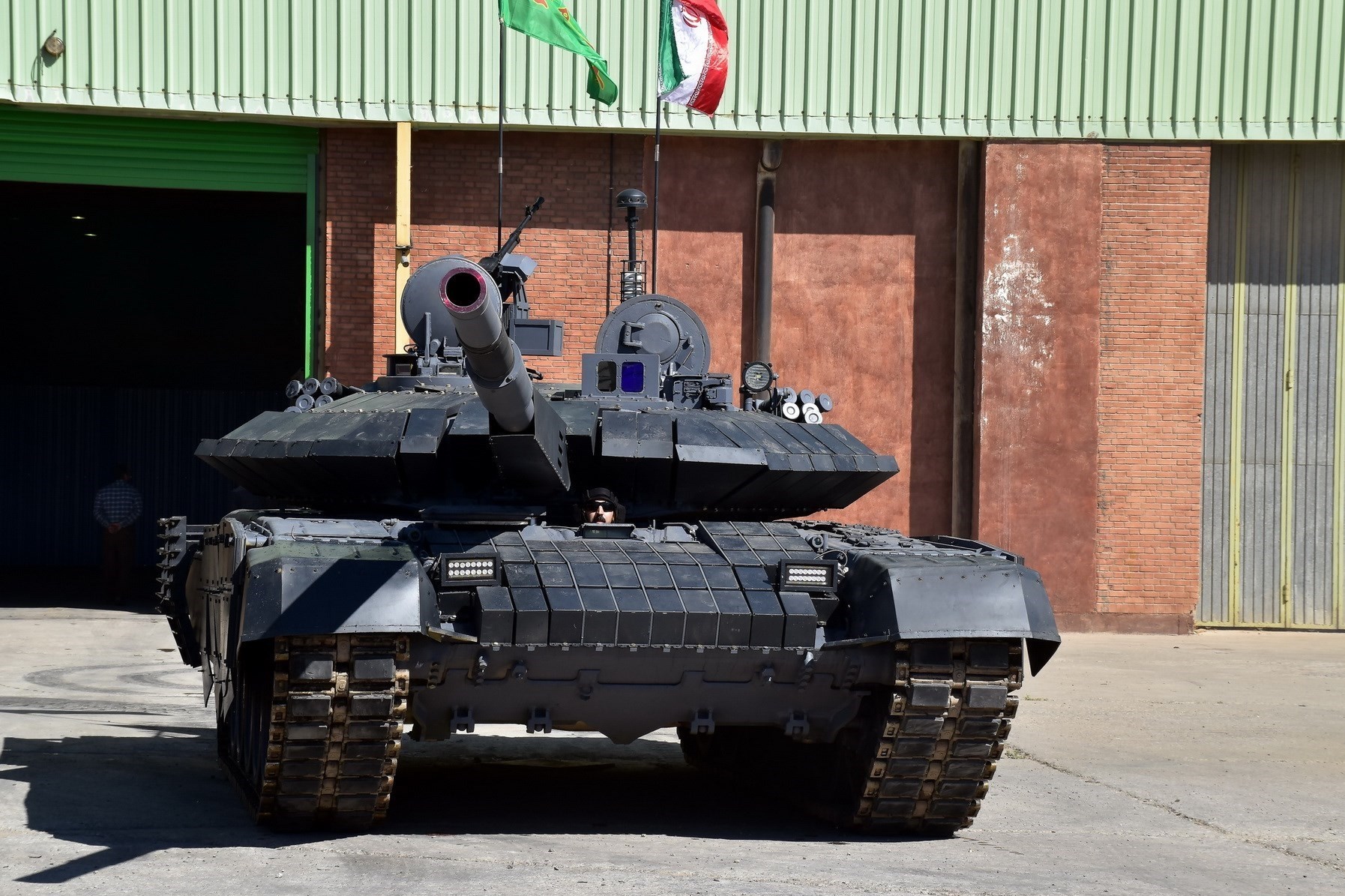
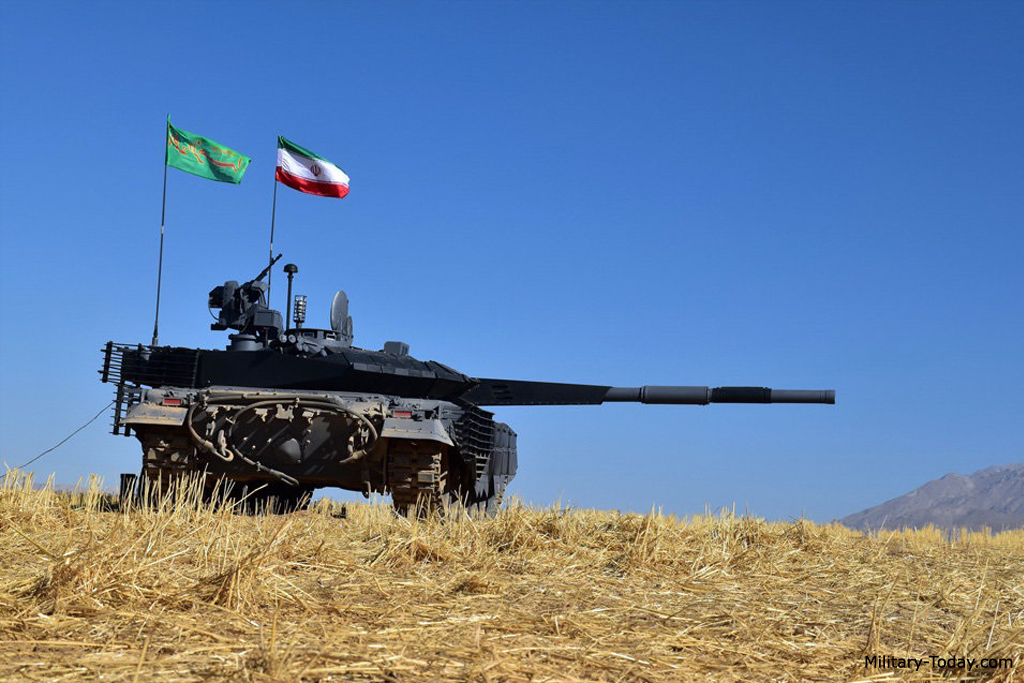
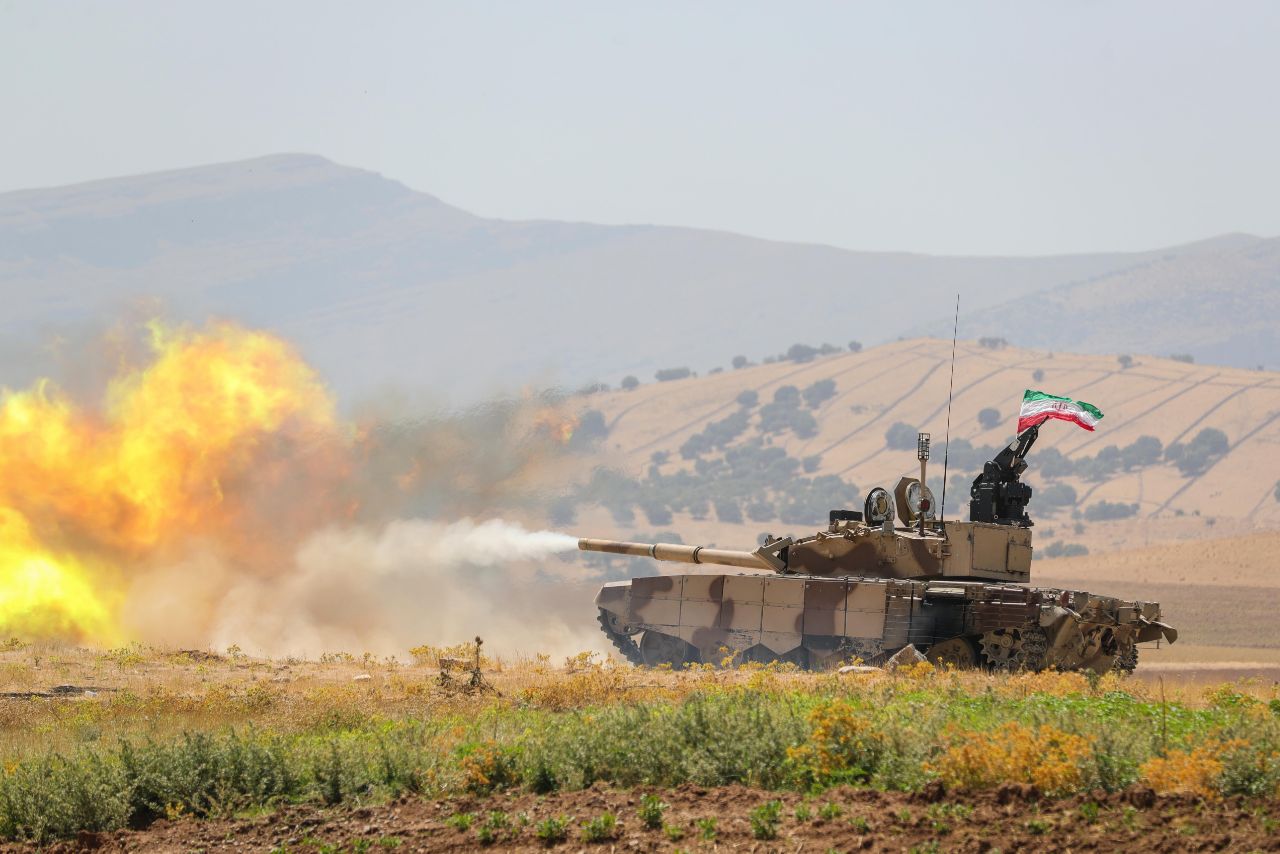
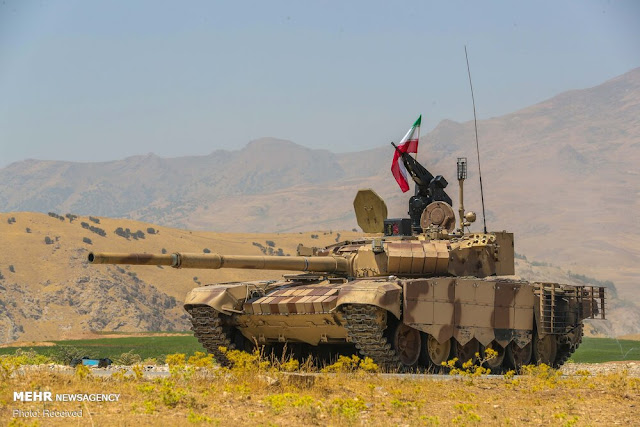
Design: The Karrar tank features a welded and modern turret with a 125mm gun and a remote-controlled 12.7mm machine gun, as well as a coaxial 7.62mm machine gun.
There are 12 smoke grenade launchers with an 81mm caliber on both sides of the turret, with six launchers on each side. The use of smoke grenades on both sides of the tank provides a larger range for creating smoke screens to disrupt laser-guided missiles
12 grenade launchers installed on Karrar
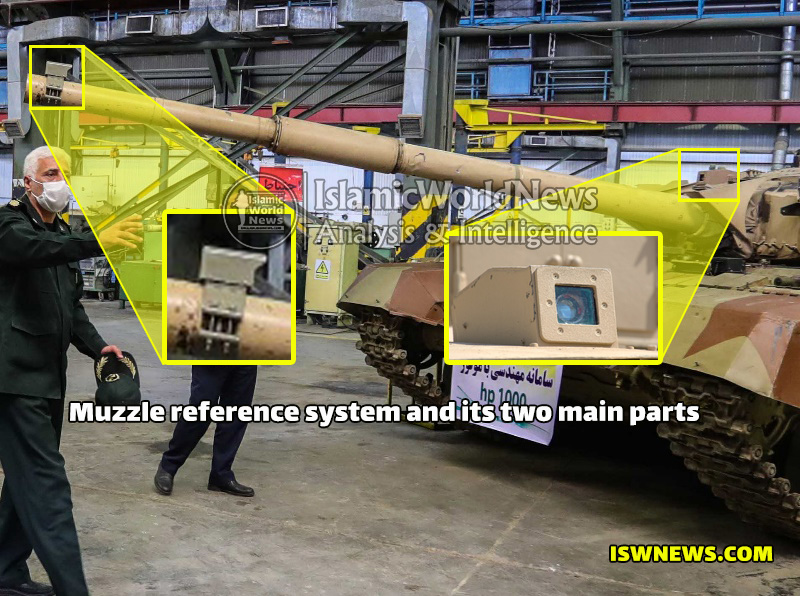
The Karrar tank includes a fire control system that consists of various components such as a muzzle reference system and a weather station. The muzzle reference system consists of two pieces, one at the beginning of the gun and one at the mouth of the gun, which detects the smallest angle of the gun that is not visible to the naked eye. As a result, the accuracy of direct gun fire is greatly increased.
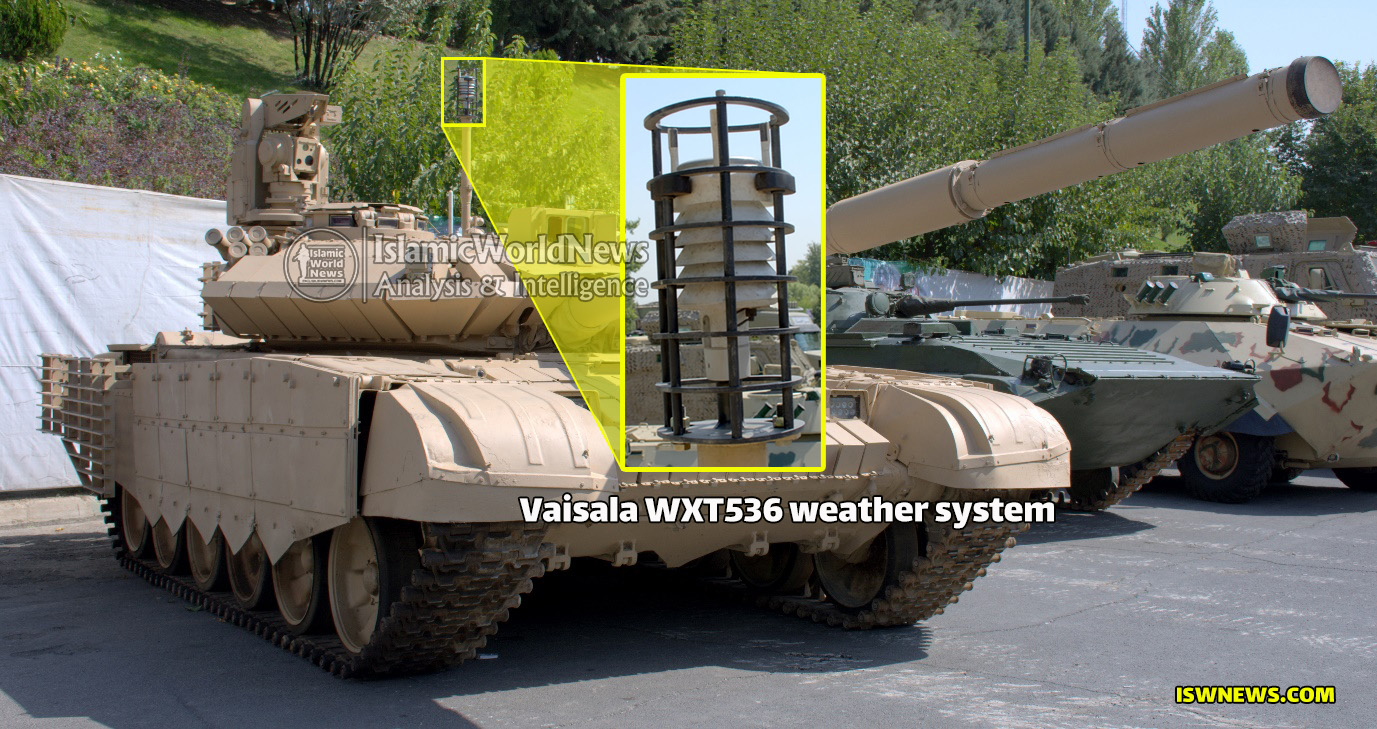
The weather sensors, by performing calculations on variables such as wind speed, humidity, air temperature, etc., increase the accuracy of ballistic shots. The Karrar tank uses a Vaisala WXT536 weather station belonging to a US company.
Muzzle reference system and its two main partsVaisala WXT536 weather systemClick to view full size image
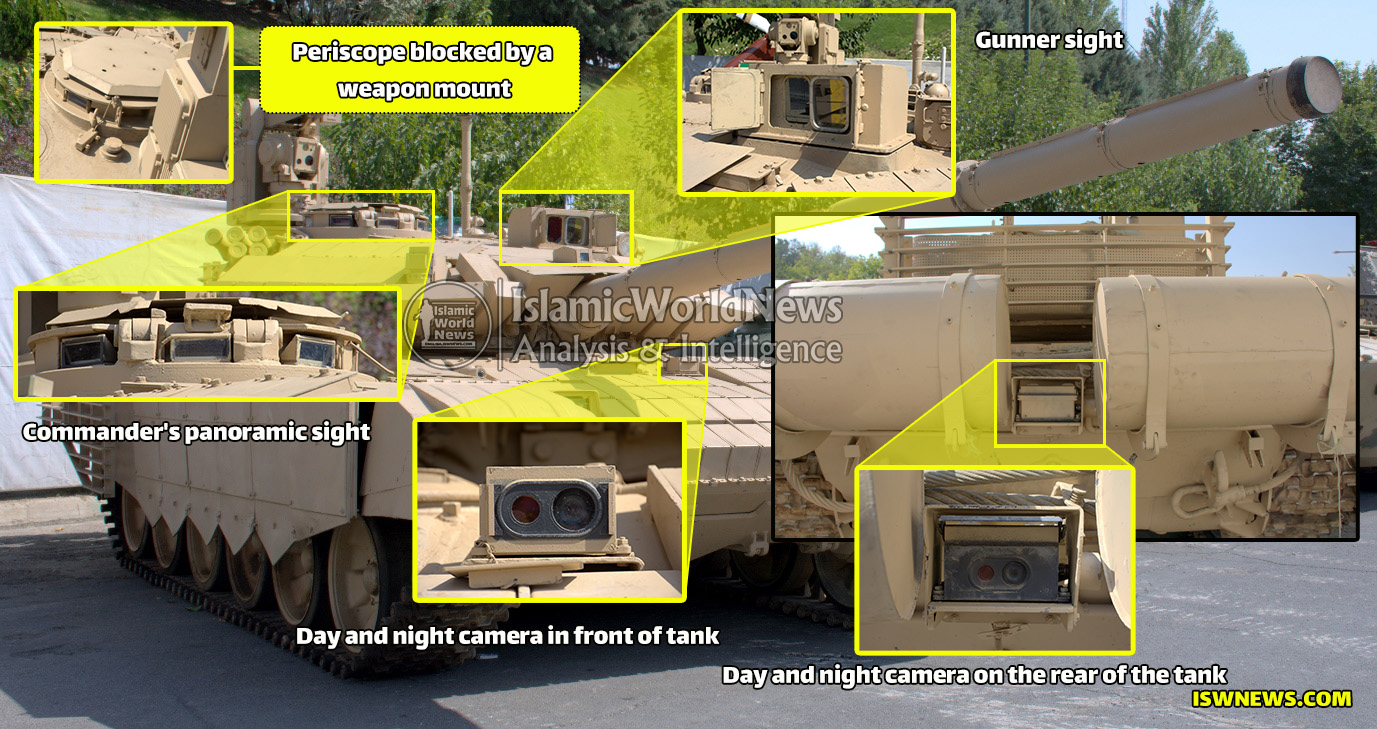
The Karrar tank uses a day and night vision system in front and back of the tank. This system includes an IR/EO day and night vision camera in the front left window of the driver’s hatch and a day and night vision camera at the back of the tank between the external fuel tanks.
The all-around surveillance system (360-degree periscope) of the commander of the tank is another available system on the Karrar tank. This system includes seven fixed periscope windows installed in the commander’s hatch. The all-around surveillance system provides the ability to install eight periscopes, but one of the positions is occupied by the remote-controlled machine gun base and it has been blinded, so no periscope is installed there.
The Karrar tank utilizes a surveillance and targeting system for the gunner, which is located on the turret of the tank. The two doors of this surveillance system are manually operated and they do not have remote control. In addition, this surveillance and targeting system does not have a washer or snow remover, which is a major weakness. In war conditions, there is a possibility of dirt and snow accumulating on it, which will disrupt the performance of the surveillance and targeting system without a cleaning system.
Karrar tank surveillance and targeting system collection
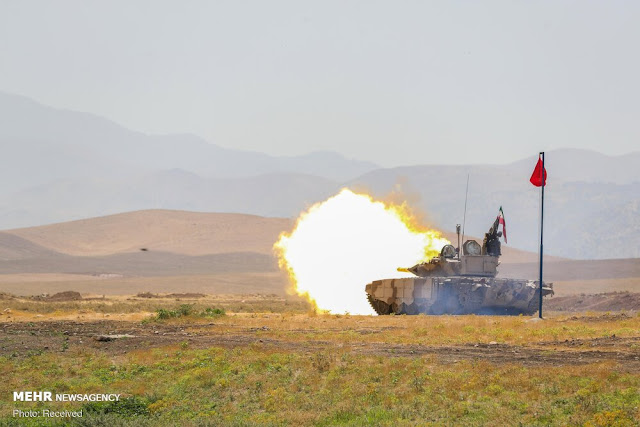
Armament: As it was mentioned before, the main weapon of the Karrar tank is the 2A46 series 125mm cannon, which is the same cannon used in T72 and T90 tanks. This cannon can fire various anti-armor and anti-structure ammunition. It also has the ability to fire laser-guided missiles. The first version of the Karrar tank contained armor for the cannon, which was located at the connection point of the cannon to the body precisely on the cannon. The mentioned armor provided significant protection for the cannon against post-impact bullet cracks on the body.
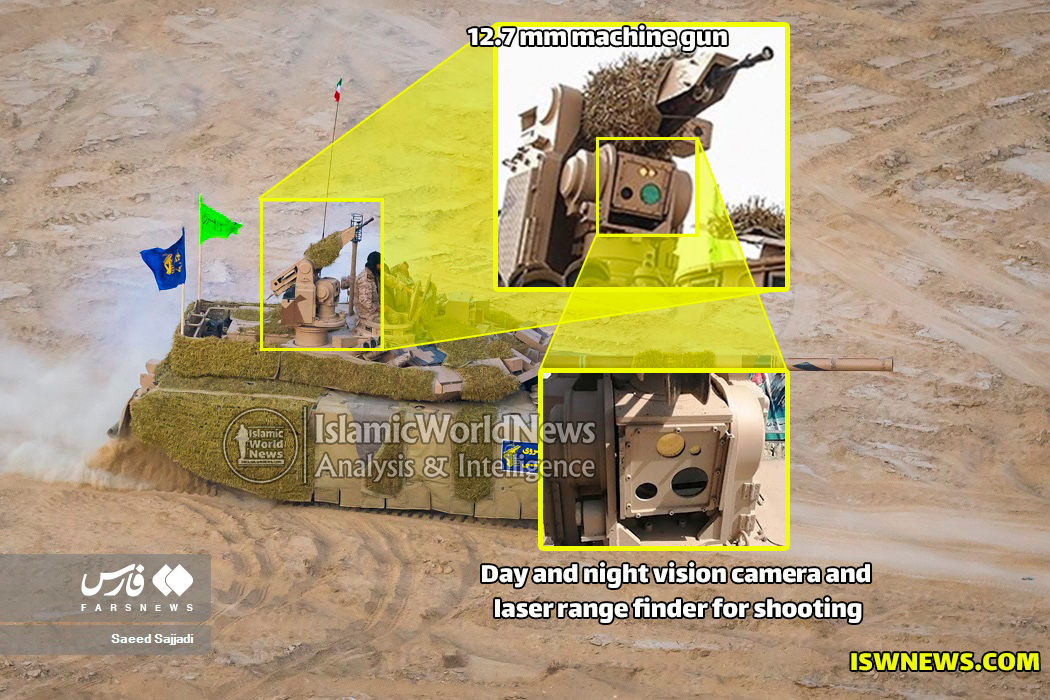
The secondary weapon of the Karrar tank is a remote-controlled 12.7mm machine gun. This weapon has its own day and night vision sight and is guided by the tank commander. It is not clear whether this machine gun can be independently guided by the gunner or not, but the possibility of its guidance by the tank gunner is not unlikely.
Remote controlled 12.7 mm machine gun
Armor protection: In addition to the main armor, the Karrar is also equipped with reactive armor in the front part of the chassis to protect itself. According to the available images, in this section, Karar uses Kontakt-1 reactive armors that are produced in Iran.
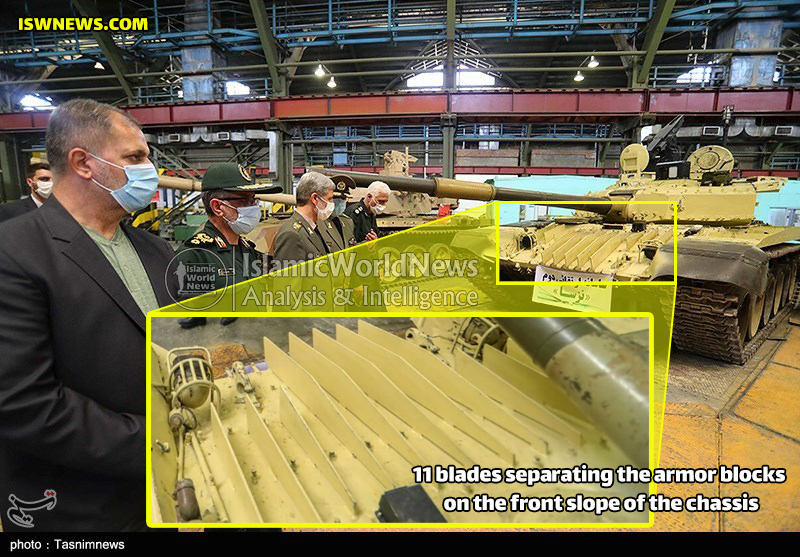
In this section, the Karrar tank uses 11 separating blades to separate the reactive armor blocks on the front slope of the chassis. In addition to separating the blocks from each other and preventing the transfer of explosive effects to the adjacent blocks, these blades also cause the blocks to be arranged more regularly. Because the effect of explosion of the reactive armor blocks (explosion wave, heat and shrapnel) is more lateral, the separation blades are also placed laterally.
In side protection, the Karrar tank uses armor similar to the Relikt plates. This section is a combination of 5 layers: two middle layers of vulcanized rubber, two steel layers reinforcing the rubber layer and a thicker steel layer, which is the last layer closest to the tank.
11 blades separating the reactive armor blocks in the front slope of the chassisThe side armor of Karrar tankClick to view full size image
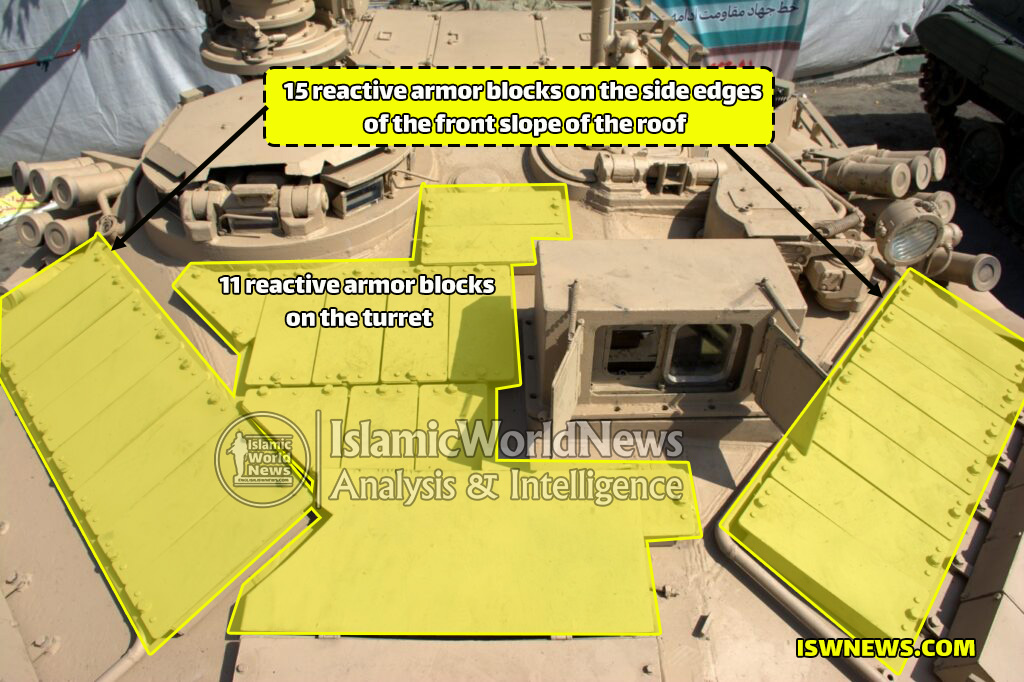
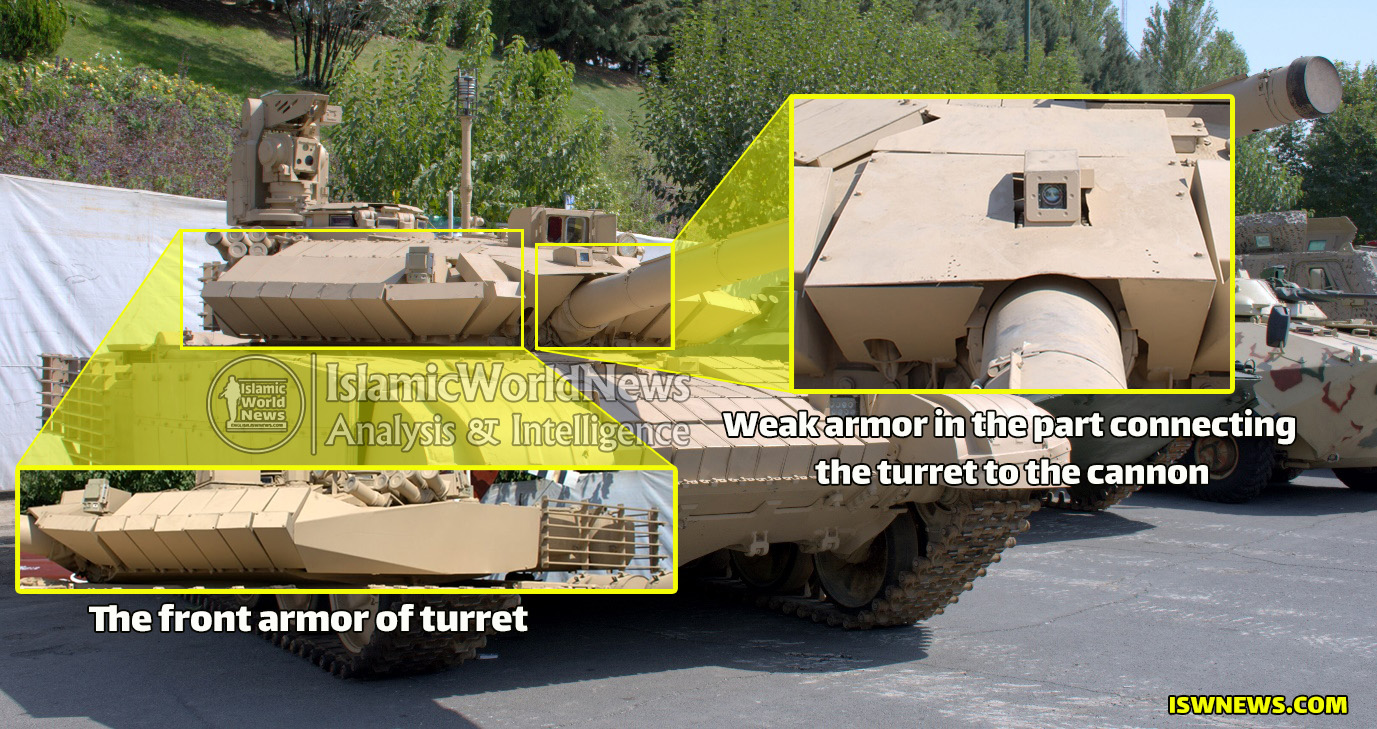
In terms of turret protection, the design is very similar to the T-90MS tank. In this section, reactive armors with more resistance and similar to Relikt or Kontakt-5 reactive armor are used. The main difference between the Karrar design and the T-90MS in this section is the dimensions of the reactive armor. These plates are installed on the turret with a steep slope, the thickness of which increases in the end part. The number of blocks used in the Karrar tank turret is 58. 32 blocks are located on the front and side of the turret, which use different dimensions, and 15 blocks are used to cover the side edges of the front slope of the roof and 11 blocks are used to cover the central part of the roof.
The main challenge to fully cover the turret is related to covering the part connecting the gun to the turret, the armor used must be able to move up and down along with the gun. It seems that this part of Karrar tank does not have enough protection.
Arrangement of reactive armor blocks on the roof of the Karrar tankThe arrangement of the side blocks of the turretClick to view full size image
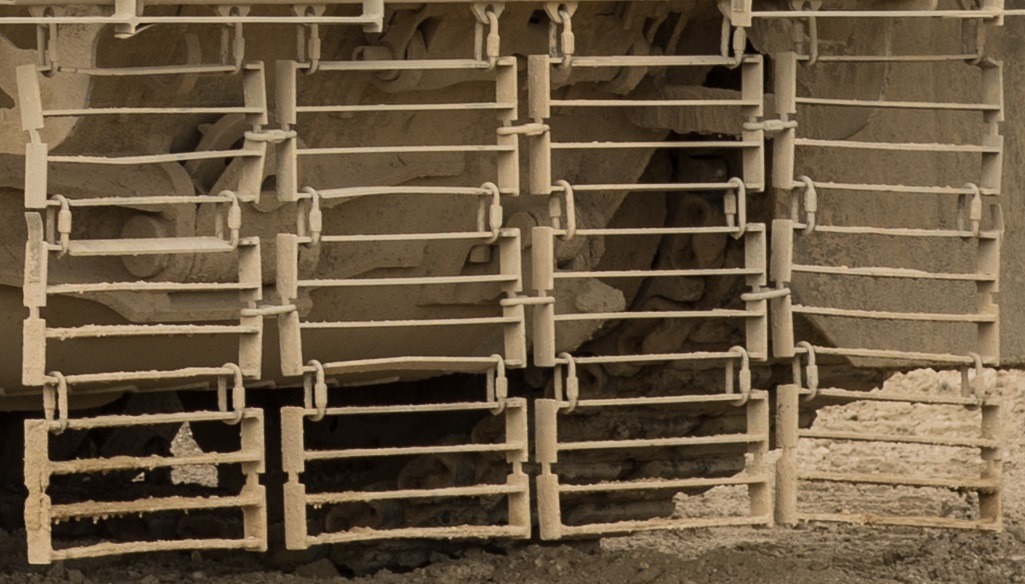
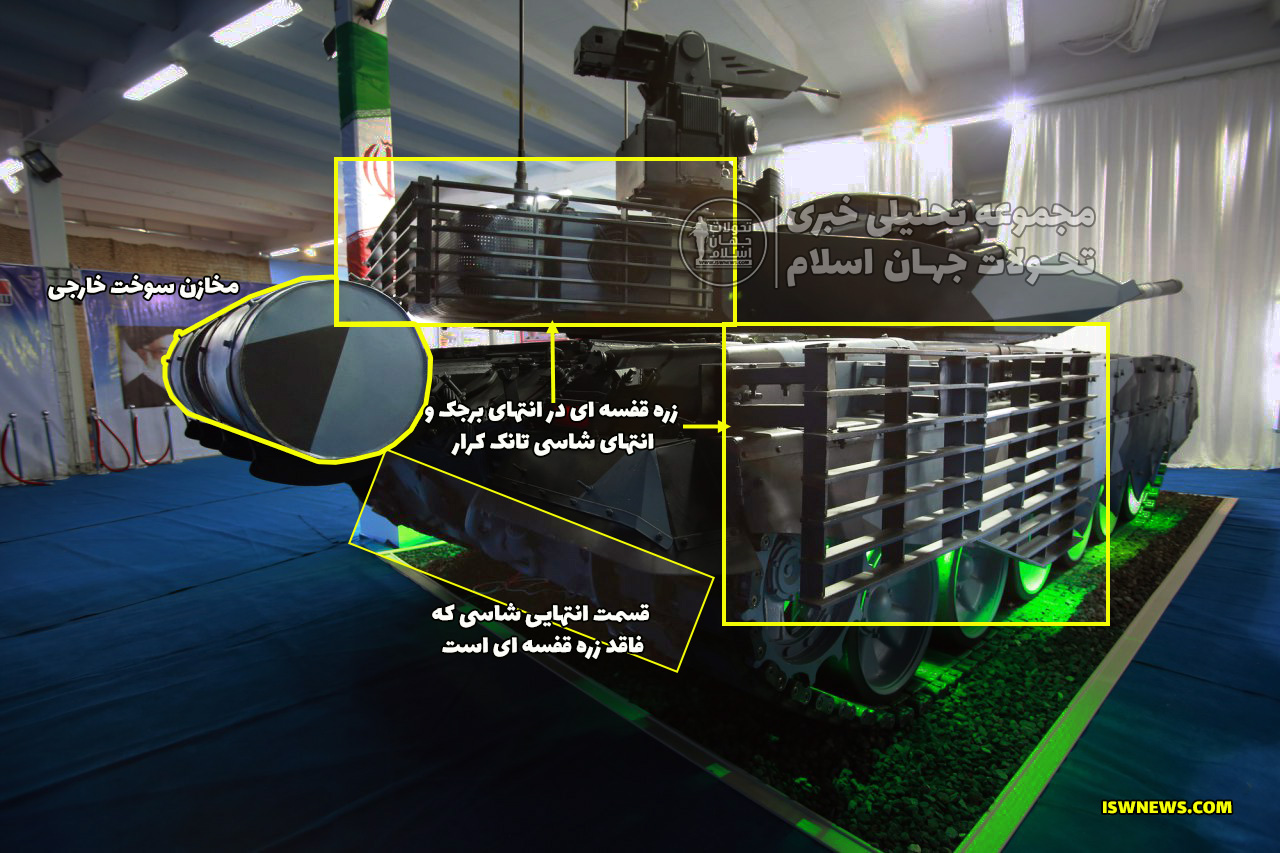
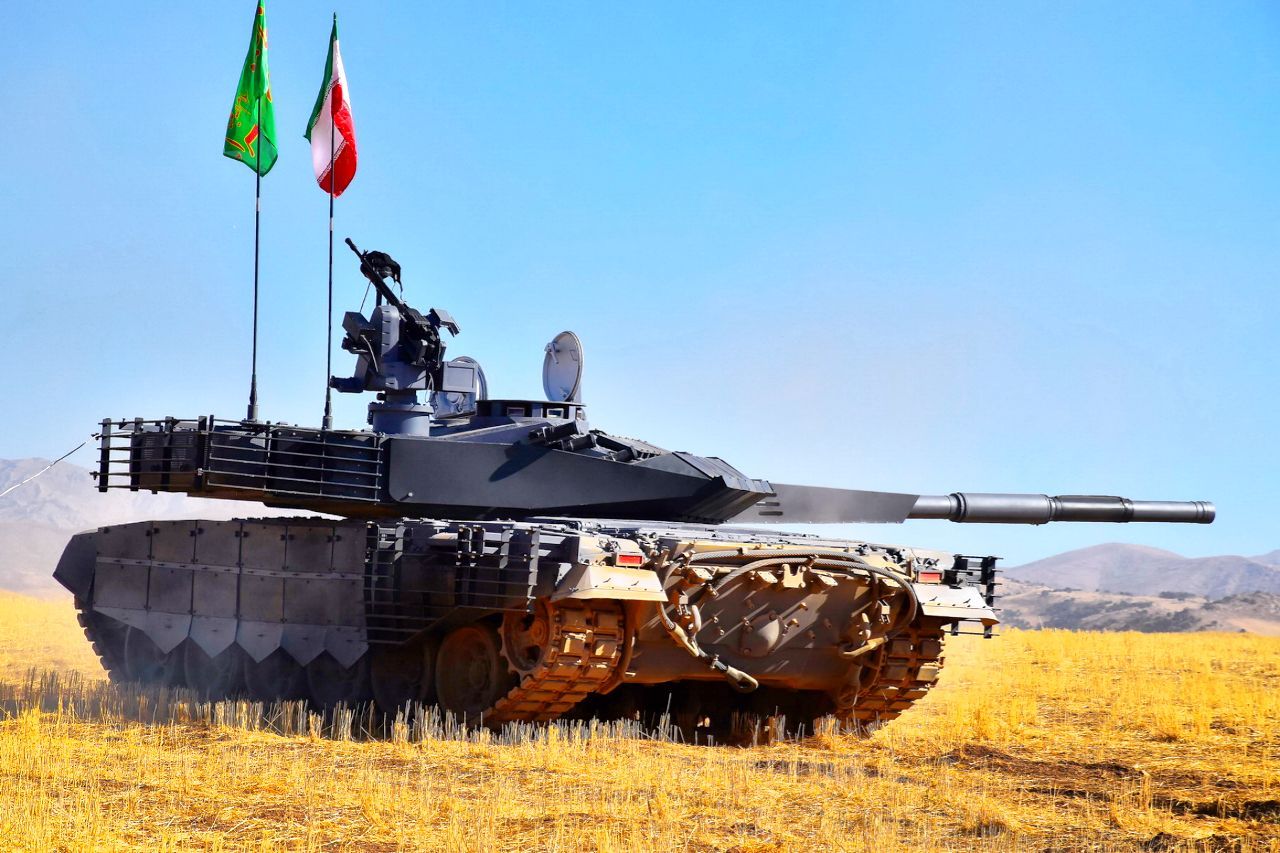
Karrar tank uses cage armor (or slat armor) in the end parts of the body and turret. These armors cause early activation of the anti-armor missile warhead, and due to the distance they have from the main body and tank armor, it reduces the explosive effect of the missile warhead, which ultimately leads to a decrease in missile penetration. In addition to being cheap, this type of armor is a suitable option for use in areas that are less threatening, i.e. the back of the tank.
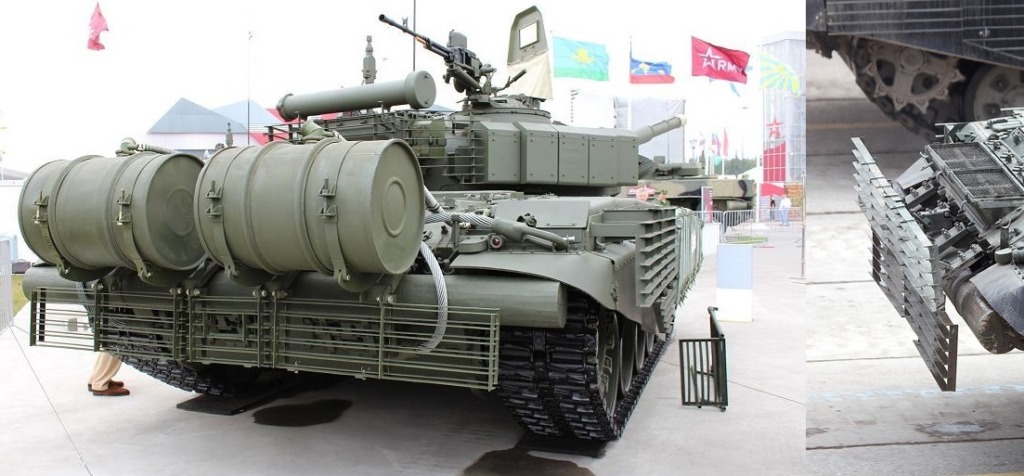
In the rear part of the tank chassis, there are two barrel fuel tanks as external fuel tanks. This part of the tank does not have cage armor. The lack of armor in this section is due to three reasons: one is due to the low probability of hitting in open environment battles, and the second reason is the presence of external fuel tanks itself on Karrar, which does not allow the installation of cage armor, and the third reason is the possibility of cage armor hitting the ground and causing damages.
It would have been better to install flexible cage armors based on the T72B3 tank. These armors can be moved in the presence of external fuel tanks, and when the fuel tanks are not installed, they provide the required protection for the tank. It is also possible to use armors that are flexible and do not have the problem of hitting the ground by modeling the cage armor of the Challenger-2 tank.
The cage armor of the Challenger-2 tank, flexible when hitting the groundKarrar tank – fuel tanks and the cage armorRetractable cage armor in T72B3 tankClick to view full size image
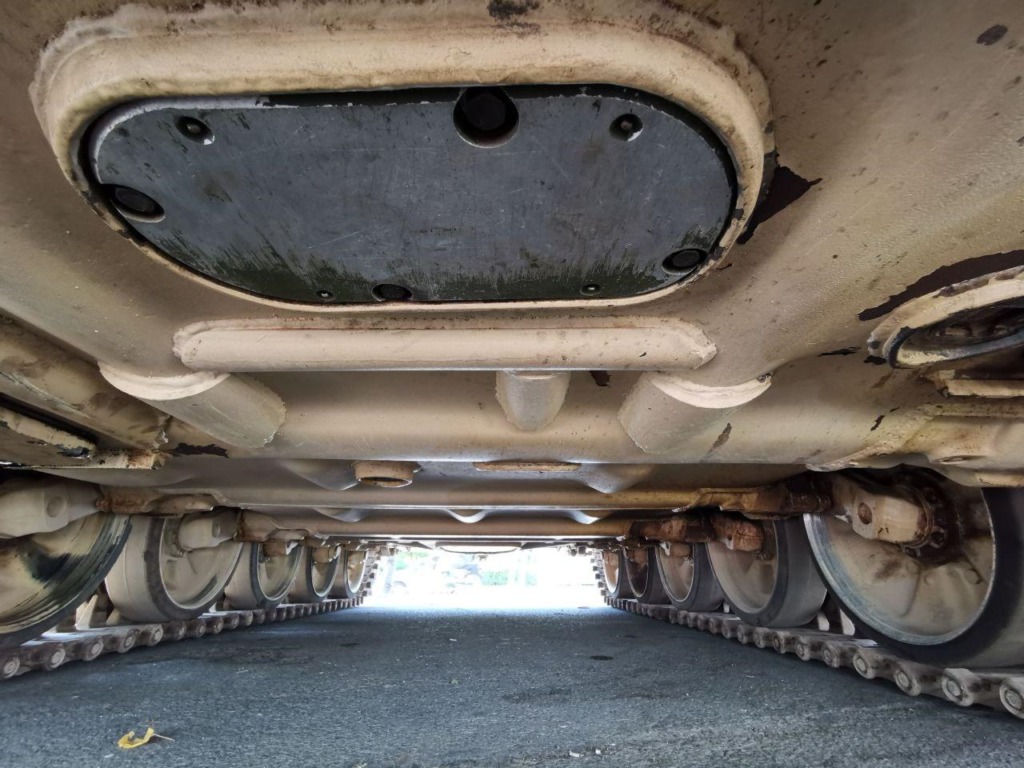
One of the weaknesses of the T-72 series tanks, which is caused by its initial design, is the poor protection of the bottom part of the tank chassis. This issue still exists in the main chassis of the Karrar tank and no action has been taken to fix it. This issue becomes more important when we know that the tank’s main ammunition is stored in the floor of the chassis by means of the automatic loading system and in case of a mine explosion, the probability of the explosion of these ammunition is also very high. To fix this defect, this part can be strengthened by adding resistant and anti-shock plates in the front and lower parts, which are more sensitive.
The bottom of the Karrar tank chassis, which does not have additional armor
Protection system: Karrar tank uses a protection system with Soft Kill mechanism. This system, which is equipped with a laser beam detector and an infrared disruptor, includes four modules, in such a way that two modules are placed in the front part of the turret and two modules are placed in the rear part of the turret, and each one covers a specific angle.
The laser beam detector used in the protection system module reacts to the radiation of the laser beam from the guidance system and to the laser beam of the range finder system and warns the crew. When the crew received the warning, they threw smoke grenades and created a smoke screen, causing disruption of the laser beam reflection from the tank body.
The infrared disruptor used in the protection system module has a COB (Chip On Board) lamp with a 17×17 array. This system, by imitating xenon light radiation or thermal illuminator used at the end of anti-armor missiles, causes errors in missile guidance by the missile guidance system. This infrared disruptor has a general field of view of 60 degrees, a near infrared emission wavelength (Near IR), a preparation time of 60 seconds, a working continuity of up to 6 hours, a lifetime of 800 working cycles (each cycle includes 6 hours of work and one hour of shutdown), the power consumption is less than 80 watts and the working temperature is -20 to +55 degrees Celsius.
This system is presented to disrupt the performance of missiles such as TOW and M47 Dragon or second generation armored missiles in general, but it will also be effective against missiles such as 9K111 Fagot, 9M113 Konkurs, etc. by making modifications.
Karrar tank Soft Kill protection system
Engine power and mobility: The maximum possible weight of the Karrar tank is stated to be 48.5 tons, and according to the evidence of the use of an engine with a power of 1000 horsepower on the tank, the ratio of power to weight of this tank is 20.6 horsepower per ton, as a result we see an increase in the mobility of the Karrar compared to the T72-S version.
The type of Karrar tank engine has not been announced, but considering its 1000 horsepower and the fact that the T-90A model uses a V-92 engine with 1000 horsepower. It can be assumed that the Karrar tank engine is the same V-92 that was imported through Russia.
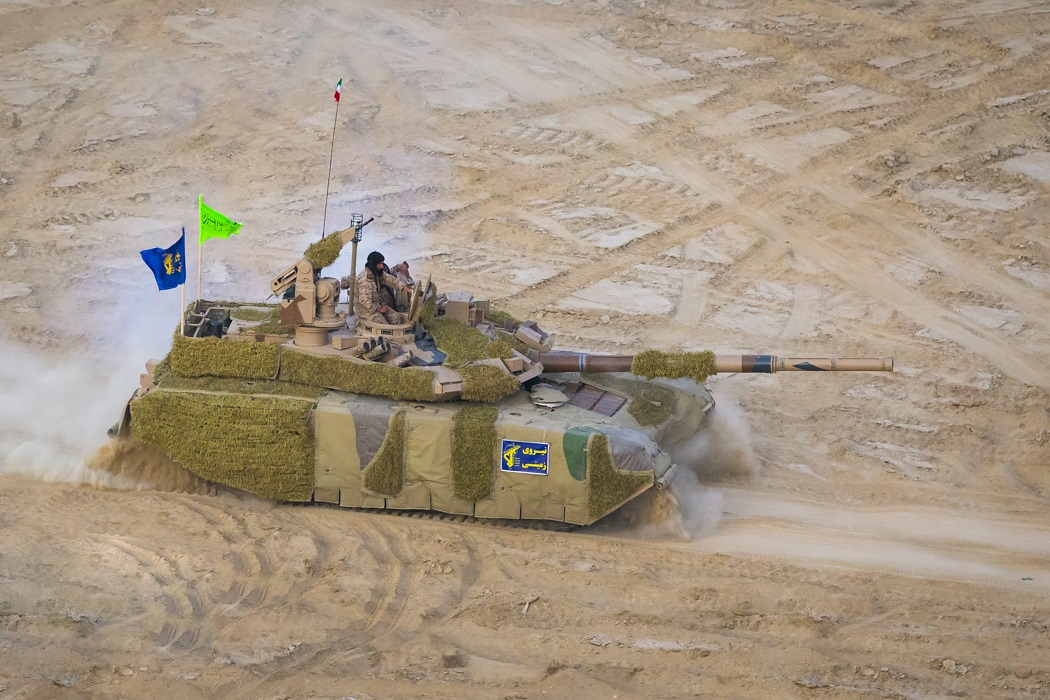
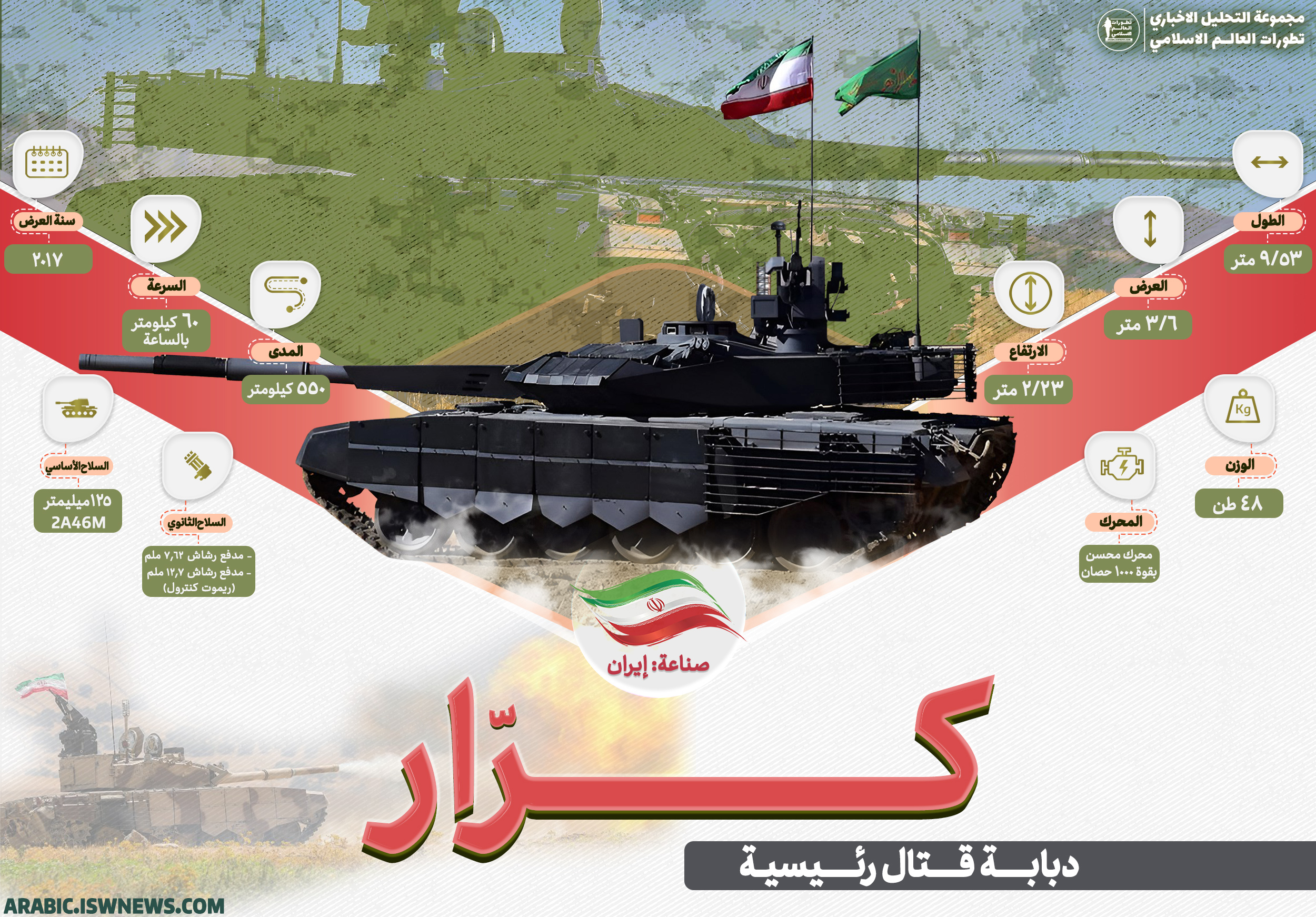
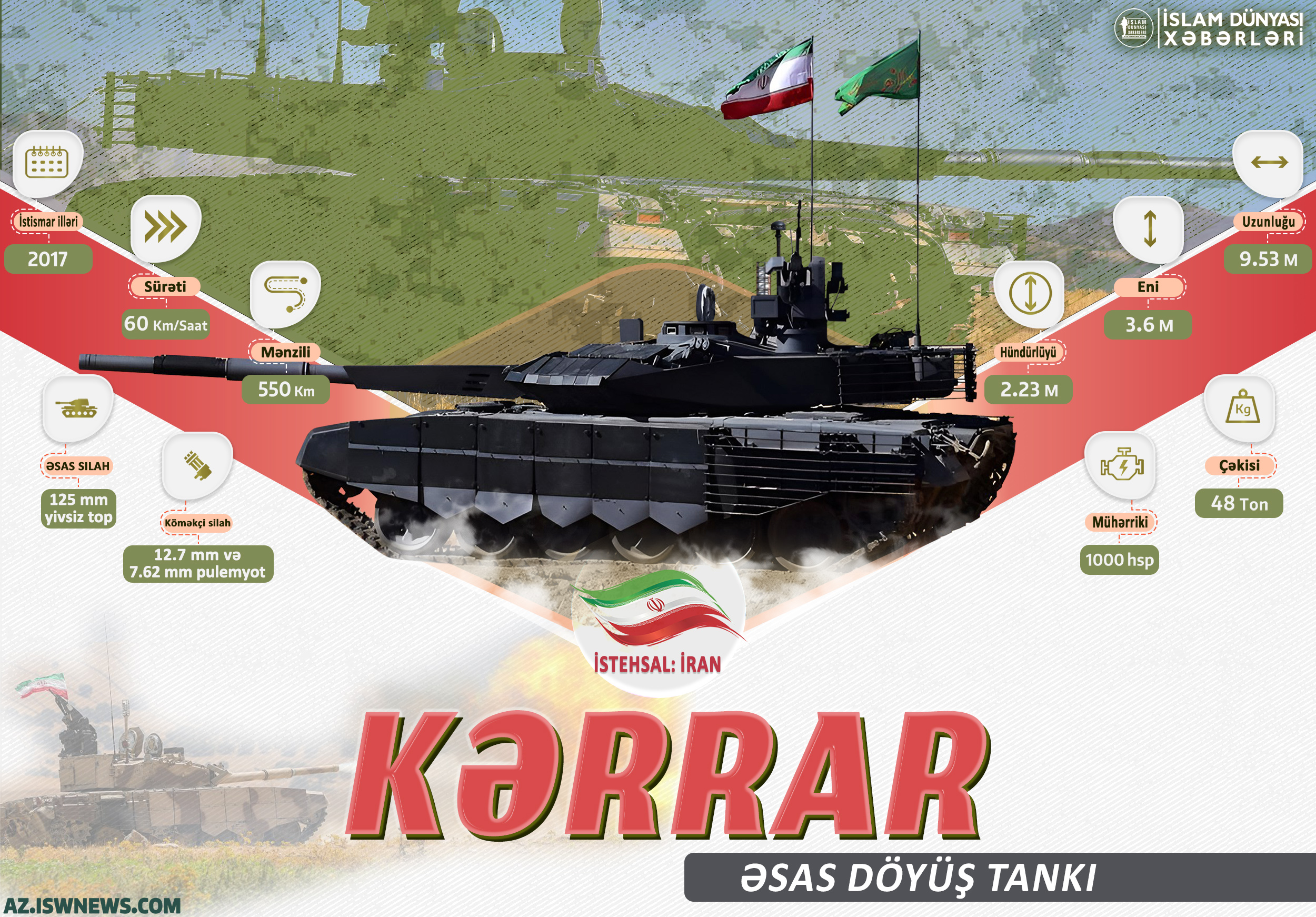
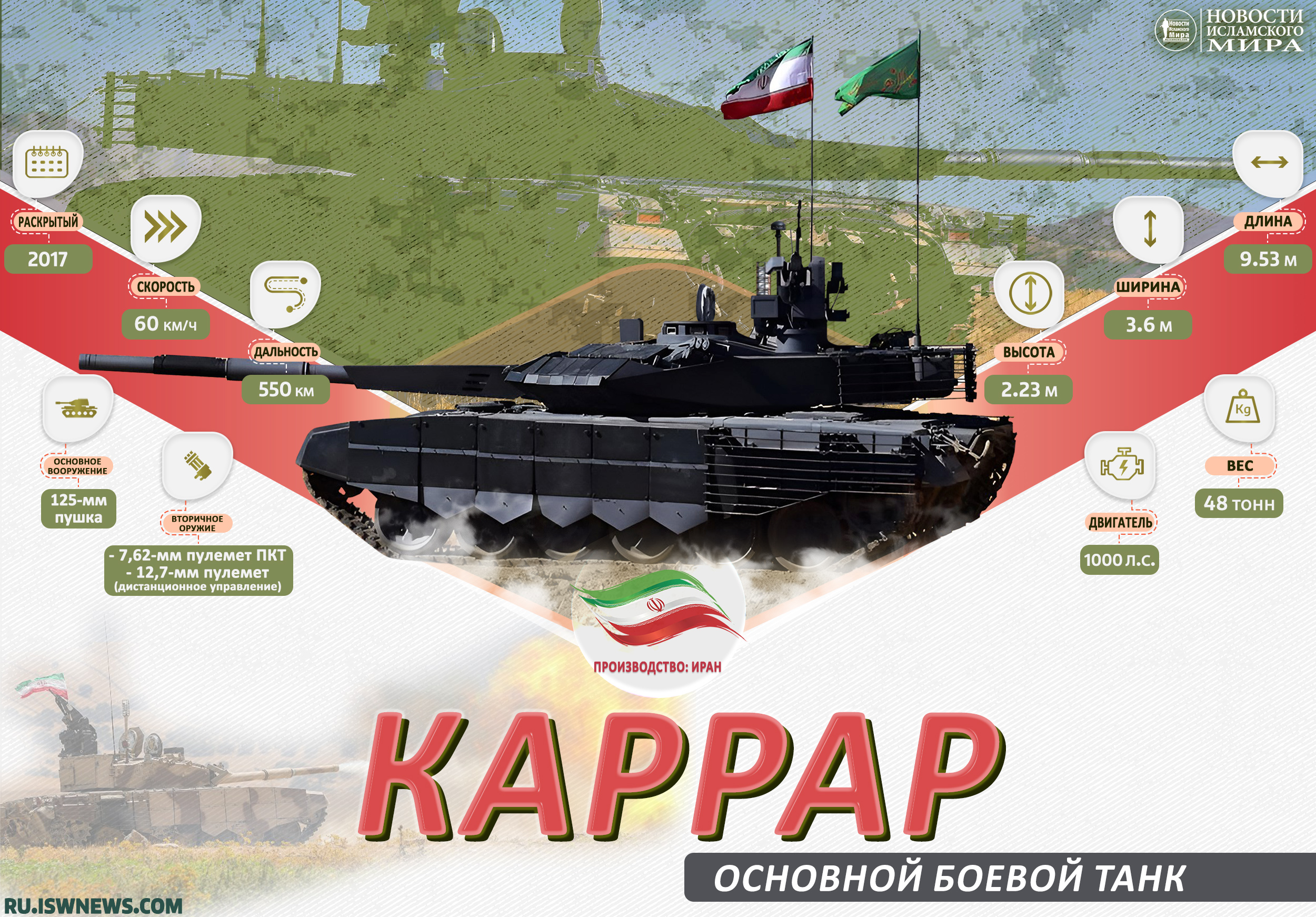
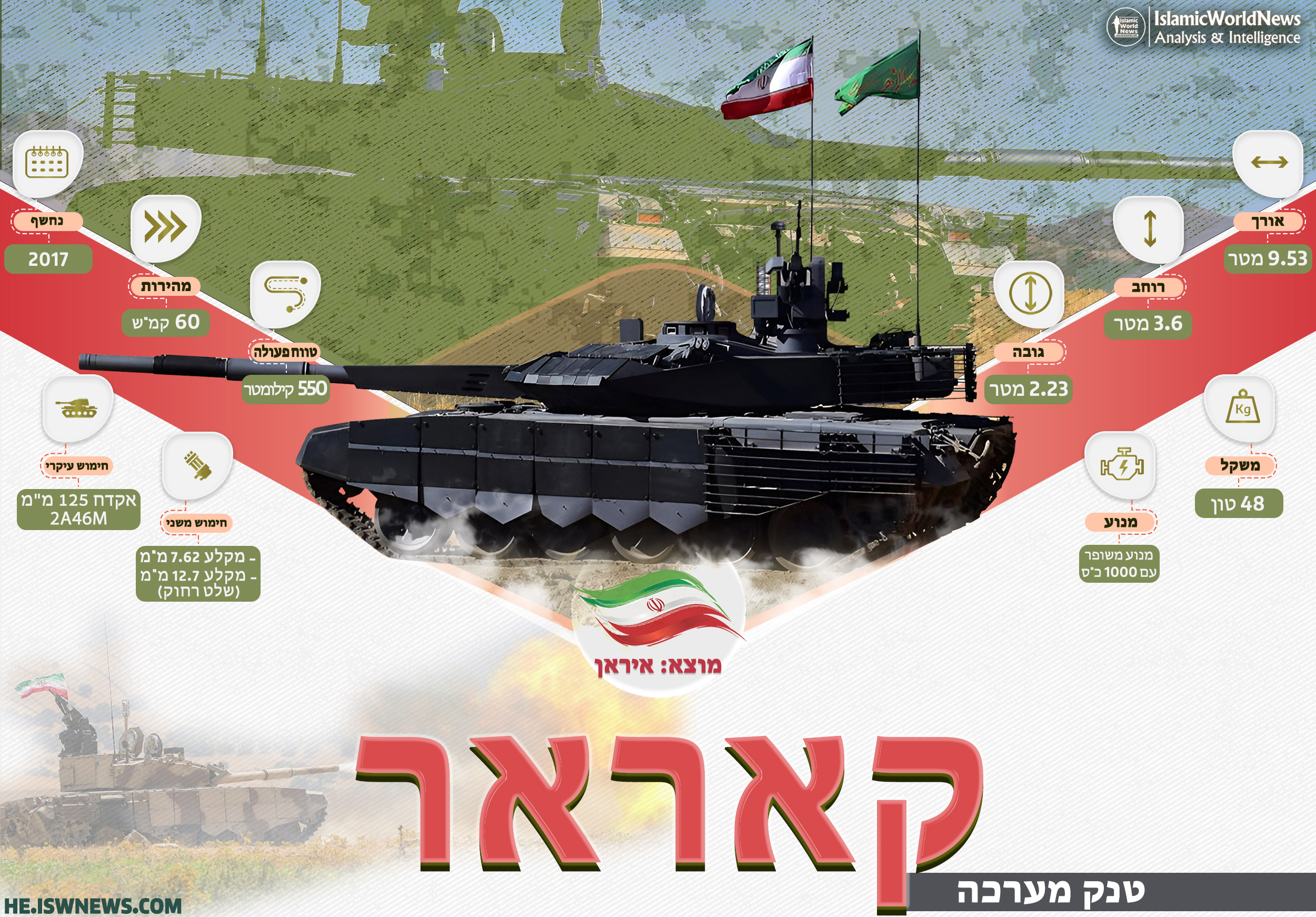
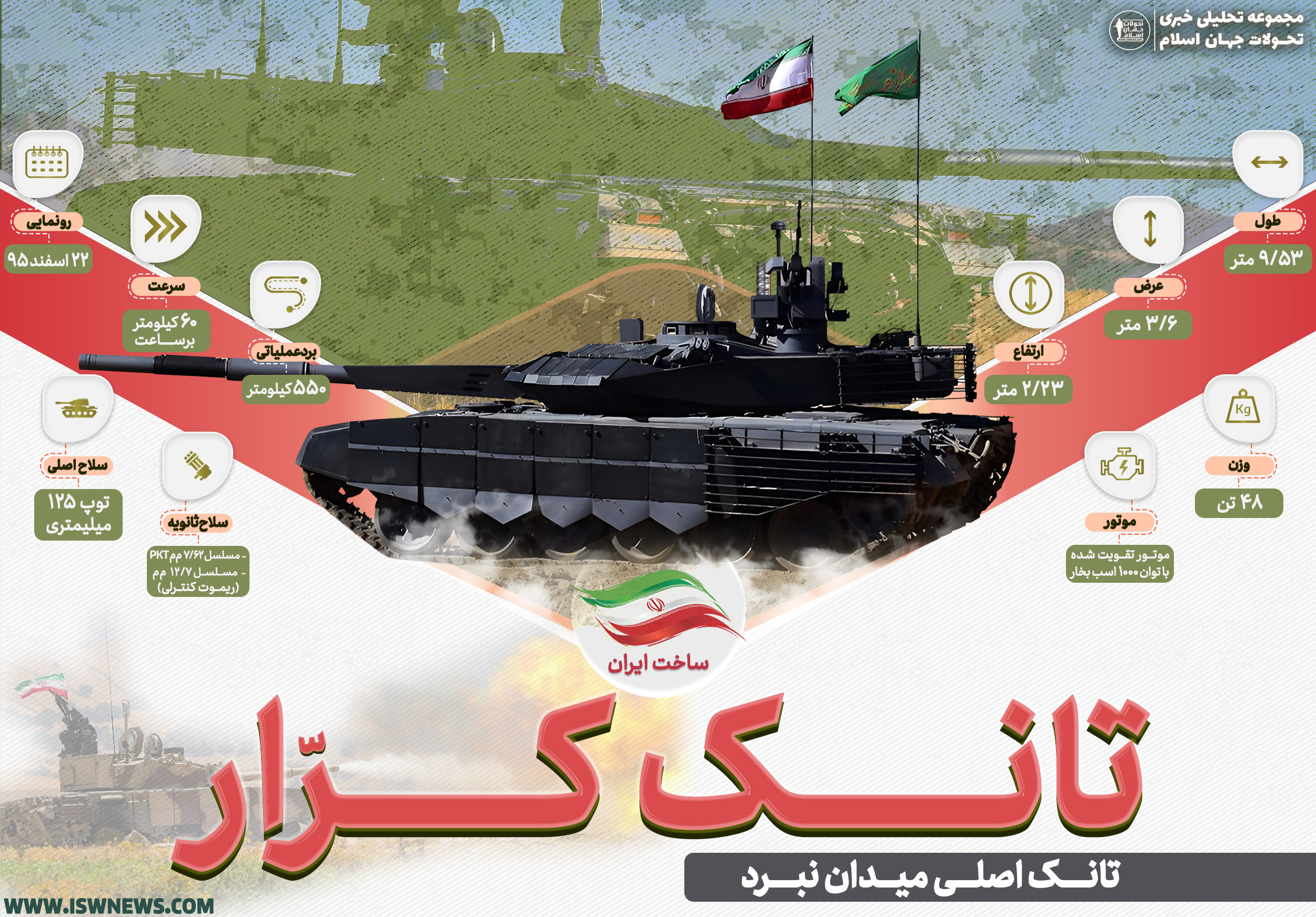
Karrar tank specifications: Type: Main Battle Tank Produced: Since March 12, 2017 Manufacturer: Bani Hashem Armor Industrial Complex Origin: Iran Length: 6.8 meters (hull) – 9.53 meters (with gun) Width: 3.6 meters Height: 2.23 meters (without remote-controlled gun) Mass: 46 to 48.5 tons (exact weight not announced) Crew: 3 (driver, commander and gunner) Engine: Enhanced engine with 1000 horsepower Speed: 60-70 km/h Operational range: 550 km (plus with 200-280 km more from fuel tank) Main armament: 125 mm 2A46M/M-2/M-5 smoothbore gun with stabilizer Secondary armament: Coaxial 7.62mm machine gun and a remotely controlled 12.7mm machine gun / 14.5mm machine gun
Karrar Main Battle Tank – click to view full size image
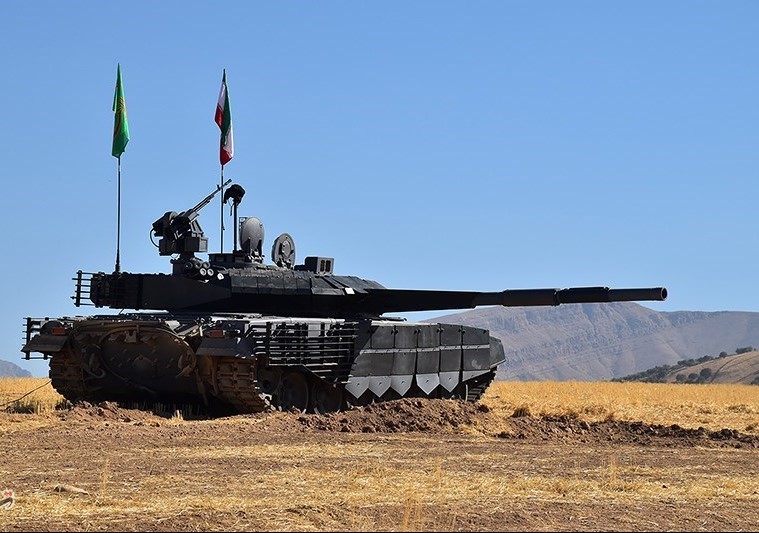
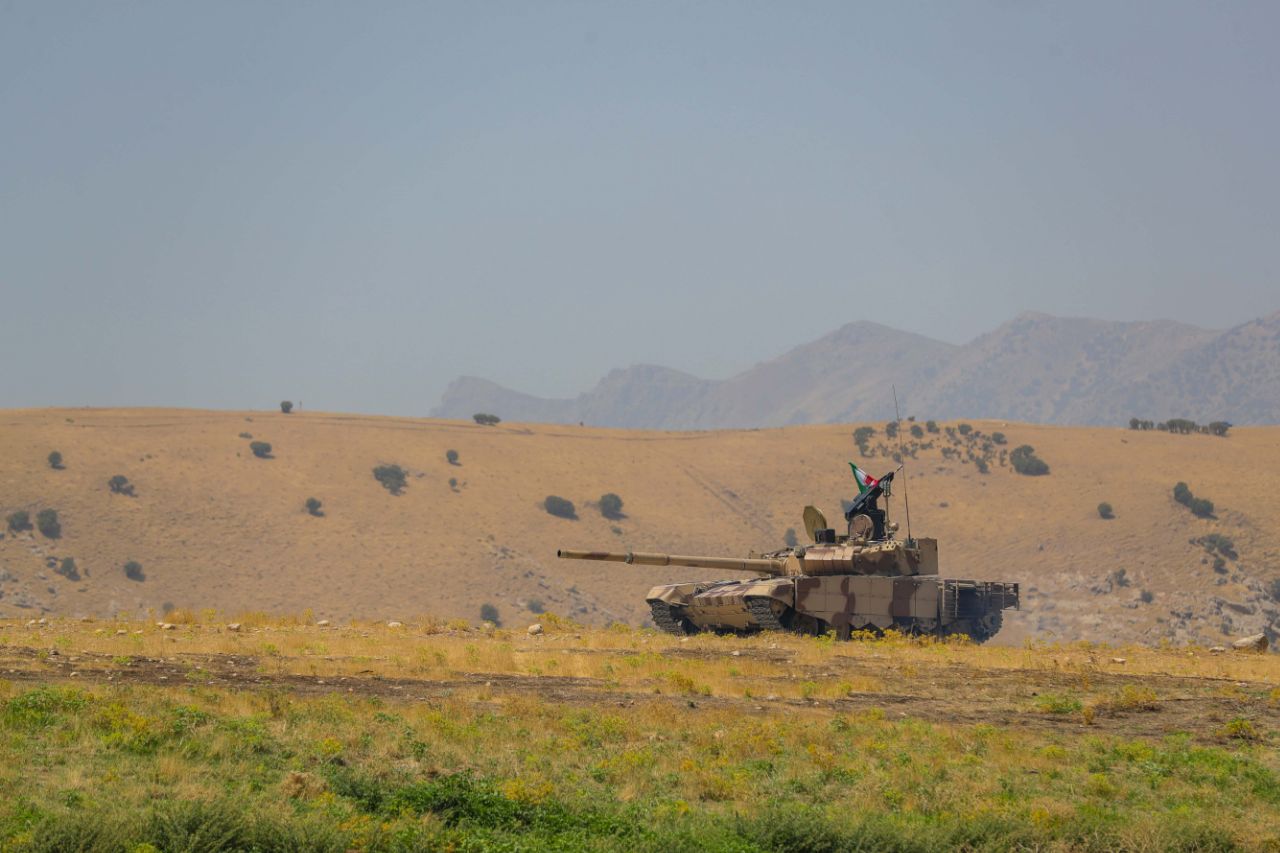
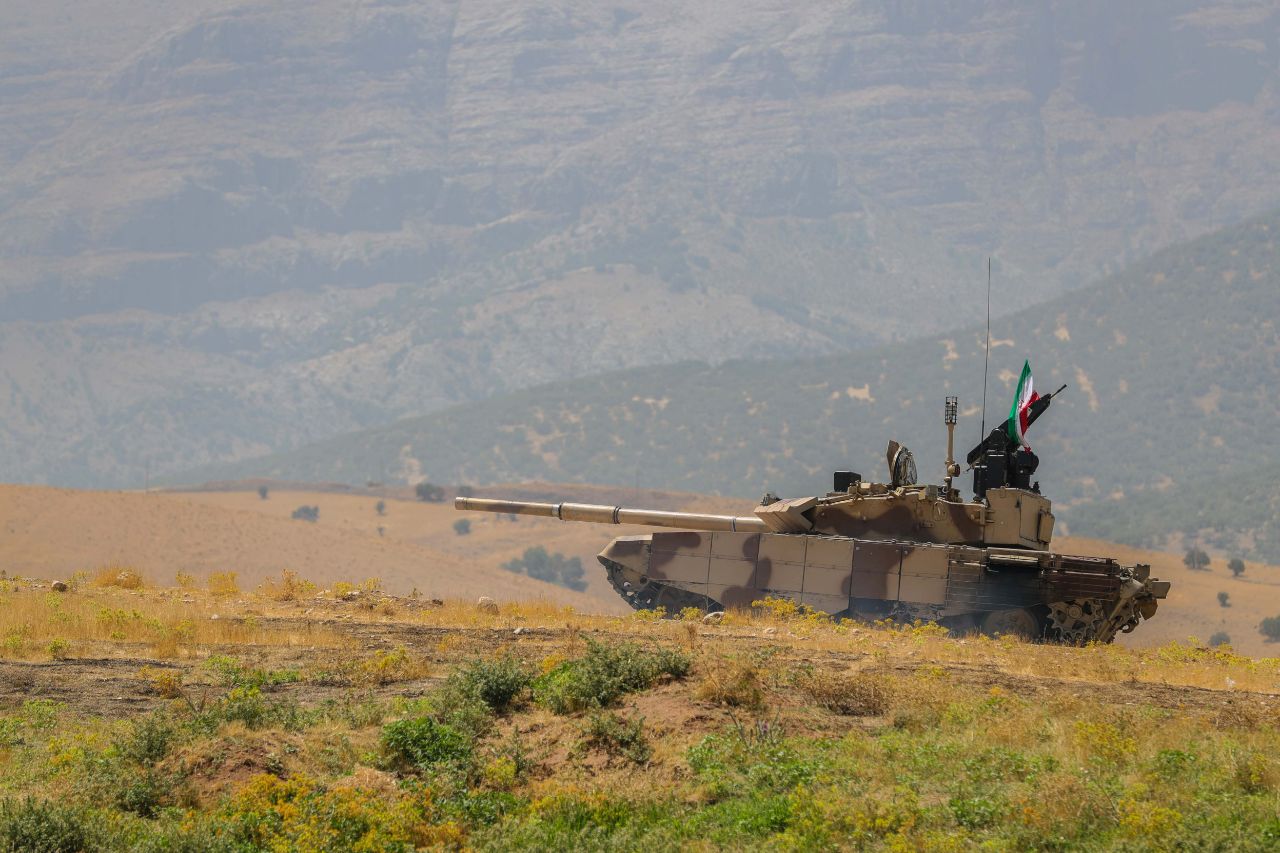
More images of Karrar tank:
Click to view full size image
Infographics of Karrar tank in Russian(Каррар танк), Arabic, Hebrew(טנק קאראר), Azeri(Kərrar Tankı) and Farsi(تانک کرار):