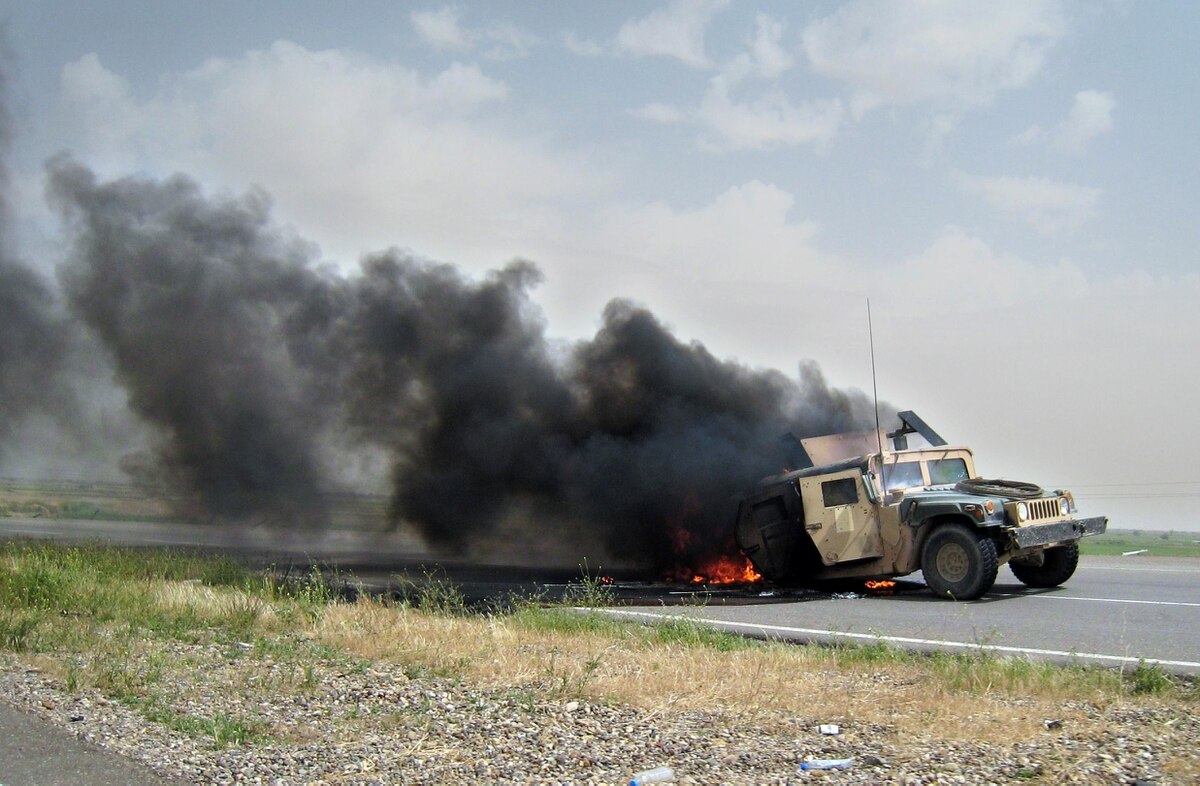
Late on Saturday, at 22:45 local time, a US military logistical convoy was attacked by the “International Resistance Faction” group in the Qadisiyah province in southern Iraq.
Earlier on February 23rd, two logistical convoys of American forces were attacked by Iraqi resistance forces in Baghdad province.
The “Ayn Al-Insaniyah Research and Statistics Center” published statistics and figures of the crimes and aggression of the Saudi coalition against Yemen during the year 2022. The damage statistics on Yemen in 2022 show that despite the peace agreement between the Saudi coalition and Ansar Allah, Saudi Arabia continues to violate the ceasefire and aggression on Yemen.
Statistics of the Saudi coalition aggression on Yemen in 2022: The total number of martyrs and wounded is 3,083, of which 643 are martyrs, of which 27 are women and 102 are children. 2440 people were injured, of which 97 were women and 353 were children.
In 2022, the Saudi coalition has attacked 1 airport, 1 port, 22 power stations and generators, and 46 networks and communication stations. Also, 334 reservoirs and water distribution system, 57 government facilities and 974 bridges and roads were targeted or destroyed.
4 factories were destroyed or damaged, 13 fuel tankers, 25 gas stations, 229 business establishments, 29 poultry and livestock, 1022 transport means, 3 fishing boats, 37 food stores, 5 markets and 95 food trucks were also destroyed or damaged.
The number of destroyed and damaged civilian houses has reached 14,367. One university center, 134 mosques, 5 tourist centers and 12 hospitals and health centers were destroyed and damaged. The Saudi coalition attacks also destroyed and damaged 64 schools and institutes, 1987 agricultural lands, 2 sports facilities, 3 historical sites and 7 media centers were destroyed or damaged.
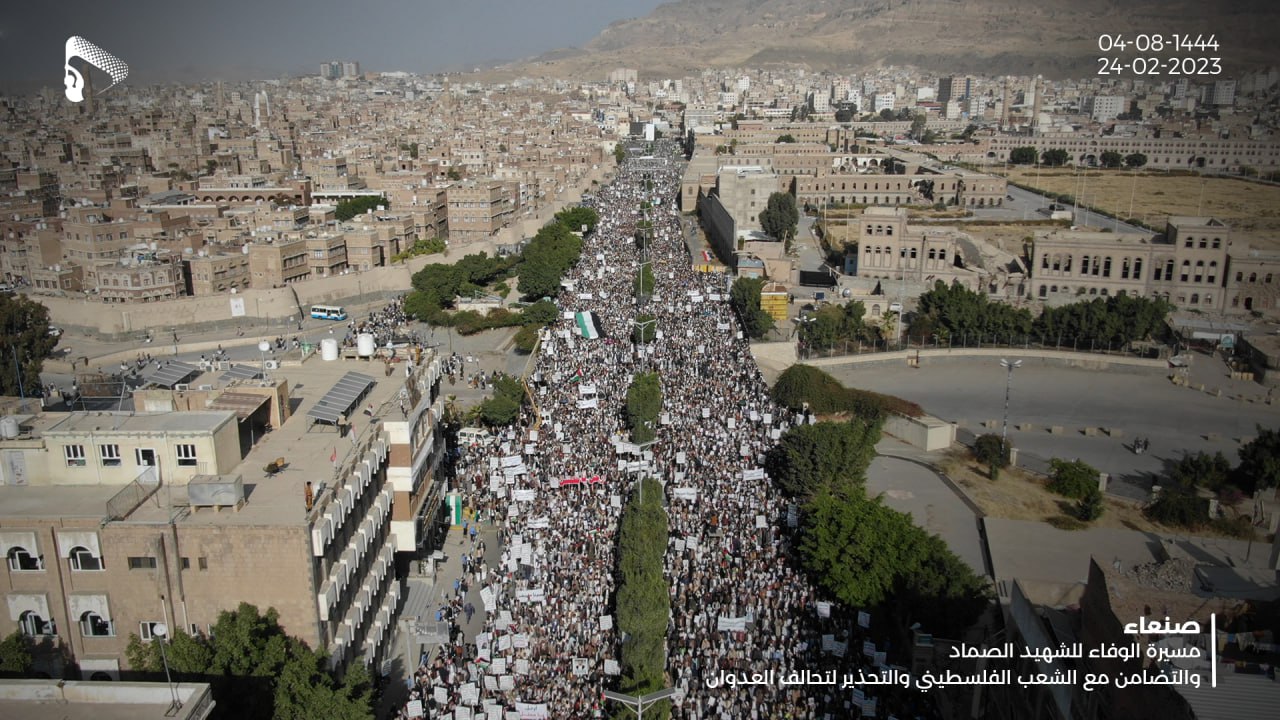
On Friday, February 24th, the people of Yemen held a mass rally and march under the title of “loyalty to martyr al-Sammad, solidarity with Palestine and warning to the aggressor coalition” in various cities under the control of Ansar Allah, in response to the call of Sayyid Abdul-Malik Badruldeen al-Houthi, the leader of Ansar Allah on the occasion of the anniversary of the martyrdom of Saleh Ali al-Sammad.
In the final statement of this march, the people of Yemen declared solidarity with the Palestinian people while warning the member countries of the Saudi coalition and their main supporters regarding the continuation of the all-round blockade of Yemen.
In a televised speech on the occasion of the martyrdom anniversary of Saleh al-Sammad, the former chairman of the Supreme Political Council of Yemen, Sayyid Abdul-Malik Badruldeen al-Houthi, said:
Click to view full size
“Martyr al-Sammad was a model of honesty, loyalty, patience and tireless effort, and after the position of president (head of the Supreme Political Council), he still maintained the spirit of a soldier who is with God and his people. Some of those who reach the position of president, reach this position with assets, companies and huge investments and even urban development in some countries, And some others who left this post with a heavy burden due to abuse of their position at the cost of suffering and oppression of the people and neglecting their issues. Those who used the presidency to loot the wealth of their people, and considered themselves as national symbols, their treachery was revealed. They talked about homeland and patriotism in their media, but in the most difficult stages, they not only left their people alone, but also conspired against them in Sana’a, the capital of the country. However, unlike other people who seek positions for personal gain, Martyr Al-Sammad had no desire to reach positions. He accepted this responsibility based on his belief and sense of responsibility that was formed with the insistence of others. His spirit and morals did not change after this responsibility and he still maintained the spirit of a soldier, a simple citizen and a servant of the people. Martyr al-Sammad tried to activate institutions, popular mobilization and continuous support in the army and popular committees. In all stages of the Saudi coalition’s invasion to control Hudaydah, he played a role in mobilizing the people and activating the official and popular capacities and pushing them to confront the aggression. All the operations of the aggressor coalition, including the operation that targeted Hudaydah, were carried out under the supervision of the United States. The assassination of Martyr al-Sammad was motivated and directed by the Americans. They have repeatedly announced that one of the most important roles they play directly in the aggression against Yemen is identifying the targets. We conducted research, the definitive conclusion of which is that the Americans identified martyr al-Sammad as the main target of the Saudis. They admit that they were directing the bombing operation and were in charge of monitoring the operation from the beginning. In this aggression, Saudi Arabia and the UAE are tools to do what the Americans dictate and draw for them. We have the right to treat any armed presence in Yemen as an occupation. Foreign troops must be removed from our country and we will try with all options to expel the invaders whether on land, sea or sky.”
Leader of Ansar Allah considered the main reason for the strength and victories of the Yemeni people over their enemies to be God’s support, and in explaining the details and the latest status of the negotiations, he said:
“The attack that we witnessed at this stage was the strongest attack in the history of Yemen, considering the size of the armies and the harsh conditions and suffering that the people faced. An important area of our country remained (free), which shows the strategic depth and the inability of the invaders to control it by God’s grace. We are currently in the phase of de-escalation and limited progress in port and airport traffic. The current stage also includes working to prevent the looting of the national wealth of oil, its sale and the looting of its value and price. Also, the dialogue with the mediation of Oman continues, and the aggressor coalition seeks to delay the implementation of the commitments that must be made. During the negotiations, we noticed the negative role of America and their monitoring and role in postponing the commitments of the aggressor coalition. The commitments that we demand are the right of our people and the responsibility of implementing them is with the aggressor coalition because it is he who is the aggressor and the besieger.“
In another part of his speech, Sayyid al-Houthi expressed solidarity with the Palestinian nation and pointed out the Arab countries’ hostility towards Iran and said:
“It is a big fallacy to accuse Iran of enmity with the Arabs and to introduce Israel as a friend! Israel has killed Arabs and insulted their honors, and its presence in the region is aimed at looting their lands and wealth. Israel is actually the enemy of all Muslims and the first enemy of Arabs. But Iran’s position on Palestine is an honorable one. Iran is the biggest supporter of Palestine and also the main supporter of Lebanon.”
It should be mentioned that Saleh al-Sammad was the second head of the Supreme Political Council of Yemen, who was martyred by a Saudi drone strike in April 20, 2016 on his way back from Al Hudaydah university in Al Khamseen street along with a numbers of his companions.
The publication of a footage of Kamov Ka-52 helicopter flying in the eastern Russian city of Vladivostok with a camouflage color proper for the West Asian or African states has reinforced the likelihood of selling this class of helicopter to Iran. Given the fact that the usage of that sort of camouflage color for the helicopters of the Russian Air Force seems not to be common and rational, it is probable that the helicopter has been prepared for selling to Iran or Algeria, who have collaborated and inked several military agreements with Russia in recent years.
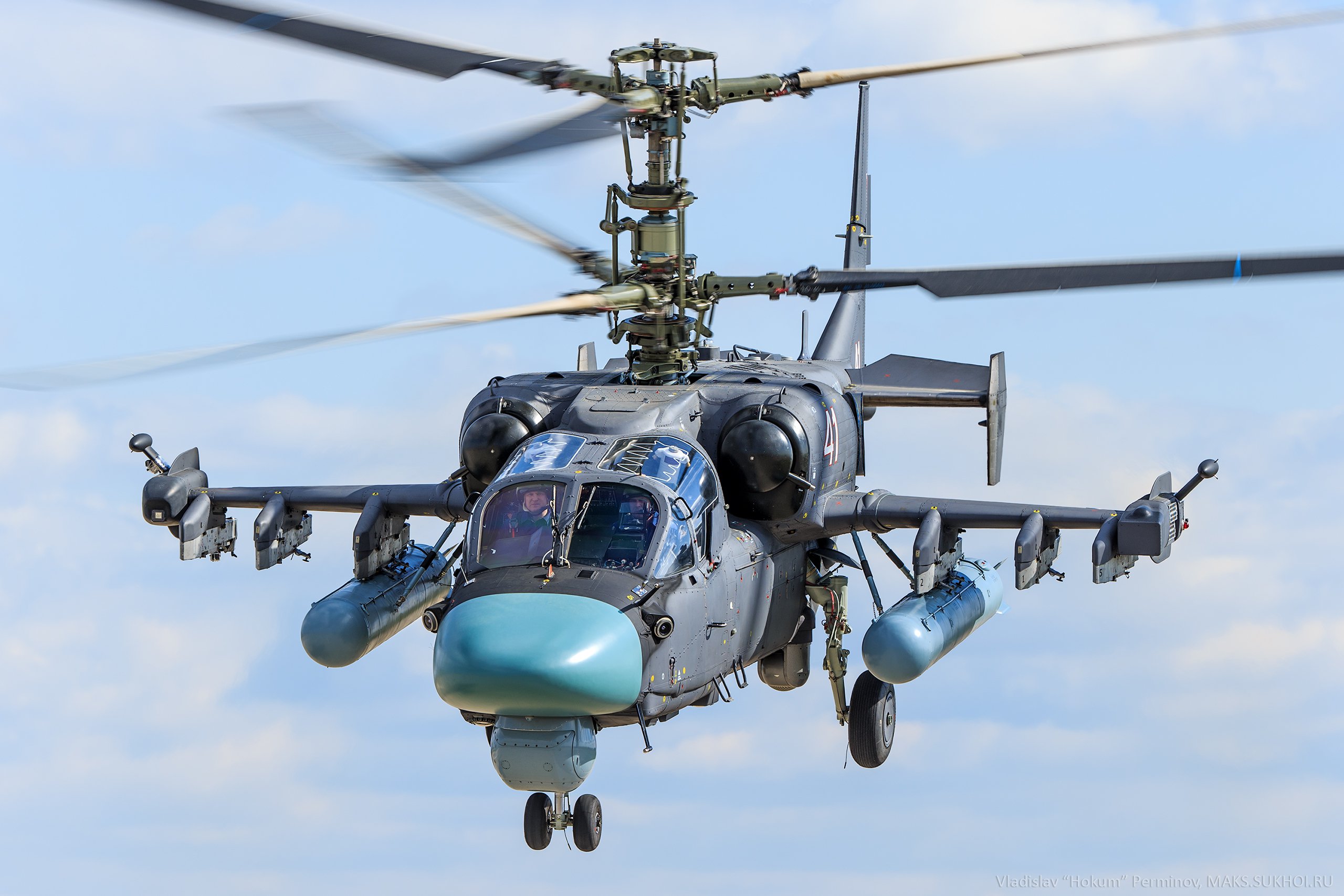
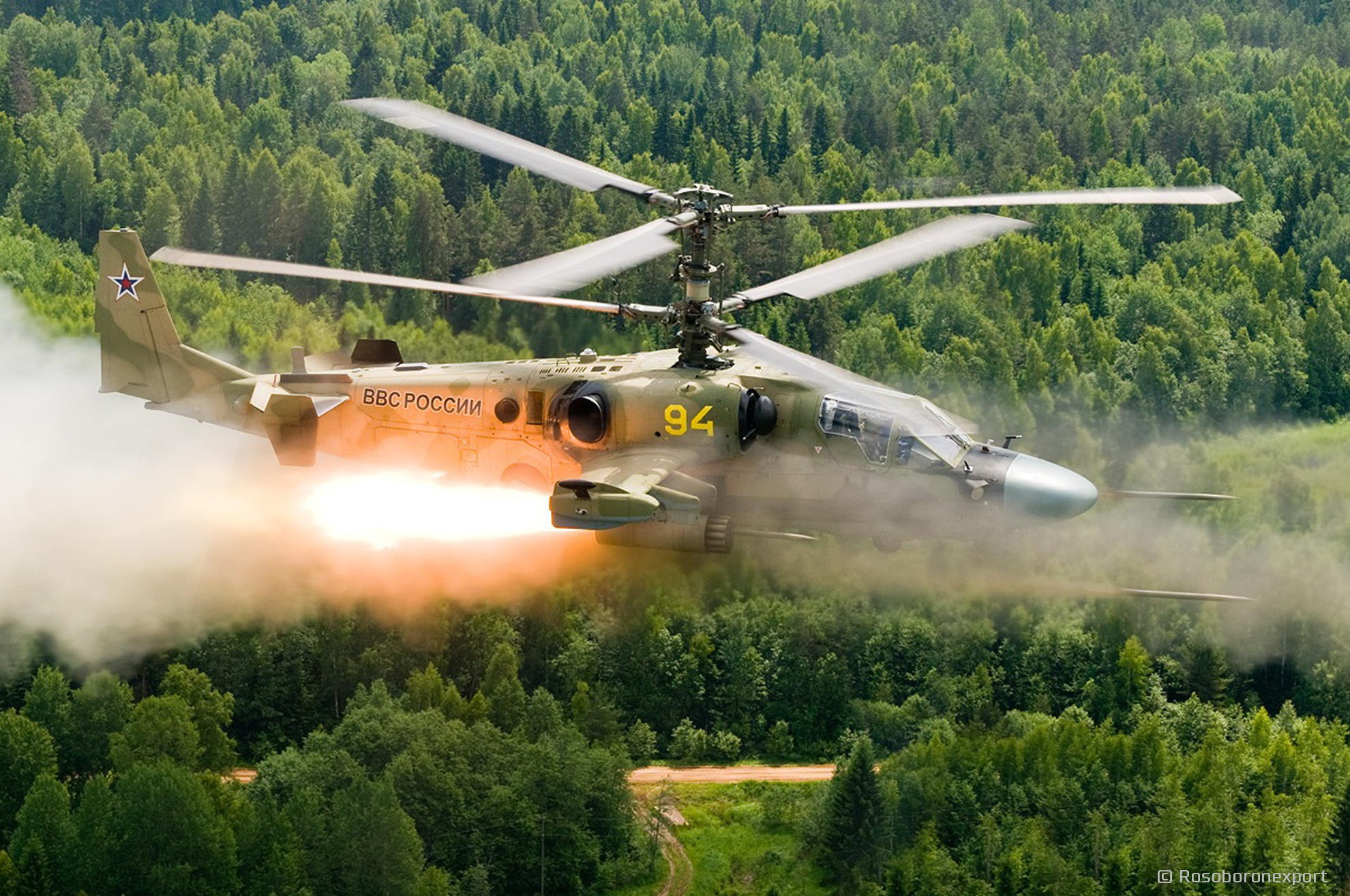
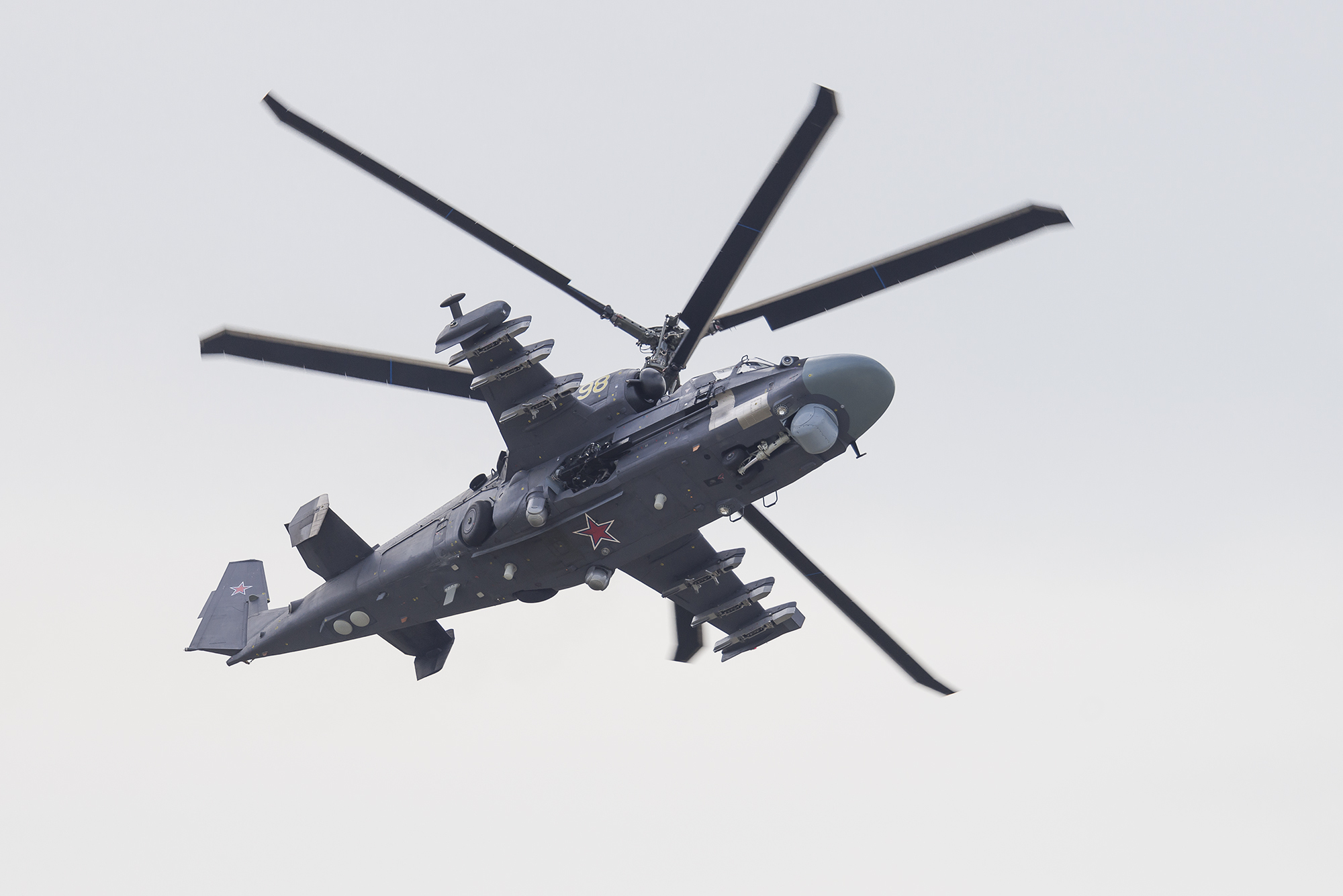
The Kamov Ka-52 helicopter is an advanced Russian-made invasive multi-purpose one capable of flying in different weather circumstances. The Ka-52 helicopter has showcased satisfactory performance during the combats in Syria and Ukraine, and it seems to be an appropriate option for equipping and advancing the helicopter fleet of the Islamic Republic of Iran Armed Forces.
Kamov Ka-52 helicopter flying in the eastern Russian city of Vladivostok with a camouflage color proper for the West Asian or African countries
In recent days, there were various reports of military collaboration between Russia and Iran in selling Iranian-made ballistic missiles and suicide drones in return for Su-35 fighter jets, S-400 air defense systems, and Kamov helicopters (Ka-52), which have been confirmed by certain authorities in Iran. Shahriar Heydari, member of the National Security and Foreign Policy Commission of the Iranian Parliament, confirmed that Iran will buy Russian fighter jets, saying that “the Sukhoi 35 fighter jets that Iran ordered from Russia will enter the Islamic country early next Iranian calendar year (1402). We ordered defense systems, missiles and helicopters to Russia, and most of the arms will arrive in Iran as soon as possible.”
The Russia-Iran negotiations on the purchase of offensive, multi-purpose and light helicopters started among Iran Aviation Industries Organization, the JSC Kamov Company and other Russian military organizations in 2014, and the process sped up in the past months. The collaboration between Russia and Iran amplified following the continuation of the conflict in Ukraine as well as the Western sanctions on both states, leading to the enhancement of the might of the two countries in different military and economic arenas.
The development of this helicopter started in 1996 and its first flight was successfully completed in June 1997. The serial production of Ka-52 began in 2008 at Progress Arsenyev Aviation plant in the Primorye region of Russia. In December 2010, the Russian Air Force’s 334th Tactical Deployment Centre in Torzhok received three Ka-52s. The twin-seat Ka-52 serves in the air force as a special mission helicopter. The Russian Air Force began fielding Ka-52 helicopters in April 2011. In the same year, Russia’s defence ministry signed a contract with the company to procure 140 Ka-52 helicopters. In February 2018, the Russia’s defence ministry expressed interest in procuring 114 upgraded versions of Ka-52 attack helicopters as part of the new State Armament Programme for 2018–2027.
However, The limited production of this helicopter has caused only 127 units (each unit between 10 and 13 aircraft) of this helicopter to enter service in the Russian air fleet by 2020.
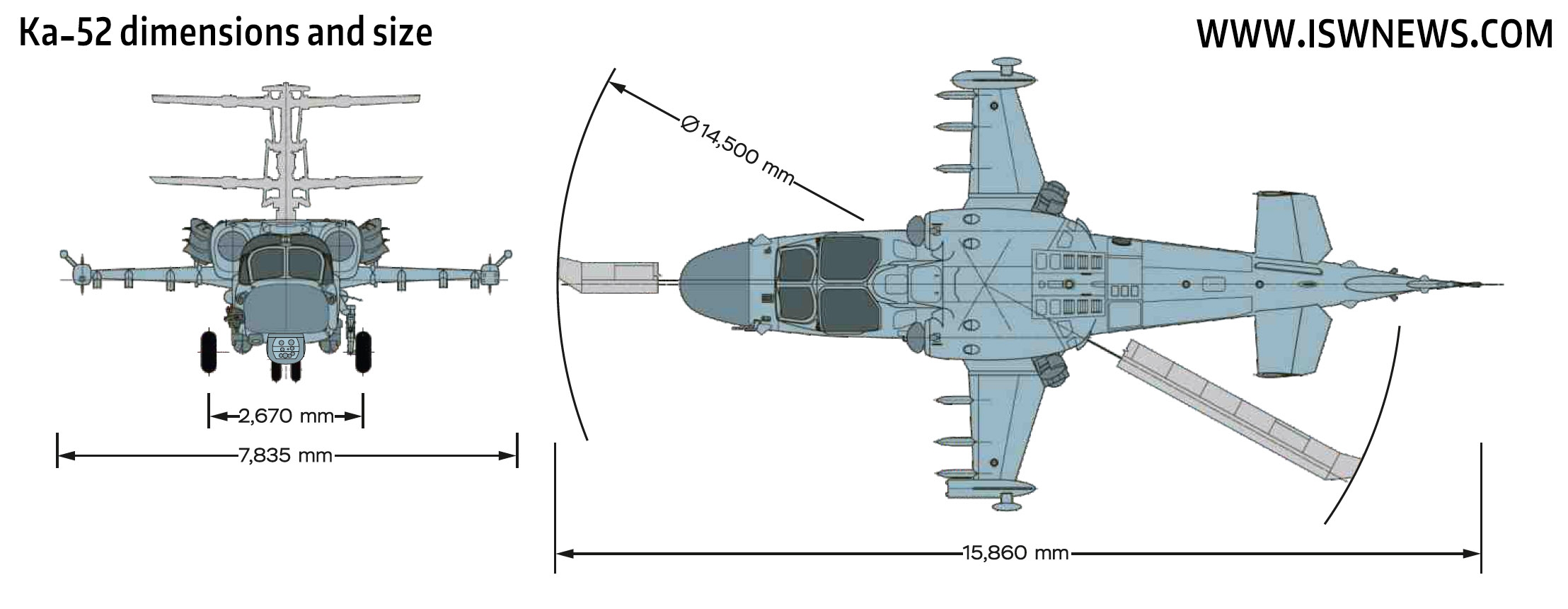
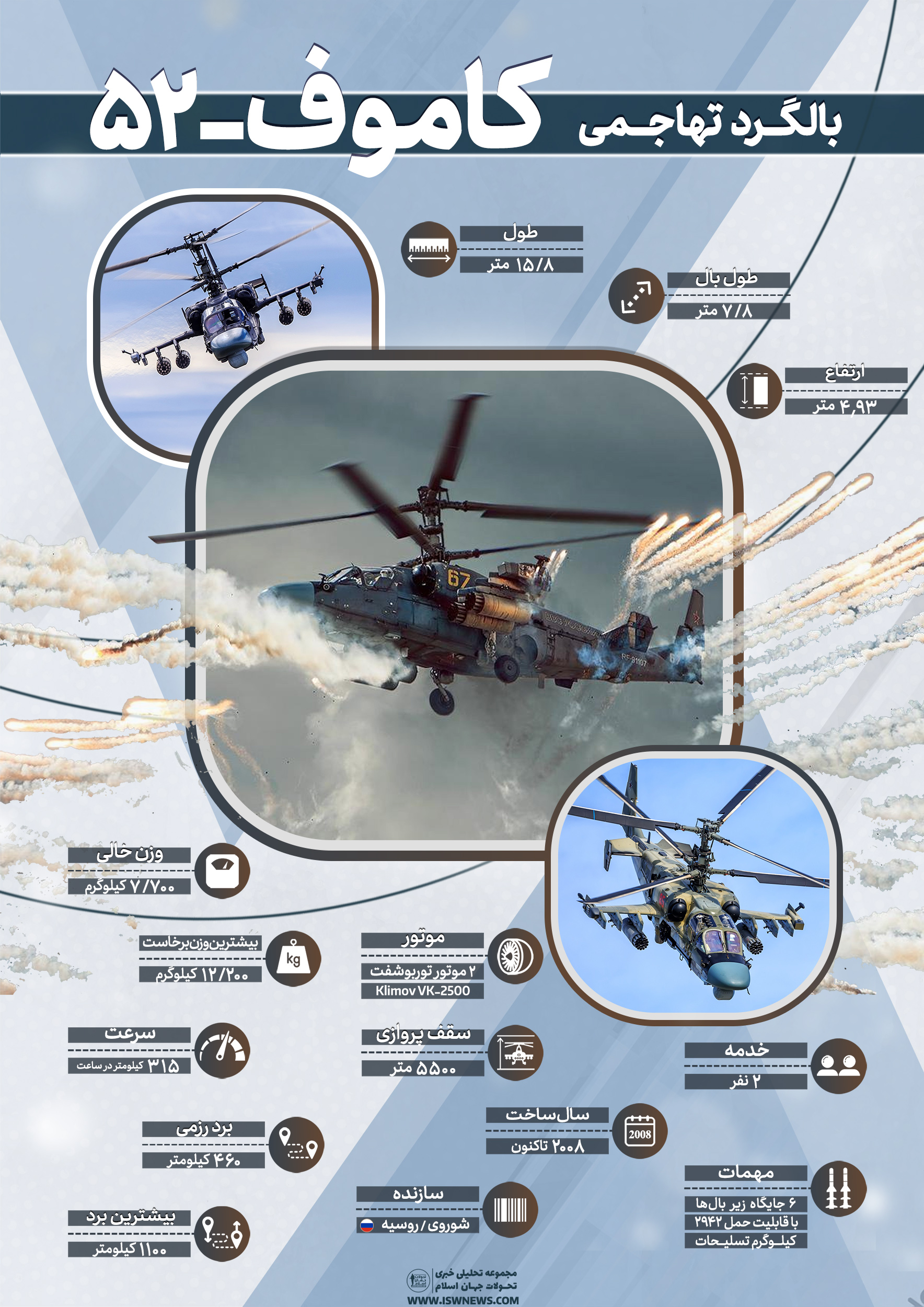
The Ka-52 has a wider nose and an extended fuselage compared to the Ka-50, however, the commonality of the airframe, components and systems of the two variants is about 85%. The Ka-52 attack helicopter has a length of 15.8 meters, height of 4.93 meters and main rotor diameter of 14.5 meters. The maximum take-off weight of the Ka-52 is 12,200 kg.
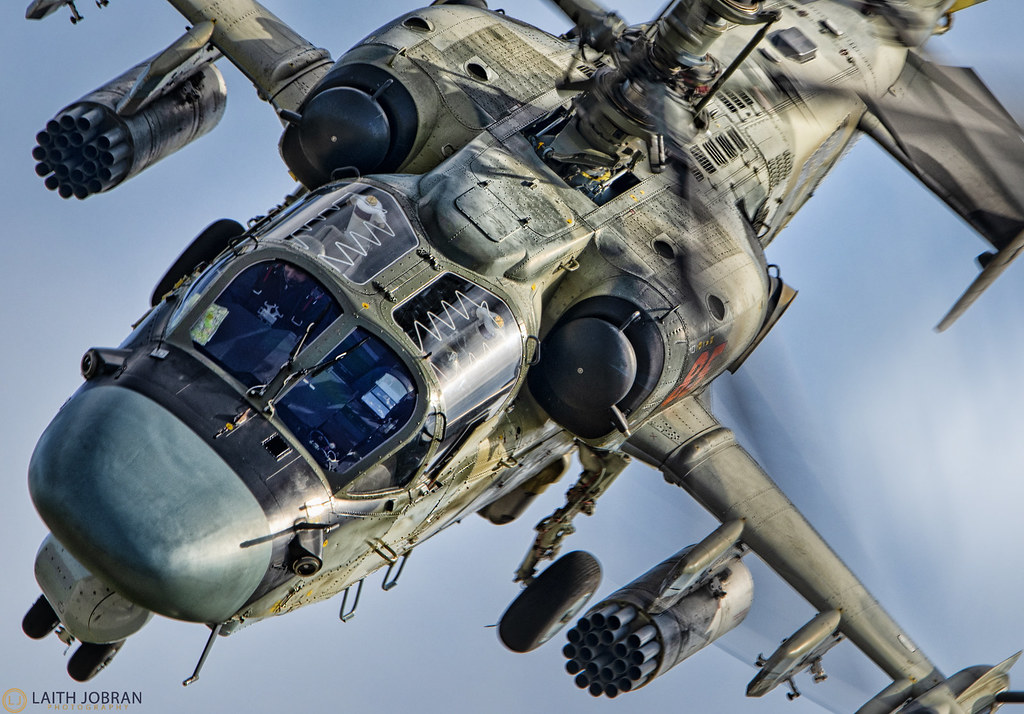
General view of Ka-52 helicopter – click to view in larger size
The Ka-52 helicopter is capable of performing a wide range of missions, such as attacking armored and non-armored vehicles, attacking low-speed air targets, attacking enemy infantry in the front line and in the tactical depth of the enemy, providing fire support for the front line forces and etc. Ka-52 can also be used as a monitoring platform and air command post for a group of attack helicopters.
The Ka-52 helicopter has unique capabilities in terms of maneuverability and agility and is known as one of the most maneuverable helicopters in the world. This high maneuverability is obtained from its coaxial rotors. Coaxial rotors or coax rotors are a pair of helicopter rotors mounted one above the other on concentric shafts, with the same axis of rotation, but turning in opposite directions (contra-rotating), which eliminates the vibration and rotation of the tail; so there is no need for rotors in the tail section. In general, one of the problems with any single set of rotor blades is the torque (rotational force) exerted on the helicopter fuselage in the direction opposite to the rotor blades. This torque causes the fuselage to rotate in the direction opposite to the rotor blades. In single rotor helicopters, the antitorque rotor or tail rotor counteracts the main rotor torque and controls the fuselage rotation. Coaxial rotors solve the problem of main rotor torque by turning each set of rotors in opposite directions.
The use of coaxial system in Ka-50 and Ka-52 has significantly increased the stability and maneuverability of these helicopters; which is very necessary and important for an attack helicopter. High turn speed and fast change of position, performing military maneuvers such as flat turns in the direction of the target, side ways motions at high speeds, which is less seen in heavily armored aircraft, and deep glides of the high pitch angle of up to 30 degrees or 35 degrees are other capabilities of this highly maneuverable helicopter.
Coaxial system in Ka-52 and significant increase of stability and maneuverability
Kamov helicopters have been present in many wars and have shown very good survivability so far. In the Ukraine war, there are cases where the Ka-52 was hit by the enemy but was able to continue on its way, or in many cases where the helicopter was shot down, the helicopter pilots were saved. One of the reasons for the survival of this helicopter on the battlefield is the existence of the coaxial system, which was explained above about how it works. In conventional helicopters, the rotor in the tail section plays a role as a stabilizer, but it is highly vulnerable and in case of a hit, the balance of the helicopter will be lost. Removing the rotor in the tail section of Kamov helicopters and using an coaxial rotor has solved this problem, and if the tail section is damaged, the Kamov helicopter is still able to move. Another reason for Kamov’s survival is the possibility of flying with one engine. If one of the engines is targeted on the battlefield, Ka-52 is able to operate with other engine.
Engine:
The Ka-52 helicopter uses two Klimov VK-2500 turboshaft engines. It is worth noting that this engine is developed from the TV3-117 engine used on the Ka-50 helicopter. The VK-2500 engine has three different types, the first type has 2000 horsepower, the second type has 2200 horsepower, and the third type has 2400 horsepower. There is also another example of this engine known as VK-2500P and it has 2500 horsepower. The interesting thing about these engines is that they have an emergency power mode with a power of 2700 horsepower. This feature is used in case of failure of one of the engines and significantly improves flight safety in emergency situations.
Klimov VK-2500P/PS turboshaft engine
The main difference between the VK-2500 and VK-2500P/PS engine is the use of a modern automatic electronic control system of the FADEC type and anti-overheat protection. Thanks to the new design, the VK-2500P ensures more reliable operation of helicopters in areas with moderate climates and even high temperatures and in high mountains. The existence of two separate gearboxes to transfer the power of each engine is an important factor in the operation of the helicopter in critical conditions. This power transmission system, in addition to the power of 2700 horsepower, is an important factor in the survival and preservation of the lives of the pilots in case of loss of one of the engines. Also, the engines have a filter to prevent dust from entering the engine and have a fire extinguishing system.
Cabin:
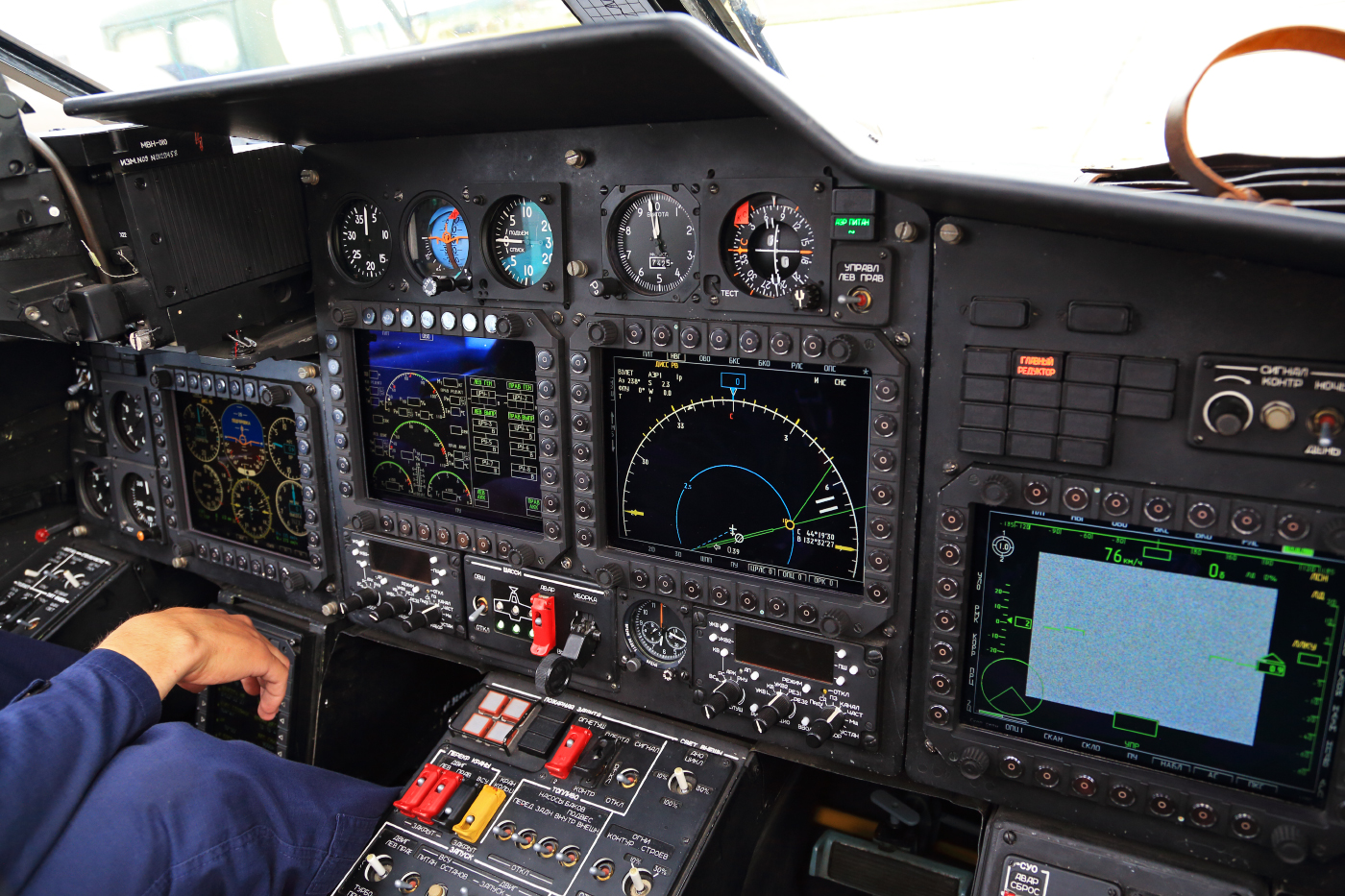
The Ka-52 twin-seat cockpit accommodates two crew members in side-by-side arrangement. Both the crew members are seated on identical K-37-800M ejection seats. The helicopter has a modern bulletproof glass cockpit equipped with a head-up-display (HUD), four SMD 66 multifunction displays, helmet-mounted sight display, image intensifiers and a GPS receiver. The helicopter also integrates a PHAZOTRON cabin desk radio-locator and navigation and attack system for helicopters (NASH).
Ka-52 helicopter cockpit
The SAU-800 automatic control system, created by Radioelectronic Technologies’ facilities in Saratov, enables the Alligator to be piloted in manual, automated and automatic modes. The SAU-800 is integrated with the SIVPV-52 aerometric data recording and processing system developed by Radioelectronic Technologies’ Moscow-based company Aeropribor Voskhod. The SUO-806P weapons control complex for the Ka-52 has been designed and produced by Radioelectronic Technologies’ Kursk-based Aviaavtomatika company.
SUO-806P weapon control system
The helmet-mounted display was signed and delivered in a long-term contract with Ramenskoye Design Company (RDC) as part of the avionics equipment required for the Ka-52 attack helicopter and the Ka-52K advanced ship-based variant between 2013 and 2020.
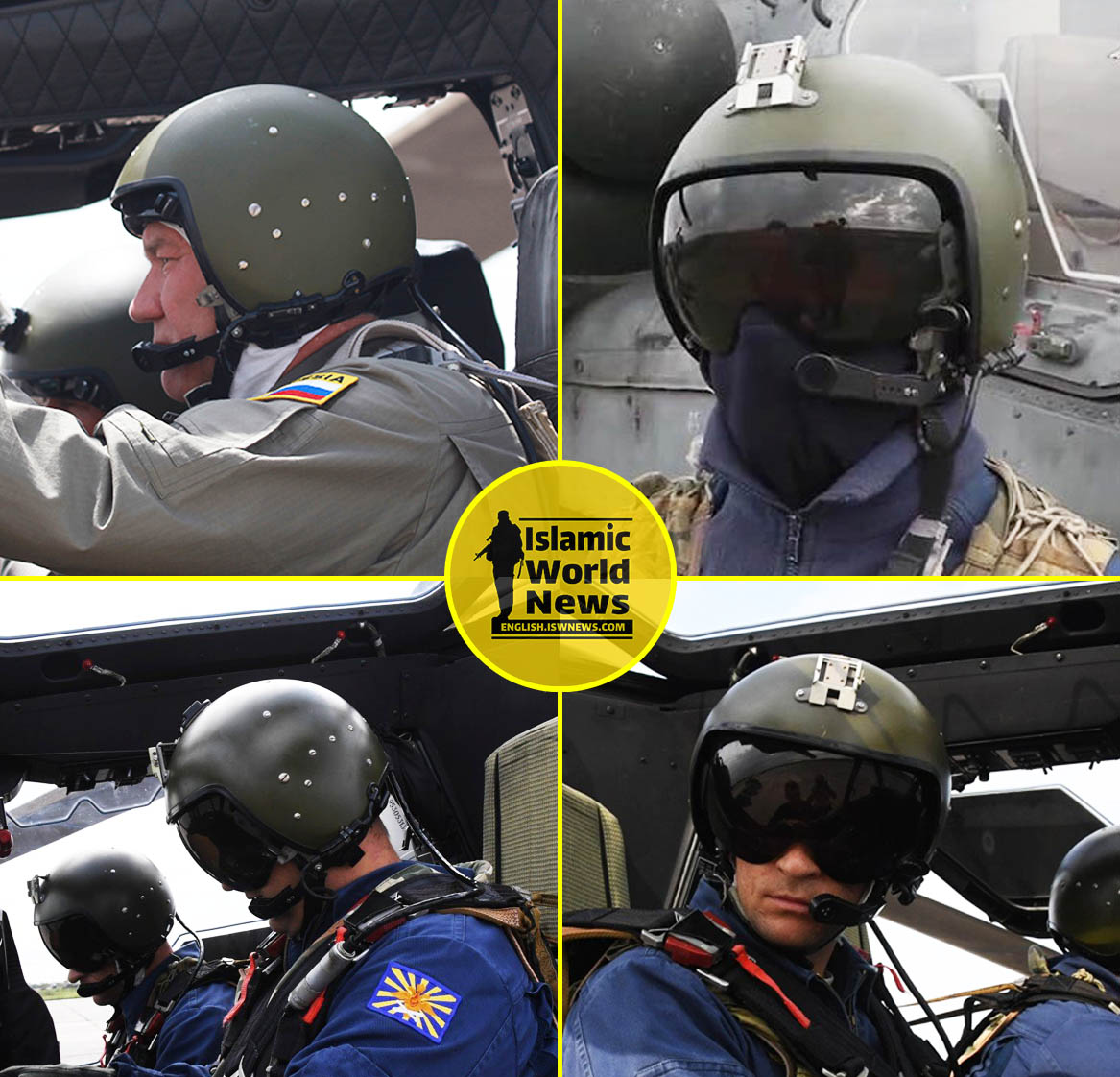
Ka-52 pilot’s helmet
The cockpit of the Ka-52 helicopter is armored and provides good protection for the pilots. The armor of this section is a 3 hardlinered armor; the inner cockpit section made of a full single titanium alloy “bathtub” covering both pilots, followed by a middle liner of ceramic plates, which caused trouble first after a single shot they break apart and lost all its protective abilities, they avoided that by covering this ceramic plates with kevlar/aramid that was glued on tightened and the outer liner which gives the aerodynamic shape and is made of aluminium alloy with a part carbon in it. Also, to further protect the cabin, in addition to the 44 mm bulletproof glass, two armored plates have been used in the side of the cabin next to the pilots.
Ka-52 armor and protective armored plates
The outer part of the cabin and the bottom of the fuel tanks are also made of aluminum and carbon alloy with a thickness of 20 mm. The total amount of armor that could be installed for each pilot of the Ka-50 helicopter is about 300 kg. For the Ka-52 helicopter, this number has been reduced to 150-200 kg per pilot. This is despite the fact that about 90 kg of armor is used for each pilot in the American Apache helicopter. Ka-52 armor is (at least theoretically) resistant to 23 mm bullets.
Ka-52 body close-up – click to view in larger size
The helicopter has four separate fuel tanks, three in the rear and one just behind the cockpit. All four fuel tanks are plated and separate from each other.
Quadruple fuel tanks in Ka-52
As mentioned, the Ka-52 has 85% of the same parts as the Ka-50. But in terms of appearance, it has a wider nose and in the cabin, two pilots sit next to each other. Both pilots are able to fully control the helicopter; Such an arrangement simplifies the operation of the helicopter during the battle. Also, there is no need for a dedicated training version for this helicopter and it is possible to use this helicopter as a training helicopter.
Ejection seats and eject system:
Another unique feature of this helicopter is being equipped with ejection seats. The Ka-52 helicopter, along with the Ka-50, are the only active helicopters in the world that have this capability. The Ka-52 CAS K-37-800M ejection seats consists of two parts, an armchair and a side part, designed to perform the functions of the pilot’s seat of the Ka-50 and Ka-52 helicopter and providing in combination with the ZSh-7VS helmet and oxygen equipment of the KCO-VK-LP safe emergency exit by bailout with the help of a towing rocket engine at an indicated flight speed from 90 to 350 km/h in the altitude range from 0 to 5000 m and reducing the loads acting on the pilot during an emergency landing using the energy-absorbing cushioning suspension of the chair.
How the ejection seats work in Ka-52CAS K-37-800M ejection seats and eject rocket in Ka-52
Radar:
The Ka-52 helicopter is fitted with a mast-mounted radome nose mounted housing a Phazotron FH-01 Millimeter Wave Radar (MMW), known as the Arbalet radar with two antennas for aerial and ground targets. This radar is manufactured by Phazotron-NIIR, Russia’s largest developer of military and avionics radars.
Arbalet radar on Ka-52 nose
The Ka-52 radar is an Arbalet-52 dual-band pulse doppler radar weighing 140 kg, which allows the helicopter to effectively carry out combat missions at any time of day or night in all weather conditions, even in the presence of organized or natural electronic jamming. The maximum range of the Arbalet-52 radar is 37 km. In general, Ka-52 uses two radars, Arbalet-52 or Arbalet-M, which are more powerful versions of the Arbalet radar and use the Baguet series processor. In this radar, Ts181F processor is responsible for data processing and Baget-55-04.01 processor is responsible for signal processing.
Phazotron FH-01 radar known as Arbalet radar in Ka-52
The air-to-surface capabilities of this radar include various mapping modes, mapping range up to 32 km, azimuth coverage of 120°, the ability to detect ground targets such as bridges at 25 km and tanks at 12 km, the ability to detect ground-based obstacles and terrain detection/avoidance- Electricity cables at 400 meters and the ground with a slope of 10 degrees at 1.5 km, the ability to detect moving target selection of ground and air targets, determination of priority of objects, missile approach warning, support/cueing of EO targeting systems, detection of dangerous weather conditions, nvigation systems update and correction, missile and rocket control, target type classification (in conjunction with IFF) and tracking of 20 targets simultaneously.
The air-to-air capabilities of this radar include the azimuth coverage of 360° with elevation ±30°, the tracking limits with azimuth of ±60° with elevation±30°, the ability to detect hostile aircraft at a range of 15 km and a Stinger missile at a range of 5 km, the ability to engage with a variety of targets such as cruise and drones, the ability to track up to 20 targets.
Observation and electro-optical system section:
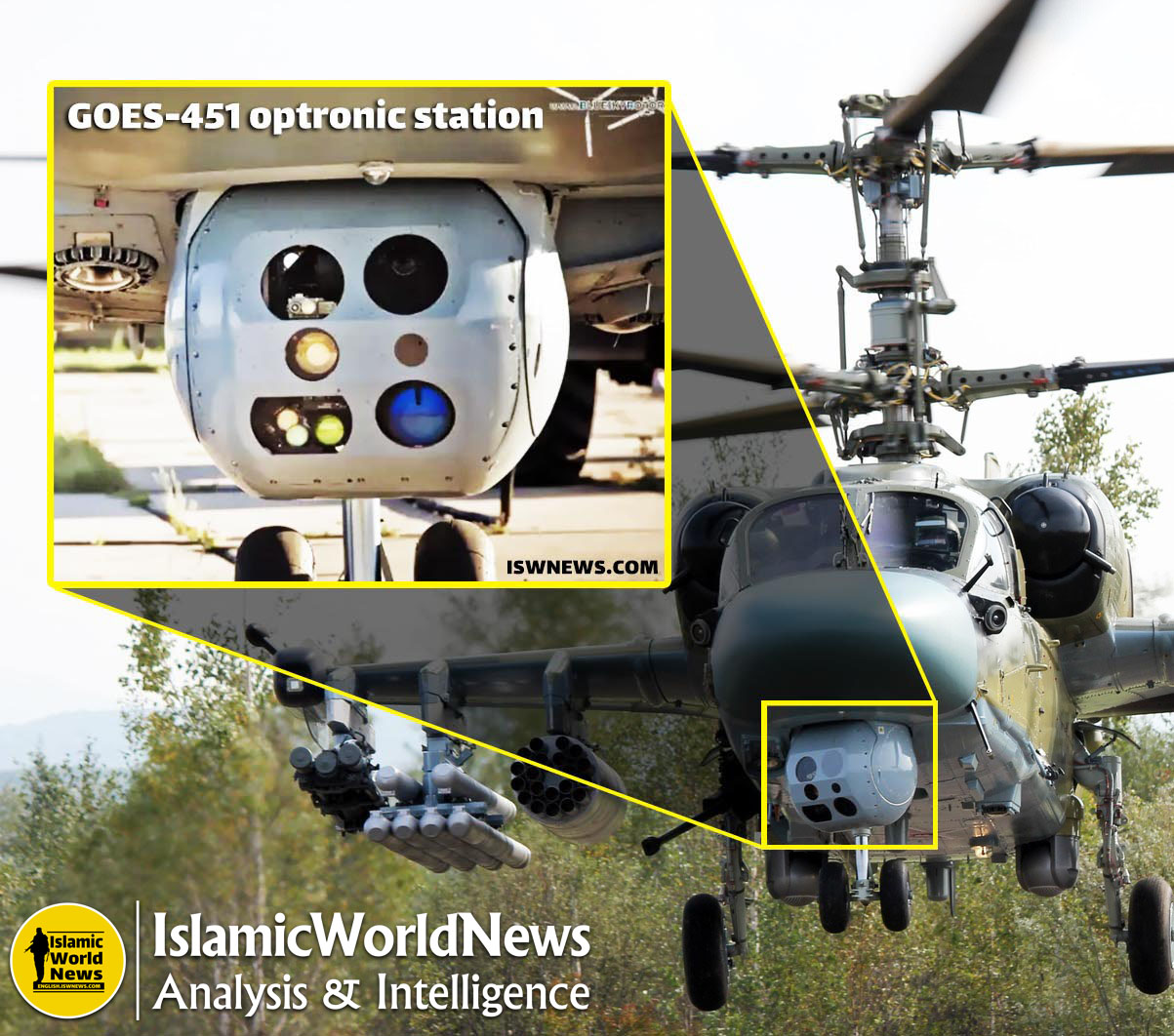
In terms of observation and electro-optical system, Ka-52 is equipped with GOES-451 optical system. The GOES-451 system is gyro-stabilized optronic station designed to provide detection, targeting and missile guidance for the Ka-52 attack helicopter. The GOES-451 sensor package includes visible and infrared cameras, laser rangefinder and laser designator.
GOES-451 visible camera has a maximum range of 83.3 km, infrared range of 55.6 km, laser range finder with a range of 18.5 km and laser point designator with a range of 14.8 km.
GOES-451 electro-optical system
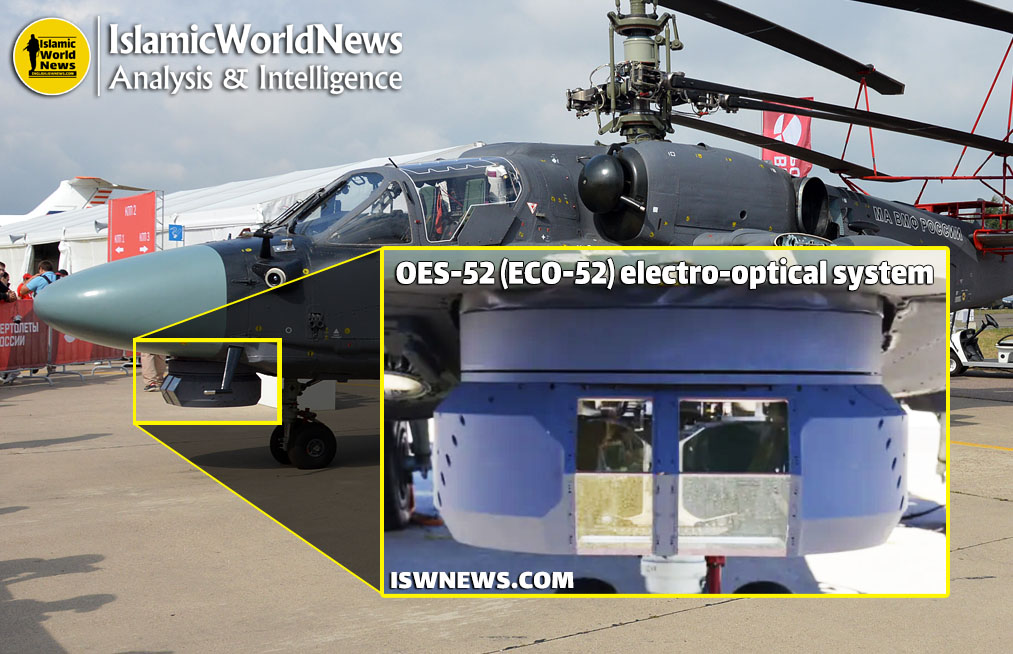
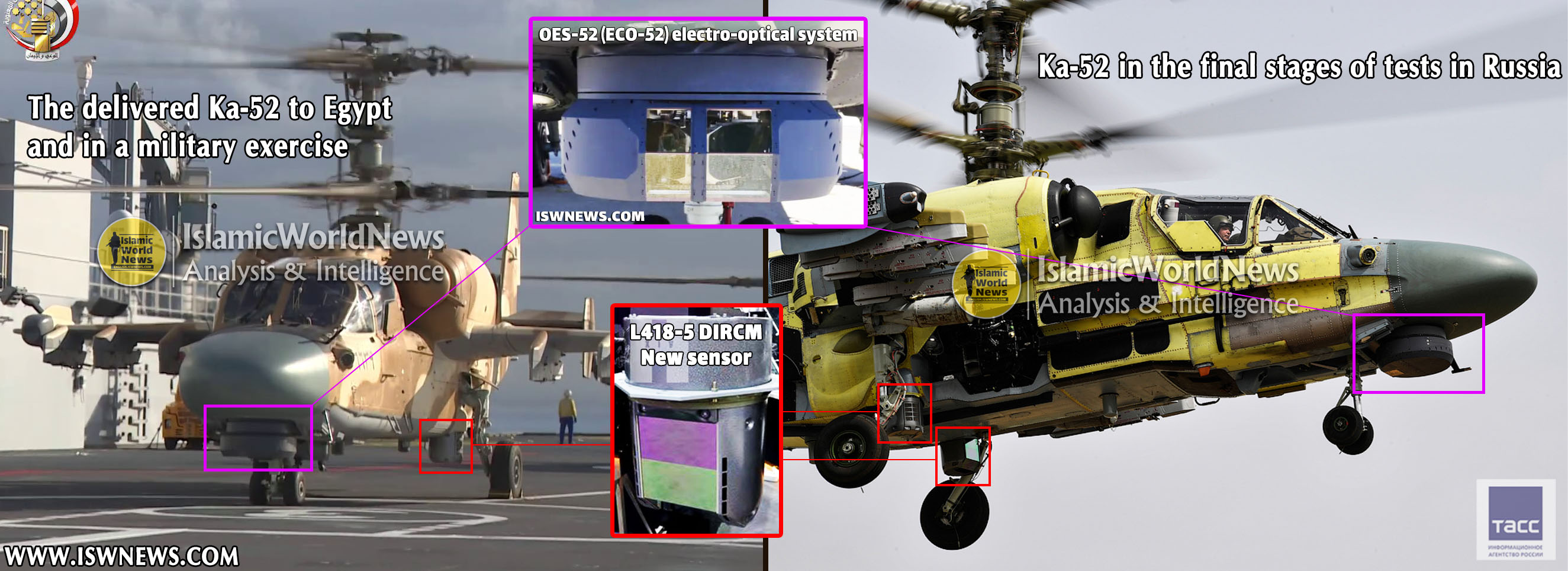
It should be noted that a version of the Ka-52 Katran (Marine version of the Ka-52) was displayed at the MAKS 2015 exhibition, which used the OES-52 (ECO-52) electro-optical system instead of the GOES-451 electro-optical system. Also, in 2016, another version of the Ka-52 was seen in the sky of Moscow, which was equipped with the OES-52 electro-optical system. It was later revealed that the OES-52 electro-optical system will be used for the Ka-52M helicopters, which are a more powerful and updated version of the Ka-52. Nevertheless, the possibility of installing this system on older and current Ka-52 versions is expected. Also, the export versions sold to Egypt, namely the Ka-52 Nile Crocodile (Ka-52E) are equipped with the OES-52 electro-optical system.
The OES-52 system is functionally similar to the GOES-451 system. The OES-52 developed by Moscow-based NPK SPP and houses five sensors: a thermal imaging camera, TV camera, laser rangefinder/designator, laser beam riding for anti-tank guided missiles, as well as a laser spot tracker. However, the weight of this system is 177 kg, which is 43 kg lighter compared to the GOES-451 system, which is 220 kg.
OES-52 electro-optical system on Ka-52 Katran in MAKS exhibition 2015Ka-52 equipped with OES-52 system in the sky of Moscow
Protection system and electronic warfare:
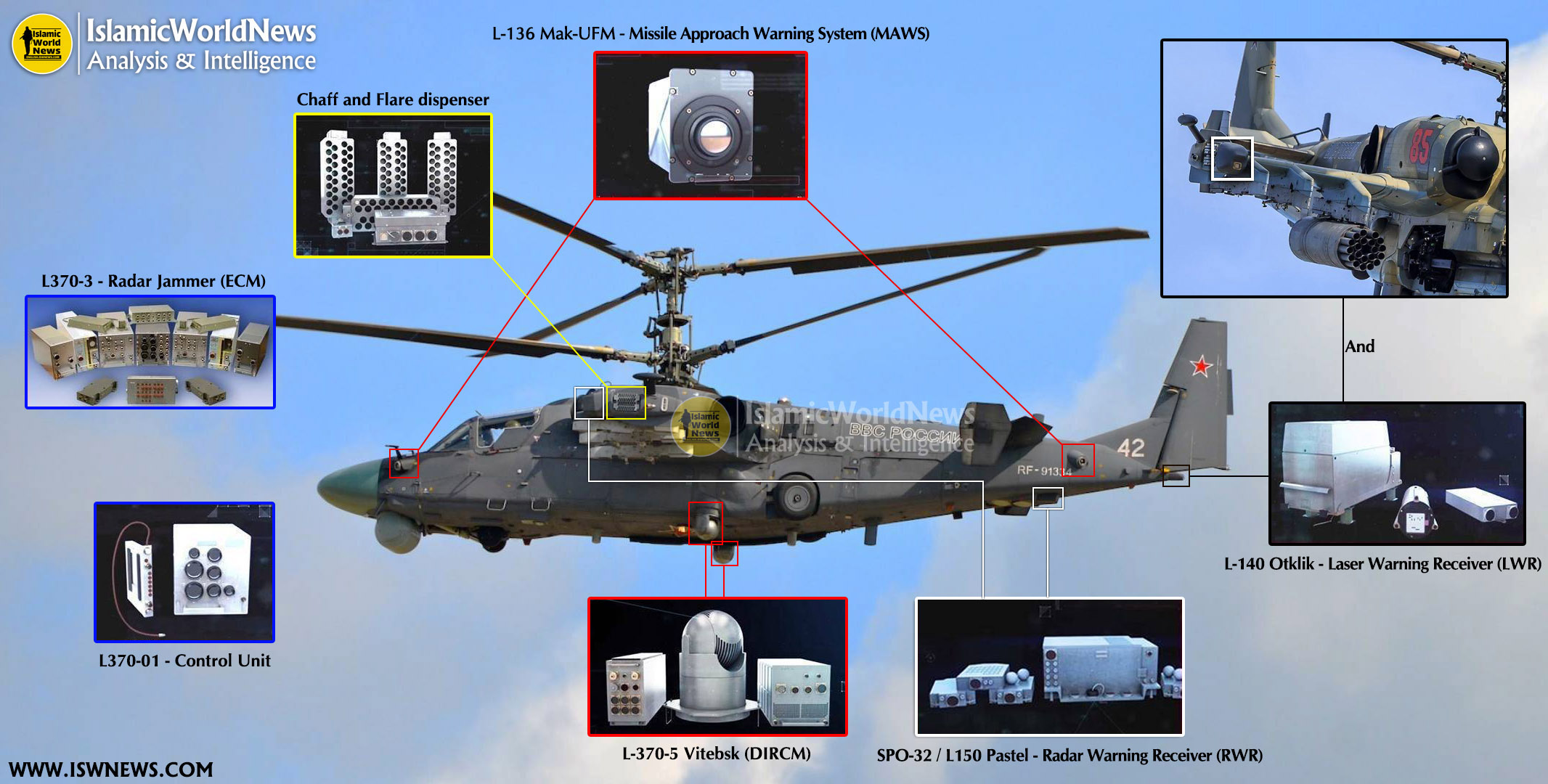
In terms of protection systems and electronic warfare, the Ka-52 is equipped with the President-S integrated protection system. The President-S system is made by KRET and Ekran Scientific Institute and includes a set of various countermeasures such as active IR and electronic jammers, radar warning receiver (RWR), laser detection system, IR missile approach warning sensor, etc. Next, we will introduce the President-S system components :
Components of the President-S integrated protection system on the Ka-52
– “L370-0 control unit” is a digital computer module which is responsible for managing the entire electronic warfare package, as it receives all data from the warning sensors deployed on the helicopter’s structure and says it is integrated, analyzed and presented to the pilot to take defensive countermeasures.
– “L-136 MAK-UFM missile approach warning (MAWS) system” as its name suggests, is a system that detects and warns the approach of missiles fired at the helicopter. This system can detect shoulder-launched missiles such as the Stinger and Igla from a distance of 10 km, and air-to-air missiles launched from aircraft such as the Sidewinder and the R-73 from a distance of 30 km to 50 km.
L-136 MAK-UFM warning system, two in the front and two in the back of the helicopter
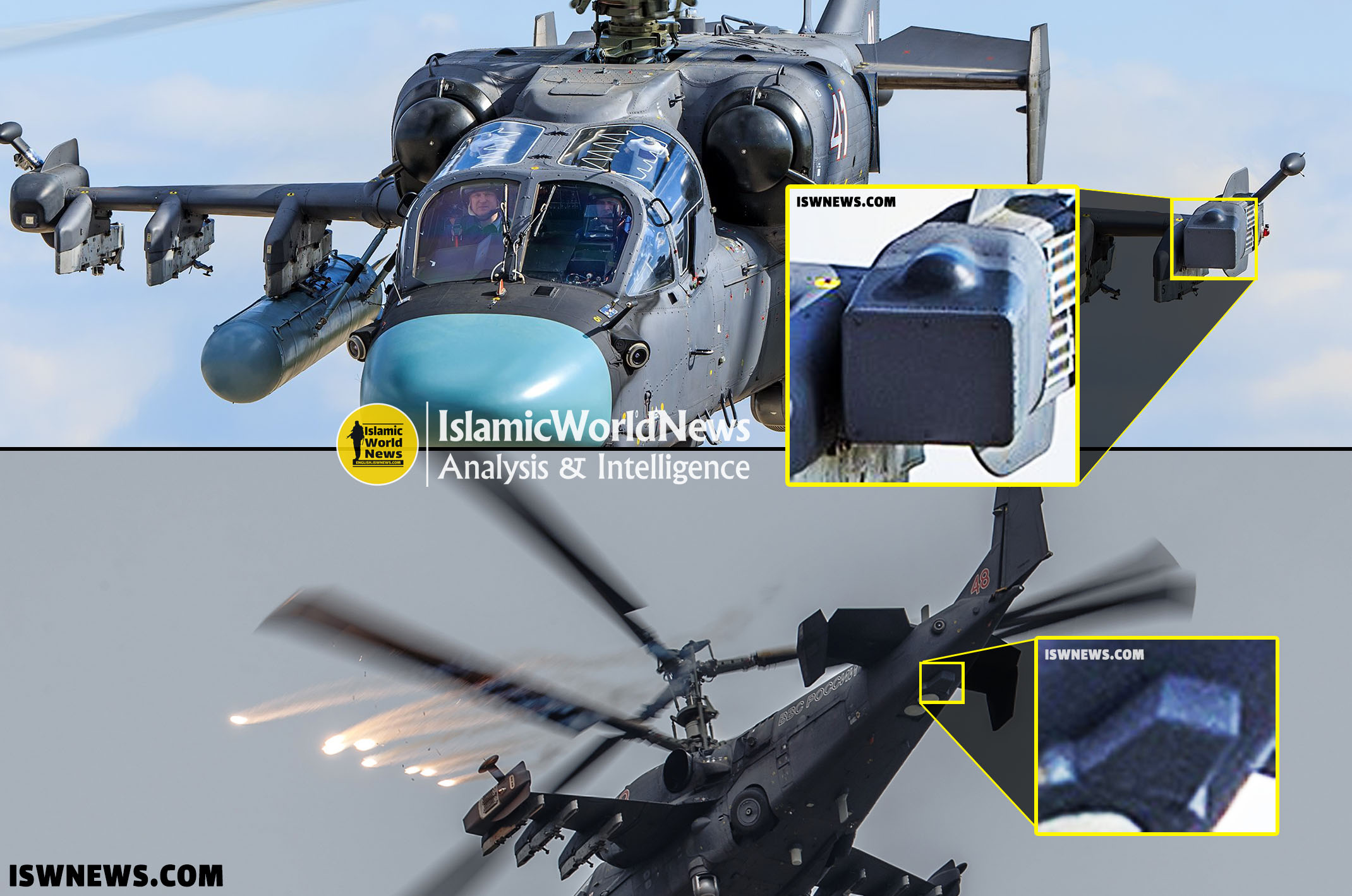
– “L-140 Otkilk laser warning receiver (LWR) system” is specialized in intercepting and monitoring laser beams emitted from distance measuring devices for anti-aircraft missile guidance systems, and provides integrated protection at an angle of 90° horizontally and 360° vertically.
L-140 Otkilk system on the right wing tip and in the rear at the very end of the helicopter
– “SPO-32 / L150 Pastel radar warning receiver (RWR) system” is a system that detects and receives radio waves emitted by enemy aircraft radar systems, and if a threat is detected, such as the presence of a fighter jet’s fire control radar or a missile launcher’s radar seeker, issues a warning about the existence of a threat. This system has a range equivalent to 222.2 km.
The SPO-32 / L150 Pastel system on the left wingtip and lower end of the helicopter
– “L370-3 radar jammer or electronic countermeasures (ECM) system” are systems installed inside the Kamov-52 helicopter and their task is to perform a wide range of jamming measures against surface-to-air, air-to-air missile search radars, etc. This system works in integration with the L150 Pastel system. The L150 Pastel system is responsible for intercepting radar waves and determining their source and the L370-3 jams them.
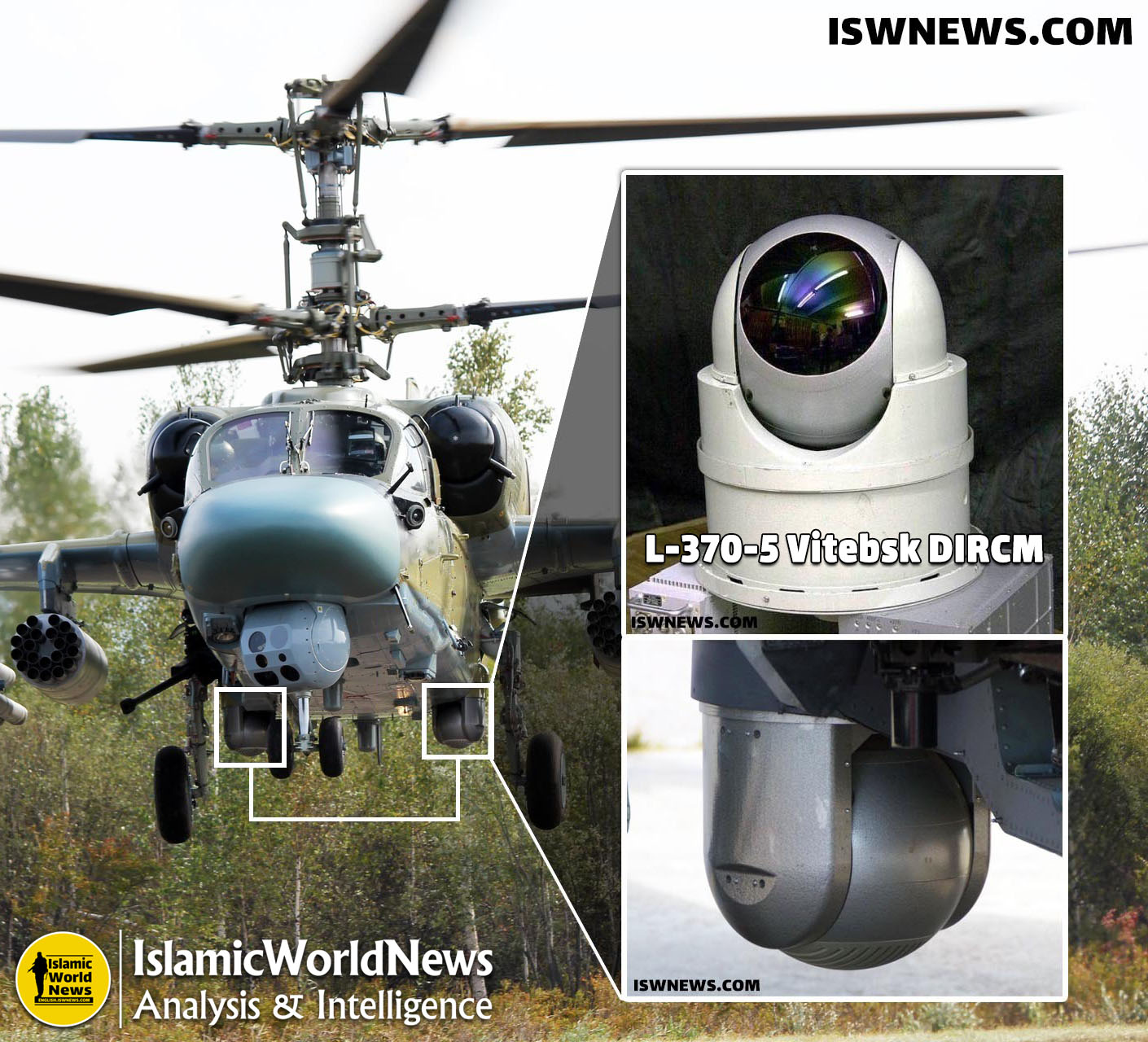
– “L-370-5 Vitebsk directional infrared countermeasures (DIRCM) system” is a jamming system to protect the helicopter against anti-aircraft missiles. This system is installed under the belly of Ka-52 in both sides of the helicopter in a rotating turret. This system is responsible for jamming missile seekers operating in the ultraviolet and infrared ranges. The L-370-5 Vitebsk system shines laser beams on the missile’s thermal / electro-optical seekers to confuse it and mislead it away from the helicopter. This system is able to track missiles fired at the helicopter within a radius of several kilometers.
L-370-5 Vitebsk infrared jamming system
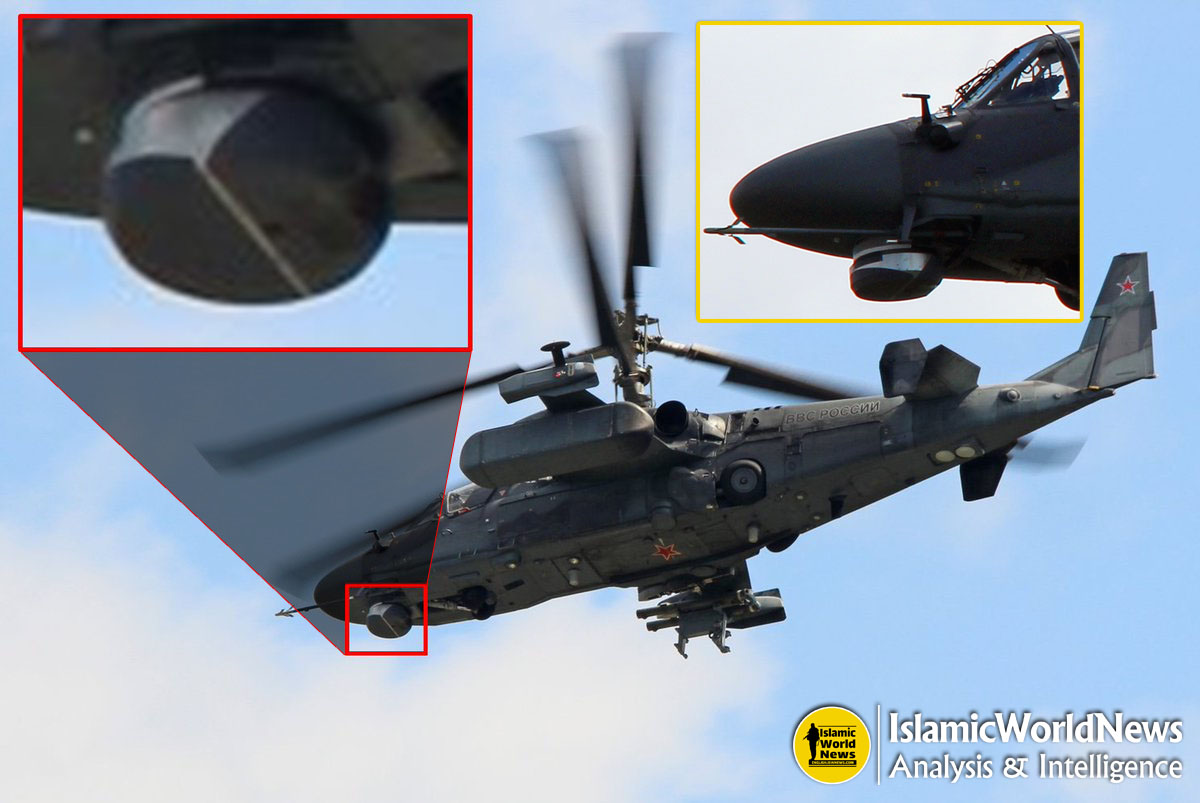
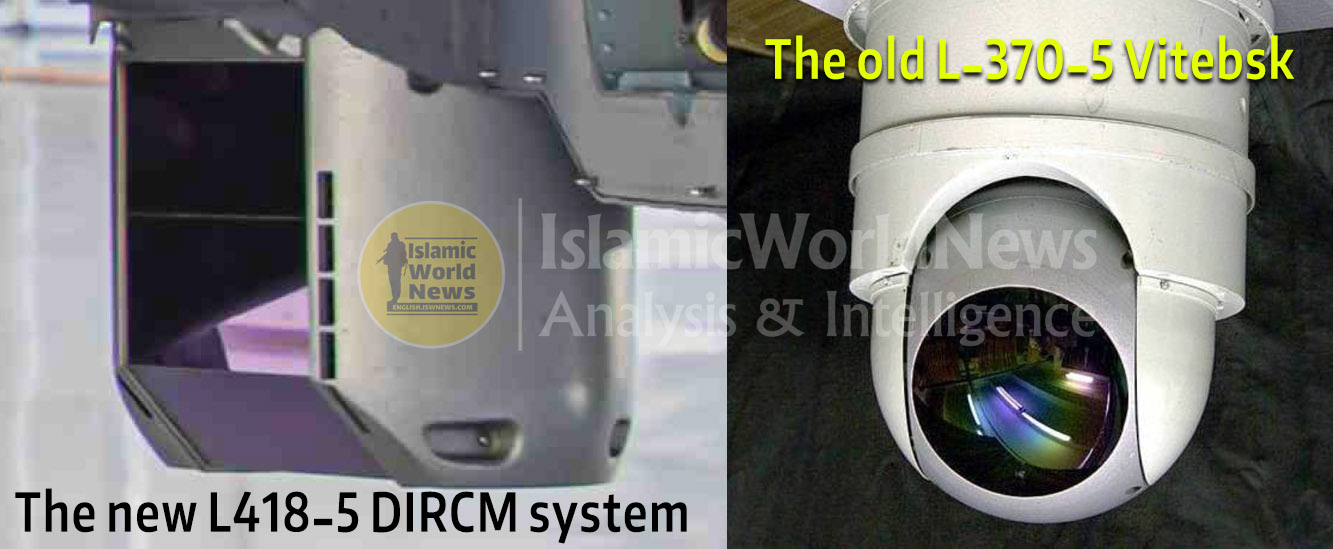
It should be noted that, based on the available evidence, in the new and updated version of the Ka-52, the Kamov Ka-52M, instead of the L-370-5 Vitebsk system, a more advanced system called the L418-5 DIRCM has been used. The possibility of installing this system on the older and current Kamov 52s is also not far from expected. Also, in the export versions sold to Egypt, i.e. Ka 52E, the L418-5 DIRCM system is used.
Ka-52E exported and sold to Egypt, equipped with new L418-5 DIRCM sensor and new OES-52 optics.
– In Ka-52, the UV-26 flare and chaff dispensers is used. This system is placed in two double positions at the wingtips of Ka-52, and each of them contains 32 pieces of chaff and flare.
UV-26 flare and chaff dispensersin Ka-52
Ka-52 armaments:
Ka-52 armaments
In the armament section, the Ka-52 helicopter is equipped with a 30mm Shipunov 2A42 automatic cannon on the right side of its body. This cannon has low mobility and only moves up and down. The 30mm Shipunov 2A42 cannon is designed to shoot at lightly armored targets at a distance of 1500 meters, non-armored targets at a distance of 4000 meters, as well as low-flying subsonic aerial targets at a distance of 2000 meters. This cannon has the ability to operate in harsh conditions, such as the temperature range from +50 degrees to -50 degrees Celsius in rain, dust, frost and in a very dry environment. The firing speed of this cannon is 550 rounds per minute and its weight reaches 115 kg.
Shipunov 2A42 30 mm automatic cannon
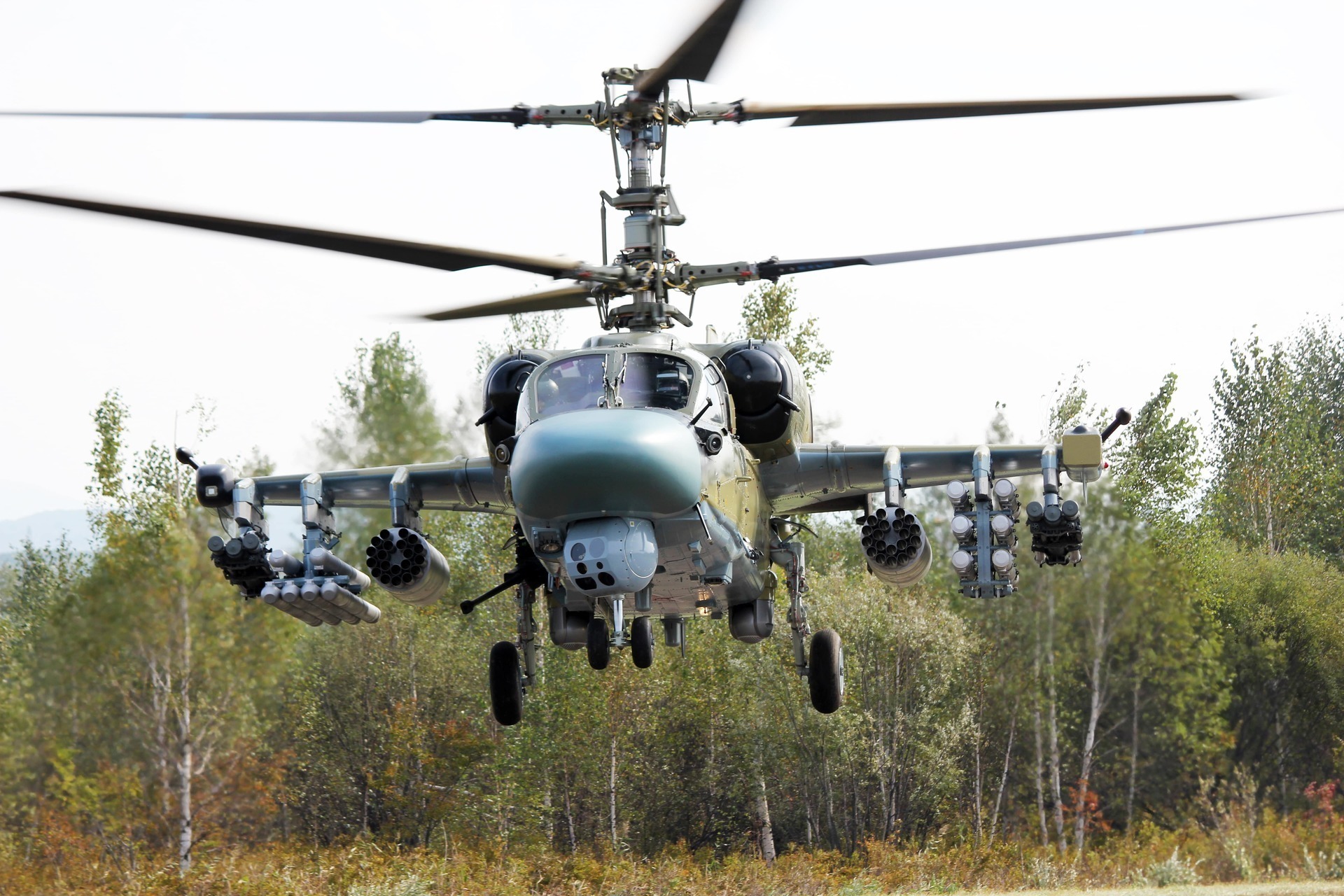
Also, there are 6 external hardpoints under the two wings, which can be used to install different combinations of weapons up to the weight of 2,942 kg. There are also 2 dual slots on the wingtips for chaff and flare dispensers.
6 external hardpoints under the two wings of Ka-52
The Ka-52 has 3 hardpoints under each wing, which can carry an APU-6 rack along with an unguided rocket pod and an anti-tank missile on the third hardpoint and two UV-26s on the wingtip, each of which contains 32 pieces of chaff and flare. The APU-6 rack is actually a shelf for storing and firing 6 anti-tank missiles, which is designed to increase the carrying capacity of the Ka-52 helicopter.
Also, to increase the range, Ka-52 is able to carry four external fuel tanks up to 500 liters in its hardpoints.
External fuel tank for Ka-52
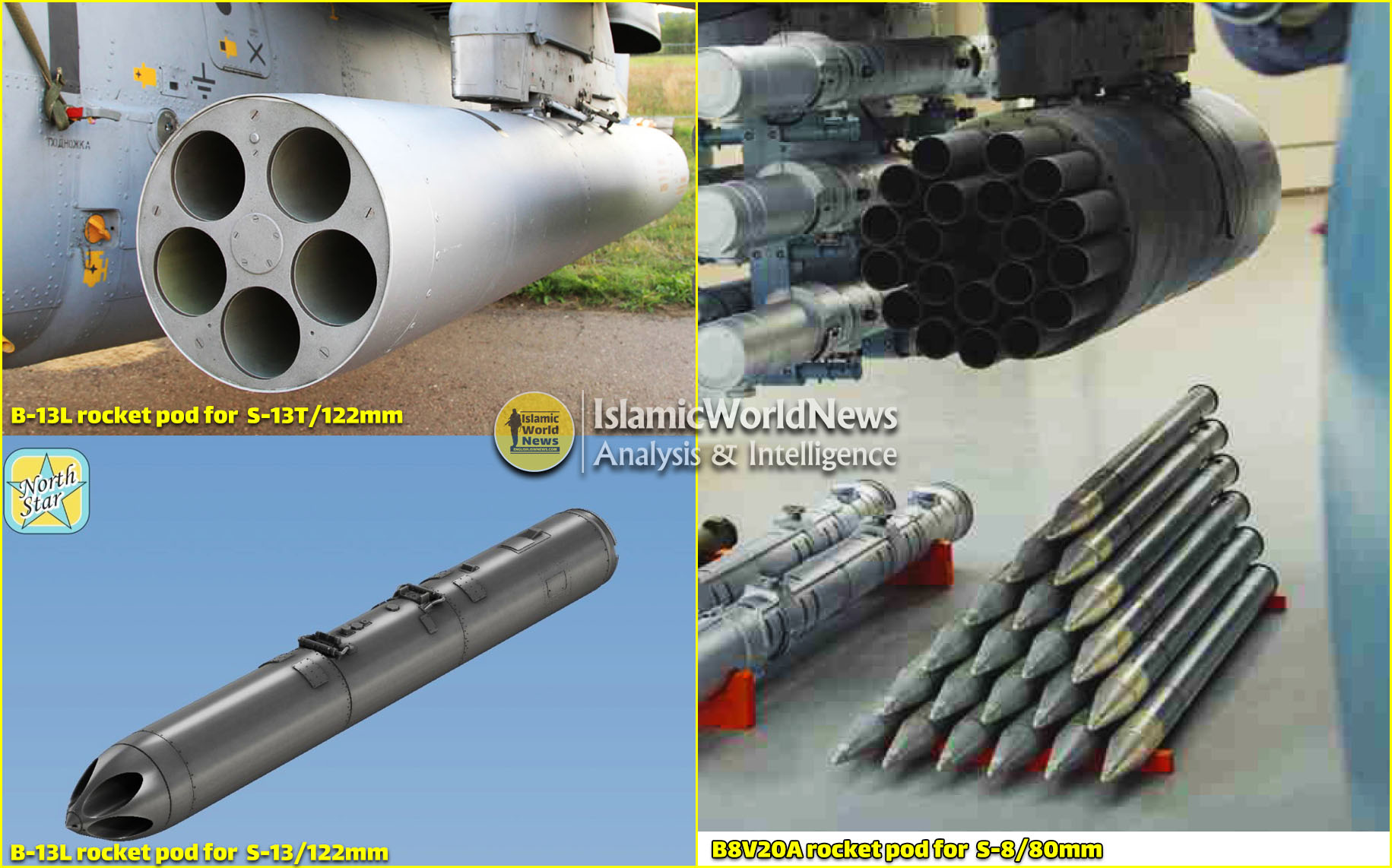
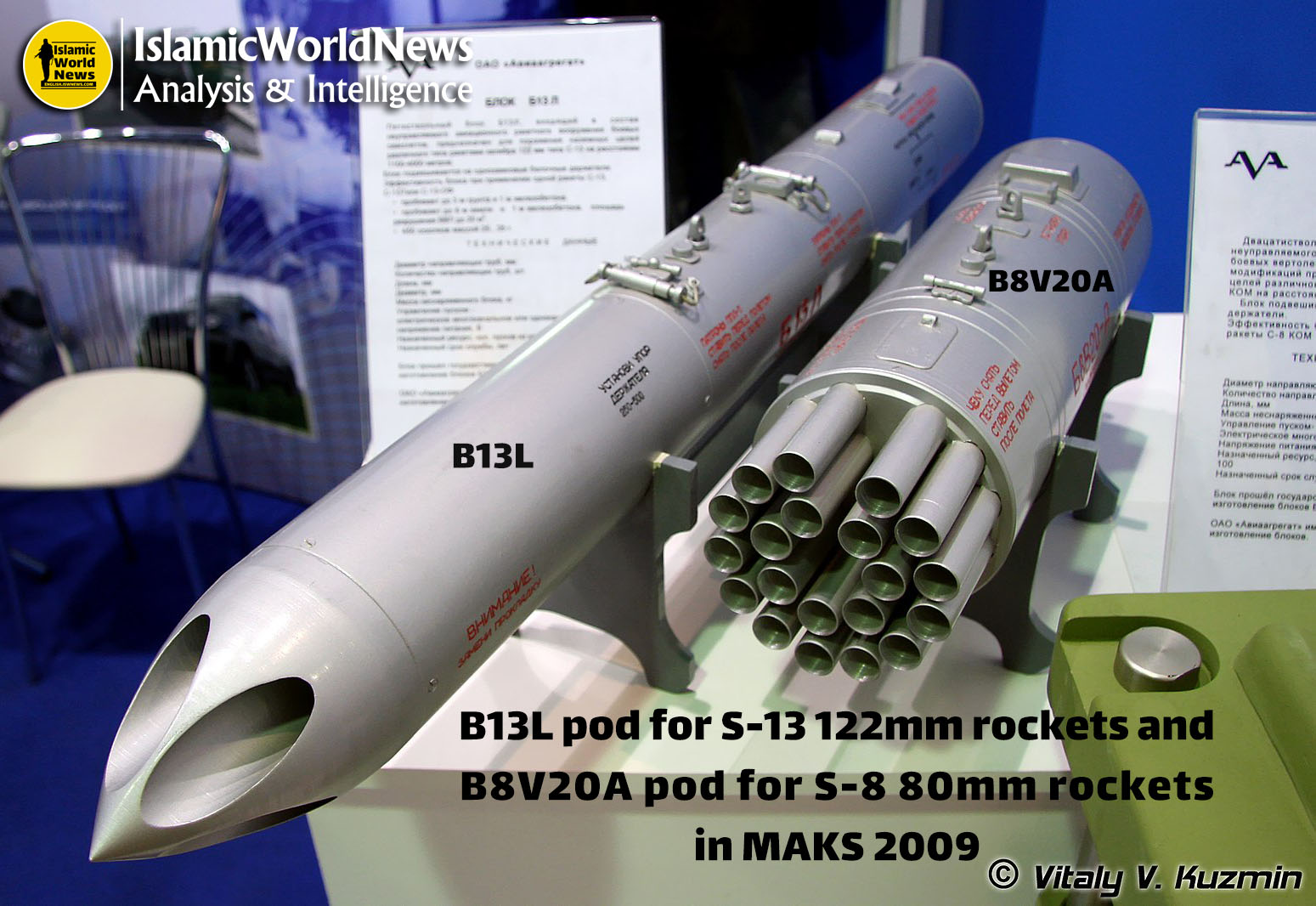
The pods of unguided rockets on Kamov are two types of S-8 80mm rockets (S8/80mm) containing 20 rockets and S-13 122mm rockets (S13/122mm) containing 5 rockets, which can be installed one on each wing and a total of two of them are in addition to 6 anti-tank missiles on the APU-6 rack in each wing and a total of 12 anti-tank missiles. This combination gives a lot of power to the Ka-52 helicopter in suppressing armor and infantry on the battlefield.
S-8 80mm rocket pod (S8/80mm) containing 20 rockets and S-13 122mm rocket pod (S13/122mm) containing 5 rocketsB8V20A pod for 80mm S-8 rocket and B-13L pod for 122mm S-13 rocket
It is also possible to install anti-tank missiles such as 9K121 Vikhr and 9M120 Ataka on APU-6 racks. The Vikhr missile can destroy targets at a distance of 10 to 12 km, and the Ataka missile provides the Ka-52 helicopter with an operational range of 400 meters to 6 km to target armored targets.
Right: Vikhr missile – Left: Ataka missile
A video from inside the Ka-52 cabin recorded during the operation of the Russian army to seize the Antonov (Gostomel) airport near the city of Kiev on February 24, 2022. In this video, the Ka-52 is flying low and providing fire support for Russian infantry and a Russian Mil-8 transport helicopter. The Ka-52 escapes from being hit by several rockets and is finally forced to make an emergency landing due to the impact of a missile.
Video from inside the cabin of Kamov-52 during the capture of Antonov airport
Introduction of other versions of Ka-52:
Updated version of Ka-52: Ka-52M helicopter In recent years, the Russian Ministry of Defense announced the production of a new version of the Ka-52, which was finally known as the Ka-52M in 2018. Ka-52M is actually an updated version of Ka-52, which has undergone changes in terms of system and some equipment. According to the information of the Russian Ministry of Defense, 114 aircraft of this model are to be put into service, and according to the latest information, on January 4, 2023, the Russian army received 10 Ka-52M helicopters.
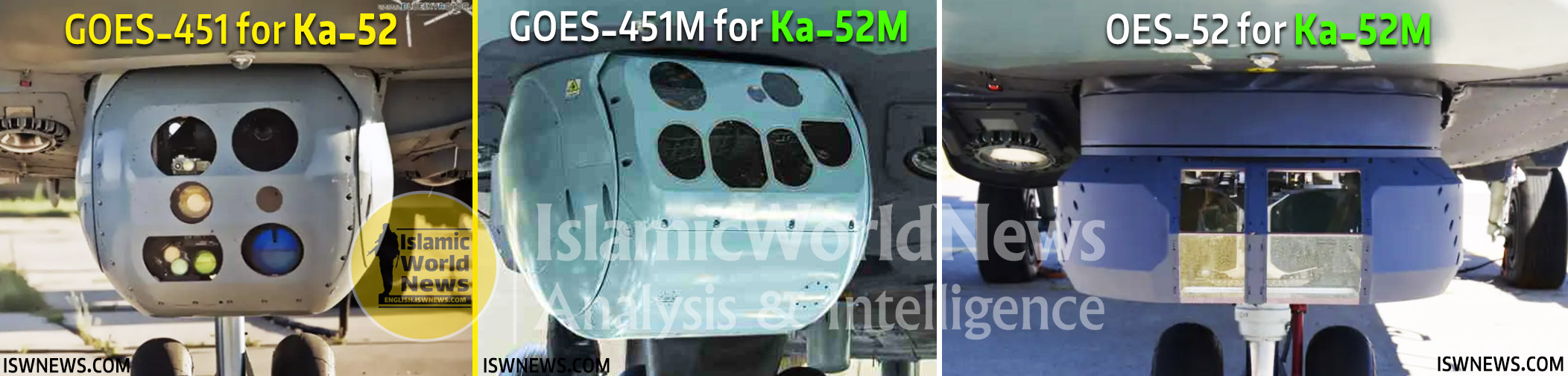
The updated version of the Ka-52M helicopter is equipped with the GOES-451M electro-optical system with greater range and better performance. Also, the new OES-52 electro-optical system is used in the Ka-52M helicopter. The OES-52 system is functionally similar to the GOES-451 system. The OES-52 houses five sensors: a thermal imaging camera, TV camera, laser rangefinder/designator, laser beam riding for anti-tank guided missiles, as well as a laser spot tracker. However, the weight of this system is 177 kg, which is 43 kg lighter compared to the GOES-451 system, which is 220 kg.
GOES-451M and OES-52 electro-optic system for Ka-52M
Stronger undercarriage, improved cockpit ergonomics and better night vision goggles compatibility are other changes and updates to the Ka-52M.
In terms of armament, the Ka-52M is equipped with Light Multipurpose Guided Surface-to-Air (LMUR) missiles. This missile, which is also known as Izdeliye 305 and Item 305, has a range of 14.5 kilometers and is used to destroy a wide range of ground targets.
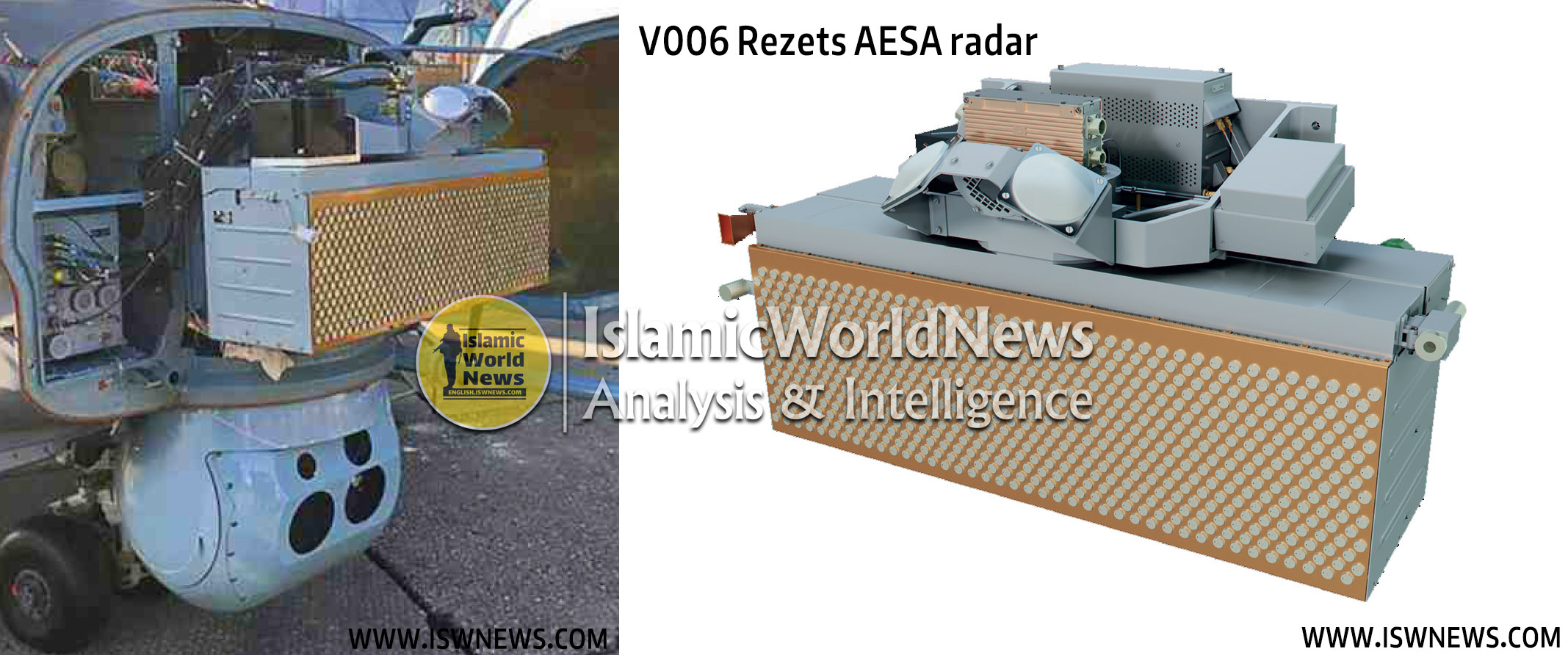
In the radar section, the Ka-52M is equipped with the V006 Rezets (cutter) active electronically scanned array (AESA) radar instead of the Arbalet-52 radar. This radar has a fixed 900×300 mm AESA antenna with 640 transceiver modules. This radar can detect a group of tanks from 45 km, a railway bridge from 100 km, and a destroyer-class warship from 150 km, according to the manufacturer. In the air-to-air mode, it can detect a fighter aircraft with a radar cross section of 3 sq m from up to 50 km head-on and a hovering helicopter from 20 km. The Rezets radar weighs 130 kg, 10 kg less than the current Ka-52’s FH01 radar and is air-cooled, with an air scoop for cooling seen on the helicopter’s nose fairing.
V006 Rezets active electronically scanned array (AESA) radar
In the field of countermeasures and electronic warfare, the Ka-52M President-S integrated protection system has undergone changes and its various components have been improved. In one of the most important components of this section, instead of the L-370-5 Vitebsk system, a more advanced system called L418-5 DIRCM has been used.
New L418-5 DIRCM system for Ka-52M
Finally, and perhaps the most important part of the helicopter’s upgrade, is the installation of new systems for the helicopter to adapt to work in the new battlefield command and control system.
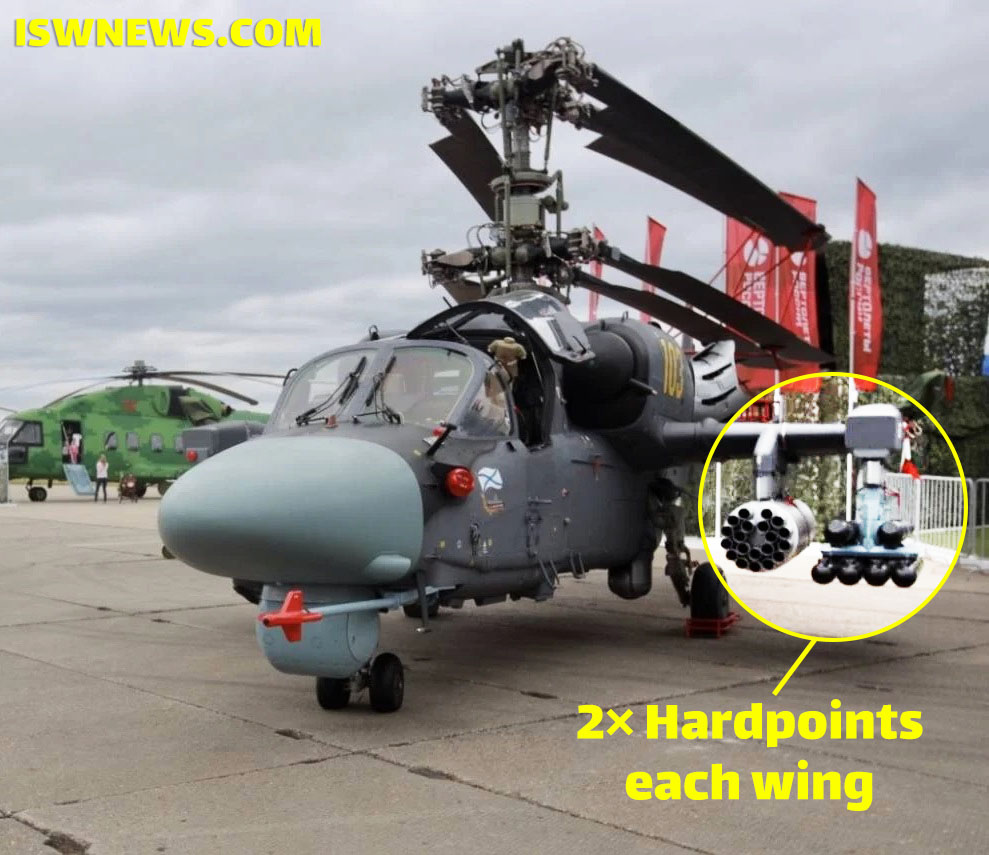
Naval version of Ka-52: Ka-52K Katran helicopter: The Ka-52K Katran helicopter is the naval version of the Ka-52 helicopter and is based on the Ka-52 Alligator; But the equipment and systems of this helicopter have been modified according to sea operations and its body is also covered with elastic anti-corrosion coating. Since this helicopter is designed for use on aircraft carriers and warships, its dimensions have become smaller and it has folding blades and wings to occupy less space in the hangar. The length of this helicopter is 13.8 meters and its wingspan is 6.3 meters. The reduction of the wing length in this helicopter has caused the weapon hardpoints to be reduced from 6 to 4. The rotor system of Ka-52K is equipped with elastic bearings between the blade and the mast to bear more weight.
Folding blades in Ka-52 KatranFolding wings and two hardpoints under each wing in Ka-52 Katran
The Ka-52K helicopter is equipped with radio and satellite navigation equipment and provides the possibility of independent landing from the watchtower on the ship’s deck. The helicopter is also optimized with an air conditioning system to perform missions in the humid marine atmosphere. By equipping the KA-52K with advanced avionics systems and powerful weapons, it can be configured for different roles.
Ka-52K helicopter is equipped with laser beam guidance system and Okhotnik video processing system developed by KRET. The Okhotnik system increases the range of detection and identification for the helicopter.
Ka-52K helicopters are equipped with Arbalet radar system in early versions. In newer versions, this radar has been changed to active phased array radar. Russian defense contractor Radio-Electronic Technologies’ Active Phased Array (AESA) radar has been developed for the naval version of the Kamov 52 to replace the Arbalet radar. This radar gives the Ka-52K helicopter the ability to fire the Kh-35 anti-ship cruise missile and the Kh-38 missile. The detection range of this radar for large sea targets reaches 180 km.
It should also be noted that this version, like the regular Ka-52 versions, will be known as the Ka-52KM when it receives new upgrades. The M suffix is used for versions that have received the latest updates.
Ka-52K Katran helicopter
Pros and cons of Ka-52 helicopter:
Pros: It’s a multipurpose helicopter and very fast, agile and flexible. It provides a good level of armor protection in the cockpit for the pilots. It has a wide range of countermeasures and electronic warfare. It has 6 hardpoints to carry a wide variety of ammunition. It has effective anti-tank capabilities with Vikhr and Ataka missiles. It has a very good electro-optical system and a strong weapon management system. Cons: Small area for locking on with Igla air-to-air missiles The firing arc and performance of the 30 mm gun is limited due to its placement on the right side of the helicopter. High angles of attack can result in fuel starvation to the engine
Specifications of K-52 attack helicopter: Role: attack helicopter First flight: 25 June 1997 Produced: since 2008 Length: 15.8 meters Height: 4.93 meters Large wingspan: 7.8 meters Small wingspan: 2.6 meters Main rotor diameter: 2 x 14.5 meters Main rotor area: 330.3 square meters Crew: 2 people Empty weight: 7,700 kg Maximum take-off weight: 12,200 kg Engine: 2 Klimov VK-2500 turboshaft engines, 2,400 horsepower each. Internal fuel: 1,870 liters External fuel tank: up to 4 tanks and a total of 4,070 liters Maximum speed: 315 km/h Combat range: 460 km (with internal fuel tank) Maximum range: 1100 km (with external fuel tanks) Flight ceiling: 5,500 meters (18,000 feet) Rate of climb: 12 m/s
Armament: 30 mm Shipunov 2A42 cannon, it is possible to mount a 23 mm UPK-23-250 cannon pod (with 240 rounds) on the wings. Hardpoints: 6 under-wing hardpoints with capacity of 2,942 kg + 2 double slots at the wingtips for chaff and flare dispensers.
It is possible to carry a combination of the following weapons: Rockets: S-8 80mm rocket pod containing 20 rockets and S-13 122mm rocket pod containing 5 rockets. Missiles: Using the APU-6 racks, allows the use of a variety of anti-tank missiles such as the 9K121 Vikhr and Ataka. Up to 12 laser guided missiles Two Kh-25 laser guided missiles In Ka-52K version, anti-ship missile kh-31 and kh-35 R-73 air-to-air missile Bombs: up to 4 bombs weighing 250 kg or 2 bombs weighing 500 kg
Click to view full size image
More pictures of Ka-52 attack helicopter:
Click to view full size image
“Ka-52 Attack Helicopter” posters in English, Russian, Arabic, Azeri and Kurdish:
Against the background of the twelve-year civil war in Libya, largely connected with the American-European presence, the parasitism of Zionism and the struggle for spheres of influence between regional players (Turkey, the UAE), a “ray of light in the dark kingdom” was still discovered.
It became known about the existence of the Libyan community of Ahlu-Bayt consisting of a number of local tribes. The Shiites of Libya do not have a party yet, but there is a clear self-organization and connection with the leading Islamic figures of the country. Of course, the fact that the supporters of Ahlu-Bayt were able to declare themselves is, among other things, the merit of the activities of the Islamic Republic. There is still little information on this topic specifically, and this is normal, because the IRGC’s activities in Libya are carefully classified in view of the difficult situation in the country. However, thanks to the Iranian media, quite interesting information still leaked into general use.
For example, from an interview with former Foreign Minister Ali Akbar Salehi, it became known that the IRGC helped Libyan revolutionaries fight the Gaddafi regime. In another interview with an expert from the Imam Khomeini Research Institute, Hujjat al-Islam Mahdi abu Talebi said that “the new government of Libya is turning to Iran for help in writing the constitution.” Based on this, it can be summed up that Iranians are present in Libya, which means that the foundation of Islamic revolutionary thinking has been laid in the Maghreb.
Contrary to the opinion of the enemies, the export of the Islamic Revolution has not faded, on the contrary, the revolutionary enlightenment is opening new frontiers for itself and if twenty years ago no one would have believed about the presence of the IRGC in Libya, now it is difficult to find a place in the Islamic World where there would not be the presence of Iranians and the promotion of Islamic revolutionary ideas.
Following their negotiations with top Ukrainian officials, including President Volodymyr Zelensky, the two parliamentarians called on Israel to increase their all-out support for Ukraine in particular in military field.
Moreover, the Zionist regime’s Channel 13 TV network reported that the Ukrainian president called for Israeli Prime Minister Benjamin Netanyahu’s trip to Kiev and the premier’s office said the invitation is being weighed. The Israeli officials opine that the visit in such a volatile condition may make trouble for the regime; however, Netanyahu’s office has announced that the invitation would be discussed.
The Israeli parliamentarians’ visit to Ukraine takes place just a few days after Foreign Affairs Minister of Israel Eli Cohen’s travel to the European country, where he held talks with top Ukrainian officials.
According to local sources in the island, the UAE forces expelled all residents of Abd al Kuri Island and relocated the Yemeni people in the Socotra Archipelago over the last two days. The UAE had earlier constructed some towns in Socotra and suggested the relocation of the residents of Abd al Kuri Island in the archipelago, but most residents ruled out the proposal.
The relocation occurred simultaneous with the set-up of a joint military base of the UAE, the US and Israel in Abd al Kuri Island. The UAE resorts to the assistance of ultra-regional players such as the US and the Zionist regime in order to pursue a broaden plan to militarize islands and coasts of Yemen in a bid to control maritime transportation in the Gulf of Aden and the Red Sea.
The Socotra Archipelago consists of the coral islands of Socotra, Abd al Kuri, Samaha, Darsa and numerous smaller islands, encompassing a total area of 3,625 square kilometers. The islands are 340 km far from the coasts of Yemen and 250km away from Somalia’s coasts. The islands of Samaha and Darsa are also recognized as brother islands.
The Socotra Archipelago with more than 50,000 populations plays a key role in controlling the Gulf of Aden, and it had been applied by colonial powers (British and Portuguese colonialists) as a military and maritime base. Thus, the UAE spends a great amount of money to dominate the islands especially Socotra and Abd al Kuri.
The Ministry of Fisheries in the National Salvation Government of Yemen issued a statement, condemned the forced displacement of fishers and residents of Abd al Kuri Island, and described the attempt to turn the island into a military base by the UAE as a plot in line with the Zionists’ demands.
The ministry noted that the Abd al Kuri Island, which is located 120 kilometers far from Socotra Island, is of geostrategic importance, because it is located near six oil-rich areas as well as the Horn of Africa. It also held accountable the UN Security Council for the escalation of tension in the island, calling for withdrawal of the Saudi-led forces from all lands, islands and coasts of Yemen.
The UAE’s occupation, change of use and the destruction of natural resources of the Socotra Archipelago is real violation of Yemen’s territorial integrity. If peace negotiations with the mediation of Oman and the UN fail, the Ansar Allah movement can target the UAE positions in the islands and coasts of Yemen.
Early on February 23th, at 02:00 local time, two US military logistical convoys were attacked by the “International Resistance” group in the Taramiyah area in north of Baghdad city.
These attacks were the fifth and sixth attack on the US convoys in Iraq since the beginning of 2023.
Earlier on February 6th, another US convoy was attacked by the “International Resistance Faction” group in the Muthanna province.
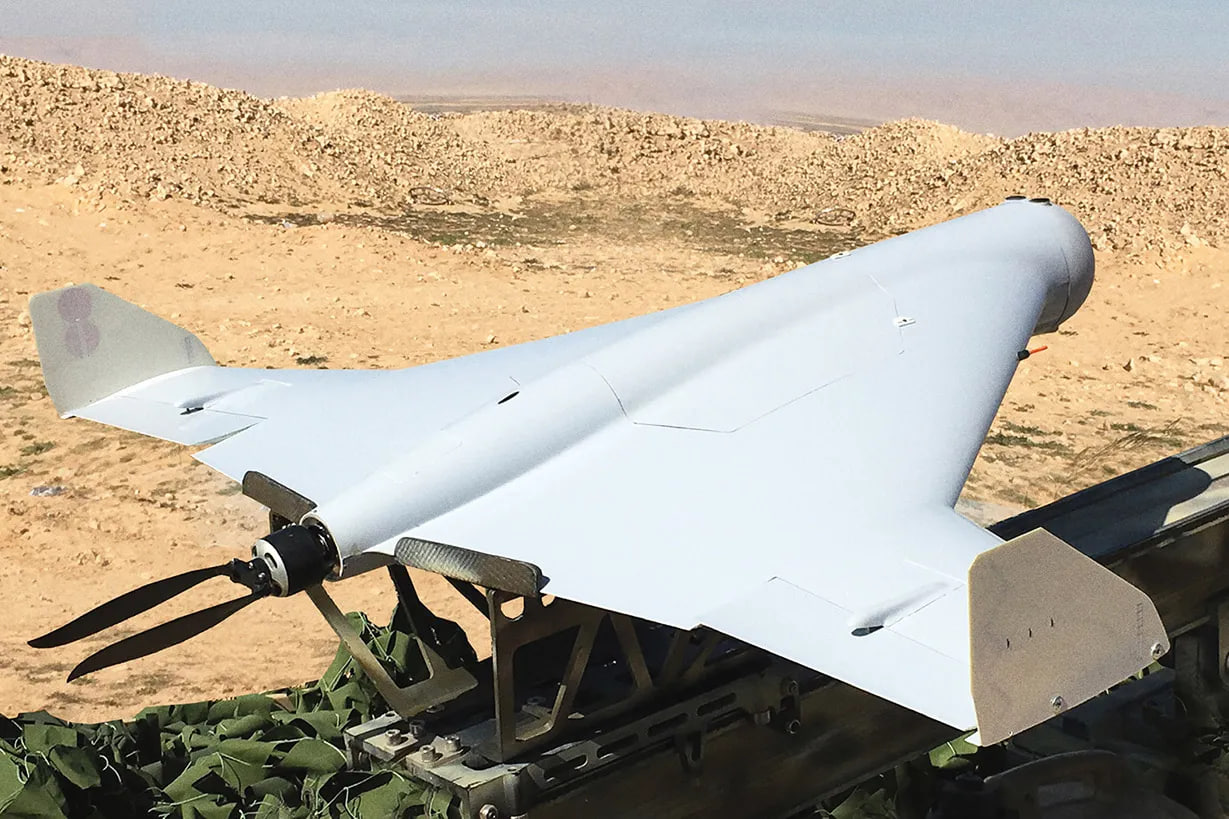
Following the onset of Russia-Ukraine war, orders for assault drones have remarkably increased. The Ministry of Defense of Russia is the main customer of the assault drones manufactured by the Kalashnikov Group. Thus, the production of the kamikaze drones “KUB-BLA” mounted in recent weeks, and the issue is one of the major priorities of the Kalashnikov Group.
KUB-BLA kamikaze drone was unveiled in the International Defence Exhibition & Conference (IDEX 2019) in Dubai, the UAE. The KUB-BLA drone’s speed is between 80 to 130 kilometers per hour and it can fly 30 minutes. The drone can carry three kilograms of explosive materials.
According to the group’s program to mount its production, it is probable that the company would put on agenda the increase of manufacturing Lancet drones, because they have been applied by the Russian forces in the war against Ukraine.
It is notable that both KUB-BLA and Lancet drones were manufactured by the Russian company named ZALA Aero affiliated to the Kalashnikov Group.
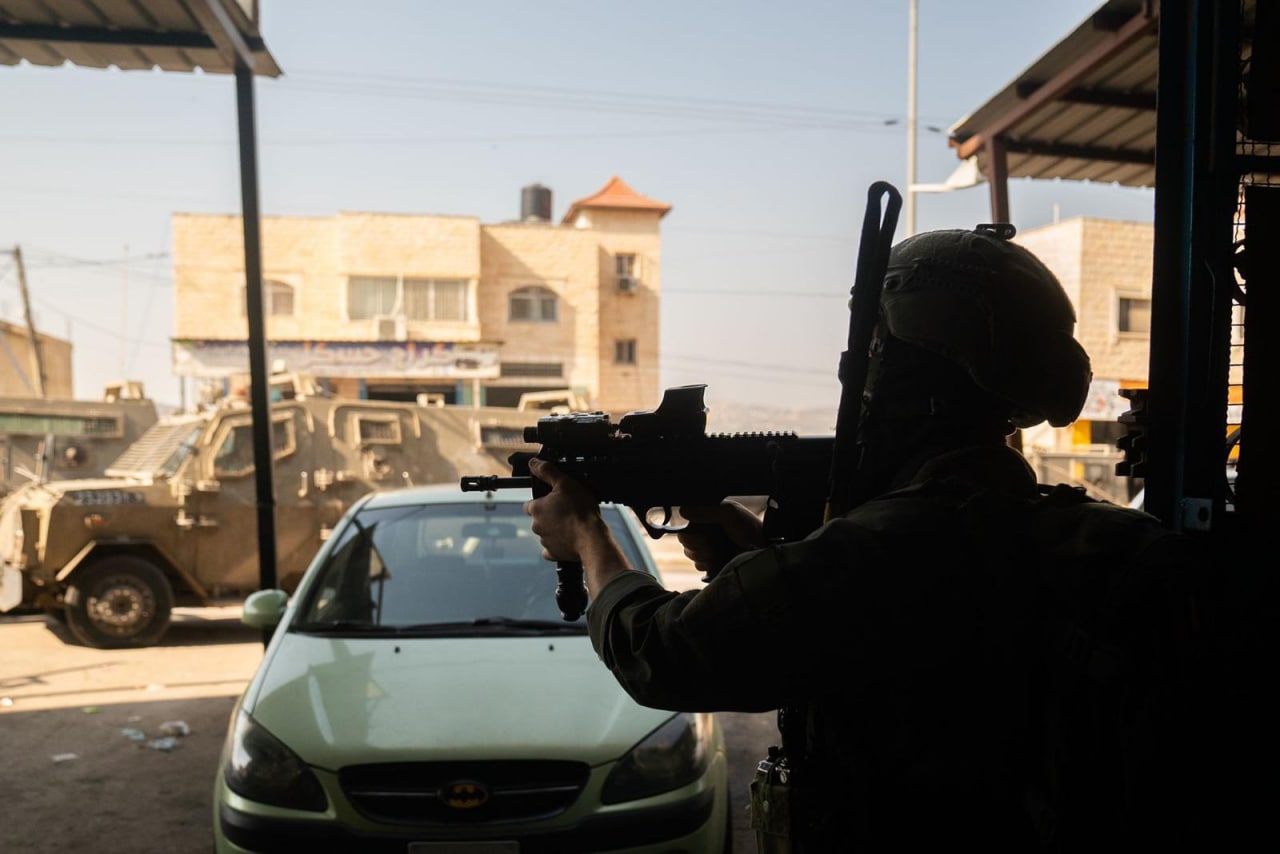
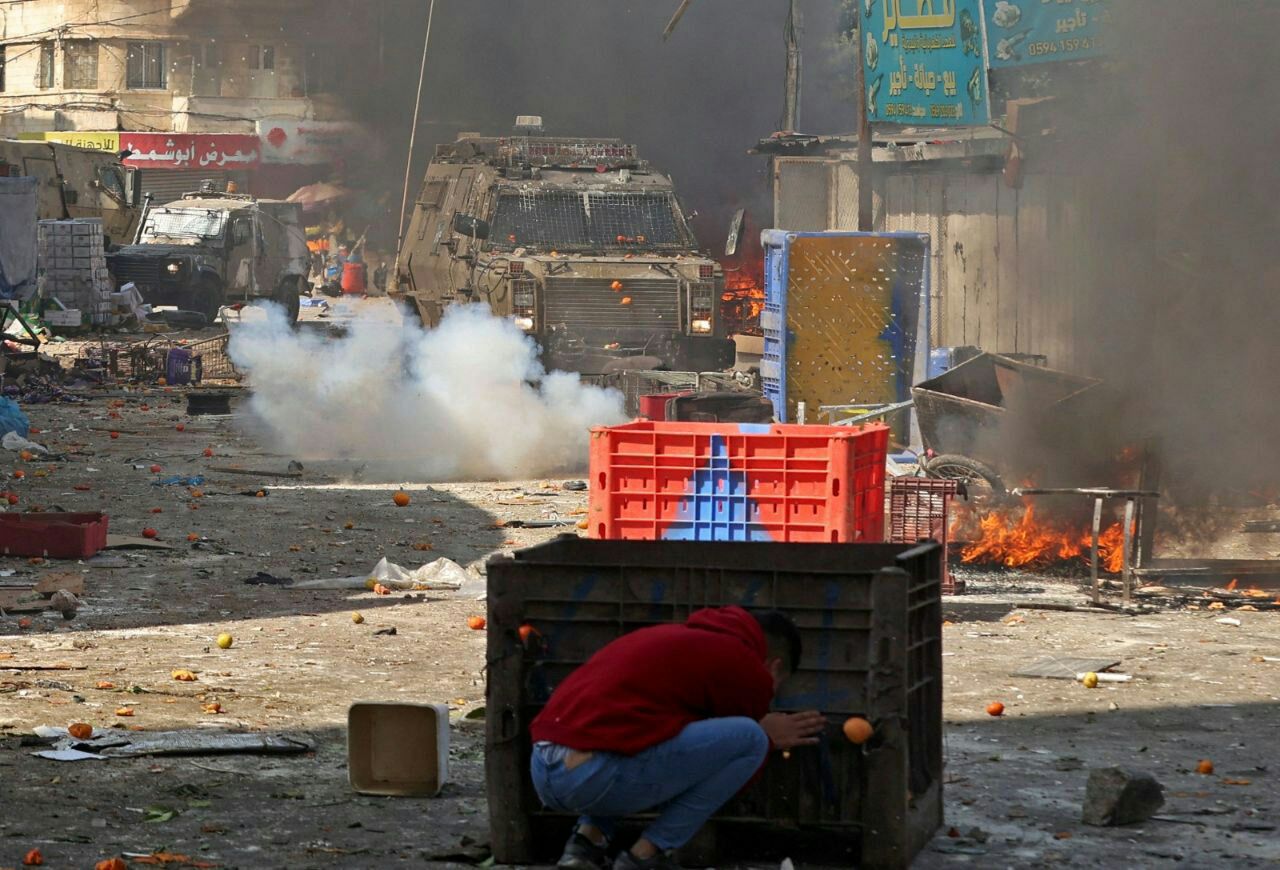
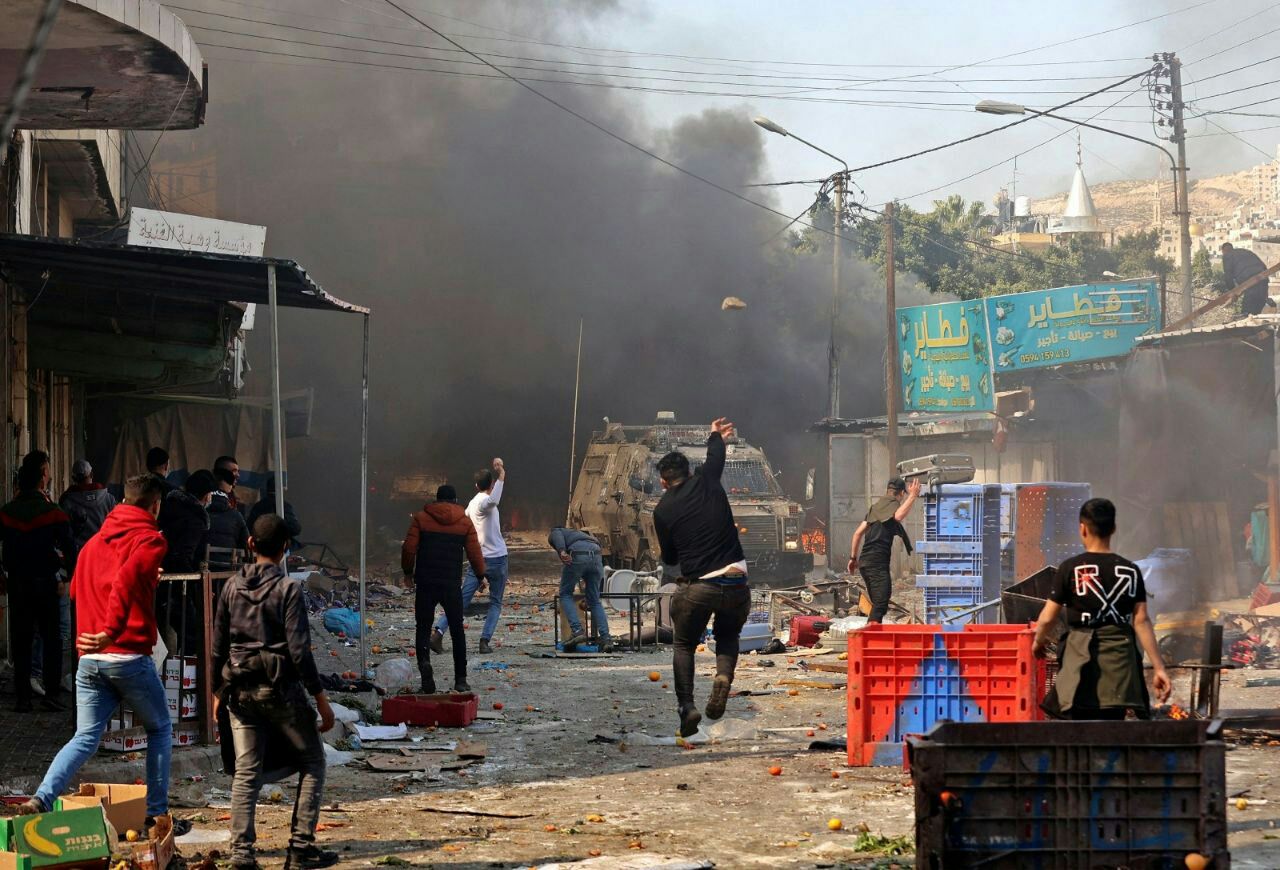
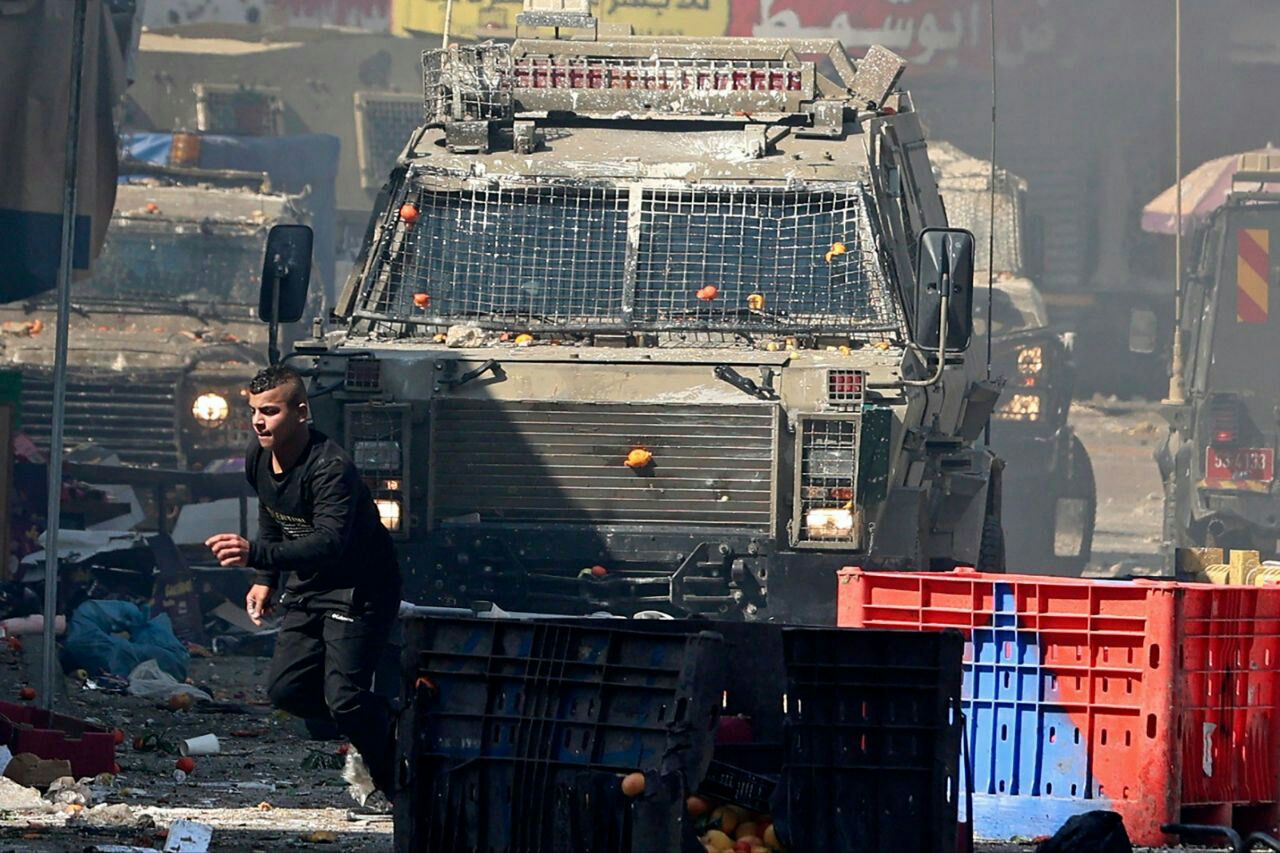
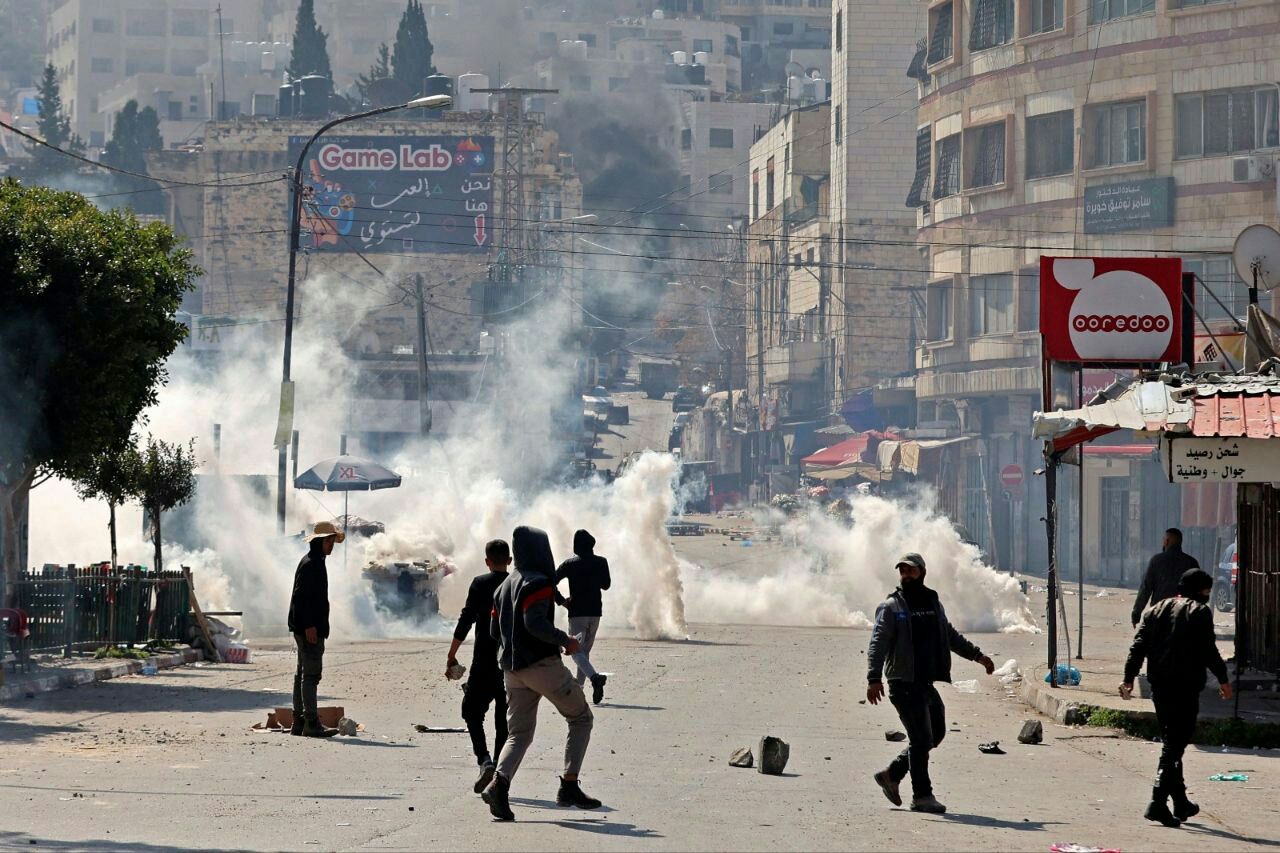
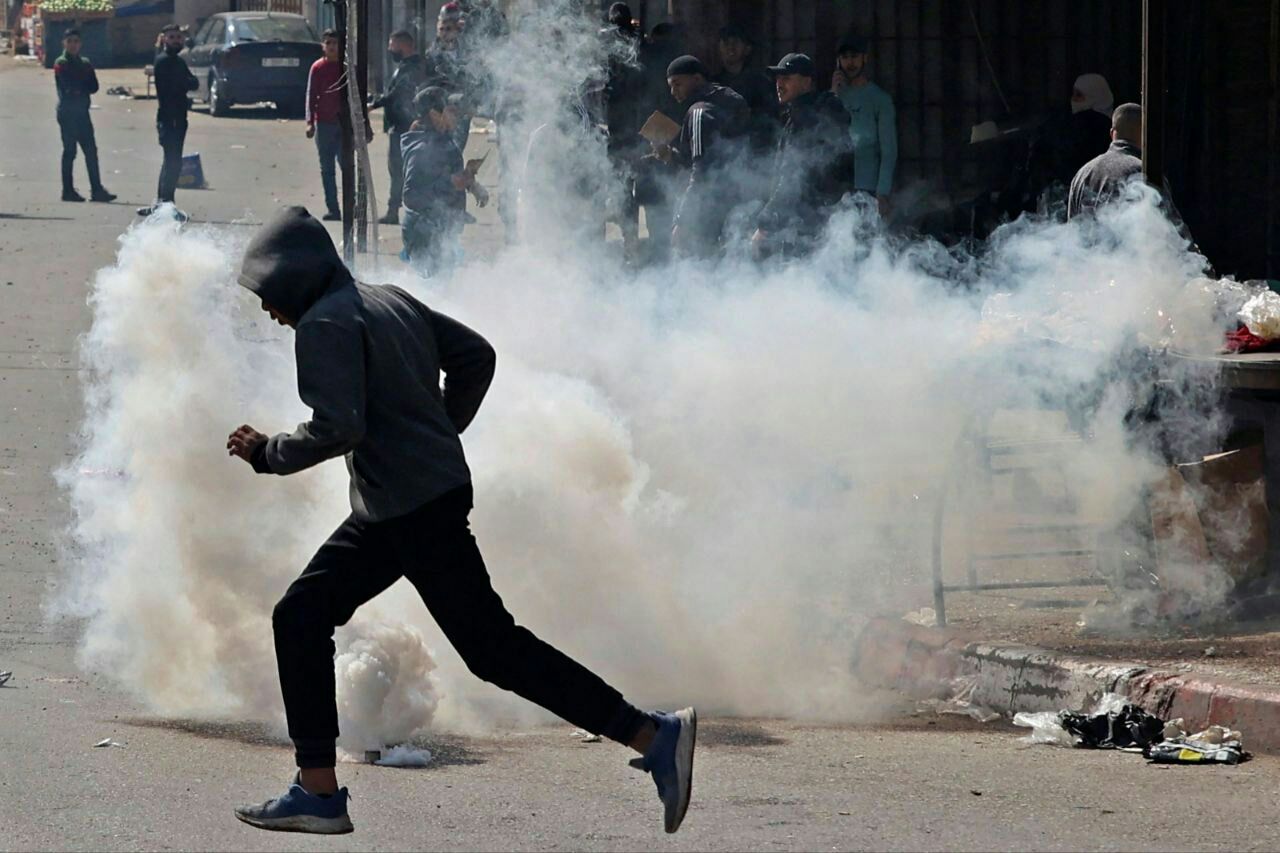
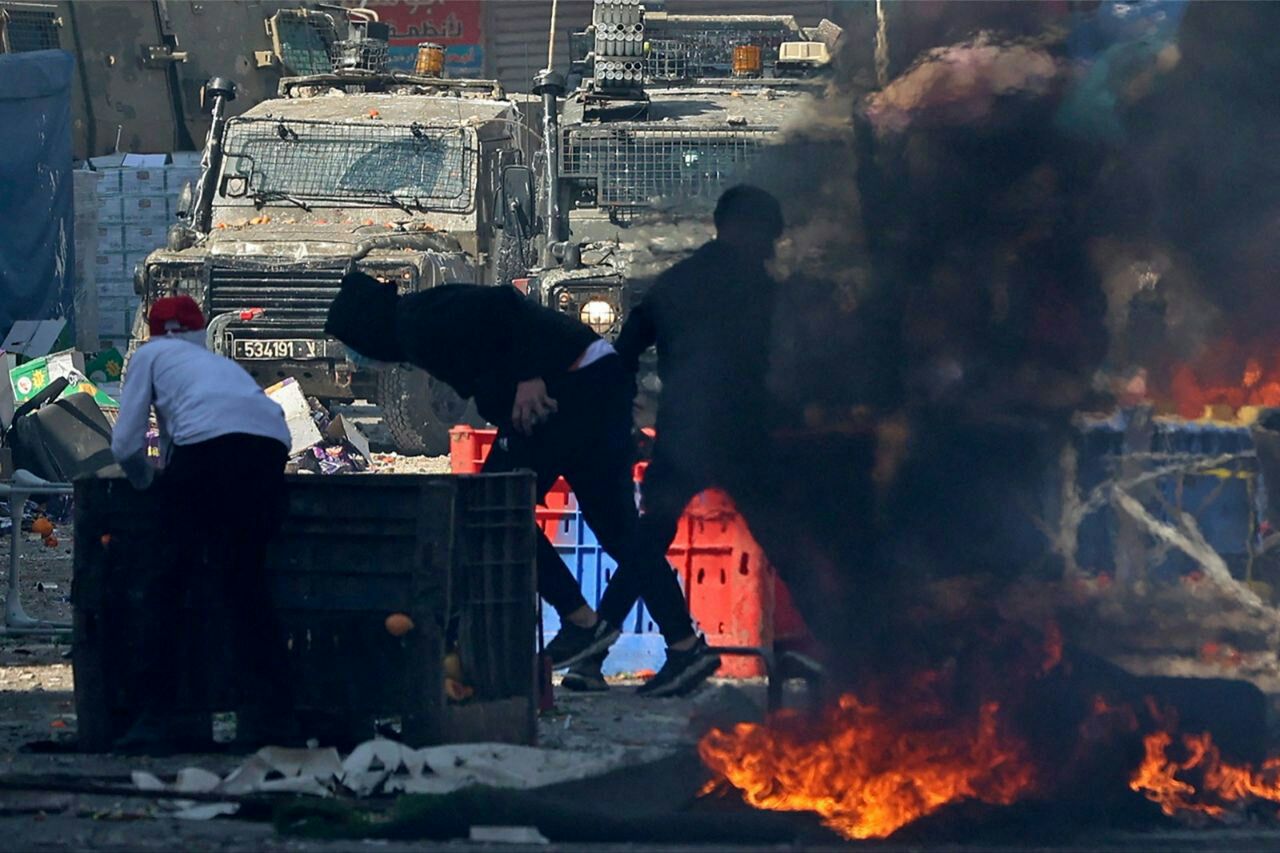
Following the Zionist troops’ attack on an old district in Nablus, fierce conflicts erupted between the Israeli forces and the Palestinian resistance militias.
Amid the skirmishes, the Israeli forces besieged houses of two Palestinian field commanders of the Al-Quds Brigades named Hisam Aslim and Muhammed al-Junidi; then, the Israelis called for the two commanders’ surrender, but the two Palestinian resistance fighters ruled out the Israelis’ demand and fought back the Zionists till their last breath.
Finally, after the martyrdom of a number of resistance fighters and injury of some others in Nablus, the Israeli forces gradually retreated from the area.
Al-Qassam Brigades’ spokesperson Abu Obeida commented after the conclusion of the mentioned clashes in Nablus that the resistance in the Gaza Strip is following the growing crimes committed by the Zionist enemy against our loved ones in the West Bank and the resistance’ patience is coming to an end.
Al-Qassam Brigades is the military wing of the Hamas resistance movement.
Given the threatening message of the Al-Qassam Brigades’ spokesman, it is expected that the Palestinian resistance groups would target Zionist settlements near the Gaza Strip in coming hours in response to the fatal attack in Nablus, which lefts many Palestinians martyred and wounded.
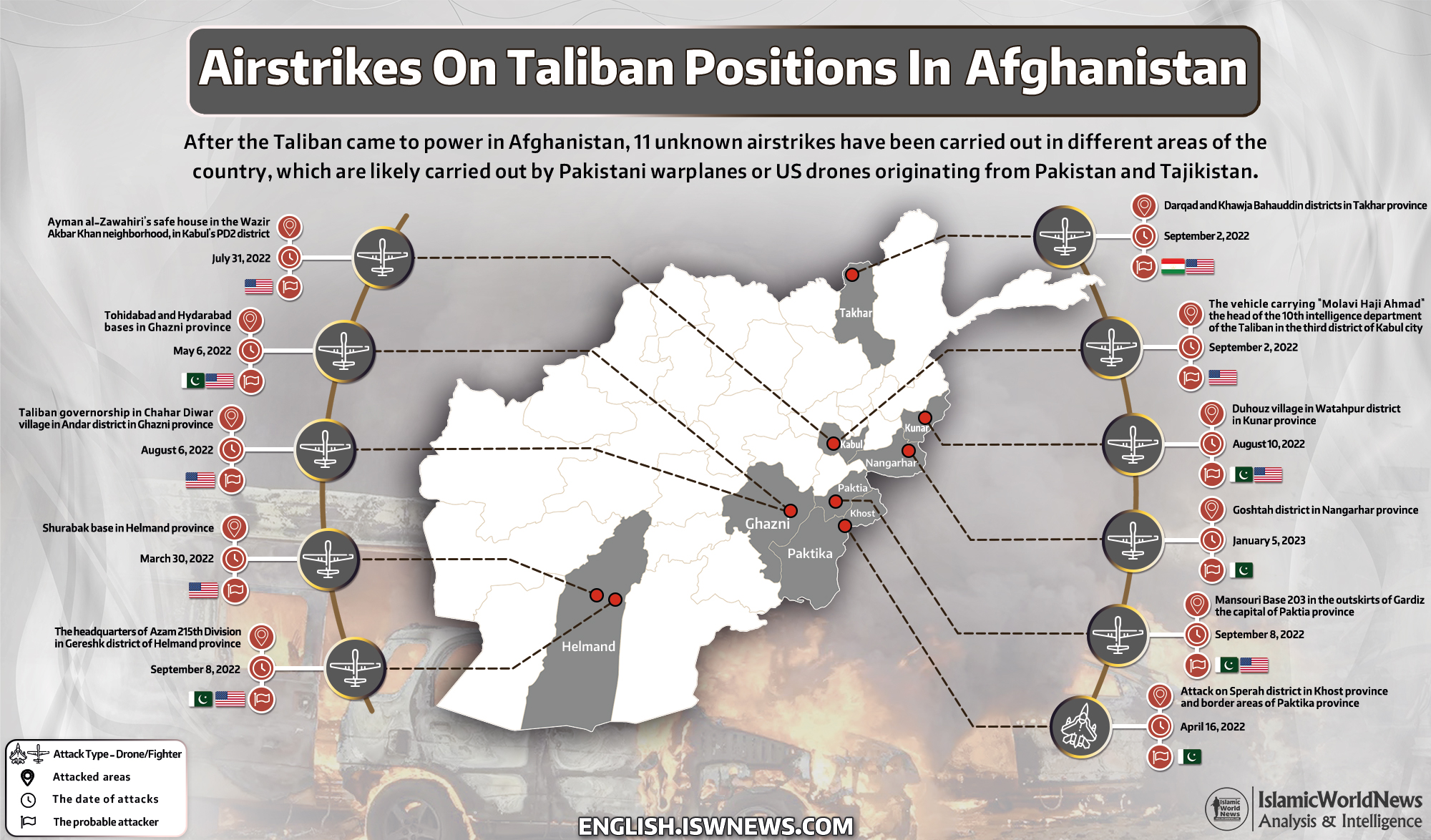
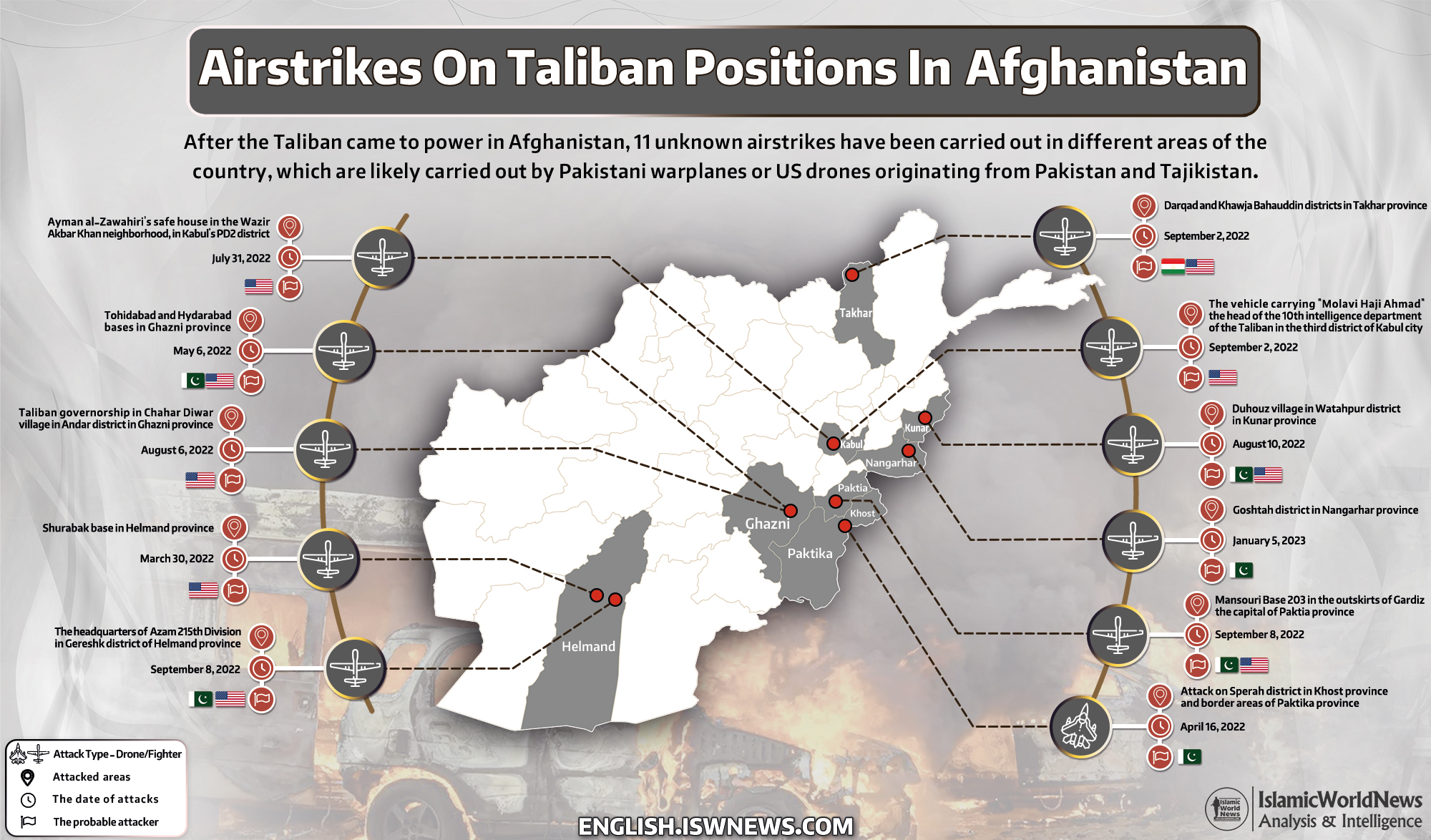
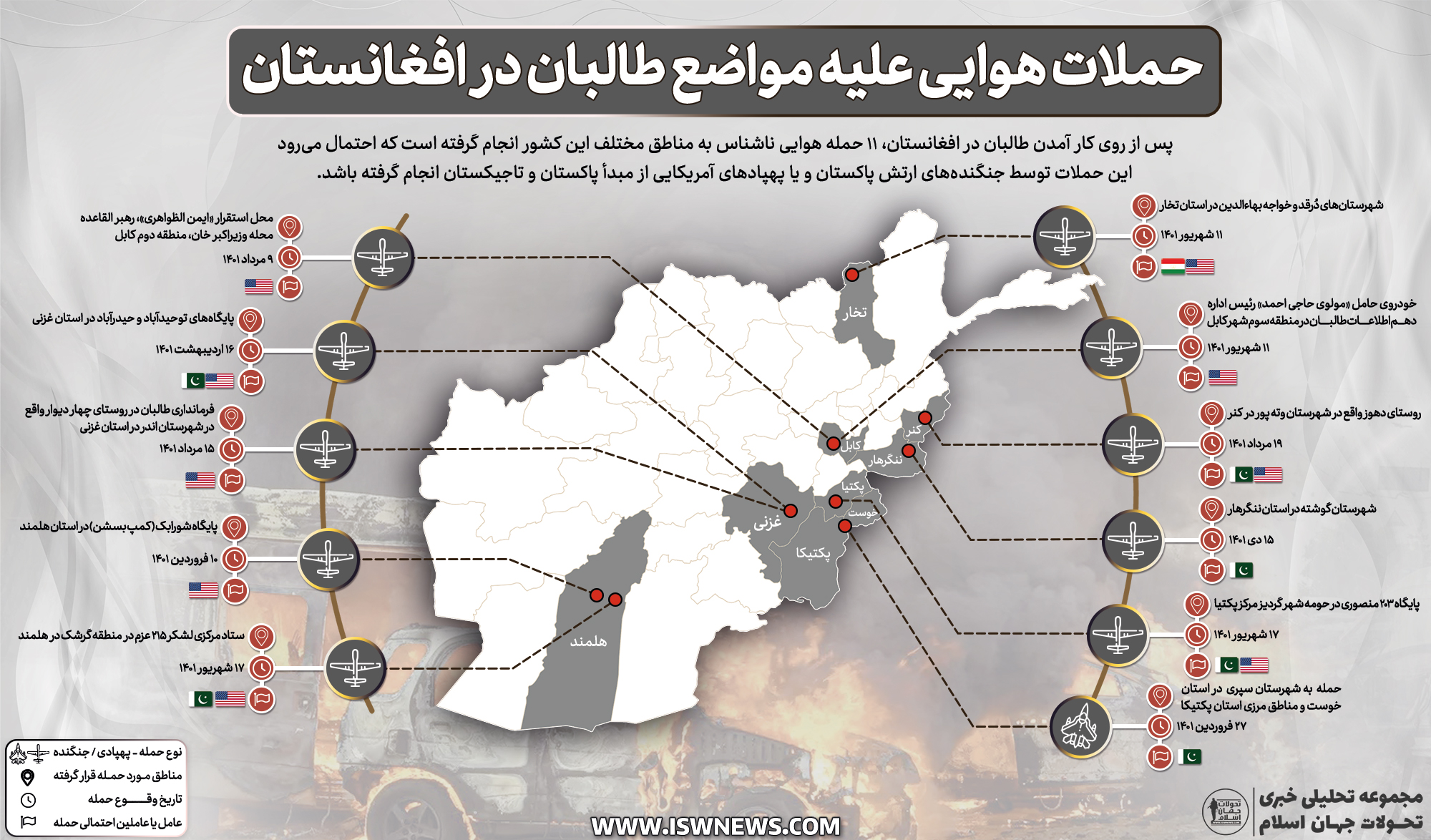
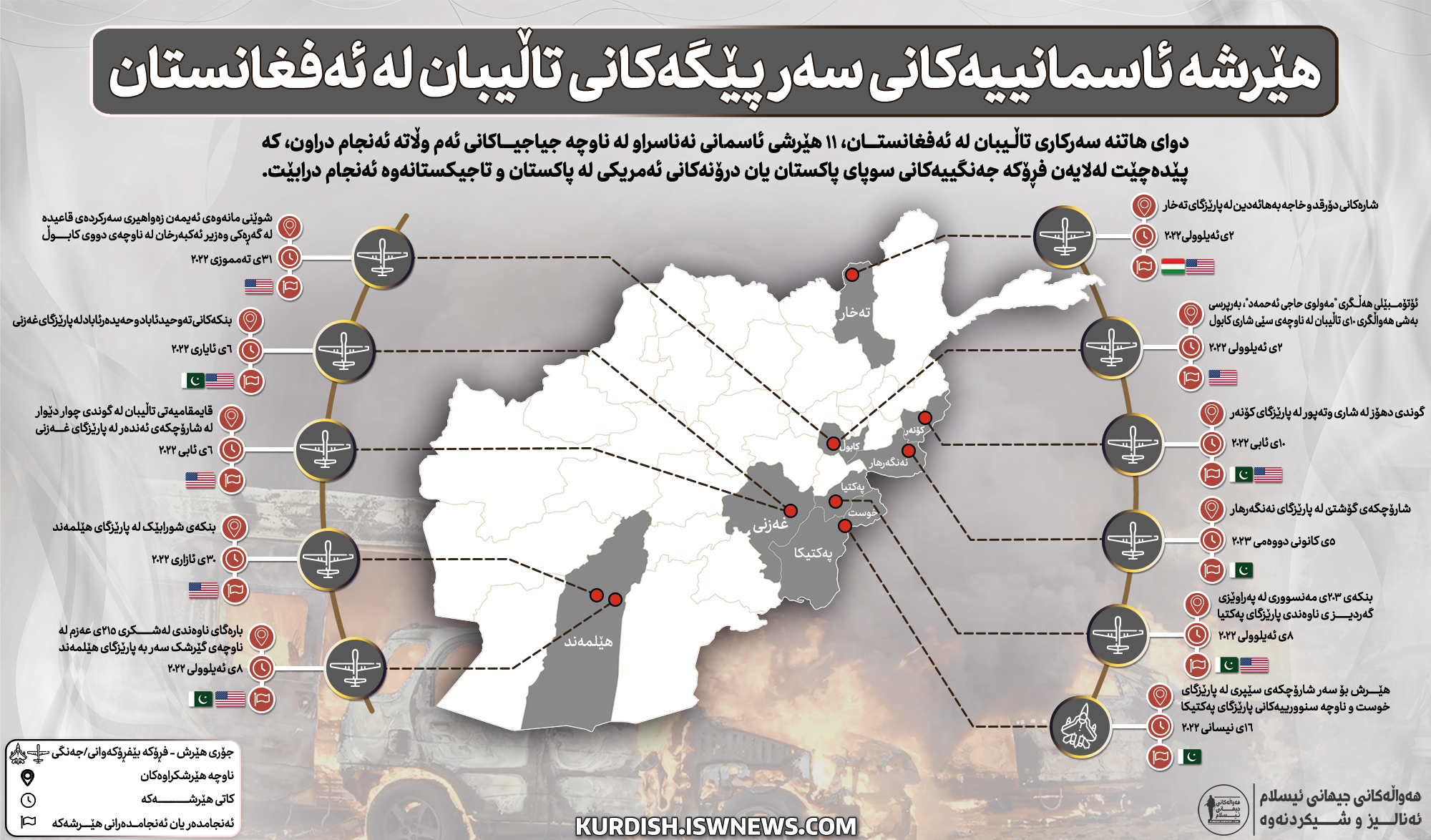
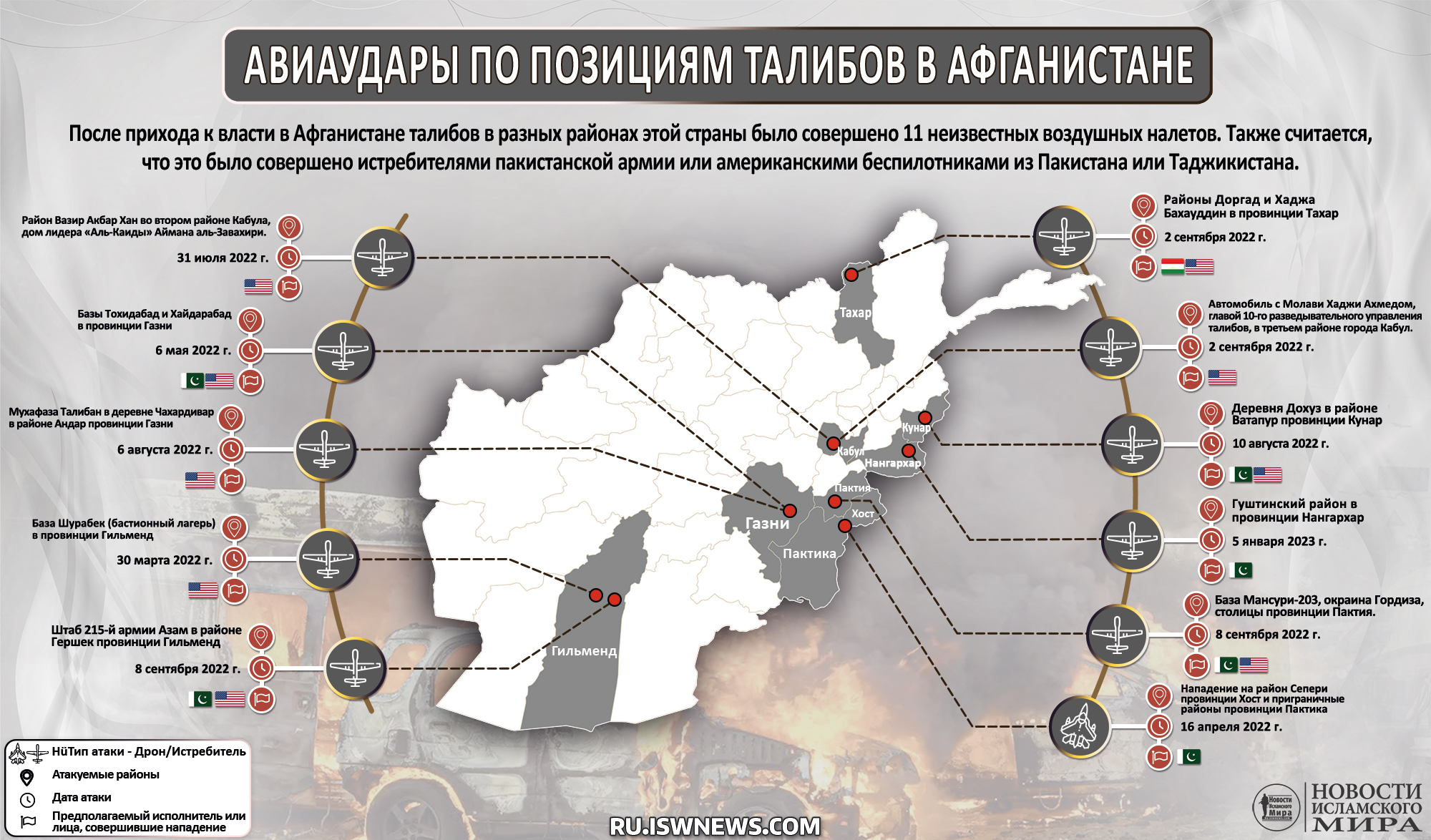
The sudden withdrawal of the US and NATO forces from Afghanistan led to a new chaos in this country, which, in addition to the collapse of Ashraf Ghani’s government and the rise of the Taliban, led to the strengthening of ISIS and increase of the activities of this terrorist group in Afghanistan. Although the US and NATO have apparently left Afghanistan, their previous and current actions are still plaguing this region, and the occasional attacks and flights of their drones have taken away peace from the people of Afghanistan.
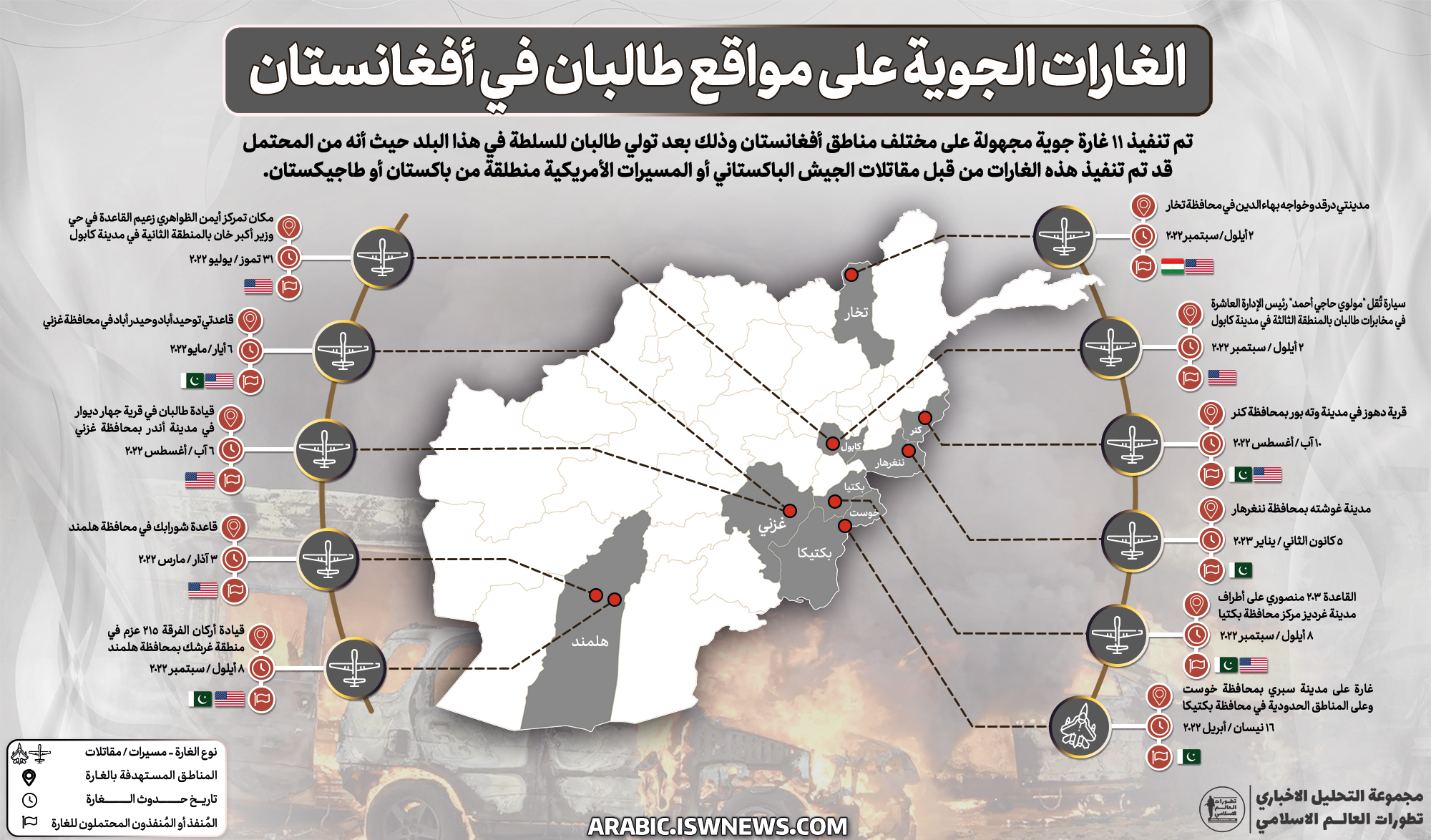
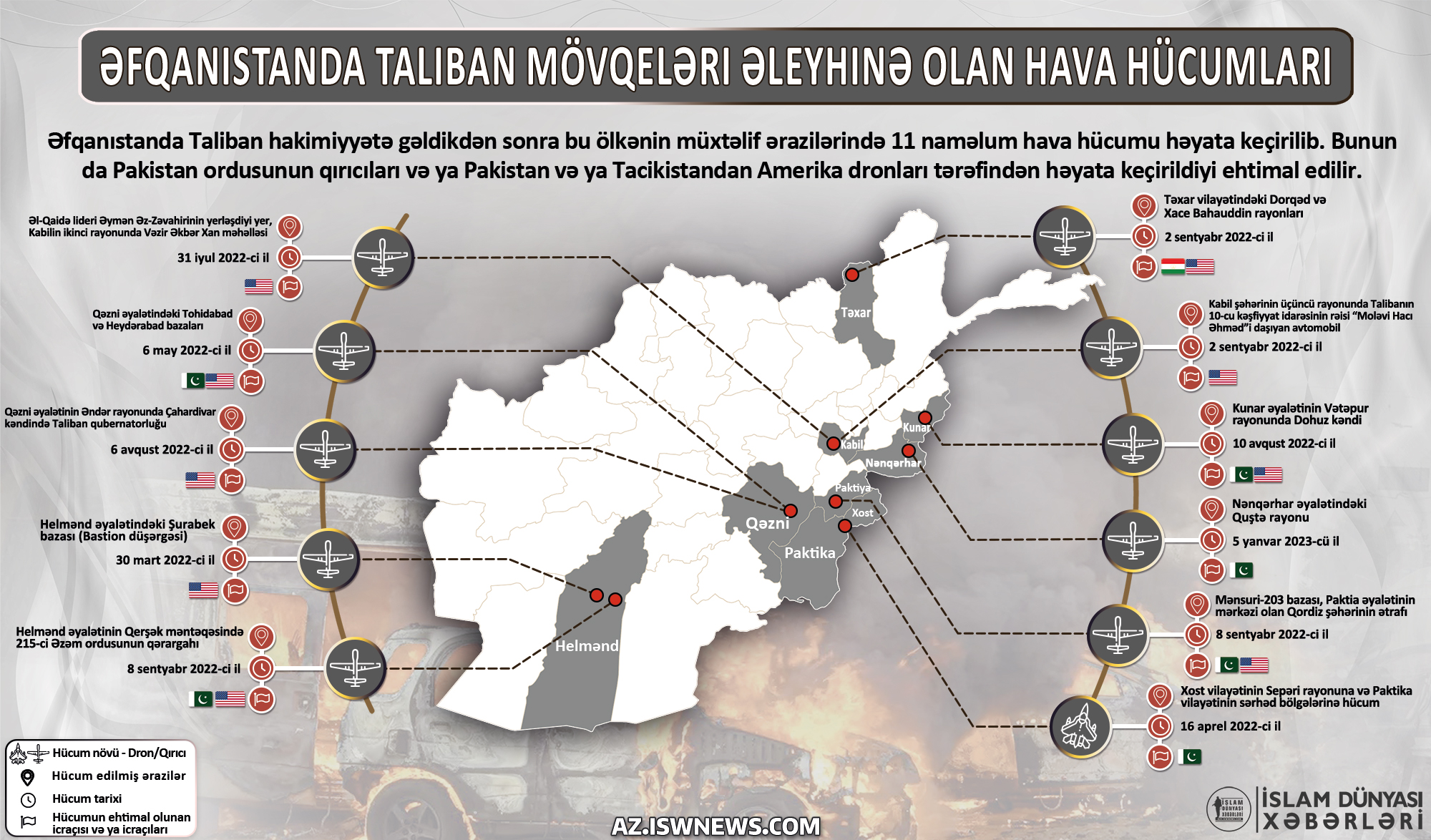
These attacks and flights have started since the spring of 2022 and have been carried out 11 times against different targets in different regions of Afghanistan. The exact cause and details of these attacks have generally not been disclosed to the media by the Taliban and the United States. However, according to available information and ISWNEWS reviews, the details of these attacks are as follows:
1- Drone attack on Shurabak base (Camp Bastion) in Helmand province, date: March 30, 2022. This attack led to several explosions in the weapons warehouse of this base and killed and wounded 30 members of the Taliban. (Possible attacker: the US)
2- Air attack by unknown fighters on Spera district in Khost province and the border areas of Paktika province, date: April 16, 2022. These attacks were carried out on the residences of Pakistani refugees from the North Waziristan region in the villages of Mir Safar and Kurai, and the positions of Pakistani Taliban militants in the areas of Mandete, Amir Sapar, Pakhi Mili and Shakuni in the Spera district of Khost province, which resulted in the death and injury of 40 people from Tehreek-e-Taliban Pakistan (TTP) militants. There are no details about the casualties and damages of the air attack on the border areas of Paktika province. (Possible attacker: Pakistan Army)
3- Drone attack on Tohidabad and Hydarabad bases in Ghazni province, date: May 6, 2022. Tohidabad base was called PRT and US troops base during the previous regime and was under the control of NATO forces. This attack was probably carried out to destroy the warehouse of ammunition and military equipment left by foreign forces. The Hydarabad base is also the headquarters of the Taliban reserve forces, and this attack has resulted in the death and wounding of 15 armed members of the Taliban reserve unit. (Possible attacker: the US or Pakistan)
4- Drone attack on Ayman al-Zawahiri, the leader of Al-Qaeda terrorist group, in Wazir Akbar Khan neighborhood located in the second district of Kabul, date: July 31, 2022 According to the US claim and the report of local sources, this attack was carried out to assassinate Ayman al-Zawahiri, which led to his death and the wounding of two officials of the Taliban Ministry of Interior. (Attacker: the US).
5- Drone attack on the Taliban governorate building in Chahar Diwar village located in Andar district of Ghazni province, date: August 6, 2022 During the previous regime, this place was the joint base of foreign troops and Afghan army soldiers, and during the Taliban period, it became the governorate of Andar district. The casualties and damages of this attack are unknown. (Possible attacker: the US)
6- Drone attack on Dahouz village in Watapur district in Kunar province, date: August 10, 2022 According to local sources and considering the previous US attacks on these areas, this village is the hideoutse of the members of Al-Qaeda group or Tehreek-e-Taliban Pakistan. (Possible attacker: the US or Pakistan)
7- Drone attack on a vehicle carrying “Molavi Haji Ahmad”, the head of the 10th intelligence department of the Taliban, in the three-way of the Habibie school located in the third district of Kabul city, date: September 2, 2022 This attack led to the death of five Taliban militants, including “Molavi Haji Ahmed”, the head of the 10th intelligence department of the Taliban, and five others, including “Abu Hassan Al-Mujahid” alias “Molavi Hanzala”, a prominent Egyptian member of the Al-Qaeda terrorist group. In this attack, four other members of al-Qaeda, namely Seyyed Mohammad Mobarez, Jahadollah Farahi, Hejrat Qureishi and Abu Omar Logari, who were accompanying “Abu Hasan Al-Mujahid” were also killed. (Possible attacker: the US)
8- Drone attack on Darghad and Khajeh Bahauddin disricts in Takhar province, date: September 2, 2022 These attacks were carried out in support of Ahmad Massoud’s forces and led to the death and wounding of several Taliban militants. (Possible attaker: the US or Tajikistan)
9- Drone attack on the headquarters of the Azam 215th Division in Gereshk district in Helmand province, date: September 8, 2022 This attack led to the death and wounding of several Taliban militants, including the general commander of the 215th Azam division. (Possible attacker: the US or Pakistan)
10- Drone attack on Mansouri base 203 in the outskirts of Gardiz, the capital of Paktia province, date: September 8, 2022 This attack led to an explosion in the weapons warehouse of this base and killed or wounded 10 Taliban militants. (Possible attacker: the US or Pakistan)
11- Drone attack on Goshtah district in Nangarhar province, date: January 5, 2023 This attack was carried out on the hideouts of Tehreek-e-Taliban Pakistan in Salala village located in Goshtah district in Nangarhar province. The casualties and damages of this attack are unknown. (Attacker: Pakistan Army)