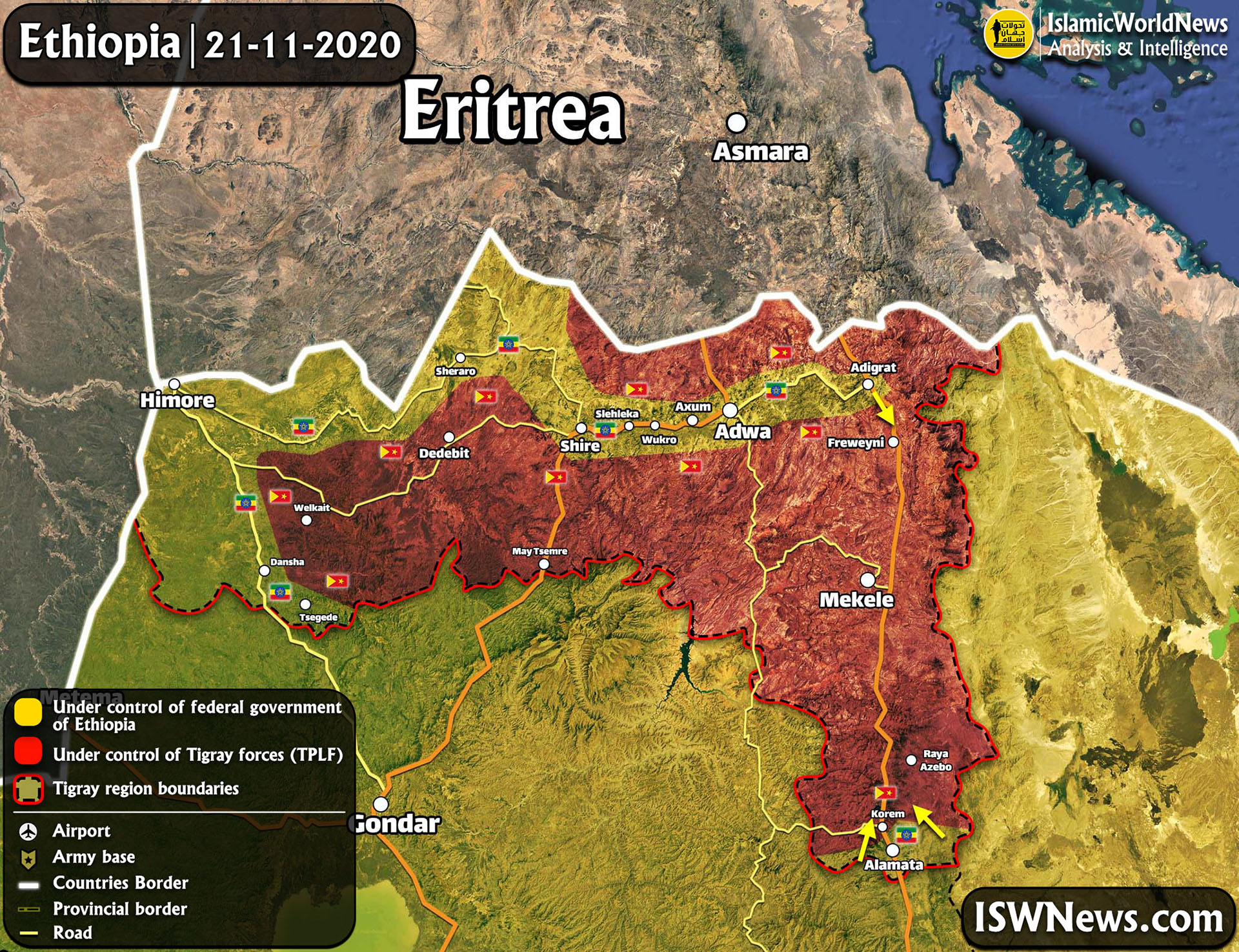
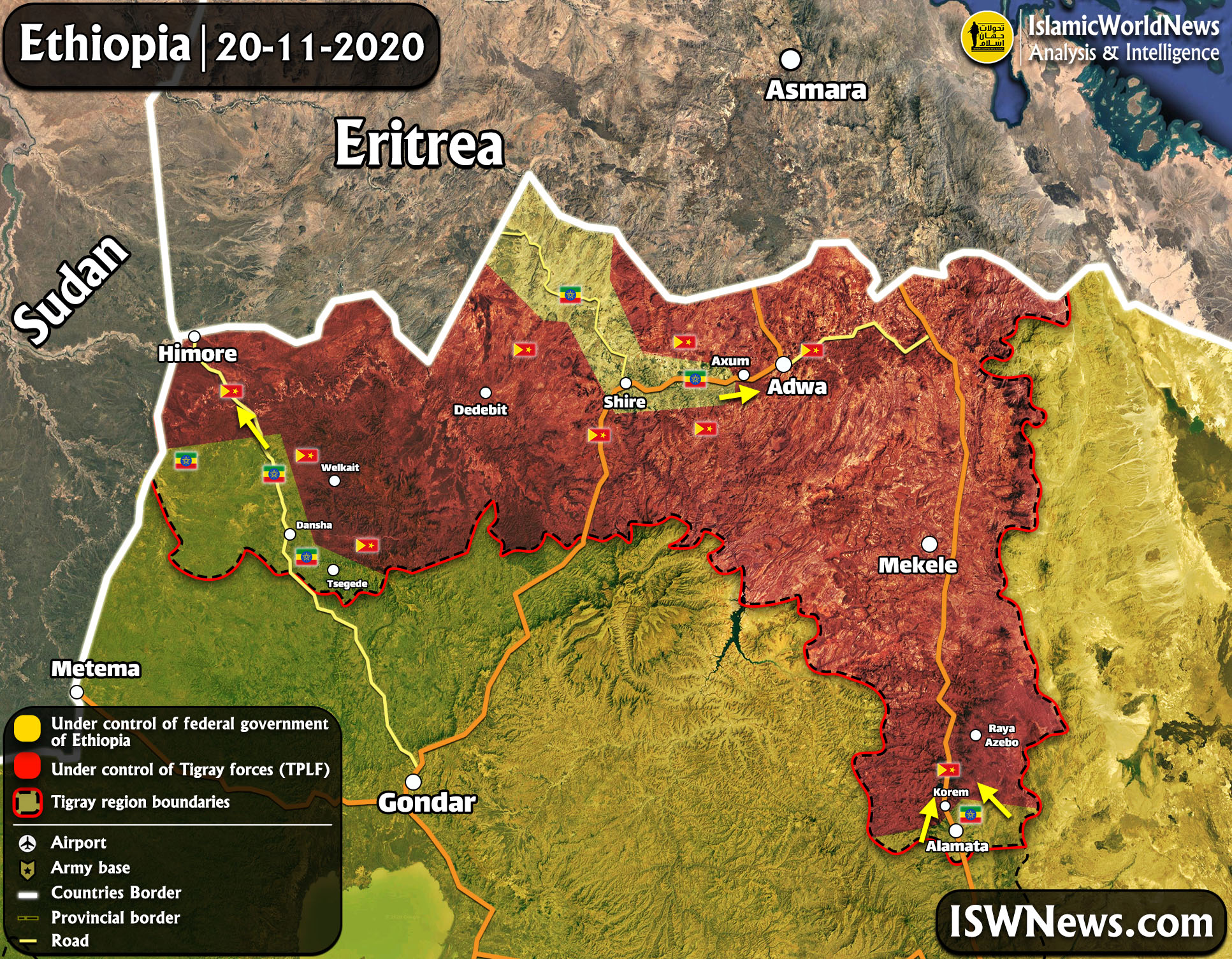
Ethiopian army forces (ENDF) with air and artillery support are approaching the city of Mekelle, the capital of Tigray province. According to local sources, nine civilians were killed during the Ethiopian army attack on Adigrat.
Since the beginning of the conflict, more than 30,000 civilians have sought refuge in Sudan, and the number of displaced people is rising. International organizations have warned of the humanitarian consequences of the war, and despite numerous calls for an end to the war, the Ethiopian military continues to ignore the issue in the Tigray region.
Ethiopian military sources claim control of the town of Axum, as well as Adwa in the northern province of Tigray, but sources in the Tigris TPLF have denied the allegations, saying clashes continue in Axum.
On the southern front of the Tigray, clashes continue in northern Alamata in the Korem region between Ethiopian army and TPLF forces.
Ethiopian Prime Minister Abiy Ahmed has said in a new statement that Ethiopian troops will soon arrive in the capital Tigray, Mekelle. The Ethiopian Broadcasting Authority has announced that it has suspended the press license of a Reuters reporter in Ethiopia. Warning letters have also been issued to the BBC and DW.
According to local sources, the Ethiopian government has stopped sending food, fuel and medical supplies to Tigray province for the past 17 days.
According to Amhara provincial officials, on November 219, the city of Bahir Dar was targeted by TPLF rockets.
Tigray region lays in north of Ethiopia along the border with Eritrea and Sudan, and the main land for three tribes of Tigray, Irob and Kunama. According to Ethiopia constitution, Tigray province enjoy a some kind of autonomy. Nevertheless, the relationship between Tigray and capital of Ethiopia was under tension from time to time and it became worse after Abiy Ahmed took power in 2018. Before Abiy Ahmed, TPLF was the strongest ruling party in Ethiopia but after Abiy was elected as PM, he started wide political reforms and limited TPLF power significantly. Tigray people believe that the central government is trying to cease the power in Tigray region completely and put TPLF aside from power.
The first signs of military tensions appeared in September 2019 when a caravan of Ethiopia forces was stopped in north of Tigray. The convoys were transferring and evacuating the Ethiopian forces from border with Eritrea after almost two decades due to the agreement between two countries to open the border and normalize the bilateral relations.
The second serious tension between TPLF and ENDF took place in September 2020 when Tigray requested the central government to help them hold the regional election in Tigray region but Abiy Ahmed canceled the election due to Covid-19 pandemic. However TPLF with support of opposition parties in Tigray province formed the election committee to hold the election and 2.7 million people participated in the election. On the other hand Abiy Ahmed announced that the government does not consider the election in Tigray official and banned the foreign reporters to cover the election.
On 4 November, TPLF attacked EDNF HQ in Mekelle city, capital of Tigray province and took control of it. TPLF claimed that ENDF were preparing for a long time to attack Tigray and this was a pre-emptive attack. Abiy Ahmed however claimed that TPLF crossed red lines and announced war against them.
Abiy Ahmed: TPLF intended to war. With today’s attacks red lines were crossed and the federal government has to enter the military conflict.
He declared a six month emergency situation and no flight zone in Tigray province, said there will be a military operation to restore the rule of law in the area. It is said that after declaration of war, the government cut the electricity, telephone and internet services in Tigray province.
TPLF also captured all the posts and stations of ENDF in the province and the forces in them joined TPLF. Some of army radars and SAMs including S-125 Pechora was ceased by TPLF as well.
It is noteworthy that TPLF has between 200-250 thousand experienced warriors and the army has 160 thousand soldiers, which is a serious challenge for the Ethiopian army.
According to TPLF officials, during the recent clashes, the group’s positions have been targeted at least 10 times by Ethiopian army warplanes. There are also reports of drones targeting Tigray positions. The UAE army are said to be assisting Ethiopia from a Assab base in Eritrea and targeting Tigray positions in northern Ethiopia.
According to local sources, from the beginning of the conflicts on 4 November so far at least 500 of TPLF or Pro-TPLF forces have been killed. ENDF suffered heavy casualties, too.
On 14 November, TPLF hit Gondar and Bahir Dar airports by several rockets. Late on November 14 also, Eritrea’s Asmareh airport was targeted with several rockets. TPLF announced that their forces are engaging with Eritrea army, which is ally of Ethiopia, in several fronts in recent days.
Currently, The conflicts continue between ENDF and TPLF in different areas of the province.
In the latest updates of the battlefield, in western front, ENDF seized control of the Gondar-Homera road and Homera airport. On the eastern front also ENDF tried to advance on Raya Azebo and Mekelle area, but the attacks were repulsed by the TPLF. In the southern front, the Ethiopian army took control of the city of Alamata, and the advance continues towards Mekelle from the south.
After conflicts broke out between two movements “Libyan National Army” (LNA) led by general Haftar and “Government of National Accord” (GNA) led by Fayez al-Sarraj in northwest of Libya, pressuring Libya to accept ceasefire, resuming oil export, etc. by foreign powers, led Libya in a direction that is important in the future of Libya.
The following article is based on the situation right now and the details can change in the future. The deductions are as follows:
1- Russia supporting Saif al-Islam Gaddafi: Some western analysts believe that Russia is using its influence in military, politics, society, etc. to bring back Saif al-Islam Gaddafi to libya’s politics. (These Russian forces include Maxim Shogali and Samir Saifan who are arrested by GNA and now in prison.) He says that using Wagner forces and using Arabic countries support (e.g. UAE) for LNA, Russia planned to occupy Tripoli which was not successful due to Turkey intervention. Now Russia, with the help of some European countries, is trying to prepare the situation for Saif al-Islam Gaddafi to come back to power. It is said that a person close to Putin, labeled as “Putin’s cook” is initiating a political movement whose mission is to acquit Saif al-Islam Gaddafi from terrorist activities and accuse his opponents and apparently its goal is to establish “security and peace, and a decisive Libya.” In the negotiations, Russia told Turkey that cities Sirte and Jufra are its red lines, since it counts on Sirte tribes support for Saif al-Islam. In addition Sirte is the gate to oil resources of libya and Russia won’t ignore it easily.
2- The influence of normalizing the relations between UAE and Zionist regime on libya: In addition to the influence on Palestinian groups fighting Zionists, normalizing the relations between UAE and Zionist regime has influence on UAE foreign and military policies specially in Yemen and Libya. One reason behind this agreement is failure of UAE in Libya and Yemen wars, which forced Emirates to form a coalition with more influential powers. The incidents of the last year in Libya are influenced by tensions and policies of countries which intervened in the civil war. UAE’s intervention only brought heavy expenses for them. Having the least common interests with the other major support of LNA, i.e., Russia and limited military capabilities against Turkey are among the failure reasons. The influence of Israel and UAE relations on Libya will be clearer in future, however we should not forget about the abduction of Imam Musa Sadr in Libya and hidden relations between Gaddafi family and Israel (claimed by Muslim Brotherhood).
3- Reduction of political support for general Haftar: Currently the supporters of LNA are changing direction from supporting militancy, which resulted in rejection of Haftar’s plan to reclaim Tripoli, to supporting ceasefire and political solutions. However this is the result of Russia and Turkey agreement mainly, which also brought serious troubles such as conditional resignation of Fayez al-Sarraj which was decried by Turkey. GNA leaders, under influence of European countries, saw their recent victory in northwest of Libya a good opportunity to leave the power and rise the peaceful flag! On the other hand, Aguila Saleh Issa, head of parliament, is supported by Egypt to be a new player in east of libya and resulted in anger of general Haftar. This can be related to Haftar’s relation with Venezuela and his oil policies, which are mainly dictated by Russia. This is not acceptable by USA and therefore the root of USA supporting Turkey’s intervention in Libya is to remove Haftar slowly using Egypt and UAE.
Considering the recent incidents, the pressure of European countries on GNA caused GNA to accept the ceasefire and hold the election. Russia influence in the east and USA will resulted in limiting nationalist general Haftar power in east of Libya. Continuation of ceasefire, resuming oil export and holding presidential election are the topics to discuss between four influential powers in Libya, i.e., Russia, EU, Arabic states and Turkey. In case of an election in March 2021, the main candidate will be Saif al-Islam Gaddafi.
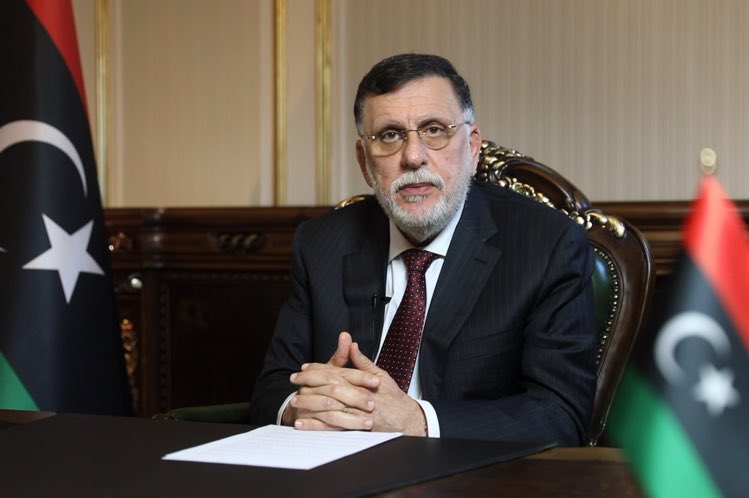
Fayez al-Sarraj expressed hope that a new leadership committee would be formed by the end of October and that he would resign from the post of chairman of the presidential council of the GNA after handing over power to the committee.
Earlier, Bloomberg reported Fayez al-Sarraj imminent resignation until the Geneva talks next month (October 2020).
Talks are currently under way in Morocco between the two sides, the Government of National Accord (led by Fayez al-Sarra) and the Libyan National Army (commanded by General Haftar), with the aim of ending the civil war and holding elections to form the Libyan government.
Meanwhile, the main supporters of the two sides, Russia and Turkey, have also reached an agreement to establish a ceasefire in Libya and the Libyan civil war, which has continued since the fall of Gaddafi in 2011, seems to be coming to an end.
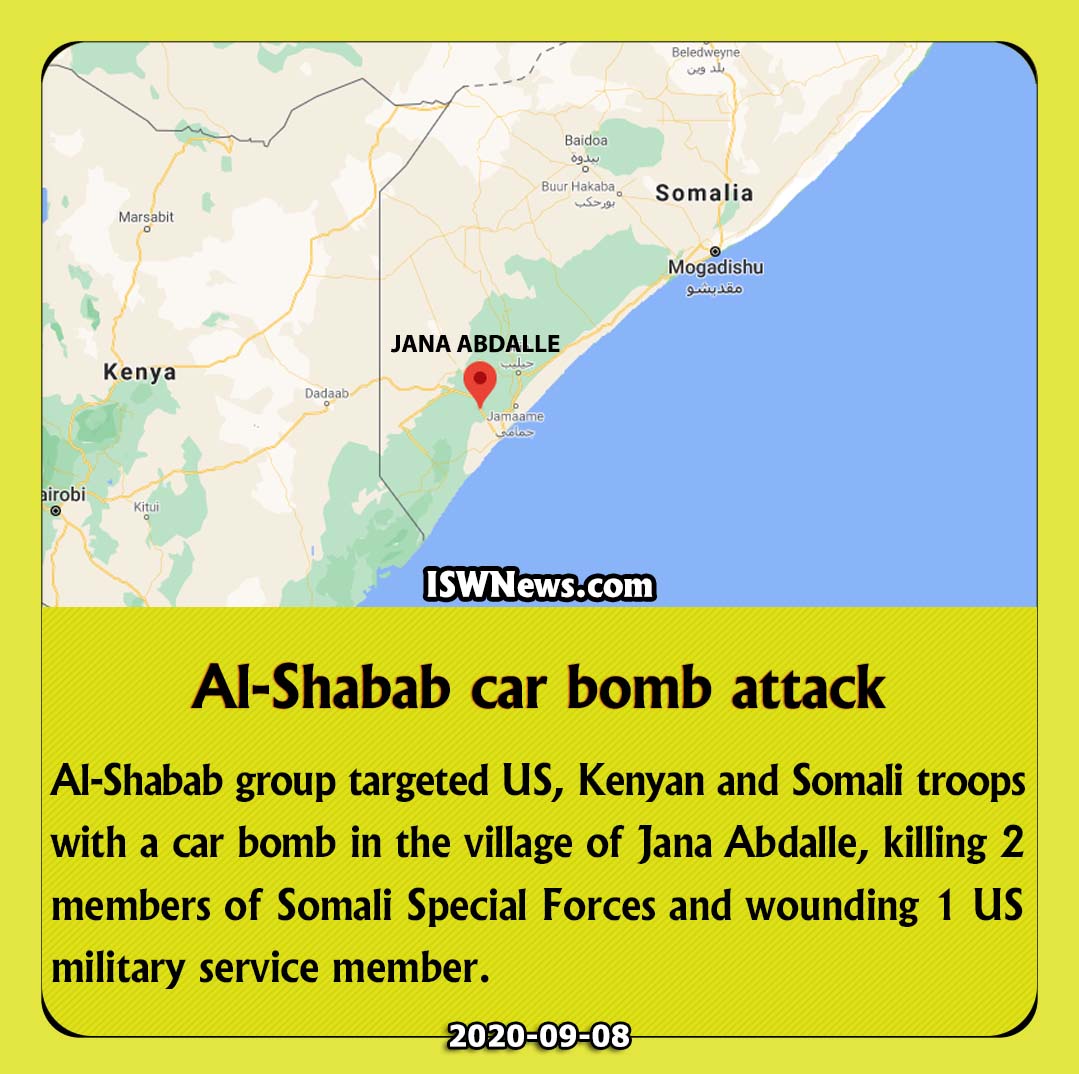
The village of Jana Abdalle is located 60 km northwest of the coastal city of Kismayo. The village has recently liberated from al-Shabab forces. According to available information, the attack was carried out against a joint patrol convoy of American, Kenyan and Somali forces.
Al-Shabaab said in a statement that 16 soldiers, including four American soldiers, had been killed and dozens more wounded in the attack; But Somali officials have denied Al-Shabaab claims.
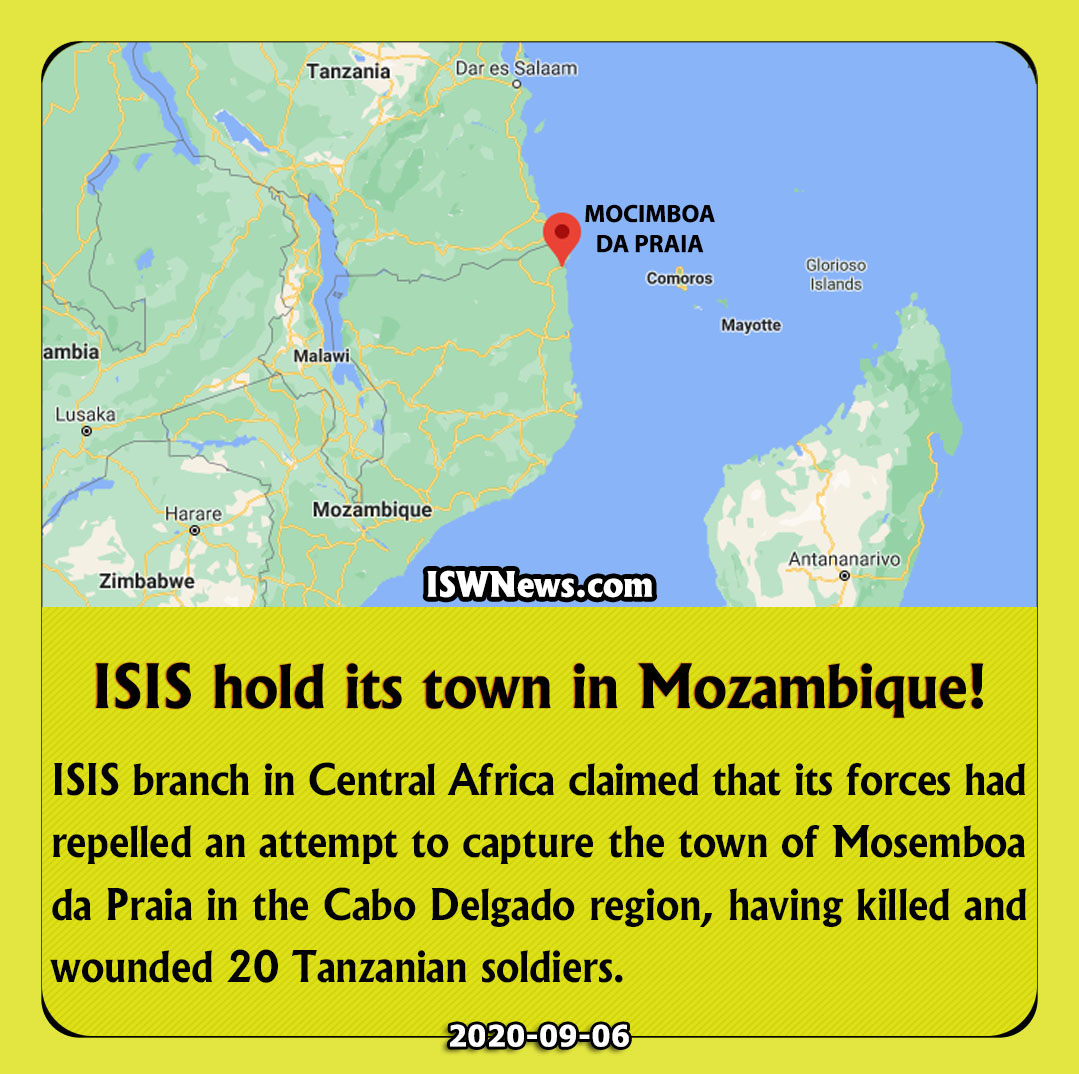
Twenty soldiers of the Tanzanian army allegedly were killed and wounded after Islamic State elements in Central Africa (ISCAP) repelled an attack against them in northeastern Mozambique. According to ISIS media, a joint force of the Tanzanian and Mozambican armies attacked the positions of the ISIS in the town Mocimboa da Praia in the Cabo Delgado region, however ISIS forces managed to repel the attack and the town is still in hands of ISIS elements.
In recent months militants have taken a number of northern towns in Cabo Delgado region, displacing tens of thousands of people. The militants attacks began in 2017 in the northern province of Cabo Delgado, but escalated this year after the group responsible, Ahlu Sunnah Wa-Jama, pledged allegiance to ISIS. The town of Mocimboa da Praia have seized by ISIS forces on 23 March after days of fighting.
The town is near the site of natural gas projects worth $60bn. The Mocimboa da Praia port is used for cargo deliveries to the oil projects about 60km away, which are being developed by oil giants including Total.
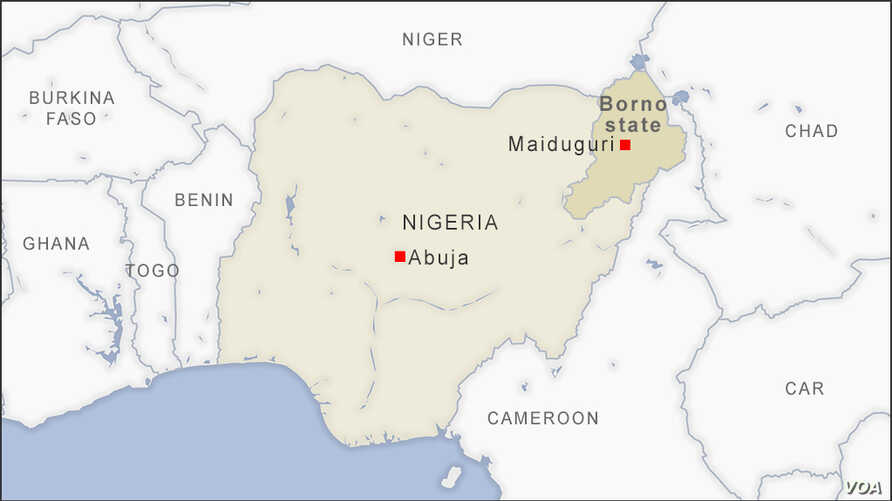
The Islamic State in West Africa Province (ISWAP), known as Boko Haram, is a terrorist group that operates mainly in Borno state in northwestern Nigeria and in the border areas around Lake Chad. Lake Chad is located between the four countries of Nigeria, Niger, Chad and Cameroon, and in recent years, securing the region has become a major challenge for these countries.
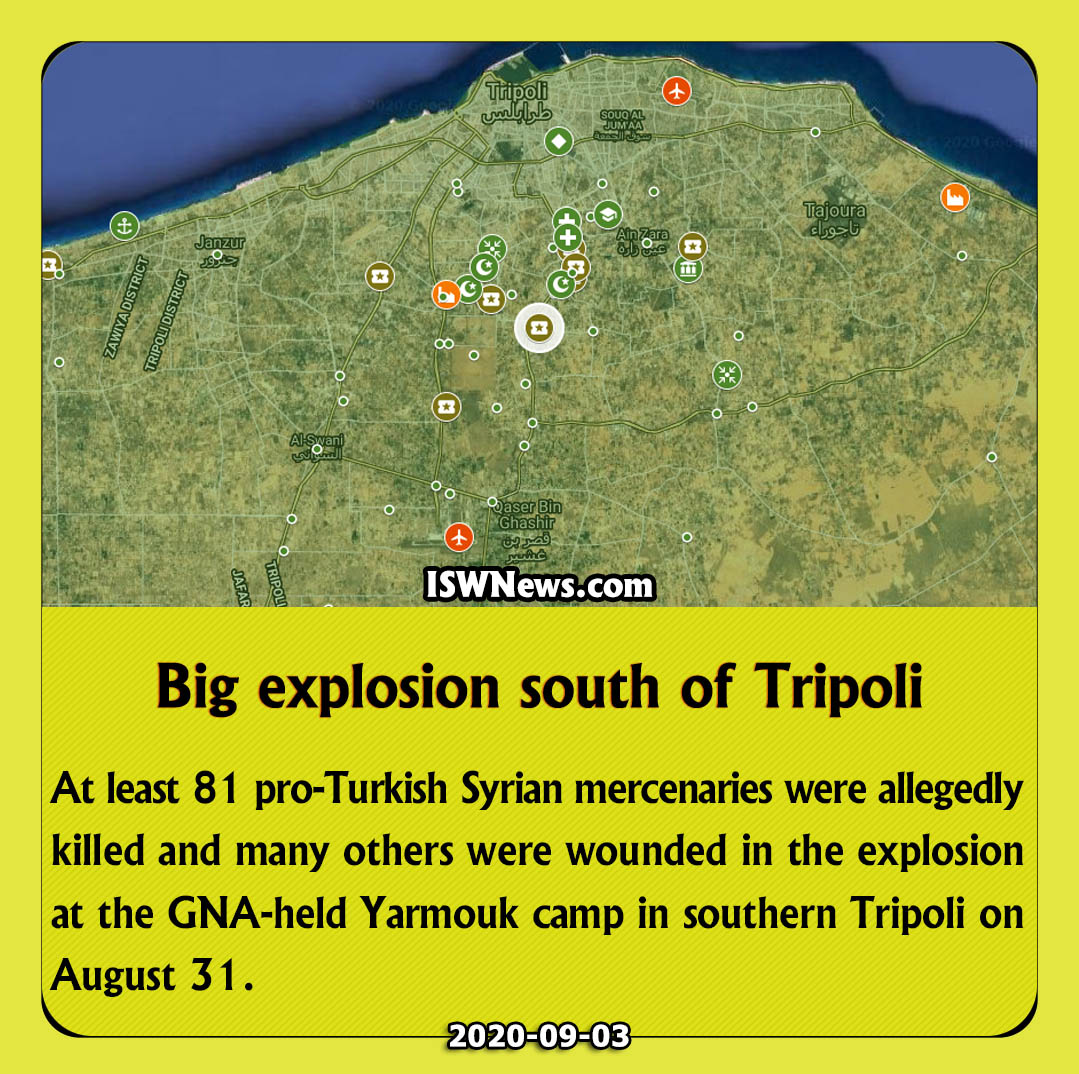
The base is under the GNA control and the cause of the explosion has not been officially announced yet. Some have attributed the blast to a car bomb, and there have been rumors of clashes between GNA forces and Syrian mercenaries over financial issues.
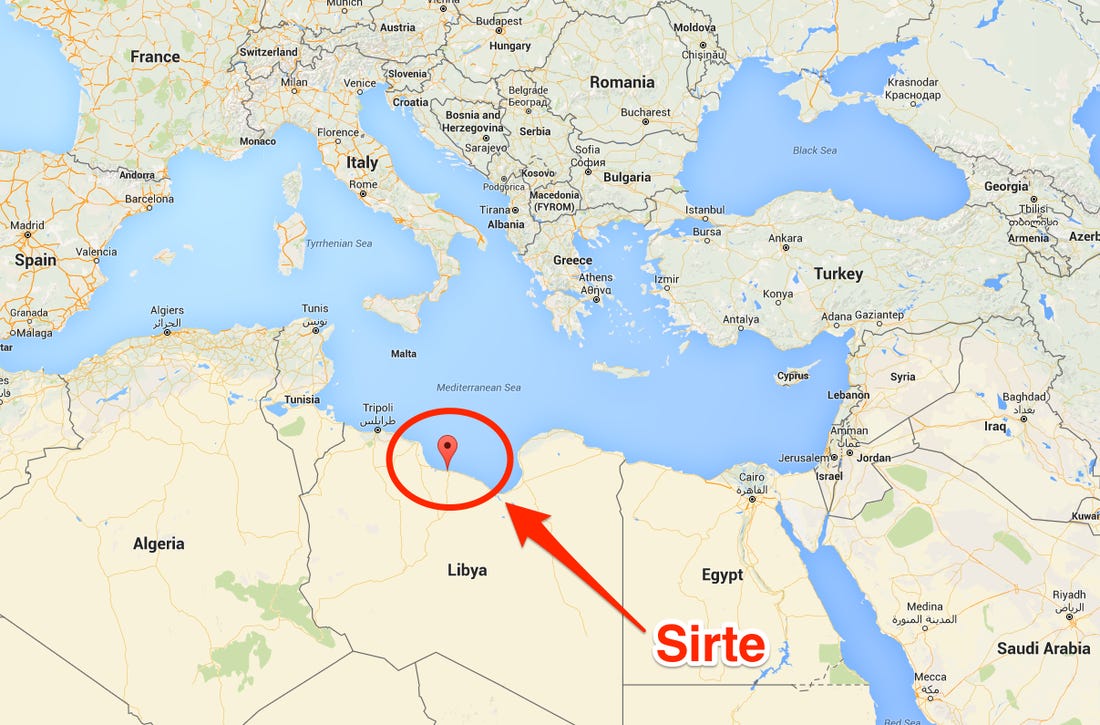
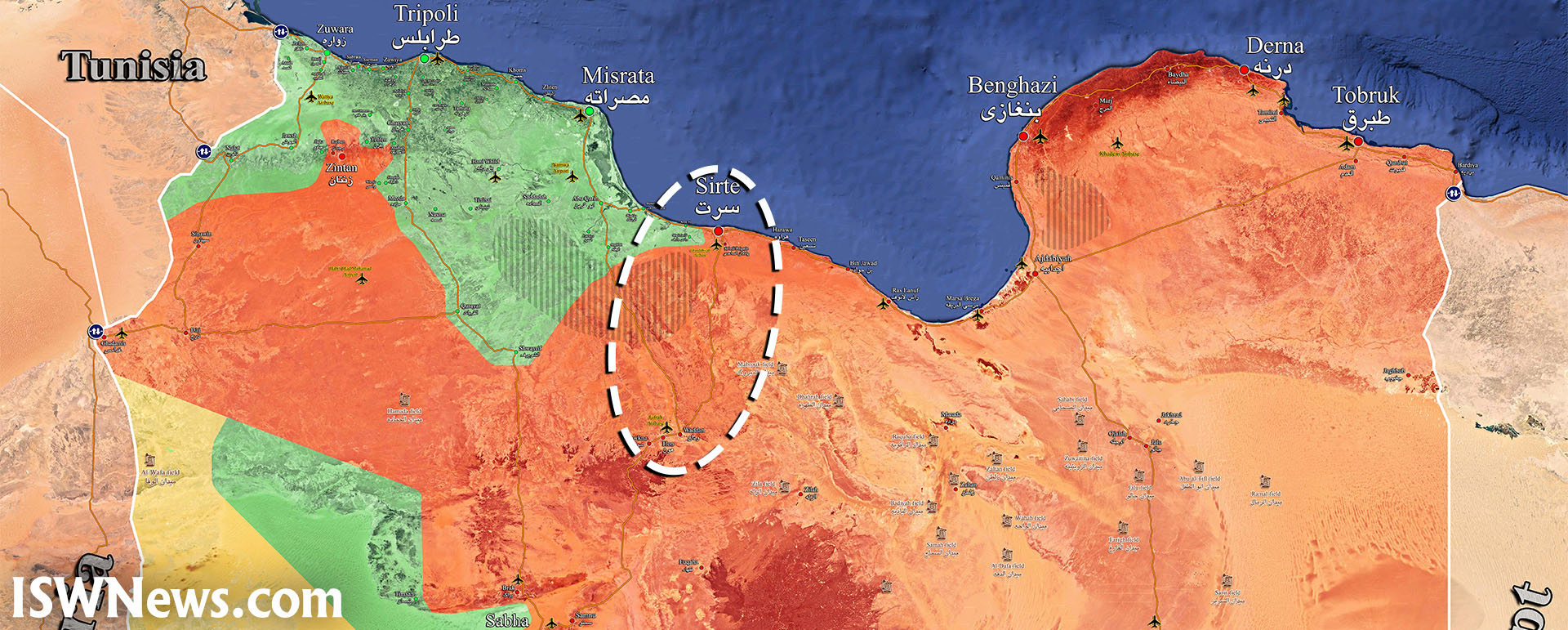
Last Friday, President of Government of National Accord, Fayez Al-Sirraj and President of the Libyan House of Representatives Aqila Saleh announced a ceasefire across and the ceasefire was welcomed by many countries, including LNA’s supporters. However, LNA forces rejected the announced ceasefire and it seems they won’t withdraw from Sirte and Jufra peacefully.
Col. Muhammad Qanun, the GNA spokesman also stated that the LNA keeps hundreds of Chadian and Janjaweed mercenaries in a training camp in Zalla and LNA forces set up checkpoints from eastern Sirte to Al-Jufrah and to southern Sabha.
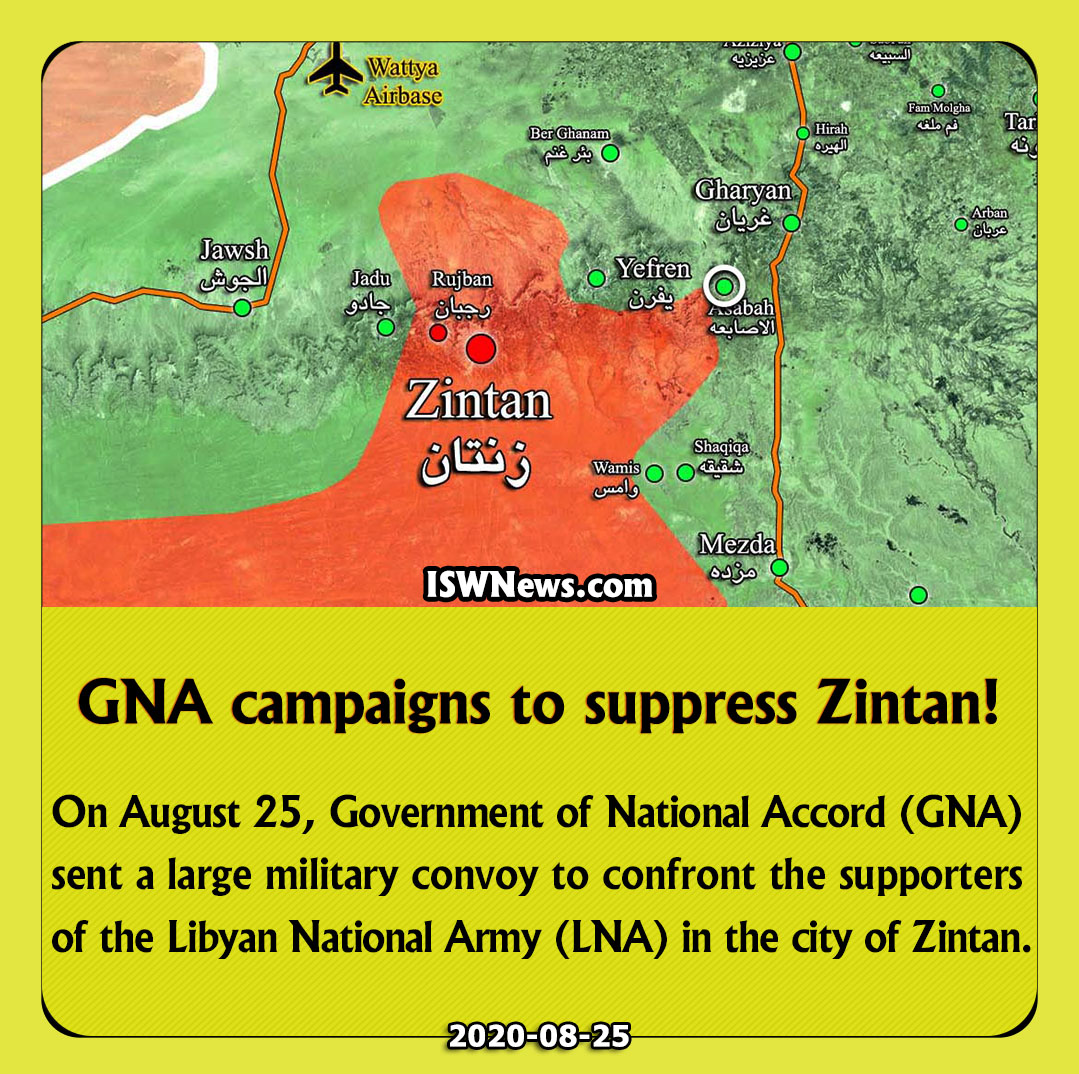
According to images, about 200 vehicles belonging to the GNA entered the town of al-Asabeah. So far, these forces have not entered the areas under the control of pro-LNA forces. However, the purpose of these activities is to put pressure on pro-LNA groups in the Zintan and the surrounding areas.
In the latest advance by Turkish-backed GNA forces, which led to the recapture of southern Tripoli, the Zintan and southern areas remained under the control of forces loyal to the Libyan National Army under General Haftar.
According to separate statements by Fayez al-Sarraj, head of Government of National Accord (GNA) located in west of Libya, and Aguila Saleh Issa, president of House of Representatives (HoR) located in east of Libya, they stress demanding ceasefire, readiness to hold the presidential and parliament election in March 2021 and, resuming negotiation regarding extracting oil and its income and removing weapons from cities Sirte and Jufrah. In case of ceasefire, Sirte city will be temporary HQ of Libya presidential council.
UN and European and other countries welcomed the agreement and emphasized on foreign forces to leave Libya.
GNA and LNA conflicts intensified after general Haftar operation in south of Tripoli and northeast of Libya but GNA under full support of Turkey could defeat the operation and reclaimed northwest of Libya again. The conflict sides in Libya tried agreement sever times but everytime it failed due to interference of foreign countries.