The head of Human Rights committee of Azerbaijan parliament said: Bill of “media law” in 9 chapters and 78 articles in presence of near 50 media owners was drafted in different commissions. Zahed Oruj claims that the new bill by the government helps with development of media in Azerbaijan Republic.
According to state-run TV, Khazar TV, according to the bill the social media activists with Azerbaijan nationalities are treated like reporters but foreign reporters are exempted from the law.
There are six thousand social media activists with large number of followers in Azerbaijan.
The articles of the new law shows that the government helps the large audience media financially. Also Humanistic ideologies and free speech are allowed but religious activities are banned. Promoting racial, religious, gender and tribal discrimination is crime.
The new law prohibits religious and ethnic parties and groups in Azerbaijan from publishing the press, launch TV and radio networks, websites and any activities in social media.
The bill allows foreign individuals and companies to support up to 25% of published contents.
The monitoring council is allowed to suspend the activities of violators for 24 hours until the accusations are judged.
According to ISWNEWS analysis, Azerbaijan government is limiting the free speech of parties, groups and individuals who have critiques. Also political, religious parties and ethnic groups could relay their messages on social media after their formal media were closed.
Most of the media are controlled by the government and its allies, and in some cases, they are controlled by fake identities.
The authorities use a range of measures to restrict freedom of the media within the country. Opposition and independent media outlets and journalists have their access to print-houses and distribution networks limited, or can find themselves facing defamation charges and crippling fines and are subject to intimidation tactics, including imprisonment on fabricated charges.
Most Azerbaijanis receive their information from mainstream television, which is unswervingly pro-government and under strict government control. According to a 2012 report of the NGO “Institute for Reporters’ Freedom and Safety (IRFS)” Azerbaijani citizens are unable to access objective and reliable news on human rights issues relevant to Azerbaijan and the population is under-informed about matters of public interest.
The government is clueless how to deal with six thousand informal social media activists and see them a big source of uncensored contents. Helping financially the favored media and banning the opposite media is the way the Azerbaijan government is trying right now.
Gagam Stepanian, an Armenian citizen and human rights activist from Nagorno-Karabakh told Armenian Radio: On Thursday, December 2, Azerbaijani forces opened fire on Armenian civilians near the contact line near the Karmirshuka town. The shooting began at 10:30 a.m. local time and lasted for 15 minutes.
Karmirshuka is located in the south of the Nagorno-Karabakh region and near the contact lines between the Azerbaijani and Armenian government forces.
Also on Friday, December 2, the Azerbaijani border guards fired on an Armenian civilian in Martuni province in Rayon Khojavand.
Siran Sarkisian, a 65-year-old Armenian civilian living in the town of Chartar, was shot and killed while grazing livestock near a border post.
Azerbaijani sources have remained silent on the matter, but unofficial sources identify the dead man as an armed militant who had intended to sabotage.
The Foreign Ministry of the Artsakh (De facto) government condemned the actions and said in a statement: “The action of the Azerbaijani government against Armenian citizens is against international law and human rights, and Azerbaijan is openly violating all bilateral agreements so that the Armenian people forced to leave their homeland.”
Exchange of prisoners with map of minefields
According to the Sochi agreement, the governments of Azerbaijan and Armenia exchanged prisoners and minefield maps with the mediation of the Russian Federation.
On Saturday, December 4, the Azerbaijani government released 10 Armenian prisoners of war taken hostage in the border clashes of November 16, and handed them over to the Russian mediating delegation. The released prisoners are Narek Yerimian, Araik Araklian, Serjik Amirkhanian, Georg Akopian, Robert Nalbandian, Harut Sarkisian, Artem Manasian, Eric Autisian, Armen Tusian, Tigran Akopian and were airlifted from Azerbaijan to Armenia.
According to Azerbaijani news sources, the Azerbaijani government is receiving a map of a number of minefields in the evacuated areas in Karabakh.
The Azerbaijani government has released a wounded Armenian prisoner in order to fulfill the agreements and has evacuated part of its forces from Mount Mets Ishkhanasar in the Syunik province of Armenia.
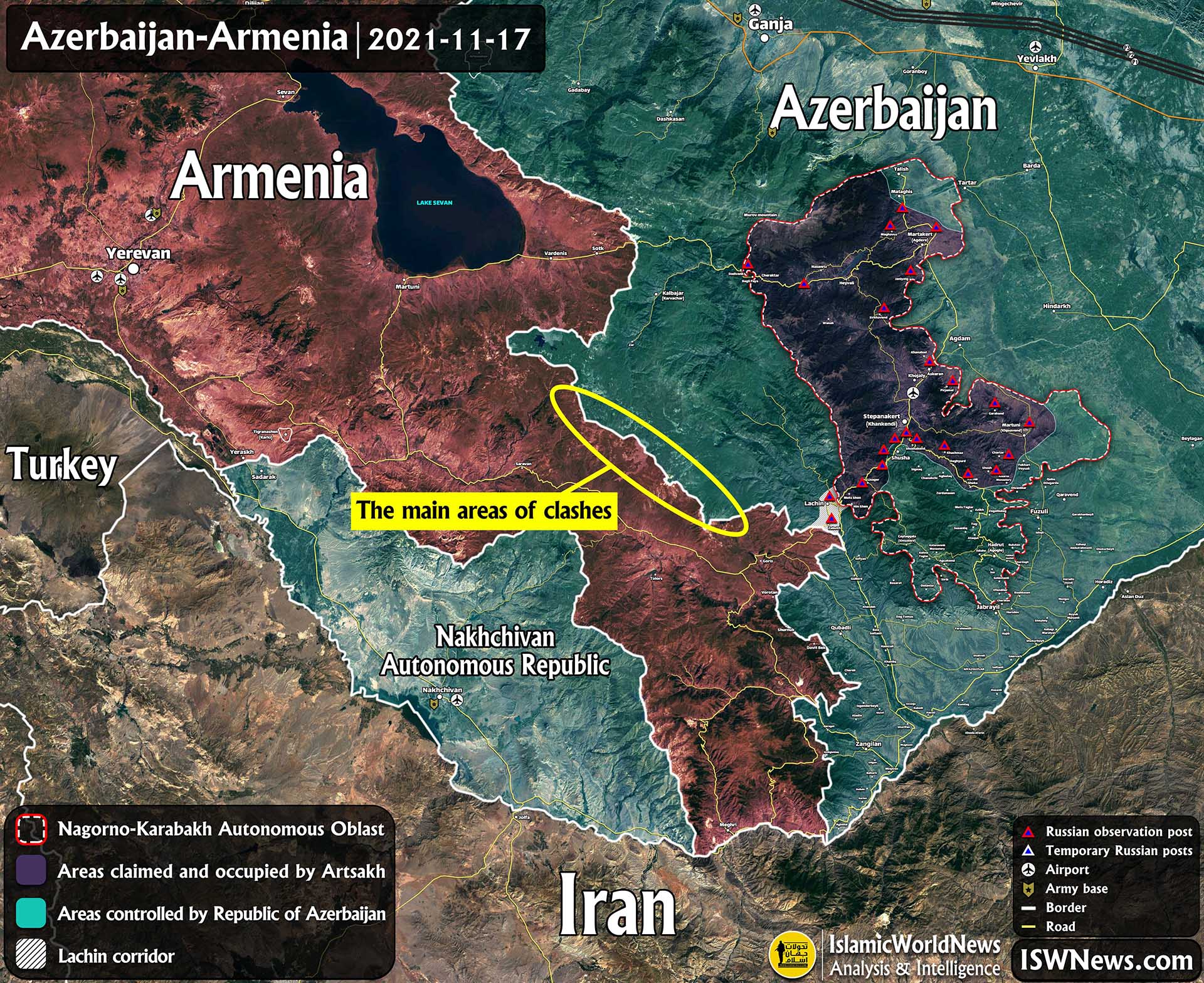
According to the field evidence, on November 16, the Azerbaijani military, in violation of the peace agreement advanced on several border points in the Armenian province of Syunik, But in the aftermath of the aggression, they faced a strong response by the Armenian military.
The clashes between Azerbaijan and Armenia started at about 1 pm and ended with the mediation of Russia and the declaration of a ceasefire at 5:30 pm (local time). During these conflicts, two Armenian military points were occupied by Azerbaijan.
According to a statement from the Armenian Ministry of Defense, one Armenian soldier was killed, 13 captured and 24 others were missing during the clashes. Also, according to the information provided by the Azerbaijan Ministry of Defense, 7 Azerbaijani servicemen were killed and 10 others were wounded.
Following the clashes, the Iranian Foreign Ministry, the Russian Ministry of Defense and the United Nations issued messages calling for restraint on both sides and the de-escalation of the clashes. While emphasizing respect for international borders, the Iranian Foreign Ministry spokesman announced Iran’s readiness to help resolve the disputes between the Republic of Azerbaijan and Armenia peacefully. In this regard, the presidents of Iran and Russia during a telephone conversation stressed the need not to change the political geography of the Caucasus region.
Armenian Security Council Secretary Armen Grigoryan also called for Russia’s protection of Armenian territory under the 1997 agreement in an interview. Grigoryan went on to say that if the crisis is not resolved through Russia and the CSTO, they will ask for help from other international partners.
This afternoon, in order to reduce tensions between Azerbaijan and Armenia, Deputy Commander of the Southern Military District of the Russian Federation and Commander of the Russian Peacekeeping Forces in Nagorno-Karabakh, Lieutenant General Rustam Muradov, transferred the body of the Armenian soldier who was killed in November 16th battles from Baku to Yerevan.
In the autumn of 2020, the Republic of Azerbaijan launched a large-scale military operation with the full support of Turkey and the Israeli regime with the aim of full control over the Karabakh. In a 44-day period from September 27 to November 10, Azerbaijan has managed to control about 50 percent of the territory, including parts of the south (inside) of the Nagorno-Karabakh Autonomous Region, as well as the occupied territories around the Nagorno-Karabakh Autonomous Region. Subsequently, in accordance with the peace agreement reached between Azerbaijan and Armenia, the regions of Aqdam, Kalbajar and Lachin were handed over to the government of Azerbaijan.
The Peace Agreement consists of nine main clauses; However, the different interpretations of Azerbaijan and Armenia from the ninth paragraph of this agreement have prevented the achievement of a lasting peace. By exploiting this clause, the Baku government is also trying to fulfill its illegitimate demands, using this issue as a pretext to create an illegal corridor called the Zangezur Corridor or to occupy the Armenian province of Syunik.
The joint military exercises of the Republic of Azerbaijan with Turkey and Pakistan in the last month, the interruption of the transit route of Iranian trucks and the arrest of their drivers and the sharp statements of the Azerbaijani officials against Iran are important issues in the Caucasus region. What are the goals of Aliyev and his main supporters (Israel and Turkey) in implementing this anti-Iranian project?
The answer to this question is examined in several cases:
1- The success of the Republic of Azerbaijan in the Second Nagorno-Karabakh War was due to the widespread support of Turkey and Israel, the will of the world powers, as well as the inability of the Armenian leaders. This victory has misled Aliyev and other officials in Baku to mistakenly have the illusion and feeling of power against Iran. Therefore, one of the reasons for these anti-Iranian actions of the leaders of the Republic of Azerbaijan is their misunderstanding of regional developments.
2- The confrontation between the Republic of Azerbaijan and Iran is an unequal confrontation. Iran’s military and political power and position are in no way comparable to the Republic of Azerbaijan, even in the case of an alliance with Turkey and Pakistan. On the other hand, the countries of the region will not enter into tension with Iran because of Aliyev, and the harms of this tension far outweigh its benefits. We all know that there is always a political message behind military exercises. Exercise is more of a boast than a military threat, and it is done to prevent military conflict. The Republic of Azerbaijan’s recent exercises with Turkey and Pakistan also served as a warning not to interfere in the Zangezur issue, as well as to announce the support of countries in the region for Aliyev’s government against Iran.
3- Israeli influence on Iran’s borders has always been an important strategy to counter Iran. Aliyev’s government has also entered into closer relations with Israel in recent years, and their debt volume has increased. Hence, the role of Israel in Aliyev’s rhetoric and their tensions cannot be ignored. Therefore, this tension is under the confrontation between the regions of Iran and Israel, and the choice of the name “Khaybar Conquerors” for the Islamic Republic of Iran’s drill on the northwestern borders of Iran is also a proof of this claim.
4- The Republic of Azerbaijan opposes the general policy of Iran in the Caucasus region; And the Iran policy is the policy that pits “unity” against “separatism.” Iran, like Iraq, Yemen, Afghanistan and… opposes any changes in the borders of neighboring countries, including Armenia and the Republic of Azerbaijan. Iran also opposes Azerbaijan plot for the Zangezur area and its Zangezur Corridor, which jeopardize Iran’s economic interests. The detention of Iranian truck drivers on the Armenian border road is also an example of hostage-taking by Turkey and the Republic of Azerbaijan for the Zangezur corridor. In addition, it is said that the Republic of Azerbaijan, in cooperation with Turkey, intended to launch a surprise attack on the southern Armenian province of Syunik, which was thwarted by Iran’s allied policy, and the “Khaybar Conquerors” exercise is in line with this policy.
In this regard, Baku’s actions can be seen as a multidimensional Zionist project, which includes: separatism (emphasis on the separation of Azerbaijani provinces from Iran), ethnicity (Pan-Turkism), security tensions (action against nuclear and political facilities), psychological and media operations, economic issues. (Affecting the economic relations between Iran and Armenia), etc. Given these circumstances, it must be said that if the weakness of Pashinyan and the Armenian authorities in the face of this project continues, their betrayal of Armenia is also certain, and Iran must act alone in the face of the Zionist project. However, considering the recent meetings between the Iranian and Armenian officials, the possibility of such an issue is low, and as the views of Iran and Armenia approach, we will see the opposite front turn to political talks.
Given these circumstances, it should be said that if Armenia acts weakly against this project, Iran will not hesitate to confront the Zionist project and will take more active action. However, considering the recent meetings between the Iranian and Armenian officials and the approaching point of view between the two countries, we are witnessing the opposite front turning to political talks.
Both sides media reported of heavy border conflicts on Wednesday 28 July. Two neighbors accuse each other of intensifying the tensions. The conflict enters the fifth day.
Armenia DM claims that three soldiers killed due to shooting and artillery shelling of Azerbaijan and four wounded. They also claim Azerbaijan army entered Armenia soil in two points in Gegharkunik province.
Azerbaijan DM issued a statement on Wednesday that Armenia shot on Azerbaijan positions using mortars and tanks. According to Azerbaijan DM two soldiers wounded by Armenia bullets.
Independent sources confirmed that Azerbaijan used guided artillery shells and Turkish built Bayraktar drones.
Most of the conflict occured near Vardenis town in Gegharkunik province of Armenia and near borer with Kalbajar province of Azerbaijan. Azerbaijan calls Vardenis town as Basarkeçər which is part of Azeri inhabited of Yeraz people.
It is noteworthy that in the last two years of Soviet time, Azeri inhabitants of the area were migrated to Azerbaijan due to racial segregation of Armenia in 1988.
According to the field information, the (Turkish) Bayraktar drones of the Azerbaijani army attacked several targets in the Yeraskh area of Ararat and on the border with Sadarak in Nakhchivan.
On the other hand, Armenian sources claim that they shot down an Azerbaijani drone invading their country.
It is worth mentioning that these tensions continue in the wake of yesterday’s clashes and exchange of fire on the border between Kalbajar and Gegharkunik.
The Azerbaijan Ministry of Defense has accused the Armenian side of starting a conflict on the evening of Friday, July 23, in the village of Bazaar Kichar in Kalbajar. According to Azerbaijani sources, an Azerbaijani soldier was shot dead by an Armenian sniper at 4 pm local time and the Azerbaijani army responded to the fire. Confirming the conflict, the Armenian Defense Ministry said the Armenia was not the initiator of the incident and that three Armenian soldiers were wounded by Azerbaijani artillery.
Rayon (district) Kalbajar is located in the neighborhood of Gegharkunik province of Armenia and was evacuated by Armenia during the Second Karabakh War and after the implementing of the ceasefire agreement. Determining the border in this mountainous and highlands is one of the challenges between the two countries. Armenia claims that Azerbaijan has crossed the border lines of the Gegharkunik region at two points and occupied part of the heights in this region. After the collapse of the former Soviet Union and the war between the two countries, the border between the two countries has not been demarcated and there are no border posts. The recent tensions are taking place while clashes are reported in other parts of the country.
The anniversary of the summer clashes of July 14, 2020 and the martyrdom of 11 Azerbaijani servicemen, including Polad Hashimov, has entered the political calendar of the South Caucasus region. The event is considered the beginning of the September 27 military operation of the Azerbaijani coalition in occupied Nagorno-Karabakh against Armenian and Armenian separatists. Although the end of the dispute was signed on November 10 of this year after 44 days between the two parties, disputes over the implementation of the terms of the contract remain.
Hot summer July, Exclaves war!
July is still tense, and can still be considered the start point of another war. Especially since the media once again reported more than three major clashes between Armenian and Azerbaijani forces last week. The first clash on Friday, July 9 on the border of Azerbaijan’s Gadabay district and the northern part of the Nagorno-Karabakh region with Armenia’s Chambarak region was reported by the Ministry of Defense of Azerbaijan and the positions of these forces were shelled in Zamanli village.
The clashes took place near the Artsvashen (Bashkend) area which is Armenia’s exclave inside Azerbaijan. The 40-square-kilometer Artsvashen was occupied by Azerbaijani forces in 1992 after the start of the war between Armenia and Azerbaijan, and its Armenian inhabitants were displaced to Armenia.
The second clash took place on Tuesday July 13 in the town of Shusha in Nagorno-Karabakh (Artsakh) and near the Russian peacekeeping post. A disputed town which was inhabited by a mix of Armenians and Azeris before the Nagorno-Karabakh crisis began. The city was captured from Azerbaijan by Armenians in 1992 and came under Armenian control. Shusha (Shushi) was captured by the Azeri side in the last days of the war last year.
The third clash took place on Wednesday, July 14, coinciding with the anniversary of Hashimov’s death on the northwestern border of Nakhchivan with Armenia and near the town of Sadarak in the Nakhchivan Autonomous Republic. An Azerbaijani soldier was wounded and Azerbaijani Nakhchivan army forces exchanged fire with the Armenian side. This area is located near the borders of Turkey and Karki (Tigranashen) village which is Azerbaijan’s exclave inside Armenia. Karki was occupied by Armenia in 1992 and its Azeri inhabitants were displaced.
The fourth clash also took place on July 19 in the same Sadarak-Yersakh border area between the two sides which led to injury of several people including the head of Yeraskh community of Ararat region Rudik Ogikyan in Yeraskh village.
In addition, the Republic of Azerbaijan has two other exclaves in northern Armenia, which are part of the 1992 occupied territories. Barkhudarly and Sofolu (Barkhudarlu) areas of Rayon Ghazakh (Qazax) with an area of 22 square kilometers are located in the Tavush district , Armenia. Also, the Yukhari Askipara exclave (Azeri: Yuxarı Əskipara – Armenian: Verin Voskepar) is also located inside the Tavush district.
According to the terms of the ceasefire, all these areas shall be returned to their country and the displaced have the right to return to their place of residence.
Azerbaijan: Zangezurbelongs to us!
Establishing a corridor connecting the mainland of Azerbaijan with its exclave territory in Nakhchivan is a major geopolitical challenge. According to the Moscow agreement, the Zangezur (Syunik) corridor between the mainland of Azerbaijan and the outskirts of Nakhchivan is to be established.
Of course, Azerbaijan’s interpretation of this corridor is slightly different, so that in addition to a transport corridor, it has officially made a territorial claim to the southern parts of Armenia. The Zangezur and Goycha regions claimed by Azerbaijan include the Meghri, Kapan, Sisian and Goris, which were ceded to Armenia during the former Soviet Union.
Click to see the full size map The map above shows the military situation before and after the start of the Azerbaijani army operation in Nagorno-Karabakh. The Azerbaijani army took control of more than 50% of the occupied territories in the south of Nagorno-Karabakh in a 44-day period from September 27 to November 10. According to the peace agreement reached between Azerbaijan and Armenia, the regions of Aghdam, Kalbajar and Lachin were handed over to the Azerbaijani government. Armenian forces now control about 55 percent of the “Nagorno-Karabakh Autonomous Region.”
Aliyev’s iron fist in Nagorno-Karabakh!
The President of Azerbaijan on Thursday, July 15, at a ceremony of handing over housing units and cars to the wounded and families affected by last year’s war in the town of Khojavand, Nagorno-Karabakh (Azerbaijani-controlled areas) explained Azerbaijan’s position on territorial policy and the issue of refugees. Elham Aliyev spoke about the return of the Goycha and Zangezur regions to the rule of the Republic of Azerbaijan and the return of the Azeris of Armenia And he mentioned this issue as a necessary condition for the permanent implementation of the peace agreement with Armenia. (About 300,000 Azeris were displaced from Armenia from the Goycha and Zangezur and Yerevan regions between 1988 and 1991, causing Armenian-Azeri tensions. This group is known as the “Yeraz” and is part of the Aliyev family.)
“When all communications are opened, we, the people of Azerbaijan, will return to their ancestral land, of course. The 10 November Trilateral Declaration states: all refugees must return to their homeland. Our native land is Zangezur; our native land is Goycha district, Iravan. We will definitely return there,” Azerbaijan President quoted Aliyev as saying.
He stated that the political solution is the most logical option for this position. Emphasizing his country’s determination to implement these cases, Aliyev warned the Armenian side to implement the terms of the ceasefire agreement before its military action and to hand over the construction of the Zangezur corridor to Azerbaijan. The President of Azerbaijan also claimed the dissolution of Autonomous Republic of Nagorno-Karabakh and creation of the Nagorno-Karabakh Economic Zone. He stressed that the residents of this region must accept Azerbaijani citizenship or go to Armenia forever. Aliyev also said that if the Armenian authorities in Nagorno-Karabakh resist like last year war, he will hit them with an iron fist and will make them runaway like a dog!
Does Aliyevsend a message of war?
Elham Aliyev’s remarks in the Khojavend region, the southeastern territories of Nagorno-Karabakh and the proximity of areas controlled by Armenian forces can be seen as a signal to the other side. The remarks come as Armenia weakens after the war and is in a political and judicial crisis after the parliamentary elections. So another war between Azerbaijan and Armenia is not so unlikely and could happen again. The Caucasus region, with a density of 80 ethnic groups and religions of Islam, Christianity, Jews and Zoroastrians, is one of the most tense military and security regions in the world. This geopolitical disorder is the result of the creation of small ethnic states where races live intertwined.
One of the countries that took an indifferent and silent position during the recent Palestine-Israel conflict was the Republic of Azerbaijan. The government of Azerbaijan has had long and close relations with Israel than the Arab countries such as the UAE, Bahrain, Sudan, etc., and the level of these relations is not comparable to other Islamic countries that have recently normalized their relations with Israel. During the recent war between Azerbaijan and Armenia, Israel provided covert and special international and military support to Azerbaijan. In such a way that the countries and factions opposed to Azerbaijan’s actions in Europe and the United States did not find the strength to seriously confront Azerbaijan’s actions against Armenia.
Therefore, the main reason for the silence of the Republic of Azerbaijan in the face of Israeli crimes in the West Bank and Gaza Strip and even their association with the Zionist media can be considered the debt of this government to the Zionists. The Azeri media was not neutral in this battle either, and mainly with targeted analyzes and writings, they called the policies of “Joseph Biden” and “Hamas” the cause of the war against the Zionists, and described this war as a useless and erosive war that is nothing but destruction and killing.
Some of the causes of this alliance can be categorized as follows:
1- The need of the Republic of Azerbaijan to gain the support of Israel against the countries and opposition factions in Europe and the United States.
2- Alignment of political and social attitudes of the two governments: Both governments consider Islamic thought as their ideological enemy and in this regard have had extensive intelligence and security cooperation. Actions against Iran’s nuclear and security issues are an example of cooperation between the two governments.
3- Alignment of nationalist thoughts of the two governments: The Republic of Azerbaijan considers Armenia as a racial enemy and the Zionist regime considers the Muslims as their racial enemy and has planned to eliminate and resolve their enemy.
4- Economic relations: Israel supplies 40% of its crude oil needs through the Baku-Ceyhan pipeline (a port on the shores of the Mediterranean Sea in Turkey) and in return sells military weapons to the Republic of Azerbaijan, according to the Stockholm International Peace Research Institute (Sipri) 60% of the military weapons of the Republic of Azerbaijan are supplied through Israeli factories. These weapons include drones, missiles, radar systems, ammunition, etc., which played an important role in Azerbaijan’s military superiority in the recent war with Armenia.
The discrepancy and the silence of the government of Ilham Aliyev in the face of the recent developments in Palestine will certainly have many consequences for the Republic of Azerbaijan and others, one of which is the exposure of the hypocritical face of these governments. During the war with Armenia, Aliyev’s government and its supporters repeatedly provoked the feelings of Muslims and abused them for their own purposes by reminding the desecration of Muslim mosques by Armenians in the past. This is while they did not take any position against the desecration of Al-Aqsa Mosque by the Zionists!
Of course, no more is expected of such rulers and governments with such records. But nations, Muslims, and observers of these truths are expected to understand and analyze such facts, regardless of race or religion, in such twists and turns.
It was an interesting meeting specially after a 44 days war, in which more than six thousand people killed in Karabakh and then Aliyev and Pashinyan met like two good boys with their boss Putin and listened to him.
Following this four hours meeting, three countries unveiled a joint statement to create a list of joint projects to open the borders. There are not much details regarding the new agreement but it is in the same direction as the previous Karabakh ceasefire agreement.
Pashinyan spokesperson said before the meeting that important projects already are being investigated and talked over, one of which is to permit Armenia to cross Nakhchivan and transit to Iran, as well as using the railroad built in USSR era which was used to connect Yerevan to the southern regions of Armenia.
According to this trilateral agreement, each country forms a committee of specialists led by the vice PMs to make a list of joint projects for the leaders of the countries.
Russian paper Kommersant released a railroad map of Caucasus two days ago, which was the same railroad built in USSR era and was closed since the first Karabakh war in 1990. It is going to be open with the new agreement.
Regarding opening this important railroad, which is one of the articles in Karabakh ceasefire agreement, we have mentioned in previous articles. Following Karabakh ceasefire agreement, some claimed the southern corridor means to cut Iran-Armenia border, which was wrong from the beginning.
This railroad will connect Armenia to Russia through Azerbaijan and will be used for transit to Iran as well. On the other hand Azerbaijan will connect to Nakhchivan area and Turkey through Armenia.
This new agreement will have huge impact on different aspects of Caucasus area and each side will get benefited. Although Putin said that the agreement will be useful for all the countries of Caucasus but obviously not on the same level.
Russia and Turkey undoubtedly will get the most of it. Russia restored its hegemony after a 30 years period of weak presence in the area and Turkey as a new player in the Karabakh, has greatly strengthened its foothold in the region and will strengthen its ties with Central Asian countries by connecting the Caspian Sea; Azerbaijan, while regaining its vast occupied territories in the south of Karabakh, was directly connected to the Nakhchivan region and of course to Turkey, and largely overcame the previous problems; Armenia will also benefit from direct connection to Russia and better connection to Iran, and by opening its western border with Turkey will benefit from trades with this country too. And finally, Iran, as the civilization and cultural owner of the Karabakh region, will have the least benefit from the events in Karabakh and the reopening of a new transit route; and Iran political and economic influence in the Karabakh region will be greatly reduced.
– According to the information provided by the Ministry of Defense of Azerbaijan, a group of Azerbaijani soldiers in the Hadrut region was attacked by a group of 6 Armenian forces. It is said that these forces were those who had not withdrawn from the area. The Azerbaijani Defense Ministry said that all Armenian forces were killed in the incident, and that one Azerbaijani soldier was killed and another was wounded. On the other hand, the Artsakh Ministry of Defense rejected Azerbaijan’s claim, stating that no military clashes had taken place between Armenian and Azeri forces in the past two days, and that Azerbaijan’s claim was false and propaganda.
– According to information of Russian Ministry of Defense, more than 300 hectares of Karabakh land and 120 km of roads are cleansed from mines and booby traps and 12000 explosive objects were found and destroyed.
– According to Russian Ministry of Defense, since the ceasefire in Karabakh around 44600 of Armenian inhabitants of Karabakh returned to their homes.
– Russian Foreign Minister Sergey Lavrov spoke by telephone with Armenian Foreign Minister Ara Ayvazyan about the Nagorno-Karabakh refugees and the implementation of the Nagorno-Karabakh ceasefire.
– The joint Turkish-Russian ceasefire monitoring center is expected to start working in January 2021 in the Agdam.
– The Ministry of Defense of Artsakh released the names of 47 other Armenian soldiers who lost their lives in the battles of Nagorno-Karabakh.
– The representatives of the Azerbaijani military entered the area between Vorotan and Shurnuk in south of Goris for demarcation of the border. Azerbaijani forces have asked the residents of the village of Vorotan to leave the Azerbaijani part of the village.
– The Secretary of the Security Council of Nagorno-Karabakh (Artsakh) Vitaly Balasanyan announced that together with Armenia and Russia, we will return the areas lost in the Karabakh war. “I want to assure my people that we will do this. There are victories and defeats during military operations. We did not lose, we did not kneel,” Balasanyan said. He added the Artsakh forces would operate in Nagorno-Karabakh under the control of the Nagorno-Karabakh Security Council.
– Azerbaijan Ministry of Defense released photos, names, surnames and information of 2823 Azerbaijani soldiers who were killed in Karabakh war.
– 4 Armenian and 2 Azerbaijani POWs have been exchanged between the two countries by Russian mediation, according to General Rustam Muradov, commander of the contingent of Russian peacekeepers in Karabakh.
– 3 Azerbaijani soldiers were reportedly injured by an anti-tank mine blast near Hadrut.