Category: Editor’s Picks

  • Sayed Hasan Nasrallah in “Liberation Day”: “We Do Not Seek War But We Do Not Fear It”

    Sayed Hasan Nasrallah in “Liberation Day”: “We Do Not Seek War But We Do Not Fear It”

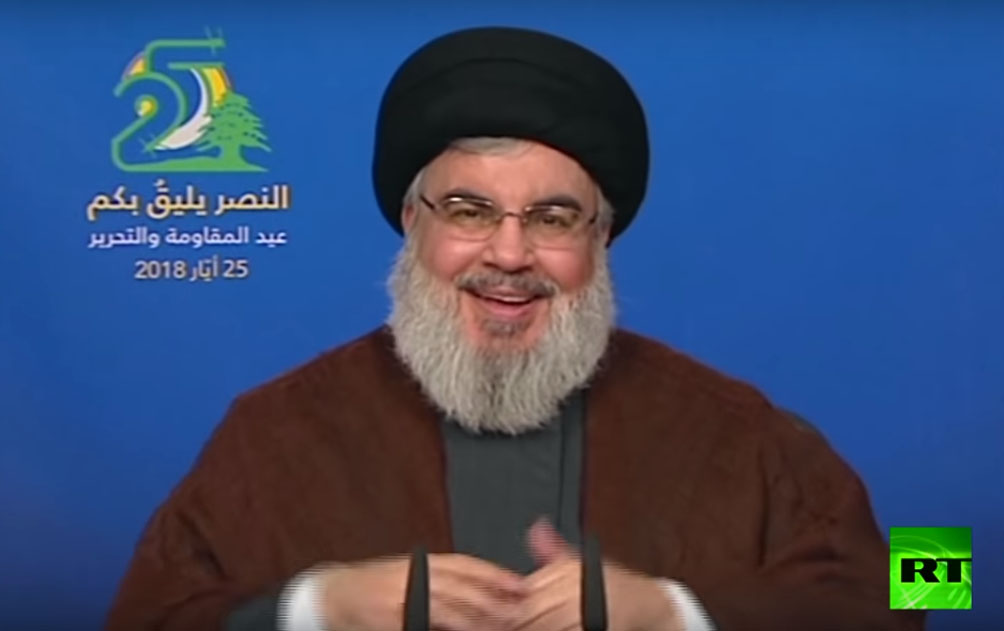
    A Summary from Sayyid Hassan Nasrallah’s speech on the occasion of the “Resistance and Liberation Day” :


    – Welcome all and every year and you are well. We did not make an event this year for Liberation Day because of elections and Ramadan.

    – This year’s Quds Day is important and must be covered by media and politically due to sensitive time that Jerusalem is going through after Trump’s decision.

    – I want to start by congratulating all Muslims on beginning of the blessed month of Ramadan.

    – On Liberation Day of 25 May 2000, I congratulate all on this day whether it’s Lebanon or the people of the region as a lesson for the present and future.

    – We thank God first and last for giving us this victory. After that, the resistance fighters at the first degree who fought in 1982 and before who fought to liberate this land from the aggression.

    – Among them martyrs who sacrificed their lives like Musawi, Harb, Mohammad Saad and many more. As well as martyrdom operators and those are wounded and the prisoners who spent their youth in Occupation prisons like Khiyam.

    – Not to forget the people of the villages and those on the border region and throughout all Lebanon. Lebanese Army & other factions also played a role, as well as the Syrian Arab Army who sacrificed martyrs.

    – Those who supported the resistance through financial means and housing those displaced. And not to forget the help from Syria and Iran.

    – Between 1982 and 2000, Hezbollah capabilities were modest compared to not only the enemy (Israel) but also Hezbollah today

    – There were people who ran around looking for a reason not to resist the occupation. But it was our people’s resistance which led to Israel’s withdraw which was not through an agreement or organised fashion, this resistance is still evident today.

    – We do not seek war but do not fear it. Israel threatens but we say that in a war (God forbid) that it will be a victory for us. Confidence in the Resistance was also demonstrated during the election.

    – On sanctions; previously there were Hezbollah personalities sanctioned by US and now there are new lists. This won’t affect us, it is only aimed at isolating us from those who want to sit or meet with us.

    – It is dangerous when it affects Lebanese business and commercial who need to come and go.

    – Let’s say some did give money, Hezbollah is not a terrorist here, we have a holiday (25 May) for us, how can the state accept this?

    – Most importantly the aim of the sanctions is to cut off its financial source, whether its domestic, its allies or the very source, Iran. US with its ‘12 points’ wants Iran to stop supporting Resistance and turn it into a puppet state.

    – We refuse US/Zionist agenda in Lebanon whether it is occupation or installing political administration or a normalisation agreement.

    – Refuse US or Israel attempt to seize land or any drop of oil, naturally this enemy needs to see it be threatened or else it will result to assassinations and sieges.

    – Killings and wars by Israel against Lebanon will not reach results. Loss of life and destruction of homes and businesses is part of the sacrifices of the battle. And we will build our victories on that.

    – I tell US and all, your mistake in your attempt to cut off Hezbollah financially, is they see their ‘allies’ as price tags, they see us as mercenaries. This Resistance, they are owners of an issue which are defending it with their souls no matter the conditions.

    – I say to our enemies this won’t go forward or go back, this Resistance today is stronger in all fields.

    – I have said previously, Syrian leadership and its allies will not allow the fall of Syria. On this day, we congratulate the Syrian Arab Army on the complete liberation of Damascus as it achieves victory after victory.


    Then, Sayed Hassan Nasrallah continued his speech about some of the issues in lebanon election and the Party’s plans on future affairs of the country..


    /End

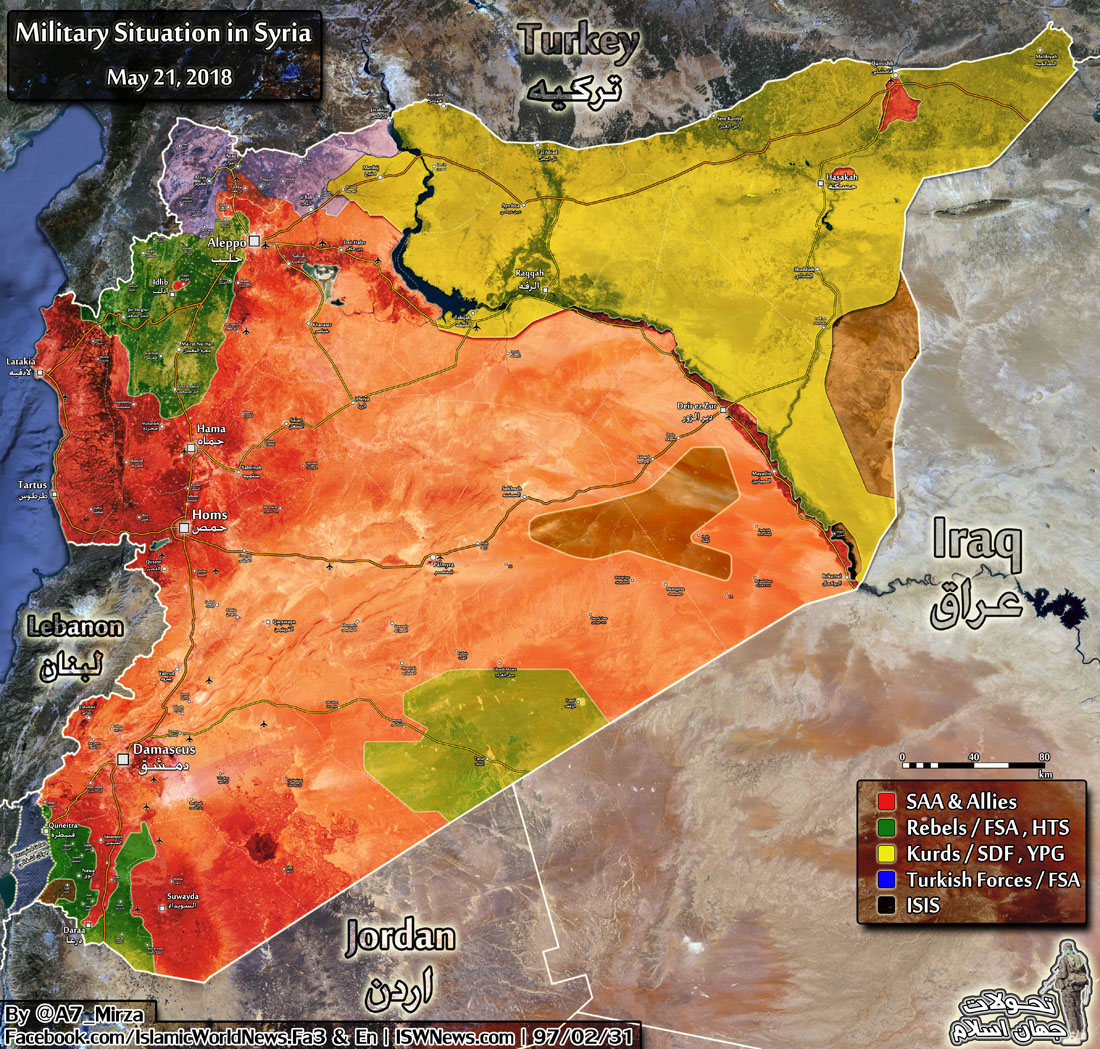
  • Latest Map of Fronts in Syria until May 21, 2018; Everything You Need to Know About the Past 97 Days

    Latest Map of Fronts in Syria until May 21, 2018; Everything You Need to Know About the Past 97 Days

    Latest HD map of fronts in Syria: Download

    The online map of Syria : Click here

    Map of 97 days ago for comparison: Here


    ? The most important changes in the past 97 days are as follows :


    Afrin region

    Without any doubt, the most important event and change in the northern part of Syria, is the occupation of “Afrin” region by the Turkish Army and Turkish-backed militias which are under the direct command of Turkey.

    In the recent writing of us, we mentioned briefly some of the reasons for the fall of “Afrin”; where the Turkey with opportunism and use of factors like, constraining Russia, the stubbornness and lack of discretion & foresight of the Kurds, and the low effect of the resistance axis forces, were successful and managed to kick the Kurds out of the northwest of Syria, and achieved its goals.


    With Russia giving an obvious green light to the Turks to fly their airforce freely over the “Afrin”, and the pigheadedness of the Kurdish commanders which were under the command of the United States, it was so clear and natural that the Syrian government and resistance axis forces hands would be tight in this matter. And the military & logistical donations of the resistance axis to “Afrin”, was the best attempt that they could do in that time. These supports in some periods could only decrease the pace of the Turkish army’s advances, nothing more.


    If we look back to the situation of Afrin a little while before the Turkey’s aggression, it wouldn’t be so hard to “make sense” of the “Afrin” event. where the operation of SAA was stopped at the gates of “Saraqeb” and the Turkish forces —with the green light that was given by the Russia—facing the resistance of the SAA and resistance axis to some extent, managed to deploy themselves in Al-Eis and its roundabouts.


    The Turkish forces, however, managed to capture Afrin city in March 17, 2018, 59 days after the initiation of “Operation Olive Branch”.

    Further more, with the militias advancing in southern Afrin, the “Shia” populated towns of Nubl & Al-Zahraa, were under the danger of a new siege, more than ever. Hence the resistance axis and SAA in an effective action, managed to gain control of some of the regions around these towns. With this move, practically, the “Operation Olive Branch” came to an end in northwest of Aleppo.


    About some of the most important achievements of Turkey in this operation, we can mention:

    The reconnecting of northern parts of Aleppo to Idlib;

    Expelling the Kurds(militias) out of northwest of Aleppo;

    Obtaining full control over the affairs of the people in the region;

    and finally gaining an important military & political leverage in order to use it against Syria in future negotiations.


    East of Syria

    In east of Syria, and in continuation of advances by US-backed forces, namely SDF, all of the oil wells in eastern part of Euphrates has fallen to the hands of SDF.
    Cooporating with Iraqi intelligence & military forces, SDF advanced on borderline and with capturing the Baghoz village, located in north of “border crossing” of al-Qaem-al-Bukamal, the SDF managed to encircle the remaining ISIS forces at eastern Euphrates in two northern & eastern pockets .

    Now continues the operation of US-led coalition & SDF against ISIS. The Syrian Democratic Forces, “SDF” are trying to capture “Hajin” village.
    The important village of “Hajin” which is said to be the main base for ISIS in east of Syria, is under the heaviest strikes from both air and ground forces.


    Also in southern part of “al-Mayadin” town, the SAA and its allies, in a series of intelligence operations, managed to liberate Al-Fayzat and Al-Tammah from ISIS.


    South of Syria

    “Liberating the entire Damascus and Rif Dimashq Governorate“, is something that in the eyes of the experts and people, was impossible.

    Yet the SAA with leaning to its allies & their victory’s outcomes and sacrifices of the warriors over all these years, thrived to achieve it over different battles and negotiations.


    On February 25, 2018, The SAA launched the final phase of its operation in eastern Ghouta of Damascus, which in the end led to clearing the eastern Ghouta completely.
    Making massive preparations and the vast presence of brigades & forces for this operation, shows the strong willingness of SAA and its allies to end the eastern Ghouta matter.

    Unfolding the will of the SAA and its allies, the so called “Internatonal Organizations” in order to make their final efforts to prevent the liberation of eastern Ghouta, have once attempted to make a 30 day ceasefire so that atleast it delays the SAA’s advances in eastern Ghouta.

    The Syrian Government, however, not only continued their operation, but also their will & determination strengthened even more.


    The speed of this operation was that high, that under the 30 days, about 75% of the eastern Ghouta was liberated and the militants were encircled in three separate region.

    Latest Updates on Eastern Ghouta of Damascus; the Ghouta is Divided into Three Parts!


    Ultimately, with SAA increasing its pressure, the militants of “Jaysh al-Islam” and other groups, were compelled to accept the “Compromise Agreement” and surrender to SAA.


    Hence the militants and those who didn’t want to stay in the region, in different stages and after surrendering their heavy and medium weapons, left eastern Ghouta.

    And in April 14, 2018, in an official statement of the armed forces of Syria, the SAA enetered “Duma” —the last den of terrorists in eastern Ghouta— and cleared it.

    Therefore after years, the security have once again returned to eastern parts of Damascus.


    How the SAA & Allies liberated Eastern Ghouta from Militants in their last operation in the area.


    It needs to be mentioned that with the liberation of eastern Ghouta, overall about 175,000 of southern Ghouta’s ihabitants left the region, including 21,000 militias and 40,000 of their families.


    After liberation of the eastern Ghouta of Damascus, other options for reconciliation and liberation, such as the siege of eastern Qalamoun, al-Dhumayr and the southern Damascus areas, were put on the government’s agenda.


    In the next stage, the militants of al-Dhumayr with accepting the “Compromise” left this region and the SAA aimed its attacks towards eastern Qalamoun regions and by going around of Al-Ruhaybah, the militias have once again came under pressure.

    Simultaneous with these events and alongside the operation in eastern Qalamoun, the operation in southern Damascus against ISIS, staterd.

    After the siege of “Al-Ruhaybah”, militants of eastern Qalamoun including the most important ones like, “Ahmad Al-Abdo”, “Aswad Al-Sharqia” (backed by United states-Jordan forces), and FSA, were compelled to accept the SAA’s suggested compromise agreement , and like other militias, give up their weapons and go to northern Syria.

    Therefore on April 25, 2018, Eastern Qalamoun was completely cleared of militias presence.


    After clearing Eastern Qalamoun, the southern Damascus was the last place which were occupied by the militias in Damascus province.
    The SAA with the help of its allies in April 19, 2018, started its operation to liberate the southern Damascus from the hands of ISIS terrorists.
    Because of the high density of wrecked buildings and the nature of ISIS, operation in this pivot continued with more difficulty and caution.

    It needs mentioning that the present militias in southern Damascus —with negotiations which was on in recent months, ultimately after the initiation of SAA’s operation against ISIS in southern Damascus— agreed on leaving the the region.

    Therefore the operation of evacuating the militias out of this region happened simultaneous with SAA’s operation against ISIS.


    The advances against ISIS in Hajar Al-Aswad & Yarmouk Camp were so “buidling to building”, that the ISIS terrorists were convinced that there is no way but to surrender. Heretofore the ISIS terrorists had rejected all the Syrian governemnt’s suggested compromises .


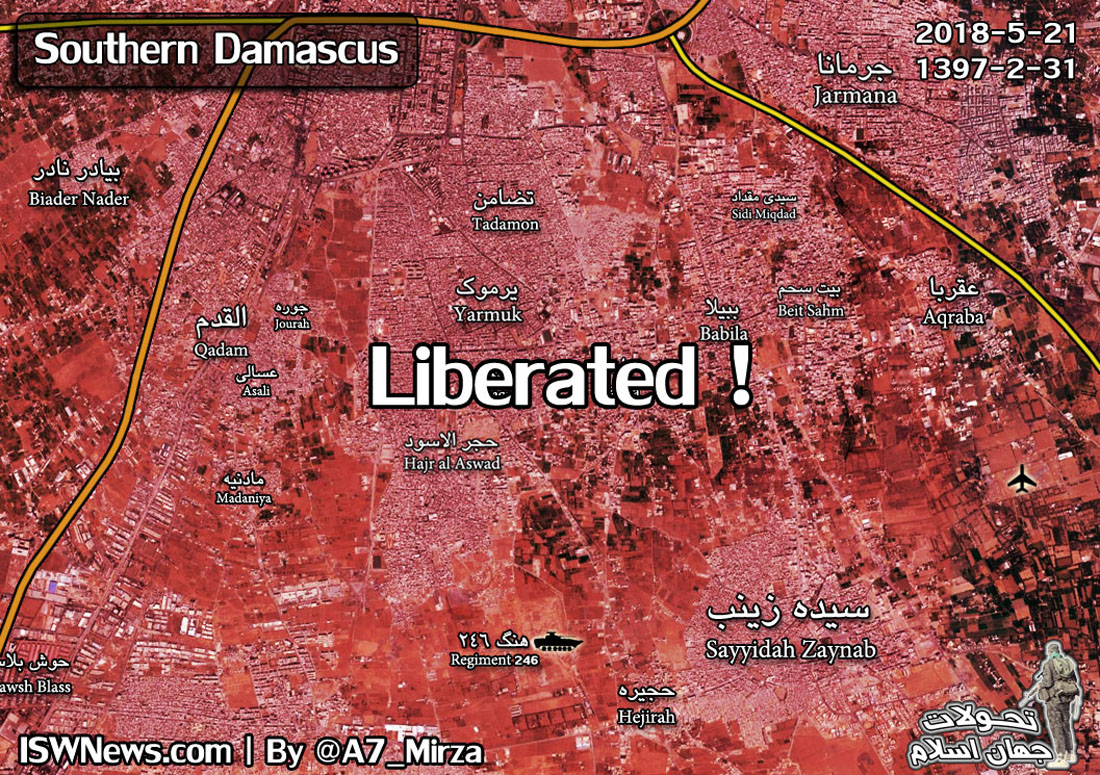
    Eventually, one month after the initiation of the operation in May 21, 2018, with an agreement, the ISIS terrorists managed to leave the southern parts of Damascus completely, hence with the liberation of southern Damascus all of Damascus and “Governorate of the Countryside of Damascus (Rif Dimashq Governorate)”, —after 7 years of different terrorist groups presence— were liberated.


    Latest Military Situation in Southern Damascus 21 May 2018; Yarmouk Camp Liberated, Rif Damascus Governorate Completely Liberated!


    West of Syria

    The siege of northern Homs (The al-Rastan pocket) was one of the other important middle parts of Syria, which was under the occupation of different militia groups, most notably Hay’at Tahrir al-Sham “HTS”.


    Liberating these regions returns the security to countrysides of Homs, Hama and Salamiyah in one hand, and would open the strategic “Hama-Homs’ road which was closed for years because of the presence of the militants, on the other hand.

    Also it would be a source for SAA’s manpower, and they could fight the terrorism in other parts of Syria.


    Because of the sensitivity of region, the peace talks failed many times, but ultimately—with massive deployments of SAA’s convoys to Homs, the news of SAA’s Imminent operation and militias fear of this matter— the militias accepted the agreement and left the region.

    For more information, look at this article: Reconciliation Agreement in Northern Homs or Military Operation?!


    From May 3, 2018, with militias giving up their heavy and medium weapons to SAA, the compromise agreement was executed officially.


    Generally, the operation for evacuating the militias from northern Homs, implemented in two stages:
    1) The SAA’s forces and the Russia’s military police with their entrance in eastern part of the “al-Rastan pocket” and raising the flag of Syria.

    2) The western part of the “Siege of Northern Homs” with the entrance of SAA to every single of villages and raising the Syrian flag in them (as a sign of liberated regions),

    and therefore all the northern regions of Homs was cleared completely from the threat of militias.


    It needs mentioning that during the evacuation stages, about 35,000 of militias with their families evacuated from the northern Homs, towards north of Syria.


    If you’re able, and if you like our content and approach, please support the project. Our work wouldn’t be possible without your help:

    BTC: 1BvrWhL7UQQgv6BNwCiV56YMaMcxJy5T5A

    BCH: qpm7pgnypm0v070mh032s0vmgyl972zgk5atqtttnw

    ETH: 0x29722b2D6c64Bb1d83568d6a5026B02170E12460
  • Iran Foreign Ministry: No One Can Force Iran to do Anything; Iran Will Help Syria as Long as Syria Wants It.

    Iran Foreign Ministry: No One Can Force Iran to do Anything; Iran Will Help Syria as Long as Syria Wants It.

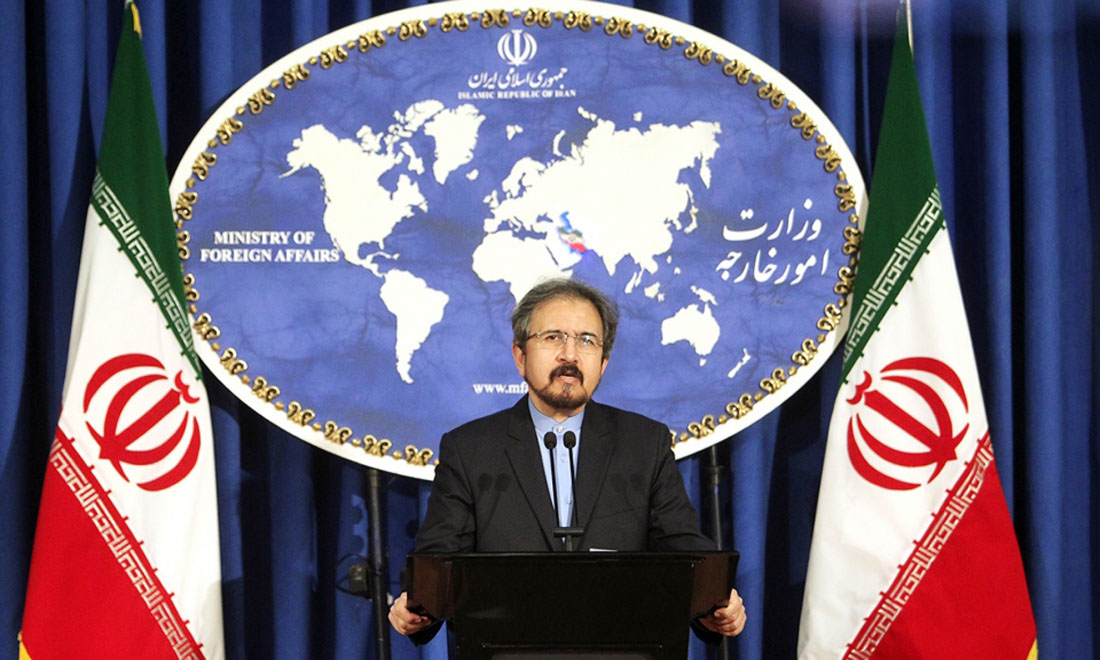
    Bahram Ghasemi on May 21, in response to a question about recent reports of Russia’s call for the withdrawal of Iranian forces from Syria replied:

    ” Nobody can force Iran to do something against its will, Iran is an independent country that pursues its policies according to its own interests.

    The presence of Iran was with the invitation of the Syrian government to fight against terrorism and defend the territorial integrity of Syria and Iran will help Syria as long as Syria wants it.

    All those should leave Syria who entered the territory of the country without the approval of the Syrian government.”


    On May 17, Russian President Vladimir Putin met with Syrian President Bashar Assad in Sochi, Russia.

    During the visit, Vladimir Putin emphasized the withdrawal of foreign forces from Syria; however Putin did not specify precisely what he meant, but the next day Russian presidential envoy to Syria Alexander Lavrentiev said that the Iranian forces and the resistance forces should also leave Syria.


    These words, while caused a wave of reactions from Syrian allies, denied by the Syrian government media.


    Following this, the Kremlin spokesman Dmitry Peskov said that the foreign forces that are supposed to leave Syria are those forces that are “illegally” in the country.


    So today, Iran’s foreign ministry spokesman, while stressing the presence of Iran in Syria, said Iran was not among the countries that entered the country without the consent of the Syrian government and will remain in Syria as long as needed.

  • Latest Military Situation in Southern Damascus 21 May 2018; Yarmouk Camp Liberated, Rif Damascus Governorate Completely Liberated!

    Latest Military Situation in Southern Damascus 21 May 2018; Yarmouk Camp Liberated, Rif Damascus Governorate Completely Liberated!

    As we said in yesterday’s news about the Syrian government agreement with ISIS to expel this terrorists from the southern Damascus, today following this issue the General Command of the Syrian Armed Forces published an announcement and acknowledged the complete liberation of the Southern Damascus from ISIS terrorists.


    The Syrian army and its allies started the military operation in southern Damascus on 19 April 2018 and one month later on 21 May 2018, they managed to liberated all southern Damascus areas from terrorism.


    Thus, with the liberation of southern Damascus, all of Damascus and Rif Damascus Governorate were freed from the existence of various armed groups after 7 years.


    We honor the memory of all our fallen dear ones in the path of freedom, their pure blood were spilled on the sands of Levant next to the shrine of Sayyida Zainab (peace be upon her).


    HD MAP

    Interactive Map


    If you’re able, and if you like our content and approach, please support the project. Our work wouldn’t be possible without your help:

    BTC: 1BvrWhL7UQQgv6BNwCiV56YMaMcxJy5T5A

    BCH: qpm7pgnypm0v070mh032s0vmgyl972zgk5atqtttnw

    ETH: 0x29722b2D6c64Bb1d83568d6a5026B02170E12460
  • Parliamentary Election in Iraq after Defeat of ISIS

    Parliamentary Election in Iraq after Defeat of ISIS

    The most important parties and alliances are as follows

    • Shiite alliances:

    1. Al Nasr alliance led by Haidar al Abadi

    2. Al Fath alliance led by Hadi al Amiri

    3. Dawlat al Qanun alliance led by Nouri al Maliki

    4. Saeroun Nahv al Islah alliance led by Sadr and Communist party

    5. National Movement of Hikmat lef by Sayyid Ammar al Hakim


    • Sunni alliances:

    1. Al Watanieh alliance led by Ayad Allawi

    2. Al Qarar al Iraqi alliance led by Osama al Nujaifi


    • Kurdish alliances:

    1. Kurdistan Democratic Party led by Nechirvan Barezani

    2. Patriotic Union of Kurdistan (after Jalal Talabani death it has no leader yet.)

    3. Kurdistan Islamic Group

    4. Kurdistan Islamic Union

    5. Al Taqiir

    6. Kurdish forces alliance in Kirkuk under title Watan led by Yusuf Mohamed

    7. Alliance for democracy and justice led by Barham Salih


    It is noteworthy that Masoud Barzani who led the referendum of Kurdistan independency has not voted yet.


  • Chief of Staff of the Iranian Armed Forces: “Iran Shouldn’t Have Accepted JCPOA from Very First Day”

    Chief of Staff of the Iranian Armed Forces: “Iran Shouldn’t Have Accepted JCPOA from Very First Day”

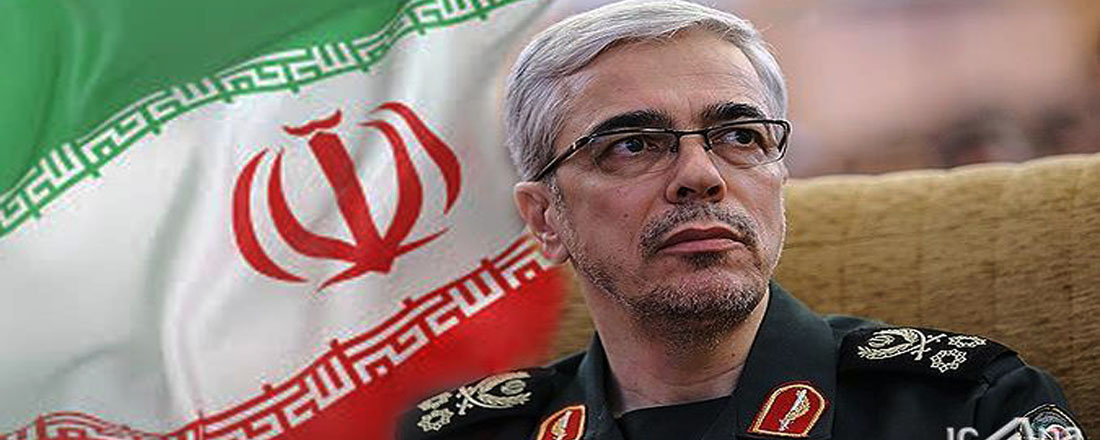
    “[The US exit] proved we should stand on our own feet and do not rely on such things as JCPOA,” he said, adding that the country needs to depend on domestic capacities to make progress.


    US President Donald Trump on Tuesday pulled the United States out of an international nuclear deal with Iran.


    Once again, it has been proven to the whole world that the United States never adheres to its promises, and once again it became clear that the United States can not be trusted.

  • An Astute Glance at Critical Parliamentary Election of Lebanon

    An Astute Glance at Critical Parliamentary Election of Lebanon

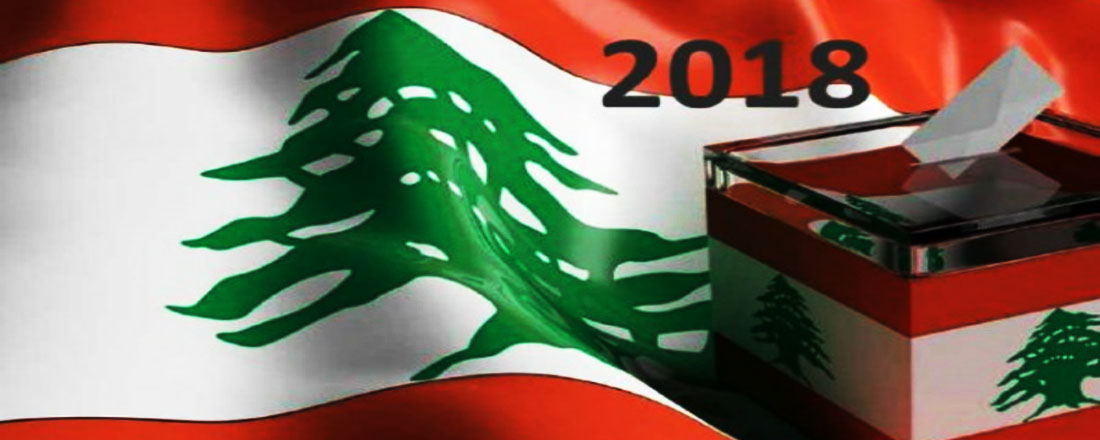
    Islamic World News Analysis Group reports that it seems Lebanon is a rich and problem less country, which is partially correct but there are lots of political and social troubles in bride of Western Asia. One of these political problems is the parliamentary governing system which dominates everything from assigning the president and prime minister to legislation and vote of confidence among others. In another word the only opportunity that Lebanese are involved in the destiny of their country is parliamentary election but it is not very easy.


    History of Parliamentary Election in Lebanon

    Basically, election in Lebanon is an unreachable dream, since Lebanon is always engaged in civil or foreign wars and occasionally there is an opportunity to hold a political system but it is very rare. For example, after the election in 1972, the parliament was extended for 20 years due to civil wars and war with Israel. After the election in 1992 until 2005, election did not take place due to governing political situation. The only time that the election was held on its four years rendezvous was in 2009 but again in 2012 due to critical situation in Lebanon and Syria and domestic political conflicts between adherents and opponents of Syrian government, the election was postponed for another four years and in 2016, due to lack of president and political conflicts the parliament was extended temporarily. By assigning Michel Aoun as president in 2016, he chose 2018 as the election date but this election has several complexities.


    Election Law, a Tumult Which Finished

    A principal trouble in parliamentary election of Lebanon is the law of election. Based on the old law of election which was approved in 1960, Lebanon election is a majority election, which has a lot of drawbacks. The first drawback is dividing Lebanon into several election districts and hence conflict in Lebanon. The second is omitting the political minority, i.e., minor parties do not have any chance to enter the parliament. The third and the biggest drawback is the injustice inherited in it. For example, in a district if there are 10 seats to be occupied and one party wins 51% and the other 49%, the party with 2% more votes occupies all seats and 49% of people do not have any member of parliament. In this method, people elect individuals not the parties.

    In 2017 a new law was approved which corrects the older law of election. According to the new law, there is more justice among parties. For example, if one party wins 60% of votes and the other 40%, they share the seats according to their votes and there is no absolute dominance of one party.

    Map of Seats per each Districts According to the New Law


    Situation of Moghawemat Movement in Different Districts

    South of Lebanon

    Hezbollah and Amal Movement are very active in south of Lebanon, the political alliance of Hezbollah and Amal Movement have the highest fans and with Nabih Berri, the head of Amal Movement as head of the joint list under the title hope and loyalty, nothing other than absolute win for this alliance is expected.

    Alliance between Hezbollah and Amal Movement is Unbreakable and Unfilterable


    Baalbek-Hermel District, Center of Saudi-Emirates Plot

    Beqaa valley is a base of Hezbollah; however Amal Movement exist there too but people of Lebanon consider people of Beqaa in fight against Zionists in south of Lebanon as strategic army of Hezbollah in hard days. This has changed in recent years with the fight against extremist groups and the role of Beqaa as a base of Hezbollah in east of Lebanon has been emphasized more. But Beqaa in despite of their great sacrifice has a poor living condition and people of Beqaa do not have much role in the economy. This was a good reason for Saudi-UAE alliance to work on to destroy Hezbollah influence in this region. Even ambassadors of UAE and Saudi visiting Beqaa claimed that they aim to destroy Hezbollah in Beqaa.

    On the other side Hassan Nasrallah, secretary of Hezbollah, said that we do not let those who betrayed people of the region when extremists were attacking every day to be representatives of Baalbek-Hermel district. Sayyid Hassan Nasrallah said that I will come and speak for people of Beqaa personally if necessary but answer of people of Beqaa was positive and it let head of Moghawemat to be assured that Baalbek-Hermel is a base for Hezbollah.

    All of these signs show that in this region the majority of seats will be won by Hezbollah and a small of number of seats will be won by 14th March Movement close to Saudi-UAE alliance.


    Beirut and North of Lebanon

    In Beirut, Hezbollah has alliance with Free Patriotic Movement led by Michel Aoun president of Lebanon. This alliance has a high chance of win in Beirut since fans of Michel Aoun are increasing in recent years however due to unknown reasons the relation between Free Patriotic Movement and Amal Movement is not good. Although both are Hezbollah allies but verbal fight has increased between them and Hezbollah tried to be neutral in this conflict and fixes it after the election.

    But in north of Lebanon, Hezbollah and Moghawemat Movement do not have direct activities, since the region is under influence of 14th March, but chance of Hezbollah to bring members of parliament via Free Patriotic Movement is high.

    Hezbollah and Free Patriotic Movement Signed Their Alliance 12 Years Ago


    Conclusion

    Election in Lebanon has always a predictable result since the districts of influence of each side is known. From now the results can be guessed by 70% and say who stays in political system of Lebanon, but in the two districts of north and Baalbek-Hermel, we should wait and see who will be elected.

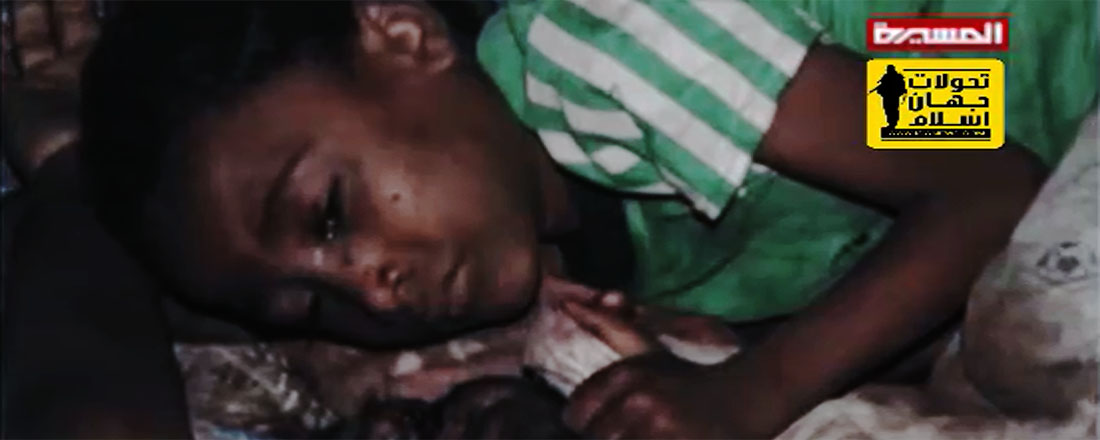
  • The Story of “Samih”, A Child From Yemen

    The Story of “Samih”, A Child From Yemen

    On 23 April 2018
    In an air strike to a wedding in Bani Qais in Hajjah governorate by Saudi fighters, more than 30 martyred.

    Samih is among survivors of this tragedy.

    In the coward silence of international organizations he is one of thousand children of Yemen who become either orphan or martyred under dailyair strikes of Saudi Alliance.

    Isn’t it enough to do something?

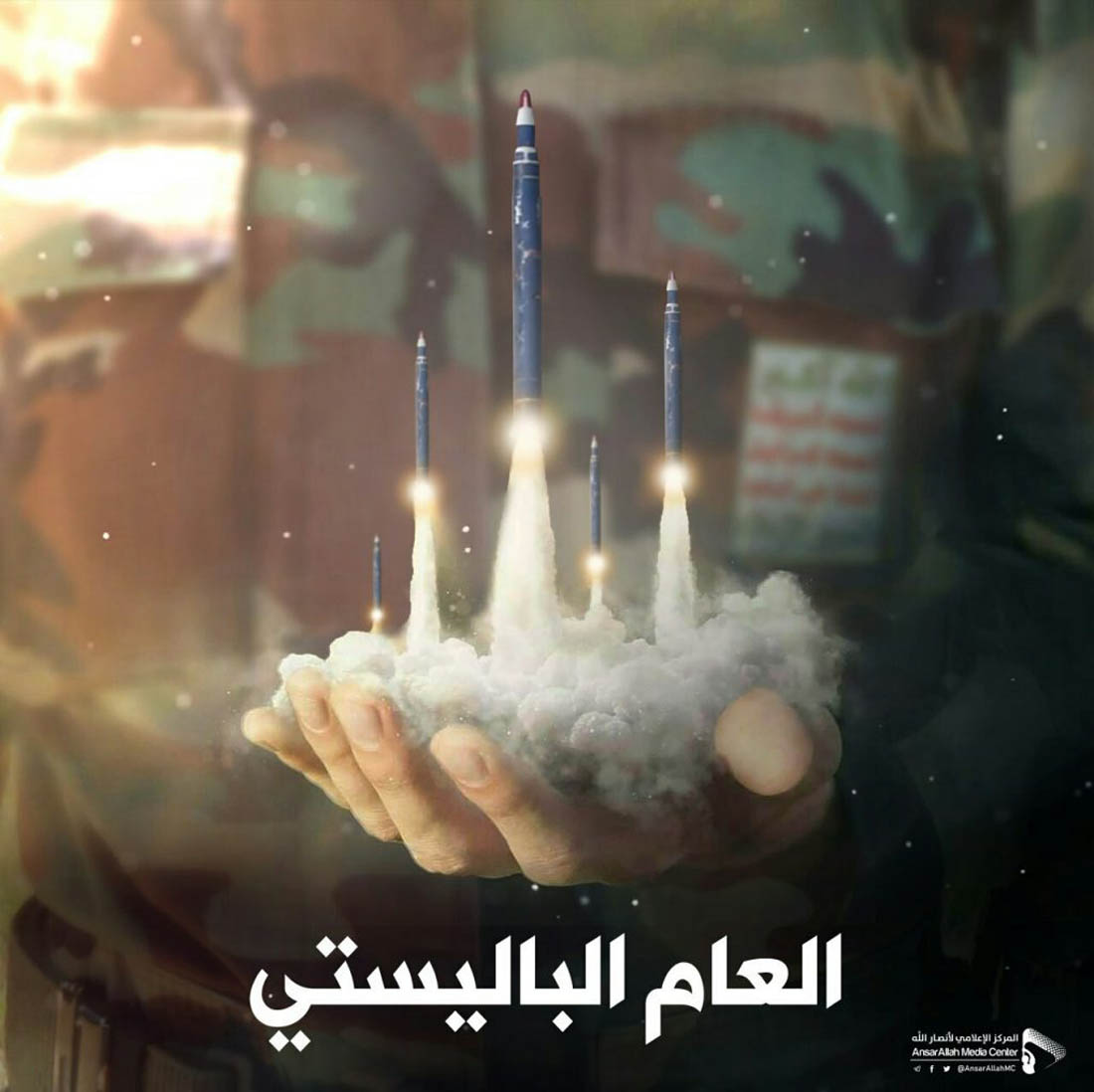
  • “Year Of Ballistic Missiles”; Response to Saudi-led Coalition missiles, will be missiles !

    “Year Of Ballistic Missiles”; Response to Saudi-led Coalition missiles, will be missiles !

    Saleh al-Samad the president of the Supreme Political Council of Yemen: “This year will be the year of firing ballistic missiles at Saudi Arabia, We will see launch of missiles everyday and it’s not important how Saudis activate their air defenses, there is no place to hide from our missiles.

    Just as the enemy has intensified its attacks, We shall start this year with decisiveness & intensify our attacks against Saudi aggressions.
    The internal front is in its most powerful time and any thought of collapse of this front is completely wrong. ”


    “and for [all] violations is legal retribution. So whoever has assaulted you, then assault him in the same way that he has assaulted you. And fear Allah and know that Allah is with those who fear Him.” Surah Al-Baqarah [2:194] – Quran

    “فمَنِ اعْتَدَى عَلَيْكُمْ فَاعْتَدُواْ عَلَيْهِ بِمِثْلِ مَا اعْتَدَى عَلَيْكُمْ وَاتَّقُواْ اللّهَ وَاعْلَمُواْ أَنَّ اللّهَ مَعَ الْمُتَّقِينَ” ﴿۱۹۴﴾بقره


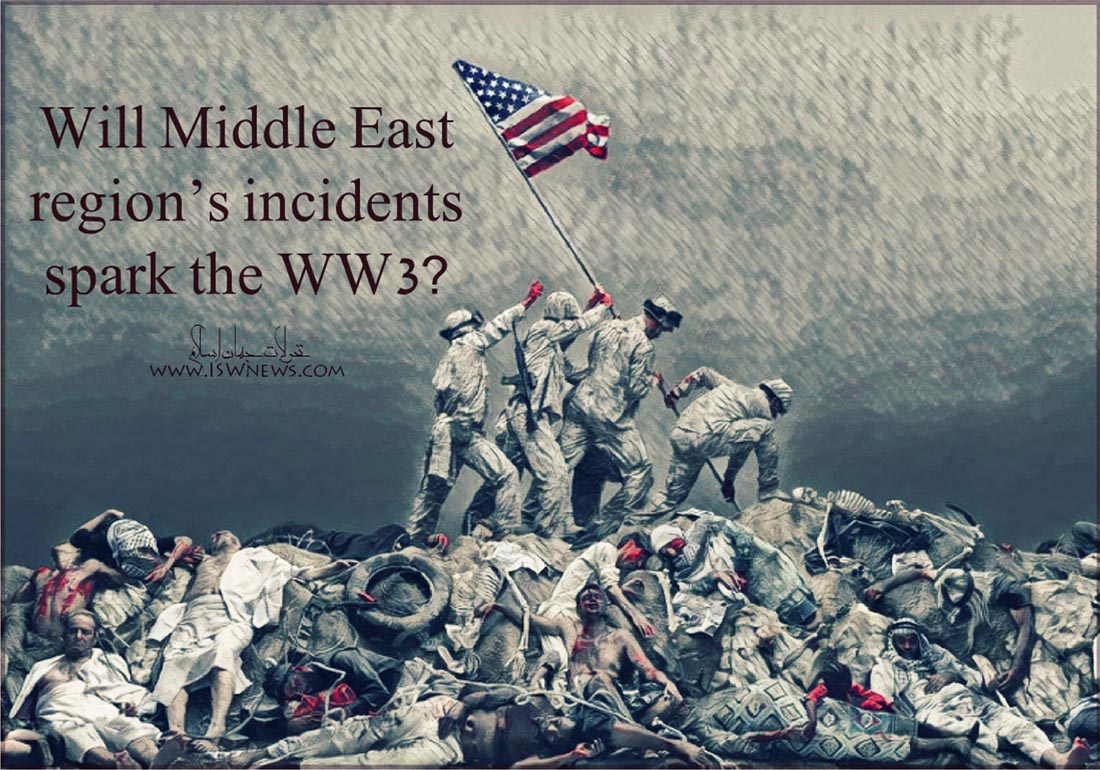
  • Will Middle East Region’s Incidents Spark The Third World War? Part One

    Will Middle East Region’s Incidents Spark The Third World War? Part One

    In recent years, countries with power and authority (specially in west of Asia) to achieve their goals form economic, political and recently military alliances.

    Shanghai Cooperation Organization, BRICS, NATO (to confront USSR and then Russia), Saudi-led Coalition (to confront Islamic Resistance, Moghawemah) among others are some examples and now in west of Asia and in post-Takfirism (extremism), western countries to implement a new plan.

    A plan that Prof. Aleksandr Dugin (Russian strategist) believes Sergei Skripal terror and chemical attack to Douma are introduction to third world war and Abdul Bari Al- Atwan (famous Palestinian analyst) says that according to recent Trump’s assertions, assault of the West will span beyond attacking T4(Tiyas) airbase and even Russian positions are threatened by USA and its allies!

    To enlighten different aspects of the recent incidents, answers to some questions out of many questions are examined:


    1. What will happen if war starts?

    In one plan, USA and the Zionist regime and other allies attack some of the bases in Syria (similar to the missile attack to Shu`ayrat airbase) that Syria answers in three ways:

    Foreign bases in occupied Palestine will be targeted or US bases inside Syria such as al-Tanf and Ayn Eissa and etc will be targeted, or even no military retaliation and only diplomatic solutions.

    If in these attacks Moghawemah(Resistance) forces are attacked too, probably a response similar to first or second will be used and if USA responses again, Moghawemah responses back and so on until one side stops, otherwise this results in a wide war spanning the whole world similar to the final years of war between Iran-Iraq which resulted in oil export difficulties from Strait of Hormuz in Persian Gulf. In this case, not only Strait of Hormuz but also Bab al-Mandab Strait and Suez Canal are threatened.


    2. Does Moghawemah(Resistance) have enough strength to answer USA and its allies or even the recent attack to T4 airbase?

    Considering the current situation (economic problems in Iran, Iraq being busy with elections and still dealing with ISIS, Syria engaged in a war and dealing with state decomposition, AnsarAllah under air raids and siege and Russia’s complicated and unknown stands) the answer is very difficult, however there is preparation for engagement at all levels. In addition, Iran’s Sword of Damocles, i.e. Hezbollah, is on the throat of Israel.


    3. In the case of a war, what will be the reaction of Saudi Alliance?

    There are two possibilities:

    First is that they participate in the war, in this case the harshest reaction of Moghawemah(Resistance) will be for Riyadh and Saudi bases after occupied Palestine. Considering troubles of Saudi including domestic protests (suppressions in al Awamiyah and Qatif), war with Yemen and cut relations with Qatar, their engagement with a bigger war will result in their removal from the region.

    In second possibility, they do not engage in war and only pay the West for the war. In this context, we refer to crown prince of Saudi who said there is a high chance of engagement with Iran in the next ten to fifteen years and indeed current situation is surprising for him. He is in a trip to Europe and negotiation with powers such as France. However Macron, president of France has always insisted on solving the problem by negotiation and demanded to limit Iran’s missile power and exiting it from the region.


    4. Which areas will be involved?

    The most immediate points to be attacked are US bases in north of Syria, occupied Palestine and other US bases in the region from Bahrain to Iraq are at higher level of reaction. Military ships and tankers also will not survive.


    5. What will be the result of war?

    According to studies of American Thinktanks during the time of George Bush (after Afghanistan war and during the military drill of millennium challenge) the cost of fighting with Iran is very high and it causes a high spike in oil price and up to 20 thousand of casualties for US and allies.

    On Iran’s side there is no study but indeed the casualties will be severe too.

    But it is noteworthy that US tried to attack Iran from 1979 revolution several times and they know that the situation has changed from early years after revolution and Iran-Iraq war time and even after Sadam’s fall. So the casualties should be more than 20 thousand or the oil price should go even higher and also it can result in Saudi and Zionist regimes’ extinction.

    This is not a slogan and by studying the recent situation of Saudi Arabia (with reasons mentioned in third question) and Zionist regime (due to Moghawemah preparation in Palestine and the narrow width of this region up to Mediterranean Sea), they are very likely to extinct.


    The confrontation between Moghawemah and the West is unavoidable and considering Russia’s effort to reduce the stress, passive assertions and silence of political and military officials, it is not very impossible that a severe war starts in a few days.

    Of course Trump’s threats and limited attacks and also sending messages via Russians and other pressure levers are to make Iran withdraw from victory and its position in the region specially in Syria, since the next step of Moghawemah is to end Israel in occupied Palestine and they have not seen themselves closer to extension in recent years than now!


    In the end, we can say that there is very high chance that US and Israel attack limitedly to Syria’s or Moghawemat’s positions. Beside military attacks, they will put political pressure to restart negotiations and these pressures might end up in “withdraw-missile negotiation-destiny similar to Libya” or it might end up in a severe war, which is called third world war(WW3) by Aleksandr Dugin or hot war by Abdul Bari Al- Atwan and the winner is the one who persists more.


    Read: Will Middle East Region’s Incidents Spark The Third World War? Part Two

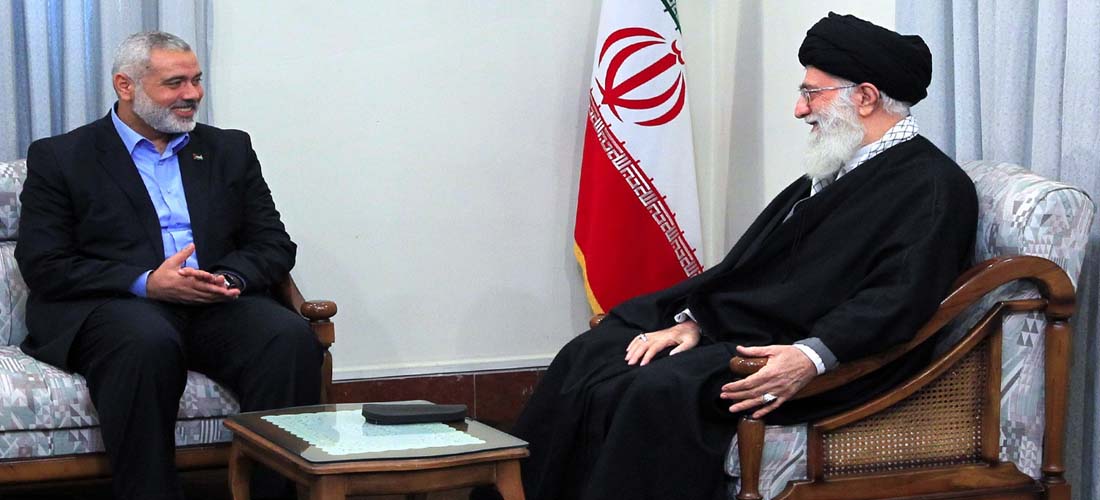
  • Imam Khamenei’s response to Hamas leader’s letter on Arab states’ betraying Palestine

    Imam Khamenei’s response to Hamas leader’s letter on Arab states’ betraying Palestine

    In the Name of God, the Most Beneficent, the Most Merciful:

    All praise is due to Allah, the Lord of the Worlds; peace and greetings be upon our Master and Prophet, Ab-al-Qassem Al-Mustafa Muhammad, and upon his pure, immaculate and chosen household, especially the one remaining with Allah on earth.


    Dear brother, resistance activist Dr. Ismail Haniyeh,

    I start my letter with this verse from the holy Quran, which seems as if it was meant for us during our time, addressed to you and all of us: “Do not be faint of heart in pursuing the enemy: if you happen to suffer harm they too are suffering just as you are, while you may hope from God what they cannot hope for. God is All-Knowing, All-Wise.[Quran, 4:104]” In other words, He is aware of your victory through God’s permission and advises you to refrain from frailty and infirmness.


    At a time when aggravation of oppression and animosity, led by the Zionist enemy in Gaza, has made the enthusiasts of Palestine sad and angry, I insist on the Islamic Republic’s enduring position regarding Palestine, which is also an important issue of the Islamic Ummah.


    No doubt, resistance is the only way to free an oppressed Palestine, and it is the only cure for wounds on the body of that brave and proud nation. In your affectionate letter, your excellency has indicated some of the main challenges of the Islamic Ummah: you have referred to the conspiracy and hypocrisy of some Arab countries in the [South West Asia] region and their vicious plots, following the Great Satan (the US); you have also reminded us of the resistance in Palestine—the fighters on the front line before the enemy’s pressure, oppression, and cruelty. Your remarks are absolutely true and we confirm them. We feel it is our responsibility to support you, in any manner as needed.


    This [support of Palestine] is a religious duty and a humane responsibility that goes beyond political events and changes; we will, God willing, continue to perform this duty, like before. All Muslim governments, Muslim nations, and Islamic movements are obligated to fulfill this great task [support of Palestine] and should try to carry on with it.


    Today, the return to dignity and authority of the Islamic Ummah relies upon resistance against the Front of Arrogance and its vicious plots; the matter of Palestine is at the heart of all international challenges that the Islamic Ummah faces while fighting against the Front of Arrogance. Moving towards negotiations with the cunning, usurper, and untruthful regime is an irreversible mistake that would delay the victory of the Palestinian nation; and it will bring about nothing other than detriment for the oppressed nation.


    Act of Betrayal by some Arab leaders, which is gradually revealing itself, pursues the same goal [as delaying the victory of the Palestinian nation]. The only cure is strengthening the resistance within the Muslim World, reinforcing the fight against the usurper Zionist regime and its allies.


    Nations, especially zealous youth in Muslim and Arab countries, as well as governments that feel responsible towards Palestine, should seriously consider this as their duty:

    repelling the enemy to the point of annihilation, through strategic and vigorous action. I ask Allah the Almighty to bestow success upon you and all resistance forces; I beseech closeness towards the day of your victory, which is a certain destiny.


    And Peace be upon you
    Sayyid Ali Khamenei
    April 4, 2018


    Imam Khamenei Official Website

  • Warning to Saudis !

    Warning to Saudis !


    Yemen’s problem.


    Saudis committed a bad heresy in this region and indeed they did wrong.


    What Saudi government is doing in Yemen today, is exactly what Zionists did in Gaza.


    It has two aspects:

    one, it’s a crime, it’s genocide, can be sued internationally, they kill children, ruin houses, demolish infrastructures, destroy the national wealth in a country; well, this is a great crime; this is only one aspect of the issue;

    the other aspect is that Saudis will lose something, they’ll be damaged, there’s no way they can win.


    The reason is quite clear; it’s because Zionist’s military capability is several times more than these Saudis; several times more than them, they had military capability; and their target was small Gaza.

    Here the opponent is a country, a country with a population of tens of millions; a nation, a large vast country. If they [Zionists] could win in Gaza, these [Saudis] can win here;  even if they had won in gaza again these would have no chance for victory; now it’s even less.


    They will surely get a beating; definitely Saudis will be defeated.


    We have numerous disagreements with Saudis in different political issues, but we always said that Saudis had shown some dignity and sobriety; now they have lost that dignity and sobriety.

    A few naïve young men, have taken matters of that country in hand and are predominating the barbaric aspect over sobriety and good appearance; this will end badly for them.


    I warn Saudis, they should stop these criminal acts; this is not acceptable in this region.


    America supports them indeed, defends them; this is the nature of America, in all issues takes the oppressor’s side; take’s side with the bad figures, instead of taking oppressed people’s side;

    this is their nature, and here they’re acting the same, or else they’ll suffer losses, they’ll lose.


    Now they will create controversy that “Iran is meddling in Yemen”; Yes! this is meddling, our talking here is meddling; but their criminal warplanes making Yemen’s airspace unsafe is not meddling!

    they make up their foolish excuses for this meddling; these excuses won’t be accepted by international logic, neither nations will accept it nor god…

    Imam Khamenei


    Download Video Here