Category: Editor’s Picks

  • Aircraft losses of US-Israeli, European, and Arab countries in the Iran War

    Aircraft losses of US-Israeli, European, and Arab countries in the Iran War

    The U.S. and Israeli aircraft:

    Iran Front – Including 178 drones (official statement), 9 fighter jets, 8 aircraft, 11 helicopters, and 16 cruise missiles and bombs

    Destruction of 2 C-130 transport aircraft and 4 MH-6 helicopters during a U.S. special operation in southern Isfahan, on April 5.

    Drones:
    — MQ-9 Drone: At least 28 units
    — MQ-4C Drone: 1 unit (April 9)
    — MQ-1 Drone: 2 units (April 4, May 31)
    — RQ-21 Drone: 1 unit (March 30)
    — LUCAS Suicide Drone: Undisclosed number
    — Hermes 900 Drone: At least 8 units
    — Heron Drone: At least 2 units (March 31, April 5)
    — Harop Suicide Drone: Undisclosed number
    — Orbiter Drone: Undisclosed number

    Fighter jets:
    — Destruction of three U.S. F-15E fighter jets over Kuwait (March 2)
    — Destruction of one F-15 fighter jet in central Iran (April 1)
    — Destruction of one A-10 fighter jet over the Strait of Hormuz (April 2)
    — Destruction or damage to one F-35 fighter jet in central Iran (March 19)
    — Destruction or damage to one F-16 fighter jet in central regions (March 21)
    — Damage to one U.S. F-15E fighter jet over Hormuz Island (March 22)
    — Destruction or damage to one U.S. F/A-18 Super Hornet fighter jet in southern Iran (March 25)

    Tanker aircraft and AWACS:
    — Destruction or damage to 5 KC-135 refueling aircraft at Prince Sultan Air Base in Saudi Arabia, March 1-3
    — Destruction of 1 E-3G AWACS aircraft and damage to several other KC-135 refueling aircraft at Prince Sultan Air Base, March 27

    Helicopters:
    — Damage to 1 CH-47 helicopter in Kuwait, April 3
    — Destruction or damage to 1 Black Hawk helicopter, April 3
    — Destruction or damage to 1 CH-47 helicopter at Camp Buehring, Kuwait, date unspecified
    — Destruction or damage to 1 CH-53 Sea Stallion helicopter at Ali Al Salem Air Base, Kuwait, date unspecified
    — Destruction of an AH-64E Apache helicopter in the Strait of Hormuz, June 8

    Cruise Missiles and Bombs:
    — Interception and destruction of 15 AGM-158 JASSM or Tomahawk cruise missiles
    — Shooting down 1 GBU-39 bomb

    Iraq, Lebanon, and Yemen Fronts – Including 14 drones, 3 aircraft, and 2 helicopters

    Drones:
    — 3 U.S. MQ-9 drones: in Jabal Maraqsha, Abyan Governorate (March 3), the desert of Marib (May 17), and north of Marib city (May 29) – by Yemeni Armed Forces
    — 1 U.S. MQ-9 drone: north of Basra (March 10) – by Iraqi Resistance
    — 8 Israeli Hermes 450 drones: Bint Jbeil (March 16), Al-Ayshiyeh region (April 1), Aynatha (April 2), Siddiqin (April 12), Adloun (April 17), Al-Hawsh (April 24), Nabatieh (April 30), Al-Khardali (June 10) – by Hezbollah
    — 1 Israeli Hermes 900 drone: southern Lebanon (April 28) – by Hezbollah
    — 1 Israeli Heron 1 drone: Nahla in Baalbek (June 11) – by Hezbollah

    Tanker aircraft, transport planes, and Helicopters:
    — Destruction of 1 KC-135 refueling aircraft and damage to another KC-135 in western Iraq (March 21) – by Iraqi Resistance
    — Destruction or damage to 1 U.S. UH-60 helicopter at Camp Victory, Iraq (April 5) – by Iraqi Resistance
    — 1 Iraqi Army Antonov-32 transport aircraft (April 10) – by Iraqi Resistance
    — Destruction or damage to 1 Israeli helicopter in the Yaroun area of southern Lebanon, type unknown (April 11) – by Hezbollah

    European countries aircraft:
    — One Italian Army MQ-9 drone (March 15)

    Arab countries aircraft:
    — 1 UAE Army helicopter, type unknown (March 9)
    — 1 Qatari Army helicopter, type unknown (March 22)
    — 2 Wing Loong drones belonging to Saudi or the UAE: in Shiraz (April 1) and Bushehr (April 3)

    The statistics presented are based on official statements by the armed forces of Iran, Iraqi resistance groups, and Lebanon’s Hezbollah, as well as admissions by the United States, the Zionist regime, European, and Arab countries.

    Click to view in full size
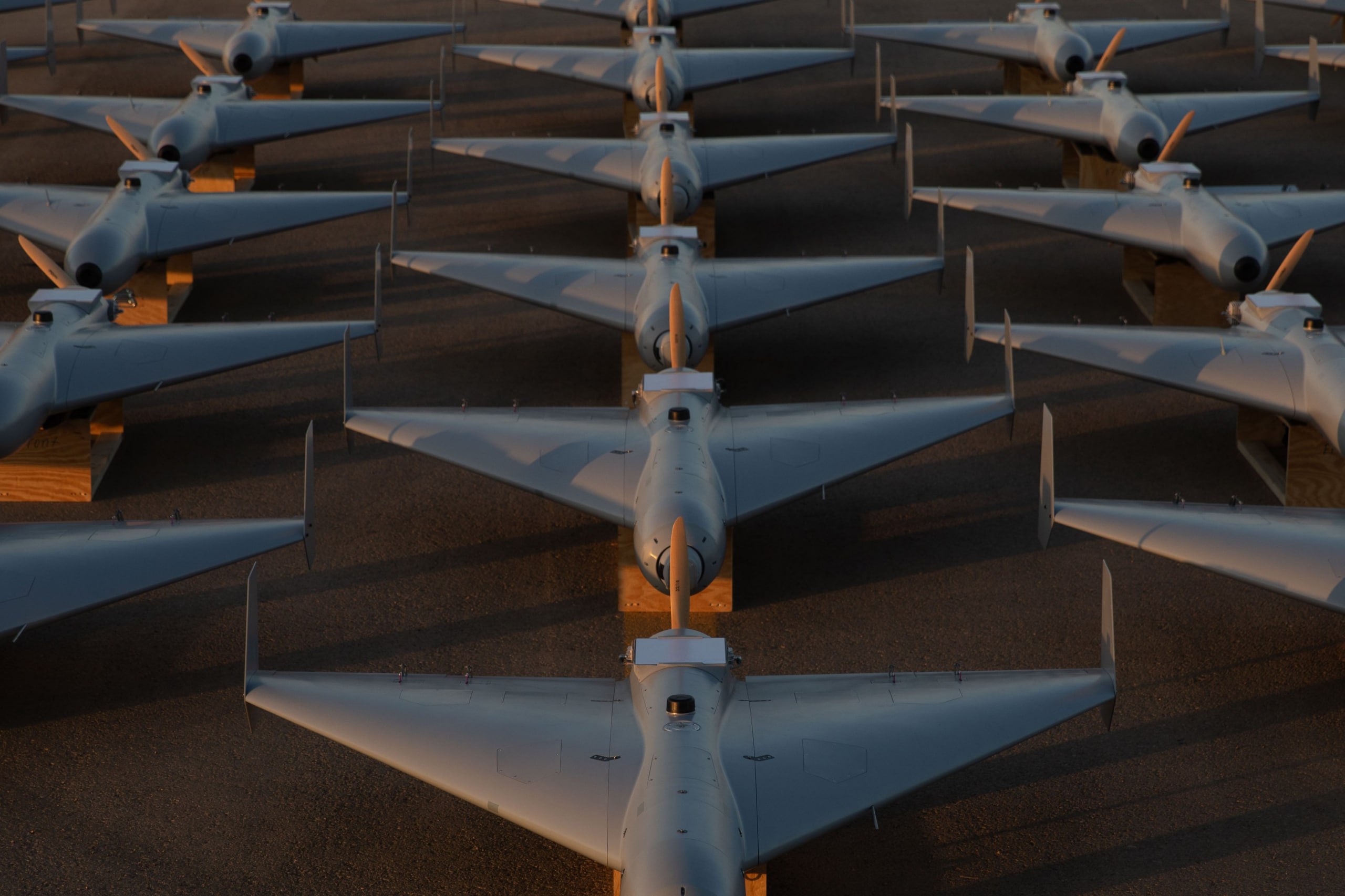
  • United States Deployed Suicide Drones Similar to Shahed‑136 in West Asia to Counter Iran!

    United States Deployed Suicide Drones Similar to Shahed‑136 in West Asia to Counter Iran!

    According to CENTCOM’s commander, the purpose of TFSS is to provide American forces with affordable and effective drone capabilities as a deterrent against “bad actors” in the region. Obviously, by bad actors he means first Iran and then other components of the resistance axis.

    We had previously warned that given America’s access to all active battle fronts around the world including Iran, combined with mass production of these suicide drones, could pose serious risks if used directly by U.S. forces or its allies against adversaries. This concern is now openly acknowledged by U.S. officials and military experts.

    As reported by The War Zone, a U.S. official described the establishment of TFSS as a “major development”, calling it a way to reverse the game against Iran. He stated: “We’ve reached the point where not only are we mass‑producing these drones, but for the first time we’ve deployed them in the Middle East. In effect, we’ve turned the tables on Iran.”

    He added: “We’ve seen what Russia has done in Ukraine, how Iran destabilized the region with drone technology, their 12‑day war threats against Israel, and how partners had to spend vast resources to defend against such attacks. Now we’re taking a page from their playbook and turning it back on them. Iran gained an advantage through sheer volume of drone strikes, which are difficult to defend against at scale.”

    He continued: “We are strengthening our defenses, and sometimes a strong defense can also be a good offense. We’re adding offensive firepower that has already proven effective—especially now that the country which once wreaked havoc with this technology has become vulnerable itself.”*

    The official further noted: “We have no problem targeting Iran‑backed Houthis in Yemen and can use this capability against them as well. With the Houthis, the challenge is finding targets, unlike Iran where there are plenty of targets available!”

    As seen, U.S. officials explicitly speak of using these drones against Iran in future war scenarios. Over the past year, Washington has heavily invested in this category of low‑cost suicide drones, with mass production underway. Experiences from recent conflicts—such as the war in Ukraine and the 12‑day war—have demonstrated how these simple systems can decisively alter the course of battle.
    During the 12‑day war and the True Promise operations (1 and 2), the U.S. and its allies spent enormous resources and deployed vast aerial assets to effectively neutralize Iranian drone attacks on Israel. Yet, unlike America and its partners, Iran lacks comparable large‑scale aerial and defensive assets, which poses a significant challenge. Iran, however, retains asymmetric options for deterrence, as seen in the Aramco attack. At this stage, the U.S. has not yet tested these drones in real combat, but future use against Yemen is considered likely.

  • How Much is Palestine Worth to Turkey?! Learn More About the Covert Cooperation Between Israel and Turkey

    How Much is Palestine Worth to Turkey?! Learn More About the Covert Cooperation Between Israel and Turkey

    Turkey’s economic and trade cooperation with the Zionist regime is carried out through three main channels: sea, land, and air. These methods are as follows:

    — Use of maritime transport and logistics routes:
    Oil, construction materials, steel, and more are shipped from Turkish ports to Israeli ports using vessels flying the flags of neutral countries such as Liberia, Panama, etc. According to available data, about 18% of Israel’s essential non-oil goods are supplied by Turkish cargo ships.

    The maritime route is critical for supplying oil to the Zionist regime. Based on existing information, most of Israel’s oil needs are met by Central Asian countries like Azerbaijan and Kazakhstan via shipping routes that pass through Turkey. Thus, oil from the Caspian Sea is transported by the Baku government in cooperation with Turkey through the Baku–Tbilisi–Ceyhan pipeline into Turkey. Turkish tankers load the oil at Ceyhan port and, upon entering Israeli waters, turn off their AIS tracking systems and deliver the cargo to ports in Haifa, Ashdod, and Ashkelon.
    In January of last year, Israel topped the list of oil destinations from Azerbaijan, receiving 523,500 tons of oil worth $297 million.

    The Baku-Tbilisi-Ceyhan pipeline, which transports oil from the Caspian Sea to the Mediterranean Sea

    — Use of hybrid land and air routes:
    Trade via this method is conducted through third countries. Goods are likely transported overland from Turkey to Georgia and Azerbaijan, and from there flown to Israel. Azerbaijani logistics companies play a key role in this process. Cargo flights from Baku to Israel are actively ongoing, and it’s likely that Turkish goods are included in these shipments.

    — Use of Turkish and other Israel-friendly air routes:
    Turkish and Israeli airlines may use routes through countries such as Jordan, the UAE, and Greece. Cargo may be labeled “for Oman,” while its actual destination is Tel Aviv.

    Possible sea and air routes for transporting oil and goods to the Zionist regime

    Financial transactions are also conducted through intermediary countries. Banks in the UAE and Switzerland facilitate money transfers between Turkey and Israel. Even cryptocurrency transactions may be used to maintain anonymity.

    Overall, neither Turkey nor the Zionist regime shows any real intention of fully cutting economic and trade ties. Turkey profits from trade in various sectors, and Israel benefits not only from securing oil and essential goods like textiles and food, but also from Turkey’s potential role in exporting Israeli gas to Europe. Additionally, Israel can use Turkey as a gateway to access Central Asian and Caucasus markets. This is a strategically important issue that economically benefits both sides. In this context, public statements from Turkish and Israeli officials about severing ties are mostly for domestic consumption and global image management. As long as tensions remain “rhetorical,” it’s highly unlikely that the profitable trade between Turkey and Israel will be disrupted.

    Economic and trade cooperation between countries—especially Islamic ones—and the Israeli regime prevents pressure from being effectively applied and instead enables the regime to continue its crimes against the Palestinian people and the region. Cutting off these ties is one of the most effective ways to pressure Israel to stop its crimes.

    As a regionally influential country, if Turkey truly seeks to end the killing and war against Palestinians and apply pressure on Israel, it must sever its economic, trade, and political relations with the regime. Otherwise, it will be considered a direct and indirect accomplice in the crimes committed by the Israeli regime.

    Sources:
    Islamic World News
    Rybar Telegram Channel

  • How Many Israeli Drones Were Shot Down Over Iran During 12-Day War?

    How Many Israeli Drones Were Shot Down Over Iran During 12-Day War?

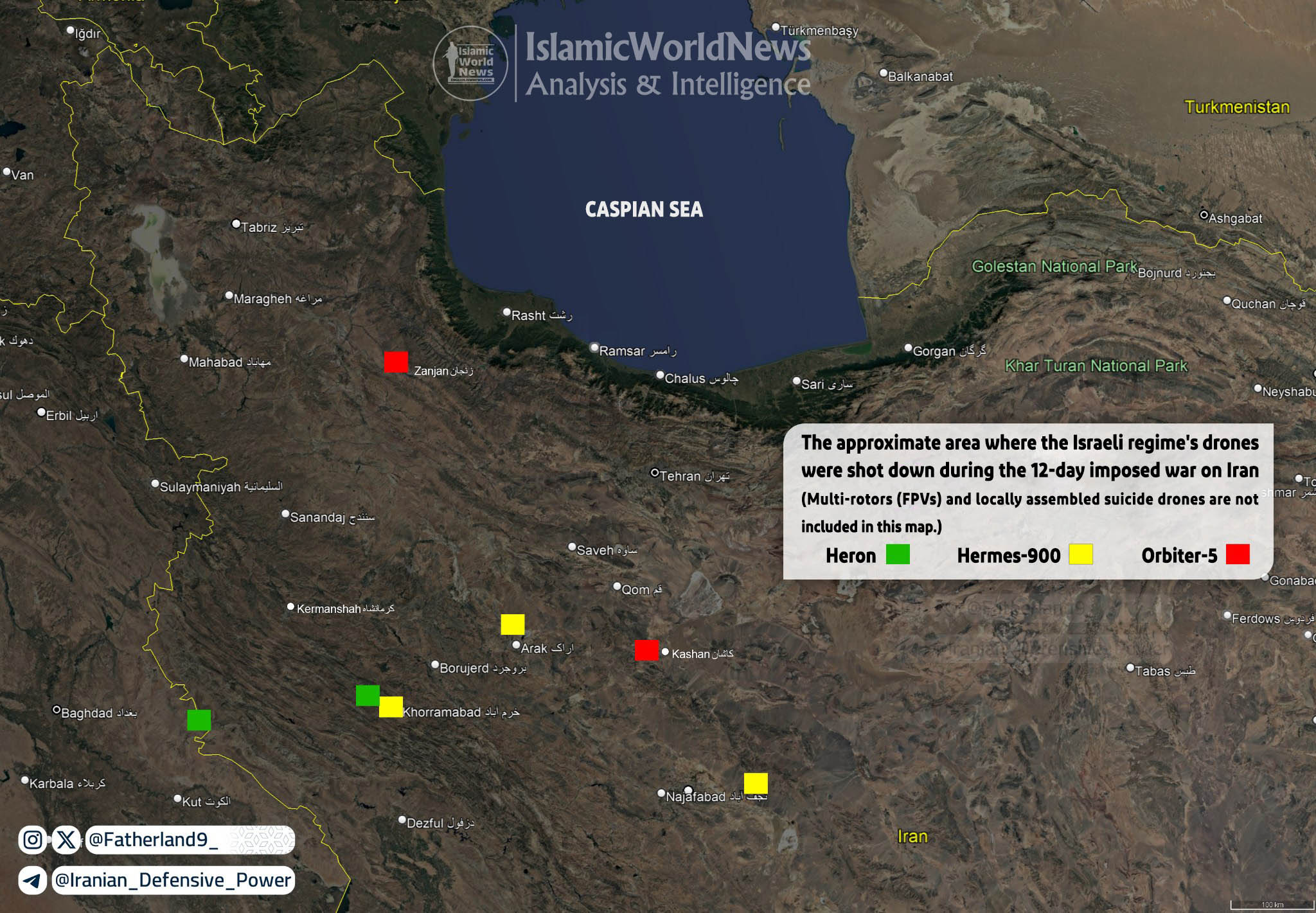
    Based on visual documentation, the downed drones are as follows:

    A Hermes 900 drone was shot down on June 18 in eastern Isfahan province. Images of the wreckage show a rocket pod and smart guided munitions.

    Read more about Hermes-900 drone: Military Knowledge: Hermes 900 Drone

    A Hermes 900 drone was downed on June 18 near Isfahan city

    Heron drone with serial number 298 was downed on June 19 near Iran’s western borders in Ilam province. It was destroyed by the short-range Majid air defense system. Analysis of the wreckage and archival images revealed that this Heron lacked a satellite communication antenna and had to be guided by ground stations, giving it a range of about 300 km. This suggests it was likely operated from a ground station in Iraqi Kurdistan or a U.S. base in Iraq.

    Read more about Heron and Heron TP drones: Military Knowledge: Eitan (Heron TP) Drone

    Destruction of a Heron drone on the country’s western borders in Ilam province

    Another Heron drone with serial number 248 was shot down on June 19 in the mountainous areas of Lorestan province. Visual evidence shows this drone was equipped with a satellite antenna.

    Destruction of a Heron drone in the heights of Lorestan province

    An Orbiter-5 drone with serial number 8312 was downed on June 21 in Kashan.

    An Orbiter-5 drone with serial number 8312 downed on June 21 in Kashan

    A Hermes 900 drone with serial number 939 was shot down on June 22 in Markazi province.

    Another Hermes 900 was downed on June 23 in Khorramabad, Lorestan province.

    The moment a Hermes 900 drone was targeted and downed over Lorestan province
    Wreckage of Hermes 900 drone downed on June 23 in Khorramabad. The Rotax 914 engine is visible in the footage.

    An Orbiter-5 drone with serial number 8373 was shot down on June 24 in Zanjan. Interestingly, this drone featured a satellite communication antenna—something not previously seen in Orbiter-5 models. Drones of this class, due to their size and weight, are typically used as tactical drones on the front lines. However, the Orbiter-5 downed in Iran had extended capabilities thanks to its satellite link, overcoming the usual 100 km range limitation of ground control stations. This enhancement gave it a role beyond that of a tactical drone, allowing Israel to extend its surveillance deeper into Iranian territory.

    Read more about Orbiter-5 drone: Military Knowledge: Orbiter-5 Drone

    The video released by the IRGC regarding the shot down of a Orbiter-5 drone in Zanjan province

    Source: Iranian Defensive Power

  • Operation True Promise 3: Which Locations Were Targeted In Occupied Territories?

    Operation True Promise 3: Which Locations Were Targeted In Occupied Territories?

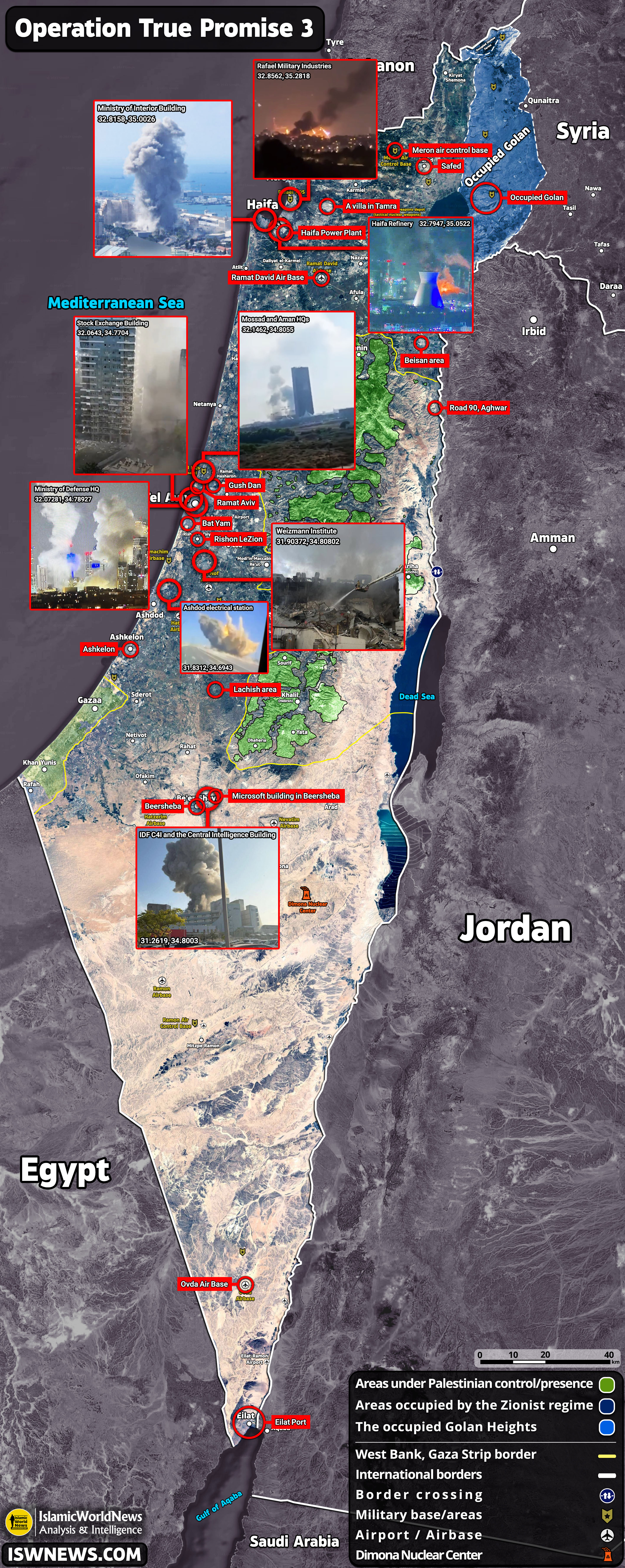
    The Iranian armed forces launched the ‘Operation True Promise 3’ shortly after the Zionist regime’s aggression on Iran on June 13, And attacked Israeli positions across occupied Palestine. During the operation, Iranians utilized a variety of ballistic missiles, such as Emad, Qadr, Kheibar-Shekan, Sejjil, Hajj Qassem, Fattah-1 hypersonic missile, and Shahed-136 and 238 suicide drones, along with Arash-1 and 2 suicide drones. It also involved cruise missiles and other cyber and intelligence tools.

    Areas that were targeted in Israel by Iranian missiles during ‘Operation True Promise 3″

    This operation was conducted daily in multiple stages, targeting various Israeli military assets including military and intelligence centers, air bases, fuel production sites, energy supply facilities, defense infrastructure, military industrial complexes, command and control hubs, and operational support units.

    Based on our investigations and gathered information, the Iranian armed forces have targeted and attacked the following locations during Operation True Promise 3.

    – June 13 and 14; first and second days
    1- Israeli Defense Ministry headquarters in Tel Aviv: 32.0728, 34.7892
    2- Rishon Lezion: 31.9701, 34.7904

    The moment an Iranian hypersonic missile hit the Israeli Defense Ministry headquarters in Tel Aviv
    The moment an Iranian hypersonic missile hit the Israeli Defense Ministry headquarters in Tel Aviv – another angle
    The moment at least 15 Iranian ballistic missiles hit Tel Aviv
    The moment an Iranian ballistic missile hit the Rishon LeZion area south of Tel Aviv

    – June 15, Day 3
    1- Haifa Refinery: 32.7947, 35.0522
    2- A Villa in Tamra near Haifa
    3- Eilat Port
    4- Tel Aviv (various areas):
    Weizmann Institute in Rehovot area: 31.9037, 34.8080
    Bat Yam area
    5- Ramat David Air Base: 32.6680, 35.18174

    Ramat David Air Base is the primary Israeli Air Force installation in northern the occupied Palestinian territory. Situated on the southeastern edge of Haifa, 46 kilometers from Lebanon, it features three runways. The base hosts multiple squadrons, including F-16 fighter jets, Heron drones, and attack helicopters. It has been a crucial part of Israel’s operations in Lebanon and was frequently targeted by Hezbollah rockets and drones during the recent conflict.

    The moment an Iranian ballistic missile hit the city of Haifa
    Fire breaks out at Haifa refinery after Iranian missiles hit
    Iranian missile hits villa in Tamra town near Haifa
    Two Iranian Shahed-238 drones hit the port of Eilat. This is the first officially recorded successful operation using this type of jet-powered suicide drone.
    The moment Iranian missiles hit points in Tel Aviv
    Iranian missiles hit and caused extensive damage to the Weizmann Institute of Science in the town of Rehovot, located in the southern suburbs of Tel Aviv.

    – June 16, Day 4
    1- Rafael Military Industries in Haifa: 32.8562, 35.2818
    2- A snagogue in Lachish area
    3- Haifa Power Plant: 32.7910, 35.06526
    4- Tel Aviv, Gush Dan area, disruption of air defense systems and hit on Arrow 3 system

    Iranian missile hits Rafael military industries in Haifa
    Iranian missile hits synagogue in Lachish area
    The moment two Iranian missiles hit the Haifa power plant and a fire broke out in the area. As you can see, a large number of interceptor missiles were fired in the final stage, but they did nothing and out of the three missiles, two missiles hit the targets. These interceptors are the final stage and before that, the exo-atmospheric interceptors had also failed.
    A rare angle shot of the moment an Iranian missile hit a target in Haifa. The missile came straight at the cameraman. Fast and scary!
    Two Iranian missiles hit Tel Aviv
    Video showing the Israeli army’s Arrow 3 defense system malfunctioning amid a missile attack at dawn on the fourth day of the war. The IRGC stated it had disrupted Israel’s defense systems. In this footage, we observe the disruption described by the IRGC, along with an Israeli interceptor missile striking another launcher.

    – June 17, Day 51
    1- Disruption of Israel’s air defense systems and the downing of an interceptor missile in Tel Aviv
    2- Aman military intelligence center and Mossad headquarters in Herzliya

    The interceptor missile failed and returned and hit a point in Tel Aviv.
    Iranian missiles hit Mossad facilities in the Herzliya area of Tel Aviv. The cameraman also says in the video: “Wow… they even managed to hit Mossad!”
    Another video of Iran’s missile attack on the Mossad headquarters in Herzliya. In this video, at least three missiles hit the area around the headquarters and one missile hits the headquarters itself.

    – June 18, Day 6
    1- Disruption of Israel’s air defense systems and the fall of an interceptor missile in Tel Aviv for the third time.
    2- Tel Aviv

    In this video, the Israeli interceptor missile malfunctioned and crashed after launch, causing a fire in Tel Aviv. These malfunctions are likely accidentals, as Iranian jamming systems disrupt Israeli defenses.
    The moment two more missiles hit Tel Aviv
    Breathtaking moments of Iranian missiles reaching Tel Aviv and Israeli interceptors firing. In this video, it is confirmed that 3 Iranian missiles hit.

    – June 19, Day 7
    1- Occupied Golan
    2- Tel Aviv, a high-rise building near Stock Exchange Building in Ramat Gan: 32.0643, 34.7704
    and Ministry of Defense facilities in Tel Aviv
    3- Israeli army’s Command and Intelligence (IDF C4I) headquarters and the Intelligence HQ in the Gav-Yam Technology Park in Beersheba
    4- Microsoft Building in Beersheba

    The moment one of the Iranian army’s suicide drones (probably the Arash type) hit Israeli positions. The strikes captured by a surveillance camera in the occupied Golan.
    A video depicts two missiles, possibly Sejjil-type, striking Tel Aviv. The Israeli regime heavily censored news about the Iranian missile strikes on the seventh day of the war.
    Iranian missiles hit Tel Aviv, near stock exchange building in Ramat Gan area
    The moment an Iranian missile hit the IDF C4I HQ and the intelligence headquarters in the Gav-Yam Technology Park in the city of Beersheba.

    – June 20, Day 8
    1- Ministry of Interior Building in Haifa: 32.8159, 35.0027
    2- Beersheba
    3- Ashkelon
    4- Radar system in the occupied Golan with suicide drone

    Iranian missile hit Beersheba
    Iranian missile hit Ashkelon
    Iranian suicide drone hits Israeli army radar system in occupied Golan Heights

    – June 21, Day 9
    1- Tel Aviv
    2- Beisan area, drone attack
    3- Occupied Golan, drone attack
    4- Road 90, Aghwar area, Jordan Valley

    The moment two Iranian missiles hit Tel Aviv
    The site of the suicide drone strike in the Baysan area in occupied Palestine
    The moment a Shahed-136 drone of the Iranian armed forces hit the Baysan area in northern occupied Palestine.

    – June 22, Day 10
    1- Haifa
    2- Tel Aviv, Ramat Aviv

    Iranian missile hits a target in Haifa port
    The moment multiple Iranian missiles hit Tel Aviv
    One or more Iranian missiles hit the Ramat Aviv area of Tel Aviv, causing widespread destruction. According to Zionist media reports, the Iranian armed forces launched 22 missiles in one phase and five more missiles in a second phase towards the occupied territories.

    – June 23, Day 11
    1- Ashdod Power Plant: 31.8312, 34.6943
    2- Ashkelon
    3- Safed
    4- Al-Udeid Air Base in Qatar: 25.1154, 51.3164

    The moment a missile hit the Ashdod power plant, located along a road in the occupied territories towards Tel Aviv. According to the Israeli Energy Minister, 8,000 customers lost their electricity after the missile hit.
    This video appears to have been recorded by a Zionist settler, likely in Ashkelon. It shows the sound of several missiles hitting the occupied territories, with the Israeli commenting on the Iranian missile strikes, saying: “What is that sound? Wow, wow, wow.”
    Iranian missile hits the town of Safed in northern occupied Palestine
    Another missile hit northern occupied Palestine
    Iranian missile hits unspecified point in northern occupied Palestine

    – June 24, Day 12
    1- Beersheba city

    The moment a missile hits a seven-story building in Beersheba.

    The attack sites listed are based on image and video evidence of Iranian strikes in the occupied territories. Additionally, sites such as Ben Gurion Airport, Nevatim Air Base, Hatzerim Air Base, the Sail Tower in central Haifa hosting AI12 Labs, the Hadera Power Plant, Ovda Air Base in the southern Negev, the Kiryat Gat semiconductor industrial zone, and Meron Air Control Base in northern occupied Palestine have also been targeted by Iranian strikes, according to IRGC statements and other international media reports.

    Some notable outcomes of Iran’s strikes on Israel:

    Haifa Oil Refinery Shuts Down: The Haifa Oil Refinery has shut down following extensive damage from an Iranian missile attack on June 16, according to Yedioth Ahronoth. The Zionist economic newspaper Calcalist also reported that Sonol, one of Israel’s largest fuel companies, contacted its customers after damage to Bazan Company caused by Iranian missile strikes. They announced that, “Under these circumstances and due to the situation being out of our control, we are forced to reduce or cease fuel supplies to our customers.”

    The destruction of the Weizmann Institute of Science and Technology: On June 15, Hajj Qasem tactical ballistic missiles struck the Weizmann Institute, causing extensive damage. The institute’s leader reported that the attack destroyed two research buildings and damaged 112 units, including 60 laboratories and 52 other structures. The head highlighted the institute’s difficulty in obtaining compensation and estimated the total damage at 2 billion shekels (approximately $590 million). Rebuilding is expected to take around five years.

    The Weizmann Institute of Science is Israel’s leading and largest center for education and research in nuclear, military, and artificial intelligence fields. Founded 14 years before the Israeli regime in occupied Palestine, it trains students in physics, chemistry, electronics, and related disciplines at both master’s and doctoral levels. The institute has housed human data samples, biological databases, and trillions of bioinformatics records. Additionally, some alumni have contributed to the development of weapons for the Zionist military and are employed across its various scientific divisions.

    Suspension of Maersk Shipping Company’s activities: Maersk, the largest international shipping company, announced that it will suspend all commercial transportation to the port of Haifa.

    Suspension of flights at airports in occupied Palestine: Flights into and out of Ben Gurion Airport and other Israeli airports were completely suspended.

    Ashdod power outage: Following an Iranian missile accurately hitting the Ashdod electrical station, the Israeli Minister of Energy announced that 8,000 customers have lost their electricity and Ashdod is experiencing a blackout.

    Displacement of 18,000 settlers from the Bat Yam area: According to the Israeli economic-analytical newspaper Calcalist, the Iranian missile attack turned Bat Yam, one of Israel’s three most populous towns, into a ruined city akin to Gaza. About 18,000 residents have evacuated their homes due to damage and destruction. Of these, 12,000 have moved to hotels, while others are in rented apartments or temporary shelters. Additionally, four towns—Bat Yam, Tel Aviv, Rehovot, and Ramat Gan—are experiencing a severe housing shortage for displaced residents caused by the attacks. This destruction is expected to impact housing prices in the occupied territories over the medium term.

    Moroccan soldiers killed in Iranian attack: A leaked document reports that two Moroccan soldiers killed when an Iranian missile struck Meron air control base in northern occupied Palestine. These casualties included a captain and a senior Moroccan commander who were there for joint exercises with Israeli forces. Additionally, another Moroccan soldier and officer were wounded and treated in Haifa. Notably, if Moroccans were killed in the attack, then Israeli casualties likely occurred as well. However, these Israeli losses are typically kept from the public view, as has often been the case.

    Statistics and Israeli casualties from Iran’s Operation True Promise 3:

    According to the latest reports from the Israeli media, the Israeli regime’s casualties include 33 deaths (including Arabs in northern Palestine) and 3238 injuries. Of the injured, 23 are reported to be in serious condition and 111 in moderate condition. It is important to note that these figures are based on information from media outlets and institutions linked to the Israeli regime, while the number of casualties in military and security zones remains concealed and censored, consistent with the regulations established by the regime’s army since the war’s outset.

    International reactions to Israel’s aggression on Iran; Yemen’s military support and Pakistan’s political support for Iran:

    Many countries worldwide and within the Islamic world, such as Russia, China, Pakistan, Yemen, Saudi Arabia, and Egypt, condemned Israel’s attack on Iran. Notably, Pakistan’s stance was more prominent in terms of broad political support, while Yemen offered significant political, social, and military backing. An emergency UN Security Council meeting on June 14 to discuss Israel’s assaults on Iran resulted in minimal action, with officials only expressing concern and urging Iran to exercise restraint. Western governments including the United States, France, Germany, England, and Canada also supported Israel.

    A rally supporting Iran took place in Pakistan, where Defense Minister Khawaja Muhammad Asif expressed Pakistan’s stance. He stated: “Israel has targeted Yemen, Iran, and Palestine. If the Islamic world does not unite now, we all risk facing the same fate. Pakistan stands with Iran. Silence is no longer an option. The Organization of Islamic Cooperation should convene a meeting to develop a unified strategy. I urge all Islamic countries to immediately cut diplomatic ties with Israel.”

    On June 15, the Yemeni Armed Forces announced they launched several Palestine 2 hypersonic ballistic missiles at different times, coordinating military operations with Iran and the IRGC targeting key Israeli sites in Tel Aviv region. Brigadier General Yahya Saree, spokesman for the Yemeni Armed Forces, stated: “The Yemeni Armed Forces salute the Islamic Republic of Iran, its nation, army, and leadership for bravely and determinedly confronting the brutal Zionist attack. Relying on God, they strike successive blows at its facilities, headquarters, and bases. While observing these developments, we proudly reaffirm our commitment to the people of Gaza and its loyal Mujahideen until the war and siege against Gaza end.”

    According to the leader of Ansar Allah, the Yemeni army has continued its support for Palestine against the Zionist regime during Dhul-Hijjah (from May 28 to June 26). They reportedly utilized 25 ballistic missiles, hypersonic missiles, and suicide drones. Studies from Islamic World News indicate that Yemeni forces collaborated with Iranian forces on five occasions, launching a total of eight ballistic missiles and suicide drones targeting locations in Tel Aviv, Haifa, Beersheba, and Eilat. Additionally, they emphasized that in response to U.S. military strikes against Iran’s nuclear facilities, if the U.S. engages directly in the conflict with Iran, they will target all American ships in the Red Sea.

    Conclusion:
    Iran’s Operation True Promise 3, which was a legitimate defense of Iran’s territory and airspace against widespread Israeli aggression, involved 22 waves of missile attacks and 10 stages of drone attacks that began on June 13 and lasted for 12 days. The positive effects of this operation inside and outside Iran led to the failure of the declared plan by Israeli regime leaders to destroy Iran’s nuclear program, change the political system of the Islamic Republic, and eliminate Iran’s military capabilities, especially its missile forces.

    Zionist media and the military spokesperson for the regime claim that during the twelve-day war, the Iranian armed forces launched over 510 ballistic missiles, as well as more than 680 (with some reports claiming more than 1,000) suicide drones and cruise missiles towards the occupied territories. Israel also claims that only 55 of these missiles struck occupied Palestinian territory, while the rest were intercepted and destroyed by the air defenses.

    However, this claim exaggerates the number of missiles, and the reported hits have been censored. The Israeli army’s statistics do not match the actual field conditions. Based on investigations by Islamic World News and visual evidence presented in this article, there are documented cases of 90 missile hits and 7 drone hits. Additionally, the Iranian armed forces reportedly launched around 300 to 350 missiles during Operation True Promise 3. Also, it should be noted, the exact count of drones and cruise missiles remains uncertain due to the lack of available visual documentation.

    Undoubtedly, this figure is not definitive because of widespread censorship by the media and security institutions of the Zionist regime. The actual number of missiles hit is likely higher than the estimate provided. Overall, Operation True Promise 3 was a significant military effort with impactful results, prompting the leaders of the United States and Israel to agree to a temporary ceasefire.

  • Infographic: Saudi Coalition And US Aircraft Losses In Yemen War (Updated)

    Infographic: Saudi Coalition And US Aircraft Losses In Yemen War (Updated)

    1- Saudi F15S fighter on March 27, 2015, Gulf of Aden
    2- Saudi AH-64D helicopter on May 7, 2015, Al-Boqa, Saada area
    3- Moroccan F16C fighter on May 10, 2015, Wadi Nashur
    4- Saudi Seeker400 UAV, July 3, 2015, Al-Boqa
    5- Saudi AH-64D helicopter, August 5, 2015, Jizan
    6- Saudi AH-64D helicopter, August 21, 2015, Jizan
    7- UAE Schiebel Camcopter S-100, August 25, 2015, Makiras, Abyan Province
    8- UAE Schiebel Camcopter S-100, October 25, 2015, Al-Abdiyah, Marib Province
    9- Bahrain F16C fighter, December 30, 2015, Jizan
    10- UAE MQ-1 Predator UAV, January 19, 2016, Sanaa
    11- Saudi Selex ES Falco UAV, February 3, 2016, Midi, Hajjah province
    12- UAE Schiebel Camcopter S-100, February 27, 2016, Dhubab, Taiz province
    13- UAE Mirage 2000 fighter, March 13, 2016, Al-Bariqa, Aden
    14- UAE AH-64D UAE helicopter, June 12, 2016, Gulf of Aden
    15- UAE NSA407 helicopter, June 13, 2016, Al-Bariqa, Aden
    16- Saudi AH-64D helicopter, July 25, 2016, Beer Al-Maraziq, Al-Jawf
    17- Saudi Seeker400 UAV, August 16, 2016, Kataf, Saada province
    18- UAE Wing Loong UAV, September 26, 2016, Kholan, Sanaa province
    19- Saudi AH-64D helicopter, December 30, 2016, Najran
    20- US V-22 Osprey Helicopter, January 29, 2017, Al-Baydha province
    21- Saudi SA 365F Helicopter, January 30, 2017, Al-Hudaydah coast (on the Al-Madinah frigate)
    22- UAE MQ-1B Predator UAV, February 14, 2017, Al-Manin, Marib province
    23- Jordanian F16A fighter, February 24, 2017, Najran
    24- Saudi S-70A helicopter, April 18, 2017, Marib province
    25- UAE Schiebel Camcopter S-100, June 21, 2017, Dhubab, Taiz province
    26- UAE AH-60L helicopter, August 11, 2017, Wadi Amaqin, Shabwa province
    27- Saudi Seeker 400 UAV, August 15, 2017, Al-Boqa, Saada province
    28- US UH-60M helicopter, August 25, 2017, Gulf of Aden
    29- UAE AT-802U aircraft, September 11, 2017, Gulf of Aden
    30- Saudi Eurofighter Typhoon fighter, September 13, 2017, Abyan province
    31- US MQ-9 UAV, October 1, 2017, Sanaa city
    32- UAE AH-64D Helicopter, October 17, 2017, Khab and Shaaf, Jawf province
    33- Saudi S-70A helicopter, November 5, 2017, Abha
    34- Saudi Panavia Tornado fighter, January 7, 2018, Kataf, Saada province
    35- Saudi F-15S fighter, March 21, 2018, Saada province
    36- Saudi CH-4B UAV, July 12, 2018, Al-Rabu’ah
    37- Saudi Panavia Tornado fighter, July 12, 2018, Asir
    38- Saudi CH-4B UAV, August 30, 2018, Jizan
    39- UAE Schiebel Camcopter S-100, September 2, 2018, Al-Jah, Hudaydah province
    40- Saudi AH-64D helicopter, September 14, 2018, Al-Mahra province
    41- Seeker 400 UAE UAV, November 26, 2018, Al-Jabaliya, Hudaydah province
    42- Saudi CH-4V UAV, December 23, 2018, Saada province
    43- US MQ-9 UAV, June 6, 2019, Hudaydah province
    44- Saudi CH-4B UAV, April 11, 2019, Hadhramaut province
    45- UAE Wing Loong, April 19, 2019, Saada province
    46- UAE RQ-1E Predator UAV, May 15, 2019, Bani Matar, Sanaa
    47- UAE Schiebel Camcopter S-100, June 2, 2019, Hays, Hudaydah area
    48- US MQ-9 UAV, August 21, 2019, Dhamar province
    49- US MQ-9 UAV, March 23, 2021, Marib province
    50- UAE Shiebel Camcopter S-100, November 1, 2019, Raas Issa, Hudaydah province
    51- Saudi AH-64D helicopter, November 29, 2019, Asir
    52- Saudi Wing Loong UAV, November 30, 2019, Hayran, Hajjah province
    53- Saudi Luna X2000 UAV, December 4, 2019, Saada province
    54- Saudi Karayel UAV, December 30, 2019, Al-Salif, Hudaydah province
    55- Saudi CH-4V UAV, January 7, 2020, Khab and Shaaf, Jawf province
    56- Saudi Panavia Tornado fighter, February 14, 2020, Jawf province
    57- Saudi RQ-20 UAV, August 2, 2021, Haradh, Al-Hajjah province
    58- Saudi CH-4B UAV, December 21, 2020, Marib Province
    59- Saudi Karayel UAV, January 6, 2021, Jawf province
    60- Saudi CH-4B UAV, February 12, 2021, Marib province
    61- Saudi Karayel UAV, March 7, 2021, Jawf province
    62- Saudi CH-4B UAV, March 23, 2021, Sarwah, Marib province
    63- Saudi Wing Loong UAV, May 21, 2021, Najran
    64- US MQ-9 drone, May 23, 2021, Jawf province
    65- Saudi Scan Eagle UAV, June 19, 2021, Marib province
    66- Saudi Scan Eagle UAV, June 21, 2021, Marib province
    67- Saudi Scan Eagle UAV, August 14, 2021, Madghal, Marib province
    68- Saudi Wing Loong UAV, September 13, 2021, Kataf, Saada province
    69- Saudi Scan Eagle UAV, September 27, 2021, Madghal, Marib province
    70- Saudi CH-4 UAV, October 6, 2021, Jubah, Marib province
    71- Saudi RQ-20 UAV, October 7, 2021, at the Jizan border
    72- Saudi Scan Eagle UAV, November 9, 2021, Al-Juba, Marib province
    73- Saudi Scan Eagle UAV, November 13, 2021, Al-Juba, Marib province
    74- Saudi CH-4 UAV, December 1, 2021, in Al-Amshia area, Amran province
    75- Saudi Scan Eagle UAV, December 4, 2021, Al-Juba, Marib province
    76- Saudi Scan Eagle UAV, December 8, 2021, Al-Juba, Marib province
    77- Saudi CH-4 UAV, December 8, 2021, Al-Wadi, Marib province
    78- Saudi Scan Eagle UAV, December 10, 2021, Sarwah, Marib province
    79- Saudi CH-4 UAV, December 14, 2021, Usaylan, Shabwa province
    80- Saudi Scan Eagle UAV, December 16, 2021, Al-Wadi, Marib province
    81- Saudi Scan Eagle UAV, December 25, 2021, Yatmah, Khab and Al-Shaaf, Al-Jawf province
    82- UAE Wing Loong UAV, January 5, 2022, Usaylan, Shabwa province
    83- UAE Wing Loong UAV, January 11, 2022, Ain Shabwah province
    84- Saudi Scan Eagle UAV, January 29, 2022, Al Juba, Marib Province
    85- Saudi CH-4 UAV, February 10, 2022, Harad, Hajjah province
    86- UAE MQ-1 UAV, February 25, 2022, Al-Jawf province
    87- Saudi Scan Eagle UAV, February 25, 2022, Al Juba, Marib Province
    88- Saudi Scan Eagle UAV, February 28, 2022, Harad, Hajjah province
    89- Saudi Scan Eagle UAV, March 8, 2022, Harad, Hajjah province
    90- Saudi Scan Eagle UAV, March 29, 2022, Al-Wadi, Marib province
    91- Saudi CH-4 UAV, May 4, 2022, Harad, Hajjah province
    92- Saudi Karayel UAV, May 21, 2022, Hayran, Hajjah province
    93- Saudi CH-4 UAV, May 23, 2022, Sana’a, Sana’a province
    94- Saudi Wing Loong UAV, May 24, 2022, Kataf, Saada province
    95- US MQ-9 drone, November 8, 2023, Hudaydah province
    96- US MQ-9 drone, February 19, 2024, north of Hudaydah province
    97- US MQ-9 drone, April 25, 2024, Saada province
    98- UAE Wing Loong 1 drone, April 29, 2024, Al-Rawdha district, Shabwah province
    99- US MQ-9 drone, May 16, 2024, Al-Wadi district, Marib province
    100- US MQ-9 drone, May 21, 2024, Al Bayda province
    101- US MQ-9 drone, May 29, 2024, Marib province
    102- US MQ-9 drone, August 4, 2024, Saada
    103- US MQ-9 drone, September 7, 2024, Marib
    104- US MQ-9 drone, September 10, 2024, Saada
    105- US MQ-9 drone, September 30, 2024, Saada
    106- US MQ-9 drone, November 8, 2024, Al-Jawf
    107- US MQ-9 drone, November 28, 2024, Al-Bayda
    108- US MQ-9 drone, December 2, 2024, Marib
    109- US F/A-18 fighter jet, December 21, 2024, Red Sea
    110- US MQ-9 drone, March 3, 2025, Al-Hodeidah
    111- US MQ-9 drone, March 31, 2025, Marib
    112- US MQ-9 drone, April 3, 2025, Al-Hodeidah
    113- Saudi Giant Shark F-360 Giant Shark drone, April 5, 2025, Saada
    114- US MQ-9 drone, April 9, 2025, Al-Jawf
    115- US MQ-9 drone, April 13, 2025, Hajjah

    (Last update on 15 April 2025)

    Statistics in other languages:

  • Military Knowledge: B-2 Spirit Stealth Bomber

    Military Knowledge: B-2 Spirit Stealth Bomber

    Introduction:
    In the 1980s, global advancements in air defense systems significantly threatened the United States Air Force’s capability to hit crucial enemy targets. To counter this challenge, the Air Force adopted cutting-edge stealth technology for a long-range bomber designed to carry substantial payloads, both conventional and nuclear. The B-2 Spirit, developed by Northrop Grumman, achieved a level of invisibility to advanced radars that was unprecedented at the time, utilizing a flying wing configuration, innovative composite materials, specialized coatings, and secret stealth technologies.

    B-2 bomber

    The aircraft was first unveiled to the public in November 22, 1988, at Air Force Plant 42 in California and completed its first test flight in July 17, 1989. After undergoing development, the first operational B-2 was delivered to the United States Air Force in December 17, 1993. The bomber, whose primary base is Whiteman Air Force Base in Missouri, has participated in various operations, the most significant of which include Operation Allied Force in Serbia in 1999, Operation Enduring Freedom in Afghanistan in 2001, and Operation Iraqi Freedom in Iraq in 2003.

    The B-2 Spirit can conduct combat missions for over 30 hours without a break, operated by a crew of two (a pilot and a mission commander). It has the capacity to carry precision-guided munitions weighing up to 40,000 pounds for each mission. Earlier B-2 models were subjected to extensive environmental tests, including 1,000 hours of temperature evaluations at the McKinley Climatic Laboratory, ranging from -65 to 120 degrees Fahrenheit. The results of these tests, later confirmed in Alaska, proved that the B-2 Spirit is not only capable of withstanding various climatic challenges but also effectively executes strategic missions with minimal radar detection by adversaries.

    History and development of the B-2 bomber:

    The concept of ​​designing a stealth bomber dates back to the 1940s and 1950s when Northrop sought to introduce a new approach to military aircraft by developing advanced flying wing designs like the YB-35 and YB-49. This design, lacking a traditional tail, significantly reduced the radar cross-section and could have revolutionized air tactics if completed. However, at that time, the absence of advanced control systems and technological limitations led to these projects being shelved.

    In the 1970s, advances in radar-absorbing technologies, advanced composite materials, and digital computing reignited the United States Air Force’s interest in developing a stealth bomber. The Vietnam War experience and the increasing threat of Soviet air defenses underscored the necessity for a strategic aircraft capable of penetrating deep into enemy territory undetected.

    In 1979, the United States Air Force launched the Advanced Technology Bomber (ATB) program, which aimed to develop a stealthy strategic bomber capable of striking deep into enemy territory. The project was highly classified, with information only available to a select few senior officials.

    Northrop and Lockheed competed for the program. Lockheed, known for its success with the F-117 Nighthawk stealth fighter, proposed a design aligned with those principles. However, Northrop ultimately proved its superiority by creating a flying-wing bomber, securing the contract for the program’s development in 1981.

    However, Northrop’s design, which integrated a distinctive aerodynamic shape, radar-absorbing materials, and fully digital flight systems, set the stage for a new era of strategic bombers. The outcome of this initiative, the B-2 Spirit, surpassed all previous bombers in both design sophistication and operational capabilities at the time.

    Visual comparison of Northrop (top image) and Lockheed and McDonnell-Douglas designs

    The soaring costs and technical difficulties of the program attracted significant criticism in Congress. By the early 1980s, the estimated project cost was $22.1 billion, but as it advanced, the combination of technical hurdles and escalating research and development expenses caused this estimate to climb to $44.7 billion by 1988. Ultimately, taking into account research and development, production, maintenance, and upgrades, the entire B-2 program cost totaled $101 billion, making each aircraft approximately $2.1 billion. In 1992, the Bush administration opted to cut the aircraft production from 132 to a mere 21. The anticipated cost for producing the 20 aircraft was about $26.8 billion. This assessment bolstered the case against any additional B-2 production. Consequently, Congress decided to stop further production, maintaining 20 operational aircraft and 1 experimental one in service.

    Its high maintenance costs and limited fleet prompted the US Air Force to announce in 2018 that the bomber would be retired by 2032, to be replaced by the B-21 Raider, a new generation of stealth bombers.

    B-2 design and technical features:

    A standout aspect of the B-2’s design is its distinctive flying wing structure, which lacks any vertical or horizontal tails. This feature is intended to minimize radar reflection. The tailless configuration, combined with its expansive wings, effectively lowers the radar cross-section (RCS), enhancing its stealth capabilities. Consequently, the B-2 can operate at high speeds and altitudes while remaining undetectable to enemy radars. Measuring 21 meters in length, 5.18 meters in height, and boasting a wingspan of 52.4 meters, this aircraft ranks among the largest stealth platforms globally.

    The B-2’s flying wing design

    Since the B-2 is a traditional airframeless aircraft, integrating strength into its structure required the use of advanced materials. For this purpose, special composites such as carbon fiber and metal compounds were used in the fuselage structure, as they are lightweight while also providing high strength and excellent radar absorption. Additionally, to withstand the stresses and pressures from flying at very high altitudes, the body was designed to endure extreme changes in temperature and air pressure.

    B-2 Avionics and Guidance Systems:

    Another notable feature of the B-2 is its advanced avionics. One of these systems is the AN/APQ-181 multi-purpose radar, designed to detect and track targets under various flight conditions. With its capability to operate in multiple bands, this radar enables the B-2 to identify its targets across a broad spectrum. The system employs radar stealth technology to conduct precise reconnaissance without being detected by enemy defense systems.

    The AN/APQ-181 radar is among the most advanced terrain mapping and tracking systems designed specifically for the B-2 Spirit stealth bomber. It operates in the G-band and features 21 operational modes, including terrain tracking, navigation, target acquisition, tracking, and weapons guidance.

    The AN/APQ-181 features a modular design that enhances capabilities and reduces failure rates. This system employs two electronically scanned array antennas, providing a broad field of view that covers the front and sides of the aircraft. The radar consists of 10 modular replaceable units (LRUs), with a combined weight of 955 kg and a volume of 1.485 cubic meters. Each antenna has a weight of 260 kg. Designed to meet the MIL-STD-1553 standard, the AN/APQ-181 system is resistant to electromagnetic interference as well as the effects of electromagnetic pulses (EMP). Additionally, the radar is optimized for challenging operating conditions, including low-altitude and high-speed flights. In response to the growing demand for the frequency spectrum by commercial communications systems, the US Air Force initiated a program in 2004 to upgrade this radar to an active phased array (AESA) system.

    Alongside radar, the B-2’s sophisticated navigation system incorporates GPS and astro-inertial technology, ensuring accurate guidance through lengthy and perilous routes. These systems are designed to function optimally, even in electronic warfare environments, with the ability to autonomously correct their course when necessary.

    Stealth of the B-2 bomber:

    Stealth is a key feature of the B-2, enabling the aircraft to stay concealed from modern detection systems such as multi-band radars and infrared sensors. To achieve this goal, the B-2’s airframe was designed to minimize radar reflection by reducing its radar cross-section (RCS). The delta-shaped flying wing configuration, along with the airframe’s sharply angled surfaces that reduce radar reflection, collectively enhance the B-2’s stealth capabilities. The B-2 reportedly has a radar cross-section of about 0.1 square meters.

    Image of the B-2 radar’s initial reflection angles

    Another stealth feature of the B-2 is the use of special radar-absorbing coatings called Radar Absorbent Material (RAM). These coatings are applied throughout the aircraft’s body to absorb radar waves, thereby minimizing its radar cross-section.

    To lower its thermal signature, the B-2’s engines are uniquely positioned within the body, and their exhaust is carefully shrouded to reduce heat visibility. Additionally, ventilation and cooling systems for the engine’s intake air, combined with efforts to decrease exhaust temperature, effectively minimize the B-2’s thermal signature.

    B2 engines specially designed within the body to minimize thermal signature

    Engine power and performance of the B-2 bomber:

    The B-2 bomber features four General Electric GE-100 non-afterburning turbofan engines, generating 77 kilonewtons (17,300 pounds) of thrust. These uniquely designed engines enable the B-2 to achieve speeds exceeding 630 mph (1,010 km/h) at an altitude of 40,000 feet (12,000 m). Additionally, the aircraft can cruise at 560 mph (900 km/h) at the same elevation. With an operational range of approximately 6,800 miles (11,000 km), the B-2 is equipped for long-range missions.

    Armament and carrying capacity of the B-2 bomber:

    The bomber can carry 40,000 pounds (18,000 kg) of ordnance, which may consist of both nuclear and conventional weapons. Since the Cold War concluded, modifications have enabled the aircraft to effectively deploy conventional armaments as well. It has the capacity to hold up to 80 500-pound bombs, 36 750-pound bombs, and 16 2,000-pound bombs in its two bays. Additionally, the bomber is outfitted with long-range weapons such as the AGM-154 Joint Standoff Weapon (JSOW) and the AGM-158 Joint Air-to-Surface Standoff Missile (JASSM).

    To complement the aircraft’s military capabilities, the B-2 is also designed to carry two massive Massive Ordnance Penetrator (MOP) bombs. The 14-ton GBU-57 bunker-busting bomb is ideal for destroying bomb-resistant structures such as bunkers and fortified underground facilities. The B-2 is one of the few platforms capable of delivering these bombs.

    The cockpit and flight crew of the B-2 bomber:

    The B-2 bomber features an advanced, automated cockpit managed by two pilots. The primary pilot sits on the left, while the mission commander is located on the right. This arrangement enables the flight crew to continuously and seamlessly monitor systems and conduct intricate operations. Additionally, the aircraft is equipped with sophisticated systems that minimize flight crew fatigue, enabling one member to rest or utilize the aircraft’s amenities during extended flights.

    B-2 bomber cockpit

    B-2 Missions and Operations:

    Since entering service in the 1990s, the B-2 Spirit has participated in numerous important military missions. Its first operational appearance occurred during the Kosovo War in 1999, where the B-2 played a significant role in destroying targeted sites, dropping 11 percent of the bombs used in the conflict. The aircraft also marked the first use of JDAM smart bombs.

    In the 2000s, B-2 bombers played a crucial role in the Afghanistan and Iraq wars. They undertook one of their longest missions, flying from Whiteman Air Force Base in the United States to Afghanistan and back after refueling. The B-2 also took part in attacks on Iraq from Diego Garcia in the Pacific and other US bases, dropping over 1.5 million pounds of munitions. Additionally, in 2011, B-2 bombers entered Libya as the first American aircraft involved in Operation Odyssey Dawn. By 2025, the bombers were again stationed at Diego Garcia, conducting bombing operations in Yemen.

    B-2 bomber specifications:

    Type: Strategic heavy bomber
    Manufacturer: Northrop Grumman
    Country of manufacture: United States
    First flight: 1989
    Entered service: 1993
    Crew: 2
    Length: 21 m
    Wingspan: 52.4 m
    Height: 5.18 m
    Engine: 4 × General Electric F118-GE-100 engines without afterburner
    Maximum range: 11,000 km
    Combat range: 9,600 km
    Cruise speed: 900 km/h
    Maximum speed: 1,010 km/h
    Rate of climb: 3,000 ft/min
    Service ceiling: 15,240 m
    Endurance: up to 40 hours (estimated)
    Empty weight: 71,700 kg
    Maximum takeoff weight: 170,500 kg
    Payload: 18,000 kg (official), 23,000 kg (estimated)
    Armament:
    Two internal bays with a capacity of 18,000 kg (46,000 lb) of ordnance
    80 × 500 lb class bombs (Mk-82, GBU-38)
    36 × 750 lb class cluster bombs (CBU)
    16 × 2,000 lb class bombs (Mk-84, GBU-31)
    16 × B61 or B83 nuclear bombs
    AGM-154 JSOW and AGM-158 JASSM missiles
    2 × GBU-57 heavy bunker buster bombs

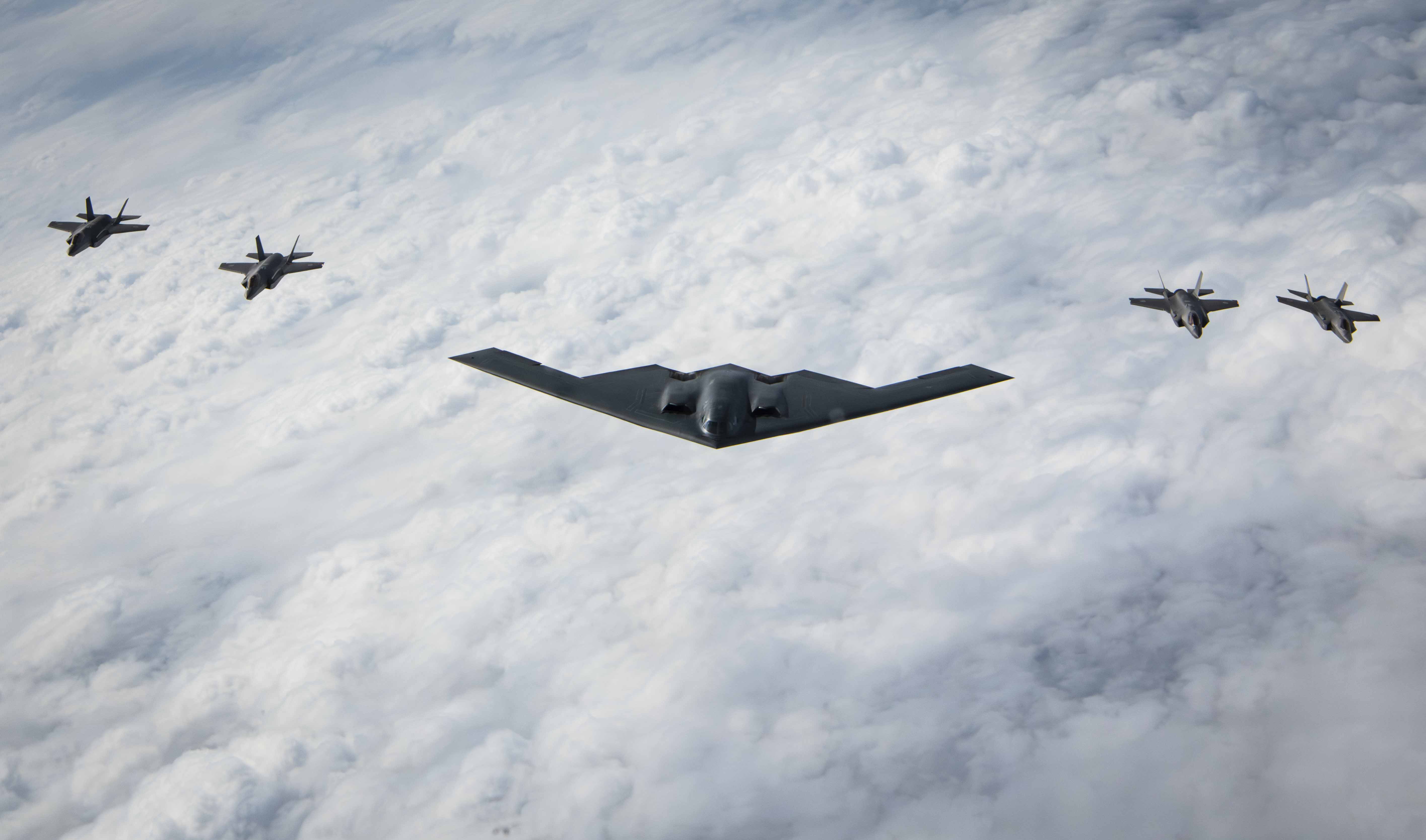
    More images of the B-2 bomber:

    Sources:
    Defense Technical Information Center
    Northrop B-2 Spirit
    Northrop B-2 Spirit
    B-2 Spirit
    Report to Congressional Committees- B-2 Bomber Cost and Operational
    “2009 USAF Almanac, Fact and Figures” – Air Force Magazine
    Why the Air Force Only Has 20 B-2 Spirit Stealth Bombers
    B-2 Bomber: Status of Cost, Development, and Production
    The Bomber Roadmap” – Air Force Magazine
    Inside the Stealth Bomber

  • Formation of the Suwayda Military Council: Is Israel Supporting the Druze to Implement the David Corridor Plan?!

    Formation of the Suwayda Military Council: Is Israel Supporting the Druze to Implement the David Corridor Plan?!

    Local militants in Suwayda province have announced the formation of a new group called the Al-Majlis Al-Askarī L’As-Suwayda (Suwayda Military Council) in southern Syria. They have scheduled a meeting on February 24 in the Sad al-Ayn area, southeast of Sweida.

    Interestingly, the logo of this newly formed group is strikingly similar to that of the Syrian Democratic Forces (SDF). In fact, it appears that the logo of this group is essentially the same as the SDF logo but with a new location in Sweida province in southern Syria.

    Following the announcement of the group’s existence, several residents of the Al-Ghariyah area in the southern suburbs of Sweida province released a video declaring their allegiance to the Sweida Military Council and emphasizing their commitment to defending their homeland.

    Video from residents of the Al-Ghariyah area

    The SDF’s support for the residents of Suwayda is not a new development, as there have been similar instances in the past. During Bashar al-Assad’s government, the SDF expressed their support for the creation of an autonomous region in southern Syria and for the Druze. Sweida holds significant importance for the SDF; during the war with ISIS, the SDF agreed to exchange 60 ISIS prisoners for 30 residents of Sweida who had been kidnapped by ISIS. These instances highlight the strong relationship between the Kurds and the residents of Suwayda province.

    The Suwayda Military Council, led by Tariq al-Shufi, maintains a positive relationship with the Syrian Democratic Forces (SDF). In his recent remarks, al-Shufi praised the SDF forces, referring to them as defenders of the land and the Kurds against terrorism and dictatorial rule. The Sweida Military Council Command further emphasized the importance of maintaining positive and serious relations with the SDF forces.

    Tariq al-Shoufi, Commander of the Suwayda Military Council

    On the other hand, continuing the Israeli regime’s support for the Druze community in Syria, Israeli Prime Minister Benjamin Netanyahu emphasized the need for the Syrian government to respect the rights of the Druze minority and stated that any threat against the Druze in southern Syria will not be tolerated.

    In response to Netanyahu’s statements, Al-Shufi expressed gratitude to all those who support the Sweida Military Council and help protect the Druze community and stabilize the region.

    Simultaneously with the announcement of the Sweida Military Council’s existence and Netanyahu’s support for the Druze, some analysts viewed these actions as part of the “David Corridor” plan. They considered these actions an attempt by the Zionists to support Israel’s Kurdish allies east of the Euphrates in order to fuel separatist conflicts in the region.

    The so-called David Corridor in Syria

    The “David Corridor” is envisioned as a corridor created through the occupation of southern Syria, including the provinces of Daraa, Suwayda, part of Homs province (the Al-Tanf region), and Deir Ezzor, reaching the Euphrates. The recent occupation of areas in Daraa province by the Israeli army could be seen as part of this plan.

    If the Zionists decide to implement this plan, Tel Aviv’s next step after advancing in Daraa province would be Sweida. Gaining access to and passing through Sweida requires the support and approval of the Druze, which has been partially achieved. After Sweida, the advance of the Zionist military in southern Syria would be facilitated, as the Al-Tanf region in Homs province has been under American occupation for years, and the US army would pave the way for the Zionists to reach Deir Ezzor province.

    It is worth noting that the construction of the David Corridor is considered part of the “Greater Israel” plan.

  • Military Knowledge: Ababil-5 Reconnaissance Combat Drone

    Military Knowledge: Ababil-5 Reconnaissance Combat Drone

    During a parade held on April 18th, 2022 in Tehran, a new drone called “Ababil 5” (also known as Ababil-V or AB-V) was revealed to the public. Prior to this event, no official information about the Ababil 5 drone had been released. Although the exact specifications of the Ababil-5 drone have not been officially disclosed, we will analyze the available footage to review its specifications and features in this article.

    The aerodynamic design of this UAV is generally akin to that of the Mohajer-6. While the Mohajer-6 features a High Boom Tail configuration, the Ababil-5 employs a Boom Tail configuration. This design choice not only shortens the runway length needed for landing and takeoff but also enhances the drone’s ability to perform more intense maneuvers.

    Types of aircraft tail configurations

    The body of this drone has sharp angles and lines, which are clearly designed to reduce the radar cross section from the front, i.e., when the bird is approaching the radar.

    Sharp angles and lines

    Considering the dimensions of the truck floor, the Ababil-5 drone is estimated to have a wingspan of approximately 12 meters.

    Ababil-5 estimated wingspan

    The Ababil-5 boasts a wingspan that is 20% larger than that of the Mohajer-6. This increase in wing area allows for a greater cargo mass, enabling the Ababil-5 to carry six Qaem-1 bombs, compared to the Mohajer-6, which can carry up to four bombs.

    The landing gear is designed to retract, which helps to reduce drag and minimize the radar cross-section. This reduction in drag, facilitated by the retractable landing gear, enhances the UAV’s cruise speed, flight endurance, and range.

    Another reason for incorporating retractable landing gear at the front of the body is to prevent obstruction of the electro-optical’s view. If the camera system were placed in front of the landing gear, as seen in the Mohajer-6, the increased distance from the drone’s center of mass would require additional balance weight, potentially affecting the drone’s performance. Therefore, retractable landing gear is utilized to avoid these issues.

    Ababil-5 front wheel landing gear

    The rear wheel landing gear is fixed type. According to the published images, the base of the rear wheels are connected to each other by a wire, which limits the amount of final bending of the landing wear during landing and prevents the body from hitting the runway surface.

    Ababil-5 rear wheel landing gear

    When it comes to weaponry, the Ababil-5 has been observed equipped with Qaem Glide bombs, Almas missiles, and Arman-1 bombs. This drone is capable of carrying six Ghaem-1 bombs and four Ghaem-5 bombs.

    Read more:
    Military Knowledge: Qaem Smart Bombs
    Military Knowledge: Almas Missile

    Given that the Ababil-5 has been adopted by both the Iranian Army and the IRGC, and considering it is manufactured by the Iran Ministry of Defense, there’s a possibility that the ammunition used in the Mohajer-6 could be compatible with the Ababil-5, due to the similarity of some of their components.

    Carrying a larger number of bombs or cargo effectively increases the lethality of the UAV, and economically, it destroys targets with fewer sorties and hunts targets at a lower cost. Also, reducing the number of flight sorties can be important both in terms of maintenance and increasing the operational rate of the fleet.

    In terms of camera system, the Ababil-5 drone can be equipped with a more advanced electro-optical system, in addition to using older electro-optical systems such as the Eagle 4 models. This advanced camera features at least 60x zoom capabilities, along with a thermal imaging camera and a laser rangefinder.

    Ababil-5 electro-optical system
    During the 1402 Joint Drone Exercise of the Islamic Republic of Iran Army, the Ababil-5 drone was used to observe an Arleigh Burke-class destroyer in the Indian Ocean for four hours

    This drone is powered by a piston engine. Images from the NAZAJA exercise in February 2024 reveal that the Ababil-5 is equipped with a Rotax 915 iS engine or a similar model. The Rotax 915 engine delivers up to 141 horsepower at its peak performance.

    Overall, Rotax engines are commonly employed in many Iranian drones. Due to sanctions targeting Iran’s military and aviation sectors, direct procurement from Rotax is not feasible. Consequently, to cater to the varied requirements of drones in Iran, numerous components of different Rotax engines have been domestically produced, with some models achieving a complete localization rate of 100%.

    With the Rotax 915 iS engine, the Ababil-5 achieves a flight ceiling of approximately 7,000 meters (23,000 feet) and a speed of around 210 kilometers per hour. Its maximum takeoff weight is estimated to be about 1,000 kilograms.

    The Ababil-5 drone boasts a flight duration of 12 hours in combat mode, and up to 24 hours in reconnaissance mode without a combat payload. It has a maximum range of up to 2,400 kilometers.

    Video showcasing the Ababil-5 drone’s performance during the Islamic Republic of Iran Army Ground Forces exercise in February 2024

    Ababil-5 UCAV specifications:
    Length: ~ 8 meters
    Wingspan: ~ 12 meters
    Maximum range: up to 2,400 kilometers
    Flight ceiling: 7,000 meters
    Flight endurance: 12 hours combat – 24 hours reconnaissance
    Engine type: Rotax 915 – 141 horsepower (at its peak)
    Speed: 210 km/h
    Hardpoints: 2, with the ability to carry 6 missiles and bombs
    Maximum takeoff weight: ~ 1,000 kilograms
    Weapons payload: up to 150 kilograms
    Origin: Iran

    Ababil-5 UCAV – Click to view full size

    More images of Ababil-5 drone:

    “Ababil 5” UAV poster collection in Farsi, Russian, Arabic, Chinese and Hebrew:

  • Winners and Losers of the Al-Aqsa Flood

    Winners and Losers of the Al-Aqsa Flood

    In connection with the fact that the Axis of Resistance is a purely defensive alliance against the aggressive expansion of Zionism and its regional allies, therefore the current war should be interpreted based on defense tactics, and not vice versa, as pseudo-experts of the Arab or Turkish media are trying to do.

    Fact number one. Hamas, Hezbollah still exist and continue to prepare for the next battles, Iranian aid is functioning properly and will continue until the complete defeat of the enemy. Conclusion – Zionism has failed in its tasks of eliminating its main enemies.

    Fact number two. In Syria, there are still more than a hundred thousand citizens loyal to the IRGC, who have been undergoing combat training in the Islamic Republic all these years. Therefore, regardless of the future of Syria, whether it will be a “democratic country” or a Takfiri emirate, the Syrians will find a way to revive and expand the corridor from southern Lebanon to Tehran.

    Fact number three. The victims of the IRGC and Hezbollah on the battlefield, the activity of the Houthis and the Iraqi resistance at the height of the “al-Aqsa flood” once again strengthened the opinion among the Palestinian public that only Iran and its allies are ready to sacrifice themselves on the path to the liberation of al-Quds. Therefore, the naive attempts of Qatar and the Ak Party in Turkey to break the alliance of Hamas and Iran have failed.

    Fact number four. The Jordanian Muslim Brotherhood failed to come to the aid of the Palestinians, limiting themselves to senseless rallies and cheap populism; the blood of the children of the Gaza Strip is on their conscience, among other things. Having an impressive social base, the “Islamic Action Front” preferred to avoid a revolutionary struggle against the Hashemite autocracy and to rely on a “political struggle” to the detriment of the Palestinians of Gaza. The Jordanian Ikhwans had a year to carry out a revolution and thereby create a new front to distract the Zionists from the genocide of Gaza, but they preferred to shout “solidarity” in their streets. In general, even if Zionism ever attacks Jordan with the goal of creating a Palestinian enclave there, and the local Ikhwans rebel, they will not find much authority in the eyes of the world pro-Palestinian community. Because everything must be done on time, especially in politics. The Muslim-Brotherhood of Jordan have definitely disappointed everyone, including Hamas.

    Fact number five. Tahrir al-Sham managed to disgrace itself during its short term of rule. The Syrian jihadists lost immediately when they decided to “be friends” with the Zionists and personify an anti-Iranian policy. For many observers, Tahrir al-Sham is simply a Trojan horse of Zionism in Syria. Ignoring the Zionist intervention in southern Syria also shows the nature of the jihadists, who don’t care what happens near Damascus. They are more interested in agitating the Syrian people to fight against Iran. In the context of the Palestinian tragedy, Tahrir al-Sham is the main loser, since it simply exposed its essence.

    Fact number six. Erdogan’s populism regarding the Palestinian tragedy has become the main weapon of the opposition against him. No matter how hard the Ak party tries to position itself as the “main defender of Palestine”, but facts remain facts, trade with the Zionists is happening without problems. Mistrust of Erdogan’s government will only grow not only among Palestinians, but also in Islamic circles in Turkey. We all remember the many rallies throughout Turkey, where pro-Palestinian activists exposed the Turkish government’s trade with the Zionists.
    It is obvious that the activity in Syria is intended to replace the impotence of Turkish policy in the Gaza Strip in the eyes of its electorate. Erdogan may have increased Turkey’s global role, but he has clearly lost in the Gaza Strip. Evidence of his defeat is the statement of the spokesman for the Al-Qassam Brigades, Abu Ubaida, who thanked the “Axis of Resistance” but ignored Erdogan.

    Fact number seven. Qatar is a symbol of parasitism on the Palestinian cause. Doha disgraced itself a year ago when it “threatened to cut off oil supplies” to EU countries in connection with their support for the Zionist genocide of Palestinians in the Gaza Strip. Naturally, it was a cheap bluff. After the collapse of the Assad government, Qatar immediately organized a media picture praising Syrian al-Qaeda, and news from Syria overshadowed the Zionist crimes in Gaza and Lebanon. Moreover, Qatari propagandists are trying their best to denigrate Iran in the context of the al-Aqsa flood. This is done so that among the Arabic-speaking audience there is an impression that “Hamas hoped for Iran, but it did not come to the rescue”, that is, a false superficial media picture designed to hide the cowardice of the Gulf states in relation to the Zionists and the betrayal of the Palestinians.

    Now let’s look at the losers of the al-Aqsa flood. In addition to the Zionists, who are gradually becoming international pariahs, so are all those who rejoiced in the victory of the jihadists in Syria. Public opinion in these countries has not yet realized the full gravity of the problems ahead, but the situation is unfolding in this direction.

  • How Will the Israeli Army Withdraw From the Gaza Strip? (Map)

    How Will the Israeli Army Withdraw From the Gaza Strip? (Map)

    Under the ceasefire agreement, the Israeli army will gradually withdraw from various areas of the Gaza Strip over the coming days and weeks, in stages.

    • Initial Withdrawal: Israeli forces left the southern areas of Beit Lahia and Jabalia yesterday, re-establishing the connection between northern Gaza and Gaza City. Displaced residents in the north are returning home.
    • Next Steps: On the seventh day of the agreement, Israeli forces will begin withdrawing from the Netzarim axis in central Gaza. They will initially move from Al-Rashid Street to Salah al-Din Street, and by the twenty-second day, will retreat to the buffer zone on the Gaza border, reopening travel routes for Palestinians.
    • Final Phase: On the 50th day, Israeli forces will fully withdraw from southern Gaza and the Philadelphi axis, redeploying to a 1-kilometer-deep buffer zone along the Gaza border.

    Avichay Adraee, the Arab spokesman for the Israeli army, released a map showing the locations of Israeli forces in Gaza. He noted that currently, movement from south to north Gaza is dangerous due to Israeli presence on the Netzarim axis. Starting next week, Palestinian civilians will be able to return to northern Gaza. Activities such as fishing, swimming, diving, and approaching buffer zones, the Rafah crossing, and the Philadelphia axis will remain prohibited.

    Click to view full size
  • Establishment of Gaza Strip Buffer Zone; Zionist Forces Destroy and Permanently Occupy 32% of the Territory (Map)

    Establishment of Gaza Strip Buffer Zone; Zionist Forces Destroy and Permanently Occupy 32% of the Territory (Map)

    The buffer zone covers an area of 58 square kilometers, accounting for 16 percent of the total Gaza Strip area. In this zone, at least 4,100 buildings have been completely destroyed. Previously, the buffer zone depth was 300 meters, but the Israeli army increased it to around 1 kilometer in recent months.

    Additionally, in the Netzarim axis in central Gaza Strip, an area of 49 square kilometers, or 13.5 percent of the Gaza Strip, has been occupied by the Israeli army, with residential buildings completely destroyed. The Netzarim axis was established during the Israeli army’s ground operations to cut off land connections between Gaza City and southern Gaza Strip. The Zionist regime has established four bases in this axis to consolidate its positions and enhance its presence and influence.

    The so-called Netzarim corridor and four Israeli army bases on this axis

    Here’s a rephrased version:

    In the Philadelphia axis south of Rafah in the southern Gaza Strip, the Israeli army has occupied 12 square kilometers, equivalent to 3 percent of the total Gaza Strip area. To maintain a permanent presence, the Israeli military has destroyed at least 6,932 buildings in this zone.

    Consequently, approximately 32.5 percent of the Gaza Strip is currently destroyed and occupied by the Israeli military. These areas are permanently occupied by Israeli forces, with troops stationed there constantly. In other areas of the Gaza Strip, the presence of Zionist forces manifests through short-term, temporary operations and raids.

    The buffer zone on the border between the Gaza Strip and the occupied territories on the Netzarim and Philadelphi axis

    The extensive and total destruction of buildings in these areas has made it impossible for the Palestinian refugees to return.

    In recent months, the Israeli army has laid the groundwork for the permanent occupation of parts of Gaza and the creation of buffer zones by conducting several military operations in the north, center, and south of the Gaza Strip. According to Israeli claims, these buffer zones and the continuous presence of Israeli soldiers aim to tighten the siege on Gaza’s resistance forces and, in turn, reduce attacks on Israeli settlements around Gaza.

    However, recent actions by resistance fighters indicate that the presence of Israeli soldiers has not completely halted their attacks. Despite the buffer zones and the continuous raids by Israeli soldiers in various parts of the Gaza Strip, rocket attacks by resistance groups persist.

    The establishment of buffer zones and the complete withdrawal of Israeli soldiers from Gaza have long been contentious issues in negotiations between Hamas and the Israeli regime. Recently, there has been speculation about the possible withdrawal of Israeli forces from the Netzarim and Philadelphi axes as part of an initial ceasefire agreement, but this has not yet been confirmed, and negotiations are still ongoing without specific conclusions.