The resistance groups also freed the Karam Abu Salem (Kerem Shalom) border crossing in the south of the Gaza Strip from the occupation of the Zionist army.
Palestinian resistance groups fired more than 5,000 rockets at the occupied territories.
Currently, the clashes continue in the settlements of Sderot, Ashkelon, Nirim and other occupied settlements in the outskirts of the Gaza Strip. It should be noted that Al-Qassam Brigades, the military branch of Hamas, announced that it has attacked more than 50 bases of the Zionist regime’s army inside the occupied territories, and its fighters are still confronting the occupiers in 25 pints inside the occupied territories.
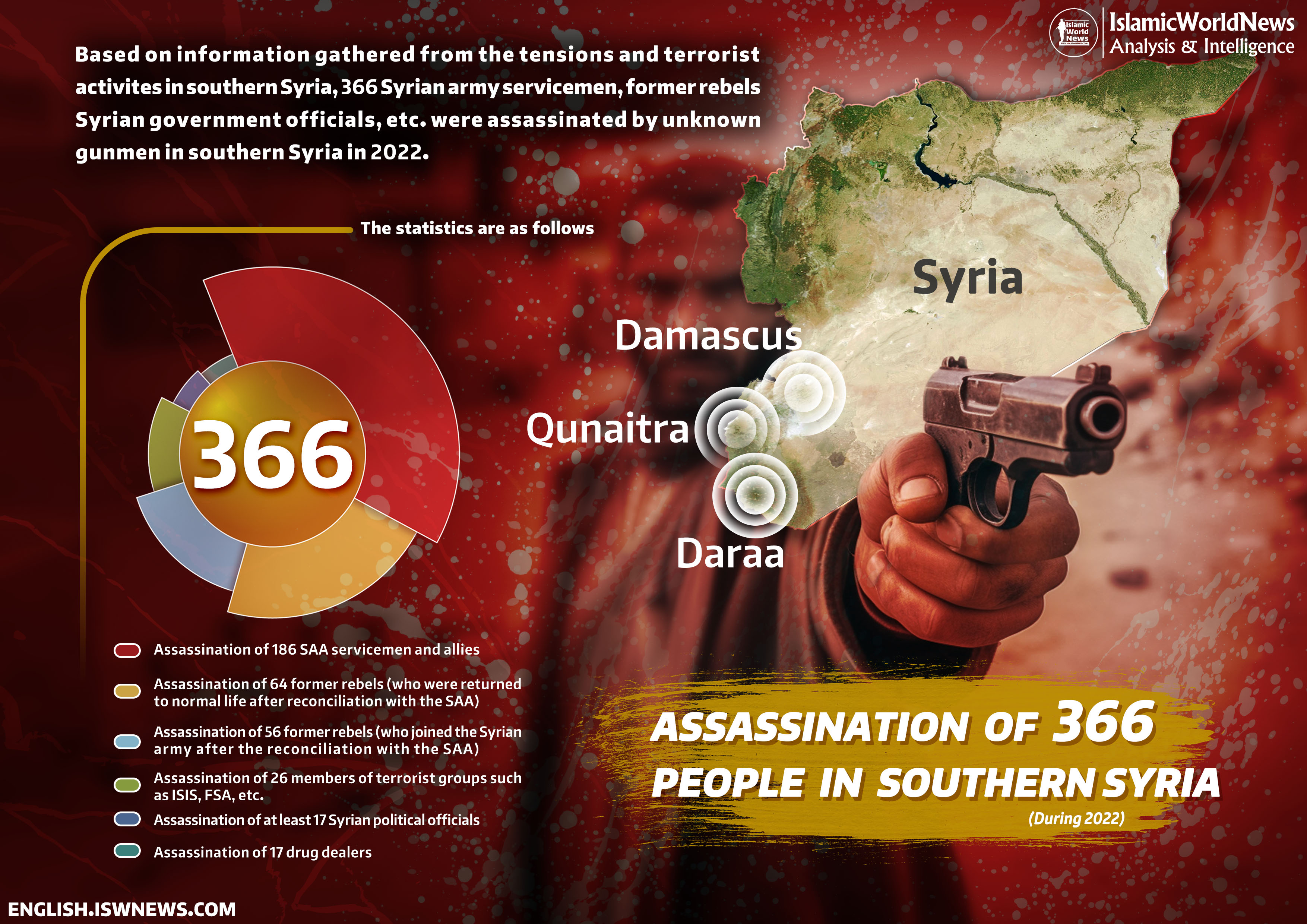
ISWNews Analysis Group – A media outlet affiliated to the militants active in the Arab country reported that the statistics on the killings of people in southern Syria, which have been released newly, show that about 366 Syrian soldiers plus former militants, and Syrian government officials and so on were killed all through 2022.
The published statistics are as follows: 1- Assassination of 186 members of the Syrian armed forces and allies. 2- Assassination of at least 17 Syrian political officials 3- Assassination of 56 former militants (people who joined the Syrian armed forces after the reconciliation plan) 4- Assassination of 64 former militants (people who returned to normal life after the reconciliation plan and turned into civilians) 5- Assassination of 26 members of terrorist groups such as ISIS, Free Syrian Army, and so on 6- Assassination of 17 drug dealers
It is worth mentioning that the southern regions Syria have always been susceptible to chaos, armed conflicts, assassination, and so on, because there have been dormant terrorist cells and the initial militants in those areas since the onset of foreign-backed war in the Arab country.
The spread of assassination and insecurity in southern Syria has clearly affected economic activity and people’s lives; so, despite the fact that several years have passed, insecurity has not yet been completely eradicated. Therefore, the lack of a clear horizon for the end of insecurity is driving many residents of southern Syria to come to the conclusion that they have to migrate from their residential areas.
After the publication of news stories about the disappearance of the Russian-Israeli woman, an anonymous high-ranking Israeli official presented a report to a group of Israeli journalists and strongly denied published news about Tsurkov’s membership in the terrorist organization Mossad, but investigations show something else.
Israeli media introduced Tsurkov as an “Israeli prisoner” in Iraq and the Israeli Prime Minister’s office announced that she is alive and was kidnapped by Iraq’s Hezbollah Battalions.
Iraqi media claims, Israel’s statement was based on an encrypted message from one of Mossad’s agents, which stated: The crow has been caught! Benjamin Netanyahu’s office announced: Tsurkov, who has dual citizenship of Russia and Israel, entered Iraq using her Russian passport.
It is said that she is a PhD student at Princeton University in the US and an analyst of West Asian affairs who entered Iraq to conduct academic research. Later, Abu Ali al-Askari, head of the security office of Hezbollah Battalions rejected the allegations, describing Netanyahu’s claim on the issue as a dangerous matter.
A few days after Tsurkov’s disappearance, her sister said in an interview with Israeli media that she was aware of her sister’s abduction from the first moments and quickly informed the Israeli regime. She claimed the family decided to keep it a secret in the hope that the matter would be resolved quickly and quietly.
Tsurkov has been active on Twitter for over 15 years and openly supported wars and interventions against countries that the US and Israel consider their enemies, especially Syria. Despite the crimes of terrorist groups and opponents of the Syrian government, she helped to whitewash in favor of Syrian militants.
According to her close friends, she was a former member of the Israeli army intelligence forces who participated in Israel’s 2006 war against Lebanon’s Hezbollah (33-day war). Tsurkov is also simultaneously a member of several Israeli think tanks and US institutions, including New Lines Institute.
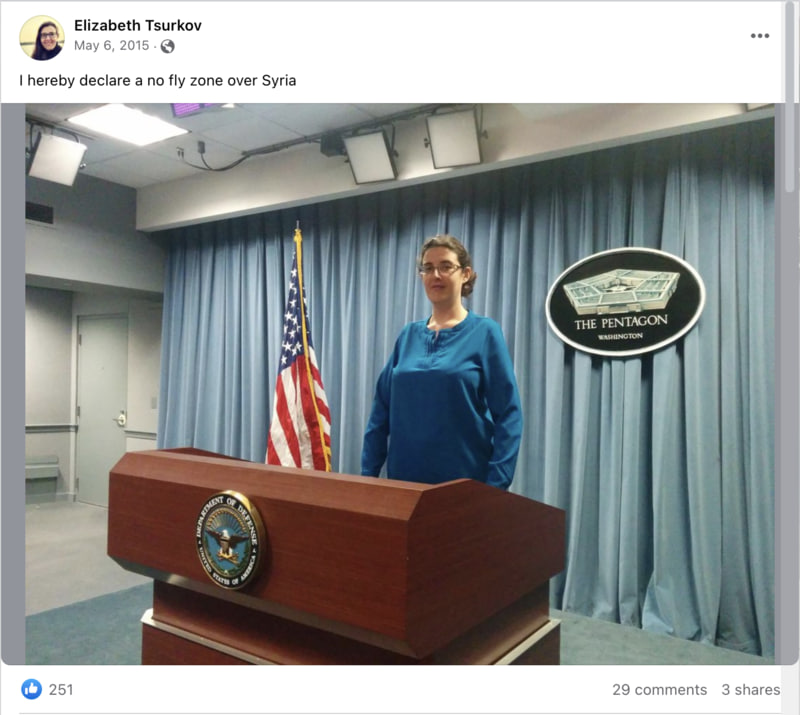
Tsurkov in Pentagon
Tsurkov’s trips to Iraq! Tsurkov traveled to various countries in the region, including Lebanon and Syria, where the visit of Israelis is prohibited. The reasons for changing and hiding her identity on all these trips are also interesting. Tsurkov reported in February 2019 that she had visited the Kurdistan region in northern Iraq.
According to some sources, she also visited the city of Mosul in 2019 and 2020. The trips took place while the entry of Zionists into Iraq is prohibited. Also, Israel prohibits its citizens from traveling to countries such as Iraq without a special permit from the Israeli Ministry of Interior.
The presence of any Israeli in Iraq – especially an Israeli woman with such a resume! – becomes sensitive. Some sources claimed, Tsurkov first visited Baghdad in early 2022. She traveled to several cities in Iraq, including Basra, Maysan, and Najaf, and lived with an Iraqi woman in the Karada neighborhood of Baghdad. She entered Iraq again with a two-month visa in November 2022 and extended it in the United Arab Emirates in January of that year.
Despite repeated claims by Israeli officials that Tsurkov was present in Iraq to conduct research for her PhD studies, Princeton University’s published policies reject Israeli officials’ excuses, because Iraq is among about 20 so-called X-class countries that the university strongly prohibits its students from traveling to for student affairs; a law and policy that existed before and after Tsurkov’s trip to Iraq.
Moreover, all Princeton University students must register any domestic or international travel related to their course at the university to ensure that their travel complies with the rules. Students can have personal trips to X-class countries (for example, to visit friends or family) but Princeton University law is unambiguous: “You cannot travel to X-class countries for personal work and then engage in course-related activities!”
Interestingly, during an interview with an Iraqi journalist in Sadr City, Baghdad, Tsurkov described the US government as a “tyrannical government” in the face of Iraq and praised the Iraqi journalist.
Given her extensive and constant support for US military intervention in Syria and other countries and her membership in American institutions and think tanks, this is an obvious deception.
Despite having a history of publishing anti-Shia news and promoting extremist ideas affiliated with Al-Qaeda in Syria, Tsurkov introduces herself as an advocate of Sadr!
Video of Tsurkov’s conversation in Arabic with an Iraqi journalist in Baghdad’s Sadr
According to statements by Iraqi individuals close to Tsurkov, she met with several Iraqis under different names and asked questions about resistance groups, Sadr movement. She also requested people to meet with leaders of the movement. It is said that Tsurkov had a conversation with one of the senior leaders of the movement days before her disappearance.
Will we see Tsurkov’s exchange? Contradictory reports were published about the efforts of different parties to free Tsurkov. Some media claim Iran and Israel have been negotiating the exchange of prisoners, including Tsurkov, through Russian mediation since June.
The Russian ambassador to Baghdad denied any Russian involvement in her case. Reports were published about the extensive efforts of the Iraqi government to identify Tsurkov’s location, because the US embassy in Baghdad is strongly pursuing her disappearance.
In February 2021, Tsurkov tweeted that she was “generally opposed” to prisoner exchanges; even if she is arrested on her next trip to Syria or Iraq! Tsurkov was last seen on March 23 leaving a cafe in the Al-Karada neighborhood.
Tsurkov leaving Ridha Alwan cafe in Baghdad
Tsurkov is fluent in English, Hebrew, Russian, and Arabic and used her Russian passport for easy travel to Arab countries under the guise of research and human rights work.
Seemingly, Tel Aviv failed in its infiltration operation of one of its elements into Baghdad with the code name “Crow”. However, it may take time to fully determine why Tsurkov was in Iraq and exactly what actions she took or intended to take!
Given the fact that an unwritten ceasefire between the Ansar Allah movement and the Saudi coalition is in place, the conflict in Yemen shifted to occupied areas, and the Saudi-led factions are trying to gain more power and influence in the war-torn country.
The situation led to weakening of the resigned Yemeni government, and members of its presidential council are hopeless for success against Ansar Allah movement; so, they pursue implementing their ideal plans, including the partition of southern Yemen.
Moreover, the Takfiri terrorist group Al-Qaeda, which has a significant number of supporters in central and eastern Yemen, expanded its activities and returned to the Yemeni war.
Aden, Lahij and Taiz fronts:
On January 14, 2023, forces of Yemeni military commander and the nephew of the late President Ali Abdullah Saleh, Tareq Mohammed Abdullah Saleh, took control of the Ras al-Ara area on the coast of Lahij province. However, this advance was hampered by tribes, and Rashad Al-Alimi, head of the Presidential Council of the resigned Yemeni government, approved a plan to form a new brigade of Al-Daraa Al-Watan forces in the area under the leadership of Bashir Saif Al-Mazrabi Al-Sabih on February 1, 2023.
The city of Taiz is currently under the control of forces of the al-Islah Party, the resigned government and some independent militants. Tareq Saleh has also returned to the city despite opposition from al-Islah Party. One of the major tensions that occurred after Tareq’s entry into Taiz was the failed assassination attempt on Minister of Defense of the resigned government Mohsen Al-Daeri. These tensions question the resigned government’s claim that Taiz has been besieged by Ansar Allah movement for past eight years. Since the western road and southern areas of Taiz Governorate are under control of al-Islah Party and Tareq Saleh, tensions between these groups limited access to Taiz and prevented delivery of humanitarian aid. The Ansar Allah movement has repeatedly reopened Sana’a-Taiz road voluntarily, but al-Islah Party prevented non-military vehicles from entering Taiz.
On January 25, 2022, the forces of Al-Dara’ Al-Watan (backed by Saudi Arabia) took control of the important Al-Anad base in Lahij Governorate by expelling the militants of the Southern Transitional Council (STC) and evacuating Sudanese mercenaries. This action by Al-Daraa Al-Watan can be considered as Saudi Arabia’s first move to limit the STC.
Saudi media outlets announced that Riyadh intends to remove the STC from the political scene in southern and eastern Yemeni governorates, but this claim has not been seriously implemented so far, and in fact, Saudi Arabia intends to confront with Al-Daraa Al-Watan forces and create a national council for Hadramout Governorate to confront the STC and partition southern Yemen. The control of the resigned government and Saudi Arabian bases in Aden has also been transferred to Al-Daraa Al-Watan, and Saudi advisers are managing Aden’s security issues alongside them.
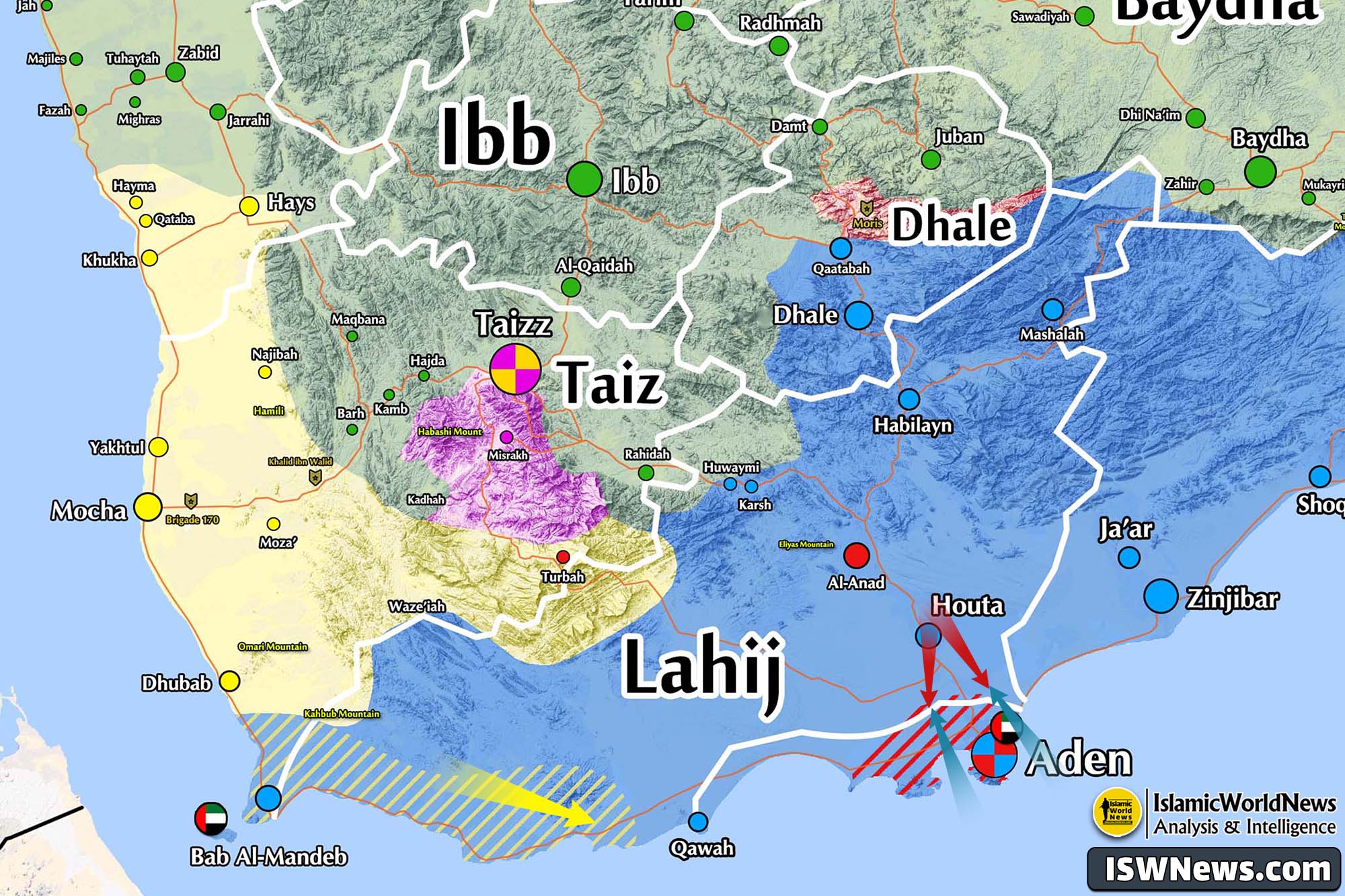
Latest military situation in Taiz, Aden and Lahij regions in the southwest of Yemen – click to view full size
Abyan front:
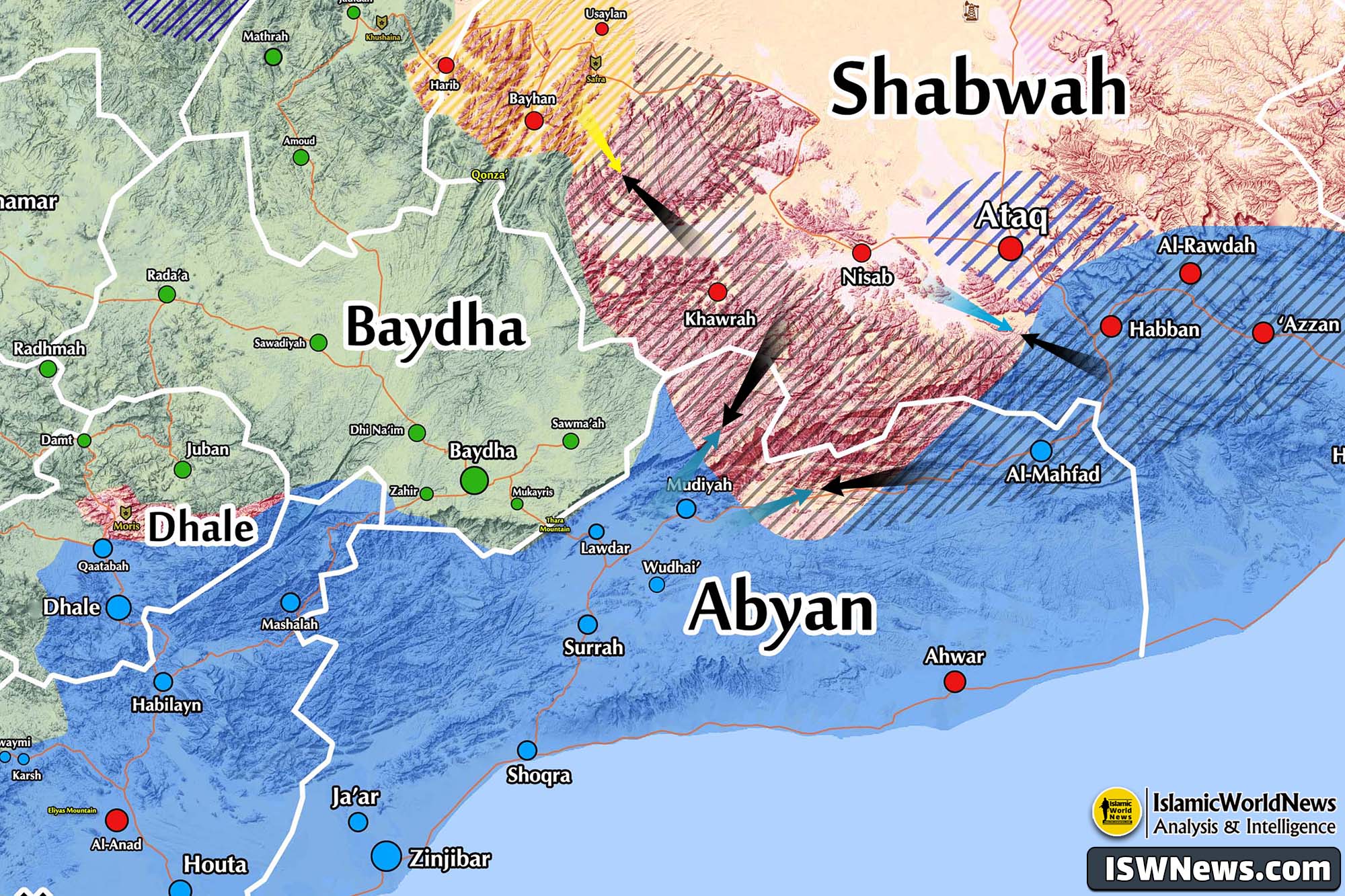
The terrorist group Al-Qaeda recruited hundreds of militants from some tribes in Shabwa and Abyan governorates, and Al-Qaeda has again transferred its activities to the north of Abyan Governorate and parts of Shabwa Governorate. Their attacks, which are mostly limited to roadside bombings and guerrilla attacks, have led to the withdrawal of STC forces from most areas of Al-Mahfad and Modiyah districts. Central areas of these areas are under the control of STC militants, but most mountainous areas are under Al-Qaeda control, and clashes between the two sides are ongoing in Wadi Omran.
The increase in Al-Qaeda’s movements on this axis may not be supported by Saudi Arabia, but since it weakens the positions of the Southern Transitional Council in Abyan province, it has not been opposed by Saudi Arabia either, and there is a possibility of covert support from Saudis for Al-Qaeda. Because Al-Qaeda has started using scarce weapons such as quadcopters, etc., which is not possible without external support.
Latest military situation in Abyan and the south Shabwa regions – click to view full size
Shabwa front:
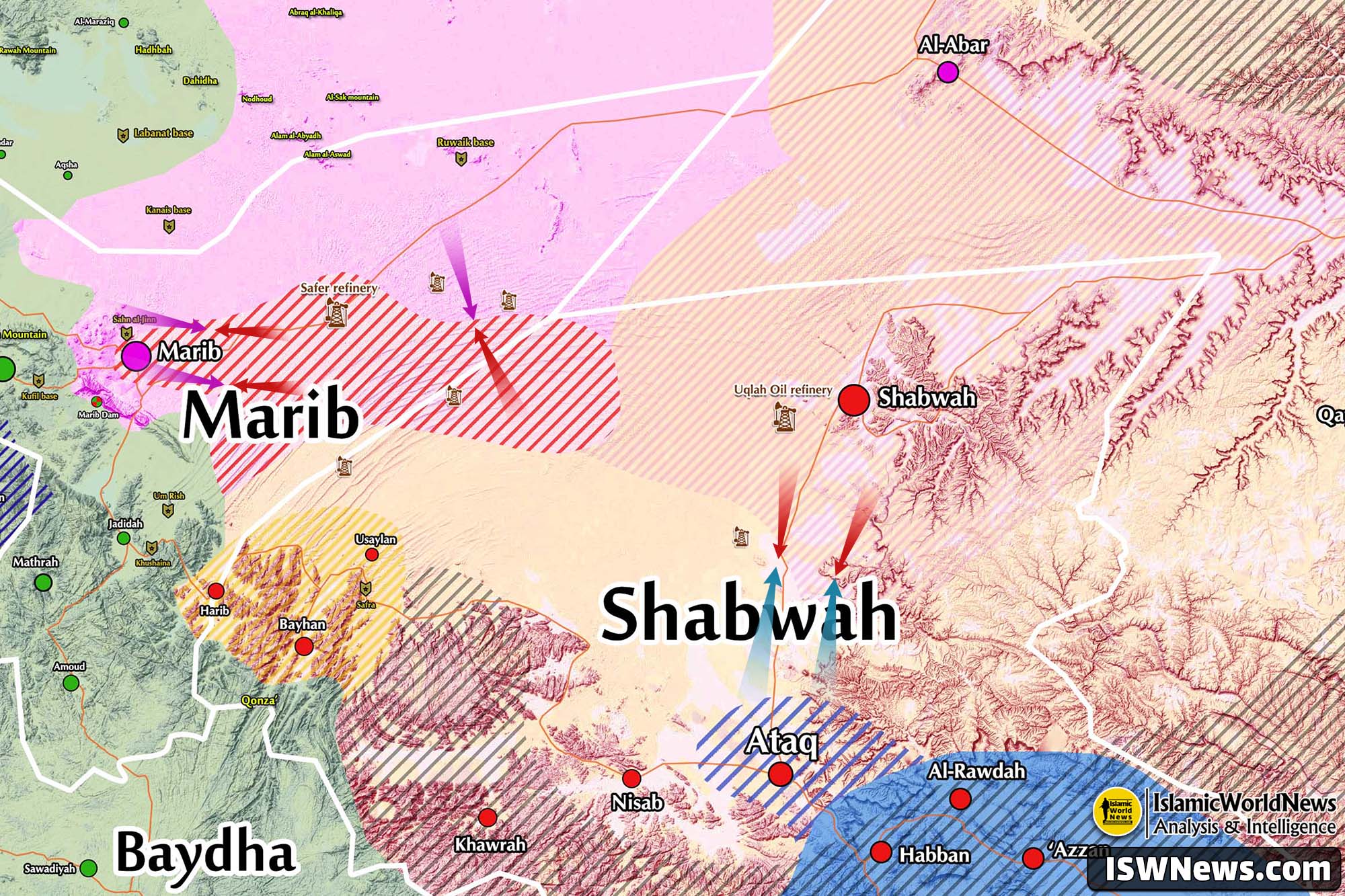
The Southern Giants Brigades known as Al Amaliqah forces, drove out the Shabwa Defense forces on April 8, 2023 to control Bayhan district. The surroundings of the district are also under the control of Shabwa Defense forces; so, Al-Qaeda attacks mostly these forces.
Al-Qaeda terrorists attacked the town of Al-Masiniyah in Al-Saeed district on June 11, 2023 under the pretext of killing commander of al-Islah Party in Bayhan Abdullah Al-Bani. Al-Qaeda used quadcopters and also the US conducted drone attacks on al-Islah Party’s positions in support of the STC.
The US’s support for the STC strengthened their position and governor of Shabwa Awadh bin Al-Wazir Al-Awlaki, and it also reduced the likelihood of operations by Al-Daraa Al-Watan and al-Islah Party forces with Saudis’ support in Ataq city. Saudi Arabia stationed its forces on the northern axis of Ataq to Jardan district and it intends to expel the STC from Ataq city and Shabwa Governorate’s oil-rich areas.
Therefore, competition between Saudi Arabia and the UAE in Shabwa Governorate has been stopped following US intervention, and meetings between US Ambassador to Yemen Steven Fagin and Awadh Al-Awlaki, indicating the US plans to use Shabwa’s oil resources.
Marib front:
After mounting differences between al-Islah Party and the resigned government in late December 2022, Marib Governorate became the scene of tension between the forces of commander-in-chief of the Yemeni resigned government’s armed forces Major General Saghir bin Aziz and al-Islah Party militants. The clash led to the expression of dissatisfaction by tribes in eastern Marib. The root cause of the clashes is a dispute over the division of oil field revenues, and tribes claim parts of oil revenues.
The difference between Saghir bin Aziz and al-Islah Party in Marib continues, but Saudi Arabia temporarily stopped it and is concentrating on merging al-Islah Party militants into Al-Daraa Al-Watan forces; therefore, it appointed al-Islah Party’s field commander in Shabwa Governorate Brigadier General Abd Rabbo Laakb as commander of one of Al-Daraa Al-Watan brigades.
Latest military situation in Marib and north of Ataq regions – click to view full size
Yemen is currently facing several serious challenges such as plots for partitioning southern regions by the STC, exploiting oil and gas resources by the US, Europe and Arab states, stationing terrorist groups in central regions, and being occupied by Saudi Arabia and the UAE.
The Ansar Allah movement and the resigned government of Yemen are opposed to partitioning southern Yemen; so, they will not support the STC, which seeks to revive southern Yemen and the group will not succeed in implementing partition plan. But the issue of exploitation of oil and gas resources and handing over of islands to foreigners are challenges, which are being opposed only by the Ansar Allah movement.
The opposition to the issue prevented oil and gas exports, but did not create any danger for companies and military personnel from the US, Europe and other foreigners in Yemen. In fact, Western political pressures become a leverage so that Ansar Allah movement cannot hinder threats by foreigners.
The occupation by Arab states and presence of terrorist groups in Yemen will only be eliminated through serious confrontation by Yemeni army and Ansar Allah. The Ansar Allah movement must prepare itself for this scenario with support from Iran and resistance groups. Political negotiations at this stage are not very effective; so, peace negotiation is a claim to provide enemies with opportunity to renew strength.
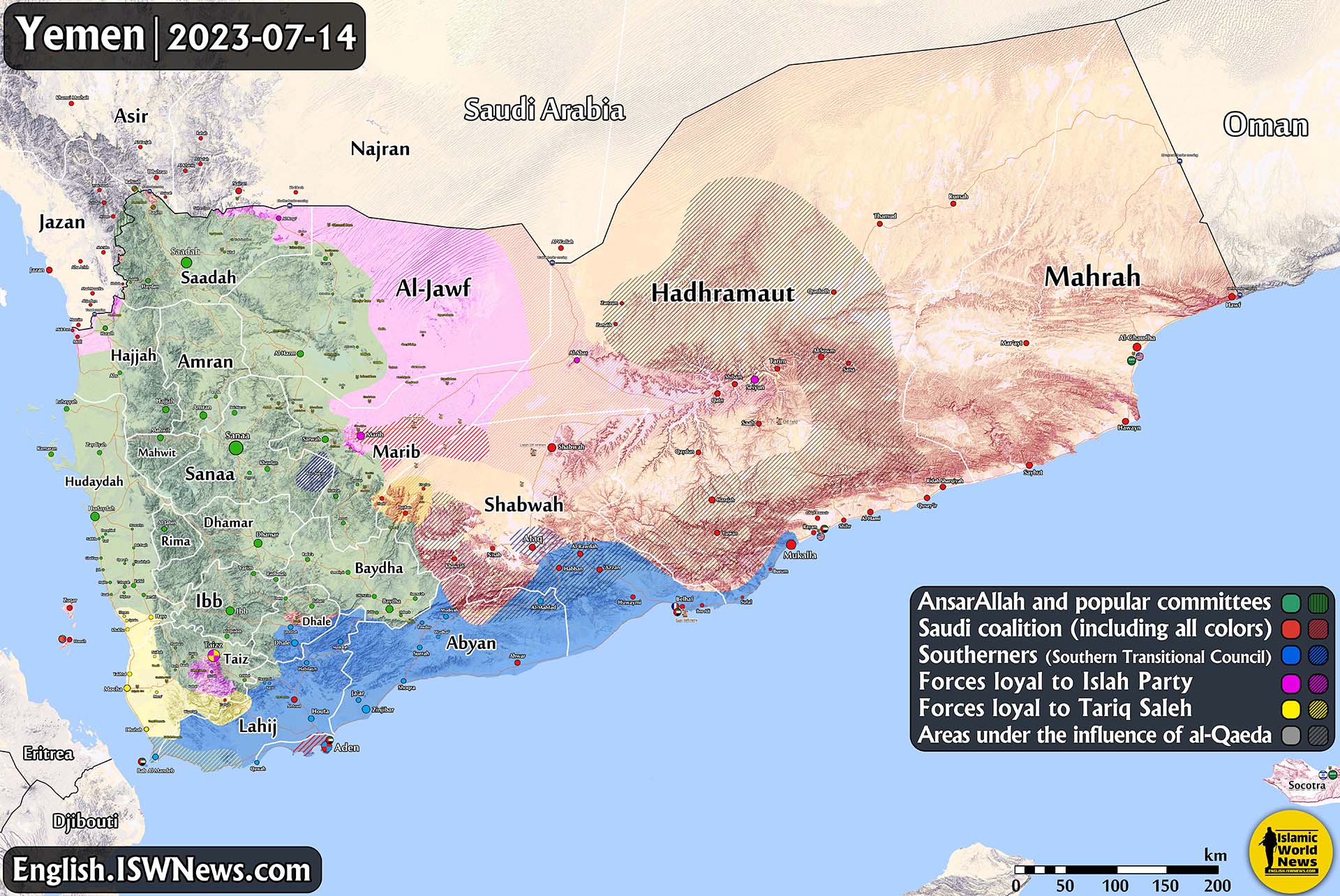
Military situation in Yemen – click to view full size
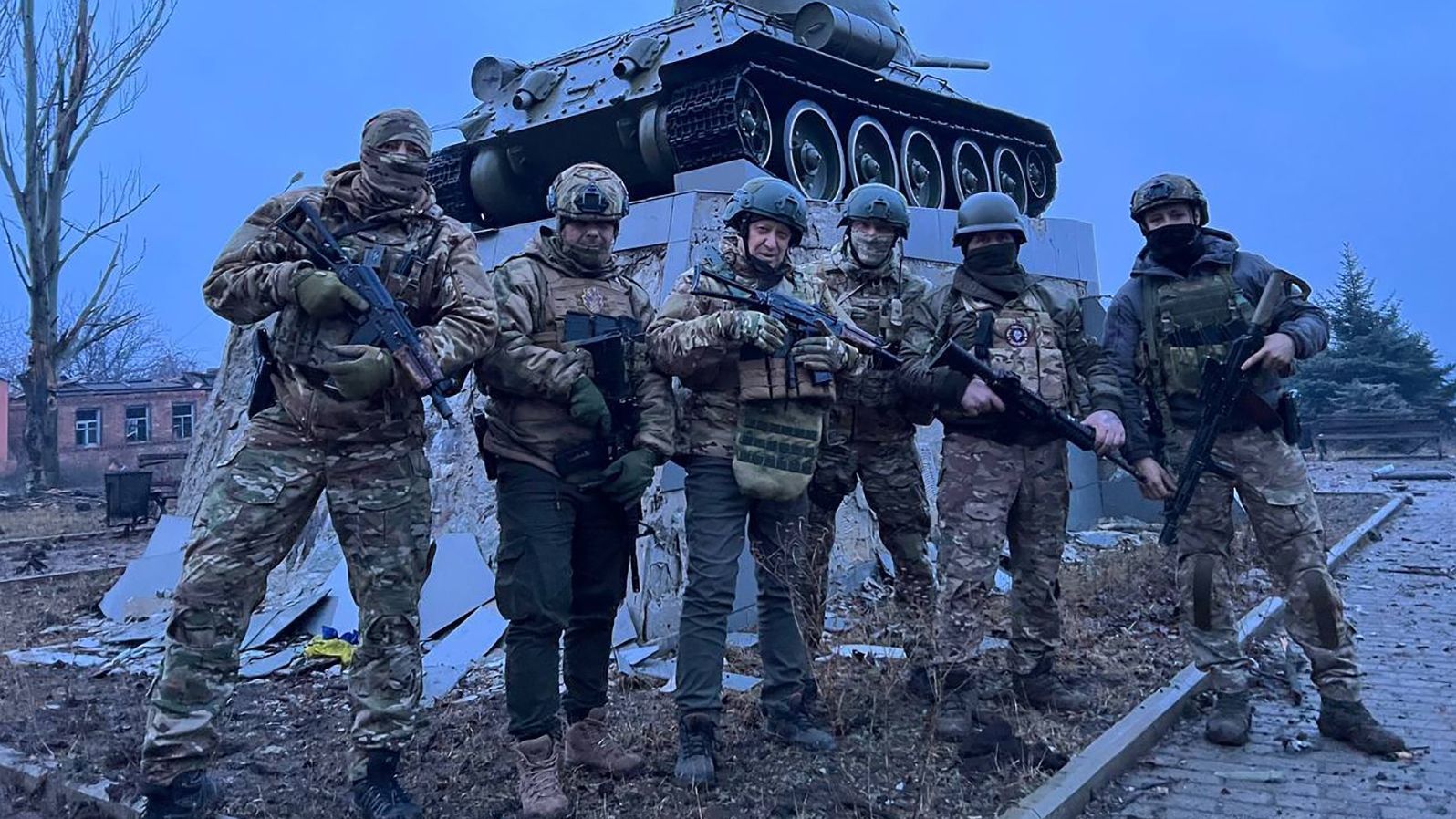
The Russian private military company, which is known as Wagner Group is a paramilitary organization that is directly affiliated with the Russian Armed Forces. The Wanger mercenaries have taken part in various conflicts, including the clashes in the Crimea and eastern Ukraine in 2014, the Syrian war, the Libyan civil war, Mali, Sudan and so on, and now they are engaged in military training, consulting activities and even arms sales in different countries.
The head of the organization is Yevgeny Prigozhin, who is one of the important tycoon and traders of Russia, and he is also referred to by the some media outlets as Russian President Vladimir Putin’s cook.
Following the outbreak of the war in Ukraine, Prigozhin entered a tough competition with the senior military leaders of Russia, namely Minister of Defence of the Russian Federation Sergei Shoigu and Chief of the General Staff Valery Gerasimov to consolidate his power and influence in the Russian government.
However, Shoigu and Gerasimov gradually weakened his alliance with Commander of the Russian air force Sergei Surovikin, and they managed to reduce Prigozhin’s military position in the eyes of the Russian president and take back the command of Russian forces in Ukraine from Surovikin.
The decline in power did not please Prigozhin; so, he sabotaged many times the defense ministry’s support for his forces in the war in Ukraine and finally rebelled against the Russian government by claiming a missile attack by the Russian army on the bases and positions of Wagner Group forces. Prigozhin called for the handover of Shoigu and Gerasimov to Wagner forces and pursued their punishment, but President Putin ordered to clamp down the rebellion while ignoring his demands.
The future of the group’s rebellion depends on a plan that its designers have prepared.
The rapid control of the Russian city of Rostov-on-Don by the Wagner Group, their unimpeded advance towards capital city Moscow, and the lack of concern by the Russian army and government officials, as well as the Western countries’ heed to the issue do not seem normal. In fact, the nature of the rebellion and the goals of the Wagner Group have not become clear yet.
Therefore, the Wagner Group’s rebellion is not that much similar to a coup or an armed rebellion, and it is possible to raise the possibility that Russians are paving the ground for a more important action. Perhaps the rebellion was also shaped by the Western powers, because Russia’s intelligence fault against Westerners is a proven issue. In total, the Wagner Group’s next actions and the reaction of the Russian government and armed forces to such actions will clarify the nature of the story and it would be better to wait for more information and analysis.
Most ballistic missiles have the ability to reach speeds higher than 5 Mach, but they are not considered hypersonic because they follow a ballistic path and have bullet-like movement. In general, it is easy for air defense systems to detect a ballistic trajectory at any speed. But maneuvering in the final phase is an important characteristic that creates a fundamental difference in missile classification. A hypersonic ballistic missile is a ballistic missile that has the ability to maneuver before hitting its target while maintaining a speed of more than 5 Mach.
For example, the Khorramshahr missile has a speed of near 16 Mach in the intermediate phase outside the atmosphere and a speed of near 8 Mach when entering the atmosphere, but it lands directly on the target like a bullet, so it is just a ballistic missile.
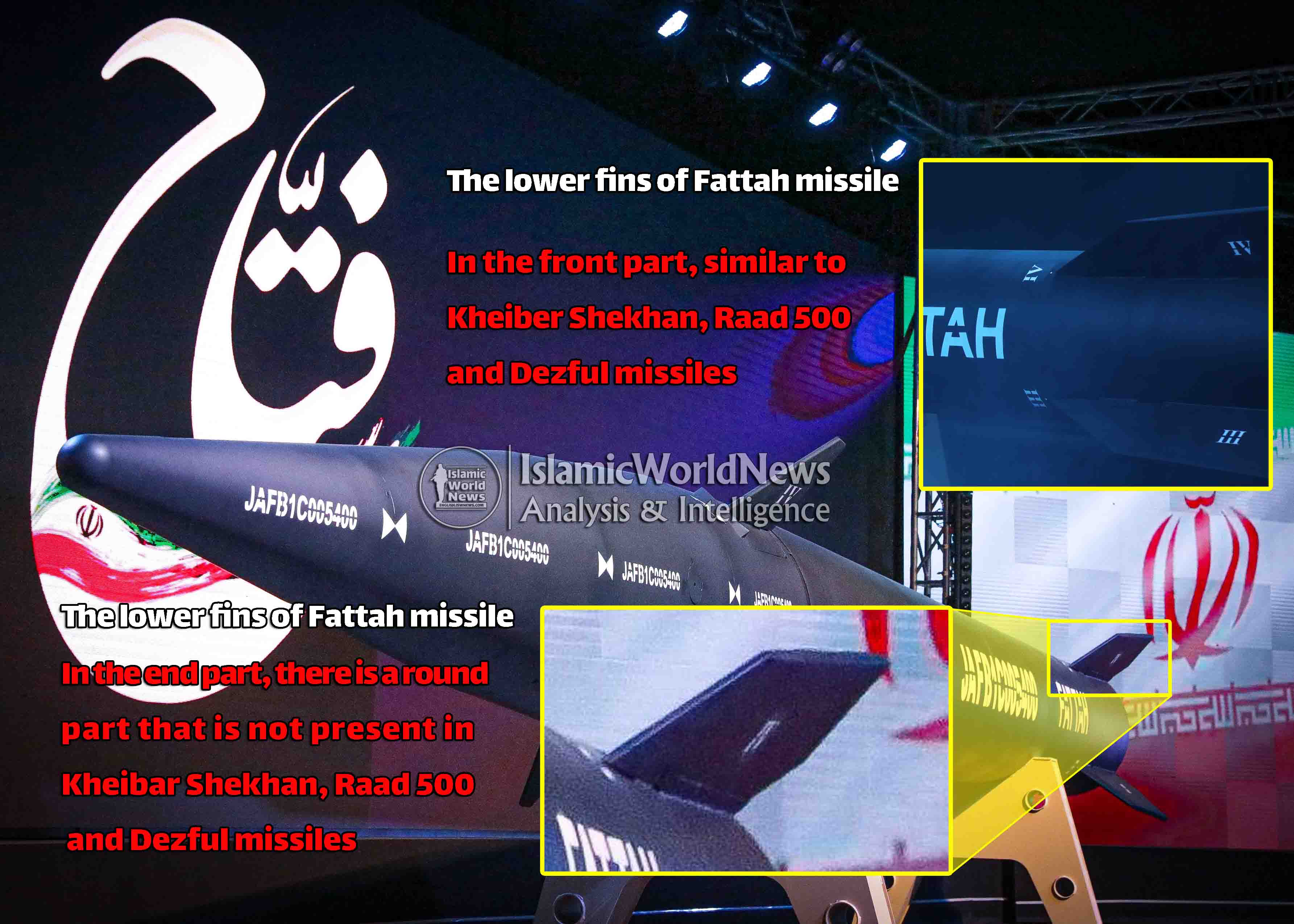
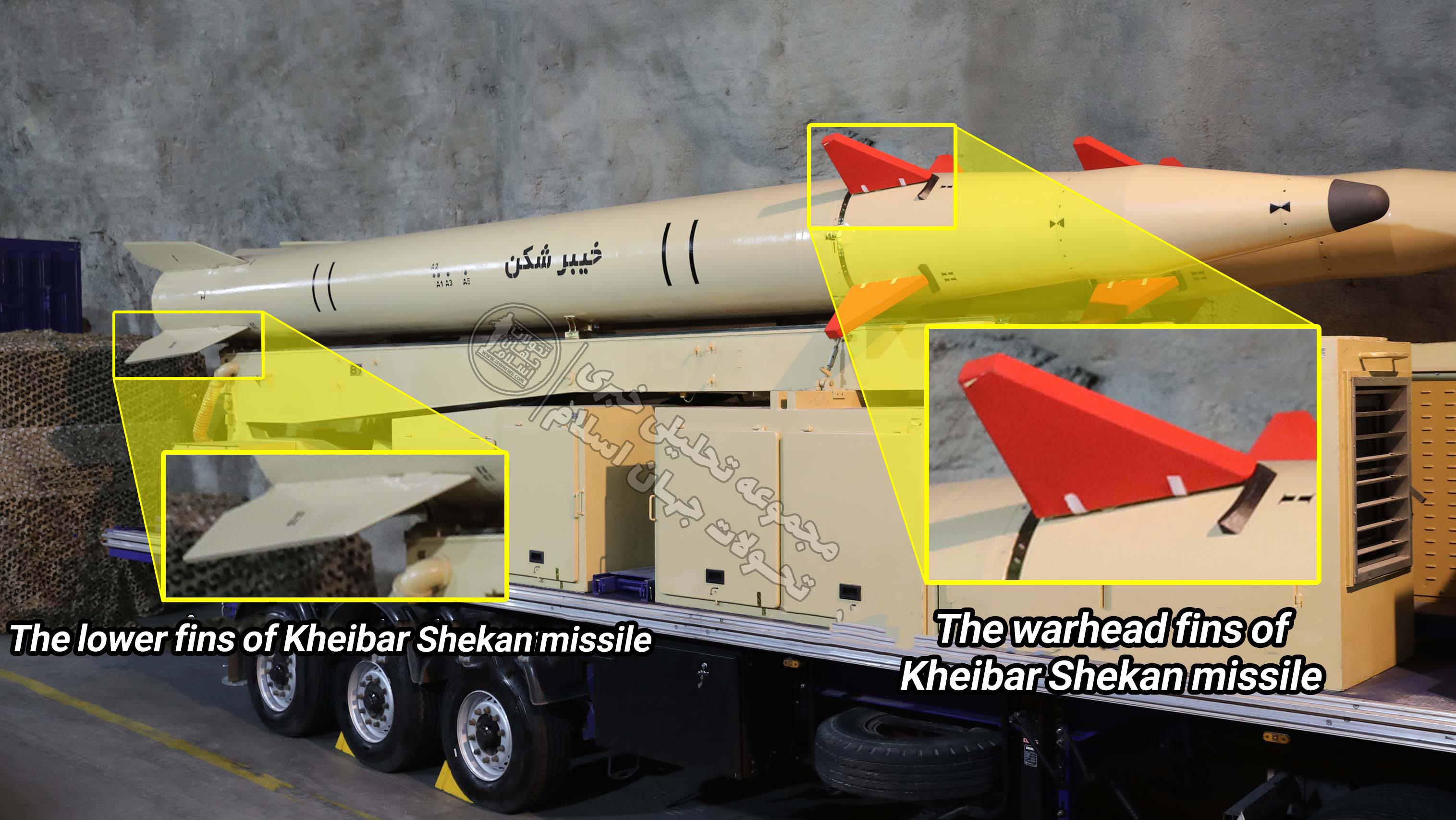
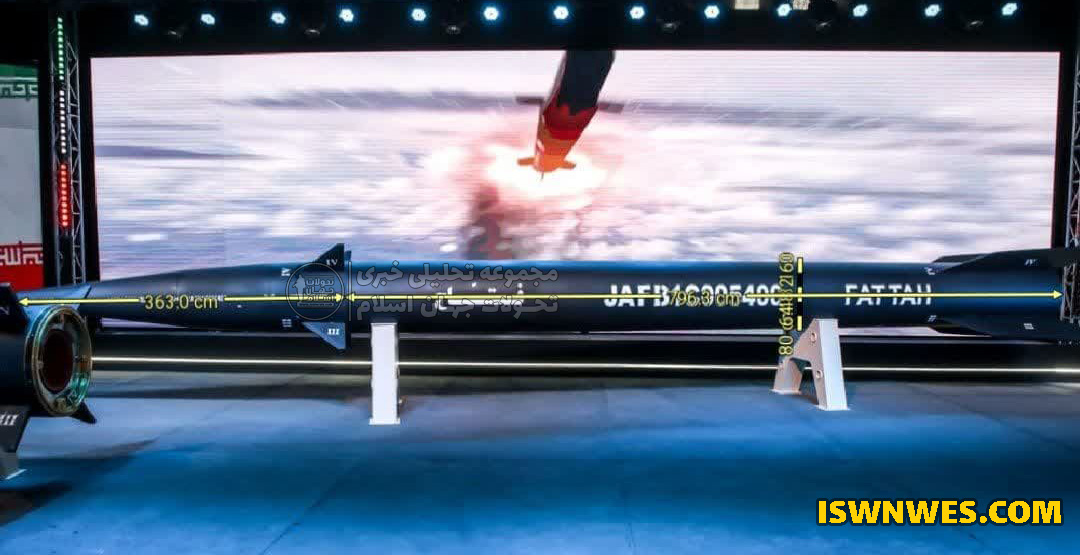
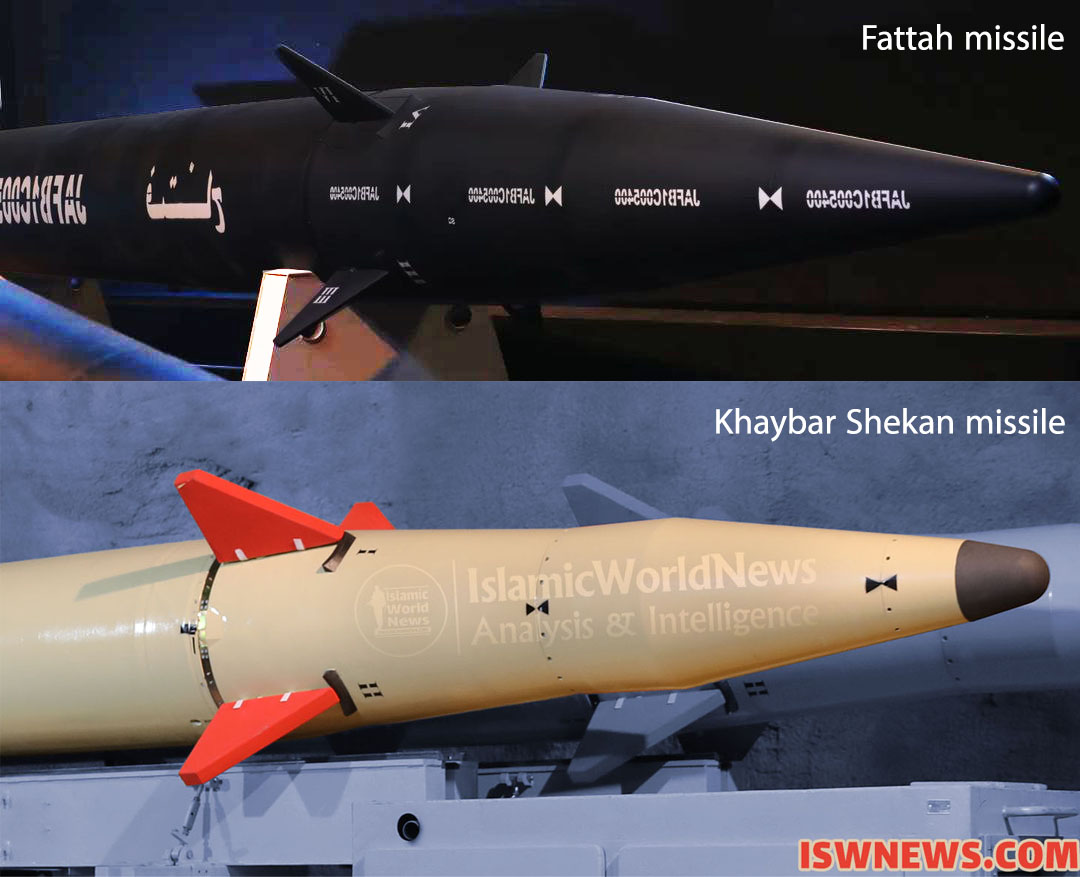
A review of the Fattah missile shows that this missile has a lot of similarity to the Kheibar Shekan missile in appearance. The tail fins and warhead have a lot of similarity to each other. The similarity is such that even the front ramp of the warhead control fins is the same. Therefore, it is assumed that the diameter of the Fattah and Kheibar Shekan missiles are also the same.
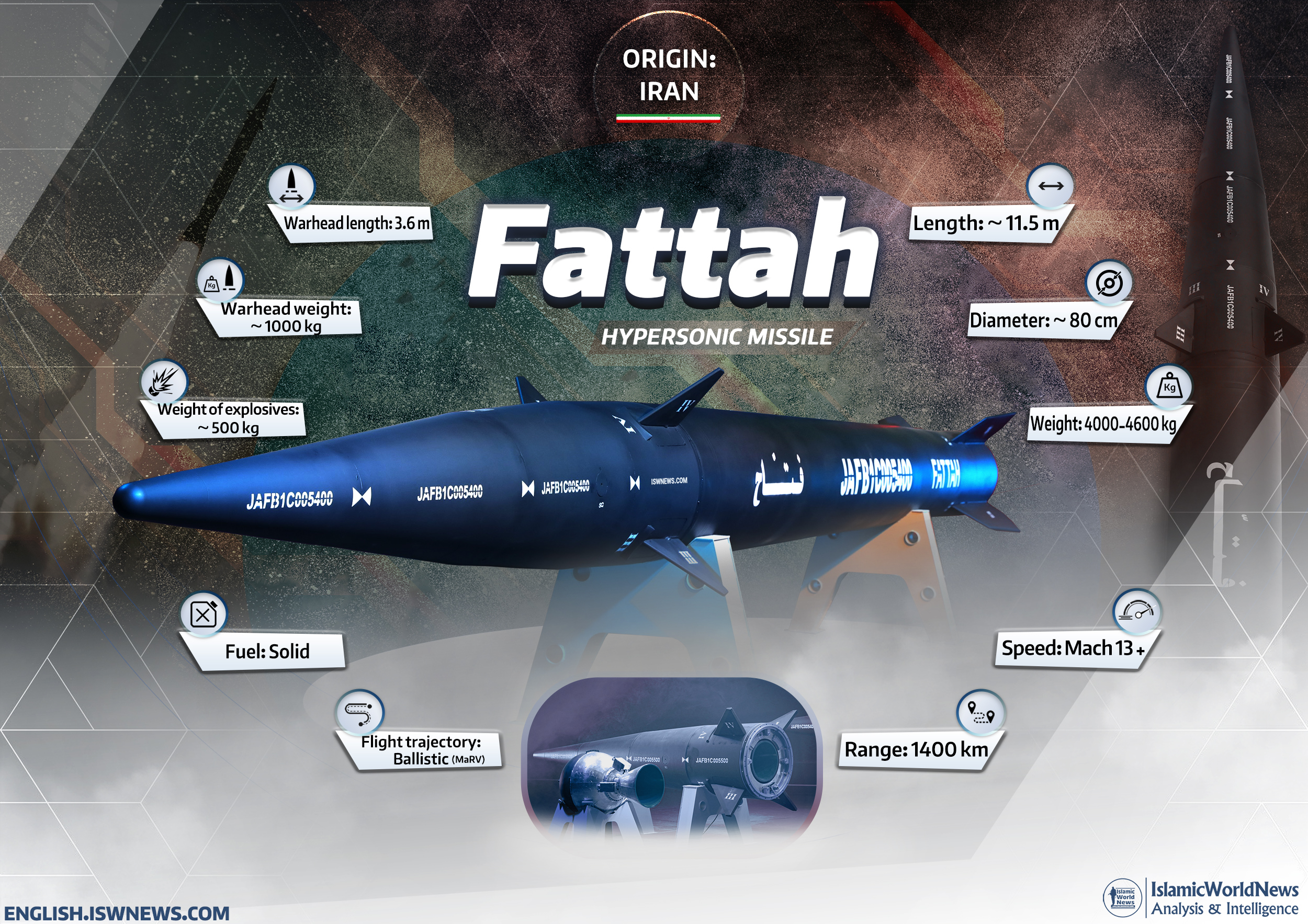
Given the great similarity between the two missiles and also the software reviews that were done, it can be assumed that the two missiles have the same diameter, equal to 80 centimeters. Also, considering that the length of the warhead has been announced as 3.6 meters, with a software review of the missile, the total length of the missile can be considered as 11.5 meters.
Estimation of the length of the Fattah missile
Another similarity between these two missiles is their range. In addition to the visual similarity of the Kheibar Shekan and Fattah missiles, the range of these two missiles is also similar to each other. The Kheibar Shekan has a range of 1450 kilometers and Fattah has a range of 1400 kilometers.
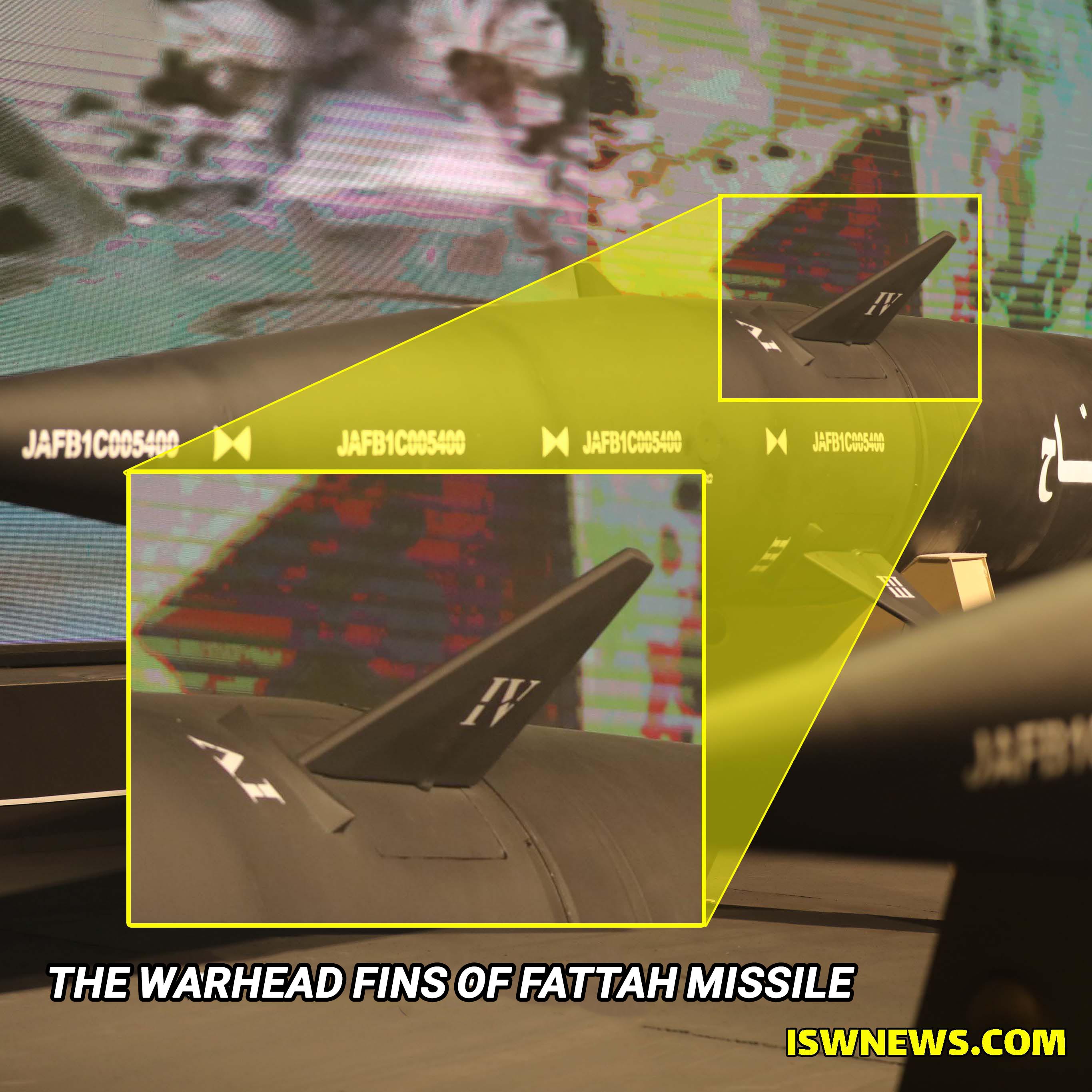
The missile body, along with the end fins and the fins on the cap, is entirely composite (carbon fiber). The body color is also of the radar wave absorbing type, which helps increase missile stealth. The use of warhead fins is when the missile comes down from an altitude of 30 kilometers and enters the atmosphere. Because at higher altitudes it has no effect on warhead maneuvering. This is useful for maneuvering near the target.
The warhead fins of Fattah missile
As it is clear, the aerodynamic shape of the Fattah and Kheibar Shekan warheads are the same, but due to the addition of an engine and fuel in the final section, it has been tried to maintain the aerodynamics of the warhead and reduce drag by making the missile tip longer.
Comparison of warheads of Fattah and Kheibar Shekan missiles
As mentioned, the warhead has propulsion with the ability of change thrust vector, and the presence of this engine allows the warhead to maintain its speed at a speed of more than Mach 5 when maneuvering near the target. When the warhead enters the atmosphere, its speed is greatly reduced due to the strong air resistance, and by performing heavy maneuvers with the help of its fins, its speed is reduced again; But with the warhead engine, it is possible to increase the speed to more than Mach 5. Also, with the thrust vector nozzle, it is possible to perform heavier maneuvers. It should be noted that this engine can be turned on when the warhead is separated from the missile, which increases the flight height of the warhead and greatly increases its range.
Fattah warhead engine with thrust vector nozzle
The next issue is how the Fattah missile works and whether it is hypersonic or not. This missile has a warhead with the ability to change thrust vector, which allows it to maneuver from the time the warhead separates from the body at an altitude of 300 kilometers above the ground. So after separating from the body, the Fattah missile’s warhead maneuvers with a low or depressed trajectory to escape anti-ballistic missile systems and changes or adjusts its path several times during flight. It should be noted that Fattah does not need much maneuvering outside the atmosphere; in addition to performing regular maneuvers to adjust its path, this missile has the ability to change its ballistic path shape. The next point is the ability to maneuver from a distance of 100 kilometers before hitting the target, which also puts it in the category of MaRV ballistic missiles.
So, Fattah follows a non-ballistic path both outside the atmosphere and when it is in Earth’s atmosphere and near its target. However, it should be noted that the mentioned capabilities alone do not make Fattah hypersonic. What puts the Fattah missile in the category of hypersonic ballistic missiles is that in addition to the mentioned capabilities, the missile’s speed at the moment of impact on the target is also higher than 5 Mach. This has been made possible by keeping the engine on for 50 seconds at different stages of flight to maintain warhead speed. As a result, by combining all of these features, we can consider Fattah as a hypersonic ballistic missile.
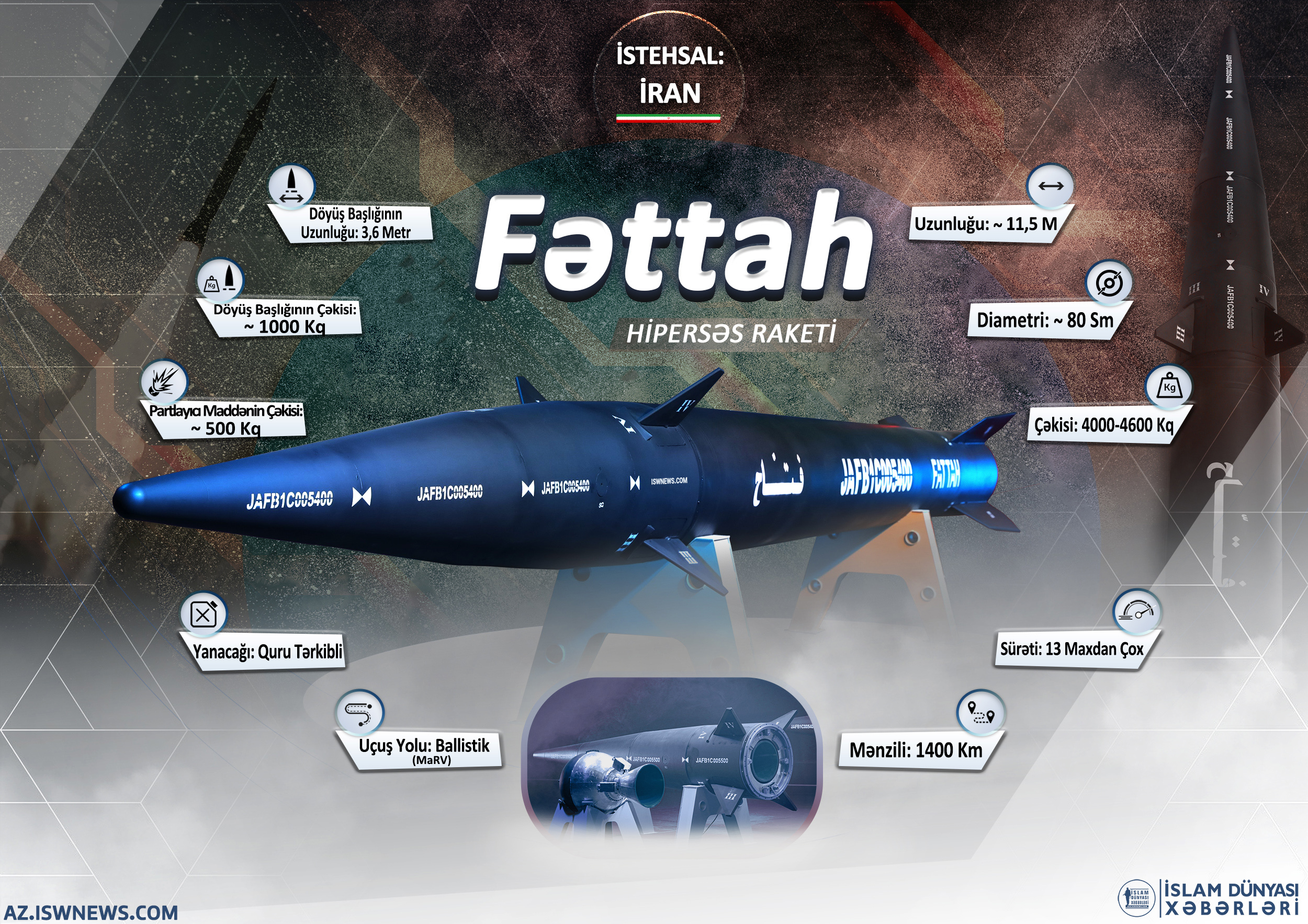
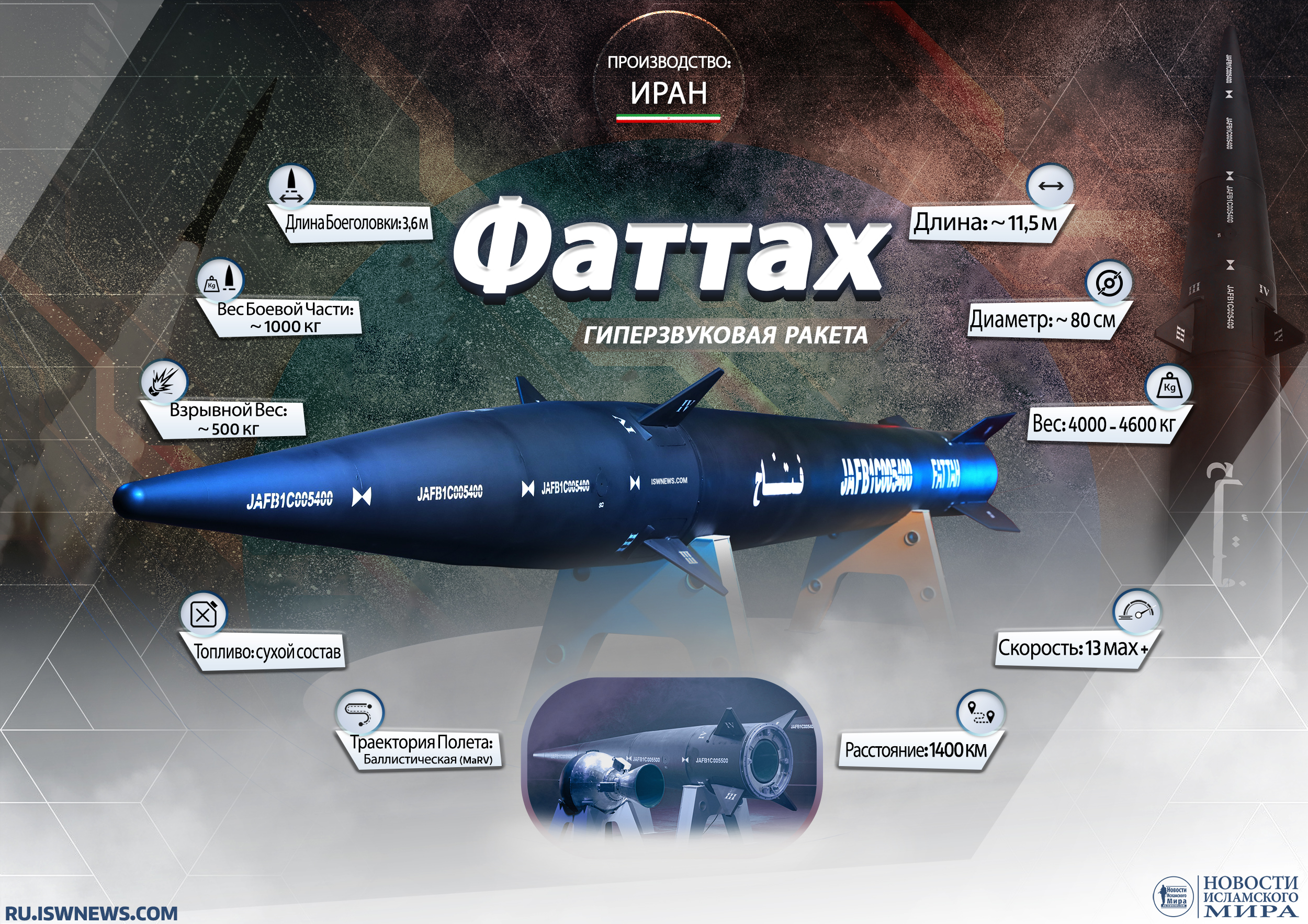
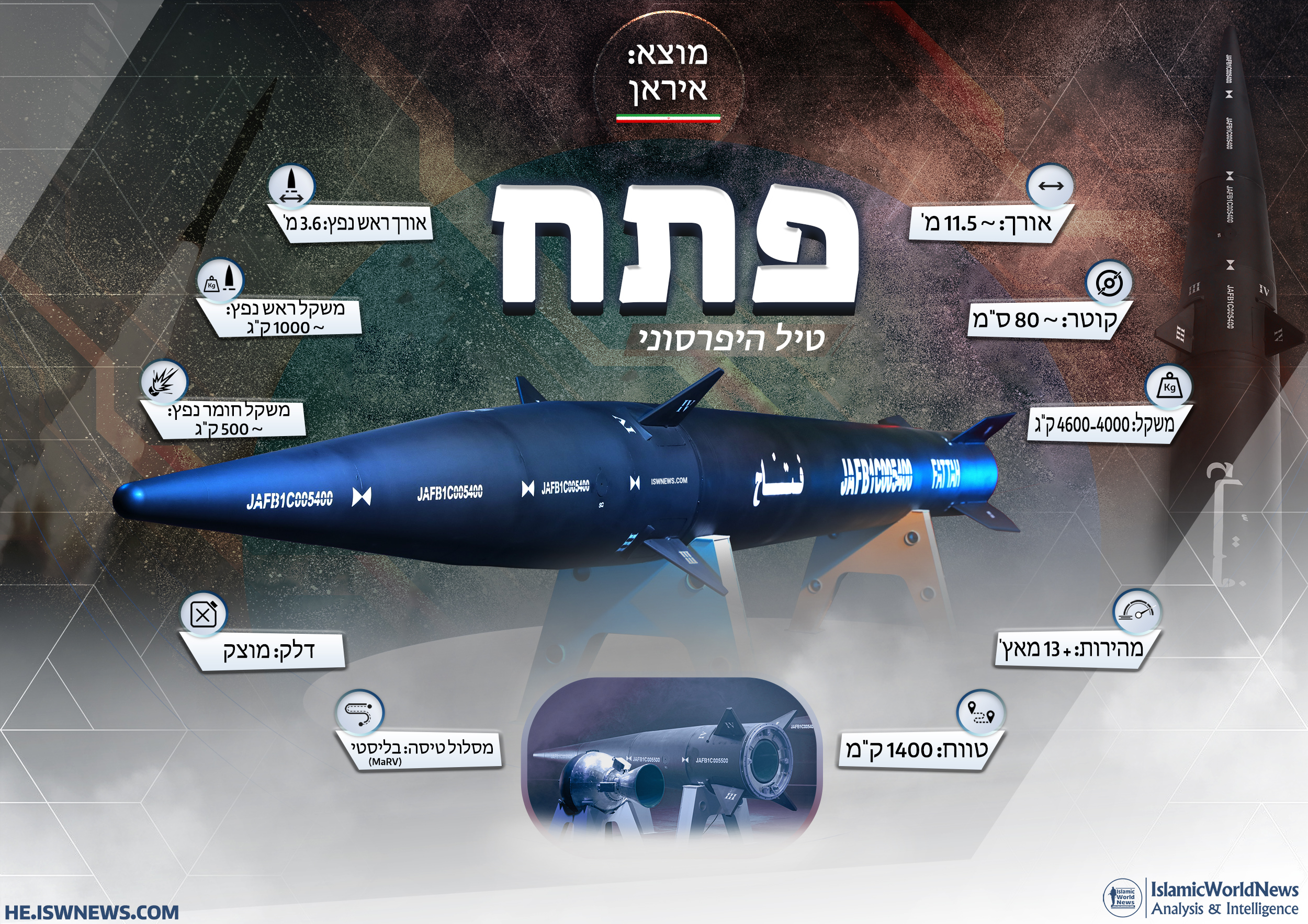
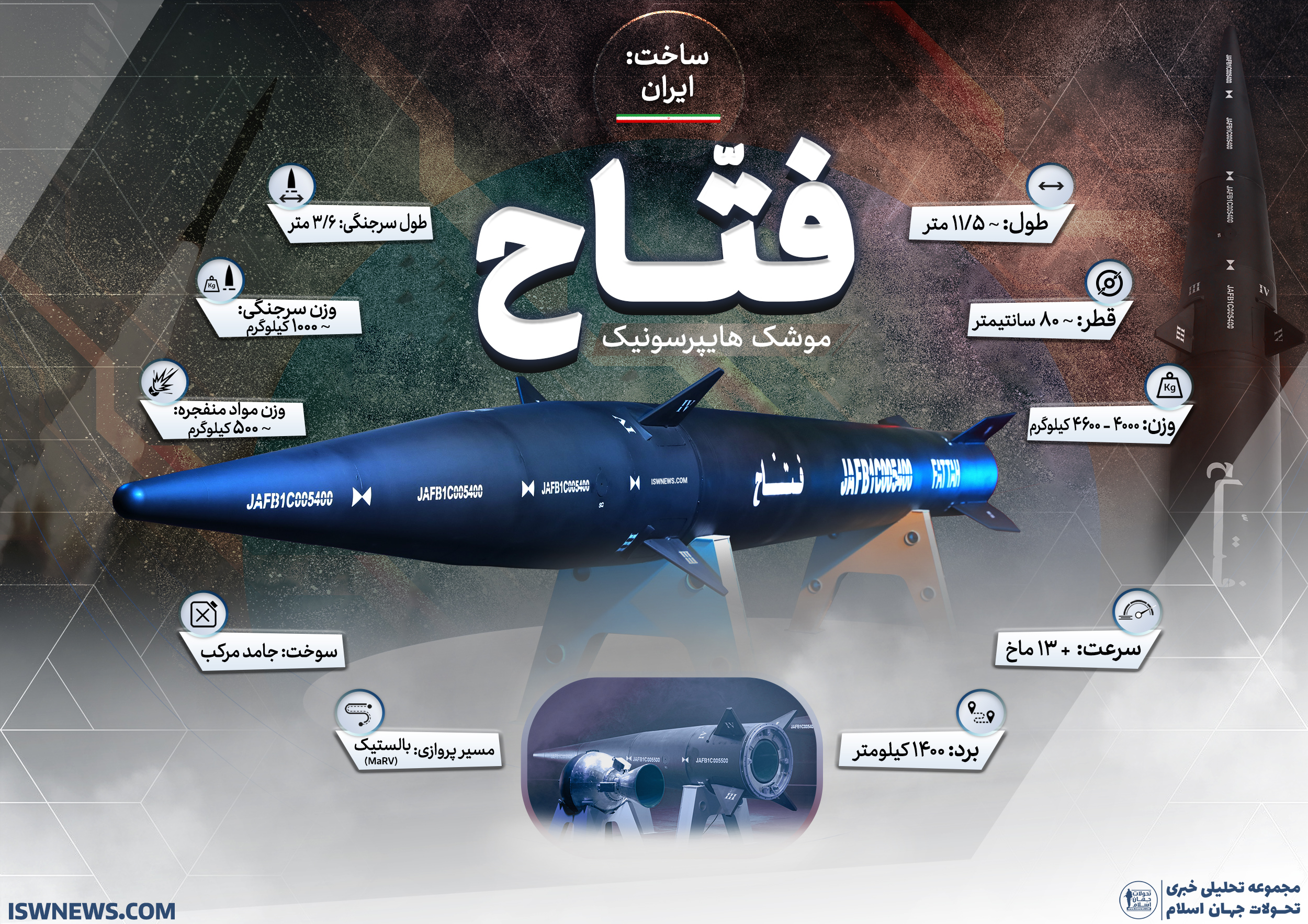
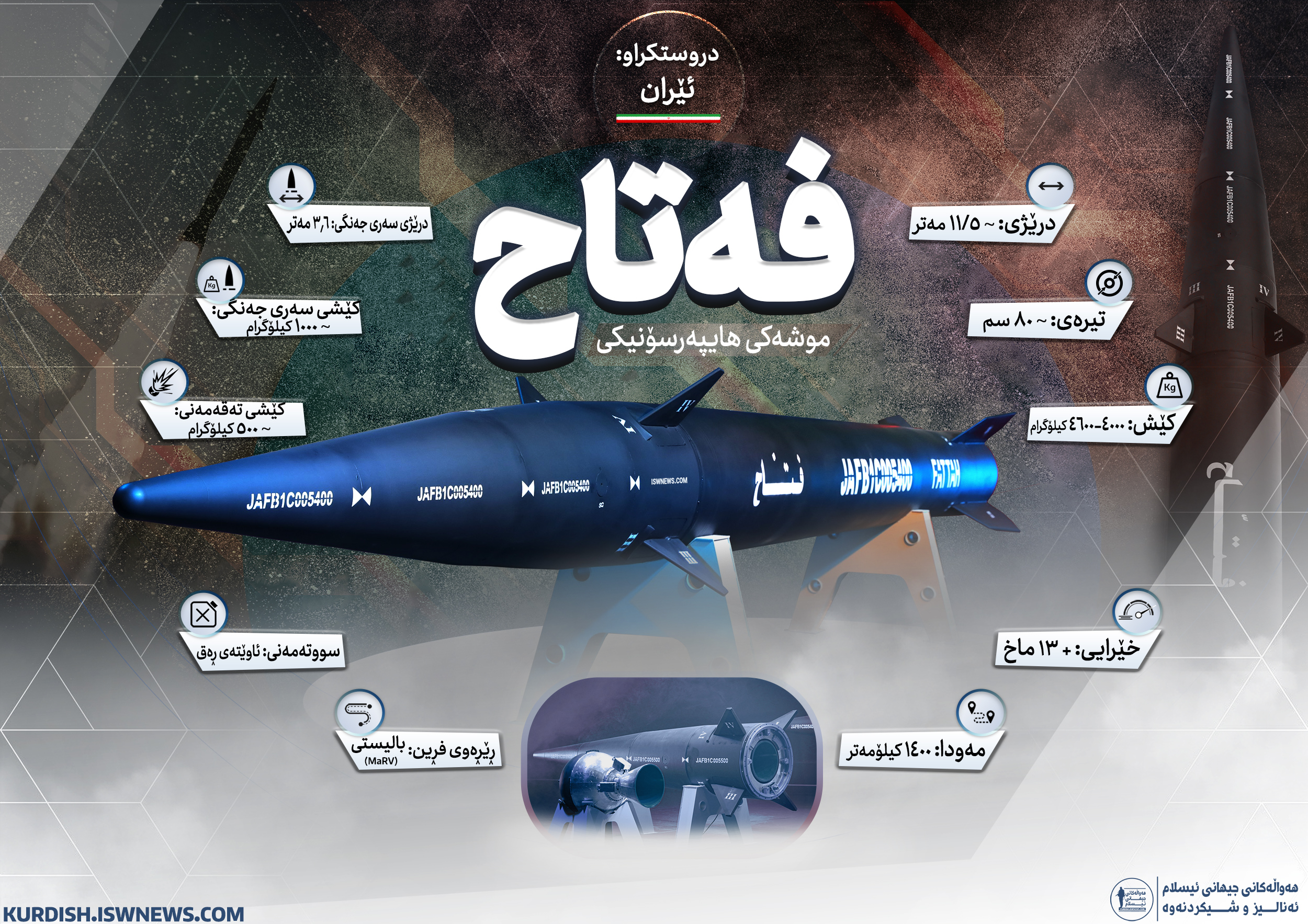
Fattah missile specifications: Length: ~ 11.5 meters Diameter: ~ 80 cm Weight: 4000 to 4600 kg Warhead length: 3.6 meters Warhead weight: ~ 1000 kg Weight of explosives: ~ 500 kg Speed: more than Mach 13 Range: 1400 km (increasable) Fuel: solid compound Flight trajectories: ballistic (maneuverability from the mid-phase) Origin: Iran
Fattah hypersonic missile – click to view full size
“Fattah hypersonic ballistic missile” posters collection in Persian, Russian, Arabic, Azeri, Kurdish and Hebrew:
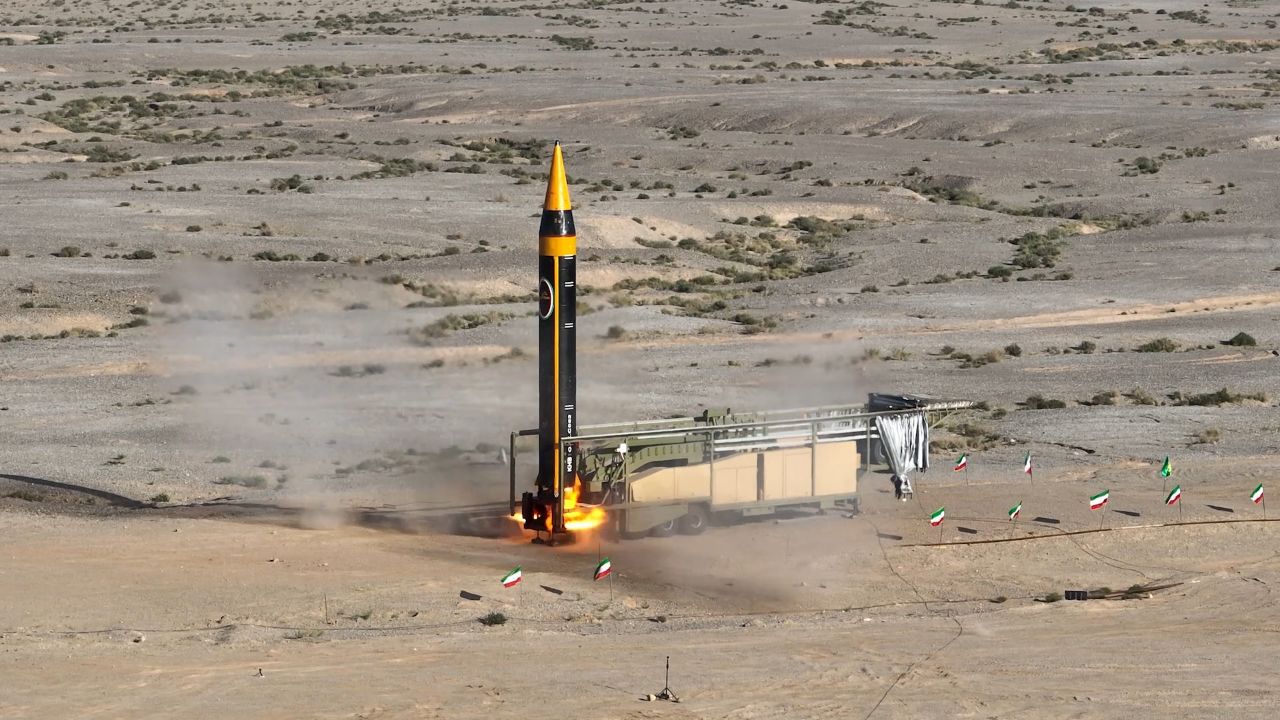
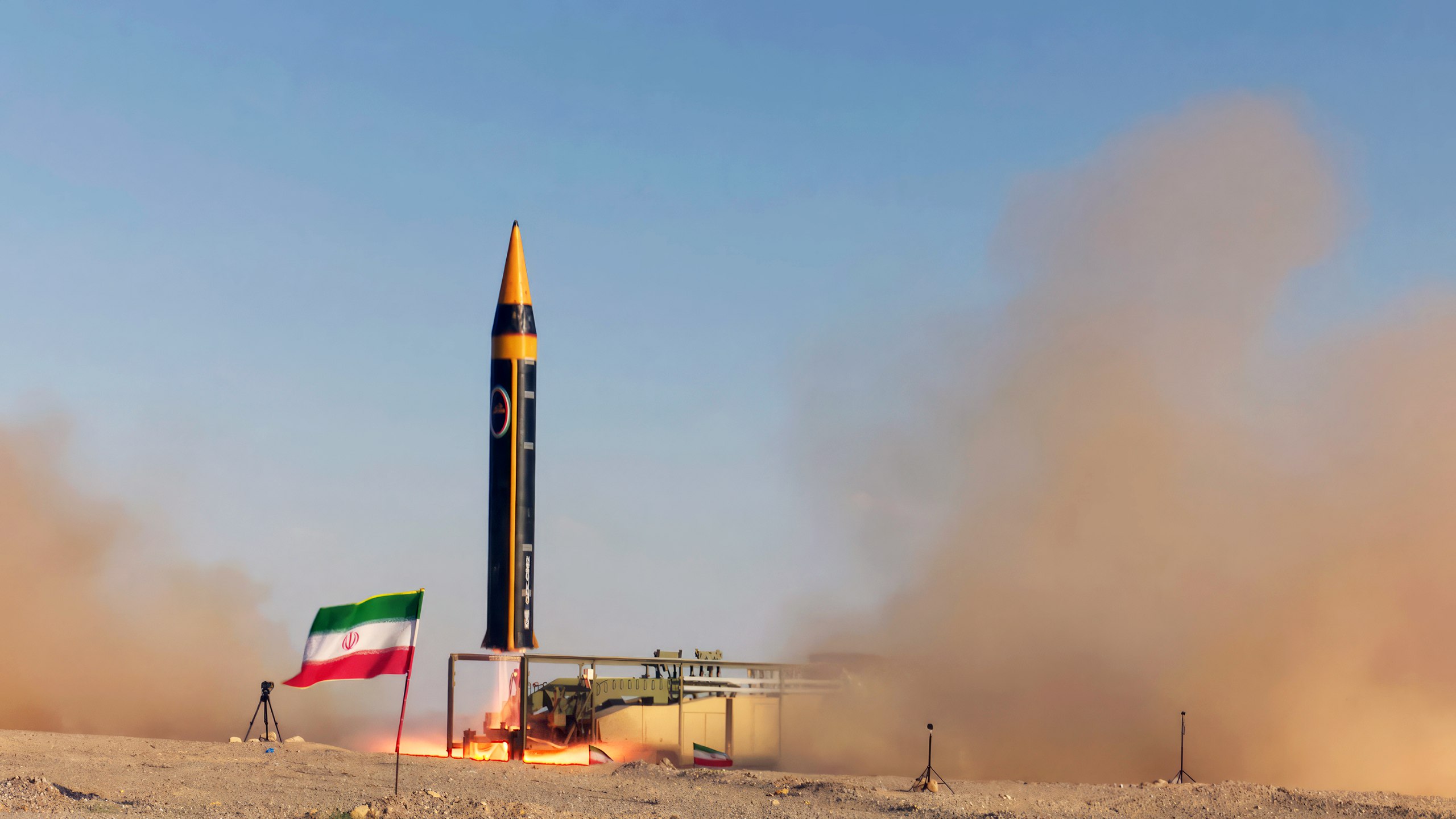
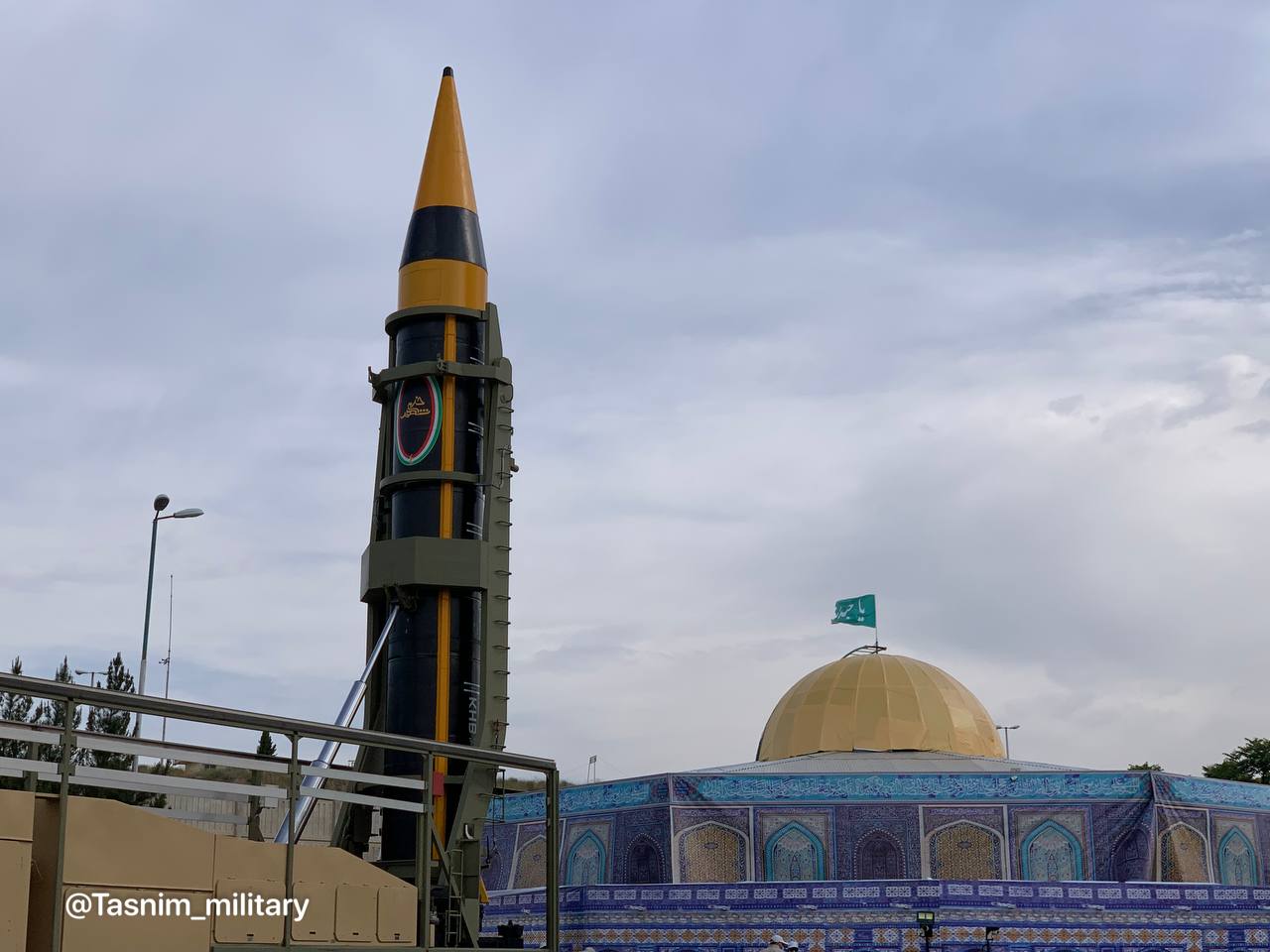
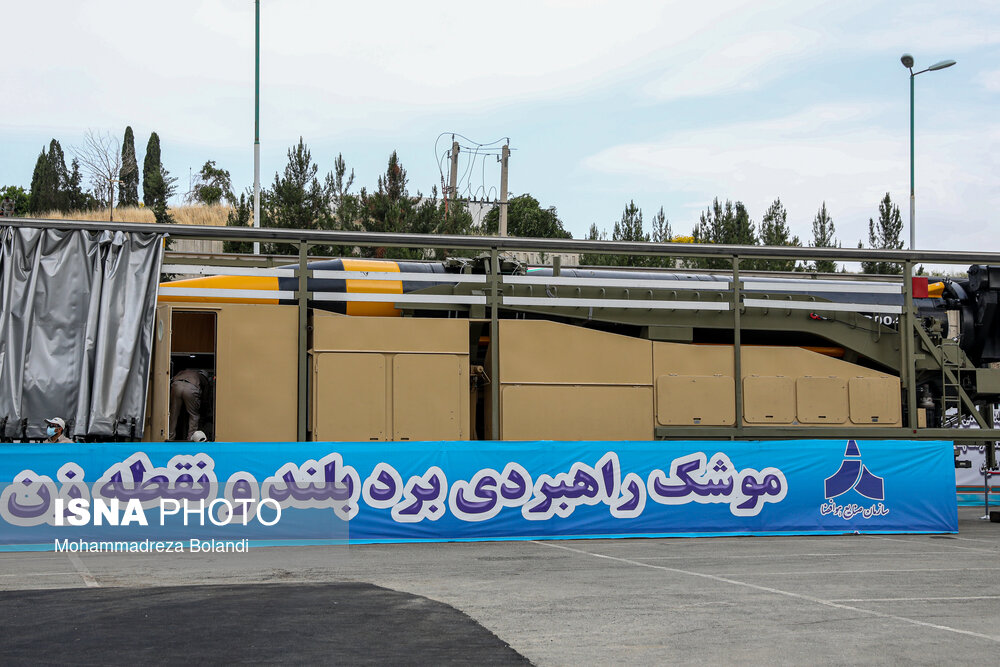
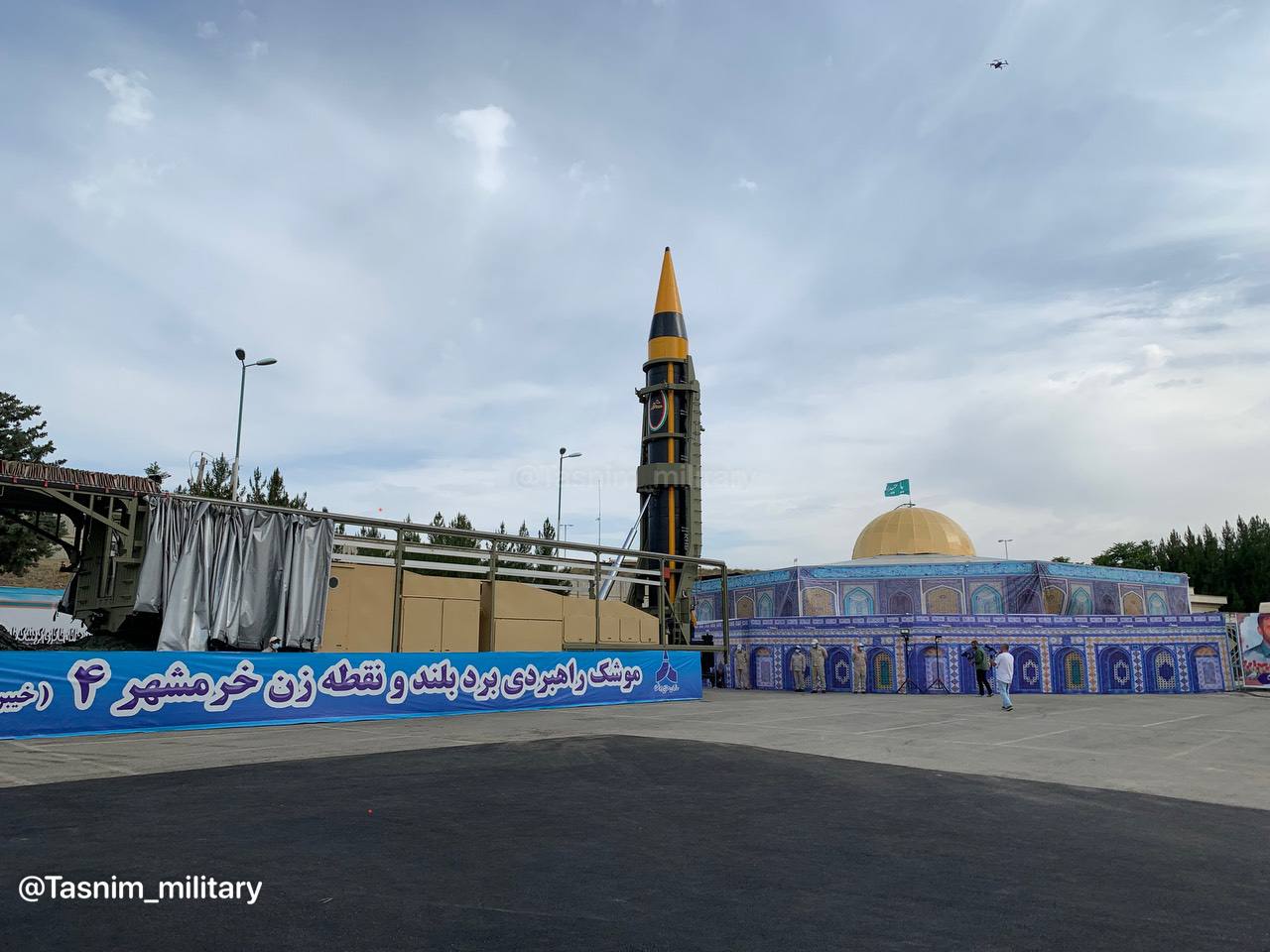
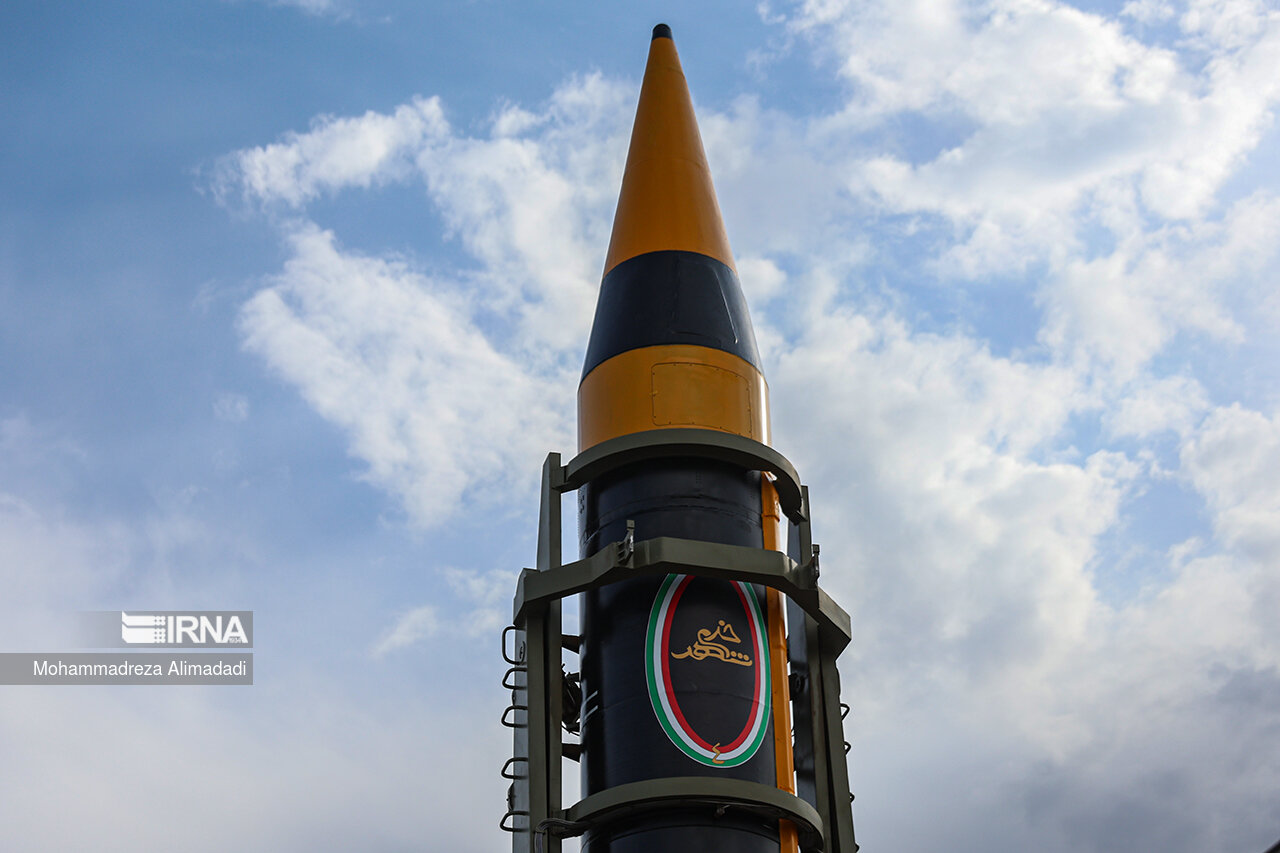
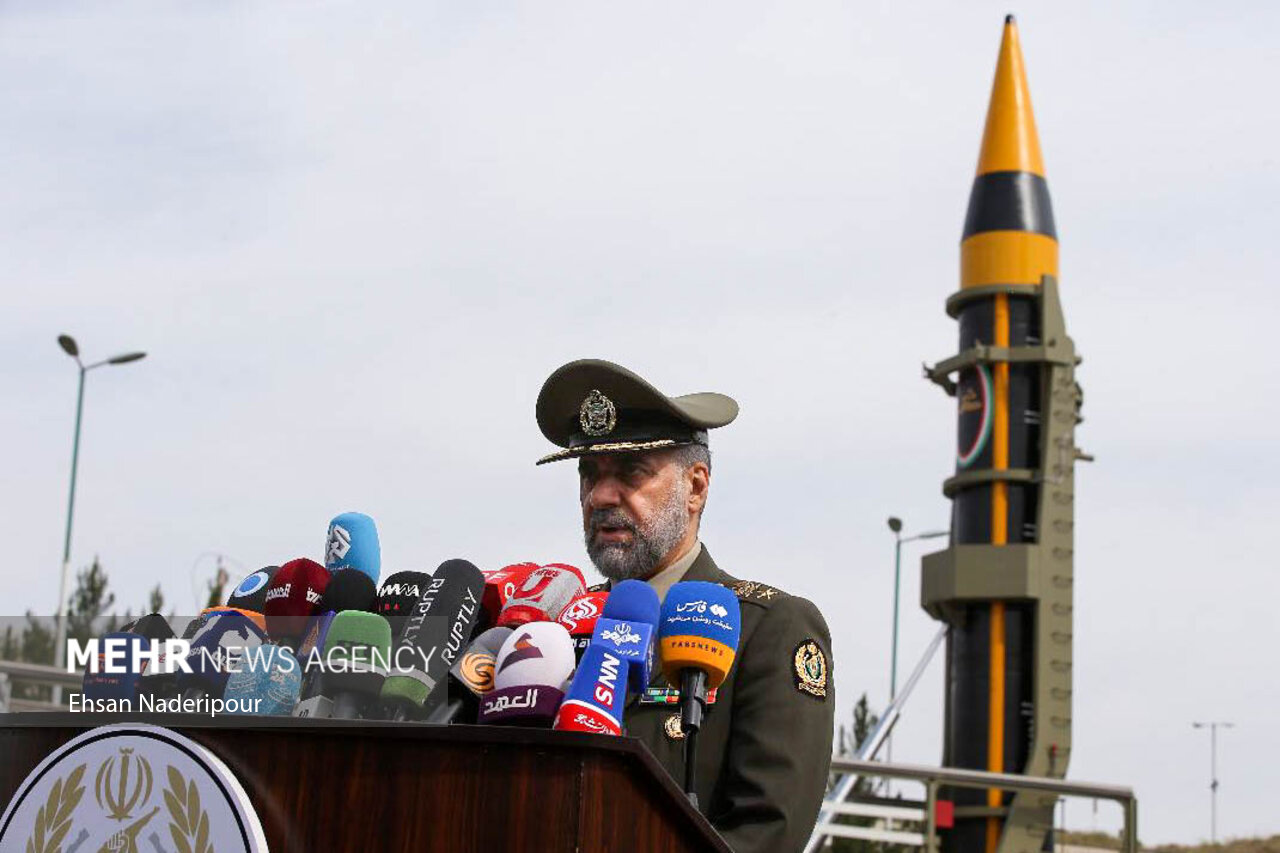
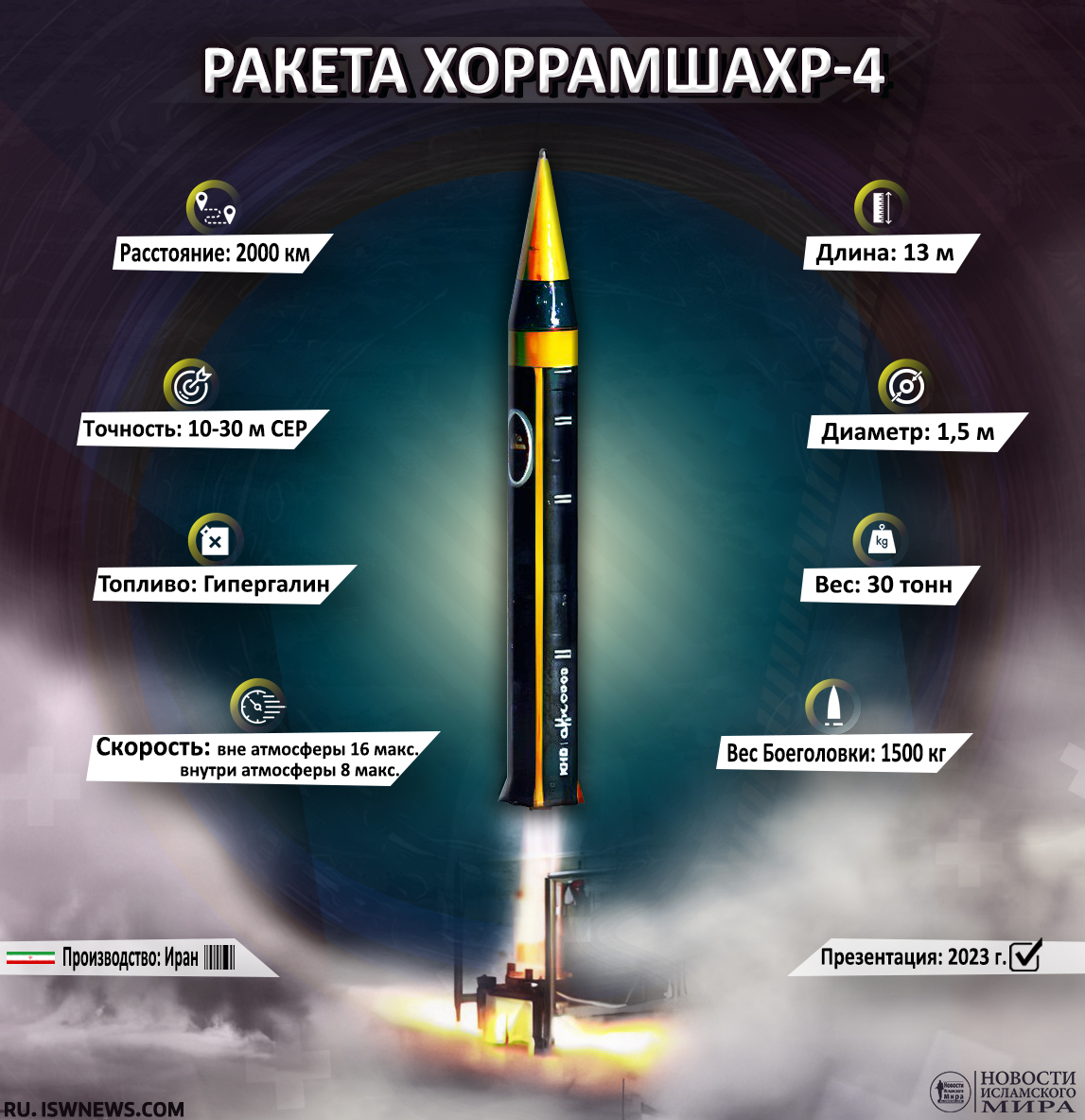
On May 25 and on the occasion of the anniversary of the liberation of Khorramshahr city in the Iraq-Iran war, the Khorramshahr 4 surface-to-surface ballistic missile with the operational name of “Khaybar” was unveiled in the presence of Mohammad Reza Ashtiani, Minister of Defense and Armed Forces Logistics of Iran.
Brigadier General Mohammad Reza Ashtiani, called the Khorramshahr-4 missile a strategic pinpoint ballistic missile with radar evasion capability. In some parts of his speech, he said the message of the unveiling of the Khorramshahr-4 missile to Iran’s friends is helping peace and stability in the region and providing comprehensive support to countries that are on the path of fighting against the arrogance system.
Khorramshahr-4 missile is considered to be the newest variant of the Khorramshahr missile series, which has undergone major changes in various parts. Among the most important of these changes, we can point out the use of hypergolic fuel and a new engine. Khorramshahr-4 is equipped with Arvand engine, one of the most advanced Iranian liquid fuel engines, in order to use hypergallic fuel.
A hypergolic propellant is a rocket propellant combination used in a rocket engine, whose components spontaneously ignite when they come into contact with each other. The main advantages of hypergolic propellants are that they can be stored as liquids at room temperature and that engines which are powered by them are easy to ignite reliably and repeatedly. Hypergolically-fueled rocket engines are usually simple and reliable because they need no ignition system. As hypergolic rockets do not need an ignition system, they can fire any number of times by simply opening and closing the propellant valves until the propellants are exhausted and are therefore uniquely suited for spacecraft maneuvering.[source]
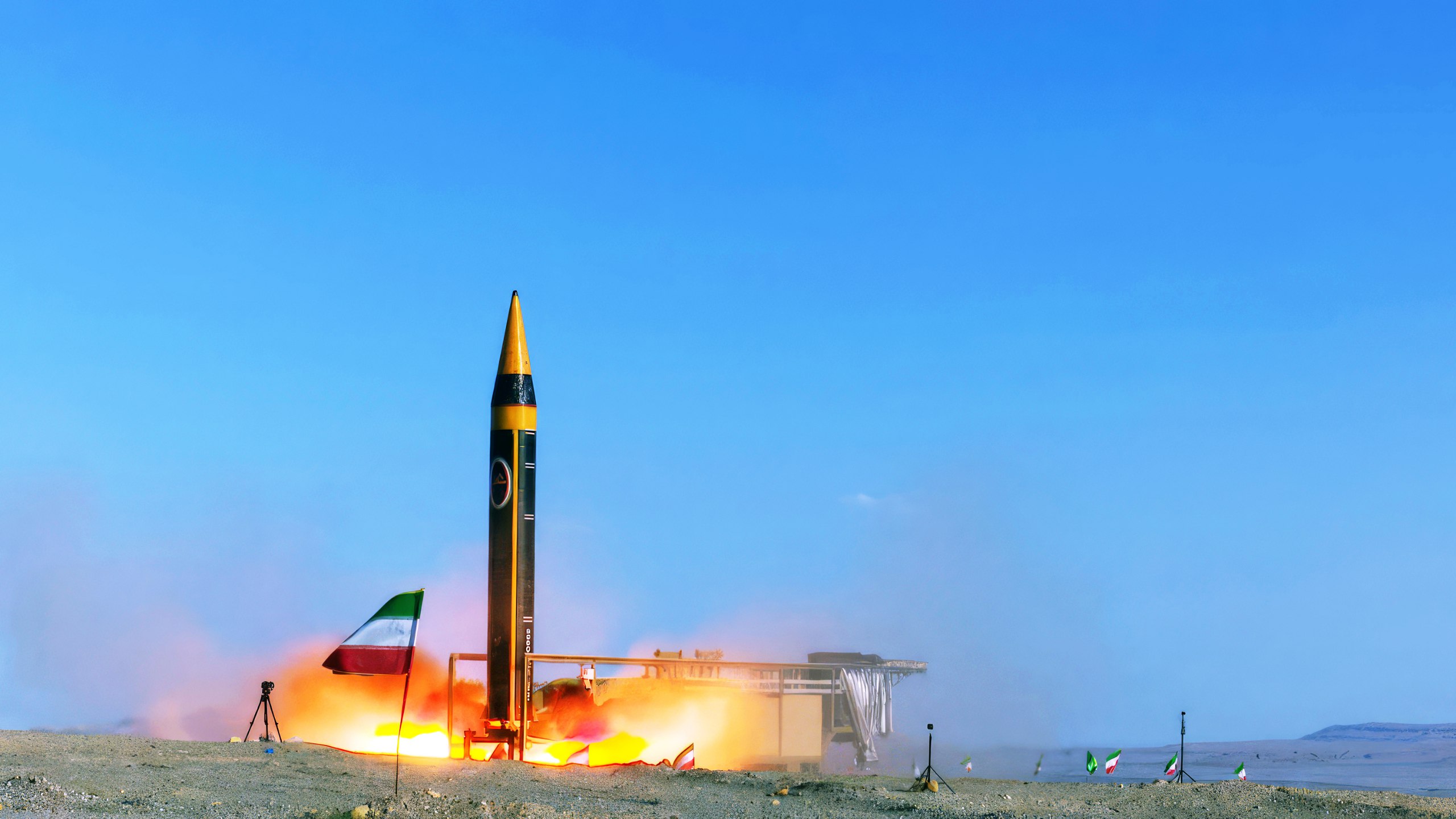
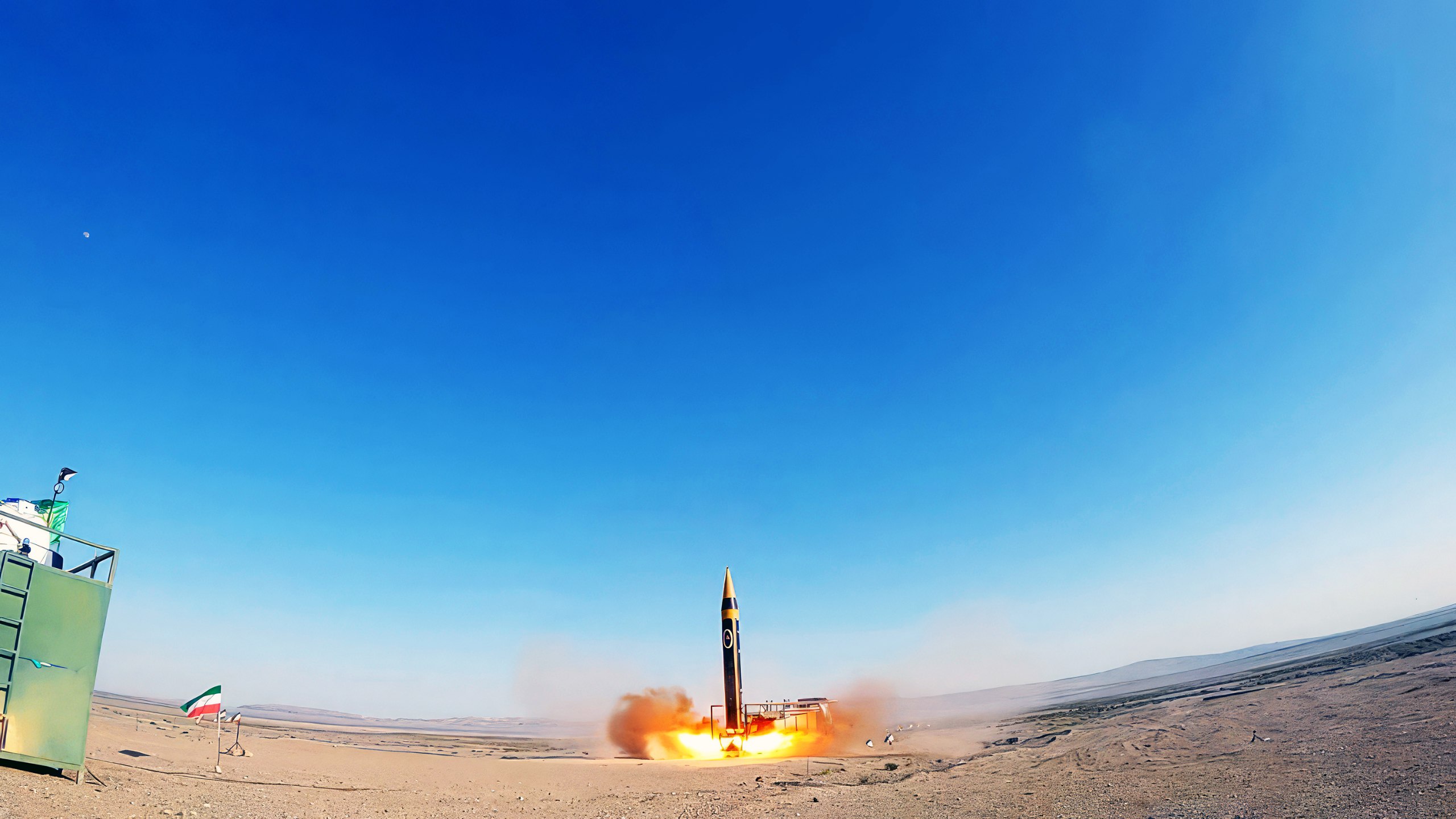
The launch moment of Khorramshahr-4 ballistic missile
Another feature of this missile is the ability to store fuel inside the Khorramshahr-4 missile for several years. Using this ability, it is possible to inject fuel into the rocket and keep it in storage for several years. For this reason, the rocket is always ready to fire and there is no need to spend long time for refueling again. Therefore, the preparation time and entering the launch position has reached less than 12 minutes.
According to statements and information provided by military sources, the range of Khorramshahr-4 missile is up to 2000 km and its warhead is 1500 kg. But based on some facts, it seems that the range of the missile is intentionally announced lower than its actual range. Experts believe that the real range of this missile is up to 4000 km.
In general, the warhead of this missile with a length of 4 meters and a weight of 1,500 kg is one of the largest and heaviest warheads produced by Iran, which is also resistant to electronic warfare. It should be noted that out of this 1,500 kg, about 1,000 kg are explosives and 500 kg are related to engine, guidance, equipment, etc. The warhead of this missile can be single and heavy or in the form of several lighter warheads, and it also uses various warheads such as thermobaric warheads. The point here is that in this warhead, guiding micromotors are used to control and adjust its trajectory outside the Earth’s atmosphere. For example, by reducing the weight of the warhead by half and increasing the amount of fuel, and with the use of guiding micromotors in the mid-phase in exoatmosphere, the range of this missile can easily be increased up to twice the declared range!
Review of the performance of launch, guidance and control in the mid-phase outside the atmosphere in Khorramshahr-4 missile
The speed of Khorramshahr-4 is Mach 16 outside the atmosphere and Mach 8 inside the atmosphere before hitting the target, and the circular probable error (CEP) of 10 to 30 meters is also expected for this missile. The speed of Mach 16 outside the earth’s atmosphere and the use of guidance engines to control and adjust the trajectory of the warhead makes it very hard for the outer space missile systems to intercept and destroy this missile. Also, the speed of Mach 8 in the final phase in the atmosphere is a very good speed, making it very difficult to detect, track and intercept by existing anti-missile systems.
One day after the unveiling of the Khorramshahr 4 missile, Deputy Defense Minister General Farahi provided more information about this missile in a television interview. According to him, unlike previously built missiles whose guidance and control system was in the atmosphere and there was a possibility of jamming and electronic interference by the enemy, guidance and control of Khorramshahr 4 is done outside the atmosphere, and its guidance and control systems are not active inside the atmosphere, and therefore, electronic warfare systems have no effect on the Khorramshahr 4 missile.
Also, in addition to this feature, this missile uses a cyber defense system and using artificial intelligence with the necessary maneuverability, it can deceive the enemy’s defense systems and escape from the enemy’s missiles. He stated the circle of error (CEP) of Khorramshahr 4 missile up to 30 meters at a distance of 2000 km, and the durability of the fuel inside the missile was also stated to be a maximum of 3 years.
Among the other capabilities of Khorramshahr 4 is the ability to use radar and optical seeker individually or simultaneously with the use of artificial intelligence to target moving sea and land targets, which is installed on the missile depending on the type of mission and target.
MIRV and MRV capabilities on Khorramshahr-4 warhead
Khorramshahr-4 missile can carry multiple warheads inside its main warhead and each warhead can hit an independent target.
Multiple independently targetable reentry vehicle (MIRV) capability refers to a warhead that carries several other warheads inside, and each of these warheads can target an independent and different target. There is another type of warheads called multiple reentry vehicle (MRV), which is also capable of carrying several warheads, but the warheads do not have the ability to target independently, and all of them hit the target in a certain range and are unguided.
Currently, the US, UK, France, Russia, China and India have claimed to have MIRV missile systems. Pakistan and the Israeli regime are also suspected of developing and possessing MIRV missile systems.
In 1970, the United States presented this capability to the world for the first time with the LGM-30G Minuteman III missile. Today, Iran has also achieved this ability and has used it in the new generation of Khorramshahr missiles.
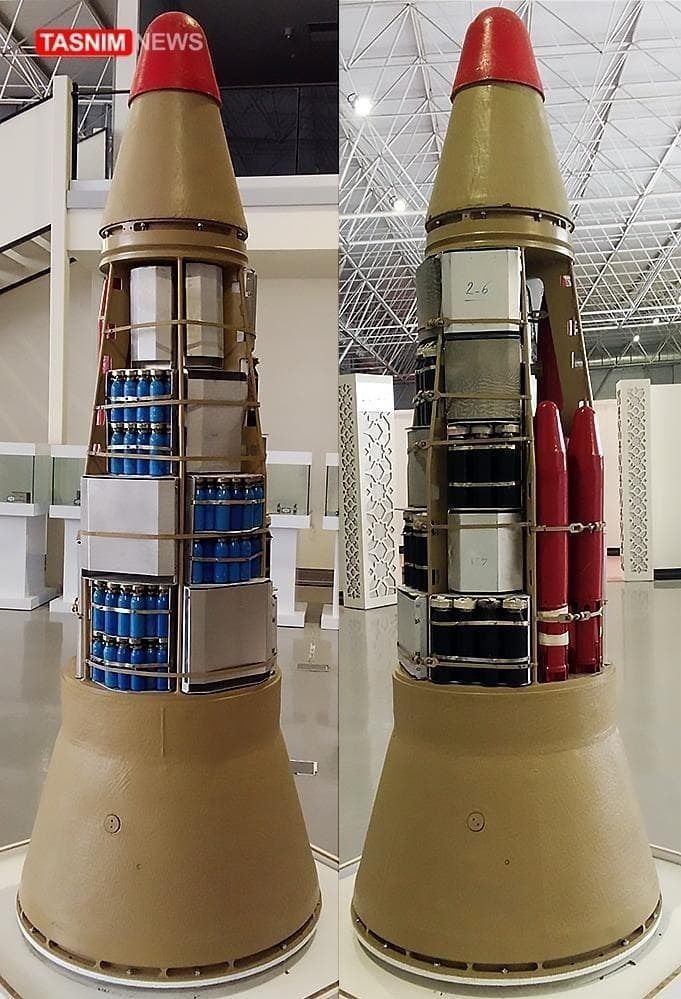
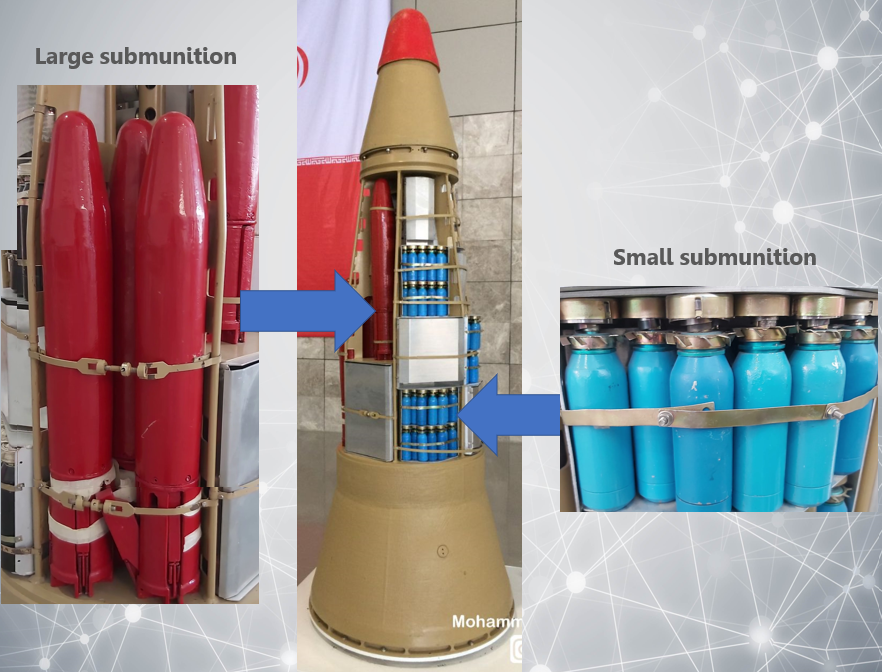
Khorramshahr-2 missile uses a warhead with MRV capability. This type of warhead, carrying a large number of rockets and bombs, is very suitable for targeting various targets such as runaways, barracks and enemy gatherings. But Khorramshahr-4 missile has gone one step further and has achieved MIRV capability. This feature is very suitable for attacking fixed and predetermined targets.
Unguided munitions in the warhead of Khorramshahr missile (MRV variant)
The main difference between the Khorramshahr-4 missile and the Minuteman III missile is the accuracy and type of munition. The American missile is designed to carry several nuclear warheads with a power of 170 kilotons of TNT and does not need pinpointing accuracy, because nuclear warheads have large explosions, and even several kilometers of error is not important for these type of missiles. However, the Khorramshahr-4 missile has been developed to carry a conventional warhead, and for this reason, each warhead must have high accuracy.
Khorramshahr 4 (Khaybar) missile will further boost the offensive and defensive capabilities of Islamic Republic of Iran. The country has been working nonstop to develop its missile capabilities in order to deal with increasing threats from the United States and the Israel regime. Tehran’s large missile program achieved a number of breakthroughs in the last few years, despite facing strict sanctions and even sabotage.
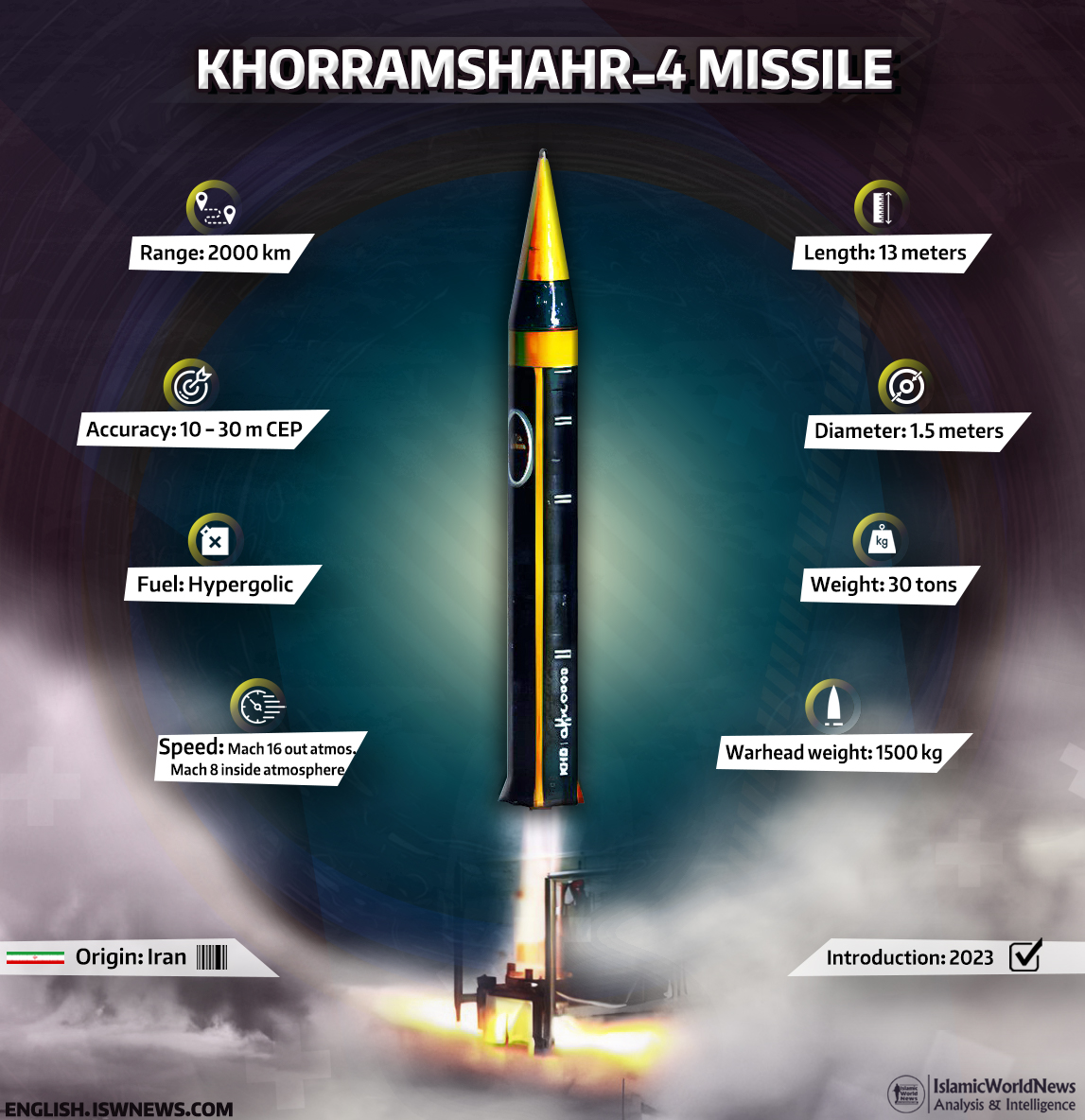
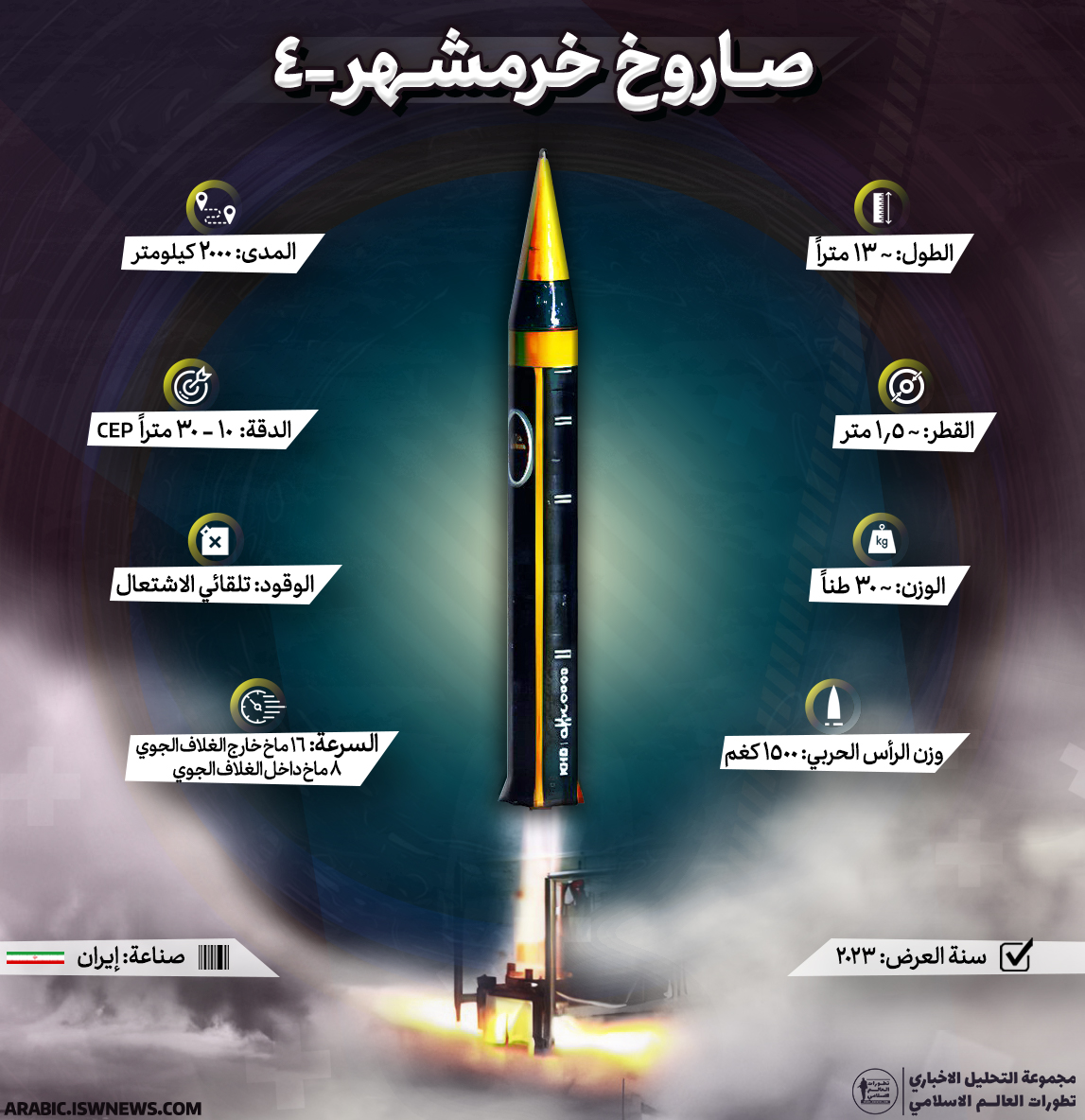
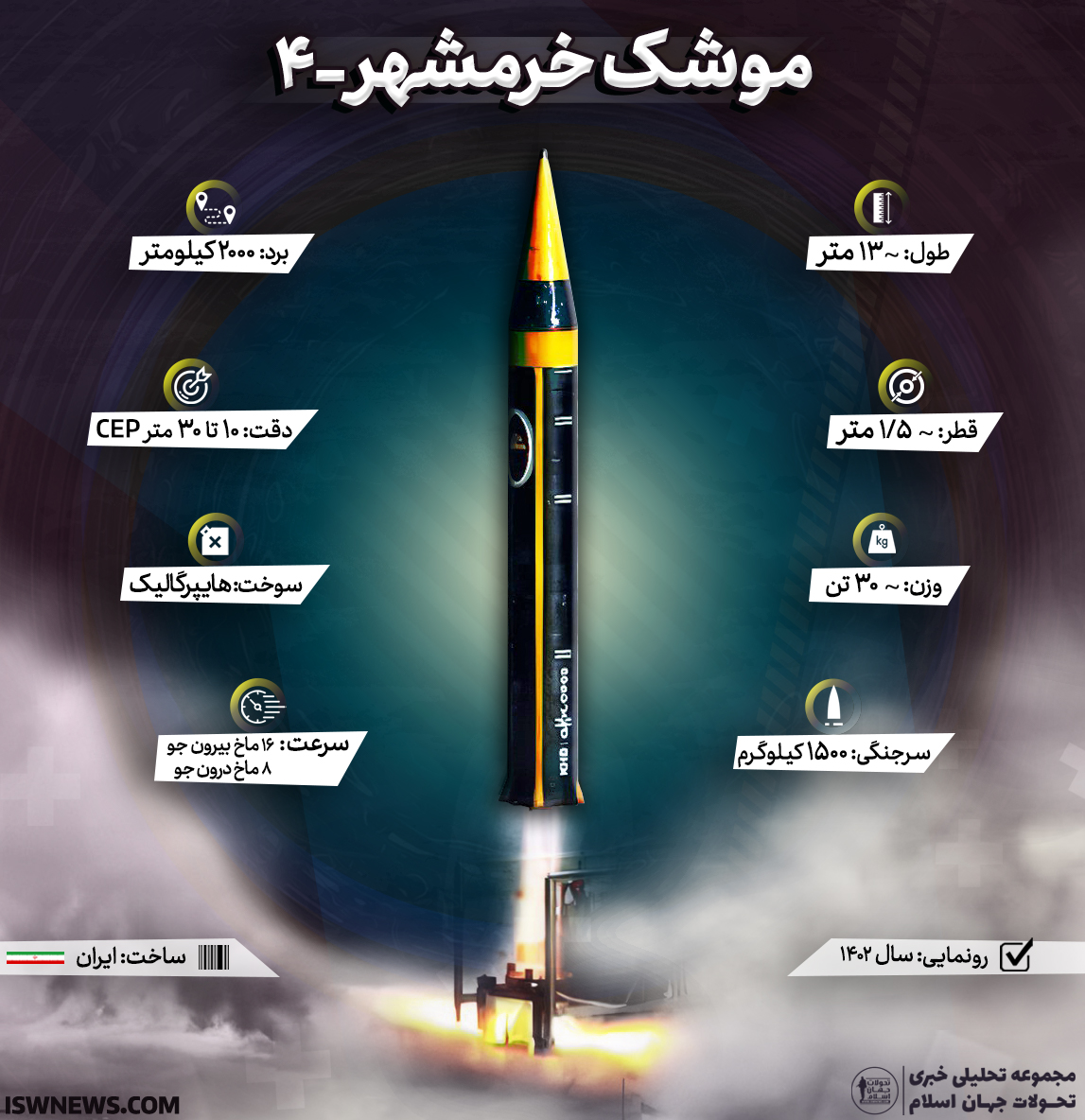
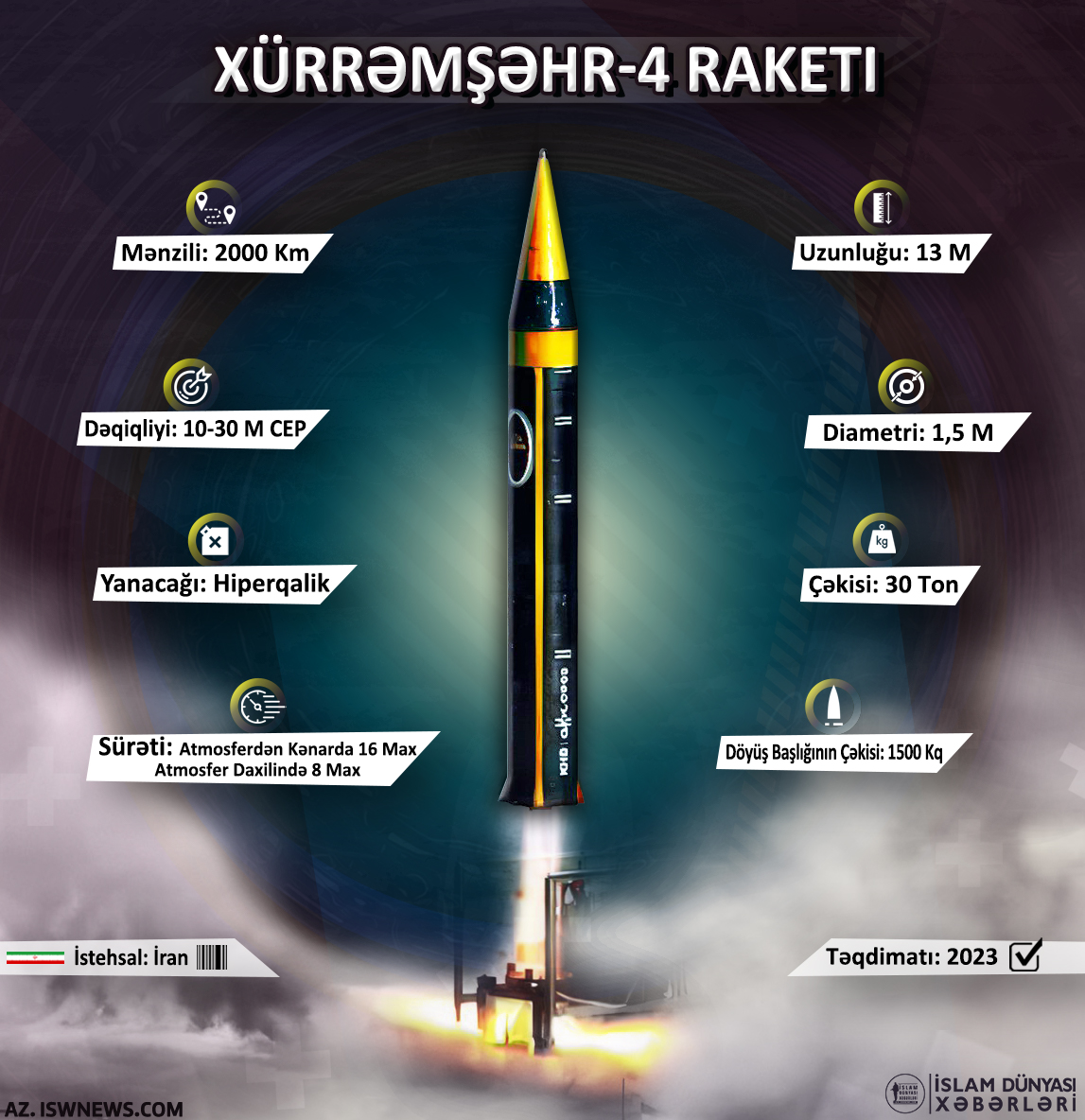
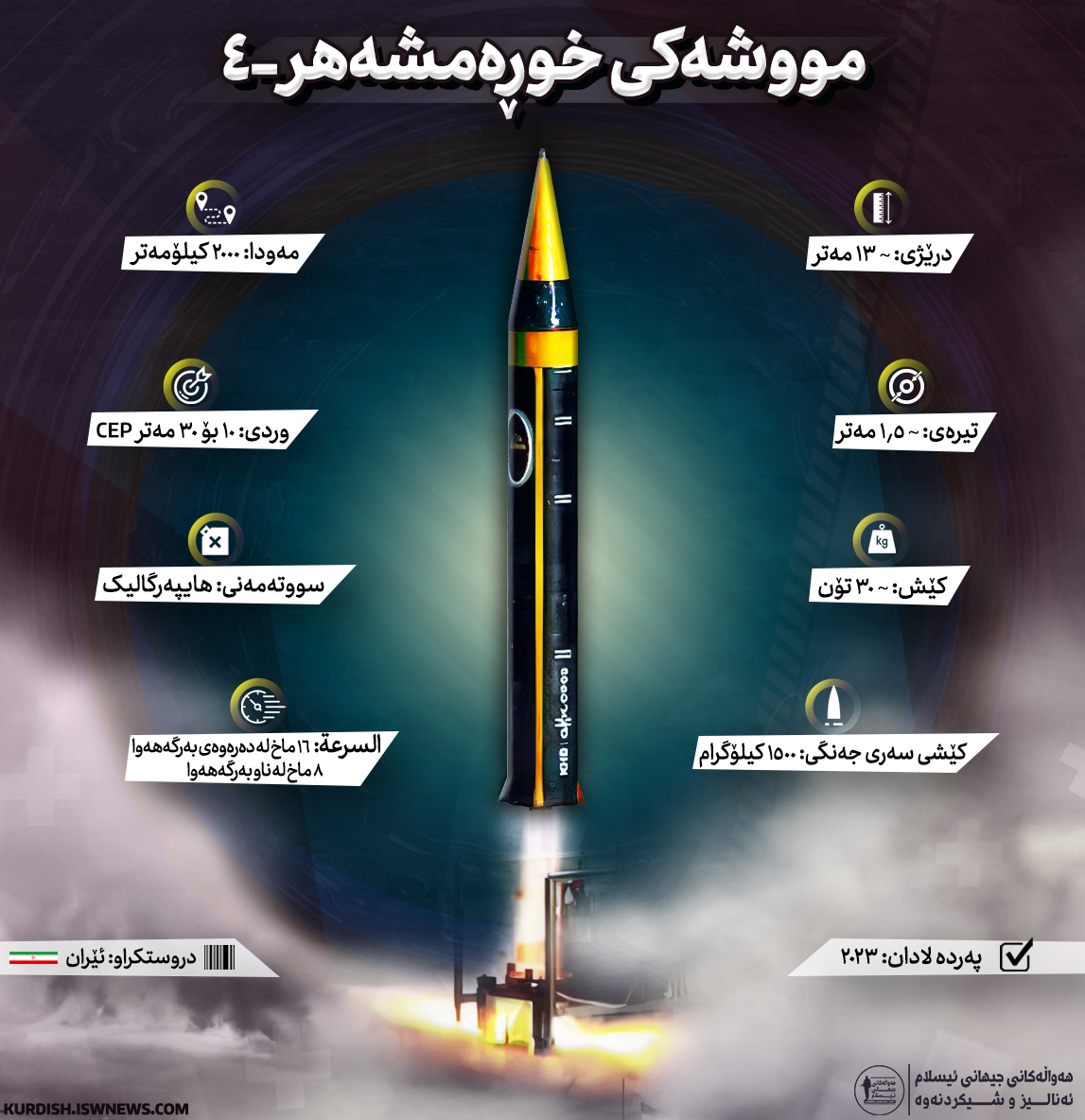
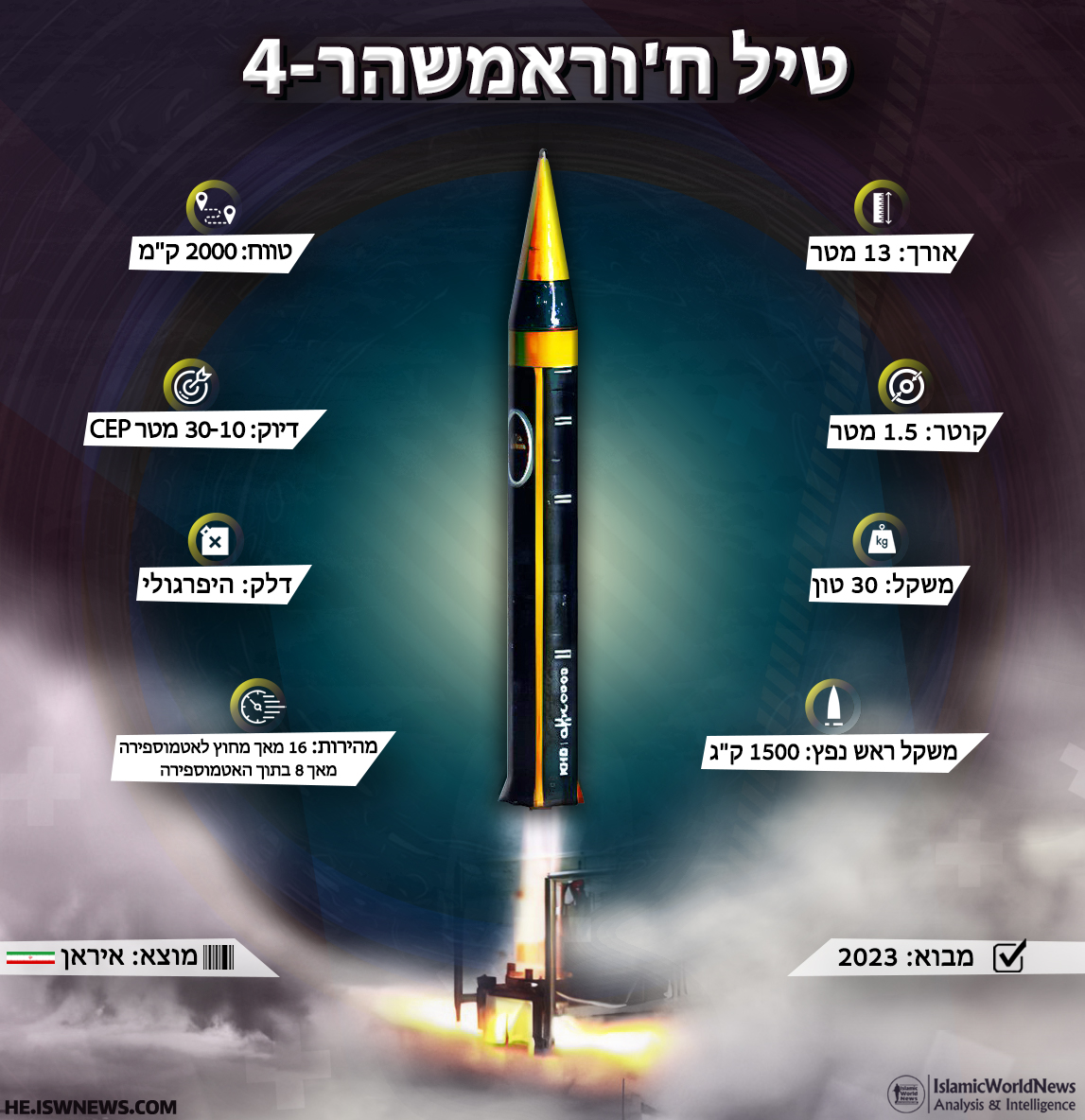
Khorramshahr 4 missile specifications: Length: ~ 13 meters Diameter: ~ 1.5 meters Weight: ~ 30 tons Warhead weight: 1500 kg Range: 2000 km (unofficial range: up to 4000 km) Accuracy: 10 to 30 meters CEP Fuel: Hypergolic – single stage Speed: Mach 16 outside the atmosphere – Mach 8 inside the atmosphere Introduction: May 25, 2023 Origin: Iran
Khorramshahr 4 medium-range ballistic missile – click to view in full size
More iamges of Khorramshahr 4 missile:
Click to view full size
“Khorramshahr 4 (Khaybar) missile” posters collection in Farsi, Russian, Arabic, Azeri, Kurdish and Hebrew:
In light of the decline in resistance strikes in Iraq as well as the increase in attacks on the United States’ forces in Syria, the Americans’ movements have increased in recent months in Iraq because their bases in Iraq are somehow a sort of stronghold for the US military bases in Syria.
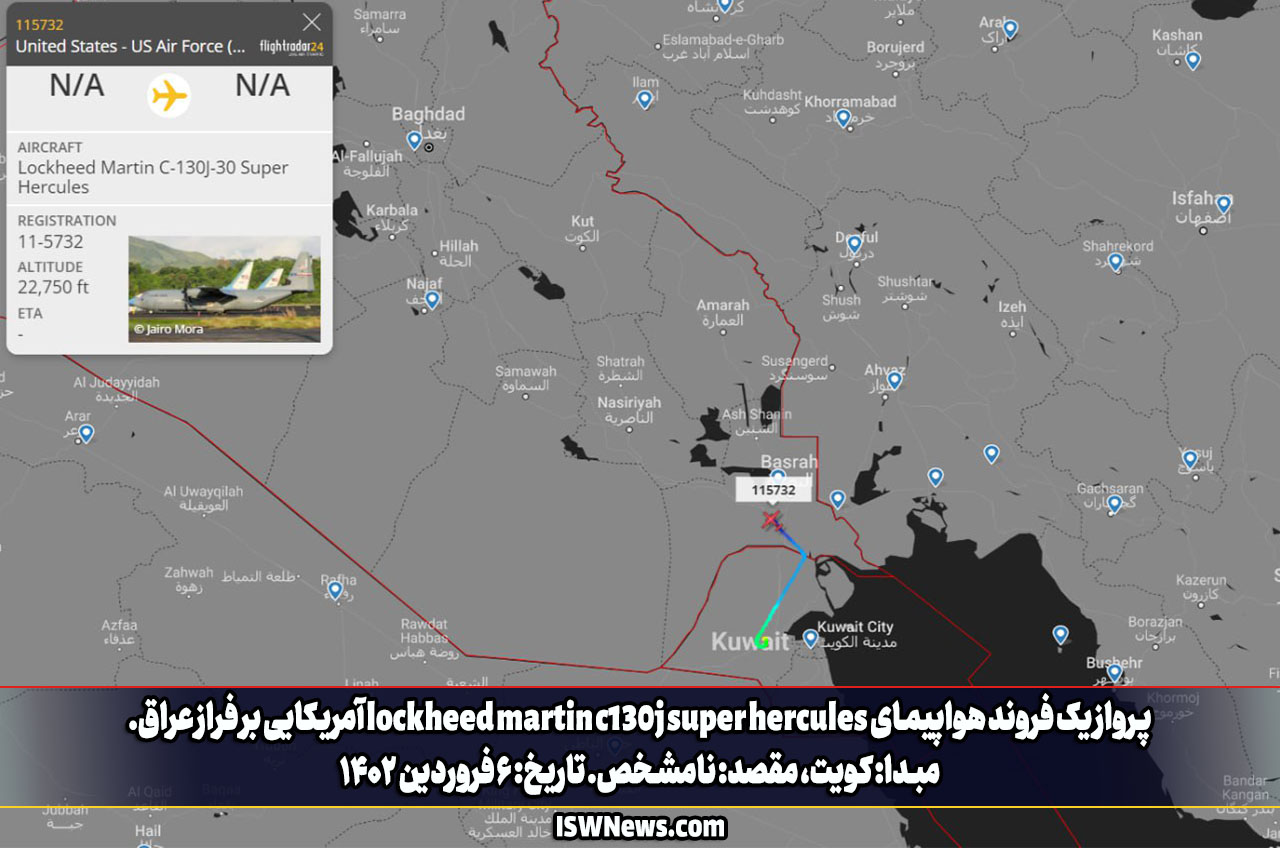
Hence, the US army has transferred a number of its forces and equipment to certain bases in Iraq by aircraft and vehicles, and it has also increased the number of flights of the spy drones over the border areas between Iraq and Syria.
Flights of American aircraft in the border areas of Iraq and Syria. (Click to view full size)
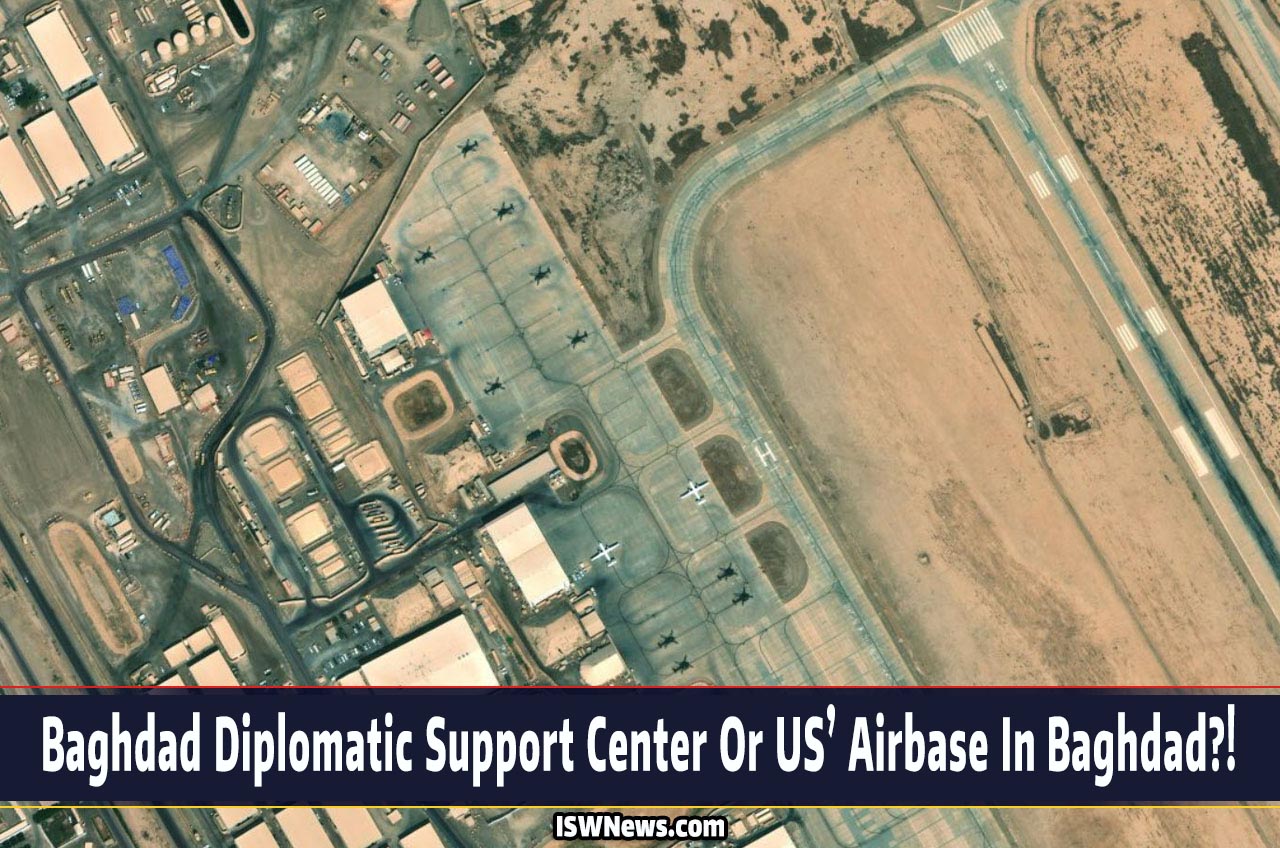
As a result of the surge in military forces and equipment in Iraq, the activity of the Baghdad Diplomatic Support Center (BDSC) increased as well. The Baghdad Diplomatic Support Center is one of the important military bases in the Arab country, which hosts a significant number of helicopters and military aircraft. The 350-hectare center is located at the Baghdad International Airport near the Victory Base Complex. At least 41 agencies and groups as well as a total of 1,600 military personnel are present in the so-called diplomatic center, which is managed by the United States Department of State.
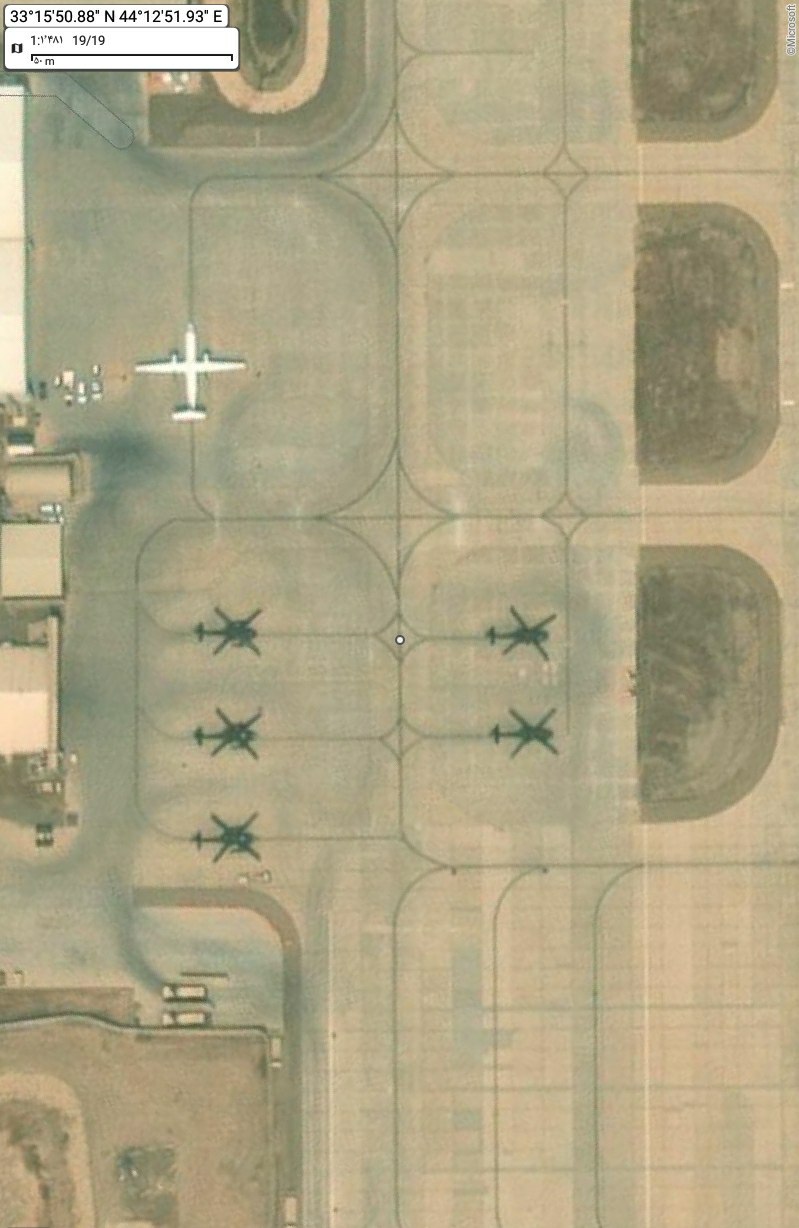
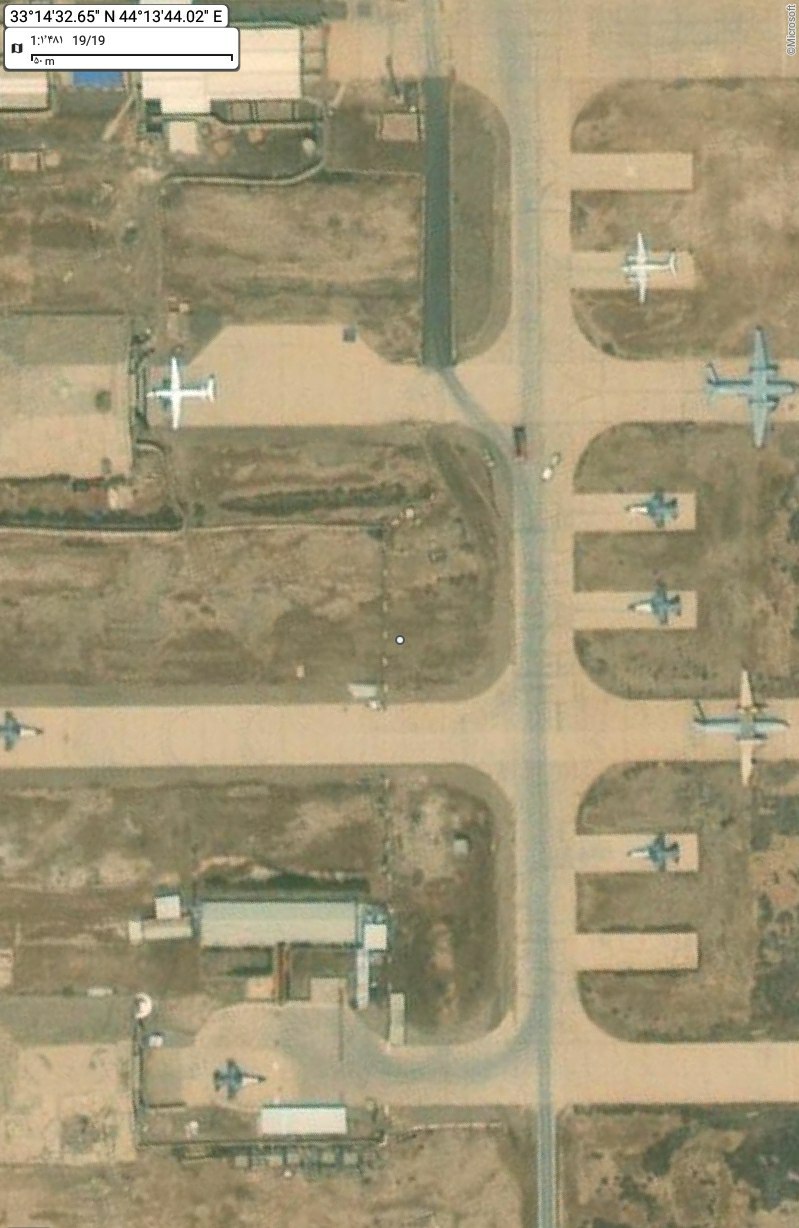
The Satellite images of the BDSC center show that different types of helicopters such as Sikorsky HH-60L Black Hawk and CHINOOK as well as some aircraft such as Beech C-12U-3 Huron and Lockheed C-130 Hercules are stationed at the Baghdad Diplomatic Support Center.
The Americans are conducting their activities in the site under the guise of carrying out diplomatic affairs, but flight observations show that the number of helicopter flights from this air base to the areas of the regional countries and their regions increased in recent months. Observations also show that several military helicopters have flown from the air base to various districts of Baghdad in recent months.
American aircraft activities in Baghdad Diplomatic Support Center (BDSC). (Click to view full size)
Such actions are taking place while many Iraqi people and political factions protest against the presence of the US troops in the Arab country. The activity of the air base, along with other US military bases such as Victory Base Complex in Baghdad Governorate, Al-Harir Air Base in Erbil Governorate, Ayn al-Assad Air Base in Al Anbar Governorate, Al-Taji Air Field and Balad Air base both in Baghdad Governorate, shows the importance of Iraq for the US and indicates Washington’s investment in the Arab country.
The continuation of the military presence and the failure of American soldiers to leave Iraq prompted many people in Iraq to make their voices heard by their officials over the continued presence of the American troops. Some Iraqi analysts and media outlets also published cartoons, memos and various news stories, complaining that the US embassy should deal with political and diplomatic affairs, but it has turned into a large military base in Baghdad, because the Americans deployed heavy military equipment and weapons; so, the personnel of the Baghdad Diplomatic Support Center are engaged in anti-Iraq activities.
However, despite the promises made by the US and Iraqi officials, the presence of the American military forces has not decreased in Iraq in comparison to the past circumstances, but they are still hatching plots and acting against the Arab country and its neighboring states.
Satellite images of Baghdad Diplomatic Support Center (BDSC). (Click to view full size)American aircraft activities in Iraq. (Click to view full size)
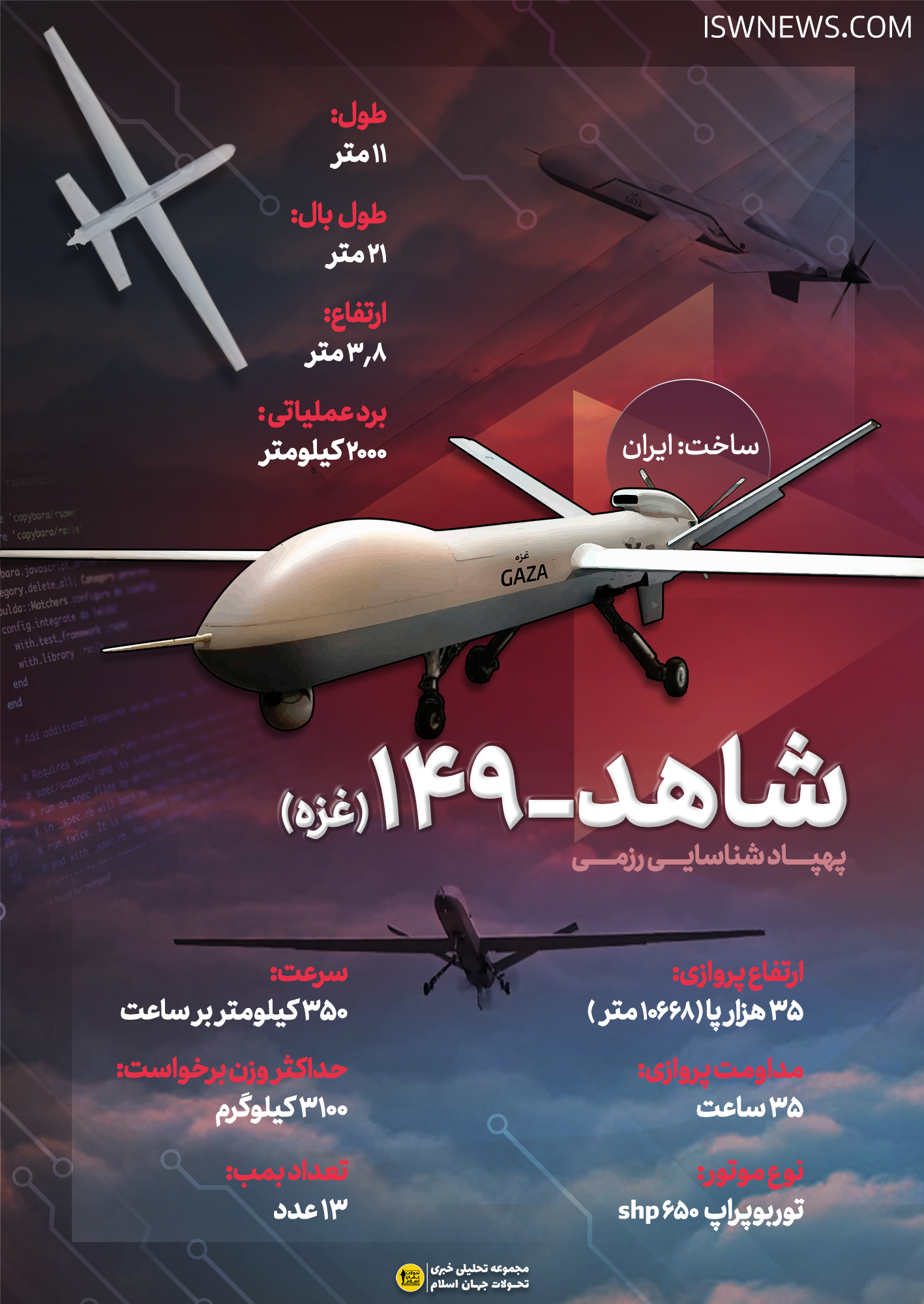
Shahed-149 or Gaza drone is one of the most advanced and largest Iranian drones ever built by the Iranian Armed Forces, and the specifications and equipment used in it show the significant progress of Iran in increasing the country’s capabilities in the field of UAVs.
The Shahed-149 reconnaissance combat drone, capable of carrying 13 bombs and 500 kilograms of equipment, as well as a 35-hour flight duration up to a radius of 2,000 kilometers, and is capable of conducting a variety of combat and intelligence operations and greatly enhances and promotes Iran’s military capability in the region.
This drone is very similar to the US MQ-9 Reaper drone and is compared to this drone in terms of operational level. According to the published images, it seems that Iranian experts have succeeded in building such a drone by using past experiences and studies on American captured drones.
Shahed-149 (Gaza) drone with a wingspan of 21 meters and a length of 11 meters has a speed of about 350 kilometers per hour and its maximum takeoff weight is 3100 kg and is capable of carrying cargo weighing at least 500 kg and its flight altitude is about 35,000 feet. Therefore, due to the large size and heavy weight of this drone, a turboprop engine has been used. This is the first time that a turboprop engine with this power is used on an Iranian drone. Exact information about the power of this engine has not been published yet; But according to the published images and general information of the drone, it seems that the Shahed-149 drone uses a turboprop engine with a nearly 650 shaft horsepower.
Another noteworthy point in this drone is the use of a more advanced electro-optical system than previous drones. This system, which seems to be one of the most advanced Iranian electro-optical systems, in addition to a day-vision camera with a zoom power of at least 100 to 120 times, also has a infrared sensor system, laser designation and laser illumination capabilities. One of the highlights of this system is the use of a catadioptric lens that increase the magnification ability several times and this is the first time that it has been used in Iranian drones.
Shahed-149 Gaza drone electro-optical system
Amir Ali Hajizadeh, Commander of the IRGC Aerospace Force, regarding the weapons capability of the Gaza drone, stated that this drone is capable of carrying 13 bombs. In the published images, a device similar to the rotating bomb system used in bombers is seen. And given the space under the drone’s fuselage, the Gaza drones appears to be using a Rotary Bomb Launcher under its fuselage that can carry up to five bombs. If this is true, this is the first Iranian drone to use this mechanism. Due to this improvement, 5 bombs will be installed inside the bomb bay and 8 bombs will be installed under the wings, and in total, this drone is capable of carrying 13 bombs.
Possible Rotary Bomb Launcher mechanism in the Shahed-149 Gaza drone
Iranian Sadid “Fire-and-Forget” missiles weighing up to 34 kg, 13 of which weigh up to 442 kg, can be one of the types of missiles that can be used in the Gaza reconnaissance combat drone.
Shahed-149 (Gaza) drone specifications: Length: 11 m Wingspan: 21 m Height: 3.8 m Range: 2,000 km Service ceiling: 35,000 ft (10,668 m) Endurance: 35 hours Powerplant: Turboprop ~ 650 shp Speed: 350 km/h Gross weight: 3,100 kg Armament: Up to 13 missiles Origin: Iran
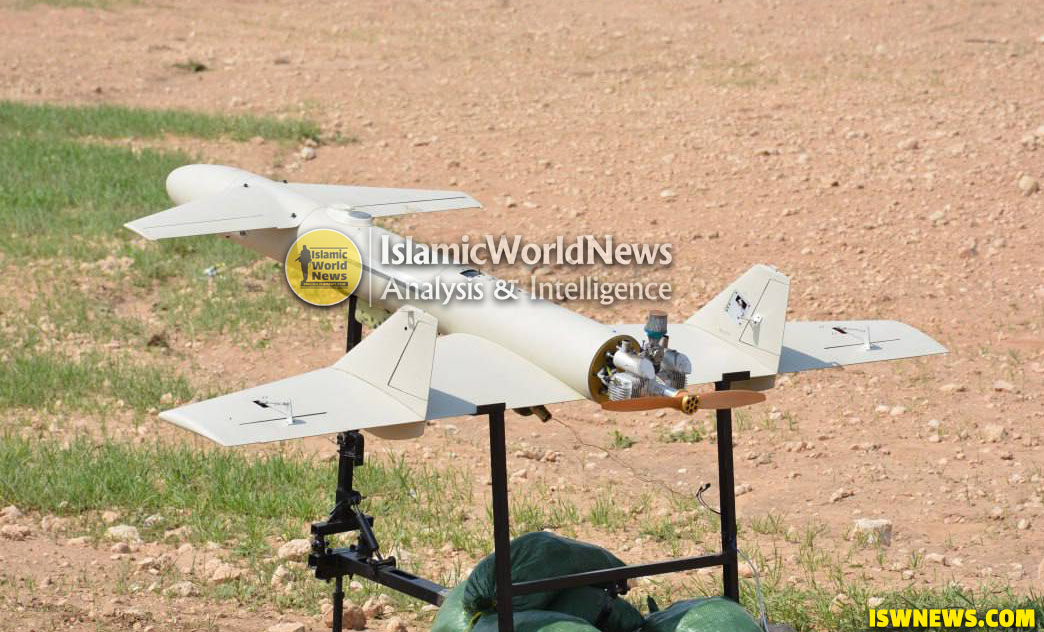
The above picture is related to the drone that the “Liwa Al-Ghalibun Islamic Resistance” group used to attack the US base near the village of Kharab al-Jir. This image has been obtained by “Islamic World News“ for publication.
After the drone attack on Kharab al-Ji base and the US retaliatory strikes on Deir Ezzor, a statement was released by CENTCOM announcing the death of a US contractor. However, informed sources told “Islamic World News“ that three US servicemen were killed and eight others were wounded in this attack. The authenticity of these casualties becomes more believable considering the strong reaction of the US after the drone attack and heavy airstrikes on Deir Ezzor.
It should be noted that this is not the first time that the US Army hides its casualties in the face of the axis of resistance or publishes unreal statistics in its statements.
After the painful drone attack by the Iraqi and Syrian resistance groups on the US occupation base in Syria, a wave of media propaganda by the MSM started against Iran. Ignoring the years of occupation, crimes and massacres of the people of West Asia by the US and its allies, these media point the finger at Iran and accuse Iran of participating in these attacks! These accusations are raised while confronting the US occupation is the natural and legal right of the occupied countries and the oppressed people of these countries, and the US cannot justify its illegal presence in Syria or other parts of West Asia by lying and accusing Iran.
Therefore, this attack was carried out by the will of the people of the region and by independent groups, and the use of Iranian weapons or similar weapons does not necessarily mean Iran’s participation in this attack or other attacks! Just as the US provides various weapons to its allies and their use does not mean direct participation of the US, Iran also provides specific weapons to its allies; And they also use it to defend themselves.
The launching moment of a drone that targeted US base in Syria’s Kharab al-Jir
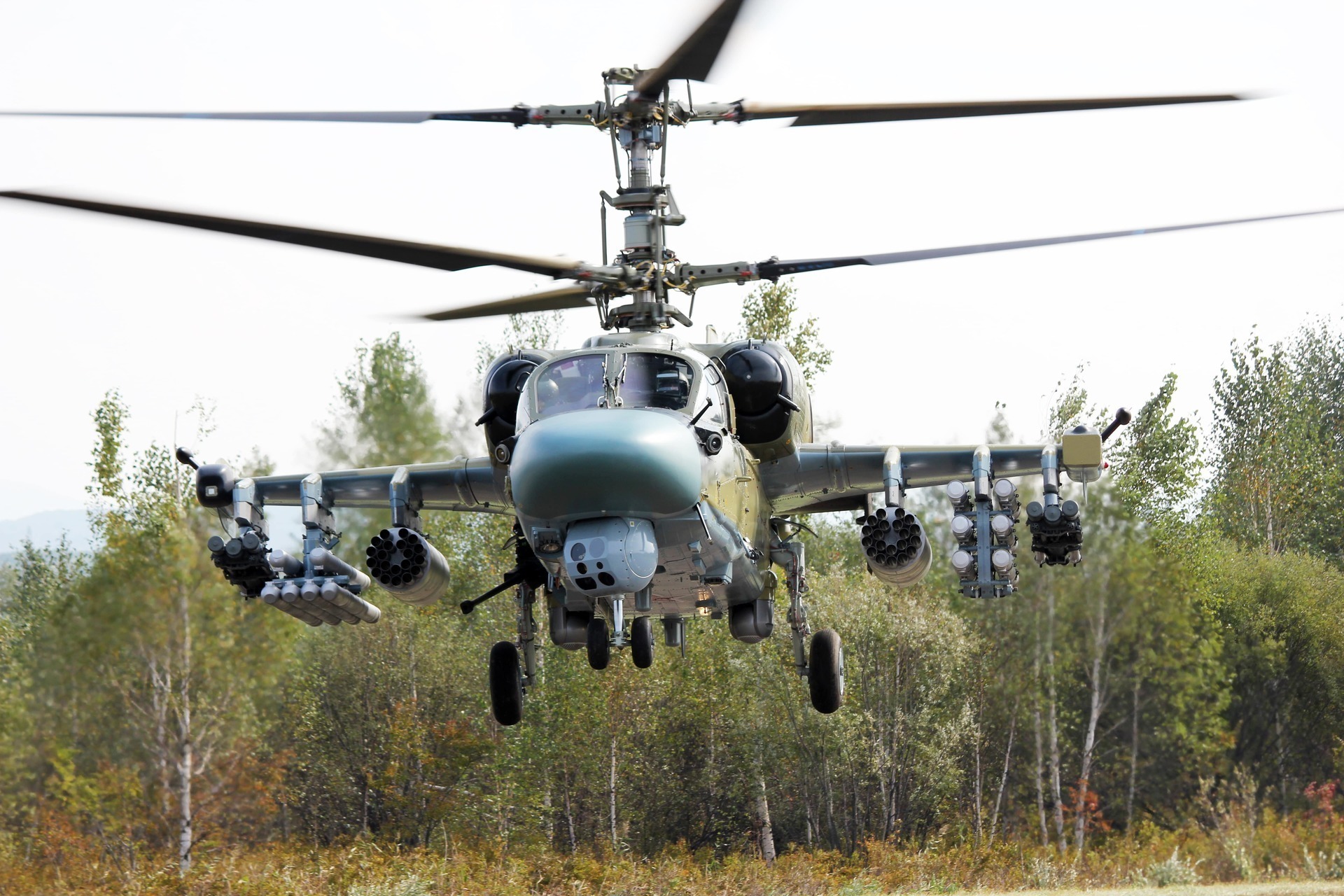
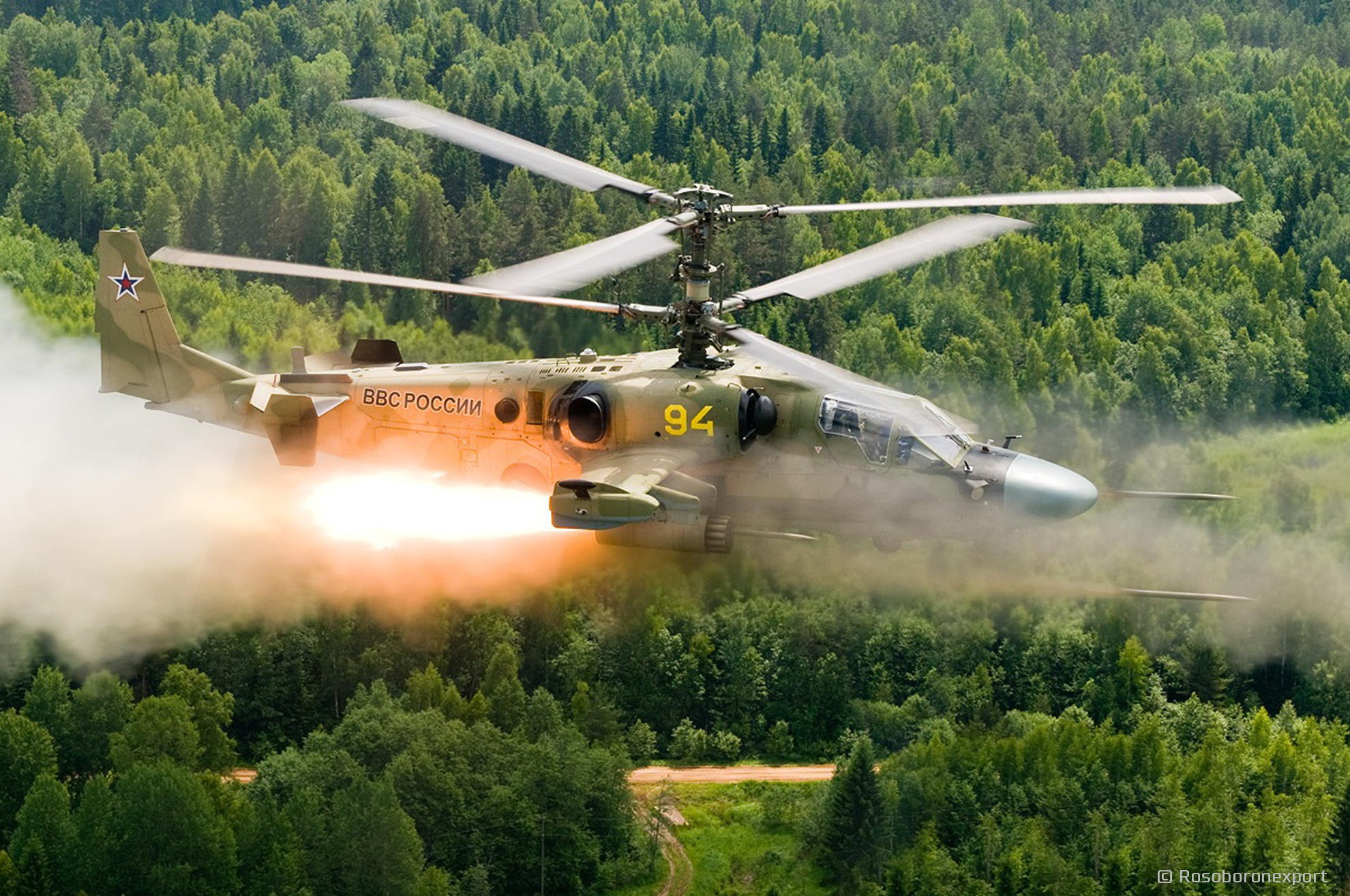
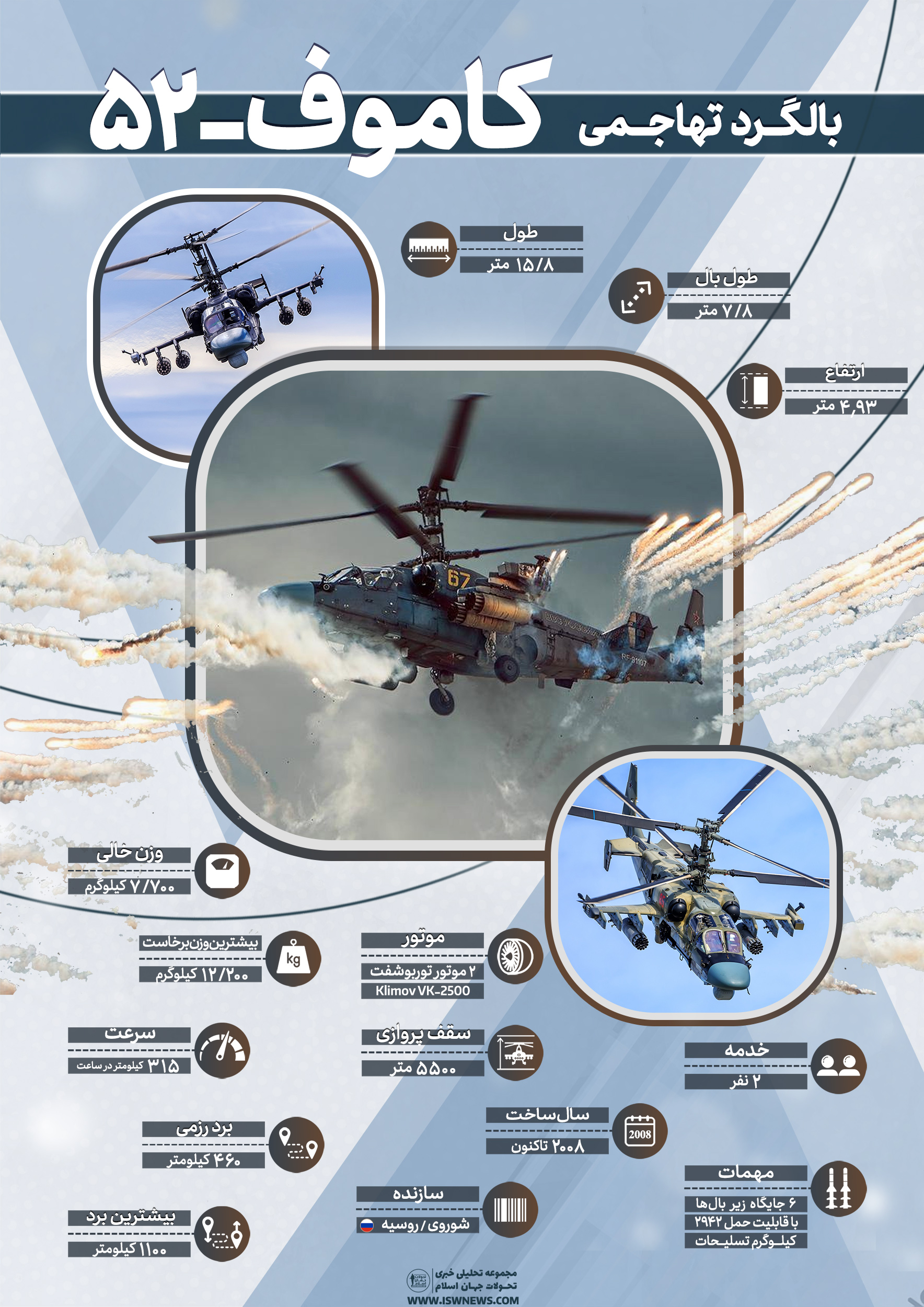
The development of this helicopter started in 1996 and its first flight was successfully completed in June 1997. The serial production of Ka-52 began in 2008 at Progress Arsenyev Aviation plant in the Primorye region of Russia. In December 2010, the Russian Air Force’s 334th Tactical Deployment Centre in Torzhok received three Ka-52s. The twin-seat Ka-52 serves in the air force as a special mission helicopter. The Russian Air Force began fielding Ka-52 helicopters in April 2011. In the same year, Russia’s defence ministry signed a contract with the company to procure 140 Ka-52 helicopters. In February 2018, the Russia’s defence ministry expressed interest in procuring 114 upgraded versions of Ka-52 attack helicopters as part of the new State Armament Programme for 2018–2027.
However, The limited production of this helicopter has caused only 127 units (each unit between 10 and 13 aircraft) of this helicopter to enter service in the Russian air fleet by 2020.
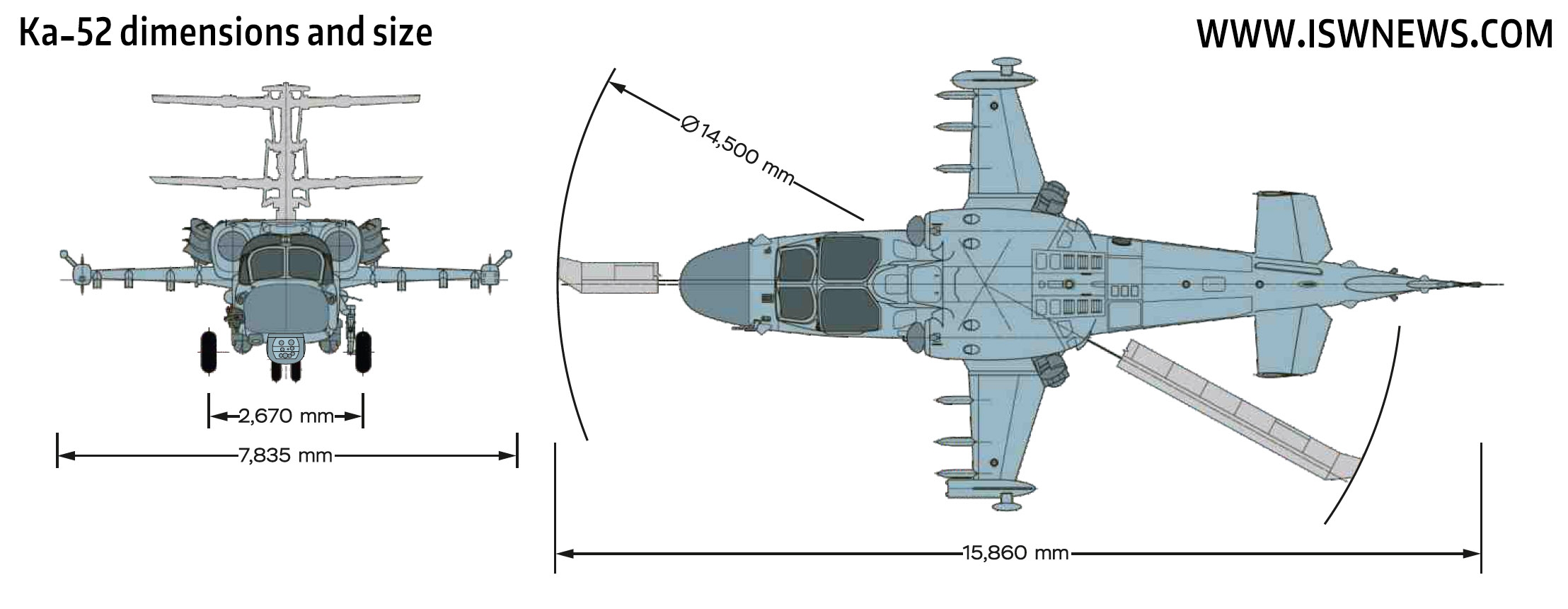
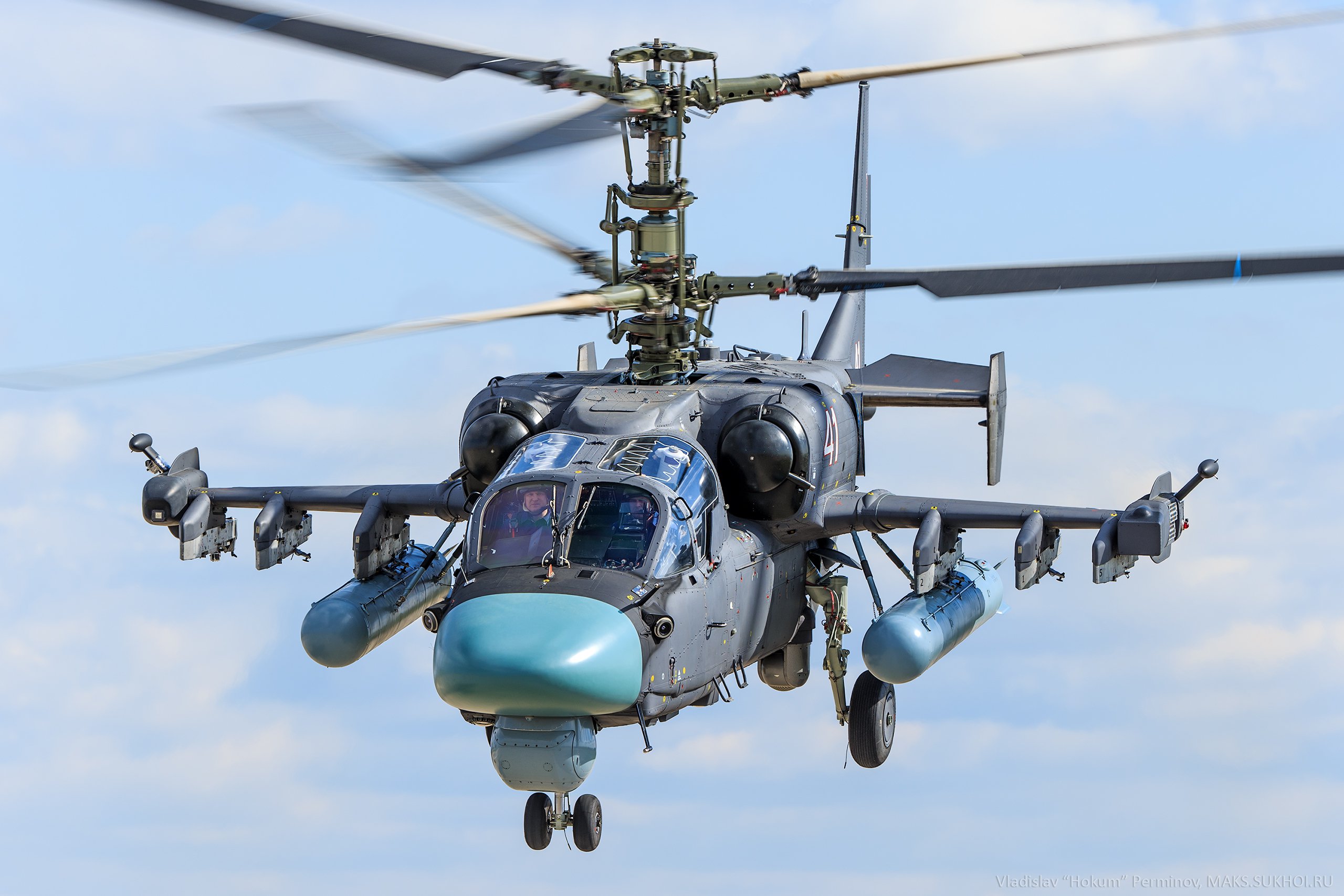
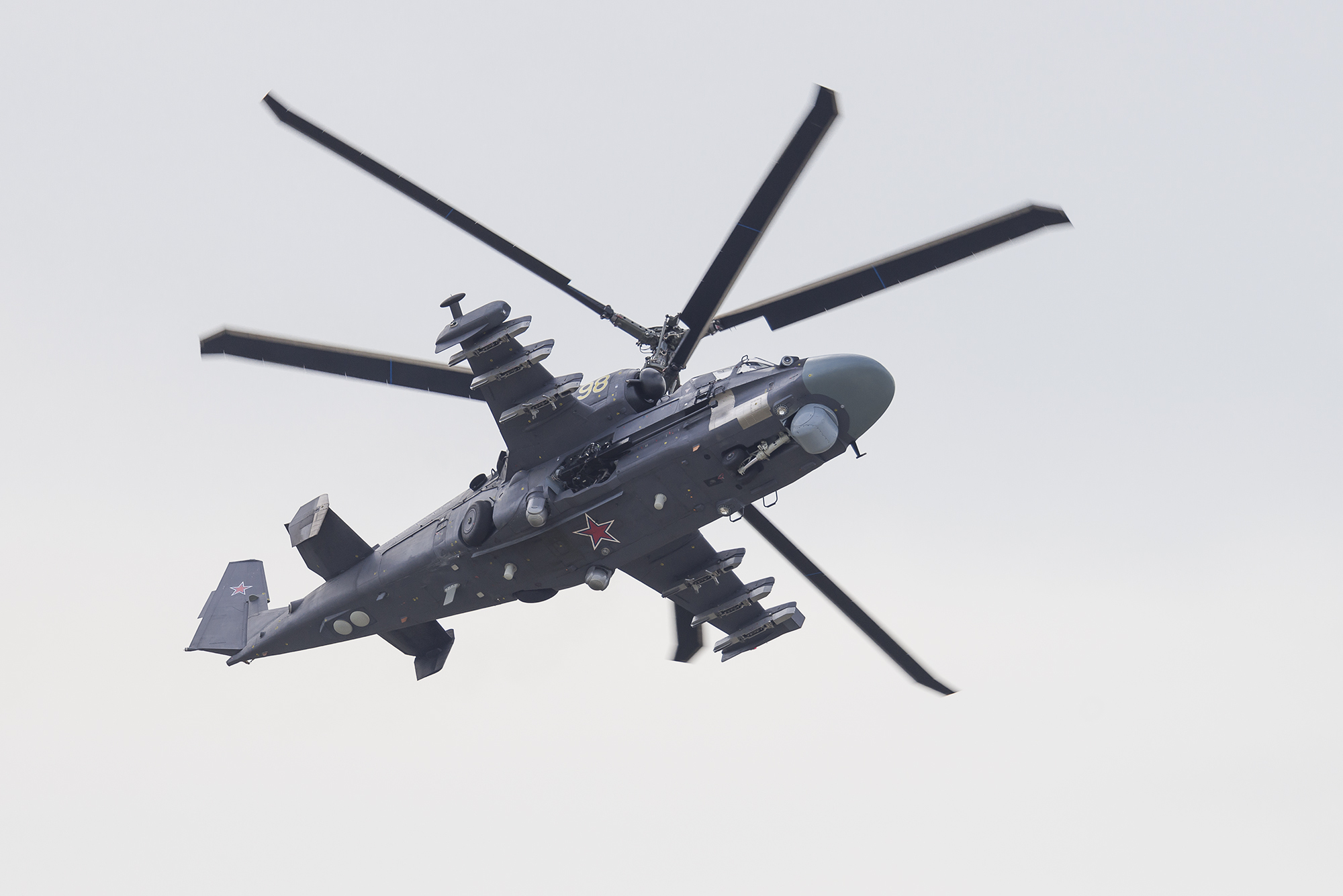
The Ka-52 has a wider nose and an extended fuselage compared to the Ka-50, however, the commonality of the airframe, components and systems of the two variants is about 85%. The Ka-52 attack helicopter has a length of 15.8 meters, height of 4.93 meters and main rotor diameter of 14.5 meters. The maximum take-off weight of the Ka-52 is 12,200 kg.
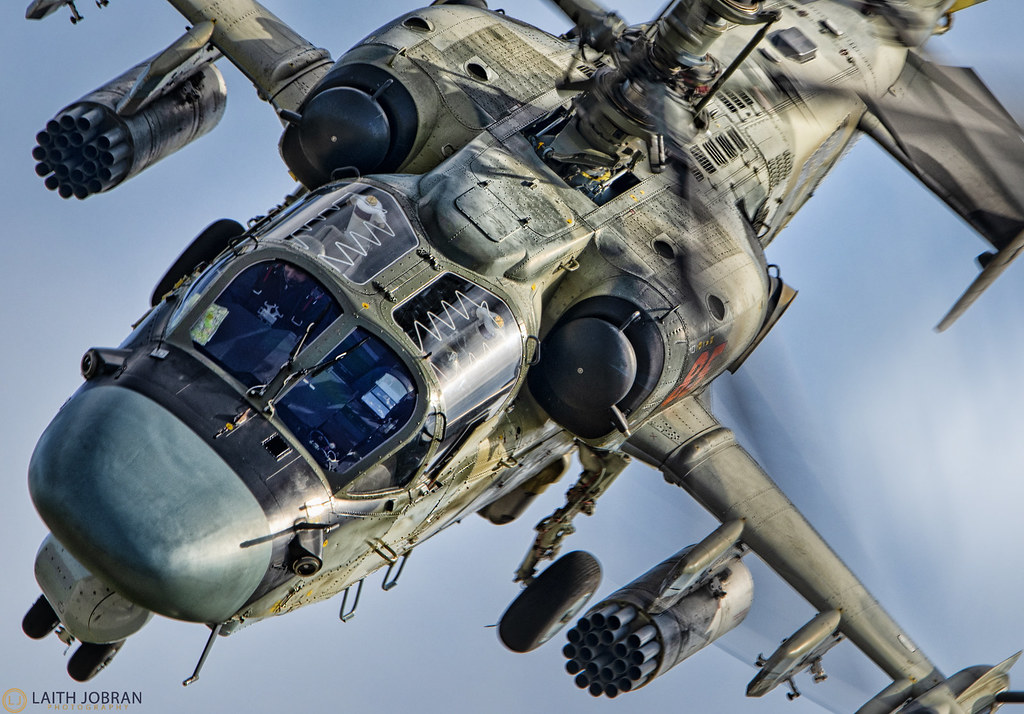
General view of Ka-52 helicopter – click to view in larger size
The Ka-52 helicopter is capable of performing a wide range of missions, such as attacking armored and non-armored vehicles, attacking low-speed air targets, attacking enemy infantry in the front line and in the tactical depth of the enemy, providing fire support for the front line forces and etc. Ka-52 can also be used as a monitoring platform and air command post for a group of attack helicopters.
The Ka-52 helicopter has unique capabilities in terms of maneuverability and agility and is known as one of the most maneuverable helicopters in the world. This high maneuverability is obtained from its coaxial rotors. Coaxial rotors or coax rotors are a pair of helicopter rotors mounted one above the other on concentric shafts, with the same axis of rotation, but turning in opposite directions (contra-rotating), which eliminates the vibration and rotation of the tail; so there is no need for rotors in the tail section. In general, one of the problems with any single set of rotor blades is the torque (rotational force) exerted on the helicopter fuselage in the direction opposite to the rotor blades. This torque causes the fuselage to rotate in the direction opposite to the rotor blades. In single rotor helicopters, the antitorque rotor or tail rotor counteracts the main rotor torque and controls the fuselage rotation. Coaxial rotors solve the problem of main rotor torque by turning each set of rotors in opposite directions.
The use of coaxial system in Ka-50 and Ka-52 has significantly increased the stability and maneuverability of these helicopters; which is very necessary and important for an attack helicopter. High turn speed and fast change of position, performing military maneuvers such as flat turns in the direction of the target, side ways motions at high speeds, which is less seen in heavily armored aircraft, and deep glides of the high pitch angle of up to 30 degrees or 35 degrees are other capabilities of this highly maneuverable helicopter.
Coaxial system in Ka-52 and significant increase of stability and maneuverability
Kamov helicopters have been present in many wars and have shown very good survivability so far. In the Ukraine war, there are cases where the Ka-52 was hit by the enemy but was able to continue on its way, or in many cases where the helicopter was shot down, the helicopter pilots were saved. One of the reasons for the survival of this helicopter on the battlefield is the existence of the coaxial system, which was explained above about how it works. In conventional helicopters, the rotor in the tail section plays a role as a stabilizer, but it is highly vulnerable and in case of a hit, the balance of the helicopter will be lost. Removing the rotor in the tail section of Kamov helicopters and using an coaxial rotor has solved this problem, and if the tail section is damaged, the Kamov helicopter is still able to move. Another reason for Kamov’s survival is the possibility of flying with one engine. If one of the engines is targeted on the battlefield, Ka-52 is able to operate with other engine.
Engine:
The Ka-52 helicopter uses two Klimov VK-2500 turboshaft engines. It is worth noting that this engine is developed from the TV3-117 engine used on the Ka-50 helicopter. The VK-2500 engine has three different types, the first type has 2000 horsepower, the second type has 2200 horsepower, and the third type has 2400 horsepower. There is also another example of this engine known as VK-2500P and it has 2500 horsepower. The interesting thing about these engines is that they have an emergency power mode with a power of 2700 horsepower. This feature is used in case of failure of one of the engines and significantly improves flight safety in emergency situations.
Klimov VK-2500P/PS turboshaft engine
The main difference between the VK-2500 and VK-2500P/PS engine is the use of a modern automatic electronic control system of the FADEC type and anti-overheat protection. Thanks to the new design, the VK-2500P ensures more reliable operation of helicopters in areas with moderate climates and even high temperatures and in high mountains. The existence of two separate gearboxes to transfer the power of each engine is an important factor in the operation of the helicopter in critical conditions. This power transmission system, in addition to the power of 2700 horsepower, is an important factor in the survival and preservation of the lives of the pilots in case of loss of one of the engines. Also, the engines have a filter to prevent dust from entering the engine and have a fire extinguishing system.
Cabin:
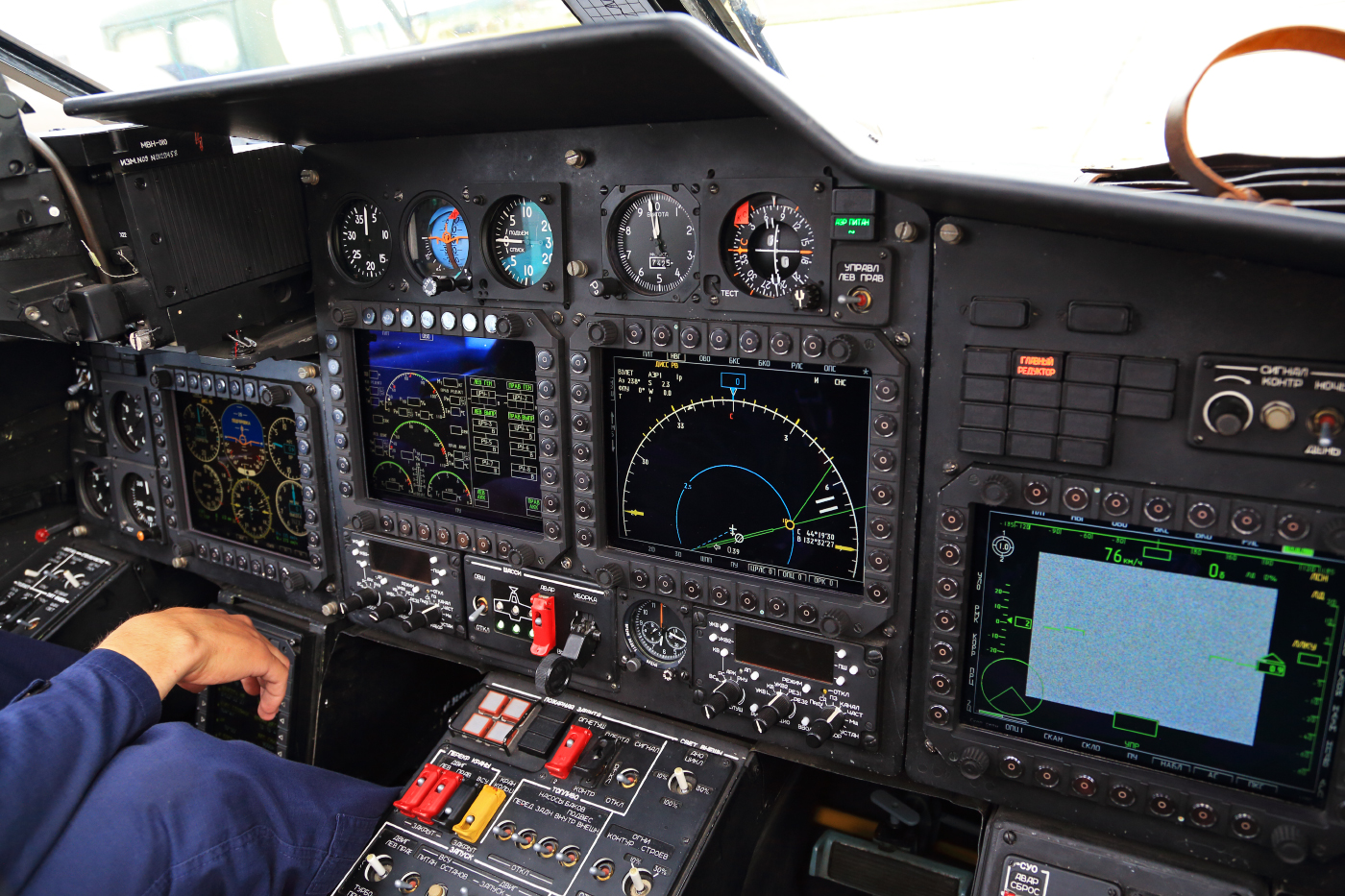
The Ka-52 twin-seat cockpit accommodates two crew members in side-by-side arrangement. Both the crew members are seated on identical K-37-800M ejection seats. The helicopter has a modern bulletproof glass cockpit equipped with a head-up-display (HUD), four SMD 66 multifunction displays, helmet-mounted sight display, image intensifiers and a GPS receiver. The helicopter also integrates a PHAZOTRON cabin desk radio-locator and navigation and attack system for helicopters (NASH).
Ka-52 helicopter cockpit
The SAU-800 automatic control system, created by Radioelectronic Technologies’ facilities in Saratov, enables the Alligator to be piloted in manual, automated and automatic modes. The SAU-800 is integrated with the SIVPV-52 aerometric data recording and processing system developed by Radioelectronic Technologies’ Moscow-based company Aeropribor Voskhod. The SUO-806P weapons control complex for the Ka-52 has been designed and produced by Radioelectronic Technologies’ Kursk-based Aviaavtomatika company.
SUO-806P weapon control system
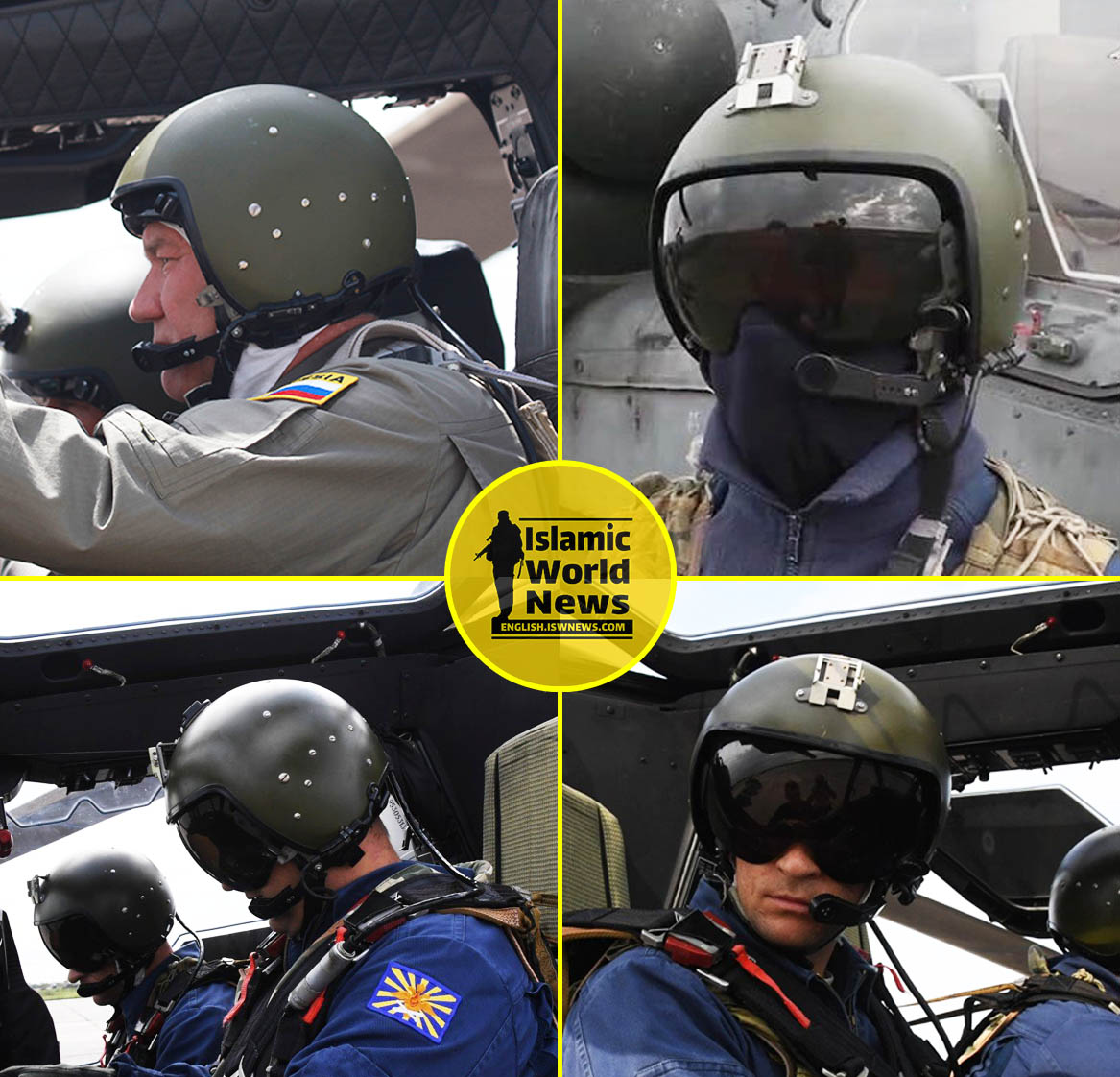
The helmet-mounted display was signed and delivered in a long-term contract with Ramenskoye Design Company (RDC) as part of the avionics equipment required for the Ka-52 attack helicopter and the Ka-52K advanced ship-based variant between 2013 and 2020.
Ka-52 pilot’s helmet
The cockpit of the Ka-52 helicopter is armored and provides good protection for the pilots. The armor of this section is a 3 hardlinered armor; the inner cockpit section made of a full single titanium alloy “bathtub” covering both pilots, followed by a middle liner of ceramic plates, which caused trouble first after a single shot they break apart and lost all its protective abilities, they avoided that by covering this ceramic plates with kevlar/aramid that was glued on tightened and the outer liner which gives the aerodynamic shape and is made of aluminium alloy with a part carbon in it. Also, to further protect the cabin, in addition to the 44 mm bulletproof glass, two armored plates have been used in the side of the cabin next to the pilots.
Ka-52 armor and protective armored plates
The outer part of the cabin and the bottom of the fuel tanks are also made of aluminum and carbon alloy with a thickness of 20 mm. The total amount of armor that could be installed for each pilot of the Ka-50 helicopter is about 300 kg. For the Ka-52 helicopter, this number has been reduced to 150-200 kg per pilot. This is despite the fact that about 90 kg of armor is used for each pilot in the American Apache helicopter. Ka-52 armor is (at least theoretically) resistant to 23 mm bullets.
Ka-52 body close-up – click to view in larger size
The helicopter has four separate fuel tanks, three in the rear and one just behind the cockpit. All four fuel tanks are plated and separate from each other.
Quadruple fuel tanks in Ka-52
As mentioned, the Ka-52 has 85% of the same parts as the Ka-50. But in terms of appearance, it has a wider nose and in the cabin, two pilots sit next to each other. Both pilots are able to fully control the helicopter; Such an arrangement simplifies the operation of the helicopter during the battle. Also, there is no need for a dedicated training version for this helicopter and it is possible to use this helicopter as a training helicopter.
Ejection seats and eject system:
Another unique feature of this helicopter is being equipped with ejection seats. The Ka-52 helicopter, along with the Ka-50, are the only active helicopters in the world that have this capability. The Ka-52 CAS K-37-800M ejection seats consists of two parts, an armchair and a side part, designed to perform the functions of the pilot’s seat of the Ka-50 and Ka-52 helicopter and providing in combination with the ZSh-7VS helmet and oxygen equipment of the KCO-VK-LP safe emergency exit by bailout with the help of a towing rocket engine at an indicated flight speed from 90 to 350 km/h in the altitude range from 0 to 5000 m and reducing the loads acting on the pilot during an emergency landing using the energy-absorbing cushioning suspension of the chair.
How the ejection seats work in Ka-52CAS K-37-800M ejection seats and eject rocket in Ka-52
Radar:
The Ka-52 helicopter is fitted with a mast-mounted radome nose mounted housing a Phazotron FH-01 Millimeter Wave Radar (MMW), known as the Arbalet radar with two antennas for aerial and ground targets. This radar is manufactured by Phazotron-NIIR, Russia’s largest developer of military and avionics radars.
Arbalet radar on Ka-52 nose
The Ka-52 radar is an Arbalet-52 dual-band pulse doppler radar weighing 140 kg, which allows the helicopter to effectively carry out combat missions at any time of day or night in all weather conditions, even in the presence of organized or natural electronic jamming. The maximum range of the Arbalet-52 radar is 37 km. In general, Ka-52 uses two radars, Arbalet-52 or Arbalet-M, which are more powerful versions of the Arbalet radar and use the Baguet series processor. In this radar, Ts181F processor is responsible for data processing and Baget-55-04.01 processor is responsible for signal processing.
Phazotron FH-01 radar known as Arbalet radar in Ka-52
The air-to-surface capabilities of this radar include various mapping modes, mapping range up to 32 km, azimuth coverage of 120°, the ability to detect ground targets such as bridges at 25 km and tanks at 12 km, the ability to detect ground-based obstacles and terrain detection/avoidance- Electricity cables at 400 meters and the ground with a slope of 10 degrees at 1.5 km, the ability to detect moving target selection of ground and air targets, determination of priority of objects, missile approach warning, support/cueing of EO targeting systems, detection of dangerous weather conditions, nvigation systems update and correction, missile and rocket control, target type classification (in conjunction with IFF) and tracking of 20 targets simultaneously.
The air-to-air capabilities of this radar include the azimuth coverage of 360° with elevation ±30°, the tracking limits with azimuth of ±60° with elevation±30°, the ability to detect hostile aircraft at a range of 15 km and a Stinger missile at a range of 5 km, the ability to engage with a variety of targets such as cruise and drones, the ability to track up to 20 targets.
Observation and electro-optical system section:
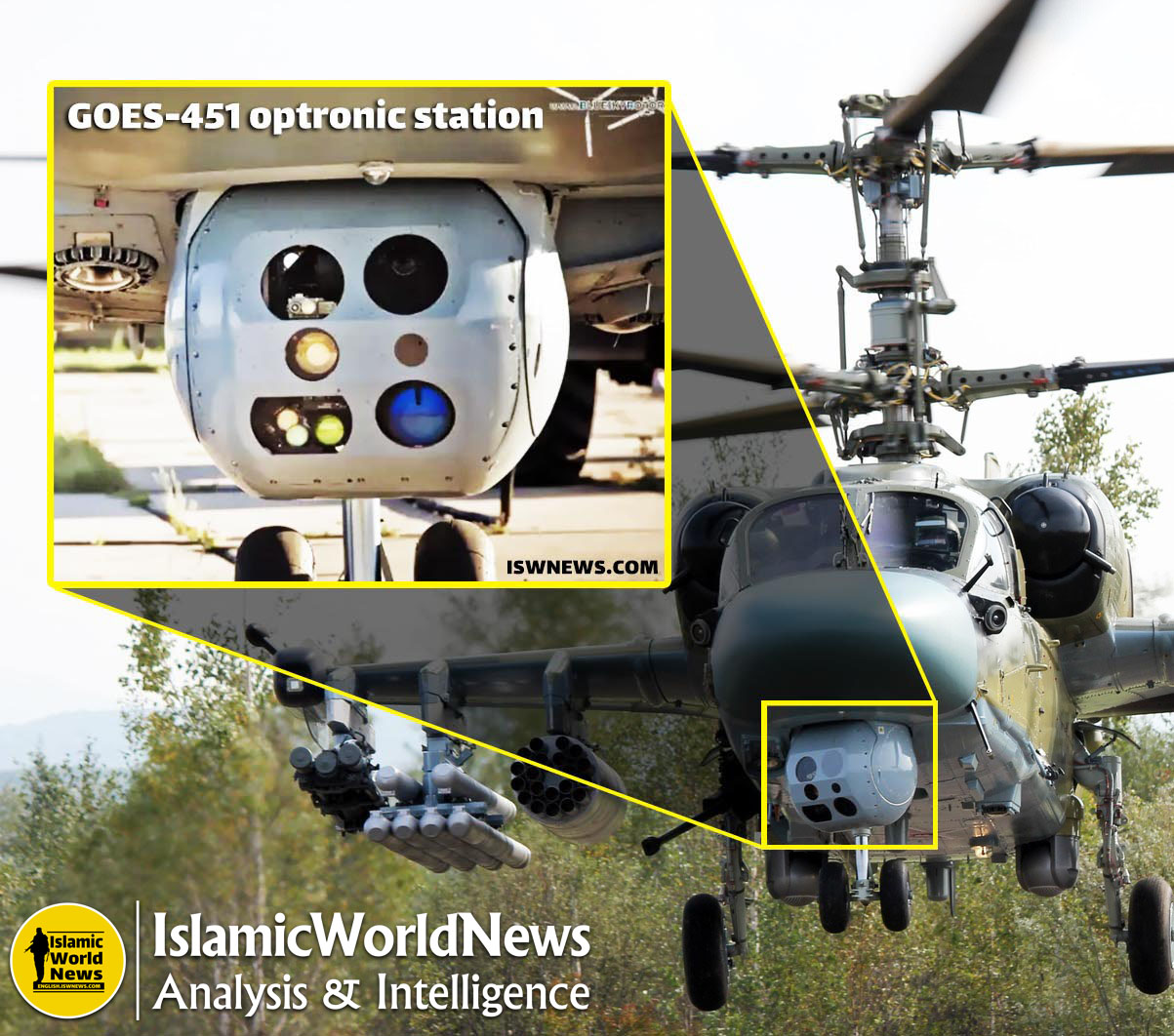
In terms of observation and electro-optical system, Ka-52 is equipped with GOES-451 optical system. The GOES-451 system is gyro-stabilized optronic station designed to provide detection, targeting and missile guidance for the Ka-52 attack helicopter. The GOES-451 sensor package includes visible and infrared cameras, laser rangefinder and laser designator.
GOES-451 visible camera has a maximum range of 83.3 km, infrared range of 55.6 km, laser range finder with a range of 18.5 km and laser point designator with a range of 14.8 km.
GOES-451 electro-optical system
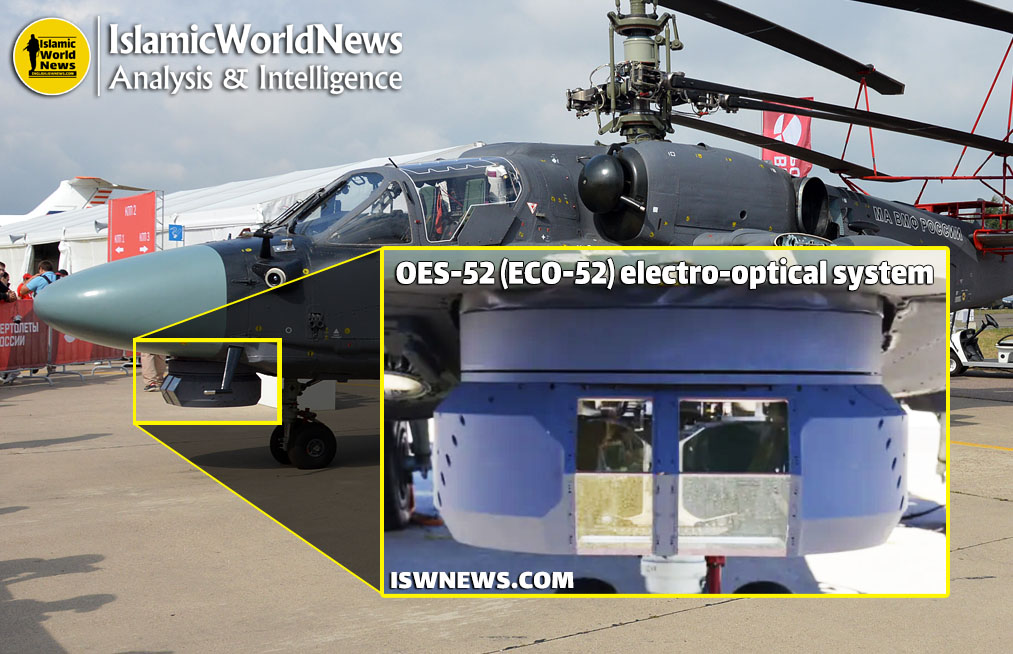
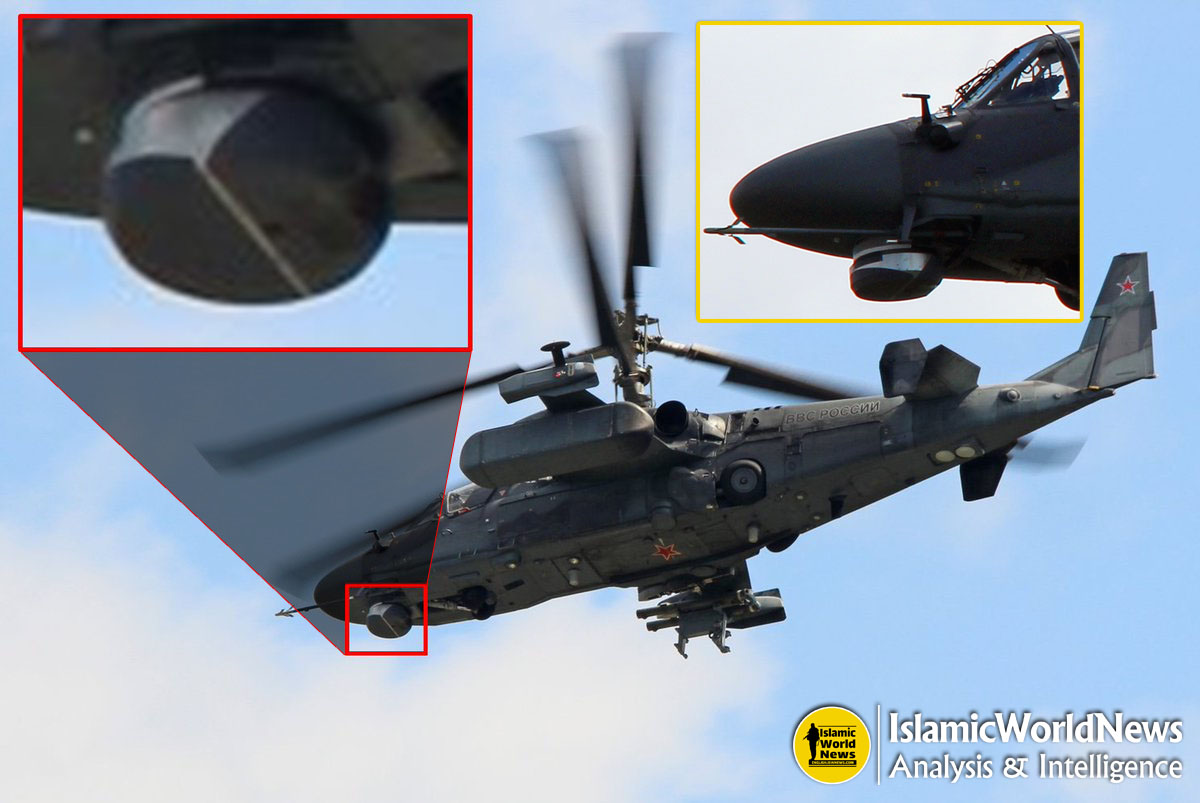
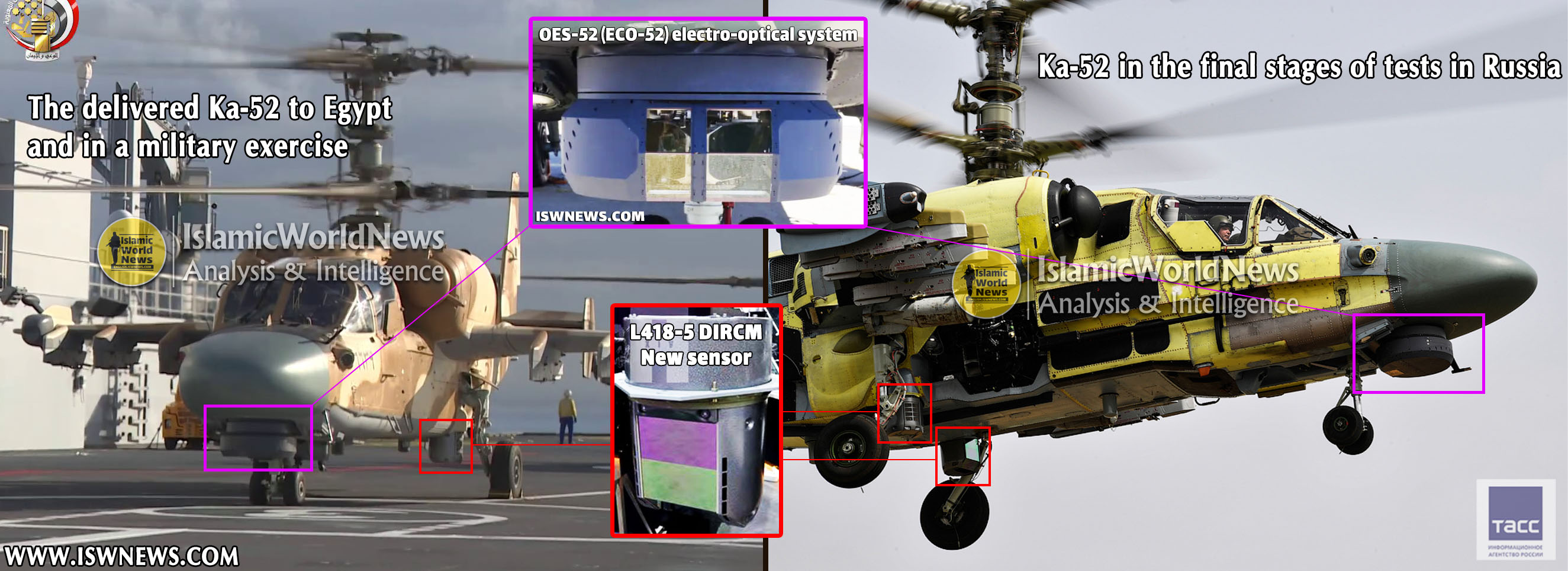
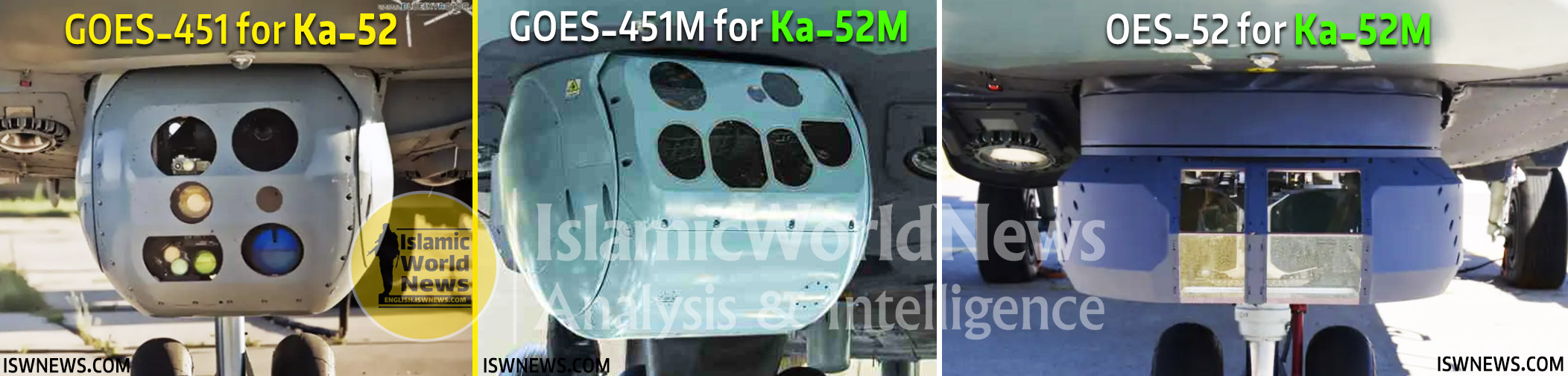
It should be noted that a version of the Ka-52 Katran (Marine version of the Ka-52) was displayed at the MAKS 2015 exhibition, which used the OES-52 (ECO-52) electro-optical system instead of the GOES-451 electro-optical system. Also, in 2016, another version of the Ka-52 was seen in the sky of Moscow, which was equipped with the OES-52 electro-optical system. It was later revealed that the OES-52 electro-optical system will be used for the Ka-52M helicopters, which are a more powerful and updated version of the Ka-52. Nevertheless, the possibility of installing this system on older and current Ka-52 versions is expected. Also, the export versions sold to Egypt, namely the Ka-52 Nile Crocodile (Ka-52E) are equipped with the OES-52 electro-optical system.
The OES-52 system is functionally similar to the GOES-451 system. The OES-52 developed by Moscow-based NPK SPP and houses five sensors: a thermal imaging camera, TV camera, laser rangefinder/designator, laser beam riding for anti-tank guided missiles, as well as a laser spot tracker. However, the weight of this system is 177 kg, which is 43 kg lighter compared to the GOES-451 system, which is 220 kg.
OES-52 electro-optical system on Ka-52 Katran in MAKS exhibition 2015Ka-52 equipped with OES-52 system in the sky of Moscow
Protection system and electronic warfare:
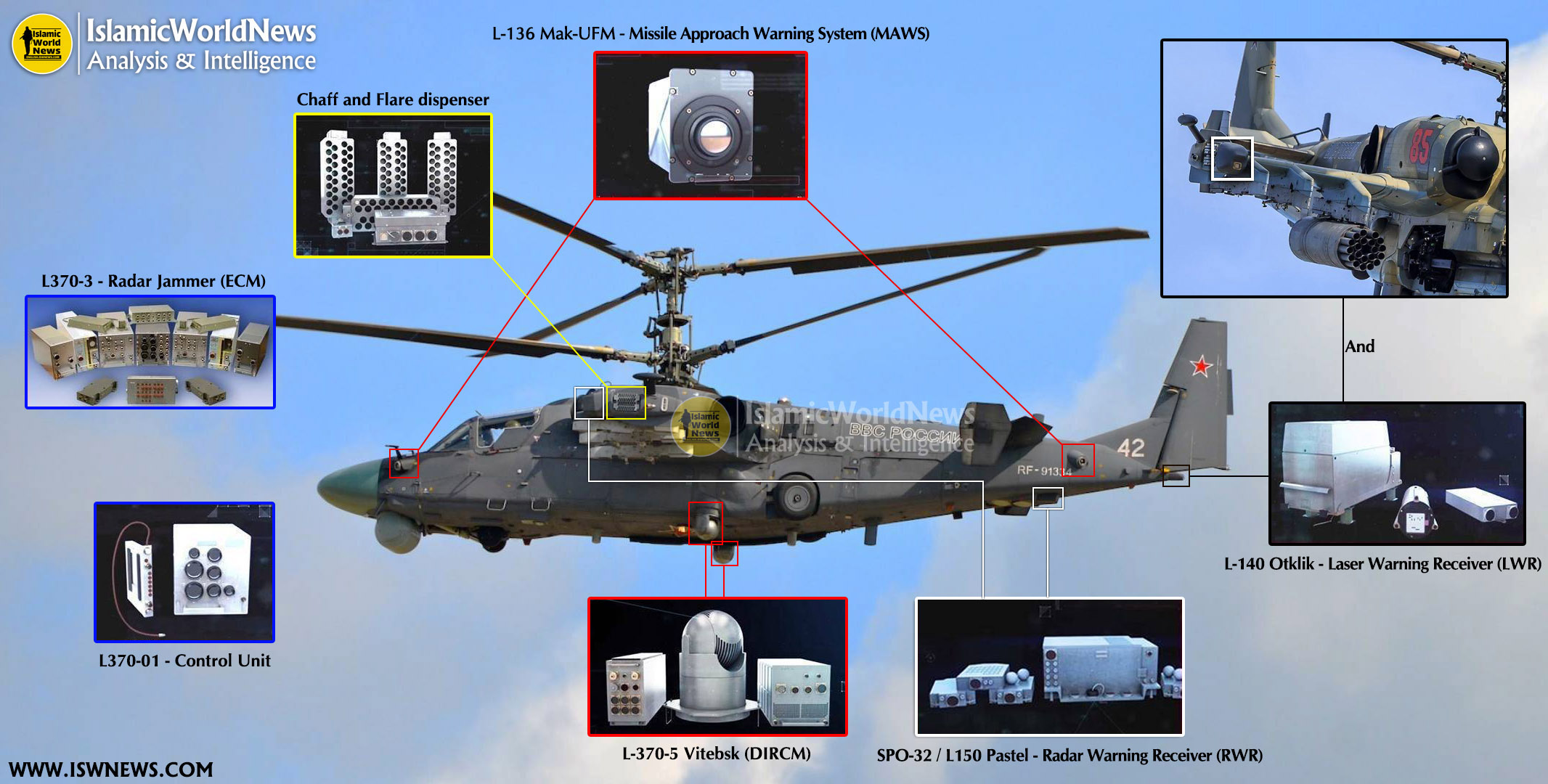
In terms of protection systems and electronic warfare, the Ka-52 is equipped with the President-S integrated protection system. The President-S system is made by KRET and Ekran Scientific Institute and includes a set of various countermeasures such as active IR and electronic jammers, radar warning receiver (RWR), laser detection system, IR missile approach warning sensor, etc. Next, we will introduce the President-S system components :
Components of the President-S integrated protection system on the Ka-52
– “L370-0 control unit” is a digital computer module which is responsible for managing the entire electronic warfare package, as it receives all data from the warning sensors deployed on the helicopter’s structure and says it is integrated, analyzed and presented to the pilot to take defensive countermeasures.
– “L-136 MAK-UFM missile approach warning (MAWS) system” as its name suggests, is a system that detects and warns the approach of missiles fired at the helicopter. This system can detect shoulder-launched missiles such as the Stinger and Igla from a distance of 10 km, and air-to-air missiles launched from aircraft such as the Sidewinder and the R-73 from a distance of 30 km to 50 km.
L-136 MAK-UFM warning system, two in the front and two in the back of the helicopter
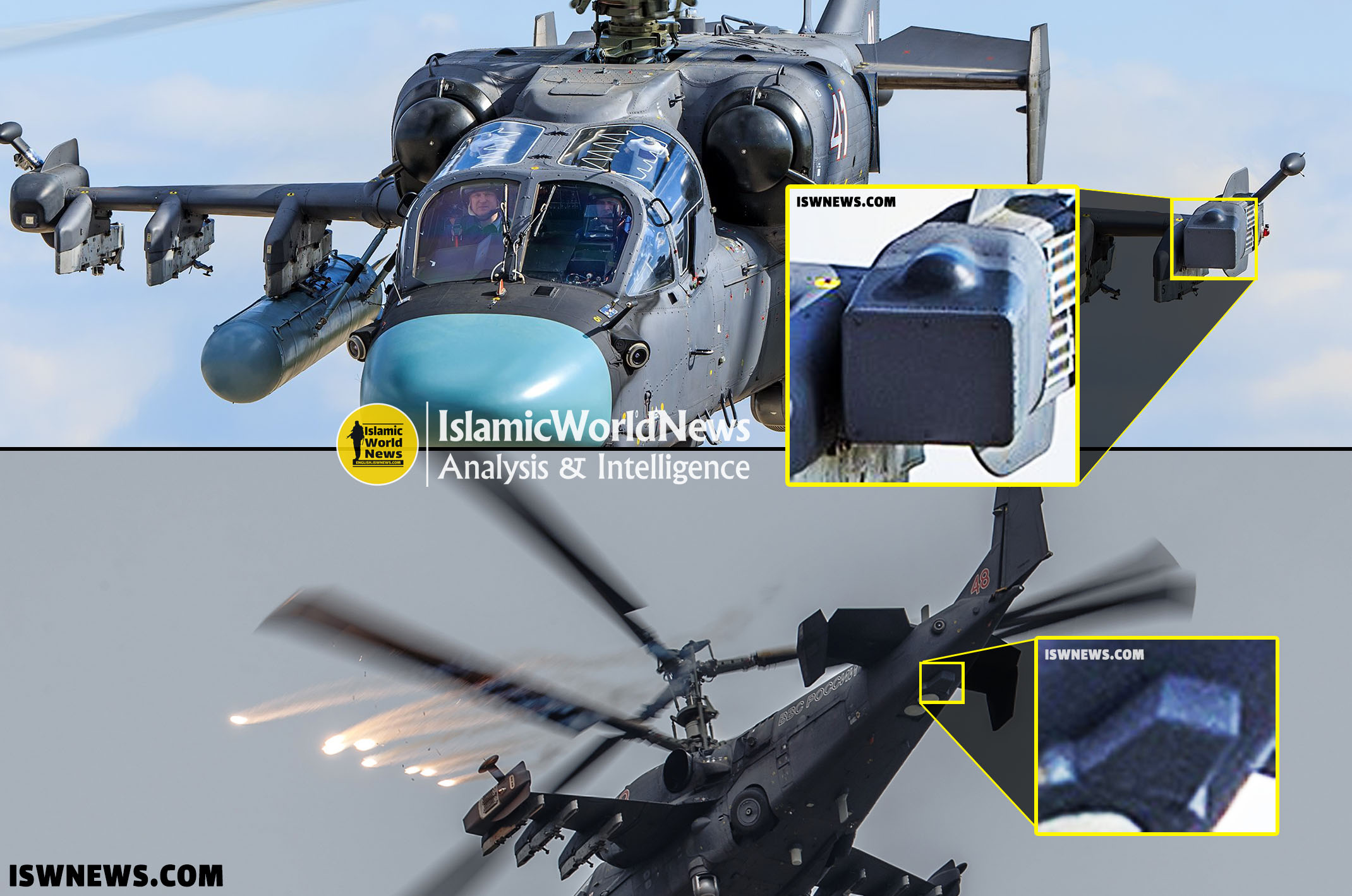
– “L-140 Otkilk laser warning receiver (LWR) system” is specialized in intercepting and monitoring laser beams emitted from distance measuring devices for anti-aircraft missile guidance systems, and provides integrated protection at an angle of 90° horizontally and 360° vertically.
L-140 Otkilk system on the right wing tip and in the rear at the very end of the helicopter
– “SPO-32 / L150 Pastel radar warning receiver (RWR) system” is a system that detects and receives radio waves emitted by enemy aircraft radar systems, and if a threat is detected, such as the presence of a fighter jet’s fire control radar or a missile launcher’s radar seeker, issues a warning about the existence of a threat. This system has a range equivalent to 222.2 km.
The SPO-32 / L150 Pastel system on the left wingtip and lower end of the helicopter
– “L370-3 radar jammer or electronic countermeasures (ECM) system” are systems installed inside the Kamov-52 helicopter and their task is to perform a wide range of jamming measures against surface-to-air, air-to-air missile search radars, etc. This system works in integration with the L150 Pastel system. The L150 Pastel system is responsible for intercepting radar waves and determining their source and the L370-3 jams them.
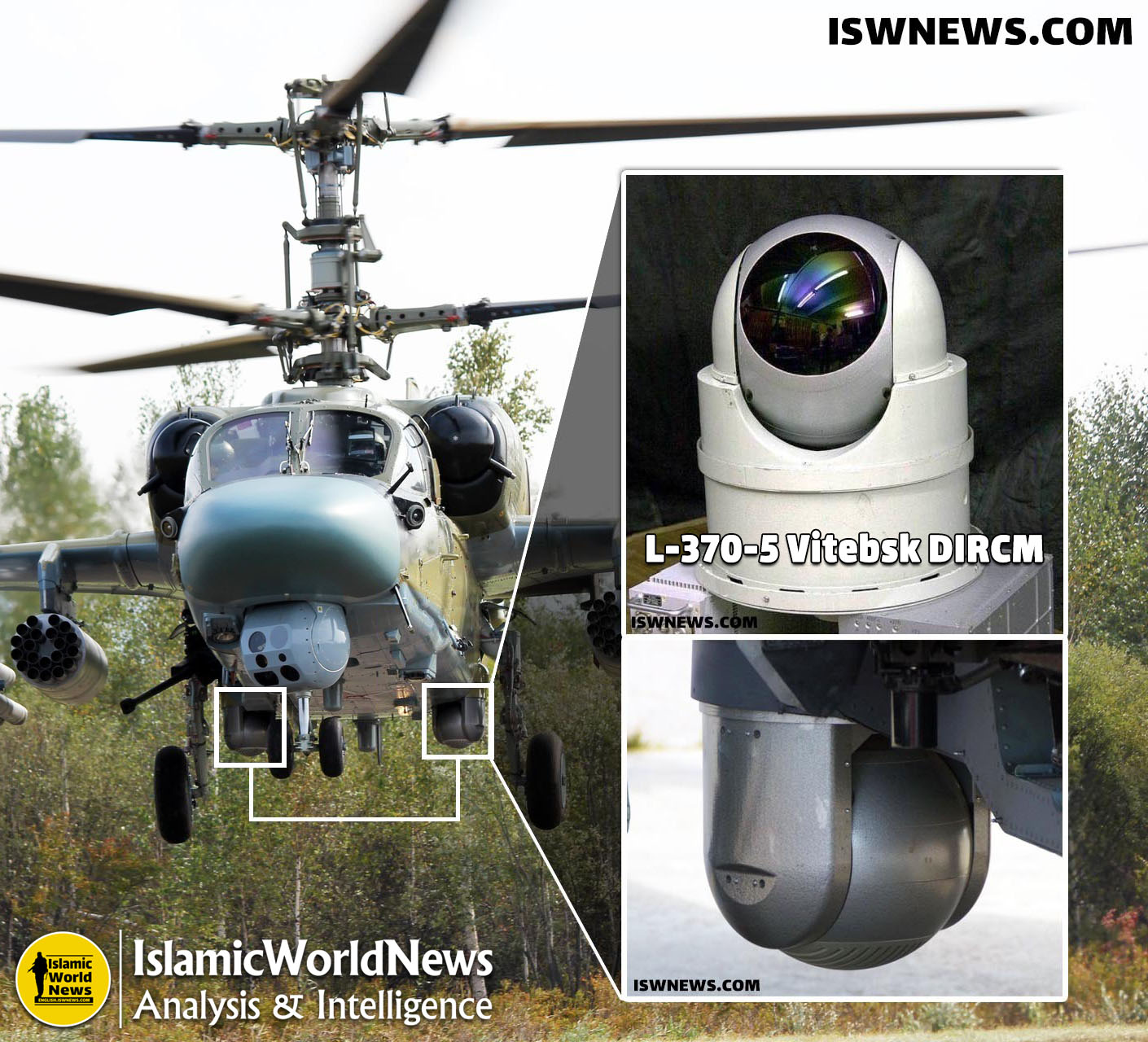
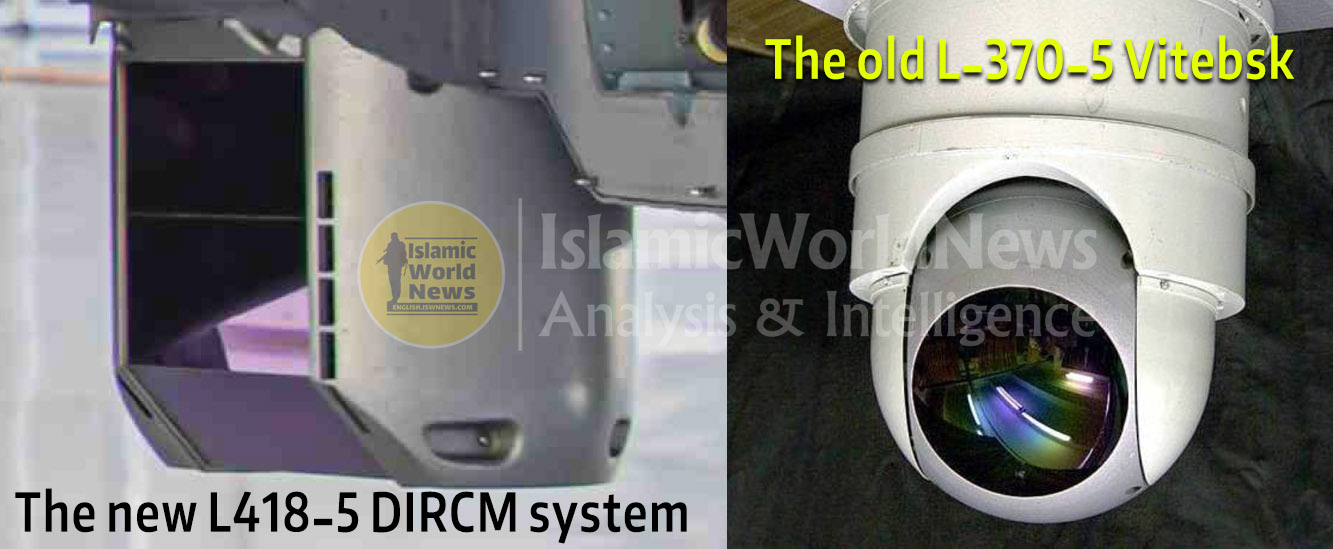
– “L-370-5 Vitebsk directional infrared countermeasures (DIRCM) system” is a jamming system to protect the helicopter against anti-aircraft missiles. This system is installed under the belly of Ka-52 in both sides of the helicopter in a rotating turret. This system is responsible for jamming missile seekers operating in the ultraviolet and infrared ranges. The L-370-5 Vitebsk system shines laser beams on the missile’s thermal / electro-optical seekers to confuse it and mislead it away from the helicopter. This system is able to track missiles fired at the helicopter within a radius of several kilometers.
L-370-5 Vitebsk infrared jamming system
It should be noted that, based on the available evidence, in the new and updated version of the Ka-52, the Kamov Ka-52M, instead of the L-370-5 Vitebsk system, a more advanced system called the L418-5 DIRCM has been used. The possibility of installing this system on the older and current Kamov 52s is also not far from expected. Also, in the export versions sold to Egypt, i.e. Ka 52E, the L418-5 DIRCM system is used.
Ka-52E exported and sold to Egypt, equipped with new L418-5 DIRCM sensor and new OES-52 optics.
– In Ka-52, the UV-26 flare and chaff dispensers is used. This system is placed in two double positions at the wingtips of Ka-52, and each of them contains 32 pieces of chaff and flare.
UV-26 flare and chaff dispensersin Ka-52
Ka-52 armaments:
Ka-52 armaments
In the armament section, the Ka-52 helicopter is equipped with a 30mm Shipunov 2A42 automatic cannon on the right side of its body. This cannon has low mobility and only moves up and down. The 30mm Shipunov 2A42 cannon is designed to shoot at lightly armored targets at a distance of 1500 meters, non-armored targets at a distance of 4000 meters, as well as low-flying subsonic aerial targets at a distance of 2000 meters. This cannon has the ability to operate in harsh conditions, such as the temperature range from +50 degrees to -50 degrees Celsius in rain, dust, frost and in a very dry environment. The firing speed of this cannon is 550 rounds per minute and its weight reaches 115 kg.
Shipunov 2A42 30 mm automatic cannon
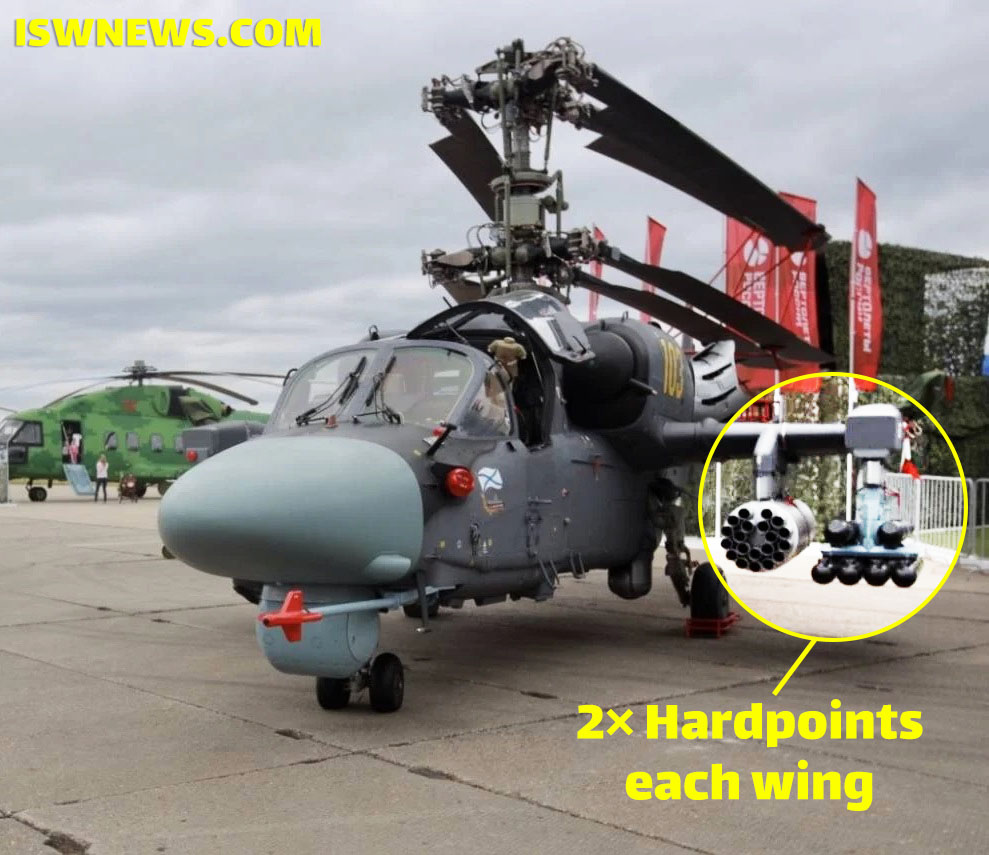
Also, there are 6 external hardpoints under the two wings, which can be used to install different combinations of weapons up to the weight of 2,942 kg. There are also 2 dual slots on the wingtips for chaff and flare dispensers.
6 external hardpoints under the two wings of Ka-52
The Ka-52 has 3 hardpoints under each wing, which can carry an APU-6 rack along with an unguided rocket pod and an anti-tank missile on the third hardpoint and two UV-26s on the wingtip, each of which contains 32 pieces of chaff and flare. The APU-6 rack is actually a shelf for storing and firing 6 anti-tank missiles, which is designed to increase the carrying capacity of the Ka-52 helicopter.
Also, to increase the range, Ka-52 is able to carry four external fuel tanks up to 500 liters in its hardpoints.
External fuel tank for Ka-52
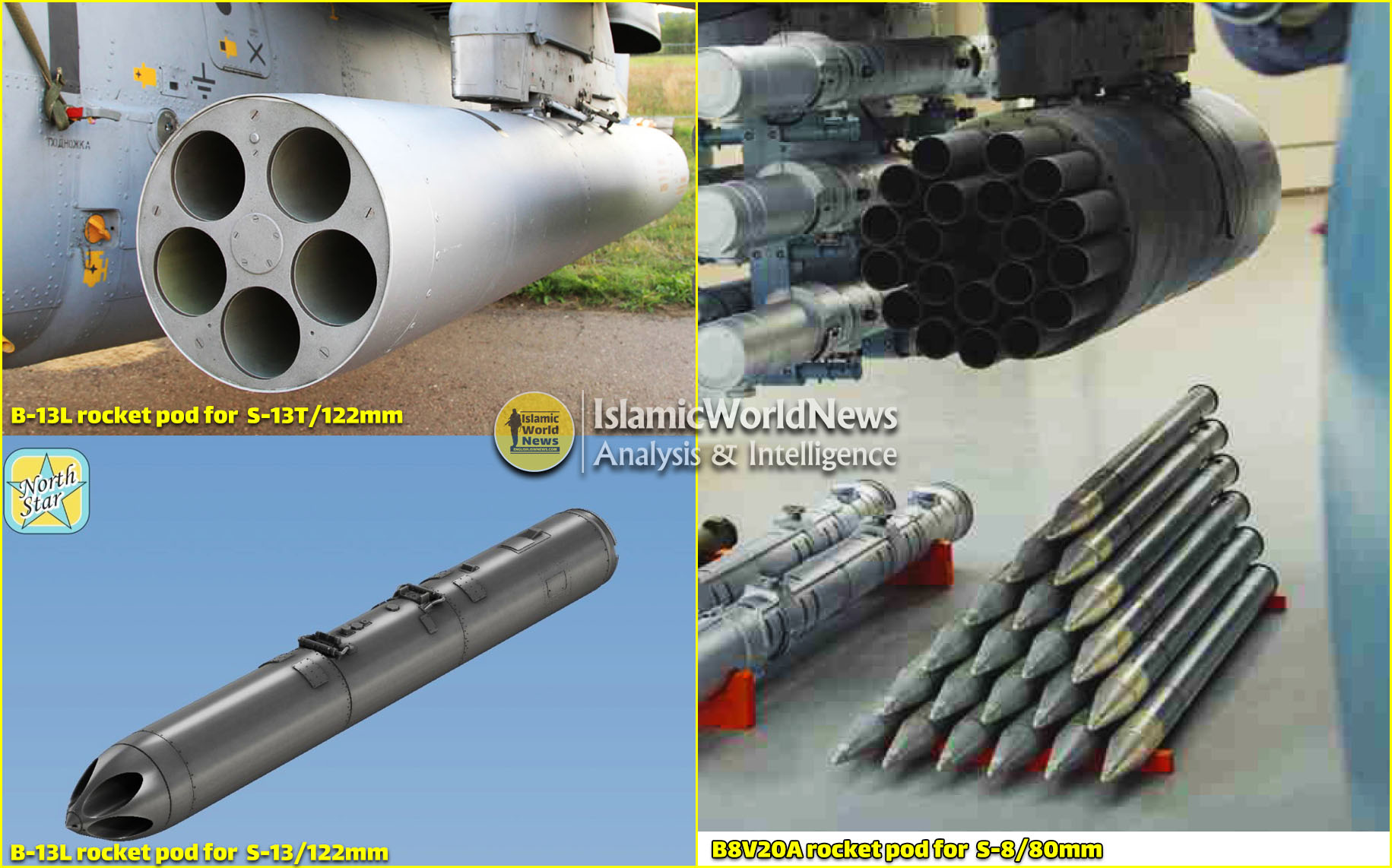
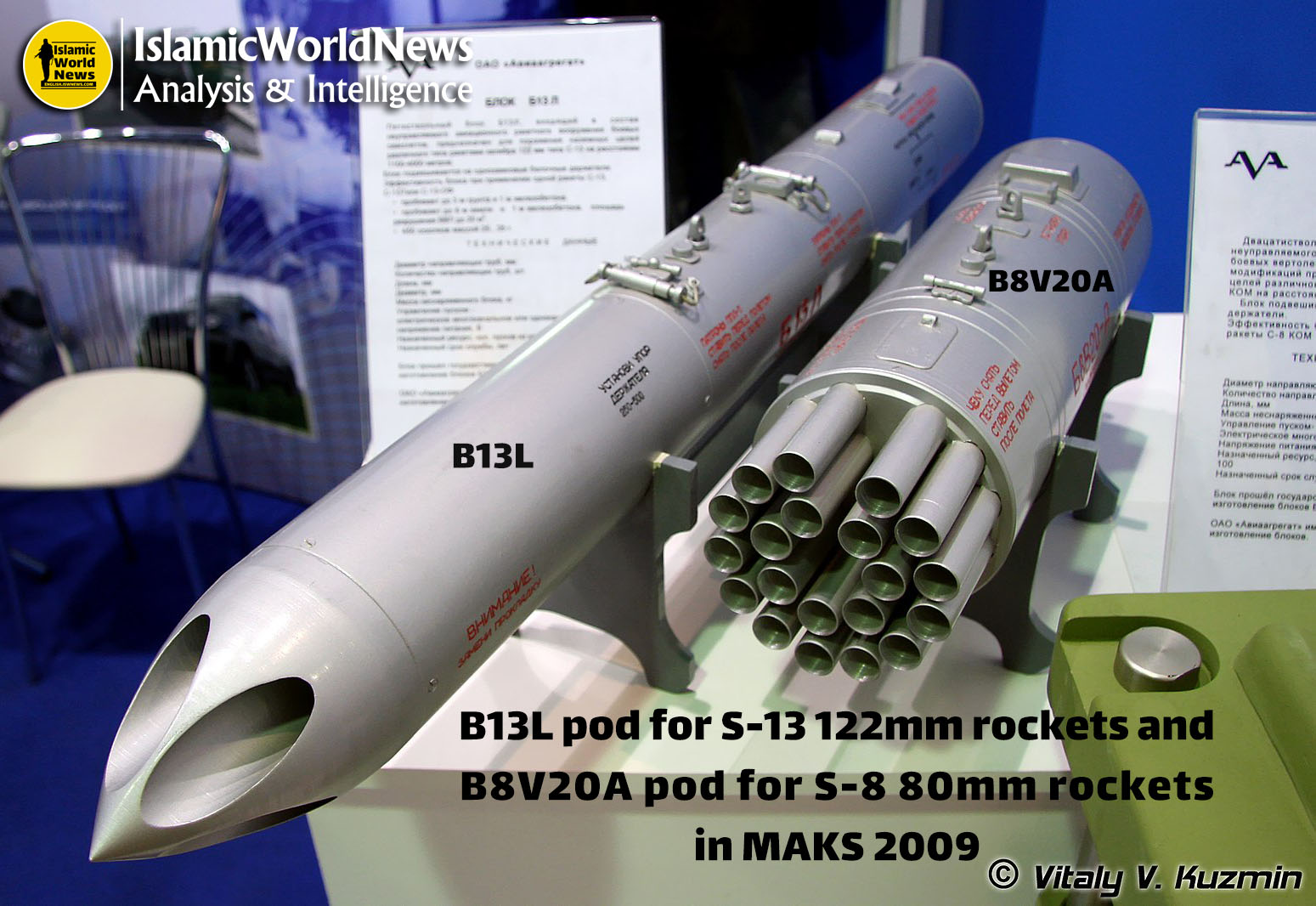
The pods of unguided rockets on Kamov are two types of S-8 80mm rockets (S8/80mm) containing 20 rockets and S-13 122mm rockets (S13/122mm) containing 5 rockets, which can be installed one on each wing and a total of two of them are in addition to 6 anti-tank missiles on the APU-6 rack in each wing and a total of 12 anti-tank missiles. This combination gives a lot of power to the Ka-52 helicopter in suppressing armor and infantry on the battlefield.
S-8 80mm rocket pod (S8/80mm) containing 20 rockets and S-13 122mm rocket pod (S13/122mm) containing 5 rocketsB8V20A pod for 80mm S-8 rocket and B-13L pod for 122mm S-13 rocket
It is also possible to install anti-tank missiles such as 9K121 Vikhr and 9M120 Ataka on APU-6 racks. The Vikhr missile can destroy targets at a distance of 10 to 12 km, and the Ataka missile provides the Ka-52 helicopter with an operational range of 400 meters to 6 km to target armored targets.
Right: Vikhr missile – Left: Ataka missile
A video from inside the Ka-52 cabin recorded during the operation of the Russian army to seize the Antonov (Gostomel) airport near the city of Kiev on February 24, 2022. In this video, the Ka-52 is flying low and providing fire support for Russian infantry and a Russian Mil-8 transport helicopter. The Ka-52 escapes from being hit by several rockets and is finally forced to make an emergency landing due to the impact of a missile.
Video from inside the cabin of Kamov-52 during the capture of Antonov airport
Introduction of other versions of Ka-52:
Updated version of Ka-52: Ka-52M helicopter In recent years, the Russian Ministry of Defense announced the production of a new version of the Ka-52, which was finally known as the Ka-52M in 2018. Ka-52M is actually an updated version of Ka-52, which has undergone changes in terms of system and some equipment. According to the information of the Russian Ministry of Defense, 114 aircraft of this model are to be put into service, and according to the latest information, on January 4, 2023, the Russian army received 10 Ka-52M helicopters.
The updated version of the Ka-52M helicopter is equipped with the GOES-451M electro-optical system with greater range and better performance. Also, the new OES-52 electro-optical system is used in the Ka-52M helicopter. The OES-52 system is functionally similar to the GOES-451 system. The OES-52 houses five sensors: a thermal imaging camera, TV camera, laser rangefinder/designator, laser beam riding for anti-tank guided missiles, as well as a laser spot tracker. However, the weight of this system is 177 kg, which is 43 kg lighter compared to the GOES-451 system, which is 220 kg.
GOES-451M and OES-52 electro-optic system for Ka-52M
Stronger undercarriage, improved cockpit ergonomics and better night vision goggles compatibility are other changes and updates to the Ka-52M.
In terms of armament, the Ka-52M is equipped with Light Multipurpose Guided Surface-to-Air (LMUR) missiles. This missile, which is also known as Izdeliye 305 and Item 305, has a range of 14.5 kilometers and is used to destroy a wide range of ground targets.
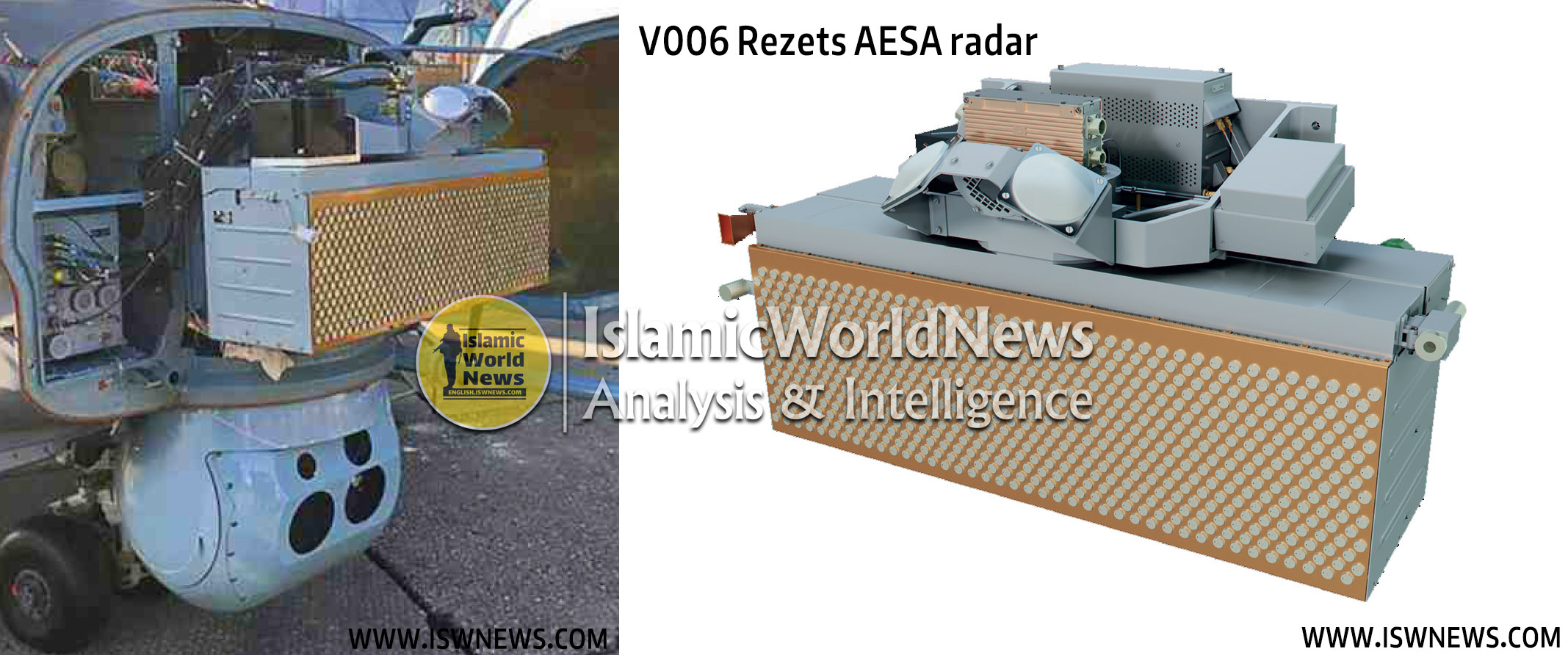
In the radar section, the Ka-52M is equipped with the V006 Rezets (cutter) active electronically scanned array (AESA) radar instead of the Arbalet-52 radar. This radar has a fixed 900×300 mm AESA antenna with 640 transceiver modules. This radar can detect a group of tanks from 45 km, a railway bridge from 100 km, and a destroyer-class warship from 150 km, according to the manufacturer. In the air-to-air mode, it can detect a fighter aircraft with a radar cross section of 3 sq m from up to 50 km head-on and a hovering helicopter from 20 km. The Rezets radar weighs 130 kg, 10 kg less than the current Ka-52’s FH01 radar and is air-cooled, with an air scoop for cooling seen on the helicopter’s nose fairing.
V006 Rezets active electronically scanned array (AESA) radar
In the field of countermeasures and electronic warfare, the Ka-52M President-S integrated protection system has undergone changes and its various components have been improved. In one of the most important components of this section, instead of the L-370-5 Vitebsk system, a more advanced system called L418-5 DIRCM has been used.
New L418-5 DIRCM system for Ka-52M
Finally, and perhaps the most important part of the helicopter’s upgrade, is the installation of new systems for the helicopter to adapt to work in the new battlefield command and control system.
Naval version of Ka-52: Ka-52K Katran helicopter: The Ka-52K Katran helicopter is the naval version of the Ka-52 helicopter and is based on the Ka-52 Alligator; But the equipment and systems of this helicopter have been modified according to sea operations and its body is also covered with elastic anti-corrosion coating. Since this helicopter is designed for use on aircraft carriers and warships, its dimensions have become smaller and it has folding blades and wings to occupy less space in the hangar. The length of this helicopter is 13.8 meters and its wingspan is 6.3 meters. The reduction of the wing length in this helicopter has caused the weapon hardpoints to be reduced from 6 to 4. The rotor system of Ka-52K is equipped with elastic bearings between the blade and the mast to bear more weight.
Folding blades in Ka-52 KatranFolding wings and two hardpoints under each wing in Ka-52 Katran
The Ka-52K helicopter is equipped with radio and satellite navigation equipment and provides the possibility of independent landing from the watchtower on the ship’s deck. The helicopter is also optimized with an air conditioning system to perform missions in the humid marine atmosphere. By equipping the KA-52K with advanced avionics systems and powerful weapons, it can be configured for different roles.
Ka-52K helicopter is equipped with laser beam guidance system and Okhotnik video processing system developed by KRET. The Okhotnik system increases the range of detection and identification for the helicopter.
Ka-52K helicopters are equipped with Arbalet radar system in early versions. In newer versions, this radar has been changed to active phased array radar. Russian defense contractor Radio-Electronic Technologies’ Active Phased Array (AESA) radar has been developed for the naval version of the Kamov 52 to replace the Arbalet radar. This radar gives the Ka-52K helicopter the ability to fire the Kh-35 anti-ship cruise missile and the Kh-38 missile. The detection range of this radar for large sea targets reaches 180 km.
It should also be noted that this version, like the regular Ka-52 versions, will be known as the Ka-52KM when it receives new upgrades. The M suffix is used for versions that have received the latest updates.
Ka-52K Katran helicopter
Pros and cons of Ka-52 helicopter:
Pros: It’s a multipurpose helicopter and very fast, agile and flexible. It provides a good level of armor protection in the cockpit for the pilots. It has a wide range of countermeasures and electronic warfare. It has 6 hardpoints to carry a wide variety of ammunition. It has effective anti-tank capabilities with Vikhr and Ataka missiles. It has a very good electro-optical system and a strong weapon management system. Cons: Small area for locking on with Igla air-to-air missiles The firing arc and performance of the 30 mm gun is limited due to its placement on the right side of the helicopter. High angles of attack can result in fuel starvation to the engine
Specifications of K-52 attack helicopter: Role: attack helicopter First flight: 25 June 1997 Produced: since 2008 Length: 15.8 meters Height: 4.93 meters Large wingspan: 7.8 meters Small wingspan: 2.6 meters Main rotor diameter: 2 x 14.5 meters Main rotor area: 330.3 square meters Crew: 2 people Empty weight: 7,700 kg Maximum take-off weight: 12,200 kg Engine: 2 Klimov VK-2500 turboshaft engines, 2,400 horsepower each. Internal fuel: 1,870 liters External fuel tank: up to 4 tanks and a total of 4,070 liters Maximum speed: 315 km/h Combat range: 460 km (with internal fuel tank) Maximum range: 1100 km (with external fuel tanks) Flight ceiling: 5,500 meters (18,000 feet) Rate of climb: 12 m/s
Armament: 30 mm Shipunov 2A42 cannon, it is possible to mount a 23 mm UPK-23-250 cannon pod (with 240 rounds) on the wings. Hardpoints: 6 under-wing hardpoints with capacity of 2,942 kg + 2 double slots at the wingtips for chaff and flare dispensers.
It is possible to carry a combination of the following weapons: Rockets: S-8 80mm rocket pod containing 20 rockets and S-13 122mm rocket pod containing 5 rockets. Missiles: Using the APU-6 racks, allows the use of a variety of anti-tank missiles such as the 9K121 Vikhr and Ataka. Up to 12 laser guided missiles Two Kh-25 laser guided missiles In Ka-52K version, anti-ship missile kh-31 and kh-35 R-73 air-to-air missile Bombs: up to 4 bombs weighing 250 kg or 2 bombs weighing 500 kg
Click to view full size image
More pictures of Ka-52 attack helicopter:
Click to view full size image
“Ka-52 Attack Helicopter” posters in English, Russian, Arabic, Azeri and Kurdish:
The Islamic Republic of Iran Air Force unveiled the Eagle 44 underground airbase on February 7 in the presence of Chief of Staff of the Iranian Armed Forces Major General Mohammad Hossein Bagheri and Commander-in-Chief of Iran’s Army Seyyed Abdolrahim Mousavi.
A few days following the inaugural ceremony, certain foreign analysts and media reporters used the photos and video footages released during the unveiling ceremony of the Eagle 44 Airbase of the Islamic Republic of Iran Air Force in order to examine the features as well as strengths of the underground airbase.
They pointed out to the presence of high-ranking Iranian commanders in the unveiling ceremony of the Eagle 44 airbase, asserting that the underground airbase is a tactical base, which would be capable of accommodating all types of fighter jets, various bombers and different sorts of drones. The outsized underground airbase will also be capable of housing the Sukhoi Su-35. Furthermore, the Eagle 44 airbase, which is situated tens of meters underneath the mountains, will be sheltered, when it comes to missile attacks and Bunker buster and the underground airbase will be a safe haven to safeguard aircraft.
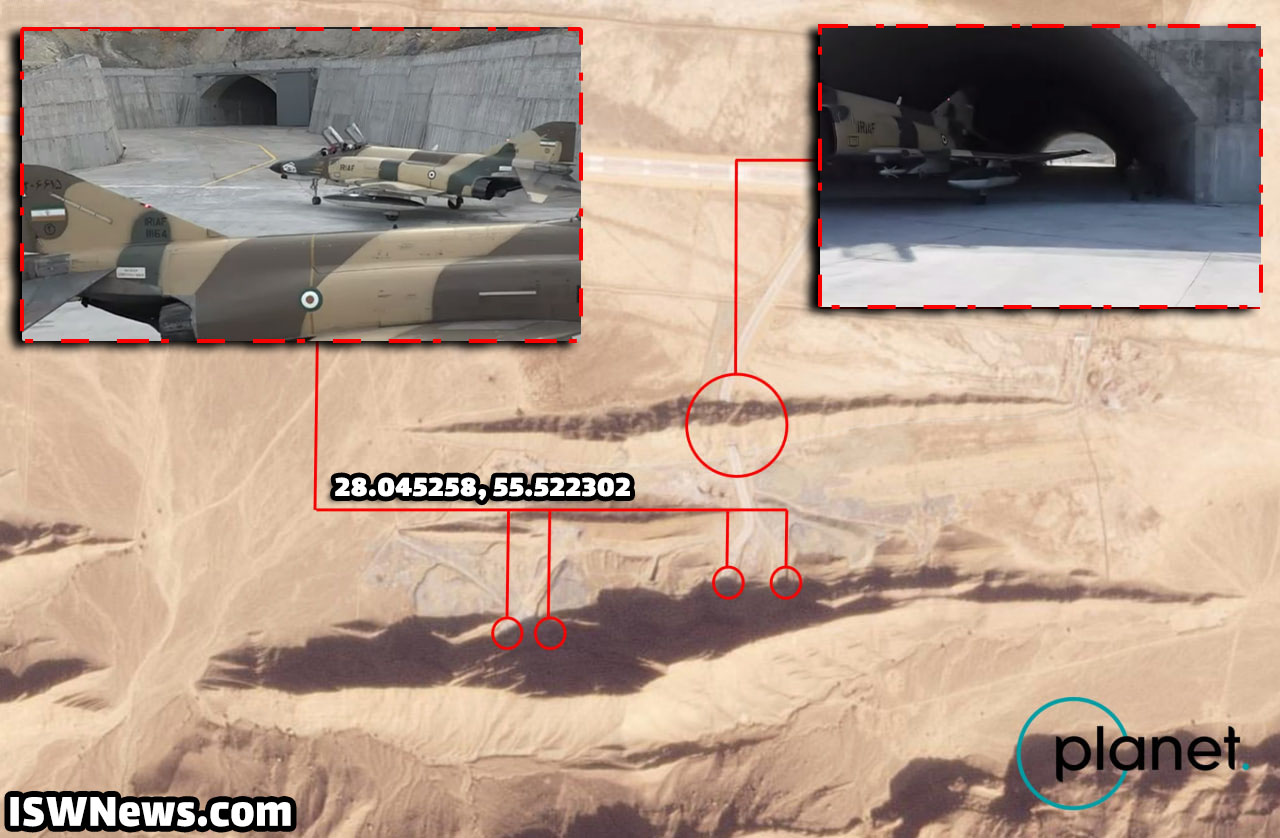
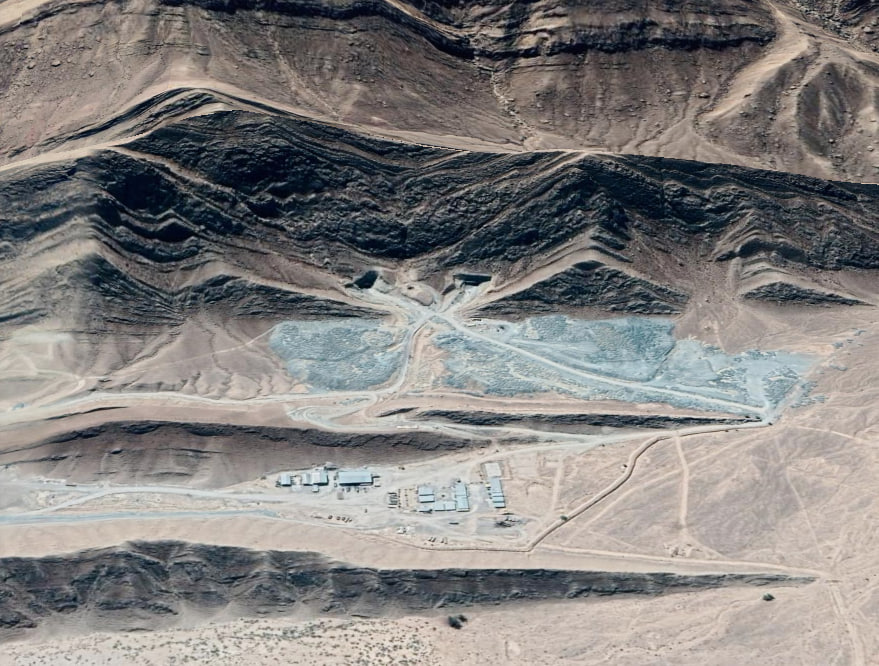
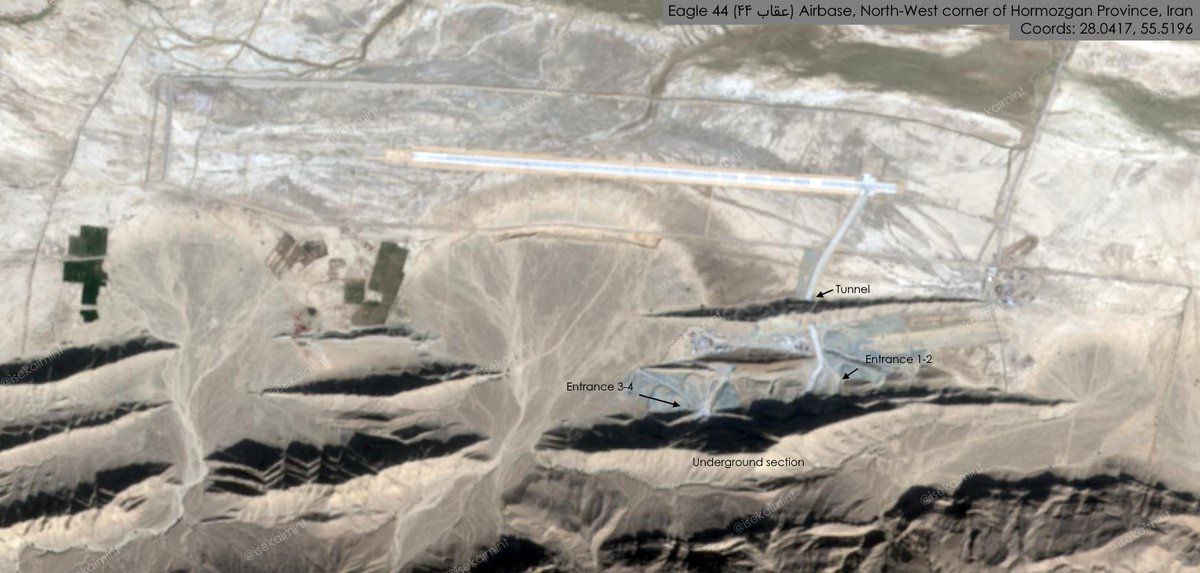
The attention-grabbing point in the so-called detection of the location of the airbase is that the foreign media journalists have utilized Open-Source Intelligence (OSINT) to identify and publish the alleged site of the underground airbase. In accordance with the published satellite photos and the allegations leveled by some foreign journalists, the underground airbase is situated in the northwest of Hormozgan Province.
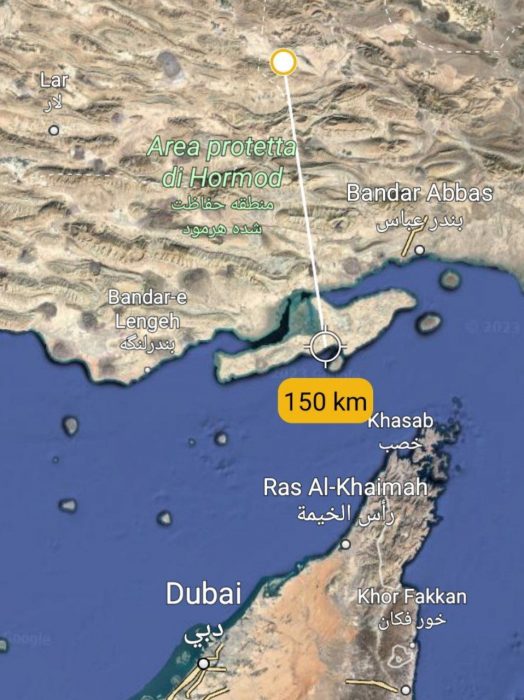
In line with the published data, the Eagle 44 underground airbase is located nearly 150 km far from the southern maritime boundaries of the Islamic Republic of Iran, and it is positioned in a very suitable area in terms of geographical aspects. It seems to be completely obvious that the military bases, which are situated in vicinity of the border areas, would always be more vulnerable when it comes to insecurity and conflict. Hence, the Eagle 44 airbase enjoys a much higher security standard in comparison to other airbases such as the Chabahar, Bandar Abbas, Omidiyeh and Bushehr airbases.
The location of Oghab 44 underground airbase at a depth of approximately 150 kilometers from the southern blue borders
Over and above the mentioned geographical advantage of the underground airbase, the placement of different types of equipment, logistics, and fighter jets and so forth at the depth of tens of meters (perhaps nearly 200 meters) will provide the airbase with an excellent fortification. Moreover, the utilization of long-range, medium-range and short-range air defense systems, such as Sevom (3rd) Khordad, Zubin, Majid and the like will complete the safety parameters needed for the strategic underground airbase.
It is worth mentioning that the Eagle 44 airbase is not the only one underground airbase of the Iranian armed forces, but there have been built or are being constructed a number of such underground airbases in other areas of the Islamic country, which would be publicized when it is needed to be announced.
In conclusion, it seems that the Iranian military organizations have released photos and video footages of the Eagle 44 underground airbase, while they were well aware that the publicizing of the airbase would pave the way for revealing the exact location of the military site sooner or later. Therefore, the announcement seems to be a deliberate measure, which contains important messages for the enemies of the Islamic Republic of Iran.
Satellite images of “Eagle 44” underground airbase