Category: Editor’s Picks

  • What is happening in Iran?

    What is happening in Iran?

    Yesterday, in continuation of rallies protesting economic situation, in some cities people gather and opposing the current economic situation, in some of which, extreme slogans can be heard.


    Opposition is not deniable and there are rational reasons for it but the dangerous issue is US obvious and secret interferences in Iran’s affairs to deviate the rallies.


    The (main stream)media covering the rallies by showing them in exaggerated way to promote them and on the other hand to censor that many people in Iran are against these rallies try to deceive the world that everyone in Iran is in rallies.


    Wall Street Journal in the same sense, writes an article entitled “New Protests in Iran” showing Hassan Rouhani, Iran’s president. In this article, they try to show that these rallies are biggest after election protests in 2009.


    BBC bolds some slogans which point to Iran’s presence in Syria or Yemen and tries to relate the protests to these issues.


    But the real joke is when Donald Trump, US president, with threatening language tweets “Many reports of peaceful protests by Iranian citizens fed up with regime’s corruption & its squandering of the nation’s wealth to fund terrorism abroad. Iranian govt should respect their people’s rights, including right to express themselves. The world is watching! ”


    This is while most of bad economic situation in Iran are resulted from unfair sanctions performed by US and their allies. Sanctions which include vital needs such as medications. Now they try to support people against government… !


    After revolution in 1979 and establishing Islamic Republic government, Iran have always seen such behaviors from western countries who try to tense or even help to overthrow the government with smallest unrest in Iran.

    This is not a small issue and there are tons of documents showing evil intentions of some western countries against Iran in the last four decades.


    This is a long story which includes but not limited to supporting the coup against Mosaddegh’s government in 1953 to supporting terrorist People’s Mujahedin in Iran who killed thousands of innocent people in Iran and are still active under US supports.


    But what is really happening in Iran?

    With the corruption in administrative system (which exists in every country) and economic pressure on people which is caused by some western countries’ unfair financial sanctions made supreme leader of Iran and some politicians to pretest.

    Ayatullah Khamenei, supreme leader of Iran, in his latest speech, mentioning internal problems says that why some officials who had all the facilities yesterday or even those who have power now are protesting today? But they have to be responsible for their functions, considering that people are smart and monitor their behaviors and won’t be deceived.


    Or even GholamHossein Karbaschi, the general Secretary of Executives of Construction Party, which is in the same shoe as current government, especially since the Vice President of Iran, Eshaq Jahangiri is from same party, says: “I am very unhappy with VP’s claims that we have some Abusive officials. If there are abusive officials, then fire them and as leader said you should not be like oppositions.”


    These are some examples of speeches and truth inside Iran and show that government and politicians in the same sense with people request the fight against corruptions and firing abusive officials. But these truths are never covered by mainstream media in western countries and inversely they try to show an unreal wrong picture from Iran.


    Today, 30 December 2017, majority of people in the anniversary of the epic 30 December 2009 show their support for Islamic Republic by rallies which is also censored by mainstream media . On the other hand, they covered some protesting rallies against economy and claim it is against government!


    Some of today`s pictures showing people’s support of Islamic Republic of Iran which did not covered by mainstream media:

  • Investigating Four Decades War In Afghanistan

    Investigating Four Decades War In Afghanistan

    After assassination of Mohammed Dawoud Khan, the first president of Afghanistan, Democratic Republic of Afghanistan is established by Marxist People’s Democratic Party of Afghanistan (PDPA) in 1978. Marxist government enforces anti-Islamic rules which results in Mujahidin uprising and since government could not fight with guerrillas they ask for help from Soviets. Red Army after a long story invades Afghanistan in 1979 and withdraws in 1989 with almost 15,000 casualties and more than 50,000 injured.

    After this, communist government fights with Mujahidin for a few more years and finally after 14 years, Kabul is conquered by Mujahidin in 1992.

    From every aspect, invading Afghanistan by Soviet Union was a mistake and Imam Khomeini’s anticipation about Soviet is now applicable for US and their allies:

    “One day Soviet ambassador came to me and said Afghanistan government asks Red Army to Afghanistan, I told him it is a mistake by Soviet. Of course they can occupy Afghanistan but they cannot stay, if you think you can occupy there and calm them, it is a daydream. Afghanis are Muslims and are protesting government, even if you go there or any other powerful country, occupy there but cannot calm and control them and finally you are defeated.”

    After fall of government in 1992, Seven Party Mujahidin alliance do not agree on power and start to fight among each other for several reasons.

    Alliance of Peshawar Seven

    In 1985 an alliance forms between seven parties in Peshawar to form an Islamic government but later when they conquer Kabul in 1992, do not agree on power distribution and start fighting all over Afghanistan.

    These parties are:

    • Jamiat-i-Islami (Islamic group) led by Burhanuddin Rabbani and Ahmad Shah Massoud (mainly Tajiks)
    • Hezbi Islami (Islamic party) Hekmatyar branch led by Gulbuddin Hekmatyar (mainly Pashtuns).
    • Hezbi Islami Khalis branch led by Mohammad Yunus Khalis (mainly Pashtuns).
    • Islamic Union for the Liberation of Afghanistan led by Abdul Rab Rasul Sayyaf (mainly Wahabi Pashtuns).
    • National Islamic Front for Afghanistan led by Ahmed Gailani (mainly Sufi Pashtuns).
    • Afghanistan National Liberation Front led by Sibghatullah Mojaddedi (mainly Pashtuns).
    • Islamic and National Revolution Movement of Afghanistan led by Mohammad Nabi Mohammadi (mainly Pashtun).

    Image: Afghanistan after withdrawal of Soviet in 1989. Red: government, blue: Jamiat-i-Islami, olive: Hekmatyar, green and white: Khalis, yellow: Shiite parties, green: Nabi Mohammadi, violet: Sayyaf, pink: Gailani.

    Internal fight starts between different groups in Kabul and foreign countries, each supports one group.

    Pakistan supports Gulbuddin Hekmatyar, Uzbekistan supports General Abdul Rashid Dostum (a highly ranked official who leads National Islamic Movement party), Saudi Arabia supports Sayyaf’s group and other Wahabi groups close to them, Iran supports Shiite groups (Hizb-i-Wahdat (Islamic Unity Party) which roots in Nasr and Pasdaran and other groups) and Jamiat-i-Islami etc. who want the government of Rabbani.

    Hekmatyar allies with Sayyaf and later with General Dostum and has hardest confront against Dawlat and Jamiat-i-Islami. But in 1994, Massoud conquers Kabul and defeats troops of Hekmatyar and Hizb-i-Wahdat (Massacre of western Kabul and Afshar neighborhood happens during this time but criminals never determined and trialed but allegations are due Massoud and Rabbani’s troop and Sayyaf and Hekmatyar’s troops.). At the same time Mazari Sharif in northern Afghanistan is conquered by General Dostum.

    Coincidentally Taliban is established in Kandahar by support of Saudi Arabia, Pakistan etc. Taliban with Jihadi motto gathers a lot of troops and in first step conquers Kandahar. After two years by conquering Kabul, Herat and other eastern, northern and southern cities in Afghanistan claims the Islamic Emirate of Afghanistan which is accepted by Saudi Arabia, UAE and Pakistan only. The result of Taliban power is massacres, plunders and destroying historical places and other brutal crimes and only northeastern part of Afghanistan under the control of Ahmad Shah Massoud and Rabbani is safe.

    Massacre in Mazari Sharif and specially Hazaras who are mainly Shiite is one of most brutal crimes happened by Taliban. During the attack to Mazari Sharif, Iran consulate is attacked which results in death of 11 diplomats and journalists by Sipah-e-Sahaba, an ally of Taliban and Al-Qaeda.

    In 1996, after conquering Kabul by Taliban, General Dostum who feels the danger allies with Massoud. Later supported by Iran to promote peace and strives of Afghan leaders to unify different Shiite groups with Jamiat-i-Islami and supports of other countries, northern alliance forms:

    • Jamiat-i-Islami mainly Sunni Tajiks led by Ahmad Shah Massoud and Burhanuddin Rabbani.
    • Junbish-i-Milli (Islamic Movement) mainly Sunni Uzbeks led by Abdul Rashid Dostum.
    • Eastern Shura (council) mainly Sunni Pashtuns led by Abdul Haq and Abdul Qadir.
    • Harakat-e Islami mainly Shiite Tajiks and Hazaras led by Asif Mohseni and Sayed Mohammad Ali Jawid.
    • Hezb-e Wahdat mainly Shiite Hazaras led by Mohammad Mohaqiq and Karim Khalili.

    Northern alliance then saves northern and northeastern areas from Taliban (except Herat province).

    After 11 September 2001 attacks, USA accuses Osama Bin Laden. Bin Laden is born in a small area near Riyadh, Saudi Arabia and from the Soviet occupation of Afghanistan enters Afghanistan, after Soviet withdrawal, leaves Afghanistan and in 1994 comes back to Jalalabad and joins Taliban. Several terrorist attacks are attributed to him before 2001 attacks, such as attack to US ship in Yemen and US embassy in Tanzania.

    After Taliban does not surround Bin Laden to US, USA and their allies attack widespread Afghanistan in 2001 with the name “Operating Enduring Freedom – Afghanistan”. It is noteworthy that Ahmad Shah Massoud was assassinated two days before 9/11 attacks. He denied any foreign interference specially from US in Afghanistan when he meets US deputy of minister of foreign affairs.

    After heavy air raids performed by US and their allies, Kabul and some key cities are liberated by northern alliance in fall 2001. Mohammad Ismail Khan one of commanders of northern alliance and Herat ex-commander with support of Iran could take control of Herat again. Later on Kunduz is liberated and finally Kandahar is liberated in November 2001 and Taliban fell.

    After establishing the new government in 2004 by Hamid Karzai until now fights happen sporadically. During these years Afghanistan Army with support of NATO mainly operates several times to liberate occupied areas by Taliban but so far the total liberation of Afghanistan has not achieved. Taliban and some other separatist groups are still active in Afghanistan…

  • Economical aspect of the Loss and damage during 1000 days of Saudi aggression on Yemen

    Economical aspect of the Loss and damage during 1000 days of Saudi aggression on Yemen

    Physical assets:
    • $ 25 billion. The initial cost of damage to physical assets in basic social services, infrastructure and housing is estimated at an initial cost of
    . $ 19.83 billion The initial cost of damage to housing units and urban infrastructure until June 2017,
    2. $ 5 billion direct losses incurred by the electricity sector during 1000 days of aggression.
    • $ 770 million is the initial cost of damage to roads and bridges
    • $ 480 million for initial damage to the water and sanitation sector
    • $ 1 billion cost of damage to the health sector as a result of the aggression
    • $ 7 billion is the initial cost of direct losses incurred by Yemen due to the interruption of oil production in various sectors.


    private sector :
    $ 75 billion losses incurred by the Yemeni private sector as a result of the aggression and siege, including $ 39 billion of direct losses as a result of systematic targeting by the Saudi Air Force on factories and commercial establishments.
    Telecommunications Sector:
    76 billion riyals The losses of the Yemeni telecommunications sector due to the direct targeting by the Air Force to more than 400 sites and networks, including 333 transmission stations for mobile coverage of Yemen Mobile and other private and government companies within two years.


    Fishing :
    $ 3.1 billion Losses due to war, overfishing and destruction of coral reefs resulted from the marine aggression. These losses were compounded by the aggression of traditional fishing activity in 12 maritime areas and resulted in the deprivation of more than 50,000 traditional fishermen The fishing profession in the Red Sea coast was also targeted their boats and destroyed seaports and markets and assembly centers. For the same reason, the traditional fishing decreased by 75% in Taiz and Hodeidah in addition to attended the traditional activity in the coasts of Hadramout and Abyan coasts by the UAE forces.


    Agricultural sector:
    $ 16 billion losses of the Yemeni agriculture sector as a result of the aggression and blockade, of which 13.7 billion dollars losses of 720 days
    • $ 703.9 million initial losses for government and cooperative enterprises and farms
    • $ 500 million has been lost by agricultural sector loans and agricultural assistance previously agreed upon with donor countries
    • $ 112.3 million in preliminary losses incurred by associations and agricultural cooperatives as indirect losses due to the aggression and siege
    • $ 5.2 billion losses incurred by the agricultural production due to the aggression and siege during the first two years, including:
    1. $ 145.1 million in seed losses
    2. $ 589.9 million initial losses incurred by the fruit sector
    3. $ 58 million losses incurred by the legume sector
    4. 3.8 billion dollars in damages affecting cash and economic crops such as Yemeni cotton, cotton and other cash agricultural products
    • $ 6.7 billion in primary losses incurred by the livestock sector, including:
    1. $ 5.5 billion losses of the poultry sector as a result of the direct targeting of hundreds of farms and the death of millions of poultry and high feed prices and marketing losses
    2. $ 1 billion losses of livestock as a result of targeting and death.
    3. $ 135.9 million initial losses of bees and production of Yemeni honey
    • $ 302.5 million in preliminary losses in the Yemeni agricultural sector due to the suspension of Yemeni exports abroad
    • $ 478.5 million initial losses incurred by the labor sector in the agriculture sector total losses over two years of the war and is expected to exceed half a billion dollars.


    Transport sector :
    $ 2.5 billion losses incurred by the Yemeni maritime, land and air transport sector as a result of aggression and siege, including:
    1. 2 billion dollars of preliminary losses of Yemeni air aviation and the targeting of airports, navigational and technical equipment, communications equipment and radars and stopping travel to and from Yemen.
    2. $ 900 million losses incurred by the maritime transport sector as a result of the aggression and siege, including $ 300 million losses of Hodeidah and Mukha ports during the past two years only.
    3. $ 19 million direct losses incurred by the land transport sector.


    Electricity sector:
    6 billion dollars of initial losses suffered by the Yemeni electricity sector directly since the beginning of the aggression and siege, including:
    1. 2 billion and 77 million and 243 thousand dollars of initial losses of damage suffered by its affiliates for electricity during the first year of the aggression
    2. 659 million and 163 thousand dollars cost of damage to the electrical system
    3. 750 million dollars in initial cost of losses incurred by the power generation projects of the General Electricity Corporation.
    4. 500 thousand dollars is the initial cost of losses that affected the unit of the project of transport, distribution and control.


    Source of statistics : الصمود

  • The Yemeni Interior Ministry announced the end of the crisis with full control over their positions and the death of its leader Ali Abdullah Saleh

    The Yemeni Interior Ministry announced the end of the crisis with full control over their positions and the death of its leader Ali Abdullah Saleh

    The Ministry of the Interior announces the end of the crisis of the treason militias with full control over their densities and the spread of security throughout the capital Sana’a and its environs and all other provinces and the killing of the treason leader and a number of its elements.

    This came after Saleh`s militants started killing citizens, cutting roads, causing chaos and disturbing public tranquility, and direct and public collusion with the countries of aggression. The entrances of cities coincided with the intensive bombing of the air force, which intensified its raids to pass the scheme of strife and internal fighting, which forced the Ministry of Interior to move quickly and resolve the situation.

    As we announce the end of the crisis of the treason militias, the State represented by the Ministry of Interior confirms that aborting that plan is a fallow of the most dangerous project of treachery and sedition bet on the forces of the Saudi-American aggression to subjugate Yemen, and return to the era of the most unjust,

    The Ministry of the Interior thanks the Almighty and the Supreme Political Council and the Government of Salvation and the people of Yemen and its tribes and all its national forces for their great support for the role of the security services in restoring security and stability to the country so that the Yemeni people can continue to build the state on sound and correct basis.

    Taking into account the equal citizenship and dignity of citizens, and continue strongly in the battle for sovereignty until the Republic of Yemen to achieve independence and stability.

  • Muslims Defeated the “Islamic State”, Israel Is the Big Loser

    Muslims Defeated the “Islamic State”, Israel Is the Big Loser

    Most observers would agree that the United States has directly or indirectly contributed to the creation of most of the international terrorist groups that have been in the news for the past thirty years. The narrative of how Osama bin Laden and what was to become al-Qaeda were initially supported by the U.S., Pakistan and Saudi Arabia to drive the Red Army out of Afghanistan is well known. Washington did so with little regard for broader agendas, including removing the United States out of the Middle East and regime changing the existing secular and religious Arab states in the region.


    When the American supported Holy Warrior Mujahidin were successful beyond their dreams and succeeded in forcing the Soviets to withdraw during 1998-9, a weak Moscow-supported Mohammad Najibullah regime stayed in power, only to be defeated in 1992 by the Taliban, who were one component of the Islamist groups that were being supported by the U.S. and its partners. The Taliban soon demonstrated that they too were not willing to be tools of either Islamabad or Washington and eventually provided al-Qaeda and bin Laden with a home, the casus belli that led to the U.S. attack on Afghanistan after 9/11.


    The U.S. occupation of Iraq followed, based on a similar pretext, i.e. that Saddam Hussein was in league with terrorists and was preparing weapons of mass destruction that threatened the United States. The deliberate dismantling of Iraqi government mechanisms coupled with a collapse in its civil society resulting in extreme sectarianism led many Sunni Iraqis to join the next emerging terrorist group, the Islamic State (IS), also called the Islamic State in Iraq and Syria (ISIS) or Daesh. IS was as surely the product of the American interventionist tactics in Iraq as were al-Qaeda and the Taliban earlier in Afghanistan.


    IS’s appeal was largely due to its recreation of a territorial state, which it dubbed the new Caliphate. It is now facing final defeat at its last remaining enclaves in Iraq and Syria. Soon, it will only be a dark memory in those two countries, a legacy of ruined cities, mass executions, cultural vandalism and torture.


    It is not known if the Islamic State’s leader Abu Bakr al-Baghdadi is still alive, but the group, which proved to be particularly astute in its handling of internet generated propaganda, will certainly live on through radical websites and to an extent through its foreign supporters returning to their home countries to carry out terrorist acts. There were also be places in Africa and Asia where IS will continue to have a physical presence on the ground, to include Sinai and Libya. But, generally speaking, the group will cease to exist, even though one can anticipate that there will be successor organizations that will benefit from the IS example and follow a similar pattern to attract recruits.


    What has changed, however, is the manner in which IS was defeated. The United States helped create al-Qaeda and the Taliban and then played a major role in attempting to destroy them after they ceased to be useful. Washington did indeed play a part in the fighting against IS but it was generally in support of others like the Iraqi Army or Kurdish militias and it did not get seriously engaged due to misgivings about previous interventions and incompatible demands for regime change in Damascus. So IS was defeated by a coalition of Muslim states supported by limited but effective Russian air and sea power, not by some arrangement cobbled together by the United States. Now, the United States, which has lost what little leverage it had to participate at the head table in any discussions to come to a final settlement of the Syrian crisis is desperately seeking to remain relevant by leaving its troops in the area and operating through surrogates.


    But the big loser in the defeat of IS will likely be Israel. The Netanyahu government, whose overall strategy has been to weaken all of its neighbors by bringing about their fragmentation along sectarian and tribal lines, has assisted both IS and al-Qaeda fighters in Syria against that country’s legitimate government and has repeatedly attacked Syrian Army forces. It has been actively supporting Kurdish separatism in Iraq while urging the United States to attack Iran and is now colluding with Saudi Arabia to use both military and economic force to compel the Lebanese government to remove the political arm of Hezbollah from the country’s government and to disarm the group. This has created a crescent of battle-tested governments running from the Caspian Sea to the Mediterranean – Libya, Syria, Iraq and Iran – which now have particularly good reasons to hate the Israelis and their meddling in the region.


    It would be overreach to suggest that the four governments in question will act in unison against Israel because each has particular national interests that will drive its policies, but they certainly will not make any effort to be accommodating to either Israel or to the United States. The four nations are united by the experience of their war against IS, by their largely Shi’a populations, and by their appreciation of the Iranian effort that contributed so greatly to their successes on the battlefield.

    Once again, the United States has intervened in a conflict in the Middle East that was none of its business and, regarding which, no genuine interests were involved. And behind the scenes, Israel was encouraging the unrest for its own reasons. Washington can again walk away from the mess that it has created, but will it? Recent comments from Secretary of Defense James Mattis and from Nikki Haley at the U.N. that the U.S. will keep troops in Syria and will “fight for justice” would suggest that the adults have again left the room. But someday the United States will either have a reality check or run out of manpower and money and will go. Israel will have to stick around and is likely to find itself in a really unfriendly neighborhood.


    Source

  • Gen. Soleimani congratulates Ayatollah Khamenei and Muslims on ISIS termination

    Gen. Soleimani congratulates Ayatollah Khamenei and Muslims on ISIS termination

    Following the historic victory of Iraq and Syria’s resistance movement over the sedition of Takfiri terrorism and the end of ISIS’s domination, which was manifested by lowering the flag of this American-Zionist group at Abu Kamal–the last key area in the hands of ISIS–General Soleimani issued an important message to Ayatollah Khamenei.

    The following is the full text of Major-General Soleimani’s message to Ayatollah Khamenei:
    In the Name of God, the Most Beneficent, the Most Merciful

    “Indeed, we have opened for you (Prophet Muhammad) a clear opening.” Quran [1: 48]

    To the dear and brave Leader of the Islamic Revolution, Ayatollah Khamenei:

    Salamun Alaikum (peace and greetings upon you),

    Six years ago, a dangerous plot like the ones at the time of Amir al-Mu’minin (as), which prevented Muslims from truly understanding the pure Islam of Muhammad (pbuh), this time, mixed with the poison of Zionism and arrogance, covered the Islamic world like a devastating storm.
    This devastating and poisonous sedition was created by the enemies of Islam with an aim of initiating widespread war within the Islamic world and a fight among Muslims. The evil movement, under the name of the “Islamic State of Iraq and the Levant,” managed, in the early months, to deceive tens of thousands of Muslim youth from both countries, causing a very dangerous crisis for the influential and crucial countries of the Islamic world: Iraq and Syria.
    They occupied hundreds of thousands of square kilometers of land from these countries along with thousands of villages, towns, and provincial centers; they destroyed thousands of factories, manufactures, and major infrastructure of these countries–including roads, bridges, refineries, wells, gas and oil lines, and power plants; they destroyed or burned important cities with valuable historical monuments and national civilizations by bombing them.
    Although it is not possible to calculate all the damage caused yet, the preliminary investigation estimates damages to be around $500 billion.
    In this event, there were extremely horrendous crimes that could not be shown, which included the following: decapitation of children, skinning men alive before their families, taking young girls and women hostage and raping them, burning people alive and group massacres of hundreds of young people.
    The people of these countries, astounded by this poisonous storm, either became victims of the takfiri criminals or left their homes, displaced throughout other cities and countries.
    In this dark sedition, thousands of mosques and sacred centers of Muslims were destroyed or ruined, and sometimes a mosque along with the Imam and all the people in it were blown up.
    More than 6,000 young people, deceived in the name of defending Islam, blew themselves up by way of suicide bombings, using explosive vehicles at city squares, mosques, schools, even hospitals and public places of Muslims; as a result of these criminal acts, tens of thousands of innocent men, women, and children were martyred.
    All these crimes have been designed and implemented by US leaders and organizations, according to the acknowledgement of the highest-ranking US official who is currently president of the United States; moreover, this scheme is still being modified and implemented by current American leaders.
    What, in addition to the favour of God and the special grace of the great Prophet Muhammad and his honorable household (pbut), led to the defeat of this dark and dangerous conspiracy was the wise leadership and guidance of his Excellency, Ayatollah Sistani, who mobilized all facilities to deal with this toxic storm.
    Certainly, the resistance of the Iraqi and Syrian governments and the perseverance of the armies and youths of these two countries, especially the holy Popular Mobilization Forces (PMF), Al-Hashd Al-Sha’abi, and other Muslim youth from other countries with the prominent presence of Hezbollah led by its great leader, Sayyid Hassan Nasrallah, played an important role in overturning this dangerous event.

    Definitely the valuable role of the nation and the government of the Islamic Republic of Iran–the respected president in particular–the parliament, the Defense Ministry, as well as police, military and security organizations of our country, in supporting the above mentioned states and nations, is admirable.
    This humble person, as a soldier called upon by your eminence to serve on this battlefield, announces the termination of the rule of this vicious cursed entity, following the completion of the liberation operation of Abu Kamal as ISIS’ last fort, bringing down the flag of this US-Zionist made terrorist group, raising the flag of Syria. On behalf of all the commanders and anonymous fighters on the battlefield, the thousands of Iranian, Iraqi, Syrian, Lebanese, Afghan and Pakistani martyred and disabled defenders of the holy shrine–who gave their lives to defend the lives and honor of Muslims and their sanctities–I congratulate and felicitate you and the noble nation of Islamic Iran, as well as the nations of Iraq, Syria, and other Muslims of the world. I prostrate before the Almighty God in gratitude for this great victory.

    “And victory comes only from God, the All-mighty, the All-wise.” Quran [3:126]

    Your son and soldier

    Qasem Soleimani

    Source

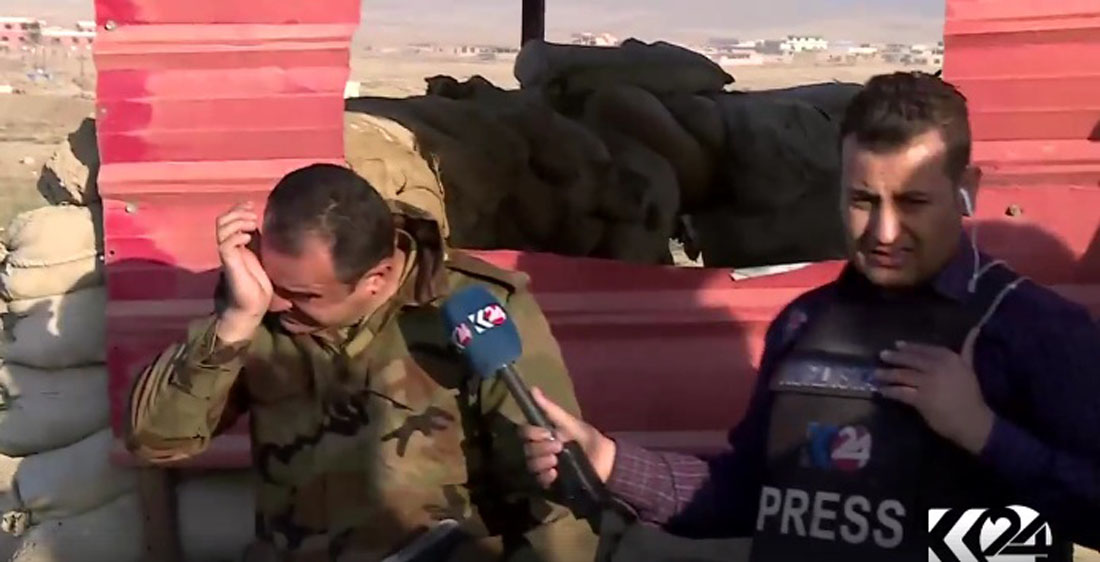
  • How Barzani regime’s media ridiculed itself during the Kirkuk Crisis: the case of Rudaw and Kurdistan24

    How Barzani regime’s media ridiculed itself during the Kirkuk Crisis: the case of Rudaw and Kurdistan24

    The political circus received relatively wide coverage in the Western media, but many people find it easier to follow the English-language regional media whose teams of professional journalists reported from the field and published articles more frequently. Beside the well established news networks like the Qatar-based Al-Jazeera, the Saudi-owned Al-Arabiya and the Iranian Press TV, several new actors have emerged on various social media platforms, notably Rudaw and Kurdistan24. In this October, the first one has recorded more than 94,000 shares and 480,000 comments on Facebook posts, as well as over 20 million impressions on Twitter, reaching over 90 million people in total. Rudaw has over 3.2 million Facebook followers, compared to Kurdistan24 which has less than half.

    Media of tribal enterprise

    The ownership background and the differences between two networks are quite astonishing. In the authoritarian countries, the national media presents one-sided view, and in totalitarian systems, all outlets are owned by the ruling party. However, in the tribal enterprise of the Barzani clan, called Iraqi Kurdistan, they have gone even further. Rudaw and Kurdistan24 therefore do not only present a single view and propagate policies that support the Kurdistan Democratic Party (KDP), but they’re also owned by the same family. Rudaw was established in 2008 for the purpose of serving interests of current Kurdish prime minister Nechirvan Barzani, and competitive Kurdistan24 (K24) was launched in 2015 by his cousin Masrour Barzani, a son of president Masoud Barzani. That’s the concept of, as Kurdophiles like to say, a Western-minded flourishing democracy and its free press.

    In the mid 2000s, there was a brief period of the independent media in local languages, emerged in political chaos rather than a pluralistic environment. Information monopoly of ruling party was temporary staggered, so regional authorities quickly moved to stifle it. The first step of undermining was establishing a number of allegedly independent outlets, but de facto subservient to the regime. The second step was the severe repression of individuals and organizations. In 2008, journalist Soran Mama Hama was killed by unknown armed men, and later the same fate befell Sardasht Osman and Kawa Garmeyani. All were writing critically on the political situation and corruption in Iraqi Kurdistan. Numerous other independent reporters received death threats for reporting on corruption and discrimination. In 2011, a free satellite TV-station NRT was established, but was set on fire by armed men only three days after its official launch.

    Both Rudaw and Kurdistan24 do not enjoy popularity among neighboring countries and their Kurdish groups. Rudaw has been banned in PYD-led Syrian Kurdistan for conducing a ‘smear campaign’ against them, while the Turkey’s Kurdistan Communities Union also called for the boycott and accused the media group as being founded by Turkish Intelligence Organization. Turkey itself has removed both Rudaw and Kurdistan24 from its TurkSat satellite, due to broadcasting violations during the independence referendum. Both channels are also banned in Iran, and even Baghdad issued statements threatening to revoke their television license in Iraq. Neither the US Department of State has any words of praise for Rudaw, describing it as the KDP affiliated outlet rather than objective media. On the other hand, among very few of their foreign admirers is Bernard-Henri Levy who recently spoke against proposed Baghdad’s ban and stated that “every friend of freedom in the world should support Rudaw.” His objectivity is already well known, as we’re speaking about the same person who called Israeli forces as “the most democratic army in the world.”

    Referendum coverage

    By analyzing coverage during the thirty days following the referendum, it’s easy to conclude that Rudaw’s and Kurdistan24’s strategic and tactical approach was almost identical. The personal rivalries between Nechirvan and Masrour were set aside, as well as various economic issues. There was not a single word about disputed oil exports (illegal over-exploitation against constitution and an OPEC agreement), the KRG’s major customers (Italy and Israel), a few months’ delay in payment of salaries, or the region’s debt which may be upwards of $20 billion. For a region with population comparable to that of Croatia, oil reserves/exports larger than those of Libya, that’s truly an amazing achievement. Still, they happily pointed out and exaggerated Iraqi debts, and all their financial hardships were attributed to Baghdad. Duo published over a thousand articles during a month, subordinating everything to the positive outcome of the referendum and desperately desired international recognition.

    Their position regarding the referendum choices can be hardly described as a black-and-white dichotomy, since “no” vote option was not even considered possible. According to their reports, stances among participants could be divided only into “yes” and “not yet” categories. When it comes to specific political actors, the contrast between good and bad was more clear. On one side there’s the light forces, “One Leader, One Party, One Choice, One Country,” and on other side there are the dark forces of the inconvenient Gorran Movement, the traitorous Patriotic Union of Kurdistan (PUK), oppressive Baghdad and the regional bullies Turkey and Iran. In the hundreds of articles, there is not a single statement against separatism, either from an average citizen or some high-ranking politician. Counter-views obviously weren’t worth even of disproportionate treatment.

    Opposing arguments given by numerous international leaders were also ignored, and the Kurdish media instead rushed to find and present any publicly available support. The results are invaluable, as they gave us a clear picture of the nature of their apologists. Those ‘freedom lovers,’ in alphabetical order, include Ralph Abraham, Stephane Bergeron, Marsha Blackburn, Richard Blumenthal, John Bolton, Ted Cruz, Trent Franks, Peter Galbraith, Mike Gallagher, Jay Garner, Newt Gingrich, Franklin Graham, Lindsey Graham, Glenn Grothman, Fuad Hussein, Jim Inhofe, Jack Keane, Zalmay Khalilzad, Bernard Kouchner, Bernard-Henri Levy, John McCain, Benjamin Netanyahu, Jared Polis, Vesna Pusić, Marco Rubio, Chuck Schumer, and the Wilson Center. Beside a few energy lobbyists and conspiracy theorists, virtually all of them are Zionist extremists and the neoconservative warmongers. Thus, the alleged Iranian-Turkish ‘accusation’ or a ‘conspiracy theory’ of Zionist role in the referendum, turned out to be a verified fact.

    From heroes to victims

    Rudaw’s and Kurdistan24’s coverage has reached peak absurdity during the Kirkuk Crisis, when they clumsily balanced between the narratives of heroism and victimhood. Four days prior to the start of military operation, they reported that region’s Security Council is expecting a ‘major attack’ by the Iraqi Security Forces and Popular Mobilization Forces (Hashd Al-Shaabi), and in the following days numerous reports about Kurdish heroism appeared. President Barzani told to Baghdad that referendum won’t be annulled at any price, Peshmerga also rejected all Iraqi warnings and stood prepared to face them, the Kurdish authorities were allegedly united, and thousands of volunteers took up arms. They even published bizarre videos of children and old ladies carrying rifles, claiming “they would rather die than allow occupation.” According to such reports, a decisive battle was supposed to happen, the cataclysmic conflict between the forces of good and evil, between Peshmerga as the finest soldiers ever and the cowardly Iraqi army, with Glorious Leader declaring ‘not a step back’ order, and courageous civilian support. A new Stalingrad battle.

    The reality proved to be quite different. On 15 October 2017, the Iraqi military started a major operation and restored full control of Kirkuk City in just about 15 hours, with very little violence since Kurds mostly retreated without fighting. This fact passed unreported as both Rudaw and Kurdistan24 continued to report about minor skirmishes between smaller groups of disobedient soldiers, and phrase ‘fall of Kirkuk’ appeared only three days later. In the meanwhile, the desperate need for heroic scenes resulted in flooding their websites and social media by fake pictures and stories, intentionally posted to increase hatred and escalate tensions. They presented Saudi army vehicles burned in Yemen as ‘Iraqi’ equipment, killed Daesh terrorists in Fallujah as ‘Shia militia’ in Kurdistan, a controlled demolition of the bridge in Kansas as the ‘Peshmerga’s scorched-earth policy’ in Altun Kupri, etc. One rumor said that Abu Azrael, a famous Shia figher against Daesh, had been killed in fighting in northern Iraq, but the lie was refuted by himself who posted a YouTube video to show he was still alive and well. They also published unconfirmed and highly dubious data of ‘180 killed’ Iraqis, ‘400 killed’ Kurdish civilians and ‘200 missing’ in Kirkuk.

    A sudden shift in the reporting strategy has rigorously transformed the Peshmerga soldiers and the Kurdish people. On Sunday night, they were ‘fearless warriors’ who never retreat, but it was already Monday morning when they became ‘betrayed and abandoned,’ blubbering incoherently for help. The bitter confession about real outcome required shame and humility, denial that true heroes never fail, and for Rudaw and Kurdistan24 that was out of the question. Instead, they found the main reason for failure in a ‘treacherous elements’ within the rival PUK party, claiming their leaders ordered a retreat, while the second reason was role of merciless foreign powers, notably Iran. During the first day of operation, Kurdistan24 showed several videos of weeping Peshmerga members who allegedly wanted to fight, but commanders ordered to pull back. The Kurdish narrative of victimhood became fashionable once again. First they managed to convince own population that there’s a total war going on, and after many fled from Kirkuk, they showed crowded roads and claimed people are escaping due to persecution.

    Non-combatant Kurdish citizens also reportedly suffered ‘tremendous crimes,’ as the Kurdish language was barred from the Iraqi organized press conference in Kirkuk, and someone even put Iranian Khamenei’s photos inside governorate building. Such ‘horrors’ might remind us of Saddam’s al-Anfal campaign and the times when tens of thousands of the Kurds when gassed. It was Iran who helped Peshmerga and gave refugee to over 1.5 million Kurds, and it was the United States who supported Saddam’s regime and continued to aid it after receiving reports of chemical attacks. Still, in the perspective of Barzani ruling thugs, Iran is a major enemy, and the US should intervene in the KRG favor. Beside equalizing Iraqi prime minister Haider al-Abadi to Saddam, the Kurdish media also tried to present Iraqi Shia militias as no different than Daesh. A recently published video by Rudaw shows women with totally covered faces and smiling boys, claiming they have witnessed a beheading of a 12-year-old son and house burning. The footage shows no dead bodies, no destroyed houses, only empty stories. Perhaps Kurdish soldiers are not the bravest in the World, but Kurdish journalists definitely are. Not because they are not afraid of anything, but because they are not ashamed of anything.


    Source

  • Summary: Operation of the Federal Government of Iraq in disputed areas with the Iraqi Kurdistan Region

    Summary: Operation of the Federal Government of Iraq in disputed areas with the Iraqi Kurdistan Region

    In the first stage, anti-terrorism forces succeeded in entering and dominating in the general area of ​​the city of Kirkuk following the dispersal conflicts with the Peshmerga and PKK forces. On the same day, other federal police forces managed to dominate the North Oil Refinery.

    The results of the first day are these : the domination of the central government on the city of Kirkuk as well as the oil wells and oil facilities of the region.

    On the second day of the operation, the withdrawal of various forces from various Kurdish parties was obvious. The forces succeeded in domination over the various regions on five axes.

    First axis: Diyala province

    In this axis, the forces managed to dominate the cities of Jalola, Khanaqin and Qarat-Tepa. The Khosrawi border crossing was also controlled by Iraqi central government forces.

    Second axis: Kirkuk province

    In this axis, the forces managed to advance towards the important village of Bai Hassan and Debs. The importance of this village is located on the shore of the Zab River, as well as facilities and oil wells around the area.

    Third axis: Nineveh province, Mosul area

    In this axis, the forces succeeded in dominating the city of Ba`shiqah. The news of the troops’ arrival to Tel Oskof and Betnai is not confirmed.

    Fourth axis: Nineveh Province, Sinjar area

    In this axis, due to the large presence of PKK forces, the forces succeeded in dominating the city of Sinjar and part of its northern mountains, in order to control the important village of Senoni and the central al-Rabi`ah borderway . In this axis, the cooperation between the Izadi(Yazidi) forces and the central government of Iraq was very close and friendly.

    Fifth axis: Ninewa province, Mosul dam area

    In this axis, the Iraqi Army’s 16th Army Corps managed to control the Mosul Dam, the strategic city of Dhamar and  Aski village.

    Now with the withdrawal of various Kurdish forces has spread across the south of Diyala to the north of Sinjar, it must be seen that the forces under the Barzani control(KDP), will accuse PUK(Patriotic Union of Kurdistan) as a traitors! Or just the withdrawal of PUK forces was betrayal,and the retreat of the KDP forces was their tactics to prevent conflict and bloodshed!?


    HD MAP

  • Everything you need to know about the future of Turkey’s operations in the Idlib province of Syria + Map

    Everything you need to know about the future of Turkey’s operations in the Idlib province of Syria + Map

    After announcing the start of the operation in Idlib province by Erdogan on October 7th and executing another part of the Astana agreement known as “De-Escalation Zone Deal” , till now about 200 military equipment including military vehicles and personnel along with the Turkish army entered the province of Idlib.

    Turkey’s entry into the province of Idlib within the framework of the Astana peace agreement can be investigated.

    Apart from mentioned objectives of entering the province of Idlib by the Turkey, in the first phase, this event is included of the presence of Turkish troops in western side of Aleppo province along the Darat Izza, Jabal Sheikh Barakat, Dir al-Sam’an and the frontlines between militants(Such as FSA, HTS, etc) and the Kurds(SDF, YPG, etc) throughout the southern front of Afrin, from Bashamrah to Jandris.

    It should be noted that the Turkish troops will not cross the contact line of Afrin and by being in these areas, they will play as a buffer zone.

    In the second phase, Turkish troops will across border between Syria and Turkey. Therefore, Turkish troops will be deployed in areas of Darah Izza, Harim, Sarmada, Darkush, Atmah to Jasr al-Shughur.

    The purpose of this move is to close all militants`s supplying routes (weapons and personnel) from Turkey to Syria and vice versa.

    So far, there will not be any serious tension certainly.

    According to what our field & trusted sources have indicated that the Turkish and their militants (like Euphrates Shield, etc) will move from north and west towards the Aleppo-Hama highway, and on the other hand, the Syrian army and Resistance forces will move from the south of Aleppo and the Abu Dhohour area to the Aleppo-Hama highway.

    The final goal is to open the Aleppo-Hamah highway.

    In the next stage and third phase Turkish troops or Turkish backed forces will be distributed in areas along the highways like Saraqeb, Khan Sheikhun, Ariha, Murek, and they will enter the northern suburbs of Hamah from the north.

    From the southern side, the Syrian Army and Resistance forces as well as the Russian forces on the outskirts of Hama will move along the highway, and ultimately the Aleppo-Hamah highway will be fully liberated and active.


    Therefore, all that mentioned will be carried out in three general stages:

    The first stage is on the western suburbs of Aleppo
    The second stage in the northern and western suburbs of Idlib
    Third stage along the Aleppo-Hamah highway


    According to what is known, the city of Idlib will remain under the control of Tahrir al-Sham (HTS)

    Finally, due to the field changes and political changes, it will decided that the Turkish-backed forces will be distributed in more areas of Idlib and northern Hamah, or that the Turkish forces will be completely excluded from the area by clearing (setting) the situation of the armed forces and the city of Idlib.

    The details of this stage can include many options that domestic (national) reconciliation is one of them.


    It should be noted that the issues mentioned are based on field evidence and the parties’ plans(all sides), and given the dangerous nature of Erdogan and his sudden turns, there is a possible new scenarios.

    There is also no specific talk about the state of Fu`a and Kafraya it is not clear what kind of plans were intended for these settlements.

    Also, the situation of important areas such as al-Rashidin and al-Zahra in west of the city of Aleppo is unclear, and it is likely that these areas will also join the national reconciliations.

    HD MAP

  • The latest situation of contact lines around the al-Tanf border crossing

    The latest situation of contact lines around the al-Tanf border crossing

    The Syrian Army and allies over the last few months, especially in the last month of the summer when other Syrian fronts were very active, began to slowly clear the borders of Jordan with the least amount of tension, and by liberating border posts one after the other they moved to the nearest point of the Al-Tanf border crossing.

    The progress in this area made while the Badia(dessert) armed forces and their masters, the United States and Jordan, lost the upper hand in the Al-Tanf crossroad when the Resistance forces, and the Syrian Army turned around it so they made the best use of this opportunity. They blocked large areas and routes that were considered as the main ways for supplying armed forces from Jordan to Syria in the past.

    At the same time as the advancements that were mentioned, the pressure for negotiations was also applied by Russia on the United States and Jordan to speed up the process of solving the problem of the al-Tanf area and liberating the southeastern regions of Syria. Therefore, as we said earlier, talks were held in Jordan during the summer (the quality and quantity of the talks are unclear) and the latest (unconfirmed) news of the decision of the United States and Jordan is to give the control of the Al-Tanf bordercorssing to the Syrian government.

    Basically, in the current situation and with considerable successes of the Syrian army and the resistance forces in Syria, the Badiah armed forces will not do anything and their presence will not help the armed forces and their goals, unless the Americans and Jordan directly enter into battle and declare war against Syria.

    Therefore, now it is the most logical way to give the region to the Syrian army.

    “The border between Syria and Jordan near the US base in al-Tanf has become a 100-kilometer” black hole, “said the Russian Defense Ministry’s deputy Igor Konashnokov, The Representative of Pentagon has repeatedly said that new Syrian forces are being trained under the supervision of the United States, Britain and Norway. Along with the new Syrian forces, ISIL forces emerge from that point, like the devil. ”

    These are sarcastic expressions to the recent attacks of ISIL on al-Qaryatain, or the Syrian-Iraqi military posts around the Al-Tanf border crossing, and according to the Russian Defense Ministry, these attacks could not be possible without American guidance or without allowing ISIS terrorists to pass.

  • Three main reasons which bind all kurds to Iran

    Three main reasons which bind all kurds to Iran

    An important point in the history of the Kurdish struggles is the remarkable difference between the Kurdish riots in Iran compared to the riots in Turkey and Iraq. The Iraqi Kurds had bloody clashes with the Iraq(central government) for a long time. in Anfal operation , which was launched by the Saddam Hussein against the Kurds.especially in 1988 that 180 thousands Kurds lost their lives.

    The war between the PKK and the Turkish government, which has been taking place in the country since 1984, caused nearly 50 thousand dead.

    But the war between the Iranian government and Kurdish armed groups is far less extensive. This is the result of the less friction(struggle) of the Kurdish society with the government compared to the Kurds of Iraq, Turkey and Syria, which makes the Kurdish insurgent groups unable to attract people’s support like the insurgents in three other countries did. This issue has so many reasons that most notable reasons are these:

    1. Differences in the national identity in Iran with other countries with Kurdish population.

    National identity in Iraq and Turkey is defined by ethnicity. Turkey has based its national identity on Turkism, and Turkey’s name comes from the Turkish word. According to the Turkish Constitution, all citizens of this country are considered to be Turkish. Turkey gave the Kurds the title of “Turk of Mountain” and by 1991, the use of words such as Kurdistan and Kurd in this country was prohibited even in personal life.

    In Iraq, the Ba’ath Party was an Arab nationalist party, which established the country’s identity on Arabs.

    In Syria, the same is true about the Arab Ba’ath Party, and its official name is the Syrian Arab Republic. On the contrary, Iran has not defined its identity on ethnicity.

    In Iran, different ethnic groups have lived together for a long time and have formed kind of historical identity, while Turkey, Iraq, and Syria all founded after the First World War and after the fall of Ottoman caliphate, especially Syria and Iraq have a short historical identity as new founded countries . In addition, from the time of Safavids, Iranian identity has been defined based on the religion of Islam and Shiite religion, not ethnicity. That is why in Iran, the Shiite Kurds have not shown any ethnocentric tendencies, and almost all Kurdish ethnic struggles have occurred in the Sunni areas. However, it should be noted that the root of the ethnocentric struggles of the Sunni does not return to the differences between the two Shiite and Sunni religions. Basically, in the regions with Sunni population in Kurdistan, political Sunni Islam has little power(influence), and the vast majority of Kurdish armed groups follow a leftist(left wing)or nationalist ideology. The cause of the emergence of ethnic identity in the Sunni Kurdistan of Iran is that the people of these areas are not part of Shiite religion, which is one of the most important elements of the unity of the majority of the people of Iran. Of course, this does not mean ignoring other unifying elements of Islam, the Iranian historical identity, and linguistic and ethnic similarities. As we have seen and will see, these factors have made the Kurdish ethnic conflict less in Iran than the neighboring countries.

    2-The close relation of ethnic and racial identities of the Kurds to the rest of Iranians

    The race of Kurds are among the Aryan tribes. Kurdish is also one of the branches of Persian language in linguistic divisions and is similar to Persian language and local languages ​​in Iran. Like other Iranians, the Kurds celebrate Nowruz and also Kurds & Iranians have many common culture and myths .But there are no similarities between Kurdish language, culture, and myths with the language, culture and myths of Arabs and Turks.

    In Turkey and Syria, Nowruz was a political event and a sign of Kurdish ethnic identity. Because of that, for a long time, severe restrictions were imposed by the governments of these countries on this celebration, and in some cases, Kurds were killed by the security forces. But Nowruz throughout Iran is a national celebration that various ethnic groups of Iran celebrate along with the government. Because of these reasons, the sense of belonging to the Iranian identity among Kurds is far more than their solidarity with Turkish and Arab identities.

    3-The Cultural and Political Approach of the Iranian Government towards the Kurds

    Iran has chosen a more liberal cultural and political approach to its ethnic groups, including the Kurds. Unlike Turkey, the use of Kurdish or the use of words had not been forbidden in Kurdistan in Iran. Kurdish language has long been used in local media, and in recent years, the teaching of ethnic languages ​​in schools has also been provided. Also, the Shiite Kurdish politicians did not have any obstacle to reach the highest political and administrative positions. Such conditions have not existed for a long time in Syria, Turkey and Iraq, or still does not exist. Before the Syrian civil war, the government refused even to issue birth certificate for Kurd residents and to recognize their citizenship. There were also obvious discrimination against Kurdish citizens in Turkey and Iraq.

    Although some of the dissatisfaction and independency tendencies in the Sunni regions of Kurdistan of Iran can not be denied, these reasons, plus the political and security problems, except in the first two decades of the revolution, and especially in the early years, the activities of the Kurdish rebel groups were mainly limited scattered attacks on the border areas from inside of the Iraqi Kurdistan and these attacks were stopped at some points.

    PS: This map does not represent correct & exact boundaries, and it’s just the hypothetical range of Kurdish presence in region