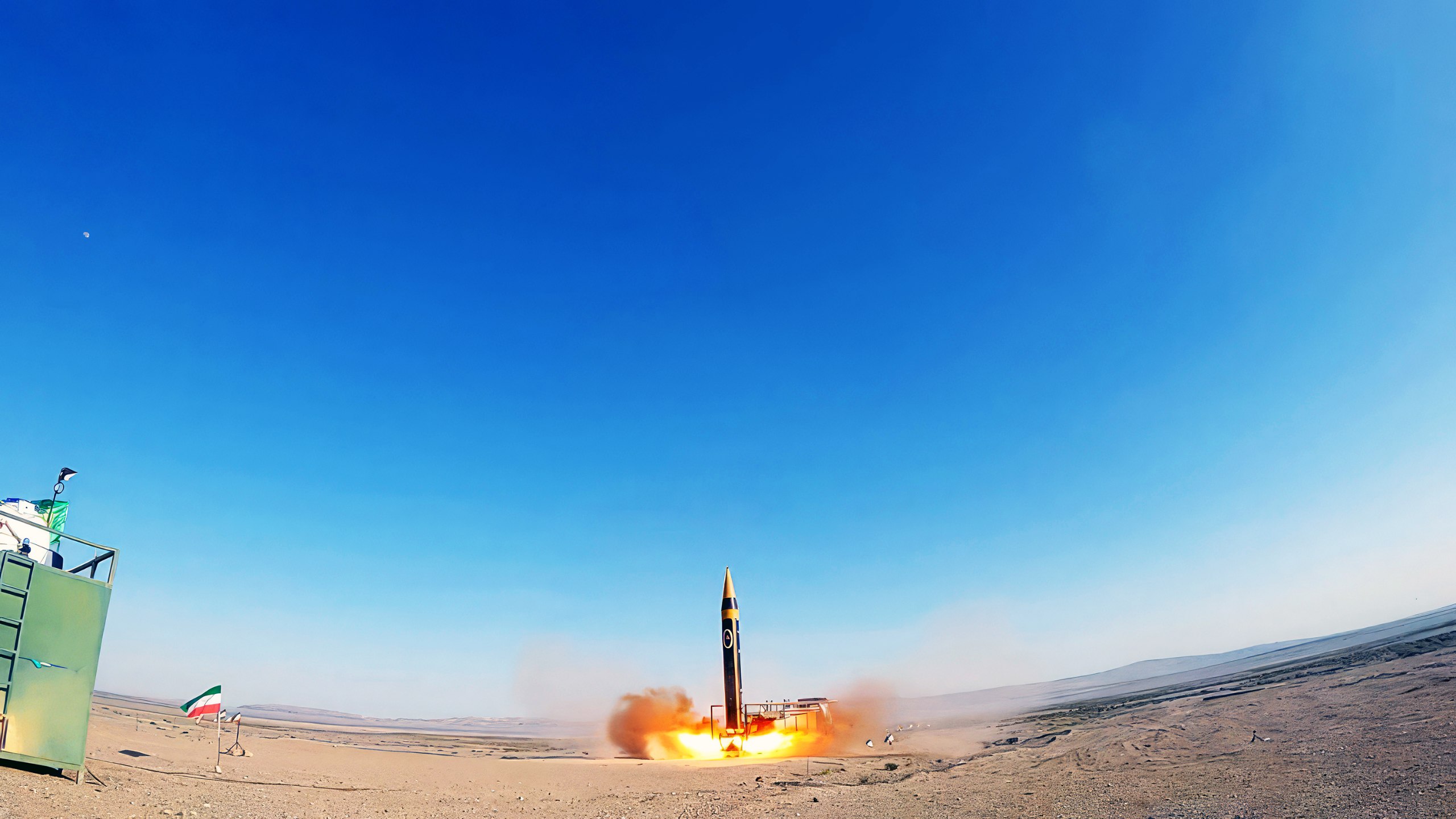
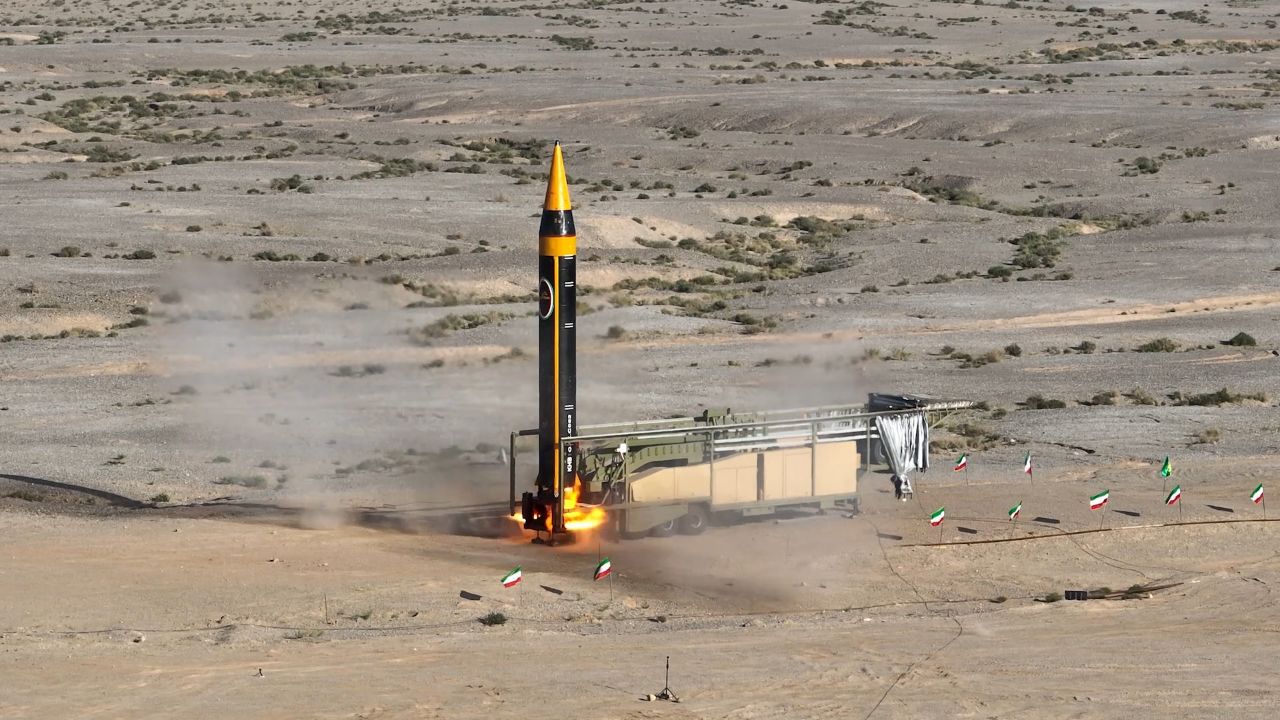
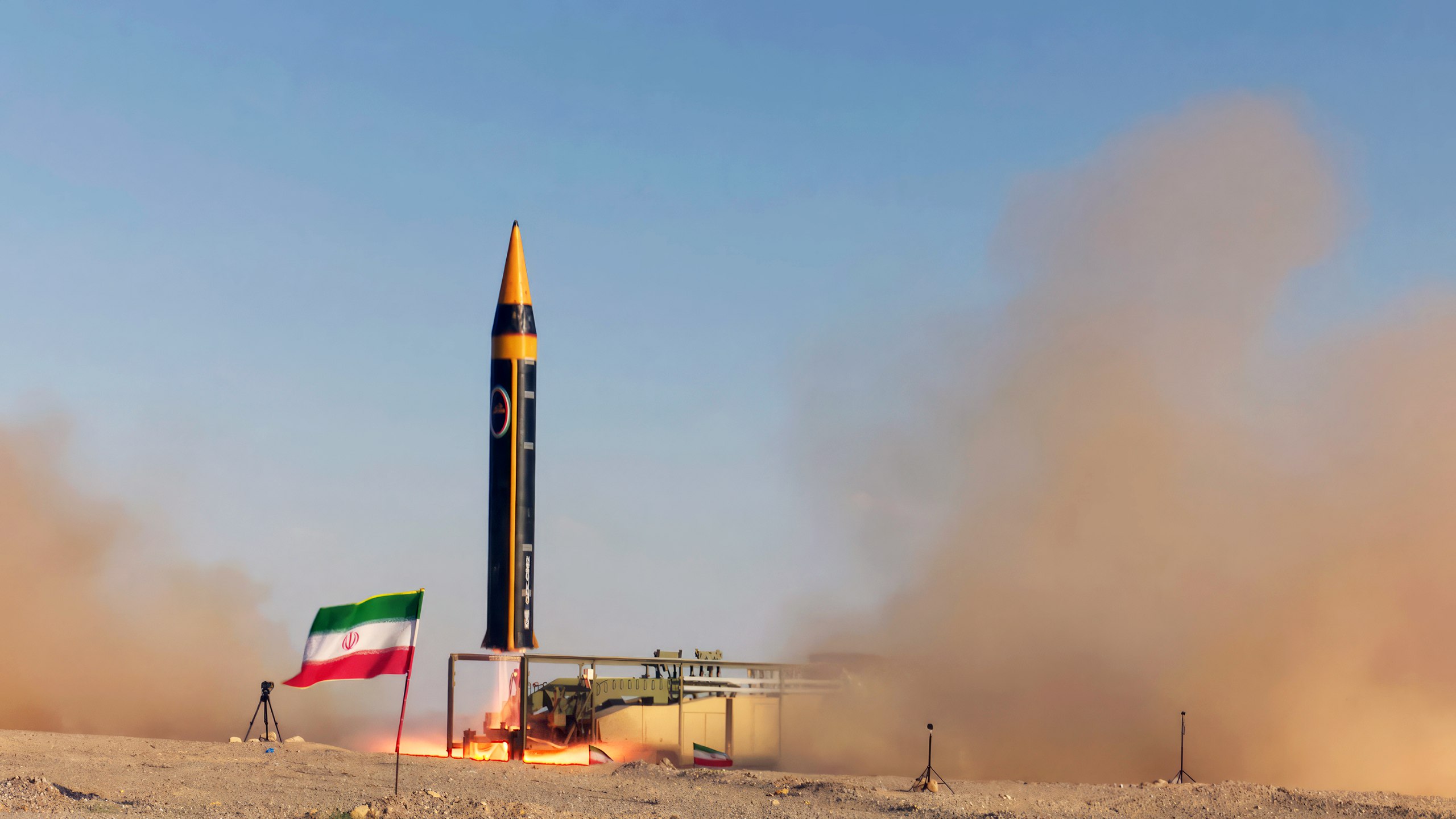
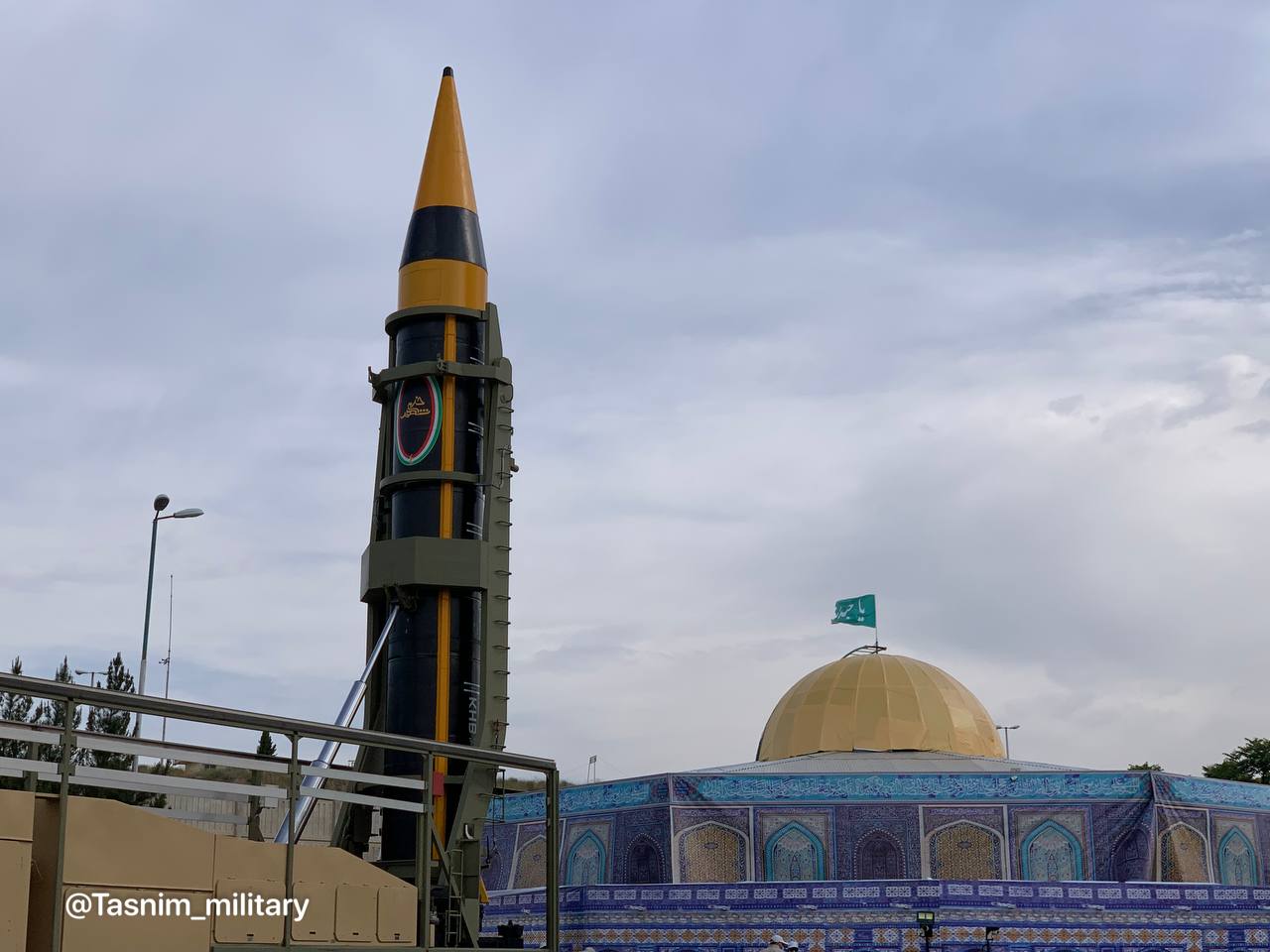
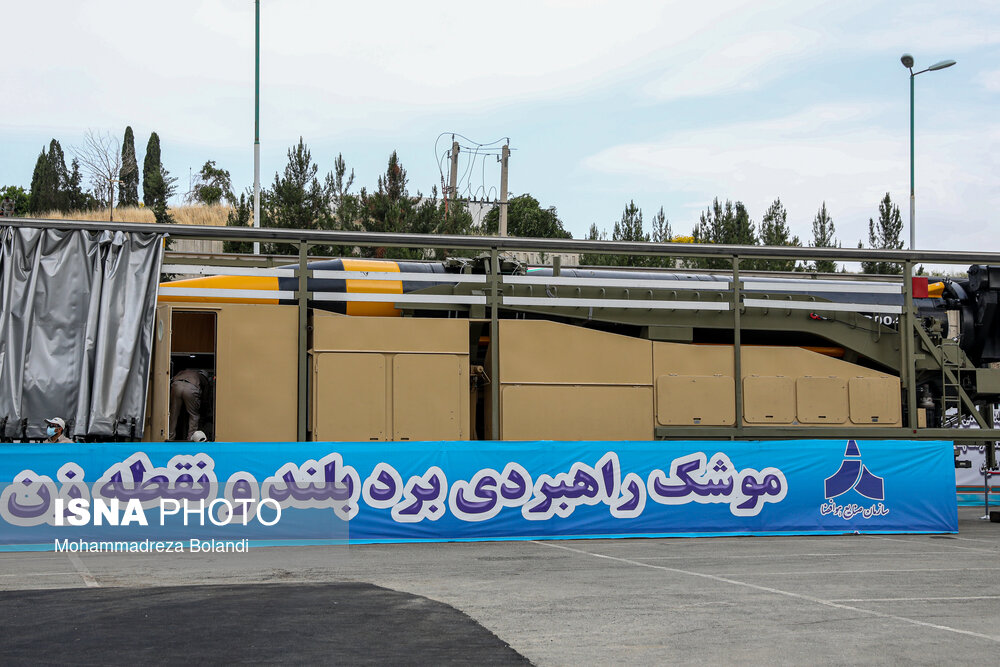
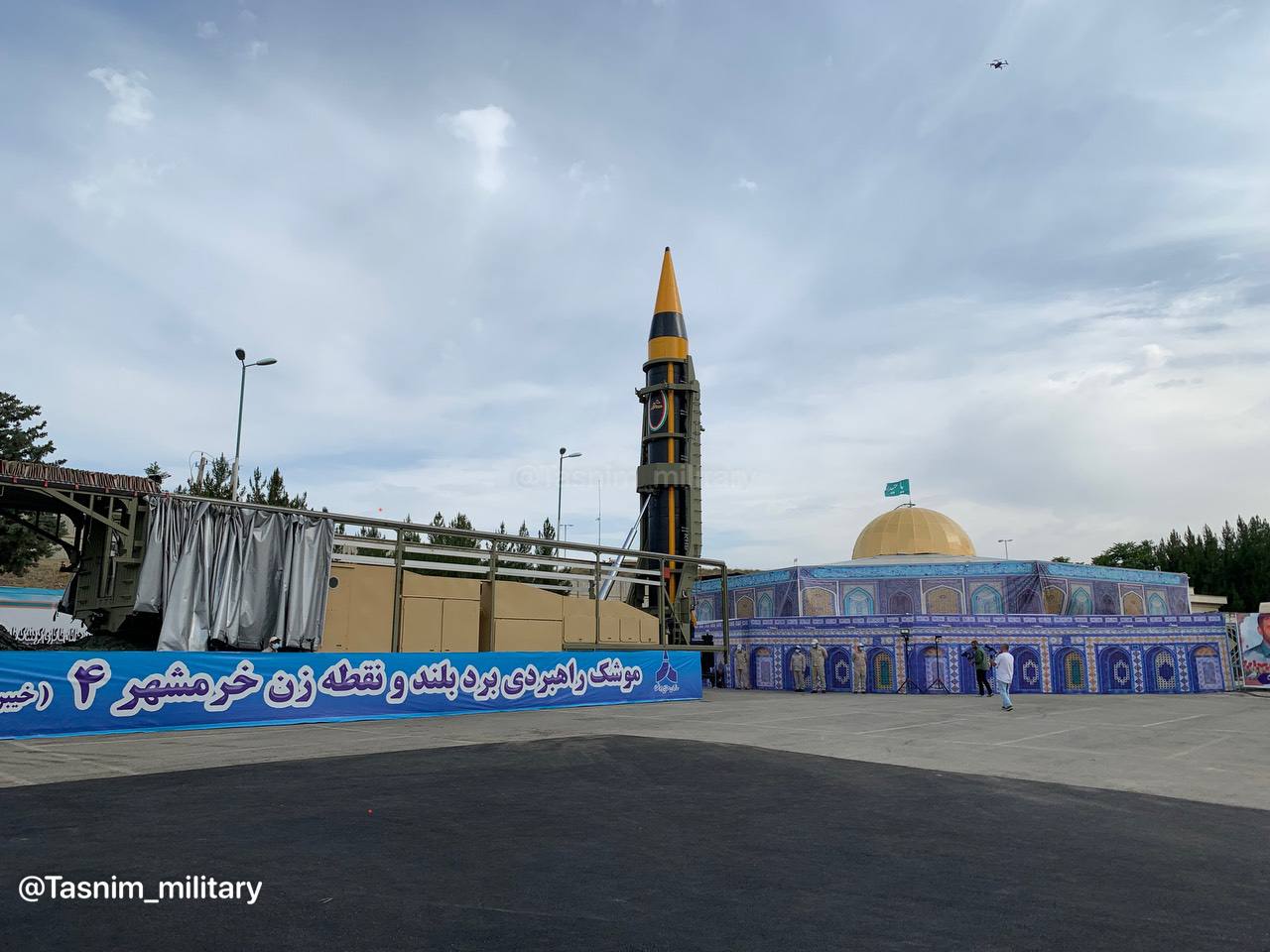
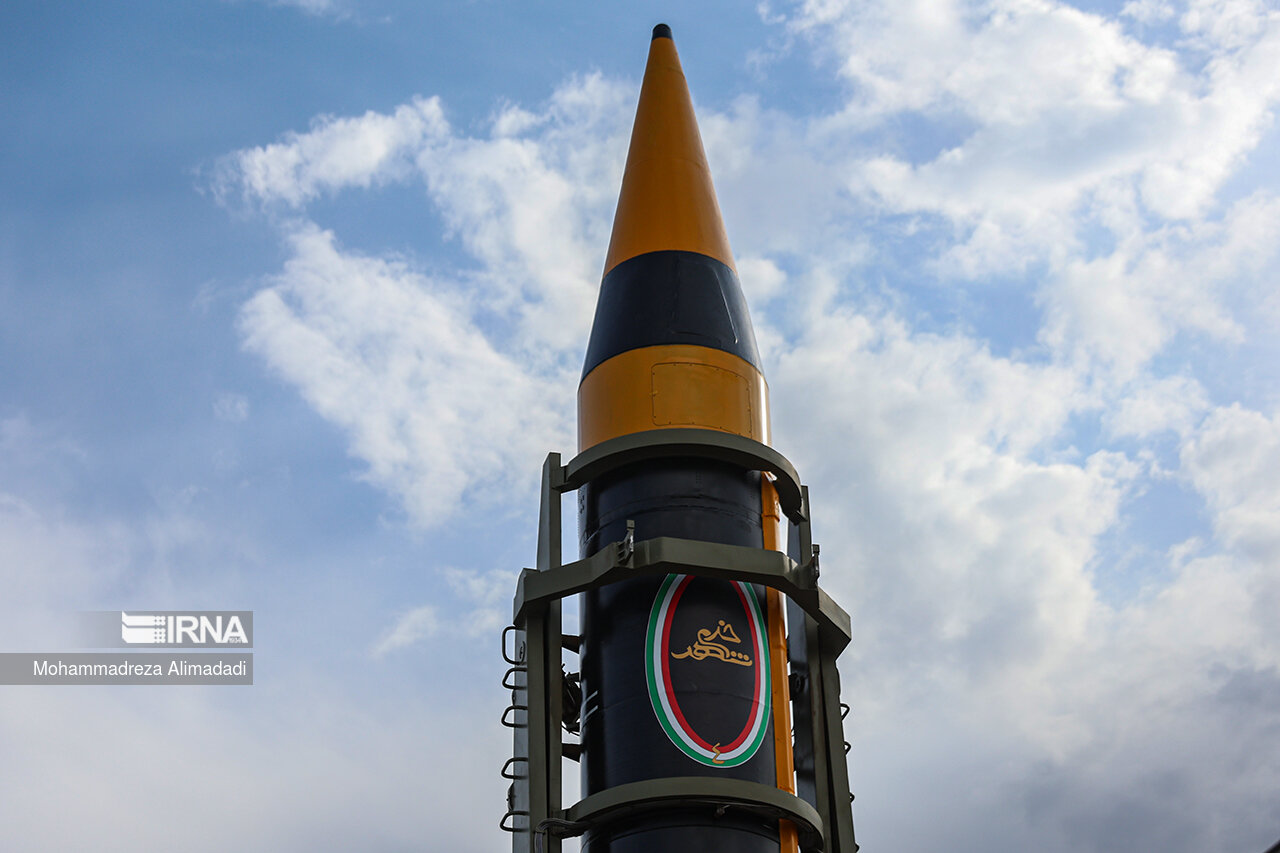
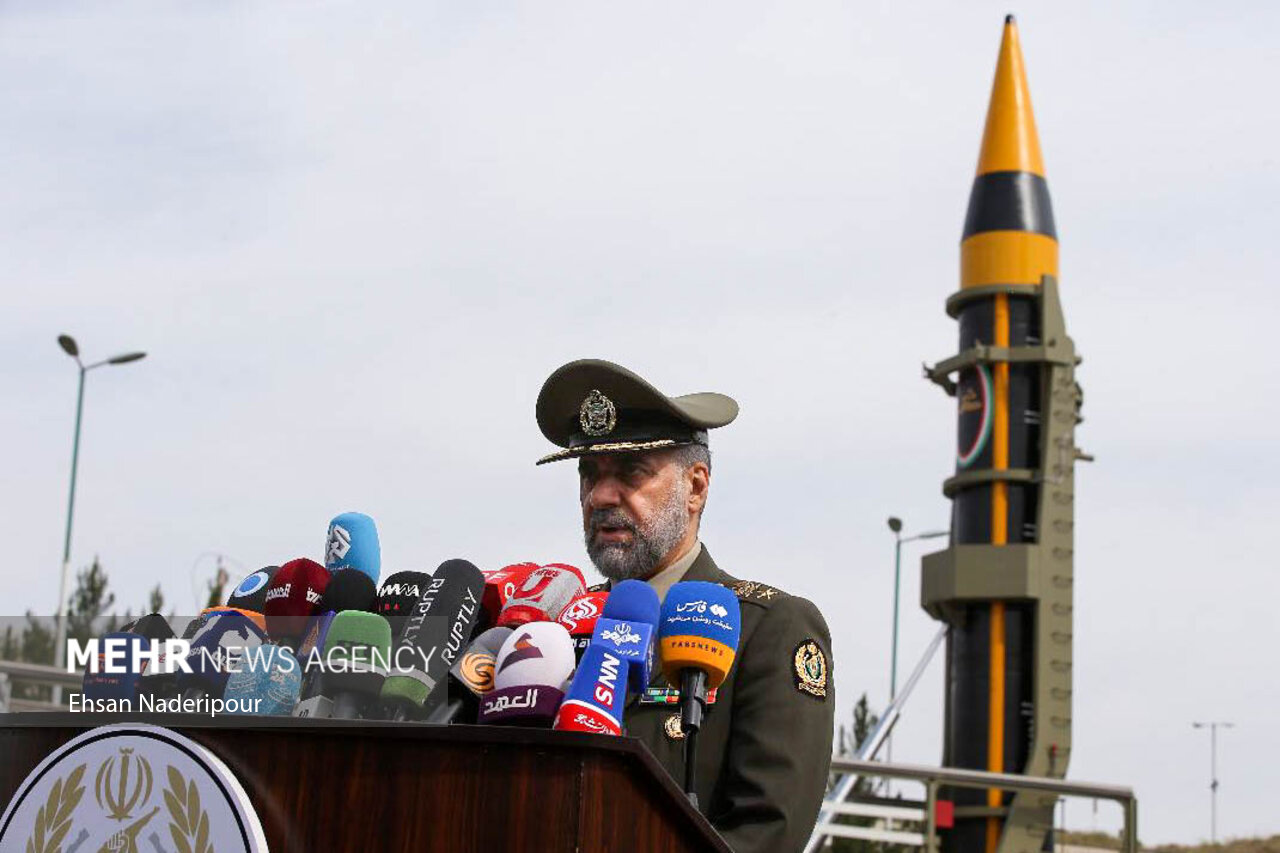
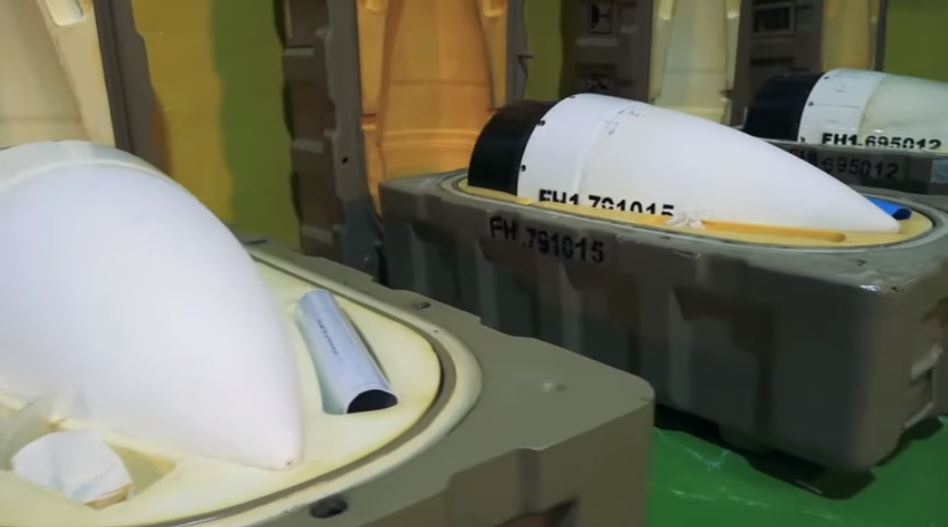
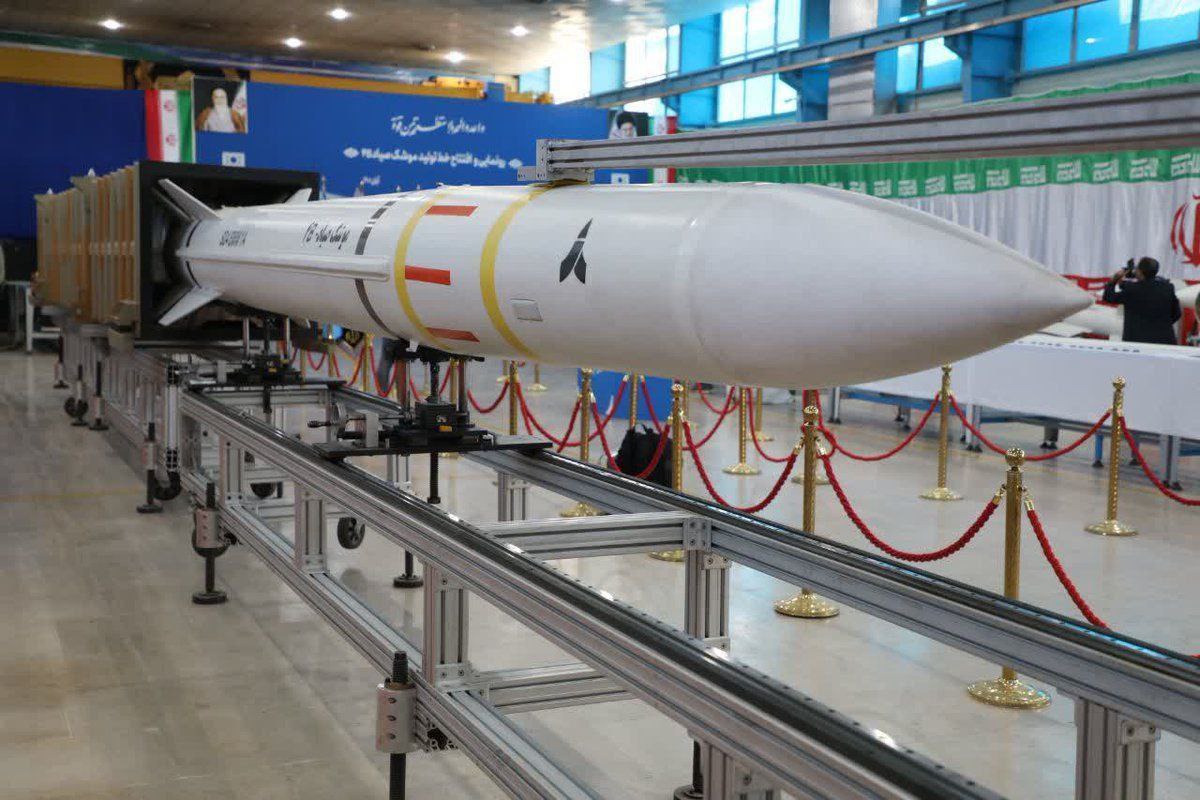
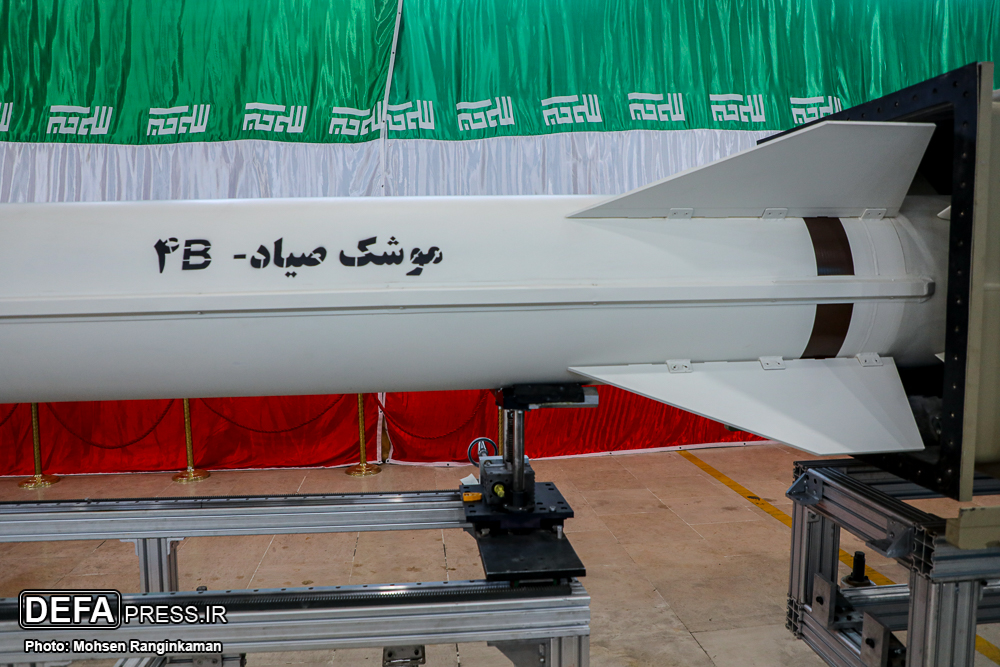
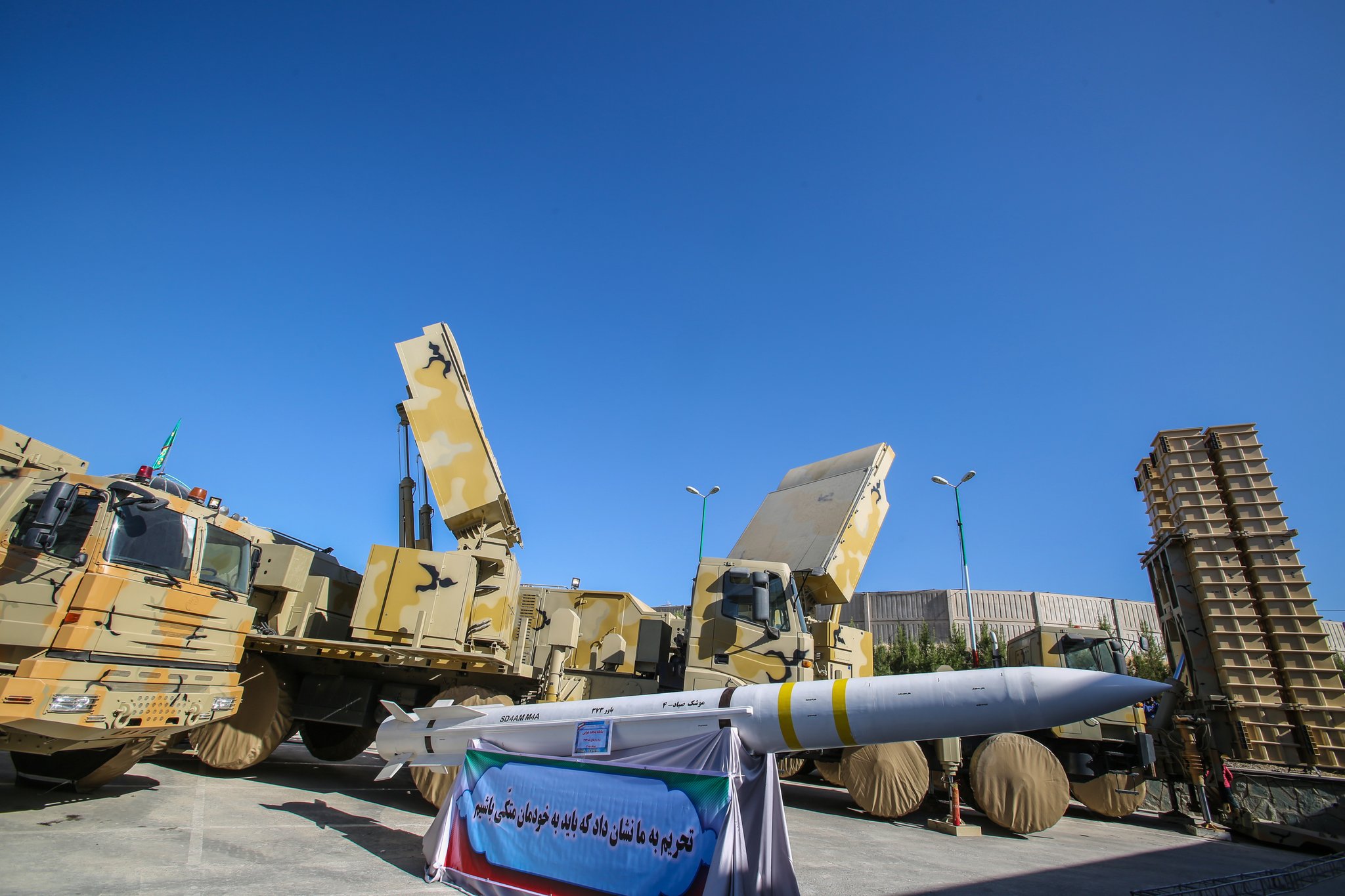
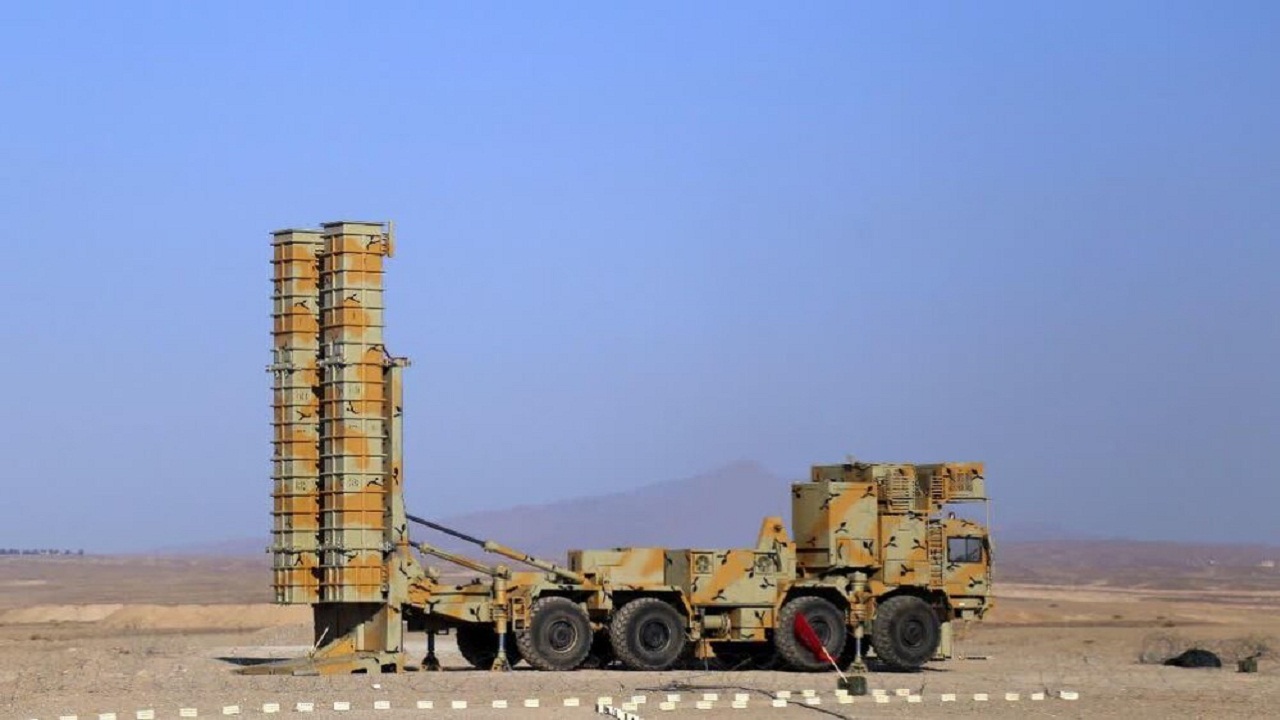
On May 25 and on the occasion of the anniversary of the liberation of Khorramshahr city in the Iraq-Iran war, the Khorramshahr 4 surface-to-surface ballistic missile with the operational name of “Khaybar” was unveiled in the presence of Mohammad Reza Ashtiani, Minister of Defense and Armed Forces Logistics of Iran.
Brigadier General Mohammad Reza Ashtiani, called the Khorramshahr-4 missile a strategic pinpoint ballistic missile with radar evasion capability. In some parts of his speech, he said the message of the unveiling of the Khorramshahr-4 missile to Iran’s friends is helping peace and stability in the region and providing comprehensive support to countries that are on the path of fighting against the arrogance system.
Khorramshahr-4 missile is considered to be the newest variant of the Khorramshahr missile series, which has undergone major changes in various parts. Among the most important of these changes, we can point out the use of hypergolic fuel and a new engine. Khorramshahr-4 is equipped with Arvand engine, one of the most advanced Iranian liquid fuel engines, in order to use hypergallic fuel.
A hypergolic propellant is a rocket propellant combination used in a rocket engine, whose components spontaneously ignite when they come into contact with each other. The main advantages of hypergolic propellants are that they can be stored as liquids at room temperature and that engines which are powered by them are easy to ignite reliably and repeatedly. Hypergolically-fueled rocket engines are usually simple and reliable because they need no ignition system. As hypergolic rockets do not need an ignition system, they can fire any number of times by simply opening and closing the propellant valves until the propellants are exhausted and are therefore uniquely suited for spacecraft maneuvering.[source]
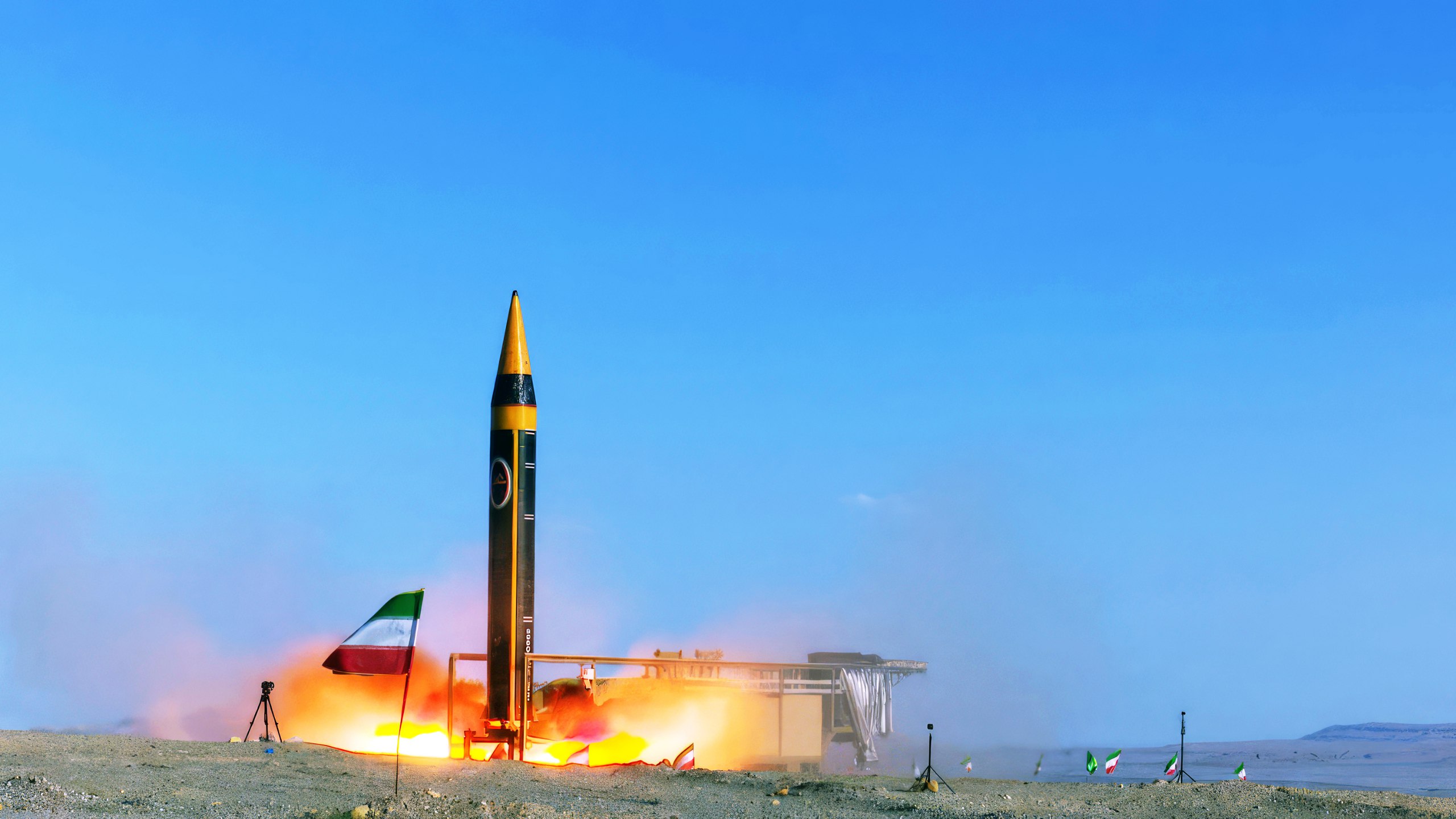
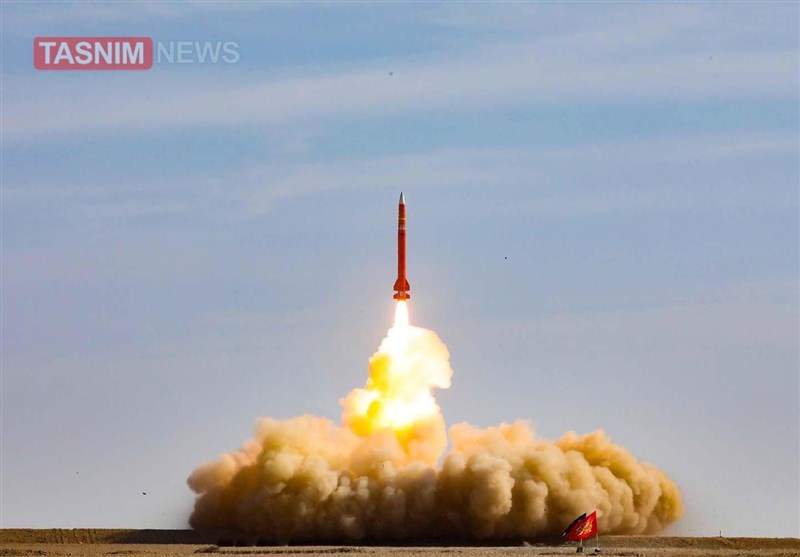
The launch moment of Khorramshahr-4 ballistic missile
Another feature of this missile is the ability to store fuel inside the Khorramshahr-4 missile for several years. Using this ability, it is possible to inject fuel into the rocket and keep it in storage for several years. For this reason, the rocket is always ready to fire and there is no need to spend long time for refueling again. Therefore, the preparation time and entering the launch position has reached less than 12 minutes.
According to statements and information provided by military sources, the range of Khorramshahr-4 missile is up to 2000 km and its warhead is 1500 kg. But based on some facts, it seems that the range of the missile is intentionally announced lower than its actual range. Experts believe that the real range of this missile is up to 4000 km.
In general, the warhead of this missile with a length of 4 meters and a weight of 1,500 kg is one of the largest and heaviest warheads produced by Iran, which is also resistant to electronic warfare. It should be noted that out of this 1,500 kg, about 1,000 kg are explosives and 500 kg are related to engine, guidance, equipment, etc. The warhead of this missile can be single and heavy or in the form of several lighter warheads, and it also uses various warheads such as thermobaric warheads. The point here is that in this warhead, guiding micromotors are used to control and adjust its trajectory outside the Earth’s atmosphere. For example, by reducing the weight of the warhead by half and increasing the amount of fuel, and with the use of guiding micromotors in the mid-phase in exoatmosphere, the range of this missile can easily be increased up to twice the declared range!
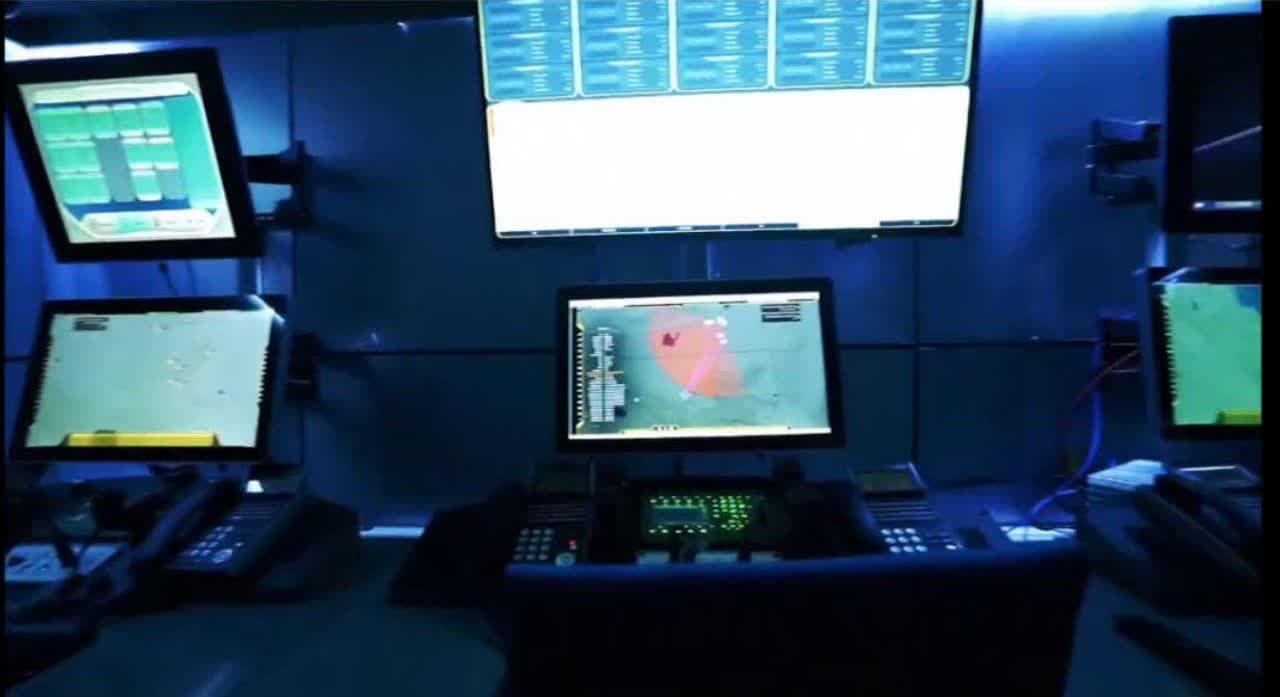
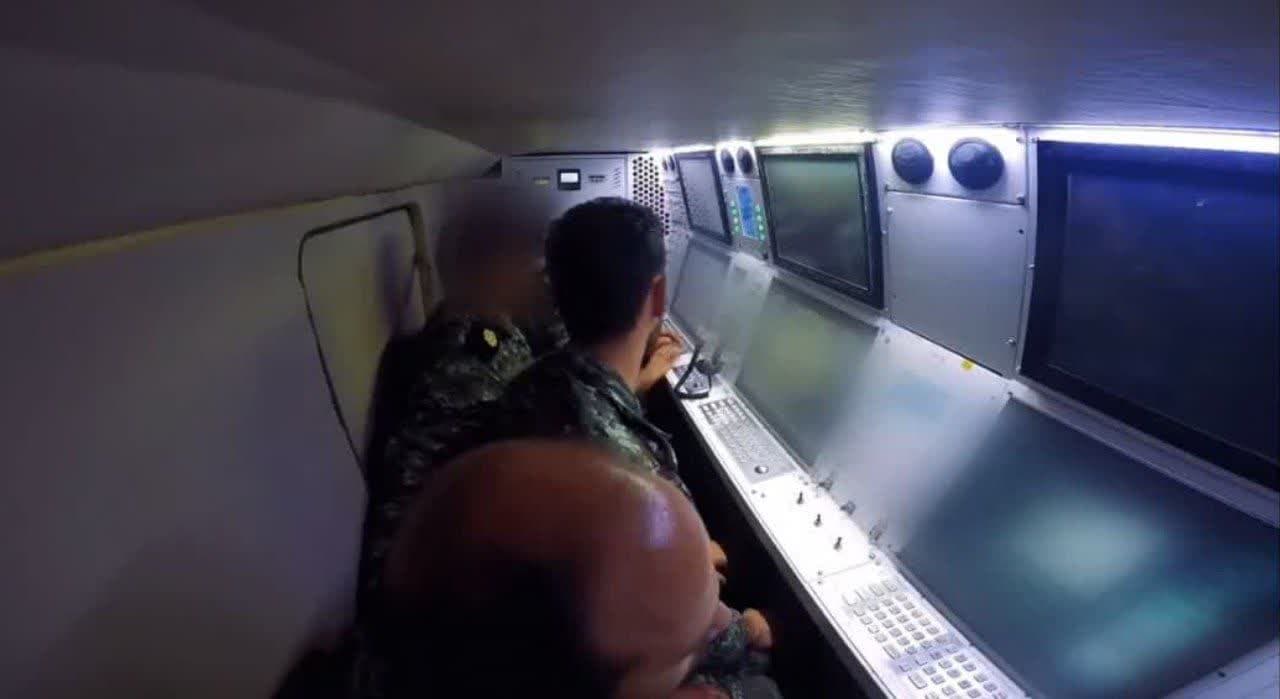
Review of the performance of launch, guidance and control in the mid-phase outside the atmosphere in Khorramshahr-4 missile
The speed of Khorramshahr-4 is Mach 16 outside the atmosphere and Mach 8 inside the atmosphere before hitting the target, and the circular probable error (CEP) of 10 to 30 meters is also expected for this missile. The speed of Mach 16 outside the earth’s atmosphere and the use of guidance engines to control and adjust the trajectory of the warhead makes it very hard for the outer space missile systems to intercept and destroy this missile. Also, the speed of Mach 8 in the final phase in the atmosphere is a very good speed, making it very difficult to detect, track and intercept by existing anti-missile systems.
One day after the unveiling of the Khorramshahr 4 missile, Deputy Defense Minister General Farahi provided more information about this missile in a television interview. According to him, unlike previously built missiles whose guidance and control system was in the atmosphere and there was a possibility of jamming and electronic interference by the enemy, guidance and control of Khorramshahr 4 is done outside the atmosphere, and its guidance and control systems are not active inside the atmosphere, and therefore, electronic warfare systems have no effect on the Khorramshahr 4 missile.
Also, in addition to this feature, this missile uses a cyber defense system and using artificial intelligence with the necessary maneuverability, it can deceive the enemy’s defense systems and escape from the enemy’s missiles. He stated the circle of error (CEP) of Khorramshahr 4 missile up to 30 meters at a distance of 2000 km, and the durability of the fuel inside the missile was also stated to be a maximum of 3 years.
Among the other capabilities of Khorramshahr 4 is the ability to use radar and optical seeker individually or simultaneously with the use of artificial intelligence to target moving sea and land targets, which is installed on the missile depending on the type of mission and target.
MIRV and MRV capabilities on Khorramshahr-4 warhead
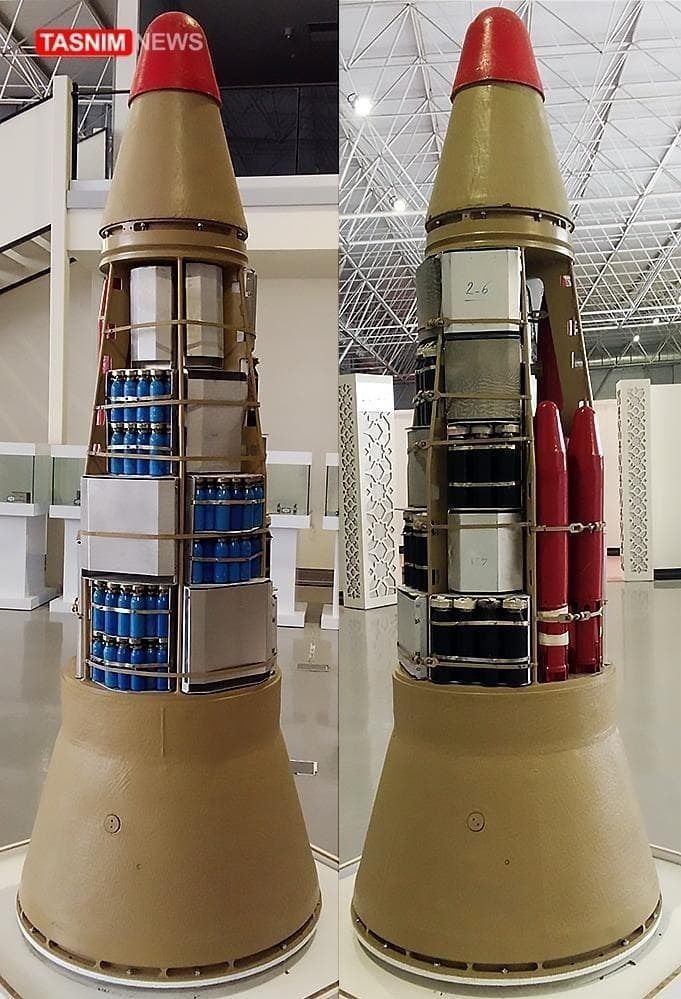
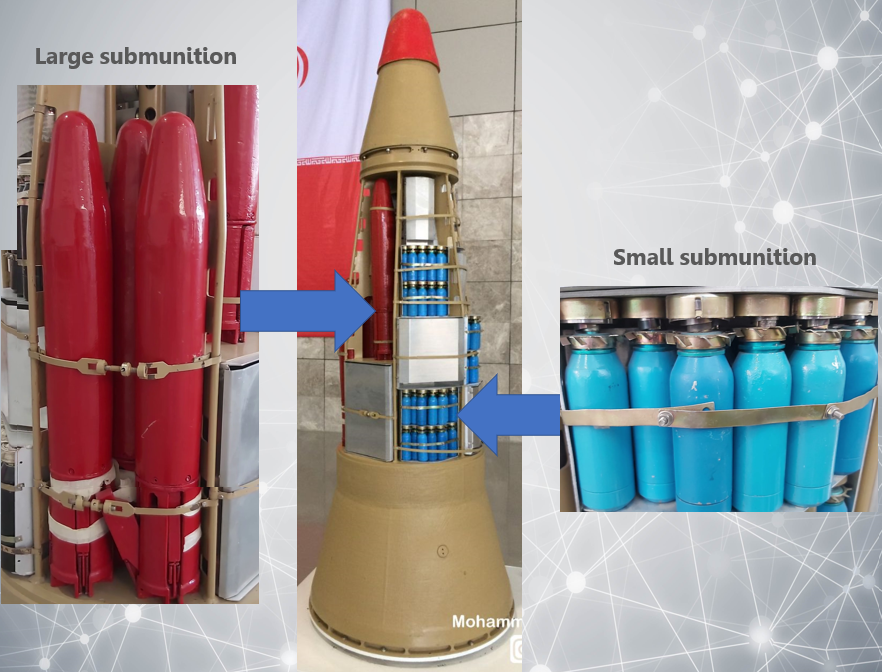
Khorramshahr-4 missile can carry multiple warheads inside its main warhead and each warhead can hit an independent target.
Multiple independently targetable reentry vehicle (MIRV) capability refers to a warhead that carries several other warheads inside, and each of these warheads can target an independent and different target. There is another type of warheads called multiple reentry vehicle (MRV), which is also capable of carrying several warheads, but the warheads do not have the ability to target independently, and all of them hit the target in a certain range and are unguided.
Currently, the US, UK, France, Russia, China and India have claimed to have MIRV missile systems. Pakistan and the Israeli regime are also suspected of developing and possessing MIRV missile systems.
In 1970, the United States presented this capability to the world for the first time with the LGM-30G Minuteman III missile. Today, Iran has also achieved this ability and has used it in the new generation of Khorramshahr missiles.
Khorramshahr-2 missile uses a warhead with MRV capability. This type of warhead, carrying a large number of rockets and bombs, is very suitable for targeting various targets such as runaways, barracks and enemy gatherings. But Khorramshahr-4 missile has gone one step further and has achieved MIRV capability. This feature is very suitable for attacking fixed and predetermined targets.
Unguided munitions in the warhead of Khorramshahr missile (MRV variant)
The main difference between the Khorramshahr-4 missile and the Minuteman III missile is the accuracy and type of munition. The American missile is designed to carry several nuclear warheads with a power of 170 kilotons of TNT and does not need pinpointing accuracy, because nuclear warheads have large explosions, and even several kilometers of error is not important for these type of missiles. However, the Khorramshahr-4 missile has been developed to carry a conventional warhead, and for this reason, each warhead must have high accuracy.
Khorramshahr 4 (Khaybar) missile will further boost the offensive and defensive capabilities of Islamic Republic of Iran. The country has been working nonstop to develop its missile capabilities in order to deal with increasing threats from the United States and the Israel regime. Tehran’s large missile program achieved a number of breakthroughs in the last few years, despite facing strict sanctions and even sabotage.
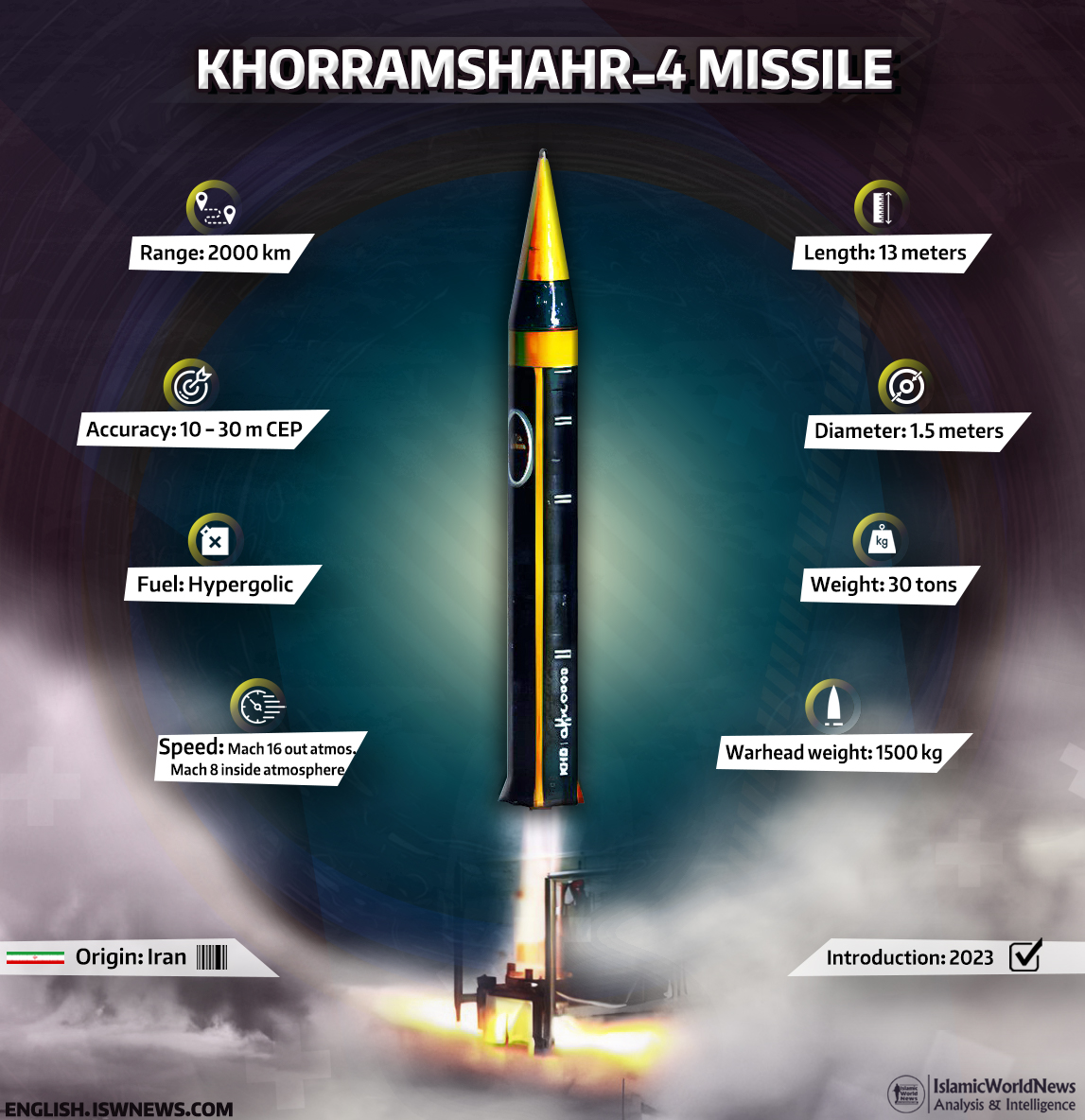
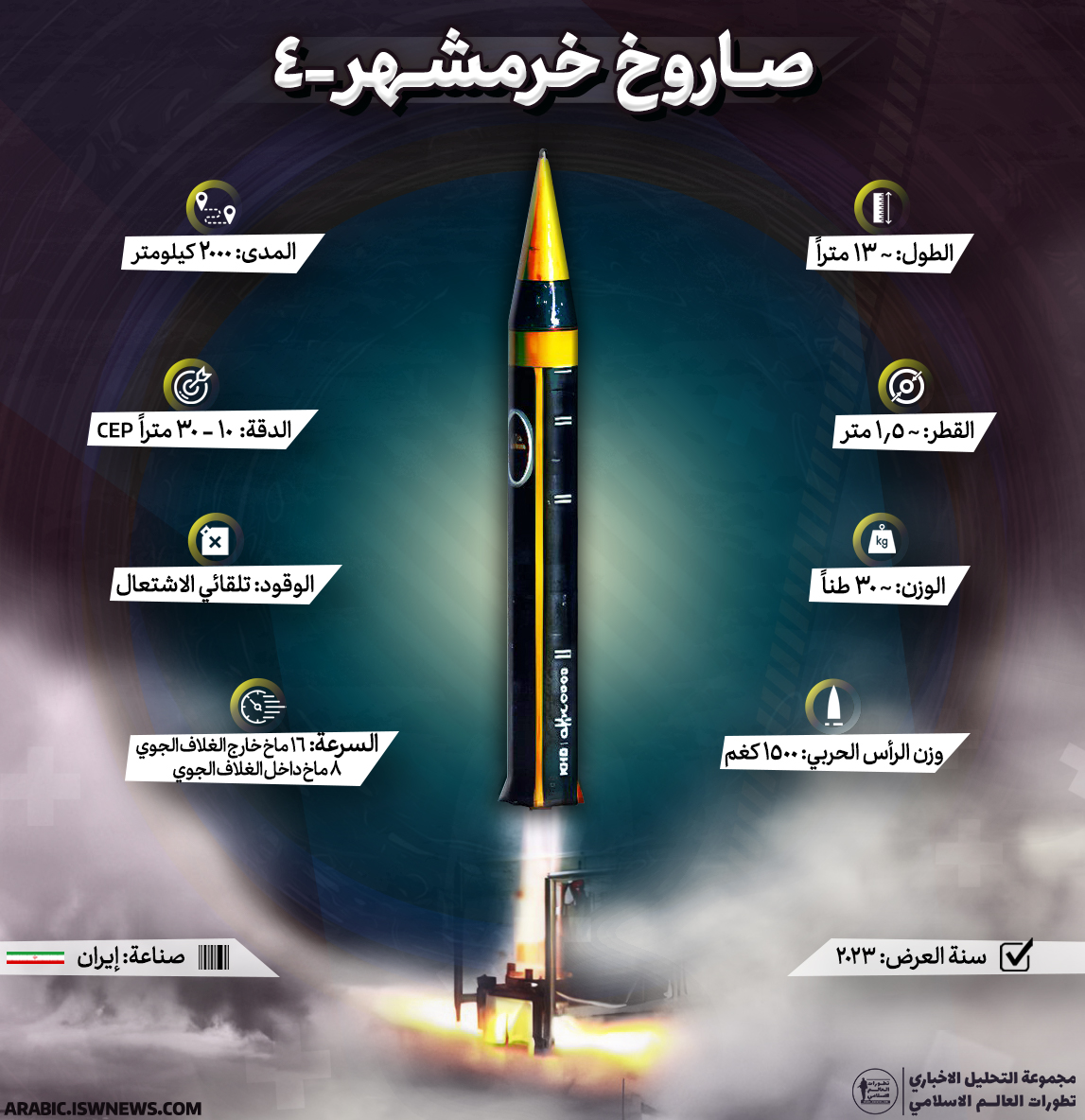
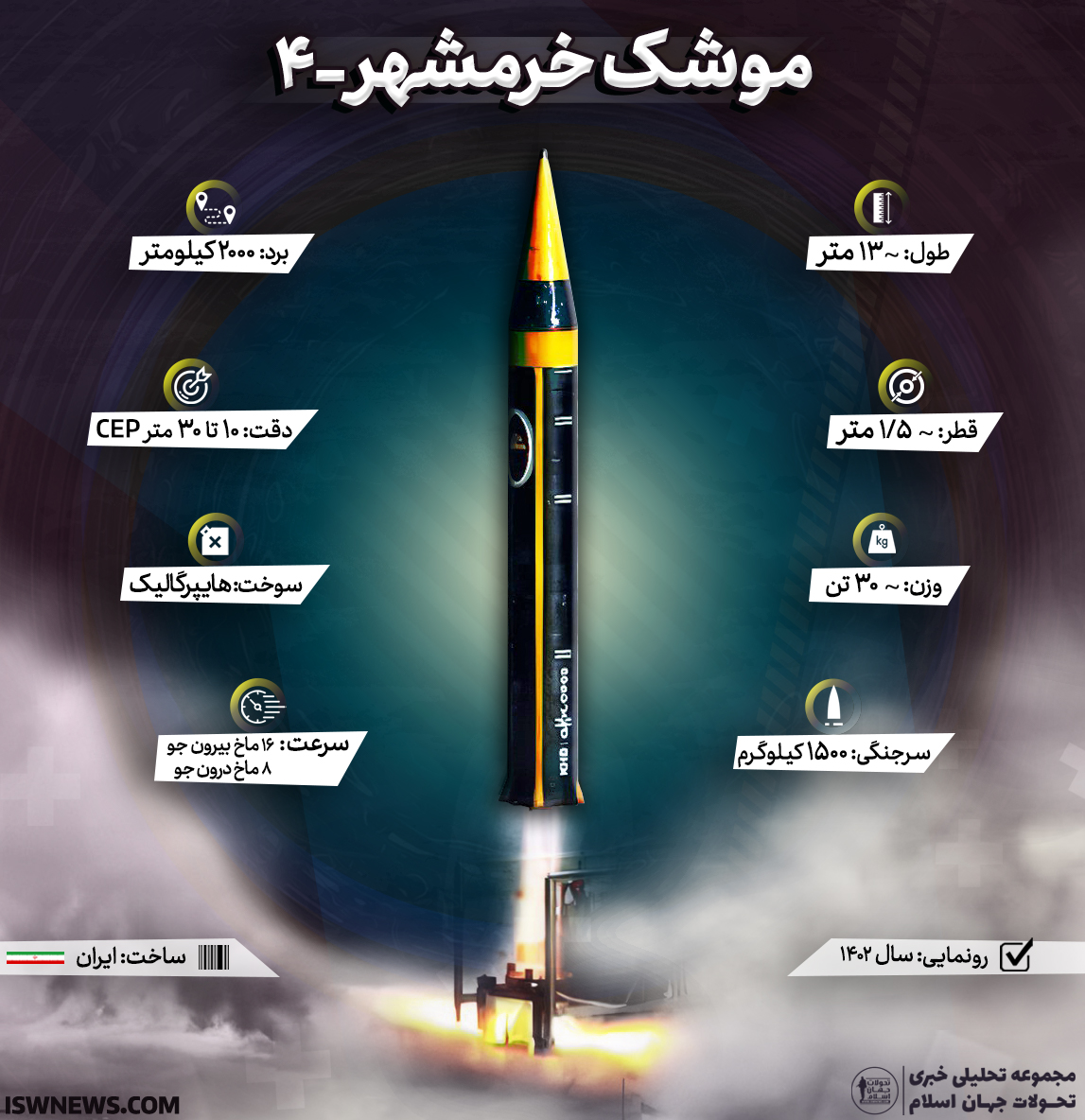
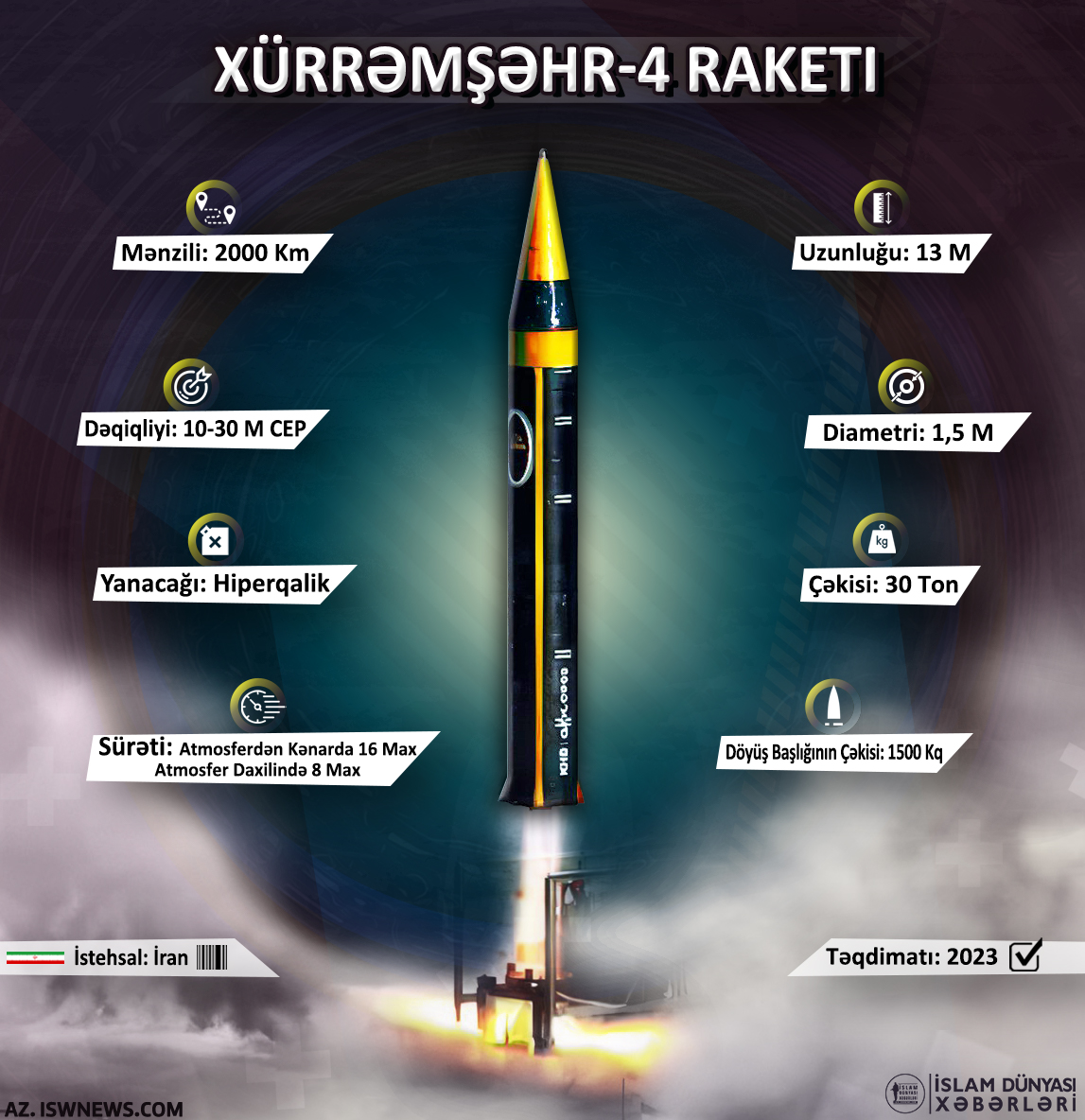
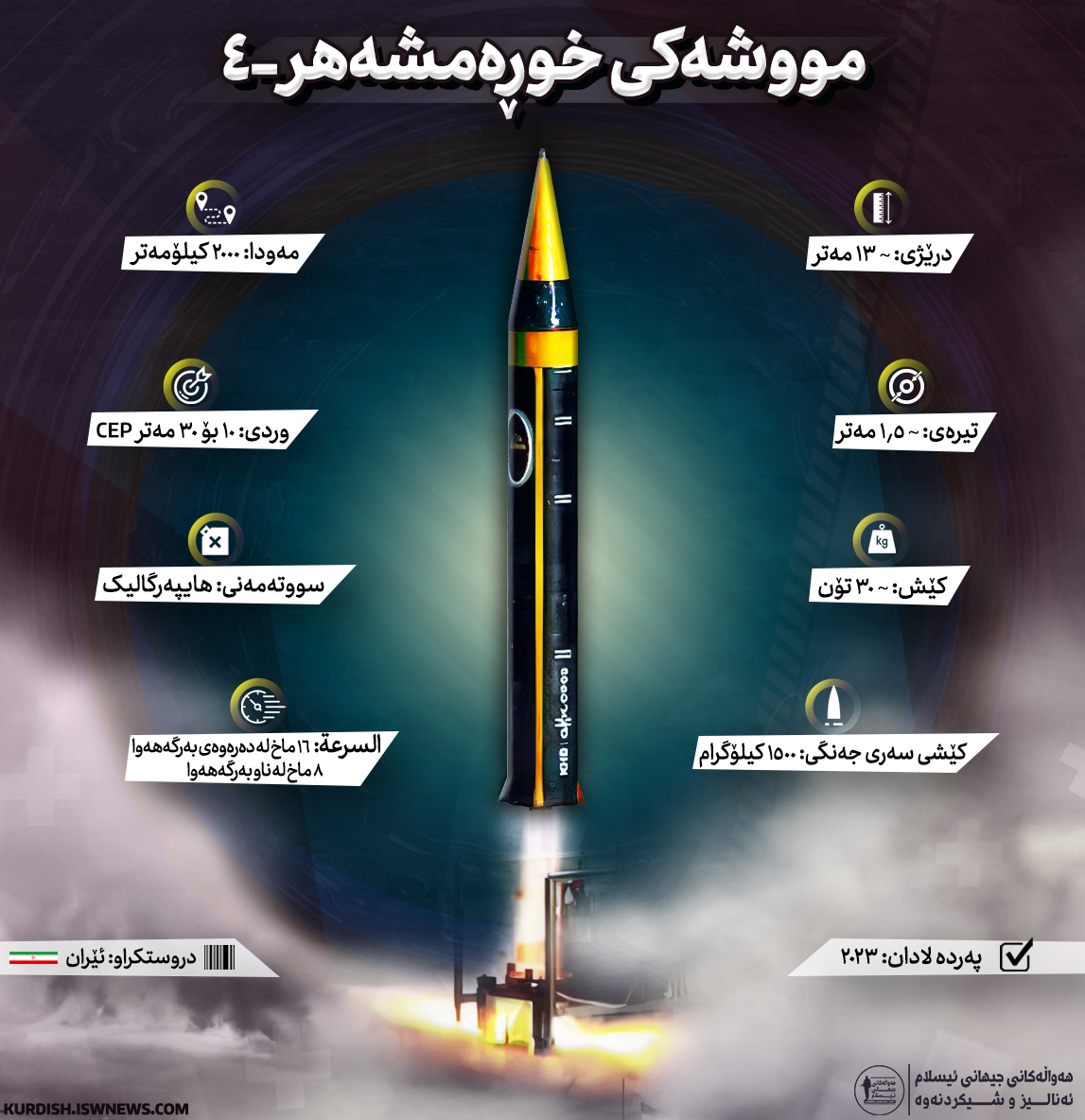
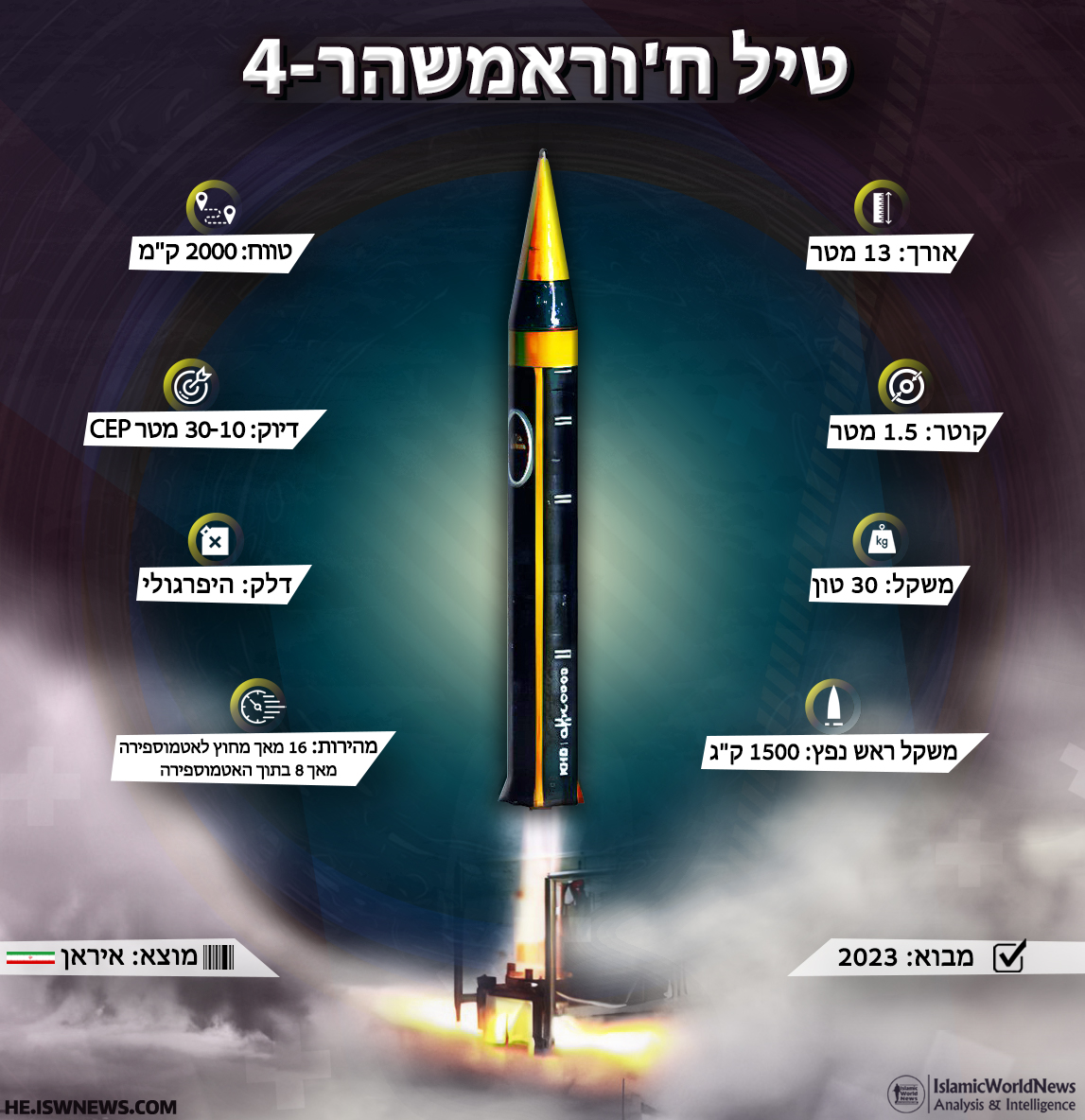
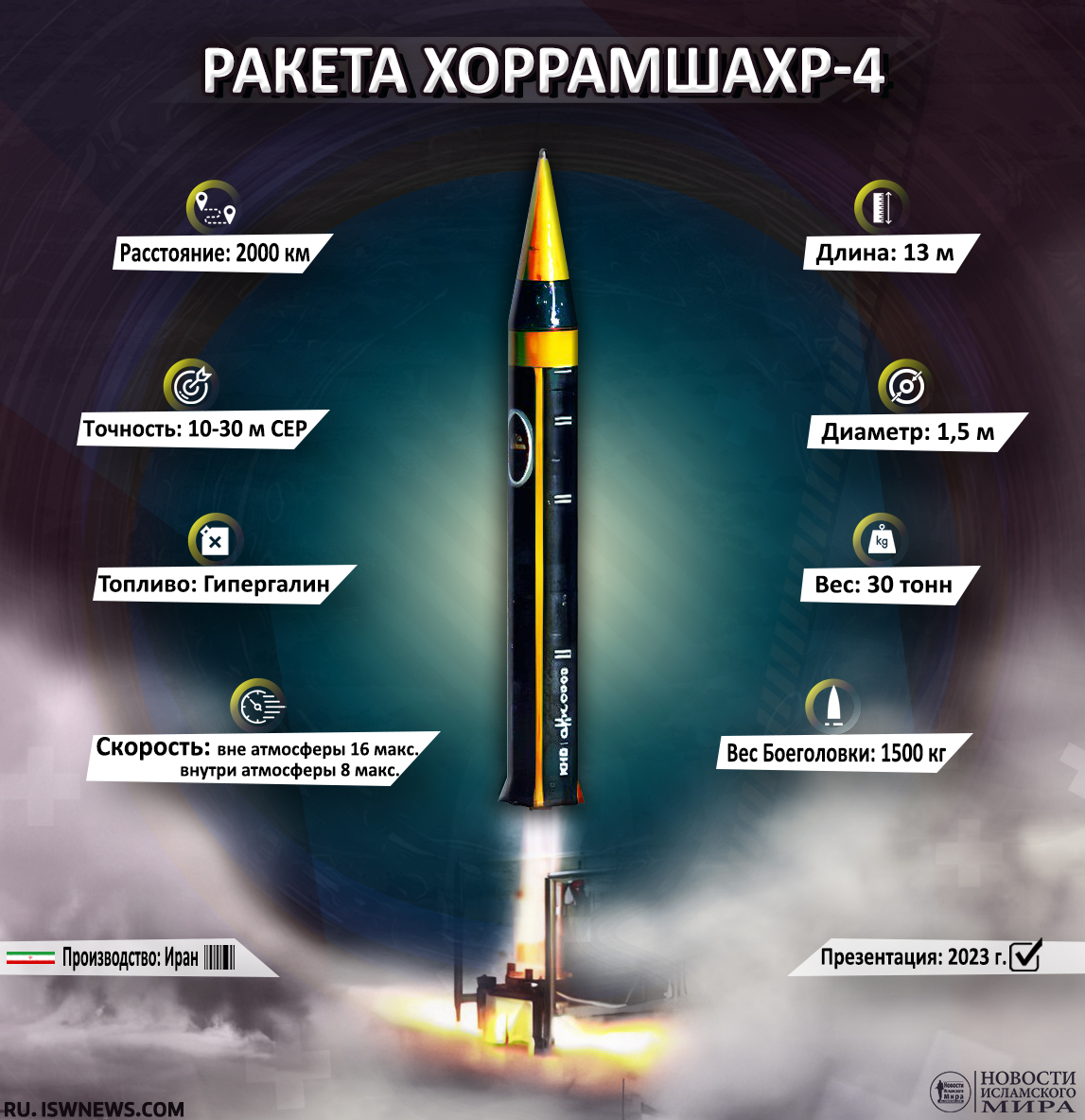
Khorramshahr 4 missile specifications: Length: ~ 13 meters Diameter: ~ 1.5 meters Weight: ~ 30 tons Warhead weight: 1500 kg Range: 2000 km (unofficial range: up to 4000 km) Accuracy: 10 to 30 meters CEP Fuel: Hypergolic – single stage Speed: Mach 16 outside the atmosphere – Mach 8 inside the atmosphere Introduction: May 25, 2023 Origin: Iran
Khorramshahr 4 medium-range ballistic missile – click to view in full size
More iamges of Khorramshahr 4 missile:
Click to view full size
“Khorramshahr 4 (Khaybar) missile” posters collection in Farsi, Russian, Arabic, Azeri, Kurdish and Hebrew:
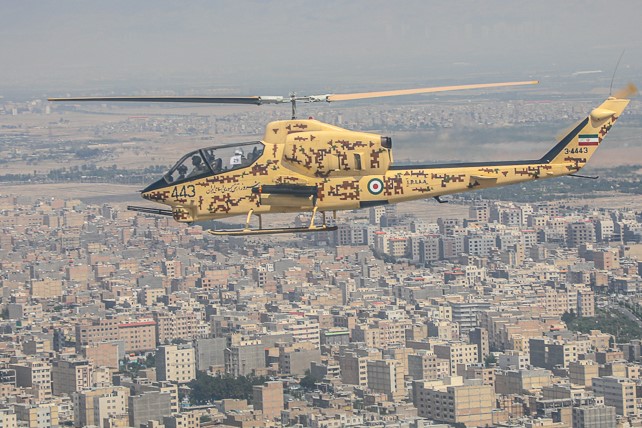
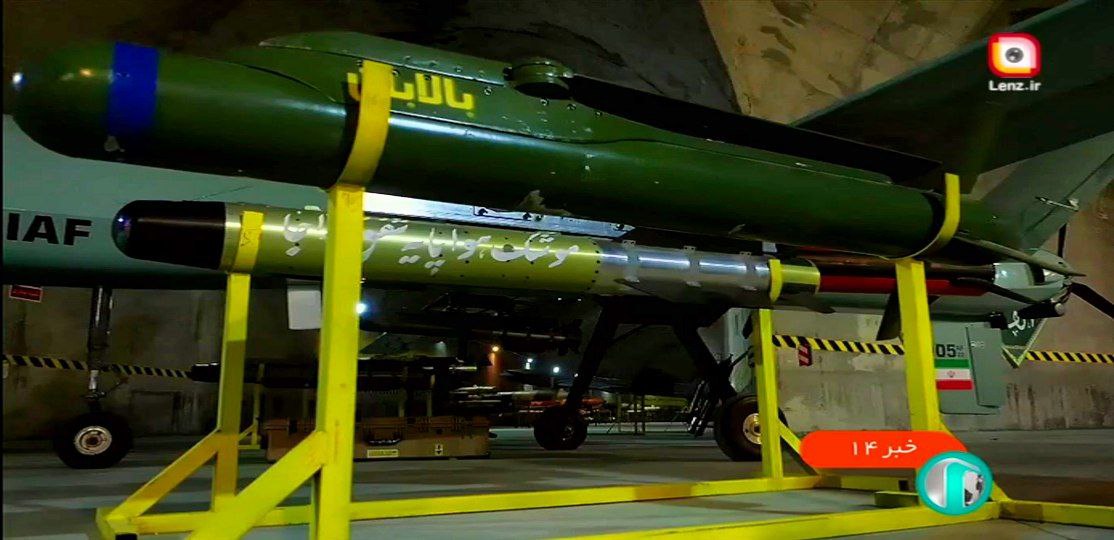
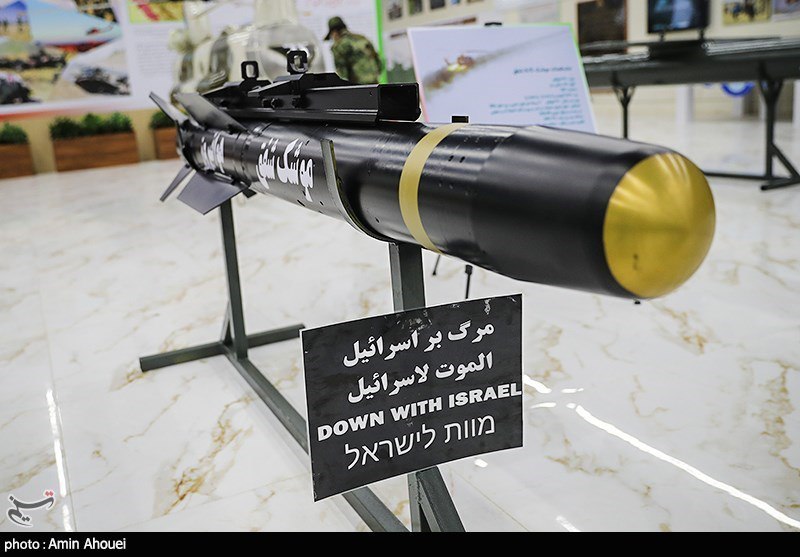
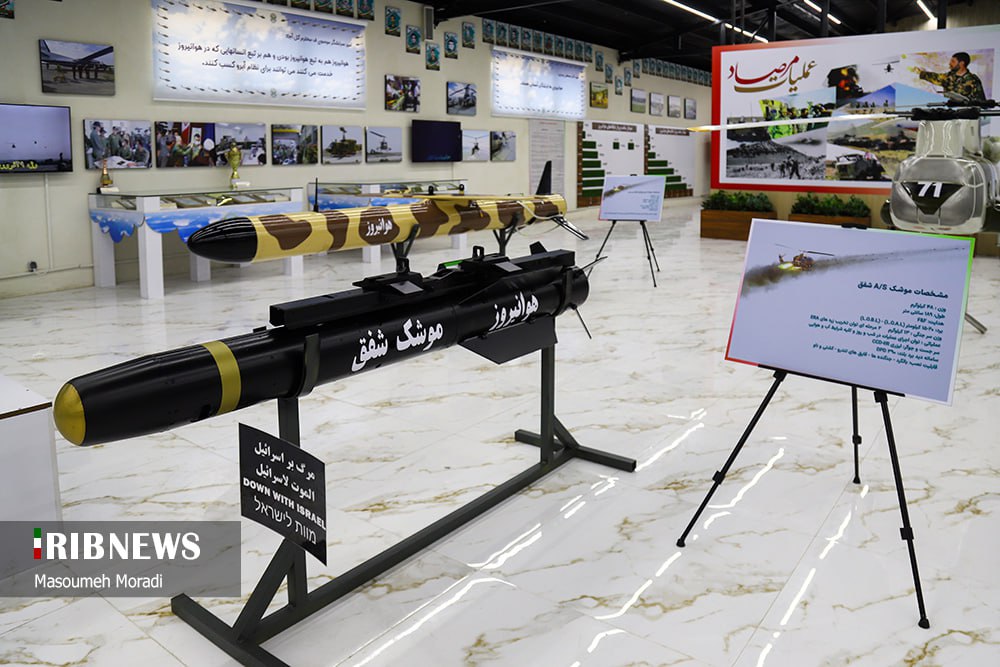
The first type of Shafagh missile was unveiled and introduced in 2014 during a ceremony in the presence of the then Defense Minister, General Dehghan. This missile (first type) has a range of 8 to 12 km with a penetration rate of 1500 mm in armor. This amount of armor penetration is considered a very good number for an air-to-ground missile. For example, Kornet ME anti-armor missile has a penetration rate of 1300 mm in rolled steel.
The Shafagh air-to-ground and anti-tank missile in its two prototypes is very similar to the Shahab Sagheb defense missile that was used in the Ya Zahra (S) and Herz-9 air defense systems. Ya Zahra (S) air defense system, which was unveiled in 2013, is modeled after the French Cortal air defense system, which was captured by the Islamic Republic of Iran Army during the Iraq-Iran war. This French air defense system is also produced in China under the name FM90 or HQ7.
Cortal air defense systemFM90 air defense systemYa Zahra air defense systemClick to view full size
The Shahab Sagheb missile is also made from the R440 missile belonging to the Cortal defense system and is very similar to it.
R440 missile belonging to the French Cortal systemShahab Sagheb missile belonging to the Ya Zahra (S) air defense systemClick to view full size
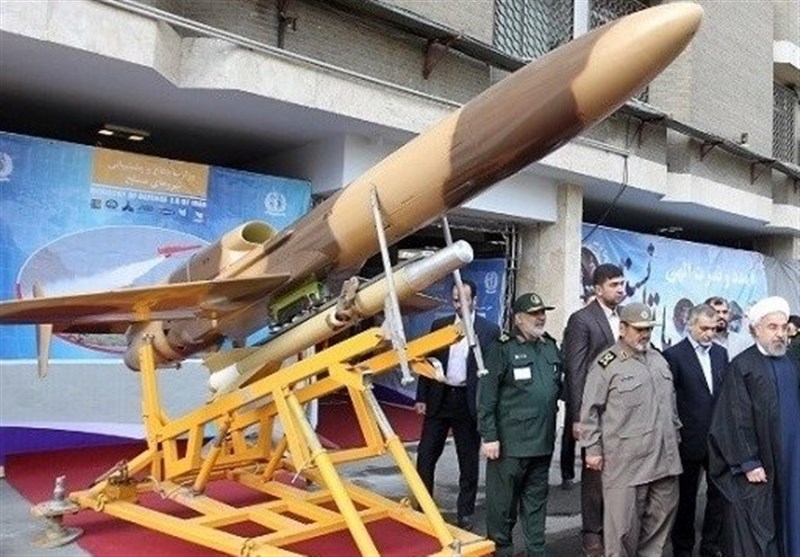
Prototypes of Shafagh missile: As mentioned, the first Shafagh missile was installed on the Army’s Air Force helicopters in 2014, but before that in 2013, this missile was seen on the Karrar drone. In those years, it was stated that the Shafagh missile has a range of 8 to 10 km and uses an infrared seeker (IIR) in the last stage to attack targets independently; So Shafagh is a fire-and-forget missile capable of penetrating 1 to 1.5 meters of armor. The prototypes of the Shafagh missile have an accuracy of more than 30 cm at a distance of 10 km and have a speed equal to Mach 2 to 2.7 depending on the release height and the distance to the target. The high speed and fire-and-forget ability turned Shafagh missile into a very dangerous one, because the tanks’ defense system has very little reaction time to deal with this missile and the helicopter can quickly move away from the danger zone after firing.
Another variant of Shafagh missile was unveiled again in 2019 with the same name as Shafagh. The main difference between the two missiles unveiled at a different time interval was the appearance of the front fins. In the first prototype, Shafagh lacked the front fins, but in the secondary prototype, keeping the front fins, the Shafagh missile was completely similar to the Shahab Sagheb missile. Structurally, the maximum range of the second Shafagh missile was increased to 12 km. The Shafagh missile has a maximum speed of Mach 2 to 2.7 in both variants.
The first Shafagh missile unveiled in 2014The second Shafagh missile unveiled in 2019Shafagh missile seen in 2013Click to view full size
The main difference between the Shafagh missile in the first variant and the Shahab Sagheb missile was the removal of the front fins in the Shafagh missile, but in the secondary variant, the Shafagh missile can be distinguished from its IIR seekers compared to the Shahab Sagheb.
Safagh 1 and 2 specifications: Length: 2.9 meters Weight: 60 kg in first variant – 84 kg in second variant Maximum speed: Mach 2 to 2.7 Range: 8 to 12 km in second variant
The enhanced Shafagh missile: The enhanced Shafagh (شفق بهینه) missile was unveiled as a new generation of Shafagh missile in 2022. The new Shafagh missile has been described as a two-stage missile with a 13 kg warhead. This missile with a length of 1.89 meters and a weight of 50 kg is capable of destroying all types of tanks, personnel carriers, concrete trenches, floats and defense infrastructures in all weather conditions, day and night.
Due to the aerodynamic redesign and probably the solid fuel engine propulsion of the Shafagh missile, its range has increased to 20 km. There is only one other anti-armor missile in this range, and that is the Nimrod 2 missile manufactured by the Israeli Aerospace Industries. Also, in terms of appearance, Shafagh missile can be compared with Nimrod missile. The main difference in appearance between Shafagh and Nimrod is in the middle fin of these two missiles, which in Shafagh is a trapezoid with two slanted sides, and in Nimrod this trapezoid is with one slanted side and one straight side. In terms of length, the Nimrod is one meter longer and its range is up to 36 km.
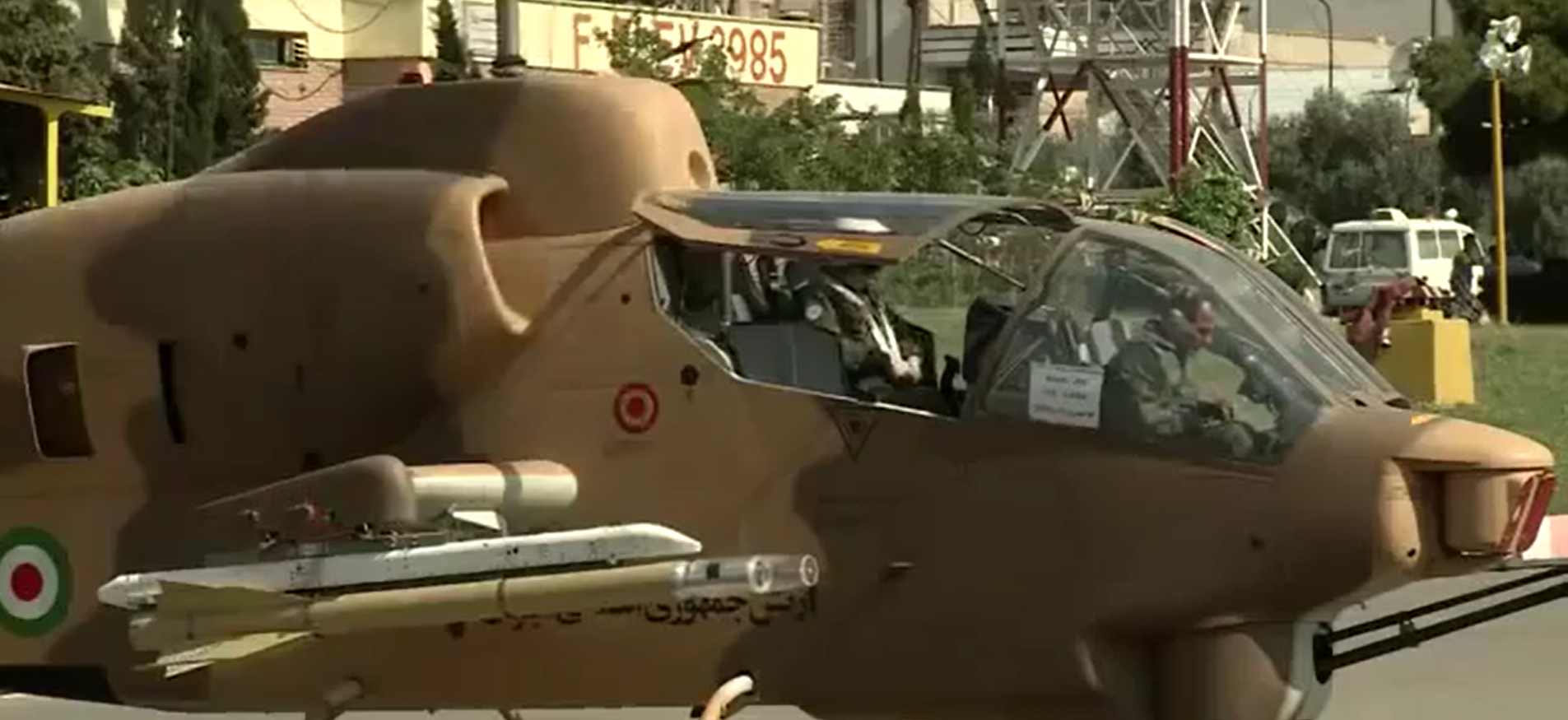
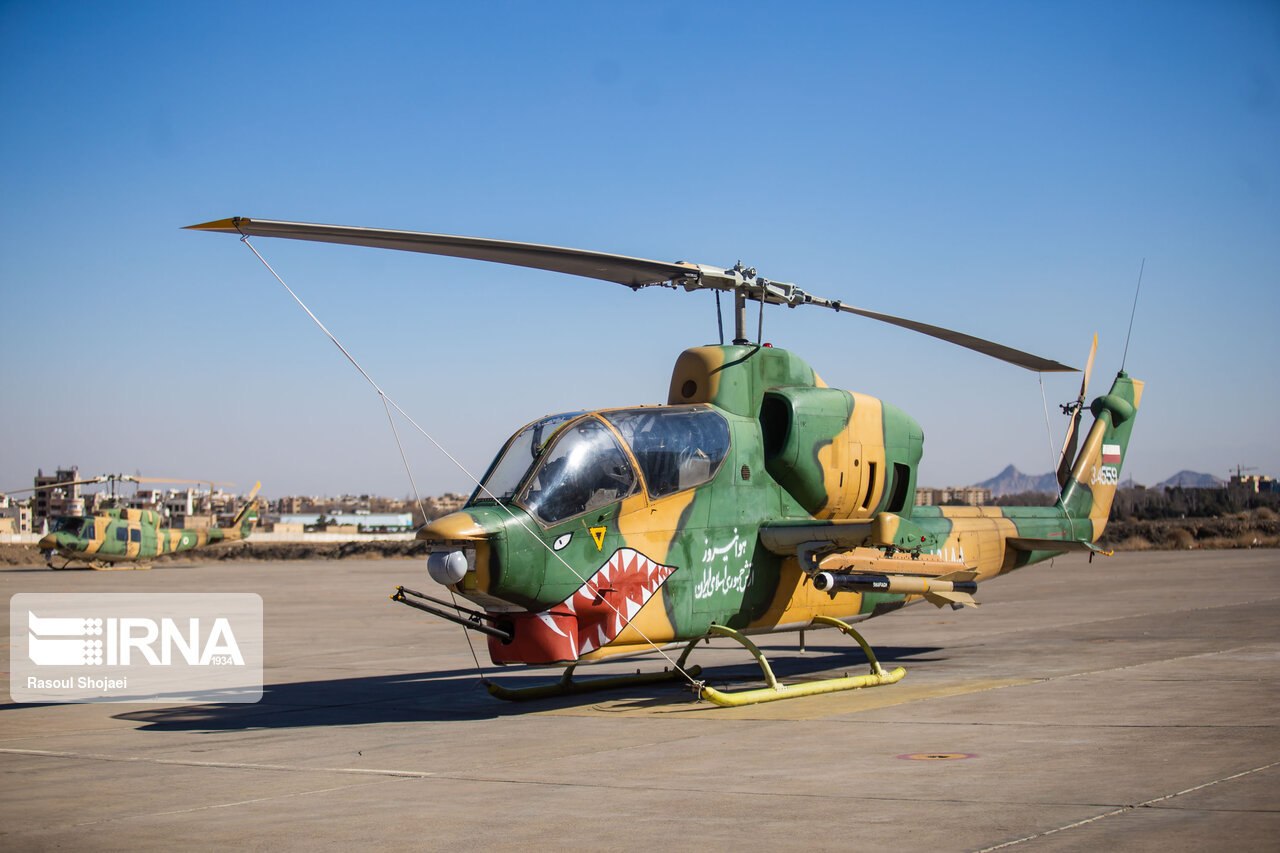
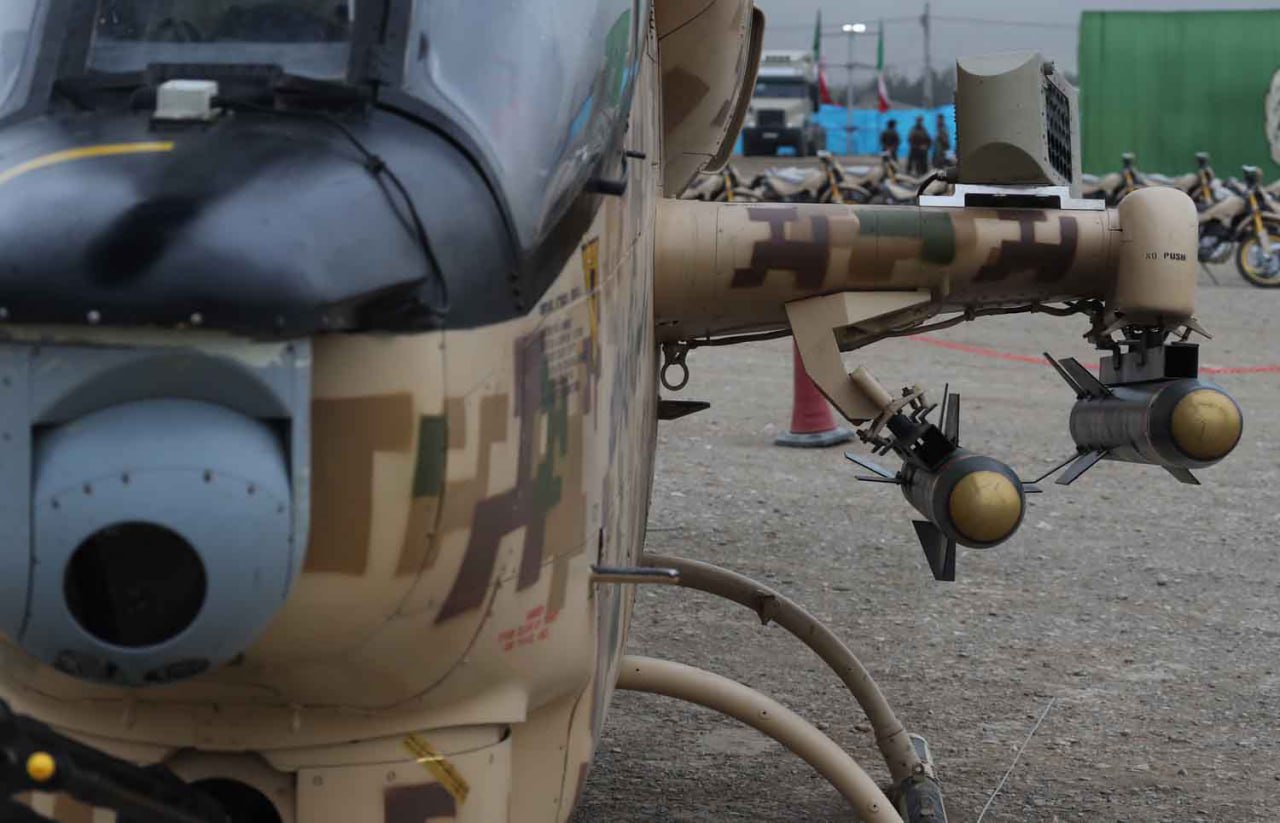
Shafagh air-to-surface missile on Cobra helicopterNimrod air-to-surface missileClick to view full size
The maximum speed of Shafagh (enhanced) missile is 750 meters per second. The probable circular error (CEP) rate of this missile is 20 cm. The Shafagh (enhanced) missile which is a fire-and-forget missile, uses an infrared seeker and laser guidance to accurately target and hit targets.
Shafagh (enhanced) missile specifications: Type: Fire-and-forget Introduction: 2022 Length: 1.89 meters Diameter: 20 cm Weight: 50 kg Warhead weight: 13 kg Speed: 750 meters per second Range: 20 km Guidance: Infrared homing, semi-active laser Origin: Iran
Shafagh air-to-surface missile – Click to view full size
More images of Shafagh 1 and 2 missiles and the enhanced Shafagh:
Click to view full size
Shafagh air-to-ground missile posters in English, Russian, Arabic, Azeri and Hebrew:
The Pantsir air defense system uses the general design concept of the Tunguska M1 system, which is a combination of air defense missiles and a 30 mm anti-aircraft gun. The philosophy of this type of design is to fight against helicopters that quickly reduce their height after firing and hide themselves from the radar, for this purpose a combination of defense missiles and anti-aircraft cannons is considered for quick reaction at different distances and in different situations.
The effectiveness of the AGM-88 HARM anti-radar missiles produced by the United States and the ALARM anti-radar missile produced by the United Kingdom against the old Soviet systems based in Iraq in the First Persian Gulf War showed that long and medium range defense systems need protection. Iraq’s defense systems were destroyed in the first few days of the Desert Storm operation due to anti-radar missile attacks. These missiles destroyed the defense systems’ radars without any obstacles. The operation showed that if a fighter jet equipped with an anti-radar missile gets close enough to fire the missile, the defense system’s radar is likely to be destroyed. Therefore, one of the goals of developing the Pantsir system was to protect all types of defense systems against anti-radar missiles.
Therefore, the purpose of the Pantsir defense system is to protect civil and military point and area targets and create defensive cover for motorized or mechanized forces up to regimental size and to defend higher-level air defense assets such as S-300 and S-400 against precision munitions, anti-radar missiles, cruise missiles and drones.
History: The first thing to develop the system was the type of carrier chassis. Due to the fact that the purpose of making Pantsir is to provide air defense to S-300 long-range defense systems, the Pantsir defense system required high mobility. For this reason, a wheeled chassis seemed better than a tank tread for the Pantsir-S, because wheeled vehicles are faster and less prone to breakdowns, and are also easier to maintain and cheaper to manufacture.
Development of the Pantsir-S began in 1990 as a planned successor to the Tunguska M1. In the first step, the equipment such as the turret and radar were redesigned and then installed on the Ural-5323 chassis and the prototype was completed in 1994. This sample was displayed at the MAKS-1995 exhibition. Due to financial problems that began with the collapse of the Soviet Union in 1991, funding for the development of the Pantsir short-range defense was halted in 1995, but the KBP continued to develop the program using its own funds.
In order to reduce costs, the same 1L36-1 engagement radar and 9M335 missile used in the Tunguska system were used in the initial design. The turret was modified to increase the number of missiles from 8 to 12, and an optical sighting system was added to it, and the radar was also modified. Two liquid-cooled 30 mm 2A72 cannons with a firing power of 300 to 450 rounds per minute, with a muzzle velocity of 970 m/s and an effective range of 3000 to 4000 m were also used in the turret.
Pantsir-S prototype that used the Ural-5323 truckPantsir prototype at MAKS-1995 exhibitionPantsir-S turret prototype2A72 cannon used in the Pantsir systemClick to view full size
The prototype of the system had a folding paraboloid search radar operating in the S-band and a flat engagement radar with a conical radome capable of operating in both the X-band and MMW. These radars had the ability to detect and engage with targets with a radar cross section of 0.1 square meters at a distance of 15 km and engaged with two targets at the same time. The set of electro-opticals also gave the system a significant fighting power in the absence of radar. The second radar of this system was 1RS2/1RS2-E Shlem or SSTsR fire control radar. This pulse doppler radar could detect a 2 square meter target from a distance of 30 kilometers. This radar operates in two X and Ku bands, the X band to detect the target and the Ku band to guide the missile. This radar, which had the ability to track one target and guide two missiles, was later replaced with another radar. One of the reasons for cutting the budget for the production of Pantsir was the inability of this system to fire while moving. This problem was contrary to the main purpose of its development, i.e. protection of mobile systems. The reason for this problem was the use of a modified turret of the Tunguska system. To solve this problem, KBP started redesigning the turret and removed all the remaining features of the old design. Among these efforts was the production of a new PESA (passive electronically scanned array) radar to increase engagement power. During the development of the Pantsir system, Ural-5323, MZKT-7930 and KAMAZ-6530 trucks were used, but eventually the KAMAZ-6560 truck entered the production line of this system. However, the MAN chassis provided by the European Union has also been used for the systems delivered to the United Arab Emirates. The development of these parts eventually led to the first release, the Pantsir-S1.
Variants of Pantisr missile system
Pantsir-S1 missile system: The Pantsir-S1 defense system was supplied with a combination of an anti-aircraft gun and defense missiles, and all its components are installed on a carrier vehicle. This system is designed for point defense of military, industrial, facilities, etc. against warplanes, helicopters, precision ammunition, cruise missiles, and drones.
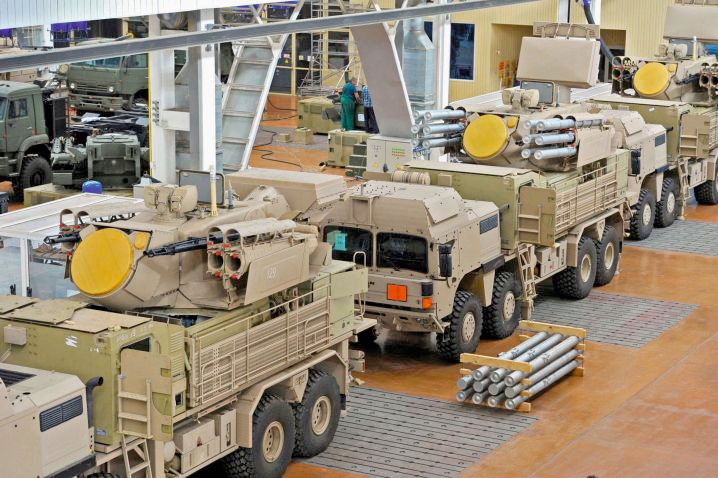
Pantsir-S1 system carrier vehicle: As mentioned, this system uses the KAMAZ-6560 truck as the main chassis, which is used for the Russian army. KAMAZ truck is a 4-axle 8×8 truck. This 7.31 ton truck uses KamAZ-740.35-400 diesel engine. This 400 horsepower engine allows this truck to carry a maximum of 20 tons of cargo and tow 14 tons of cargo. KAMAZ-6560 truck is also used for other types of Pantsir defense system. The Pantsir system can also be installed on the BAZ-6909 truck, which is the truck used in the S-400 system and is similar to the KAMAZ 8×8 truck, but unlike the KAMAZ-6560 truck, which has one steering axle, the BAZ has two steering axles. Also, the Pantsir system is available on the GM-352 armored chassis, which is shared with the Tunguska.
Pantsir-S1 defense system2K22 Tunguska defense systemUse of KAMAZ-6560 truck in Pantsir-S1 systemUsing the BAZ-6909 truck in the Pantsir-S1 systemClick to view full size
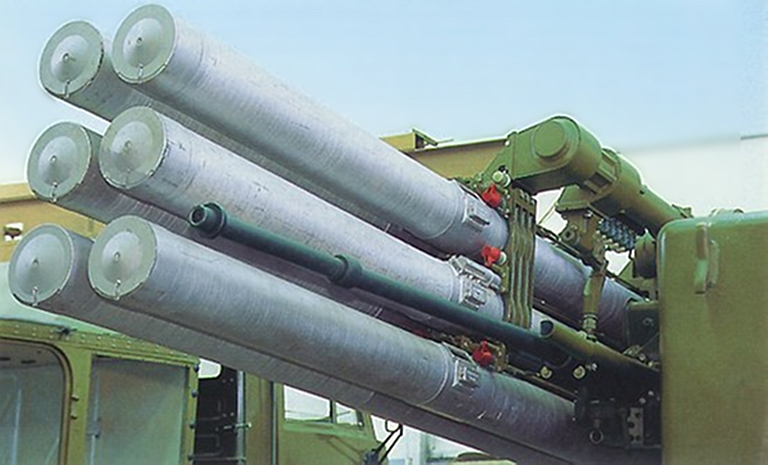
Pantsir-S1 armament: The Pantsir-S1 carries up to twelve 57E6 two-stage solid fuel radio/optical command-guided surface-to-air missiles in sealed ready-to-launch container tubes. Missiles are arranged into two six-tube groups on the turret. The missile has a bicalibre body, consisting of two stages in a tandem configuration. The first stage is a booster, providing rapid acceleration within the first 2 seconds of flight, after which it is separated from the sustainer-stage. The sustainer is highly agile and contains the high explosive multiple continuous-rod/fragmentation warhead, as well as the contact and proximity fuses, guidance flare and radio transponder. The missile is not fitted with a seeker to keep target engagement costs low. Target and missile tracking is instead provided via the system’s multiband sensor system. Guidance data is submitted via radio link for up to four missiles in flight. The system is capable of tracking and guiding four missiles fired at four distinct targets. Operationally, however, two missile salvos are typically fired at each target. The 57E6 missile is believed to have a kill probability of 70–90%. They have a 15-year storage lifetime in its sealed launch container. In addition to the described missiles, the Pantsir-S1 system has a liquid-cooled 30 mm 2A38M automatic cannon that can fire 1,950 to 2,500 rounds per minute with a muzzle velocity of 960 meters per second, and the turret magazine capacity has increased to 1,400 rounds.
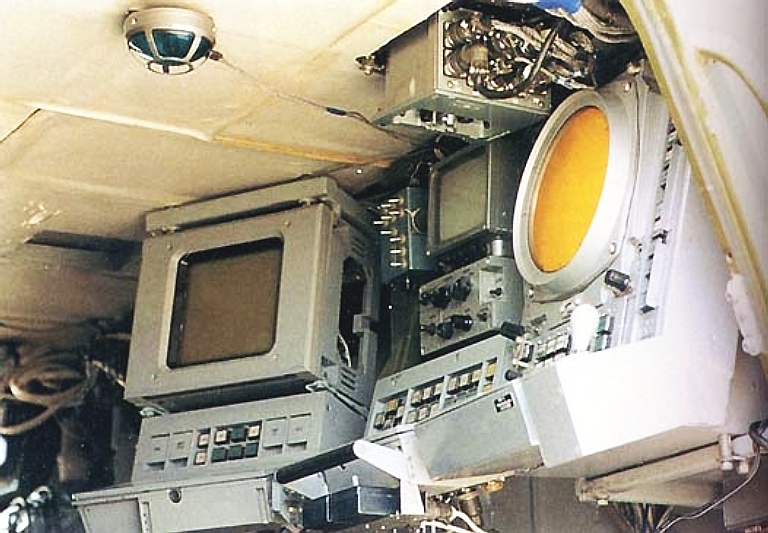
Turret designed for Pantsir-S1 systemPrototypes of the Pantsir-S1 system with CRT displaysDigital equipment in Pantsir-S1 defense systemElectric motor unit and Pantsir-S1 system computerClick to view full size
Pantsir-S1 radars
– 2L80E search radar made by VNIIRT company: VNIIRT, which is a part of Almaz-Antey Holding as the world’s 8th largest contractor and designer of ground-based air surveillance radars, was responsible for the design of a new radar. The newly designed radar, known as the 2L80 and 2L80E, was a passive phased array (PESA) radar weighing 760 kg with mechanical rotation and dimensions of 1776 x 940 mm. This passive phased array radar is a 360-degree search radar and is mounted at the top and behind the turret and has a freedom angle of 26 to 82 degrees in height, which has a search capability from 1 to 50 km and scans the sky in 2 to 4 seconds. This radar is provided with the ability to identify air targets with an effective dispersion level of 2 to 3 square meters at a distance of more than 30 km and track them from a distance of more than 24 km. With its missiles, Pantsir-S1 can engage tactical aircraft with a maximum range of 20 km and an altitude of 10 km, subsonic cruise missiles with a range of 12 km and an altitude of 6 km, and high-speed air-to-ground missiles. The performance of the 2L80E radar for different types of targets according to its radar cross-section is listed as follows: 36 km for a small fighter jet with a radar cross section (RCS) of 2 square meters. 20 km for a cruise missile with a radar cross section (RCS) of 0.1 square meters. 16 km for a glidebomb with a radar cross section (RCS) of 0.2 square meters. 12 km for an AGM-88 HARM anti-radar missile with a radar cross section (RCS) of 0.1 square meters. 32 km for an AH-64 Apache attack helicopter.
– 1RS2-1fire control radar: The 1RS2-1 fire control radar (export version 1RS2-1E), which is a passive phased array (PESA), was developed to replace the 1RS2-Shlem radar. This radar system engages with two targets simultaneously, and by prioritizing the targets and destroying them within one minute, it can engage with 12 targets. The effective range of this system for missiles is 20 km and the maximum height is 8 km. It is also said that it has the ability to engage with artillery shells at a distance of four kilometers. KBP claims the radar has a wavelength of “8 mm in K-band” and an antenna geometry of 15 mm (20 GHz) to 18 mm (16.7 GHz). With the ability to guide 4 missiles simultaneously, this radar has the ability to track airborne targets with speeds between 10 and 1100 meters per second. The performance of the 1RS2-1 radar for different target types according to its radar cross-section is listed as follows: Detection range for a target with a radar cross section (RCS) of 2 square meters: 24 km Detection range for a target with a radar cross section (RCS) of 1 square meter: 21 km Detection range for a target with a radar cross section (RCS) of 0.5 square meters: 16 km Detection range for a target with a radar cross section (RCS) of 0.1 square meters: 10 km Detection range for a target with a radar cross section (RCS) of 0.03 square meters: 7 km
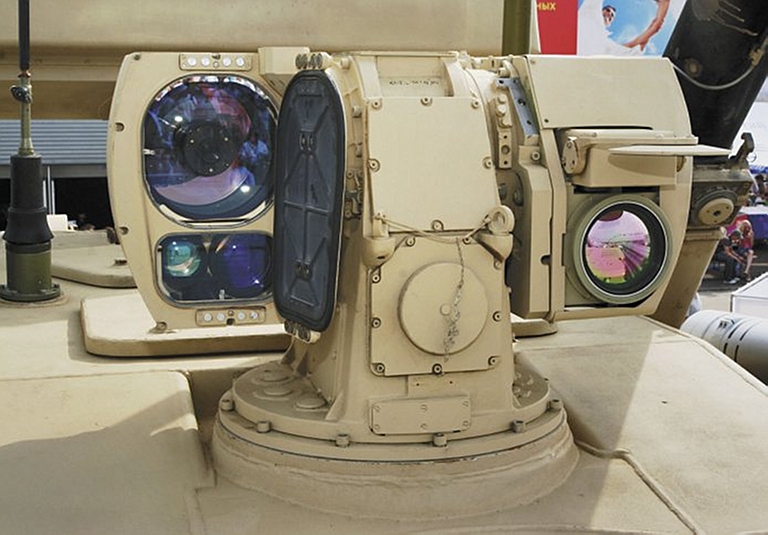
– 10ES1electro-optical system: The 10ES1 electro-optical system has been developed for the Pantsir-S1 defense system. This system uses the MATIS LR thermal camera made by the French company Sagem with a Wide Field Of View (WFOV) sensor with a search angle of 4.17 to 6.25 degrees in order to detect the target and a Narrow Field Of View (NFOV) sensor with a narrow search angle of 0.87 to 1.3 degrees for the lock on the target. The 10ES1 electro-optical system has the ability to cover azimuth ± 90 degrees, altitude coverage from -5 degrees to 82 degrees, angular tracking rate of 100 degrees per second and angular acceleration of 170 degrees per second. This system can detect an F-16 fighter jet in a range of 17 to 26 km, AGM-88 HARM missile in a range of 13 to 15 km, cruise missiles in a range of 11 to 14 km, and glider bombs in It is 10 kilometers.
Electro-optical system 10ES12L80E search radar, 1RS2-1 fire control radar and 10ES1 electro-optical system
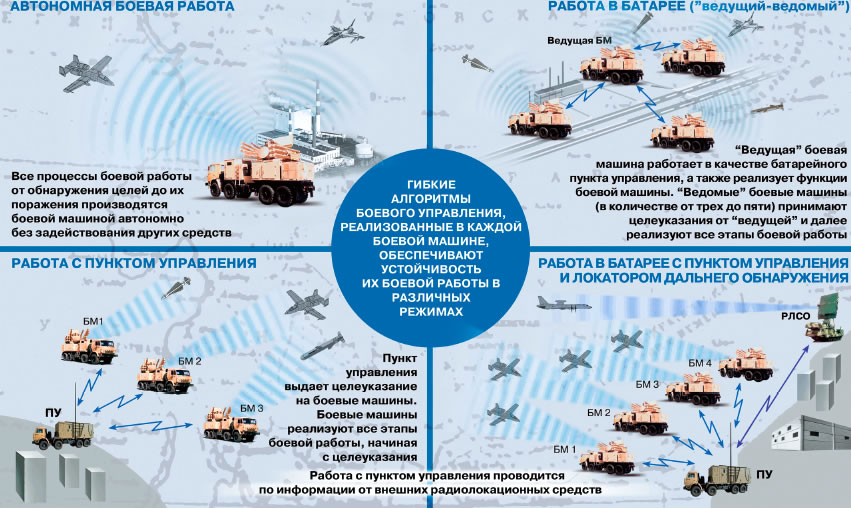
1RL-123E long range radar and Pantsir-S1 control center: The Pantsir system in battalion form has two other parts, which include a 1RL-123E long-range radar and a control station. The exact range of the 1RL-123E radar has not been disclosed, but in various sources, a range of 200 to 350 km has been announced for it. The dimensions of this radar are 2.8 x 3.4 meters and is installed on a KAMAZ-6560 truck. The main drawback of this radar is the lack of 360 degree coverage. The control station in a Pantsir missile system battalion is also responsible for coordinating three or four Pantsirs with long-range radar or coordinating several Pantsir systems in the absence of long-range radar. Of course, there is also the possibility of coordination between several Pantsir systems in the absence of a control station.
Pantsir-S1 control station1RL-123E long range radarCoordination between the control station and the 1RL-123E long range radarClick to view full size
Pantsir-S1 exports: The first order of this system was registered by the United Arab Emirates worth 734 million dollars. The UAE ordered 50 96K6 Pantsir-S1 systems in May 2000. After the delivery of the first batch in November 2004, the United Arab Emirates requested a new radar, and in 2007, this batch was delivered with the UAE’s desired modifications. Syria also ordered 50 Pantsir-S1 systems, which began to be delivered in June 2008. Jordan has also ordered an unknown number of this system. Serbia also announced on January 18, 2020 that it had purchased six Pantsir-S1 systems, and in February 2020, it received the first batch of Pantsir-S1.
Pantsir-S1 system on MAN SX 45 chassis for UAEPantsir-S2 system on KAMAZ-6560 chassis produced for Russian armyClick to view full size
Pantsir-S1 system specifications: Armament: 12 anti-aircraft missiles (SAM) on the launcher and 1400 30 mm rounds Missile range: up to 20 km Height of missile engagement: up to 15 km Gun range: up to 4 km up to a height of 3 km Radar detection range: 38 km (for a cross section of 1square meter) Engagement range: 28 km (for a cross section of 1 square meter) Maximum engagement speed: a target with a speed of 1000 m/s Number of simultaneously engaged targets: 4 targets Reaction time: 4 to 6 seconds if the system is online
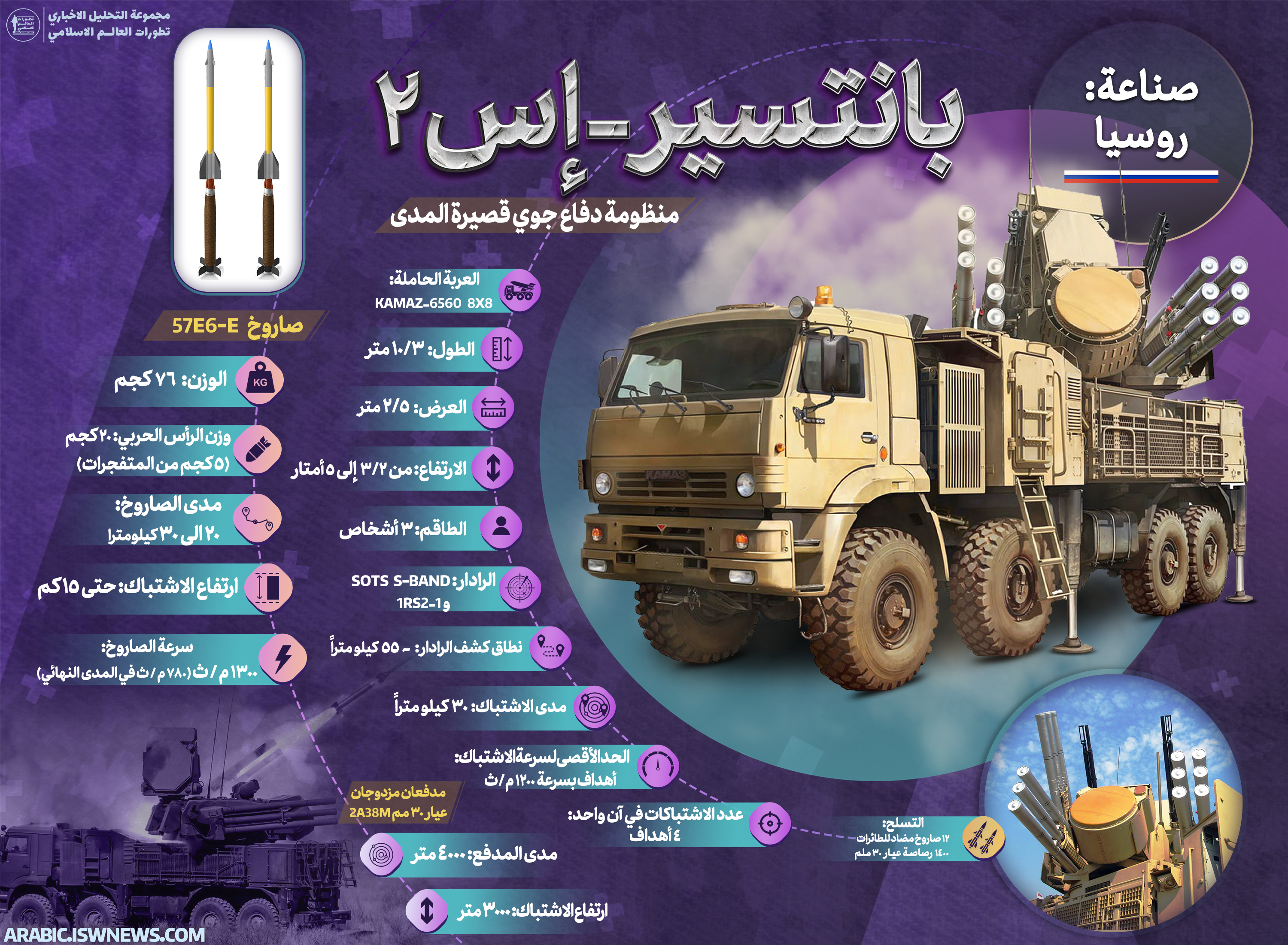
Pantsir-S2/S2E missile system: The Pantsir-S2 air defense system (export version Pantsir-S2E) is an improved version of the Pantsir-S1 system, which entered service with the Russian army in 2015. This system uses the same 2A38M cannon along with 12 missiles, which has a range of more than 20 kilometers. The new Pantsir-S2 radar is a two-faced SOTS S-band radar that has a hexagonal appearance. This combination allows for faster monitoring of the environment as well as the possibility of engaging in one direction and monitoring behind the head at the same time. This radar has also been improved in terms of range and engagement; So that it has been upgraded from the possibility of simultaneously engaging with one target and guiding two missiles in the Pantsir-S1 system to simultaneously engaging with 4 targets and guiding 8 missiles in the Pantsir-S2 system. This system has the new 57E6 missile (export version 57E6E), the range of which has been increased from 20 km to 30 km. Due to this increase in missile range, the new Pantsir-S2 radar should also be able to engage in a range of more than 30 km and detect targets at a distance of more than 50 km. The 57E6E missile has a weight of 76 kg with a 20 kg warhead and a speed of 1300 m/s.
57E6E missile
In general, the main characteristic to distinguish the S2 variant from the S1 is the radar, which is Janus-faced in the Pantsir-S2 system. The extent of export success of this model is not yet known, as not much information has been published about it.
Two-faced (Janus-faced) SOTS S-band radar of the Pantsir-S2 systemPromotional video of Pantsir-S2 short-range defense system
Radar: SOTS S-band and 1RS2-1 Radar detection range: ~ 55 km Engagement range: 30 km Maximum engagement speed: targets with a speed of 1200 m/s Number of simultaneously engaged targets: 4 targets Reaction time: 4 to 6 seconds (if the system is online) 12 anti-aircraft missiles 1400 30 mm bullets
57E6-E missile Weight: 76 kg Warhead weight: 20 kg (5 kg of explosives) Missile range: 20 to 30 km Altitude of fire: up to 15 km Missile speed: 1300 m/s (780 m/s at final stage)
Two dual 30mm 2А38M cannons Gun range: 4000 meters Altitude of fire: 3000 meters
Pantsir-S2 Air Defense System – Click to view full size
Pantsir-M/ME missile system: The Pantsir-M system (ME for export versions) is the naval version of the Pantsir, and its design was unveiled in 2015, and it has been in service with Russian Army since 2018. This system, which replaced the Kortik SAM system (SA-N-11 Grison), uses two 30 mm GSh-6-30K/AO-18KD gatling cannons with a maximum range of 5 km. Gatling cannon has a higher firing rate and better cooling than normal cannons due to the presence of six rotating cannons. The number of missiles has been reduced from 12 to 8. Pantsir-M system can fire the Pantsir family missiles with a range of 20 kilometers and can also fire Hermes-K missiles. The Hermes missile is a new and light missile that can engage light armored targets, various types of fortifications, small surface sea targets and air targets at a low speed. The Hermes-K missile warhead weighs 27.5 kg, which consists of 13 kg of explosives. Hermes-K missile has two samples with 170 mm and 210 mm booster. The Hermes-K missile with a 170 mm booster weighing 110 kg has a range of 15 to 20 km, and the Hermes-K missile with a 210 mm booster weighing 130 kg has a range of 100 km.
Hermes-K missile on the right and 57E6E missile on the left
The fire control radar of this naval system is developed based on the Pantsir 1RS2-1 radar, but the search radar of this system is installed on the mast in a four-sided manner. Also, this system uses an electro-optical system like the ground versions. The Pantsir-M defense system was installed on the Odintsovo battleship and tested in October 2020. Pantsir-M was able to destroy all small air targets that were dropped on it by Su-27 fighter jets. Pantsir-M is now installed on Project 22800 of the Navy and other upgraded warships will also be armed with it. This system is likely to become the main close air defense weapon for the Russian Navy.
Pantsir-M systemPromotional video of the Pantsir-ME short-range defense system at the Army exhibition
Pantsir-SA missile system: The Pantsir-SA defense system, which was first unveiled at the 2017 Russian Victory Parade, is a development of the Pantsir-S1 system, which is mounted on the DT-30PM armored chassis. The DT-30PM armor consists of two separate parts. The Pantsir-SA appears to have been delivered to the Russian military since 2016. The Pantsir-SA system has the same weapons station as the Pantsir-S1, but does not have the 30mm gun mounted on it. The main weapons of this system include 18 57E6 surface-to-air missiles, which are placed in 9 numbers in three rows next to each other on each side of the turret. This system can hit targets at a range of 20 km and a height of 15 km with a maximum speed of 1000 km/s. The DT-30PM chassis used in this type of Pantsir has a YaMZ-847.10 12-cylinder V-shaped multi-fuel diesel engine with a power of 800 hp. The DT-30PM can travel at a maximum road speed of 45 km/h and reach a maximum range of 700 km. DT-30PM has the ability to cross slopes up to 30 degrees and transverse slopes up to 15 degrees, and can also cross obstacles with a width of 4.5 meters or a height of 1.2 meters.
DT-30PM two-piece chassis belonging to Pantsir-SA systemPantsir-SA weapon station with 18 missiles and radar systemClick to view full size
Pantsir-SM missile system: The Pantsir-SM defense system is developed based on the Pantsir-S1 system. This system, which was unveiled at the Army 2019 exhibition, had the same radar used in the Pantsir-S1, with the difference that its range was increased. The truck carrying this system has been changed to the K-53958 truck, which is basically a Kamaz-6560M military truck with an armored cabin. All components from search radar and fire control radar, optical system, 30 mm cannon and 12 missiles are installed on the turret assigned to the new truck. The only way to distinguish the S1 system from the SM is this type of truck, which is armored in the Pantsir-SM system and is very different from the Kamaz-6560. A replica of the Pantsir-SM system was also exhibited, which shows this defense system with 24 missiles, in such a way that each side of the turret has four rows of three types of 57E6 missiles. But at the time of unveiling, it carries the same 12 standard Pantsir-S missiles.
The unveiled system has 12 missiles and a Kamaz-6560M truck with an armored cabinPantsir-SM replica with 24 missilesClick to view full size
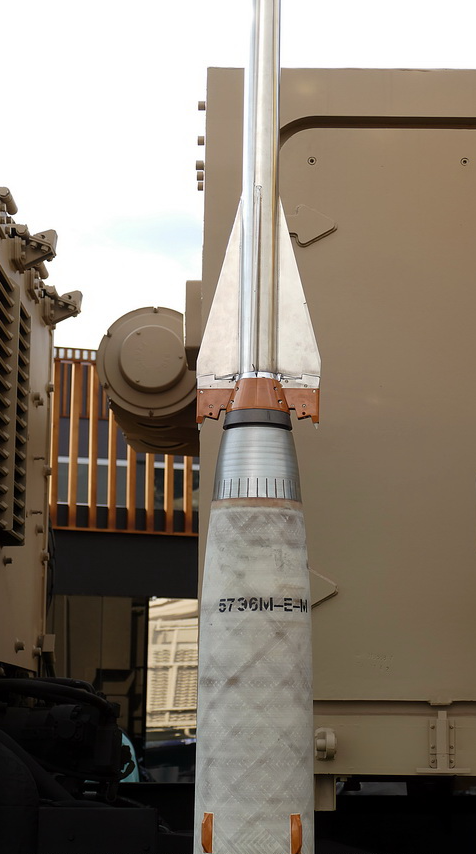
This new system has a new missile called 57E6-E-M, which has a range of 40 kilometers. This new missile is designed with the same length as the previous missile to fit inside the previous missile canister. The 57E6-E-M missile gets all its propulsion power from the white booster, which is made of carbon fiber. The system also has a new smaller missile for targeting UAVs and precision guided weapons such as SDBs, which is called 12YA6 and has a maximum range of 5 km.
New 57E6-E-M missile with a range of 40 km12YA6 missile used in Pantsir-SMClick to view full size
The range of the search radar has reached 55 km, and the engagement range has reached 40 km. The main composition of missiles in this system is 10 medium-range missiles and 8 short-range missiles.
Pantsir-SM system specifications: Armament: Missile: 12 57E6-E-M missiles independently or combined with 12YA6 missile on the launcher Bullets: 1400 30 mm bullets 57E6-E-M missile range: up to 40 km with a maximum engagement height of 18 km 12YA6 missile range: up to 5 km with a maximum engagement height of 4 km Gun range: up to 4 km with a maximum height of 3 km Radar detection range: 55 km (for a cross section of one square meter) Engagement range: 40 km (for a cross section of one square meter) Maximum engagement speed: a target with a speed of 1000 m/s Number of simultaneously engaged targets: 4 targets Reaction time: 4 to 6 seconds if the system is online Crew: 3
Pantsir-S1M missile system: The Pantsir-S1M defense system was unveiled at the ARMY-2021 exhibition. This short-range defense system is a developed example of the Pantsir-SM version. The radar of this system is a janus-faced radar similar to the Pantsir-S2 system radar. Pantsir-S1M, like all versions of Pantsir, has a search radar, a fire control radar, and an electro-optical system, and is capable of firing all missiles developed for this system. The only way to distinguish this system from the S2 is the armored truck K-53958, which is identical to the SM system. Increasing the detection range up to 80 km and increasing the number of detected targets up to 40, increasing the detection range, accurate tracking of 4 targets at the same time, automatic and semi-automatic determination of the coordinates of the missile and the target in the optical band using the electro-optical system (OES), the possibility thermal and television imaging, laser range finder, automatic optical and thermal detector are the new features of this system, which provides the possibility of airspace monitoring and target search by the operator at speeds of up to 1000 meters per second.
Pantsir-S1M system57E6E missile on the right and 57E6-E-M missile on the leftClick to view full size
More images of Pantsir air defense systems:
Click to view full size
“Pantsir Short Range Air Defense System” posters in Russian, Arabic, Persian, Kurdish and Azeri:
This system was seen for the first time at the IRGC achievements exhibition in 2014, and at the time of its unveiling, it had a range of 75 kilometers; After receiving the necessary upgrades in the field of missiles and radar, it reached a range of 200 km. Sevom Khordad system has expanded its operational capability to a wide range of targets by receiving the 9 Dey missile. This fully mobile system can be used as a suitable replacement for the Russian S-200 system and even it’s better than it.
The image of the prototype of the Sevom Khordad system, which was unveiled in 2014 at the IRGC Achievements Exhibition.
The Sevom Khordad carrier chassis: Sevom Khordad, Raad, Tabas, Alam Al-Hodi and 9th of Dey systems are all from the same air defense family and use the same carrier chassis. Sevom Khordad carrier chassis looks similar to the carrier used in Buk-M2EK and 9K332 Tor-M2 defense systems. Both of these systems use MZKT-6922 manufactured by MZKT.
The first unveiling of the carrier of the Sevom Khordad missile system took place in December 2012 for the Raad system. But the Iranian model is seriously different from the MZKT-6922 version. The first difference is the length of the truck; The Iranian model is shorter and according to the published images, the engine installation location is in front of the truck, while the engine of the Belarusian model is at the end of the truck. For this reason, the only access door for the operator to the electronic systems in the Iranian example is from the side, and the access doors have different numbers and shapes. Also it seems that the height has increased a little, and two hydraulic jacks have been added in the area between the two axles of the truck for the stability of the system during firing. Considering the presence of three missiles instead of four and the modifications made, it can be said that this truck has better offroad power than the Belarusian model.
According to these explanations, it seems that Iran made this carrier truck based on the model of Belarus; There is also a possibility that this new chassis was developed with the help of Belarus and produced in Iran.
9K332 Tor-M2 air defense systemBuk-M2EK air defense systemRaad air defense systemEngine installation location at the front of the truckThe difference between the carrier chassis of the Raad system and other systems – (click to view full size)
Sevom Khordad radar: As mentioned, Sevom Khordad system has received many updates in the field of missiles and radar. For a better review, we will look into the radar systems used in Sevom Khordad.
Sevom Khordad and Tabas systems were unveiled simultaneously in 2014. Tabas was introduced as an inexpensive supplement to Sevom Khordad system; Initially, both systems, as a high-altitude and medium-range system, had the ability to engage at an altitude of 25 to 27 km and a range of 50 km, but Sevom Khordad has an active phased array radar and Tabas has a flat reflector radar with limited rotation power. The declared altitude of fire was exactly the same as the range of Buk-M2EK system, i.e. 50 km, which raises the suspicion that the systems are the same. But the differences in the carrier chassis that we reviewed earlier and the use of three missiles in the Iranian systems instead of four missiles in the Russian system, rejected this suspicion. Also, the installation location of the middle fin of Buk missile and Taer missile is different. In the Taer missile, the middle fin is near the end of the missile, while in the Buk missile, the middle fin is located in the middle of the missile.
Reflective radar of the Tabas air defense systemSeveom Khordad phased array radarThe difference between Taer and Buk missilesClick to view full size
In order to better examine the Sevom Khordad radar systems, we must start with the evolution of this system and from its starting point, the Raad system. Contrary to what was seen at the time of the unveiling of Raad system, Raad 1 and 2 systems were installed on commercial trucks. Probably, the reason for using commercial trucks was that the capacity of production line for the prototype was not enough or that the unveiled model was under development. The investigation of the primary radars used in the Raad system shows that Raad used pulse doppler radars and its combination with its optical systems, and the whole system was mounted on a commercial truck. So, it seems that the chassis developed for Sevom Khordad was not supposed to be used for the Raad system at all; Rather, the Raad system could be a system similar to Sevom Khordad but for urban and passive warfare; which has used a commercial truck for the carrier for better camouflage, and has the ability to link to TEL variant that only carry missiles.
Raad 2 system mounted on a commercial truckElectro-optical system and special radar for Raad system, installed on a commercial truckThe electro-optical system and special radar of Raad system from a close-up viewRaad 1 system with a commercial truck as a missile carrierImages of Raad system as a passive system of the Sevom Khordad- click to view full size
Alam al-Hoda system is another system related to Sevom Khordad. Alam al-Hoda system is actually a complementary system for the whole collection. Although the exact image of the Alam Al-Hoda radar is not available and its exact range has not been announced, the radar of this system is similar to the Nebo-UE radar. The Nebo-UE radar is a 3D radar in the VHF band with a range of 310 km; But the radar used in the Alam Al-Hoda defense system is a fire control phased array radar in the VHF band. Nevertheless, it is noteworthy that after several years since the unveiling of Alam Al-Hoda radar, quality images showing the operationality of such a system have not been published. Therefore, probably, the Alam Al-Hoda system has not been widely implemented or used.
There are two possibilities for this system: 1- Considering that Iran has the experience of building the Keyhan mobile radar with a range of 2000 km, the Alam A-Hoda radar is also a very long range radar with a detection range of 500 km and more, which, unlike the nature of VHF band radars, has a very accurate detection capability to detect stealth targets from long distances and is linked with the Sevom Khordad system or any other system and acts as a long-range radar for the Sevom Khordad battalion. 2- The second possibility is that the Alam Al-Hoda system was actually a development plan for the Sevom Khordad system, which was later led to the use of Bashir radar. Bashir radar can detect cruise and stealth targets and other long-range targets at a range of at least 350 km.
Banner of the Alam al-Hoda radarNebo-UEradarImage of Alam Al-Hoda radar (left) and Nebo-UE radar (right) – click to view full size
In general, the Sevom Khordad system consists of three components: Transporter Erector Launcher Radar (TELAR), Transporter Erector Launcher (TEL) and Bashir long range radar for early detection of hostile targets.
The TEL version of the Sevom Khordad systemThe TELAR version of the Sevom Khordad systemClick to view full size
Until now, not so many images of the Sevom Khordad radar system have been published, and reliable information about the height of the conflict and its range has not been provided by the official authorities; But what is clear is that this radar has continuously developed since its unveiling in 2014. According to the available information, this radar is an active phased array (AESA) radar in the X band with 1700 elements, which can simultaneously detect 4 targets and guide 8 missiles (two missiles for each target). The altitude of fire for this radar can be estimated up to 30 km, and the range of this radar has probably reached more than 200 km. The reason for this is the presence of Sevom Khordad long-range (Taer-3) missile with a range of 200 km, which was unveiled at Iranian Armed Forces parade on commemoration of the Sacred Defense Week on September 22, 2022.
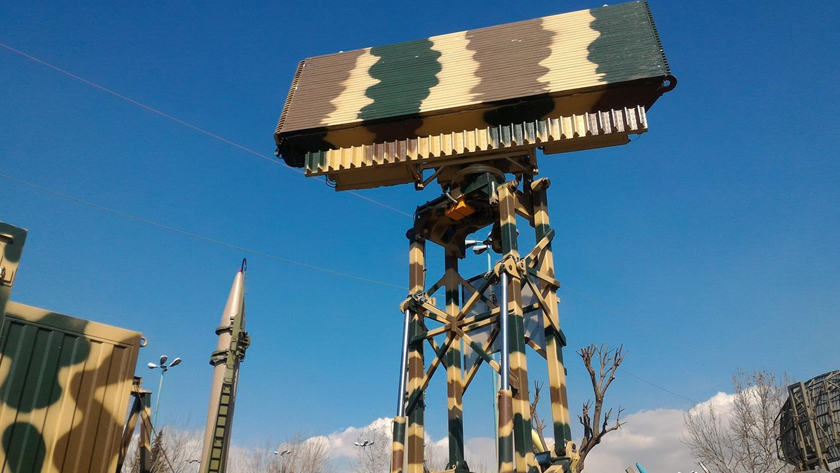
Bashir radar: The Bashir radar, which is one of the important components of the Sevom Khordad system, is a 3D phased array radar with linear antenna arrays that operates in the L and S bands and is capable of detecting cruise and stealth targets. The maximum range of Bashir radar is 350 km. This radar, which was unveiled and used in the Welayat 97 military exercise in February 2019, is installed on a truck and is placed at a certain height by opening jacks and then rotates to cover 360 degrees. Evidence that Bashir radar has the ability to be used as a fire control radar has not been obtained to date; Therefore, the previous assumption that the main radar of the Sevom Khordad has a maximum range of more than 200 km, can be correct.
The way Bashir radar is set up and the very short time it takes for this radar to start working
In the Sevom Khordad system, the entire complex, i.e., missiles, radar, and control station, are all mounted on one vehicle, so Sevom Khordad is able to perform missions completely independently. But its main radar, which is responsible for detecting and locking on the target and then intercepting and guiding the missiles, can only operate in one direction and does not have the ability to engage in four directions at the same time. This is the main weakness of the Sevom Khordad system, and if it is used independently, it will be surprised and vulnerable to attack from several different directions. Therefore, Bashir radar, as a very important part of this system, is an important factor in the stability of the Sevom Khordad system in the battlefield, to detect cruise and stealth targets and to constantly monitor the environment around the Sevom Khordad system. With the presence of Bashir radar in this system, it is possible to monitor the surrounding environment in 360 degrees, and by using four Sevom Khordad systems in one battalion, surprise and destruction of the system is prevented.
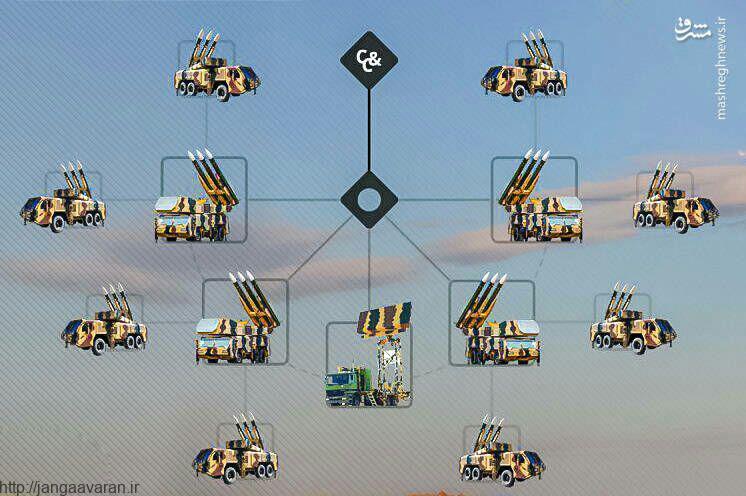
Each battalion of the Sevom Khordad missile system includes a control station that is responsible for coordinating the Bashir radar and four TELARs of the Sevom Khordad system. Bashir radar is also responsible for 360-degree scanning of the surrounding environment in the battalion. Each TELAR vehicle can also coordinate with two TELs in the battalion, in addition to coordinating with Bashir radar and control station. As a result, each battalion includes a control station, a Bashir radar, four Sevom Khordad systems (TELAR) and eight TELs, with a total of 36 missiles serving a Sevom Khordad air defense system battalion.
The Sevom Khordad (Taer-3) long-range missile with a range of 200 km in the parade of the armed forces on September 22, 2022The main radar of Sevom KhordadBashir radarAn air defense battalion consisting of all components of the Sevom Khordad systemClick to view full size
The number of missiles used in the Sevom Khordad missile system is varied. These missiles include: Taer-2, Taer-2A, Taer-2B, Sayyad-2, Sayyad-2C, Sayyad-3, 9 Dey and the Sevom Khordad (Taer-3) long-range missile. The existence of this number of missiles in different ranges can be considered one of the distinctive aspects of this system, because it gives the Sevom Khordad system the ability to perform various missions. In fact, the Sevom Khordad missile system today is not a BUK class system, but an S-300 class system. The comparison between the two may seem far-fetched, but by looking at the S-300 system, we will realize that this system also uses a large number of missiles with different ranges and different altitudes of fire. Only the 40N6 missile that used in the S-300 PMU-3 or S-400 air defense system, has a longer range than the Sevom Khordad missiles. So practically today, the Sevom Khordad system has capabilities close to the S-300.
Regarding the 9 Dey missile, it is necessary to mention that this missile, unlike other missiles of the Sevom Khordad system, is launched from a box launcher that is specially made for the 9D missile. Therefore, sometimes this launcher is mistakenly considered another independent systems under the title “9 Dey Air Defense System”, which is not true. Rather, this system is the same as the Sevom Khordad system, but with a special box launcher for launching 9 Dey missiles.
A special box launcher for launching 9 Dey missiles in the Sevom Khordad missile system
Range and flight ceiling of active missiles in the Sevom Khordad system
The range and flight ceiling of active missiles in the Sevom Khordad system are: Taer-2: with a range up to 50 kilometers and flight ceiling of 27 kilometers Taer-2A: with a range up to 75 kilometers and a flight ceiling of 27 kilometers Taer-2B: with a range up to 105 kilometers and a flight ceiling of 27 kilometers Sayyad-2: with a range up to 75 kilometers and a flight ceiling of 27 kilometers Sayyad-2C: with a range up to 120 kilometers and a flight ceiling of 27 kilometers Sayyad-3: with a range up to 150 kilometers and a flight ceiling of 30 kilometers 9 Dey: with a range up to 5 to 30 kilometers and a flight ceiling of 20 kilometers Taer-3 (Sevom Khordad): with a range up to 200 kilometers and a flight ceiling of 30 kilometer
The first missile of this system is the Taer-2 missile, this missile and the Taer-2B missile are the first missiles that have been seen on the Sevom Khordad, Tabas and Raad system. After that, Sayyad-2 and then Sayyad-3 were adopted for Sevom Khordad system, and until Taer-3 was produced, the longest range missile of this defense system was Sayyad-3 with a maximum range of 150. Finally, with Taer-3 (Sevom Khordad) missile, with a range up to 200 km, this missile became the longest-range missile of the Sevom Khordad system.
Taer family missiles used in the Sevom Khordad systemMissiles of the Sayyad family used in the Sevom Khordad systemSevom Khordad long-range missile (Taer-3)9 Dey missileCollection of missiles used in the Sevom Khordad system – click to view full size
As for the missiles used in the Sevom Khordad system, there are two missile families: the Taer family and the Sayyad family. The difference in the appearance of these two families, as shown in the picture, is more evident in the middle fin; Of course, there are differences in the fin at the end of the missile. But in each generation, the middle fin has a fixed shape, the main reason for which was the pattern of each missile at the time of its design and construction.
In the Sayyad family, the missile is modeled after the standard missile, and in the Taer family, the missile is designed and built based on the model of the BUK family. The middle fin of the Sayyad missile is a trapezoid, both edges of which are angled and extends to the body of the missile. But in Taer, the shape of the middle fin is a trapezoid, one edge of which is vertical and the other edge of which is angled. Due to this difference in appearance, we classify the Sevom Khordad (Taer-3) missile in the Taer family.
Another point is that the Taer missile has a radar to detect targets in the last stage. However, there is still no information about the presence of such a radar in Sayad-2, Sayad-2C and Sayad-3 missiles. It means that the Taer missile is likely to have the ability to detect the target independently, and the Sayyad missile needs to be guided until the moment of impact.
BUK missile system (top image) and standard missile system (bottom image)The shape of the fin of the Sayyad missile (top image) and the shape of the fin of the Taer missile (bottom image)Taer missile’s radarClick to view full size
The next subject about Taer family missiles is that the radome part of the missile is made separately. This feature makes it possible to build a missile with different guidance capabilities at the lowest cost; This has led to the construction of the Taer-2 passive guided missile for the Sevom Khordad system. There is also a version of the Sevom Khordad system that provides the possibility of passive missile guidance at the same time as radar guidance. It is not clear exactly how passive guidance is implemented in the Sevom Khordad system and how it works.
The RADOME of Taer missileThe passive version of the Taer missileThe passive system used in Sevom Khordad systemClick to view full size
The sea-based version of the Sevom Khordad system was seen for the first time on the Shahid Siavashi ship of the IRGC along with the passive version of this system. Also, the IRIS Shahid Roudaki was unveiled along with the Sevom Khordad system; Therefore, it is possible to make this system operational with Shahid Roudaki.
A version of the Taer missile was displayed in the National Aerospace Park of Iran, which identified its various components separately, for example, the location of the missile warhead is located behind the missile’s radar. Also, the Taer missile warhead was displayed, which is a high explosive fragmentation (HE-FRAG) warhead.
Testing the passive guidance version of the Taer missileThe HE-FRAGwarhead of Taer missileDifferent sections of Tayer-2 missile;Click to view full size
The missiles used in the Sevom Khordad system have another feature, which is the use of proximity sensors such as the Meteor air-to-air missile. This sensor allows the missile to explode near the target and minimizes the need for a direct missile hit. Proximity sensors in the form of strips have been seen on all 9 Dey, Sayyad-2, 2C and 3 missiles as well as Taer 2 and 3.
Taer missiles have a special flight profile, and in the published footage of how this system works, two points are noteworthy for these missiles. The first point is the flight profile of the Taer missile to deal with cruise missiles, which flew at a distance of several meters from the surface, and this type of flight is very practical. The next point is the missile hit with targets with a higher height. In the published images, the missile hits the target from above, and as stated, with the presence of proximity sensors intended for the missile, this missile does not need a direct hit.
The flight of the Taer missile at a distance of a few meters from the surface to counter the cruise missileA Taer missile before hitting a moving target with high precisionThe flight profile of the Taer missile from above towards the targetClick to view full size
The control station in the TELAR launcher of the Sevom Khordad system is located beneath the missiles and behind the engine of the carrier vehicle, which is an equipped and fully digital station. Each Sevom Khordad system is connected to a Bashir radar and control station to perform the task of aerial surveillance with greater accuracy.
Sevom Khordad system control stationThe control station of the TELAR vehicle of Sevom Khordad
The possibility of linking Sevom Khordad with other systems: Since Sayyad missiles links to the Sevom Khordad radar, it seems that other systems that currently use Sayyad missiles can also link to the Sevom Khordad system; Such as the Najm-802 radar, which is used for the early warning radar of the Talash system and 15 Khordad as the user of the Sayyad missile. Of course, another possibility can be proposed for the Sevom Khordad system, and that is to link this system with the Bavar-373 system so that Taer missiles can also be used in the Bavar system. Although what was said about the coordination of the Sevom Khordad system is only speculation, but considering the background of the mentioned systems, the use of Sayyad missiles on the Sevom Khordad is also not far from the mind.
The final combination of missiles in the Sevom Khordad system: It seems that the combination of missiles operating in the Sevom Khordad system has reached a smaller set today, which shows the independence of the system in the field of production, service and operation in the IRGC combat organization. In its evolution, the Sevom Khordad system has reached three missiles, which are perfectly suitable for three types of conflicts. The first missile is the 9 Dey missile, which is suitable for engagement in the last ring of defense and a range of 5 to 30 km, and its engagement height is 20 km; The ability to fight at this level is excellent. But the second missile is the Taer-2 missile, which has a range of 30 to 105 km at an altitude of 25 to 27 km. The third missile, the Taer-3 missile, as a long-range missile of this system, gives the Sevom Khordad system the ability to fight from a range of 100 to 200 km. The Sevom Khordad missile system achieves a very good operational efficiency with such a combination. Of course, it is still possible to use Sayyad family missiles on Sevom Khordad.
Weaknesses of the Sevom Khordad system: The only problem that the Sevom Khordad system has in the missile section is a missile suitable for targeting ballistic missiles. By adding such a missile to this system, as well as correcting the radars for engagement with ballistic missiles, this system will be a powerful and much more efficient system. Of course, it has been said that this system has the ability to engage targets up to 1000 km/h, which is a very good number. Another weakness of this system (if it is used independently) is the lack of 360 degree coverage, which is largely solved by the Bashir radar.
The main composition of missiles of the Sevom Khordad system – From right to left: 9Dey, Taer-2, Taer-3 missiles
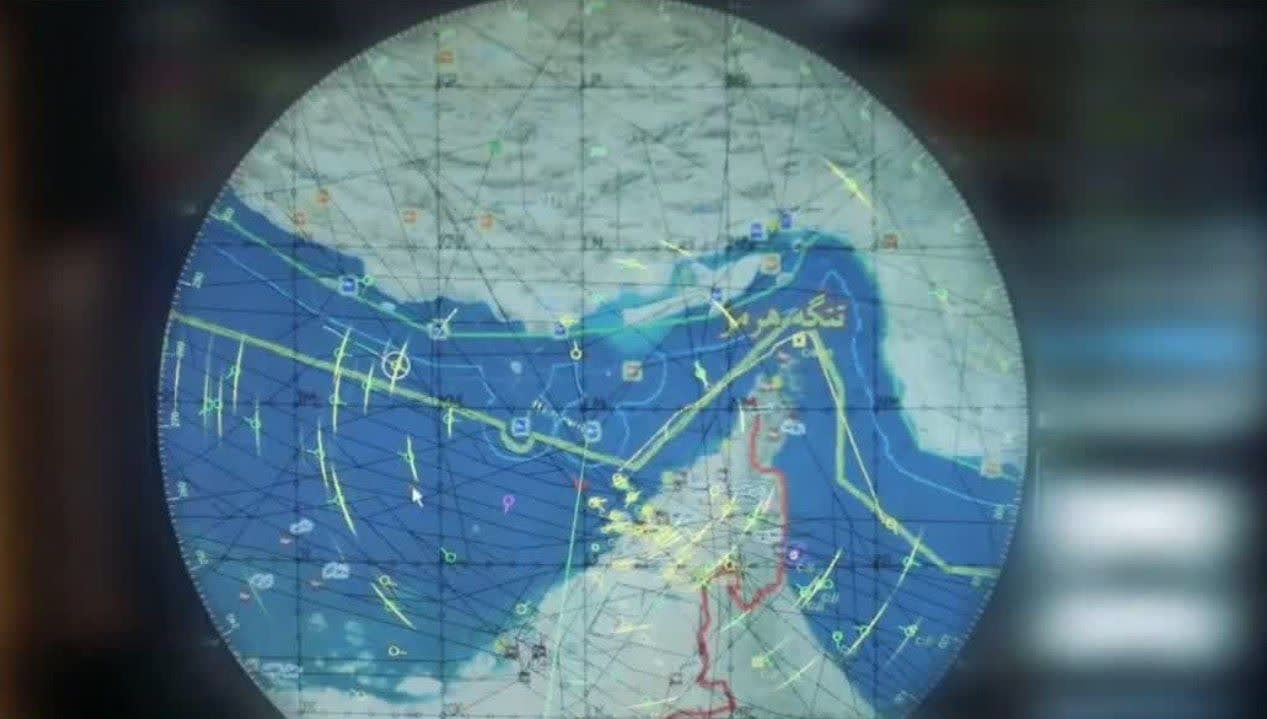
Operational history of Sevom Khordad: On June 20, 2019, Sevom Khordad missile system managed to shoot down an American RQ-4A Global Hawk drone over the Strait of Hormuz and near Mubarake Mountain. RQ-4A drone was detected by the early warning radar at a distance of 490 km and at a distance of 120 km, Sevom Khordad did a radar lock on it and finally the missile hit the RQ-4A at a distance of 75 km and at an altitude of 14 km and destroyed it. It should be noted that the Sevom Khordad air defense system became known as the “Vulture Hunter” after shooting down the US RQ-4A.
The location of the radar system in Abu Musa IslandThe Kill Mark of RQ-4A on Sevom Khordad systemA video of Sevom Khordad air defense system that hunted the US RQ-4A drone
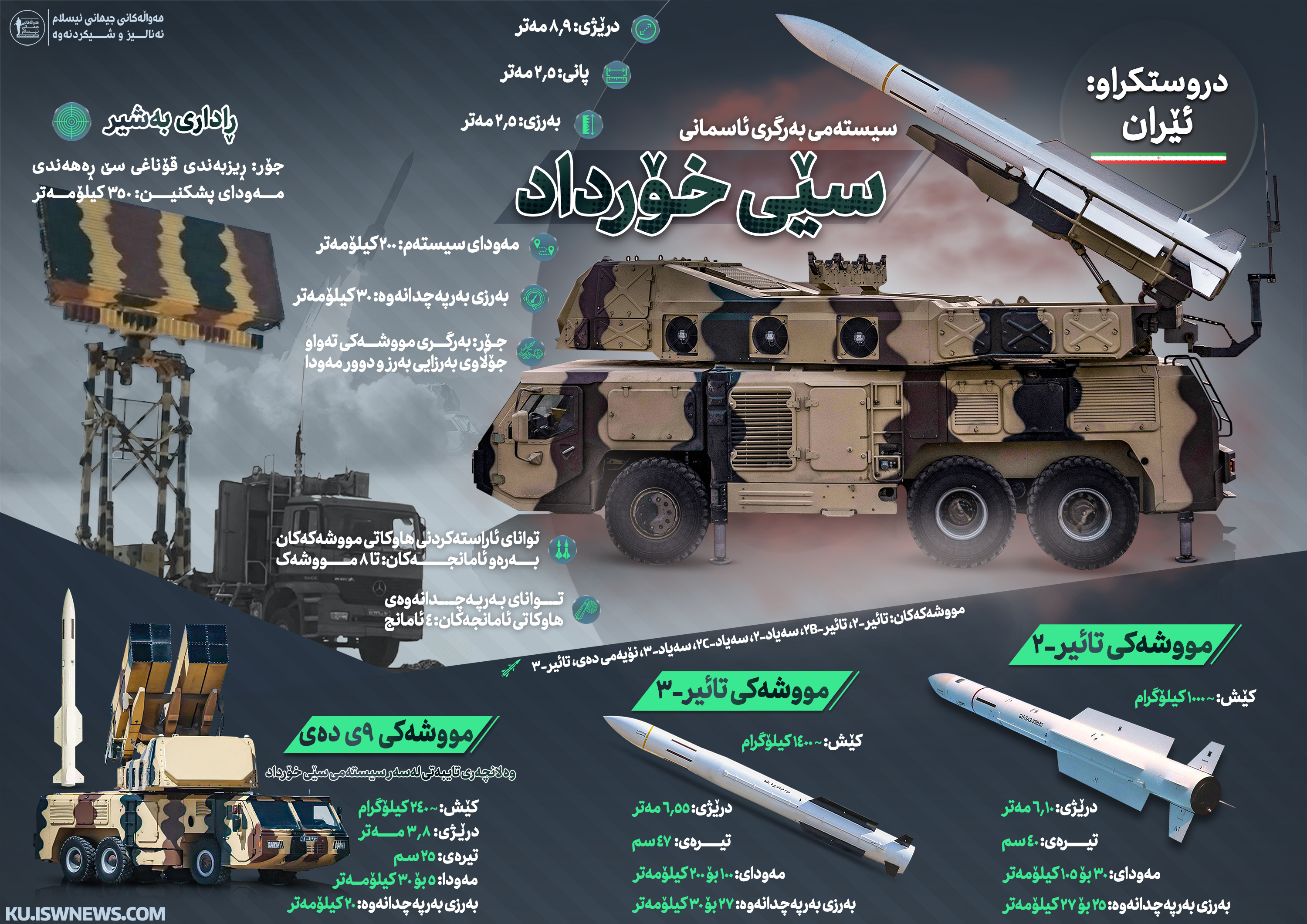
Specifications of Sevom Khordad air defense system: Type: Fully mobile high-altitude long-range missile defense Length: 8.9 meters Width: 2.5 meters Height: 2.5 meters Range: 200 km Altitude of fire: 30 km Number of simultaneously engaged targets: 4 targets Number of simultaneously guided missiles: 8 missiles Missiles: Taer-2, Taer-2B, Sayyad-2, Sayyad-2C, Sayyad-3, 9 Dey, Taer-3 Fire-control radar: The name is not specified with a range of more than 200 km and installed on the TELAR vehicle Search radar: Bashir radar with a range of 350 km
9 Dey missile (with a special launcher): Range: 5 to 30 km Altitude of fire: 20 km Length: 3.8 m Diameter: 25 cm Weight: ~ 240 kg
Taer-2 missile: Range: 30 to 105 km Altitude of fire: 25 to 27 km Length: 6.10 m Diameter: 40 cm Weight: ~ 1000 kg
Taer-3 missile: Range: 100 to 200 km Altitude of fire: 27 to 30 km Length: 6.55 m Diameter: 47 cm Weight: ~ 1400 kg
Sevom Khordad air defense system – click to view full size
More images of Sevom Khordad air defense system:
Click to view full size
The collection of posters of Sevom Khordad air defense system in Russian, Arabic, Farsi, Azeri, Kurdish:
The first generation of the Germans’ Main Battle Tank (MBT) was the M48 Patton tank made by the United States, and the second generation was the Leopard-1 tank, which is still in service with modifications for other NATO users. The Leopard 1 tank was designed and produced in West Germany in the 1960s. This tank was first produced in 1963 by Krauss-Maffei for the Ministry of Defense of West Germany, and more than 6,000 units of it were produced for 9 NATO member countries, including Germany, the Netherlands, Belgium, Greece, Turkey, Italy, Canada, Norway, as well as Made in Australia.
To develop and improve the Leopard-1 tank, Germany started developing the MBT-70 project in 1963 with the cooperation of the United States of America. However, in 1967, the German government ordered Porsche to research the facilities needed to upgrade the Leopard-1 tank. It is interesting to know that the Leopard-1 tank was in the service of Germany from 1965 to 1995, and the need for the MBT-70 project was announced before the Leopard-1 tank entered service. Leopard-1 was designed by Porsche and manufactured by Krauss-Maffei. This issue becomes more interesting when you know that Porsche named this new project Vergoldeter Leopard or Gilded Leopard and focused on updating with advanced technologies. Adding an automatic loader, an automatic and coaxial cannon with a machine gun, an independent periscope for the commander, the possibility of using an anti-aircraft machine gun from inside the cabin, the presence of a television surveillance camera on the mast with the possibility of increasing the height, changing the shape of the turret, improving the suspension system, the gearbox and engine exhaust valves, were considered as new project items.
Development and production:
In 1967, the West German government decided to produce a prototype of the Gilded Leopard project, as well as an experimental development based on the Leopard 1 tank. But due to the lack of sufficient funds, it was not possible to develop two projects at the same time, finally a trial development contract was concluded with Krauss-Maffei, but this company committed to work with Porsche to develop the chassis and with Wegmann to develop the turret. In this regard, two prototypes with different components were built with the aim of improving the Leopard 1 tank to match the firepower requirements of the MBT-70. The purpose of these optimizations was to increase the probability of hitting the first shot at a range of more than 2000 meters. Also, increasing the ability to accurately engage with moving targets using a computerized fire control system was another main goal of the experimental development. The tanks built were nicknamed Keiler. Two prototypes (ET01 and ET02) were built by Keiler in 1969 and 1970, both powered by the MB872 engine.
After many ups and downs in 1971, the name of the MBT-70 project was changed to Leopard-2. In the same year, 17 prototypes were ordered, but only 16 hulls were built because production of the PT12 hull was cancelled. The turrets were named from T1 to T17 and the hull from PT1 to PT17. These prototypes were produced to perform numerous tests, from the required and different components and concepts for the development of the tank, and each sample had components that were not found in other samples. Ten of these turrets were equipped with 105 mm cannons and seven prototypes were equipped with a 120 mm cannon. The welded turret used spaced armor formed by two steel plates. Prototypes were equipped with the EMES-12 optical range finder and fire control system, which was later used in the Leopard 1A4. The T14 turret was modified to install new anti-armor modules and was equipped with an all-electric turret drive and stabilization system. The turret was jointly developed by General Electric and AEG Telefunken.
The PT15 model with a 105 mm cannon
In July 1973, an agreement was signed between the defense ministries of Germany and the United States to standardize the Main Battle Tanks (MBT) in favor of NATO. Due to the previous joint cooperation on the MBT-70 design, it was decided to use the parts that were completely manufactured by German companies for the Leopard 2 in the Abrams tank prototype, which reduced the cost of the XM1 Abrams design. According to the US laws, it was not possible to interfere in the production of the XM1 Abrams tank by the German company. As a result, modification of the Leopard-2 prototypes to meet US Army requirements was considered. On December 11, 1974, a memorandum of understanding was signed between Germany and the United States that required the United States to test a modified version of the Leopard-2 against the XM1 prototypes. Also, this memorandum obliges the Federal Republic of West Germany to send a sample suitable to the needs of the United States for examination.
A tougher version of the Leopard 2 tank, the Leopard 2AV, was developed to meet both US requirements and the latest protection requirements of the German Ministry of Defence. The T14 turret was used as the main turret of the Leopard 2AV, but achieving the required level of protection for the hull required further research, until final ballistic tests were carried out in June 1976. The United States preferred to use a US-made laser range finder; For this purpose, the US Hughes company’s laser range finder was used on the turret. This turret was installed on the PT19 prototype. Compared to the Leopard 2 prototypes, the AV prototype had a fire control system, along with the EMES-12 optical range finder. In this example, the crosswind sensor was removed and air pressure and temperature sensors were added. Modifications such as the addition of a PERI R12 commander’s sight with infrared illuminator, short-range anti-infantry grenade launcher, retractable searchlight, fixed searchlight, retractable night vision camera, APU and mechanical loading assistant were among the additions to the AV prototype.
Due to the longer-than-expected design and production of the Leopard 2AV, it was not possible to send the Leopard 2AV to the United States and conduct tests in the United States before September 1, 1976. Despite German efforts to evaluate the Leopard 2AV and XM1 prototypes at the same time, the US Army decided not to wait for the Leopard 2AV and tested XM1 prototypes built by Chrysler and General Motors.
The Germans sent two prototypes of the hull and three turrets to the United States: the PT20 using a 105 mm L7 gun with a Hughes fire control system, and the second PT19 with the same Hughes fire control system but with the 120 mm Rheinmetall cannon. The third prototype was called the PT21, which was equipped with a Krupp Atlas Elektronik EMES-13 fire control system and a 120 mm Rheinmetall cannon. A study conducted by the US company FMC showed that manufacturing the Leopard 2AV under license in the US would not exceed the cost limits set by the US military. Thus the Leopard 2AV design fully met the US requirements. But after obtaining the license to manufacture the Leopard 2AV, FMC decided not to submit a technical proposal because they saw little chance of acceptance for a vehicle that had not been developed in the United States. For this reason, the focus was on common features and components between the two tanks.
A US military evaluation found that the XM1 had more special armor than the Leopard 2AV. In tests, the Leopard 2AV was found to have the same performance as the XM1 prototypes, but the AGT-1500 turbine engine used about 50% more fuel. The wheel chains on the Leopard 2AV tank had good endurance, while the wheel chains used on the XM1 prototypes failed to meet the Army’s requirements. The thermal reflection of the MTU diesel engine used in the Leopard 2AV was much lower than the AGT-1500 turbine engine used in the XM1 Abrams. The fire control system in Leopard-2 performed better and the 120 mm gun showed its superiority. The projected production costs for one XM1 tank were $728,000 in 1976, and the costs for one Leopard 2AV were $56,000 higher.
Contradictory statements about the reasons for rejecting the Leopard 2AV tank were given by America; Such as lower loading speed for firing and lower tank weight as well as better stabilization system of the XM1 Abrams tank. This decision was criticized by many German experts at that time.
The Ministry of Defense of the West German Federal Government ordered 1,800 Leopard 2 tanks in September 1977, to be produced in five batches. The main contractor was Krauss-Maffei Wegmann (KMW), but Maschinenbau Kiel (MaK) was also contracted to produce 45% of the tanks. The first batch consisted of 380 tanks, with delivery of six tanks scheduled for 1979, 114 tanks for 1980, 180 tanks for 1981, and 300 tanks each year thereafter. This tank entered service from 1979 and Germany received more than 2000 Leopard 2 tanks by 1991. During the Cold War, KMW Company was able to produce 16 units per month and MaK Company was able to produce 9 units per month of this tank. But after the end of the cold war, this production decreased, but KMW company has still maintained its production capacity.
Leopard 2 variants:
Leopard 2: The base and early version of the Leopard 2, sometimes informally called “A0” to distinguish it from later versions. This version was the first version produced in the Leopard tank series. From October 1979 to March 1982, a total of 380 tanks of this version were produced.
Leopard 2A1: In this version, a number of minor modifications were made, including the installation of a thermal sight for the gunner and new ammunition racks on the Leopard-2 tank. This variant of Leopard-2 tank has been used in the Netherlands and Canada.
Leopard 2A2: This version uses a new thermal sight. This modernisation gradually replaced the original PZB 200 sights in the first batch with thermal sights for the EMES 15 as they became available. The upgrade included the fitting of filler openings and caps to the forward hull fuel tanks to allow separate refuelling. There was an addition of a deflector plate for the periscope and a large coverplate to protect the existing NBC protection system. The tank was given new five metre towing cables with a different position.
Leopard 2A3: The main change was the addition of the SEM80/90 digital radio sets (also being fitted to the Leopard 1 at the same time), and the ammunition reloading hatches being welded shut. Even with these minor changes the new batch was known as the 2A3.
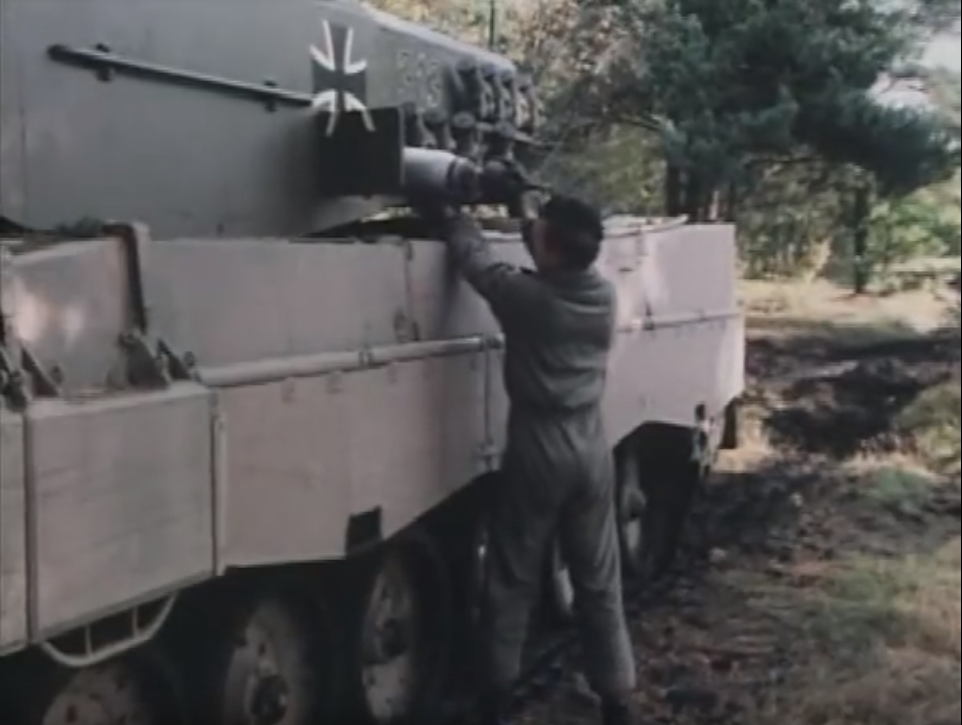
An old ammunition hatch of a Leopard 2AV tank with a crew member loading anti-armor rounds into it.
Leopard 2A4: This version is equipped with a 120mm caliber L44 smoothbore gun along with a high-performance stabilizer, which gives it better combat capabilities than the previous generation. In addition, it has received several upgrades and renovations since its introduction in 1985. The addition of a digital ballistic computer along with an improved fire suppression system plus optimization of the front turret and cannon protection, a new electronic turret and a new automatic cannon arming mechanism, a commander’s periscope equipped with an infrared camera and thermal imaging device, a modern navigation system and etc, are just a few of the upgrades that have been made since then. In general, all models of the Leopard-2 tank have armor consisting of a combination of steel plates of different hardness, elastic materials, and other non-metallic materials to repel various types of anti-armor ammunition, in which changes have been made in this model so that the armor of the Leopard-2 tank model A4 It has a maximum physical thickness of 800 mm.
The Leopard 2A4 tank was the most produced of the Leopard 2 tanks. Between 1985 and 1992, 2,570 Leopard 2A4 tanks were built for Germany and the Netherlands. After the end of the Cold War, many A4s were sold to other NATO countries including Canada, Denmark, Finland, Greece, Norway, Poland, Portugal, Spain, Sweden and Turkey have also used this tank.
The latest A4 model is the Leopard 2A4M. The Leopard 2A4M add an additional mine protection plate for the belly, which increases protection against mines and IEDs. Adaptive suspension systems with a combination of thermal imager and low light amplifier, driver’s night vision system for front and rear vision are also among other optimizations of the 2A4M model. Also, to increase operational capabilities, the A4M is equipped with an engineering interface and additional mounts for attaching a bulldozer blade, plow, or roller for dealing with mines.
During the war between Russia and Ukraine, the Leopard 2A4 tank was the most important option sent by the countries supporting Ukraine. Meanwhile, the Czech Republic was an exception as it sent T-72 MBT tanks to Ukraine and received Leopard 2 in return. On June 5, 2022, Spain announced the delivery of 40 Leopard 2A4 tanks to Ukraine. On January 26, 2023, Canada announced that it had delivered four Leopard 2A4 tanks to Ukraine from their military inventory. On February 3, 2023, Spain announced a plan to supply up to 6 Leopard 2A4 tanks to Ukraine. The first four Leopard 2A4 tanks donated by Poland arrived in Ukraine on February 24, 2023. On March 4, 2023, citing information published by the German news magazine “Der Spiegel”, it was stated that the German company Rheinmetall is ready to supply 50 Leopard 2A4 tanks to Ukraine. Also, on March 7, 2023, Poland announced the delivery of 10 more Leopard 2A4 tanks to Ukraine.
An image of the Leopard 2A4 KMW tank
Specifications of the Leopard 2A4 tank: Length (turret forward): 9.67 meters Width: 3.7 meters Height: 2.79 meters Weight: 52 tons Combat weight: 55 tons Engine power: 1500 horsepower (1100 kW) Maximum speed: 70 km/h on road and more than 30 km/h off road Operational range: 450 km Weapons: 120 mm smoothbore gun L/44 – 7.62 mm machine gun
Various components of the Leopard 2 tank
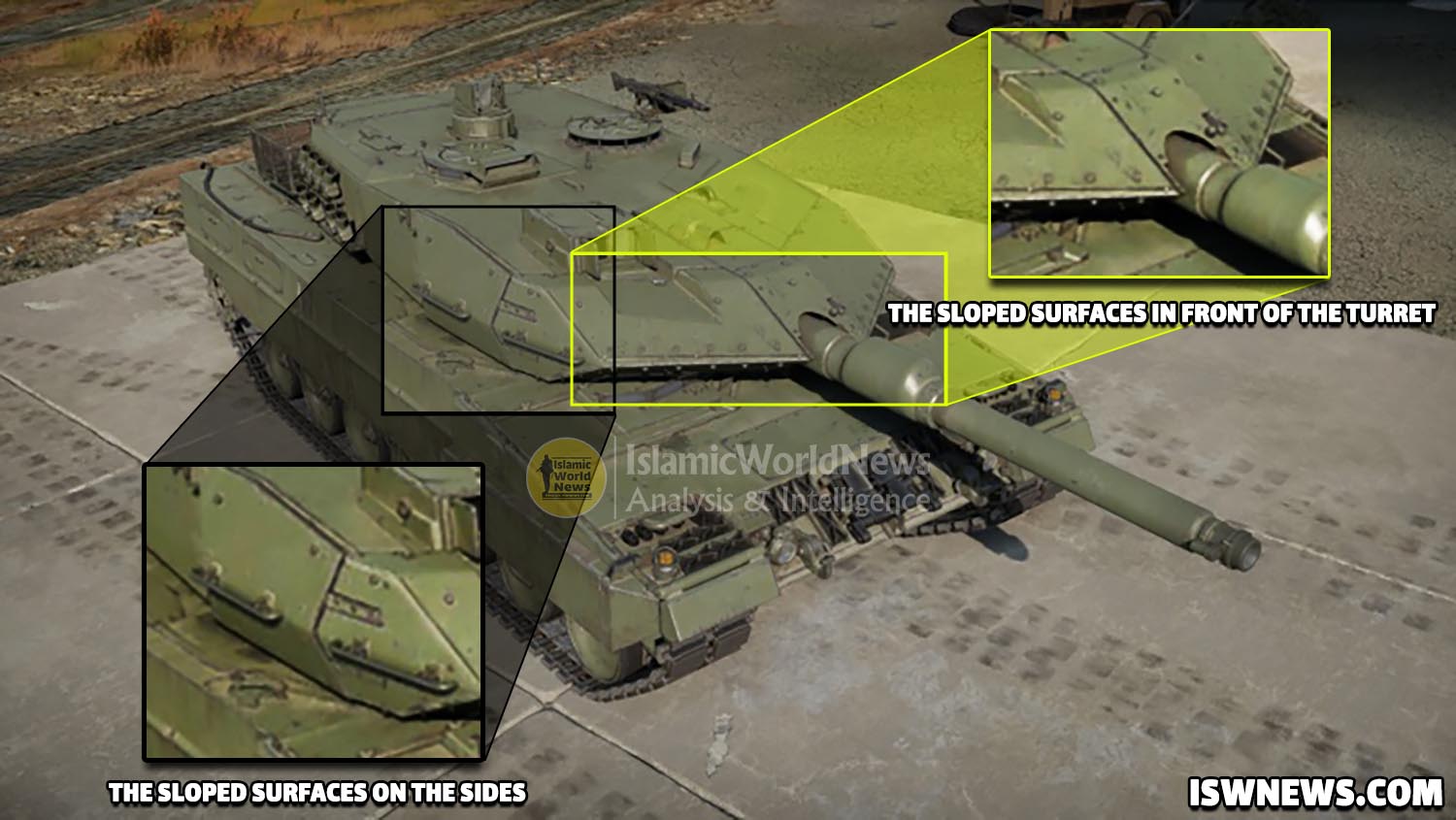
Leopard 2A5: The development of this version of the Leopard 2 tank began in 1995 and its production continued until 2002. In the A5 model, armor with a high slope is placed in the front part of the turret and in the sides, and the thickness of the armor has been increased to 1200 mm by these sloped modules. Improvements have also been made to the main armor composition, making it resistant to 125mm APFSDS rounds fired from 1,500 meters away. The inner part of the tank has a spall liner. These liners are used to eliminate the damage caused by projectiles and the fragmentation of armor parts inward if the armor is penetrated. The front third of the tank’s side skirts armour, which protect the tanks against projectiles and rocket-propelled grenades (RPGs), have been replaced with a new, stronger type.
Arrowhead-shaped armour module of the Leopard 2A5Parts of the Leopard 2A5 tank equipped with additional sloped armor
In addition to the armor changes mentioned earlier, there have also been changes in the command and control section. This tank uses the same gun as the A4 model, i.e. the Rheinmetall 120 mm smoothbore gun L/44 along with two 7.62 mm machine guns, one of which is located on the left side of the gun coaxially with it and the other on the turret and requires an operator outside the tank turret. Two groups of four 76 mm smoke grenades are installed on each side of the turret. The Leopard 2A5 turret is equipped with fully electronic gun control equipment as a replacement for the previous Leopard 2A4’s hydraulic system. This model of tank has been used by Germany, Sweden, Spain and 16 other countries. There is also the possibility of delivering this variant to Ukraine.
Image of emes 15 thermal imaging system installed on Leopard 2A5 tank
Leopard 2A6: The A6 version has a Rheinmetall 120 mm smoothbore gun L/55, which is one meter longer than the L/44 model used in the A5, making it easy to distinguish the A6 from the A5. This modern gun has more power due to the use of longer length and high caliber bullets. With the new ammunition, the L/55 also gains greater penetration power at greater distances. With the improved DM53 kinetic energy ammunition, the L/55 gun can fire up to a range of 5,000 meters. DM53 ammo is a new type of ammo that has a melting shell, this increases the volume of explosives in the pumice, which improves muzzle velocity. The DM53 ammunition was developed for both the L/44 and L/55 cannons.
Shooting 5 dm53 bullets within 20 seconds. As it is clear, the bullets have no pumice and only a small part of the bullet remains.
On both sides of the turret, two places with four smoke grenades are installed. The gunner is equipped with a stabilized dual-magnification EMES-15 sight with a 9,900-meter range laser rangefinder and a thermal imaging unit (WBG) connected to the fire control computer. The fire control computer sequentially calculates the sight angle and side angle for the main weapons. The production of this version started in 2001 and continued until 2005.
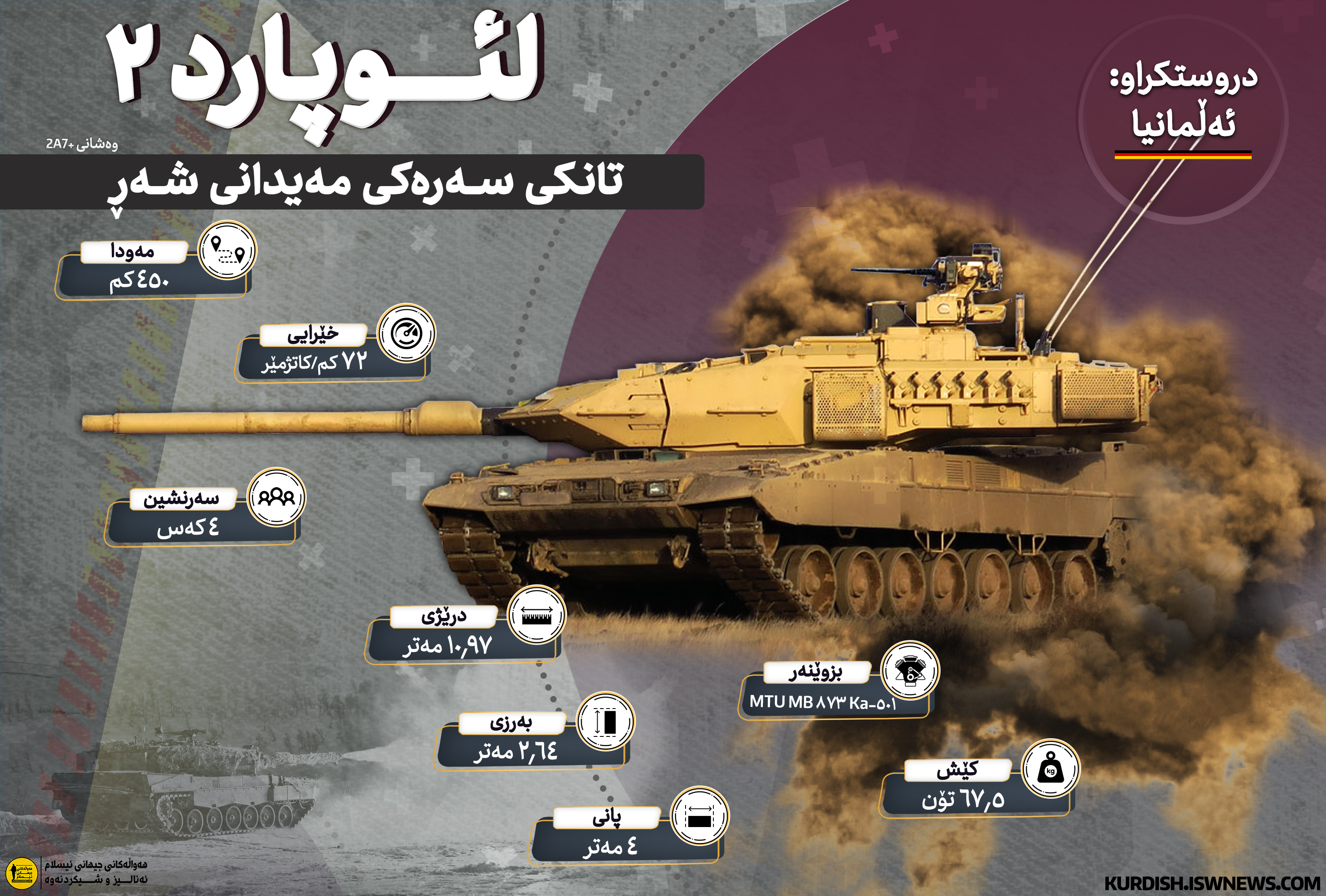
In general, the Leopard 2A6 tank with the changes it received reached a weight of about 61.7 tons. This tank was equipped with a MTU MB 873 diesel engine, with a power of 1500 hp, and a Renk HSWL 354 gear and brake system, so that it could carry out its missions despite its greater weight. A6 has a maximum road speed of 70 km/h and a maximum range of 450 km.
Leopard 2A6 tank in the service of the German army
Leopard 2 also has an A6M model. In the A6M version, for more protection of the crew against mines, toothed plates are used under the chassis, which makes the crew more survivable on the battlefield. Also, the Leopard 2A6EX model has been made with private investment for the export market. The Leopard 2A6 EX tank has an auxiliary power unit, air conditioning unit and improved armor protection over the base model A6.
Periscope system PERI R17 assigned to various Leopard 2 tanks
Leopard 2A7: This version of the tank is known with two models A7 and A7+. The A7 tank was not optimized for urban warfare and was fundamentally different from the variants developed by KMW. Therefore, another example named A7+ has been developed by KMW (Kraus-Maffei Wegmann), which has better urban warfare capabilities added to this tank. The Leopard 2A7+ tank has been in service since 2014 and was first publicly displayed at the Eurosatory exhibition in 2010 by the German Ministry of Defense.
Leopard 2A7+ tank at the Eurosatory exhibition in 2010
The upgrade of this version of the Leopard 2 tank began in 2012. The Leopard 2A7+ is designed to operate both in low-intensity and high-intensity conflicts. The tank’s protection has been increased by modular armour. The frontal protection has been improved with a dual kit on the turret and hull front, while 360° protection against RPGs and mine protection increase the survivability of the tank in urban operations The asymmetric threats of terrorist groups, improvised explosive devices, complex and dangerous urban environments led Krauss-Maffei Wegmann to offer the Leopard 2A7+ a suitable solution for armored forces, so that they can carry out their missions more effectively and safely. Like the A6 version, the Leopard 2A7+ tank is equipped with the Rheinmetall 120 mm smoothbore gun L/55, replacing the L/44 cannon. Increasing the length of the barrel from 44 caliber to 55 caliber (139 cm) allows more of the energy in the barrel to be converted into projectile velocity. The new programmable 120mm HE gun capability enables the crew to engage targets behind cover and inside buildings. The turret-mounted MG3 has been replaced with a stabilised FLW 200 remotely controlled weapon station. Mobility, sustainability, and situational awareness have also been improved. The optimizations made in version 2A7+ are available as an upgrade kit for all versions of Leopard 2 and include a complete set of all components.
7.62 mm machine gun installed on the remote control weapon station KMW FLW 200 on the turret of the Leopard 2A7+ tank
The Leopard 2A7 + tank is divided into two versions, which we will briefly introduce below: Leopard 2A7+ Duel Operations: Developed by KMW and based on a Dutch Leopard 2A6, this model has been optimized for anti-armor operations on the modern battlefield. Leopard 2A7+ Urban Ops: The Leopard 2A6 upgrade is equipped with new armor and special equipment for urban combat operations. In fact, this example is considered an upgrade kit.
How the Leopard tank works on the battlefield
In all types of Leopard 2 tanks, different thicknesses of armor are used throughout its body. The side and back of the tank are resistant to heavy machine guns, medium caliber bullets and old types of anti-tank ammunition. The side of the body is also covered by armor in the new types to protect against shrapnel and light anti-armor such as RPG and roadside bombs to save the tank crew. On both sides of the body, rubber plates reinforced with steel are used to cover the tank chains. To increase mine protection, a 45-degree slope is used in the front and back, and the floor is reinforced with corrugations.
Reviewing the armor of Leopard 2, especially the A5 variant, from the way it is arranged to the way the anti-armor bullet penetrates
Leopard 2 tanks can carry 42 bullets, 15 ready-to-fire bullets are stored in the turret and the rest are stored in front of the body and next to the driver. This ammunition tank is equipped with NBC protection system and automatic fire extinguishing systems.
This tank uses two types of APFSDS-T anti-armor bullets and HEAT-MP-T multipurpose bullets. The APFSDS-T bullet has the ability to penetrate 450 mm of rolled homogeneous armor at a range of 2000 meters. Since its introduction, several generations of APFSDS-T rounds have been developed and used by the German military. The Germans claim that the Leopard-2 tank bullet can penetrate the front armor of the Russian T-72 tank at a range of 2000 meters and the front armor of the T-62 tank at a range of more than 4000 meters.
All variants of the Leopard 2 tank have four crew members, including the commander, gunner, loader and driver, and in addition to the 120 mm cannon, it has two 7.62 mm machine guns. One is guided by the gunner and moves along with the main gun, and the other is mounted on the turret, which in the prototypes is fired by one of the crew, and in the A7+ is controlled by remote control from inside.
The engine used in the A4 and later models is a MTU MB 873 Ka-501 12-cylinder twin-turbocharged diesel engine that provides 1479 horsepower. Providing a torque of 4,700 newton meters at 1,600 to 1,700 rpm gives the tank a very good performance.
MTU MB 873 Ka-501 12-cylinder twin-turbocharged diesel engine
The existence of a very good suspension system and gun stabilizer has provided the possibility of accurate shooting and specific movement conditions for this tank. Leopard 2 has tanks with a capacity of 1160 liters of fuel and can travel up to 450 km on the road and up to 300 km on rough terrain.
Future development of Leopard-2 tank titled “Panther KF51”:
The Panther KF51 tank is being developed by Rheinmetall based on the Leopard 2A4 chassis and has not yet reached mass production. This tank uses a new turret that is equipped with a 130 mm automatic cannon, which gives this tank more fire power.
130 mm Rheinmetall gun
The development of this tank started in 2016 and the first example was produced and tested in 2018. Its full development is expected to take until 2026, but it is already possible to produce a prototype. One of the features of this tank is coordination with the HERO 120 suicide drone. Using active protection instead of passive protection, using artificial intelligence in the fire control system to enable automatic target detection and identification, using a more powerful engine, using a body with less weight and greater ability to adapt to the environment for longer survivability in the fields are some of the salient features of this model. It is also possible to create an unmanned version of the Panther KF51, which has not yet reached the stage of production and testing.
The current model of the Panther KF51 tank uses the same MTU MB 873 Ka-501 engine used in the previous models of the Leopard 2 tank. Due to the weight reduction of Panther to 59 tons, its navigation capacity has increased up to 500 km. The KF51 Panther is stated to have three layers of protection: passive, reactive and active. The innermost layer consists of all-welded steel armour covered by passive armour modules. The second layer comprises sensor-based reactive armour, while the final layer consists of Rheinmetall’s Active Defence System (ADS) Active Protection System (APS) that Rheinmetall claims is capable of protecting against kinetic energy (KE) projectiles and Anti-Tank Guided Missiles (ATGMs). It is possible to mount the ADS on both the hull and the turret. The Panther is fitted with eight Rheinmetall Rapid Obscuring System (ROSY) smoke grenade launchers mounted in staggered rows of two behind the central camera housing on each side of the turret. It is possible to integrate sensors into the Panther that can detect the launch signature of ATGMs and unguided anti-tank rockets before cueing the vehicle’s crew towards the threat or launching appropriate countermeasures. The Panther can be fitted with Rheinmetall’s Top Attack Protection System (TAPS). This comprises a hard-kill element in which the coverage of the ADS is extended to the roof of the platform to protect against both ATGMs and unguided anti-tank rockets launched at high elevations, as well as a soft-kill element that aims to protect against threats such as loitering munitions..
A video of the introduction of Panther KF51
Leopard 2 export and contracts:
In 2011, it was announced that Saudi Arabia plans to purchase 270 Leopard 2A7+ tanks from Germany, but this was not confirmed by Germany. According to reports, in 2013, Qatar ordered 62 Leopard 2A7+ tanks, 24 PzH-2000 155mm self-propelled howitzers (SPH) and several light armored vehicles in a contract worth $2.21 billion. The first batch of these weapons was delivered to Qatar in 2015 and the second batch in 2016 by the German company KMW. On December 19, 2018, Hungary signed a contract with the German defense company Krauss-Maffei Wegmann (KMW) for the purchase of 44 Leopard 2 A7+ main battle tanks as part of its military modernization process. KMW received an order for the delivery of 44 Leopard 2A7+ tanks to the Hungarian Defense Forces in December 2018, scheduled for delivery between 2021 and 2025. According to information published in May 2022 by the Reuters news agency, the Czech Republic is negotiating with Germany to purchase 50 machines.
Leopard-2 specifications: Crew: 4 Length Turret forward: 9.67 meters (2A4 and 2A5 models) – 10.97 meters (2A6 and 2A7+ models) Width: 3.7 meters (2A4 model) – 3.76 meters (2A5 and 2A6) – 4 meters (2A7+ model) Height: 2.79 m (2A4 model) – 3.03 m (2A5 and 2A6) – 2.64 m (2A7+ model) Ground clearance: 0.54 meters Wading depth without preparation: 1.2 meters Wading depth with snorkel: 4 meters Engine: MTU MB 873 Ka-501 12-cylinder twin-turbocharged diesel engine with 1500 horsepower Fuel capacity: 1160 liters Speed: 72 km/h – backwards 31 km/h Range: 450 km Empty weight: 52 tons (2A4 model) – 57.3 tons (2A5 model) – 57.6 tons (2A6 model) Combat weight: 55.15 tons (2A4 model) – 59.5 tons (2A5 model) – 61.7 tons (2A6 model) – 67.5 tons (2A7+ model) Rotation time (360°): in 10 seconds Armament: – Rh-120 L/44 120 mm smoothbore gun and 7.62 mm machine gun (2A4 and 2A5 models) – Rh-120 L/55 120 mm smoothbore gun and 7.62mm machine gun (2A6 model) – Rh-120 L/55 120 mm or Rh-120 L/44 120 mm smoothbore gun, FLW 200 system with 40mm automatic grenade launcher and 7.62mm machine gun or 0.50 MG machine gun (2A7+)
Click to view full size
More images of Leopard 2 tank:
SONY DSCClick to view full size
Collection of “Leopard Tank 2” posters in Russian, Arabic, Farsi, Kurdish and Azeri languages:
Shahed-149 or Gaza drone is one of the most advanced and largest Iranian drones ever built by the Iranian Armed Forces, and the specifications and equipment used in it show the significant progress of Iran in increasing the country’s capabilities in the field of UAVs.
The Shahed-149 reconnaissance combat drone, capable of carrying 13 bombs and 500 kilograms of equipment, as well as a 35-hour flight duration up to a radius of 2,000 kilometers, and is capable of conducting a variety of combat and intelligence operations and greatly enhances and promotes Iran’s military capability in the region.
This drone is very similar to the US MQ-9 Reaper drone and is compared to this drone in terms of operational level. According to the published images, it seems that Iranian experts have succeeded in building such a drone by using past experiences and studies on American captured drones.
Shahed-149 (Gaza) drone with a wingspan of 21 meters and a length of 11 meters has a speed of about 350 kilometers per hour and its maximum takeoff weight is 3100 kg and is capable of carrying cargo weighing at least 500 kg and its flight altitude is about 35,000 feet. Therefore, due to the large size and heavy weight of this drone, a turboprop engine has been used. This is the first time that a turboprop engine with this power is used on an Iranian drone. Exact information about the power of this engine has not been published yet; But according to the published images and general information of the drone, it seems that the Shahed-149 drone uses a turboprop engine with a nearly 650 shaft horsepower.
Another noteworthy point in this drone is the use of a more advanced electro-optical system than previous drones. This system, which seems to be one of the most advanced Iranian electro-optical systems, in addition to a day-vision camera with a zoom power of at least 100 to 120 times, also has a infrared sensor system, laser designation and laser illumination capabilities. One of the highlights of this system is the use of a catadioptric lens that increase the magnification ability several times and this is the first time that it has been used in Iranian drones.
Shahed-149 Gaza drone electro-optical system
Amir Ali Hajizadeh, Commander of the IRGC Aerospace Force, regarding the weapons capability of the Gaza drone, stated that this drone is capable of carrying 13 bombs. In the published images, a device similar to the rotating bomb system used in bombers is seen. And given the space under the drone’s fuselage, the Gaza drones appears to be using a Rotary Bomb Launcher under its fuselage that can carry up to five bombs. If this is true, this is the first Iranian drone to use this mechanism. Due to this improvement, 5 bombs will be installed inside the bomb bay and 8 bombs will be installed under the wings, and in total, this drone is capable of carrying 13 bombs.
Possible Rotary Bomb Launcher mechanism in the Shahed-149 Gaza drone
Iranian Sadid “Fire-and-Forget” missiles weighing up to 34 kg, 13 of which weigh up to 442 kg, can be one of the types of missiles that can be used in the Gaza reconnaissance combat drone.
Shahed-149 (Gaza) drone specifications: Length: 11 m Wingspan: 21 m Height: 3.8 m Range: 2,000 km Service ceiling: 35,000 ft (10,668 m) Endurance: 35 hours Powerplant: Turboprop ~ 650 shp Speed: 350 km/h Gross weight: 3,100 kg Armament: Up to 13 missiles Origin: Iran
Bavar-373 is an Iranian long-range air defense system build to engage with hostile air targets at a range of more than 300 kilometers. The Bavar-373 missile system can be prepared for launch easily. It features anti-stealth capability that allows it to detect hidden targets with a very low radar cross-section. This system was unveiled for the first time in 2016 And later in 2019, it was added to the Air Defense Force of the Iranian Army. The Ministry of Defense of Iran has unveiled an upgraded missile of the Bavar-373 defense system dubbed Sayyad-4B. With this update, the range of Bavar-373 air defense system increased to more than 300 km.
The Bavar-373 missile system is more advanced than its Russian counterpart S-300 long-range surface-to-air missile system. Several studies and tests conducted by the Iranian military showed that the system is superior to the US Patriot PAC-3 air defence system.
After the American invasion of Iraq, Iran analyzed the US’s operational measures and then according to the needs and deficiencies it had in the field of defense systems, made extensive purchases in the field of air defense systems. The purchase of several types of radar and detection systems, electronic warfare system and short-range defense systems such as TOR-M1 and BUK-M2 and the purchase of the long-range S-300 PMU1 system were among Iran’s measures to fill the gaps in its air defense systems.
It should be noted that before 2016, some of these purchases entered Iran, and some others were not delivered to Iran by Russia under the pretext of Western and American sanctions against Iran. For this reason, Iran began to reform the air defense structure and seriously started the domestic production of air defense systems.
The process of production and localization of air defense systems first started with the update of S-200, And Iran started to modify and localize the missile of this system. The efforts of Iran’s military industry in this field resulted in the production of Taer missiles. Following the localization of missiles of air defense systems, missiles of the Sayyad family such as Sayyad 1, 2 and 3 and a wide range of indigenous air defense systems such as Sevom Khordad, Tabas and Talash reached the operational level.
In radar, with the purchase of Gamma radar, Iran started the production and localization of phased array radars. According to the commander of Iranian Army’s Air Defense Force, this was the result of the studies between the Air Defense Force, the Ministry of Defense and some universities, which despite all the ups and downs it had reached the stage of test firing in 2018 and finally in 2019, it was handed over to the Air Defense Force of the Iranian Army.
To name this system, “belief in internal power” was shown in the word “belief” (Bavar) and “373” is the Abjad letter of “Ya Rasulullah”.
Operational test of Bavar-373 system
Introduction of units of Bavar-373 system:
Bavar-373 is an impenetrable, anti-hacking surface-to-air missile defence system comprising a vertical launching system, two acquisition and engagement radars, Sayyad-4 missiles, and a command-and-control center. The design minimises the need for additional support equipment and systems. The vertical launching system features square launchers that are identical to the launchers utilised by naval warships for air defence.
Each Bavar-373 battalion has a command, control and communication unit, which, as the brain of Bavar-373, is responsible for managing and establishing communication between the system’s components, in addition to communicating with the country’s integrated defense network. One battery of this system has four Sayyad-4 transporter erector launchers (TELs) ready-to-launch missiles and has the ability to destroy targets at a range of 300 km. Also, instead of a Sayyad-4 TELs, the other TELs of Sayyad missile family can also be used.
Bavar-373 control and command unit
Meraj-4 radar is the longest range radar of this system. This radar works similar to the large 64N6E2 radar in the S-300 system, but has superior features. For a better comparison, we will first describe the specifications of the 64N6E2 radar, and then we will discuss the Meraj-4 radar:
64N6E2 is a 3D S-band air surveillance radar that has a maximum range of 300 km and the ability to detect 200 targets. The interceptor radar is also capable of intercepting 12 targets at the same time and assigns these targets to the engagement radar for targeting. The S-300 system is capable of engaging targets at a distance of 200 km.
Meraj-4 radar is a long-range 3D active electronically scanned array (AESA) radar made of 40 rows of waveguides. The research, development and production of this radar has been done in Shiraz Electronics Industries (SEI). Meraj-4 can track up to 300 targets simultaneously. The maximum range of this radar is 450 km, the maximum detection height is 130 km and the maximum range for ballistic targets is 1200 km.
Meraj-4 radar
The engagement radar of this system also belongs to Shiraz Electronics Industries. This radar is an active electronically scanned array (AESA) type with a low probability of interception (LPI). The maximum detection range of this system is 320 km and the detection height is 65 km. It has the ability to detect up to 300 targets simultaneously and has the ability to intercept up to 60 targets and engage with 6 targets and simultaneously guide two missiles towards one target.
The engagement radar of Bavar-373
The Hafez multipurpose and phased array radar is also available as a search and tracking radar for low-altitude scanning, which has track while scan (TWS) capabilities. Its maximum range is 300 km and has the ability to detect up to 100 targets.
Hafez acquisition radar
Another radar of Bavar-373 system is the Alim radar, which is a passive radar. Passive radars are used to resist electronic warfare and increase the detection range of stealthy targets. These types of systems passively track 3D waves of aircraft systems, such as Link 16, identification friend or foe waves (IFF) and waves from aircraft navigation systems (GPS). In case of interference in the interception on the radars, existing passive systems have the ability to accurately track or help to track the hostile aircraft or identify the source of the interference, which, by finding the source, provides the possibility to attack and eliminate the interference.
Alim radar
The Saegheh electronic warfare system is an enhancement system for Bavar-373 that operates in the X and Ku bands and is used to detect specific targets such as AWACS radars, classify the waves emitted by airborne radar and disrupt fire control radars and ground tracking radars that is used in cruise missiles and all types of aircraft. This Saegheh system effectively increases the possibility of dealing with enemy AWACS radars.
Saegheh electronic warfare system
The tactical vehicles used in Bavar system are of two types Zafar and Zoljanah. However, it seems that Zoljanah was excluded from the Bavar-373 system over time.
Zafar-8824 heavy tactical vehicle is 8×8 carrier truck, And it has 4 moving axes and its maximum load carrying capacity is 24 tons. The chassis of this truck is similar to MAZ-537 truck. The Zafar truck has been used as the carrier of the radars and command and control equipment of Bavar-373 system. Also, in the new tests of Bavar-373 system, it has been used as a carrier of two box launchers.
Zafar-8824 heavy tactical vehicle
Zoljannah heavy tactical vehicle is a 10×10 carrier truck. Like the Zafar truck, this truck uses the MAZ-537 chassis. Its maximum load capacity has not been announced, but due to the change in the chassis and the addition of an axle, it should be able to carry more weight than Zafar. The important point is the controllability of the last axis of Zoljanah, which provides the possibility of better maneuvering in difficult conditions. Zoljanah is used to carry Sayyad-4 launcher. Zoljanah will be more expensive than Zafar due to its complexities.
Zoljanah tactical vehicle
Sayyad-4 launcher is another component of Bavar-373 system. This launcher, unlike the Russian models that have round tubes, is designed similar to the Patriot system launchers. Each Zoljanah vehicle can carry four Sayyad-4 launchers.
Sayyad-4 launcher
Bavar-373 can use several types of missiles. This capability allows Bavar-373 to cover the range and altitude of different targets like the S-400 system. Nevertheless, so far only the Sayyad-4 missile has been officially introduced for use in the Bavar-373 system, but the use of Sayyad family missiles such as Sayyad 2 and 3 is also very likely.
The Sayyad-4 missile can engage targets at a range of 200 km and up to an altitude of 27 km, similar to the 48N6E2 missile of the S-300 system. Sayyad-4 missile uses stabilizer fins and thrust vector control system, which has significantly increased the maneuverability of the missile. These features have made the Sayyad-4 missile similar to the S-400 48N6DM missile, which has anti-ballistic properties. The main difference between the Sayyad-4 missile and the 48N6DM missile is the fins of the thrust vector control system. In Sayyad-4, these fins protrude from the body, and this causes more changes in the exhaust gases of the missile, and as a result, creates a sharper angle for the missile to turn. So, the high turning power shows that the missile has a high G-pressure tolerance. When the missile gains altitude and enters the thin atmosphere, the control fins at the end of the missile lose their effectiveness, and this is another reason for using the thrust vector control system.
Sayyad-4 missile
The Sayad-4 missile has the ability to engage targets at a speed of 4800 m/s. Meanwhile, the 48N6E2 missile has the ability to engage targets at a speed of up to 2800 m/s. It is interesting to know that the Antey-2500 anti-ballistic system missile can engage targets with a speed of 4500 m/s.
As the numbers show us, the Sayyad-4 missile is superior to the S-300’s missiles and Antey-2500 in terms of anti-ballistics and is near to the S-400’s 48N6DM missile. It also has the ability to engage targets such as fighter jets and cruise missiles. Another type of Sayyad-4 missile called Sayyad-4B has been introduced lately, which has a range of up to 250 km. In the latest tests, the Sayyad-4B missile has managed to hit targets at a distance of 304 kilometers.
Sayyad-4B missile
Considering that the Bavar system is modeled after the S-300, the guidance method of the Sayyad-4 missile should also be similar to the S-300 system. The desired guidance method is Track-via-missile. In this guidance method, the missile combines the characteristics of semi-active radar homing (SARH) and radio command guidance. This method has been used on a number of long-range surface-to-air missiles (SAMs), including the MIM-104 Patriot.
In an interview with the commander of the Iranian Army Air Defense Force in 2022, it was said about the “300 km test”:
“Bavar 373 system in this test detected the target at a distance of 450 km. When this target is detected, the initial lock is performed at a distance of 400 km and a stable lock is performed at a distance of 360 km. It takes a minute to hit it. In this test, we chose a UAV with a small cross-sectional area, and by this we wanted to say that this system is able to identify and destroy the smallest target with a very small cross-sectional area, which it succeeded in destroying at a range of 304 km. The target drone, which was produced by a joint effort by the Ministry of Defense and Air Defense of the Army, reached a height of 43,000 feet (13,716 km) in this test, and was hit by the Bavar-373 system. If other countries want to produce a system with this capability, sometimes they need up to 20 years, but we were able to improve this system over time until we achieved a range of more than 300 kilometers; Immediately after this shot, we also conducted the ballistic test, of course, if we had not been obsessive in this test, we could have destroyed the target at a range of 320 km.”
The cases mentioned by the then commander of Iranian Army Air Defense Forces show that the upgrade in Bavar-373 was not limited to the Sayyad-4 missile, but all the subsystems were also upgraded to perform complex operations and hunting ballistic missiles, and the speed of the Sayyad-4B missile was also increased.
Bavar-373 Long Range Air Defense System specifications: Range: + 300 km Number of missiles: 4 missiles Missile variants: Sayyad-4 and Sayyad-4B Radars: – Meraj-4 active phased array radar with a range of 450 km – SEI active electronically scanned array radar – Hafez multipurpose phased array radar – Alim passive radar Carrier chassis: Zafar or Zoljanah tactical vehicle In service: Since August 22, 2019 Target types: Warplane, helicopter, drone, cruise missile, ballistic missile Origin: Iran
Sayyad-4 missile specifications: Range: + 200 km Speed: Unknown Altitude of fire: 27 km Diameter: 515 mm Length: 7.5 meters Warhead weight: 180 kg
Sayyad-4B missile specifications: Range: + 300 km Speed: Mach 6.1 Altitude of fire: 32 km Diameter: 515 mm Length: ~ 8 meters Warhead weight: Unknown
Click to view full sizeClick to view full size
The poster collection of Bavar-373 long-range air defense system in Farsi, Russian, Arabic, Azeri and Kurdish:
The prototype production of a fighter jet is the last step before mass production of the same jet. Hence, we examine the prototype of Yasin fighter jet production.
The examination of the different pictures of the fighter jet that have been published thus far, several transformations in the final prototype of the Yassin fighter jet are obvious. The first change is visible in the training fighter jet’s landing gear.
Change in landing gear The above photo is the landing gear Yasin jet in its final design and the below picture shows Yasin fighter in its first type; so, the images indicate appropriately that the front landing gear of the final design has been reinforced and the way it folds is similar to the way that the landing gear of Kowsar fighter jet folds. The position of the landing gear has been transferred from the left side to the middle of the jet.
Change in canopy of fighter jet As it can be seen in the photos, the prototype possesses a cabin with a greater arc in comparison to the fuselage of the jet, but in the final design it has an angle, which is such that two pilots are being placed in the cockpit in a stepped way and they enjoy the maximum angle of view. Furthermore, the cockpit doors, which could be opened totally in the prototype, can be opened in two pieces in the final design.
Changing air intake, exhaust of hot gases in engine As it can be seen clearly in the photos, the air intake of the engine has become smaller, which is perhaps linked to shifts in the engine of the fighter jet. Moreover, some changes have been made in the exhaust component of the hot gases of the engine, because its exhaust section is located outside a cover.
The Iranian engineers also added VHF and UHF antennas, which are being used for secure communications. They also added an air brake under the fuselage and in front of the rear landing gear of the jet that helps reduce the speed of the jet in the landing process.
Change in tail of the fighter The manufacturers of the fighter jet also changed its vertical rudder in order to reduce aircraft dragging, and it seems that they have changed the location of the horizontal rudder as well, and the horizontal rudder is slightly smaller than the prototype.
We can mention to the following aspects of the training aircraft among other important points:
In accordance to the photos released of the banner available in the production line of the Yasin combat training fighter jet, its various parts will be manufactured by different organizations in Iran. The cockpit displays are going to be produced by Sairan (Iran Electronics Industries), which was producing cockpit displays for the Kawsar fighter jets in the past.
The canopy glass and its door, the ejection seat and the landing gears are going to be produced by the Iran Aircraft Manufacturing Industries Corporation. The wings as well as horizontal and vertical rudders will be made by Iran Helicopter Support and Renewal Industries (PANHA). And the radome and the cockpit will be manufactured by the Owj Aviation Industries. The manufacturers of the fuselage and the engine of the jet are not visible because of the angle that the picture is located.
Various parts of Yasin manufactured by different organizations
Given the available pictures of the engine, the Owj Aviation Industries will utilize engines without afterburner for the fighter jet, which is being produced by the Iran Aviation Industries Organization (IAIO). It is known as the Owj-Y engine, which is a light turbojet engine without afterburner, possessing a thrust of 3500 lb-ft equivalent to 16 kilonewtons. The engine possesses a maximum speed of 16,600 rpm and it can provide the Yasin fighter jet with a maximum speed of Mach 0.8 and a maximum altitude of 40k feet.
Owj-Y engine
Furthermore, a single-seater model of the jet is going to be manufactured for close air support (CAS). The Yasin jet has three spaces, including the central space, which can be applied to carry an external fuel tank and the other two spaces can be utilized to carry arms. In the training prototype of Yasin jet, the two spaces are used for all sorts of training armaments.
For instance, the Yassin fighter jet can carry and apply arms, including the Yassin advanced precision-guided smart bomb, the Maverick missile, various types of Iranian SDB bombs, and the Shafaq missile for the close air support operations.
The Yassin fighter jet does not need any radar in order to utilize the weaponries and it can conduct close air support operations to defend ground forces.
The production of the Yassin fighter jet is considered a step forward concerning the training for Iranian pilots, because they have been using a propeller plane such as Bonanza, and after that they fly a PC7 plane, and it would be better for them to get trained by an advanced fighter jet, when they are accepted in the fighter squadron.
The fighter jet can meet all requirements of the Iranian air force, including all sorts of training drills and firings. The Yasin fighter can be categorized in the Yak-130 class and it seems to be very essential and functional for the training pilots to fly by using the new generation of fighter jets.
The development of this helicopter started in 1996 and its first flight was successfully completed in June 1997. The serial production of Ka-52 began in 2008 at Progress Arsenyev Aviation plant in the Primorye region of Russia. In December 2010, the Russian Air Force’s 334th Tactical Deployment Centre in Torzhok received three Ka-52s. The twin-seat Ka-52 serves in the air force as a special mission helicopter. The Russian Air Force began fielding Ka-52 helicopters in April 2011. In the same year, Russia’s defence ministry signed a contract with the company to procure 140 Ka-52 helicopters. In February 2018, the Russia’s defence ministry expressed interest in procuring 114 upgraded versions of Ka-52 attack helicopters as part of the new State Armament Programme for 2018–2027.
However, The limited production of this helicopter has caused only 127 units (each unit between 10 and 13 aircraft) of this helicopter to enter service in the Russian air fleet by 2020.
The Ka-52 has a wider nose and an extended fuselage compared to the Ka-50, however, the commonality of the airframe, components and systems of the two variants is about 85%. The Ka-52 attack helicopter has a length of 15.8 meters, height of 4.93 meters and main rotor diameter of 14.5 meters. The maximum take-off weight of the Ka-52 is 12,200 kg.
General view of Ka-52 helicopter – click to view in larger size
The Ka-52 helicopter is capable of performing a wide range of missions, such as attacking armored and non-armored vehicles, attacking low-speed air targets, attacking enemy infantry in the front line and in the tactical depth of the enemy, providing fire support for the front line forces and etc. Ka-52 can also be used as a monitoring platform and air command post for a group of attack helicopters.
The Ka-52 helicopter has unique capabilities in terms of maneuverability and agility and is known as one of the most maneuverable helicopters in the world. This high maneuverability is obtained from its coaxial rotors. Coaxial rotors or coax rotors are a pair of helicopter rotors mounted one above the other on concentric shafts, with the same axis of rotation, but turning in opposite directions (contra-rotating), which eliminates the vibration and rotation of the tail; so there is no need for rotors in the tail section. In general, one of the problems with any single set of rotor blades is the torque (rotational force) exerted on the helicopter fuselage in the direction opposite to the rotor blades. This torque causes the fuselage to rotate in the direction opposite to the rotor blades. In single rotor helicopters, the antitorque rotor or tail rotor counteracts the main rotor torque and controls the fuselage rotation. Coaxial rotors solve the problem of main rotor torque by turning each set of rotors in opposite directions.
The use of coaxial system in Ka-50 and Ka-52 has significantly increased the stability and maneuverability of these helicopters; which is very necessary and important for an attack helicopter. High turn speed and fast change of position, performing military maneuvers such as flat turns in the direction of the target, side ways motions at high speeds, which is less seen in heavily armored aircraft, and deep glides of the high pitch angle of up to 30 degrees or 35 degrees are other capabilities of this highly maneuverable helicopter.
Coaxial system in Ka-52 and significant increase of stability and maneuverability
Kamov helicopters have been present in many wars and have shown very good survivability so far. In the Ukraine war, there are cases where the Ka-52 was hit by the enemy but was able to continue on its way, or in many cases where the helicopter was shot down, the helicopter pilots were saved. One of the reasons for the survival of this helicopter on the battlefield is the existence of the coaxial system, which was explained above about how it works. In conventional helicopters, the rotor in the tail section plays a role as a stabilizer, but it is highly vulnerable and in case of a hit, the balance of the helicopter will be lost. Removing the rotor in the tail section of Kamov helicopters and using an coaxial rotor has solved this problem, and if the tail section is damaged, the Kamov helicopter is still able to move. Another reason for Kamov’s survival is the possibility of flying with one engine. If one of the engines is targeted on the battlefield, Ka-52 is able to operate with other engine.
Engine:
The Ka-52 helicopter uses two Klimov VK-2500 turboshaft engines. It is worth noting that this engine is developed from the TV3-117 engine used on the Ka-50 helicopter. The VK-2500 engine has three different types, the first type has 2000 horsepower, the second type has 2200 horsepower, and the third type has 2400 horsepower. There is also another example of this engine known as VK-2500P and it has 2500 horsepower. The interesting thing about these engines is that they have an emergency power mode with a power of 2700 horsepower. This feature is used in case of failure of one of the engines and significantly improves flight safety in emergency situations.
Klimov VK-2500P/PS turboshaft engine
The main difference between the VK-2500 and VK-2500P/PS engine is the use of a modern automatic electronic control system of the FADEC type and anti-overheat protection. Thanks to the new design, the VK-2500P ensures more reliable operation of helicopters in areas with moderate climates and even high temperatures and in high mountains. The existence of two separate gearboxes to transfer the power of each engine is an important factor in the operation of the helicopter in critical conditions. This power transmission system, in addition to the power of 2700 horsepower, is an important factor in the survival and preservation of the lives of the pilots in case of loss of one of the engines. Also, the engines have a filter to prevent dust from entering the engine and have a fire extinguishing system.
Cabin:
The Ka-52 twin-seat cockpit accommodates two crew members in side-by-side arrangement. Both the crew members are seated on identical K-37-800M ejection seats. The helicopter has a modern bulletproof glass cockpit equipped with a head-up-display (HUD), four SMD 66 multifunction displays, helmet-mounted sight display, image intensifiers and a GPS receiver. The helicopter also integrates a PHAZOTRON cabin desk radio-locator and navigation and attack system for helicopters (NASH).
Ka-52 helicopter cockpit
The SAU-800 automatic control system, created by Radioelectronic Technologies’ facilities in Saratov, enables the Alligator to be piloted in manual, automated and automatic modes. The SAU-800 is integrated with the SIVPV-52 aerometric data recording and processing system developed by Radioelectronic Technologies’ Moscow-based company Aeropribor Voskhod. The SUO-806P weapons control complex for the Ka-52 has been designed and produced by Radioelectronic Technologies’ Kursk-based Aviaavtomatika company.
SUO-806P weapon control system
The helmet-mounted display was signed and delivered in a long-term contract with Ramenskoye Design Company (RDC) as part of the avionics equipment required for the Ka-52 attack helicopter and the Ka-52K advanced ship-based variant between 2013 and 2020.
Ka-52 pilot’s helmet
The cockpit of the Ka-52 helicopter is armored and provides good protection for the pilots. The armor of this section is a 3 hardlinered armor; the inner cockpit section made of a full single titanium alloy “bathtub” covering both pilots, followed by a middle liner of ceramic plates, which caused trouble first after a single shot they break apart and lost all its protective abilities, they avoided that by covering this ceramic plates with kevlar/aramid that was glued on tightened and the outer liner which gives the aerodynamic shape and is made of aluminium alloy with a part carbon in it. Also, to further protect the cabin, in addition to the 44 mm bulletproof glass, two armored plates have been used in the side of the cabin next to the pilots.
Ka-52 armor and protective armored plates
The outer part of the cabin and the bottom of the fuel tanks are also made of aluminum and carbon alloy with a thickness of 20 mm. The total amount of armor that could be installed for each pilot of the Ka-50 helicopter is about 300 kg. For the Ka-52 helicopter, this number has been reduced to 150-200 kg per pilot. This is despite the fact that about 90 kg of armor is used for each pilot in the American Apache helicopter. Ka-52 armor is (at least theoretically) resistant to 23 mm bullets.
Ka-52 body close-up – click to view in larger size
The helicopter has four separate fuel tanks, three in the rear and one just behind the cockpit. All four fuel tanks are plated and separate from each other.
Quadruple fuel tanks in Ka-52
As mentioned, the Ka-52 has 85% of the same parts as the Ka-50. But in terms of appearance, it has a wider nose and in the cabin, two pilots sit next to each other. Both pilots are able to fully control the helicopter; Such an arrangement simplifies the operation of the helicopter during the battle. Also, there is no need for a dedicated training version for this helicopter and it is possible to use this helicopter as a training helicopter.
Ejection seats and eject system:
Another unique feature of this helicopter is being equipped with ejection seats. The Ka-52 helicopter, along with the Ka-50, are the only active helicopters in the world that have this capability. The Ka-52 CAS K-37-800M ejection seats consists of two parts, an armchair and a side part, designed to perform the functions of the pilot’s seat of the Ka-50 and Ka-52 helicopter and providing in combination with the ZSh-7VS helmet and oxygen equipment of the KCO-VK-LP safe emergency exit by bailout with the help of a towing rocket engine at an indicated flight speed from 90 to 350 km/h in the altitude range from 0 to 5000 m and reducing the loads acting on the pilot during an emergency landing using the energy-absorbing cushioning suspension of the chair.
How the ejection seats work in Ka-52CAS K-37-800M ejection seats and eject rocket in Ka-52
Radar:
The Ka-52 helicopter is fitted with a mast-mounted radome nose mounted housing a Phazotron FH-01 Millimeter Wave Radar (MMW), known as the Arbalet radar with two antennas for aerial and ground targets. This radar is manufactured by Phazotron-NIIR, Russia’s largest developer of military and avionics radars.
Arbalet radar on Ka-52 nose
The Ka-52 radar is an Arbalet-52 dual-band pulse doppler radar weighing 140 kg, which allows the helicopter to effectively carry out combat missions at any time of day or night in all weather conditions, even in the presence of organized or natural electronic jamming. The maximum range of the Arbalet-52 radar is 37 km. In general, Ka-52 uses two radars, Arbalet-52 or Arbalet-M, which are more powerful versions of the Arbalet radar and use the Baguet series processor. In this radar, Ts181F processor is responsible for data processing and Baget-55-04.01 processor is responsible for signal processing.
Phazotron FH-01 radar known as Arbalet radar in Ka-52
The air-to-surface capabilities of this radar include various mapping modes, mapping range up to 32 km, azimuth coverage of 120°, the ability to detect ground targets such as bridges at 25 km and tanks at 12 km, the ability to detect ground-based obstacles and terrain detection/avoidance- Electricity cables at 400 meters and the ground with a slope of 10 degrees at 1.5 km, the ability to detect moving target selection of ground and air targets, determination of priority of objects, missile approach warning, support/cueing of EO targeting systems, detection of dangerous weather conditions, nvigation systems update and correction, missile and rocket control, target type classification (in conjunction with IFF) and tracking of 20 targets simultaneously.
The air-to-air capabilities of this radar include the azimuth coverage of 360° with elevation ±30°, the tracking limits with azimuth of ±60° with elevation±30°, the ability to detect hostile aircraft at a range of 15 km and a Stinger missile at a range of 5 km, the ability to engage with a variety of targets such as cruise and drones, the ability to track up to 20 targets.
Observation and electro-optical system section:
In terms of observation and electro-optical system, Ka-52 is equipped with GOES-451 optical system. The GOES-451 system is gyro-stabilized optronic station designed to provide detection, targeting and missile guidance for the Ka-52 attack helicopter. The GOES-451 sensor package includes visible and infrared cameras, laser rangefinder and laser designator.
GOES-451 visible camera has a maximum range of 83.3 km, infrared range of 55.6 km, laser range finder with a range of 18.5 km and laser point designator with a range of 14.8 km.
GOES-451 electro-optical system
It should be noted that a version of the Ka-52 Katran (Marine version of the Ka-52) was displayed at the MAKS 2015 exhibition, which used the OES-52 (ECO-52) electro-optical system instead of the GOES-451 electro-optical system. Also, in 2016, another version of the Ka-52 was seen in the sky of Moscow, which was equipped with the OES-52 electro-optical system. It was later revealed that the OES-52 electro-optical system will be used for the Ka-52M helicopters, which are a more powerful and updated version of the Ka-52. Nevertheless, the possibility of installing this system on older and current Ka-52 versions is expected. Also, the export versions sold to Egypt, namely the Ka-52 Nile Crocodile (Ka-52E) are equipped with the OES-52 electro-optical system.
The OES-52 system is functionally similar to the GOES-451 system. The OES-52 developed by Moscow-based NPK SPP and houses five sensors: a thermal imaging camera, TV camera, laser rangefinder/designator, laser beam riding for anti-tank guided missiles, as well as a laser spot tracker. However, the weight of this system is 177 kg, which is 43 kg lighter compared to the GOES-451 system, which is 220 kg.
OES-52 electro-optical system on Ka-52 Katran in MAKS exhibition 2015Ka-52 equipped with OES-52 system in the sky of Moscow
Protection system and electronic warfare:
In terms of protection systems and electronic warfare, the Ka-52 is equipped with the President-S integrated protection system. The President-S system is made by KRET and Ekran Scientific Institute and includes a set of various countermeasures such as active IR and electronic jammers, radar warning receiver (RWR), laser detection system, IR missile approach warning sensor, etc. Next, we will introduce the President-S system components :
Components of the President-S integrated protection system on the Ka-52
– “L370-0 control unit” is a digital computer module which is responsible for managing the entire electronic warfare package, as it receives all data from the warning sensors deployed on the helicopter’s structure and says it is integrated, analyzed and presented to the pilot to take defensive countermeasures.
– “L-136 MAK-UFM missile approach warning (MAWS) system” as its name suggests, is a system that detects and warns the approach of missiles fired at the helicopter. This system can detect shoulder-launched missiles such as the Stinger and Igla from a distance of 10 km, and air-to-air missiles launched from aircraft such as the Sidewinder and the R-73 from a distance of 30 km to 50 km.
L-136 MAK-UFM warning system, two in the front and two in the back of the helicopter
– “L-140 Otkilk laser warning receiver (LWR) system” is specialized in intercepting and monitoring laser beams emitted from distance measuring devices for anti-aircraft missile guidance systems, and provides integrated protection at an angle of 90° horizontally and 360° vertically.
L-140 Otkilk system on the right wing tip and in the rear at the very end of the helicopter
– “SPO-32 / L150 Pastel radar warning receiver (RWR) system” is a system that detects and receives radio waves emitted by enemy aircraft radar systems, and if a threat is detected, such as the presence of a fighter jet’s fire control radar or a missile launcher’s radar seeker, issues a warning about the existence of a threat. This system has a range equivalent to 222.2 km.
The SPO-32 / L150 Pastel system on the left wingtip and lower end of the helicopter
– “L370-3 radar jammer or electronic countermeasures (ECM) system” are systems installed inside the Kamov-52 helicopter and their task is to perform a wide range of jamming measures against surface-to-air, air-to-air missile search radars, etc. This system works in integration with the L150 Pastel system. The L150 Pastel system is responsible for intercepting radar waves and determining their source and the L370-3 jams them.
– “L-370-5 Vitebsk directional infrared countermeasures (DIRCM) system” is a jamming system to protect the helicopter against anti-aircraft missiles. This system is installed under the belly of Ka-52 in both sides of the helicopter in a rotating turret. This system is responsible for jamming missile seekers operating in the ultraviolet and infrared ranges. The L-370-5 Vitebsk system shines laser beams on the missile’s thermal / electro-optical seekers to confuse it and mislead it away from the helicopter. This system is able to track missiles fired at the helicopter within a radius of several kilometers.
L-370-5 Vitebsk infrared jamming system
It should be noted that, based on the available evidence, in the new and updated version of the Ka-52, the Kamov Ka-52M, instead of the L-370-5 Vitebsk system, a more advanced system called the L418-5 DIRCM has been used. The possibility of installing this system on the older and current Kamov 52s is also not far from expected. Also, in the export versions sold to Egypt, i.e. Ka 52E, the L418-5 DIRCM system is used.
Ka-52E exported and sold to Egypt, equipped with new L418-5 DIRCM sensor and new OES-52 optics.
– In Ka-52, the UV-26 flare and chaff dispensers is used. This system is placed in two double positions at the wingtips of Ka-52, and each of them contains 32 pieces of chaff and flare.
UV-26 flare and chaff dispensersin Ka-52
Ka-52 armaments:
Ka-52 armaments
In the armament section, the Ka-52 helicopter is equipped with a 30mm Shipunov 2A42 automatic cannon on the right side of its body. This cannon has low mobility and only moves up and down. The 30mm Shipunov 2A42 cannon is designed to shoot at lightly armored targets at a distance of 1500 meters, non-armored targets at a distance of 4000 meters, as well as low-flying subsonic aerial targets at a distance of 2000 meters. This cannon has the ability to operate in harsh conditions, such as the temperature range from +50 degrees to -50 degrees Celsius in rain, dust, frost and in a very dry environment. The firing speed of this cannon is 550 rounds per minute and its weight reaches 115 kg.
Shipunov 2A42 30 mm automatic cannon
Also, there are 6 external hardpoints under the two wings, which can be used to install different combinations of weapons up to the weight of 2,942 kg. There are also 2 dual slots on the wingtips for chaff and flare dispensers.
6 external hardpoints under the two wings of Ka-52
The Ka-52 has 3 hardpoints under each wing, which can carry an APU-6 rack along with an unguided rocket pod and an anti-tank missile on the third hardpoint and two UV-26s on the wingtip, each of which contains 32 pieces of chaff and flare. The APU-6 rack is actually a shelf for storing and firing 6 anti-tank missiles, which is designed to increase the carrying capacity of the Ka-52 helicopter.
Also, to increase the range, Ka-52 is able to carry four external fuel tanks up to 500 liters in its hardpoints.
External fuel tank for Ka-52
The pods of unguided rockets on Kamov are two types of S-8 80mm rockets (S8/80mm) containing 20 rockets and S-13 122mm rockets (S13/122mm) containing 5 rockets, which can be installed one on each wing and a total of two of them are in addition to 6 anti-tank missiles on the APU-6 rack in each wing and a total of 12 anti-tank missiles. This combination gives a lot of power to the Ka-52 helicopter in suppressing armor and infantry on the battlefield.
S-8 80mm rocket pod (S8/80mm) containing 20 rockets and S-13 122mm rocket pod (S13/122mm) containing 5 rocketsB8V20A pod for 80mm S-8 rocket and B-13L pod for 122mm S-13 rocket
It is also possible to install anti-tank missiles such as 9K121 Vikhr and 9M120 Ataka on APU-6 racks. The Vikhr missile can destroy targets at a distance of 10 to 12 km, and the Ataka missile provides the Ka-52 helicopter with an operational range of 400 meters to 6 km to target armored targets.
Right: Vikhr missile – Left: Ataka missile
A video from inside the Ka-52 cabin recorded during the operation of the Russian army to seize the Antonov (Gostomel) airport near the city of Kiev on February 24, 2022. In this video, the Ka-52 is flying low and providing fire support for Russian infantry and a Russian Mil-8 transport helicopter. The Ka-52 escapes from being hit by several rockets and is finally forced to make an emergency landing due to the impact of a missile.
Video from inside the cabin of Kamov-52 during the capture of Antonov airport
Introduction of other versions of Ka-52:
Updated version of Ka-52: Ka-52M helicopter In recent years, the Russian Ministry of Defense announced the production of a new version of the Ka-52, which was finally known as the Ka-52M in 2018. Ka-52M is actually an updated version of Ka-52, which has undergone changes in terms of system and some equipment. According to the information of the Russian Ministry of Defense, 114 aircraft of this model are to be put into service, and according to the latest information, on January 4, 2023, the Russian army received 10 Ka-52M helicopters.
The updated version of the Ka-52M helicopter is equipped with the GOES-451M electro-optical system with greater range and better performance. Also, the new OES-52 electro-optical system is used in the Ka-52M helicopter. The OES-52 system is functionally similar to the GOES-451 system. The OES-52 houses five sensors: a thermal imaging camera, TV camera, laser rangefinder/designator, laser beam riding for anti-tank guided missiles, as well as a laser spot tracker. However, the weight of this system is 177 kg, which is 43 kg lighter compared to the GOES-451 system, which is 220 kg.
GOES-451M and OES-52 electro-optic system for Ka-52M
Stronger undercarriage, improved cockpit ergonomics and better night vision goggles compatibility are other changes and updates to the Ka-52M.
In terms of armament, the Ka-52M is equipped with Light Multipurpose Guided Surface-to-Air (LMUR) missiles. This missile, which is also known as Izdeliye 305 and Item 305, has a range of 14.5 kilometers and is used to destroy a wide range of ground targets.
In the radar section, the Ka-52M is equipped with the V006 Rezets (cutter) active electronically scanned array (AESA) radar instead of the Arbalet-52 radar. This radar has a fixed 900×300 mm AESA antenna with 640 transceiver modules. This radar can detect a group of tanks from 45 km, a railway bridge from 100 km, and a destroyer-class warship from 150 km, according to the manufacturer. In the air-to-air mode, it can detect a fighter aircraft with a radar cross section of 3 sq m from up to 50 km head-on and a hovering helicopter from 20 km. The Rezets radar weighs 130 kg, 10 kg less than the current Ka-52’s FH01 radar and is air-cooled, with an air scoop for cooling seen on the helicopter’s nose fairing.
V006 Rezets active electronically scanned array (AESA) radar
In the field of countermeasures and electronic warfare, the Ka-52M President-S integrated protection system has undergone changes and its various components have been improved. In one of the most important components of this section, instead of the L-370-5 Vitebsk system, a more advanced system called L418-5 DIRCM has been used.
New L418-5 DIRCM system for Ka-52M
Finally, and perhaps the most important part of the helicopter’s upgrade, is the installation of new systems for the helicopter to adapt to work in the new battlefield command and control system.
Naval version of Ka-52: Ka-52K Katran helicopter: The Ka-52K Katran helicopter is the naval version of the Ka-52 helicopter and is based on the Ka-52 Alligator; But the equipment and systems of this helicopter have been modified according to sea operations and its body is also covered with elastic anti-corrosion coating. Since this helicopter is designed for use on aircraft carriers and warships, its dimensions have become smaller and it has folding blades and wings to occupy less space in the hangar. The length of this helicopter is 13.8 meters and its wingspan is 6.3 meters. The reduction of the wing length in this helicopter has caused the weapon hardpoints to be reduced from 6 to 4. The rotor system of Ka-52K is equipped with elastic bearings between the blade and the mast to bear more weight.
Folding blades in Ka-52 KatranFolding wings and two hardpoints under each wing in Ka-52 Katran
The Ka-52K helicopter is equipped with radio and satellite navigation equipment and provides the possibility of independent landing from the watchtower on the ship’s deck. The helicopter is also optimized with an air conditioning system to perform missions in the humid marine atmosphere. By equipping the KA-52K with advanced avionics systems and powerful weapons, it can be configured for different roles.
Ka-52K helicopter is equipped with laser beam guidance system and Okhotnik video processing system developed by KRET. The Okhotnik system increases the range of detection and identification for the helicopter.
Ka-52K helicopters are equipped with Arbalet radar system in early versions. In newer versions, this radar has been changed to active phased array radar. Russian defense contractor Radio-Electronic Technologies’ Active Phased Array (AESA) radar has been developed for the naval version of the Kamov 52 to replace the Arbalet radar. This radar gives the Ka-52K helicopter the ability to fire the Kh-35 anti-ship cruise missile and the Kh-38 missile. The detection range of this radar for large sea targets reaches 180 km.
It should also be noted that this version, like the regular Ka-52 versions, will be known as the Ka-52KM when it receives new upgrades. The M suffix is used for versions that have received the latest updates.
Ka-52K Katran helicopter
Pros and cons of Ka-52 helicopter:
Pros: It’s a multipurpose helicopter and very fast, agile and flexible. It provides a good level of armor protection in the cockpit for the pilots. It has a wide range of countermeasures and electronic warfare. It has 6 hardpoints to carry a wide variety of ammunition. It has effective anti-tank capabilities with Vikhr and Ataka missiles. It has a very good electro-optical system and a strong weapon management system. Cons: Small area for locking on with Igla air-to-air missiles The firing arc and performance of the 30 mm gun is limited due to its placement on the right side of the helicopter. High angles of attack can result in fuel starvation to the engine
Specifications of K-52 attack helicopter: Role: attack helicopter First flight: 25 June 1997 Produced: since 2008 Length: 15.8 meters Height: 4.93 meters Large wingspan: 7.8 meters Small wingspan: 2.6 meters Main rotor diameter: 2 x 14.5 meters Main rotor area: 330.3 square meters Crew: 2 people Empty weight: 7,700 kg Maximum take-off weight: 12,200 kg Engine: 2 Klimov VK-2500 turboshaft engines, 2,400 horsepower each. Internal fuel: 1,870 liters External fuel tank: up to 4 tanks and a total of 4,070 liters Maximum speed: 315 km/h Combat range: 460 km (with internal fuel tank) Maximum range: 1100 km (with external fuel tanks) Flight ceiling: 5,500 meters (18,000 feet) Rate of climb: 12 m/s
Armament: 30 mm Shipunov 2A42 cannon, it is possible to mount a 23 mm UPK-23-250 cannon pod (with 240 rounds) on the wings. Hardpoints: 6 under-wing hardpoints with capacity of 2,942 kg + 2 double slots at the wingtips for chaff and flare dispensers.
It is possible to carry a combination of the following weapons: Rockets: S-8 80mm rocket pod containing 20 rockets and S-13 122mm rocket pod containing 5 rockets. Missiles: Using the APU-6 racks, allows the use of a variety of anti-tank missiles such as the 9K121 Vikhr and Ataka. Up to 12 laser guided missiles Two Kh-25 laser guided missiles In Ka-52K version, anti-ship missile kh-31 and kh-35 R-73 air-to-air missile Bombs: up to 4 bombs weighing 250 kg or 2 bombs weighing 500 kg
Click to view full size image
More pictures of Ka-52 attack helicopter:
Click to view full size image
“Ka-52 Attack Helicopter” posters in English, Russian, Arabic, Azeri and Kurdish:
The upgrade of the Su-35 kicked off from 1980s, when the Russians started developing the Su-27. The fighter jet was introduced as the Su-27 in the first place; in fact, the Russians sought to manufacture a more powerful version of the Su-27 to improve its maneuverability, Avionics (Aviation Electronic), longer range and more powerful engine of the jet. Thus, the first version of the fighter jet conducted the initial flight in June 1988, and then, 15 Su-27 were manufactured prior to the collapse of the Soviet Union.
Following the downfall of the Soviet Union, the Sukhoi Company changed the name of the fighter jet to Su-35 with the aim of attracting purchasers from the global export markets. In 2003, the company initiated the second big upgrade of the fighters and the first flight of the new version took place in February 2008. The aim was to maintain the Russian Air Force fleet up-to-date in order to fill the gap between the fourth and fifth generations of fighter jets as long as the fifth generation of fighters of Russia’s Sukhoi PAK FA would be ready.
The Su-35 fighter jet is considered as the “fourth generation ++” of the fighter jets, which was seen as the most powerful and the most advanced fighter of Russian aerial superiority before the fifth generation Su-57 in order to carry out different defensive and offensive missions.
Performing a combined maneuver of the Sukhoi-35, which is a combination of the three techniques of the Cobra maneuver, the hook maneuver to the left and an additional back, shows off the agility and maneuverability of the Sukhoi-35.
Design and development of Su-35 The first design of the Su-35 dates back to early 1980s, at the same time when the Su-27 entered service with the Soviet Army. The final version of the Su-27 is identified with the name T-10S. The operation to upgrade the Su-27M began in 1982 and the design was accepted in 1983 with the name T-10M.
The design of the Su-27M is widely similar to the Su-27; however, when it comes to manufacturing the fuselage of the Su-27M, they used small canards in the fighter jet cabin, which is located slightly ahead of main wings. The usage of canards gives the fighter jet an opportunity to carry out maneuvers of higher intensity, while it does not need any revamp and amplification of the key structure. The other transformations to the version comprise longer tail fins, aerial refueling system as well as larger wheels on the front of fuselage of the fighter jet. Other than the abovementioned issues, one of the distinguishing features of the fighter jet is the usage of an up-to-date fire control system.
The extra powerful turbofan engines and the usage of lightweight composite materials as well as aluminum and lithium alloys are among other features applied in the fighter jet.
The radar installed on the fighter jet is multi-purpose and able to spot targets on the ground.
When the N011 Bars radar was installed on the Su-27M for the first time, it transformed the fighter jet from an air defense jet to a multirole fighter. Contrary to the N001 Myech radar, the N011 Bars radar is being installed on the Su-27 and is capable of detecting 10 targets as well as at the same time directing two missiles against merely one target; furthermore, the radar, which is installed on the Su-27M, can detect 15 targets and is capable of engaging with six targets.
N011 Bars radar
The Russians installed radar named N012 on the back of the fighter plus the main radar in order to detect missiles fired at the fighter jet. The design was applied on the Su-27M first, and the fighter jet is the first combat plane to be equipped with this sort of capability. In succeeding designs, the radar was detached from the rear of the Su-35 fighter, and the existing Sukhoi-35 fighters do not possess such radars; however, the fighters were equipped with the electronic warfare and jamming systems in the rear section.
Test and operation of Su-35 The Sukhoi Company kicked off manufacturing the first aircraft called the T10M-1 in 1987 that was alike in appearance to the T-10S. Sukhoi’s chief pilot Oleg Tsoi carried out the first flight of the aircraft on June 28, 1988.
Following the manufacturing of two prototypes, the design of the fighter jet was handed over to Russia’s Far East region to be manufactured at the KnAAPO factory. The first real edition of the fighter jet is identified as T10M-3. Actually, the version is the first original edition of Su-27M, which was manufactured by KnAAPO and the aircraft made its first flight in April 1992. At that time, the Soviet Union collapsed and political developments caused delay of the manufacture of the fighter jet, and they manufactured merely two test editions and nine main versions of the fighter until 1995.
The Su-27M (T10M-3) design was first shown to the public at the Farnborough Airshow in 1992. A third prototype, the T10M-3, was unveiled at the Dubai Air Show in 1993, at which time Sukhoi renamed the fighter to Su-35. The Sukhoi-35 made several air shows over the next few years, including at the MAKS Airshow in 1993 and 1995, as well as the ILA Berlin Air Show in 1994.
During the Su-35’s flight test and test programs, it was found that the aircraft did not have good control during the cobra and tailslide maneuvers. Therefore, the 11th version of the Su-27M with the model number T10M-11 was made by KnAAPO in 1995 exclusively for the installation of an engine equipped with a thrust vectoring nozzle. Finally, this change ended in the construction of the first and only Su-37 fighter.
The first and only Sukhoi-37 model
15 prototypes of the Su-35 fighter (i.e. Su-27M) 15 prototype versions of Su-27M have been made, which are described in the following order:
Sukhoi with body number 88
There is no image of the two prototypes with body numbers 86 and 87.
Sukhoi with body number 701-702-703
Sukhoi with body number 704 was a test bed and there is no picture of it.
Sukhoi with body number 705-706-707Sukhoi with body number 708-709-710
It should be noted that the tenth version of the Su-27M fighter, named T10M-10, was equipped with AL-41F1S engines to perform tests related to the Sukhoi Su-57 fighter. The picture of Sukhoi with body number 710 above is related to this model.
Sukhoi with body number 711 – this model was equipped with an engine with thrust vectoring nozzle, which eventually became known as the Su-37 fighter.Sukhoi with body number 712 – along with 703 were owned by Russian Knights acrobat team for some time.
First official version: Su-27M/Su-35 It is a single-seat version known by the code T-10M. The two initial versions of this model are equipped with a different structure in the front part of the body.
Second official version: Su-37 It is a technology proof version and it is actually the 11th version of Su-27M which is equipped with flight control system, new cabin, N011M radar and AL-31FP engines equipped with thrust vectoring nozzle.
Sukhoi 37 fighter engine equipped with a thrust vectoring nozzle
Third official version: Su-35UB It is a two-seat and training version designed and manufactured by KnAAPO factory. This version is known as T-10UBM-1 and is equipped with the same body as Su-30MKK. Also, the tail fins of this fighter are longer than the Su-27M version. The Su-35UB fighter is equipped with the electronic systems of the Su-30MKK fighter. The engines of this version are of AL-31FP type and are equipped with thrust vectoring nozzle. Although the Su-35UB fighter is a trainer aircraft, it has all the capabilities of a full fighter jet.
Su-35UB fighter
Fourth official version: Su-35BM It is a single-seat version and a redesign of the Su-27. This version has significant changes in the air intakes, the radar of this version has been updated to the N035 Irbis-E type, and also the engines of this version are AL-41F1S, which is equipped with a thrust vectoring nozzle. Another name of this version is T-10BM.
Fifth official version: Su-35S The Sukhoi-35S is a redesign of the T-10BM design for the Russian Air Force and the main operational version of this fighter. “S” stands for the Russian word Stroyevoy meaning “Combatant”.
Salient features of Sukhoi-35 fighter The AL-41F1S Sukhoi-35 engine is equipped with thrust vectoring nozzle. The Su-35’s thrust vectoring system and integrated thrust and flight control systems allow the aircraft to achieve “super-maneuverability” and enable it to perform post-stall maneuvers at low speeds. The AL-41F1S engine gives the Su-35 the ability to maintain supersonic speed without the use of afterburners. According to Carlo Kopp of the Australian Air Power think tank, such a “supercruise” feature allows the Su-35 to engage with the enemy at a higher speed and altitude and increase the range of its long-range missiles by 30 to 40 percent.
Thrust vectoring nozzle on a Sukhoi Su-35S
The Su-35 fighter uses the powerful N035 Irbis-E passive electronically scanned array radar. This radar has the ability to detect targets from a distance of 400 km. This radar has the ability to identify 30 targets and can engage with 8 targets simultaneously. In addition to the above, the radar has the ability to identify ground targets by providing high-resolution images using synthetic-aperture radar (SAR) mode.
N035 Irbis-E radarThe range and ability of the Sukhoi 35 radar to detect other fighters
According to some sources, the Su-35 fighter has the ability to identify and destroy the F-15 fighter from a distance of 400 km, the F-16 F/A-18 fighter and the Typhoon from a distance of 300 to 350 km, the F-35 fighter from a distance of 60 and the F-22 fighter from a distance of 35 km. The pulse doppler radar of the F-15 fighter has a range of about 175 km.
The Su-35 fighter is equipped with the L175M Khibiny-M electronic warfare system to deal with the enemy. The system is designed for radio direction-finding and probing signal source irradiation allowing it to distort reflected signal parameters. This system helps to delay aircraft detection; mask the true subject against false reflections; cause range finding difficulties namely in speed and angular positions; degrading maintenance mode TWS when scanning antenna beam radar; and increase the time and difficulty of capturing an object during real-time active scanning.
Khibiny-M electronic warfare system installed on the wing tips of Sukhoi-35
In May 2024, new images of the Sukhoi-35 fighter jet were published, which show that this fighter jet is also equipped with the newer L-420 Khibiny-U electronic countermeasures system.
Images of the SU-35S multirole fighter equipped with L-420 Khibiny-U anti-electronic warfare, which was delivered to the Russian army in May 2024.
Su-35 is equipped with an OLS-35 optoelectronic targeting system ahead of the cockpit to provide other forms of tracking including infra-red search and track. OLS-35 comprises a heat-seeker, a laser rangefinder/designator and a TV camera along with new algorithms and advanced software to outperform its predecessor installed on the Su-27/Su-30 aircraft family. The OLS-35 provides a coverage of +/-90 in azimuth and +60/-15 in elevation with a target acquisition range for non-afterburning aerial targets of 50 km facing up to target’s front hemisphere and 90 km facing up to rear hemisphere. The laser rangefinder features a five-meter Circular Error Probable (CEP) and ranges up to 20 km for aerial targets and 30 km for targets on the ground.
OLS-35 advanced infrared search and track (IRST)
In the cabin section, while the design of the Su-27M cabin had avionics equipment suitable for a multipurpose fighter, but in the flight tests, the inefficiency of the cabin for the effective use of the fighter’s weapons was determined. Therefore, the cockpit and its systems were redesigned and optimized. In the new design, the information management system of aircraft’s avionics suite had been changed so that it now has two digital computers which process information from the flight- and weapons-control systems. The information is then displayed on two 9 in × 12 in (23 cm × 30 cm) multi-function liquid crystal displays, which replaced the smaller multi-function cathode-ray tube displays found on the Su-27M. The pilot can also view critical flight information on the head-up display,[42] and is equipped with Hands On Throttle-And-Stick (HOTAS) controls.
Su-35S cockpit layout: a head-up display, two multi-function liquid crystal displays, and a control stick with HOTAS controlsA view of the cabin of an early Sukhoi-35
Sukhoi-35 is equipped with a GSh-30-1 30 mm automatic cannon in the armament section. This fighter has 12 external hardpoints for loading all types of missiles for air, land and sea targets as well as anti-radar missiles. These hardpoints can also load a variety of guided bombs. The arrangement of 12 Hardpoints is as follows: 2 wingtip rails, and 10 wing and fuselage stations with a capacity of 8,000 kg.
12 hardpoints of the Sukhoi-35 fighter The Su-35’s 30 mm GSh-30-1 automatic cannon
Su-35 export market The Sukhoi-35 fighter to attract export customers in Dubai in 1993 and piloted by Viktor Pugachev engaged in an aerial battle with the Su-30MK fighter. After this, the fighter once again flew in air shows in Berlin, Paris and Moscow and showed its features to the public.
In the late 1990s and early 2000s, Sukhoi had negotiations with South Korean officials to sell the fighter, but the negotiations were unsuccessful. The company also presented its designs to Brazil, China and the UAE.
Egypt was one of the main customers of Su-35 and ordered 24 of this aircraft to Russia. But this order was canceled due to US threats. The US had threatened Egypt that if it buys fighters from Russia, it will be subject to US sanctions. Also, Indonesia, which had ordered 11 planes of this fighter, along with Algeria, canceled the order and purchase plans of Sukhoi-35 for similar reasons.
Currently, Russia with 88 and China with 24 planes are among the main users of this fighter.
According to Sukhoi’s estimate, this company has the ability to sell 160 of these fighters to Latin American countries, Southeast Asia and the Middle East. The first order of this fighter was made by the Ministry of Defense of Russia in 2009, which was 64 aircraft.
A video of the taxi, takeoff, flight and performing a number of maneuvers and landings of the Russian Air Force Sukhoi-35
Sukhoi Su-35 Specifications: Role: Multi-role fighter, air superiority fighter Manufacturer: Soviet Union/Russia Year of manufacture: Su-27M version from 1987 to 1995 and Su-35S version from 2007 until now First flight: Su-27M version in 1988 and Su-35S version in 2008 Length: 21.9 meters Wing length: 15.3 meters Height: 5.9 meters Crew: 1 Empty weight: 19,000 kg Maximum take-off weight: 34.500 kg Engine: 2 Saturn AL-41F1S afterburner turbofan engines Maximum speed: 2.400 km/h Maximum range: 3.600 km Flight ceiling: 18,000 meters (59,000 feet)
Su-35 Armament: Guns: 1 × internal 30 mm Gryazev-Shipunov GSh-30-1 autocannon with 150 rounds
KAB-500KR and KAB-1500KR and GBU-500T and GBU-1000T TV guided bombs KAB-500L, KAB-1500L, GBU-500, and GBU-1000 laser guided bombs KAB-500OD guided bomb KAB-500S-E satellite guided bomb
S-25 340 mm rocket
Vympel R-73 short-range air-to-air missile with a range of 30 km All versions of the Vympel R-27 medium-range air-to-air missile with a range of 40 to 170 km Vympel NPO R-77 medium-range air-to-air missile with a range of 80 to 200 km Vympel R-37M air-to-air missile with a range of 400 km Kh-29 air-to-surface missile with a range of 10 to 12 km 3M-14AE surface-to-air missile with a range of 300 km
Kh-36 cruise missile with a range of 120 km Kh-65SE cruise missile with a range of 600 km Kh-SD cruise missile with a range of 300 to 1,900 km
Kh-31A/AD anti-ship missile with a range of 25 to 105 km Kh-59 anti-ship missile with a range of 290 km Kh-35U anti-ship missile with a range of 300 km 3M-54AE1 anti-ship missile with a range of 300 km Kh-61 anti-ship missile with a range of 300 to 600 km
Kh-25MP anti-radar missile with a range of 60 km Kh-31P anti-radar missile with a range of 110 km Kh-58 anti-radar missile with a range of more than 120 km
The UAV is basically intended and developed for use by naval units for intelligence, surveillance, reconnaissance and search and rescue missions. The JUMP 20 UAV was first unveiled in April 2014 and underwent several test flights in January 2015.
The United States Army has chosen the JUMP 20 UAV to replace the RQ-7 Shadow series drone. Also, its heavy fuel variant has been offered for the Australian Navy’s Tactical Unmanned Aircraft Programme. The Mexican Navy deployed the JUMP 20 for unstated missions over Mexico in May 2016, approximately two months after the UAV was acquired by the country’s navy.
The JUMP 20 UAV has a flight duration of 9 to 16 hours and an operational range of 185 kilometers, and due to its vertical takeoff and landing capability, it does not need a runway or a launch and recovery system such as a catapult and parachute for landing and takeoff.
The JUMP 20 features a monocoque airframe, constructed using composite materials. It comes with two fixed wings arranged in a high-wing configuration, and a tailplane in a T-tail configuration. In the high-wing configuration, the wings are located on top of the main body (fuselage) of the aircraft.
Jump 20 takeoff and engine noise level
The vertical takeoff and landing capability is provided by twin vertically mounted rotors fitted to each wing. The UAV’s versatility, combined with VTOL capability, offers low operating costs and increased fuel efficiency. The JUMP 20 UAV uses a four-stroke EFI 190cc petrol engine and four electric motors, each of which is placed in a rotor boom. The engine has a time between overhaul (TBO) of 500 hours.
The length of this UAV is 2.9 meters, its wingspan is 5.7 meters, and the maximum take-off weight (fuel and cargo) is 97.5 kg. Payloads weighing 13.6 kg are carried in the payload bay located in the central part of the fuselage. This drone can be set up and operational in less than 60 minutes.
This drone can be operated by two crew members from the ground control station.
The Jump 20 features an autopilot system and ground control station shared with AeroVironment’s other drones, offering a highly customizable and modular platform that can be custom configured to meet operational or customer needs. The payload data is displayed on computer screens at the portable ground control station, enabling the operator to provide command and control to the UAV through the data link.
Explanations of the manufacturer about the features of JUMP 20 UAVA video of JUMP 20’s takeoff, guided by mobile ground station and vertical landing
Due to the ability to carry cargo up to 13.6 kg, this UAV can use various and advanced sensors such as ARCAM 45D, electro-optical sensor and long-range infrared MWIR along with stabilizer, image processing and internal tracking. The standard payload options are Cloud Cap Technology’s TASE series gyro-stabilised, gimballed electro-optical/infrared (EO/IR) imaging systems such as TASE400, TASE400HD, TASE400DXR and TASE400LRS. The EO/IR cameras provide imagery and video data and target tracking in real time, both during the day and at night. A video/data link, operating in L, S or C bands, transmits real-time sensor data to the ground control station. The JUMP 20 UAV also carries a number of other sensors, including standard navigation lights, LiDAR, synthetic aperture radar (SAR), communications relay, 3D mapping sensors, communications intelligence (COMINT), and signals intelligence (SIGINT).
JUMP 20 tactical drone can fly at a maximum speed of 72 km/h and its service ceiling is 4572 meters. This UAV can transmit data within a range of 125 km, and in longer ranges, the use of satellite systems is required.
JUMP 20 drone specifications: Length: 2.9 meters Wing length: 5.7 meters Maximum take-off weight: 97.5 kg Maximum payload: 13.6 kg Maximum speed: 72 km/h Operational range (limited to data link range): 185 km Flight ceiling: 4572 meters Flight endurance: 9 to 16 hours Engine: MOGAS 190CC EFI Origin: USA
Click to view full sizeClick to view full size
Collection of posters of JUMP 20 VTOL Reconnaissance Drone in Russian, Persian, Arabic, Azeri and Kurdish:
Meraj-521 loitering munition was unveiled and deployed on October 19, during the “Eghtedar ” drill of the Islamic Revolutionary Guard Corps forces in the northwest of Iran.
The Meraj-521 is a suicide drone that is used against infantry targets and enemy light vehicles. The dimensions of these drones are so small that it can be carried in a backpack. This drone is launched from a tubular launcher, and after launch, its wings are opened and it will roams over the desired areas. The operator directs the drone to the target with the screen it has, and the command to attack or change the target and roam around in the environment is available. If a situation causes a strike to be called off, the operator can call off the drone and re-target it
The main mission of the Meraj-521 is to attack light armored vehicles, trenches, personnel, etc.
The Meraj-521 suicide drone is similar in appearance to the US switchblade drone and has four folding wings, two in the front and two in the back, as well as two folding vertical rudders at the end of the drone.
During the exercise and unveiling, two examples of this drone were seen, one with the equal wingspan and the other with smaller front wings; But in the drone test video, the drones had smaller front wings. This brings to mind the speculation that the first model with equal wingspan was probably a replica of Meraj-521.
Meraj-521 has three different warhead weights of 500 grams, 700 grams, and 1000 grams and its flight endurance is between 5 and 15 minutes, and its maximum range is 5 kilometers.
Combining the use of the Meraj-521 suicide drone with hand-launched reconnaissance drones can make it possible to engage targets at longer ranges.
The total weight of the Meraj-521 drone has not been announced, but this drone can be carried by a person. The Meraj-521 drone is powered by an electric motor to fly and relies on a special solid fuel booster to exit the launch tube. Electric motors make very little noise and their radar cross-section is also small, and air defense systems are practically unable to intercept them.
Meraj-521 has the ability to be launched from various platforms such as tactical vehicles, helicopters, gyrocopters, etc. In the IRGC “Eghtedar” exercise, a video of various launches of this tactical and practical UAV was released, which can be seen in this video.
The launch of Meraj-521 from tactical vehicles, helicopters, small launchers, etc
Another strategic and important feature of this kind of drones is the swarm attack. In swarm attack, a large number of these drones are launched towards the target and saturate the target’s defense systems, making it impossible to prevent the attack.
Considering the experiences of the war in Ukraine as well as the experience of recent years in Syria and Iraq, the need to design and build these drones was felt in the combat organization of the Iranian Armed Forces. Due to the fact that Iran has a shortage of fighter jets and practically in battles outside Iran’s borders, close air coverage of the operating ground forces is very difficult and perhaps impossible. Also, if troops use anti-armor missile systems that are carried by pesron, it is very large, heavy and expensive; so using loitering munition such as Meraj-521 can solve this problem to a great extent.
The Meraj-521 drone is innovative, cheap, light, effective and highly efficient and meets the tactical needs of special forces of Iranian military.
Meraj-521 drone specifications: Range: 5 km Endurance: 15 minutes Warhead weight: 500-700-1000 grams Length: ~ 75 cm Front wingspan: ~ 75 cm Rear wingspan: ~ 100 cm Flight altitude: ~ 150 meters Speed: Unknown Origin: Iran
Click to view full size
Collection of posters of Meraj-521 Loitering Munition in Russian (Мерадж-521 Дрон), Persian (پهپاد معراج-۵۲۱), Chinese (Meraj-521 无人机), Hebrew (Meraj-521 מזלט), Arabic (مسيرة معراج-521), Azeri (Merac-521 Dronu) and Kurdish (درۆنی مێعراج-521):