The Lebanese satellite television broadcaster Al-Manar TV network released images of Hezbollah’s guided missile system codenamed Tharallah, which was unveiled during the Islamic Resistance Movement Hezbollah’s anti-armor unit exercises in the Arab country on August 11, 2023.
According to the announcement of the Al-Harbi media, affiliated with the Hezbollah resistance movement in Lebanon, some of the most important features of the anti-tank system are its anti-armor capability, being specialized for firing Kornet-M Russian anti-tank guided missile, consisting of two launchers, high accuracy and simultaneous destruction of targets, operational at night and day, easy to move, and high maneuverability.
Al-Harbi media also reported that Hezbollah forces have acquired the anti-tank system in 2015 and it was used in several battlefields with very good results.
The video published by Al-Harbi media from the Tharallah ATGM
The video, which has been released of the images of the Tharallah system, the anti-tank system is the same as Dehlavieh Dual Missile Launcher that was manufactured in Iran to counter Trophy system.
In the Tharallah system, two anti-armor missiles are fired at an interval of 0.4 seconds, which is considering the time of 1.75 seconds for Trophy system to counter the second missile, the second missile passes through Trophy Countermeasure after destroying the first missile and penetrates the targeted armor.
The Tharallah system is known as Pirouz in Iran and it possesses the capability of firing two or four Dehlavieh missiles and it has also been installed on various mobile platforms.
The Abu Mahdi cruise missile was developed and built under the “Meshkat” project. The project Mashkat is a project in which the Russian KH-55 cruise missile was reverse engineered by Iran; And based on that, at first the Ya-Ali cruise missile with a range of 700 km, then the cruise missiles Soumar with a range of 700 km, Hoveyzeh with a range of more than 1,300 km and finally an anti-ship cruise version named “Abu Mahdi” with a range of more than 1,000 km were made. The Meshkat project has another long-range cruise missile that has not been officially unveiled and there are no pictures of it.
Abu Mahdi cruise missile is the first Iranian naval cruise missile with a range of 1000 km, which can be used against both sea and land targets, And can be launched from the fixed and mobile ground launchers and warships. Therefore, this missile with such a range is considered among the strategic cruise missiles.
It is worth noting that few countries have the ability to domestically manufacture such a cruise missile in this range and more ranges, and other countries have to pay exorbitant costs to purchase this type of strategic cruise missile. For example, Russian Kalibr, the US’s Tomahawk and French MdCN cruise missiles are included in this category.
History: The long-range cruise missile “Martyr Abu Mahdi Al-Muhandis” was unveiled for the first time together with ballistic missile “Martyr Haj Qasem” in August 20, 2020, on the occasion of Iran’s Defense Industry Day. At the unveiling ceremony, Amir Hatami, the then Minister of Defense, stated that the range of this cruise missile is more than 1000 km.
At the time of the unveiling, a video of the test-fire of the Abu Mahdi missile was published, with the words “Talaiyeh” written on it. According to the process of naming cruise missiles from Soumar, Hoveyzeh and then Paveh, using the names of war zones of the Iraq-Iran war on Iranian ground cruise missiles is a common practice in Iran. However, with the martyrdom of this prominent resistance commander, Abu Mahdi Al-Muhandis, Iran put the name of this martyr on the country’s first land-attack cruise missile.
A picture of Abu Mahdi cruise missile test-fire in 2020 with the name of Talaiyeh written on it
This missile with changes in the engine section and with a new name was unveiled again on July 25, 2023 during a ceremony and its mass production line was officially opened by the Ministry of Defense of Iran. Also, in this ceremony, the Abu Mahdi missile officially entered the service of the IRGC and Army combat units.
Design: Abu Mehdi long-range cruise missile has used the features of Soumar and Hoveyzeh cruise missiles in its design. According to the published images, different parts of the Abu Mahdi missile can be examined as follows
Different parts of Martyr Abu Mahdi long-range cruise missile
The main radar of the missile is located in the nose, and after the radar, a compartment or cabin is intended for the computer.
After the radar is the warhead, which is indicated by the words WARHEAD CABIN on the missile. Abu Mahdi cruise missile uses a penetrating warhead with a 410-kilogram high-explosive warhead that can cause a lot of damage to the target.
After the warhead, there is a ground detection radar and other missile guidance systems.
In the middle section, the missile wings and the fuel tank are located. This missile has folding wings structure that allow it to be placed inside the sea and land launch containers. The Abu Mehdi’s wings use a square design with a round tip, which is completely identical to the previous design.
Click to view full size
The fuel tank and the wings are placed in one part, and the fuel tank extends to the missile engine, And the engine is placed under the missile. At the time of the initial unveiling in August 2020, the Abu Mehdi’s engine was similar to the Hoveyzeh cruise missile engine; But in the version that was unveiled in 2023 and has reached mass production, a different engine is used. The name of this engine has not been officially announced, but it can be assumed that this engine is an optimized turbojet engine (probably Tolou type) with the same flight conditions as the initial unveiling model.
The engine difference between the prototype version and the mass-produced version of the Abu Mahdi cruise missile
At the end of the missile, there are control fins and rocket booster. The control fins are responsible for changing the direction of the missile. The Abu Mahdi cruise missile uses a large booster with retractable mesh stands like the Hoveyzeh and Soumar models.
Close-up video of the Abu Mahdi missile and its launcher boxA video of the test-fire of the Abu Mahdi cruise missile from the ground mobile launcher and testing the guidance and accuracy of this missile
In the case of the Abu Mahdi missile, considering the high range of the missile and the fact that it engages with sea targets that are mobile, two issues are very critical. The first issue is the initial detection of the target and the second issue is guiding the missile towards the moving target.
Detecting the target in the sea and correcting the missile’s flight path in relation to the moving target: Abu Mehdi cruise missile has a range of 1000 km, which definitely takes more than an hour to travel such a distance. Considering that this cruise missile is designed based on the KH55 missile and the KH55 has a speed of about 700 km/h, then the Abu Mehdi cruise will probably have a speed approximately equal to this missile, and this means that it will take about 85 minutes to travel a distance of 1,000 km. If a ship is traveling at 32 knots (about 60 km/h), then it has moved about 85 km from its initial location since the missile was fired, and finding such an object is beyond the capabilities of the missile’s small seeker radar. One of the method to solve this problem is to use helicopters, fighter jets, fast boats or drones. All these items are at risk of discovery and destruction. However, the use of stealthy drones such as Shahed-171 greatly increases the probability of success in detecting and chasing the vessel.
Another method is to use spy satellites to discover the primary and the secondary position of the target. It is also possible to track the radar by the radars of surface vessels and coastal radars. It is also possible to use the radars of surface vessels and coastal radars to track the target.
Missile guidance systems
1- The main seeker and radar: RADAR HATCH is written on the nose of the missile. This brings to mind that the main radar can be accessed through this hatch and it is possible to change the mode of the radar; In other words, this hatch is for the radar adjustment and checkup. This missile uses active radar homing (ARH) and passive radar (PRH). It is also possible to use both modes. For example, the missile can use the passive mode until it approaches the target and use its active radar mode when it is near the target.
Radar hatch on the nose of missile
In another image, there is a hatch with the words ATB CABIN. This hatch is for access to the radar processor. Also, this cabin has a small air intake for cooling.
Air intake and radar processor cabin on Abu Mahdi missile
– Active radar homing (ARH): It is a missile guidance method in which the missile containing a radar transceiver and its special computer independently tracks the target in the final stage of guidance. In this method, the missile is sent to the target position, and if the target characteristics are changed, new characteristics are sent to it along the way. Considering Abu Mahdi’s range of 1000 km, this radar method will be active during target detection, which is suitable for attacking land targets and sea targets. Of course, this radar can also help the flight system during the flight.
– Passive radar homing (PRH): Passive radar is a radar systems that detect and track objects by processing reflections from non-cooperative sources of illumination in the environment. Passive radar is not able to produce radar waves, but this type of radar has the ability to detect the sources of the waves and allows it to attack the radar of air defense systems. Missiles with passive radars are very hard to detect, but easier to break their locks. These types of radars require very powerful computers to be able to separate and process a large amount of environmental waves. In the case of the Abu Mahdi missile, due to the lack of sufficient space, there is only the possibility of having a small advanced computer to detect the radar waves and its propagation direction, which can be used to attack radar targets.
According to the published video of Abu Mahdi cruise missile test, several corner reflectors are used in the upper part of the target, which is to engage the missile’s radar, and the missile finally hits the middle part of the metal structure, which is completely similar to the performance of conventional anti-ship cruise missiles. High accuracy of hitting the target is seen in the tests.
The corner reflector on the dummy target and the point where the missile hits the middle of the dummy target
This method of target detection was also used for anti-ship missiles such as Ghadir, Ghadr, Kosar, etc. In this method, the missile finds the target using its search radar and then scans the target and finds the middle part of the target and attacks it. This collision causes maximum damage to the vessels, which ultimately leads to the vessel being split in half and sinking.
2- Inertial guidance: An inertial navigation system (INS) is a navigation device that uses motion sensors (accelerometers), rotation sensors (gyroscopes) and a computer to continuously calculate by dead reckoning the position, the orientation, and the velocity (direction and speed of movement) of a moving object without the need for external references, which keeps the position of the missile on its right path.
3- GPS guidance: In this method, the missile is guided to the target using the Global Positioning System (GPS). This system, along with the inertial guidance system, can greatly increase the accuracy of the missile. The accuracy of some types of missile with this type of guidance reaches an accuracy of less than 1 meter. It is also possible for Abu Mahdi to access GLONASS and BeiDou navigation systems, which is the Russian and Chinese version of GPS.
4- TERCOM system: Terrain contour matching or TERCOM uses a contour map of the terrain that is compared with measurements made during flight by an on-board radar altimeter. A TERCOM system considerably increases the accuracy of a missile compared with inertial navigation systems (INS). The increased accuracy allows a TERCOM-equipped missile to fly closer to obstacles and at generally lower altitudes, making it harder to detect by ground radar. Topographical maps are very accessible today because they are used for commercial purposes and Abu Mehdi takes advantage of this.
In the lower part of the Abu Mahdi missile, a part with a different shape and material can be seen, which seems to be the location of the altimeter radar or terrain detection. This radar is responsible for a part of the mission for guiding the missile along with the INS, And it significantly increases the accuracy of the missile.
Terrain detection radar located in the lower part of the missile
The technical specifications of the Abu Mahdi long-range cruise missile have not been officially announced, but considering the family of missiles in project Meshkat, and also the technical specifications of the KH55 cruise missile, it is possible to accurately estimate the specifications of the Abu Mahdi cruise missile, which we will mention below.
Abu Mahdi cruise missile specifications: Type: Land-attack and anti-ship cruise missile Unveiled: 20 August 2020 Origin: Iran Manufacturer: Aerospace Industries Organization (AIO) Length: 600 cm Wingspan: 310 cm Diameter: 55 cm Weight: 1650 kg Warhead: 410 kg HE Accuracy: 3 meters CEP Range: more than 1000 km Flight altitude: under 50 meters Guidance: GPS/INS – TERCOM – ARH/PRH Engine: Turbojet Speed: about 700 km/h Launch platform: Fixed and mobile ground launchers and ships
Abu Mahdi long-range cruise missile – click to view full size
More pictures of the Abu Mahdi cruise missile:
Click to view full size
Abu Mahdi cruise missile infographic in Persian (موشک کروز ابومهدی), Russian (крылатая ракета Абу Махди), Arabic, Hebrew (טיל שיוט אבו מהדי), Chinese (阿布·马赫迪 巡航导弹), Azeri (Raketi Əbu Mehdi) and Kurdish (موشەکی کروز ئەبومەهدی):
The M142 HIMARS (High Mobility Artillery Rocket System) is a light multiple rocket launcher developed in the late 1990s for the United States Army and mounted on a standard United States Army Family of Medium Tactical Vehicles (FMTV) truck frame. The HIMARS carries one pod with either six Guided Multiple Launch Rocket System (GMLRS) rockets or one Army Tactical Missile System (ATACMS) missile. It is based on the United States Army’s FMTV five-ton truck, and is capable of launching all rockets specified in the Multiple Launch Rocket System Family of Munitions (MFOM). HIMARS ammunition pods are interchangeable with the M270 MLRS; however, it is limited to a single pod as opposed to the standard two for the M270 and its variants. HIMARS rocket system has the ability to launch rockets and precision guided missiles.
History: The requirement for HIMARS first came about in 1982, when the 9th Infantry Division (Motorized) saw the need to acquire a light multiple rocket launcher as a counterfire asset. The requirement failed to gather support from the Field Artillery School and languished for a number of years. With the waning of the Cold War and the growing interest in low-intensity operations, both the Field Artillery School and Missile Command realized that the M270 MLRS was too heavy for rapid deployment and pushed for the funding of HIMARS. The Gulf War gave new impetus towards fielding a lightweight MLRS, when the M270 proved too costly in airlift assets to deploy in theater and the launchers did not arrive with the initial wave of U.S. troops.
The HIMARS concept was tested on April 1991 at White Sands Missile Range, using a modified Honest John launcher. Proof-of-concept prototype of HIMARS at White Sands Missile Range, April 1991 HIMARS was then developed as a private venture by Loral Vought Systems, later Lockheed Martin Missiles and Fire Control, to meet this requirement. The system first appeared publicly in 1993.
Honest John rocket and its launcher
In 1996, the U.S. Army Missile Command awarded Lockheed Martin a $23.2 million contract to build four prototypes. The vehicles were delivered to the XVIII Airborne Corps in April 1998 for a two-year evaluation with 3rd Battalion, 27th Field Artillery Regiment. In July 1998, the Army conducted a test firing of the ATACMS.
In December 1999, the Aviation and Missile Command awarded Lockheed Martin a $65 million contract for engineering and manufacturing development. Under this contract, Lockheed Martin delivered six HIMARS in late 2001 for Army evaluation.
In April 2003, the Army awarded Lockheed Martin a $96 million contract to begin low rate initial production. Around this time, the Marine Corps placed an order for two units for evaluation purposes.[16] The launcher system and chassis are produced by Lockheed Martin Missiles & Fire Control in Camden, Arkansas as of 2019.
Design: The HIMARS is similar in design to the M270 Multiple Launch Rocket System (MLRS), with the main exception being that it is a wheeled vehicle as opposed to a tracked vehicle. HIMARS uses a 6×6 armored vehicle with high mobility and a total weight of 16,250 kg, but the M270 uses an armored vehicle with a total weight of 24,040 kg. M270 has two ordnance pods capable of carrying 12 GMLRS rockets or 2 ATACMS missiles or a combination of these two types. While HIMARS has an ordnance pod capable of carrying 6 GMLRS rockets or one ATACMS missile.
The FMTV truck was originally manufactured by Armor Holdings. Until 2007, this company was bought by BAE Systems Mobility & Protection Systems, and this British company, as the main producer of FMTV parts, was fully producing these trucks until 2010. Then, from 2010 to 2017, the FMTV truck was produced and sold by Oshkosh. But since 2017, these trucks are assembled and produced by Lockheed Martin Missiles and Fire Control (MFC).
This truck uses a Caterpillar 3115 ATAAC engine with 290 horsepower, which allows it to reach a speed of 85 km/h. The maximum range of this truck is 480 km.
As mentioned earlier, HIMARS uses a launcher module with an integrated crane to load different ordnance pods, which can carry multiple pods depending on the ammunition it fires. This crane, which requires two crews, loads a new pod within 4-5 minutes. HIMARS launcher has three crew including driver, gunner and commander.
HIMARS and crane, launcher module and six rocket pods
Armament: The HIMARS is capable of carrying and firing conventional rockets, precision-guided artillery rockets, as well as its own missiles that are in the US arsenal. These items include the following munitions:
MLRS: Multiple launch rocket system (MLRS) rockets are a set of 227 mm rockets. This type of rockets have very low accuracy. The types of MLRS rockets are:
M28A1 Reduced-Range Practice Rocket (RRPR) with blunt nose. Range reduced to 9 km.
M28A2 Low-Cost Reduced-Range Practice Rocket (LCRRPR) with blunt nose. Range reduced to 9 km.
GLSDB: The GLSDB is a ground-launched low-diameter precision munition. This bomb is a combination of the M26 rocket and the GBU-39 SDB, which was developed and produced by SAAB and Boeing. The Ground Launched Small Diameter Bomb (GLSDB) is a weapon that allow Boeing’s GBU-39 Small Diameter Bomb (SDB), originally developed for use by aircraft, to be ground-launched from a variety of launchers and configurations. It combines the SDB with the M26 rocket, enabling it to be launched from ground-based missile systems such as the M270 Multiple Launch Rocket System and M142 HIMARS. The range of this precision-guided munition is 150 km.
GMLRS: Guided Multiple Launch Rocket System (GMLRS) 227mm rockets have an extended range and add GPS-aided guidance to their Inertial Navigation System. As of 1 December 2021 50,000 GMLRS rockets have been produced, with yearly production now exceeding 9,000 rockets.
M30 rockets carrying 404 DPICM M101 submunitions. Range: 15–92 km. 3,936 produced between 2004 and 2009, production ceased in favor of the M30A1. The remaining M30 rockets are being updated with either the M30A1 or M31A1 warhead.
M30A1 rockets with Alternative Warhead (AW). Range: 15–92 km. GMLRS rocket that replaces the M30’s submunitions with approximately 182,000 pre-formed tungsten fragments for area effects without unexploded ordnance. Entered production in 2015.
M30A2 rockets with Alternative Warhead (AW). Range: 15–92 km. Improved M30A1 with Insensitive Munition Propulsion System (IMPS). Only M30 variant in production since 2019.
M31 rockets with 91 kg high-explosive unitary warhead. Range: 15–92 km. Entered production in 2005. The warhead is produced by General Dynamics and contains 23 kg of PBX-109 high explosive in a steel blast-fragmentation case.
M31A1 rockets with 91 kg high-explosive unitary warhead. Range: 15–92 km. Improved M31 with new multi-mode fuze that added airburst to the M31’s fuze point detonation and delay.
M31A2 rockets with 91 kg high-explosive unitary warhead. Range: 15–92 km. Improved M31A1 with Insensitive Munition Propulsion System (IMPS). Only M31 variant in production since 2019.
ER GMLRS rockets with extended range of up to 150 km. Rockets use a slightly increased rocket motor size, a newly designed hull, and tail-driven guidance while still containing six per pod. It will come in unitary and AW variants. The first successful test flight of an ER GMLRS occurred in March 2021. Lockheed Martin anticipates adding the ER to its production line in the fiscal year 2023 contract award, and is planning to produce the new rockets at its Camden facility. Full operational capability is planned for 2025.
ATACMS: The Army Tactical Missile System (ATACMS) is a series of 610 mm surface-to-surface missile (SSM) with a range of up to 300 km. Each rocket pod contains one ATACMS missile. As of 2022, only the M48, M57, and M57E1 remain in the US military’s arsenal.
M39 (ATACMS BLOCK I) missile with inertial guidance. The missile carries 950 M74 Anti-personnel and Anti‑materiel (APAM) bomblets. Range: 25–165 km. 1,650 M39 were produced between 1990 and 1997, when production ceased in favor of the M39A1. During Desert Storm 32 M39 were fired at Iraqi targets, and during Operation Iraqi Freedom a further 379 M39 were fired. The remaining M39 missiles are being updated to M57E1 missiles. The M39 is the only ATACMS variant, which can be fired by all MLRS and HIMARS variants.
M39A1 (ATACMS BLOCK IA) missile with GPS-aided guidance. The missile carries 300 M74 APAM bomblets. Range: 20–300 km. 610 M39A1 were produced between 1997 and 2003. During Operation Iraqi Freedom 74 M39A1 were fired at Iraqi targets. The remaining M39A1 missiles are being updated to M57E1 missiles. The M39A1 and all subsequently introduced ATACMS missiles can be used only with the M270A1 (or variants thereof) and the HIMARS.
M48 (ATACMS Quick Reaction Unitary; QRU) missile with GPS-aided guidance. The missile carries the 230 kg WDU-18/B penetrating high explosive blast fragmentation warhead of the US Navy’s Harpoon anti-ship missile, which was packaged into the newly designed WAU-23/B warhead section. Range: 70–300 km. 176 M48 were produced between 2001 and 2004, when production ceased in favor of the M57. During Operation Iraqi Freedom 16 M48 were fired at Iraqi targets; a further 42 M48 were fired during Operation Enduring Freedom. The remaining M48 missiles remain in the U.S. Army and US Marine Corps’ arsenal.
M57 (ATACMS TACMS 2000) missile with GPS-aided guidance. The missile carries the same WAU-23/B warhead section as the M48. Range: 70–300 km. 513 M57 were produced between 2004 and 2013.
M57E1 (ATACMS Modification; MOD) missile with GPS-aided guidance. The M57E1 is the designation for upgraded M39 and M39A1 with re-grained motor, updated navigation and guidance software and hardware, and a WAU-23/B warhead section instead of the M74 APAM bomblets. The M57E1 ATACMS MOD also includes a proximity sensor for airburst detonation. Production commenced in 2017 with an initial order for 220 upgraded M57E1. The program is slated to end in 2024 with the introduction of the Precision Strike Missile (PrSM), which will replace the ATACMS missiles in the US arsenal.
PrSM: The Precision Strike Missile (PrSM) is a new series of GPS-guided missiles, which will begin to replace ATACMS missiles in 2024. PrSM carries a newly designed area-effects warhead and has a range of 60–499 km. PrSM missiles can be launched from the M270A2 and the HIMARS, with rockets pods containing 2 missiles. As of 2022 the PrSM is in low-rate initial production with 110 missiles being delivered to the US military over the year. PrSM will enter operational service in 2023.
The set of rockets and missiles used in two systems M142 HIMARS and M270 MLRS
HIMARS orders and delivery: In January 2000, Lockheed Martin was awarded an EMD (Engineering and Manufacturing Development) contract to provide six HIMARS launchers. Two more HIMARS launchers were ordered under a two-year user evaluation program for the US Marine Corps.
The US Army and Marine Corps signed a Low Rate Initial Production (LRIP) contract in March 2003 for 89 launchers for the Army and four launchers for the USMC. In January 2004, a second LRIP contract was awarded for 25 launchers for the Army and one for the USMC. A third contract involving 37 launchers for the Army and one launcher for the USMC was signed in January 2005. A total of 900 launchers are planned to be purchased by the United States Army.
In September 2006, the United Arab Emirates submitted a Foreign Military Sales (FMS) request for 20 HIMARS launchers with ammunition including 101 ATACMS block 1A missiles and 104 MLRS rockets, along with 130 GMLRS and 130 GMLRS single rocket pods. The first unit was delivered at the end of 2009.
In January 2007, Lockheed Martin awarded another contract for 44 HIMARS systems for the US Army and 16 systems for the USMC.
The United States announced the proposed sale of 18 HIMARS launchers plus 32 GMLRS pods and 30 MLRS practice rocket pods to Singapore in 2007. The first HIMARS launcher was delivered in July 2010 and entered service with the Singapore Armed Forces (SAF) in September 2011.
In January 2011, the US Army awarded a $139.6 million contract to Lockheed Martin for 44 HIMARS launchers, bringing the total number of HIMARS launchers to 375.
In December 2012, the government of Qatar requested seven M142 HIMARS launchers with UFCS (HIMARS System Training, Repair and Maintenance Section), among other weapons, from the US government. The UAE requested 12 HIMARS launchers along with 100 M57 ATACMS T2K missiles and 65 M31A1 GMLRS rocket pods in September 2014.
In July 2017, the US Army signed a $73.8 million contract with Lockheed Martin as part of the second phase of the Long Range Precision Fires (LRPF) program; The contract included technology upgrades and risk controls to develop a prototype of the munition, which could be fired from the M142 Himars launcher.
In August 2017, the Romanian government submitted a request for the purchase of 54 HIMARS launchers to the US Defense Security Cooperation Agency (DSCA). The sale includes 81 GMLRS M31A1 rockets along with 81 GMLRS M30A1 alternative warheads, which is a type of cluster munition with 16,000 tungsten fragments, along with a number of ATACMS M57 missiles and other weapons at an estimated cost of $1.25 billion.
In August 2018, the US Army awarded a $218 million contract to Lockheed Martin to produce 18 HIMARS launchers and related hardware as part of the FMS contract by the end of December 2020. Lockheed Martin also awarded a $289 million contract with the US military in September 2018 to produce 24 M142 HIMARS launchers and related equipment through July 2022.
As of October 2018, Lockheed Martin has delivered approximately 500 HIMARS launchers to the US military and its international customers. (with an average rate of 33 units per year)
Lockheed Martin received a FOREIGN MILITARY SALES-FMS contract worth $1.14 billion to deliver GMLRS to Poland, Bahrain and Romania in March 2019. In July 2019, the US Army Contracting Command was awarded a $492 million contract to deliver M142 HIMARS launchers and related hardware to the US Army, US Marine Corps, Romania and Poland through 2022.
Lockheed Martin was awarded a $431 million contract in December 2022 to produce the M142 HIMARS for the US Army and FMS partners.
In February 2023, the US State Department approved a $10 billion FMS package including the sale of 18 HIMARS launchers to Poland. Lockheed Martin delivered the first shipment of HIMARS launchers to Poland in May 2023.
In April 2023, Lockheed Martin signed a $615 million manufacturing contract with the US military to build HIMARS launchers and related equipment. Also, the United States Department of State confirmed the possible sale of HIMARS rockets to Morocco worth $524.2 million dollars.
M142 HIMARS specifications: Type: Multiple Rocket Launcher and Tactical Missile System Length: 7 meters Width: 2.4 meters Height: 3.2 meters Crew: 3 people Weight: 16250 kg Armament: MLRS rockets with a range of 45 km GLSDB munitions with a range of 150 km GMLRS rockets with a range of 92 kilometers ER GMLRS rockets with a range of 150 km ATACMS missiles with a range of 300 km PrSM missile with a range of 499 km Development and production: In the late 1990s In service: Since 2010 Origin: USA
M142 HIMARS multiple rocket launcher – click to view full sizeClick to view full sizeClick to view full size
The Antimatter’s SCOPESWITCH consists of four general components. The first part is a scope mount that is fixed on the picatinny rail and then a scope is installed on it. The next part is a throw ring, which is installed on the magnification ring and provides the possibility to change the zoom. The third part is a slider installed on the picatinny rail, which can be easily moved on the rail with fingers.
The slider is connected to the throw ring using a fine steel wire. By moving the slider by the shooter’s hand, which is also on the gun, without removing the hand, the scope provides the necessary magnification for the shooter to see the target.
Antimatter SCOPESWITCH components
Antimatter has used 4140 nitrided steel lugs for the SCOPESWITCH. 4140 steel is an alloy with very high hardness and strength against stress, fatigue and wear and has high impact resistance. Also, T6-7075 aluminum is used for three other components, i.e. scope mount, throw ring and the slider. T6-7075 aluminum is considered to be a very suitable alloy for use in aircraft parts or parts that are subject to wear due to its characteristics such as high strength against fatigue, tension, and the possibility of proper machining, good welding, and corrosion resistance in addition to its low weight.
A video of how SCOPESWITCH works
According to the above, it can be said that SCOPESWITCH is made of the best materials in the market. Currently, this tool is sold in the US market for $150.
One of the negative points of this tool is that if it is installed, almost all the space above the rail will be occupied and unused. Therefore, the creators of SCOPESWITCH have said that in order to solve this problem and free up the upper space of the rail, they will also make an electronic and wireless version in future.
History In the late 1970s, Sweden sought to replace its aging Saab 35 Draken and Saab 37 Viggen. Early proposals included the Saab 38, also called B3LA, intended as an attack aircraft and trainer, and the A 20, a development of the Viggen that would have capabilities as a fighter, attack and sea reconnaissance aircraft. Several foreign designs were also studied, including the General Dynamics F-16 Fighting Falcon, the McDonnell Douglas F/A-18 Hornet, the Northrop F-20 Tigershark and the Dassault Mirage 2000. Ultimately, the Swedish government opted for a new fighter to be developed by Saab.
On 30 June 1982, with approval from the Riksdag, the FMV issued contracts worth SEK 25.7 billion to Saab, covering five prototypes and an initial batch of 30 production aircraft. By January 1983, a Viggen was converted to a flying test aircraft for the JAS 39’s intended avionics, such as the fly-by-wire controls. The JAS 39 received the name Gripen (griffin) via a public competition, which is the heraldry on Saab’s logo.
Saab launched the first Gripen on April 26, 1987, on the occasion of the company’s 50th anniversary. This company managed to make the first flight in 1988 by developing the JAS 39 design. In 1993, its first aircraft was delivered, which was able to enter the service of the Swedish Air Force in 1996.
For the international marketing of this aircraft, Saab made joint efforts with aerospace companies outside of Sweden. In the export market, early Gripen models achieved moderate success with sales to countries in Central Europe, South Africa, and Southeast Asia.
A 2007 report by the European Union Institute for Security Studies stated the total research and development costs of Gripen were €1.84 billion. According to a study by Jane’s Information Group in 2012, the Gripen’s operational cost was the lowest among several modern fighters; it was estimated at $4,700 per flight hour. The Swedish Ministry of Defense estimated the cost of the full system, comprising 60 Gripen E/F, at SEK 90 billion distributed over the period 2013–42. The Swedish Armed Forces estimated that maintaining 100 C/D-model aircraft until 2042 would cost SEK 60 billion (€6.6 billion in 2013), while buying aircraft from a foreign supplier would cost SEK 110 billion (€12.1 billion).
Design The JAS 39 Gripen fighter jet is a light single-engine supersonic multirole fighter jet with a delta wing and canard configuration with relaxed stability design and fly-by-wire flight controls. The engine used in this fighter jet is called Reaktionsmotor 12 (RM12), which is a licence-built derivative of the General Electric F404−400. The RM12 engine is produced by the Swedish company Volvo Aero, which was sold to the English company GKN Ltd in 2012.
Volvo RM12 engine
The Gripen fighter jet uses the PS-05/A radar, which is a 156 kg pulse doppler radar currently installed on the A, B, C and D models. The PS-05/A radar works in the 8-10 GHz band and has an energy output of 1 kW (more than 10 kW maximum output) and can automatically identify, locate and track multiple targets in the upper and lower spheres, land and sea or air in any weather condition. The PS-05/A family radars were developed by Ericsson in collaboration with GEC-Marconi.
Variants and upgrades
Gripen A, or JAS 39A: initial single seat version that entered service with the Swedish Air Force in 1996. A number have been upgraded to the C standard or been converted to 39D at a 2:1 ratio.
Gripen B, or JAS 39B: two-seat version of the 39A for training, specialised missions and type conversion. To fit the second crew member and life support systems, the internal cannon and an internal fuel tank were removed and the airframe lengthened 0.66 m.
Gripen C, or JAS 39C: NATO-compatible single seat version with extended capabilities in terms of armament, electronics, etc. Can be refuelled in flight. Variant was first deliveried on 6 September 2002.
Gripen D, or JAS 39D: two-seat version of the JAS 39C, with similar alterations as the JAS 39B.
Gripen NG: Follow-on the Gripen Demo technology demonstrator. Changes from the JAS 39C include the more powerful F414G engine, Raven ES-05 AESA radar, increased fuel capacity and payload, and two additional hardpoints. These improvements reportedly increased costs to an estimated 24,000 Swiss Francs (US$27,000) per hour, and the flyaway cost to 100 million Swiss Francs (US$113M).
Gripen E, or JAS 39E: single-seat production version developed from the Gripen NG program, priced at US$85 million per unit. Sweden and Brazil have ordered the variant. Brazil’s designation for this variant is F-39E.
Gripen F, or JAS 39F: two-seat version of the JAS 39E. Eight ordered by Brazil, to be developed and assembled in Brazil; planned for pilot training and combat, being optimized for back seat air battle management, with jamming, information warfare and network attack, besides weapon system officer and electronic warfare rolesBrazil’s designation for the variant is F-39F.
Click to view full size
Specifications
JAS 39C/D specifications: Crew: 1 JAS 39C / 2 JAS 39D Length: 14.9 m JAS 39C / 15.6 m JAS 39D Wingspan: 8.4 m Height: 4.5 m Empty weight: 6,800 kg Max takeoff weight: 14,000 kg Fuel capacity: 3,000 L (internal); 3,500 L (external) Payload: 5,300 kg Powerplant: 1× Volvo RM12 afterburning turbofan engine, 54 kN thrust dry, 80.5 kN with afterburner Maximum speed: Mach 2 (2,100 km/h) Combat range: 800 km Ferry range: 3,200 km Service ceiling: 15,240 m (50,000 ft) Armament Guns: 1× 27 mm Mauser BK-27 revolver cannon with 120 rounds (single-seat models only) Hardpoints: 8 (two hardpoints under fuselage, two under each wing, and one on each wing tip, with one of these for FLIR / ECM / LD / Recon pod) with a capacity of 5,300 kg.
JAS 39E/F specifications: Crew: 1 JAS 39E / 2 JAS 39F Length: 15.2 m JAS 39E / 15.9 m JAS 39F Wingspan: 8.6 m Height: 4.5 m Empty weight: 8,000 kg Max takeoff weight: 16,500 kg Fuel capacity: 4,360 L (internal); 4535 L external with 3 drop tanks Payload: 7,200 kg Powerplant: 1× General Electric F414-GE-39E (RM16) afterburning turbofan engine, 61.83 kN thrust dry, 98 kN with afterburner Maximum speed: 2,100 km/h Combat range: 1,500 km Ferry range: 4,000 km Service ceiling: 16,000 m (52,000 ft) Armament Guns: 1 × 27 mm Mauser BK-27 revolver cannon with 120 rounds (single-seat models only Hardpoints: 10 (three hardpoints under fuselage, two under each wing, one on each wing tip, and one dedicated for FLIR / LD / Recon pod) with a capacity of 7,200 kg.
Avionics Selex ES-05 Raven AESA radar Skyward-G IRST system Air-to-air and air-to-surface tactical data link system Wide Area Display (WAD) (single screen display) Targo helmet mounted display (HMD) ANVIS advanced night vision system/head up display (HUD)
Saab JAS 39 Gripen Fighter Jet – click to view full sizeClick to view full size
Saab JAS 39 Gripen posters in Russian, Arabic and Azeri:
The entire process of designing and producing of this missile was carried out by the Aerospace Industries of the Islamic Revolutionary Guard Corps of Iran.
The missile was first unveiled on 11 May 2014 when Iranian leader Grand Ayatollah Ali Khamenei visited the Aerospace Force of the Army of the Guardians of the Islamic Revolution. In the same exhibition, the Ya Ali (AS) cruise missile was announced as a land cruise missile with a turbojet engine, a range of 700 km and a warhead of 200 kg. In another interview in 2014, General Hajizadeh, commander of IRGC Aerospace Force announced that this missile can be installed and used by the IRGC’s Sukhoi 22.
Based on the images released from the unveiling ceremony of Ya Ali (AS) cruise missile, it can be said that this missile has a cylindrical body, fixed rectangular wings, a jet engine at the end of the body and an air intake below it, and control fins at the end of the body.
The dimensions of this missile have not been officially announced, but in some sources, the length of the missile is 4.9 meters and its diameter is 35 centimeters.
No detailed information is available about the engine of this missile. Two Toloue-4 and TJ100 engines are considered as the main options, the most likely of which is the Toloue-4 engine. The Toloue-4 engine is installed on Ghader and Noor cruise missiles as well as the Karrar drone.
The guidance system of this missile has not been officially announced, but this missile can obviously use Terrain contour matching (TERCOM) or Digital Scene Matching Area Correlator (DSMAC) method. However, considering the time of unveiling and use of this missile, the most likely method is to use an altitude measuring radar along with the inertial system and GPS, which helps the autopilot in guiding the missile. One of the weaknesses of this missile is not using a camera in the last stage of hitting, which could increase the accuracy of this missile.
Click to view full size
Ya-Ali (a.s) cruise missile is considered the first achievement of Meshkat project. This project is defined to achieve a 2000 km cruise missile; Its first prototype is the Ya-Ali cruise missile. After this missile, Soumar and Abu Mahdi cruise missiles were also built with higher ranges.
Specifications of Ya-Ali cruise missile: Length: 4.9 meters Diameter: 35 cm Range: 700 km Warhead weight: 200 kg Engine: Toloue-4 turbojet Launch platform: capable of firing from land, air and sea launchers Origin: Iran Designer and manufacturer: Islamic Revolutionary Guard Corps Aerospace Force
Ya-Ali cruise missile – click to view full size
Posters of Ya-Ali cruise missile in Farsi, Arabic (صاروخ كروز يا علي), Russian (Крылатая ракета Йа Али), Hebrew (טיל שיוט יא עלי), Chinese (亚阿里巡航导弹), Kurdish (موشەکی کروزی یاعەلی) and Azeri (Ya Əli (Ə) Qanadlı Raketi):
The Ground Launched Small Diameter Bomb (GLSDB) is a weapon developed by Boeing and the Saab Group to allow Boeing’s GBU-39 Small Diameter Bomb (SDB), originally developed for use by aircraft, to be ground-launched from a variety of launchers and configurations. It combines the SDB with the M26 rocket, enabling it to be launched from ground-based missile systems such as the M270 Multiple Launch Rocket System and M142 HIMARS. It can also be fired from its own launch container, allowing it to be fired from sea.
In 2014, the two companies Saab and Boeing signed a contract to design and produce a new weapon with the aim of being cheap and available, by developing an “inter-stage adapter” to connect the SDB to an M26 rocket. Also providing expertise are two Norwegian companies, Nammo for booster rocket and Nordic Shelter for launchers.
The Norwegian company Nordic Shelter, which specializes in the construction of shelters, hospitals and other mobile devices in the form of 10- and 20-foot containers, has participated in the manufacture of a special launcher for GLSDB, which is placed inside a 20-foot container.
Twelve M26 rockets at a time can be launched from M270A MLRS, six at a time from HIMARS. By using a special container launcher, the possibility of deception becomes easier and makes locating and targeting more difficult for the enemy. This special launcher carries and fires 6 rockets.
Graphic design of GLSDB and three types of HIMARS launcher, M26 (MLRS) and special container launcher
In a 2017 demonstration, the GLSDB engaged a moving target at a distance of 100 km. The SDB and rocket motor separated at altitude and the bomb used a semi-active laser (SAL) seeker to track and engage the target. A 2019 test extended this range to 130 km against a target at sea. The laser-guided SDB had previously been tested successfully using targets travelling at 80 km/h.
The mass production of this weapon has started in 2023, and Taiwan, as the only buyer of this system, has postponed receiving its order at the request of the United States to meet Ukraine’s need for this weapon. On June 22, Laura Cooper, the deputy assistant secretary of defense for Russian, Ukrainian and Eurasian affairs, told Congress that despite development and production problems, the weapon would be available sooner than the fall of 2023.
M26 rocket: M26 is a MLRS rocket with a cluster warhead. The M26 and M28 rockets have been produced since 1980 and were the only rockets available for the M270 system until 2005. The production of the M26 rocket has been stopped since 2001, and its last operational use dates back to the invasion of Iraq in 2003. In accordance with George W. Bush’s directive to destroy 1% of unused US cluster munitions, the US military in 2007 earmarked separate funds for the creation of special facilities for the destruction of MLRS rockets and ATACM missiles at the Anniston Defense Ammunition Center in Alabama and at the Letterkenny Ammunition Center in Pennsylvania. The Army requested $109 million to destroy 98,904 M26 MLRS rockets between 2007 and 2012. There are reports that the project was stopped in 2010. That is, before Trump’s order in 2017 to stop the destruction of cluster munitions, it is not clear how many of the 506,718 M26 rockets in 2001 are left today.
GBU-39/B small diameter bomb (SDB I): The GBU-39/B (SDB I) small-diameter bomb is a 110 kg precision-guided bomb designed to provide the aircraft with the ability to attack with a greater number of precision-guided bombs. The first type of this bomb, which is produced by Boeing, entered service for the first time in 2006, and the second type is produced by Raytheon. This bomb contains 16 kilograms of explosives and has the ability to penetrate one meter of reinforced concrete that is one meter deep in the ground. The accuracy of this bomb is one meter and it is possible to connect to link 16 and use network-based warfare facilities. The first type of US small diameter bombs are widely available today and are being replaced by newer models. As a result, the parts needed to produce GLSDB are widely available.
The M26 rocket and the SDB I bomb are connected to each other using an inter-stage adapter. The way the GLSDB bomb works is that after firing, the rocket brings the SDB up to a sufficient altitude and speed, the SDB separates from the rocket and the wings open, allowing the bomb to glide towards its target. Unlike conventional rockets, this bomb did not go through the ballistic path and it is possible to change the path after the separation of the SDB; Although it reduces its range.
Components of the GLSDB bomb
Unlike traditional artillery weapons, the GLSDB offers 360-degree coverage for high and low angles of attack, flying around terrain to hit targets on the back of mountains, or circling back around to a target behind the launch vehicle. The GLSDB has a range of 150 km, or can hit targets 70 km behind the launch vehicle. This weapon can be configured to detonate before hitting the ground to cause more casualties. Or detonate with a delay after impact to penetrate deep (such as trenches). The type of guidance of this bomb is GPS, which makes its accuracy up to one meter, and it is also very resistant to jamming of electronic warfare.
Video of how the GLSDB bomb works
Although the exact price of GLSDB has not been announced, each SDB bomb costs about 40,000 dollars for the US Army, and the M26 rocket is also an obsolete inventory in the US Army. Also, some money must be spent on the inter-stage adapter, developing a launcher-container, and other costs of developing and producing GLSDB by Boeing and SAAB. By comparison, the cost of an M31 missile, a variant of the GMLRS, is estimated to be only $500,000, although this may be the “export price” which is always higher than what it would cost the US military. According to US Army budget projections in 2023, the price will be around $168,000 per GMLRS. which has two examples of 70 and 150 km. It seems that every GLSDB unit has a lower price than this model.
Part of the FY 2023 US military presidential budget briefing book on GMLRS rockets projected to be more expensive than GLSDB
The purpose in developing the weapons was to offer poorer countries the strike capacity of more expensive and advanced air forces. Jim Leary, director of global sales for Boeing, told reporters in 2019: “It really fits across a broader customer set because we’re taking an existing capability, maximizing it and creating an opportunity [for countries] that don’t have the ability to have a robust air force.”
Specifications of the GLSDB: Range: 150 km Warhead: Fragmentation multipurpose warhead Warhead weight: 93 kg, Explosive fill: 16 kg Accuracy: 1 meter CEP Guidance: GPS and laser Launch platform: M270 MLRS and M142 HIMARS Or can be launched from its own launch container Designer: Boeing and Saab Group
History The story of Iranian Simorgh family drones began with hunting “The Beast of Kandahar”. On December 4, 2011, the Iranian Islamic Revolutionary Guard Corps Aerospace Force managed to take control of an advanced US drone named Lockheed Martin RQ-170 Sentinel, known as The Beast of Kandahar. The stealth RQ-170 drone had entered Iran’s airspace to collect information and espionage, and finally, through processes, Iran managed to override its controls and landed it near the town of Bardaskan.
Iran force-landed RQ-170 near Bardaskan
In May 12, 2014, during Iran’s Commander-in-Chief’s visit to the IRGC Aerospace Force’s Achievements Exhibition, it was stated that the Iranian Armed Forces had succeeded in obtaining all the software information of this bird and had obtained images from all the bases where this bird was present. During the same visit, it was also announced that a 15% scale version has flown successfully and two 40% and 100% scale versions will be flown in the same year. Also, General Hajizadeh the commander of IRGC Aerospace Force stated that this drone will also be armed with missiles. In November 2014, a video of the successful flight of this bird was published.
Three drones displayed in the IRGC achievements exhibition in 2014
In 2016, during Admiral Shamkhani’s visit to the IRGC Aerospace Force achievements exhibition, new variants of this series of UAVs named Shahed 181 were unveiled. Two years later, Shahed 191 was unveiled during the Eghtedar 40 exhibition. It should be noted that both Shahed 181 and Shahed 191 drones are 60% scale version of Shahed 171 drone.
Shahed 181 in Admiral Shamkhani’s visit to the IRGC achievements exhibitionShahed 191 drone at the Eghtedar 40 exhibitionClick to view full size
Different variants of Shahed stealth drones: The Shahed stealth drone family includes five combat and reconnaissance types, each of which is measured in terms of its size compared to the RQ-170 or Shahed-171 drone. In this way, the Shahed-171 drone, which is nicknamed Simorgh, is a 100% scale version and completely identical to the RQ-170 Sentinel, and the two Shahed-191 and 181 drones, which carry the nickname of Saegheh, are both 60% scale version of the Shahed 171. In addition to the previous three variants, there are two Shahed-141 and 161 drone, both of which are 40% scale version of Shahed 171 in terms of dimensions. It should be noted that there are also two civilian variants of this drone. The first variant is the initial 15% scale version used for flight testing and the second variant is a 60% scale version that is used for cloud seeding. In this way, the number of Shahed-171 stealth drones reaches seven.
The importance of downing of the RQ-170 was very high, so that after landing this drone, the Iranians realized how much modern technology was used in it at once. Advanced lightweight materials were used in the structure and body of this UAV, and there was a special coating and color on the body. The use of a very advanced engine, an advanced camera with high accuracy and range, and a very advanced synthetic-aperture radar (SAR) are among the other disclosed equipment of this extremely valuable American drone. These features, along with the use of flying wing design, made it one of the most advanced drones in the world. Therefore, this drone is considered the most important drone captured by Iran in the last few decades. It can even be considered one of the most important trophies obtained after World War II.
Shahed-171 (Simorgh): Shahed-171 also known as Simorgh, is a 100% scale version of RQ-170, and uses a Toloue-14 turbofan engine. Toloue-14 mini turbofan is the result of turning Toloue-4 mini turbojet engine into a turbofan. Thanks to its turbofan engine, Shahed-171 has reached a flight endurance of 10 hours and a maximum range of 4400 km. The flight ceiling of 40,000 feet (12,000 meters), the maximum take-off weight of 3070 kg and the maximum speed of 460 km/h are other specifications of this drone. Like the RQ-170 UAV, Shahed-171 uses a shield for its thermal camera, which reduces its radar cross section.
The similarity of camera cover in Shahed-171 and RQ-170
Shahed-171 specifications: Role: Reconnaissance Length: 4.75 meters Wingspan: 13 meters Height: 1.2 meters Reconnaissance range: 2200 km Maximum range: 4400 km Flight endurance: 10 hours Flight ceiling: 40,000 feet (12,000 meters) Engine: Turbofan Toloue-14 Thrust engine power: 6 kilonewtons Maximum speed: 460 km/h Cruise speed: Unknown Weight: Unknown Maximum take-off weight: 3070 kg
Shahed-171 (Simorgh)drone
Shahed-181 (Saegheh): Shahed-181 drone also known as Saegheh (Lightning), is a 60% scale version of Shahed-171 drone and uses a two-stroke propeller engine. Due to the expensiveness of the Shahed-171 stealth drone, in order to reduce the production cost and also easy mass production, the Shahed 181 drone has been mass produced by removing the landing gear and using a piston engine. Shahed-181 has the capability of carrying four Sadid-342 bombs under the body between its skates. Due to having folding wings, Sadid-342 bomb occupies the least space and four of them are easily placed next to each other, and for this reason, it is the best option for use on this drone.
Shahed 181 drone with four Sadid 342 bombsA banner containing the specifications of Shahed 181 droneClick to view full size
Shahed-181 takes help from a vehicle to take off. The drone is placed on a special pneumatic launcher on the vehicle. After the vehicle reaches the desired speed, the drone is launched and flies. For landing, Shahed-181 slides on the ground using his skates to stop.
Shahed-181 specifications: Role: Reconnaissance and combat Length: 2.7 meters Wing length: 7.3 meters Height: 0.7 meters Combat range: 1150 km Maximum range: 3450 km Flight endurance: 13 hours Flight ceiling: 15000 feet (4572 meters) Engine: 80 horsepower piston Maximum speed: 220 km/h Cruise speed: 150 km/h Weight: Unknown Maximum take-off weight: 480 kg Maximum weight of fuel and cargo: 165 kg Take off type: By vehicle Landing: By skate Armament: 4 smart bombs
Shahed-181 (Saegheh)drone
Shahid-191 (Saegheh 2): Shahed-191 drone also known as Saegheh 2, like the Shahed-181 is a 60% scale version of Shahed-171. But Shahed-191 uses a turbojet engine instead of a piston engine. The radar cross-section in Shahed-191 is smaller due to the use of a turbojet engine, and Sadid bombs are placed inside the body of the drone.
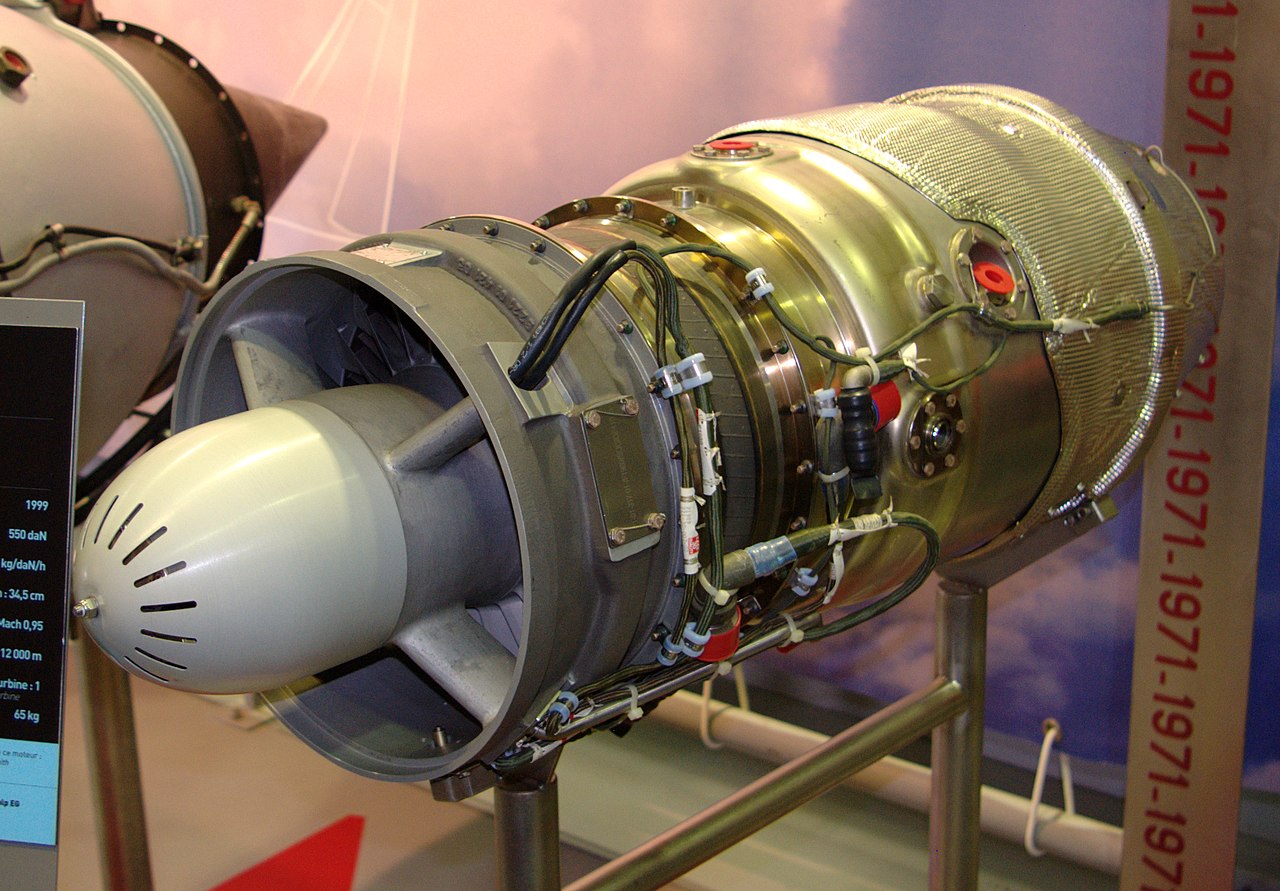
Shahed-191 uses a mini turbojet engine with a power of 1078.8 newtons, which is known as Turbojet 894, or a Toloue-10 turbojet engine with a power of 1100 to 1200 newtons. It is worth noting that the 894 turbojet engine was manufactured by the IRGC Aerospace Force and the Toloue-10 turbojet engine was manufactured by the Iran’s Ministry of Defense.
894 turbojet engine and Toloue-10 turbojet engine
Shahed-191 has a higher flight ceiling as well as greater stealth profile, and for this reason, an internal place for carrying weapons has been designed to help the stealthy features of this drone during combat missions. Saegheh 2 has the ability to carry two Sadid-342 bombs in its internal weapons bay.
Based on the published images, it seems that this drone uses the Oghab 4 electro-optic system.
The moment of releasing the Sadid-342 bomb from the Shahed 191 droneThe moment of separation of Shahed 191 drone from the launcher vehicleA view of the Shahed drone control roomClick to view full size
A type of SAR radar called Absar has been developed specifically for this drone, which is installed in camera place and provides the possibility of searching for objects in the form of 3D imaging.
Parts of Shahed 191 UAVABSAR SAR radarClick to view full size
Shahed-191 specifications: Role: Reconnaissance and combat Length: 2.7 meters Wing length: 7.3 meters Height: 0.7 meters Combat range: 500 km Maximum range: 1500 km Flight endurance: 4.5 hours Flight ceiling: 30000 feet (9144 meters) Engine: Turbojet 894 or Toloue-10 Thrust engine power: 110 kg of force (1078.8 newtons) Maximum speed: 350 km/h Cruise speed: 200 km/h Weight: Unknown Maximum take-off weight: 500 kg Maximum weight of fuel and cargo: 230 kg – 10 kg of optical cargo and 100 kg of weapons in weapon bay Take off type: By vehicle Landing: By skate Armament: 2 smart bombs
Shahed-191 (Saegheh 2)drone
Shahed-161: Shahed-161 is a 40% scale version of Shahed-171 drone. This drone uses a small and unannounced micro-turbojet engine. In the description provided for Shahed-161, the type of cargo is announced a seeker and warhead. This information strengthens the possibility that this variant is a suicide drone. If Shahed-161 is a suicide type of the Simorgh family, it must be said that this suicide drone is very a expensive one and therefor will be used to hit special targets such as air defense systems. The thermal seeker of Shahed-161 is installed on the wing and the right side of the engine, and when the UAV dives, it gets a better view of the ground. One of the characteristics of Shahed-161 is the possibility of different launch. Due to the lightness of this drone compared to other types, a pneumatic launcher has been used, which makes it possible to launch this drone faster from the vehicle. It is also possible to use this technique on other members of the Simorgh family that fly from the vehicle. This drone can also land with the help of a recovery parachute or skates.
Shahed-161 specifications: Role: Reconnaissance and suicide Length: 1.9 meters Wingspan: 5.13 meters Height: 0.71 meters Combat range: 150 km Maximum range: 300 km Flight enduracne: 3 hours Flight ceiling: 25000 feet (7620 meters) Engine: HKS microjet Engine power: 40 kg of power Maximum speed: 350 km/h Cruise speed: 150 km/h Weight: Unknown Maximum take-off weight: 170 kg Maximum weight of fuel and cargo: 40 kg Cargo: Seeker and warhead Take off type: Pneumatic launcher Landing: By skate, recovery parachute
Shahed-161 drone
Shahed-141: Shahed-141 drone has not been officially unveiled yet. This drone is a 40% scale version of Shahed-171. According to the information provided at the IRGC achievements exhibition in Isfahan, Shahed-141 has a Wankel 783 engine with a power of 32 horsepower, and thanks to the capacity of carrying 90 kg of cargo, it can carry a high-quality camera and a 12-hour flight endurance for reconnaissance missions.
Shahed-141 specifications: Role: Reconnaissance Length: 1.9 meters Wingspan: 5.13 meters Height: 0.4 meters Reconnaissance range: 1300 km Maximum range: 2600 km Flight endurance: 12 hours Flight ceiling: 15000 feet (4572 meters) Engine: Wankel 783 piston 32 hsp Maximum speed: 220 km/h Cruise speed: 150 km/h Weight: Unknown Maximum take-off weight: 200 kg Maximum weight of fuel and cargo: 90 kg Take off type: Pneumatic launcher Landing: By skate, recovery parachute
Shahed-141 drone
15% scale versionof Shahed-171: Information and a picture of this variant are not available, but it can be pointed out that this variant is the first sample made during the reverse engineering of the RQ-170 UAV. Making a 15% scale version of RQ-170 has helped to better understand the flight structure of this drone, and this has accelerated the build process and use of the Shahed family of stealth drones.
Samavat drone: The Samavat drone was showcased for the first time at the IRGC Achievements Exhibition in Birjand. This drone is equivalent to the Shahed-161 drone and is used for cloud seeding. According to published information, the Samavat drone can be used for surveillance and combat missions, and for this purpose, it is possible to separate the silver iodide holding rods from the drone. Except for the body length of 1.7 meters, which is given in the Samavat banner, the rest of the specifications are very similar to Shahed-161.
The banner and specifications of Samavat droneRods and holding tubes with silver iodide containers on Samavat droneClick to view full size
Combat history The Shahed family of stealth drones have been widely deployed in the IRGC Air Force and have carried out a large number of reconnaissance and combat operations so far. But the first combat operation that has been officially confirmed is related to the use of Shahed 181 and 191 drones on June 18, 2017 in Operation Laylat al-Qadr against ISIS in Syria. It should be noted that due to the confidentiality and sensitivity, most of the missions of this category of drones are not officially announced.
Shahed 171 And Shahed Stealth Drones Family – click to view full sizeClick to view full size
Posters of “Shahed 171 And Shahed Stealth Drones Family” in Russian (Шахед 171), Arabic, Kurdish, Azeri (Şahid 171), Hebrew (שאהד-171), Chinese (见证者-171) and Persian:
History In July 1996, the Storm Shadow design presented by two companies, Matra and British Aerospace, won a heavy competition among 6 other designs from powerful companies McDonnell Douglas, Texas Instruments/Short Brothers, Hughes/Smiths Industries, Daimler-Benz Aerospace/Bofors, GEC-Marconi and Rafael. A development and production contract was signed in February 1997, by which time Matra and BAe had completed the merger of their missile businesses to form Matra BAe Dynamics. France ordered 500 SCALP missiles in January 1998.
It is worth noting that since 2001 and after the merger of Matra BAe Dynamics with the Italian company Alenia, this missile is developed and produced under the multinational company MBDA.
This missile is known as “Storm Shadow” in UK and SCALP-EG in France. SCALP-EG in French stands for “Système de Croisière Autonome à Longue Portée – Emploi Général” and its English translation is “Long Range Autonomous Cruise Missile System General Purpose”.
The Storm Shadow missile was used for the first time in 2003 during the Iraq war by the Tornado GR4 fighter jet of the British Royal Air Force.
On November 27, 2013, this missile was tested on the Eurofighter Typhoon at the Decimomannu Air Base in Italy for a range of 250 km. This test was conducted by Alenia Aermacchi in the framework of a phase 2 improvement program for Germany, Italy, Spain and the United Kingdom.
Typhoon fighter jet carrying two storm shadow missilesTornado fighter jet carrying two storm shadow missilesClick to view full size
Design The Storm Shadow cruise missile was developed is based on French-developed Apache anti-runway cruise missile. These two missiles are similar in terms of aerodynamics and stealth, but the Storm Shadow missile uses a different engine and its warhead is integrated with high penetration power, while the warhead of the Apache cruise missile is a cluster munition.
Storm Shadow / SCALP-EG missileApache anti-runway cruise missileClick to view full size
The air-launched version of Storm Shadow missile has a weight of 1300 kg, of which 450 kg is the warhead. The maximum diameter of the body is 63 cm, the distance between its two wings is 3 meters and the length of the missile is 5.1 meters. This missile reaches a maximum speed of Mach 0.8 (equivalent to 980 km/h at sea level) and a range of 560 km using a French TRI 60-30 engine with a power of 5.3 kilonewtons. It should be noted that in export versions, the range of this missile is limited to 300 km.
This missile uses a two-stage warhead to penetrate the targets. This warhead, known as BROACH, is installed on two other missiles, AGM-154 Joint Standoff Weapon (JSOW) and AGM-86 ALCM, in addition to the Storm Shadow. The two stage warhead is made up from an initial shaped charge, which cuts a passage through armour, concrete, earth, etc., allowing a larger following warhead to penetrate inside the target.
BROACH warheadMicroturbo TRI 60-30 turbojet engineThe different components of Storm Shadow missileClick to view full size
Combat records As mentioned earlier, the Storm Shadow missile was first used in combat in 2003 by Tornado fighter jets belonging to the 617 Squadron of the British Royal Air Force during the international invasion of Iraq.
During the 2011 military intervention in Libya, SCALP-EG missiles were fired by French Air Force Rafale fighter jets and Storm Shadow missiles by Tornadoes of the Italian Air Force and the British Royal Air Force at targets including Al Jafra Air Base and a military shelter in Sirte, Muammar Gaddafi’s hometown. In December 2011, Italian defense officials noted that during the military intervention in Libya, Tornado fighter jets had fired between 20 and 30 Shadow Storm missiles, with a 97% success rate. This was the first time that Italian aircraft test-fired this missile in a real battle.
On December 15, 2015 and January 2, 2016, French fighter jets fired twelve rounds of SCALP missiles at ISIS targets in Syria.
On June 26, 2016, the British Royal Air Force, using a Tornado fighter jet, fired four Storm Shadow missiles at ISIS targets in Iraq.
In October 2016, the UK government confirmed that Storm Shadow missiles sold to Saudi Arabia had been used by Saudi Arabia in the conflict in Yemen.
In April 2018, the UK government announced that it had used Storm Shadow missiles (probably using Dassault Rafale fighters) to attack an alleged chemical weapons manufacturing facility in Himm Shinshar in Syria’s Homs province.
It is also said that during the second Libyan war, the Emirati Mirage and Egyptian Rafale fighter jets may have used Storm Shadow missiles to attack Al-Watia Air Base in July 2020.
In March 2021, two Royal Air Force FGR4 Typhoon jets attacked a group of ISIS caves near Erbil using a Storm Shadow missile, And the first combat use of the Storm Shadow was recorded by Typhoon fighter jet.
After the United Kingdom announced that it would deliver the Storm Shadow missile to Ukraine in 2023, this missile entered the Russian-Ukrainian battles. According to video documentation, these missiles are fired by Ukrainian Sukhoi-24 fighter jets.
An image of the combat use of Shadow Storm missile on the Ukrainian Sukhoi-24 fighter jet
Variants of Storm Shadow missiles Apart from the export version with a range of 250 km and the original version with a range of 560 km, which is in the service of the British and French armies, the Storm Shadow missile has other versions:
Black Shaheen: Developed by France for export to the United Arab Emirates for use with its Mirage 2000, modifications were made to reduce the range reportedly to 290 km (160 nmi; 180 mi) in order to comply with Missile Technology Control Regime guidelines.
MdCN or SCALP Naval cruise missile: In 2006, the French division of MBDA began the development of a long-range vertical-launch cruise missile to be deployed on a new series of French warships and complement the conventional SCALP missiles. This missile, which is called “Missile de Croisière Naval (MdCN)” in French, is called “Naval Cruise Missile” in English. The MdCN missile with a range of more than 1000 km plays the same role as the American Tomahawk for the French. In addition to longer range, MdCN naval cruise missile has independent navigation function and final phase guidance with the help of infrared detection. In terms of appearance, this missile has many differences with the conventional version of Storm Shadow. This missile is made in a cylindrical shape and the wings are also folded into the body. The SCALP Naval missile has a length of 6.5 meters, a diameter of 50 centimeters and a wingspan of 2.85 meters. The weight of this missile is 1400 kg, of which 200 kg is the warhead. The engine of this missile is micro-turbojet TR50 and the speed of the missile reaches 1000 km/h using this engine.
Specifications of MdCN Naval Cruise Missile: Type: Land-attack missile, Submarine-launched cruise missile Length: 6.5 meters Diameter: 50 cm Wingspan: 2.85 meters Weight: 1400 kg Warhead weight: 200 kg Speed: 1000 km/h Engine: Turbojet TRI50 Range: more than 1000 km Launch platforms: FREMM-class frigates, Barracuda-class submarines, and Scorpène-class submarines Produced: MBDA France
Missile de Croisière Naval (MdCN) / Naval Cruise Missile
The MdCN missile is installed on six French FREMM-class frigates, Barracuda-class submarines and smaller submarines such as the Scorpène-class. This missile is launched in frigates through the Sylver launcher and in submarines through the 533 mm torpedo launch tube.
SCALP Naval missile fired from the Sylver launcherContainer for cruise missiles to be launched from a submarineClick to view full size
The first successful launch of the MdCN missile was carried out in July 2013, at the Biscarosse test range, and it was able to pass all test stages in three launches.
The MdCN missile was used in the first real battlefield operation in 2018 against alleged Syrian chemical weapons production sites in Damascus and Homs. In this operation, France launched 10 SCALP cruise missiles using five Dassault Rafale fighters and three SCALP Naval missiles using FREMM class frigates. In this operation, due to technical problems and lack of coordination, two frigates failed to fire missiles and only one frigate managed to launch a missile, and out of 10 missiles, one missile had a problem and fell into the sea.
The first Barracuda-class submarine named FS Suffren, which was launched on October 20, 2020, successfully fired its first MdCN missile in the same year 2020. Considering the problems that arose in 2018 for the launch of the SCALP Naval missile, the successful launch of this missile was an indication of solving the coordination problems of this sea cruise with its marine launcher platforms.
Barracuda-class submarine FS Suffren that successfully test-fired SCALP Naval cruise missileA picture of the moment the SCALP Naval missile comes out from under the seaClick to view full size
Specifications of Storm Shadow/SCALP-EG cruise missile: Type: Air-launched cruise missile Length: 5.10 meters Width: 630 mm Wingspan: 3 meters Weight: 1300 kg Warhead weight: 450 kg Engine: Turbojet TRI 60-30 Speed: ~ 1000 km/h Range: 560 km (in export versions up to 300 km) Guidance: GPS – INS – IIR – TERPROM Launch platforms: Tornado, Mirage 2000, Rafale, Typhoon fighter jets Origin: France and UK (MBDA company)
Storm Shadow Cruise Missile – click to view full sizeClick to view full size
The Challenger 2 is the third vehicle of this name, the first being the A30 Challenger, a World War II design using the Cromwell tank chassis with a 17-pounder gun. The second was the Persian Gulf War era Challenger 1, which was the British army’s main battle tank (MBT) from the early 1980s to the mid-1990s. The design process of the Challenger 2 tank was carried out between 1989 to 1994 by the British company “Vickers Defence Systems”, which also designed the Challenger 1 tank. Today, Challenger 2 is produced by BAE Systems Platforms & Services.
The Challenger 2 tank was developed on the basis of the Challenger 1, however despite outward similarities to the Challenger 1, only about 3% of components are interchangeable with the earlier vehicle.
The main armament is a L30A1 120-millimetre rifled tank gun, an improved derivative of the L11 gun used on the Chieftain and Challenger 1. Fifty rounds of ammunition are carried for the main armament, alongside 4,200 rounds of 7.62 mm ammunition for the tank’s secondary weapons: A L94A1 EX-34 chain gun mounted coaxially, and a L37A2 (GPMG) machine gun. The turret and hull are protected with second generation Chobham armour, also known as Dorchester. Powered by a Perkins CV12-6A V12 diesel engine, the tank has a range of 550 kilometres and maximum road speed of 59 kilometres per hour.
Two 7.62 mm machine guns on the Challenger 2
Challenger 2 benefits from a L30A1 120-millimetre rifled gun, firing both long rod penetrator and High Explosive Squash Head (HESH) ammunition natures. The rifled barrels increase stability and shooting accuracy. The “rifling” is for the purpose of exerting torque and thus imparting a spin to a projectile around its longitudinal axis during shooting to stabilize the projectile longitudinally by conservation of angular momentum, improving its aerodynamic stability and accuracy over smoothbore designs.
L30A1 rifled gun on Challenger 2
The commander has a panoramic SAGEM VS 580-10 gyrostabilised sight with laser rangefinder. The commander’s station is equipped with eight periscopes for 360° vision. The Thermal Observation and Gunnery Sight II (TOGS II), from Thales, provides night vision. The thermal image is displayed on both the gunner’s and commander’s sights and monitors. The gunner has a stabilised primary sight using a laser rangefinder, with a range of 200 m to 10 km. The driver’s position is equipped with a Thales Optronics image-intensifying Passive Driving Periscope (PDP) for night driving and a rear view thermal camera.
The fire control system of Challenger 2 is the same as the US M1A1 Abrams and the French Leclerc MBT. Also, Challenger 2 and Abrams tanks use the same battlefield management system, which allows easy exchange of information between British and American tanks.
Electro-optical systems used in the Challenger 2
The turret and hull are protected with second generation Chobham armour, also known as Dorchester. The Dorchester armor, although lighter than the Chobham, provides better protection for the Challenger-2 tank.
Challenger 2 is also equipped with an automatic fire extinguishing system in addition to the Nuclear, Biological and Chemical (NBC) protection system and Visual and Infrared Screening Smoke (VIRSS) systems.
The Challenger 2 tank is designed in such a way that its detection and tracking by enemy detection radars is as low as possible. Therefore, the FV4034 Challenger 2 tank can be considered one of the most stealth tanks in the world.
One of the most confidential information about main battle tanks is the amount of armor in different parts of it, which is usually published in an exaggerated form. An image of the actual amount of armor used in Challenger 2 has been published by a website that claims to have information about Challenger 2. The images below show the armor’s resistance against high-explosive anti-tank (HEAT) projectiles and kinetic energy (KE) projectiles.
An image of the thickness of the armor of the Challenger 2 in frontAn image of the thickness of the armor of the Challenger 2 on sidesClick to view full size
The Challenger 2 Powered by a Perkins CV12-6a turbocharged diesel engine. Using this engine, the Challenger 2 tank can reach a maximum range of 550 km and a maximum speed of 59 km/h.
Challenger 2’s Perkins CV12-6a engine
Challenger 2 uses Horstman Defence Systems second-generation hydrogas suspension units, which is an improved suspension system, along with improved gearbox and a Hydraulic Track Tensioner provide platform stability covering flat road surfaces through to rough cross-country terrain.
The Challenger-2 is the Royal Army’s only main battle tank (MBT) today. The country of Oman has also recruited 38 units of this British tank.
The Challenger 2 tank has participated in wars such as Bosnia, Kosovo and the Persian Gulf War. In 2003, during the Desert Storm operation in Iraq, a Challenger 2 tank seriously damaged another Challenger 2 tank, and there were no casualties.
Challenger 2 Updates:
CLIP update: The Challenger Lethality Improvement Programme (CLIP) was a programme to replace the current L30A1 rifled gun with the smoothbore Rheinmetall 120 mm gun currently used in the Leopard 2 and M1 Abrams. The use of a smoothbore weapon would have allowed Challenger 2 to use NATO standard ammunition, including tungsten-based kinetic energy penetrators which do not have the same political and environmental objections as depleted uranium rounds. The production lines for rifled 120 mm ammunition in the UK have been closed for some years so existing stocks of ammunition for the L30A1 are finite. Challenger 2 fitted with 120 mm smoothbore gun for trials A single Challenger 2 was fitted with the L55 and underwent trials in January 2006. The smoothbore gun was the same length as the L30A1 and was fitted with the rifled gun’s cradle, thermal sleeve, bore evacuator and muzzle reference system. Early trials apparently revealed that the German tungsten DM53 round was more effective than the depleted uranium CHARM 3. The ammunition storage and handling arrangements had to be changed to cater for the single-piece smoothbore rounds, instead of the separate-loading rifled rounds. Other improvements were also considered, including a regenerative NBC protection system.
Challenger 2 equipped with L30A1 rifled gunChallenger 2 tank equipped with L55 smoothbore gunClick to view full size
HAAIP update: Updates to the automotive components of Challenger 2 are being undertaken as part of the ongoing Heavy Armour Automotive Improvement Programme (HAAIP), which is expected to continue until 2031, and expected to align with the Challenger 3 programme. The HAAIP programme “will be made to existing in-service Challenger 2 tanks to increase their mobility and stability, both of which are critical to providing the foundation for the new turret and systems that will upgrade the vehicle to a Challenger 3.”
The overall scope of HAAIP includes: – Upgraded CV12-9A engines for Challenger 3 and CRARRV – Third Generation Hydrogas Suspension – New Hydraulic Track Tensioners (HTT) with inline accumulators – Improved Electric Cold Start System (Intake Manifold Heater) – Unspecified new components fitted to improve the transmissions – New Main Engine Air Intake Filters – Improved Main Engine/Transmission Cooling; fitting new high efficiency radiators and fans.
TES Megatron update: The Megatron update, or Challenger 2 TES Megatron, was first unveiled in 2013 at the DVD Defense Expo in Millbrook. Another example of Megatron’s update was also unveiled in 2016.
This update includes: – Adding reactive and passive armors to deal with new types of threats on the battlefield, which allows to equip Megatron with additional types of armor depending on the type of threats. – Upgrading the L30A1 gun to be able to fire more of the existing NATO ammunitions. – Installation of a remote control weapons system called Enforcer. – Using of a new armor that is a combination of Dorchester’s standard composite armor, reactive, passive and rod armor and Chobham armor.
Megatron has a maximum weight of 74,840 kg with TES armor and 62,500 kg in standard configuration.
Enforcer Remote Control Weapons System
Black Night update: In 2018, following the update program of the Challenger-2 tank, an update called Black Night was implemented, which practically became a different product. Two examples of this update have been seen to date, differing only in “gun type”. One example uses the same L30A1 gun and another example uses the L55 gun that was previously coordinated with this tank in the CLIP update.
Features announced for the Black Night update by BAE include: – Active Protection System – Systems allow the tank to detect incoming anti-tank missiles or armour penetrating rounds and automatically launches a counter-explosive to neutralise the threat. – Laser Warning System – When targeted by enemy weapon systems, the tank can identify the source of the threat then automatically slew the gun to point at that source, making it quicker for the crew to counter-fire. – Regenerative braking – The tank has been made more energy efficient by using less energy-hungry kit and installing regenerative braking in the turret, which generates power when the gun slows down into position. – Thermal Imaging Technology – Front and rear infrared cameras (similar to those used in television programmes such as Planet Earth II) provide extremely sharp night imagery, helping troops identify potential threats and move undetected in hostile situations, while also shaving valuable seconds off reaction times. – Accelerated fightability – New equipment controlling tank’s weaponry is faster, meaning the crew can identify an enemy, target and engage more quickly.
Challenger 2 Black Night tank equipped with the L30A1 rifled gunChallenger 2 Black Night tank equipped with L55 smoothbore gunTrophy system and Challenger 2 Black Night componentsClick to view full size
CSP / LEP update: In 2005, the British MoD recognised a need for a Capability Sustainment Programme (CSP) to extend the service life of the Challenger 2 into the mid-2030s and upgrade its mobility, lethality and survivability. The CSP was planned to be complete by 2020 and was to combine all the upgrades from CLIP, including the fitting of a 120 mm smoothbore gun. By 2014, the CSP programme had been replaced by the Life Extension Programme (LEP) which shared a similar scope of replacing obsolete components and extending the tank’s service life from 2025 to 2035, however the 120 mm smoothbore gun had seemingly been abandoned.
In 2015, the British Army provided an insight into the scope of the LEP, dividing it into four key areas, namely: – Surveillance and target acquisition: Upgrades to the commander’s primary sight and gunner’s primary sight, as well as the replacement of the thermal observation and gunnery sights (TOGS) with third-generation thermal imaging. – Weapon control system: Upgrades to the fire control computer, fire control panel and gun processing unit. – Mobility: Upgrades including third-generation hydrogas suspension, improved air filtration, CV-12 common rail fuel injection, transmission and cooling. – Electronic architecture: Upgrades to the gunner’s control handles, video distribution architecture, generic vehicle architecture compliant interfaces, increased onboard processing and improved human machine interface.
Challenger 3 update: This update was implemented to consolidate the experience of all the upgrades made on the Challenger-2 tank and was unveiled in 2021. The upgrades that were first done on the Megatron and then on the Black Night continued on the Challenger 3. In order to increase the survivability of tank in the battlefield, two models of active protection systems (APS) have been used on this tank: MUSS (MUltifunctional Self protection System) and Rheinmetall’s ROSY Rapid Obscurant System.
MUltifunctional Self protection System – click to view full size
With the introduction of Megatron in 2016 and Black Knight in 2018, a proposal design was also unveiled by Rheinmetall in 2019. The design included the development of a completely new turret with fully digital electronic architecture, day and night sights for the commander and gunner, and a Rheinmetall L55 120 mm smoothbore gun. Whilst a more substantial upgrade than Black Night, the turret was developed on Rheinmetall’s initiative and was not funded by the UK MoD. In June 2019, BAE Systems and Rheinmetall formed a joint venture company, based in the UK, named Rheinmetall BAE Systems Land (RBSL). Despite the merger, the company was still expected to present two separate proposals for the LEP contract, however, at DSEI 2019, RBSL instead opted to only showcase the Rheinmetall proposal.
This upgrade includes a new turret with a fully digital electronic architecture, a Thales Orion day and night sight for the commander, and a Thales DGNS T3 day and night sights for the gunner, along with the use of a 120mm Rheinmetall L55A1 gun. The turret architecture also allows for an active protection system or an Improvised Explosive Electronic Warfare system to be installed in the future if required by the user.
Click to view full size
In 2020, the UK MoD argued against buying a new main battle tank from overseas instead of pursuing the Challenger 2 LEP, stating that an upgraded Challenger 2 would be “comparable – and in certain areas superior” to a Leopard 2 or Abrams.
In 2021, the UK MoD published its long-awaited command paper, Defence in a Competitive Age, which confirmed the British Army’s plans to upgrade 148 Challenger 2 tanks and designate them Challenger 3. The UK MoD confirmed the contract with RBSL had been signed, valued at £800 million (US$1 billion), on 7 May 2021. Rheinmetall’s more extensive upgrade proposal, including the new 120 mm smoothbore gun, had been accepted. The initial operating capability for the upgraded tanks is expected by 2027, with full operation capability expected to be declared by 2030.
Infographic published by RBSL comparing Challenger 2 and Challenger 3 tanks
Types of tanks and combat vehicles based on Challenger-2 chassis:
Trojan combat engineering armored vehicle: The Trojan Armoured Vehicle Royal Engineers is a combat engineering vehicle designed as a replacement for the Chieftain AVRE (ChAVRE). It uses the Challenger 2 chassis, and carries an articulated excavator arm, a dozer blade, and attachment rails for fascines. Entering service in 2007, 33 were produced.
Trojan combat engineering armored vehicle:
Challenger 2 Driver Training Tank: The Challenger 2 Driver Training Tank (DTT) is based on the Challenger 2 hull. The turret has been replaced with a fixed weighted superstructure to accommodate an instructor and up to 4 trainees. The design is similar to the Challenger 1 derived Challenger Training Tank (CTT). Weighting the superstructure replicates the weight (and therefore also the driving characteristics) of the standard tank in operational service.
Challenger 2 Driver Training Tank
Titan armoured bridge layer: The Titan armoured bridge layer is based on aspects of the Challenger 2 running gear and replaced the Chieftain Armoured Vehicle Launched Bridge (ChAVLB). The Titan came into service in 2006 with the Royal Engineers, with 33 in service. Titan can carry a single 26-metre-long bridge or two 12-metre-long bridges. It can also be fitted with a bulldozer blade.
Titan armoured bridge layer
Challenger 2E: Challenger 2E The Challenger 2E is an export version of the tank. It has a new integrated weapon control and battlefield management system, which includes a gyrostabilised panoramic SAGEM MVS 580-day/thermal sight for the commander and SAGEM SAVAN 15 gyrostabilised day/thermal sight for the gunner, both with eye-safe laser rangefinder. This allows hunter/killer operations with a common engagement sequence. An optional servo-controlled overhead weapons platform can be slaved to the commander’s sight to allow operation independent from the turret. The power pack has been replaced by a new 1,500 hp (1,100 kW) EuroPowerPack with a transversely mounted MTU MT883 diesel engine coupled to Renk HSWL 295TM automatic transmission. The increase in both vehicle performance and durability is significant. The smaller volume but more powerful EuroPowerPack additionally incorporates as standard a cooling system and air intake filtration system proved in desert use. The free space in the hull is available for ammunition stowage or for fuel, increasing the vehicle’s range to 550 km (340 mi). This power pack was previously installed on the French Leclerc tanks delivered to the UAE as well as the recovery tank version of the Leclerc in service with the French Army. Further developed versions of the EuroPowerPack have more recently been installed in the latest serial produced Korean K2 Black Panther tank. BAES announced in 2005 that development and export marketing of 2E would stop. This has been linked by the media to the failure of the 2E to be selected for the Hellenic Army in 2002, a competition won by the Leopard 2.
Challenger Armoured Repair and Recovery Vehicle: The Challenger Armoured Repair and Recovery Vehicle (CRARRV) is an armoured recovery vehicle based on the Challenger 1 hull, designed to repair and recover damaged tanks on the battlefield. Ordered in 1985, and delivered between 1988 and 1993, the CRARRV has subsequently been updated to use a Challenger 2 powertrain consisting of a CV12-5C/6C engine with TN54E transmission. The British Army ordered 80 vehicles. Four CRARRVs were purchased by Oman to complement their acquisition of Challenger 2 tanks. CRARRVs were first deployed in action in the lead up to the First Gulf War, Operation Granby in 1991. They were subsequently deployed during the 2003 invasion of Iraq, Operation Telic in 2003, alongside standard Challenger 2 MBTs.
CRARRV armored vehicle using its craneCRARRV armored vehicle equipped with a bulldozer bladeClick to view full size
Challenger 2 specifications: – Type: Main Battle Tank (MBT) – Manufacturer: BAE Systems – In service: since 1998 – Wars: Iraq war, Kosovo war, Bosnian war, Afghanistan war – Unit cost: £4,217,000 – Mass: 64 tons – Length: 8.3 m – Width: 3.5 m – Height: 2.49 m – Crew: 4 (commander, gunner, loader–operator, driver) – Engine: Perkins CV12-6A V12 diesel, 26.1 L, 1200 bhp (890 kW) – Fuel capacity: 1,592 litres – Operational range: 550 km on-road, 250 km off-road – Speed: 59 km/h on-road, 40 km/h) off-road – Origin: UK
Challenger 2 tank – click to view full sizeClick to view full size
Collection of Challenger 2 posters in Russian, Arabic, Persian, Azeri and Kurdish:
Most ballistic missiles have the ability to reach speeds higher than 5 Mach, but they are not considered hypersonic because they follow a ballistic path and have bullet-like movement. In general, it is easy for air defense systems to detect a ballistic trajectory at any speed. But maneuvering in the final phase is an important characteristic that creates a fundamental difference in missile classification. A hypersonic ballistic missile is a ballistic missile that has the ability to maneuver before hitting its target while maintaining a speed of more than 5 Mach.
For example, the Khorramshahr missile has a speed of near 16 Mach in the intermediate phase outside the atmosphere and a speed of near 8 Mach when entering the atmosphere, but it lands directly on the target like a bullet, so it is just a ballistic missile.
A review of the Fattah missile shows that this missile has a lot of similarity to the Kheibar Shekan missile in appearance. The tail fins and warhead have a lot of similarity to each other. The similarity is such that even the front ramp of the warhead control fins is the same. Therefore, it is assumed that the diameter of the Fattah and Kheibar Shekan missiles are also the same.
Given the great similarity between the two missiles and also the software reviews that were done, it can be assumed that the two missiles have the same diameter, equal to 80 centimeters. Also, considering that the length of the warhead has been announced as 3.6 meters, with a software review of the missile, the total length of the missile can be considered as 11.5 meters.
Estimation of the length of the Fattah missile
Another similarity between these two missiles is their range. In addition to the visual similarity of the Kheibar Shekan and Fattah missiles, the range of these two missiles is also similar to each other. The Kheibar Shekan has a range of 1450 kilometers and Fattah has a range of 1400 kilometers.
The missile body, along with the end fins and the fins on the cap, is entirely composite (carbon fiber). The body color is also of the radar wave absorbing type, which helps increase missile stealth. The use of warhead fins is when the missile comes down from an altitude of 30 kilometers and enters the atmosphere. Because at higher altitudes it has no effect on warhead maneuvering. This is useful for maneuvering near the target.
The warhead fins of Fattah missile
As it is clear, the aerodynamic shape of the Fattah and Kheibar Shekan warheads are the same, but due to the addition of an engine and fuel in the final section, it has been tried to maintain the aerodynamics of the warhead and reduce drag by making the missile tip longer.
Comparison of warheads of Fattah and Kheibar Shekan missiles
As mentioned, the warhead has propulsion with the ability of change thrust vector, and the presence of this engine allows the warhead to maintain its speed at a speed of more than Mach 5 when maneuvering near the target. When the warhead enters the atmosphere, its speed is greatly reduced due to the strong air resistance, and by performing heavy maneuvers with the help of its fins, its speed is reduced again; But with the warhead engine, it is possible to increase the speed to more than Mach 5. Also, with the thrust vector nozzle, it is possible to perform heavier maneuvers. It should be noted that this engine can be turned on when the warhead is separated from the missile, which increases the flight height of the warhead and greatly increases its range.
Fattah warhead engine with thrust vector nozzle
The next issue is how the Fattah missile works and whether it is hypersonic or not. This missile has a warhead with the ability to change thrust vector, which allows it to maneuver from the time the warhead separates from the body at an altitude of 300 kilometers above the ground. So after separating from the body, the Fattah missile’s warhead maneuvers with a low or depressed trajectory to escape anti-ballistic missile systems and changes or adjusts its path several times during flight. It should be noted that Fattah does not need much maneuvering outside the atmosphere; in addition to performing regular maneuvers to adjust its path, this missile has the ability to change its ballistic path shape. The next point is the ability to maneuver from a distance of 100 kilometers before hitting the target, which also puts it in the category of MaRV ballistic missiles.
So, Fattah follows a non-ballistic path both outside the atmosphere and when it is in Earth’s atmosphere and near its target. However, it should be noted that the mentioned capabilities alone do not make Fattah hypersonic. What puts the Fattah missile in the category of hypersonic ballistic missiles is that in addition to the mentioned capabilities, the missile’s speed at the moment of impact on the target is also higher than 5 Mach. This has been made possible by keeping the engine on for 50 seconds at different stages of flight to maintain warhead speed. As a result, by combining all of these features, we can consider Fattah as a hypersonic ballistic missile.
Fattah missile specifications: Length: ~ 11.5 meters Diameter: ~ 80 cm Weight: 4000 to 4600 kg Warhead length: 3.6 meters Warhead weight: ~ 1000 kg Weight of explosives: ~ 500 kg Speed: more than Mach 13 Range: 1400 km (increasable) Fuel: solid compound Flight trajectories: ballistic (maneuverability from the mid-phase) Origin: Iran
Fattah hypersonic missile – click to view full size
“Fattah hypersonic ballistic missile” posters collection in Persian, Russian, Arabic, Azeri, Kurdish and Hebrew:
Karrar multirole drone is the first Iranian drone that can carry and use a wide range of weapons, including air-to-air and air-to-surface missiles, using a single platform. This UAV is produced by the Iran Aircraft Manufacturing Industrial Company (HESA), which is under the Ministry of Defense, and has been used by various departments of the Iranian Armed Forces.
History: A maquette of Karrar UAV was first seen in 2004 at a military equipment exhibition, and later in 2010, it was unveiled under the name “Karrar Bomber Drone” during a ceremony attended by the then president of Iran. The exact date of the start of the production and use of the Karrar is not known and has not been officially announced, but the year 2010 can be considered as the year of its entry into service.
From the very beginning of its unveiling, the Karrar UAV carried a Mark 82 unguided bomb weighing 500 pounds (226.79 kg), and it was said that this UAV could also carry a cruise missile. In 2013, the news of using the Kosar cruise missile on the Karrar UAV was published, which increased the capabilities of the Karrar due to Kosar’s 100 kg weight and 25 km range.
In 2014, Mersad air defense system was tested using Karrar UAV. In this test, Karrar was used as a target drone for testing the air defense system and train the air-defense crews.
The different introduction of the Karrar UAV in 2018 with the name “Karrar-4 Interceptor” which carried the Shahab Thaqeb missile showed that this drone has generations and each of these generations is defined based on the type of mission; But this generation was never stated clearly.
At the unveiling ceremony of Yasin, Balaban and Qaem 1, 5 and 9 bombs in 2019, Amir Hatami, the then Minister of Defense, announced that the Yasin glide bomb can be released from the Karrar drone. Yasin glide bomb is the result of adding a wing and guidance kit to the Mark 82 bomb, which was previously used by the Karrar drone.
Introduction of Karrar 4 interceptor with Shahab Thaqeb missile in 2018The unveiling ceremony of the Karrar UAV in 2010 with the name of the Karrar Bomber Jet and the installation of a Mark 82 bomb under the bodyMaquette of Karrar in an exhibition in 2004 with the presence of Admiral ShamkhaniClick to view full size
Design: The Karrar multirole drone is a derivative of the American 1970s-era Beechcraft MQM-107 Streaker target drone. The MQM-107A drone was purchased before the Iranian Islamic Revolution to be used as a target drone in defense exercises. In fact, in terms of appearance, the Karrar UAV is more similar to the Skua UAV made in South Africa. Nevertheless, in general, Karrar drone is very different from Skua and MQM-107 drones.
To produce Karrar drone, it was first necessary to redesign the engine used in the American version. The MQM-107A drone delivered to Iran used the Teledyne CAE J402 engine, which was considered an old engine and was no longer used in America. In another model of this UAV, which is known by the suffix B, that is, the MQM-107B model, the French microturbo TRI 60-2 074 turbojet engine is used. So, Iran designed and produced the Toloue-4 jet engine based on the same French TRI 60 engine that was used on MQM-107B model. The French TRI 60 engine has many variants, but the TRI 60-2 074 engine is most similar to the Toloue-4 turbojet engine. The TRI 60-2 074 engine is a triaxial microjet with three axial compressors, a combustion chamber and a turbine stage, which has a diameter of 33 cm, a length of 124 cm, and a weight of 61 kg, and produces a maximum force of 3.4 kilonewtons (KN). The Toloue-4 jet engine, which is the Iranian indigenously produced variant of this engine, is also a triaxial turbojet engine with three axial compressors, a combustion chamber and a turbine stage, and has a diameter of 33 cm, length of 130 cm, weight of 55 kg, and a maximum power of 3450 newtons (N). The Toloue-4 engine is slightly longer and weighs less than its French counterpart.
The Toloue-4 turbojet engine is also used in the Noor cruise missile and the Ya-Ali cruise missile.
The French TRI 60-2 074 turbojet engineIranian Toloue 4 turbojet engineTeledyne CAE J402 engine used in the American MQM-107A droneClick to view full size
Considering the repeated comparison of the Karrar drone with the American MQM-107 drone, we will discuss the differences in appearance between this design and its American model.
The first difference is in the tail fins, which are similar to the design of Skua drone made in South Africa and not similar to the American model. The BQM-126A UAV is another UAV that is similar to the Karrar in terms of its tail fins, but the wings and the tips of the tail fins in the BQM-126A and the Karrar are completely different, and in this sense, it is more similar to the South African model.
The second difference is the location of the drone engine, which is not similar to any of the mentioned drones. In the American and African variant, the engine is placed under its body, but in the Iranian variant, this engine is placed along the body and at its end. The reason for this special design is the use of a hardpoint under the belly to carry 250 kg of weapons.
The third difference and also a similarity is the location of the main wing. In the Iranian variant, the main wing is attached under the body. In the African variant, the wings are located on the body, and in the American variant also the wings are located under the body.
It cannot be denied that the Karrar is modeled after another drone, but the design of the American target drone and the Iranian Karrar drone are both derived from the idea of simplifying the manufacture of weapons and making them less expensive, which allows for mass and cheap production.
American target drone MQM-107ESkua UAV made in South AfricaKarrar multipurpose droneBQM-126A UAVClick to view full size
Variants: According to the way of introducing the Karrar multipurpose drone, it seems that this drone has four generations. Many sources stated that there have been changes in the dimensions, but due to the fact that not all the characteristics have been announced in each generation and the lack of sufficient documents, this issue cannot be denied or confirmed. First generation: Karrar bomber drone At the time of its unveiling in 2010, the Karrar drone carried the title of bomber. The reason for this name was the use of Karrar as a drone that carried and used unguided air-to-ground bombs such as Mark-82 bomb. The published test video of Karar drone show the high accuracy of this UAV when using a free fall bomb. Second generation: No reliable information has been published about the second generation of the Karrar UAV, but it seems that this variant was launched for a completely different mission, which pushed the generation to the sidelines at the time of unveiling. For this variant, it has a range of 1000 km and a maximum speed of 900 km/h with the possibility of carrying 226 kg of explosives. Third generation: This variant has a length of 3.75, a wingspan of 3.1 and a height of 1.5 meters, and a maximum take-off weight of 750 kg with the ability to carry a cargo of 250 kg. Other features of Karrar-3 UAV include a flight ceiling of 35,000 feet equivalent to 10,670 meters, max speed of 700 km/h, a cruising speed of 650 km/h, and a flight duration of 1 hour and 15 minutes. In this variant, Toloue 4 jet engine with JP-4 fuel is used and the body is mainly made of aluminum. Fourth generation: Karar interceptor drone This variant of drone was first seen carrying a Shahab Thaqeb missile in 2018, which was later named Karrar 4 Interceptor. This UAV is used as one of the complementary components in offensive and defensive systems, and due to the possibility of firing it from the back of the trailer, it can be launched from near the borders towards the hostile aircraft to engage with it. The interceptor variant has been a regular part of many Iranian military exercises. This drone was able to intercept a P-8 reconnaissance aircraft that was trying to collect information from a military exercise in 2022. The P-8 forced to retreat from the training area.
It should be noted that for all Karrar models, the ability to fly up to a height of 40,000 feet, equivalent to 12.2 km, and a final speed of 900 km/h have been stated. Karrar UAVs have a range of up to 200 km (Karar-3) when flying with direct communication with the ground station, and between 800 and 1000 km when flying automatically without the need for constant communication with the station.
A video of “Karrar Interceptor drone” that intercepts another Karrar drone
Engine: As we said earlier, the Karrar drone uses Toloue 4 turbojet engine in most of the variants. However, in 2022, a variant of Karrar equipped with Toloue-5 turbojet engine was used to test Sayyad 4B missile for the Bavar 373 air defense system. Karrar drone with Toloue 5 turbojet engine was able to reach a height of 43000 feet equivalent to 13.1 km and a speed of 733 km/h at that height.
Launching method: The Karrar UAV is launched with the Rocket Assist Take-Off (RATO) mechanism and takes help from the booster to get the initial acceleration. With this booster and its engine, Karrar can fly with a maximum weight of 750 kg, of which 250 kg is weapons. In order to make it possible to use this drone tactically and more widely, a carrier vehicle was designed that carries three drones in ready-to-launch state. The carrier vehicle tent also folds up easily so that it is possible to quickly carry out the operation and then move away from the operation area. This combination greatly increases the survivability on the battlefield for Karrar and its carrier vehicle.
It should be noted that the Karrar does not need a runway for landing, and a parachute is used to recover it.
The truck carrying the Karrar UAV, its tent is easily folded, and it carries three Karrar UAVs, one version of which is armed with the Shahab Thaqeb missile.Landing of Karrar UAV using a parachuteClick to view full size
Sensors: It seems that Karrar did not have a front camera in its prototypes and used only one camera under the body that is fixed to see the ground and targets. Later, with the introduction of the “Karrar Interceptor”, it was revealed that this drone has a camera in its nose that can detect the target at a distance of 30 km and lock onto the target at a distance of 3 km. The Karrar Interceptor was actually an aid to the country’s air defense system to fill the void of an interceptor fighter jet and also to increase the response time by being constantly present at the border areas. The front camera of this UAV has 360-degree surveillance capabilities and increases the ability to detect both aerial and ground targets.
A new version of the Karrar was seen at the unveiling ceremony of the Army’s Eagle 44 underground base, which is equipped with a front camera and gives the UAV a wider field of vision.
The prototype of the Karrar interceptor with a front cameraThe prototype of Karrar UAV without a front cameraThe new camera of Karrar with a wider field of vision – At the Eagle 44 underground baseThe images of the underbelly camera of Karrar droneClick to view full size
Guidance system: Karrar’s guidance for accurate hitting of Mark 82 unguided free-fall bombs can be related to the existence of a type of guidance such as Constantly Computed Impact Point (CCIP). In this method, all factors such as wind, speed, target’s movement, gravity, projectile launch velocity, projectile drag and other factors that can affect targeting are calculated and provided to the main computer. The set of information and calculations is finally provided to the operator, which allows the drone to release the bomb accurately. So, the set of these factors, which is actually an inertial guidance, along with the presence of the underbelly camera and GPS, allows this drone to accurately hit the free fall bomb.
Launching of MK-82 unguided bomb by Karar UAV and accurate hitting of the bomb on the target
Radar equipment: In the first prototypes of Karrar and in its production workshop, a variant of the Karrar UAV was seen, which seemed to contain some kind of radar. Also, a type of Karrar carrying two Kosar bombs, each mounted on one wing, can be seen, but such a combat combination has never been seen after that. Another variant of Karrar has also been seen in the exercises, which seems to carry a special type of radar. It is not clear if this radar is for observing the environment or if it is a electronic warfare system to disrupt the enemy’s air defense systems.
An old image of the Karar varietyThe Karrar’s underbelly camera footageA type of radar used in the nose of a droneClick to view full size
The third-generation Karrar drone can be guided by the ground station up to 200 km. Probably, this number has increased to 300 km in the next generations. However, it is still not possible to guide the Karrar “suicide version”, at it’s maximum range which is 1000 km. But what is the solution for guiding the Karrar in a range of 1000 km? The only way to guide Karrar drone in a range of 1000 km is to guide it like a cruise missile. This variant most likely has some kind of terrain radar and TERCOM (terrain contour matching) system, which provides the possibility of automatic guidance similar to a cruise missile. It is also stated that there is a possibility of changing the target for the Karrar suicide drone, which seems logical considering the presence of GPS and the possibility of receiving GPS coordinates.
Karrar armament: From the first day of its introduction, the Karrar drone was seen with Mark 82 unguided bomb. In subsequent variants, this drone has been able to carry the Kosar anti-ship missile weighing 100 kg. In a video at an unveiling ceremony, it was revealed that this drone can carry weapons such as Simorgh cluster bomb, Yasin glide bomb (the same Mark 82 bomb with guidance kit), Balaban glide bomb, 500 pound laser guided bomb (similar to GBU-12B), Azarakhsh air-to-air and anti-tank missile and Shafagh (enhanced) missile. Of course, the Karrar drone has the capability of carrying bombs and other missiles weighing up to 250 kg, which may not be installed on it or may be installed on Karrar in the future.
A set of weapons that Karrar can carryAn image of the accuracy of a free fall bomb dropped by the Karrar droneA Karrar drone carrying Shafagh (enhanced) missileFiring the air-to-air version of the Azarakhsh missile from the Karrar droneClick to view full size
In addition to carrying all kinds of bombs and missiles, the Karrar drone can also carry rapid-firing guns, which have been offered in two types until now. The first gun is Akhgar; Akhgar gatling is a six-barreled gatling with 7.62 mm caliber and 45 kg weight, which was originally developed for helicopters. The second is the installation of three 7.62 mm light guns in one package and in the nose of Karrar drone. The operational level of these versions is not known, but it is possible to hunt drones or low-speed air targets with these guns.
Installation of the Akhgar gatling on Karrar droneInstallation of a machine gun and an empty place for two other machine guns on the nose of Karrar droneClick to view full size
In addition to mentioned weapons, an air-launched torpedo has also been installed on the Karrar drone. The Mark 46 torpedo installed on the Karrar is a light air-launched torpedo with a weight of 230 kg, which can destroy all types of submarine targets with a 43.9 kg warhead and a range of 11 km.
Due to the use of wide range of weapons that Karrar can carry, it is capable of conducting a various range of missions; Therefore, the Karrar drone can be considered and named as the first multirole drone in the world!
Karrar drone specifications: Role: multirole drone Length: 3.75 meters Wingspan: 3.1 meters Height: 1.5 meters Maximum take-off weight: 750 kg Weight: 500 kg Weapons payload: up to 250 kg Weight of warhead in the suicide version: 226 kg of TNT Engine: Toloue-4 or Toloue-5 turbojet Cruise speed: 700 km/h Maximum speed: 900 km/h Maximum range: 1000 km Combat range: up to 500 km Flight ceiling: 10700 to 13100 meters Origin: Iran
Karrar multirole drone – click to view full size
More images of Karrar drone:
Click to view full size
The collection of Karrar UAV posters in Russian, Hebrew, Arabic, Azeri, Kurdish Farsi: