Intercontinental ballistic missiles (ICBM) are a type of ballistic missiles that can travel a distance of more than 5500 km. These missiles have the ability to reach a flight height of more than 300 km.
In the past years, Iran has also built many rockets in different classes and with different fuels to develop its space technology infrastructure and has been able to reach a flight height of 500 km.
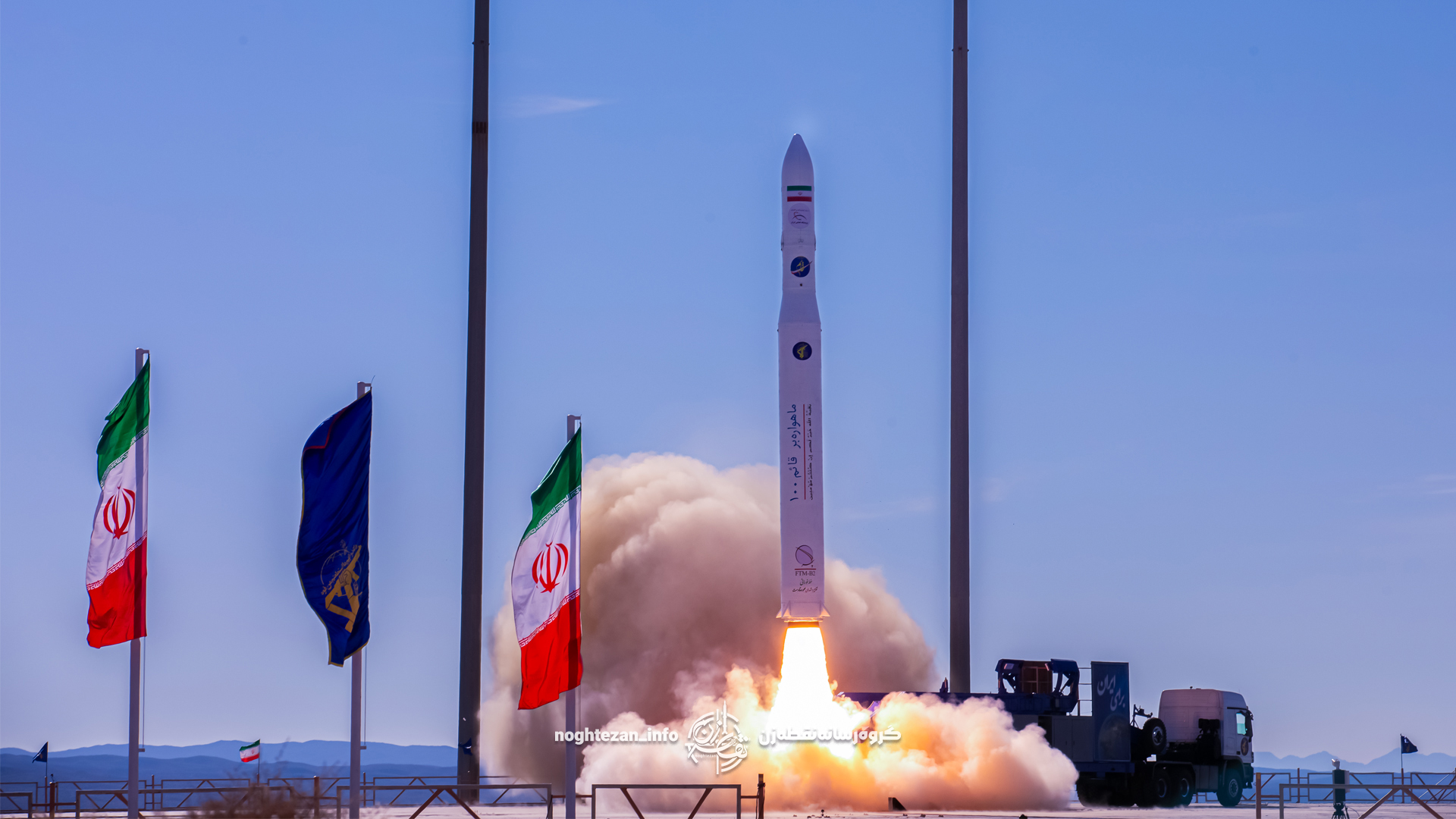
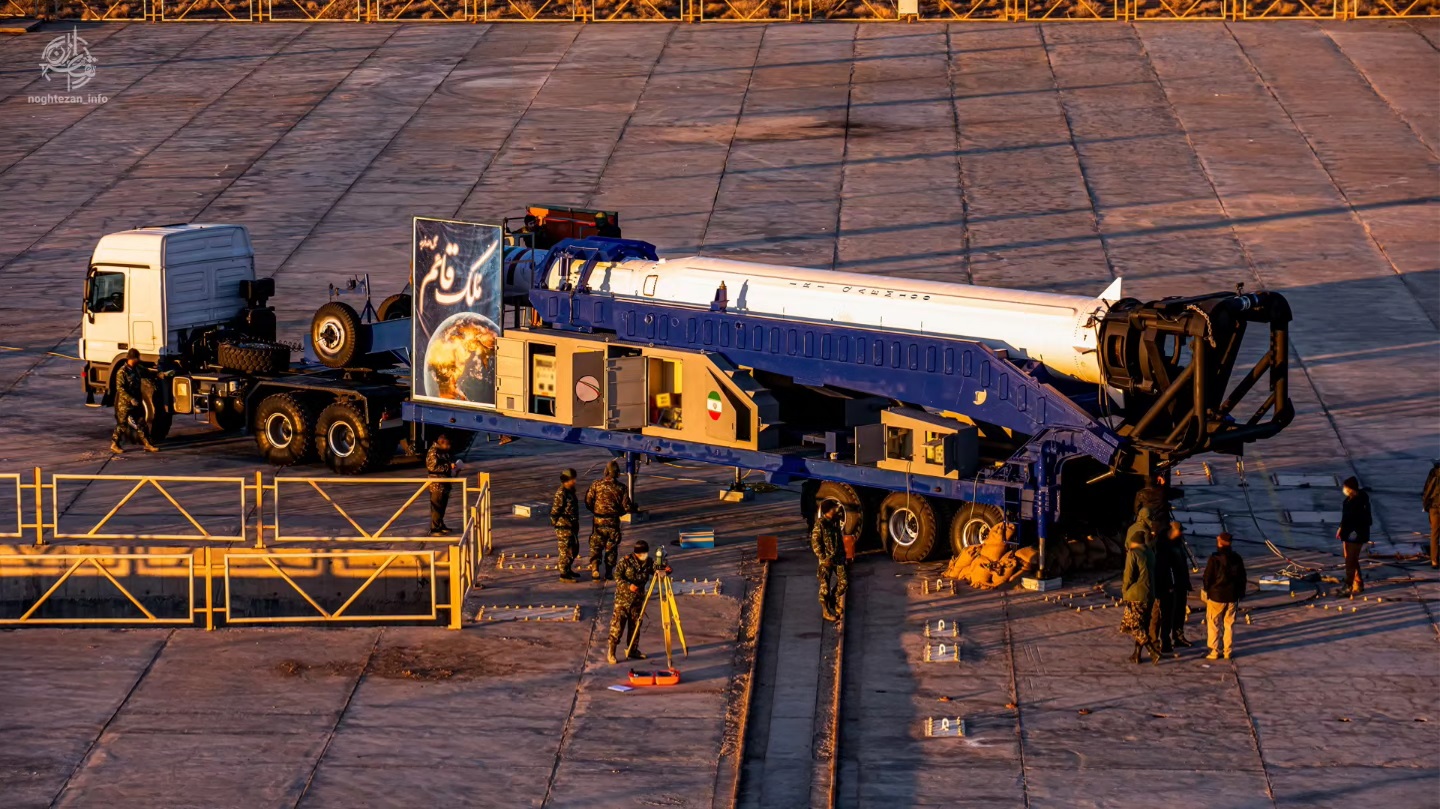
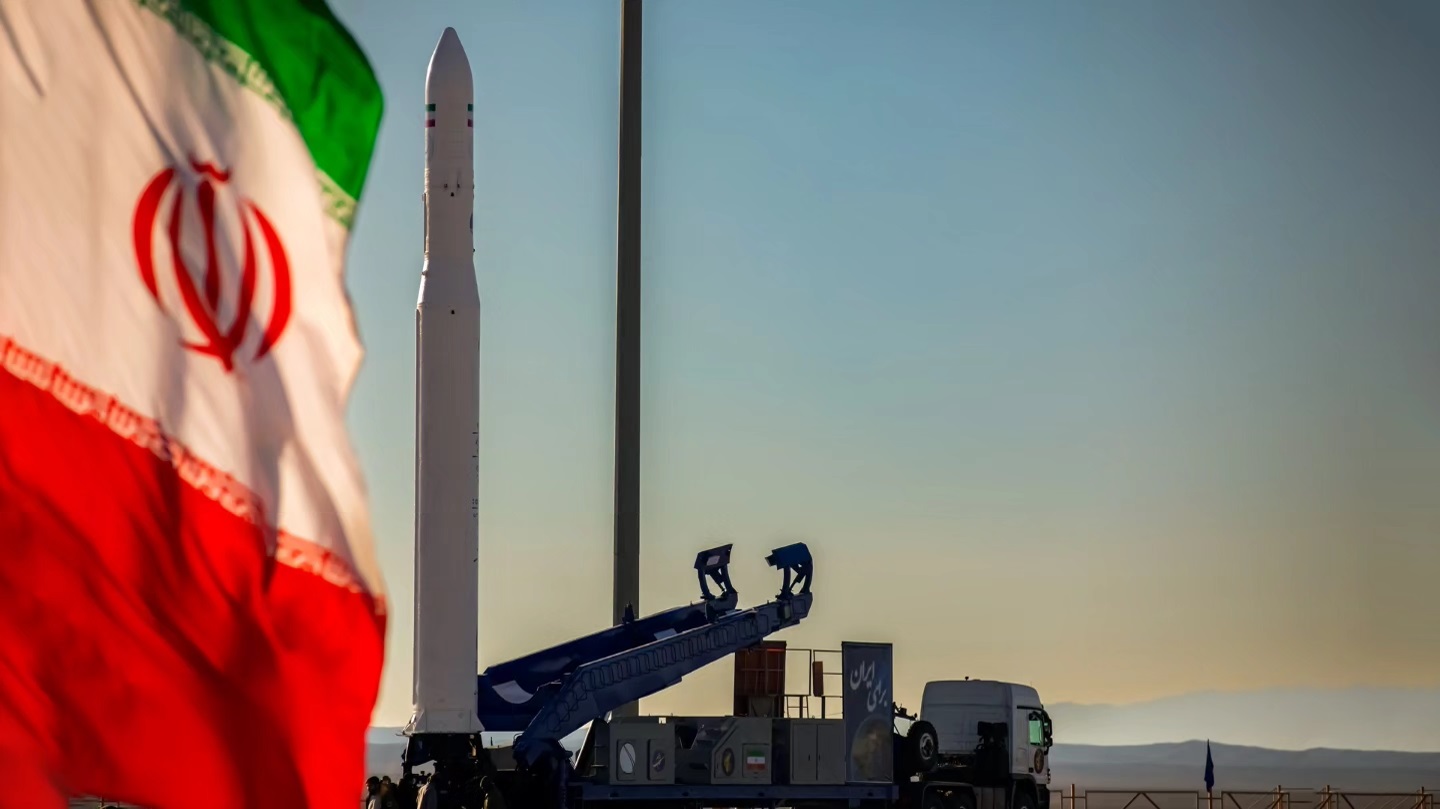
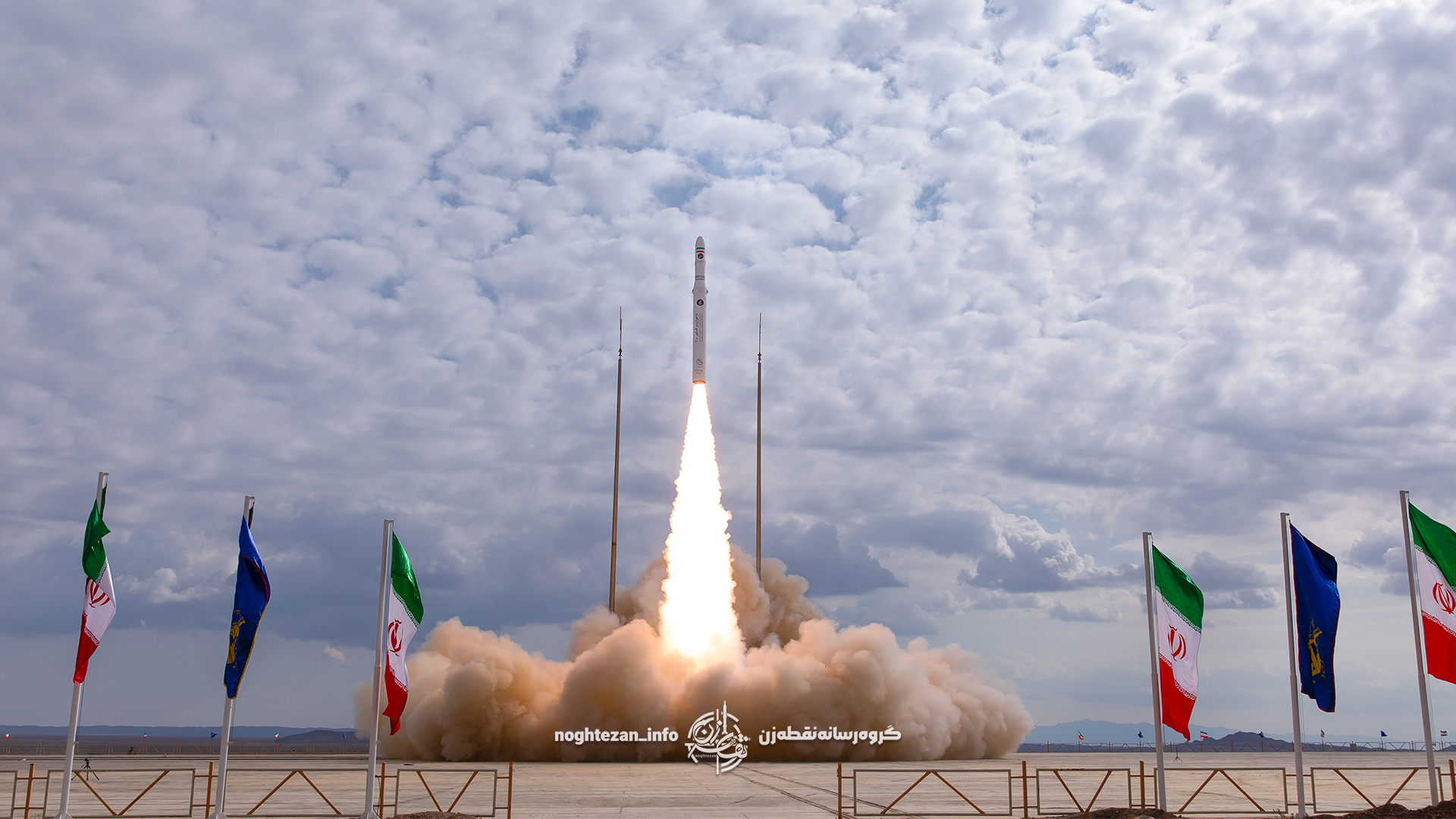
In the latest example of the Iranian satellite launch vehicle (SLV), this missile has changed significantly compared to its previous example. The Qaem 100 satellite carrier with the capacity of carrying 80 kg of cargo has had many changes compared to the previous Qaem SLV.
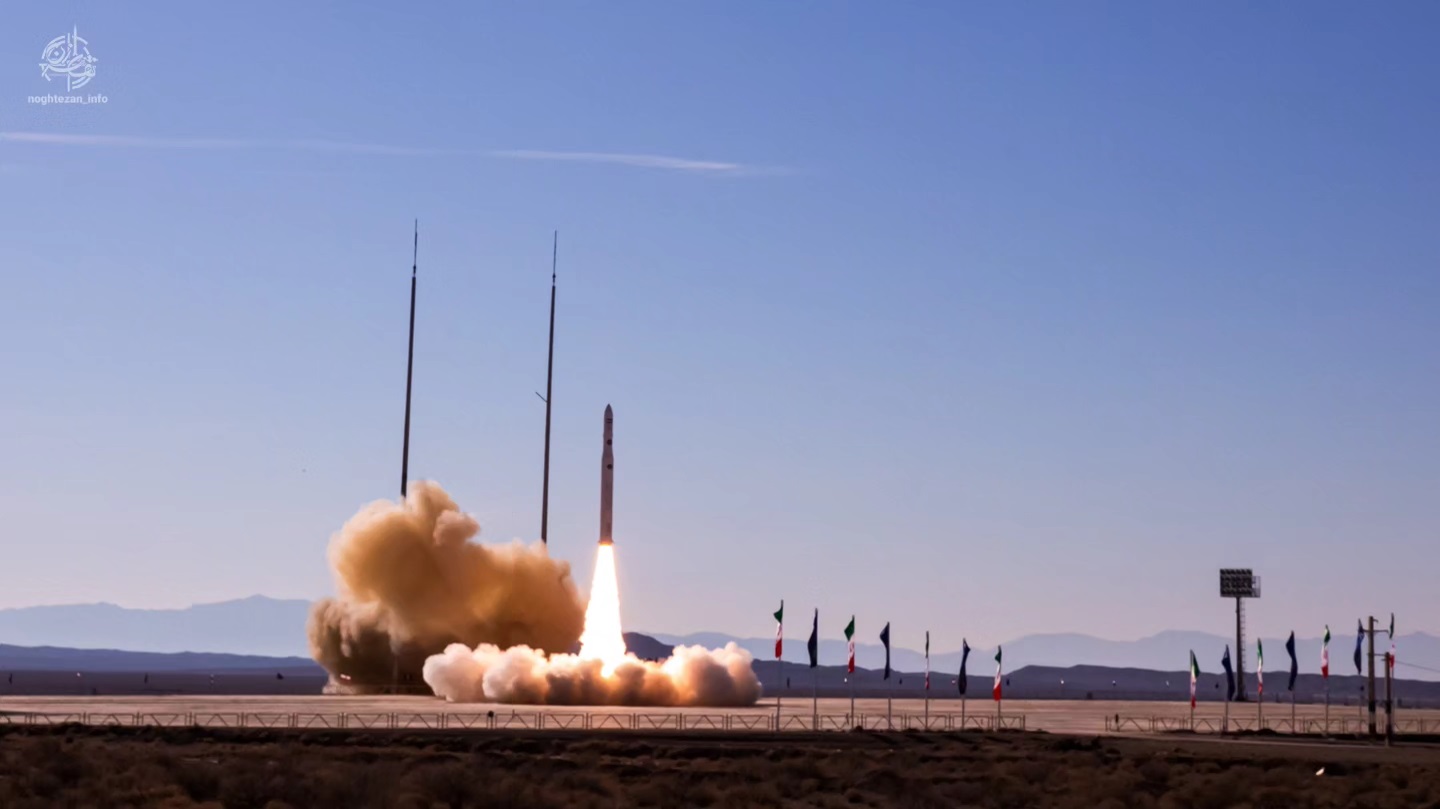
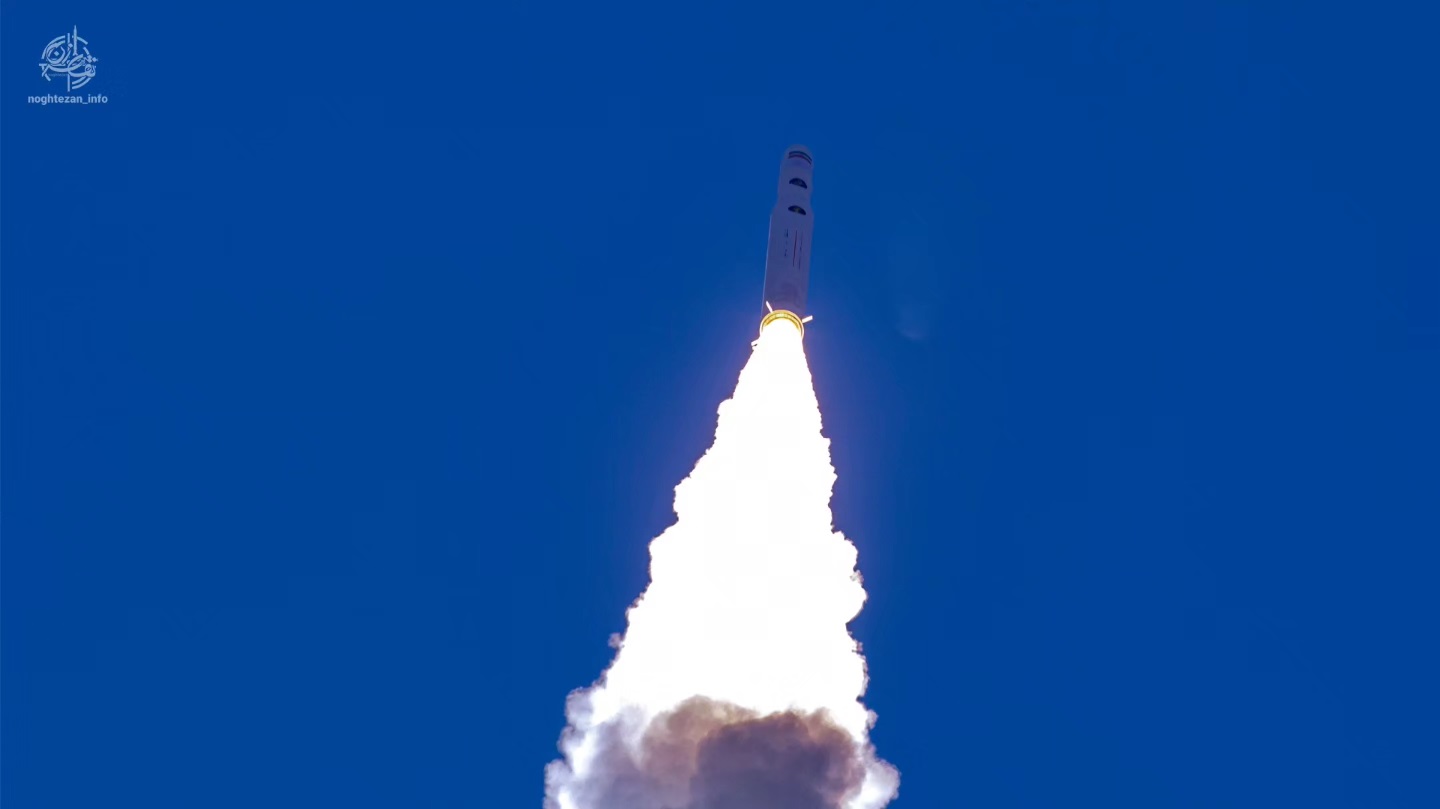
In the released footage of the launch of the Qaem-100 satellite, shortly after the launch, the rocket quickly changes direction; Therefore, a solid fuel engine with a moving nozzle has been used. Iran has a type of this engine called the ‘Raafe’ (lifter) engine.
The launch moment of Qaem-100 SLVThe launch moment of Qaem-100 SLV
As it is clear in the video, due to the composite body and the high power of the Raafe engine, the Qaem-100 satellite carrier has great acceleration. The lightness of the engine, the moving nozzle for the engine and possibly the use of a new combined solid fuel can be mentioned as the new technologies used in the Qaem-100 satellite carrier. As a result, due to the use of new fuel with high energy density, extreme thrust, and the use of an all-composite engine, which has reduced the overall weight of the missile, the acceleration has increased greatly, and Iran has practically reached a range of over 5,500 kilometers.
#Iran Today, Iran successfully launched Qaem-100 Satellite Launch Vehicle from the #Shahroud space center. Qaem-100 is a three-stage solid fuel SLV that will be able to place satellites weighing 80 kg in an orbit of 500 km. pic.twitter.com/DjnC04cPZU
It is worth mentioning that the launch of the missile that was carried out in the form of the Qaem 100 satellite carrier test is very similar to the US MGM-134 Midgetman missile with a range of 11,000 km.
Qaem-100 SLV
In this way, respecting to the ability of the Islamic Revolutionary Guard Corps, if Iran intends to produce intercontinental ballistic missiles, it will have all the necessary technologies. Modern technologies at the disposal of the Islamic Revolutionary Guard Corps allow the construction of missiles with a range of 5,500 to 12,500 kilometers in the form of two-stage and three-stage solid fuel, and it will be possible to attack the desired targets in Europe and even in the American continent.
This huge achievement has made Iran one of the few countries that have this technology. The Hebrew-Arab and Western axis have also felt threatened by understanding this fact and have become extremely afraid of what Iran has achieved in the field of “deterrence power” through intercontinental ballistic missiles.
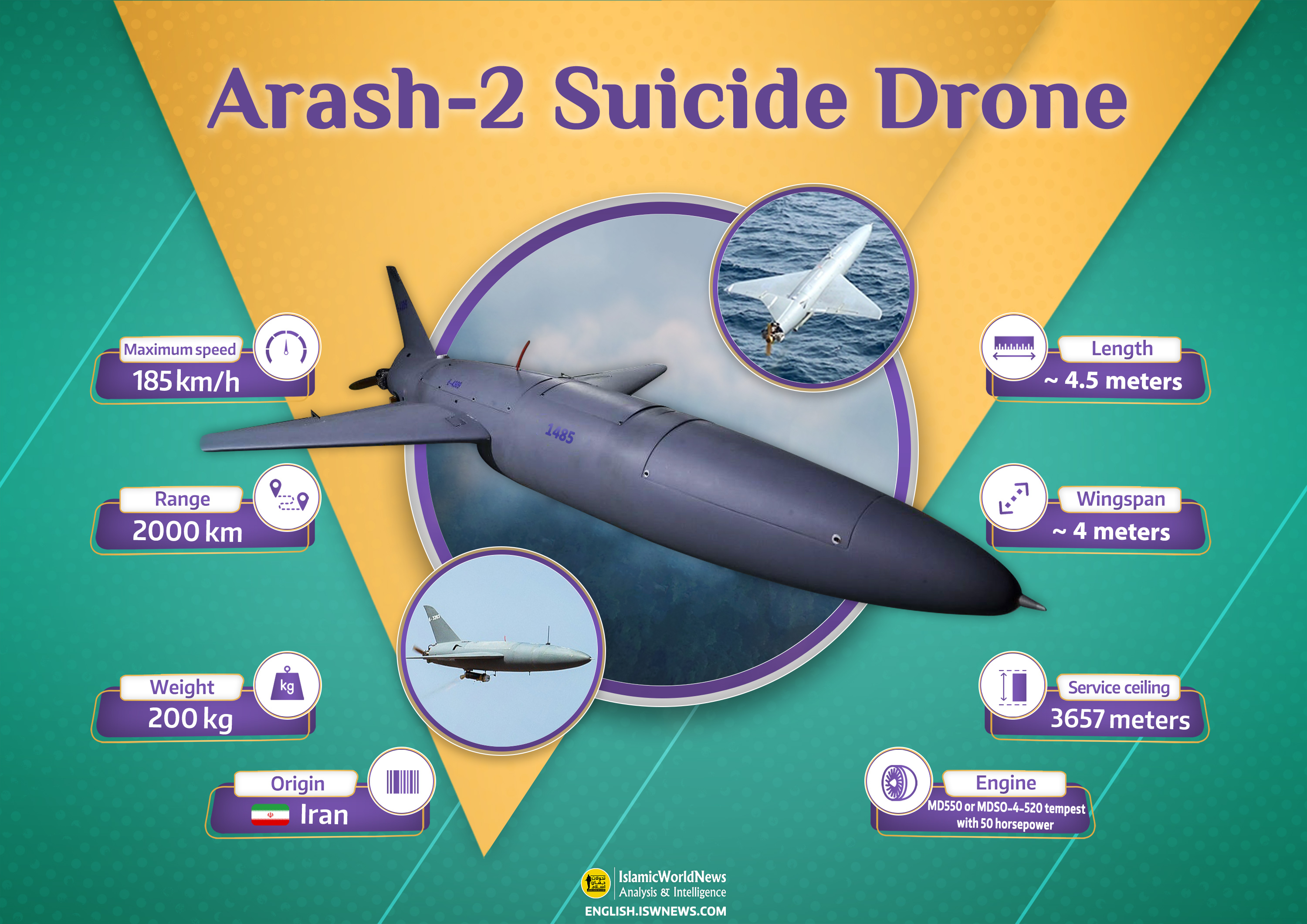
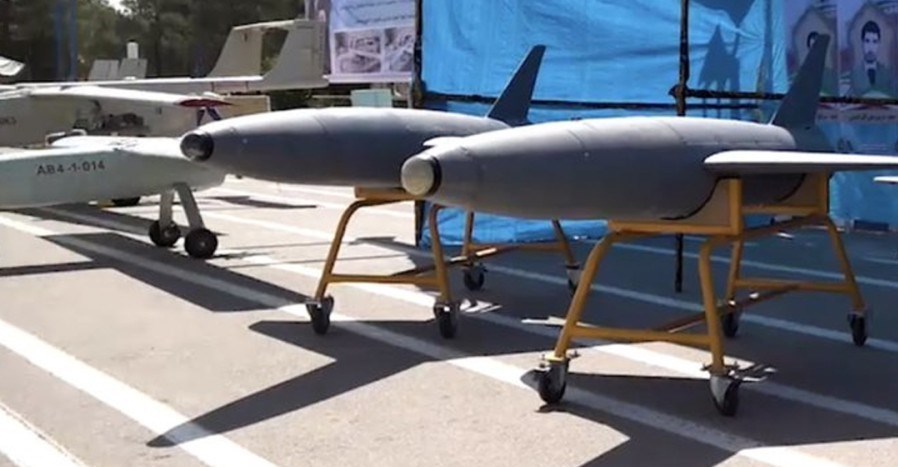
Arash-2 suicide drone with a range of 2000 km is considered the longest-range suicide drone in the world. There is a smaller version of this drone called Arash-1 with a range of 150 km, which is designed to attack nearby targets on the battlefield. In fact, Arash-2 suicide drone is an upgraded and improved version of Arash-1.
Arash-2 drone was unveiled and used for the first time in the Army drone exercise in January 7, 2021. In this exercise, this done was launched from the coast of Makran and after traveling a distance of about 1400 km, it hit its target in the general area of the exercise in Semnan province in the center of Iran.
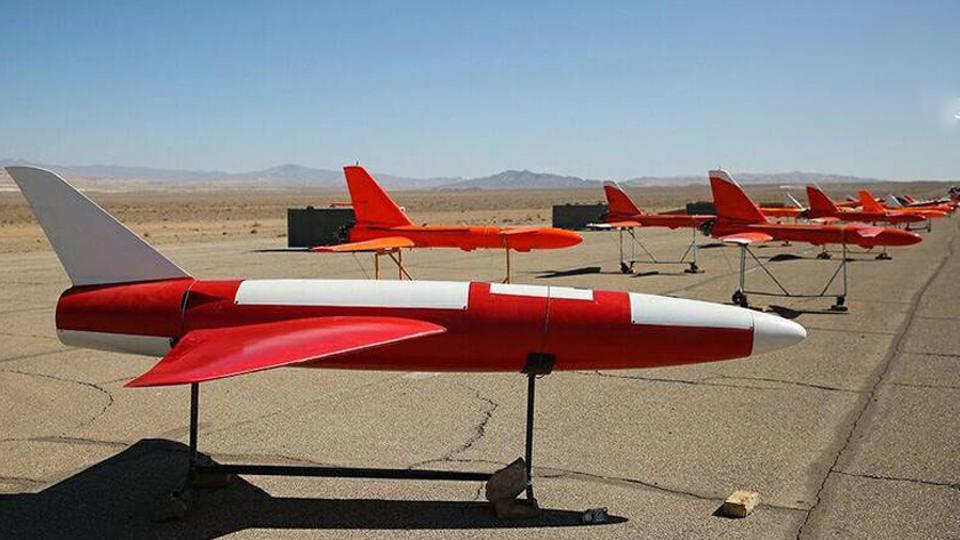
Arash-2 looks identical to Kian-2 drone and has a triangular wing. The main difference between these two drones is their engine. Kian uses a jet engine and Arash uses a piston engine. This engine difference has also had a great impact on their range.
Kian-2 drone with jet engine
So far, Arash-2 has been launched in exercises by two types of launchers. The first type by a JATO launcher and the other by a box launcher that can be mounted on the back of a truck. The box launchers will make the drone more difficult to identify and along with the high mobility, it will increase survivability of truck and the crew.
Arash-2 long-range suicide drone launched from a box launcher with a rocket booster
Arash-2 suicide drone was seen on the army drone fleet in July 2022. Therefore, the ability to use anti-ships and also attack from the sea to the shore can be considered for Arash.
At the Army’s “1401 Achievements Exhibition”, the Arash-2 drone equipped with an infrared and electro-optical seeker was seen, which gives this bird additional capabilities. Arash-2 drone with infrared and electro-optical seeker will be able to destroy various targets with high accuracy. Therefore, with various seekers, in addition to fixed targets, this drone has the ability to target moving targets or targets that need to be accurately hit in the enemy’s area.
Arash-2 suicide drone equipped with infrared and electro-optical seeker
According to the published photos and the information of the permanent exhibition of the achievements of the Ministry of Defense, the Arash-2 drone engine is of the MD 550 or MDSO-4-520 tempest type with a power of 50 horsepower. Therefore, according to the type of engine, this drone will have a maximum speed of 185 km/h.
Arash-2 suicide drone specifications: Length: ~ 4.5 meters Wingspan: ~ 4 meters Service ceiling: 3657 meters Engine: MD550 or MDSO-4-520 tempest with 50 horsepower Maximum speed: 185 km/h Range: 2000 km Weight: ~ 200 kg Origin: Iran
Click to view full size
More pictures of Arash-2 suicide drone
Click to view full size
Collection of posters of Arash-2 suicide drone in Russian (Дрон-камикадзе Араш-2), Persian (پهپاد انتحاری آرش-۲), Chinese (Arash-2 自杀式无人机), Hebrew (מזלט התאבדות ארש-2), Arabic (المسيرة الانتحارية آرش-2), Azeri (Arəş-2 Kamikadze Dronu) and Kurdish (درۆنی خۆکوژی ئارەش-2):
According to Chief Admiral Alireza Tangsiri, Commander of the IRGC Navy, three vessels of this class were being built at the same time in three different facilities of the IRGC, the Ministry of Defense and the private sector. Finally, on 14 June 2022, one of the three vessels under construction was ready to be delivered to the IRGC Navy. Two more aircraft of this class are still under construction, but exact information on the progress of the projects is not available.
In the body of Shahid Soleimani catamaran corvette, aluminum is used instead of steel, which is a newer innovation in Iran’s military shipbuilding industry. The modern design of the body in the form of a catamaran increases maneuverability and better stability in the sea and rough waters. Also, the use of aluminum alloy makes the body lighter and longer life due to less corrosion against water. This ship is powered by 4 localized and indigenous engines; Which brings its maximum range to 5000 nautical miles equivalent to 9260 km. The floating weight of Shahid Soleimani warship is 600 tons.
With this range, the Shahid Soleimani warship will increase the Iranian navy’s operational reach beyond the Persian Gulf to as far away as 9,000 km, which would cover the entire Indian Ocean down to Cape Town.
Intelligence and reconnaissance monitoring, surface and subsurface and air traffic monitoring are among the duties of this vessel. The Shahid Soleimani warship is equipped with the most advanced indigenous electronic warfare systems.
Shahid Soleimani warship is the first Iranian warship equipped with vertical launchers that can fire antiaircraft missiles up to a range of 150 km or land-attack cruise missiles up to 700 km or beyond.
There are six box launchers on both sides of the Shahid Soleimani warship which can fire antiship missiles such as the Nasr, Nasir, Ghader and Ghadir with ranges of 35 to 300 km. Four of which are Qadir or Qadir with a range of 300 km and two of which are Nasr or Nasir with a range of 90 km. According to Iran’s experiences in enhancing the weapons of warships, there is a possibility that the six box launchers in this vessel will be changed to 12 box launchers like what Iran did to Separ corvette in the Caspian Sea.
Two Ghader cruise missiles and one Nasir cruise missile
Behind the command bridge there are a number of vertical launchers silos. These silos are located in two rows of four and one row of three on both sides of the ship. The big silos are 3.4 meters long together, which means the inner diameter is about one meter. According to Major General Bagheri, at the time of unveiling, it is possible to use cruise missiles and surface-to-surface missiles up to a range of 700 km in these vertical launchers (VLS).
Vertical launchers systems (VLS) on Shahid Soleimani warship
This vessel has 16 small silos (8 on each side) for use in the air defense sector, according to Chief Admiral Alireza Tangsiri, the range of the missiles used is more than 150 km. The air defense missiles with this range will be from the Sayyad family with a diameter of less than 60 cm.
At the front of the vessel, there is a 30 mm automatic cannon with a stealth design along with a thermal camera to control it, which gives the ship the ability to engage light vessels and cruise missiles in the last stage. Two chaff and flare launch pods are installed on the sides of the main cannon to deflect anti-ship cruise missiles and disrupt the sonar. It is also possible to upgrade this cannon.
We see two types of photos of a vessel with hull number FS313-01. In the first photo, the vessel has four 12.7 mm guns. But in the second photo, it has four 20 mm three-barrel Gatling guns. According to the image of this ship on the back of General Bagheri, the model with three-barrel Gatling is the same model added to the IRGC Navy, and the other image is related to the model at the time of its sea test.
Shahid Soleimani warship during the sea test with 12.7 mm gunShahid Soleimani warship during the unveiling and with 20 mm three-barrel Gatling gunsThe warship with hull number FS313-01 at the time of joining the IRGC Navy, with 20 mm three-barrel Gatling.
Probably, this 20 mm three-barreled cannon can be synchronized with different systems to engage with boats and missiles in the final stage of ship defense. Because in the test videos released from it, it is controlled remotely by the operator from somewhere else.
20 mm three-barreled marine Gatling gun without name – related to the Musalla exhibition in 1398 H.S
The helipad of this vessel is able to carry the Bell-412 heavy helicopter with anti-submarine capability, as well as all kinds of drones in the combat organization of the army, navy, and the IRGC.
Below the helipad, there is a crane for launching speedboats or drone boats, which are also capable of firing torpedoes and anti-ship missiles.
The back part of Shahid Soleimani warship and the location of speedboats
According to Admiral Tangsiri, 20,000 maps were used to build the ship and 100,000 sketches were made until the final design was reached. This vessel currently has a speed of 30 to 32 knots equivalent to 55.5 to 59.2 km/h. The initial construction time was less than 2 years. Tangsiri stated that the construction time of each vessel in Shahid Soleimani class is currently one year.
Iranian network’s interview with Admiral Tangsiri, Commander of the IRGC Navy about Shahid Soleimani warship (in Persian language)
Shahid Soleimani Catamaran Warship Specifications: Type: Multi-role catamaran corvette Class: Shahid Soleimani Commissioned: 5 September 2022 Length: 67 m Beam: 18-20 m Displacement: 600 tons Propulsion: 4 localized engines Speed: 32 knots Range: 5,000 nmi Missile arsenal: 6 x anti-ship cruise missiles 6 x ground attack missiles 16 x air defense missiles Guns: 1 x 30 mm autocannon 4 x 20 mm Gatling with remote control Aircraft carried: 1 × helicopter Boat carried: 3 x speedboats Origin: Iran
Click to view full size
Collection of posters of Shahid Soleimani Catamaran Warship in Russian (Военный корабль Шахида Сулеймани), Persian (ناو شهید سلیمانی), Chinese (沙希德·苏莱曼尼 双体船军舰), Hebrew (ספינת מלחמה קטמרן שהיד סולימאני), Arabic (بارجة الشهيد سليماني), Azeri (Şəhid Süleymani Gəmisi) and Kurdish (کەشتی جەنگی شەهید سولێمانی):
Zolfaghar missile is equipped with a warhead weighing 579 kg and its range is 700 km. The guidance method of this missile is based on Inertial and global navigation satellite system and electro-optical terminal with the ability to guide until the last moment. Zolfaghar has anti-jamming capability and is resistant to any electronic warfare.
In the Zolfaghar missile, the nose of the missile has changed from a pointed to a curved one. This change reduces the thermal effect of drag at high speeds; Therefore, the speed of this type is higher than the Fateh-110 models and has reached Mach 5.
Zolfaghar ballistic missile guidance has been optimized. In this missile, the pointed shape of the warhead guide canards has been changed to trapezoidal shape. Also, these canards have been moved to the end of the warhead and behind the guidance, control and navigation section.
The warhead of the Zolfaghar missile is detachable. Detachable warhead, while reducing the negative effects of connecting the body to the warhead in the final phase of the attack, reduces the possibility of intercepting by enemy air defense systems and reduces the probability of enemy air defense missiles hitting the Zolfaghar warhead.
So far, the dimensions of this missile have not been officially announced; But by examining the available images, it can be seen that its length has increased compared to the Fateh-110 missile.
Zolfaghar missile has high agility due to its light weight and small dimensions, and like other missiles of the Fateh family, it can be installed and launched on a mobile chassis. This increases its survivability on the battlefield. Zolfaghar missile can be fired from a dual launchers.
Zolfaghar Ballistic Missile
In September 2020, a new type of this missile named “Zolfaghar Basir” with optical guidance and anti-ship mission was unveiled.
The Zolfaghar ballistic missile has been used in two operations “Laylat al-Qadr” and “Strike of Muharram” against the ISIS terrorist organization in Syria.
On the last night of Qadr in the month of Ramadan, which coincides with Sunday June 18, 2017, the IRGC Aerospace Force with the operational name “Laylat al-Qadr”, used 6 Zolfaghar missiles to attack the command headquarters and positions of ISIS in the Syria’s Deir Ezzor province. The missiles targeted ISIS positions in Deir Ezzor, at a distance of about 650 kilometers. This operation was carried out in response to the ISIS terrorist attack on Iranian Parliament in Tehran in 8 June 2017, which resulted in the martyrdom of 18 civilian.
In another operation on the morning of October 1, 2018, the IRGC Aerospace Force with the operational name “Strike of Muharram” (Zarbat-e Muharram) with 6 surface-to-surface ballistic missiles from Kermanshah in the west of Iran, destroyed the positions of ISIS terrorists in the Hajin area in the east of the Euphrates River in Syria. The 4 out of the 6 fired missiles were of the Zolfaghar type. Simultaneously with this operation, 7 IRGC drones have also targeted the positions of terrorists in the east of the Euphrates. This operation was carried out in response to the ISIS terrorist attack in September 22, 2018 in Ahvaz city, which resulted in the martyrdom of 25 Iranians and the wounding of 69 others.
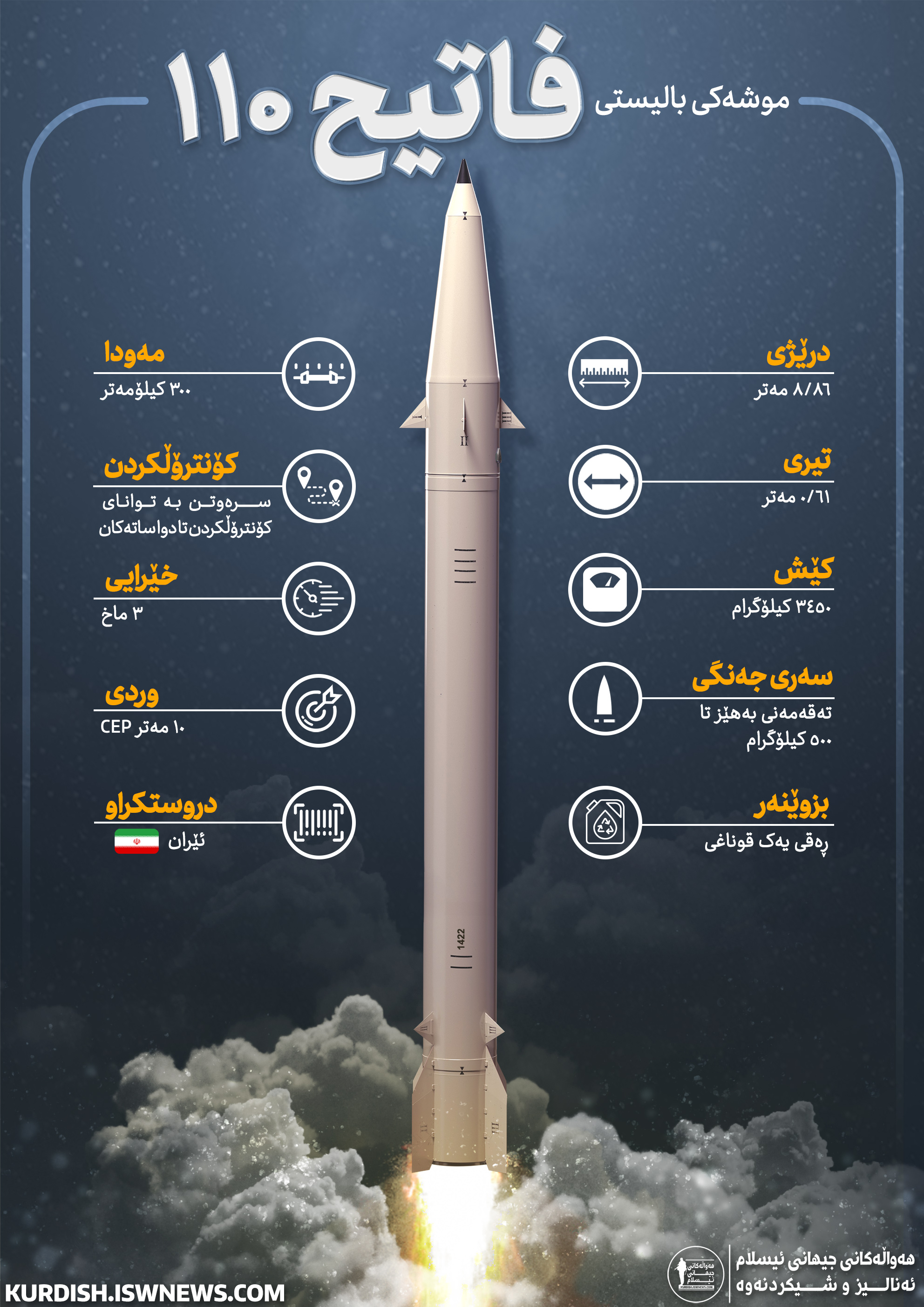
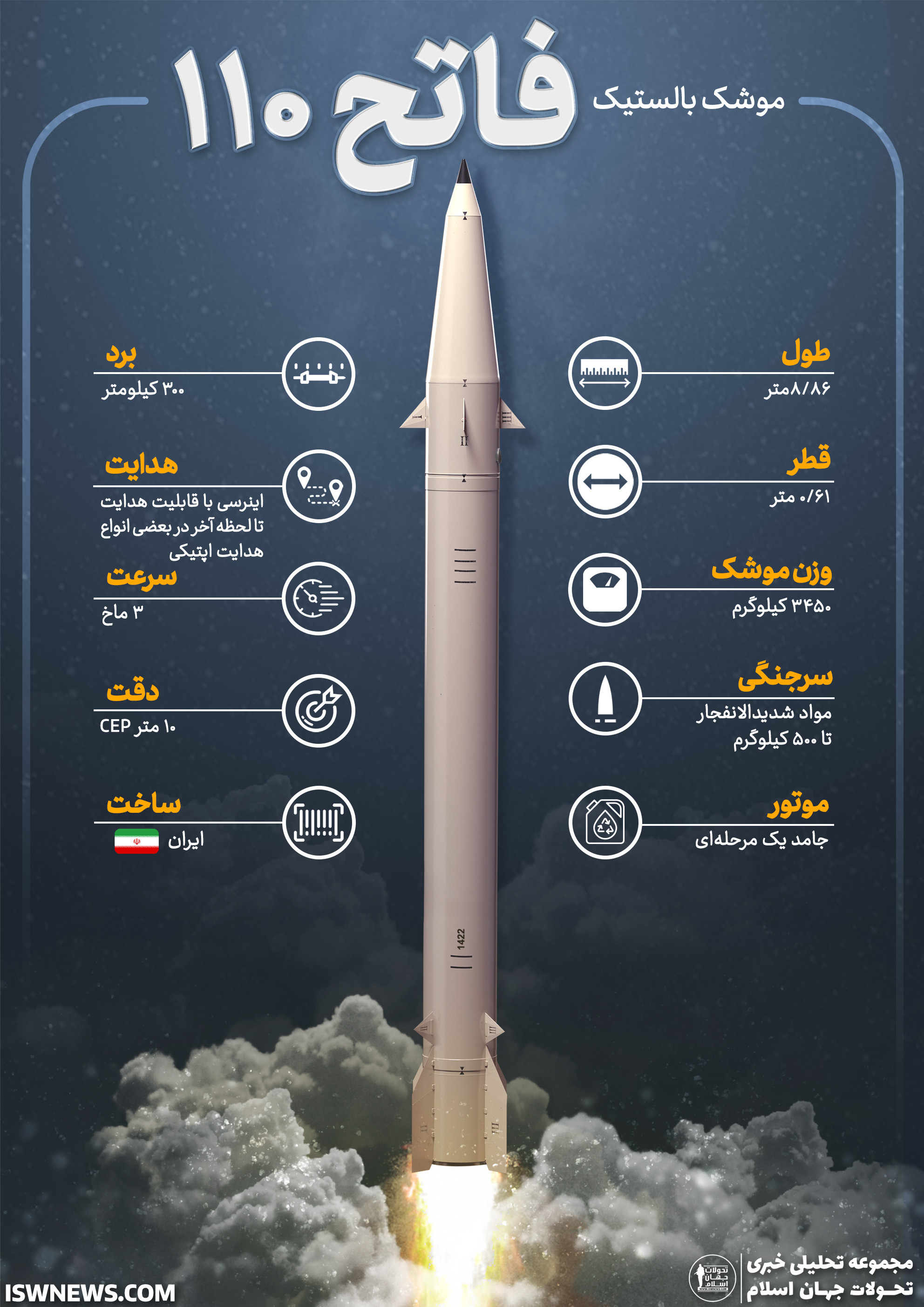
Fateh 110 missile is produced by the Aerospace Industries Organization (AIO), a subsidiary of Iran’s Ministry of Defense and Armed Forces Logistics. According to the available information, the first tests of this missile were carried out in 2002. Fateh-110 is one of the most popular types of missiles produced by Iran’s military industrial.
In the past 30 years, the development of the Fateh-110 missile has been carried out on the basis of “increasing the range and increasing the accuracy” and its various types have been produced over time. Therefore, in 2012, a version of the Fateh-110 missile with a pinpointing accuracy and an error rate of 10 meters was produced.
Fateh-110 missile should be considered as Iran’s first important step in designing a solid fueled ballistic missile. The ignition mechanism of Fateh-110 is single-stage and uses solid fuel.
So far, 10 generations of Fateh-110 missiles have been built, and their specifications are as follows: Fatih-110 generation 1: with a range of 200 km Fatih-110 generation 2: with a range of 250 km Fatih-110 generation 3: with a range of 300 kilometers and high accuracy Fatih-110 generation 4: with a range of more than 300 km and pinpoint accuracy Persian Gulf missile: an anti-ship type Hormuz 1 and Hormuz 2: an anti-radar type Fateh Mobin missile: anti-ship type with optical guidance Zolfaghar missile: with a range of 700 km Dezful missile: with a range of 1000 km Raad 500 missile: with a range of 500 km
Fateh-110 ballistic missile is able to target and destroy land and sea targets, enemy gathering points, command centers, ammunition depots, radars and other targets with high accuracy. The error rate of Fateh-110 missile is estimated to be less than 10 meters.
The warhead of Fateh-110 missile is detachable type. Detachable warhead, while reducing the negative effects of connecting the body to the warhead in the final phase of the attack, reduces the possibility of intercepting by enemy air defense systems and reduces the probability of enemy air defense missiles hitting the Fateh-110 warhead.
Fateh-110 missile has high agility due to its light weight and small dimensions, and like other missiles of the Fateh family, it can be installed and launched on a mobile chassis. This increases its survivability on the battlefield.
The effective range of this missile is 300 km and its final range is estimated between 400 and 550 km.
One of the most famous operations of Fateh-110 is the attack on the headquarters of the terrorist group of the Democratic Party of Iranian Kurdistan (KDPI) in September 8, 2018. In this operation, Fateh-110 missiles were fired from a distance of 230 km towards the headquarters of the KDPI terrorist group in Koysinjaq in the Kurdistan region of Iraq and very accurately targeted the meeting of their leaders. In this precise attack, 16 members of KDPI were killed, including 6 members of the central committee of this terrorist group. This attack was carried out in retaliation for the martyrdom of a number of IRGC servicemen who were killed by KDPI in July of the same year in the west of the country.
The operation against the Mossad base/villa near the Iraqi city of Erbil is another important and impressive operation of Fateh-110 ballistic missiles. In the morning of March 13, 2022, the IRGC Aerospace Force targeted the secret and sensitive center of the Israeli regime near the new US consulate in Erbil, with at least 10 ballistic missiles. Some of the missiles used in this operation were Fateh-110. The IRGC stated that the reason for the attack on the Mossad villa near Erbil was a response to the Israel’s recent evils activities against Iran national security.
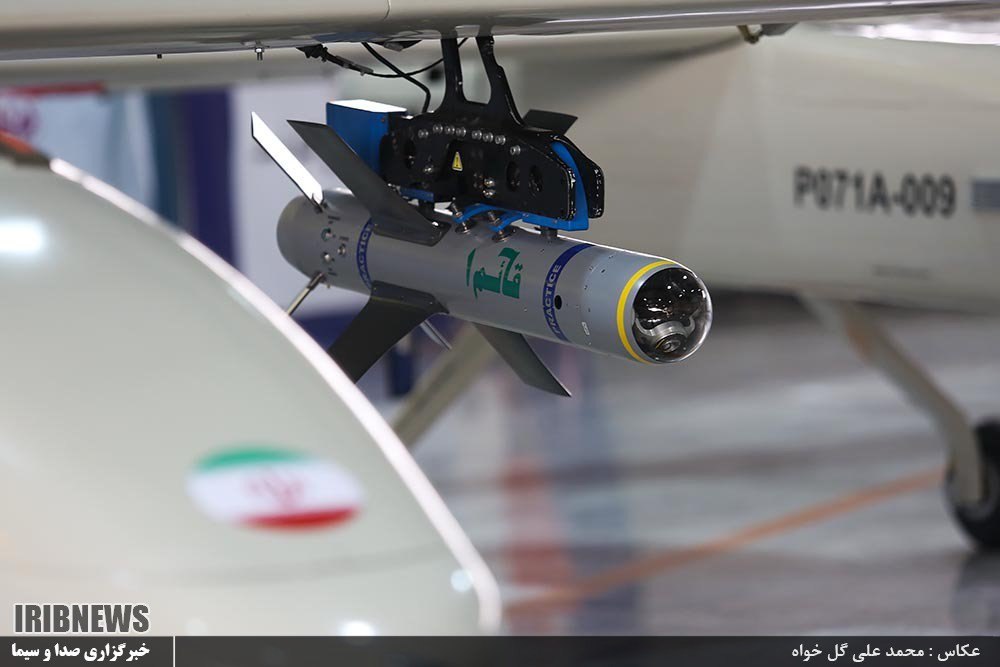
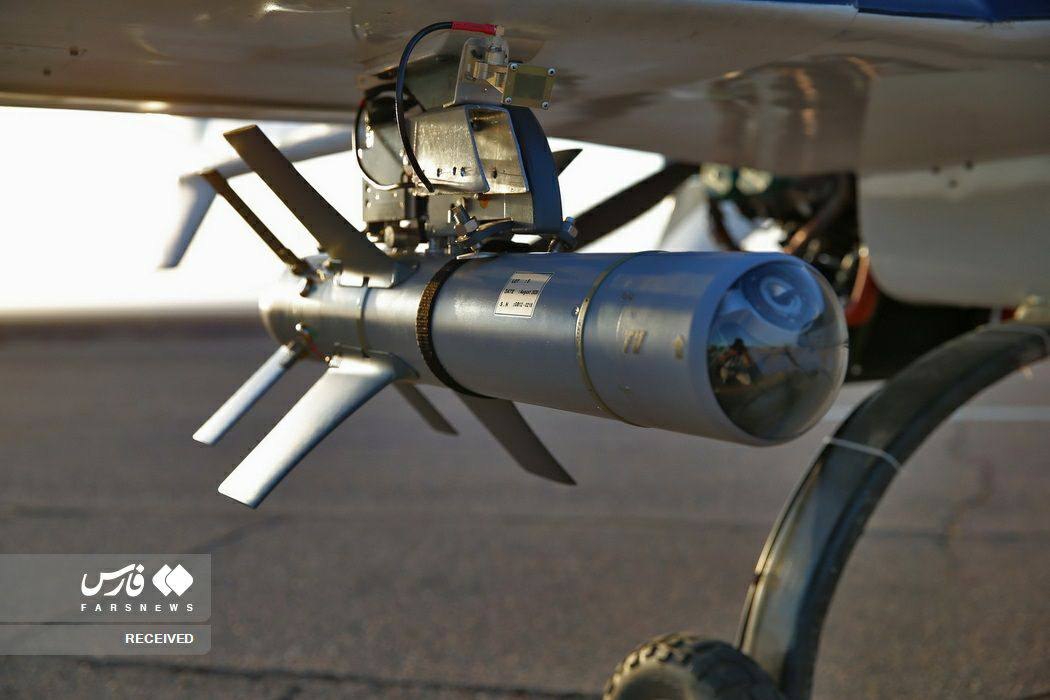
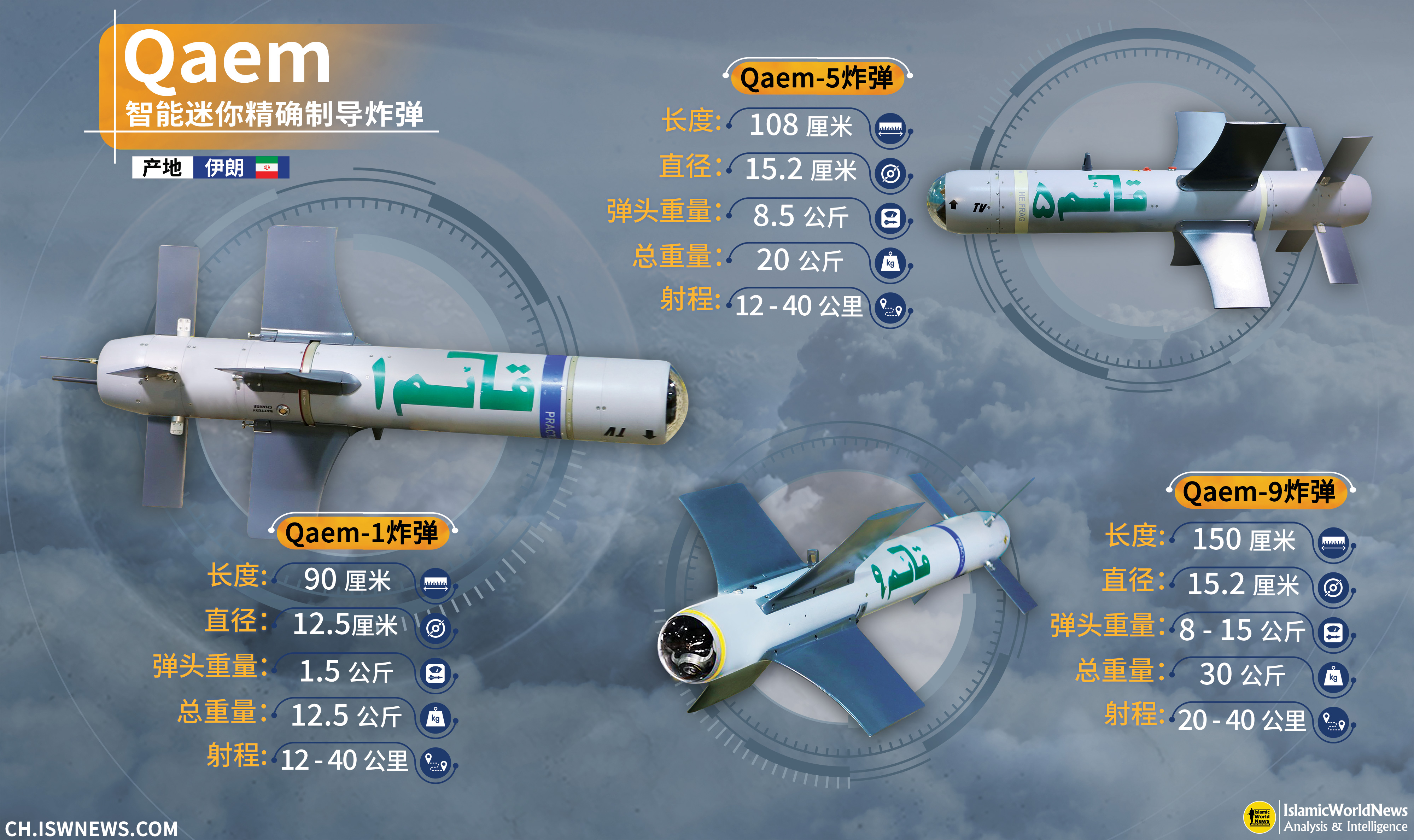
Qaem 1, 5 and 9 bombs were all unveiled during a ceremony in August 6, 2019 in Tehran. According to Amir Hatami, Former Minister of Defense and Armed Forces Logistics of Iran, at the unveiling ceremony of Qaem bombs, this product was jointly produced by the two Organizations of Defense Industries and Iran Electronics Industries. Amir Hatami stated that the minimum operational height of these bombs is 4 to 10 thousand feet (1219 to 3048 meters) and its range is 12 to 40 kilometers, and the ability to install different penetrating and shrapnel warheads with different ranges and various destructive power is also available in these bombs.
It should be noted that the “minimum operational height” of the Qaem bomb means that if we drop the bombs below this height (below 1219 meters), they will not be able to glide and will quickly fall towards the targets.
The speech of the former Minister of Defense, Amir Hatami, regarding Qaem smart bombs and announcing a range of 12 to 40 kilometers for them
But in another place, Brigadier General Shahrokh Shahram, the CEO of Iran Electronics Industries, states that the range of Qaem bombs is 20 to 40 kilometers. Due to the contradiction between the words of Amir Hatami and Shahrokh Shahram, the exact range of these bombs is in an aura of uncertainty. Also, unfortunately, the range of this series of bombs has never been officially announced in any of the military exhibitions. In the rest of the article, we will try to determine the range of each of the bombs of the Qaem series separately.
Brigadier General Shahrokh Shahram, the CEO of Iran’s Electronics Industries, explained about Qaem series bombs and announced a range of 20 to 40 kilometers for them.
Small Diameter Bombs (SDB) are a new type of bombs that have been produced and adopted in the last few years by the military powers like the United States. The U.S. prototypes of this model were heavy bombs and were launched by the fighter jets and from a high altitude. Due to Iran’s need for lighter but practical weapons for its modern drones, Iran was inspired by this type of bombs in making smart bombs, and these efforts finally came to fruition in 2010 with the introduction of the miniature bombs of the Sadid family. Sadid-342 can be considered the first miniature bomb of Iran, which was later developed in the Qaem family.
In the process of producing these bombs, the production of seeker that can be used in all current and future Iranian smart bombs was very important. Therefore, Iran’s Ministry of Defense produced seekers with various guidance methods. Two examples of these seekers named thermal image seekers RU320ST and visible image seekers RU113ST have been displayed, which have been installed and observed on Sadid and Qaem families.
RU320ST image thermal seeker (left side) next to RU113ST visible image seeker (right side)
Although there is no information available about the history and order of production of Qaem bombs, but based on the available data, the category can be considered as follows:
Qaem-5 bomb: The specifications of Qaem bombs have not been officially announced, but at the Baghdad defense exhibition, some specifications of Qaem-1 and Qaem-5 bombs were displayed. According to the specifications announced in this exhibition, the dimensions of the Qaem-5 and the Sadid-342 bomb are very close to each other, but due to use of fixed wings and the increase in the weight of the warhead, its weight has reached 20 kg.
Qaem 5 specs with BS20 branding presented at ARMY 2022Qaem 5 specs with BS20 branding presented at Baghdad defense exhibition
At the time of the unveiling of these bombs, Amir Hatami announced the range of the Qaem family from 12 to 40 kilometers. Looking carefully at the front and rear wings of Qaem-5, we will notice the larger dimensions and aerodynamic shape of the Qaem-5 compared to the Sadid family of bombs. Probably, the range of Qaem-5 is greater than that of Sadid 342 and 345 because it has less weight and more wing area, which will increase the lift and decrease the drag and finally increase its range. Therefore, based on the mentioned facts, Qaem-5 range can be considered 12 km if released from a height of 5 km. Qaem-5 bomb has the possibility of being installed on the fighter jet, and if it is released from a high altitude, a range of up to 20 kilometers can be considered for it.
The middle wings of the Qaem-5 are longer and have a backward and curved shape, which indicates an improvement in the flight characteristics of the wings compared to the Sadid-345.
The seekers used in Qaem 5 are visual/optical (TV), thermal (IR), laser and a combination of optical and laser. The use of all kinds of seekers in Qaem 5 allows operations to be carried out with great accuracy and in all weather conditions.
Optical seeker (TV) for Qaem-9
A variant of the Qaem-5 has also been seen, which has an infrared seeker and a proximity fuse (probably of the laser type), which is remarkable in its own right. The reason for using infrared is probably to reduce the cost of construction; But it will be less accurate. However, the use of a proximity fuse next to the infrared seeker compensates this defect to some extent.
A variant of a Qaem 5 bomb with an infrared seeker and a proximity fuse
Unknown variant of Qaem-5: A variant of Qaem-5 was showcased in the exhibition of the achievements of self-sufficient Jihad of the Iranian Navy in December 14, 2021. The length and width of the wings had increased noticeably. This increases the wing area and ultimately increases the range. And also there is the possibility of increasing the (warhead) weight without increasing the range.
A variant of Qaem- 5 bomb with greater length and wings
This type of Qaem-5 bomb was seen under the wing of Fotros reconnaissance and combat drone in the Iranian Army’s Strategic UAV Base 313, which strengthens the possibility of its operational nature. Therefore, we can expect to see this bomb on other combat drones of the Iranian Armed Forces in the near future. A capability that will significantly increase the offensive power of Iranian drones.
Qaem-5 smart bomb specifications: Length: 108 cm Diameter: 15.2 cm Seeker type: Visible (TV), thermal (IR), laser (L), a combination of optical and laser Type of warhead: Fragmentation Fuse type: programmable and timed Warhead weight: 8.5 kg Total weight of the bomb: 20 kg Range: 12 to 20 km based on the release height (in the unknown variant of Qaem-5, its range can be increased up to 40 km)
Qaem-1 bomb: The Qaem-1 smart bomb can be considered as the second member of the Qaem bomb family because the Qaem-5 was created along the lines of Sadid’s changes and the Qaem-1 was created due to the need for a light bomb to be carried by light drones. Iran uses a large number of light drones, such as Ababil 3 and 4. Because these drones do not have much power to carry ammunition; The Qaem-1 light and smart bomb can properly perform its duty on Iranian light drones in line with the doctrine of “one shot for each target”.
ARMY 2022 exhibition and Qaem-1 and 5 bombs – the difference between the two bombs and the style and miniaturization of Qaem-1 is clear.
The specifications of Qaem-1 bomb have also been displayed in the Baghdad defense exhibition under the brand name BS12.5 The weight of this bomb is 12.5 kg, its length is 90 cm and its diameter is 12.5 cm.
Qaem-1 specification with BS12.5 brand
Qaem-1 also uses visual or optical (TV), thermal (IR), laser, a combination of optical and laser seekers. But Qaem-1, in the warhead type, has been introduced with more variety. So far, warheads with fragmentation, incendiary, direct impact (kinetic energy) have been introduced for this bomb. Of course, it is important to mention that it is possible to use these warheads for the entire Qaem family. A programmable and timed fuse allows the bomb to detonate at a certain distance from the ground or at a specific height, increasing the effect of the warhead on targets. The total weight of Qaem-1 bomb is 12.5 kg and its warhead is 1.5 kg. The range of this bomb has not been announced like other members of the Qaem family. Qaem-1 with its light weight and small diameter and wings that are exactly similar to Qaem-5 can have a significant range. The Qaem-1 appears to have a slightly higher wing-to-body ratio than the Qaem-5. But it will probably have a range equivalent to Qaem-5, i.e. 12 km if released from a height of 5 km and a range of 20 km if released from a high altitude. The minimum release height for this bomb is 4,000 feet or 1,219 meters.
Qaem-1 bomb
Specifications of Qaiem-1 smart bomb with BS12.5 brand: Length: 90 cm Diameter: 12.5 cm Seeker type: Visible (TV), thermal (IR), laser (L), a combination of optical and laser Warhead type: fragmentation, incendiary, direct impact (kinetic energy) Fuse type: programmable and timed Warhead weight: 1.5 kg Total weight of the bomb: 12.5 kg Range: 12 to 40 km
Qaem-9 bomb: Qaem series bombs have been widely seen on all kinds of Iranian drones, but so far no pictures of Qaem-9 bomb installation have been seen. The Qaem-9 bomb has not been exhibited and very few pictures are available. According to the statements of the former Minister of Defense of Iran at the time of the unveiling of the Qaem bombs that these bombs can be used on drones and fighter jets and since the Qaem-9 bomb has not been seen on drones, we can have the impression that Qaem-9 is specially developed for fighter jets. Of course, it should be noted that it is definitely possible to install Qaem-9 bombs on drones. Although the dimensions of Qaem-9 are not available, it obviously uses the same diameter as Qaem-5, i.e. 152 mm. Considering that the wing location in this model has changed and its length and weight have also undergone changes, the center of gravity of Qaem-9 has definitely changed compared to Qaem-5. By examining the available images, a significant increase in the length of the bomb can be seen. According to the investigations, the length of this bomb should be around 150 cm. Also, in this bomb, it is possible to use all kinds of warheads and seekers used in Qaeim 1 and 5. Next is to determine the weight of the bomb. For this purpose, due to the increase in the length of the Qaem-9 bomb and based on the Qaem-5 bomb, we increase the weight of the Qaem-5 bomb by approximately 50% and consider the weight of 30 kg for the Qaem-9. Considering the dimensions of the Qaem-9 bomb, this bomb is a very favorable option for using a thermobaric warhead. Because this type of warhead has more weight and requires more space. Regarding the range, we return to the words of Amir Hatami and Brig. Gen. Shahram. The dimensions and length of the front and rear wings have been increased for the Qaem-9, which improves its aerodynamic characteristics and increases its range. The range of this bomb can be estimated to be 20 km if released from a height of 5 km and 40 km if released from a fighter, i.e. a height of more than 8 km. It is also worth noting that Qaem-9 bombs cannot be dropped from a height of less than 3 kilometers.
Qaem-9 bomb
Possible specifications of Qaem-9 smart bomb: Length: 150 cm Diameter: 15.2 cm Seeker type: Visible (TV), thermal (IR), laser (L), a combination of optical and laser Warhead type: fragmentation, incendiary, direct impact (kinetic energy) and thermobaric Fuse type: programmable and timed Warhead weight: 8 to 15 kg Total weight of the bomb: 30 kg Range: 20 to 40 kilometers based on release height
Unknown variant of Qaem family: A variant of Qaem smart bomb was displayed in the exhibition of achievements of the self-sufficient jihad organization of the Iranian Navy in December 14, 2021, which has much larger dimensions than other members of Qaem family. It seems that the diameter of this bomb is the same as other bombs, but its length has increased. The dimensions of the wings have also increased significantly. Definitely, this unknown bomb has more weight and range, but no accurate information can be obtained from it. This bomb may be designed to be dropped from large drones or fighter jets. It is also possible that this bomb was chosen instead of Qaem-9 due to its similarity with the main structure of the Qaem-5 bomb, which has the highest production rate in the Qaim family, and has the same specifications. This issue can be due to reducing the costs of bomb production and preventing the creation of new infrastructure in the new production chain. With no change in the diameter of the bomb, all the seekers used in Qaem-5 can be used on this variant as well.
An unidentified bomb with larger dimensions but a similar pattern to Qaem-5
Possible specifications of the unknown variant of Qaem bombs family: Length: 150 cm Diameter: 15.2 cm Seeker type: Visible (TV), thermal (IR), laser (L), a combination of optical and laser Warhead type: fragmentation, incendiary, direct impact (kinetic energy) and thermobaric Fuse type: programmable and timed Warhead weight: 8 to 15 kg Total weight of the bomb: 30 kg Range: 20 to 40 kilometers based on release height
Qaem free fall bomb or laziness in installing wings?! A wingless bomb has been seen in footage released about the Mojaher-6 drone in Ethiopia, which is close in size to the Qaem-5. The lack of wings makes this bomb unguided and similar to a free-fall bomb. Considering the absence of any tracking system in the front part of the bomb, there is a possibility that this bomb was made according to Ethiopia’s needs in a way to be cheap so that it can be widely used. Another possibility is that the bomb seen in the picture is one of the three bombs of the Qaem family, and it was mounted on Mohajer-6 without wings and for promotional photography. In the meantime, due to haste or any other issue, guidance wings have not been installed on these bombs.
Mohajer-6 combat reconnaissance drone is a medium-class drone manufactured by the Iran’s Ministry of Defense. This drone was first officially unveiled in April 2017 during the visit of the President of Iran to the Defense Achievements Exhibition of the Ministry of Defense.
Mohajer 6, as the newest member of the Mohajer drone family, has been deployed in the Ground and Naval Forces of the Islamic Revolutionary Guard Corps (IRGC), the Islamic Republic of Iran Army Ground Forces, and the FARAJA organization (the Law Enforcement Command of the Islamic Republic of Iran).
Iran started marketing for the sale of Mohajer-6 drone at the MAKS 2019 International Exhibition in Russia.
Mohajer-6 UAV replica at MAKS-2019 International Exhibition
This drone can be considered as Iran’s most successful export drone. Mohajer-6 has been exported to Iraq (Hashd al-Shaabi) and Ethiopia. Mohajer-6 and Qaem bomb series have performed very well in Ethiopia.
Mohajer 6 UAV in the service of Iraq’s Hashd al-ShaabiMohajer 6 UAV in the service of the Ethiopian army
In Venezuela, a replica of Mohajer-6 was first seen, and then a sample of it was produced in this country. There is no information available about the Venezuelan sample.
Mohajer 6 UAV replica with Qaem bomb series in Venezuela
Mohajer-6 drone uses a rectangular body with a wide and sharp tip. Its simple rectangular wings are located on the upper part of the body and its tail has a High Boom Tail configuration. This drone is powered by a 3-blade Rotax 912 piston engine. The Mohajer-6 drone has a forward-looking camera at its tip, which enables continuous monitoring of the drone’s path independently of the camera below the drone.
Camera in the nose of Mohajer-6
So far, Mohajer-6 with Oghab-4 electro-optical system has been seen in two versions, H and D, both of which are equipped with a day vision camera with 36x optical zoom, a laser rangefinder and a cooling thermal camera.
Oghab 4 optical systems in three types
The Oghab 4H electro-optic system has a focal distance of 15 to 300 mm and weighs 18 kg, and the Oghab 4D system has a focal distance of 60 to 120 mm and weighs 19 kg. As a result, the Oghab 4 system in the H version has a better field of vision and resolution.
Oghab 4H optic installed on Mohajer-6Oghab 4D camera installed on Mohajer-6
Also, images of a new camera with 60x zoom for this drone have been released, which shows Iran’s progress in making advanced electro-optic systems for drones.
Video of a new electro-opticwith 60x zoom that can be installed on Mohajer-6. In the footage, due to the visible landing gear, this optic is probably being tested on Ababil-4.
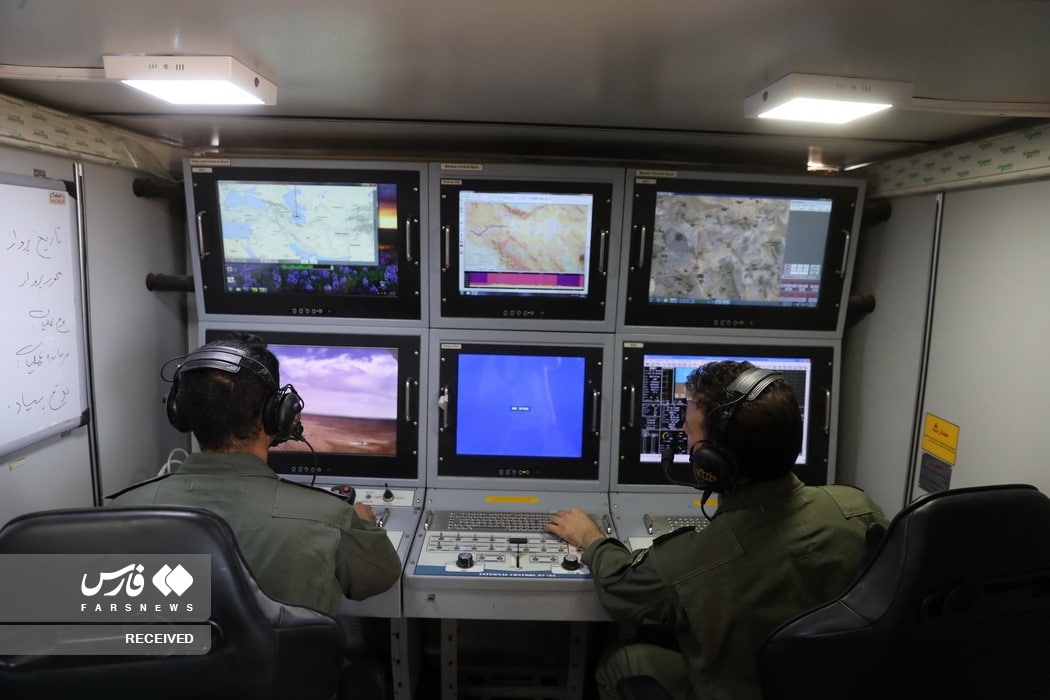
The guidance and control system of Mohajer-6 drone is placed on a truck, which allows it to be moved quickly.
The control room of Mohajer-6 droneInterior view of Mohajer-6 control room
Unfortunately, the weight information of Mohajer-6 has not been officially announced. In the early days of the introduction of this drone, due to the installation of two Qaem-5 bombs, its carrying capacity was stated by the media as 40 kg; But this number was not correct, because the weight of Qaem-5 has not been officially announced. Considering the similarity of dimensions and front wings of Qaem-5 bomb and Sadid-345 bomb, if the weight of its warhead has not changed, due to the presence of fixed rear wings, the weight of Qaem-5 bomb should be slightly heavier than Sadid-345 (34 kg).
However, a poster of Mohajer-6 has been published in the permanent exhibition of the defense achievements of the Islamic Revolutionary Guard Corps, which stated that the weapons payload was 100 kg and the gross weight was 600 kg.
Mohajer-6 poster in the permanent exhibition of the defense achievements of the Islamic Revolutionary Guard Corps
Also, at the ARMY 2022 exhibition, the Ministry of Defense of Iran published a catalog of its defense products, which published the specifications of Mohajer-6 under the title M6, and stated that the weapons payload is 100 kg, and the maximum gross weight is 670 kg.
Mohajer-6 catalog at the ARMY 2022 exhibition
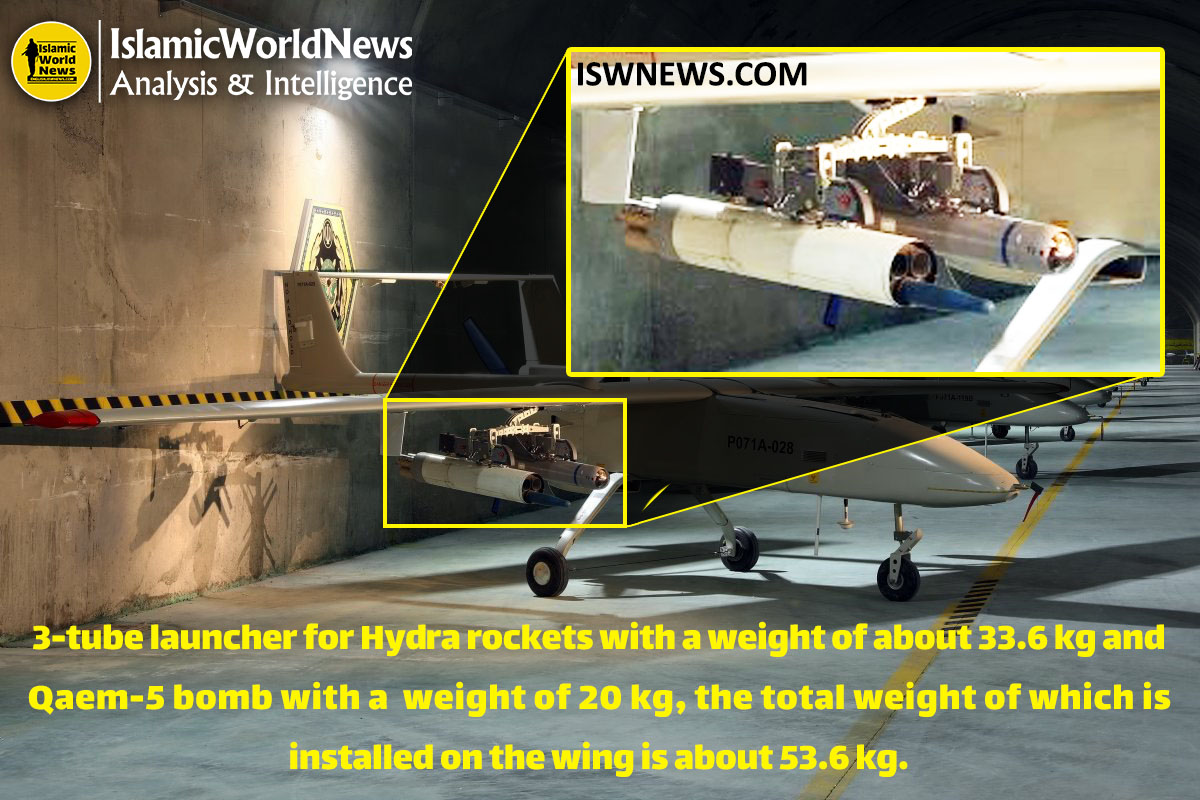
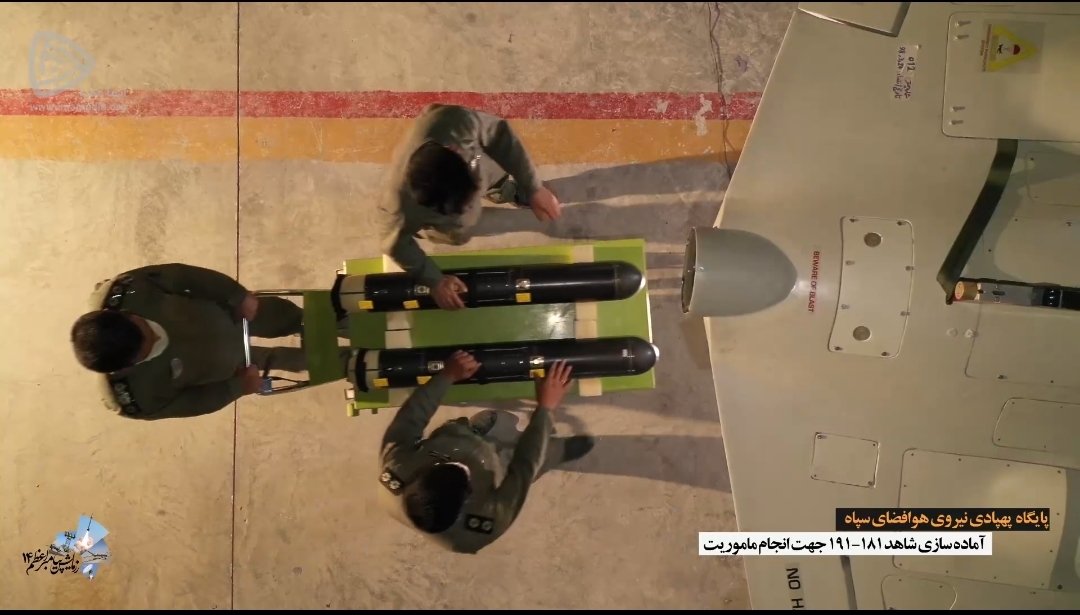
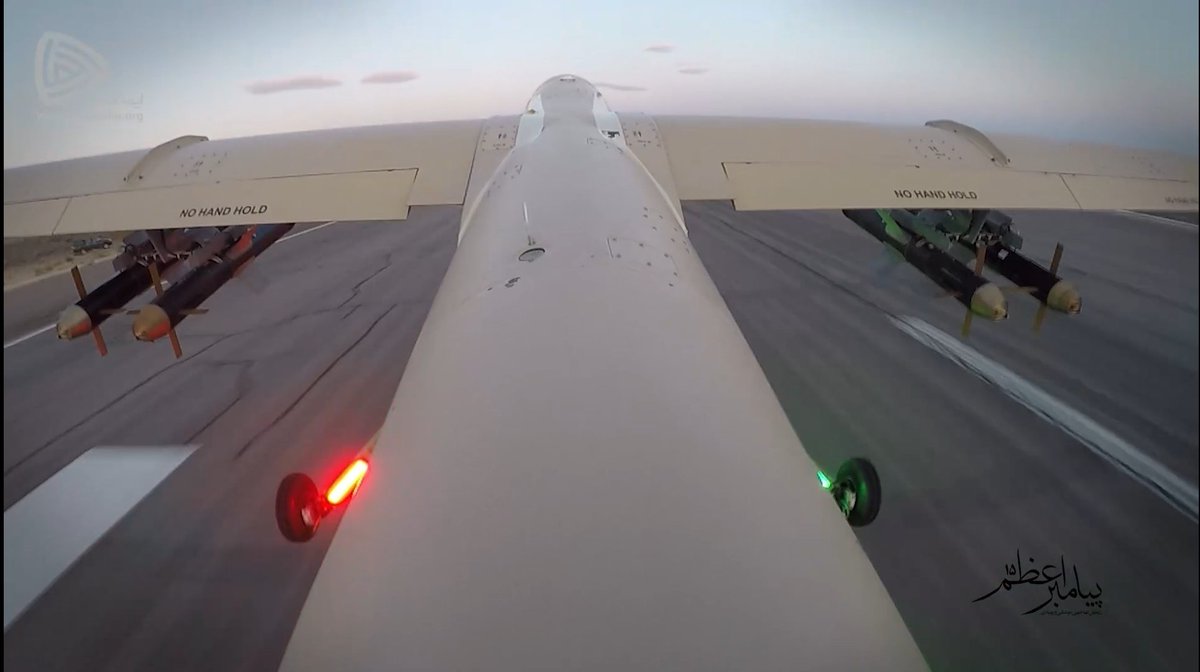
Therefore, according to the picture of Mohajer-6 with four Qaem-5 bombs, the weight of this bomb should not be more than 25 kg because the total weight of the bombs will be more than 100 kg. Also, a picture of Mohajer-6 drone has been seen in the Army’s 313 underground base (Strategic Drone Base 313) loading a Qaem-5 bomb along with a 3-tube launcher for Hydra rockets.
The picture of Mohajer 6 in the Army’s 313 underground base
The weight of each Hydra rocket is 6.2 kg, and if we assume that the rocket launcher is 15 kg (due to its small size and lightening), the weight of the whole package should be 33.6 kg. And if we consider the weight of Qaem-5 as 20 kg, it means a weight combination of 53.6 kg for one wing and 107.2 kg for both wings, which means a weight of more than 100 kg. Therefore, the maximum weapons payload for this drone is more than 100 kg, which has not been officially announced yet. So the maximum weapons payload can be considered 150 kg.
Considering that the announced numbers in two official events are different, we can conclude that we are dealing with two types of Mohajer-6 with different powers. In addition, Mohajer-6 has undergone changes in the front and rear landing gear. There may have been some changes to reduce the weight of Mohajer-6. There is also a possibility that the type that has been provided to the army has increased its carrying capacity.
Mohajer 6 front and rear landing gear
The Mohajer-6 combat reconnaissance drone can carry a wide range of indigenous weapons. This drone has the ability to carry Qaem bombs series, Sadid bombs and missiles family, Almas missile and the ability to carry Hydra rockets, which gives this drone high firepower.
Mohajer 6 drone has the ability of carrying Tiam 1400 systems with a weight of 5 kg and Taha 1400 systems with a weight of 6 kg. Tiam 1400 and Taha 1400 are detection and warning and electronic warfare systems. First, the Tiam 1400 radar detection and warning system performs detection and identification of the enemy’s radar waves, then the data about the radar is transferred to the Taha 1400 electronic warfare system so that the Taha 1400 acts to disrupt the enemy’s radar waves.
Mohajer 6 with the installation of two systems Tiam 1400 and Taha 1400 and banners related to these two systems
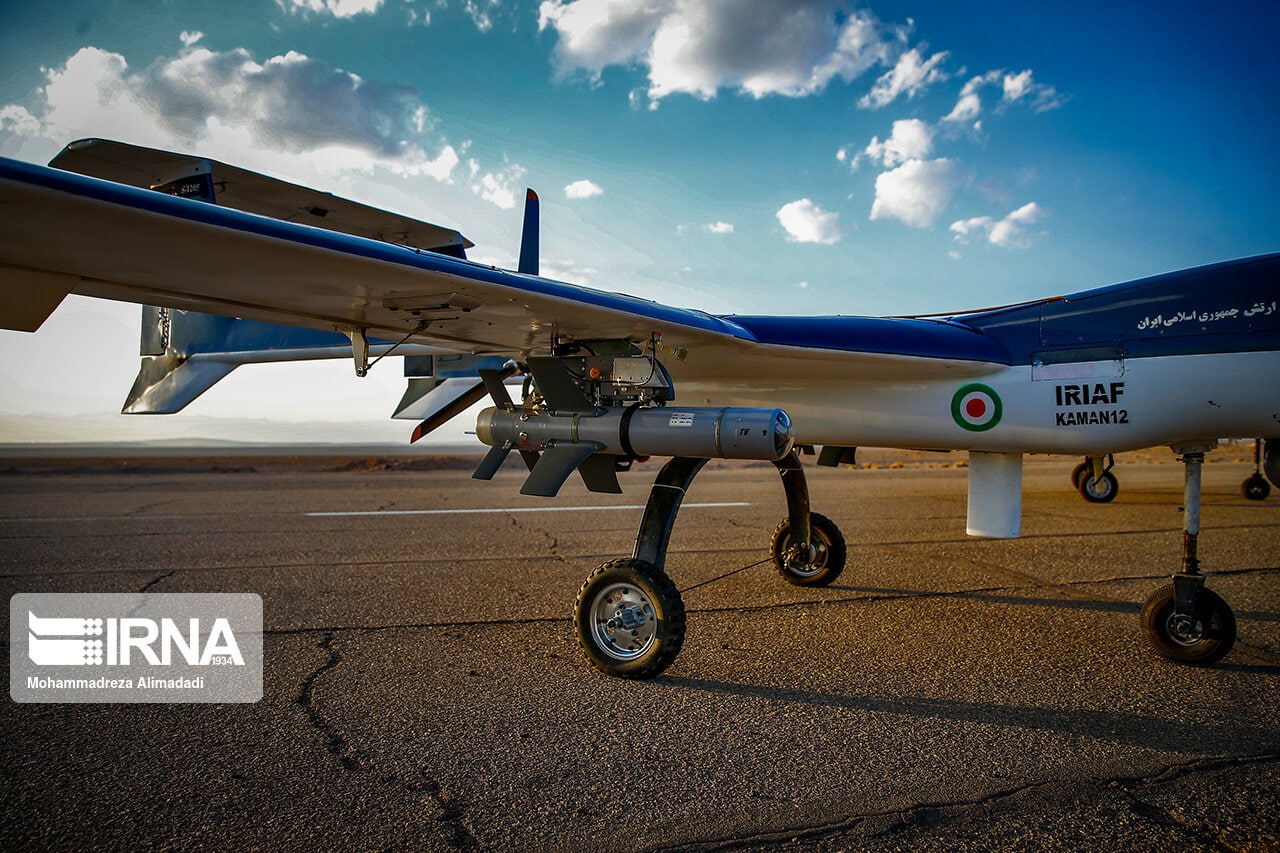
Also, an unknown pod has been spotted on Mohajer-6 drone at Army’s Strategic Drone Base 313, whose nature we do not know. This pod was also used in Kaman-12 drone.
Unknown pod installed on Mohajer-6 drone
The operational records of the Mohajer-6 drone are many, but only a few footage have been published in the media. As an example, we can refer to the operations against terrorists in the northwestern borders of Iran in July 2019.
The use of Mohajer 6 against terrorists in the northwestern borders of Iran – July 2019
The missions assigned to the Mohajar-6 combat reconnaissance drone include aerial reconnaissance and surveillance, destruction of fixed and mobile targets on land and sea and in all weather conditions day and night with high accuracy, monitoring and control of borders and coastal strip, and the possibility of carrying all kinds of Military cargo with the ability to land and take off conventionally from the runway and emergency recovery with a parachute.
Mohajer-6 and the use of Qaem-5 bombs and the explanation of the Iran’s Minister of Defense about this drone
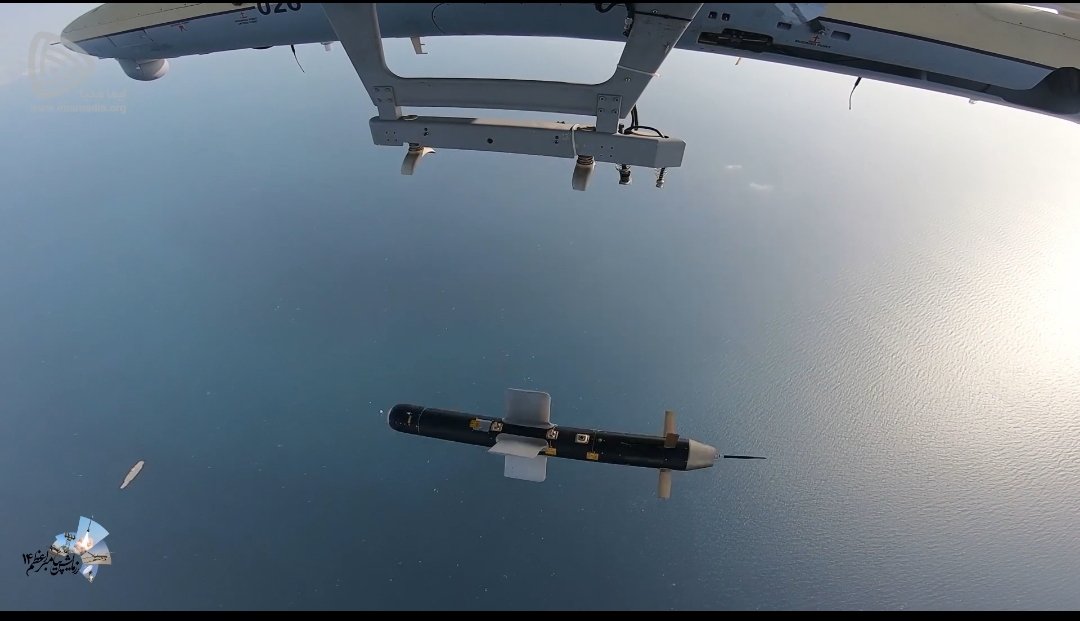
Ammunition that Mohajer-6 can carry: Bombs: 4 Sadid-342 with a range of about 3 km, 2 Sadid-345 with a range of about 3 km, 4 Qaem-1 with a range of about 6 km, 4 Qaem 5 or 9 with a range of about 12 km
Missiles: 2 Sadid-1 with a range of about 7 km (not seen but possible to install), 4 Akhgar missiles with a range of about 30 km (not seen but possible to install), 4 Almas missiles with a range of about 6 km (from In terms of weight, it is possible to carry more, but there is no proper hardpoints), 2 Qaem-114 missiles with a range of 8 km (not seen but it is possible to install)
Rocket: 2x 3-tube rocket launchers for Hydra 70 mm rockets
Electronic warfare systems: “Tiam 1400” radar wave detection and warning system and “Taha 1400” radar wave jamming system
It is possible to use a combination of above weapons and systems.
Some of the mentioned weapons have not been seen on Mohajer-6. But due to the nature of the weapon design and use on other Iranian drones, it is also mentioned here. Other weapons such as Azarakhsh and some weapons related to helicopters can also be installed, but in order to use these weapons, changes are needed, such as creating a proper fuselage to install heavy weapons on the drone.
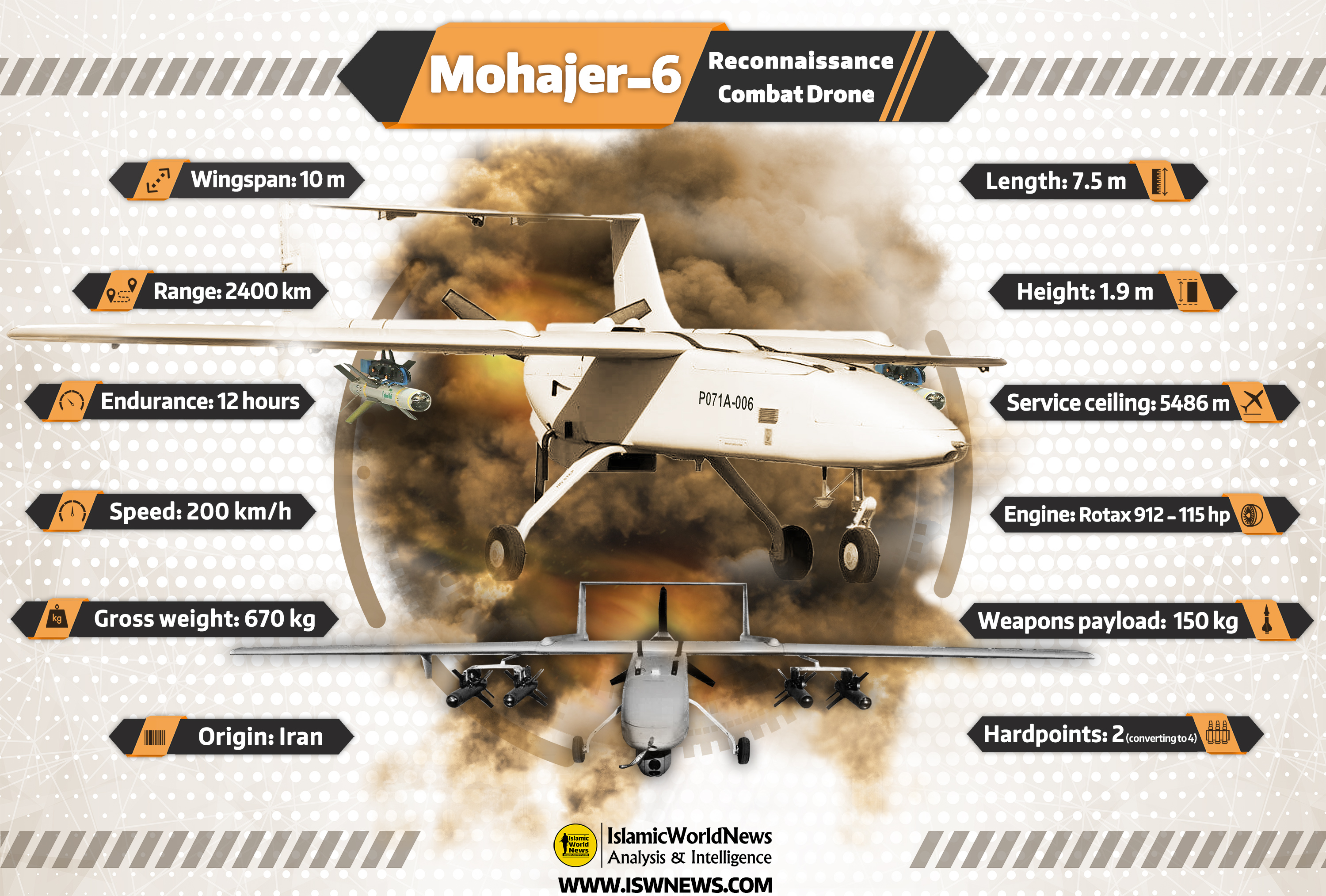
Mohajer-6 reconnaissance combat dronespecifications: Length: 7.5 meters Wingspan: 10 meters Height: 1.9 meters Operational range: 2400 km Service ceiling: 5486 meters Endurance: 12 hours Engine: Rotax 912 115 hp Speed: 200 km/h Hardpoints: 2, with the possibility of converting to 4 Gross weight: 670 kg Weapons payload: ~ 150 kg Origin: Iran
Click to view full size
Mohajar-6 combat reconnaissance drone posters in Russian, Chinese, Hebrew, Arabic, Azeri, Kurdish and Persian:
Click to view full size
More Images of Mohajer-6 combat reconnaissance drone:
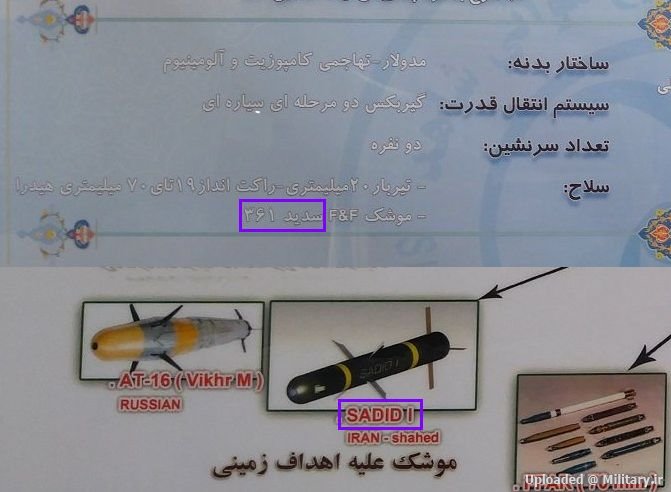
The first member of the Sadid family was exhibited at the Kish Air Show in 2010. The first two members of the family, Sadid-1 and Sadid-342, were assembled by the IRGC, and due to the fact that its parts were the same as the Toofan missile, the parts were delivered to the IRGC from Montazer Al-Mahdi Industries belonging to the Ministry of Defense, which produces the Toofan (Iranian TOW) missile.
It seems that the production and use of the Sadid family dates back to before their unveiling in the exhibition of the achievements of the Islamic Revolutionary Guard Corps in 2013. The proof of this is the display of different types for the first time in this exhibition. Sadid’s operational record in all its types in Syria is brilliant.
In the following, we will examine different types of Sadid bombs and missiles. The types that have been officially unveiled so far are as follows:
1- Sadid-1 missile: The first member of the Sadid family is the Sadid-1 missile. This missile was unveiled at the Kish air show in 2010 by installing it on Shahed 258 helicopters.
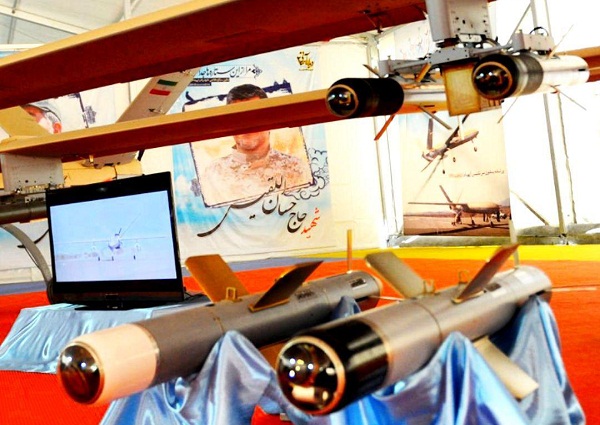
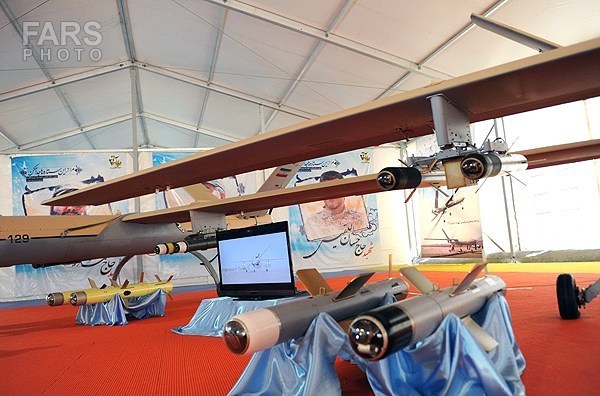
Shahed 285-C marine model helicopter equipped with Sadid-1 missile at Kish air showShahed 285-A marine model helicopter equipped with Sadid-1 missile at Kish air show
Sadid-1 missile is very similar to Toofan anti-armor missile. If you pay close attention to the placement of the wings and the engine gas outlet in Sadid and Toofan missiles, you will see a great similarity between the two missiles.
Comparing the appearance of Sadid-1 missile and Toofan missile, their similarity is quite obvious.
Sadid-1 missile has two rows of variable wings, like Toofan missile, and the size and direction of folding of wings in both missiles are completely similar to each other. In the middle of the rocket, there are two hot gas outlets for the main rocket engine, and at the end of the rocket, there is the outlet of the primary engine that is used to launch the rocket from inside the tube, which is completely similar to each other. However, at the end of Sadid-1 missile, the parts related to wire guidance, including two wire spindles and xenon lamps related to Tau missile, have been removed, which is the reason for the difference in the way the missile is guided.
Comparison of appearance of Sadid-1 and Toofan anti-armor missiles
The specifications of Sadid-1 missile have not been officially announced yet. But by comparing and matching it with the Toofan anti-armor missile, almost accurate information can be obtained.
Toofan anti-armor missile in prototypes is capable of penetrating 550 mm of armor at an effective range of 3500 meters. Considering the possibility of firing at an initial speed from the drone and the possibility of gliding if released from a height of 5 km, a range of more than 7 km can probably be considered for this type of missile. Due to the launch of this missile from the sky, which allows this missile to attack from above, its 550 mm penetration is enough to target any type of armor. There are also variants of Toofan missiles with a longer range and penetration power of up to 900 mm.
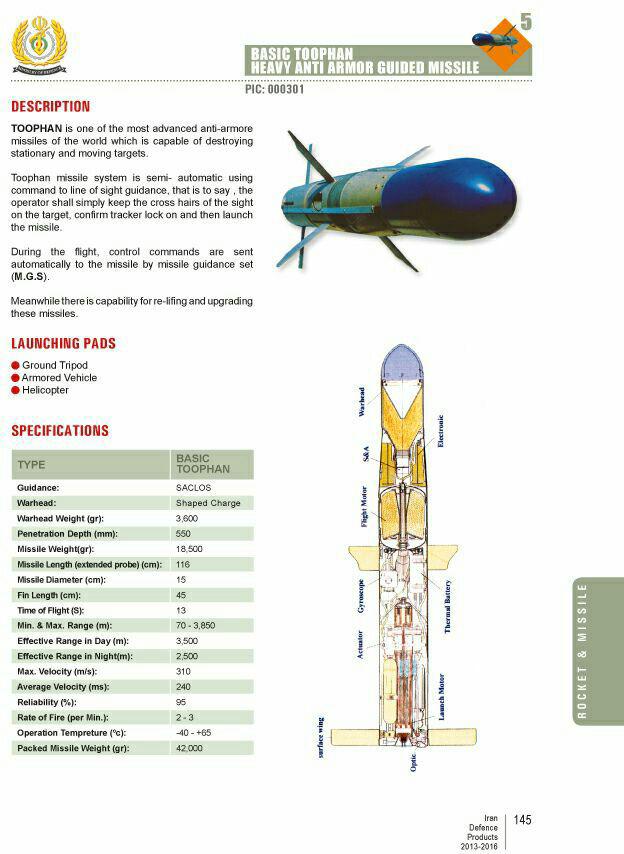
Due to the great similarity of Sadid-1 missile and Toofan anti-armor missile, the weight of these two missiles should be very close to each other. Toofan-1 has a weight of 18.5 kg with a warhead of 3.6 kg, and the weight of the missile and its tube is 42 kg. Due to the fact that the weight of Sadid-1 missile is not announced, this missile can also be considered 18.5 kg. Due to the use of Sadid-1 tube and rocket on UAV and helicopter, the weight of 42 kg should be considered for its set.
Also, the best way to determine the dimensions of the Sadid-1 missile is to consider the dimensions of the Toofan missile. The length of the Toofan missile is 116 cm and its diameter is 15 cm.
Specifications of Toofan 1 missile which has been officially published. Maximum range: 3850 meters Minimum range: 70 meters Effective range: 3.5 km Effective range at night: 2.5 km Missile weight: 18.5 kg Warhead weight: 3.6 kg The weight of the complete package of the missile: 42 kg Missile length: 116 cm Missile diameter: 15 cm Armor penetration rate: 550 mm
The Sadid-1 prototypes did not have seeker in its nose, but in May 2014, during the visit of the Leader of the Revolution to the exhibition of the achievements of the Islamic Revolutionary Guard Corps, two types of Sadid-1 missiles with optical and infrared guidance were seen. This new possibility can bring fire-and-forget capability to Sadid-1 missile.
A picture of the first Sadid-1 sample without a seeker in its noseSadid-1 missile with optical seeker on the ground and Sadid-1 missile with infrared seeker under the wing of Shahed 129
This missile has been introduced in some media with the names of Sadid 361 and Fatah 362 missiles.
The name of Sadid-1 and Sadid 361 missiles on the catalog published for the Shahed 216 helicopter
Possible specifications of Sadid-1 missile: Diameter: 15 cm Length: 116 cm Missile weight: 18.5 kg Warhead weight: 3.6 kg Warhead type: Shaped charge Packed missile weight: 42 kg Range: 7 km if released from a height of 5 km
2- Sadid-342 glide bomb: The Sadid-342 bomb is the second member of the Sadid family, which was showcased in 2014 during the visit of the Iran’s supreme leader to the exhibition of the achievements of the Islamic Revolutionary Guard Corps. However, due to the display of the Sadid-345 bomb in the same exhibition, the operational history of the Sadid-342 probably goes back to before the year of its unveiling.
In this bomb, the engine is removed and the bomb is attached to under the UAV’s wings using two rings. The main difference between Sadid-342 and Sadid-1 missile is these two things. The wings of the bomb are not different from the Sadid-1 missile, and the wings are folded into the body.
Sadid-342 bomb
The Sadid-342 bomb has been produced in three types of television, infrared and thermal guidance.
Sadid-342 bomb in the exhibition of the achievements of the Islamic Revolutionary Guard Corps in 2014. This bomb has an infrared filter, which is often used for infrared seekersSadid-342 bomb with a mercury coating indicating the use of a thermal seeker (IR) in this bombSadid-342 bomb with TV guidance installed on the wing of Shahed-129 drone and Sadid-345 on the ground
Due to the removal of the main engine in this bomb, more explosives can be used without much change in the weight of the bomb. It can be considered that the Sadid-342 bomb will probably be the same weight as the Sadid-1 missile. Removing the main engine will reduce the range of this bomb, and its range can be predicted to be about 3 km if released at a height of 5 km.
Possible specifications of Sadid-342 glide bomb: Diameter: 15 cm Length: 116 cm Missile weight: 18.5 kg Warhead weight: 7 kg, probably twice as much as Sadid-1 missile (there is a possibility of reducing the weight of the warhead and increasing the range) Warhead type: Shaped charge Packed missile weight:: 42 kg Range: 3 km if released from a height of 5 km
3- Sadid-345 glide bomb: Iran’s experiences in using Sadid missiles and bombs in the Syrian war led to the production of a new type of Sadid bombs. Sodid-345 was also showcased in the exhibition of achievements of the Islamic Revolutionary Guard Corps in 2014.
In Sadid-345 bomb, the front wings have become fixed wings and it is designed in a way that brings the maximum amount of lift to drag ratio. But the rear wings are still folded.
It should be noted that the only member of the Sadid family which its specifications have been officially announced is the Sadid-345 glide bomb.
Specifications of Sadid 345 bomb published at MAKS 2017 exhibition in Russia
According to the specifications of Sadid-345, this bomb is suitable for attacking gatherings or radar equipment and enemy artillery personnel. This bomb has three types of guidance, one of which is television guidance, the accuracy of which is the lowest and its error is 5 meters. Clear air is needed to receive television quality images and this is a very big limitation for this bomb. But there is also a type of laser guidance, which the error rate is declared to be 2.5 meters. Laser guidance also loses its effectiveness in dusty and foggy weather conditions. The third type of conventional guidance on this bomb is guidance with an IR seeker, which has brought an accuracy of 2.5 meters, which is a very good number. In addition, the thermal seeker can be used in all weather conditions.
Bottom right: Sadid-345 in the right side with television guidance and in the left side with infrared guidance Top right: Sadid-342 under the wing with TV seeker Left: Sadid-1 television guided missile on the ground and Sadid-1 infrared guided missile installed under the wing of the droneThe bombs on the right side are with television guided and the bombs on left side have a mercury coating to use the thermal (IR) seeker
The warhead weight and the range of Sadid-345 bomb have not been announced. Considering the 470 mm increase in the length of the Sadid-345 and the increase in the weight of the bomb by nearly 15 kg, about 20 kg of explosives can be considered for this bomb. It should be noted that in the above calculation, the increase in the weight of the wings is considered equal to the removal of the engine and its fuel consumption. Of course, a variant with the name Sadid-362 is mentioned in some sources, which must be the same as Fatah 362, which is the Sadid-1 missile.
Specifications of Sadid-345 glide bomb: Weight: 34 kg Length: 1630 mm Diameter: 152 mm Warhead type: Shaped charge Mission: Destroy various moving and stationary targets Warhead: H6 explosive – fragmentation Type of fuse: Impact Lethal radius: 30 meters Type of aircraft: UAV Hit accuracy: – By using IR seeker, the accuracy of impact in radius of target is 2.5 x 2.5 meters. – By using laser seeker, the accuracy of impact from laser radiation is 2.5 meters – By using visible seekers, if there is not image processing errors, the accuracy of radius impact is 5 meters.
A picture of Shahed-129 and Sadid bomb. This image shows us the size and ratio of the Shahed-129 drone and the Sadid bombUsing the Saegheh drone and dropping Sadid-342 bombs from the drone to attack ISIS terrorists in SyriaA video of Sadid’s bomb launch from Shahed-129 drone
In the war between Ukraine and Russia, despite the suppression of the Ukrainian air defense systems by the Russians, the Ukraine air defense systems has achieved considerable success. Therefore, we examine the reasons for the success of Ukraine’s air defenses as follows. These reasons can be divided into three parts:
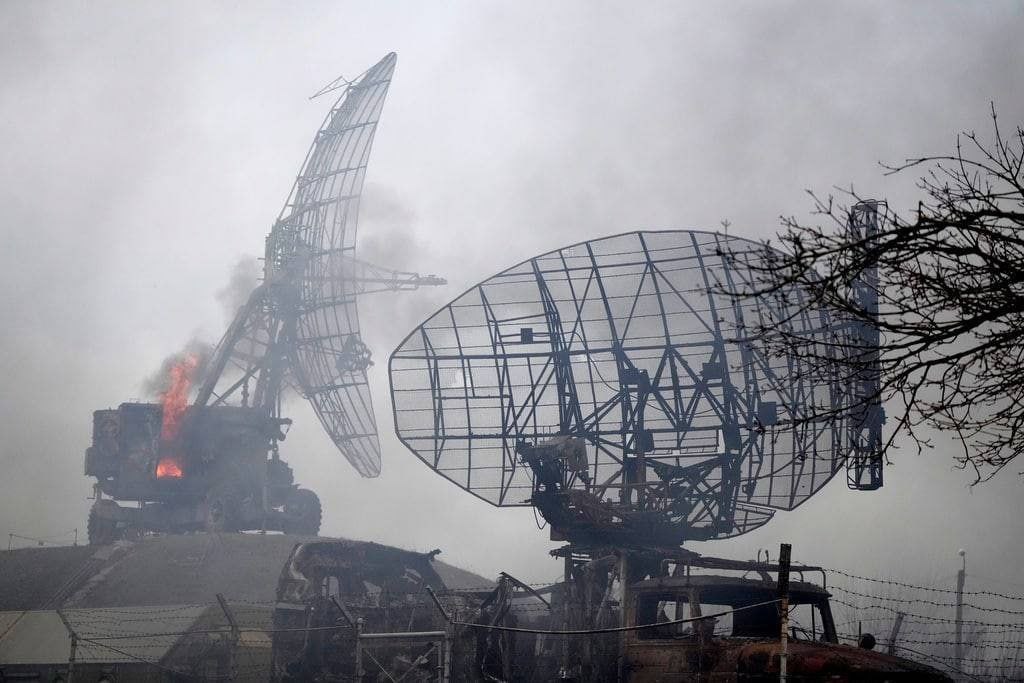
1- Incomplete suppression of the Ukrainian air defense systems: At the beginning of the battle, the Russians tried to suppress enemy radars by firing anti-radar missiles such as KH-31. But this air defense suppression was done very quickly and hastily, and the Russians only suppressed the early warning radars and active systems, and without completing the defense suppression process, they abandoned the middle layers of the air defenses and sent their forces into Ukraine. The Russians, speculating that a medium-range and short-range air defense systems without early warning radars are very ineffective, completely abandoned this part of air defense suppression and began ground and air operations to speed up their offensive process. But contrary to the speculations, some air defense systems successfully engage hostile targets even without early warning radars. Most of these systems were short-range defense systems like the TOR-M1.
The use of free-fall bombs for offensive operations on frontlines or deep operations in a situation where Ukraine’s short-range and medium-range air defenses had not been suppressed is considered a tactical mistake by the Russians. In such a situation, the Russians should either completely suppress the air defenses or use high-range smart ammunition in their operations to be completely away from the effective range of Ukrainian short-range air defense systems. In a situation where the suppression of Ukraine’s ADs were not complete, the use of helicopters had a very high risk, which the losses of the Russians prove this fact. Because short-range air defense systems such as TOR-M1 are well capable of countering Russian cruise missiles and helicopters, and in addition to this, some man-portable air-defense systems (MANPADS) also helped the Ukrainian army a lot in destroying aerial targets. Some anti-armor missiles and other MANPADS donated to Ukraine, such as the FIM-92 Stinger for hunting helicopters, caused the Russians to suffer numerous casualties in this field.
2- Ukrainian tactics for hunting aircraft: The Ukrainian air defense has a significant number of short-range systems of various types. These systems have succeeded in destroying several Russian cruise missiles and several fighter jets in the current war between Ukraine and Russia. Due to the geographical and forest conditions of Ukraine, short-range defense systems such as Buk-m1 can hide well and hunt targets such as fighter jets, cruise missiles, etc. On the other hand, soldiers can easily destroy targets such as helicopters or drones with the help of MANPADS by camouflage and sheltering among environmental covers such as trees. Ukraine’s forests have practically created an excellent natural camouflage for Ukrainian ADs to hide and to some extent escape the suppression of Russian forces.
Air defense assets of Ukraine before the start of the war (without taking into account the systems donated after the start of the war) are:
Short-range and low-altitude mobile missile defense systems SA-6, SA-8 (Osa), SA-13 (Strela-10 as a MANPAD), SA-18 (TOR-M1), SA-9 (Gaskin)
SA-17 (Buk-m1) short-range and medium-altitude mobile missile defense systems
ZSU-23-4 Shilka mobile short-range anti-aircraft weapon system
S-300PM long-range, high-altitude fully mobile missile defense system
S-200 high-altitude long-range fixed missile defense system
3- Foreign military aids to Ukraine: From the very beginning, when the possibility of a conflict between Ukraine and Russia increased, NATO member countries, especially the UK and the United States, began providing arms. These aids included individual equipment such as AR-15 rifles to various anti-armor missiles such as NLAW, Javelin, etc., and these weapons had a great effect in destroying Russian tanks on the battlefields. Military aids and better equipment is still being sent to Ukrainians day by day. Understanding the process of equipment training, the US and other allies started sending Russian defense systems such as SA-8/10/12/14 to Ukraine. It can definitely be said that the western aid has kept Ukraine afloat until today.
According to the definition of short-range defense, it has a maximum height of 15 km and a maximum range of 50 km. With the development of air-launched weapons, short-range defense is extremely vulnerable. For example, the new generation Hellfire missiles with a range of 20 kilometers which can be launched by drones, makes it easy to destroy short-range air defenses.
Most of the time, a short-range defense is effective when it operates under the cover of medium-range or long-range air defense systems. If there are early warning radars, the location of the target can be detected before reaching the target, and in this way, detection and attack operations can be carried out by short-range air defense and prevent the air defense from being hunted. Considering the anti-radar capabilities of the Russian army and the extensive use of KH-31 anti-radar missiles, along with the reports of Ukrainian radars being targeted, it can be concluded that there is practically no early warning radar left on Ukrainian soil.
A report from the CNN television network showed that an Airborne Warning and Control System (AWACS) E-3 is continuously patrolling and intercepting Russian fighter jets over the border between Poland and Ukraine. In his press conference, the President of the United States spoke clearly about providing up-to-date information to the Ukrainian side as soon as possible.
A report from the CNN television network showed that an Airborne Warning and Control System (AWACS) E-3 is continuously patrolling over the border between Poland and Ukraine and detecting and intercepting the information of Russian aircraft. In his press conference, the President of the United States also spoke clearly about providing up-to-date information to the Ukrainian side.
The AN/APY-1 radar of the US E-3 AWACS has the ability to identify a fighter jet from a distance of 320 km (of course, it also depends on the cross section of the radar). Or another example is the AWACS E3-A, the radar of this aircraft at high altitude is capable of detecting high-altitude flying targets from a distance of 650 km. The distance from the Polish border to the city of Kyiv is less than 450 km. The distance between the Romanian border and Kyiv is about 400 km. Considering the distance between the borders and the characteristics of the E-3 AWACS, this AWACS creates a suitable air cover and provides the necessary information to the air defense of Ukraine. There have been various reports of eavesdropping and surveillance flights around Ukraine. All of these and other intelligence aids contributed greatly to the execution of ambushes around Kyiv, and most of the Russian Air Force casualties were related to this.
The Ukrainian army used to ambush in different places with a high probability of attack or close to the front lines by turning off and hiding the short-range systems. In such a case, the possibility of discovering these systems by Russia was not possible. The Americans, by analyzing satellite images and eavesdropping systems, check the possibilities of attack in different places and with the help of AWACS, eavesdropping and GPS, which is used commercially by the Russians, they determine the position of Russian aircraft and at the right time and place, the air defense systems intercepts and destroys targets. And AD systems quickly turn off the radar and change their location after the operation. This makes it difficult to identify them after the operation. Satellites, electronic warfare systems and even AWACS which are capable of detecting active radars, will not have enough time to detect the short-range radar system with this method.
Realizing this, Russia withdrew from the vicinity of Kyiv and focused on the areas where the West could provide the least intelligence assistance to Ukraine. This increased the effectiveness of the operation and reduced the losses of the Russians in the air force sector.
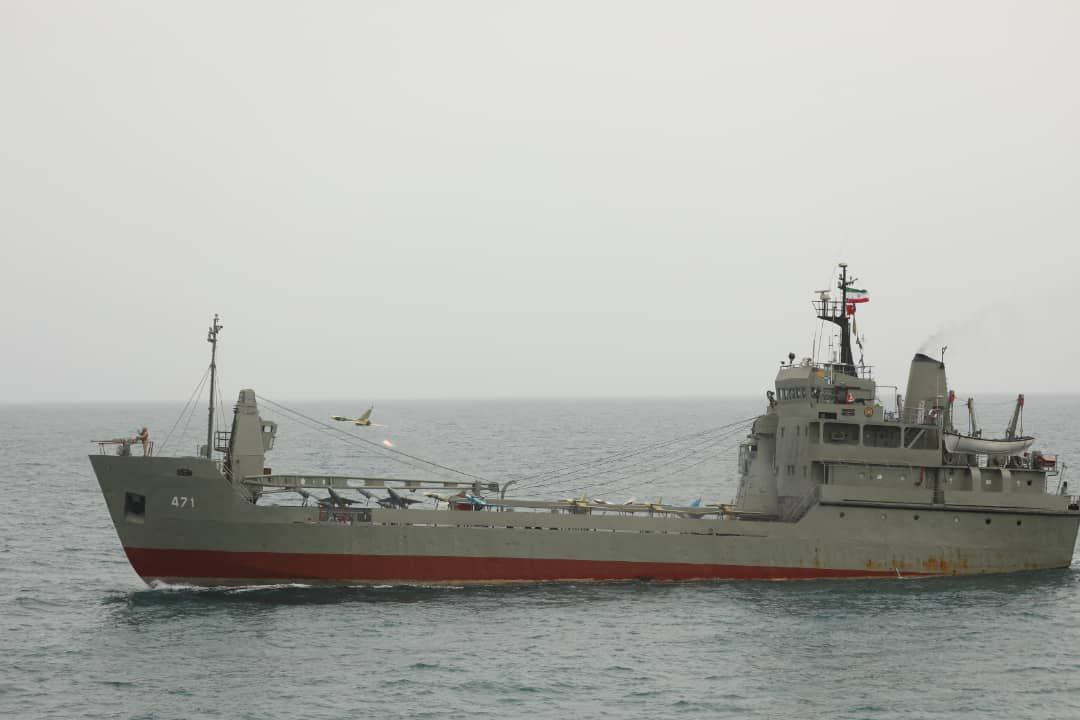
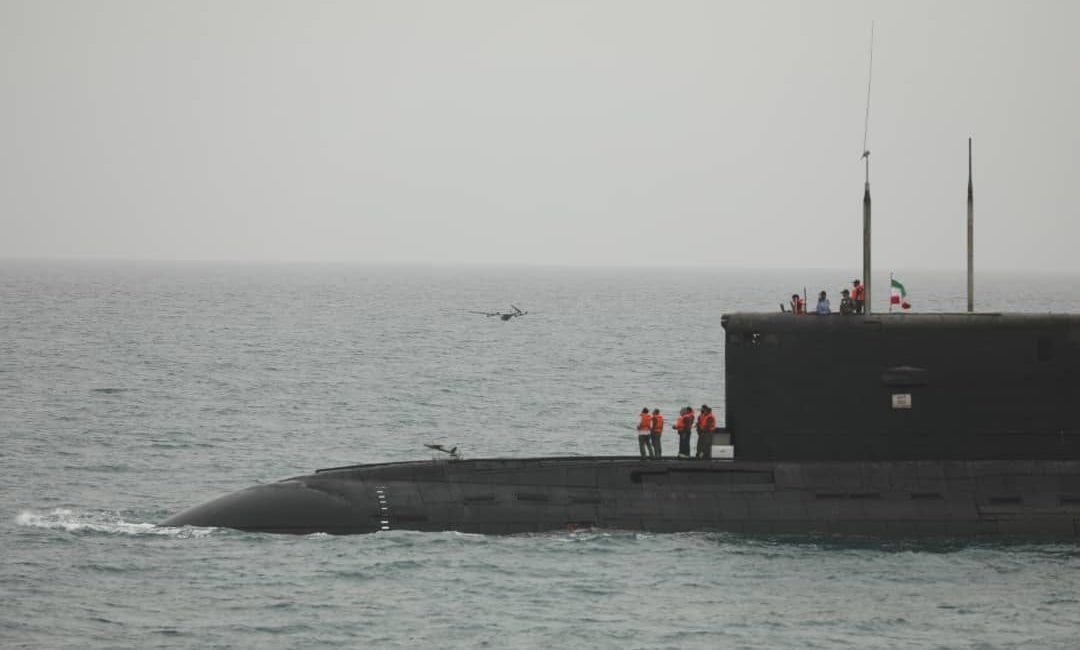
In this ceremony which was held on July 15, the Lawan and Delavar warships were converted into drone carriers, and for the first time, several drones were launched from the Iranian Fateh and Tariq submarines.
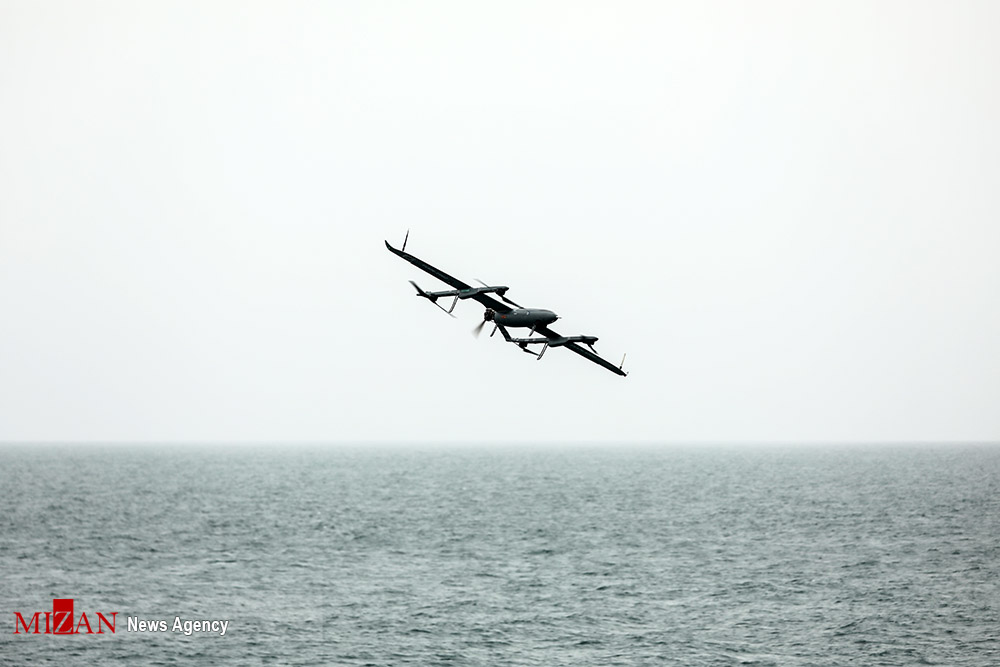
Drones such as Arash and Ababil 2 suicide drones, Pelican and Homa vertical take-off and landing drones, Karar combat and suicide reconnaissance drones, and Ababil 4 reconnaissance and combat drones were showcased and flew in this ceremony.
Click to view full size
The most important challenge for this drone carriers is the recovery of reconnaissance drones. The conventional method is to use nets; in this way, the drone hits a net installed on the ship at the lowest possible speed. This method is effective for small drones that have a short range, but it is not so favorable for larger drones. Larger drones like the Ababil 4 drone sit in a runway after taking off and completing the mission. In the unveiling ceremony, the Ababil 4 drone landed on the landing strip in Jask after taking off from the drone carrier.
In the interview of Admiral Shahram Irani, important points were mentioned about the drone fleet, which can be mentioned as follows:
The possibility of repairing and producing drones inside the fleet
The possibility of combined operations in the form of flight groups of drones and swarm operations
The possibility of moving the command control center from one ship to another or subsurface guidance or using a flight unit for command.
The possibility of setting different targets for several different categories of drones
The possibility of using drones for electronic warfare
The possibility of flying 40 to 50 drones at the same time to support any mission and the possibility of replacing them quickly
UAVs launched from submarines enable the detection of targets in the distance. For this reason, the range of submarine weapons, especially cruise missiles such as the Jask 2 missile, increases. But the main challenge for subsurface fleet use of UAVs is the launch and recovery of the UAV. If a submarine comes to the surface for every launch, the risk of detection increases greatly during the war. This also applies to the recovery of the reconnaissance drone. According to the commander of the Iranian Navy, it will be possible to launch drones under the surface in the future. Also, the possibility of discovering underwater targets will be added to drones.
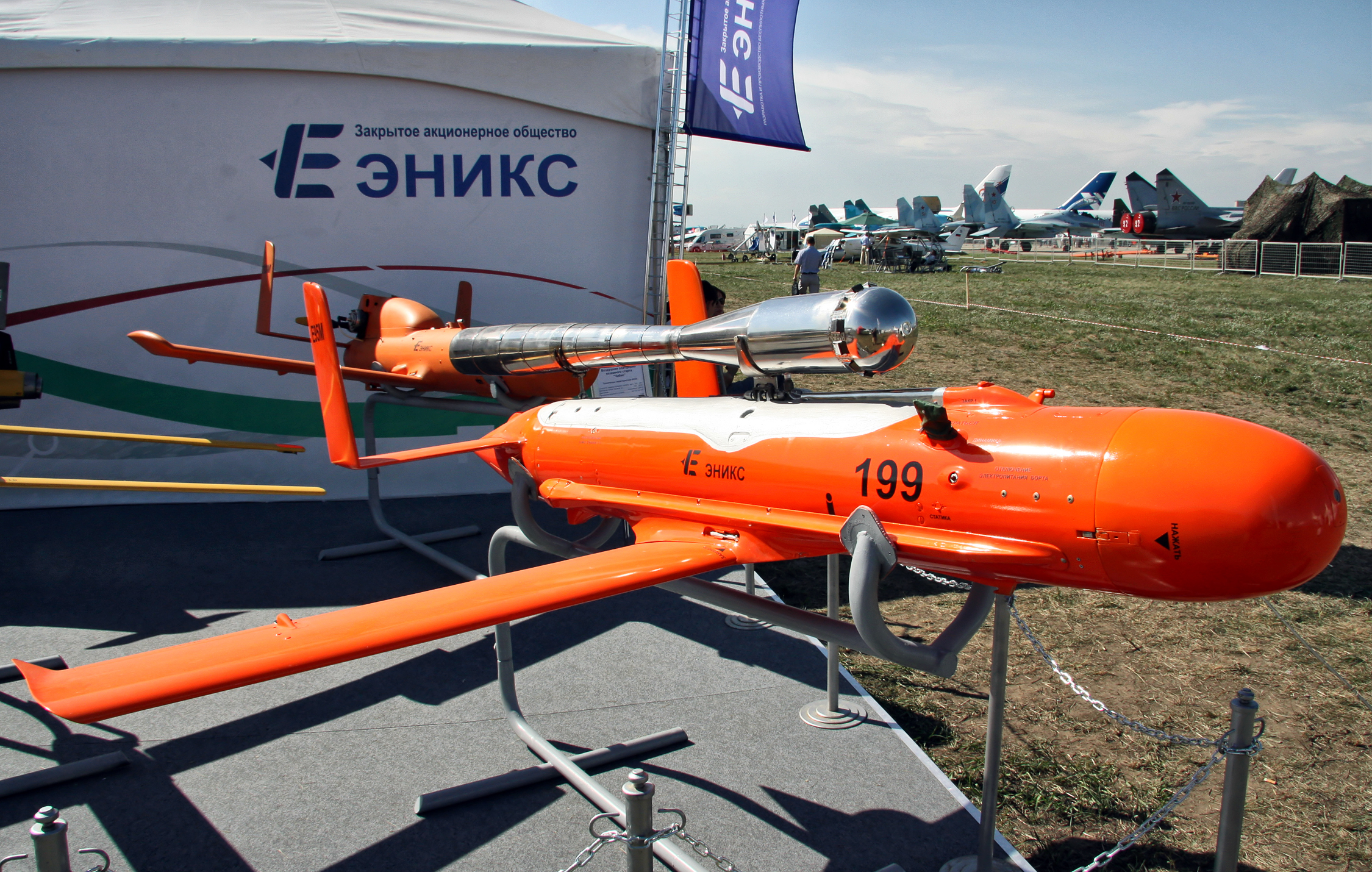
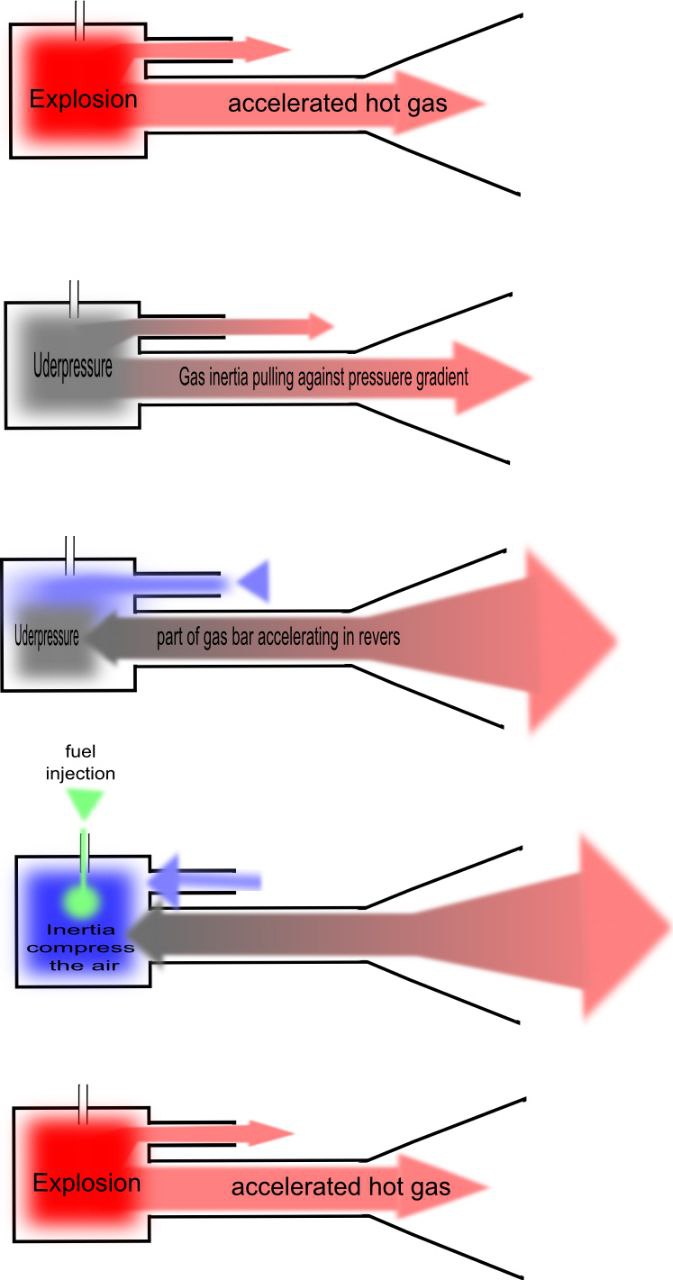
One of the things to consider about this drone is the use of the M135 Pulsejet engine. Pulsejet engines are the simplest type of jet engines and in the valveless type they do not have any complicated moving parts. The use of this engine greatly reduces the cost of construction.
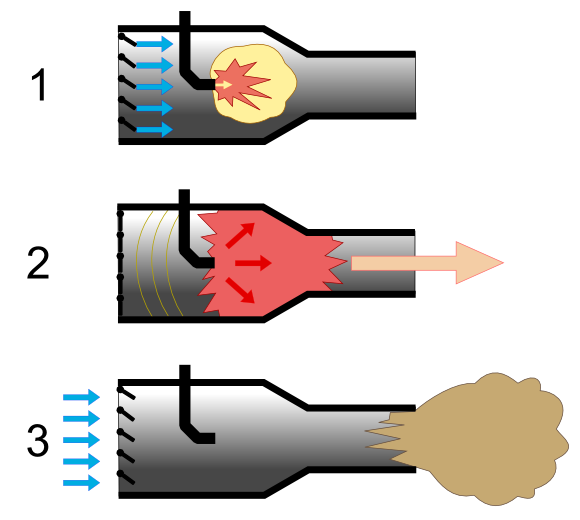
There are two main types of pulsejet engines, both of which use resonant combustion and harness the expanding combustion products to form a pulsating exhaust jet that produces thrust intermittently. The first is known as a valved or traditional pulsejet and it has a set of one-way valves through which the incoming air passes. When the air-fuel is ignited, these valves slam shut, which means that the hot gases can only leave through the engine’s tailpipe, thus creating forward thrust.
Diagram of a pulsejet engine
The second type of pulsejet is known as the valveless pulsejet. The valveless pulsejet is, mechanically speaking, the simplest form of pulsejet, and is, in fact, the simplest known air-breathing propulsion device that can operate “statically”, i.e. without forward motion. Valveless pulsejet engines have no mechanical valve, eliminating the only internal “moving part” of the conventional pulsejet.
One notable line of research of pulsejet engines includes the pulse detonation engine, which involves repeated detonations in the engine, and which can potentially give high compression and reasonably good efficiency.
Working mechanism of a valveless pulsejet engine
The takeoff is carried out using a low-pressure pneumatic catapult. Landing and recovering is carried out using a parachute that is placed in its body.
E95M drone pneumatic catapult launcher and ground control station
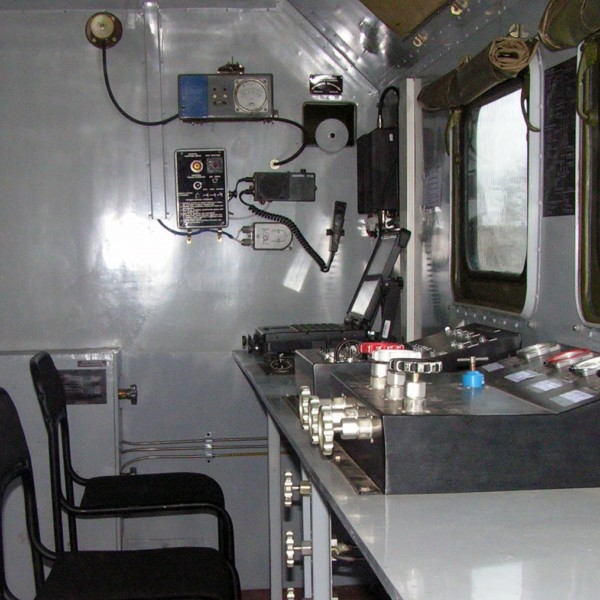
The E95M target drone is controlled by a ground mobile control station. The ground control station is mounted on an off-road chassis KAMAZ-4350, GAZ-3308 or Ural-4320. The control station is completely autonomous and provides tracking and control of the drone at a distance of up to 70 km.
E95M drone control room
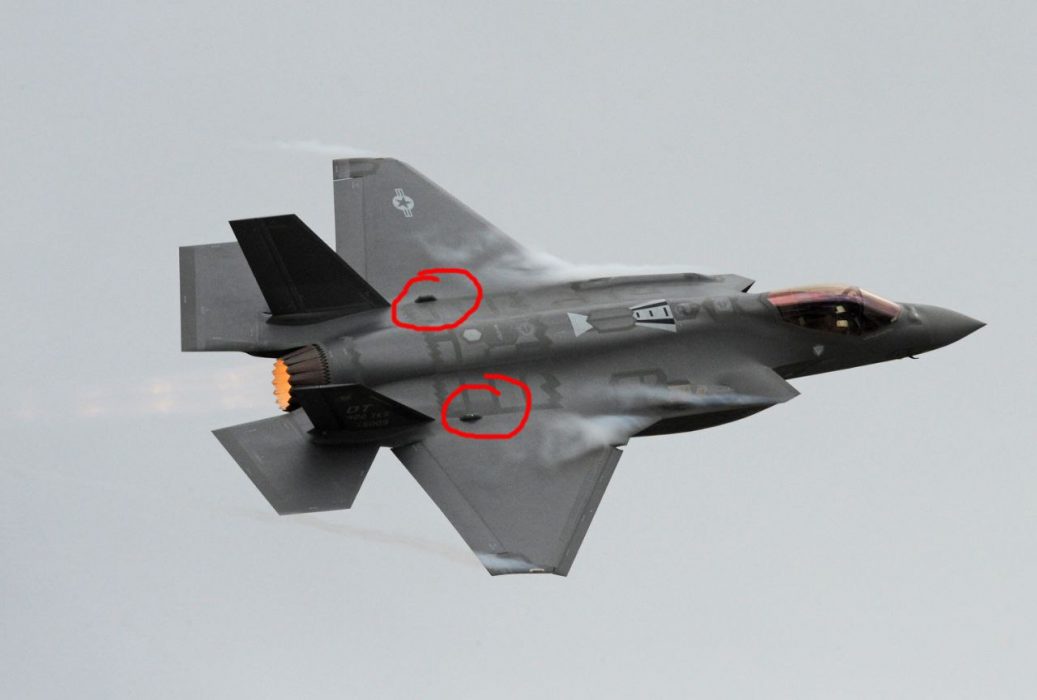
One of the cargoes of this drone in order to increase the cross-sectional area of the radar and simulate larger aircrafts is the Luneberg lens. Due to its geometry, the Luneberg lens causes resonance in the radar waves in the return wave and amplifies it and increases the overall cross section of the bird. Therefore, removable Luneburg lens type radar reflectors are sometimes attached to military aircraft in order to make stealth aircraft, such as the F-35 fighter, visible during training operations, peacetime or to conceal their true radar signature.
Luneburg reflectors (the marked protrusion) on an F-35
More pictures of the E95M target drone:
Click to view full size
E95M specifications: Length: 1.2 m Wingspan: 2.4 m Range: 50 km Flight ceiling: up to 3000 meters Flight duration: 32 minutes Maximum speed at low altitude: 300-400 km/h Available maneuvers: Dive, pull up (lifting the nose), S-turn Engine: PuVRD M135 Pulsejet Engine thrust: 150 newtons Take-off weight: 70 kg
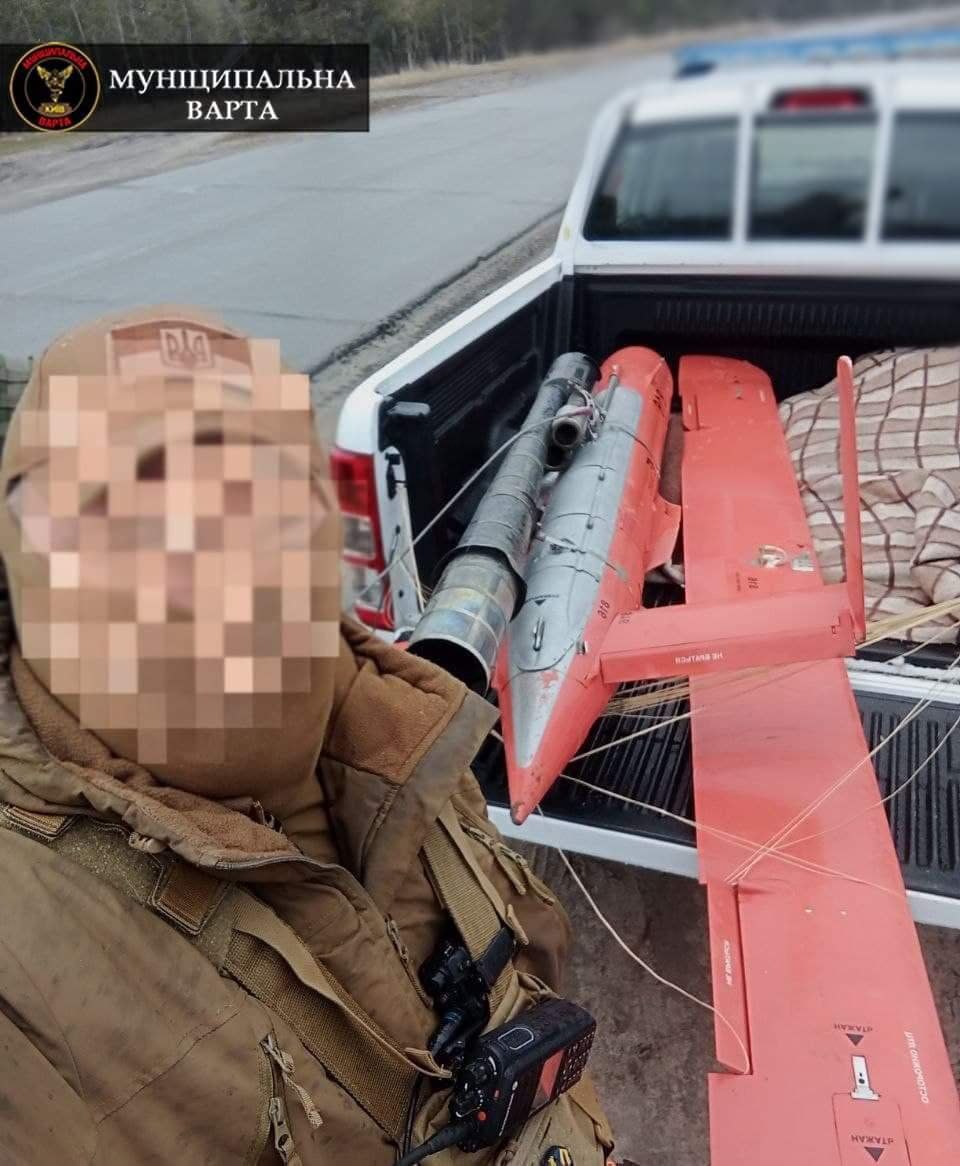
Images of the E95M target drone that fell into the hands of Ukrainian forces during the Ukrainian war
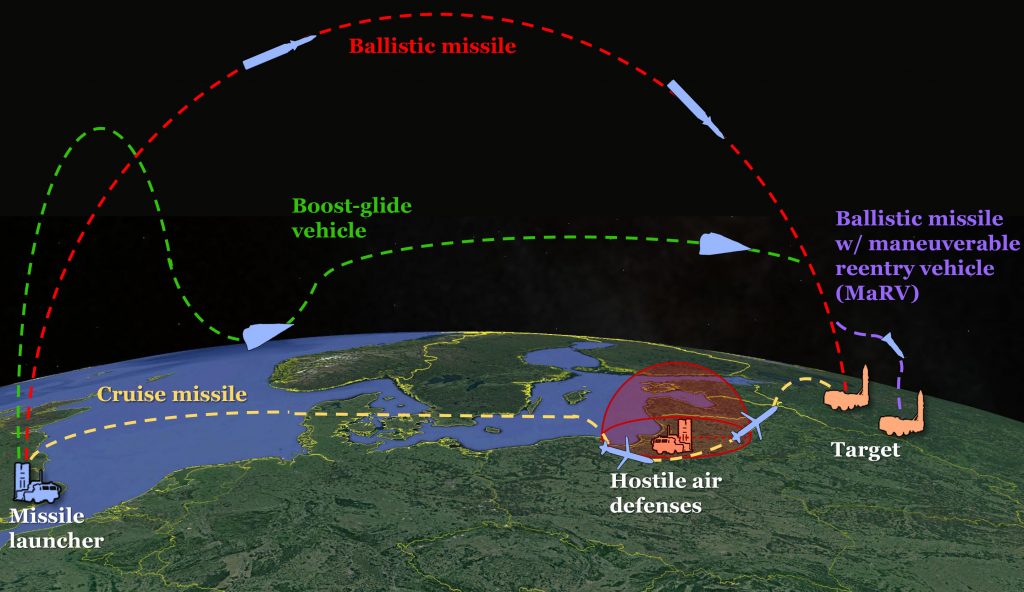
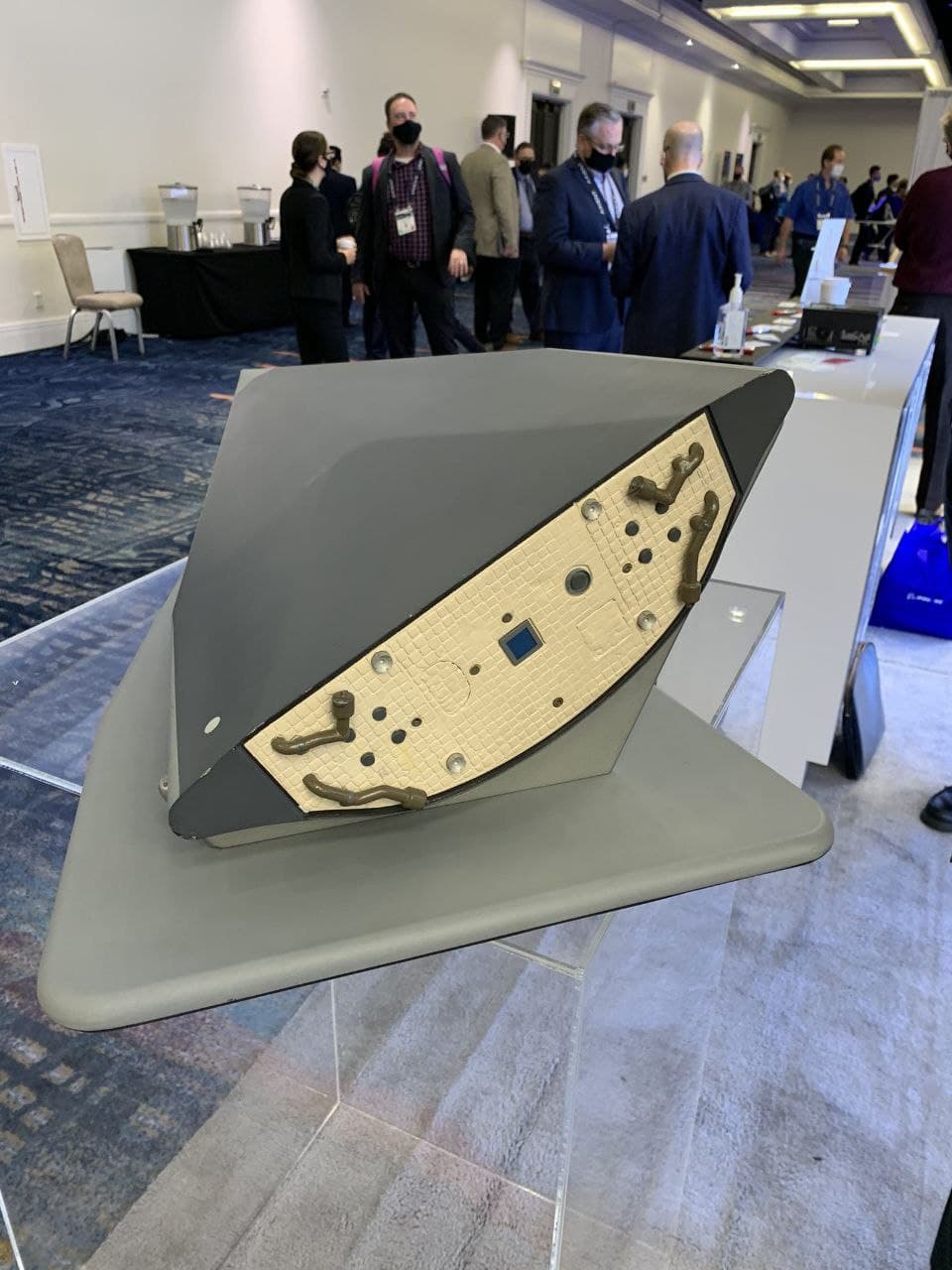
A waverider is a hypersonic object that creates a high-pressure area based on the creation of shock waves on its lower surface, so that due to the pressure difference created between the lower surface and its upper surface, generates the power required for gliding at very high flight Machs.
In military weapons, with the advent of new hypersonic weapons, hypersonic glider warheads usually use the waverider configuration in their aerodynamic design. The purpose of this is to achieve the appropriate lift-to-drag ratio so that the weapon achieves an acceptable range in the shortest possible time.
In the design of the hypersonic waverider, it is tried as much as possible that the pressurized air under the fuselage does not enter the low pressure air on the upper surface in order to achieve the highest efficiency.
One of the common methods in designing complex geometric surfaces of this device is the Wave Derived Compression Surface method.
The design of part of the hypersonic glider body
The Chinese DF-17 missile is a ballistic missile with a hypersonic glider warhead. Recently, North Korea has also tested a medium-range missile equipped with a hypersonic glider warhead, which according to its design configuration seems to have achieved this by transferring technology from China.
DF-17 hypersonic waverider missile
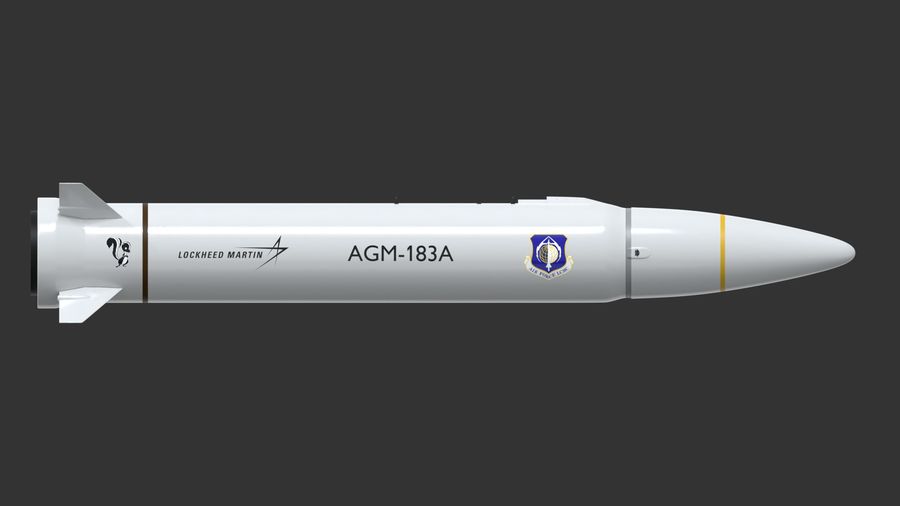
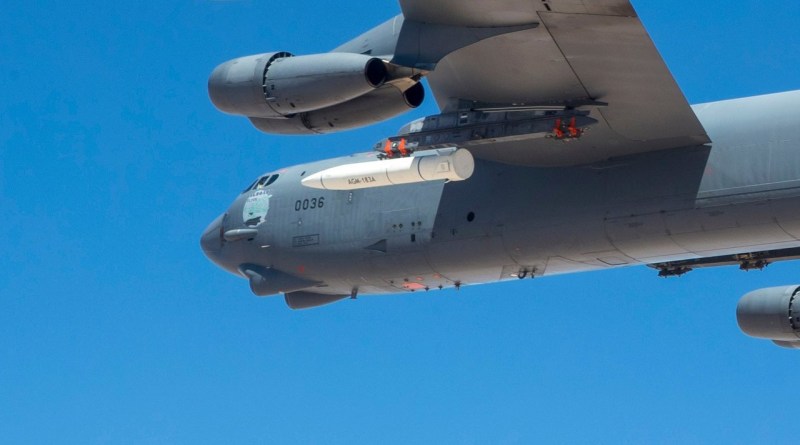
The Russians also have a hypersonic glide vehicle as a continental weapon called Avangard. It can deliver both nuclear and conventional payloads. In the United States, a missile called AGM-183 ARRW is being developed, which is air-launched.