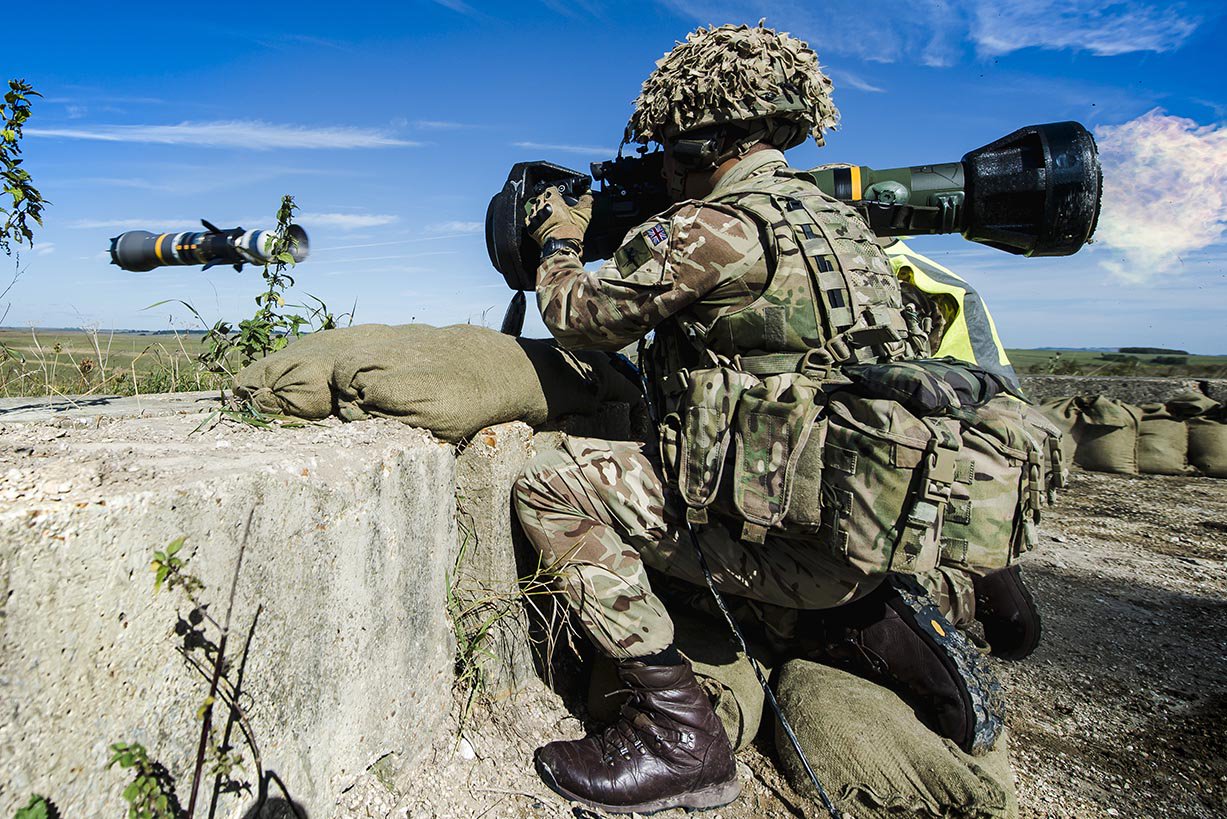
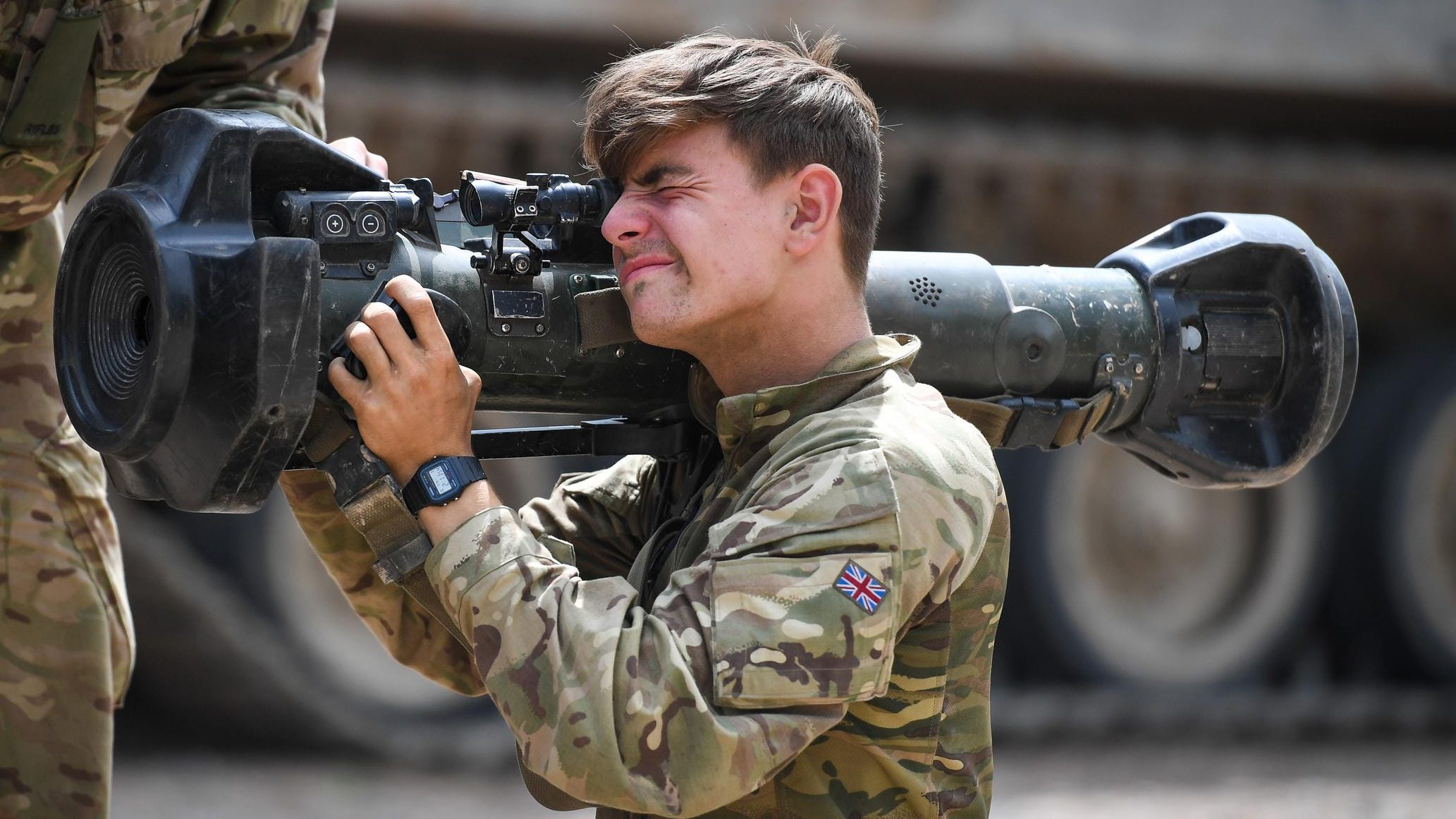
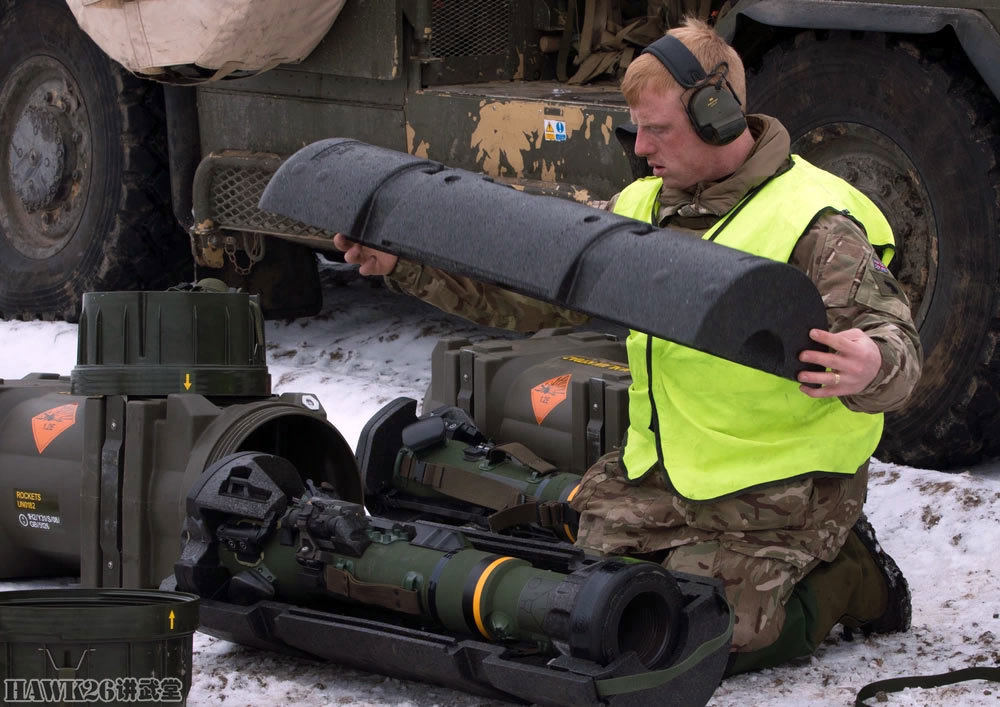
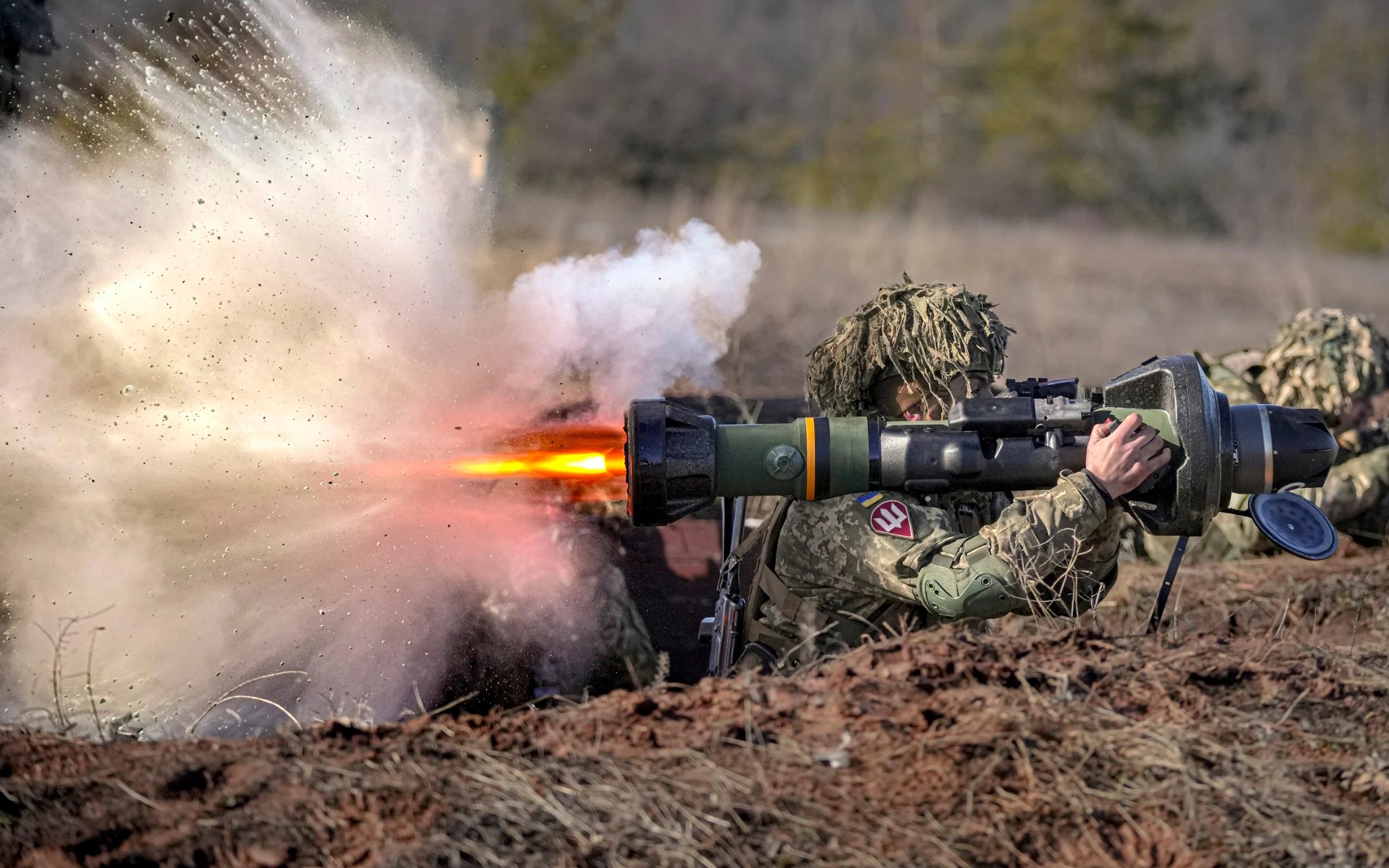
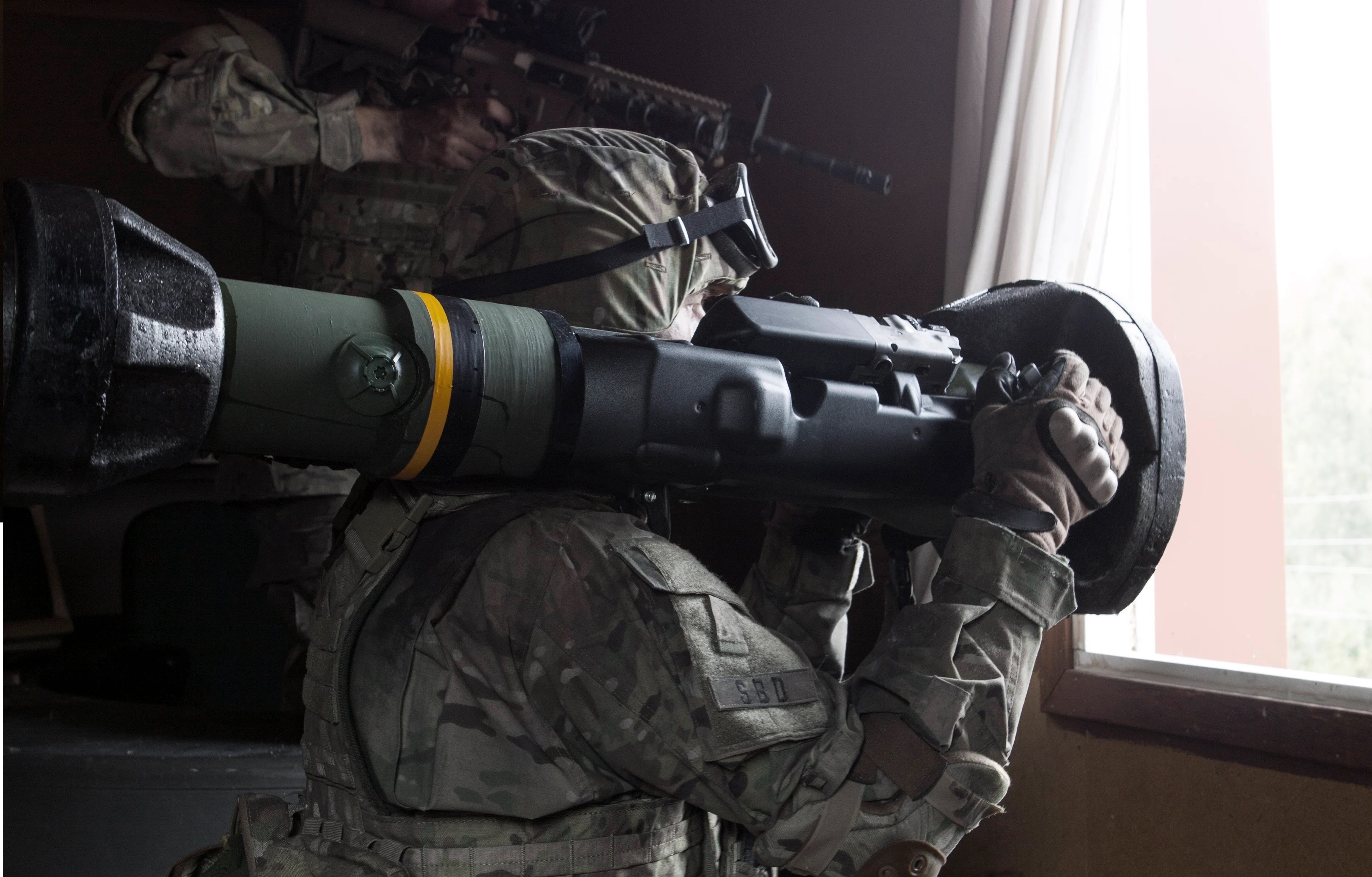
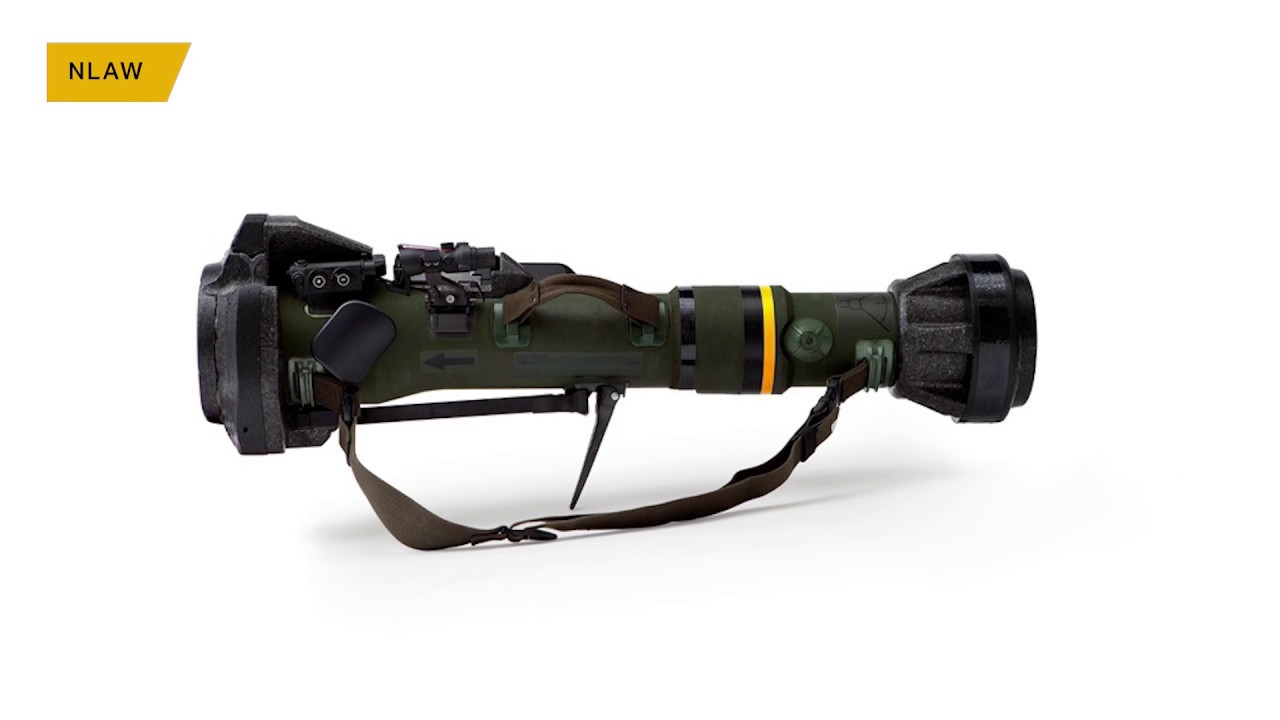
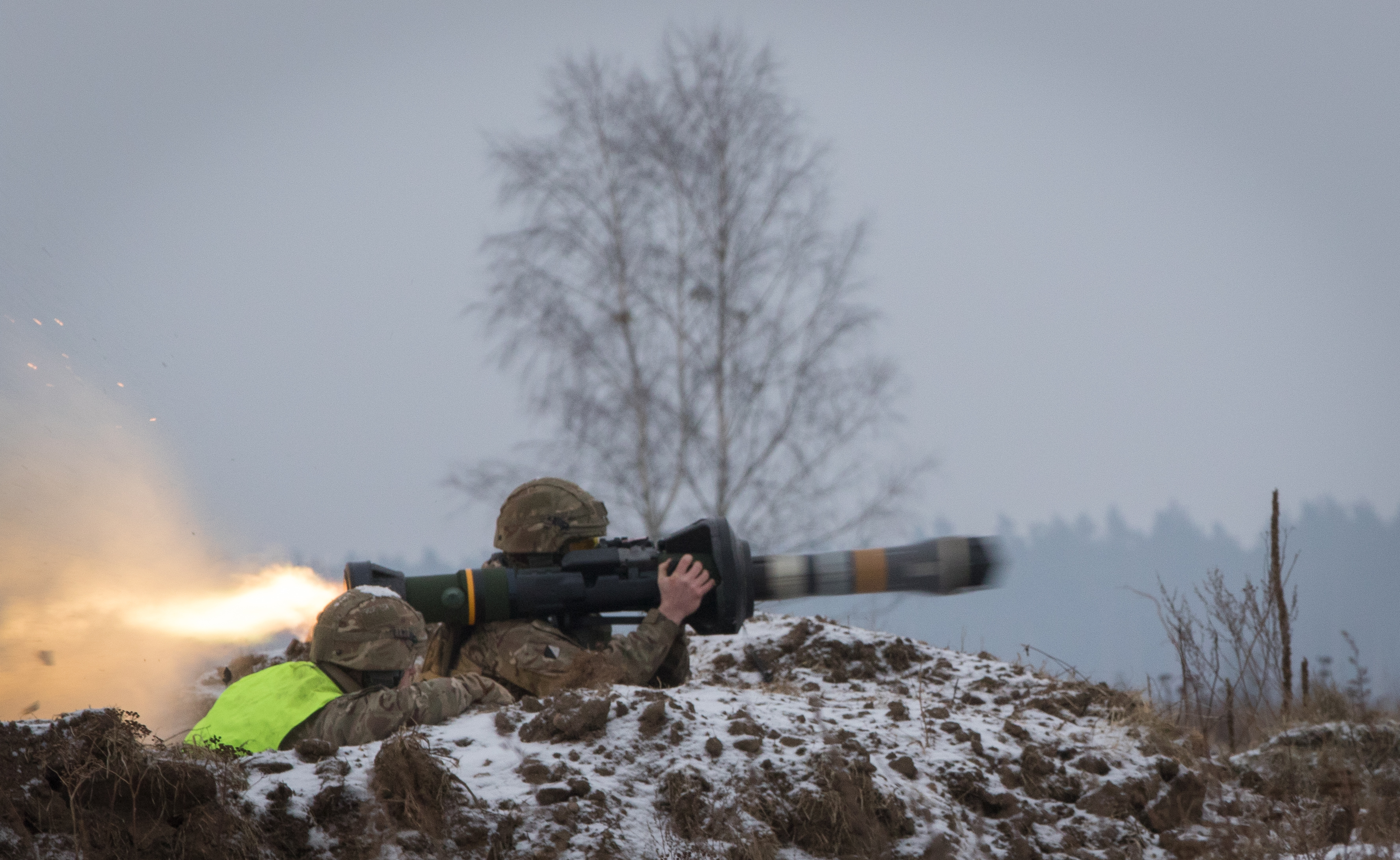
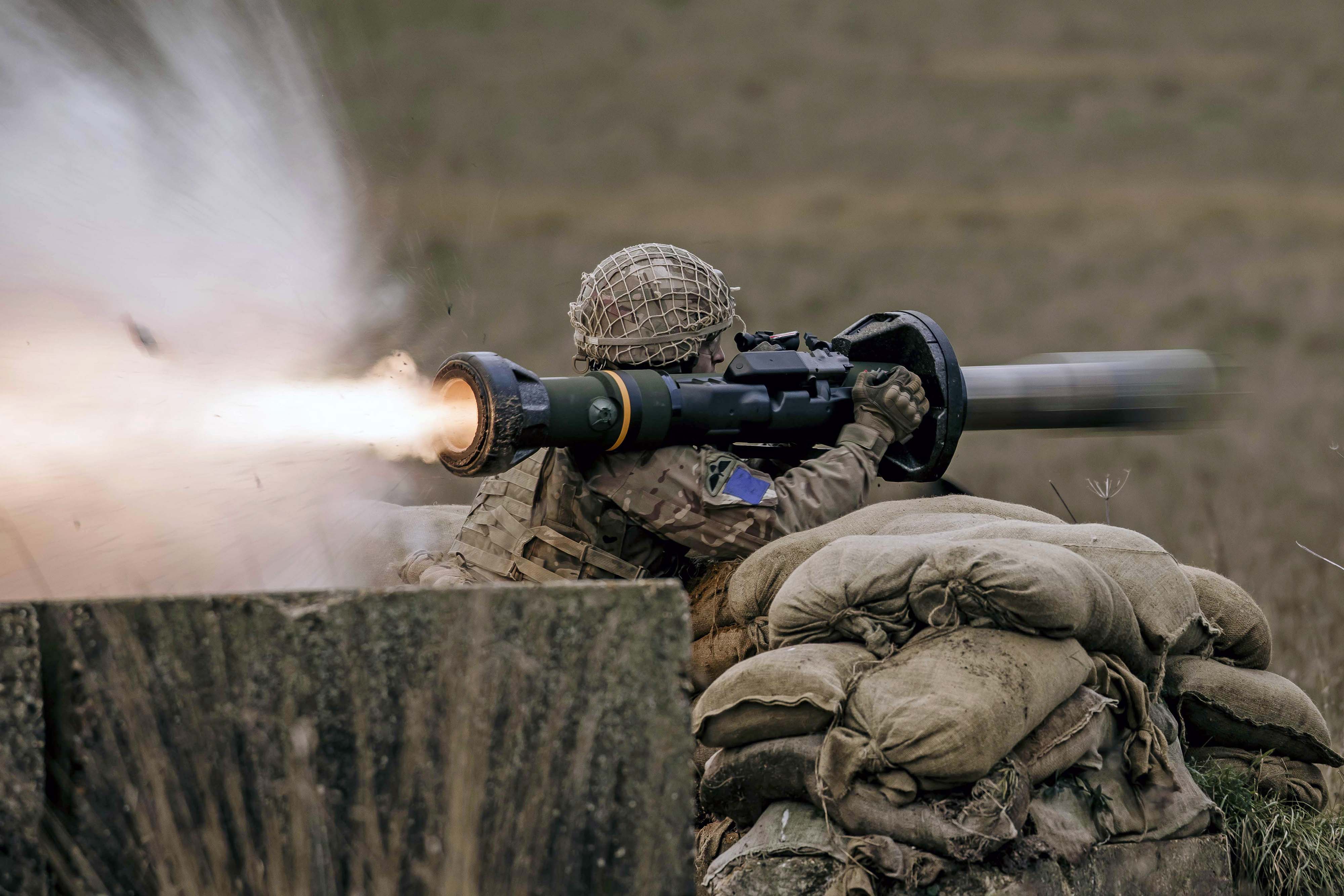
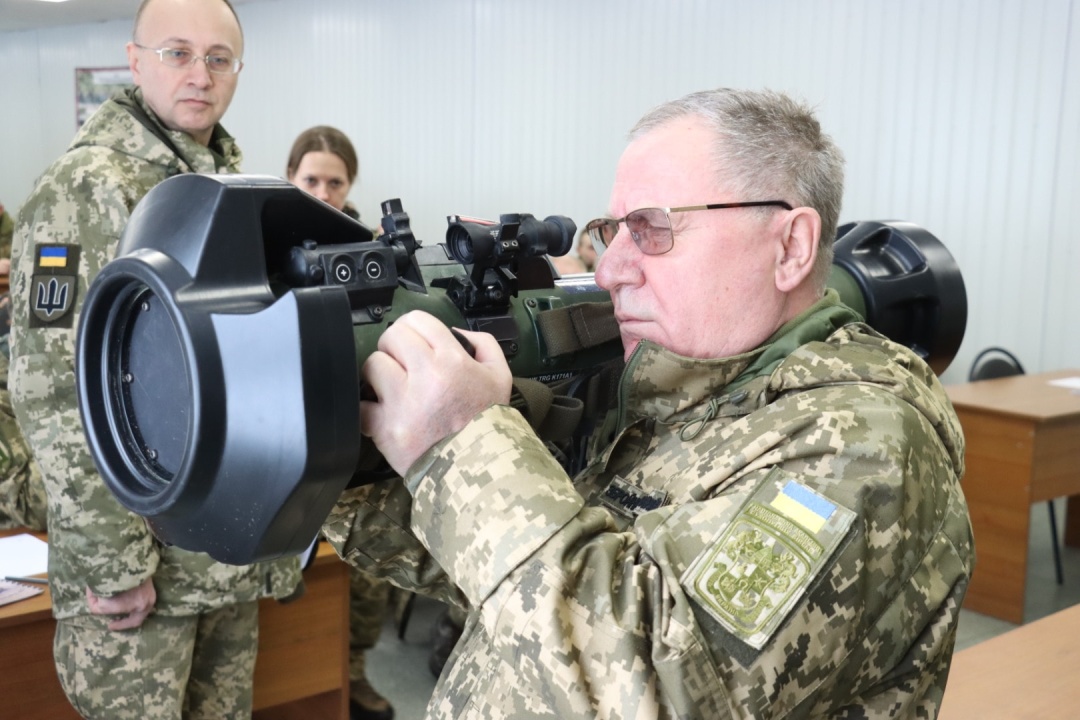
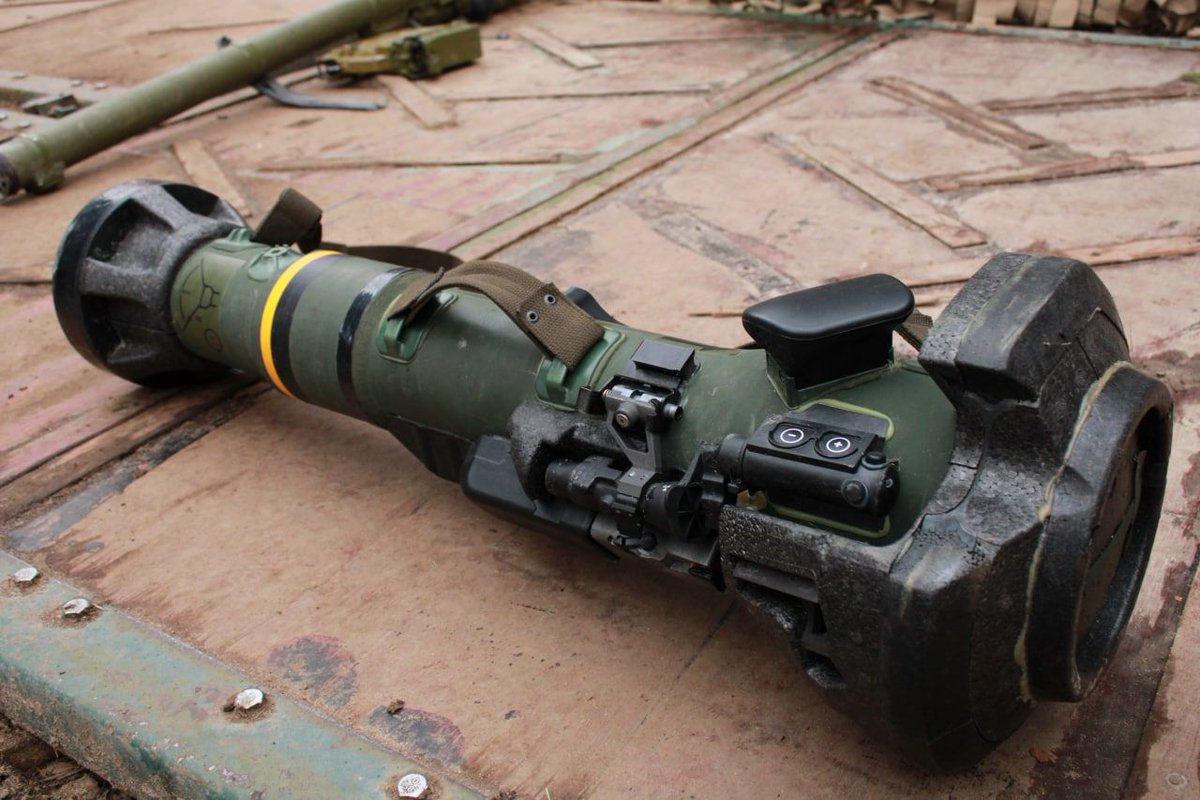
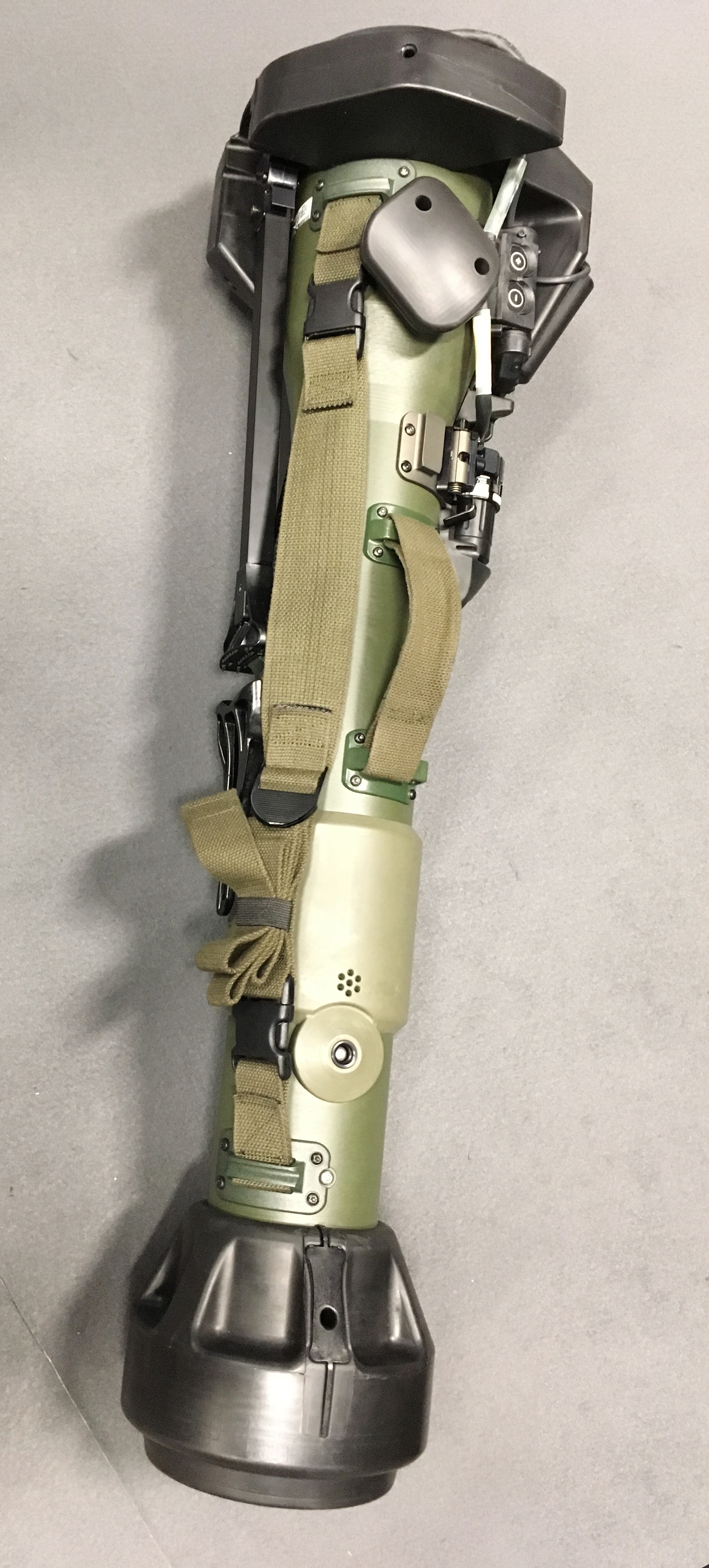
NLAW is a fire-and-forget, lightweight shoulder-fired, and disposable line of sight missile system, designed for use by infantry. The missile, using a soft-launch system, is guided by predicted line of sight and can carry out a top attack or direct attack. It was developed in Sweden by Saab Bofors Dynamics, and manufactured in the United Kingdom, mainly by Thales Air Defence. Users of the weapon include Finland, Indonesia, Luxembourg, Malaysia, Sweden, Switzerland, Ukraine, and the United Kingdom.
The NLAW missile development project was completed in 2002. The guidance technology of this missile is taken from BILL 2 missile and the small and compact configuration of this missile is obtained from AT4 anti-tank missile. The UK Department of Defense is probably looking for more than 20,000 NLAW missiles, with an estimated storage life of 20 years.
One of the salient features of this missile is its ability to fire from closed locations. For this purpose, the missile with a low pressure propulsion is activated first and after leaving the closed position, its powerful propulsion is activated. Since in urban battles it is necessary to shoot from inside the buildings, if the missile does not have such a capability, its operator will be harmed, and when the weapon has such a feature, it is very suitable for urban battles and hitting enemy armored forces inside cities.
NLAW ATGM specifications: Range: 800 m Weight: 12.5 kg Length: 1.016 m Warhead: High-explosive anti-tank combined overfly top attack, direct Warhead penetration: more than 500 mm in rolled steel
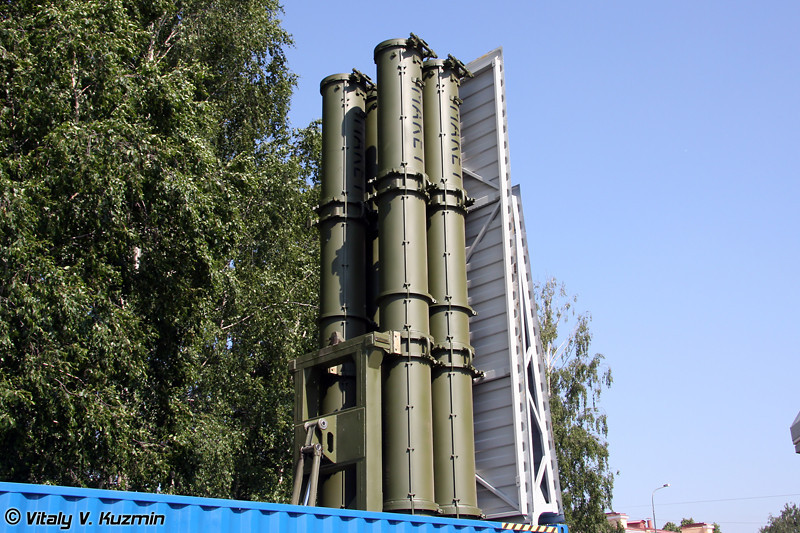
There are different types of Kalibr cruise missiles, each of which has different names depending on its function and model. These missiles are produced in two versions: “domestic” for use in the Russian army and “export” for sale to other countries.
Some versions have secondary rocket propulsion to achieve ultrasonic speeds in the final phase of target hunting. This feature reduces the reaction time of air defense systems.
The components of the submarine-launched version and the one that launch from a surface ships is designed to be as common as possible between the parts of these missiles; Of course, there are some major differences between some of the main components. For example, in the surface ship version, the rocket booster needs to control the thrust vector due to its vertical launch, but the submarine-launched version does not require this system. The fact that the Kalibr missile can be fired from vertical tubes means that it can be used on a wide range of small and large warships. Therefore, the navy of any country that has such a weapon will benefit from very precise and strategic long-range firepower.
In the air-launched version, in order to reduce the effects of the environment on the missile, the missile is placed inside a tube and after being released from the warplane, it will release from the tube and launch.
The range of all Kalibr missiles in the service of the Russian army is not exactly known; But given past operations and operational use of the missile, conservative estimates put the maximum range of 2,500 km for the longest-range version of the missile. Thus, the Kalibr cruise missile can hit targets with very high accuracy with a circular error probability (CEP) of 3 meter at 2500 km range with conventional or thermonuclear warheads. The flight ceiling of this missile is 1000 meters, but after firing it flies towards the target with a flight altitude between 50 to 150 from the ground level or with a flight altitude of 20 from the sea level. Kalibr cruise missile navigation system is a combination of inertial navigation system (INS) and satellite guidance.
Kalibr cruise missile variants
Versions used in the Russian army: Domestic versions used in the Russian Navy are divided into two general categories, 3M-54 and 3M-14 with the suffixes K and T. K means the ability to fire from submarines and T means the ability to fire from surface ships. – The 3M54 missile has two general versions, the 3M54K and the 3M54T. 3M54K missile: A submarine-launched anti-shipping variant and its length is 8.22 meters and it has a warhead of 200 kg. Its range is between 375 and 500 km. 3M54T missile: An anti-shipping variant that launches vertically (VLS) from surface ships and its length is 8.9 meters and it has a warhead of 200 kg. Its range is between 375 and 500 km.
– The 3M14 missile has two general versions, the 3M14K and the 3M14T. 3M14K missile: A submarine-launched land attack variant with a length of 6.2 meters and a warhead of 450 kg. Its range is 2500 km. 3M14T Missile: A land attack variant that launches vertically (VLS) from surface ships with a length of 8.9 meters and a warhead of 450 kg. Its range is 2500 km.
The Russian military also has other types of air-launched and land-launched cruise missile versions, but detailed specifications are not available. It is worth noting that most of the Russian army’s Kalibr cruise missiles are of the sea-launched type, and so far the Russian army has used more Kalibr sea-launched versions.
A new version of the Kalibr-M missile is also being designed, which has a larger warhead and a range of about 4,500 kilometers. The missile is expected to join the Russian Navy between 2022 and 2025.
Export variants: Export and attenuated versions (in terms of range and accuracy) of Kalibr cruise missiles fall into four main categories: Club-S, Club-N, Club-T, and Club-A. The Club-S versions are submarine-launched, the Club-N versions are surface ship-launched, the Club-T versions are land-launched, and the Club-A versions are air-launched.
The Club-S version has four types: 3M-54EClub-S,3M-54E1, 3M-14E, 91RE1. – 3M-54E Club-S: It is the submarine-launched anti-shipping variant and its length is 8.2 meters and it has a warhead of 200 kg. Its range is 220 km. -3M-54E1: It is the submarine-launched anti-shipping variant and its length is 6.2 meters with a warhead of 200 kg. Its range is 300 km. – 3M-14E: It is the land attack variant fired from a submarine and its length is 6.2 meters and it has a warhead of 450 kg. Its range is 300 km. – 91RE1: It is the submarine-launched anti-submarine variant and its length is 7.65 meters and it has a warhead of 76 kg. Its range is 50 km.
Club-S land attack, anti-shipping and anti-submarinevariants
The Club-N version has four types: 3M-54TE Club-N, 3M-54TE1, 3M-54TE, 91RTE2. – 3M-54TE Club-N: It is the surface vessel with VLS launched anti-shipping variant with a length of 8.9 meters and a warhead of 200 kg. Its range is 220 km. – 3M-54TE1: It is the surface vessel with VLS launched anti-shipping variant with and its length is 6.2 meters and it has a warhead of 200 kg. Its range is 300 km. – 3M-14TE: It is the surface vessel with VLS launched land attack variant with a length of 8.9 meters and a warhead of 450 kg. Its range is 300 km. – 91RTE2: It is the surface vessel with VLS launched anti-submarine variant and its length is 8.9 meters and has a warhead of 76 kg. Its range is 40 km.
The Club-T version has two types, the land-based 3M-54E2 for targeting warships and the Land-based land-attack 3M-14E1. These missiles are used as mobile missile systems for coastal defense. These missiles have a warhead of 450 kg and probably have a range of about 300 km.
Coastal defense version of caliber cruise missiles
The Club-A version has three types: 3M-54AE, 3M-54AE1 and 3M-14AE. – Versions 3M-54AE1 and 3M-54AE are anti-shipping missiles fired from warplanes. The 3M-54AE missile weighs 1950 kg and has a warhead of 200 kg and a range of 300 km. – The 3M-14AE is a air-launched land-attack variant fired from warplanes. It is 6.2 meters long, weighs 1400 kg and has a warhead of 450 kg. Its range is 300 km.
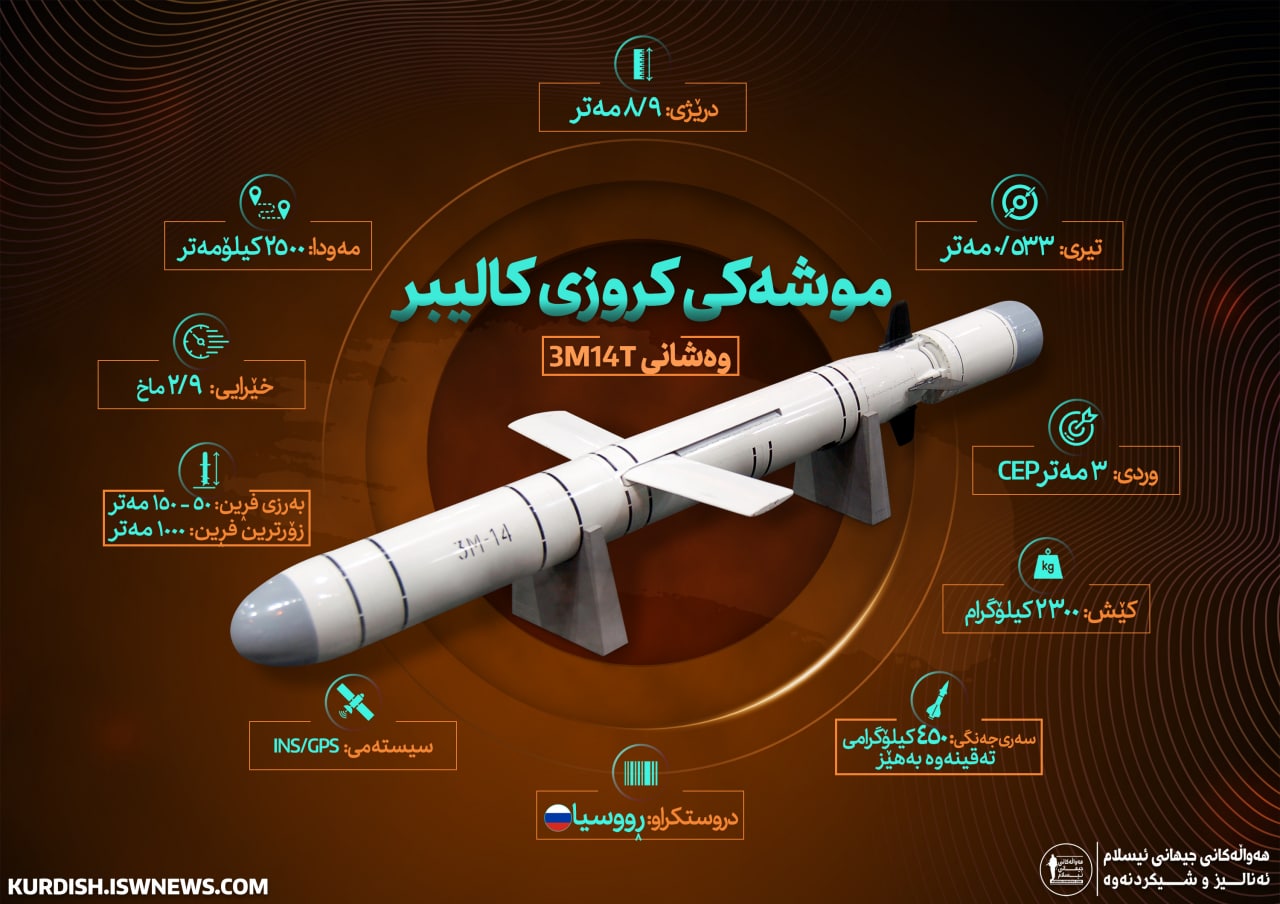
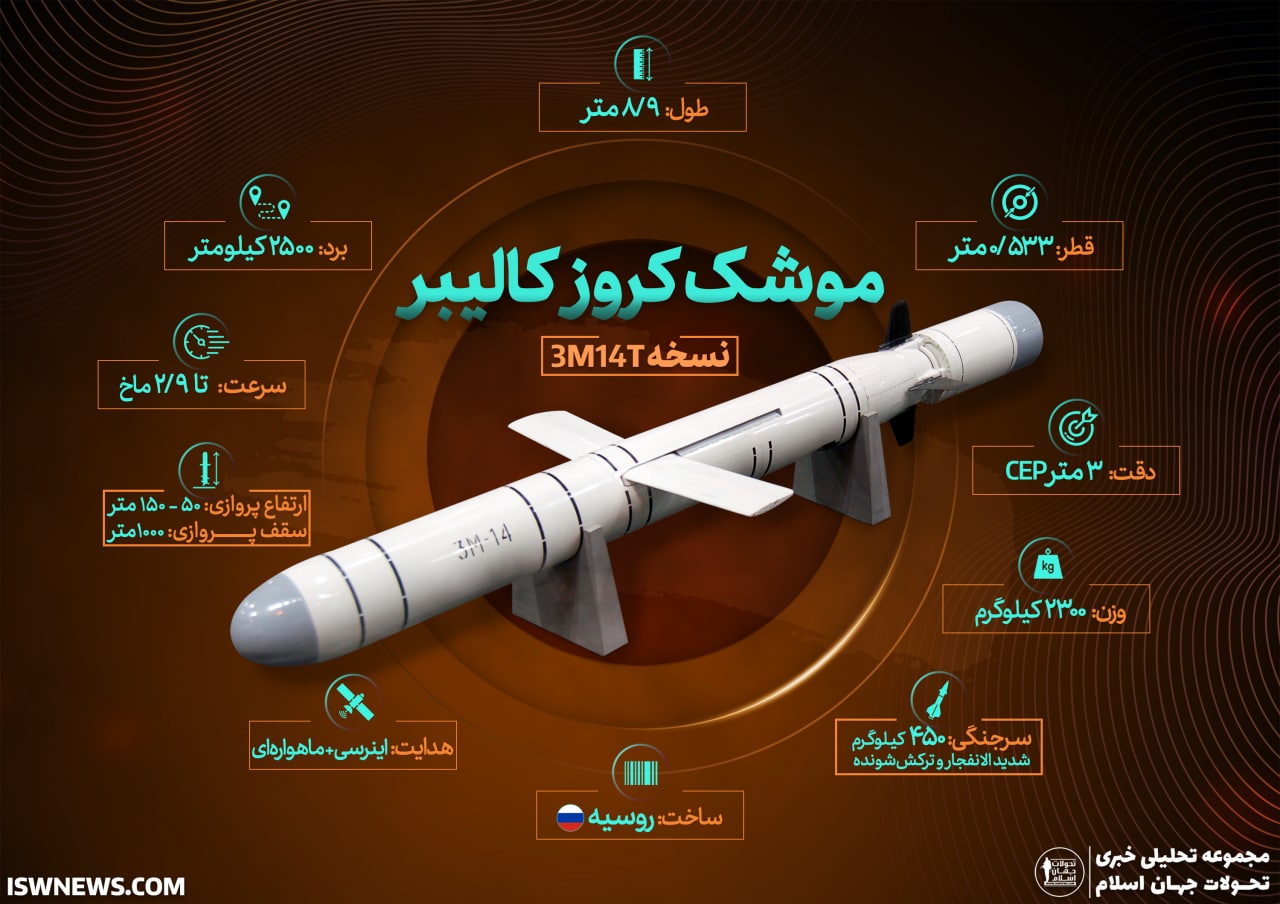
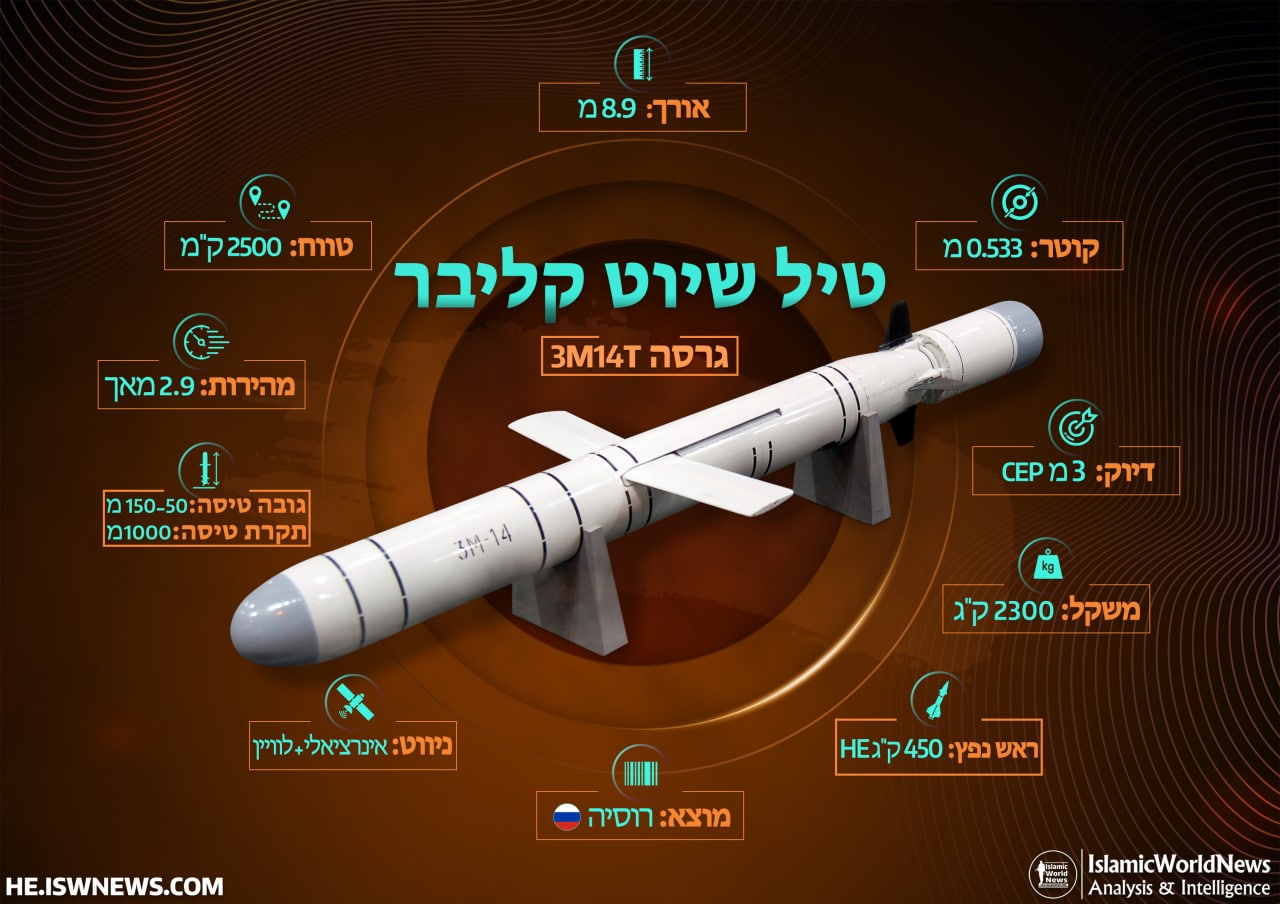
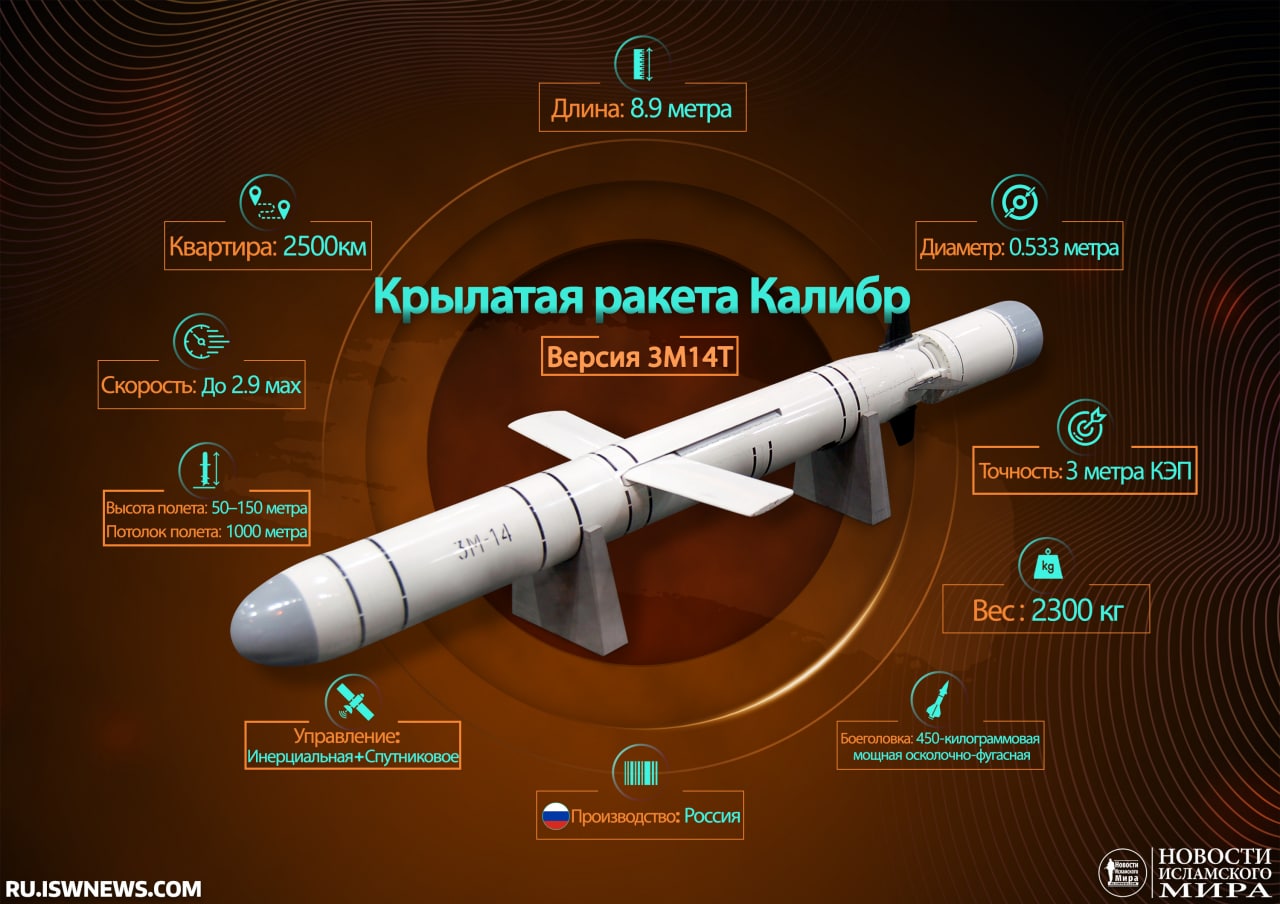
Kalibr cruise missile specifications (3M14T variant): Length: 8.9 m Diameter: 0.533 m Wingspan: 3.080 m Weight: 2300 kg Warhead: 450 kg HE Range: 2500 km Speed: Mach 2.9 Flight ceiling: 1000 m Flight altitude: 50 – 150 m Guidance: Inertial + satellite Accuracy: 3 m CEP Origin: Russia
Click to view full size3M14T and 3M54T caliber cruise missiles fired from Russian warships
“Kalibr Cruise Missile” collection of posters in Persian, Arabic, Kurdish, Azeri, Russian, Hebrew and Chinese for Social Media:
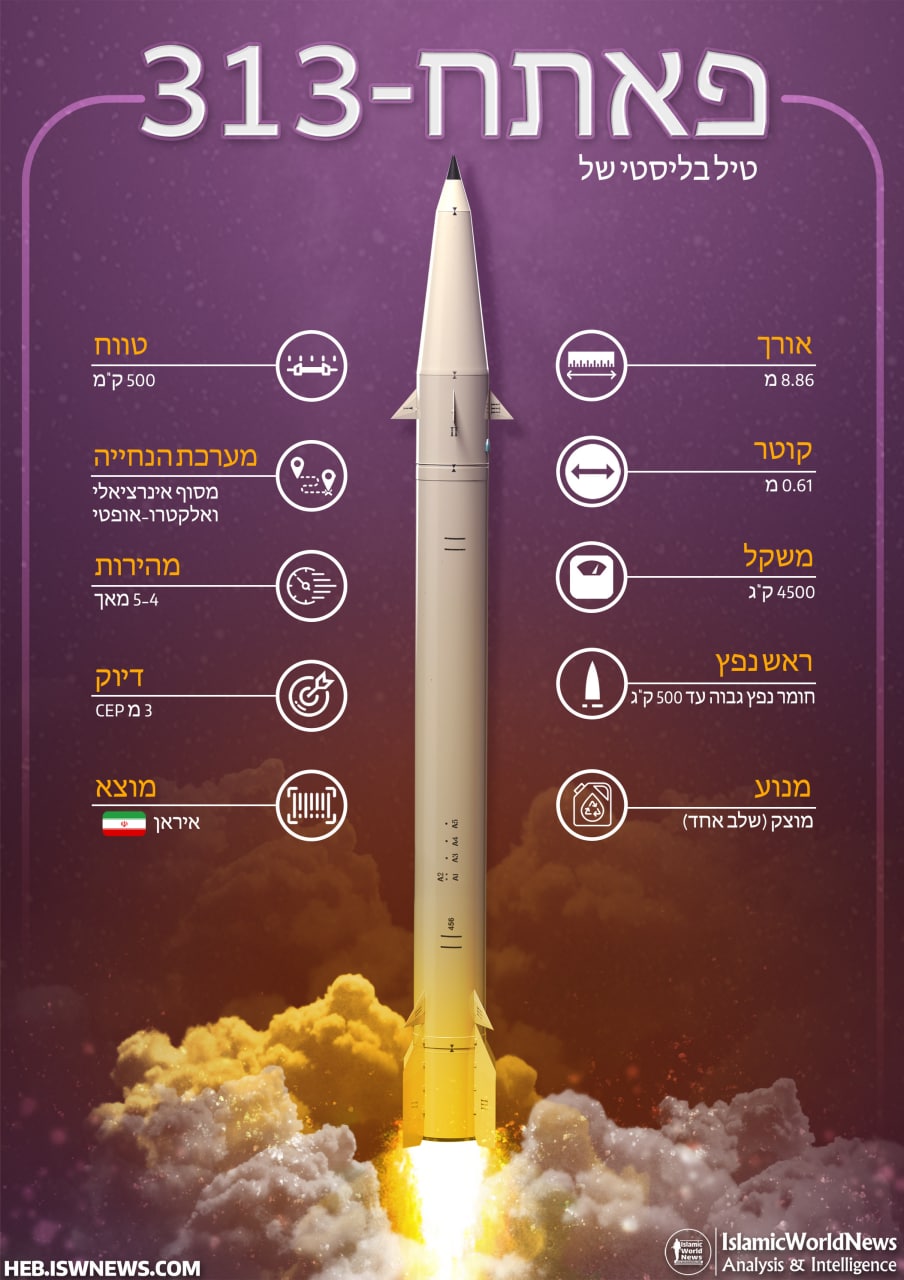
This missile was used during Operation Martyr Soleimani against the US forces at Ain Al Asad Airbase, Iraq, and the very high accuracy of this missile was proven. Fateh-313 missile with a maximum error rate of 3 meters is one of the most accurate missiles in Iran and the world.
In this missile, by using more advanced inertial navigation and possibly combining it with satellite navigation, a kind of terminal guidance has been obtained, which has provided the ability to guide the Fateh-313 missile until it hits the target.
The Fateh-313 is almost identical in length and diameter to the Fateh-110 missile; But the use of the new propulsion system with more power generation capacity has increased the missile range from 200 km to 500 km. This missile uses “composite solid fuel” unlike the Fateh-110 missile, which uses solid fuel. The use of composite solid fuel results in better fuel efficiency, greater safety and greater stability of the missile during flight.
The expanded range of the Fateh-313 makes more targets available to Iran, and due to the high accuracy and capability of using a mobile launcher and move the missile anywhere in the country allows Iran to fire its missiles from more locations within its territory, complicating the enemy’s attempts to attack the missile launchers before the missiles can be launched.
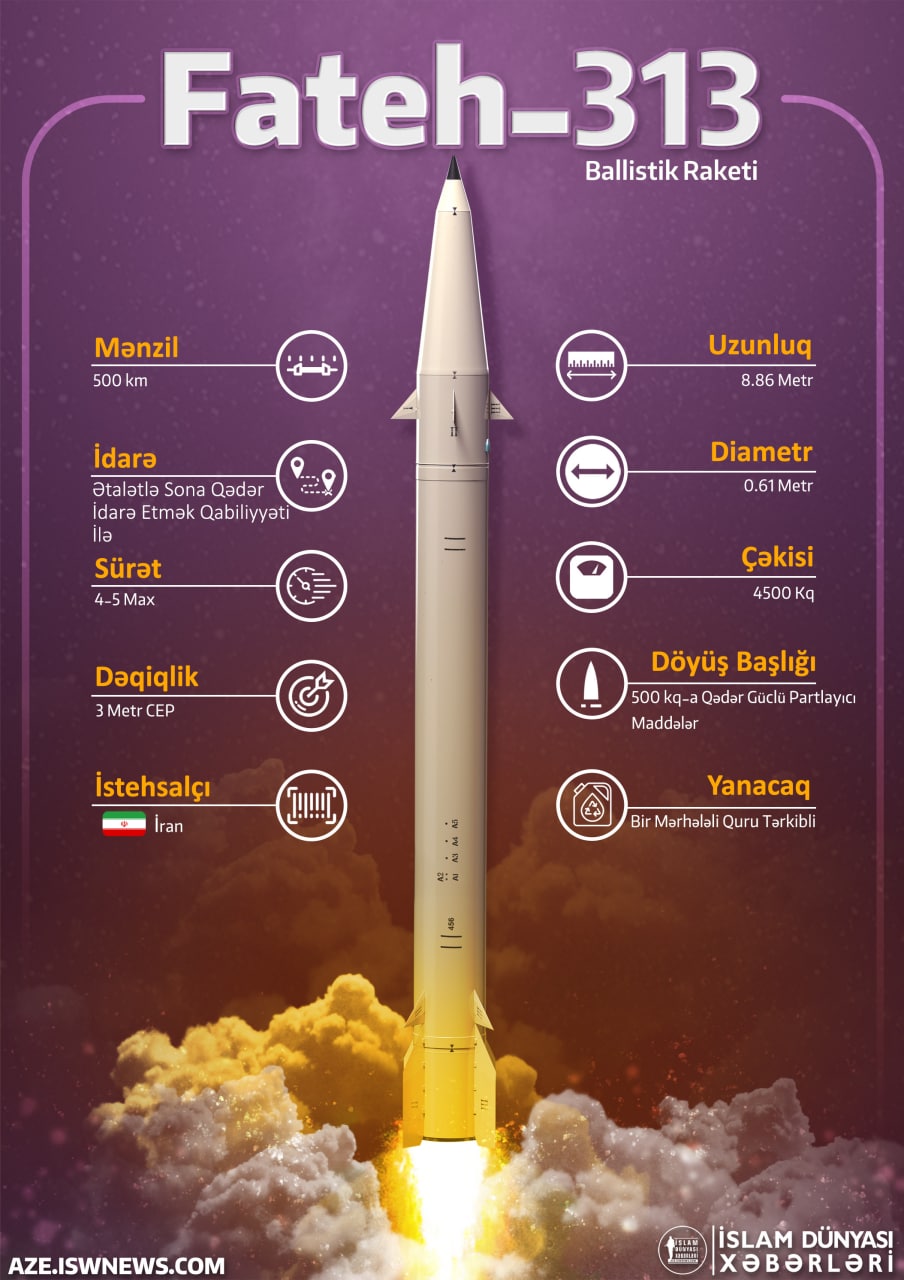
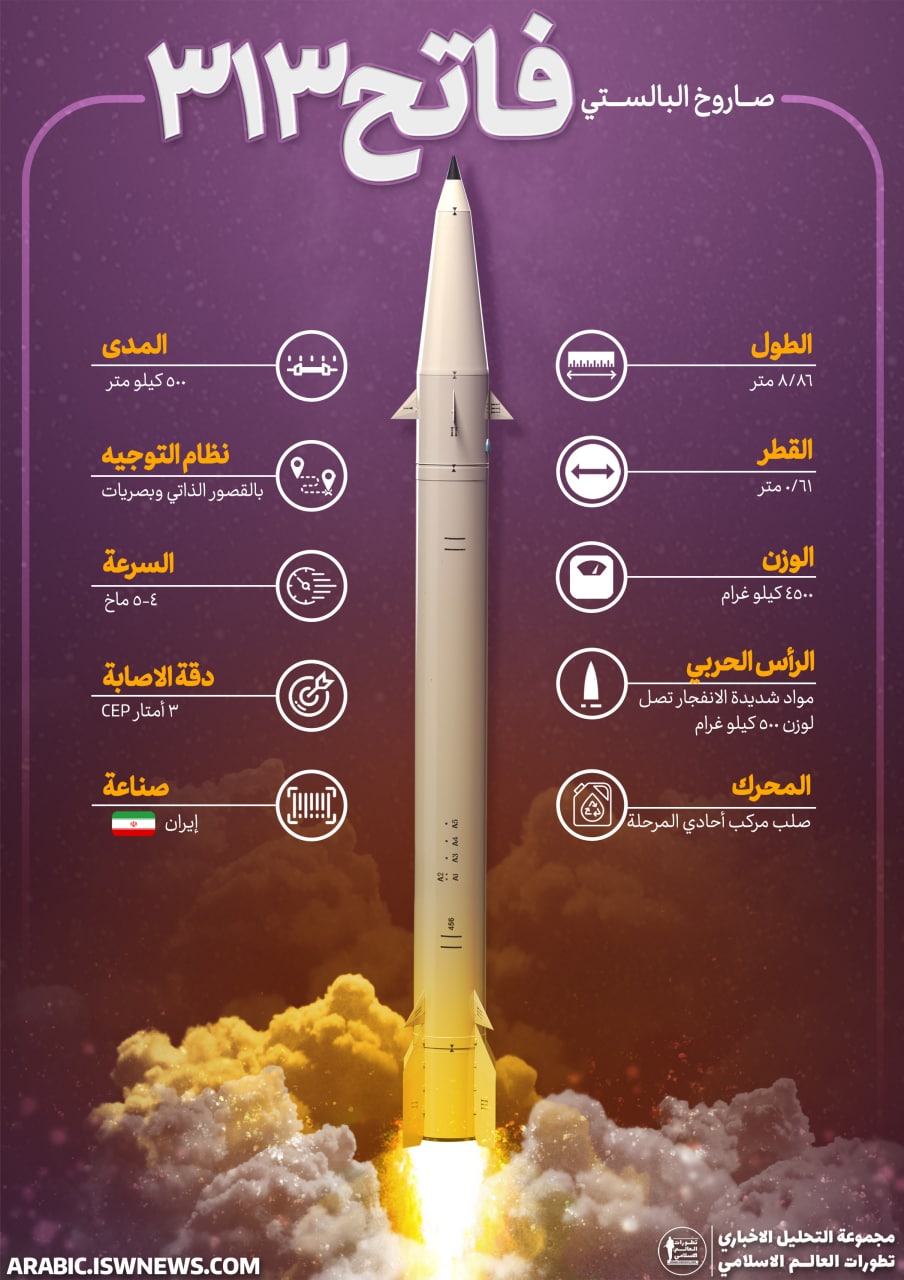
Fateh-313 ballistic missile specifications: Length: 8.86 m Diameter: 0.61 m Weight: 4500 kg Warhead: High explosive up to 500 kg Engine: Solid (single stage) Range: 500 km Speed: Mach 4-5 Guidance system: Inertial and electro-optical terminal Accuracy: 3 m CEP Origin: Iran
Click to view full sizeClick to view full size
“Fateh-313 Ballistic Missile” collection of posters in Persian, Arabic, Kurdish, Azeri, Russian, Hebrew and Chinese for Social Media:
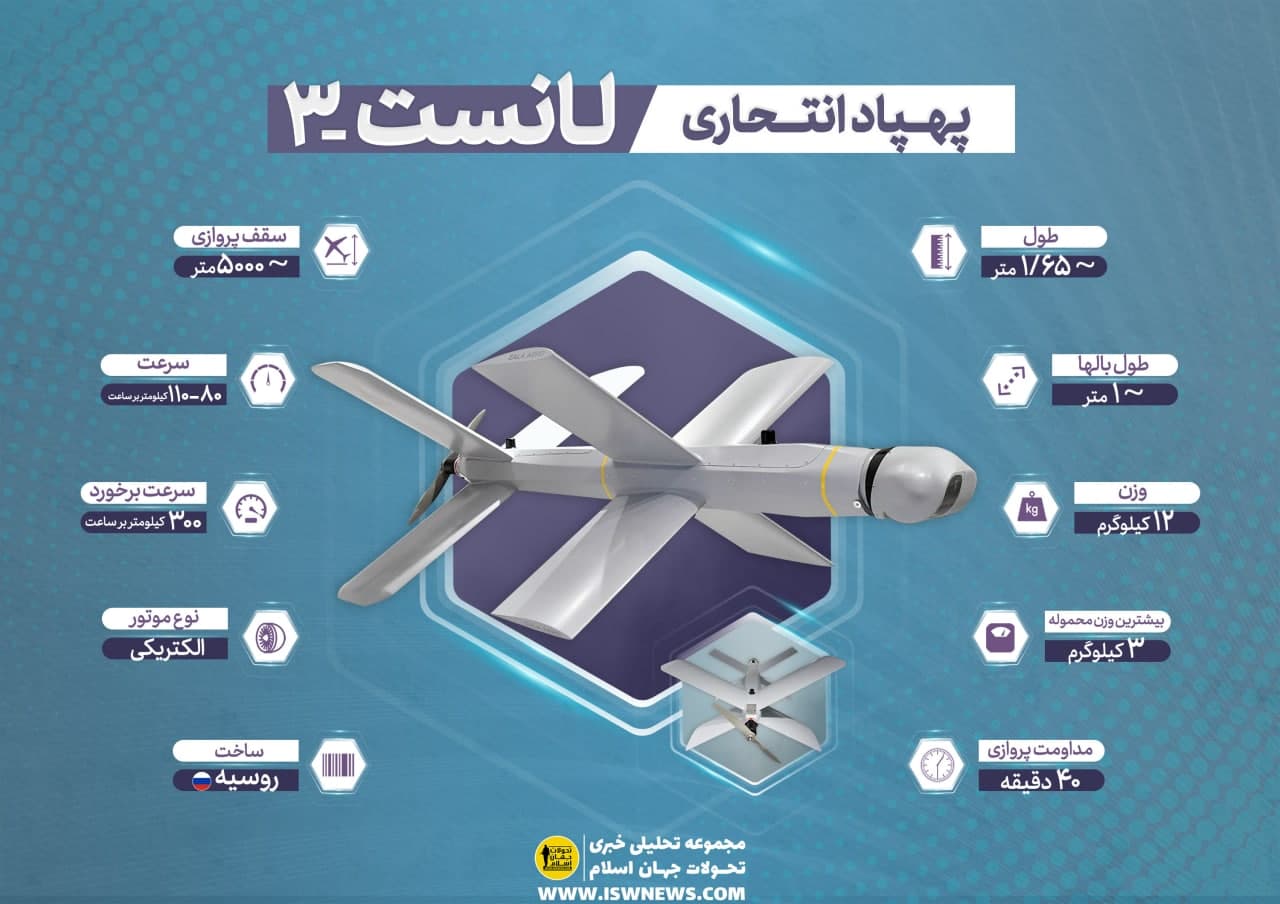
Lancet-3 loitering munition is a Russian drone made by the ZALA AERO GROUP. Since 2004 ZALA AERO GROUP is the leading Russian developer and manufacturer of unmanned aerial systems, unique payloads and mobile systems. Starting from January 2015, the Zala Aero Group became a subsidiary of the famous Russian arms company Kalashnikov. Hence, the Lancet-3 is also known as the Flying Kalashnikov.
ZALA AERO GROUP has recently developed the Lancet-3 loitering munition, And its seems the drone was inspired and modeled on other competitors.
The Zala Lancet drone was announced in late June 2019 at the Russian Army Expo exhibition with the development trials already being completed. The Lancet attack drones were deployed successfully by the Russian Armed Forces in Syria targeting Idlib militants in November 2020.
A loitering munition (or suicide drone) is a weapon that loiters around the target area for some time and attacks only once a target is located. This process can be self-reliant based on artificial intelligence or based on target approval by the operator. Loitering munitions enable faster reaction times against concealed or hidden targets that emerge for short periods without placing high-value platforms close to the target area, and also allow more selective targeting as the attack can easily be aborted. Loitering munitions fit in the niche between cruise missiles and unmanned combat aerial vehicles (UCAVs), sharing characteristics with both. They differ from cruise missiles in that they are designed to loiter for a relatively long time around the target area, and from UCAVs in that a loitering munition is intended to be expended in an attack and has a built-in warhead.
Video published by ZALA AERO GROUP on performance of the Lancet-3 suicide drone
The Lancet-3 suicide drone appears to have been modeled on the Israeli regime’s Hero family drone. Lancet-3 offers the ability to hunt targets with a range of 40 km with the ability to confirm the target before hitting. In this method, through the data link, the images of the drone electro-optical system are transmitted to the operator and the operator, after confirming the target, gives the order to engage.
The warhead fuse of this drone is of the proximity type in order to increase its effectiveness against soft targets such as tents, gatherings of enemy personnel, etc. This fuse is activated before the weapon hits the target.
According to information released by the manufacturer of this drone, the built-in laser protection device embedded in the Lancet-3 drone can effectively resist the laser weapons which are used to shoot down drones. Lancet-3 uses dual X-shaped tail design that increases its stability and maneuverability based on aerodynamic principles. This design has also helped to reduce the size of the drone effectively.
Kalashnikov’s promotional video of the Lancet-3 drone
The Lancet-3 drone weighs 12 kg and is easily portable. Also, the maximum amount of cargo (warhead) carried by this drone is 3 kg. The Lancet-3 drone can fly for 40 minutes at a speed of 110-180 km / h.
The previous version of this drone, the Lancet-1, weighs 5 kg with a payload of 1 kg and a flight time of 30 minutes and smaller dimensions. Comparing the Lancet-3 and Lancet-1 drones, it can be seen that the new version has a much better offensive capability.
The drone uses an electric motor to operate at the lowest noise level. This type of electric motor uses for surprise attacks and this method has a significant psychological effect on the enemy. Lancet-3 is launched from a catapult. The drone has no provision for landing as it is designed to self-destruct when it hits enemy targets. The drone is also capable of crashing into enemy drones.
It should be noted that Lancet-3 has earned the nom La Guerre “flying Kalashnikov” (or flying AK-47) for its simplicity, usability, and reliability.
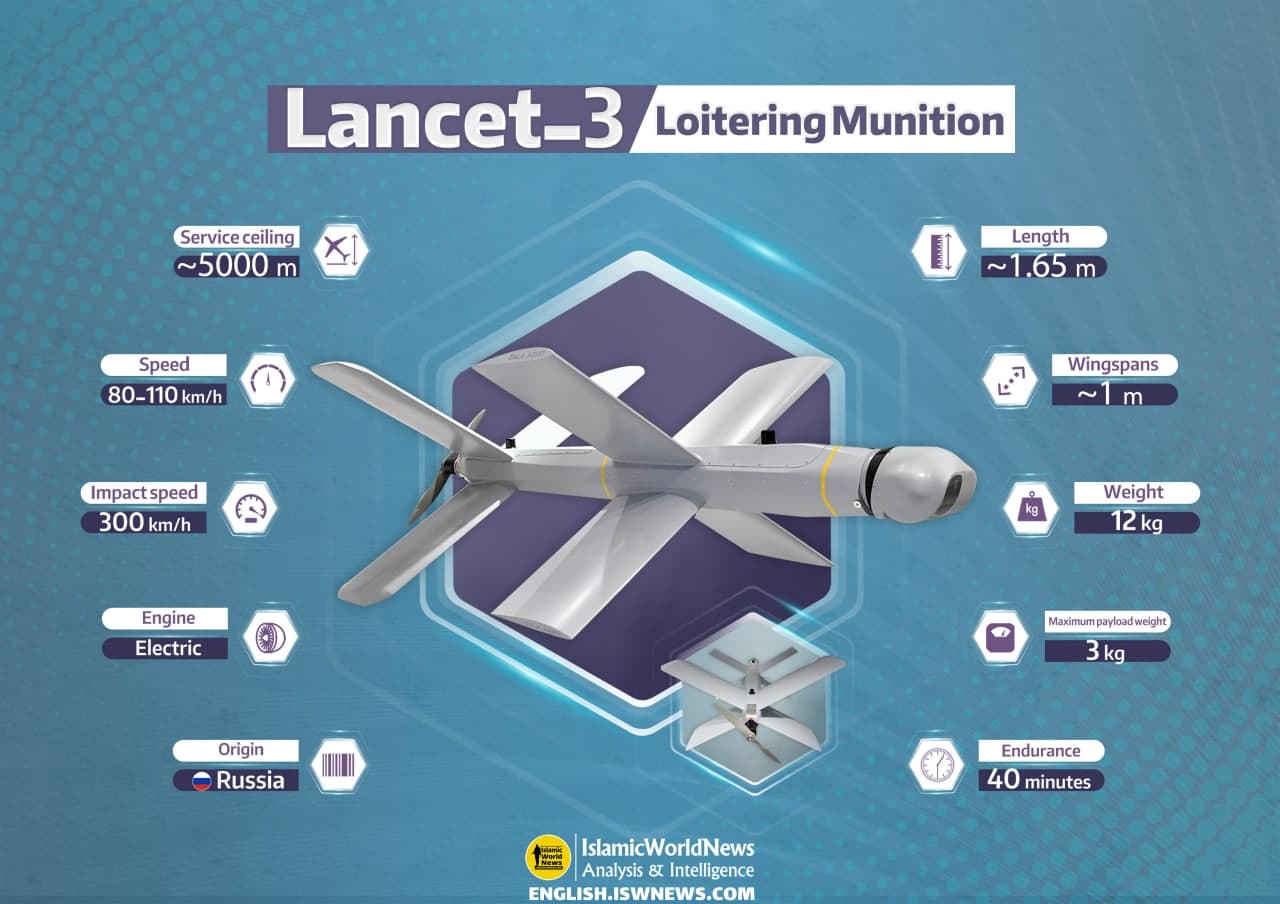
Lancet-3 suicide drone specifications:Length: ~ 1.65 m Wingspans: ~ 1 m Weight: 12 kg Maximum payload weight: 3 kg Endurance: 40 minutes Service ceiling: ~ 5000 m Speed: 80-110 km/h Impact speed: 300 km/h Engine: Electric Origin: Russia
Click to view full size
“Lancet-3 Suicide Drone ” collection of posters in Persian, Arabic, Kurdish, Azeri, Russian for Social Media:
Before the start of Russian military operation in Ukraine, as well as in the last two weeks, the United States and European countries, including Germany, the Netherlands and Lithuania, etc. sent man-portable air-defense systems and Anti-tank missiles to Ukraine. These missiles have played an important role in preventing the advance of Russian Army armored columns in Ukraine, and have so far caused significant damage to Russian armored vehicles and equipment.
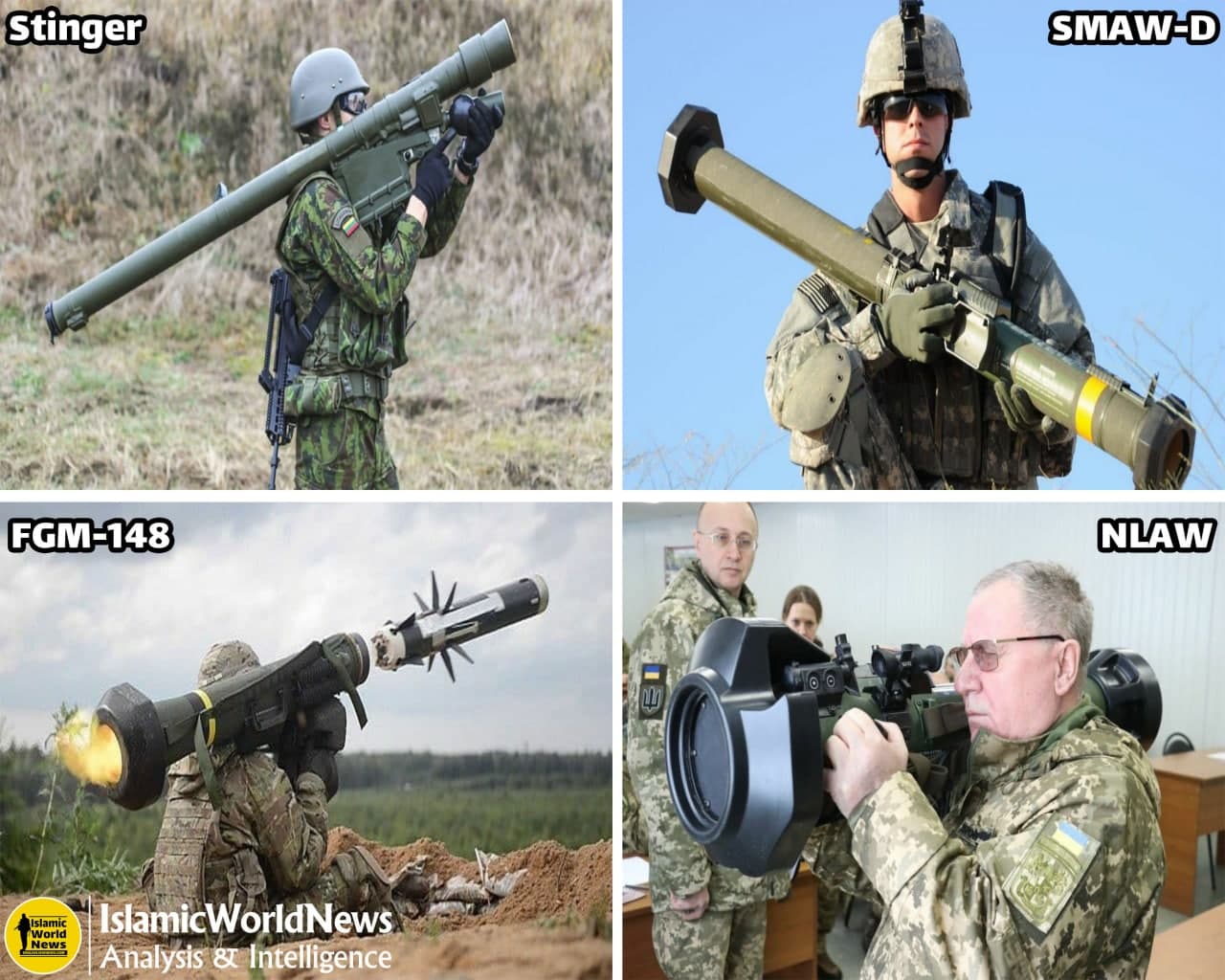
The most important systems donated by European countries to the Ukrainian army are the NLAW missile, the FGM-148 Javelin missile, the SMAW-D missile and the Stinger missile, the details of which are as follows:
1- NLAW missile: The NLAW is a top attack anti-tank, fire-and-forget missile system. Its penetration is not exactly known, but its effective firing range is between 20 and 600 meters and with maximum firing range of 1000 meters. The missile operates in such a way that it explodes on top of the target and its fragments penetrate the target. The ability to fire from inside buildings makes this missile suitable for urban warfare. The NLAW is a joint product of Sweden and Britain. According to European sources, Britain has sent more than 2,000 such missiles to Ukraine.
2- Javelin FGM-148 missile: The Javelin FGM-148 is a top attack anti-tank, fire-and-forget missile system made by United States. Its effective firing range is between 75 to 2500 meters. The penetration rate of this missile is between 600 to 800 mm on RHA. This missile also has the ability to fire from inside buildings and closed places. The United States and Lithuania have sent more than 2,000 such missiles to Ukraine.
3- SMAW-D missile: The SMAW-D (Disposable), or M141 Bunker Defeat Munition is a single-shot, shoulder-launched weapon designed to defeat hardened structures. The effective firing range of SMAW-D missile is between 15 to 1000 meters. SMAW-D is made by the United States exclusively for its Army to fill the void in the United States Army inventory of a bunker buster weapon. The United States has delivered 100 such missiles to the Ukrainian army so far.
4- FIM-92 Stinger missile: The FIM-92 Stinger is an originally US-made man-portable air-defense system that operates as an infrared homing surface-to-air missile. Its effective range is between 180 to 3800 meters with a maximum range of 4800 meters. Germany has sent more than 500 of these missiles and the Netherlands more than 200 of these missiles to Ukraine.
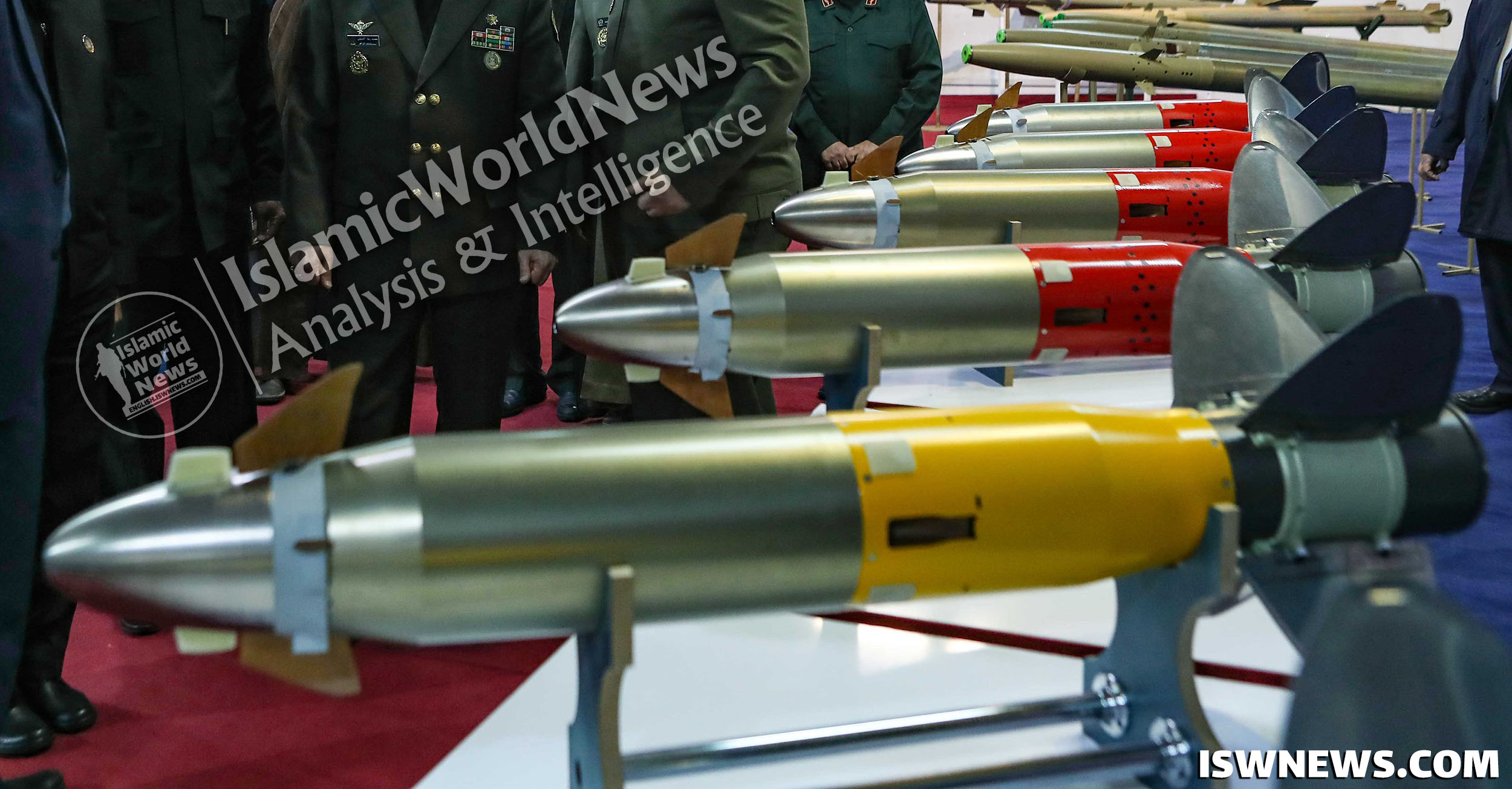
During the unveiling ceremony of 10 new defense systems of Iran Ministry of Defence and Armed Forces Logistics (MODAFL) on February 13th, the Dehlavieh-3 anti-tank guided missile was unveiled.
Examining the appearance of the Dehlavieh-3 ATGM and comparing it with the 9m133M-2 Kornet-EM missile, it can be seen that the Dehlavieh-3 is almost completely similar to the Russian model.
The 9m133M-2 missile with a maximum range of 8,000 meters is the longest-range man-portable anti-tank missile in the world, and now Iran’s MODAFL has introduced the Iranian version of this missile into mass production. Earlier, the missile was seen for the first time in 2021 during the visit of the Chief of Staff for the Armed Forces of Iran, Major General Sardar Bagheri to the Exhibition of achievements of the Iranian Ministry of Defense in Tehran.
Dehlavieh 3 anti-tank missile in the exhibition of achievements of the Ministry of Defense in 2021
The 9m133M-2 missile has the strongest warhead of anti-tank missiles in the world in terms of penetration, and its warhead is equivalent to 10 kg of TNT, and its warhead can penetrate up to 1300 mm in rolled steel.
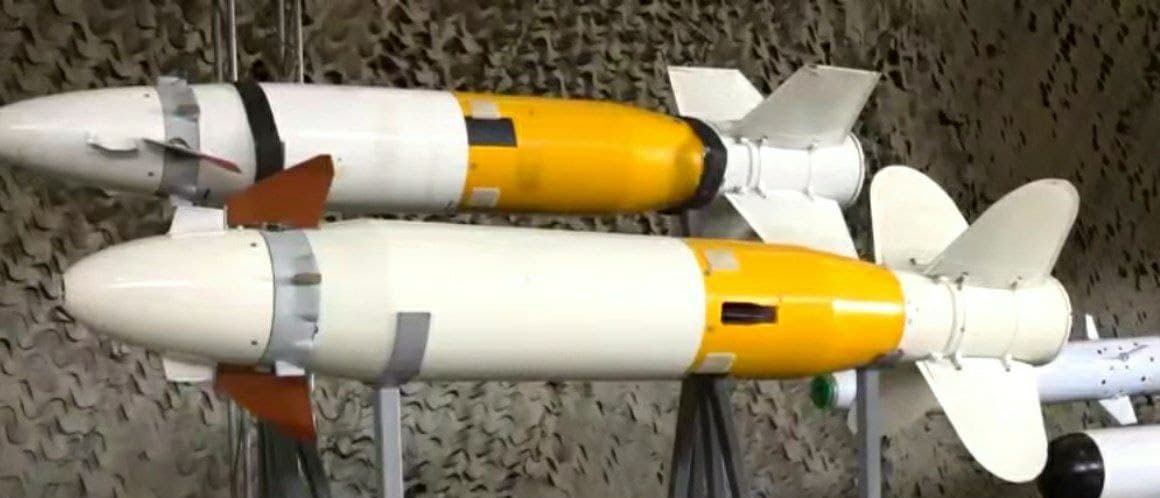
In this unveiling, a version of Dehlavieh 3 anti-armor missile, which is similar to the 9m133FM-2 model, was also unveiled with a red body. This version of the missile intended for use against light armored vehicles, personnel, field fortifications and buildings with thermobaric warhead.
Dehlavieh 3 anti-tank missile with thermobaric warhead
Dehlavieh 3 missile (9m133m-2 Kornet EM) specifications: Range: 8000-150 meters Armor penetration: 1300-1100 mm Maximum speed: 300 meters per second Missile weight (including container): 31 kg Missile tube length: 1210 mm
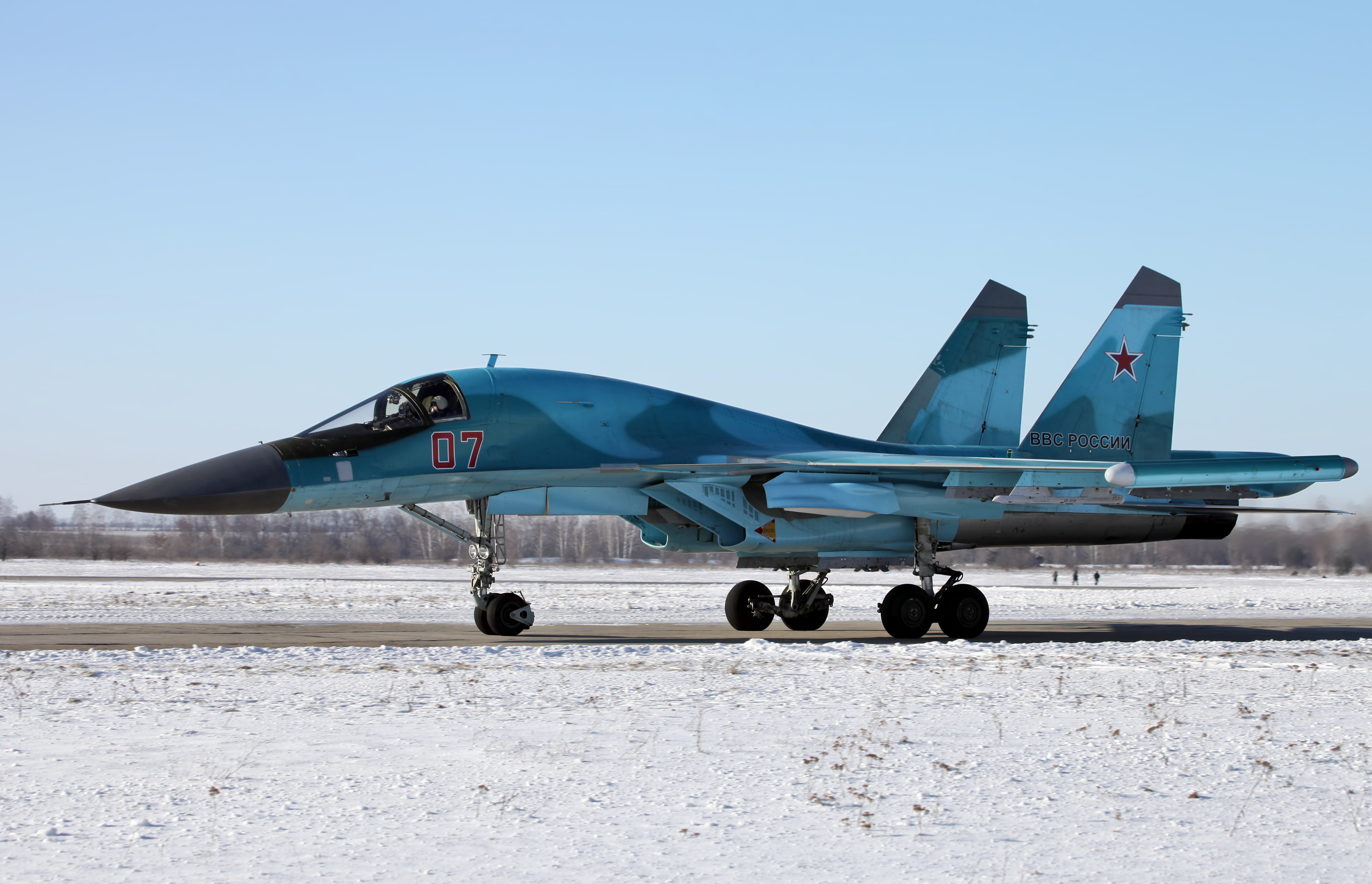
The Su-34, despite being derived from the Sukhoi Su-27 Flanker, is equipped with a cockpit with two seats next to each other; Due to its different role from other fighters in this family, it does not have the title of Flanker.
This fighter is primarily designed to attack ground and naval tactical targets and is capable of bombing, attack and air support operations. The fighter is capable of operating in any weather conditions and electronic warfare environments.
The main purpose of producing the Su-34 fighter is to replace the old Su-24 fighters and Tu-22M3 bombers in the Russian Air Force.
Su-34 fighter development
The design and development of the Su-34 fighter has a long history. Sukhoi first began a new design in the mid-1980s to replace the old Su-24 fighters. Next, the Su-27 fighter design was selected, which had a high maneuverability.
The original design of the Sukhoi 34 was known as the T10KM-2. The T10KM-2 is a Navy-derived version of the Sukhoi Su-27K. The design of the project was known in the Soviet Union as the T-10V, which was introduced in the late 1980s along with the design of the Soviet aircraft carrier Ulyanovsk.
In 1990, a photo of a prototype fighter landing on a Tbilisi aircraft carrier was released, which Western officials mistakenly identified as a Su-27KU fighter.
Tbilisi aircraft carrier: Admiral Kuznetsov aircraft carrier was first built under the name Riga, then launched under the name Leonid Brezhnev, then under the name Tbilisi conducted its naval tests and finally, it entered the service under the name of Admiral Kuznetsov.
Finally, the first flight of the Sukhoi 34 fighter jet was performed on April 13, 1990 by pilot Anatoliy Ivanov.
This version used a new nose, but the overall structure of the fighter was similar to the Su-27UB.
In 1992, the Su-27IB (Sukhoi 34 prototype) was unveiled at the MAKS Airshow and refueled from an Il-78 refueling tanker. The aircraft was officially unveiled on February 13, 1992 in Machulishi, Belarus. A year later, the fighter was re-introduced to the public at the MAKS Airshow.
The first version of this fighter, known as the T10V-2, first flew on September 18, 1993. The initial test version differed in appearance from the original because it was manufactured in Novosibirsk, the production site of the Sukhoi 24 fighter jet.
The first standard version of the Sukhoi 34 fighter jet flew on December 28, 1994, equipped with the Leninets OKB-designed V004 passive electronically scanned array radar system. This version, because it was different from the original versions, was once again introduced at the 1995 Paris Air Show under the name Su-32FN. This version was designed to serve off the coast of Russia to operate against naval targets. Sukhoi also produced another version called the Su-32MF, but it was canceled due to budget constraints.
The Russian military currently has two different versions of the Sukhoi 34, one for electronic warfare, equipped with the L700 Tarantul ECM pod, and the other for intelligence, surveillance and reconnaissance operations.
The modern version of the Sukhoi 34 is known as the Su-34M, which is equipped with a new electro-optical infrared targeting pod, a Kopyo-DL rearward facing radar that can warn the pilots if missiles are approaching, combined with automatic deployment of countermeasures and jamming
The difference between the two designs of Su-34 and Su-27KUB
The Su-27IB fighter (prototype Sukhoi 34) and the Su-27KUB, which is a naval training version, are not related to each other and each has a separate design. In appearance, the nose of the Su-27KUB design is quite round, but the nose of the Su-34 (Su-27IB) is like a duck tip.
Appearance difference between Sukhoi 34 and Sukhoi 27
Orders and delivery
The first batch of eight of these fighters was built at the Novosibirsk plant and was ready for delivery in 2004. In 2006, Russia’s defense minister announced the purchase of five Su-34 fighter jets. In late 2008, a contract was signed for the purchase of 32 Sukhoi 34 fighters until 2015.
According to reports from the Russian Ministry of Defense, by 2015, 70 Sukhoi 34s were to be replaced by 300 Sukhoi 24s, after which the program was canceled and the old Sukhoi 24s were upgraded.
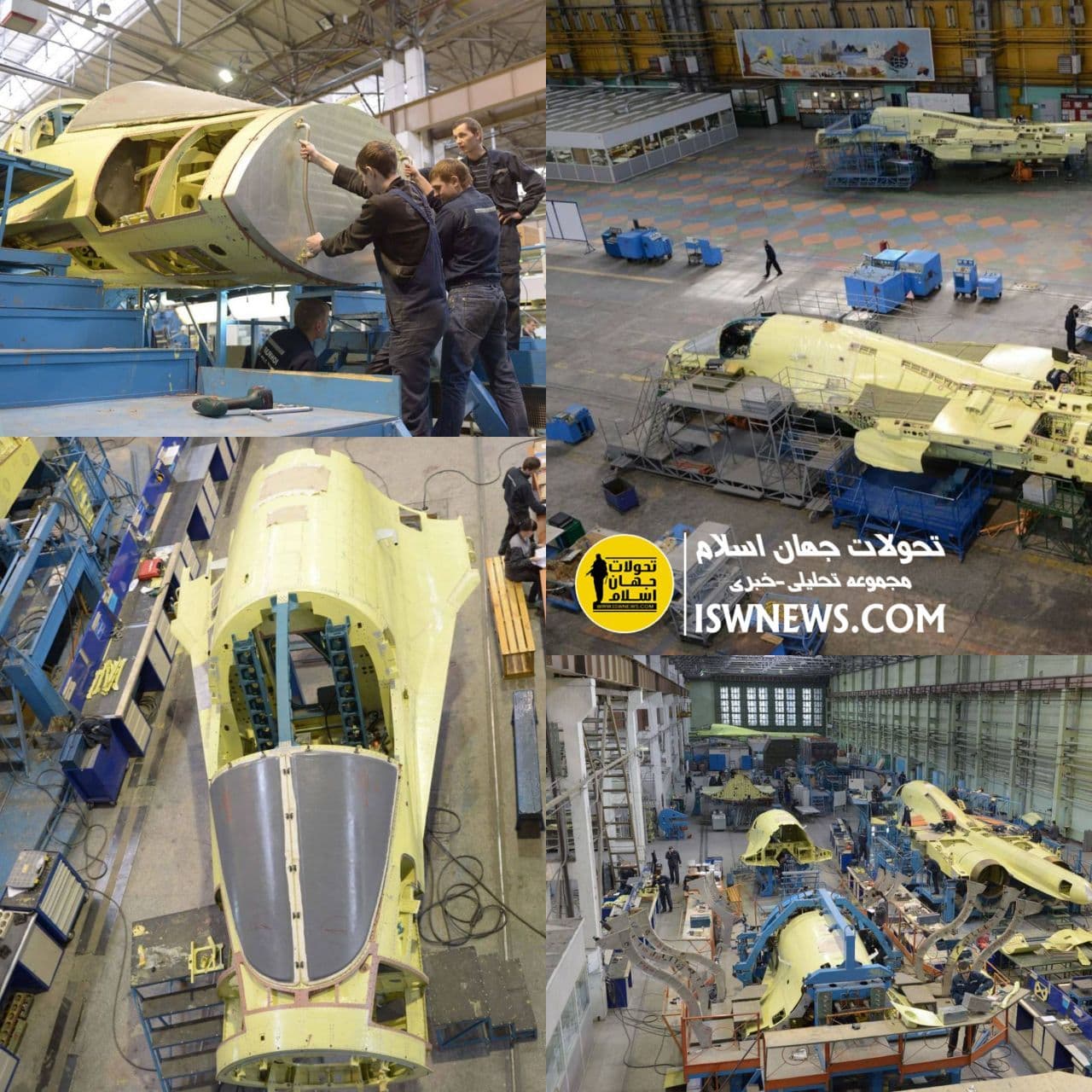
Production line/assembly of Su-34 fighter
Su-34 fighter design
The Sukhoi 34 is similar in structure to the Su-27 and Su-30 in wing, tail and engine nozzles, and similar to the Su-30MKI in the Canards. The engine of this fighter is Saturn AL-31FM1 turbofan, which is also installed on the Su-27SM fighter.
The operational range of this fighter is 4000 km with one time refueling and it is capable of carrying 8000 kg of all kinds of ammunition and weapons.
This fighter is also known by the nickname Duckling or Duckbill due to the fact that two pilots are placed next to each other. In the cockpit, the pilot is on the left and the weapons operator is on the right. One of the advantages of this design is that it is not necessary to use duplicate equipment for every pilot.
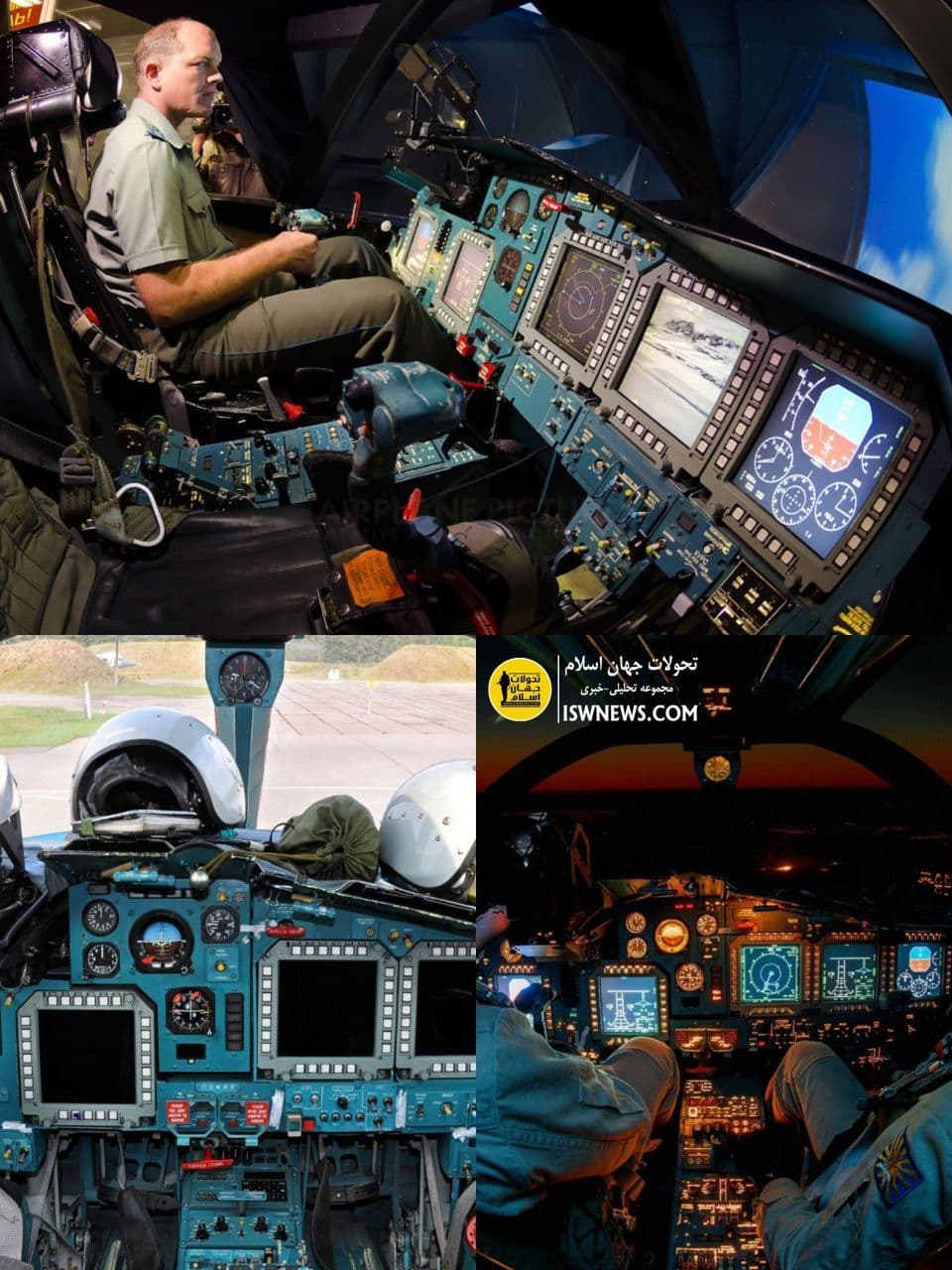
Su-34 fighter cockpit
Fighter crews are able to stand and walk inside the cockpit during long missions. Even the size of the cabin is so large that the pilot and operator have the ability to lie down and sleep on the floor. There is also a toilet and a small kitchen behind the crew seats.
Toilet inside the Su-34 fighter
The crew enters the fighter through a ladder from under the cockpit. The entire cockpit is covered with 17mm armor to withstand a variety of threats.
Ladder under the cockpit of the Su-34
The Su-34 fighter is equipped with the Helmet Mounted Display System (HMDS). HMDS is a device used in aircraft to project information to the pilot’s eyes. It provides the pilot with situation awareness, an enhanced image of the scene and cue weapons systems to the direction their head is pointing.
Su-34 fighter helmet
The radar of this fighter is Leninets OKB-designed V004 passive electronically scanned array radar, which has the ability to detect a variety of targets. The detection range of this radar is 200 to 250 km and it has the ability to detect 10 targets simultaneously. It also has the ability to engage with 4 targets simultaneously. In addition to the main radar, a N012 rearward-facing warning radar is used behind the fighter, which has a range of 120 km.
Sukhoi 34 front and rear radarVideo of Su-34 fighter flying, maneuvering, takeoff, landing, firing various missiles, rockets, etc.
Su-34 fighter-bomber specifications: Length: 23.34 m Wing length: 14.7 m Height: 6.09 m Empty weight: 22500 kg Gross weight: 45100 kg Engine: 2 × Saturn AL-31FM-1 turbofan Speed: 2200 km/h Range: 1100 km Service ceiling: 17,000 meters Crew: 2 Origin: Soviet Union (Russia) First flight: 13 April 1990 Produced: 2006–present Hardpoints: 12 × on wing and fuselage with a capacity of 8000 kg
Su-34 Armament:
Guns: 1 × 30 mm Gryazev-Shipunov GSh-30-1 autocannon with 180 rounds
KAB-500KR and KAB-1500KR TV guidance bombs KAB-500L and KAB-1500L laser guided bombs KAB-500OD guided bombs KAB-500S-E satellite guidance bombs RBK-500 and SPBE-D cluster bombs BETAB-500SHP concrete-piercing bombs ODAB-500PM, OFAB-100-120 and OFAB-250-270 free-fall bombs
80 mm S-8 missiles with a range of 1 to 4.5 km 122 mm S-13 missiles with a range of 1 to 4 km 340 mm S-25 rockets
Vympel R-73 short-range air-to-air missile with a range of 30 km All versions of the Vympel R-27 medium-range air-to-air missile with a range of 40 to 170 km Vympel NPO R-77 medium-range air-to-air missile with a range of 80 to 200 km
Kh-29 air-to-surface missile with a range of 10 to 12 km Kh-25 air-to-surface missile with a range of 11 to 60 km Kh-38 air-to-surface missile with a range of 70 km Kh-58 air-to-surface missile with a range of 120 km Kh-59 air-to-surface missile with a range of 200 km
Kh-36 cruise missile with a range of 120 km Kh-65SE cruise missile with a range of 600 km Kh-SD cruise missile with a range of 300 to 1,900 km
Kh-31A / AD anti-ship missile with a range of 25 to 105 km Kh-41 anti-ship missile with a range of 120 to 240 km Kh-35U anti-ship missile with a range of 300 km Kh-61 anti-ship missile with a range of 300 to 600 km
Kh-25MP anti-radar missile with a range of 60 km Kh-31P anti-radar missile with a range of 110 km Kh-58 anti-radar missile with a range of more than 120 km
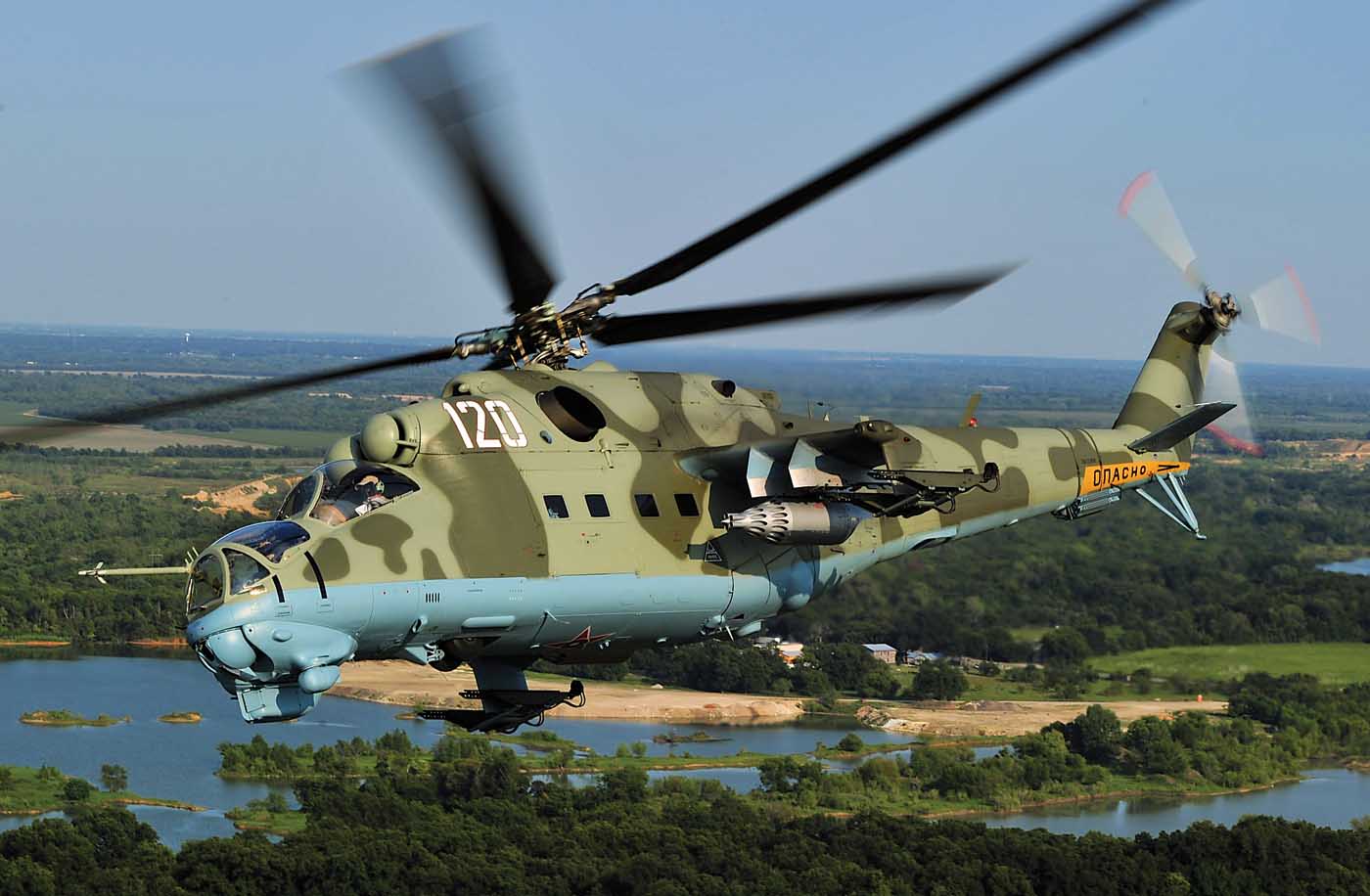
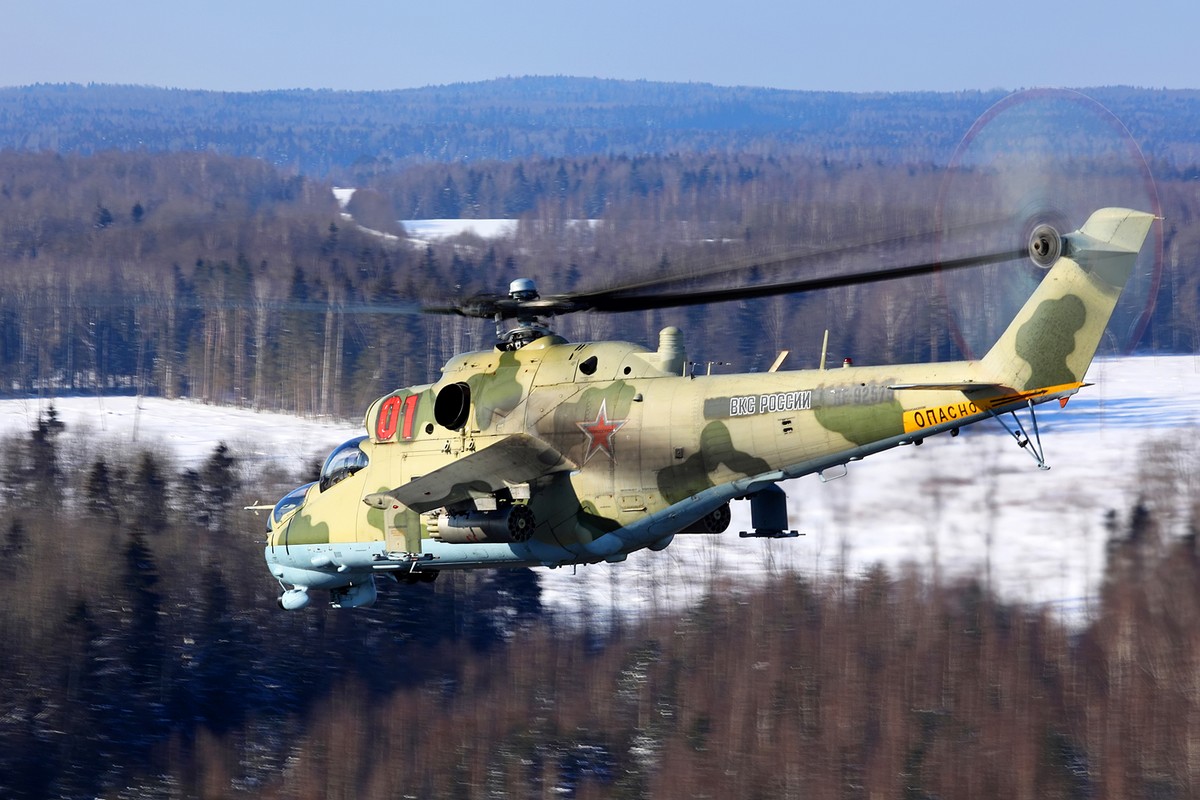
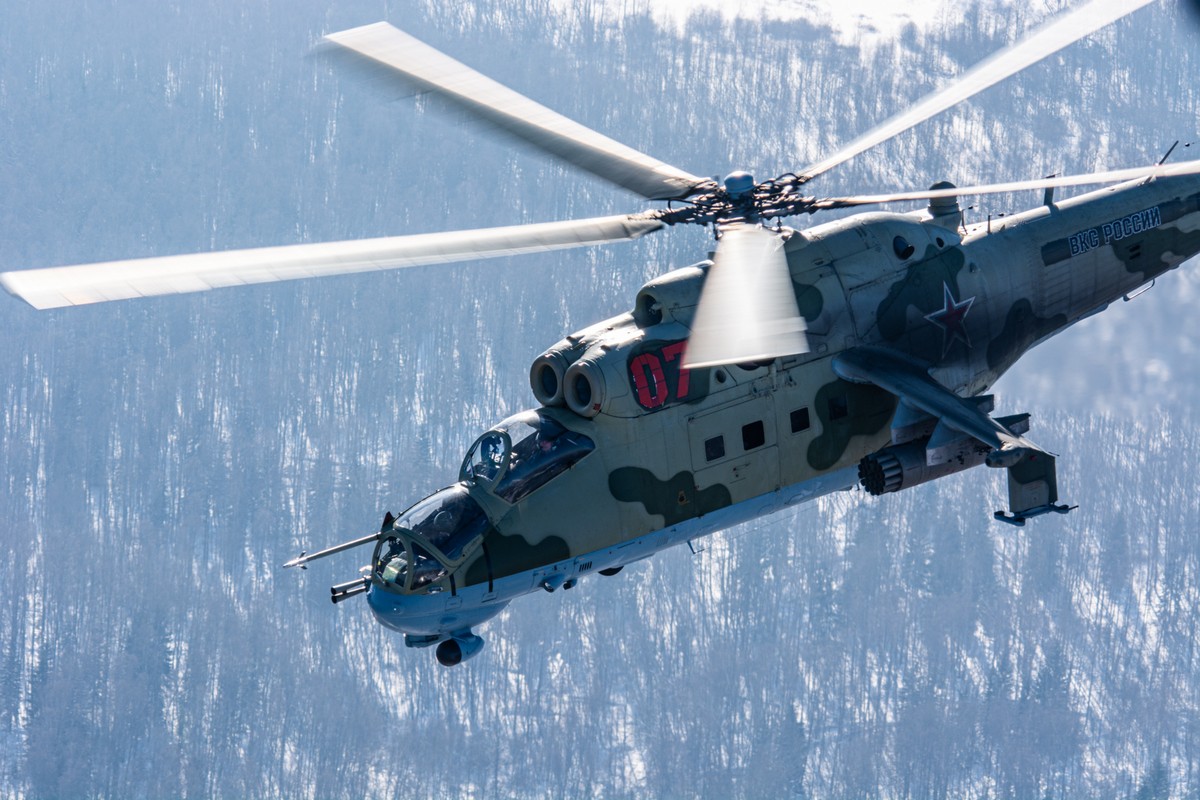
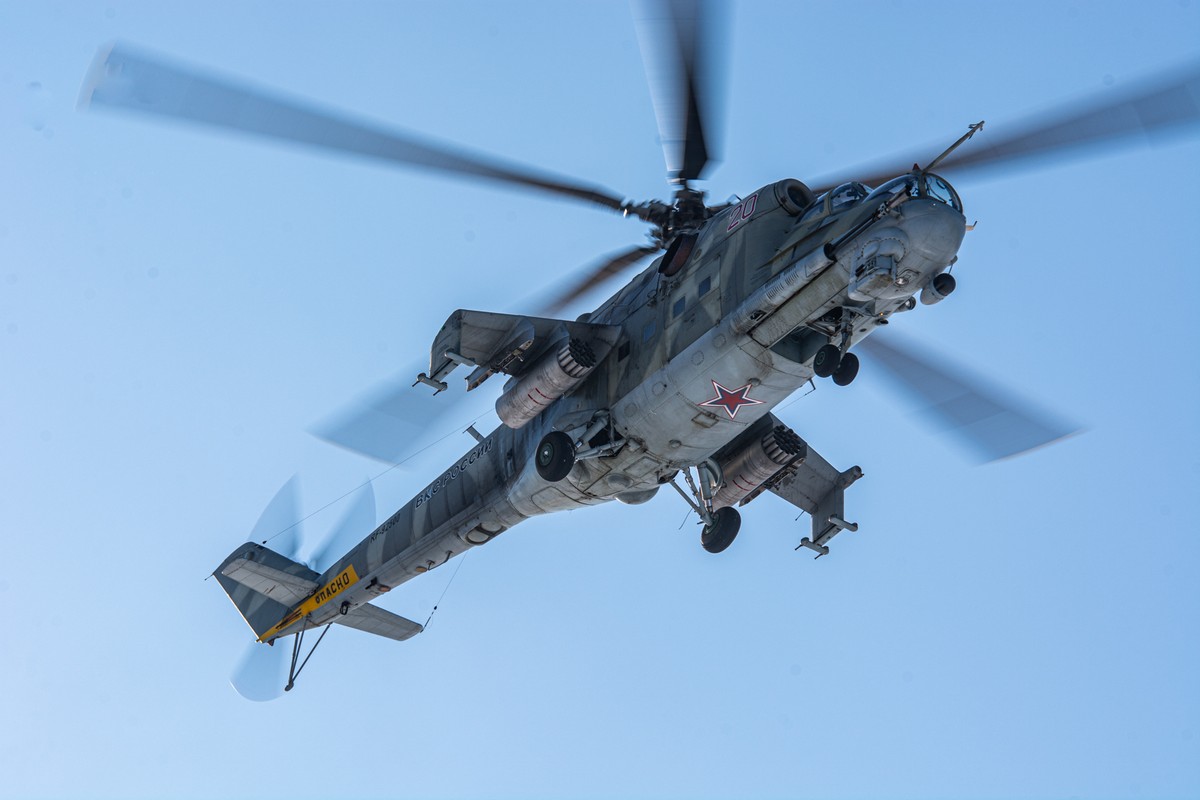
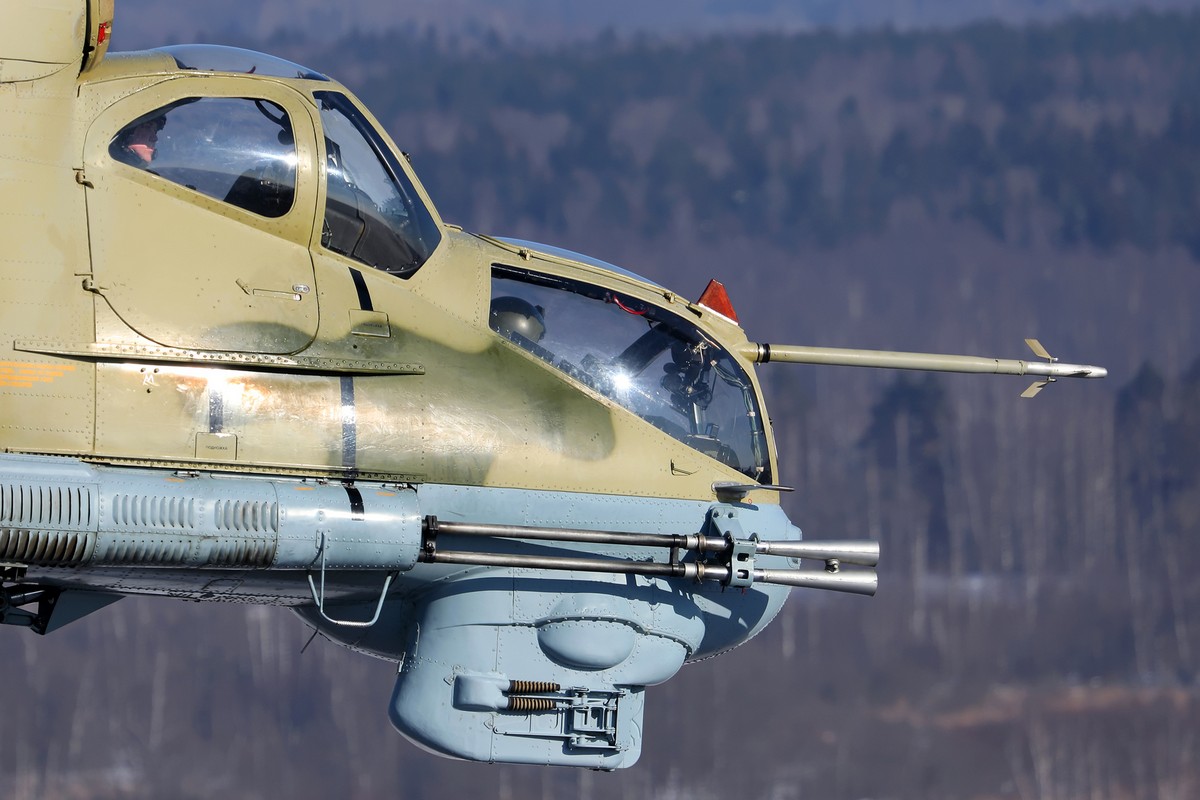
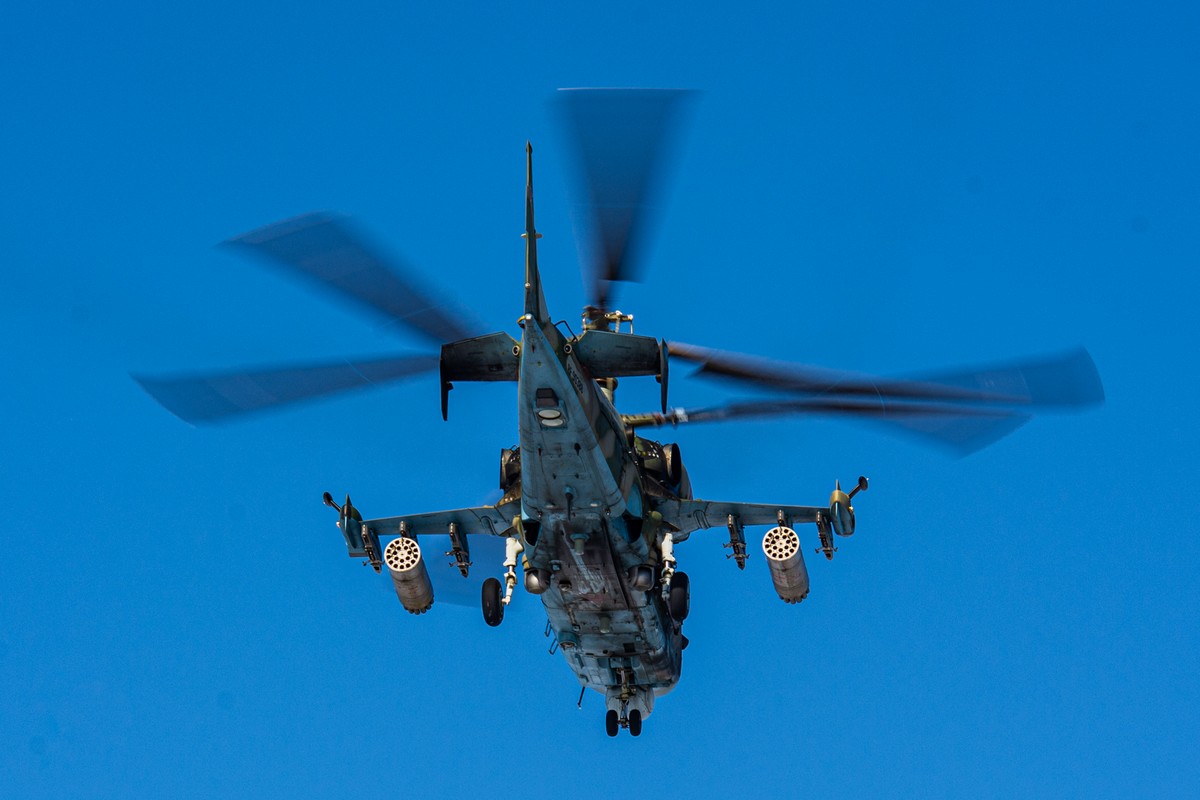
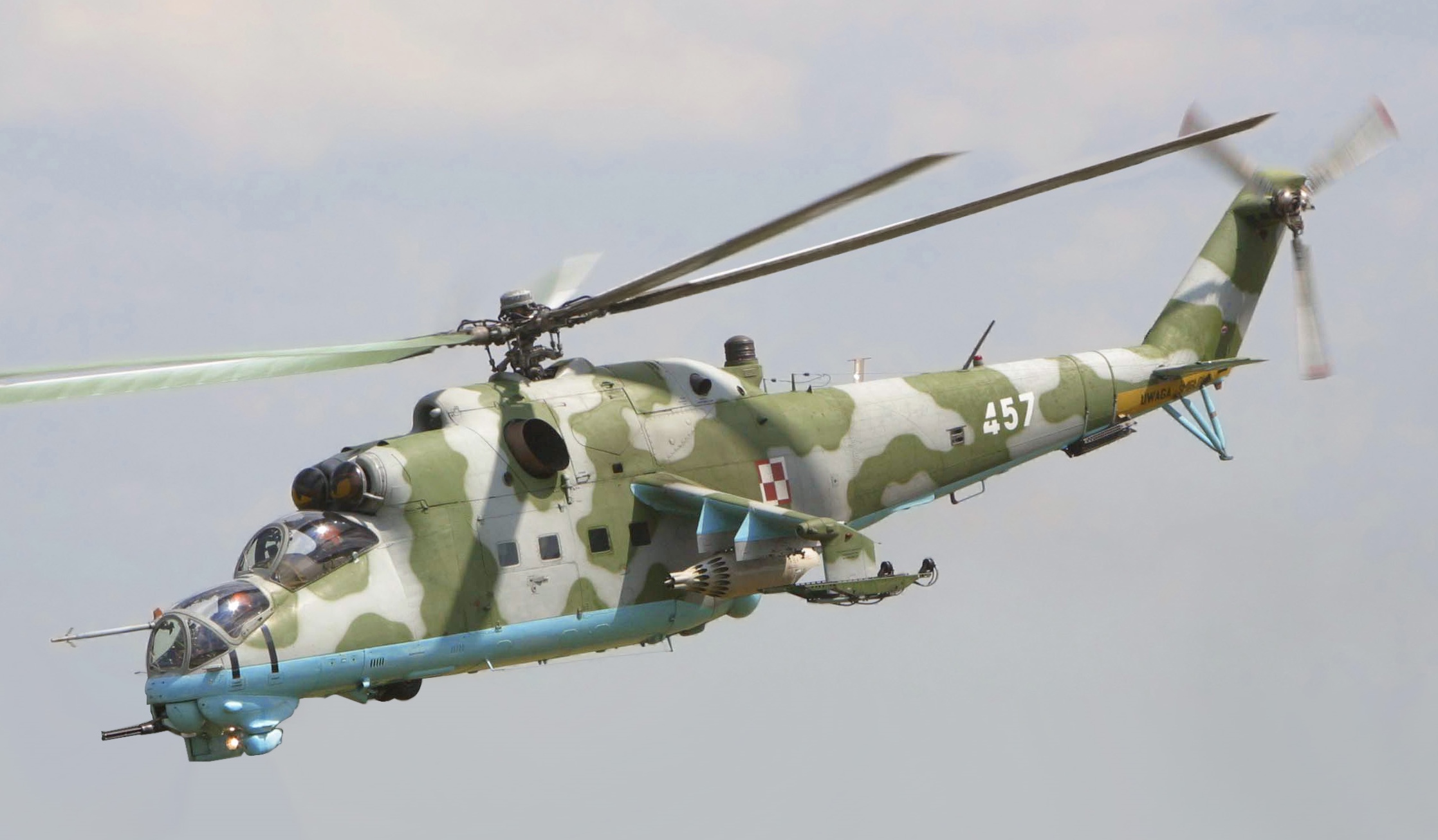
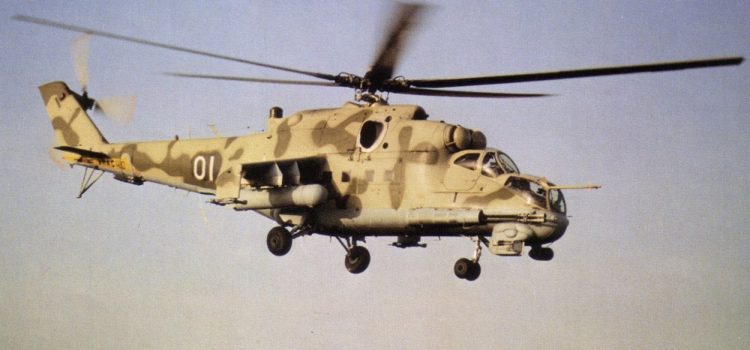
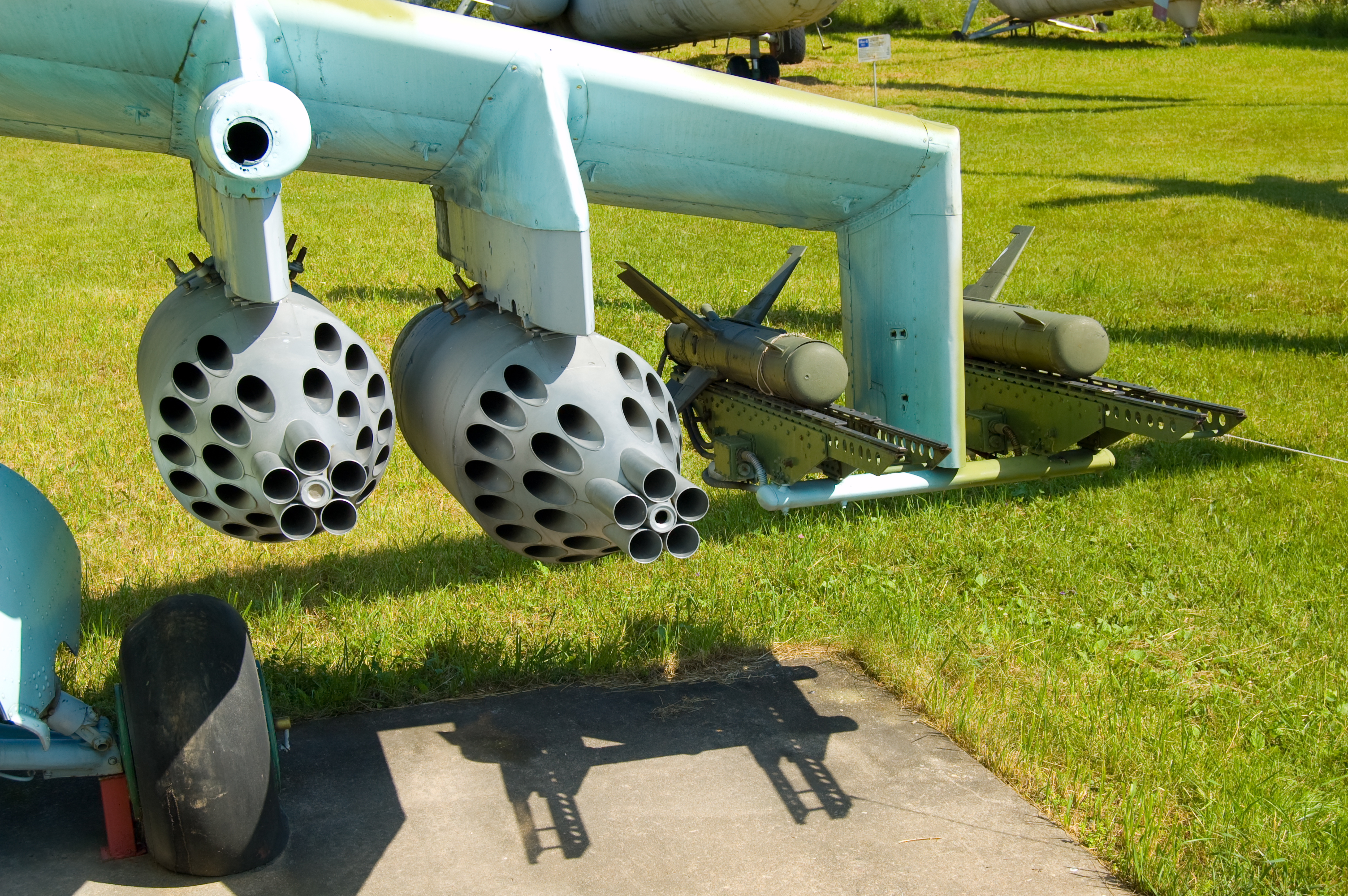
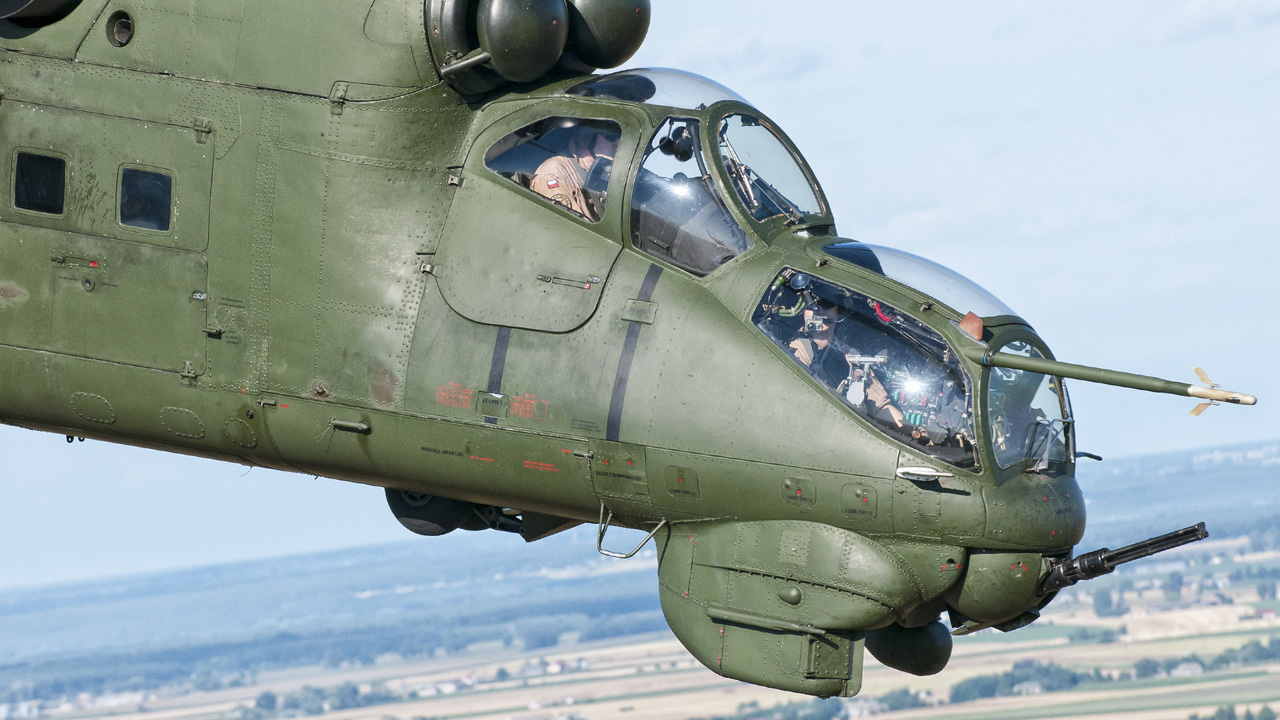
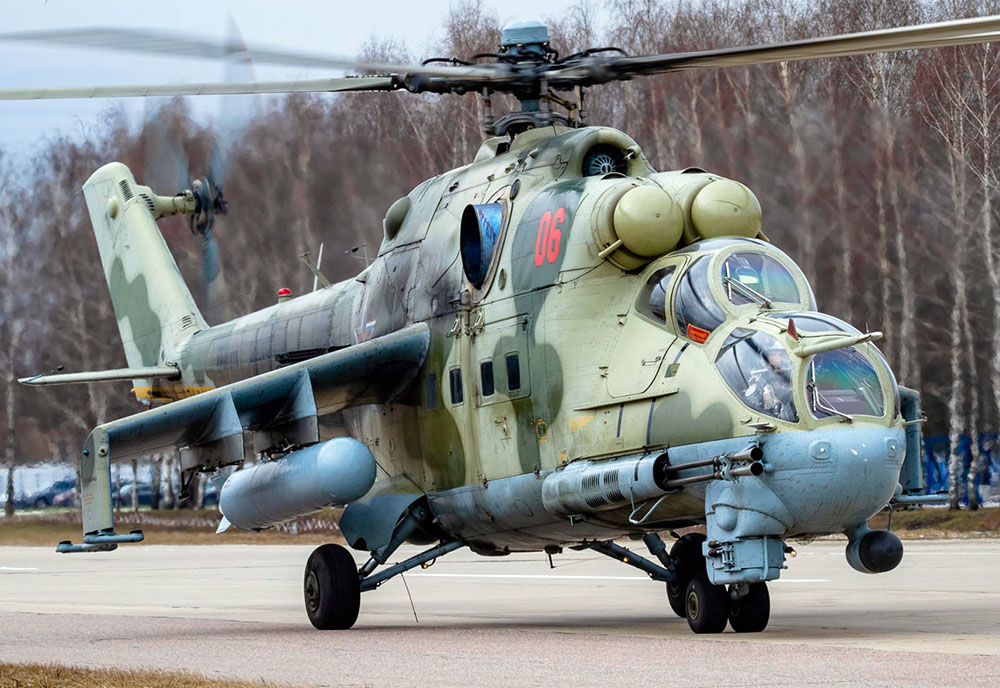
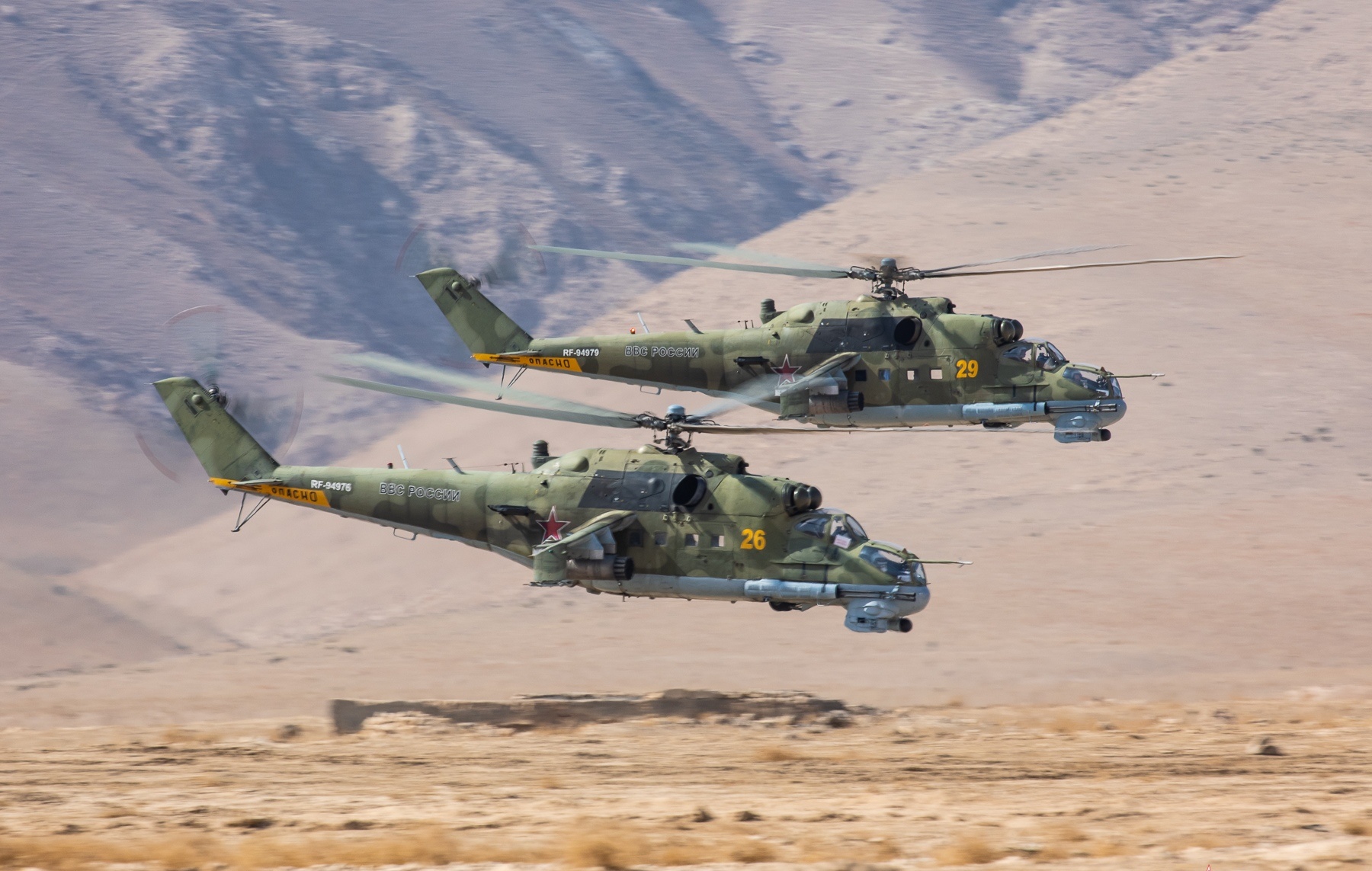
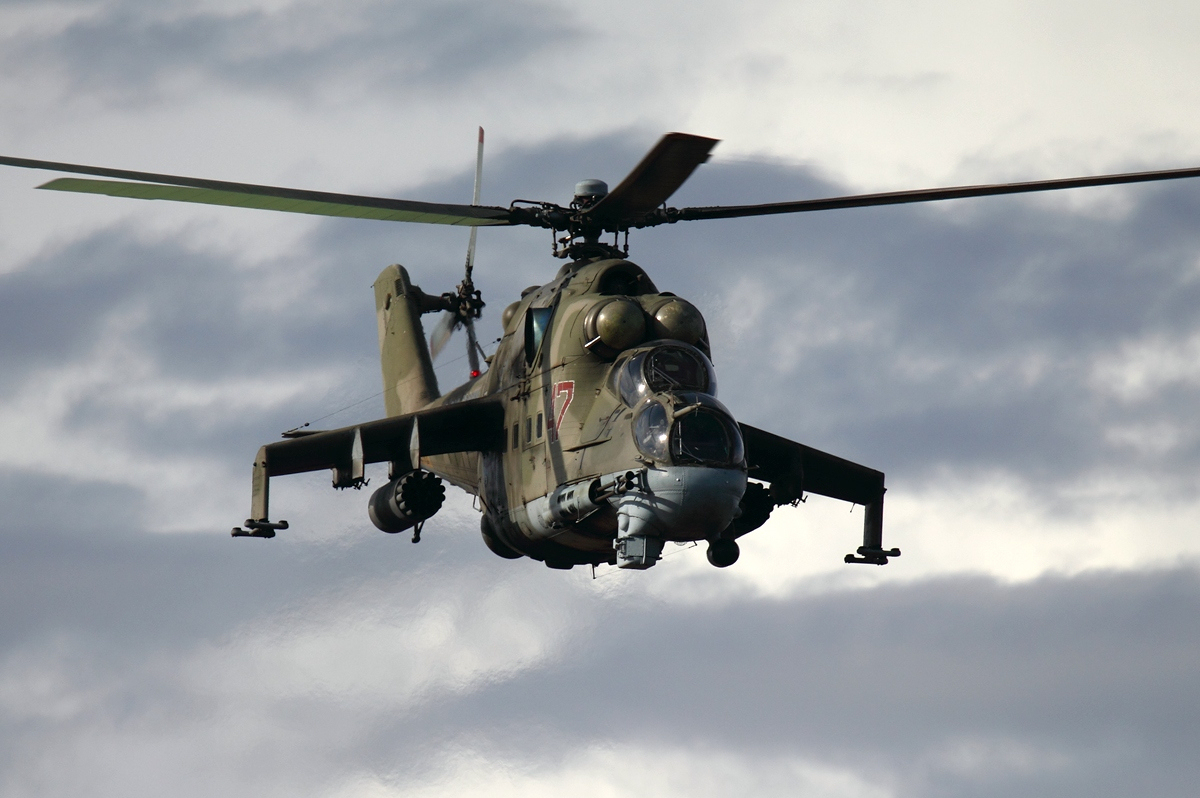
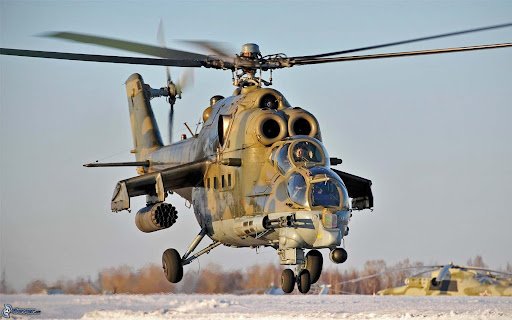
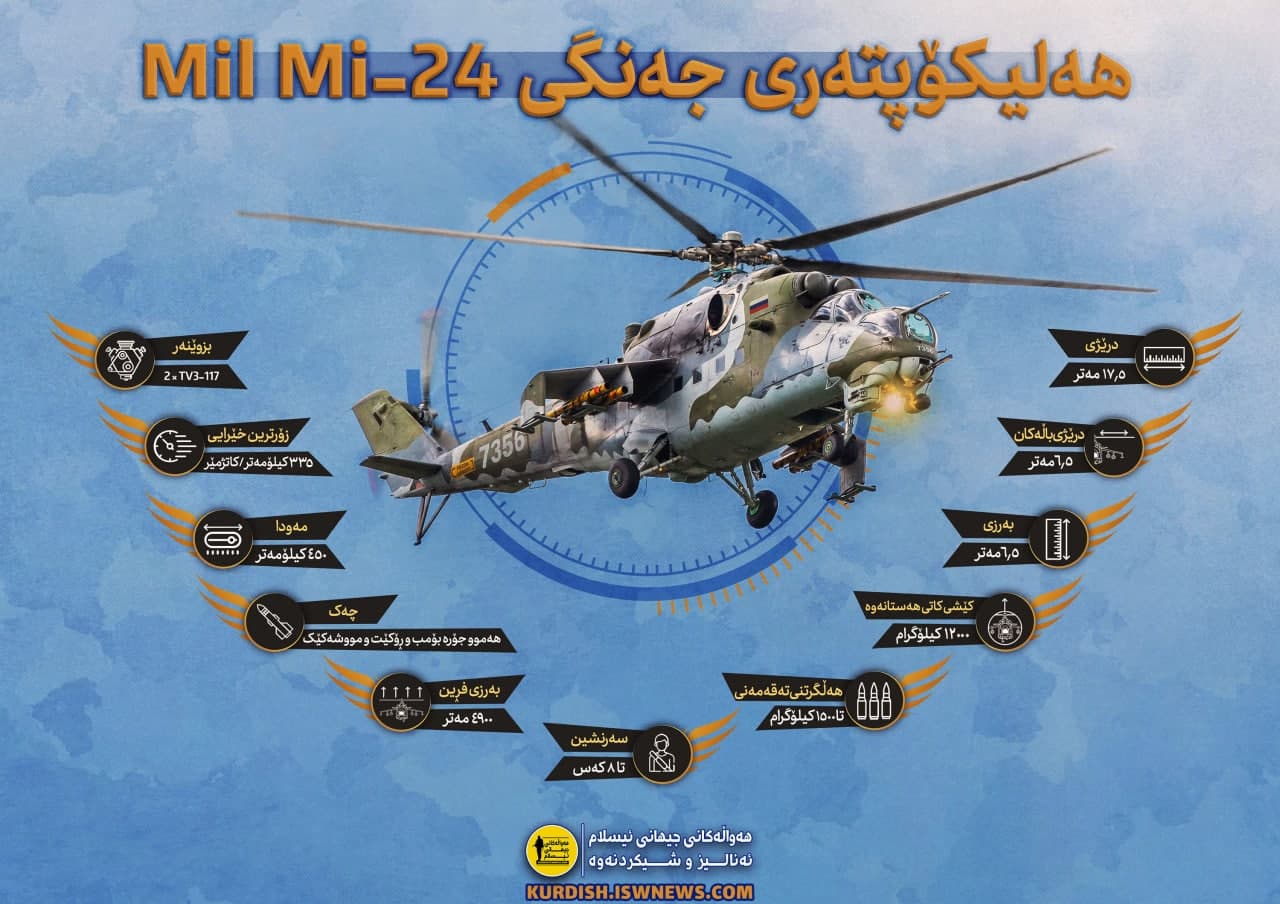
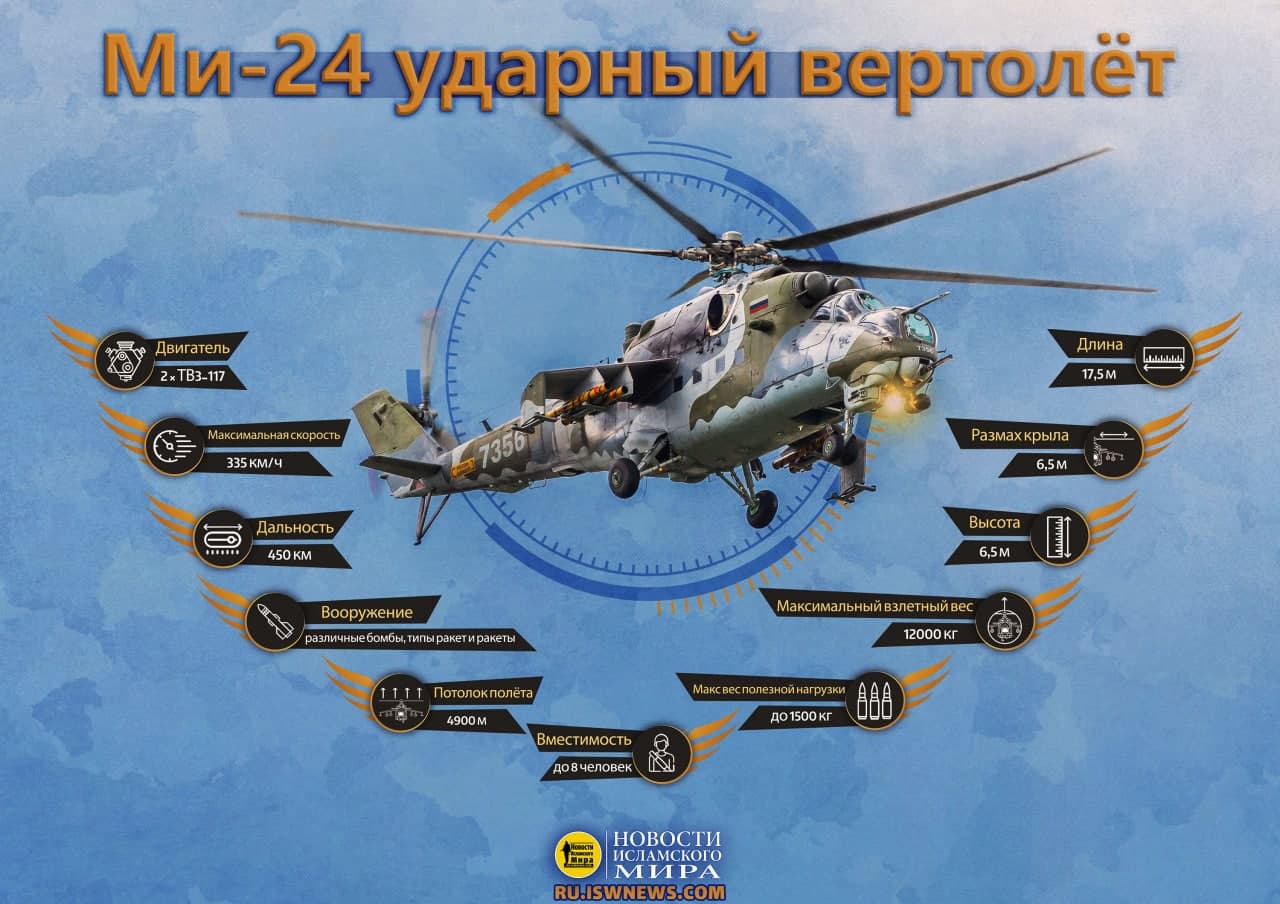
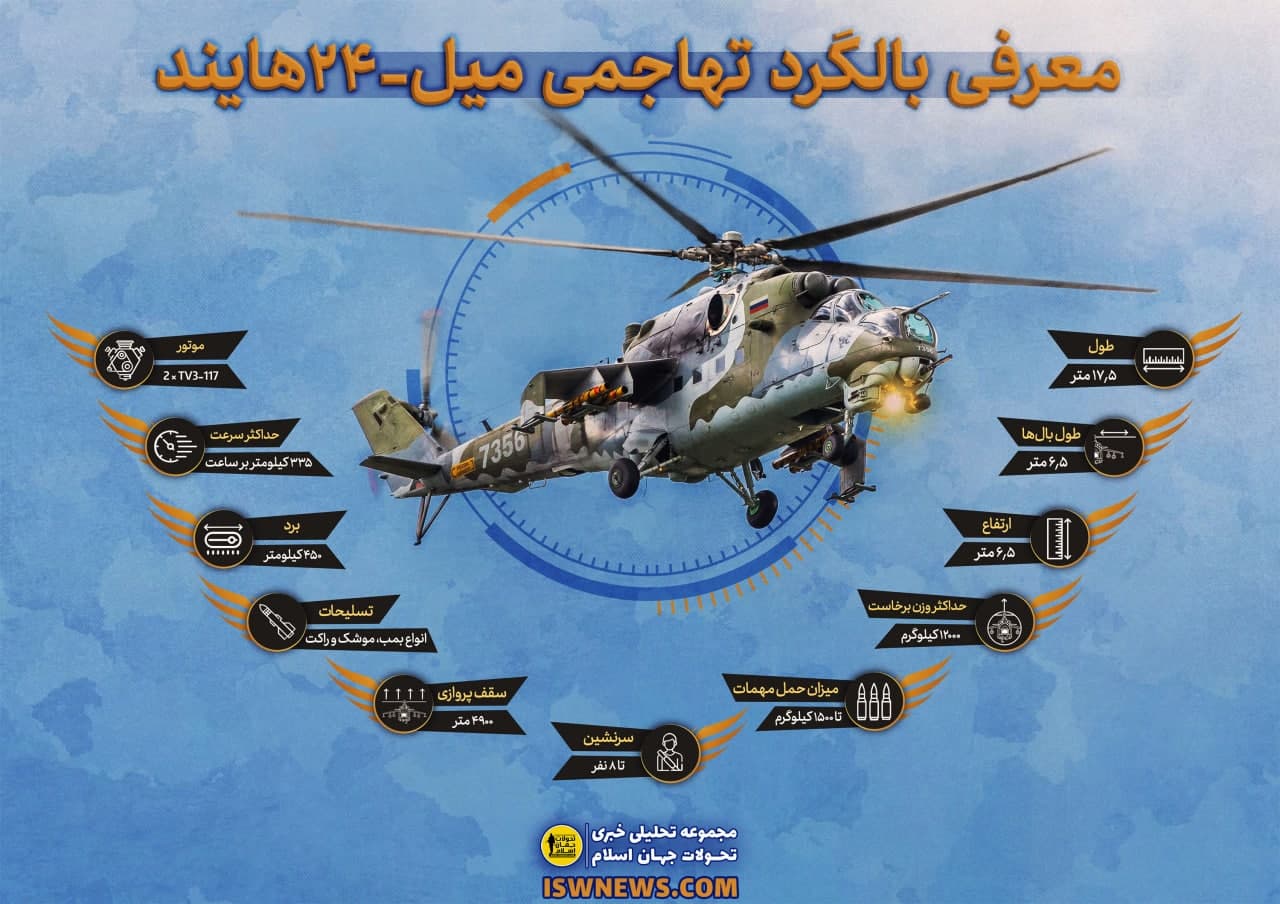
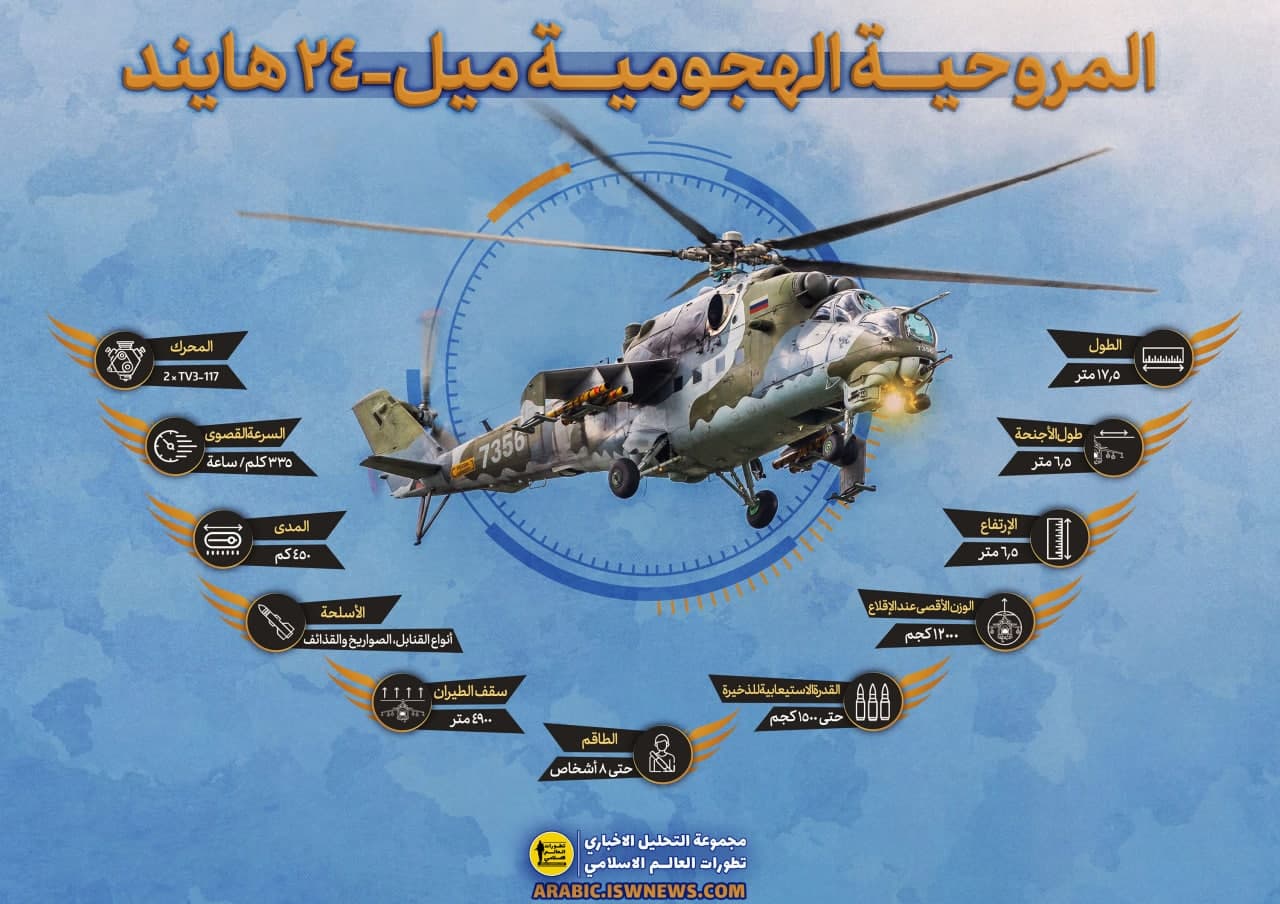
The design of the Mil-24 helicopter has striking similarities with the famous Mil-17 transport helicopter, and the number of common components between the two helicopters is significant, and this has encouraged countries that own the Mil-17 transport helicopter to use the Mil-24; The Mil-24 helicopter has been used in the armies of 48 countries.
One of the capabilities of the Mil-24 is the ability to carry up to eight people, and this feature was widely used by the Soviet Air Force in the war in Afghanistan.
The body of this helicopter is reinforced with titanium to be resistant to bullets up to 12.7 mm caliber. The rotor of the helicopter is also made of titanium and is resistant to bullets up to 12.7 caliber.
In order to protect the crew against the atomic biological chemical (ABC) agents, the air pressure inside the cabin is higher than the environment and prevents the entry of ABC agents into the cabin.
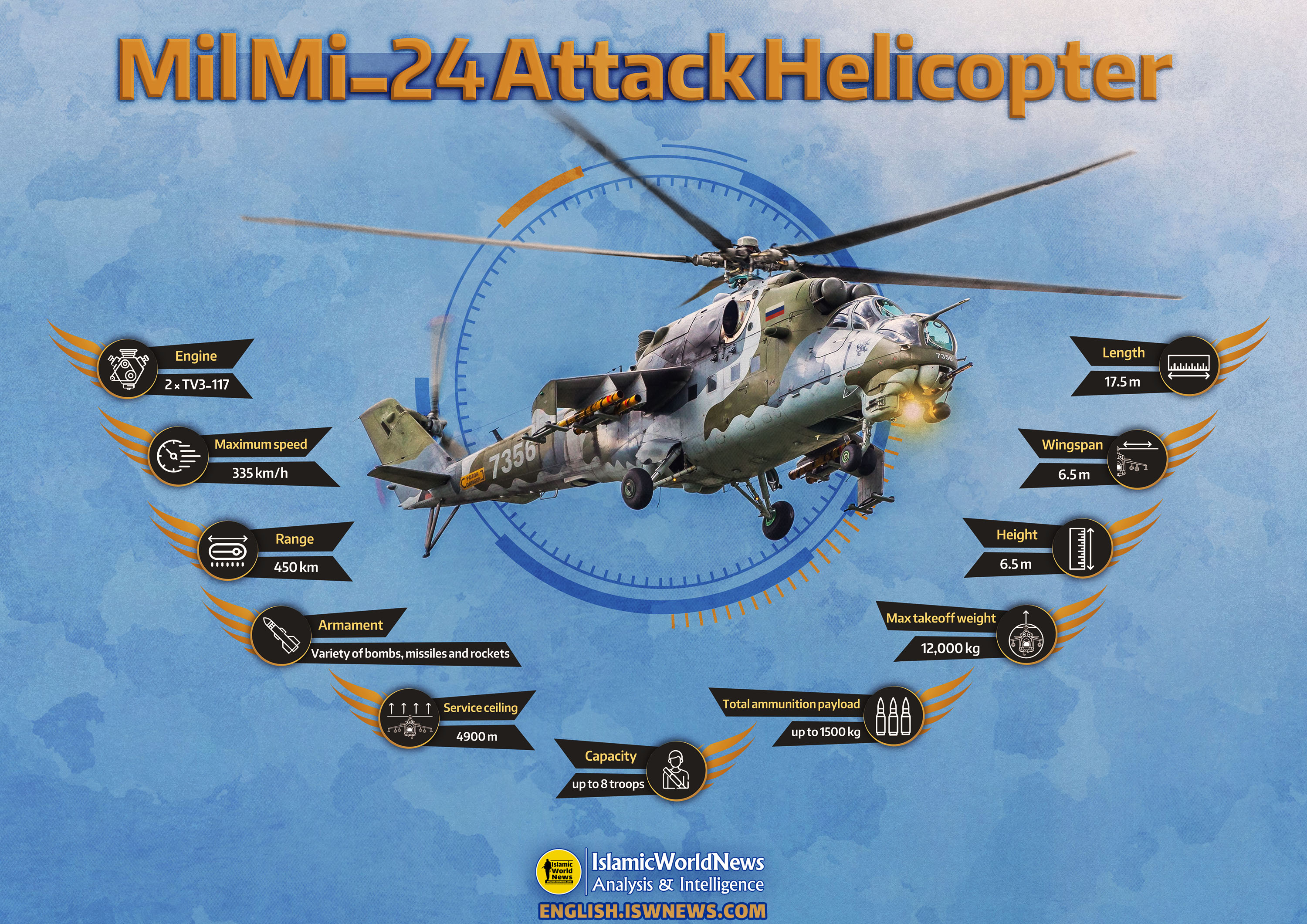
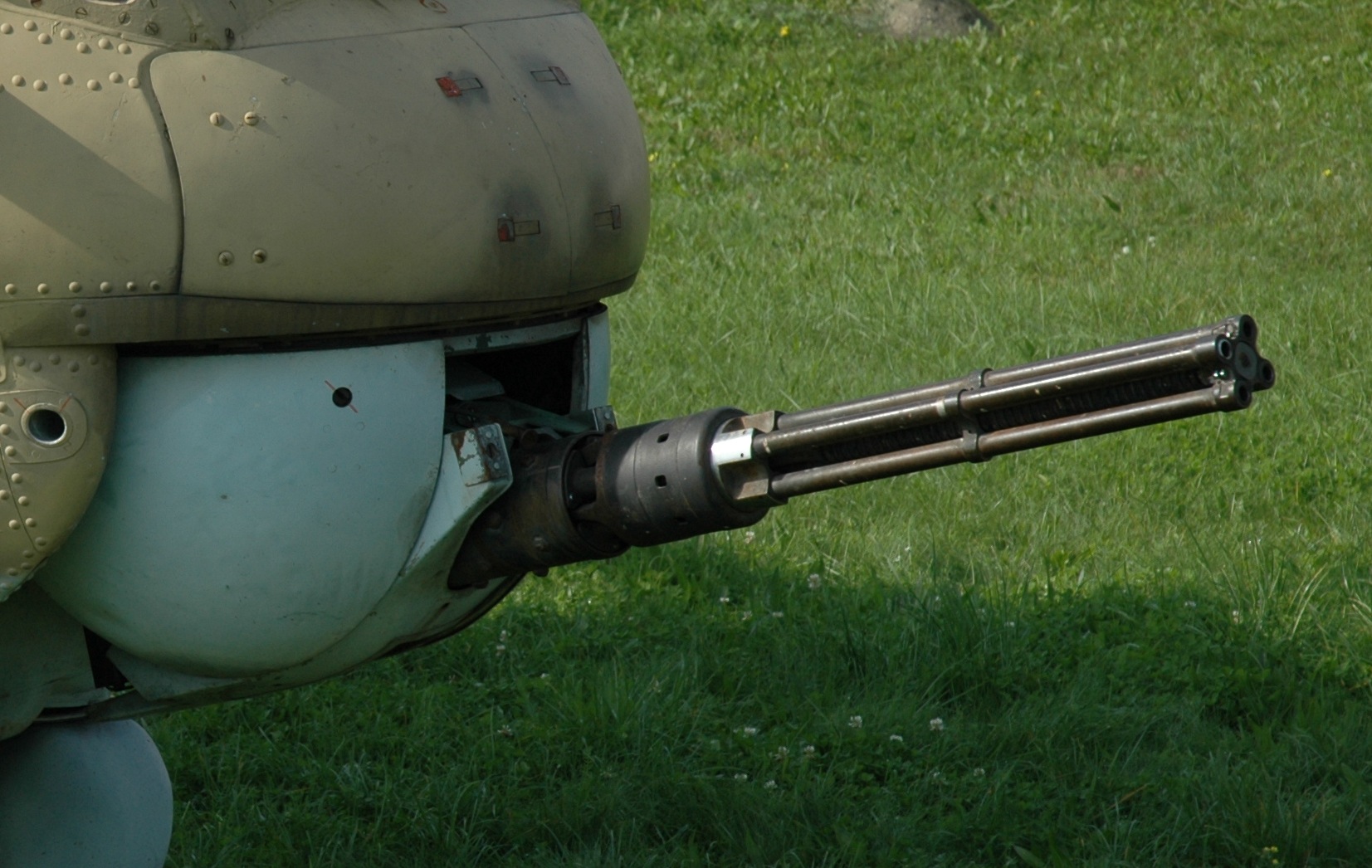
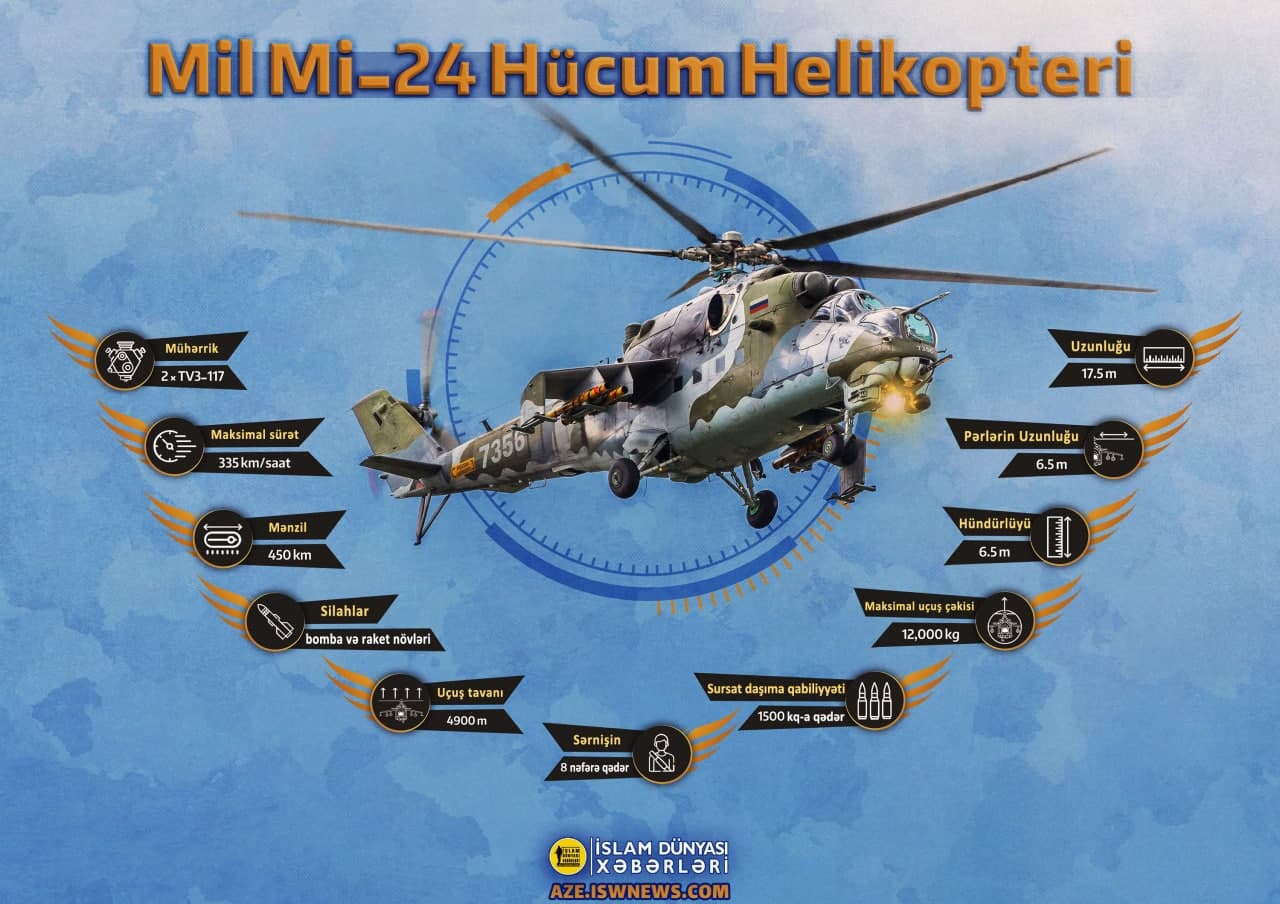
Mil Mi-24 Attack Helicopter specifications: Length: 17.5 m Wingspan: 6.5 m Height: 6.5 m Max takeoff weight: 12,000 kg Engine: 2 × TV3-117 Maximum speed: 335 km/h Range: 450 km Service ceiling: 4900 m Capacity: up to 8 troops Total ammunition payload: up to 1500 kg Armament: Variety of bombs, missiles and rockets Origin: Soviet Union (Russia)
Click to see the full size image
“Mil Mi-24 Attack Helicopter” collection of posters in Persian, Arabic, Kurdish, Azeri, Russian for Social Media:
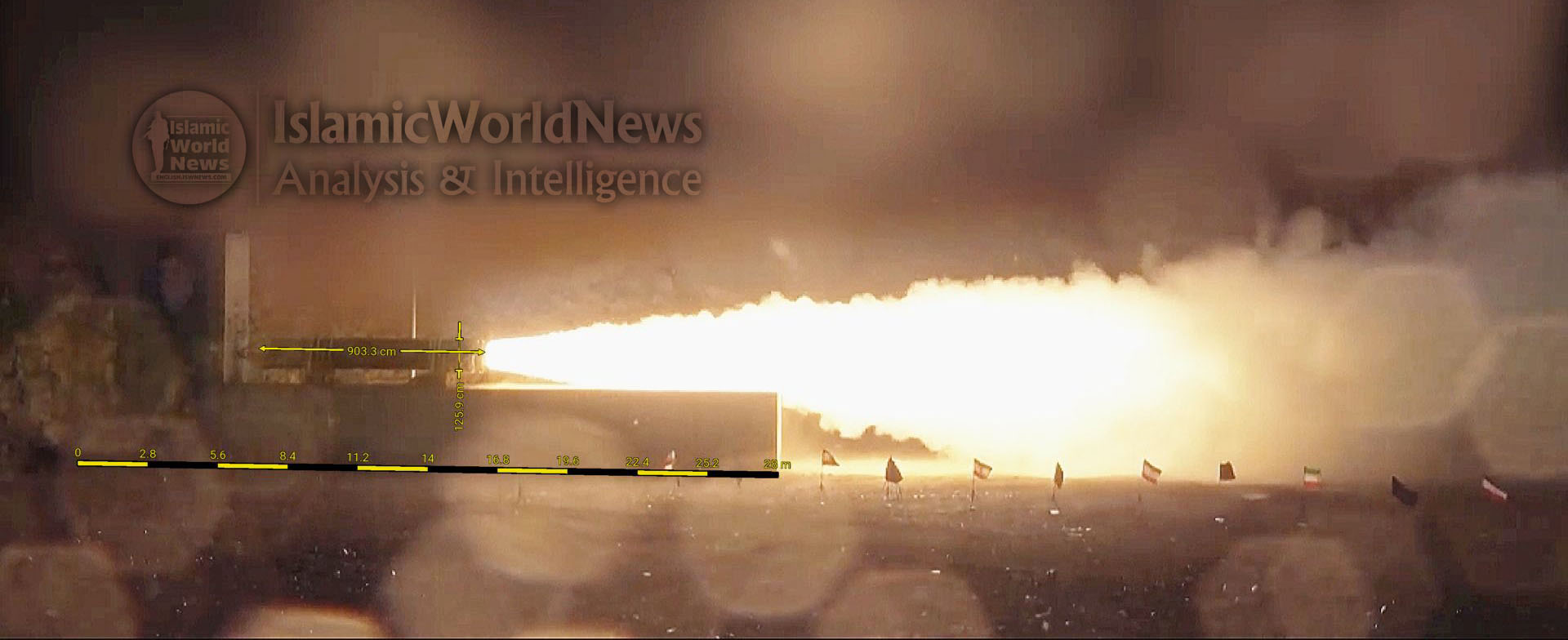
Rafe solid-fuel engine has a composite body made of carbon fiber composite and can withstand up to 100 bar pressure. The use of carbon fiber in the construction of the fuselage greatly reduces the dead weight of the engine and provides a Structural Ratio ratio of about 10%, paving the way for the construction of missile and light rocket engine with a high mass ratio.
According to the footages, the test was performed on a horizontal solid fuel test platform in the coordinates of 36°13’03.7″N 55°21’44.0″E in Shahroud base.
According to the length of the platform, which is 28 meters, the length of the ‘Raafe’ engine is 9 meters and its diameter is 1.25 meters in accordance with the standard diameter of Shahab-3, Qadr, Safir, etc. missiles.
The nozzle of this engine is Flexnozzle type to control the thrust vector, similar to Salman second stage engine. The advantage of using a Flexnozzle is better propulsion performance compared to the Jet Vane-based thrust vector mechanism in the Sejjil solid-fueled missile and the Zuljanah satellite launch vehicle.
The closest solid-fuel engine to the ‘Raafe’ engine can be considered the GEM 46 engine, which with a chamber pressure of 105 bar, a thrust of about 60 tons and a special impact of 242 seconds at sea level and a carbon fiber composite body material and a structural factor of about 11%.
The first-stage “Raafe” rocket engine can be used on the Qased-2 satellite launch vehicle, which is a light satellite launch vehicle; However, due to the size and performance of this engine, it can be used in a small intercontinental ballistic missile like the MGM-134 Midgetman missile or an extraterrestrial interceptor missile such as the GBI missile.
According to the specifications of GEM 46 engine, the specifications of Raafe engine are estimated as follows: Weight: 12.5 tons Structure coefficient: 10% Special Impact (Shahroud Conditions): 250 seconds Length: 9 meters Diameter: 1.25 meters Burning time: 65+ seconds Maximum trust: 68 tons
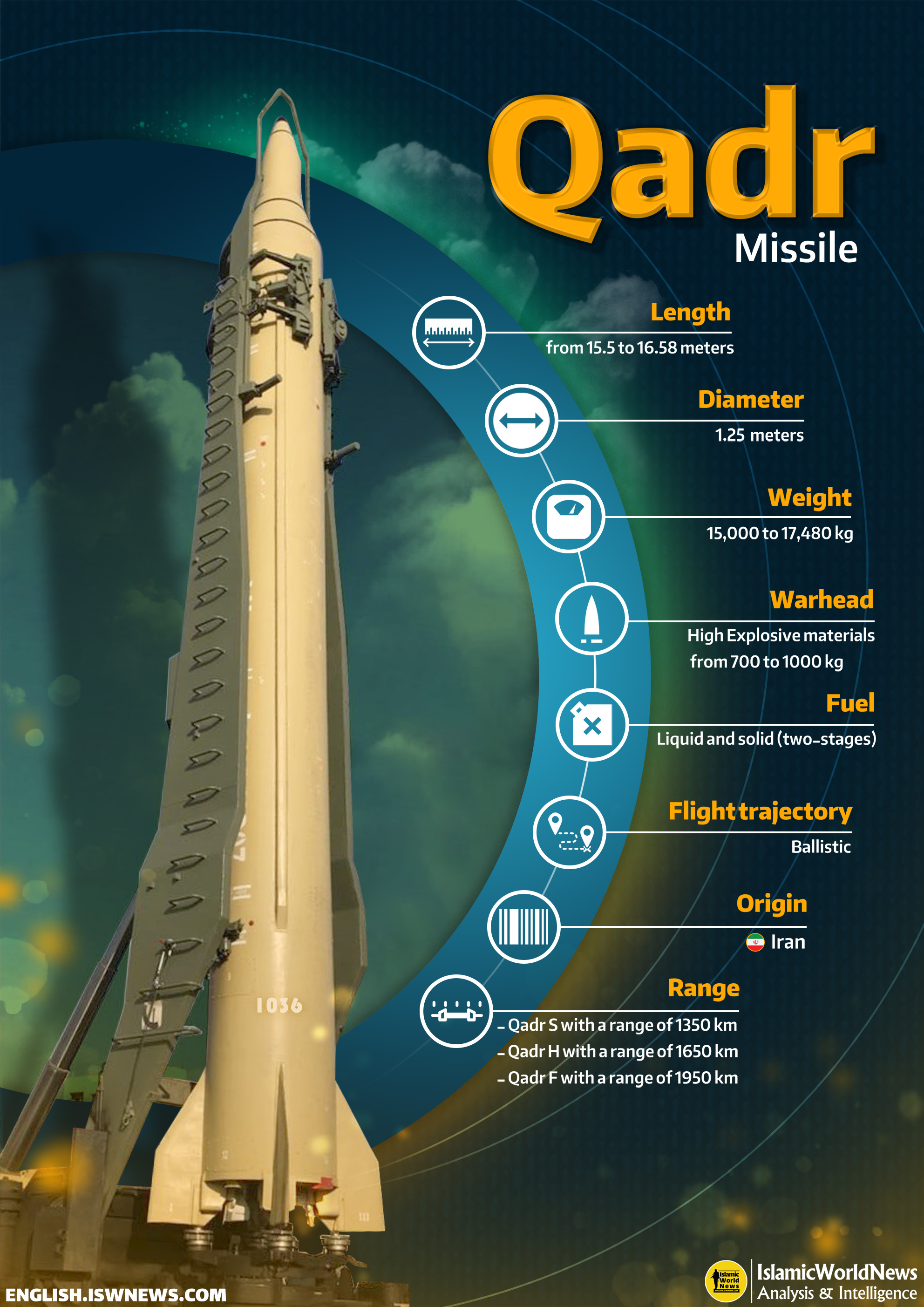
The Qadr missile is a medium-range ballistic missile based on the Shahab 3 missile. In the past, this missile was also called Qadr 1, Qadr 110 and Qadr 101.
The Qadr missile was unveiled for the first time in an annual parade marking the anniversary of the start of the Iran-Iraq war. This missile has been produced in three types: “Qadr S” with a range of 1,350 km, “Qadr H” with a range of 1,650 km and “Qadr F” with a range of 1,950 km.
The Qadr missile set-up time is 30 minutes and is much faster than the Shahab 3 missile, which takes hours to install and launch. Some sources consider the Qadr missile a two-stage missile, the first stage is liquid fuel and the second stage, which is related to detachable warheads, is solid fuel. However, some sources believe this missile to be just liquid fuel.
The speed of the “Qadr F” missile is estimated at Mach 9 and its navigation system is based on inertia-GPS guidance.
The Qadr F missile is capable of carrying warheads weighing up to 1000 kg. Qadr series missiles also have warheads in different types such as blast and cluster.
Qadr ballistic missile specifications: Length: from 15.5 to 16.58 meters Diameter: 1.25 meters Weight: 15,000 to 17,480 kg Warhead: High Explosive materials from 700 to 1000 kg Fuel: Liquid and solid (two-stages) Range: Qadr S with a range of 1350 km Qadr H with a range of 1650 km Qadr F with a range of 1950 km Flight trajectory: Ballistic Origin: Iran
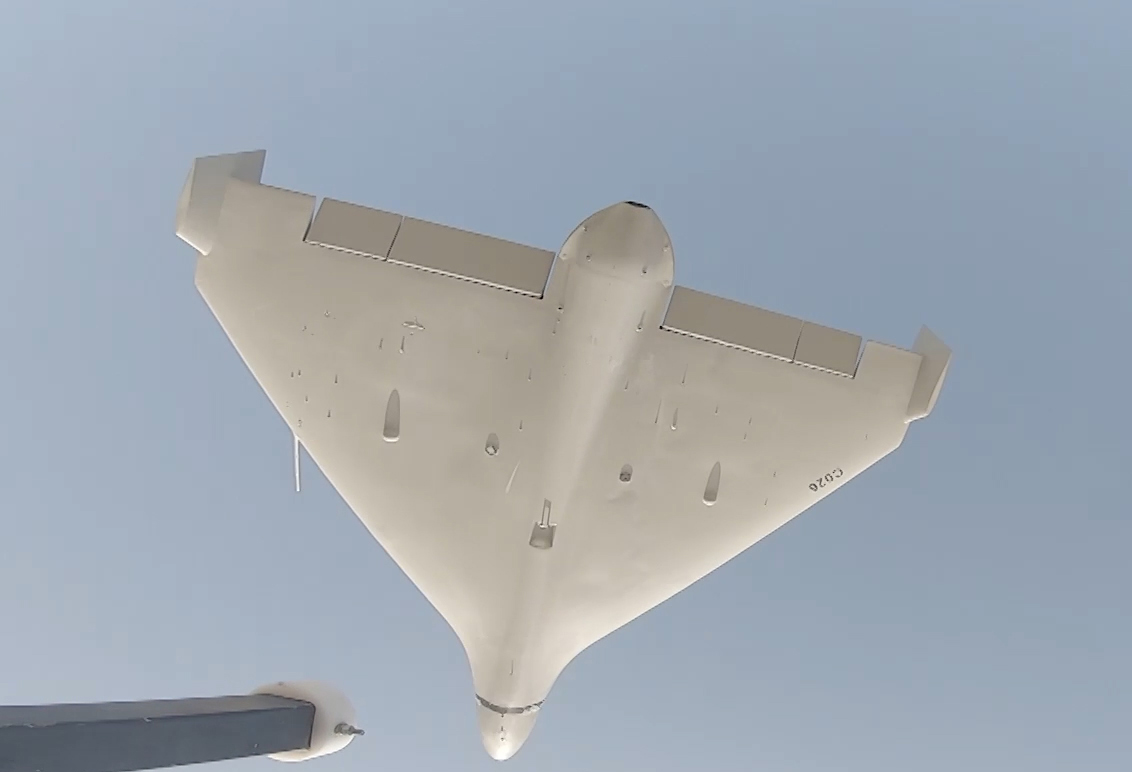
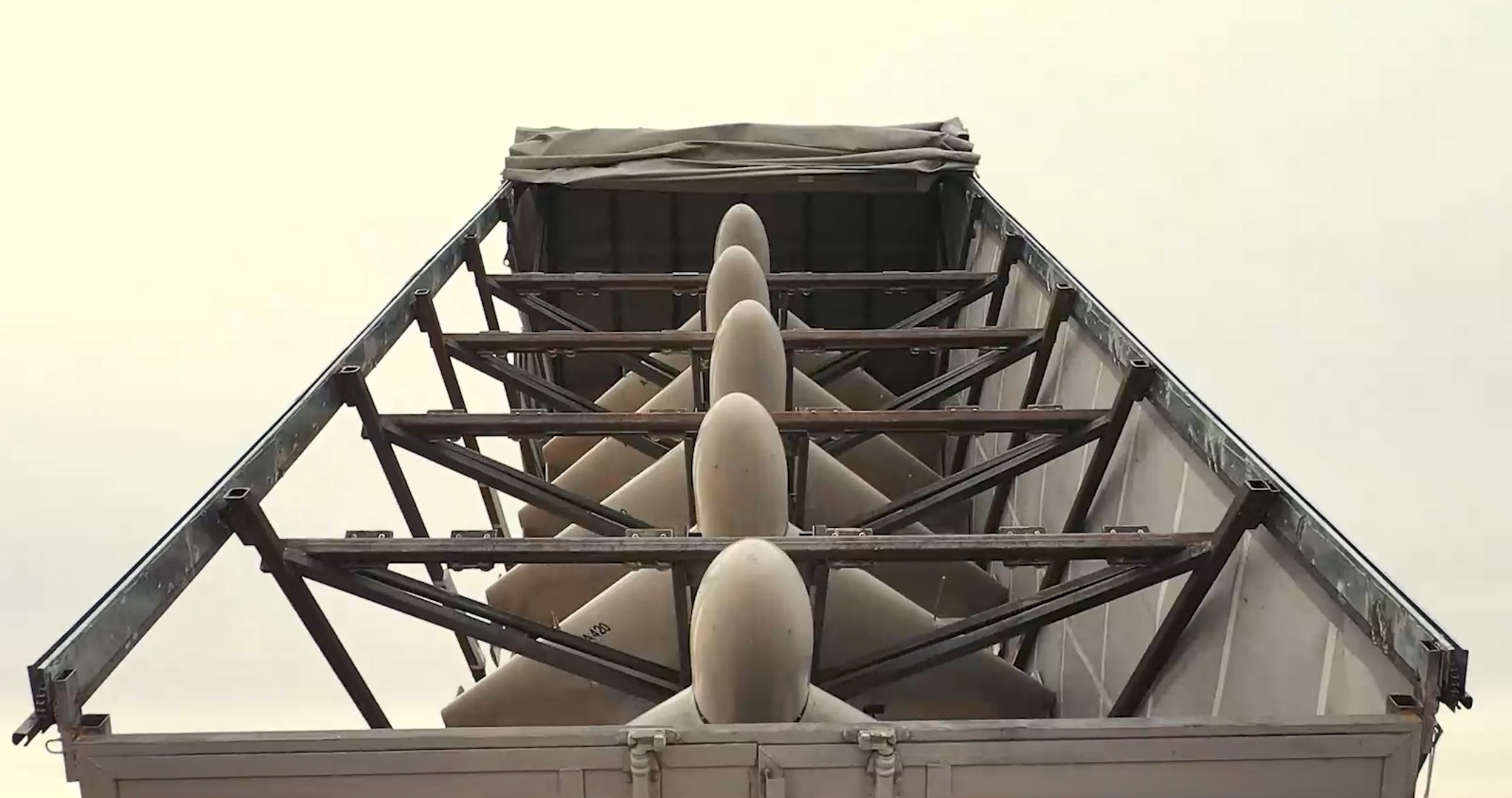
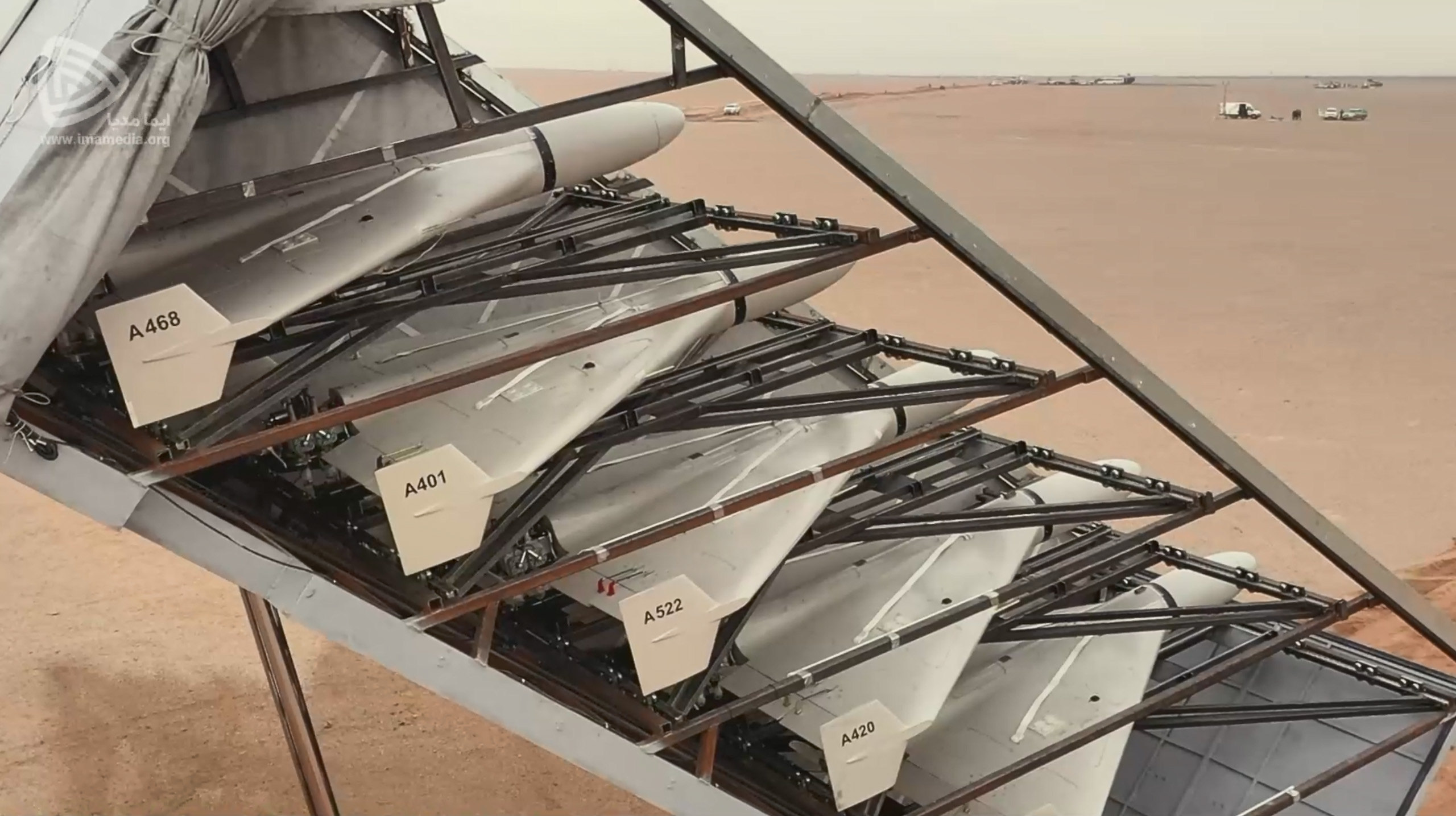
In the ‘Great Prophet (PBUH) 17‘ exercise for the first time, close-up images of Shahed-136 suicide drone and its performance were shown publicly. As part of the exercise, Shahed-136 suicide drones launched from a pod or a rack with five launcher, hitting its targets with exemplary accuracy. This phenomenon attracted many comments but where does this high accuracy come from?
In some parts of the video released from the exercise in some frames, it seems that the color and amount of light reflection from the nose of the drone is different from the body, which can indicate the use of an infrared nose (IR Dome).
Footage of the performance of Shahed-136 drone in the Great Prophet (PBUH) 17 exercise
Due to the fact that the nose color is milky in color, it seems that ZnS sulfide (without applying hot isostatic pressing process) or magnesium fluoride is used in the manufacturing process to reduce the manufacturing cost. These materials are capable of transmitting infrared spectrum and largely absorb the visible spectrum. This feature could mean using a standard camera sensor that detects only the near-infrared (NIR) spectrum by absorbing the visible light spectrum through the infrared nose. (Visible camera sensors have the ability to detect near-infrared spectrum)
Considering the defense policies of the Iranian Armed Forces, weapons such as suicide drones should be as low-cost as possible, and using conventional/standard camera sensors instead of expensive infrared sensors is fully consistent with this strategy. Of course, it is possible to use infrared sensors in the MWIR and SWIR spectrum for night operations, and radar nest detectors for suppression operations of enemy defence systems.
Also, it is noteworthy that some sources, by examining the progress of infrared air-to-air missiles and examining their infrared nose, have rejected the use of infrared nose in Shahed-136. Because in the infrared imaging models of heat-finding missiles, a transparent nose is used. However, with the some more deep studies performed, it was revealed and confirmed that in the electro-optical system of Iranian Shahed-149 drone, a milky infrared nose has been used, which indicates that these noses can be used even for imaging sensors. Therefore, the idea of using an infrared nose for the Shahed-136 is still valid.
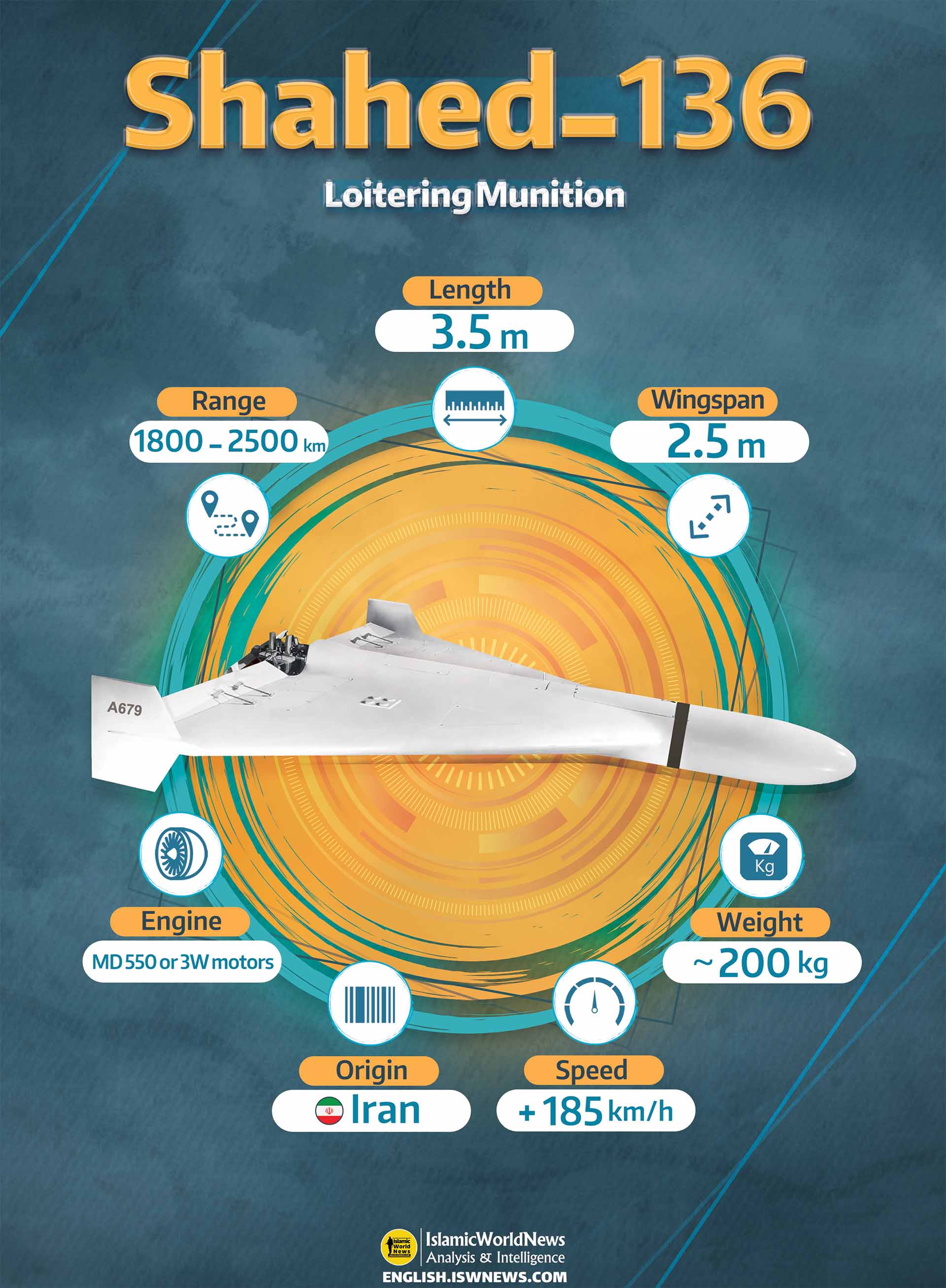
Shahed-136 suicide drone specifications: Length: 3.5 m Wingspan: 2.5 m Range: 1800 – 2500 km Weight: ~ 200 kg Speed: + 185 km/h Engine: MD 550 or 3W motors Origin: Iran
Shahed-136 suicide drone – click to view full size
The new version of the Shahed-136 suicide drone equipped with a jet engine
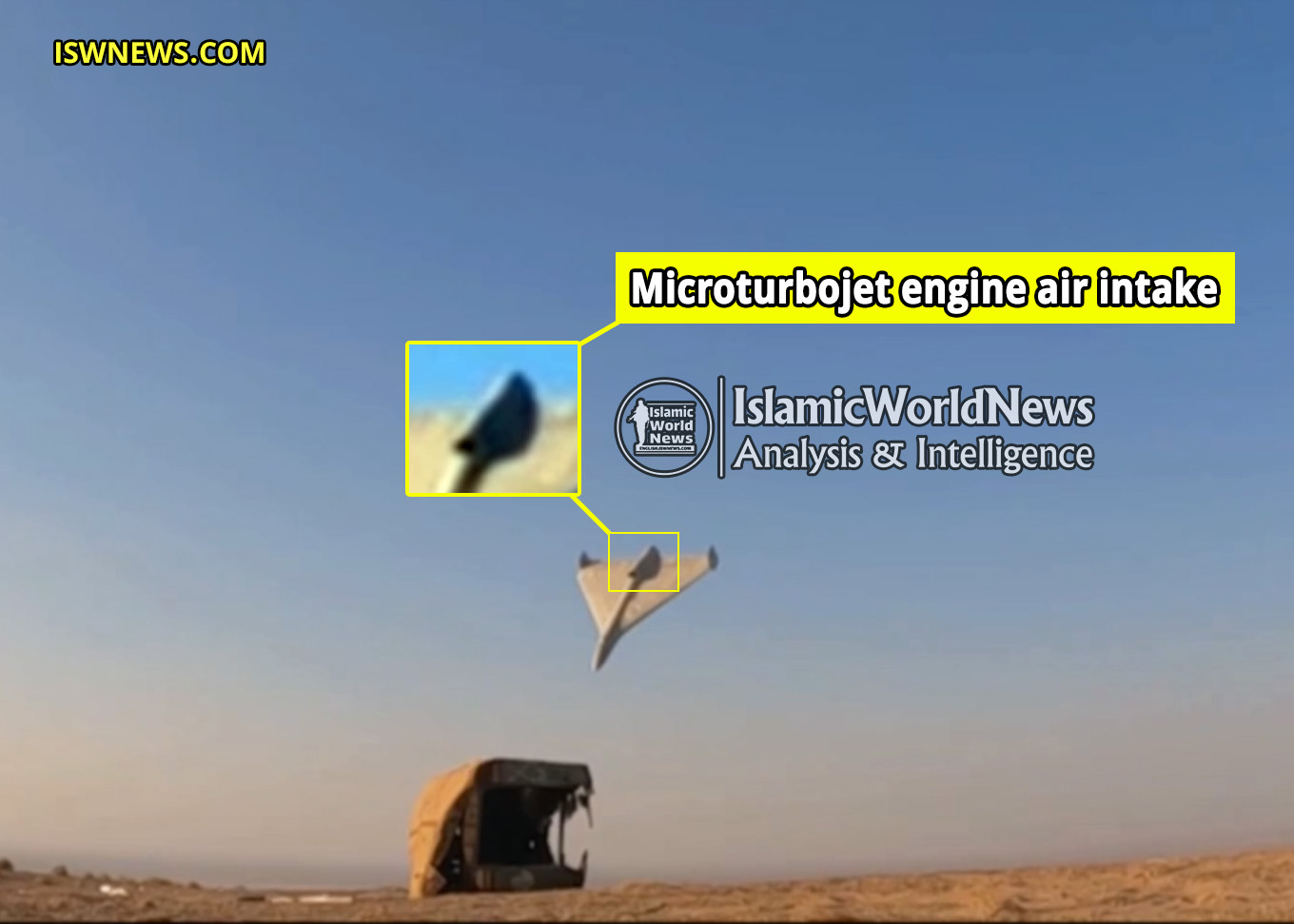
The new version of Shahed-136 suicide drone, which was unveiled recently, is equipped with a mini turbojet engine and has a higher speed and less noise than the basic version of Shahed-136. This new version was first unveiled in an Iranian documentary in October 2023 and is now known as Shahed-238.
A screen grab of the new version of the Shahed-136 suicide drone equipped with a micro-turbojet engine
The Shahed-136, despite its low radar cross-section (RCS), due to its piston engine, low speed, and distinctive loud noise, provided the enemy’s air defense systems and even ground forces with enough time to identify it. However, the use of a turbojet engine in the Shahed-238, while increasing the speed and reducing the noise, along with the drone’s specialized airframe, provides much better protection against heavy machine guns and anti-aircraft cannon, improving the overall success rate of the drone.
Air intake of the micro-turbojet engine in the new version of the Shahed-136 drone
The increase in the speed of the UAV and its very low cross-sectional area make this UAV practically a more dangerous version than the previous one, and the air defense systems that previously had problems in intercepting the Shahed-136, become more vulnerable to this new suicide drone.
More images of the Shahed-136 drone:
Click to view full size
Shahed-136 Loitering Munition posters in Persian, Arabic, Kurdish, Azeri, Russian for Social Media:
The first generation of explosive reaction armor belongs to Russia (Soviet Union), which was installed on the initial series of T-72 tanks.
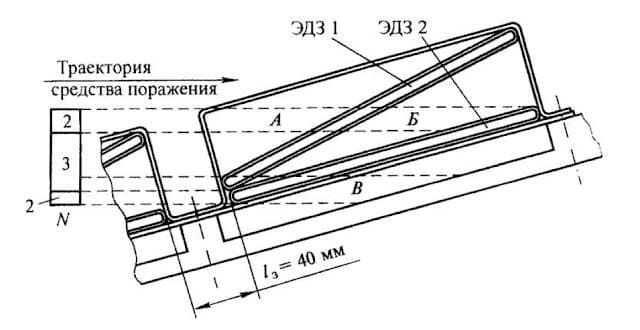
This armor consists of two sandwich flat steel plates, the outer two layers of which are made of steel plates and the inner layer of which is made of insensitive plastic explosives (equivalent to 280 grams of TNT). Two sandwich panels are placed in a V-shape in each module and have the ability to reduce the effectiveness of single shaped-charge anti-tank missiles and rockets.
When a warhead hits the module and an explosive jet of shaped-charge (from a combination of molten copper) reaches the sandwich plates, the inner layer explosives will activate inside the plates and explode, and the steel plates will throw. Therefore, hitting the shaped-charge jet obliquely causes its deflection and reduces its effectiveness.
This armor is said to reduce the penetration of conventional anti-tank missiles such as the Konkurs by about 86 percent. However, Kontakt-1 armor is weak against dual-charge projectiles because anti-tank missiles and rockets in this method activate the Kontakt-1 armor with the primary warhead and open the way for the second warhead.