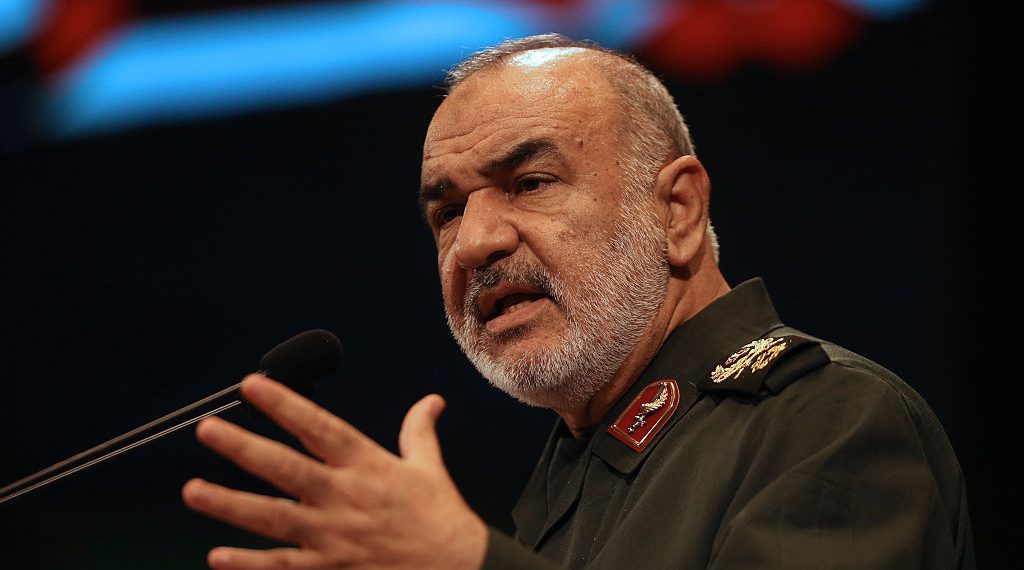
Commander of the Islamic Revolution Guards Corps (IRGC) Brigadier General Hossein Salami has made a speech at the funeral procession of Martyr Seyed Razi Mousavi: Seyed Razi Mousavi was one of the most experienced and effective commanders of the IRGC in the resistance front. Martyr Mousavi stood for the security of the Islamic Ummah over three decades in the most difficult circumstances. He was a companion of the immortal legend, the martyr Lieutenant General Qasem Soleimani. Interestingly, it should be noted that during his 33 years of service, Martyr Mousavi had not visited the holy shrines of Imam Hussein (A.S) in Karbala and Imam Ali (AS) in Najaf until yesterday (on Wednesday), when he (his corpse) visited and paid his respects to them, just like the companions of Imam Hussein (A.S) who pilgrimed Him whit their dismembered bodies.
The Commander of the IRGC differentiated between the Palestinian’s Operation Al-Aqsa Storm against Israel and taking revenge for Martyr Qasem Soleimani, adding: The Operation Al-Aqsa Storm was a purely Palestinian operation, designed and executed by the Palestinians themselves. This operation was carried out without any foreign support and is a response to the 75 years of oppression and occupation by the Israeli regime. The Operation Al-Aqsa Storm was not a revenge for the assassination of Martyr Soleimani; we will take our revenge on the perpetrators and planners of the martyrdom of this great man and deputy head of Iraq’s Popular Mobilization Forces (PMF) Abu Mahdi al-Muhandis and their comrades. We will not remain silent in the face of the assassination of our children and we will take revenge on the perpetrators. The revenge of our children will be nothing but the end of the Israeli regime’s existence.
The recent statements made by the Supreme Leader Ayatollah Seyyed Ali Khamenei and the Commander of the IRGC Hossein Salami regarding Operation Al-Aqsa Storm and the recent Palestinian war with the Israeli regime indicate that although the Islamic resistance front has coordination and strong unity in many issues, including goals, ideals, and values, each pillar of the resistance front acts based on its own national identity and circumstances. The Hezbollah movement operates based on tactics and Time requirements to limit Israel’s military might, the Ansar Allah movement also operates based on its Yemeni identity and targets the maritime shipping and economic interests of the Israeli regime, and other pillars of the resistance in Palestine, Iraq, and Syria also operate in different ways against the Israeli regime and its Western allies.
The Noor 3 imaging satellite was launched by the Qased three-stage expendable small-lift orbital space launch vehicle and is currently orbiting at an altitude of 450 kilometers above the earth’s surface
The Noor-3 satellite is expected to serve a variety of purposes, including remote sensing, data collection and potentially bolstering Iran’s telecommunications infrastructure.
The IRGC launched the first Iranian military satellite, Noor-1, in April 2020, and Noor-2 in March 2022. Both were also put in orbit by the Qased launch vehicle, designed and manufactured by the guard’s Aerospace Force.
A video of the stages of launch, separation and performance of the Qased satellite carrier, which placed the Noor-3 satellite in the 450 km orbit.
The new successful launch came as the United States was tightening sanctions on Iran. On September 19, the Biden administration issued sanctions targeting multiple people and entities in Iran, Russia, China and Turkey in connection with Tehran’s drone and military aircraft development.
The U.S. military says the same long-range ballistic technology used to put satellites into orbit could also allow Tehran to launch longer-range weapons.
IRGC Navy Chief Rear Admiral Ali Reza Tangsiri said U.S. helicopters were forced to land on the back deck of the ship shortly after taking off, following the arrival of speed boats deployed by the Zolfaqar flotilla present near the scene.
In the footage, Iranian speed boats can be seen monitoring and chasing the American ship, which was identified as USS Bataan.
This was the first time U.S. naval forces infiltrated into the Gulf waters in around two years, Tangsiri pointed out, adding that the standoff took place on August 17.
Tangsiri stressed that security in the Gulf can be maintained by neighboring countries without the presence of any foreign forces.
The standoff came amid rising tensions between Iran and the U.S. Navy in the Persian Gulf. In July, the Pentagon deployed F-35 and F-16 fighter jets, along with several warships and additional marines to the Middle East, in order to deter Iranian naval forces who seized two tankers in the gulf earlier this year. The IRGC responded by holding a series of naval drills earlier this month.
The Ghadir has a range of 300 kilometers and is armed with a 165-kilogram warhead, while the smaller Nasir has a range of 90 kilometers and carries a 130-kilogram warhead. Both missiles are equipped with an Inertial navigation system with an active radar seeker for terminal phase guidance.
A day earlier, the Mehr News Agency reported that the IRGC Navy had received hundreds of new “strategic” systems and equipment.
The new systems and equipment included reconnaissance and combat drones; several support and command vehicles; electronic warfare offense and defense systems; different types of anti-ship cruise missile launchers.
Earlier this week, the IRGC Navy held an exercise off the coast of Abu Musa, Greater Tunb and Lesser Tunb islands which are controlled by Iran but disputed by the United Arab Emirates (UAE). During the exercise, the IRGC Navy for the first time unveiled a new vessel armed with anti-ship missiles with a range of 600 kilometers.
The naval exercise came amid high tensions not only with the UAE, but also with the United States, who recently deployed additional fighter jets, warships and marines in the Middle East to deter Iran who seized two tankers in the Persian Gulf earlier this year.
The Shahed-149, which was developed by the Shahed Aviation Industries, is a high-altitude long-endurance combat drone similar in size, shape and role to the American MQ-9 Reaper. The drone was first unveiled and named after the Gaza Strip in honor of the Palestinians’ struggle against Israel amid the May 2021 Palestinian-Israeli crisis.
The upgraded version of the drone, which was unveiled at Martyr Karimi Air Base in the central city of Kashan, is equipped with an improved landing gear system and new hardpoints.
The Shahed-149 has a flight duration of 35 hours, an operational range of 2,000 kilometers and a cruising speed of 350 kilometers per hour. The combat drone is capable of carrying 13 bombs and 500 kg of electronic equipment. It is the first Iranian UAV powered by a turboprop engine.
The long endurance and range of the Shahed-149 should allow it to operate all the way from western Iran to Israel. The drone can also operate over the entire Persian Gulf and the Sea of Oman from Iran’s southern region.
Despite facing sabotage attempts by Israel as well as strict sanctions by the United States and the European Union, Iran managed to expand its drone program in the last few years. Today, the country is one of the world leaders in drone technology.
ISWNews Analysis Group – President Raisi congratulated the recent successes of the Palestinian resistance front and emphasized that such victories demonstrate that the Islamic Resistance Movement has the upper hand in dealing with the Zionist regime.
He also stated that all facts and figures on the ground show that at present, the resistance movement is stronger than ever before, and its enemies are weaker than ever.
President Raisi underscored that the most important issue in the Islamic world is the freedom of al-Quds, and that any attempt to normalize relations with the Israeli regime is a betrayal of the Palestinian ideal and a stab in the back of the resistance movement.
Head of Hamas’ Political Bureau also expressed his gratitude and that of the Palestinian people to the continuous support of the Islamic Republic of Iran for the ideal of liberation of al-Quds.
He went on to say that today the resistance movement is expanding and strengthening not only in the Gaza Strip but also in the West Bank, 1948-occupied lands, and even among Palestinians and friends of Palestine, who are residing outside the territories.
He reminded that Palestine has turned into a part of the unified and continuous resistance movement in the region, and that all resistance groups, including Palestinian jihadi groups and even other elements of the resistance movement, provided all their capabilities with groups present on the front line against the Israelis in recent battles.
Haniyeh further noted that we hold constant meetings and coordination sessions among all groups, from Lebanon’s Hezbollah movement and the Islamic Jihad Movement in Palestine to Hamas and other Palestinian jihadi groups.
In the following of the Hamas official’s visit to the Iranian capital Tehran, he held talks with Commander-in-Chief of the Islamic Revolution Guards Corps (IRGC) Hossein Salami.
It should be noted that Haniyeh also met with representative of the Supreme Leader and Secretary of the National Security Council of Iran Ali Akbar Ahmadian on June 19, and the two sides discussed issues of mutual interests.
The Fifth Fleet of the terrorist US Navy, which is based in Bahrain, alleged in a statement that three Iranian IRGC boats harassed a commercial vessel in the Strait of Hormuz in the Persian Gulf.
The US Fifth Fleet went on to say that the IRGC boats moved back after the British Royal Navy had an emergency contact with the US Navy.
The news story has been released in a situation that on June 4, the United States’ military officials expressed dissatisfaction on Iran’s plan to form a maritime coalition with regional states.
US 5th Fleet spokesperson Commander Tim Hawkins claimed in an interview with Western media outlets on Sunday that the number one country, which is behind of instability in the region (Iran) alleges that it wants to form a maritime alliance to protect waters that they themselves threaten!
He further claimed that this argue is not coherent, because Iran attacked 15 international-flagged commercial vessels over the past two years and it seized some of them; therefore, these actions are important and that is why we are strengthening our defense around the Strait of Hormuz along with our partners.
Images published of the alleged IRGC boats next to the British ship in the Strait of Hormuz
He underlined the support for the Palestinian resistance groups in a message on May 14, noting that the fighters in al-Quds and throughout Palestinian territories have proved that the dawn of victory is approaching.
The commander also praised the families of the Palestinian martyrs, saying that these people take the responsibility of defending al-Quds and sanctities.
According to the Iranian commander, the commanders of the joint operation chamber have shown a new epic in the face of the Zionist regime and proved once more that they can break the myth of strength of the foes.
The victories are parts of a stable step towards the final triumph, he said, adding that Iran will continue backing the Palestinian people and resistance groups to see the uprooting of the Zionist regime in the Palestinian land.
Qaani expressed gratitude to the fighters of Lebanon’s Hezbollah movement as well as all resistance groups, who stand against the Zionist enemies.
The new round of clashes between Palestinians and Israelis last for five days. The Israeli aggression left 33 Palestinians martyred and 147 others wounded. The Palestinians’ retaliatory rockets left one Israeli killed and 77 others injured.
In two separate statements on March 31 and April 2, the public relations of the Islamic Revolutionary Guard Corps announced the martyrdom of two of the IRGC’s military advisors in the attack of the Israeli regime fighters on the outskirts of Damascus on Friday morning.
The first IRGC’s public relations statement said: “Today, Friday, the 31th of March 2023, coinciding with the ninth of the holy month of Ramadan, the brave guardian of Islam, Milad Heydari, one of the military advisors of the IRGC in Syria, was martyred in a criminal attack by the Zionist regime near Damascus.”
In the second similar statement, the IRGC mentioned the martyrdom of the second person named “Meqdad Mahghani Jafarabadi” and it was stated that he died due to the severity of his injuries.
The IRGC, condemning the silence and inaction of the world’s effective assemblies in response to the crimes and repeated aggressions of the Zionist regime and the continued violation of the sovereignty and territorial integrity of an independent country that is a member of the United Nations, has emphasized: “The fake and criminal Zionist regime will undoubtedly receive the answer for this crime.”
It is worth mentioning that this Israeli regime attack, which led to the martyrdom of two IRGC members, was carried out on Friday March 31 at around 00:17 (local time) by firing several missiles from the occupied Golan to targets in Damascus. It seems that the Israeli army is pursuing a specific goal with frequent air strikes on Syria. This type of attack has been unprecedented in the past years. Most likely, by escalating the tension, Israel intends to luring Iran to a limited military response and then achieve its other main goals.
Brigadier General Qaani arrived in the Arab country on March 17 and started visiting some cities in Aleppo and Latakia to supervise the way the Iranian relief forces are serving the Syrian earthquake-stricken people.
The Islamic Republic of Iran has dispatched 447 tons of humanitarian aid to Syria in 16 phases. The aids shipments were sent to Syrian airports in Aleppo, Damascus and Latakia.
It is worth mentioning that this the second trip by the commander of the IRGC’s Qods Force to Syria after the recent devastating earthquake in the Arab country. He visited Syria just a few days after the quake.
The destructive earthquake in Syria, which happened on February 6, more than 1400 Syrians lost their lives and at least 2349 citizens were injured.
On 6 February, a Magnitude 7.8 earthquake hit southern and central Turkey as well as northern and western Syria, which left more than 50,000 dead in both countries.
The commander made the announcement in a televised program of Iran’s national TV network dubbed Saf-e Avval (First Line), informing the details of the state-of-the-art missile and drone weaponries manufactured by the Iranians, including Shahed-149 (Gaza) drone, Paveh cruise missile and hypersonic missile.
Brigadier General Hajizadeh said that “the US officials benefit from making the region insecure, as it can be said given the conflicts in last four decades (Iraq-Iran war, the US’s invasion of Iraq, Saudis’ attack on Yemen, the rise of Takfiri terrorist groups and the strikes on Lebanon’s Hezbollah resistance movement) that our region is facing a security fault, because the root cause of Russia-Ukraine confrontation as well as China-Taiwan quarrel comes from the US. If we are not powerful, the enemy would bring the war into the Iranian territory; so, we should be watchful to maintain security of our country and nation, and if we ignore it, our country may face some challenges.”
He noted that the IRGC Aerospace intends to make the US war machine and capabilities incapable, noting that “the Americans enjoy some components of superiority, but we tried to hit the components and turn them into impracticable. Today, the US’s regional bases are under Iran’s supervision and they are easy targets; so, the bases have turned into the Americans’ weak points, and we can hit the bases whenever it is necessary.”
Touching on the IRGC Aerospace’s missile might, which is an indirect warning to the European countries, he noted that “we are now able to target the US aircraft carriers at a 2,000-kilometer distance. Of course, we kept the limit at the distance to respect the Europeans; so, we hope they respect their esteem.”
On the features of the Iranian hypersonic missile, he said that “the hypersonic missile is capable of maneuvering in outer space and moving in different directions; that means it has an engine, which can start 300, 400 and 500 meters far from a target and kick off maneuvering. The speed of the missile reaches at Mach 12-13 and its main advantage is that the foe’s missile defense system cannot hunt and destroy the hypersonic missile; thus, I’m sure the enemies cannot manufacture a defense system to overcome the Iran-made hypersonic missiles even until tens of years.”
Asked about the timing of unveiling the Iranian hypersonic missile, he replied “given the fact that the projectile travels to outer space, we try to find a way to be able to showcase it; if the Americans do not believe in it, it would be not important, because its capability can be seen on the day of incident.”
The commander also pointed to the upgrade of capabilities of the Iranian ballistic missiles, saying that Iran managed to decrease the weight of the long-range missiles to one-fourth and improved their efficiency; and in terms of precision, all Iran-made missiles are precision-strike projectiles and the time required for their preparation has been reduced to one-sixth.
He further referred to the fact that one of the newest Iranian cruise missiles dubbed Paveh has become operational. The cruise missile with a range of 1,650 kilometers, which can travel 50 meters above earth surface.
A video published by the IRGC Aerospace shows that the missile was test-fired by the use of solid rocket booster from a launcher; then, the main part was detached from the booster after reaching altitudes, and its wings become open and the main engine starts.
The moment of firing Paveh long-range cruise missile with a range of 1650 km and moving at a flight height of 50 meters from the ground and finally hitting the target
The appearance of Paveh cruise missile is very similar to Quds missile of Yemen’s Ansar Allah movement. It seems that the course of development of Paveh missile has been carried out in recent years using the experiences of Yemen war and Ansar Allah’s operations against Aramco’s oil facilities (officially the Saudi Arabian Oil Group). Paveh missile is an evolved example of Iranian cruise missiles Soumar, Hoveyzeh and Ya-Ali etc.
Video of Yemen’s Ansar Allah Missile Force from the moment of firing Quds 1 cruise missileYemeni Ansar Allah Missile Force’s video of Quds 2 cruise missile
Notable advantages of Paveh cruise missile is that it can be carried and fired by marine and ground vessels as well as fighter jets. The significance of the issue would be highlighted, when Russian Sukhoi 35 fighter jets join the Iranian military equipment, because the Iranians would not need foreign weapons to arm their fighter jets.
Brigadier General Hajizadeh went on to say that “the Shahed-149 or Gaza drone (named after the Gaza Strip in honor of the Palestinians’ struggle against Israel amid their crisis in 2021) is huge drone, which is capable of keeping on flying for a remarkable duration and it can carry nine bombs simultaneously.”
The first video of the takeoff and flight of the Shahed-149 UAV (Gaza)
“We have the Shahed-129 and Shahed-139 in our combat drone arsenal, which provide us with good military capabilities, he said, adding that we can utilize the drones for combat, telecommunication and surveillance over border and other areas. The Shahed 129 is equivalent with the US-made MQ-1 and it possesses appropriate abilities, the commander said, noting that the Shahed-136 and Shahed-131 are also unique drones at international level, which have many capabilities.”
Click to view full size
The brigadier general further pointed to Iran’s missile operation on the United States’ airbase in Ayn al Asad (an airbase located in Al Anbar Governorate of western Iraq) in reaction to the Trump administration’s assassination of Lieutenant General Qasem Soleimani at Baghdad Airport on January 3, 2020, saying that “we did not aim to kill the American soldiers in the strike on the Ayn al Asad airbase, but we wanted to break the US’s grandeur; we pursue to avenge former US president Donald Trump and former United States secretary of state Mike Pompeo, who ordered the assassination of General Soleimani.”
Hajizadeh also hinted cooperation among the IRGC Aerospace Force, Iran Space Organization and the Ministry of Defense and Armed Forces Logistics, informing that they try to improve capabilities of satellite carriers to reach higher altitude and increase heavy weights, which will be announced in the future.
The recent operations by the IRGC in the region as well as the resistance movements in Yemen and other countries proved the broaden capabilities of Iran in drone and missile sectors; so that the Western and Eastern politicians as well as military analysts acknowledge the achievements. The understanding of the military superiority of Iran will become more difficult for the Westerners following the massive usage of big drones and hypersonic missiles by the Iranian armed forces.