The attack targeted areas such as the onion factory near Salamiyah, the cultural center in Sabourah, the forage factory near Aqarib and a military post near Ithiria. However, these attacks did not cause any casualties.
Hours before the attack on Hama province, other areas in central Syria near Sukhna and in southern Syria near Suwayda were targeted by Israeli missiles, in which two Syrian soldiers were killed.
The Israel attack, which targeted positions in four different Syrian provinces, was among the largest this year.
Author: Mirza
-

Images: Aftermath of Israeli missile attacks on Syria’s Hama province
-

Opinion: US. trying to defeat Syria’s resistance; this time from reconstruction
After near 10 years of war against Syria’s people and government the Arabic-Hebrew-Western axis unsuccessful in defeating the resistance axis started economic war against Syria. This economic war, which is not new though, started since the beginning by EU and US sanctions. This time Caesar act targets reconstruction in Syria.
Caesar act; threats and opportunities for Iran’s influence in Syria
Caesar act implemented on 17 June and according to it all parties involving in Syria’s economic and specially the infrastructure are sanctioned by US. This is while the key players in reconstruction of Syria are two strategic allies, i.e., Iran and Russia who do not pay much attention to US unilateral policies and have been under sanction by US already.
Some of Russian companies including Stroytransgaz (STG), which is doing the important project of expanding Tartus harbor and Syria’s mines, are under sanction by US for many years and thus Caesar act does not influence them. In addition, Russian officials have stated clearly that their economic activities in Syria won’t be influenced by sanctions.
Iran is under the most severe sanctions by US for many years and is immune to them. By sending fuel to Venezuela, who is also under severe sanctions, Iran yearns to form an economic league of states under sanctions to minimize the effect of it.
These sanctions rule out big opponents such as India and UAE in reconstructing Syria. UAE tried very hard to have influence on Syria’s economy and hinders Iran’s influence and using opposition of resistance axis weakens Iran’s and Assad’s positions in Syria and even remove them. Caesar act puts an end to this plan.
US two main goals of sanctions on Syria’s reconstruction
US and allies specially Israel after being unsuccessful in defeating Syria and allies in battlefield, try to use the lever of sanctions. By imposing economic leverage and preventing investment in reconstruction of Syria would increase the dissatisfaction leading to protests and pressuring Syrian government. This plan can be defeated if Syria’s allies such as Iran consider the popular economy in reconstruction of Syria.
The second goal is to putting Syrian government to not reclaim lands occupied by terrorists including Idlib an Kurdish controlled in which US is exploiting Syria’s oil. -

Iraq: The 3th security operation of Iraqi forces against ISIS
According to the statement published by the Iraqi joint operations command, the aim of this operation is the clearing of Saladin, Diyala and Kirkuk provinces with 4,853 square kilometers area from the ISIS presence; that will be done from several axes.
This operation is going on and several ISIS hideouts along their equipment have been seized so far. -
Breaking: Israel missile attack to Syria + Video
Two people were killed and four others were injured in the airstrikes, according to Syrian media.
Also hours after the first attacks, in a separate attack at 00:45, areas west of Salamiyah in Hama province were targeted by the Israeli regime missile again.
The footage you see are related to targeting of one of the Syrian Army’s ammunition depots in western Salamiya after the Israeli missile strikes: -

Detail of Ansar Allah missile and drone attacks on Saudi Arbaia
The list of areas targeted by Ansar Allah, according to local sources, is as follows:
1- Riyadh, King Khalid Airport and other military areas (more than 4 missile and drone strikes).
2- Airport and military bases of the Saudi coalition in Najran.
3- Abha Airport in Khamis Mushait.
4- Airport and military bases of the Saudi coalition in Jizan.
5- Tadawin base, headquarters of special forces and al-Ruwaik base in Ma’rib.
Saudi coalition media also reported the interception and destruction of eight UAVs and three missiles by its air defense systems in the past hours.Yemeni Armed Forces Spokesman’s Statement on last night operation against the Saudi coalition positions
According to Yahya al-Sari’, the “4th Balanced Deterrence Operation” was carried out with a large number of Zulfiqar, Quds ballistic missiles and Sammad-3 UAVs against enemy(Saudi) military bases and centers, including the Ministry of Defense and Intelligence and Salman Airport in the Saudi capital (Riyadh), and military positions in Jizan and Najran and Marib. -

Latest Updates on Yemen, 22 June 2020
1. Ceasefire between Mansour Hadi resigned government and Southern Transitional Council:
– The Southern Transitional Council (STC) agreed with Saudi Arabia proposed ceasefire.
– Saudi forces took position in Abyan province to monitor ceasefire.
– Socotra governor: Fall of Socotra areas was an intrigue by Saudis and Southerners to pressure Mansour Hadi to accept ceasefire.
– Conflict between Mansour Hadi forces and Southerners outskirt of Zanjibar.
2. Al Hudaydah:
– Rescue administration health ministry: Due to enemies attacks to Durayhimi district so far 284 martyred and injured, from whom 69 are children.
The only hospital in the town was bombed and destroyed two years ago by enemy warplanes.
– Saudi coalition forces violated ceasefire in the province 80 times in the last 24 hrs.
3. Marib
– Conflict between Saudi coalition and Ansar Allah in south of Madghal.
– Saudi coalition warplanes bombed Majzar district 36 times in the last 24 hrs. -

Presence of Russian warplanes at Deir Ezzor airport
After the military entry of the Syrian and Russian armies to east of the Euphrates in the last year, the Russian army wants to expand its military influence in east of Syria. According to available information, the Russian army is setting up a new military base in the Maadan region in the east of Syria.
Also, a part of Qamishli airport has been turned into the Russian air base, and the Russian fighter jets presence in Deir Ezzor is also interpreted in this regard. -

GNA supporting from murderers of US ambassador to Libya!
The Shura Council of Benghazi is an al-Qaeda-affiliated group in Libya that is supported by the GNA. Interestingly, this group is the same group that killed Christopher Stevens, US ambassador to Libya in 2012.
In fact, the US supporting from the GNA and the GNA supporting from the Shura Council of Benghazi means that the US supports the group that killed its ambassador to Libya! But in Libya, this is acceptable for the US, because the GNA is the actor of US policies in this country… -

Security operations in the eastern deserts of Syria
Liwa al-Quds forces reached point 400 on the Syrian-Iraqi border and cleansed 127 villages and an area of 9,000 km2 from the #ISIS cells.
-
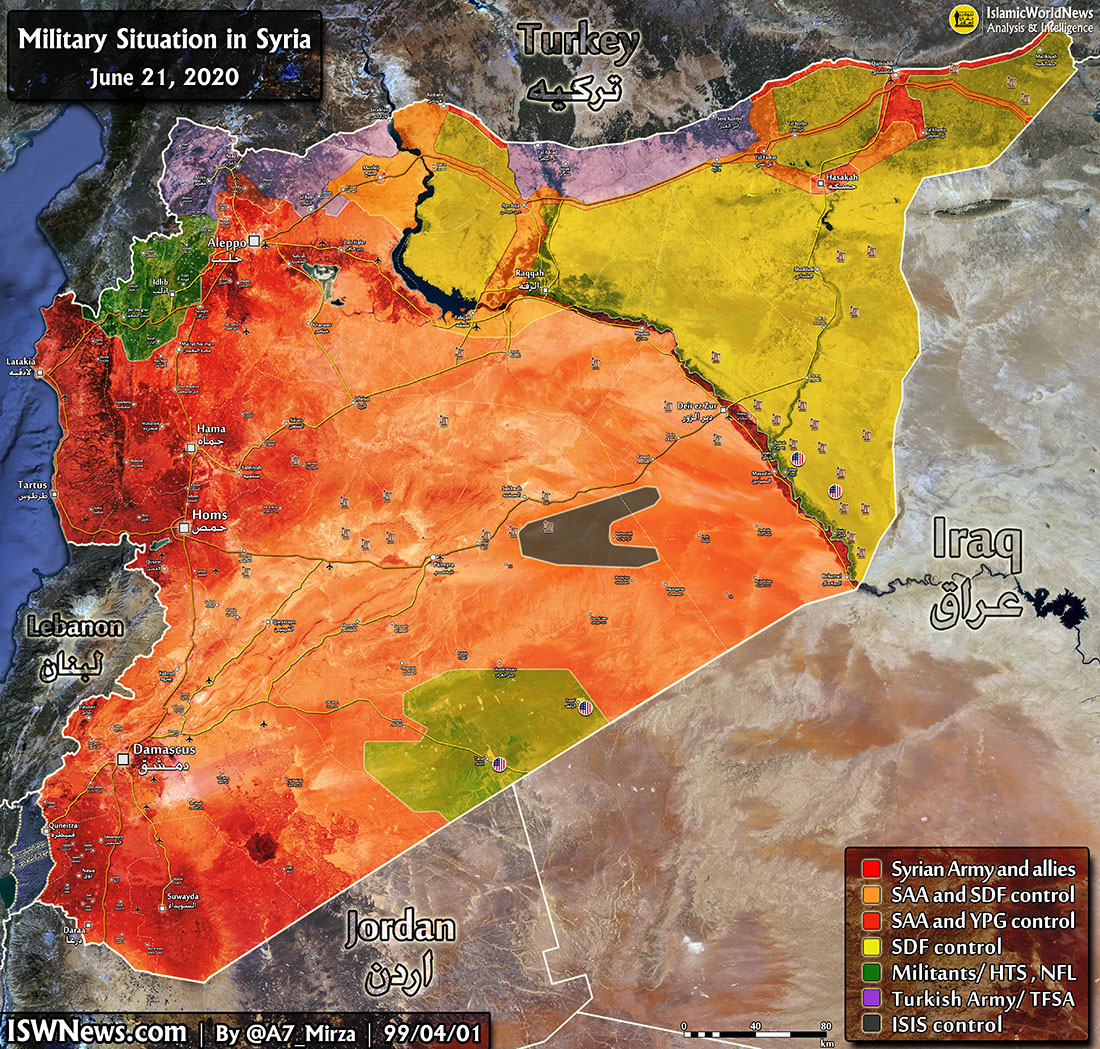
Latest Map of Frontlines in Syria until 21 June 2020
Northwest of Syria
Following the second stage of Syrian Army operation in Idlib area, which was started on 19 December 2019, army troops liberated 2,345 km2 of land from Turkish-backed terrorists until 4 March 2020. 763 km2 of liberated land was in Aleppo province and 1,582 km2 in Idlib province.
In despite that Turkish-back terrorists tried very hard in Idlib area to cut important M5 highway by occupying Saraqeb in the last two weeks of Syrian army operation to give Erdogan winning chips in Idlib ceasefire talks, but they failed and Saraqeb was finally liberated by Syrian army and Erdogan met with Putin empty handed.
Controversial Moscow summit took place and Erdogan and Putin reached a new ceasefire in Idlib area which was imposed since 6 Match in Idlib and M4 highway.
Details of Idlib ceasefire
Since the starting date of ceasefire so far, although the advances stopped and 17th joint Russian-Turkish limited patrols launched in M4 highway, but terrorist groups have not retreated from designated areas in the ceasefire agreement. Patrols have not reached Jisr al-Shoghur yet and artillery fire exchange and daily conflicts continue in Idlib area.
On the other hand in the last three months Syrian and Turkish armies strengthened their positions in Idlib front line and it seems there will be an imminent operation.
East of Syria
– After Turkish operation “Peace Spring” in east of Euphrates and occupying lands between Raas al-Ayn and Tal Abyadh to the depth of 32 km in fall 2019, front lines are unchanged and Turkish operation is halted since 25 November 2019 after announcing ceasefire and DMZ. There is only artillery fire exchange sparsely between SDF and Turkish-backed terrorists.
In recent months, joint Russian-Turkish patrols launched several times in east and west of DMZ and near Syria’s northwest border.
– Russian army took position in Qamishli airport and a large part of it turned into a Russian airbase. Russian warplanes number also increased in Deir Ezzor airport in recent days.
In general, in recent month, Russian and Syrian armies’ presence increased in east of Euphrates. Syrian and Russian armies try to limit US influence in this area by increasing their troops and equipment which resulted in friction with SDF.
– American troops still control oil and gas reservoirs in east of Euphrates even after show retreat from northeast of Syria and it seems they do not intend to leave in near future.
– ISIS hidden cells are still active in deserts of east of Homs and south of Deir Ezzor. Their main activities are in east of Sukhnah, Kabajib and east of Mayadeen including daily and weekly sabotage and hit-and-run operations against Syrian army. Although Syrian army in recent months launched several security and cleansing limited operations, it is unlikely to cleanse the area without an extensive operation.
South of Syria
The front line in south is static and all the area is controlled by Syrian army. However, there are sparse IED operations by remainder of militants and ISIS terrorists from previous cleansing against Syrian army. It has been intensified in the last two months and Syrian army has deployed more troops in the southern areas to subdue these activities. Protests and some political activities have increased against Syrian government and allies in south of Daraa province in the last month.
Click to see the full size map
Read the previous article about Syria here: Latest Map of Fronts in Syria until 22 February 2020 -

Yemen: Latest Updates on Baydha Front, 22 June 2020
Following Ansar Allah and popular commttees operation against Saudi-led coalition forces in north of Baydha and south of Marib provinces, important areas Soq Qaniya, Huran, Faleq mountain and Dumani mountain liberated.
Soq Qaniy is an important point for Saudi coalition positions in south of Marib province, whose liberation helps Ansar Allah to liberate Qaniya and districts Abdiyah and Maheliyah.
Interactive map of Baydha


