Brigadier General Yahya Saree, the spokesman of the Yemeni armed forces, announced in a statement that the Yemeni navy attacked a British oil ship called MARLIN LUANDA in the Gulf of Aden using several naval missiles.
As a result of the missiles directly hitting the Marlin Luanda oil tanker, this British ship suffered a fire and significant damage. The U.S. Central Command also confirmed this news and added that a Houthi (Ansar Allah) missile damaged the mentioned oil tanker, but no casualties were reported.
The Marlin Luanda ship on fire after being hit by a missile
Trafigura company (the owner of this ship) in a report denied the sinking of Marlin Luanda oil tanker and the casualties in the missile attack. Trafigura announced that the ship’s crew, supported by US coalition warships, are trying to contain the fire.
The Yemeni armed forces emphasized the continuation of operations in the Red and Arab seas against Israeli ships or Israeli-linked ships bound for occupied Palestinian ports until the end of the aggression and the delivery of food and medicine to the Gaza Strip. The spokesman of the Yemeni armed forces also clarified that all their military actions were carried out within the framework of the right to defend Yemen and practical solidarity with the Palestinian people.
Statement of the Yemeni Armed Forces regarding the attack on MARLIN LUANDA tanker
In response to this attack, on the morning of Saturday, January 27th, the US fighter jets bombed the Ras Issa area in the north of Hudaydah city twice. The US military claims that this airstrike destroyed an anti-ship missile ready to be launched on the shores of the Red Sea.
Marlin Luanda is a British oil tanker that has been operating under the Marshall Islands flag since 2018. The action of the Yemeni army against the British ships was carried out after the authorities of this country, in addition to participating in the American coalition against Yemen, adopted harsh positions against Ansar Allah and the Yemeni National Salvation Government.
According to the US Department of Defense, this operation was carried out with the aim of limiting Ansar Allah’s capability to carry out alleged attacks against international shipping in the Red Sea and to prevent further tensions in the region.
According to Yemeni media, the US-British airstrikes targeted the following areas: – Sana’a: Al-Dailami airbase (in Sanaa airport). – Hudaydah: Near Hudaydah airport and areas in the Zabid district. – Saada: Kahlan base in the east of Saada, Jabal al-Sama’ in the west of Saada city, and Takhiya area in the Majz district. – Hajjah: Abs airport in Hajjah province. – Taiz: Taiz airport and 22nd brigade base in Ta’aziyah district.
The areas that were targeted by the US-British airstrikes on January 12
American officials stated that this air operation was carried out with the cooperation of UK and with the support of Australia, Bahrain, Canada and the Netherlands. The US Military said that more than 100 missiles were fired at 60 targets in 16 centers affiliated to the Houthis (Ansar Allah movement), including command centers, ammunition depots and UAVs and missile systems.
Video: The moment the attack on Yemen began.
How was British participation in the operation against Yemen? The British Air Force has participated in joint operations with the United States against Yemen with four Eurofighter Typhoons. These fighter jets flew from the British base in Cyprus to Yemen and refueled in the sky of the Red Sea.
The British Ministry of Defense stated that this attack was carried out in response to Ansar Allah’s attack on the British destroyer HMS Diamond and the US warships. It is also said that in this attack, British fighter jets bombed two targets in northwestern Yemen, including the Abs airport in Hajjah province, and other targets were bombed by the US fighter jets.
Video: The flight of four Eurofighter Typhoon fighters from Cyprus to YemenInitial images of the bombing of Ansar Allah’s positions in Sana’a and Saada by the US and UKVideo: The first moments of the airstrikesVideo: The first moments of the airstrikes
After the American and British airstrikes against Yemen this morning, news about Ansar Allah’s missile attack on a British warship and an American warship was published, which cannot be confirmed until now.
The reaction of Yemen and different countries to the US and British attack on Yemen:
In a short message, Mohammad Abdul-Salam, spokesperson and chief negotiator of the Yemeni salvation government, in a short message emphasizing the continuation of the operations of the Yemeni armed forces against Israeli vessels and ships that move towards the ports of occupied Palestine, he said: “We emphasize that aggression against Yemen has no justification, because there is no danger to international shipping in the Red and Arabian Seas.”
Mohammad Al-Bakhiti, the governor of Dhamar and a member of Ansar Allah’s political office, also said in response to this attack:
“The United States and England made a mistake in the war with Yemen because they did not use their previous experiences. If it wasn’t for Bush’s stupidity in pushing Affash (Ali Abdullah Saleh) to attack us in 2004, the Yemeni people would not have started the 2014 revolution that ended the US ambassador’s rule in Sana’a and expelled their marines from Yemen. If it wasn’t for the stupidity of the United States and England in pressuring Saudi Arabia and the UAE to declare war against us in 2015, today Yemen would not be able to fulfill its religious, moral and humanitarian duty to support Palestine. There is no doubt that today the Americans and the British regret their previous follies and will soon realize that the “direct aggression against Yemen” was also the biggest folly in their history.
The Ministry of Foreign Affairs of Iran, Hezbollah of Lebanon, Hamas and Islamic Jihad of Palestine issued statements strongly condemning the US and British attacks on Yemen.
The US and British air campaign against Yemen is their second direct attack on Ansar Allah’s positions and could be the starting point for a widespread war in the Red Sea and the Bab al-Mandeb Strait. In their initial statements, the Yemeni authorities have considered this action as another stupidity of the United States and England, which will have severe consequences for them. Therefore, in the coming days, there is a possibility that the Yemeni armed forces will respond again to the naval fleet of the US coalition in the Red Sea and the Arabian Sea.
Ansar Allah’s naval operations against Israel’s interests have had intolerable results for the United States and England, and according to Rishi Sunak, the UK Prime Minister, it had led to a major disruption in maritime trade and an increase in the price of basic goods in Israel and Europe.
Despite the Western pressures, major shipping companies refused to sail through the Red Sea and openly and secretly declared that they were not willing to bear the losses caused by Ansar Allah’s missile and drone attacks. The US and British attack on Yemen and the developments before it once again emphasized the important role of Yemen in the regional developments and showed that if the American and Israeli war mongering is not stopped in Palestine, there is a possibility of their crimes spreading throughout the region.
The British forces have entered the area with the support of the United Arab Emirates (UAE) forces and they intended to establish a military base in the Al-Sheen farms, but they faced opposition from the owners of the farms.
Since the beginning of the Yemen war, no accurate information or details have been released about the presence of British troops in the war-torn country.
It seems that Britain does not have a permanent and transparent military presence in Yemen; so, most of the British forces’ movements in Yemen have been temporary or concentrated in the form of Combined Task Force 153 in Yemen’s territorial waters.
British security and intelligence forces are also present at their temporary embassy in the city of Aden and they play an important role in security issues in southern regions of the Arab country.
On Tuesday night (June 6), the British Foreign, Commonwealth & Development Office announced the firing of Richard Oppenheim and the appointment of Abda Sharif as the new British ambassador to Yemen.
The new ambassador will officially initiate his duties in September and Oppenheim will return to London to take another responsibility.
Abda Sharif is originally from Pakistan and is a Shia Muslim. She previously served as head of the Iraq and Arabian Peninsula Department in the Middle East and North Africa Directorate of the Foreign, Commonwealth & Development Office.
On her Twitter page, he expressed her happiness because of being appointed as the British ambassador to Yemen, saying: “Delighted to be the next UK Ambassador to #Yemen. Look forward to returning to the Middle East, and to working with the excellent @UKinYemen.”
The change of British ambassador to Yemen indicates London’s efforts to play a new role in Yemen’s developments. In 2014, Britain closed its embassy in Sana’a and transferred its staff to Riyadh, the capital of Saudi Arabia.
However, with the formation of the resigned government of Yemen, the UK moved their embassy to Aden and pursued their policies in Yemen.
Following the consolidation of Ansar Allah movement’s power in Yemen, various European countries have changed their approach and are also seeking to establish relations with Ansar Allah movement.
The developments did not match Richard Oppenheim’s stances and methods of work, who was implementing Britain’s separatist and colonial policies in Yemen, and following the UK’s change of approach, it was expected that the envoy would be removed from the embassy as soon as possible.
The Fifth Fleet of the terrorist US Navy, which is based in Bahrain, alleged in a statement that three Iranian IRGC boats harassed a commercial vessel in the Strait of Hormuz in the Persian Gulf.
The US Fifth Fleet went on to say that the IRGC boats moved back after the British Royal Navy had an emergency contact with the US Navy.
The news story has been released in a situation that on June 4, the United States’ military officials expressed dissatisfaction on Iran’s plan to form a maritime coalition with regional states.
US 5th Fleet spokesperson Commander Tim Hawkins claimed in an interview with Western media outlets on Sunday that the number one country, which is behind of instability in the region (Iran) alleges that it wants to form a maritime alliance to protect waters that they themselves threaten!
He further claimed that this argue is not coherent, because Iran attacked 15 international-flagged commercial vessels over the past two years and it seized some of them; therefore, these actions are important and that is why we are strengthening our defense around the Strait of Hormuz along with our partners.
Images published of the alleged IRGC boats next to the British ship in the Strait of Hormuz
According to local sources in Al-Mahrah province, on April 29, a member of Yemeni Coast Guard was shot and killed by the British Navy in Ras Fartak area located on the coast of Al-Mahrah province.
These sources added that the British forces shot at the Yemeni boatman after an argument and left the scene.
This action is a continuation of British occupation actions in the eastern coast of Yemen and in line with the militarization of this region after the construction of several coastal bases in eastern Yemen. The British and their other allies (CMF-153) have occupied the eastern and southern coasts of Yemen claiming to fight against smuggling and also to prevent the shipment of Iranian weapons to Yemeni resistance. They have also prevented the fishing of the people of Sayhut, Haswayn, Nishtun, etc., and have seized the boats of Yemeni fishermen many times.
The Maritime and Coastguard Agency (MCA) alleged on Friday that three boats carrying three or four passengers raided a ship off the Port Nishtun, which is located in Al Mahrah Governorate, Yemen.
It is worth mentioning that the region is under supervision of the resigned government of Yemen; so, some reports by certain media outlets on the Ansar Allah movement’s potential involvement in the mentioned attack are not correct.
The British entity has not yet released more information on the allegation. However, it called on the trade ships and boats sailing in this area to observe the protection and security issues.
The Maritime and Coastguard Agency is a military entity, which has been established by Britain’s army to carry out the coordination and the data exchange in the Arab Sea. It also informs news stories concerning piracy incidents in that region.
The coastal areas of Yemen have been under total siege during the eight-year war imposed by the Saudi-led coalition.
The heavy blows inflicted on the naval fleets of the Saudi-led coalition led to the deployment of another international coalition forces under the title of Combined Maritime Forces (CMF-153) in the Red Sea.
The latter coalition resorts to propagating unofficial news stories, which are sometimes fake news, on the so-called shipment of Iran-made weaponries to Yemen as well as drug trafficking in a bid to justify the Combined Maritime Forces’ presence in the Red Sea, Bab al-Mandeb and Gulf of Aden.
In the past decade, Britain was one of the most determining ultra-regional players in the crises and developments in the West Asia region. They have resorted to the crises in Syria, Iraq, Yemen and so on in line with their multilayered policy and actively intervened in that region. In the meantime, Yemen is of significant importance for the British rulers because of its key role in linking the waters of the Asia to Africa and Europe. They sold arms and provided Saudi Arabia and Iraq with military training by the use of exerting political pressures, misused diplomatic ties, and even played a mediator role in the early years of the conflicts in Yemen, Iraq, and Syria to pursue their own agenda silently. However, the policy changed in recent months and their military advisers played more active role in the region particularly in Yemen war.
What are Britain’s multifaceted policies?
– Political and Military Tools: Britain’s foreign policy is based on internationalism and contribution to allies or regional and ultra-regional powers, and it pursued the same policy in the face of the Yemen crisis. The Saudi-led coalition has time and again conducted air raids on Yemen’s cities by the use of Britain-manufactured arms, from the Euro Typhoon and Tornado fighter jets to different bombs and missiles in the war on Yemen. Furthermore, more than 280 military advisers of the Royal Air Force (RAF) are involved in training and assisting the Saudi military personnel in the Arab country. Britain continued the supports in spite of the violation of human rights (the manslaughter of Saudi journalist Jamal Khashoggi) as well as the arms embargo by certain European states on Saudi Arabia; so, the cooperation turned the Saudi kingdom into the largest purchaser of Britain’s weaponries.
– Field Military Presence in Yemen: On the other hand, the British military advisers and diplomats are actively present in the usurped regions of Yemen in particular in Al Mahrah and Aden governorates, and they overtly make decisions or influence the internal affairs of the Arab country. One of the most crucial issues that occurred recently and Britain played a key role was the 50% hike of the customs tariffs for the import of commodities in ports that are under the control of the Saudi-led coalition. The decision has been seemingly taken by the Supreme Economic Council of the so-called resigned Yemeni government, and British Ambassador to Yemen Richard Oppenheim embraced and supported the decision. Obviously, the decision was a response to Ansar Allah movement’s measures in hindering the illegal export of Yemen’s oil and the movement’s stress on the payment of the salaries of all Yemeni employees during the negotiations mediated by Oman and the United Nations; and the Ansar Allah movement amplified the resigned government’s taxes in order to respond to the proposal of 50% discount for the import of commodities from Al Hudaydah Port. The consequences of the next measures of the two sides are not clear in the economic war, and possibly the rivalry would be extended to the confiscation of fuel tankers and even a naval confrontation.
– The Control of the Asian Waterways to Africa and Europe: Britain follows up an internationalist policy and cooperates an international coalition in the Red Sea and the Gulf of Aden, which is known as “153 forces”, to control the regional waters. They contribute to the occupation of the Yemeni islands (Socotra, Mayun, Abd al- Kuri and so on) in cooperation with the UAE in a bid to benefit from the collaboration. The contribution to the coalition and mutual collaborations provides them with the opportunity to respond to the Ansar Allah’s strikes from the western coast of Yemen and also hinder the Iranians’ infiltration and the dispatch of Iran’s aid to the Arab country.
Britain also enters into a deal with ultra-regional powers in a bid to advance the multi-layered policy. For instance, the resigned Yemeni government faced a strict budget deficit following Ansar Allah prevented illegal export of Yemen’s oil by resorting to three drone attacks on Al-Dhabbah and Qena ports on the southern shores of the Arab nation. The British ambassador started consultations with his Chinese counterpart Shao Zheng to finance the resigned government via the oil sale and supply Yemen with basic commodities. The British and Chinese sides displayed the talks as they were playing ping pong (referring to the ping pong diplomacy between the US and China in the 1970s) at China’s diplomatic mission in Aden Governorate.
Richard Oppenheim and Shao Zheng meeting and playing ping pong at the Chinese Embassy in Yemen
As a whole, Britain is misusing and exploiting the crises created in the regional states particularly in the West Asia region through pursuing a multi-layered policy. The British policy-makers are fanning the flame of conflict by selling arms and dispatching military advisors to Arab countries, and they also loot the oil resources and wealth of a state under the pretext of being a mediating and peacemaking player. Britain’s actions in Yemen are a good instance of their dirty policy.
PS. “Ping-pong diplomacy” is a meaningful phrase in politics, which refers to the secret negotiations between the United States and China in the 1970s which resulted in opening the U.S.-PRC relationship, leading the U.S. to lift the embargo against China and the normalization of relations.
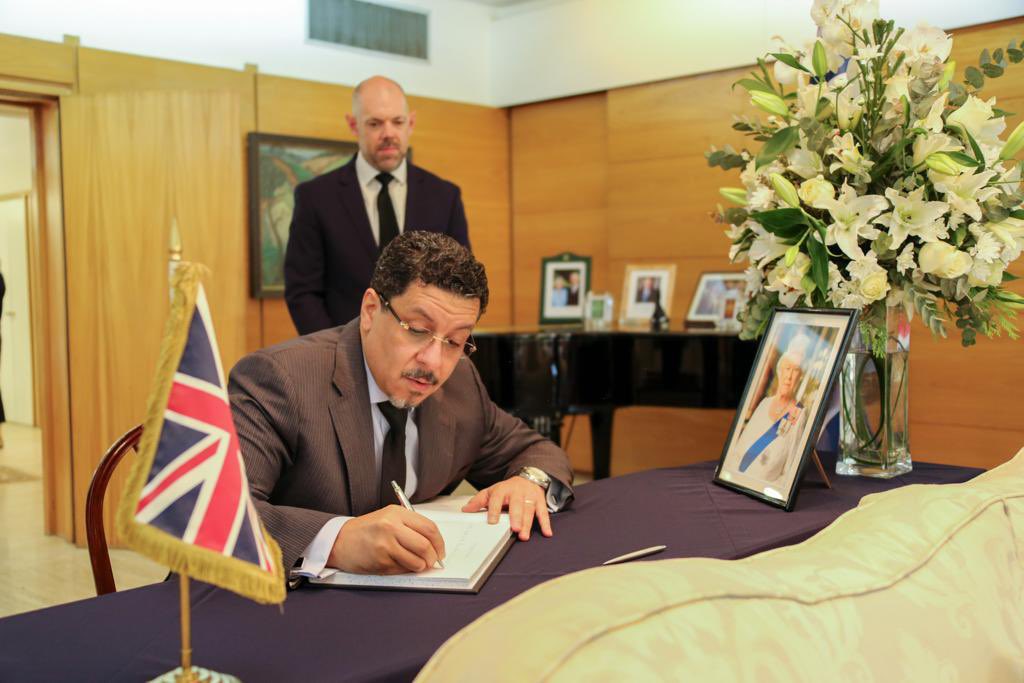
Image: The presence of Ahmed bin Awad Mubarak, the foreign minister of the resigned government of Yemen, at the British Embassy in Yemen to offer condolences on the occasion of the death of Queen Elizabeth II.
The British Ministry of Defense issued a statement claiming responsibility for the drone attack on a target in the city of al-Bab, located in the Aleppo province of Syria on December 20.
“On Tuesday 20 December, a Reaper remotely piloted aircraft kept close observation on a building near Al Bab in northern Syria where at least one active Daesh terrorist was known to be present. Great care was taken to ensure that any potential risks to civilians were understood and minimised before the Reaper’s crew fired a salvo of two Hellfire missiles which both struck the target accurately.”
It should be mentioned that on December 20, a drone targeted a house in “Kholo” neighborhood in al-Bab city. Minutes after the incident, it became clear that one of the ISIS commanders, Basa’ Ahmed Al-Sawadi, AKA Abu Yaser Al-Yamani was targeted and seriously injured. After the attack, the body of this person was taken to the hospital, but no further information about his fate was released. Western media claim that he was killed.
Britain’s Ministry of Defence on Thursday said one of its warships on patrol in the Persian Gulf earlier this year seized the arms shipment en route to Yemen.
According to Britain’s Ministry of Defence claims, the HMS Montrose warship with the support of attack helicopters and the US Navy USS Gridley destroyer, succeeded in discovering and confiscating Iranian weapons shipments in the smugglers’ speedboats in the morning of January 28 and February 25, 2022 en route to Yemen.
The seized weapons included 358 surface-to-air missiles and 351 land attack cruise missile engines with a range of 1,000 km. The British Ministry of Defense believes that these weapons are the same that Ansar Allah used in recent years attacks on Aramco’s facilities in Saudi Arabia and last year’s attacks on the UAE.
The British authorities have considered Iran’s action as a violation of United Nations Security Council Resolution 2216 and demanded compliance with international law obligations and maintaining order in the seas.
Iran also responded to this late news and rejected the Britain’s claim.
Nasser Kanani, an spokesman for the Iran’s foreign ministry announced the Britain’s claim as “baseless” and slammed the UK of being complicit in the war in Yemen.
Nasser Kanani said: “By continuously selling advanced weapons to the self-proclaimed military coalition against the defenseless people of Yemen, Britain has been a partner in the war and aggression against Yemen.”
The United States, Saudi Arabia, and now the United Kingdom have repeatedly claimed to seize Iranian weapons shipments in the Red Sea and other international waters, but these claims are one-sided and have not been confirmed by Iran and Yemeni authorities. On the assumption of the correctness of sending weapons in this way, it should be said that in the situation where all the eastern and western countries are supplying all kinds of weapons to Iran’s regional enemies, including the Israeli regime and the member countries of the Saudi coalition; sending military aid to Yemen by Iran seems to be a reasonable and logical action.
The seized alleged Iranian weapons by British Navy
Following the recent attack on the British tanker “Stolt Apal” in the Yemeni southern coasts, the British company announced that this tanker was carrying chemicals and on Sunday, has been attacked by two boats with six armed passengers in the Aden gulf (75 miles of the Yemeni coasts).
After several warning shooting by oil tanker and being destroyed one of the attacker boats, the pirates have left the place.
This tanker has requested help from the international coalition and has continued its way, after slight damages.