Category: Editor’s Picks

  • Commander of Syrian Democratic Forces Is Terrorist!

    Commander of Syrian Democratic Forces Is Terrorist!

    Ferhat Abdi Şahin known as “Mazloum Abdi” is commander-in-chief of the Syrian Democratic Forces (SDF). He was a prominent commander of terrorist group PKK before US. entered Syria and being assigned as the commander of SDF.
    He is officially member of Kurdistan Workers’ Party (PKK) since 1990. Terrorist group PKK has done a lot of crimes and massacres on civilians and soldiers of Iran and Turkey and is considered a terrorist group by those countries and international society.

    Ferhat Abdi Sahin is wanted by Turkey due to his abundant terrorist acts against Turkish military troops.

    – He was operation commander of PKK in Cilo area between 1991-1996, for that he is famous as Sahin Cilo. He even wrote a book “Diary of Hawk” and mentioned his terrorist acts.(Sahin means Hawk)
    – Between 1997 to 2003, he was acting deputy of PKK in Europe and recruited for PKK in seminars, festivals, camps, etc.
    – He was arrested by Syrian government several times between 2004 to 2009.
    – He was assigned as chief of special forces and intelligence of YPG from 2013 and from 2015 under support of US. he is assigned as commander of SDF.

    Another title of Ferhat Abdi is “Mazloum Kobani”, it means “oppressed Kobani”. It is not clear how he is called oppressed by doing so much terrorist acts!!!

    Regarding activities of this person and other commanders of PKK in Syria’s battles and before it, it is very important to consider the type and presence of these forces in Syria.
    The undeniable fact about the PKK is that the forces of this terrorist group have entered various YPG organs in different forms in recent years or the exchange of forces between these two group has taken place more frequently.
    If we put the fact that YPG has not collaborated with Syria and Resistance axis under Iran’s leadership and also the influence of PKK on Kurdish groups of north of Syria, we can realize why most of the time relations between Syria and Kurds are flawed.

    On the other hand, also we should pay attention to the fact that US. by using a deceiving name “Democratic” gathered Kurds of north of Syria under “Syrian Democratic Forces” name and under this title helped PKK forces with all kinds of training and weapons.
    This move by the US. was so stupid and rude that even US. commanders themselves admit it and that can be heard from the USSOCOM commander-in-chief at the time of the formation of the Syrian Democratic Forces.

    Gen Raymond A. Thomas interview in 2017.
    In this interview he explains clearly how they knowingly whitewashed the US-designated terrorist group PKK and chose a new name for the forces of YPG and PKK to have a lawful and legitimate way to arm them.


    Images of Ferhat Abdi Shahin attending PKK terrorists conference in Qandil Mountain on Iran-Iraq border:


    Other images of this oppressed! during his active presence in the PKK:

  • Map: Latest Military Situation in northeast of Syria after Turkey and Russia agreement

    Map: Latest Military Situation in northeast of Syria after Turkey and Russia agreement

    – Turkish Army will have the areas between Ras al-Ayn and Tal Abiad with a depth of 32 km that was occupied in operation ‘Peace Spring’.

    – According to the agreement and map of safe zone, Kurdish forces should retreat for the border with depth of 30 km.

    – Joint Russian-Turkish patrols will be in the east and west of the occupied lands and 10 km from the border.

    click to see the full size map
  • Map: Latest Military Situation on Northeast of Syria, 15 October 2019

    Map: Latest Military Situation on Northeast of Syria, 15 October 2019

    So far towns Qamishli, Hasakah, Manbij, Ayn Issa and Tabqah are controlled by Syrian army and they are expanding their realm.
    Today Russian Ministry of Defense stated officially that with Syrian army entering Manbij town and Russian forces taking position in north of it, the entire west bank of Euphrates River is under control of Syrian government.
    Regarding Ayn al-Arab(Kobani), Syrian army has not officially entered the town.

    On the other hand, Pentagon announced officially the complete evacuation of north of Syria.

    Turkey-Backed forces increased their infiltrate between Tal Abiad and Ras al-Ayn(Sari Kani) and could occupy numerous villages in Ras al-Ayn axis near Tal Tamar. During the last two days, Tal Abiad town was occupied by Turkish troops. Considering the shape of Turkey’s advances, it seems M4 is their furthest point to advance and the operation will continue along this axis.
    Yesterday Turkish forces tried to advance in Manbij axis against SDF and Syrian army but their operation was halted after occupying Dandaniyah and Yalshli in west of Manbij, under order of Erdogan.

    Click to see the full size map ( Map size 14112× 4198, 7 MB)
  • Low Income Class or Embassies Pawn Soldiers Protest?! What’s Happening in Iraq?

    Low Income Class or Embassies Pawn Soldiers Protest?! What’s Happening in Iraq?

    In recent days, surprising protest and conflicts happened in Iraq that were different from previous cases.
    This time there was no invitation by the political parties and even Sadr movement did not invite formally or informally. The protests were triggered by social media and the level of the work shows that there is a master plan behind it that removes the option of being spontaneous and people oriented and increases the likelihood that foreign embassies and intelligence agencies are behind the scene.

    This doesn’t mean that all the protesters are manipulated or even know where is the source of the riots, but actually there are enough reasons for protests. In fact the stimulation comes from special meetings and people of different classes follow it.

    The important point is the timing of the incidents, that if we ignore recent stances of Adil Abdul-Mahdi(in being close to Iran and Resistance and against Israel) and his trip to China, we have the important Arbaeen ahead of us. Some of general body of Sadr’s movement are busy with Arbaeen and even if they want to protest they would do it in Baghdad and won’t reach holy Najaf. However in several Shite provinces such as Najaf we observed a connecting network of protests simultaneously.
    Influencing multi million people parade of Arbaeen is of course part of their plan. Bringing the unrest to Najaf to influence presence of foreign pilgrims. Strong presence of non Iraqi pilgrims in Arbaeen means strengthening Shia identity irrespective of tribes or race which is not tolerable for many regional and foreign states.

    Other aspects such as more political and less economic slogans, more offensive ways to protest, attacking security forces, covering the protests with cellphones more professionally and in social media have shown us a new stage of protest in Iraq.

    Security officials of Baghdad and Najaf have confirmed that the protests are not related to Sadr movement and believe Baath movement is more into these protests.

    Although talking about Baath in recent years seems unusual to some people, but social structure of Iraq has a new class of Ba’athism which does not necessarily mean fan of Saddam.
    This class includes pan Arabs, anti Iranian, pro-dictatorship and militia from different spectra from youths to elites of Iraq together. This class should be called ‘New-Ba’athism’ which sometimes shows Shia, Sunni and even secular and communist appearance. Naturally this movement is fighting the current situation and can fit a wide range of races, tribes and religions in it.
    The upper layers of the movement is particularly related to foreign embassies.
    Neither Saudi nor USA cannot find a better way to infiltrate in and influence Iraq specially the shia community. Even cracking the shite community beyond borders like in Iran anf Iraq which have been united significantly. The enemies do not have any other choice but to promote racial and tribal differences. Since religious cracking has worked opposite of what they expected and resulted in strengthening the shia movement.
    It shouldn’t be neglected that corruption, lack of services and infrastructure and unemployment issue in Iraq are not deniable and people’s protest is acceptable but this can’t be an excuse for us to relate a special movement, which use it for political purposes and is manipulated by some embassy’s dollars, to shortcomings in services and infrastructure.

    In long-term Iraq’s future from social point of view should be investigated deeper. High population increase rate and young generation who is familiar with social media in addition to extensive social and cultural plans that US and allies have in Iraq to make younger generation liberal, are all signs of changing the social situation in Iraq in future.

    This is one side of the story and the other side is forming of Resistance and Hashad Shabi which is active and sensitive with large social basis.
    Arbaeen pilgrimage, leadership of Marja (not necessarily the current Marja), Islamic schools and often less active Islamic organizations and indeed security departments of Iraq, they all are responsible about liberalization of the younger generation and maybe in a decade the outcomes of this challenge is more clear.

    Image: Investigation on hashtags of Iraq protests show that about 79% of them came from Saudi Arabia!

  • Answering Key Questions about Yemen War – Part Five

    Answering Key Questions about Yemen War – Part Five


    Read “Part 4” here: Answering Key Questions about Yemen War – Part Four


    14. How do you analyze AnsarAllah’s recent operation ‘Nasr Min Allah’? Has AnsarAllah’s strategy changed from defensive to offensive?
    Ansar Allah’s recent operation with effective results took place while Ansar Allah’s military structure after a period of difficult situation due to severe battles, now has reached the stage to take offensive steps.
    Ansar Allah’s military strength in drone, missile, air defense, etc. were very primitive in compared with Saudi coalition equipment and the war was managed using weapons left from Ali Abdullah Saleh era. However in the last 2 years we see a significant development in Ansar Allah’s capabilities. Recent operations of Ansar Allah, such as attacking Aramco, are complicated ones.

    Considering Ansar Allah’s situation and strength, operation ‘Nasr Min Allah‘ is considered a large size operation but does not solve the war in Yemen alone. To have better result in the war Ansar Allah should operate more similar to this operation and north of Dhale operation.
    Indeed all aspect siege and lack of infrastructure is difficult but Ansar Allah’s domestic oriented strategy enables to do such operations. Ansar Allah should hold some points in Yemen.
    Saadah border area to keep the ground access to Saudi positions, al Hudaydah shores and Hajjah to have access to the world, Sanaa as capital, is the triangle Ansar Allah should hold.
    To keep the independence and preventing Yemen dissociation, there are many targets in Yemen that need to be held by Ansar Allah; more important targets than Kitaf district and northern borders, targets such as southern shores of al Hudaydah to Bab Al Mandab, Aden and southern harbors and even Marib and east of Yemen.

    15. Why Mansour Hadi’s government is called resigned and call AnsarAllah’s government legitimate?

    On 21 September 2014, Yemeni people due to corruption, disloyalty and being manipulated of Abdrabbuh Mansur Hadi and his government by Persian Gulf states, uprised and protested against them and upon arrival of Ansar Allah to Sanaa, Mansour Hadi with his own decision and parliament’s permission resigned from presidency and his government were dismissed by the parliament and resigned.
    In April 2015 Saudi Arabia and UAE forming a coalition against Yemeni people and in support of Mansour Hadi assaulted Yemen but this time Mansour Hadi claimed his resignation under pressure of Ansar Allah.
    Ansar Allah in Yemen has not formed a government alone. Yemen Rescue Government with the parliament vote and decision of Revolution Council of Yemen was established in Sanaa and has the support of people and parties, therefore it is lawful.

    16. Why AnsarAllah did not announce self-government and does not hold election?
    Announcing self-government by Ansar Allah is exactly what enemies of Islam, i.e., USA, Israel and Europe want. Dissociating Islamic states is the plan which started from Sykes–Picot Agreement and is continuing so far. Therefore, Ansar Allah’s main task as the representative of Islamic Resistance in Yemen is to keep Yemen independent and prevent it from dissociation.
    Regarding election by Ansar Allah, some analysts claim it is a weak point of Ansar Allah but we believe the other way.
    First, AnsarAllah held the election for empty seats of parliament in April 2019.
    Second, with every call of Ansar Allah, millions of people come to streets in Sanaa, Saadah and other cities controlled by Ansar Allah which shows the people support of Ansar Allah. Thus, AnsarAllah does not need to hold a discriminated election such as presidential election of 2011 to legalize itself. In the election of 2011, which was manipulated by Persian Gulf Council states, Mansour Hadi the only candidate became president of so called transition period. Mansour Hadi in this period of time, did not hold lawful and legitimate election and did not follow laws and was helping with dissociation of Yemen.

    17. How is the relationship between Yemeni army and AnsarAllah and what portion of Yemeni army work with AnsarAllah?
    Yemeni army underwent several separations and weakenings from Yemen revolution until Ali Abdullah Saleh intrigue but Ansar Allah’s support and loyalty of soldiers to the army, kept the backbone of the army.
    After Mansour Hadi fled to Riyadh and forming a government in exile and when Saudi coalition conflict with Ansar Allah did not come to conclusions in the beginning of the war, the coalition prepared an army for Mansour Hadi and some military people with intrigue and temptation joined them and after forming of Southerners Transition Council, those who were biased about south of Yemen separated and joined Hizam Al Amni (security belt backed by UAE) and other militia. After Ali Abdullah Saleh intrigue and his death, part of the army entitled Presidential Guard and other names separated from Sanaa army and joined Saudi coalition. Among these incidents, supporters of Ali Abdullah Saleh blew the army the most.
    Army has close ties with Ansar Allah and most of the army are supporters of the revolution and Rescue Government but cannot be quantified.

  • Details: What Is Happening in Kitaf Axis in North of Saadah? How Was AnsarAllah’s Great Operation in This Axis? + Map

    Details: What Is Happening in Kitaf Axis in North of Saadah? How Was AnsarAllah’s Great Operation in This Axis? + Map

    Kitaf area in west of Saadah province and Saadah city is one of the main defense lines of Saadah city. Due to the strategic importance of Kitaf, Saudi strived hard to reach Kitaf by several operations in recent months. Although Saudi advances in this axis were slow due to Ansar Allah’s rattling resistance but eventually could reach a few km from Kitaf by capturing ‘Wadi Al Abu Jabbarah’.


    Later in the operation, more troops and brigades of Saudi Army soldiers and mercenaries were dispatched to the area to advance more in north of Kitaf to get out of Wadi Al Abu Jabbarah area, in which they were stock for a while, under aerial and more troops supports.


    But unlike Saudi’s predictions, things did not go as planned!


    In general several brigades such as Al Wahda Brigades, Tohid Brigades, Al Tahrir Brigades, Al Fatah Brigades and Al Qadesiyah Brigade of Mansour Hadi’s and Saudi’s troops are present in the north of Saadah. Al Fatah and Al Qadesiyah brigades are the ones which were preparing to perform new operation toward north of Kitaf by gathering in Wadi Al Abu Jabbarah. Unlike Saudi’s expectations, Ansar Allah and popular committees forces were faster and before Saudi coalition’s grand operation toward Kitaf, they attacked them in two main directions presented by green arrows on the map, blocked the logistic line of Saudi coalition’s forces present in Wadi Al Abu Jabbarah and besieged them.
    This incident happened almost 40 days ago and was covered by ‘ISWNews’.

    Read more here:
    Ansar Allah’s Operation in North of Kitaf
    Latest Updates on Ansar Allah’s Operation in North of Kitaf; 29 August 2019


    As mentioned yesterday by the spokesperson of Yemeni Armed Forces, in the first 72 hours of AnsarAllah’s operation, almost three brigades of Saudi coalition were besieged in Wadi Al Abu Jabbarah. After the siege, engagements intensified and more brigades and troops conveyed to Wadi Al Abu Jabbarah, even 2 Saudi brigades were dispatched to break the siege.


    But due to AnsarAllah’s good tactic in implementing the operation and strong participation of AnsarAllah’s drone and missile units, Saudi coalition attacks to breaking the siege failed. According to Yemeni Armed Forces spokesperson, their air defense helped the operation a lot by keeping Apaches away from the area.


    Most probably what the spokesperson meant by air defense system is what was unveiled recently and due to their success in al Hudaydah shores conflict, they are used in this axis too and limited Apache’s air support of Saudi coalition.


    Finally, Saudi coalition could not break the siege of Wadi Al Abu Jabbarah and troops in siege also surrendered. It is not clear exactly when did besieged troops surrendered completely and media of AnsarAllah also do not talk about it. But it is clear that Saudi coalition forces are besieged by AnsarAllah for 40 days and the operation was continuing in the last 30 days and Saudi coalition efforts to break the siege only increased their number of casualties and loss. The casualties and damages were so high that even Saudi coalition commanders had to confess it.


    – Regarding the results of operation ‘Nasr Min Allah'(victory from God) we can count complete liberation of Wadi Al Abu Jabbarah and northern parts of it for almost 350 km2. This operation actually destroyed half of what Saudi coalition achieved in the last year in the area. AnsarAllah’s advance is shown by purple on the map.

    – More than 2000 Saudi coalition troops are captured which is a great victory for AnsarAllah and somehow Saudi coalition was humiliated in this operation and one more time the tactics and spirit of Saudi coalition are questioned.

    – In this operation, a large amount of armored vehicles and light and heavy munitions were captured by AnsarAllah; although armored vehicles do not play a role in AnsarAllah’s tactics but other equipment can be used by AnsarAllah very well.


    Click to see the full size map
  • Breaking: Ansar Allah Drone Attacks on Aramco Oil Facility Deep Inside the Saudi Arabia + Video

    Breaking: Ansar Allah Drone Attacks on Aramco Oil Facility Deep Inside the Saudi Arabia + Video

    According to local sources, the explosions began at three in the morning and the sound of 12 huge explosions heard in Buqayq.
    Although Saudi Arabia’s interior ministry announces the containment of fires, the images released this morning show that the oil facilities are still on fire.
     
    It is worth noting that the Buqayq oil complex in eastern Saudi Arabia is the world’s largest oil processing facility, currently refining about 6.8 million barrels per day.
     
    Ansar Allah’s drone attack on this oil facility which is at least 1000km away from Ansar Allah controlled areas, will have huge impacts on Saudi Arabia’s economic and the continuation of these drone strikes on vital Saudi refineries will change the balance of power, making the future of Yemen’s battles undergo many changes.

  • Muqtada al-Sadr Appears in Tehran

    Muqtada al-Sadr Appears in Tehran

    Sayyed Hassan Nasrallah’s remarks on Iran last night, Sayyed Abdulmalek al-Houthi’s speech about the axis of Resistance and presence of Muqtada al-Sadr in Iran, transmitted the message of unity among the Shiites of the world, with leadership of Imam Khamenei to the enemies of Iran.

  • Answering Key Questions about Yemen War – Part Four

    Answering Key Questions about Yemen War – Part Four


    Read “Part 3” here: Answering Key Questions about Yemen War – Part Three


    10. Recent visit of Muhammad Abdulsalam, spokesperson and chief negotiator of Ansar Allah to Iran and meeting with Leader of Islamic Republic and Iranian officials, how do you analyze it?
    Generally it is stated in analyses that this meeting was an official announcement of Iran-AnsarAllah coalition. But we know that the coalition of Ansar Allah and Islamic Resistance was formed from the beginning of Ansar Allah and its leaders were always following Velayat-e faqih (top Shia scholar and leader) and martyr Sayyid Hussein Badreddin al-Houthi had the same stance.
    Important points regarding this trip:
    – Leader of Iran Revolution emphasized on neutralizing the plan of dissociation of Yemen and Ansar Allah’s firm response to it by independent Yemeni-Yemeni negotiations.
    – Muhammad Abdulsalam carrying Janbiya(Yemeni dagger) in meeting with Leader of Revolution, in addition to show the Yemeni gentility and courage and Iranians trusting Yemenis, is a symbol of Ansar Allah to jihad against enemies and show teeth.
    – Assigning Yemeni ambassador in Iran; means Iran considers ambassador of Rescue Government as official political representative of Yemen and Mansour Hadi’s resigned government (due to the resignation of the President and Prime Minister) is out of office according to law.
    – Three way negotiation between Iran, Ansar Allah and Europeans, which is more in the sense of Sweden’s agreement.
    – Sayyid Abdul-Malik Badreddin al-Houthi’s letter to Imam Khamenei, whose contents are not clear and there are several guesses about it.
     
    11. How was Iran and Ali Abdullah Saleh relationship? What are details of Ali Abdullah Saleh trip to Iran?
    Ali Abdullah Saleh supported Saddam, Iraqi dictator, during the eight years of holy defense and after it, to control Yemeni Shias who under influence of Iran, tried to fix his relationship with Iran.
    In that sense, Ali Abdullah Saleh visited Iran on 13 April 2000 and in his meeting with Leader of Revolution, there was words of general situation in the region and necessity of confronting Israel and USA. After this visit, Iran’s President visited Yemen in 2003. But these trips did not influence Saleh’s confrontation with Sayyid Hussein Badreddin al-Houthi’s revolution and due to martyrdom of Sayyid Hussein and Saleh’s support for Saudi family against Iran, the relationship went cold.
     
    12. Who is Hani Ben Brek?
    45 years old Hani Ben Brek is deputy of the Yemen’s Southern Transitional Council and the main coup maker in Aden.
    He was born in Addis Ababa, capital of Ethiopia, to a Yemeni father and an Ethiopian mother and migrated to Aden at 16. Later he joined Yemen’s Al-Qaeda and went to Afghanistan to fight against USSR and after 3 years came back to Aden.
    After that, Hani participated in Southerners confronting against Ali Abdullah Saleh and was arrested in 2010 due to planting a bomb in vehicles.
    After parole, he joined ISIS alley and representative, Ansar al-Sharia, in Abyan and after ISIS defeat fled to Aden and took refugees in Aidarus al-Zoubaidi’s home. In 2017, Aidarus al-Zoubaidi established the Southern Transitional Council with support of Hani Ben Brek and request to separate from northern part of Yemen.
    Using his cleverness and rhetoric speeches with the help of Emirates, he could take Aden from Mansour Hadi’s control.
    Hani Ben Brek is fond of his assassinations and terrorist acts and call them Jihad. Media consider him the military and political arm of Aidarus al-Zoubaidi, head of the Southern Transitional Council.
     
    13. Considering the recent evolutions of Aden and conflict between Emirati and Saudi proxies, how do you predict Yemen’s future?
    Future of Yemen will form due to many different reasons such as operations, leaders of different movements decisions, foreign countries interventions, tribes stances and people’s trends. Thus there is no certainty.

    As mentioned in previous articles, conflict between Emirati and Saudi proxies were predicted and coalition between any of Yemeni movements is predictable.
    Engagement between UAE and Saudi proxies, i.e., Southerners and Mansour Hadi’s government, has root in the contrast of their ideologies and ambitions.
    Southerners want separation and revive Southern Yemen and Mansour Hadi wants Ansar Allah’s neutralized and control the whole Yemen. Therefore, reaching a solution even with Saudi coalition’s enforcement seems impossible.
    They agree upon confronting Ansar Allah but have different goals and ways; their conflict was predictable.
    What can be said as analysis of the current situation is that South of Yemen Transition Council has support of most of the people in south and UAE and used Mansour Hadi’s government incompetence to reject them from Aden and other southern cities.
    Eastern tribes are also close to UAE and there’s possibility of them confronting Saudis.
    Hadi’s government does not have any base after losing Aden and has an unstable and exilic condition. More political or military blows from either Ansar Allah or Southerners will result in their abolition.
    On the other hand, Ansar Allah has an unknown situation in other fronts. Although their aerial capabilities has increased greatly but the operation to reclaim occupied lands has not started yet. Operations north of Al Dhale and recently west of Al Jawf shows Ansar Allah’s enough power to reclaim lost lands but Ansar Allah seems to be waiting for important changes in enemies campaign.

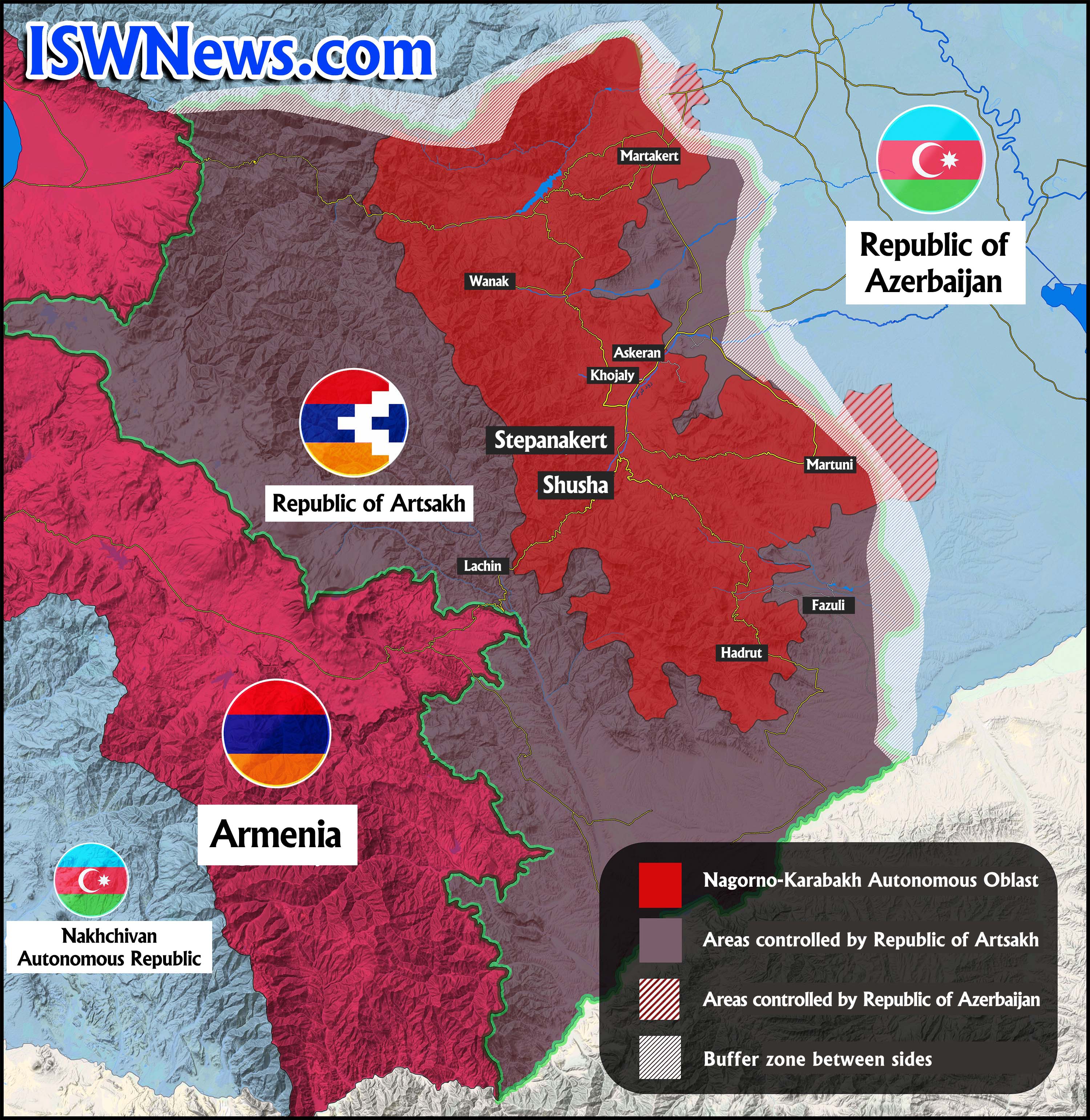
  • Overview of the Karabakh control lines + Map of Karabakh

    Overview of the Karabakh control lines + Map of Karabakh

    In seventh century, a triangle area between river’s Kura, Aras and Zengezur mountain was called Karabakh. Terrain of the area is rich and includes prairies and high mountains. Near end of 18th century, local lord of the Karabakh was the most powerful lord among Caucasus lords but due to rampant diseases, many died or migrated, made Karabakh deserted.
     
    At the dawn of USSR, upon request of Karabakh inhabitants, the area was divided into two. Low prairies were given to Azerbaijan and Armenian inhabited high mountains were self-governed as ” Nagorno-Karabakh Autonomous Oblast”.

    After USSR dissociation and start of conflicts between Armenia and Azerbaijan at the beginning of 90s, it caused military confrontation that Armenia and Karabakh joint forces occupied some lands from Azerbaijan and Azerbaijani soldiers also occupied some lands from self-governed area near Khojavend and Maraga.

    As indicated on the map, control lines in Karabakh are divided into several areas:
    – Areas controlled by Republic of Artsakh including former self-governed area plus Azerbaijan occupied lands.
    – Part of former self-governed area occupied by Azerbaijan.
    – Buffer area between two sides which is indicated by white hatching area.

    Although areas controlled by Republic of Artsakh are governed by local officials, but Armenia has the task of defending the area due to previous law. It is noteworthy that news of fire exchange and killing or injuring from both sides due to violation if the border is limited to this buffer zone and neither side have violated the lands of the other side.

    Click to see the full size map
  • Map: Latest Military Situation on Northwestern Hama and Southern Idlib

    Map: Latest Military Situation on Northwestern Hama and Southern Idlib

    This bypass tactic have always worked in battles of Syria; at least it has been so for the SAA.
    Of course maybe this decision was not taken from the beginning, but it was decided so after the three months ago clashes and twist and turns —Which led to liberation of Kafr Nabudah & Qalaat Al Madiq
    and then after the heavy counter attacks of militias and disconnection of Muhradah-Al Suqaylabiyah road and both sides taking heavy casualties in terms of infantry and armored vehicles and finally the refusal from accepting the “Astana Agreement” and the “Ceasefire” by terrorists— have led the SAA to this conclusion that it must do it another way and finish the situation of this region once and for all.
     
    With regards to three months ago events, the militias have taken serious and dreadful casualties in terms of death tolls and armored vehicles and are weakened in their offense and defense power and this decision —bypassing Khan Shaykhoun— of Army was taken in the best possible time.
    Maybe if five months ago we’d say that “the SAA will reach to two kilometers from Khan Shaykhun” it would be considered as a joke rather than reality…
     
    Anyway now the SAA is in position of power and managed to put the militias on the verge of one the most memorable sieges in the Syria War by activating two main fronts in east and west of Aleppo-Hama highway.
    While we were writing this article, unverified news about liberation of Madaya and Abedin in west of Khan Shaykhoun were published. If the situation remains so and Russia and Turkey’s political games doesn’t come in the way of Syria Government, and if before the next month “Astana Summit” the SAA’s advances be completed we will witness a large liberation in the southern Idlib region from the militias.
    A liberation which will prepare the necessary and main ground for the future operations in depth of Idlibistan.

    Click to see the full size map

  • Investigating Aspects and Reasons Behind UAE Withdrawal From Yemen War

    Investigating Aspects and Reasons Behind UAE Withdrawal From Yemen War

    Saudi coalition’s operations defeats in al Hudaydah, Sanaa, Saadah, etc. and failure in reaching the goals resulted in UAE decision on retreating Emirati forces from different fronts in Yemen. However UAE doesn’t consider it as a retreat but rather they say by training and replacing almost 90k troops from other countries (Yemeni, Sudanese, etc.), there is no need for Emirati forces.
    In general it can be said that UAE is trying to reduce international pressure and reduce loss of Emirati troops by replacing them with Yemeni(Hizam al Amni) and Sudanese troops mainly.
     
    Anyhow this retreat can have 4 main reasons:
     
    1. UAE military defeat in different battles against Ansar Allah:
    Saudi Coalition’s forces repelled from Ibb province borders and later Ansar Allah’s recent operation in north of Al Dhale and reclaiming western and northern districts of this province, in despite of several years of airraid and siege against Ansar Allah, showed the inefficiency of these expensive operations which seemed obvious to be successful by Saudi Coalition.
    Troops led by UAE are usually located in south of Yemen, which have a lot of political issues, assassinations in Aden and Ansar Allah’s drone attacks.
    UAE who bore the main ground battlefield, by opening this new front made UAE vulnerable against Ansar Allah’s missile and drone attacks and did not have the defense readiness against this style of Ansar Allah’s attacks. Also lack of troops, Sudan’s domestic issues and UAE’s interference in Libya, preoccupied Emirs of UAE that forced them to retreat.
    Thus it is safe to say one reason for UAE to retreat is numerous defeats imposed by Ansar Allah.
     
    2. Ansar Allah’s threats to attack UAE’s soil:
    Ansar Allah’s success in developing drone and missile capabilities, extended Ansar Allah’s threats to reach UAE soil. Release of footages showing Ansar Allah’s drones attacks to Abu Dhabi airport, revealed the importance of these threats. Apparently the pressure of Ansar Allah’s threats to attack UAE is another reason for UAE’s retreat.
     
    3. Internal conflicts of UAE:
    The disputes between Emirs of UAE that sometimes are reflected in media are mainly about financial issues and to accuse each other of inability in leading the state. Some of the Emirs do not want to pay for the Yemen’s battle and call it a useless war.
    Although the struggle for power is not serious but can be a reason UAE is retreating from Yemen.
     
    4. Negotiation and reaching an agreement between UAE and Ansar Allah:
    The main and of course strange reason proposed in some media and analysis is the negotiation and agreement between Ansar Allah and UAE; apparently due to recent words of Sheikh Naim Qassem , Deputy of General Secretary of Lebanon’s Hezbollah.
    Regardless of political statements, no official sources from either side confirms such theory. Even in the case of a possible negotiation, the results cannot be the only reason of UAE’s retreat.
    Negotiation is a deal, thus, what would UAE get in case of leaving battlefields and islands of Yemen?
     
    Conclusion:
    UAE’s retreat from Yemen has several obvious and non obvious reasons, which were mentioned here. Most of analyses showed Ansar Allah’s power decay in the wake of Ali Abdullah Saleh’s death but actually it is reversed by Ansar Allah’s leader’s plans and UAE’s retreat shows it.
    UAE leaders have discerned that confronting Ansar Allah should be turned into a civil war. Thus their presence in the battle is an obstacle and expensive.
    This retreat which has been broadcasted via some news and evacuating some islands and bases but it shows a sign of defeat anyways.
    Ansar Allah and UAE negotiations, if exist at all, stabilizes Ansar Allah’s victories first and isolates Islah party with its Muslim Brotherhood tendencies under leadership of Mansour Hadi, who has no supporter other than Saudi. Therefore, it is not unexpected if Saudi requests a negotiation with Ansar Allah or evacuates Yemen.