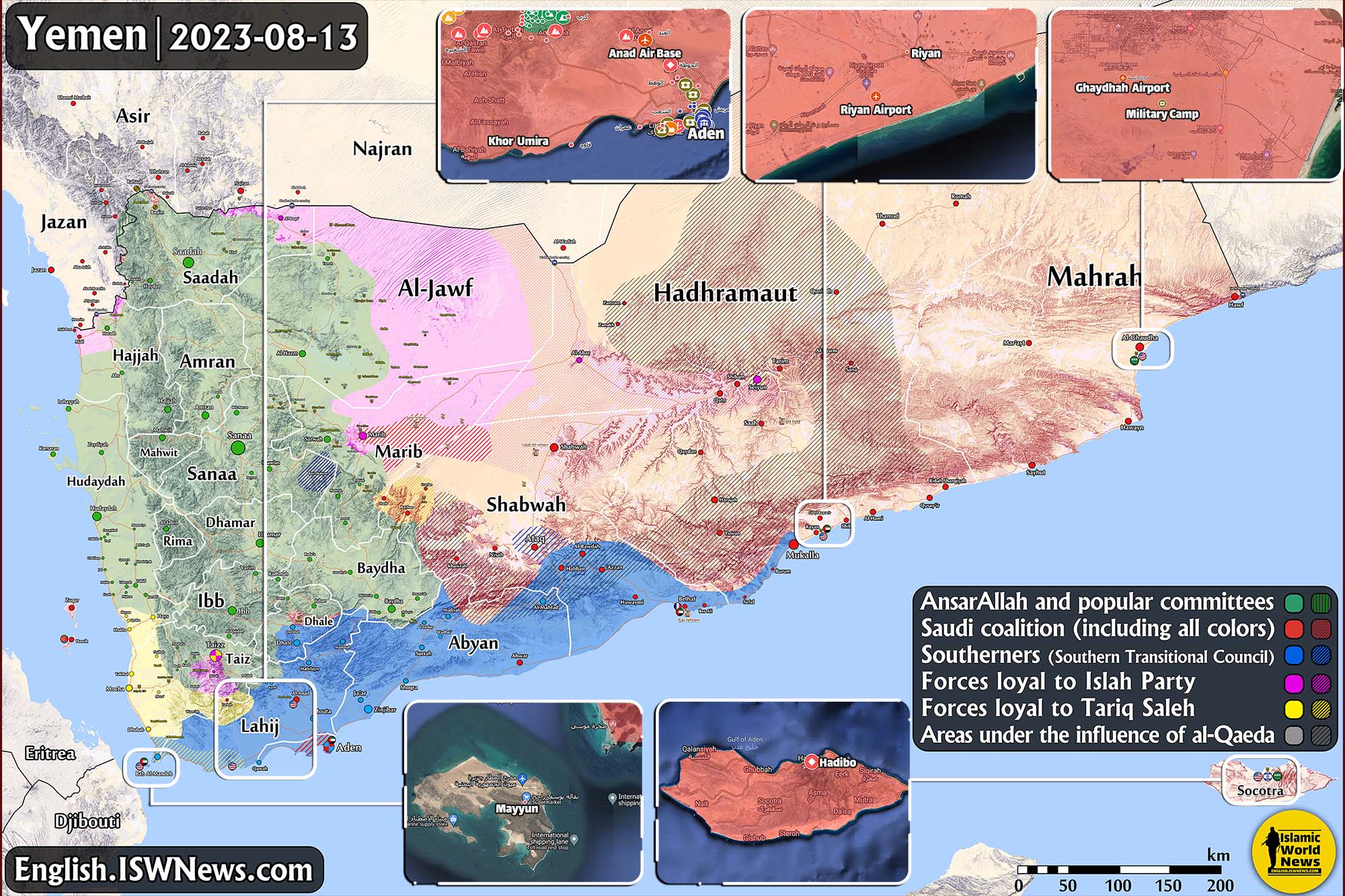
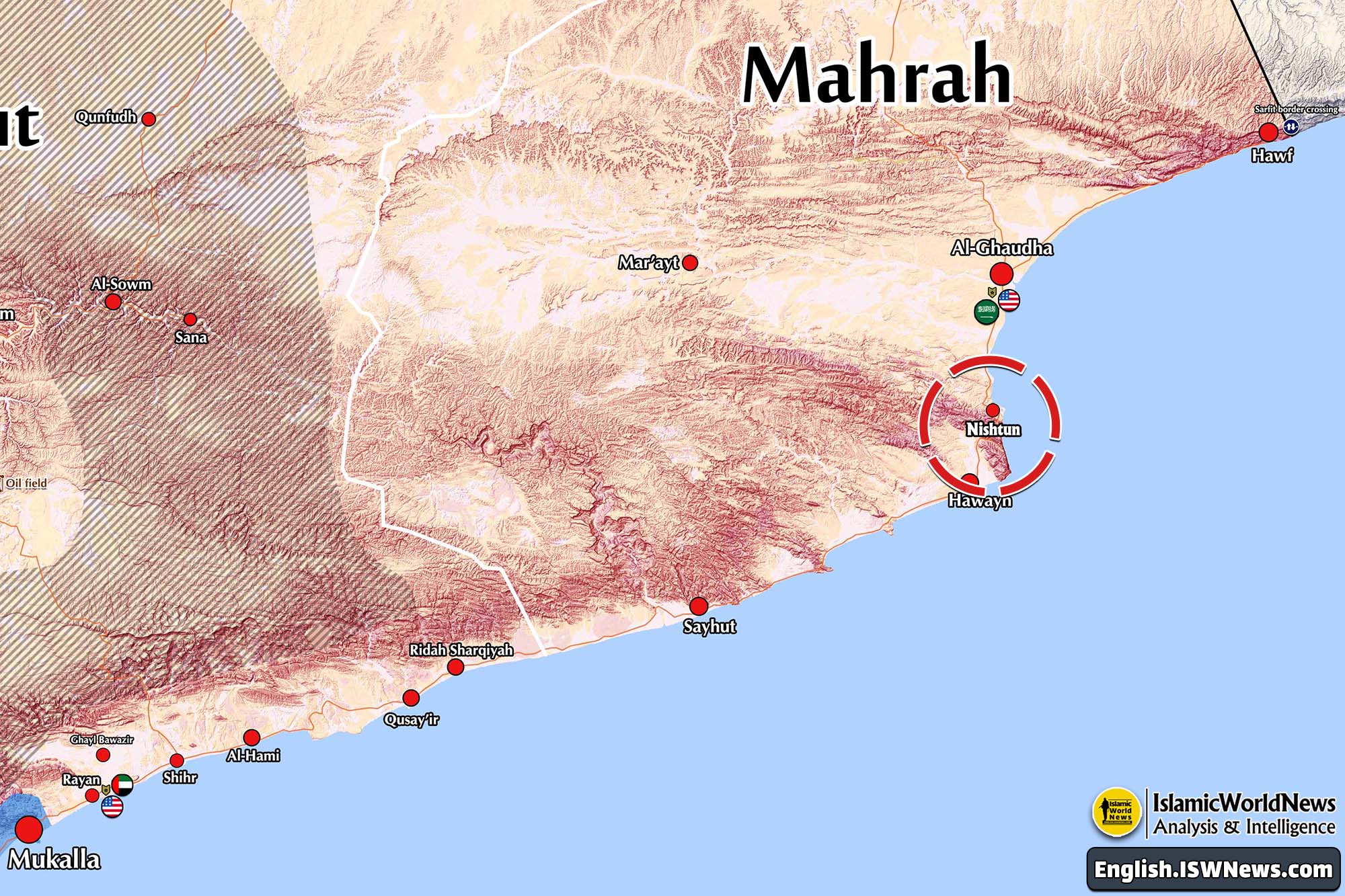
In a Twitter message, al-Qahoum said that the Yemeni capital Sana’a is closely monitoring the continuous movements of US military forces and their relocation in the Al-And base, the Khur Amira district on the coastal area of Lahij Governorate, Hadhramaut and Al-Mahrah areas as well as in Socotra and Mayyun Islands.
He also emphasized the independence and sovereignty of Yemen, as well as the ability of the Yemeni army to safeguard shipping process and combat terrorism.
The Ansar Allah member went on to say that the unjustified presence of US military forces in Yemen is a danger to the West Asia region, and the Americans’ actions to control and be present in Bab al-Mandab Strait, in addition to violating international laws, threaten international and regional security as well.
Al-Qahoum also concluded his message by warning that the Ansar Allah movement will not remain idle in the face of any conspiracy against Yemen and the region, adding that the presence of the US in the Arab country will not take long, and the people of this territory will stand against aggression towards Yemen as well as dangerous conspiracies against the region by the use of changing the rules of engagement and increasing military capabilities and industries.
The Ansar Allah movement’s repeated warnings come after an announcement by the US military to deploy three thousand military personnel along with two amphibious ships and an assault ship in the Red Sea and Bab al-Mandab Strait.
According to al-Qahoum’s statements and the movements made by the United States’ Ambassador to Yemen Steven Fagin, as well as other American advisors, US soldiers are stationed in six points in Yemen, including the Al-Anad base, the Khur Amira district on the coast of Lahij Governorate, Hadhramout region (Al-Rayyan Air Base), Al-Mahrah (perhaps Al-Ghaydah Air Base), as well as Socotra and Mayyun Islands.
The widespread deployment of American troops and their presence in those areas indicate that the US has planned to control the southern and southwestern coasts and islands of Yemen. The increase in US military presence in the Bab al-Mandab Strait and Hormuz Strait is aimed at controlling the passage of ships and monitoring Iran’s movements in this route.
The US officials are worried about the formation of an Iran-centered naval coalition in particular following the reconstruction of relationship between the Islamic Republic and regional Arab states; so, all these issues plus the Iranians’ support for Yemen have prompted the Americans to enter the maritime battlefield with the axis of resistance to maintain their position among the Arabs’ ranks.
US Troops Stationed In Six Points In Yemen – click to view full size
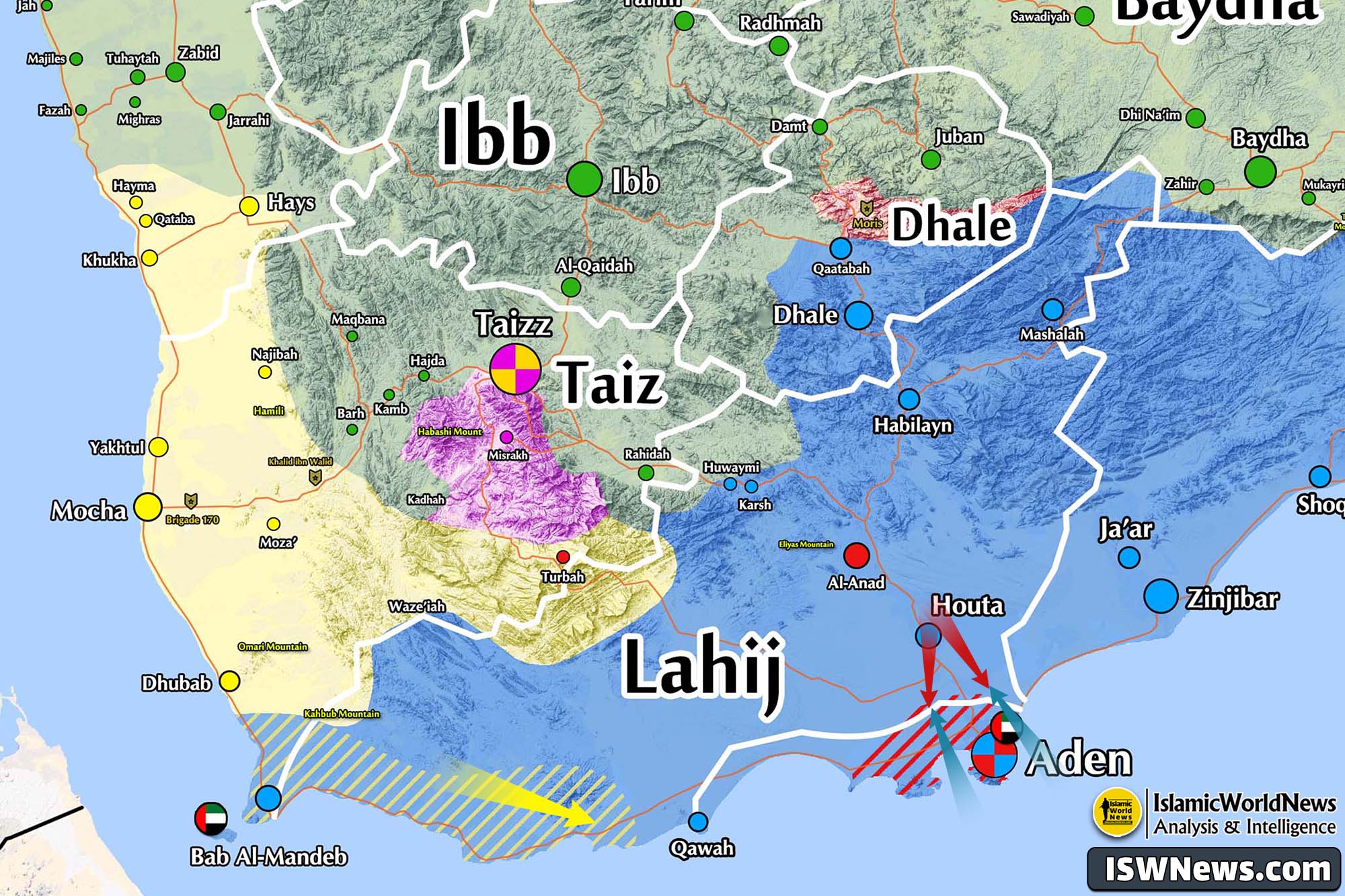
According to the plan, militant forces affiliated to Tareq Saleh, a Yemeni military commander and the nephew of the late President Ali Abdullah Saleh, will control the coastal areas from Hays city to Bab al-Mandab Strait, as well as the Southern Transitional Council (STC) forces will control the coastal regions from Ras al-Ara area to Aden governorate. The implementation of this plan faces problems, because tribes such as al-Sabiha tribes in Lahij Governorate, southern Yemen, want their share and try to control this region.
The seventh brigade of Amaliqa forces as well as groups of Al-Sabihah tribal militants prevented Tareq Saleh’s forces from constructing a base and settling in the Bab al-Mandab coastal strip, located in southwestern Taizs Governorate, on July 28.
The tension was accompanied by a halt in the movement of Tariq Saleh’s forces near Dhubab town, and al-Sabiha tribes warned Tareq’s forces against any military movement towards Bab al-Mandab. After this event, Tareq Saleh ordered more forces to be sent to Dhubab town, but eventually, due to resistance from al-Sabihah tribes, he was forced to retreat from Dhubab towards Mocha.
Al-Sabiha tribes claim that the southwestern lands of Taizz Governorate belong to these tribes and Tareq Saleh’s forces must also retreat from their other positions. They did not stop at this condition and demanded that their militants be officially recognized within the framework of the Saudi-led coalition forces and also Abu Dhiyab al-Alkami return to his position in command of support for national resistance forces (under Tareq Saleh’s command) and also hand over the killers of a soldier named Saadan Ali Saeed.
Tariq Saleh, on July 30, in his first reaction to the clash with al-Sabiha tribes in Bab al-Mandab, published a statement entitled leadership statement of national resistance forces. Saleh considered Bab al-Mandab within his operational space in this statement and referred to a plan that has been approved in joint operations with the participation of Abdul Rahman Abu Zaraa Al Muharrami, commander of Amaliqah forces. He also considered establishing himself in all areas of Taizz Governorate and securing international navigation routes as part of his duties.
Following this escalation, Tareq Saleh’s adviser Nabil Al-Sufi announced in a tweet that the plan to establish joint forces (under Tareq Saleh’s command) was designed by the United Arab Emirates and includes the area from Hays in the south of Al-Hudaydah Governorate to Bab al-Mandab. Also, the Southern Transitional Council forces will protect the coastal areas from Ras al-Ara region to Aden to ensure the security of Bab al-Mandab Strait. In addition, Djibouti’s armed forces will be stationed on the other side of the strait.
In this regard, some local sources reported that the Southern Transitional Council forces transferred control of al-Ardhi region in Bab al-Mandab to Tareq Saleh’s forces on July 31.
Based on the circumstances on the ground, this plan can be considered as part of the US-led coalition’s deployment to support a future naval war with the Ansar Allah movement. In recent months, the Ansar Allah movement has strengthened its naval force with the support of Iran and other resistance groups and has armed its forces with various missiles and speed boats.
The tension between al-Sabiha tribes and Tareq Saleh’s forces can also be considered as a sabotage by some Saudi officials to disrupt the United Arab Emirates’ plan, as they are not interested in resuming hostilities with the Ansar Allah movement and are not willing to completely surrender southwestern Yemeni coasts to the United Arab Emirate. Therefore, they play a role with the card of al-Sabiha tribes in this axis.
Altogether, the conflicts in the Red Sea and the vital Bab al-Mandab Strait seem to be important issues, which have been raised since the early years of the Yemen war and they have turned into more serious topics with the permanent deployment of the United States’ naval coalition or Combined Task Force 153 to the waters of the region.
The US and Israel resort to sabotaging the Yemen peace process and destroying relations between Iran and Saudi Arabia in order to send Saudi Arabia back to war with the Ansar Allah movement. Despite avoiding re-engagement in Yemen, the Saudi authorities continue to show inflexible reactions in negotiations as well as military deployment in a bid to maintain their positions! However, such an attitude is expected to weaken the efforts to find a political solution in line with achieving peace in Yemen.
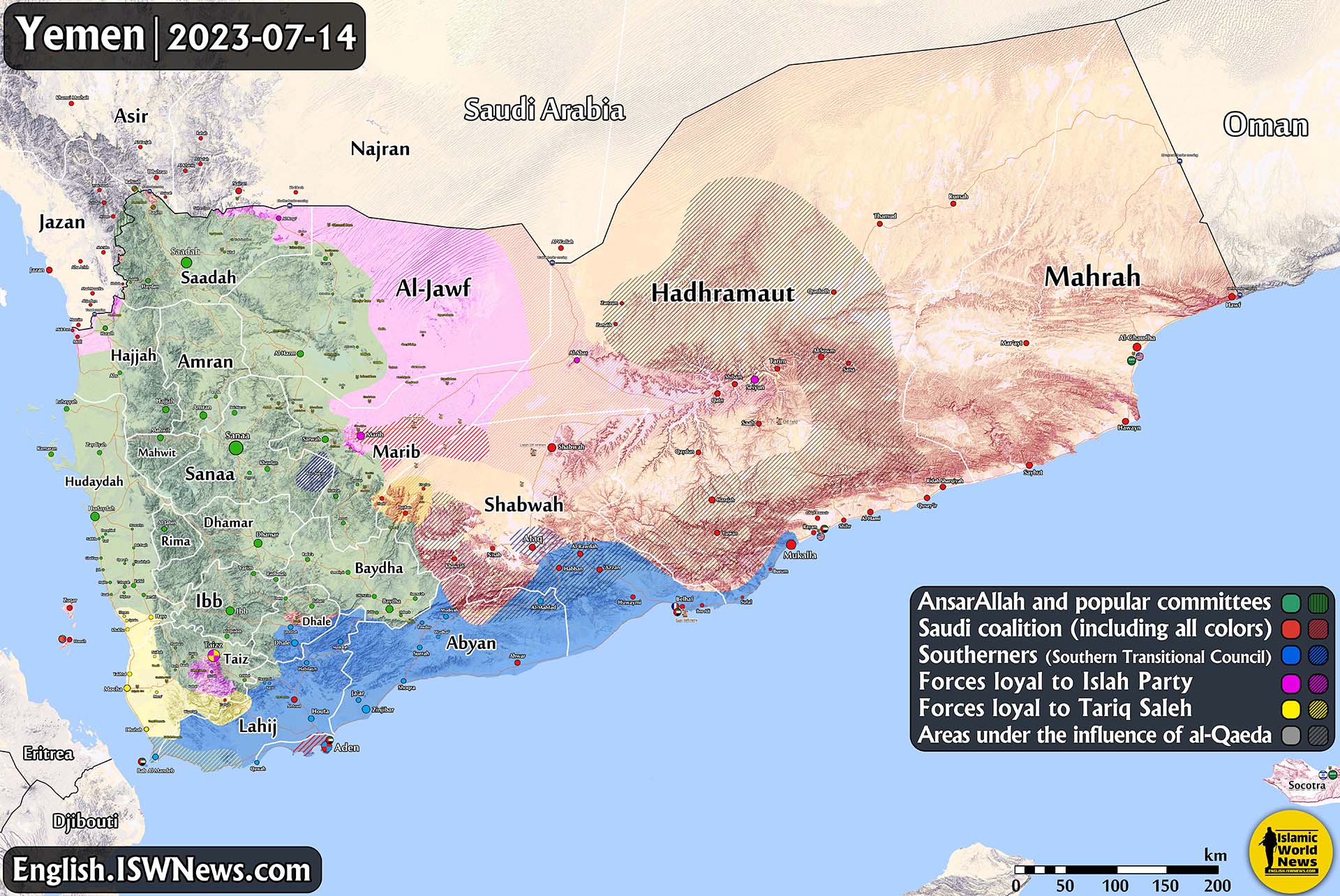
Military situation in southern Yemen – click to view full size
ISWNews Analysis Group: The attacks resulted in the killing and wounding of militants on both sides, with most of the casualties and damages inflicted on the Southern Transitional Council.
The escalation of Al-Qaeda attacks is taking place in the shadow of competition by Saudi Arabia and the United Arab Emirates (UAE) for control of Abyan Governorate.
A great number of local media and analysts consider Al-Qaeda’s movements against the Southern Transitional Council to be a project commissioned by Saudi Arabia.
Given the fact that an unwritten ceasefire between the Ansar Allah movement and the Saudi coalition is in place, the conflict in Yemen shifted to occupied areas, and the Saudi-led factions are trying to gain more power and influence in the war-torn country.
The situation led to weakening of the resigned Yemeni government, and members of its presidential council are hopeless for success against Ansar Allah movement; so, they pursue implementing their ideal plans, including the partition of southern Yemen.
Moreover, the Takfiri terrorist group Al-Qaeda, which has a significant number of supporters in central and eastern Yemen, expanded its activities and returned to the Yemeni war.
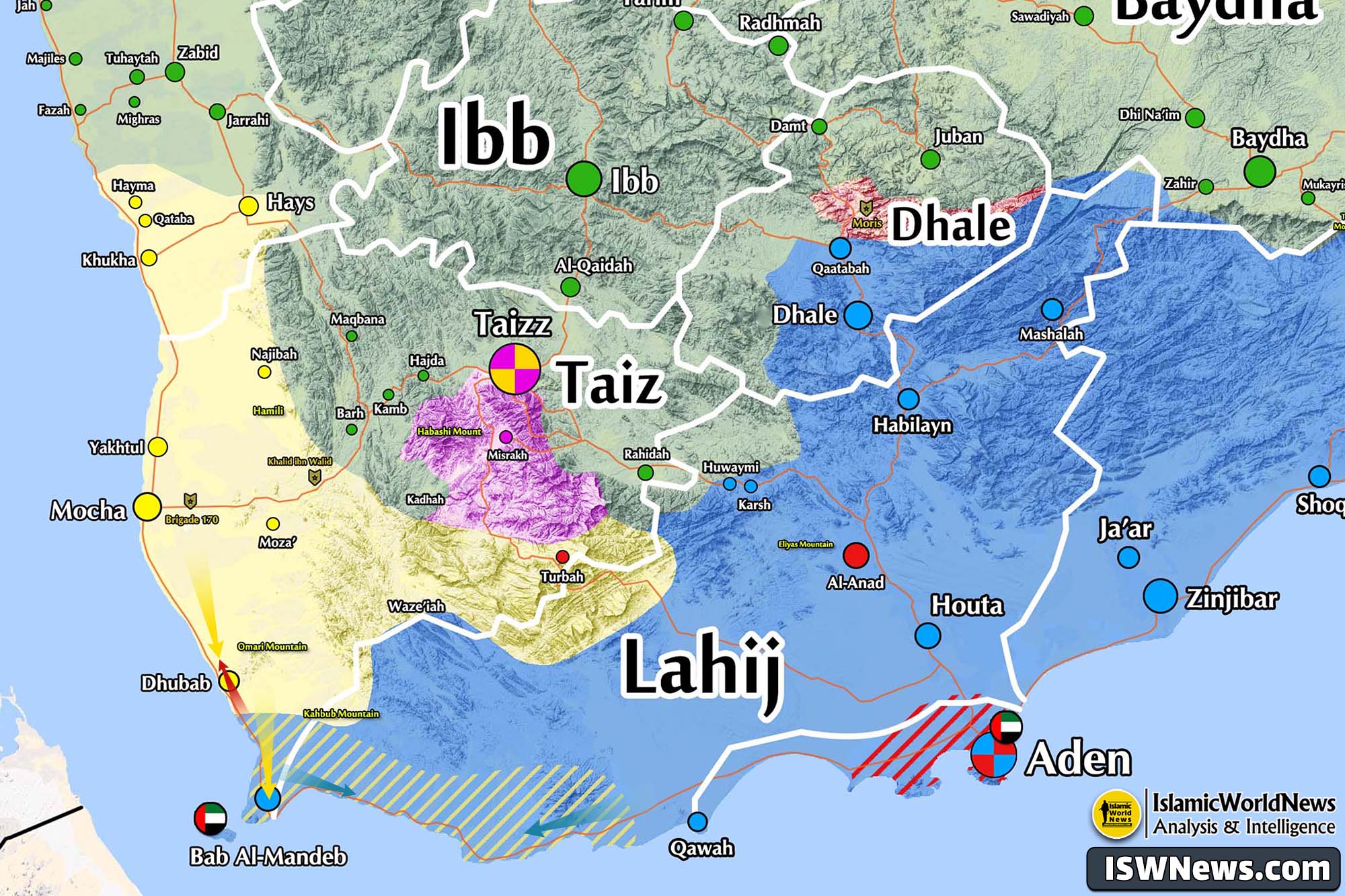
Aden, Lahij and Taiz fronts:
On January 14, 2023, forces of Yemeni military commander and the nephew of the late President Ali Abdullah Saleh, Tareq Mohammed Abdullah Saleh, took control of the Ras al-Ara area on the coast of Lahij province. However, this advance was hampered by tribes, and Rashad Al-Alimi, head of the Presidential Council of the resigned Yemeni government, approved a plan to form a new brigade of Al-Daraa Al-Watan forces in the area under the leadership of Bashir Saif Al-Mazrabi Al-Sabih on February 1, 2023.
The city of Taiz is currently under the control of forces of the al-Islah Party, the resigned government and some independent militants. Tareq Saleh has also returned to the city despite opposition from al-Islah Party. One of the major tensions that occurred after Tareq’s entry into Taiz was the failed assassination attempt on Minister of Defense of the resigned government Mohsen Al-Daeri. These tensions question the resigned government’s claim that Taiz has been besieged by Ansar Allah movement for past eight years. Since the western road and southern areas of Taiz Governorate are under control of al-Islah Party and Tareq Saleh, tensions between these groups limited access to Taiz and prevented delivery of humanitarian aid. The Ansar Allah movement has repeatedly reopened Sana’a-Taiz road voluntarily, but al-Islah Party prevented non-military vehicles from entering Taiz.
On January 25, 2022, the forces of Al-Dara’ Al-Watan (backed by Saudi Arabia) took control of the important Al-Anad base in Lahij Governorate by expelling the militants of the Southern Transitional Council (STC) and evacuating Sudanese mercenaries. This action by Al-Daraa Al-Watan can be considered as Saudi Arabia’s first move to limit the STC.
Saudi media outlets announced that Riyadh intends to remove the STC from the political scene in southern and eastern Yemeni governorates, but this claim has not been seriously implemented so far, and in fact, Saudi Arabia intends to confront with Al-Daraa Al-Watan forces and create a national council for Hadramout Governorate to confront the STC and partition southern Yemen. The control of the resigned government and Saudi Arabian bases in Aden has also been transferred to Al-Daraa Al-Watan, and Saudi advisers are managing Aden’s security issues alongside them.
Latest military situation in Taiz, Aden and Lahij regions in the southwest of Yemen – click to view full size
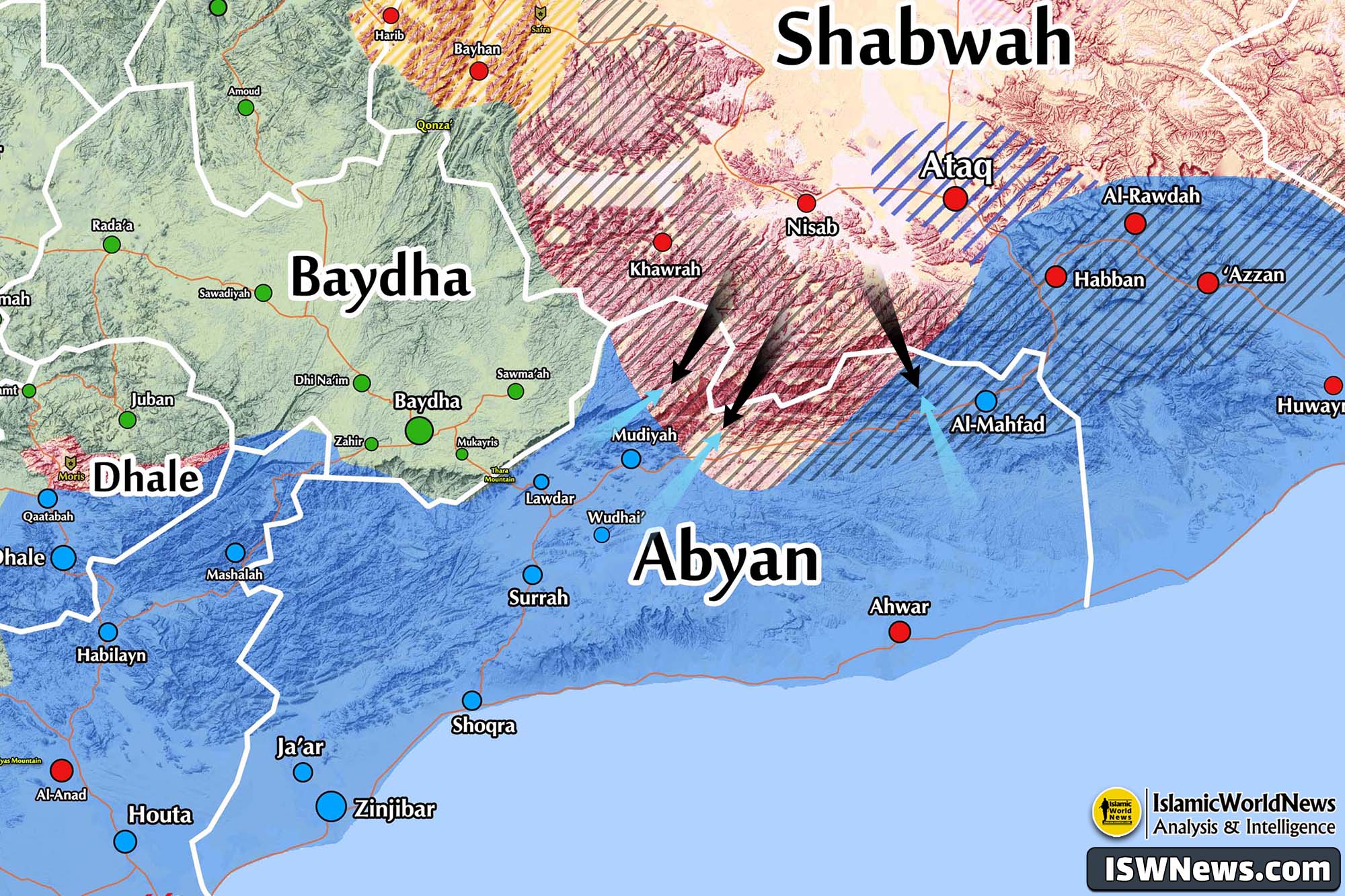
Abyan front:
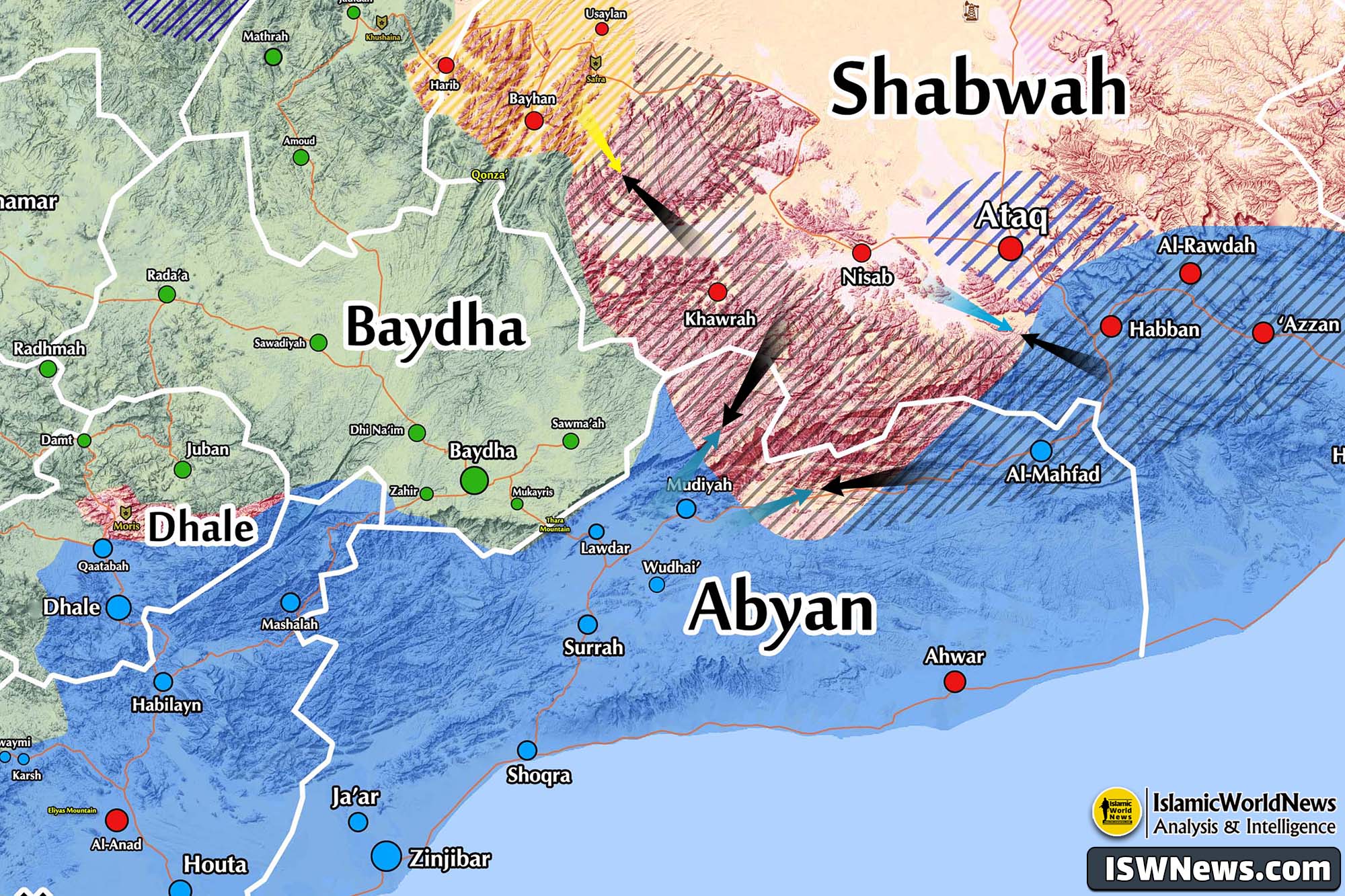
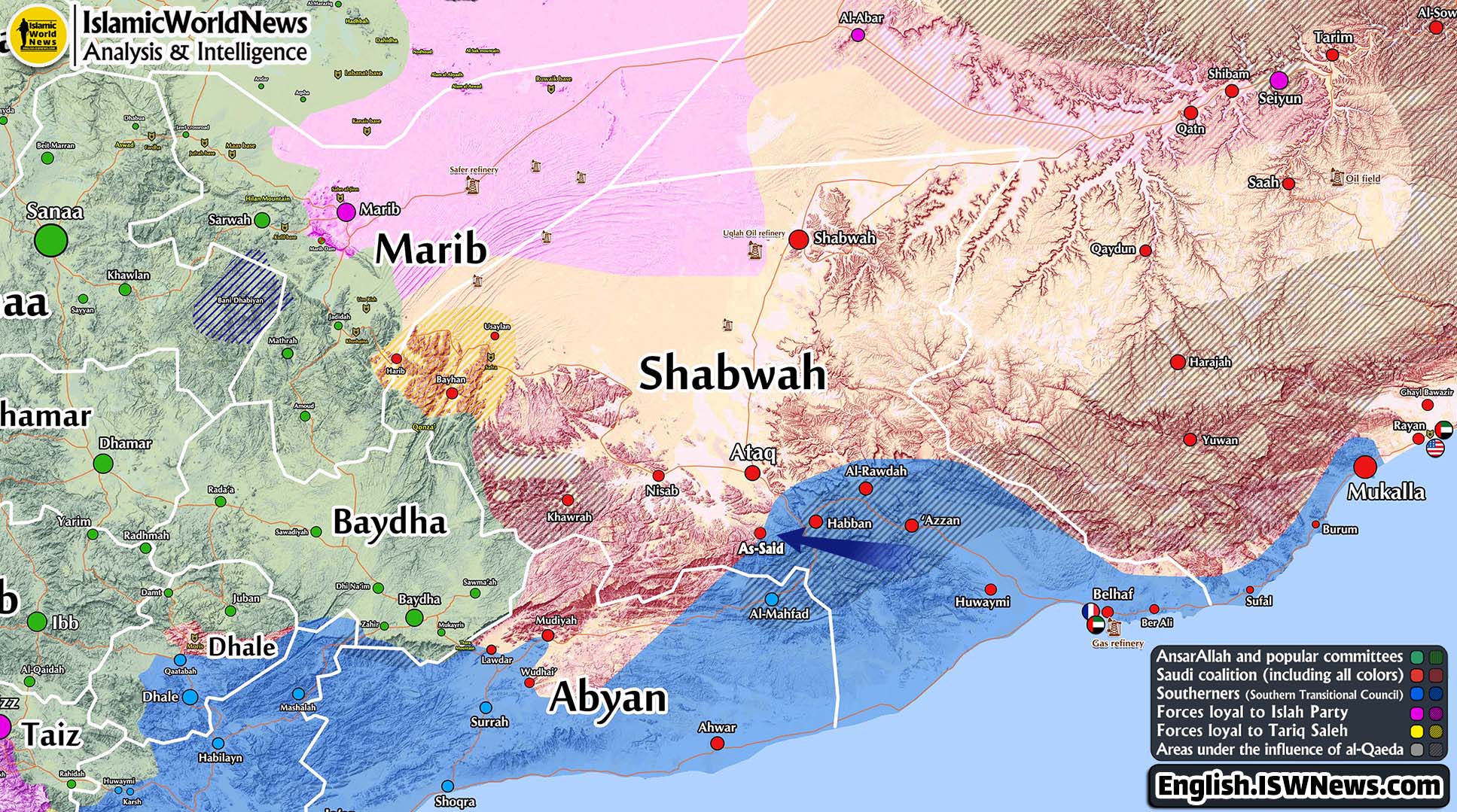
The terrorist group Al-Qaeda recruited hundreds of militants from some tribes in Shabwa and Abyan governorates, and Al-Qaeda has again transferred its activities to the north of Abyan Governorate and parts of Shabwa Governorate. Their attacks, which are mostly limited to roadside bombings and guerrilla attacks, have led to the withdrawal of STC forces from most areas of Al-Mahfad and Modiyah districts. Central areas of these areas are under the control of STC militants, but most mountainous areas are under Al-Qaeda control, and clashes between the two sides are ongoing in Wadi Omran.
The increase in Al-Qaeda’s movements on this axis may not be supported by Saudi Arabia, but since it weakens the positions of the Southern Transitional Council in Abyan province, it has not been opposed by Saudi Arabia either, and there is a possibility of covert support from Saudis for Al-Qaeda. Because Al-Qaeda has started using scarce weapons such as quadcopters, etc., which is not possible without external support.
Latest military situation in Abyan and the south Shabwa regions – click to view full size
Shabwa front:
The Southern Giants Brigades known as Al Amaliqah forces, drove out the Shabwa Defense forces on April 8, 2023 to control Bayhan district. The surroundings of the district are also under the control of Shabwa Defense forces; so, Al-Qaeda attacks mostly these forces.
Al-Qaeda terrorists attacked the town of Al-Masiniyah in Al-Saeed district on June 11, 2023 under the pretext of killing commander of al-Islah Party in Bayhan Abdullah Al-Bani. Al-Qaeda used quadcopters and also the US conducted drone attacks on al-Islah Party’s positions in support of the STC.
The US’s support for the STC strengthened their position and governor of Shabwa Awadh bin Al-Wazir Al-Awlaki, and it also reduced the likelihood of operations by Al-Daraa Al-Watan and al-Islah Party forces with Saudis’ support in Ataq city. Saudi Arabia stationed its forces on the northern axis of Ataq to Jardan district and it intends to expel the STC from Ataq city and Shabwa Governorate’s oil-rich areas.
Therefore, competition between Saudi Arabia and the UAE in Shabwa Governorate has been stopped following US intervention, and meetings between US Ambassador to Yemen Steven Fagin and Awadh Al-Awlaki, indicating the US plans to use Shabwa’s oil resources.
Marib front:
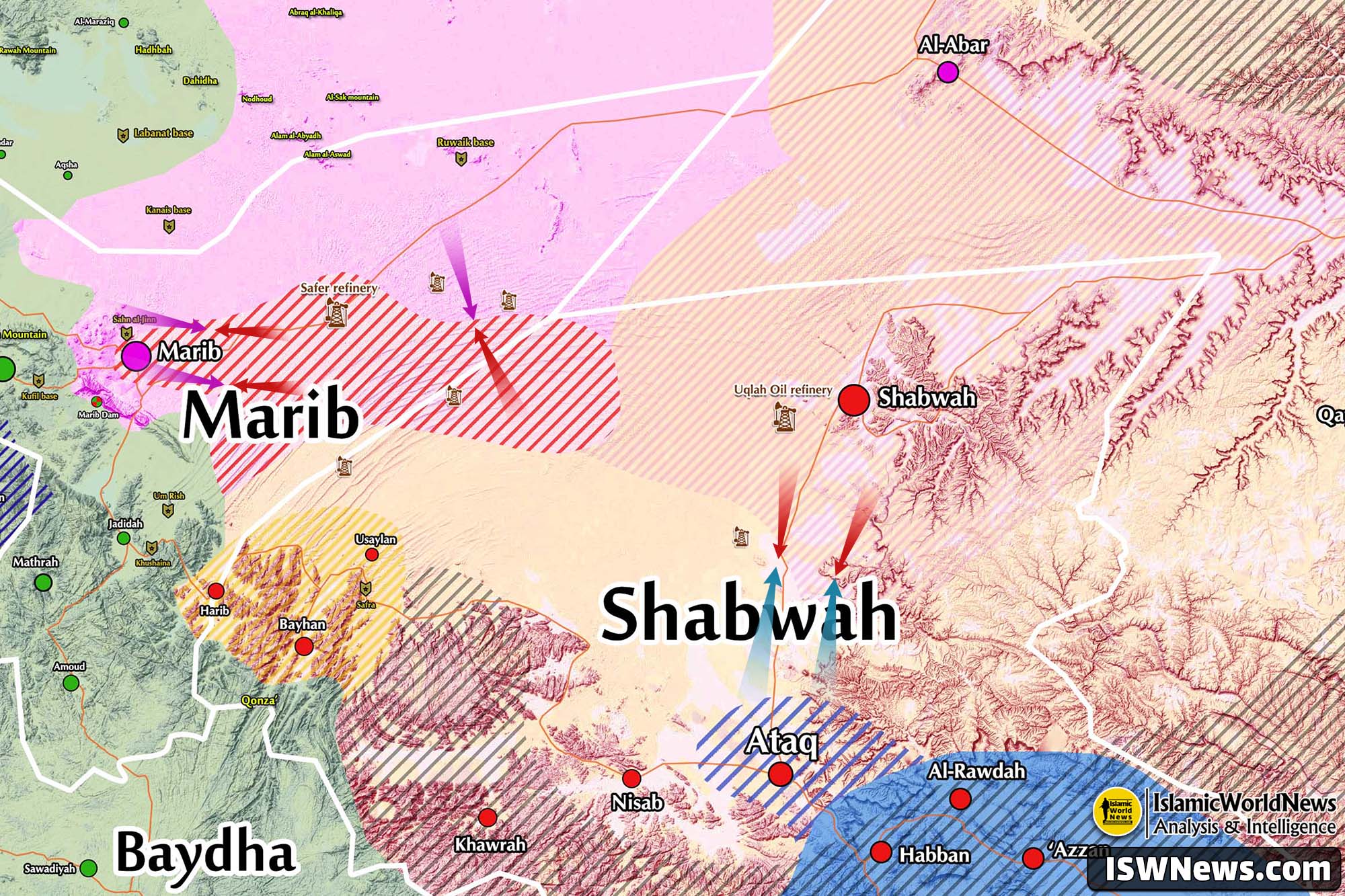
After mounting differences between al-Islah Party and the resigned government in late December 2022, Marib Governorate became the scene of tension between the forces of commander-in-chief of the Yemeni resigned government’s armed forces Major General Saghir bin Aziz and al-Islah Party militants. The clash led to the expression of dissatisfaction by tribes in eastern Marib. The root cause of the clashes is a dispute over the division of oil field revenues, and tribes claim parts of oil revenues.
The difference between Saghir bin Aziz and al-Islah Party in Marib continues, but Saudi Arabia temporarily stopped it and is concentrating on merging al-Islah Party militants into Al-Daraa Al-Watan forces; therefore, it appointed al-Islah Party’s field commander in Shabwa Governorate Brigadier General Abd Rabbo Laakb as commander of one of Al-Daraa Al-Watan brigades.
Latest military situation in Marib and north of Ataq regions – click to view full size
Yemen is currently facing several serious challenges such as plots for partitioning southern regions by the STC, exploiting oil and gas resources by the US, Europe and Arab states, stationing terrorist groups in central regions, and being occupied by Saudi Arabia and the UAE.
The Ansar Allah movement and the resigned government of Yemen are opposed to partitioning southern Yemen; so, they will not support the STC, which seeks to revive southern Yemen and the group will not succeed in implementing partition plan. But the issue of exploitation of oil and gas resources and handing over of islands to foreigners are challenges, which are being opposed only by the Ansar Allah movement.
The opposition to the issue prevented oil and gas exports, but did not create any danger for companies and military personnel from the US, Europe and other foreigners in Yemen. In fact, Western political pressures become a leverage so that Ansar Allah movement cannot hinder threats by foreigners.
The occupation by Arab states and presence of terrorist groups in Yemen will only be eliminated through serious confrontation by Yemeni army and Ansar Allah. The Ansar Allah movement must prepare itself for this scenario with support from Iran and resistance groups. Political negotiations at this stage are not very effective; so, peace negotiation is a claim to provide enemies with opportunity to renew strength.
Military situation in Yemen – click to view full size
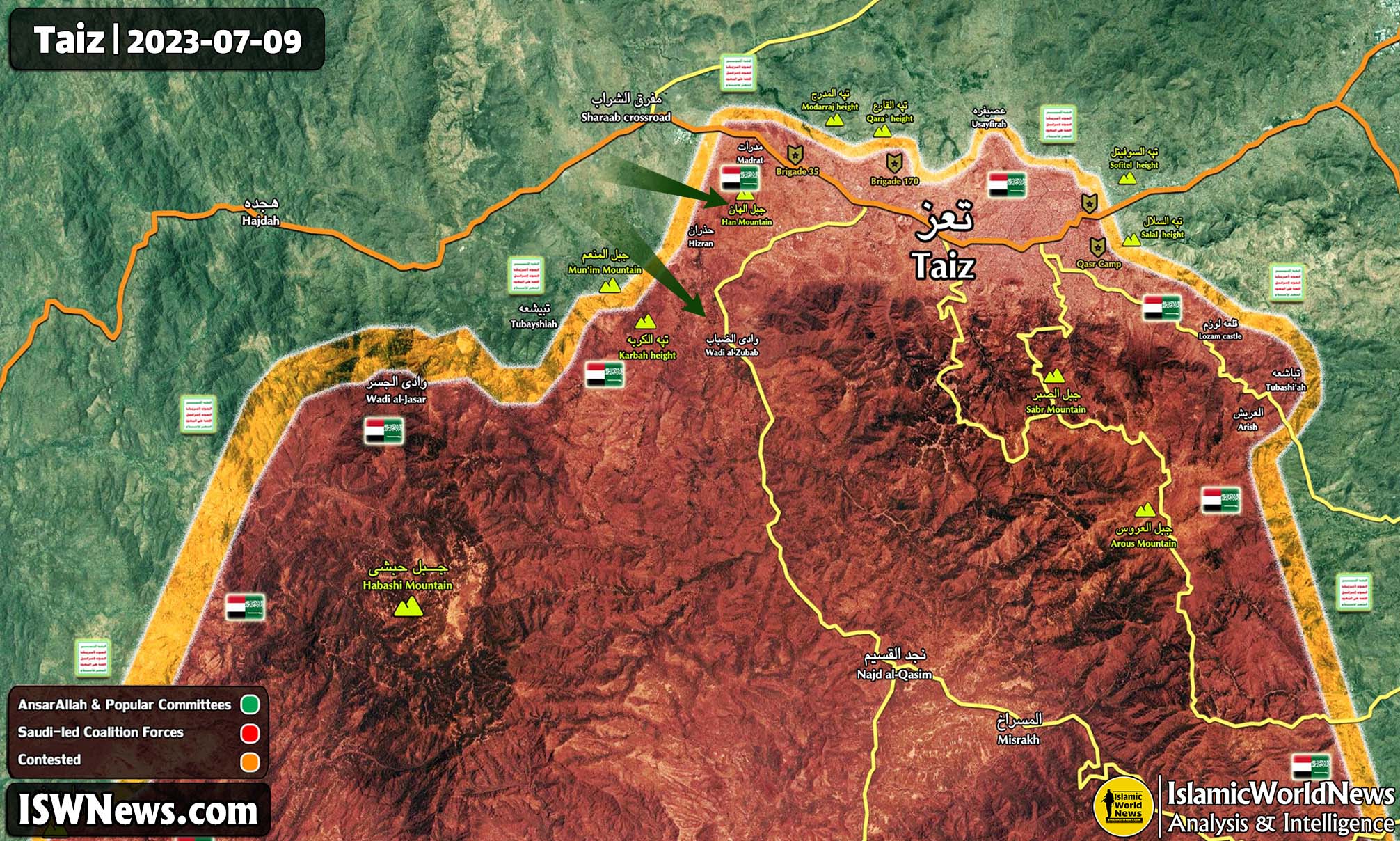
ISWNews Analysis Group: According to the command center of the pro-Hadi forces in Taiz Governorate, two Ansar Allah drones pounded the gathering in the Al-Dhabab area on Saturday, July 8.
As a result of the attack, two militants affiliated to the resigned government, including Omar Abdullah Al-Sabri, commander of the western front of Taiz, were killed and at least seven others were injured.
Some local media outlets also reported that the location of the gathering of the resigned government forces was identified on Mount Han, which is on the front line of engagements between the pro-Hadi forces and the Ansar Allah fighters and it is the origin of many mortar attacks against the Ansar Allah movements.
Thus, it is likely that Ansar Allah fighters carried out the attacks in response to repeated violations of the ongoing ceasefire by the resigned government forces on the Taiz front.
However, the Ansar Allah-affiliated media outlets and officials have not yet reacted to the news story.
The Taiz city is currently under the control of the Yemeni Congregation for Reform or frequently called as al-Islah Party forces and Tareq Mohammed Abdullah Saleh, Yemeni military commander and the nephew of the late President Ali Abdullah Saleh, as well as some independent armed groups.
The pro-Hadi resigned government forces claim that the Ansar Allah movement besieged the Taiz city during the past eight years and it does not allow humanitarian aid to pass through the northern road.
They propagate the claim while the western road and southern areas of Taiz Governorate are under the control of al-Islah Party militants as well as Tareq Mohammed Abdullah Saleh’s forces, and internal tensions between such groups have limited access to the Taiz city.
In spite of the facts, the Ansar Allah movement repeatedly voluntarily reopened the Sana’a-Taiz road, but al-Islah Party’s militants prevented non-military vehicles from entering the Taiz city.
Map: Direction of Ansar Allah drone attack on the gathering of Hadi forces in the west of Taiz – click to view in full size
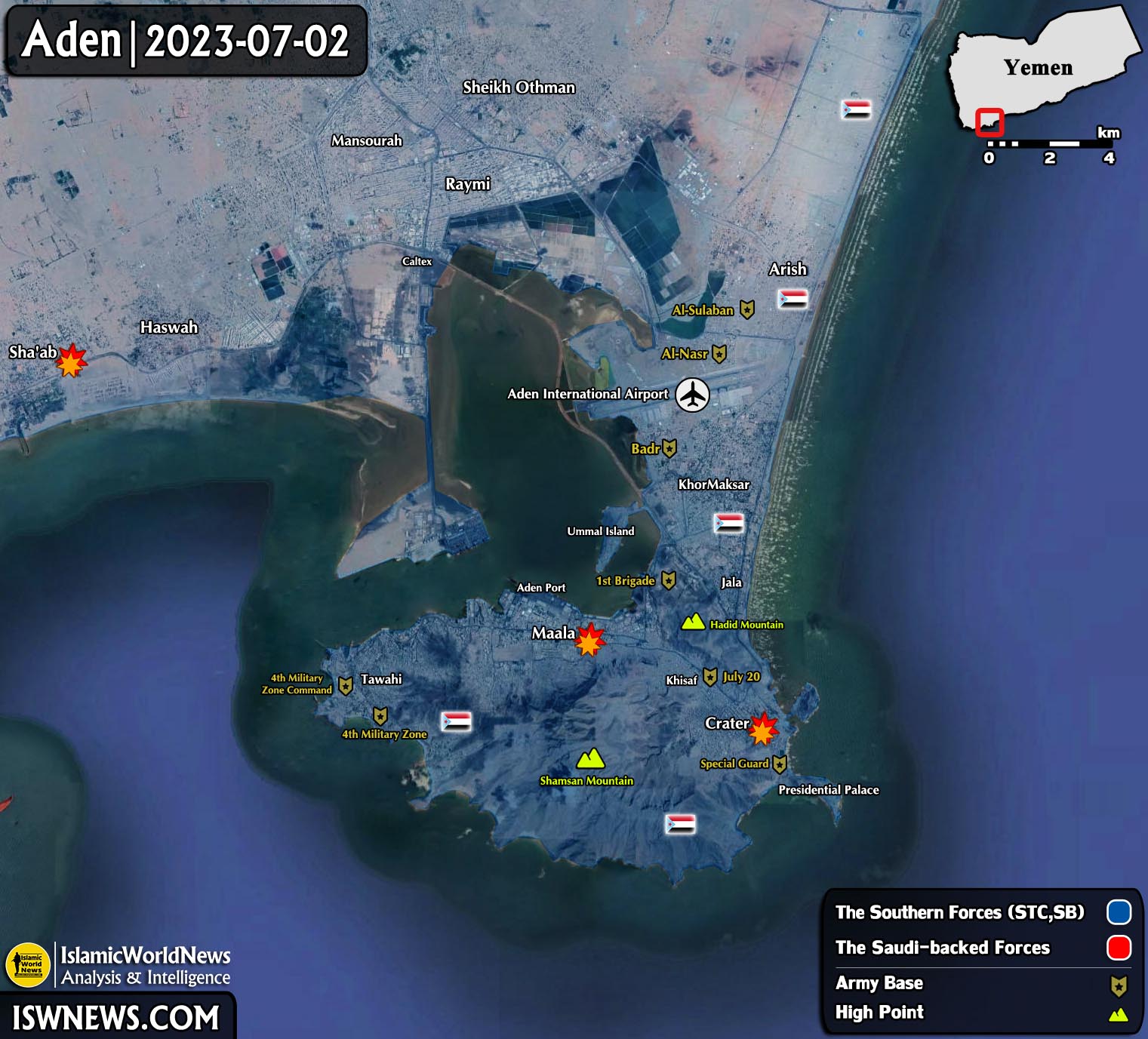
On July 30, after a woman complained to the police station in Al-Ma’ala district over being harassed by son of one of Aden’s security commanders, the Al-Hizam Amni security forces backed by the Southern Transitional Council (STC) went to this person’s house.
This move led to violence and clashes between the two sides, and one of the Al-Hizam Amni security forces was wounded by a bullet from the security commander, who later succumbed to injury after being transferred to the hospital.
Following the fatal incident, the Al-Hizam security forces went to the residence of the security commander to arrest and punish him, but this time the security commander was killed by the Al-Hizam Amni forces.
This incident has led to continued chaos in the city of Aden, and up to now an arms depot belonging to the Al-Hizam security forces has been exploded in the Al-Sha’ab neighborhood and a restaurant in the Crater district of the Aden Governorate has caught fire.
The city of Aden has witnessed violent clashes since Friday evening, which indicates that security chaos in occupied areas of Yemen has its roots in economic pressures and the inability of Yemen’s resigned government to resolve political and security woes.
Explosion of the weapons and ammunition warehouse of Hizam al-Amni forces in Sha’ab area
ISWNews Analysis Group – The unidentified drone (likely American one) attacked the positions of Al-Qaeda elements in the Al-Kawr district located on the outskirts of the Al-Sa’id village in Shabwah Governorate.
According to some local sources, one of the Al-Qaeda terrorists was killed as a result of the air raid.
This region is under the control of the Southern Transitional Council (STC), which is affiliated to the United Arab Emirates (UAE), and the Al-Qaeda terrorist group carried out heavy attacks in recent weeks in the areas such as Al-Mosina’a, As Said, and Al-Mahfad.
At the same time when the mentioned attacks occurred, the unidentified drones were utilized in the battlefield and bombarded Al-Qaeda positions, which local sources attributed to the US army.
In the previous air strike by such drones, one of the senior members of Al-Qaeda terrorist group in the Al-Mosina’a village Abu Muhammad al-Shaluni al-Awlaki was killed.
As a result of the attack by al-Islah Party militants on the Southern Transitional Council at the Al-Qana’a checkpoint located in the Al-Mosina’a town of Al-Said district, two STC militants were killed and three others were injured.
According to local sources, the raid was carried out by al-Islah Party militants and resulted in the killing of one of its own militants and the injury of two others. As a result of the confrontation, three military vehicles and an arms depot at the Al-Qana’ah military checkpoint were also demolished.
The strike by al-Islah Party militants on STC positions in Al-Masna’a took place after one of al-Islah Party field commanders named Abdullah Al-Bani was killed in an ambush by the Shabwa Defense Forces, which is affiliated to the United Arab Emirates (UAE) in Bayhan town in western Yemen; thus, its militants vowed to take revenge on Southern Transitional Council forces.
It is worth mentioning that the Shabwa Defense Forces and the Southern Transitional Council are under the protection of the United Arab Emirates, and the al-Islah Party is under the protection of Saudi Arabia.
The power struggle and tension between these armed groups were intensified after the UAE-backed militants took control of Ataq city, capital of Shabwah Governorate, as well as most regions of the governorate in July 2022.
The local sources went on to say that the unidentified offensive drones were belonged to the United States most likely.
The Jaishan district is located near the Merkhah As Sufla District in the Shabwah Governorate, which is under the control of UAE-affiliated militant forces. And it is likely that the United States’ drones attacked Salafi elements of the Al Amaliqah forces, who have been stationed in the area.
The exact details of the air strike have not yet been determined, while a number of news sources affiliated to the Southern Transitional Council (STC) militant group described the nature of the attack as a rocket attack by al-Qaeda terrorists.
Prior to the Wednesday attack, the United States’ drones carried out three separate air raids on the hideouts of prominent elements of the al-Qaeda terrorist group on the outskirts of Marib city about 120 kilometers east of Yemen’s modern capital Sana’a, which ended up in the killing and wounding of several elements of the terrorist group, on December 1, 2022, January 30, 2023 and February 26, 2023.
Following the order of the Saudi coalition command to the forces of Hashem al-Ahmar to withdraw from Al-Wadiah border crossing in Hadhramaut province, Al-Dara al-Watan (Nation Shield) forces will be deployed in this area. Hashem al-Ahmar has started withdrawing his forces from this area and handing it over to Al-Dar al-Watan on Tuesday, May 9.
This relocation is part of the new agreement between Saudi Arabia and the UAE in the occupied areas of Yemen. According to this agreement, Emirati forces will withdraw from their positions in Shabwah province and the forces loyal to Saudi Arabia will enter these areas. Considering the recent actions of Saudi Arabia in Shabwah province, the next possible step will be to enter the city of Ataq, the capital of this province.
Major General Hashem al-Ahmar is one of the parliamentarians and military personnel of the Yemeni army during the time of Ali Abdullah Saleh, who operates independently under the orders of the Saudi coalition. In the past years, after leaving Sana’a, Hashem al-Ahmar managed to gather his forces and was able to receive the mission of controlling and securing the al-Wadiah crossing from the Saudi coalition command. In the clashes of the summer of 2022 between the Islah Party (Reform Party) and the Southern Transitional Council (STC), he entered into a battle with the STC militants, but he could not maintain his positions in al-Wadiah crossing and left this area, and finally returned to this area with the mediation of Saudi Arabia. Now, Hashem al-Ahmar was removed from the post of al-Wadiah crossing. According to local sources, Hasham al-Ahmar’s forces have been sent to the Kataf district front in the north of Saada province.
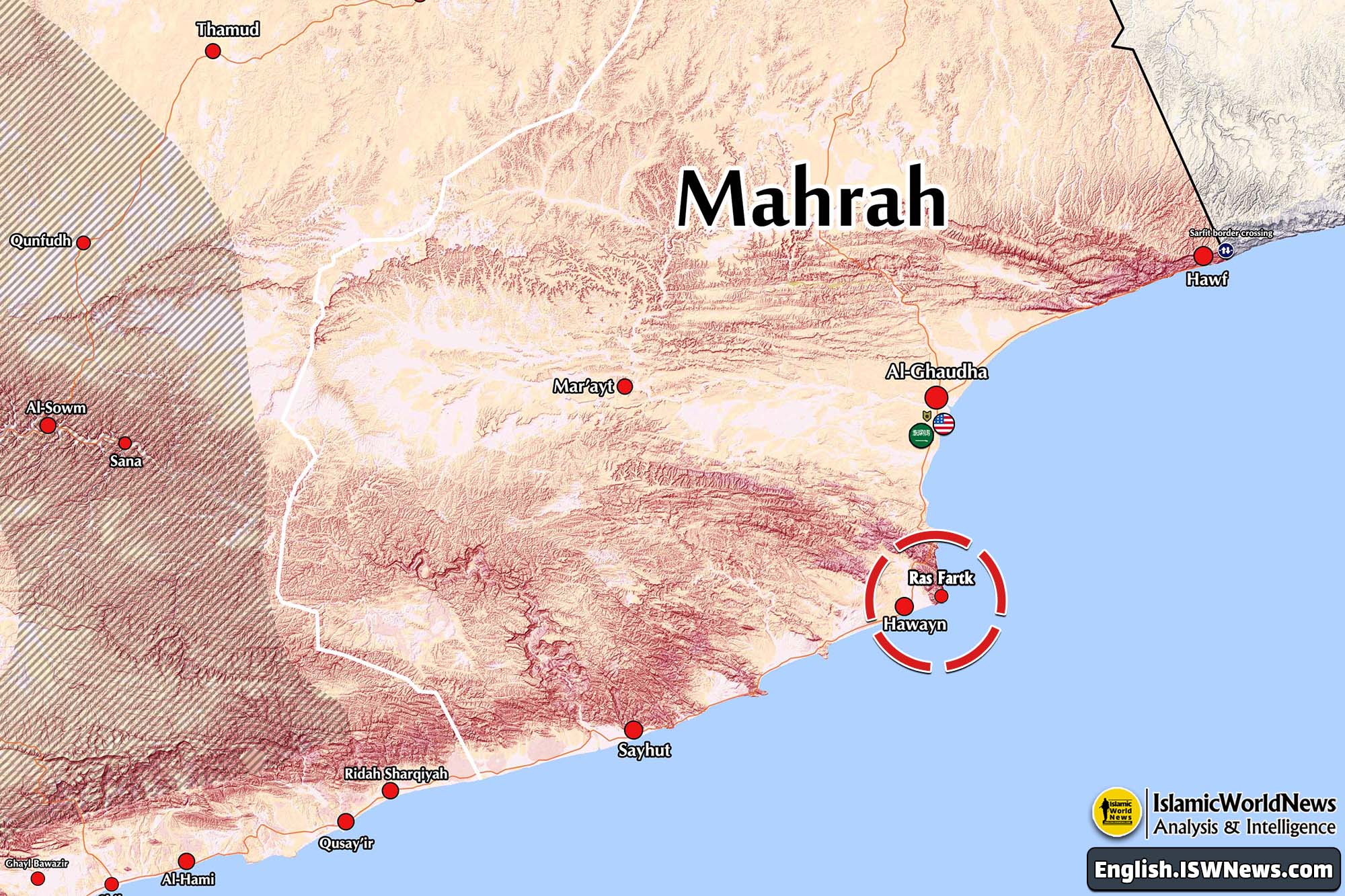
According to local sources in Al-Mahrah province, on April 29, a member of Yemeni Coast Guard was shot and killed by the British Navy in Ras Fartak area located on the coast of Al-Mahrah province.
These sources added that the British forces shot at the Yemeni boatman after an argument and left the scene.
This action is a continuation of British occupation actions in the eastern coast of Yemen and in line with the militarization of this region after the construction of several coastal bases in eastern Yemen. The British and their other allies (CMF-153) have occupied the eastern and southern coasts of Yemen claiming to fight against smuggling and also to prevent the shipment of Iranian weapons to Yemeni resistance. They have also prevented the fishing of the people of Sayhut, Haswayn, Nishtun, etc., and have seized the boats of Yemeni fishermen many times.
The Maritime and Coastguard Agency (MCA) alleged on Friday that three boats carrying three or four passengers raided a ship off the Port Nishtun, which is located in Al Mahrah Governorate, Yemen.
It is worth mentioning that the region is under supervision of the resigned government of Yemen; so, some reports by certain media outlets on the Ansar Allah movement’s potential involvement in the mentioned attack are not correct.
The British entity has not yet released more information on the allegation. However, it called on the trade ships and boats sailing in this area to observe the protection and security issues.
The Maritime and Coastguard Agency is a military entity, which has been established by Britain’s army to carry out the coordination and the data exchange in the Arab Sea. It also informs news stories concerning piracy incidents in that region.
The coastal areas of Yemen have been under total siege during the eight-year war imposed by the Saudi-led coalition.
The heavy blows inflicted on the naval fleets of the Saudi-led coalition led to the deployment of another international coalition forces under the title of Combined Maritime Forces (CMF-153) in the Red Sea.
The latter coalition resorts to propagating unofficial news stories, which are sometimes fake news, on the so-called shipment of Iran-made weaponries to Yemen as well as drug trafficking in a bid to justify the Combined Maritime Forces’ presence in the Red Sea, Bab al-Mandeb and Gulf of Aden.