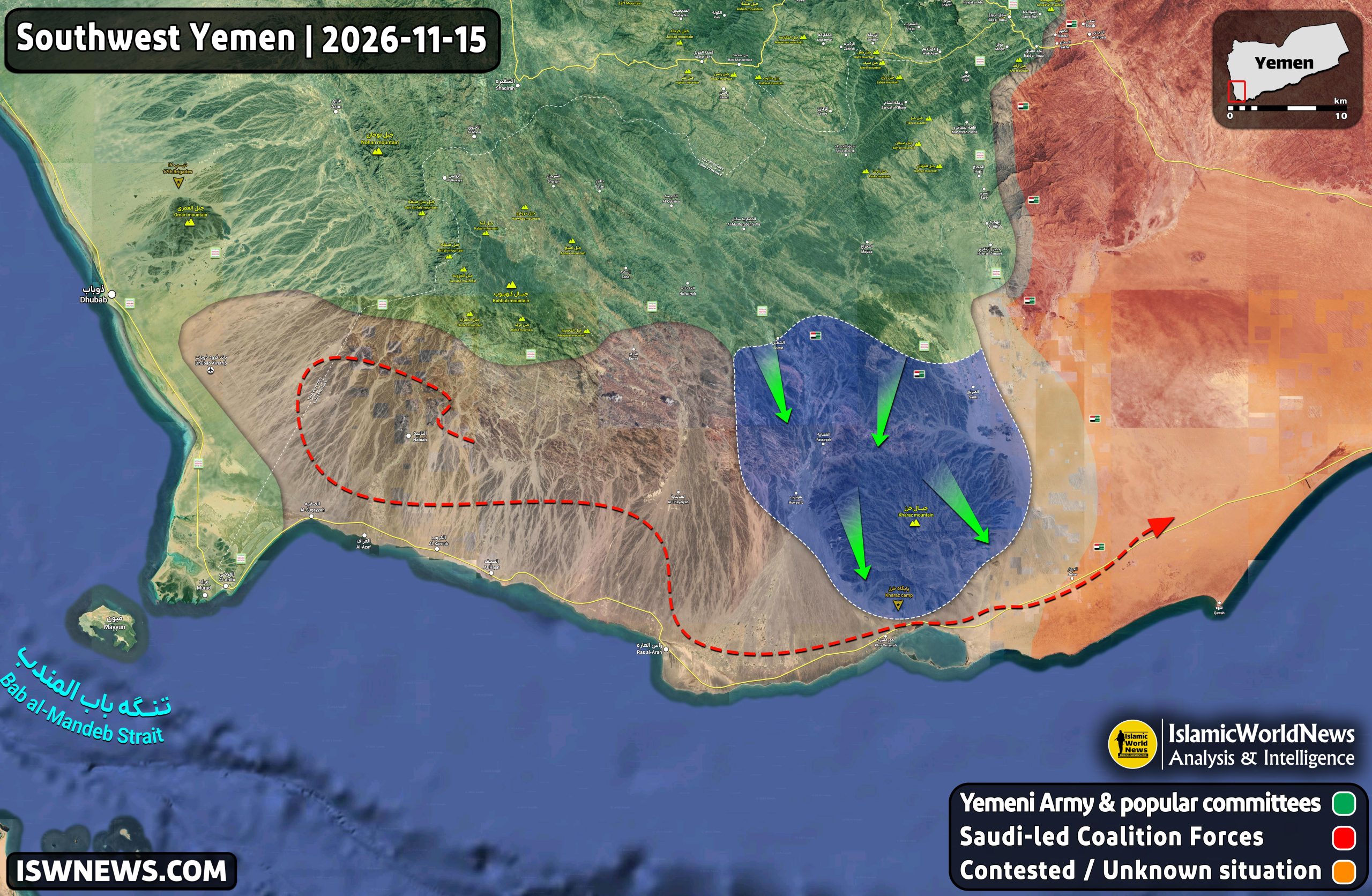
Yemeni forces have not yet entered the Khawr Umayrah settlement, but they are deployed around it and on the Kharaz heights and can target the coastal road with anti-armor missiles and artillery munitions. Therefore, Saudi coalition forces in Ras al-Arah and on the eastern front of the Bab al-Mandab Strait have officially been encircled.
In recent days, Ansarallah forces had repeatedly cut the aforementioned road with guerrilla attacks and hit-and-run tactics, but since yesterday this route has been completely cut off. It should be noted that a number of Saudi coalition forces fled toward Aden in recent days from the areas that were being besieged. However, after the encirclement was completed, a significant number of forces have been trapped in the Yemeni Army’s siege. No final decision has yet been made regarding the fate of these forces. It is possible that the coalition forces will withdraw from the area with the Yemeni Army’s permission, or there is the possibility of their complete capture.
Ansar Allah Yemen has announced that the passage of all vessels—except Saudi vessels—through this waterway is unimpeded. This decision was made within the framework of the “siege for siege” equation, and as long as the oppressive siege by the Saudi kingdom against the Yemeni people continues, the Yemeni army will likewise continue its siege and pressure on Saudi Arabia.
The latest field reports indicate that Saudi coalition forces, following widespread retreats, have now concentrated along the coastline approximately 40 kilometers east of Bab al-Mandab, around Ras al-Arah. Today, Yemeni armed forces and Ansar Allah struck a gathering of forces at Ras al-Arah with a ballistic missile, resulting in an unspecified number of Saudi coalition forces being killed and wounded in the area.
On the other hand, Saudi warplanes are heavily bombarding important areas recently liberated by Yemeni armed forces in order to prevent further advances by the Yemeni army. Today, they once again bombed Mount al-Omari near Dhubab, Dhubab town, the Khalid ibn al-Walid base at the Al-Mokha junction, Al-Mokha port, and Al-Khawkhah.
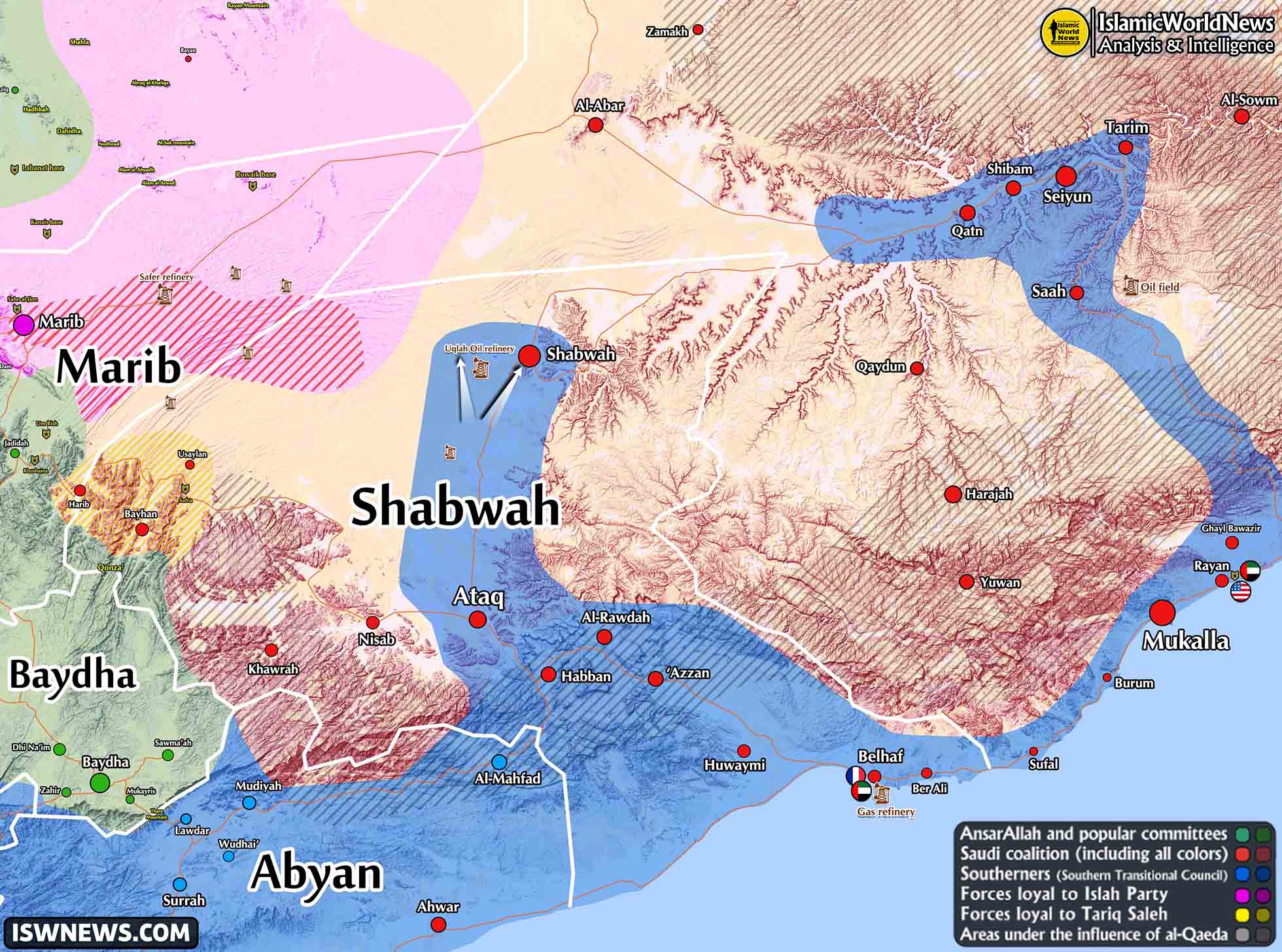
After consecutive defeats of the Southern Transitional Council (STC) in Hadhramaut and Al-Mahra — and their withdrawal without fighting from the Balhaf gas facility and the strategic Marra base in Shabwah — the focus of pro-government forces shifted to southern Yemen. In initial negotiations, local authorities in Abyan agreed to hand over their positions to Al-Dara’ Al-Watan forces. Southern militants and allied tribes have not yet surrendered their positions, but they also have not shown resistance.
In Aden, government and service facilities — including the Presidential Palace (Al-Ma’ashiq) and Aden Airport — had already been evacuated by STC fighters and handed over to representatives of the government-in-exile. Early this morning, Al-Dara’ Al-Watan forces entered Aden via the coastal road and Al-Anad base, taking control of military and security sites. Elements of the Giants Brigades also assumed control of parts of Aden at the order of the Saudi-led coalition. Their commander, Abu Zarah Al-Muharrami, officially split from the STC yesterday and pledged allegiance to Saudi Defense Minister Khalid bin Salman.
The Saudi-backed forces captured Aden and Abyan provinces
The disappearance of Aidarus al-Zoubaidi — head of the Southern Transitional Council — at dawn today, and his failure to travel to Riyadh, has angered the Saudis and escalated tensions between the STC and the government-in-exile. Rashad Al-Alimi has revoked his membership in the Presidential Leadership Council. This situation suggests instability will continue in the occupied regions of Yemen — and it is likely that Al-Dhale and Lahij will soon witness Saudi attacks and further Southern capitulations.
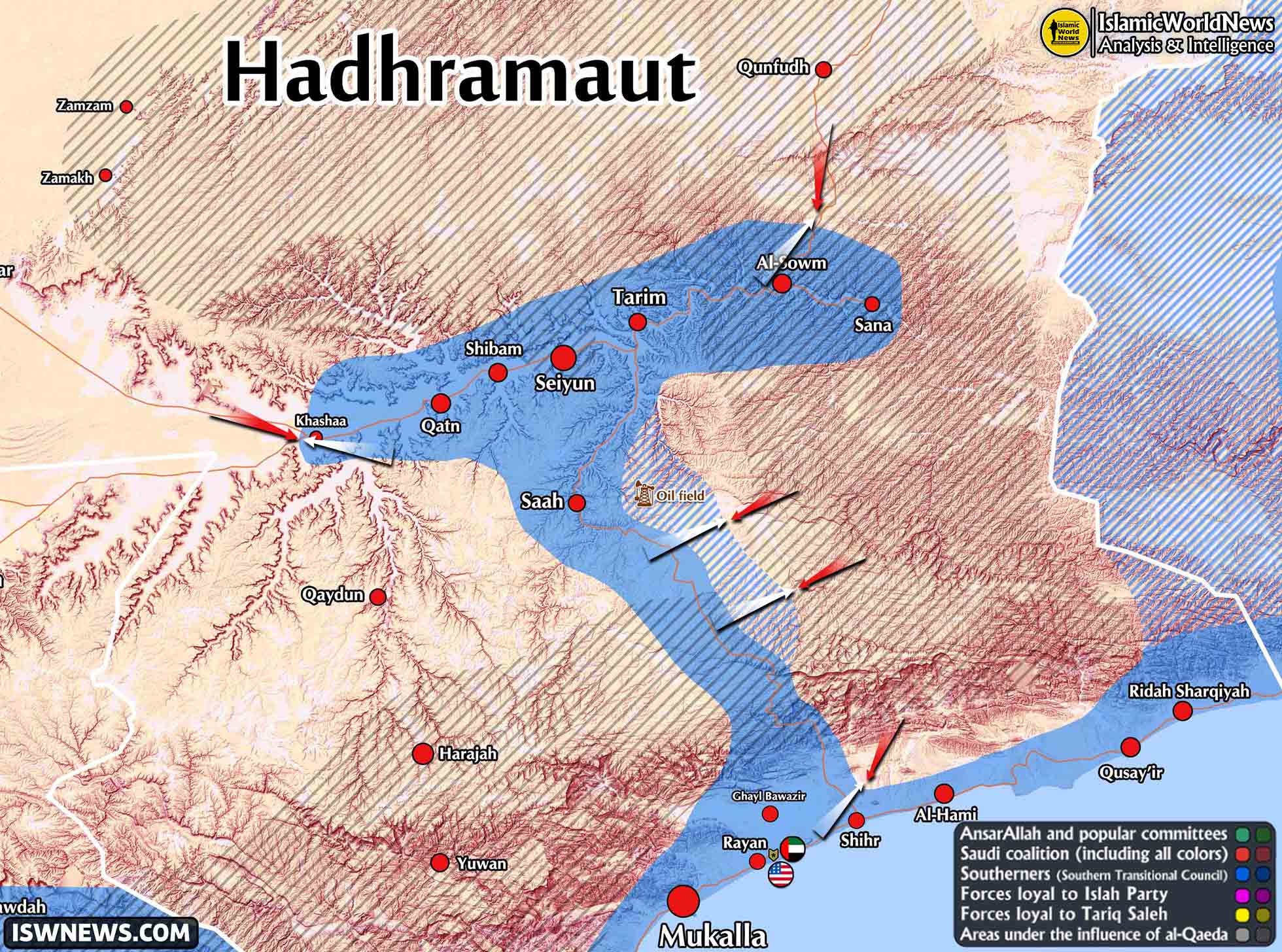
The operation, involving Al-Dara’ Al-Watan forces, armed tribal groups from Hadhramaut, and fighters from the Islah Party, began on Friday, January 3, with Saudi air support. Starting from the Al-Khasha area, they attacked positions of the Southern Transitional Council and advanced toward Al-Qatn in the Hadhramaut valley. By Saturday morning, Al-Qatn and Shibam had fallen to Al-Dara’ Al-Watan, while Southern forces retreated toward the Hadhramaut coast. By Sunday morning, Seiyun and other central districts of Hadhramaut were under government-in-exile control. The forces then moved to Al-Rayyan airbase (previously used by Emirati forces on the Hadhramaut coast) and, after hours of clashes, seized it from the Southern Transitional Council.
During these battles, at least 80 Southern fighters and an unspecified number of Saudi-backed troops were killed, with hundreds more wounded. Both sides have yet to release official casualty figures.
Al-Dera’ Al-Watan forces have since entered Mukalla, the capital of Hadhramaut, without resistance, taking control of all government and military facilities. They also advanced into Al-Mahra province, seizing Al-Ghaydah city and the port of Nishtun. Their objective is to secure Al-Ghaydah’s city and airport, border crossings, and remove Major General Talib Barjash, commander of the Second Military Region (Al-Mahra and Yemen’s southeastern coast), who recently defected to the Southern Transitional Council and rejected the authority of the Presidential Council of the government-in-exile.
Given the heavy defeat of the Southern Transitional Council in Hadhramaut valley and coastal cities, Al-Mahra is also expected to fall under government-in-exile control soon. Awad bin Al-Wazir Al-Awlaki, governor of Shabwa—previously supportive of Southern forces and backed by the UAE—has now announced cooperation with the Saudi-led coalition to deploy forces in oil-rich areas and military bases.
Overall, the Southern Transitional Council’s “Promising Future” operation collapsed with the UAE’s withdrawal and Saudi determination. The plan to partition southern Yemen has been sidelined. However, the Saudis have invited the Southern Transitional Council to participate in Yemen’s internal dialogue conference in Riyadh, and the [Persian] Gulf Cooperation Council’s federal plan for Yemen remains on the table. Still, the re-establishment of a separate South Yemen has failed, leaving Aidarus al-Zoubaidi’s efforts fruitless.
According to the latest reports on Yemen’s fronts — broken down by military zones and provinces — the situation is as follows:
Hadhramaut & Al-Mahra Fronts: In Hadhramaut, the front lines in the north remain unchanged, with Al-Khasha‘a serving as the main contact line. The cities of Al-Qatn, Tarim, and Seiyun in Wadi Hadhramaut are still under southern control. Al-Dara‘ Al-Watani (National Shield) forces have redeployed to Ramah and Thamud in the northeastern desert and taken positions along the Yemen–Saudi border, likely preparing to move toward Al-Sawm on the eastern side of Wadi Hadhramaut.
Hadhramaut map
Fighting continues between the UAE-backed Hadhrami Elite forces and tribal fighters from the Hadhramaut Tribal Council around Ghayl Bin Yamin, as well as in Wadi Khard and Al-Ays on the Hadhramaut coast. Recently, tribal fighters retook the Nohub base and pushed STC forces back from the outskirts of Wadi Khard and Al-Ays.
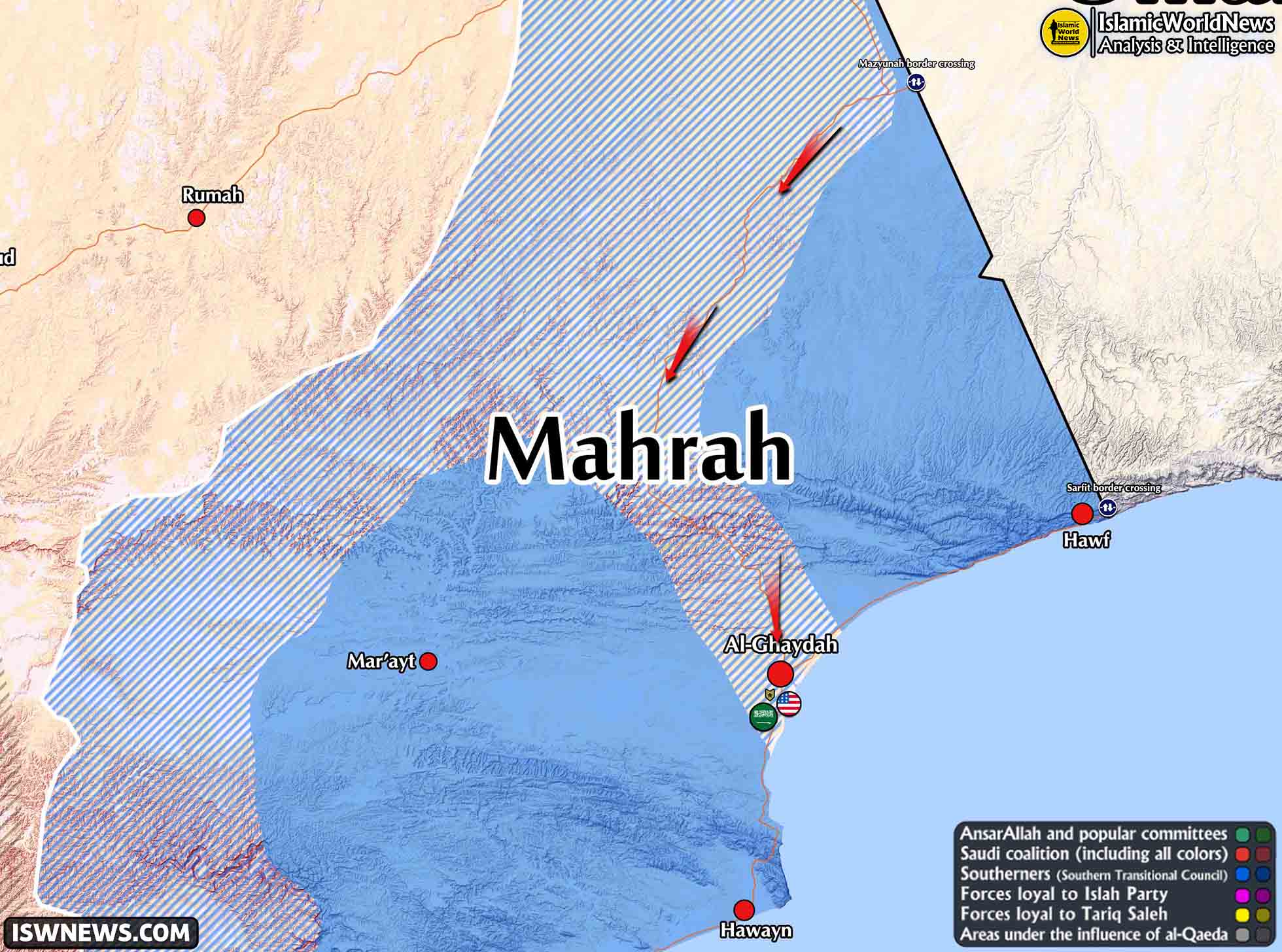
In Al-Mahra, Major General Barjash — commander of the 2nd Military Region — reaffirmed his support for the STC and declared he will not hand over his positions to National Shield forces backed by Saudi Arabia. He also urged civilians to stay away from military sites and installations.
Al-Mahra situation
Abyan Front: On northern Abyan axes, STC operations against Al-Qaeda elements are progressing slowly and have produced few tangible results. Al-Qaeda cells continue operating covertly. Beyond the integration of rapid-reaction forces from Jishan district, no major shifts have occurred.
Marib & Al-Jawf Fronts: Giants Brigade units have pulled out of Harib and Al-Abdiyah (south of Marib), as well as from the Kitaf and Al-Baqa fronts in northern Saada, redeploying to Hadhramaut and Shabwah. This redeployment has weakened the lines facing Ansar Allah, giving Yemeni resistance fighters an opportunity to resume advances from Harib toward western Shabwah in future clashes.
No significant changes have been recorded on other fronts, and the Yemeni Armed Forces (aligned with Ansar Allah) continue to observe the ceasefire that has been in place since 2023.
The UAE’s departure from Yemen marks a major setback and a turning point in the country’s civil war. Key consequences include fractures within the Saudi-Emirati coalition, a severe weakening of the exiled government, the strengthening of Ansar Allah, a growing power vacuum in the south, and the risk of deeper involvement by another outside actor — potentially the United States. The UAE’s separation from the Yemen file amounts to a failure of the “Arab coalition” project; in recent years, Saudi Arabia has lost two principal partners — Qatar and the UAE — in joint operations. Still, it is too early to draw final conclusions, and much remains unclear.
The UAE’s footprint on strategic Yemeni islands such as Socotra, Abd al-Kuri, Mayun, and others is part of a broader project to control maritime routes through the Gulf of Aden and the Red Sea — reinforced by formal agreements with the exiled government and backed by Western states and Israel.
Major General Talib Barjash, commander of the ousted government’s forces in the Second Military Region (covering al-Mahra and Yemen’s southeastern coasts), has broken away from the ousted government and aligned himself with the Southern Transitional Council. He ordered the removal of Rashad al-Alimi’s portraits—the head of the Presidential Leadership Council of the ousted government—and the Yemeni national flag from all bases under his command, replacing them with portraits of Aidarus al-Zoubaidi, the head of the Southern Transitional Council, and the flag of South Yemen.
During the Hadhramaut conflict, Talib Barjash remained neutral and at times assisted Hadhramaut tribes. However, with recent developments in Yemen’s east and south, his stance has shifted, and he has now joined the Southern Transitional Council.
STC took control of the Mahra province – click to view larger image
A similar incident has occurred in Abyan, where the Rapid Response Forces stationed in the Jayshan district have broken away from the Islah Party and the ousted government, joining the Southern Transitional Council.
Movements of Southern forces in the outskirts of the al-Khasha area came under aerial drone strikes by unidentified aircraft. The Saudi Arabian army has not issued any report regarding these attacks, suggesting they were likely carried out by armed elements of the Islah Party. Some Islah sheikhs, due to their close ties with Turkey, have received limited support, including small quantities of weaponry such as Turkish-made quadcopters.
Rapid Response Forces stationed in the Jayshan district have broken away from the Islah Party and the ousted government, and joined the Southern Transitional Council.
Jordanian Military Aid Convoy Enters al-Wadi‘ah Border Crossing
A Jordanian military aid convoy has entered Yemen through Saudi territory via the al-Wadi‘ah border crossing. In addition to these supplies, a large number of Jordanian advisors have arrived in the al-Wadi‘ah and al-‘Abr areas to train al-Dera‘ al-Watan forces in the use of Canadian armored vehicles and other delivered weaponry.
A Jordanian military aid convoy has entered Yemen via the al-Wadi‘ah border crossing
Some Arab sources have attributed Jordan’s aid shipments to Israel, but this claim is inaccurate. Israel’s positions in Yemen are more closely aligned with the actions of the Southern Transitional Council and the UAE. Through Emirati control of Yemeni islands and air bases, Israel has gained significant intelligence advantages on the Yemeni front. Therefore, it would never act to weaken its allies.
These developments indicate Saudi Arabia’s preparations for a new operation against the Southern Transitional Council in Yemen’s eastern and southern provinces. Contrary to their initial agreement with Riyadh, the STC has taken control of Hadhramaut’s oil fields and northern Shabwah. Despite repeated Saudi requests for withdrawal, the STC is moving toward declaring independence and partitioning Yemen.
STC forces and Saudi‑aligned groups continue to struggle for dominance in Hadhramaut and Shabwa. Reports of southern fighters withdrawing from the Hadhramaut Valley are inaccurate.
On other fronts, the Yemeni Armed Forces (Ansar Allah) and Saudi‑Emirati coalition forces remain under a ceasefire. These lines have held steady for 33 months without change.
At the same time, STC fighters seized all checkpoints and outposts surrounding the PetroMasila oil company (affiliated with Saudi Arabia) in Hadhramaut province.
The advance of Emirati‑aligned forces in Hadramaut and Shabwa, coupled with the repeated withdrawals of Islah fighters, marks a significant shift. The STC does not have the capacity to control these areas without support from other Emirati‑backed factions, indicating Abu Dhabi’s role behind the scenes.
In the coming days, attention will turn to Saudi Arabia’s response to these southern advances and what orders will be issued to the al‑Dara al‑Watan forces. Opponents of the UAE in Hadramaut are awaiting action by al‑Dara al‑Watan against the southerners.
Control of the 23rd Mika Brigade headquarters in the Al-Abr area, which had recently fallen to STC fighters, was handed over to Al-Dara’ Al-Watan forces (Saudi-backed) under the mediation and pressure of the Saudi security-military committee. This indicates that Riyadh has blocked the southern advance toward Marib and prevented further escalation with Islah Party elements.
Meanwhile, the Shahn and Sarfait border crossings along Yemen’s frontier with Oman have come under STC control, with customs offices refusing to clear shipments without southern authorization. Flags of South Yemen have been raised at these crossings and other border points in Al-Mahra province.
Raising the South Yemeni flag at the crossings and border points of Al-Mahra province
The Hadhramaut Tribal Council has held the UAE fully responsible for the ongoing tensions and clashes in Hadhramaut, accusing southern fighters of attacking tribal forces. The council filed a complaint to the “International Quartet” (United States, United Kingdom, Saudi Arabia, and UAE), alleging violations of the ceasefire, and urged the Saudi-Emirati coalition leadership to intervene against Abu Dhabi. This complaint comes despite the UAE itself being a member of the Quartet and a co-leader of the coalition alongside Saudi Arabia.
Overall, the Southern Transitional Council has exploited the recent political and economic turmoil in Yemen’s occupied areas to consolidate control over eastern Yemen. Given the weak administrative capacity of the southern forces, conditions in the east are expected to remain volatile and subject to further shifts.
Latest military situation in Hadhramaut and Al-Mahra as of December 6, 2025
Following the STC’s takeover of Hadhramaut’s administrative center and surrounding areas, STC representatives and Hadhramaut tribal leaders reached an agreement through the mediation of a Saudi security‑military delegation. The talks focused on safeguarding oil fields and negotiating toward a comprehensive settlement.
Under the deal, military tensions between the sides will cease starting Thursday morning, with a ceasefire in place until the mediation committee concludes its work and a full agreement is reached. All fighters under the Saudi‑led coalition must withdraw at least one kilometer from oil facilities, allowing personnel and security forces free movement. Once withdrawals are implemented, meetings between al‑Khanbashi and Amr bin Habreesh will be held to finalize the settlement under mediator supervision.
The Hadhramaut confrontation appeared to end with the Southern Transitional Council expanding its influence in occupied Yemeni territories, Saudi interests secured in the oil‑rich areas, and tribal leaders brought under control. Yet it left behind important lessons.
The first was the defeat of the Islah Party in Hadhramaut, which showed that Saudi Arabia places little value on them, limiting cooperation to countering Ansarallah and holding populous, religiously sensitive cities such as Marib and Taiz. The second was the strengthening of STC military power, now equipped with new weapons including drones and micro‑drones, aligned with UAE objectives.
Behind the STC’s success in Wadi Hadhramaut lay support from Tariq Saleh’s forces, the Giants Brigades, and Shabwa Defense units, which allowed southern forces to fully concentrate on northern Hadhramaut while these allies managed other areas until the clashes ended. This scenario could also be replicated against Ansarallah positions, potentially delivering significant blows to the central government’s authority in Sanaa.
Support operations by Yemen’s armed forces (backed by Ansar Allah) in solidarity with Palestine have continued until the final day of negotiations between the resistance and the Zionist regime. The latest actions include a precision cruise missile strike on the Dutch vessel MINERVAGRACHT and the entry of several suicide drones into the port of Eilat in southern occupied Palestine. According to Sayyed Abdul-Malik Badr al-Din al-Houthi, Yemen has carried out 1,835 support operations over the past two years using ballistic missiles, cruise missiles, hypersonic weapons, drones, and suicide boats.
In Hadhramaut province, tensions are rising between the UAE-backed Southern Transitional Council (STC) forces and the Saudi-backed Hadhramaut Protection Forces. Saudi Arabia is equipping three divisions under the Hadhramaut Protection Forces, aiming to seize oil resources and advance toward the Hadhramaut coast. Similar developments are unfolding in Al-Mahrah and Shabwah provinces, although in the city of Ataq, the capital of Shabwah, UAE-aligned forces currently hold control.
In Abyan province, guerrilla attacks by Al-Qaeda militants—including roadside bombings, drone strikes, sniper fire, and other harassment tactics—continue to target STC forces, inflicting significant casualties.
In Taiz province, tensions between the Islah Party and Tariq Saleh’s forces have escalated following the assassination of Afthan al-Mashhary, head of the sanitation and beautification office. Several failed assassination attempts have targeted local commanders from both sides. Islah militants have attempted to arrest and confront Tariq Saleh’s forces in the city of Al-Turba in southern Taiz, but these efforts have failed, and control of Al-Turba remains with Tariq Saleh’s forces.
In Lahij province, the Al-Subayha tribes—aligned with Saudi Arabia—are trying to gain control of the southwestern coast of Lahij. However, UAE-backed Al-Amaliqa forces, under the command of Brigadier General Hamdi Shukri, are blocking their advance and currently hold the area. The Al-Subayha tribes are independent tribes from southwestern Yemen, some of whose leaders have been recruited by Saudi Arabia. In recent years, Al-Subayha militants have clashed multiple times with Tariq Saleh’s forces, preventing their entry into southwestern Yemen.
Latest situation on Yemeni fronts – Click to view image in full size
Overall, Yemen’s internal front is facing numerous challenges that make the path to peace increasingly elusive. Saudi Arabia and the UAE, as influential Arab powers, have exploited Yemen’s dire economic conditions over the years, supporting proxy factions such as the STC, Islah Party, Al-Amaliqa, remnants of Ali Abdullah Saleh’s regime, and others to serve their strategic interests.
These dynamics have deepened divisions between Yemeni factions and the government in Sanaa, making national reconciliation or liberation from foreign-backed groups more difficult. Undoubtedly, once the Palestinian issue is resolved, Yemen’s government will have to confront this major challenge and adopt thoughtful and flexible strategies to overcome it.
According to Major General Ali Muqbil Saleh, the Saudi-backed governor of Dhale, this decision was made to assist in the flow of humanitarian aid, reduce suffering, and ease civilian movement.
The Dhale-Sanaa road is a 240-kilometer route that runs from Dammam to Yarim in the Al-Bayda governorate and then passes through the city of Dhamar. This essential roadway connects the southern and central governorates of Yemen.
The closure of the Dhale-Sanaa road in recent years has caused significant hardship for southern Yemenis, forcing many to take long and difficult alternative routes. Although the Sanaa-backed government, supported by Ansar Allah, announced various plans to reopen all Yemeni roads following a ceasefire with the Saudi coalition in April 2022, the resigned government has prevented these plans from being implemented due to divisions and differing positions among southern Yemen groups.