Yesterday, Israeli forces set up a temporary checkpoint on the road connecting the towns of Jabatha al-Khashab and Ofania, inspecting several vehicles and blocking the route for several hours.
Simultaneously, Israeli engineering units began excavation work in Jabatha al-Khashab, supported by four vehicles and 20 soldiers.
Local sources also reported that Israeli troops, backed by Merkava tanks, entered the Khan Arnabah–Jabatha al-Khashab road and proceeded to inspect residents in the town of Eastern Samdaniyah.
In southern Quneitra, a convoy of 10 Israeli military vehicles entered the village of Ruwayhina, establishing a temporary checkpoint near the mosque and inspecting individuals.
These movements are taking place amid the conspicuous silence of the Jolani government, which has repeatedly stated in interviews that it does not seek confrontation with Israel. This stance has effectively enabled Tel Aviv to expand its military and intelligence footprint deep into Syrian territory. The establishment of checkpoints, entry into border towns, and engineering operations are not merely tactical maneuvers—they signal Israel’s intent to solidify a sustained operational and intelligence presence in southern Syria.
Israeli troops established a temporary checkpoint between the villages of Al-Ma’laqa and Sayda, where they inspected vehicles and verified the identities of passengers.
Simultaneously, a military convoy consisting of eight Israeli vehicles conducted patrols and area inspections along the route between the villages of Al-Asha and Al-Rafid.
Another checkpoint was set up by Israeli forces using two Humvees and one Hilux vehicle between the villages of Al-Samadaniyah Al-Sharqiyah and Ajraf. Like the previous checkpoint, this one also involved vehicle inspections and identity checks.
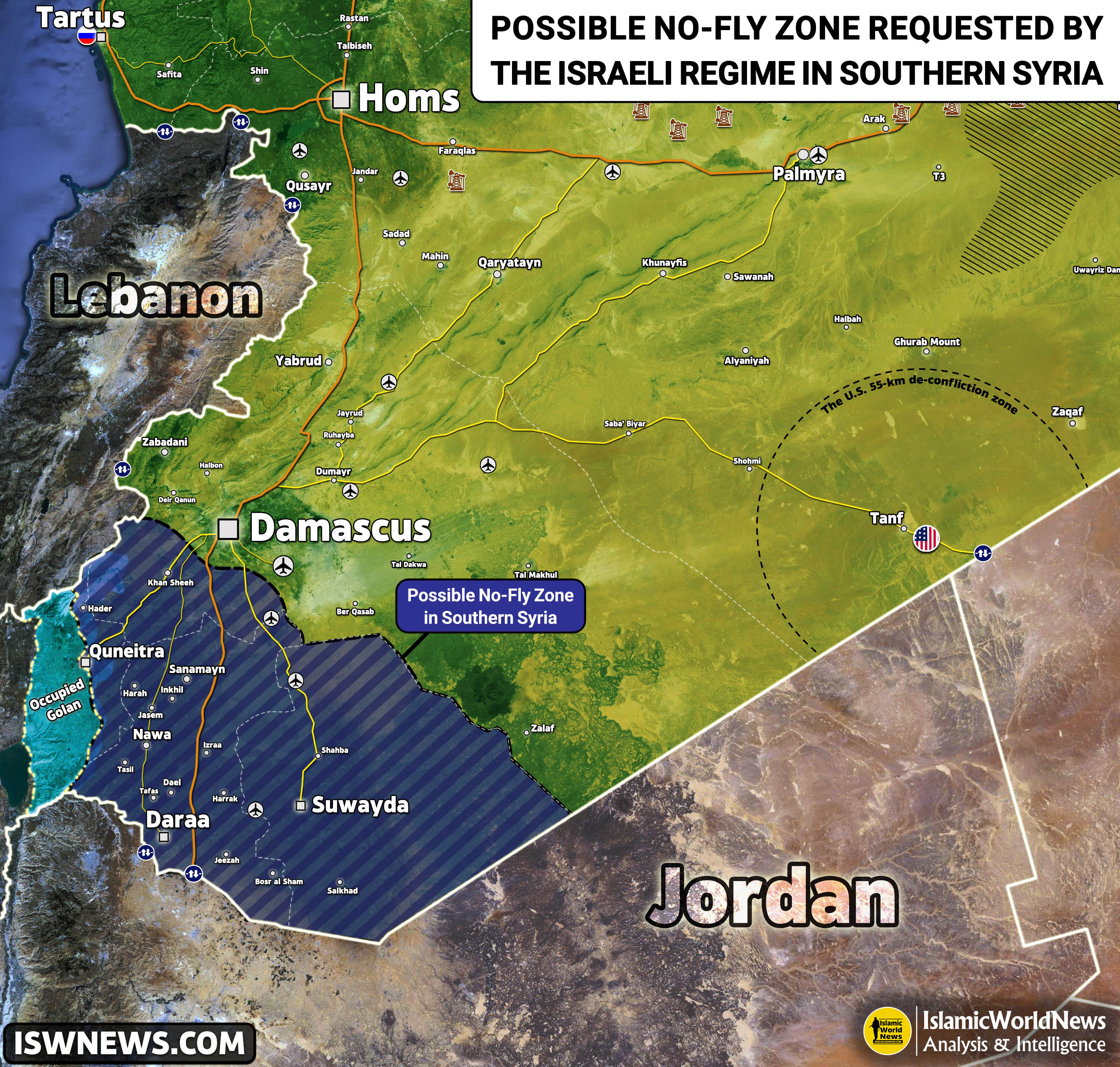
According to Western sources, Israel has presented Damascus with a new security proposal. The plan includes establishing no-fly zones over parts of southern Syria while preserving an aerial corridor from Syria to Iran. This corridor is strategically vital for Tel Aviv, potentially allowing future airstrikes on Iranian targets. The proposed no-fly zone would cover Suwayda, Daraa, Quneitra, and parts of Damascus. In exchange, Israel would withdraw from some areas it recently occupied in southern Syria—but notably, it refuses to pull back from Mount Hermon.
Meanwhile, Syria’s new government is expanding its diplomatic outreach, engaging with figures like Tom Barrack, Ayman Safadi, and representatives from Gulf Arab states. These interactions suggest Damascus is working to build a multilayered network of security and political alliances. The goal appears to be reducing international pressure while gaining flexibility in dealing with local forces (such as the SDF) and regional powers like Turkey and Israel. Al-Julani, at the helm of this effort, seems intent on balancing U.S.-Israeli demands with Turkey’s red lines.
In the context of ongoing tensions between Iran and Israel, Tel Aviv’s proposal for Syrian no-fly zones is part of a broader strategy to secure a reliable aerial corridor toward Iran. The recent collapse of Bashar al-Assad’s regime and the destruction of much of Syria’s air defense systems have made Syrian airspace one of the least risky and most cost-effective routes for Israeli aircraft heading toward Iran’s western borders. Any agreement with Damascus could significantly enhance Israel’s operational capabilities against Iranian targets.
Possible no-fly zone requested by the Israeli regime in southern Syria
Another Israeli objective is to minimize the risk of direct confrontation with Turkish air forces. Turkey’s military presence in Syria—especially in air defense—has grown in recent months, increasing the chances of accidental clashes with Israeli jets. By negotiating a no-fly zone with Damascus, Israel aims to unilaterally manage Syrian airspace, impose its terms on both Ankara and Damascus, and reduce the likelihood of unintended military incidents.
If implemented, this plan would have wide-ranging regional consequences, with Israel standing to gain the most. It would solidify a permanent aerial threat against Iran from the west, restrict Turkey’s operational freedom in Syrian skies, and place Damascus under Israeli dominance. Although the Syrian government may not favor the proposal, the current military realities in southern Syria are pressuring Damascus to accept it.
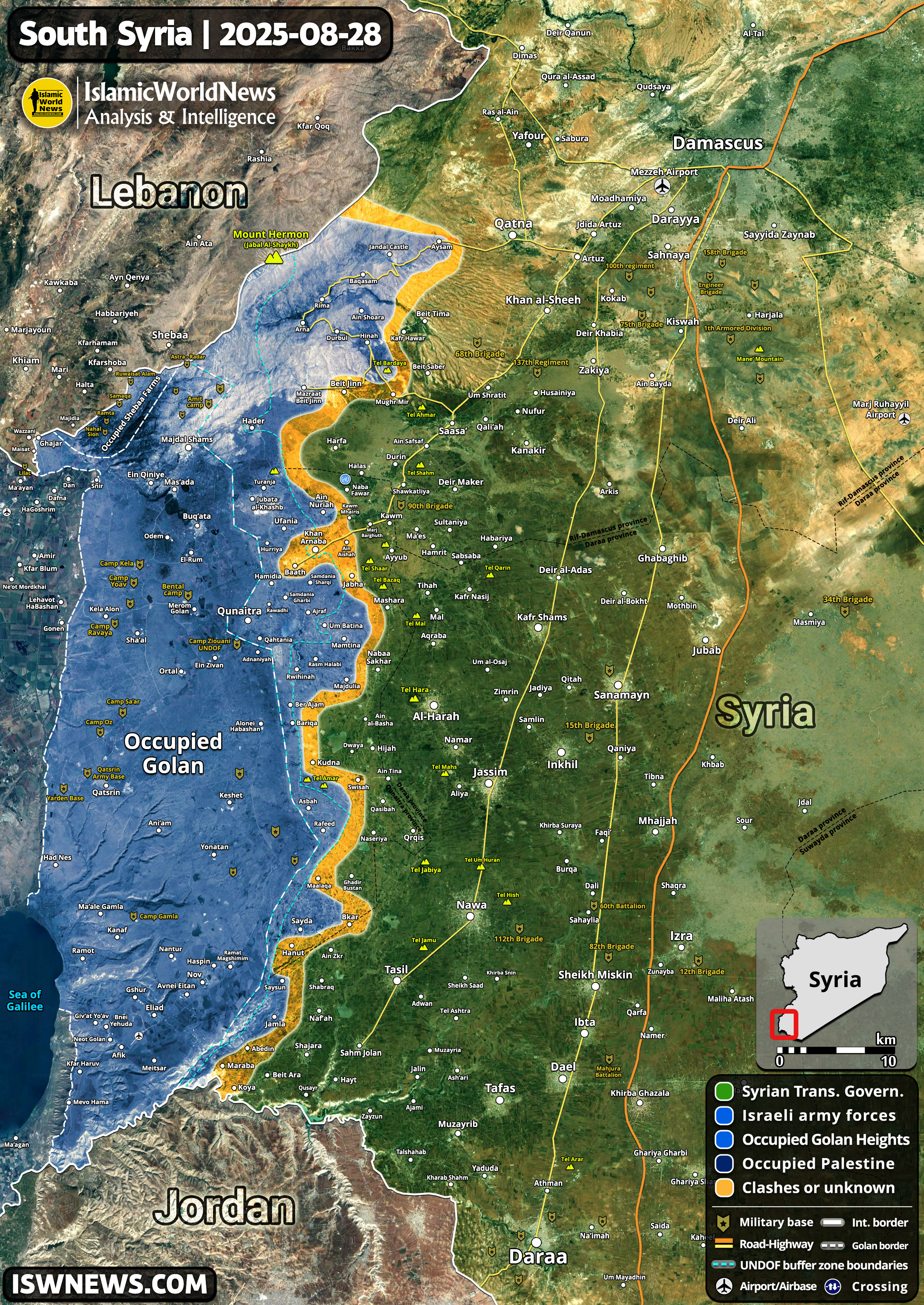
According to the latest data gathered by Islamic World News, the most recent Israeli military movements in southern Syria are as follows:
August 24: Five Israeli military vehicles entered the village of Bariqa in Quneitra province. Troops stationed themselves in front of the Public Security building and set up a temporary checkpoint, inspecting passing vehicles.
August 25: A convoy of 11 military vehicles and over 60 Israeli soldiers entered the Beit Jinn area in the Damascus countryside, detaining six local residents. Simultaneously, Israeli forces took control of Bat al-Warda hill on the slopes of Mount Hermon.
August 25: Israeli military activity intensified in the Al-Rafid area of Quneitra. After deploying on Al-Jamous hill, troops entered the village of Al-Hiran, while another group patrolled Ayn Zivan. The village of Ayn al-Abd also witnessed an Israeli raid.
August 26: An Israeli attack on a residential home in the village of Tarnajah, north of Quneitra, resulted in the death of a Syrian youth named Rami Ghanem.
August 27: Israeli forces entered the village of Western Samadaniyah in Quneitra province, conducted patrols, and then withdrew.
August 28: Israeli troops appeared at the Abu Ghara junction east of Al-Rafid and continued scattered patrols in Beit Jinn.
The physical presence of Israeli forces on Syrian soil—regardless of its immediate outcomes—sends a clear regional message: Israel is willing to enter a new operational phase to prevent the establishment of intelligence or military infrastructure near its borders. These recent actions reflect Tel Aviv’s effort to solidify a security belt beyond the ceasefire lines.
Moreover, field developments suggest that Tel Aviv aims to secure its desired geographic clauses in security agreements not through negotiation, but via direct military pressure. This strategy indicates Israel’s intent to impose its security equations on the Golan governance through a combination of iron and fire.
On August 26, Syrian security forces discovered and seized advanced Israeli surveillance and espionage equipment near Jabal al-Manea and the 1st Armored Division. While attempting to transfer the equipment to the division’s headquarters, they were struck by Israeli airstrikes, resulting in casualties among Syrian soldiers. The strikes continued for 24 hours to prevent reinforcements from reaching the area. Despite the strikes, some Syrian forces managed to destroy parts of the equipment and evacuate the bodies of the fallen.
Continuing the events, Israeli aircraft again targeted the Al-Kiswah and Jabal al-Mane’ areas multiple times last night and conducted a heliborne operation at the 1st Armored Division base. According to local sources, at least four Israeli helicopters participated. Israeli forces remained in the area for over two hours, though no direct clashes with Syrian troops were reported.
While details of the operation’s objectives remain undisclosed, it’s believed the recovered surveillance equipment was significant enough to prompt Israel to launch a retrieval mission. Of course, that’s not the whole story; the strategic importance of the military installations in Al-Kiswah and especially Jabal al-Mane suggests broader goals. The sequence of airstrikes, troop deployment, and extended presence indicates Israel is pursuing more than a limited strike.
The execution of combined operations involving airstrikes, drones, and heliborne assaults deep inside Syrian territory signals a qualitative shift in the Israeli army’s operational tactics. This style of operation was previously carried out in Masyaf during the final phase of Bashar al-Assad’s rule, during which important documents were stolen and part of an underground base was destroyed.
Overall, the Israeli regime seeks to demilitarize southern Syria and establish a large buffer zone adjacent to the occupied Golan Heights. The fall of the previous government and the rise of a fledgling and weak regime in Damascus presents the best opportunity for Israel to pursue this goal. Through repeated airstrikes and physical occupation of parts of southern Syria, the Zionist regime aims to neutralize the Syrian army’s capabilities and maintain permanent control over potential threats. Although talks between Damascus and Tel Aviv regarding normalization of relations or peaceful coexistence are ongoing, it must be understood that Israel holds the upper hand and considers itself above the need to engage with Syria. Therefore, the regime continues its attacks and efforts to neutralize the Syrian government while simultaneously participating in negotiations, viewing them as an opportunity to extract more concessions and apply greater political pressure.
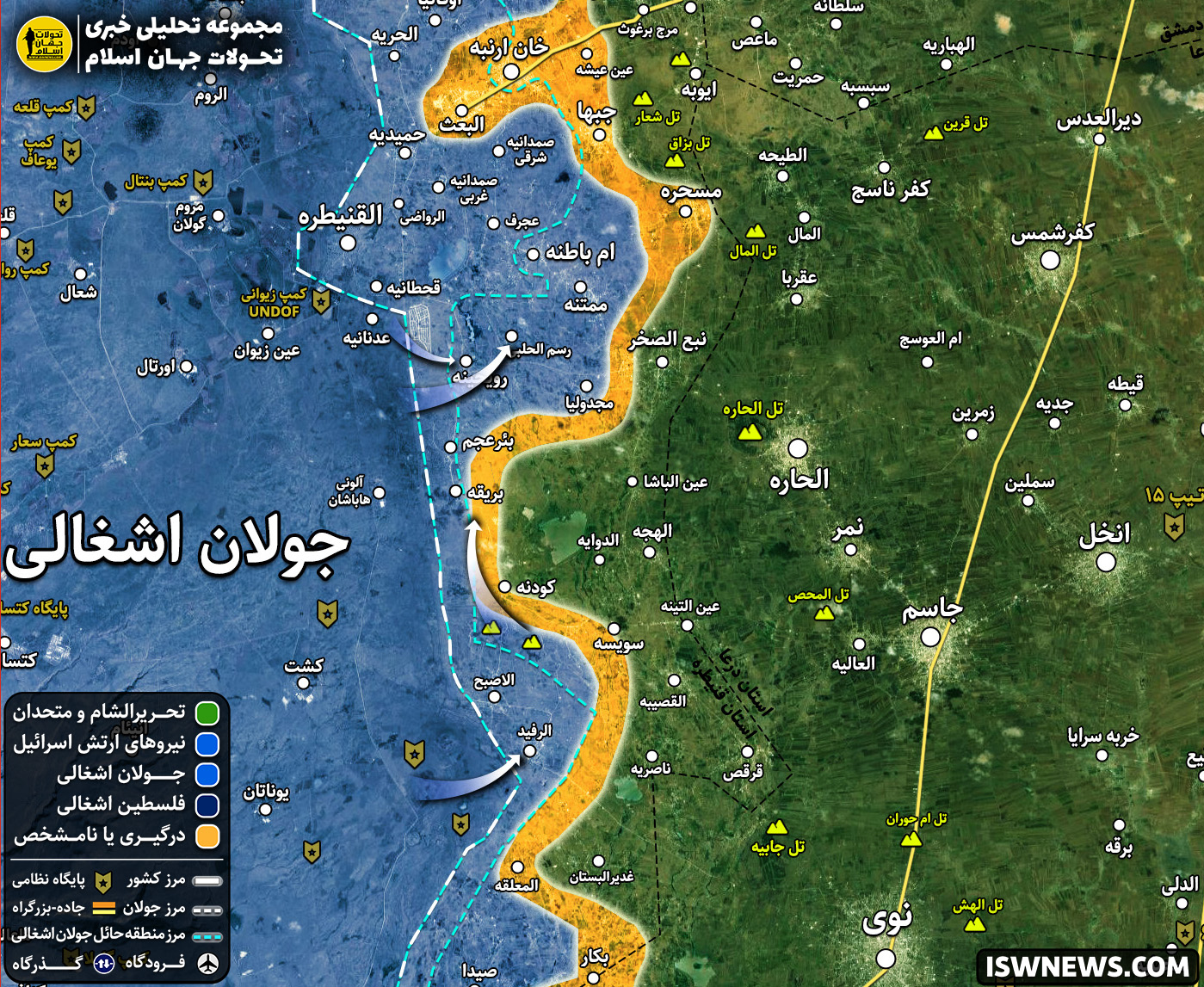
In the latest movements, 10 Israeli military vehicles departed from Tel Ahmar and headed toward the Bariga-Kudna road, establishing a checkpoint there. Additionally, another convoy of 10 vehicles entered Ruwaiheena village before proceeding toward Rasm al-Halabi in central Quneitra. Five Israeli vehicles also entered Rafid village. An Israeli patrol, supported by two tanks, moved from Adnaniyeh to Ruwaiheena, with the tanks positioning themselves on the village outskirts.
It appears that the regime’s movements in southern Syria are now directly influenced by ongoing Syrian-Israeli-American negotiations, and until the parties’ agreements are clarified, significant changes in frontlines are unlikely.
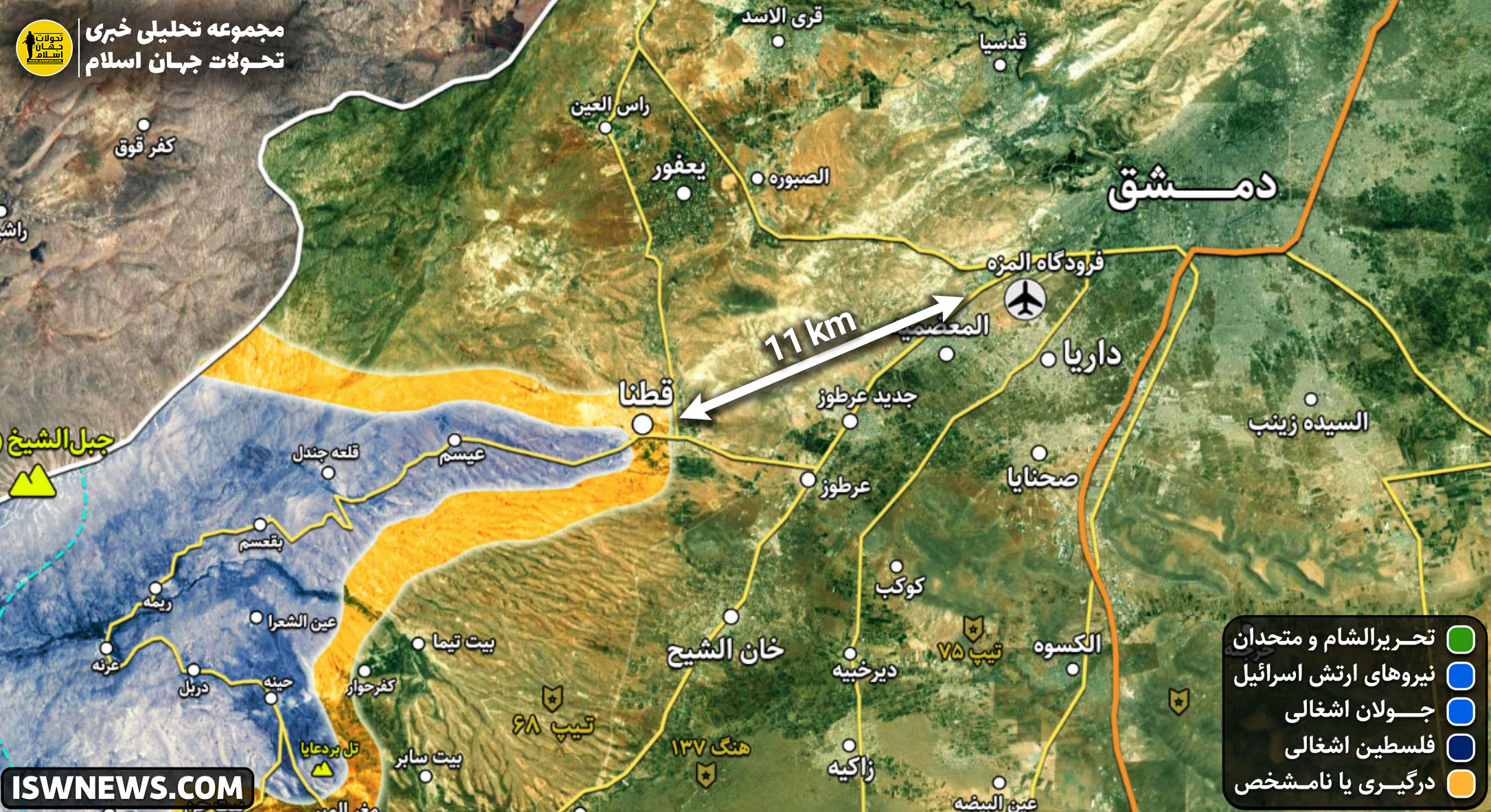
According to videos that have emerged, an Israeli army convoy consisting of approximately 15 vehicles has reached the outskirts of Qatna.
In addition to Qatna, Israeli forces have also entered the village of Al-Rafid in Quneitra province. This area has seen security operations and inspections conducted by the Israeli army in recent weeks.
Despite calls from Syrians to confront the Israeli regime and the threats made by Julani militants, the forces of the new Syrian government have not taken any action to prevent or confront the Israeli army’s movements. The Israeli advance in southern Syria continues amidst the silence of the Julani government.
Last night, Israeli forces, supported by Merkava tanks and military vehicles, entered the village of Ain Aisha and positioned their tanks on the northern outskirts of Jabha.
In another operation along the Ain Nourieh axis, the Israeli forces, after passing through Ain Nourieh, shelled Kawm Muhairis and established a presence in the surrounding fields.
As a result of these actions, the Israeli army has effectively surrounded the cities of Khan Arnabeh and Al-Baath, although they have not yet deployed forces within these cities.
If Khan Arnabeh, Al-Baath, and the towns of Jabha, Kawm along with several surrounding villages, fall under Israeli control, Quneitra province will become the first Syrian province to be completely occupied by Israel.
Israel’s objective in taking control of Quneitra province is to support the Syrian Druze and to directly challenge the leaders of Tahrir al-Sham. This move aims to threaten the leaders of Tahrir al-Sham, to divide the southern provinces of Syria and weaken them militarily to prevent possible attacks on Israeli positions.
The newly occupied areas by the Israeli regime in Qunaitra province
Local sources in Quneitra province report that on Monday, Israeli forces, accompanied by bulldozers, entered the village of al-Mashara and a military outpost on the outskirts of Tal al-Mal. Additionally, helicopters and drones were also seen in the area.
The purpose of this Israeli operation remains unclear. However, given the presence of bulldozers and aircraft, there is a possibility that military installations may be destroyed, or that information and equipment might be transferred from the area.
This operation marks the second significant incursion of the Israeli army into Syrian territory since the regime began its military involvement in the area. Previously, Israel advanced to within 25 kilometers of Damascus by capturing Jabal al-Sheikh and the southwestern heights of Syria.
Latest military situation in southern Syria after Israeli advances in Qunaitra province – click to view full size
Additionally, the Israeli forces entered the village of Ain Nouriyya, where they confiscated the remaining weapons and ammunition in the area and established a checkpoint.
This morning, Israeli army forces entered the villages of Umm Batna, Suysah, Majduliya, Rasm al-Manbatah, Mamtane, al-Dawaiya, and Ruwaihina. The situation remains uncertain in the border villages of Bir al-Ajam and Bariqah, which are expected to come under Israeli military control soon.
Israeli soldiers patrol villages in Quneitra province
The Israeli army is advancing in Quneitra province while militants in southern Syria are engaged in fighting amongst themselves instead of defending their country’s territory against Israeli aggression!
Today, Tahrir al-Sham militants, acting under the orders of Abu Muhammad al-Julani, entered the town of al-Sanamayn in northern Daraa province and clashed with militants loyal to Mohsen al-Haymad. This confrontation resulted in the deaths of several militants on both sides.
Sending Tahrir al-Sham militants and military equipment to the town of Al-Sanamayn
The main cause of the internal conflict remains unclear. Syrian media believe that militants from Tahrir al-Sham have entered al-Sanamayn to arrest individuals who are wanted. Previous reports regarding the situation in Daraa province indicate that Tahrir al-Sham-affiliated media claim that Mohsen al-Haymid, a former member of the intelligence services of the Syrian government, has close ties to the ISIS terrorist group. He also participated in the 2018 National Reconciliation Plan and has since abandoned armed conflict with the Syrian government.
The timing of these clashes coinciding with Israel’s advance in Quneitra suggests that disagreements among Syrian militants over control of Daraa province and issues related to confronting or not confronting the Zionists have intensified. Tahrir al-Sham-affiliated media seem to be attempting to suppress their opponents in southern Syria by making accusations and setting precedents against them.
Local militants in Suwayda province have announced the formation of a new group called the Al-Majlis Al-Askarī L’As-Suwayda (Suwayda Military Council) in southern Syria. They have scheduled a meeting on February 24 in the Sad al-Ayn area, southeast of Sweida.
Interestingly, the logo of this newly formed group is strikingly similar to that of the Syrian Democratic Forces (SDF). In fact, it appears that the logo of this group is essentially the same as the SDF logo but with a new location in Sweida province in southern Syria.
Sweida Military Council logo and statement
Following the announcement of the group’s existence, several residents of the Al-Ghariyah area in the southern suburbs of Sweida province released a video declaring their allegiance to the Sweida Military Council and emphasizing their commitment to defending their homeland.
Video from residents of the Al-Ghariyah area
The SDF’s support for the residents of Suwayda is not a new development, as there have been similar instances in the past. During Bashar al-Assad’s government, the SDF expressed their support for the creation of an autonomous region in southern Syria and for the Druze. Sweida holds significant importance for the SDF; during the war with ISIS, the SDF agreed to exchange 60 ISIS prisoners for 30 residents of Sweida who had been kidnapped by ISIS. These instances highlight the strong relationship between the Kurds and the residents of Suwayda province.
The Suwayda Military Council, led by Tariq al-Shufi, maintains a positive relationship with the Syrian Democratic Forces (SDF). In his recent remarks, al-Shufi praised the SDF forces, referring to them as defenders of the land and the Kurds against terrorism and dictatorial rule. The Sweida Military Council Command further emphasized the importance of maintaining positive and serious relations with the SDF forces.
Tariq al-Shoufi, Commander of the Suwayda Military Council
On the other hand, continuing the Israeli regime’s support for the Druze community in Syria, Israeli Prime Minister Benjamin Netanyahu emphasized the need for the Syrian government to respect the rights of the Druze minority and stated that any threat against the Druze in southern Syria will not be tolerated.
In response to Netanyahu’s statements, Al-Shufi expressed gratitude to all those who support the Sweida Military Council and help protect the Druze community and stabilize the region.
Simultaneously with the announcement of the Sweida Military Council’s existence and Netanyahu’s support for the Druze, some analysts viewed these actions as part of the “David Corridor” plan. They considered these actions an attempt by the Zionists to support Israel’s Kurdish allies east of the Euphrates in order to fuel separatist conflicts in the region.
The so-called David Corridor in Syria
The “David Corridor” is envisioned as a corridor created through the occupation of southern Syria, including the provinces of Daraa, Suwayda, part of Homs province (the Al-Tanf region), and Deir Ezzor, reaching the Euphrates. The recent occupation of areas in Daraa province by the Israeli army could be seen as part of this plan.
If the Zionists decide to implement this plan, Tel Aviv’s next step after advancing in Daraa province would be Sweida. Gaining access to and passing through Sweida requires the support and approval of the Druze, which has been partially achieved. After Sweida, the advance of the Zionist military in southern Syria would be facilitated, as the Al-Tanf region in Homs province has been under American occupation for years, and the US army would pave the way for the Zionists to reach Deir Ezzor province.
It is worth noting that the construction of the David Corridor is considered part of the “Greater Israel” plan.
According to a recent report by the Israeli army radio, Israel’s presence in Syria is no longer temporary, with engineering units setting up nine military sites in the south. The Syrian transitional government and their regional supporters have yet to respond to this development.
Additionally, the Israeli army continues its movements and patrols in the occupied areas of southern Syria, including establishing a checkpoint in the village of Saida. Israeli soldiers have re-entered Al-Rafid village in Quneitra province, with tanks moving along the Kodna and Bariga axis.
Saida village, located in southern Quneitra province near the buffer zone between Syria and Israel, has been under Israeli patrol since December 15. Al-Rafid village, in the Golan Heights, also lies in the buffer zone. Its significance stems from its location on the road to Nawa in Daraa province. Israeli military activities in Al-Rafid began on December 20.
A report by Yedioth Aharonot, citing senior Israeli officials, states that the Israeli army will maintain its control 15 kilometers into Syria to prevent new Syrian government loyalists from launching rockets towards the occupied Golan. Additionally, Israel is planning a new operation 60 kilometers south of Syria to expand its sphere of influence and ensure its security.
Tensions persist between Israeli forces and farmers from the village of Ma’arba, with Israeli troops at the Al-Jazeera garrison preventing Syrian farmers from accessing their fields.
The Israeli army has also dismantled the Heyran checkpoint and the site of the former Syrian army armored battalion on the outskirts of Quneitra, following an inspection and removal of ammunition. Afterward, Israeli forces withdrew to the occupied Golan.
The Syrian transitional government has yet to decisively respond to the Israeli occupation of southern Syria’s border areas. Meanwhile, Israel shows no intention of vacating Syrian territory, with the Yedioth Ahronot report indicating a fixed military presence 15 kilometers into Syria and a likely expansion to 60 kilometers. This situation could escalate tensions and conflicts between the Zionists and popular movements in Syria.