Category: Iran

  • IRGC Attacks Israeli Regime Ship In The Arabian Sea

    IRGC Attacks Israeli Regime Ship In The Arabian Sea

    According to Israeli sources, the Islamic Revolutionary Guard Corps attacked the Liberian-flagged of Zionist-owned oil tanker Campo Square in the Arabian Sea with a Shahed-136 suicide drone last Friday, 17 February. This ship belonged to “Zodiac” shipping company under the ownership of “Eyal Ofer”. There were no casualties in this attack.

    Archival image of Campo Square tanker

    Israeli media have claimed that this attack was carried out in response to the Israeli attack on a workshop of the Ministry of Defense of Iran in Isfahan.

    So far, no further details have been released about this incident, and Iranian authorities have not commented on this issue so far.

    Read more: Attack on an Israeli ship in the Arabian Sea

  • US Shoots Down Iranian Reconnaissance UAV In Deir Ezzor

    US Shoots Down Iranian Reconnaissance UAV In Deir Ezzor

    The United States Terrorist Headquarters in West Asia (CENTCOM) issued a statement announcing that a reconnaissance drone belonging to Iranian forces was shot down over the American coalition base in the CONICO gas facility located in Deir Ezzor province.

    Centcom’s statement said: “At 2:30 p.m. on February 14, the US forces shot down an Iranian spy drone that was flying over the CONICO gas facility.”

    It is worth mentioning that the CONICO gas facility is located in the east of Deir Ezzor province and has been the target of rocket and drone attacks many times in the past months. Despite the joint operations of the US coalition and the Syrian Democratic Forces (SDF) around the American bases in Syria, the American coalition has so far failed to identify and counter these attacks.

    Read more: Rocket Attack On US Base In Syria For The Second Day In A Row!

    In addition to CONICO , a number of American coalition bases in Syria, including al-Omar, al-Tanf, al-Shaddadi and Rumaylan bases, were also targeted by drone and rocket attacks by resistance groups and unknown groups in recent months, during which several American soldiers were injured.

  • China In Queue To Receive Iran-made Drones!

    China In Queue To Receive Iran-made Drones!

    An adviser to Iran’s minister of intelligence and the head of political studies think tank of the ministry said at Imam Khomeini International University in the city of Qazvin on February 8 that “the defensive authority of Iran and its influence in the West Asia region is not tolerable for the Westerners, the United States and the Israeli regime.”

    “From the day we looked East and Iran’s policy changed the balance in favor of the Eastern powers and against the West, the Western states could not tolerate the shift,” he said, naming the Ukraine war as an example to explain the shift.

    He went on to say that “today Iran’s capability is at such a level that certain media outlets claim China is in queue to receive 15,000 drones manufactured by Iran.”

    According to the Middle East Monitor, Tehran has deepened its military cooperation with Moscow since the onset of war between Russia and Ukraine; so that the American newspaper The Wall Street Journal quoted unknown sources that Tehran and Moscow are planning to construct a center to manufacture Iranian drones inside the Russian soil with the capacity of producing 6,000 drones.

    Read more: Military Knowledge: Shahed-136 Loitering Munition

    It is noteworthy that following the circulation of the allegations on the sale of the Iran-made drones to Russia and the Russian military forces’ use of the UAVs in the war against Ukraine, many Western countries imposed some sanctions on Iranian companies and individuals in a bid to prevent Iran’s arms support to Russia, because they are of the opinion that they would be able to affect the manufacturing of Iran-made drones in Russia.

    Nonetheless and in contradiction to the Western states’ pressures, the flights of transit airplanes from Iran to Russia have significantly increased in the recent months in comparison to the departures in the previous months, and as the statistics indicate the number of the flights has reached to more than 80 ones recently.

    Read more: Washington Post: Russia has bought Fateh-110 and Zolfaghar missiles from Iran!

  • More Than 20 Million Iranians Participate In February 11 March

    More Than 20 Million Iranians Participate In February 11 March

    The people residing in different areas of the Islamic Republic of Iran renewed their allegiance to the ideals of late Imam Khomeini, martyrs as well as Supreme Leader of the Islamic Revolution Ayatollah Seyyed Ali Khamenei by taking part in the massive march ceremony on February 11 (Bahman 22nd on the Iranian calendar year).

    In accordance with the initial estimates released by the Iranian entities, the number of the Iranians, who attended the February 11 march, is nearly 21 million people, including rally-goers in small towns and villages nationwide. This year’s massive turnout shows the fact that the number of people who participated in the nationwide rallies, increased by around 30% in comparison to the statistics in 2019. This comparison between 2023 and 2019 has its roots in the fact that the annual rallies were affected by the outbreak of the COVID-19 pandemic in the years in between these two years.

    Organizers of the rallies in capital city of Tehran displayed military achievements such as Sejjil and Emad ballistic missiles, Shahed-136 drone, anti-submarine cruise missile, Toofan tactical armored personnel carrier, Ra’d tactical armored personnel carrier and vehicle, as well as Mohajer-6 drone, which stationed on the way of this year’s march.

    Simultaneously with the beginning of the ceremony, journalists and international media such as Sputnik News Agency, Al-Mayadeen Network, AFP, I24 News, Al-Masirah Network, Shafaq News, Al-Nashrah, Associated Press, Reuters News Agency and SANA News Agency covered the enthusiastic presence of the Iranian people in this ceremony.

    On February 1, 1979, Imam Khomeini, the founder of the Islamic Revolution returned to Tehran after fifteen years of exile. Ten days after Imam Khomeini’s return to Iran, on February 11, 1979, the Islamic Revolution of Iran born fruit; hence, from February 1 to February 11, the 10-day Dawn has been named, and every year, special celebrations and ceremonies for the victory of the Islamic Revolution are held during these days.

    This year and these million rallies, which are held after the recent unrest in Iran, once again showed that the arrogance schemes against Iran have failed and despite the Main Stream Media claims, the majority of Iranian people support their government and stand firm for their religious beliefs.

  • Iran Underground Airbase’s Site Undisclosed! Let’s Get Acquainted With “Eagle 44 Airbase”

    Iran Underground Airbase’s Site Undisclosed! Let’s Get Acquainted With “Eagle 44 Airbase”

    The Islamic Republic of Iran Air Force unveiled the Eagle 44 underground airbase on February 7 in the presence of Chief of Staff of the Iranian Armed Forces Major General Mohammad Hossein Bagheri and Commander-in-Chief of Iran’s Army Seyyed Abdolrahim Mousavi.

    A few days following the inaugural ceremony, certain foreign analysts and media reporters used the photos and video footages released during the unveiling ceremony of the Eagle 44 Airbase of the Islamic Republic of Iran Air Force in order to examine the features as well as strengths of the underground airbase.

    Read more: Iran Unveils New Underground Airbase “Eagle 44” + Video

    They pointed out to the presence of high-ranking Iranian commanders in the unveiling ceremony of the Eagle 44 airbase, asserting that the underground airbase is a tactical base, which would be capable of accommodating all types of fighter jets, various bombers and different sorts of drones. The outsized underground airbase will also be capable of housing the Sukhoi Su-35. Furthermore, the Eagle 44 airbase, which is situated tens of meters underneath the mountains, will be sheltered, when it comes to missile attacks and Bunker buster and the underground airbase will be a safe haven to safeguard aircraft.

    The attention-grabbing point in the so-called detection of the location of the airbase is that the foreign media journalists have utilized Open-Source Intelligence (OSINT) to identify and publish the alleged site of the underground airbase. In accordance with the published satellite photos and the allegations leveled by some foreign journalists, the underground airbase is situated in the northwest of Hormozgan Province.

    In line with the published data, the Eagle 44 underground airbase is located nearly 150 km far from the southern maritime boundaries of the Islamic Republic of Iran, and it is positioned in a very suitable area in terms of geographical aspects. It seems to be completely obvious that the military bases, which are situated in vicinity of the border areas, would always be more vulnerable when it comes to insecurity and conflict. Hence, the Eagle 44 airbase enjoys a much higher security standard in comparison to other airbases such as the Chabahar, Bandar Abbas, Omidiyeh and Bushehr airbases.

    The location of Oghab 44 underground airbase at a depth of approximately 150 kilometers from the southern blue borders

    Over and above the mentioned geographical advantage of the underground airbase, the placement of different types of equipment, logistics, and fighter jets and so forth at the depth of tens of meters (perhaps nearly 200 meters) will provide the airbase with an excellent fortification. Moreover, the utilization of long-range, medium-range and short-range air defense systems, such as Sevom (3rd) Khordad, Zubin, Majid and the like will complete the safety parameters needed for the strategic underground airbase.

    It is worth mentioning that the Eagle 44 airbase is not the only one underground airbase of the Iranian armed forces, but there have been built or are being constructed a number of such underground airbases in other areas of the Islamic country, which would be publicized when it is needed to be announced.

    In conclusion, it seems that the Iranian military organizations have released photos and video footages of the Eagle 44 underground airbase, while they were well aware that the publicizing of the airbase would pave the way for revealing the exact location of the military site sooner or later. Therefore, the announcement seems to be a deliberate measure, which contains important messages for the enemies of the Islamic Republic of Iran.

  • Iran Unveils New Underground Airbase “Eagle 44” + Video

    Iran Unveils New Underground Airbase “Eagle 44” + Video

    The vast underground airbase possesses facilities such as alert area, command post, fighter jet maintenance hangars, aircraft repairment and maintenance centers, navigation and airport equipment, fuel tanks, and so on. Moreover, the airbase has the capability to receive and make operational all types of fighter jets, bombers as well as all sorts of drones belonging to the Islamic Republic of Iran Air Force. In accordance to a report by the Army’s public relations department, the underground airbase will also be capable of receiving the state-of-the-art Sukhoi 35 fighters.

    Read more:
    Russian Su-35 Swap For Iranian Ballistic Missiles To Affect Regional Developments
    Military Knowledge: Sukhoi Su-35 Multirole Fighter Jet

    The fighter jets, which are stationed at the airbase, are equipped with electronic combat systems, bombs and long-range missiles named Yasin, Ghaem and Asef, enabling long-range operations and intensifying the range of striking far targets.

    The Eagle 44 Airbase is one of numerous underground tactical airbases of the Islamic Republic of Iran Air Force, which have been constructed in various areas of the Islamic country over the last years on the basis of the passive defense principles.

    As a result of the construction of such airbases under the mountains, the military equipment stationed in the underground airbases are very unlikely to be vulnerable in any surprise strikes by the foes, and it would be unpredictable and hard for the enemies to distinguish the place and timing of arrangements for any surprise aerial operation by the Iranian forces.

    Eagle 44 underground air base

    Deputy Commander-in-Chief of the Iranian Army Brigadier General Mohammad Hossein Dadras, Advisor to the Commander-in-Chief of the Iranian Armed Forces Brigadier General Amir Hatami and Commander-in-Chief of the Iranian Air Force Brigadier General Hamid Vahedi took part in the inaugural ceremony as well.

    Constructing military underground cities, including the missile cities of the Islamic Revolution Guards Corps (IRGC), as well as the Airbase 313 and the Eagle 44 Airbase of the Islamic Republic of Iran Air Force, is one of the major plans to develop the military might and protect the military equipment of the country’s armed forces over the past decades.

    Read more:
    IRGC missile city on the shores of the Persian Gulf
    Iranian Army Unveils Underground “Strategic Drone Base 313” + Video

    The construction of these airbases is of great significance in numerous ways, which are being mentioned briefly:

    1- Abiding by the passive defense principles

    2- The necessity of protecting military equipment in particular fighters and bombers

    3- Thwarting and lowering the harms inflicted by potential strikes by the foes on the Iranian airbases, because defense systems and equipment will not be capable of completely repelling the enemies’ air strikes even though the defense systems are very advanced; so, that was proven in recent conflicts particularly in the Ukraine war.

    4- Lowering the expenses of procuring equipment and training forces to install defense systems in airbases as well as relocating the existing defense equipment in other sensitive positions.

    5- Concealing the data of air force equipment and facilitates, including the number and type of fighter jets, UAVs, defense systems and so on from being detected by the foes’ satellites.

    Publicizing the construction of the Islamic Republic of Iran Air Force’s underground airbase at this point of time, when particular developments are happening in the region, is certainly conveying a message to the United States, Israel and their allies in the Azerbaijan Republic and the certain littoral Arab states of the Persian Gulf.

    The ultra-regional enemies and the regional rivals of the Islamic Republic of Iran are attempting to attain the most advanced aerial and missile weaponries at expensive costs, so that in case of any potential confrontation with Iran, they can strike the military facilities belonging to the IRGC and the Army. Thus, the best method to defuse the hostile tactic of the foes as well as shield precious arms in particular the Army’s fighter jets from Tomcat and Phantom to Sukhoi 35 and MiG 29, is to construct and develop as numerous underground airbases as possible in different areas of Iran.

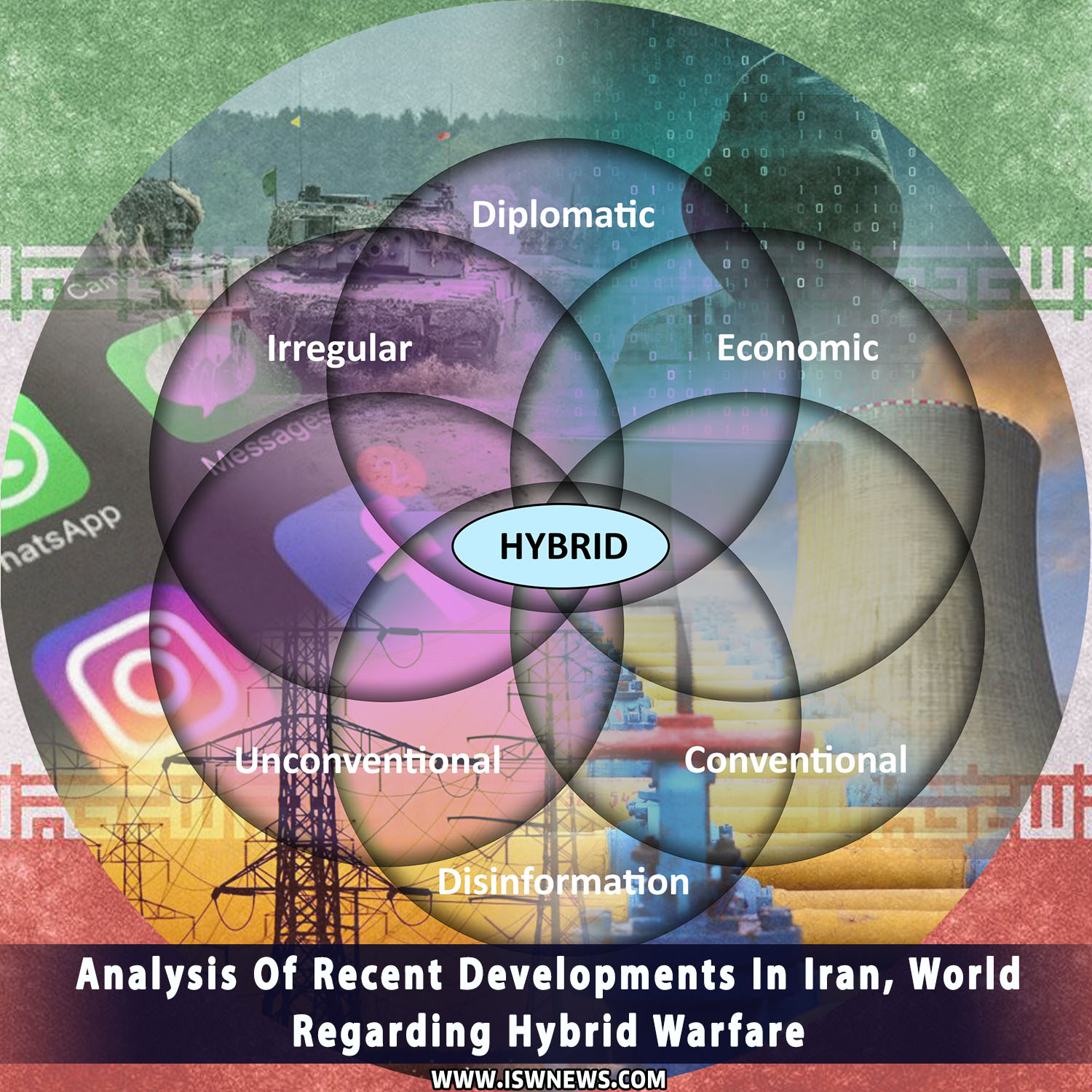
  • Analysis Of Recent Developments In Iran, World Regarding Hybrid Warfare

    Analysis Of Recent Developments In Iran, World Regarding Hybrid Warfare

    In addition to the effect of the European Union’s sanctions on the Iranian economy, the recent unknown blasts and strikes, and different incidents that have happened in Iran, we are witnessing the circulation of manipulated and fake news stories, which seems to be a complete example of hybrid warfare. However, who are designing and implementing the attacks?

    In a bid to answer the question; first, let’s review and categorize the recent news reports:

    1- The widespread drone strikes and blasts in Isfahan, Tehran, Tabriz, Rasht, Hamadan and Karaj:

    The nature of the news story collection had its roots in a combination of numerous fake news and a correct story but based on wrong information. The blast in Isfahan was conducted by the unsuccessful strike of three quadcopters on workshops belonging to the Ministry of Defence and Armed Forces Logistics, and the flights carried out by rescue aircraft in Tehran were portrayed as the flights by army fighter jets in a mission to intercept the unmanned combat aerial vehicles (UCAVs). Regarding to reports of strikes on Tabriz, Hamadan, Mahabad, Baneh and so on, whether there was not blast or strike, or the events in the cities were wrongly attributed to airstrikes. For instance, the burning incident of reeds around Yusefkand Lagoon in outskirts of Mahabad city was described as an Israeli drone attack!

    2- Qatari foreign minister’s trip to Iran:

    Minister of Foreign Affairs of the Islamic Republic of Iran Hossein Amirabdollahian met with his Qatari counterpart Sheikh Mohammed bin Abdulrahman Al-Thani on January 29, and said in a joint press conference that today we received messages from various signatories to the Joint Comprehensive Plan of Action (JCPOA) via the Qatari foreign minister.

    The presentation of a proposal for resuming the nuclear negotiations amid the peak of an ongoing conflict conveys the opposite meaning contrary to de-escalating and resolving of disputes in a peaceful manner. The US’s policy in this pattern of information warfare is a kind of double standard attitude similar to “two-edged scissors.” The Americans push ahead their attacks like the sharp edge of the scissors and at the same time, they offer to hold talks like the slow edge of the scissors.

    3- Iran-Russia military collaborations:

    The military collaborations and exchange of weaponries between Russia and Iran, experienced a significant acceleration particularly in the past one year following the onset of the Ukraine conflict as well as the West-imposed sanctions on Russia. It is worth mentioning that the Iran-made Shahed 136 drones have succeeded in inflicting heavy blows on the United States and NATO military projects and equipment. The shipment of the Iranian UAVs and ballistic missiles to Russia as well as the reciprocal transfer of the Russian Sukhoi 35 fighter jets and other Russian-made weaponries to Iran will bring about harsh repercussions for the West and Israel. Hence, they will make all-out efforts to prevent, sabotage and delay the exchange of arms between Russia and Iran.

    4- Ukraine’s warning to Iran:

    The Ukrainian authorities are of the opinion that the recent blast in Isfahan has anything to do with the conflict in the European country. The Ukrainians claim that the Islamic Republic is one of Russia’s military partners, who provides the Russians with lethal weaponries; thus, Iran will not be secure from mysterious strikes. So, Mykhailo Podoliak, an adviser to the president of Ukraine Volodymyr Zelenskyy, wrote on his Twitter account reacting to the blast in Isfahan that “the logic of confrontation is cruel and fatal. The logic holds the culprits and collaborators obstinately accountable. The night time blasts in Iran were conducted against drone and missile manufacturing facilities and oil refineries. Ukraine cautioned you.”

    The warning from Ukraine is not taken into account as a threat to the Islamic Republic of Iran; however, it indicates the repercussions of the Europeans’ anti-Iran stances and deeds. Regrettably, the Iranian authorities have not shown any appropriate reaction to the sanctions by the European Union. In the face of such issues, the officials of the Ministry of Foreign Affairs of the Islamic Republic referred to some phone calls with the European officials, calling the anti-Iran moves as superficial or trying to justify the imposition of sanctions with other matters such as the pressures made by of the US on Europe and so on. However, what is being witnessed actually is the intensification of economic pressure on Iran in particular concerning the issues such as selling crude oil and procuring currency for domestic needs.

    5- Palestinian attacks on settlements in the occupied territories of Palestine and recent incident at the Republic of Azerbaijan’s embassy in Tehran:

    The fresh operations made by the Palestinians in Jerusalem al-Quds have inflicted a heavy blow on the social status of the Zionist regime as well as the credibility of the government of Prime Minister Benjamin Netanyahu. The Israelis opine that the Palestinian resistance groups such as Hamas, Islamic Jihad, and others are fully supported by the Islamic Republic and these groups are operators of Iranians’ strikes on the occupied territories of Palestine. Hence, the Israelis mobilize their agents inside Iran’s soil to conduct proxy attacks. Thanks to Iran’s strong alliances with powerful resistance movements in Lebanon, Palestine, Yemen and other states in the West Asia region, the Islamic Republic enjoys the upper hand in terms of military struggle; so, Tehran is in the position to win any tough confrontation if it reaches the conclusion that it should engage in any military conflict, but the Iranians avoid such struggles because of their economic boundaries. In contradiction to Iran’s military superiority, Israel possesses upper hand in the political and economic fields; moreover, it has recently enhanced its influence in the Caucasus and Central Asian states. The Israeli diplomats as a result of their active and strong diplomacy succeeded in improving the relationship and influence in the Caucasus and Central Asian countries, which is considered as a very grave threat to Iran.

    Meanwhile, Iran increased its non-oil exports via the Caucasus region and Central Asian countries in recent years in a bid to compensate the deficiencies of its economy and decrease the effect of West-imposed sanctions. However, the Zionist regime’s influence in that regions can have the opposite effect and limit Iran’s paths to dodge the sanctions. Furthermore, the incident, which occurred in the Republic of Azerbaijan’s embassy in Tehran can negatively affect the International North–South Transport Corridor (INSTC) and the circumstances may be deteriorated by the hasty reaction by Azerbaijani President Ilham Aliyev’s government and it may linger to end up in severing ties and even initiating a conflict with Iran.

    All in all, now Iran is under pressure and in a hybrid warfare (political, economic, military, etc.). Any irrelevant news and event, such as a fire in a lagoon or an earthquake, can be placed under Western propaganda and used by Westerners to create chaos and achieve sinister goals against Iran. Such efforts will continue in the future, because this is an effective tactic of Westerners in hybrid warfare to deal with independent nations!

    Read more: A Failed Attack On The Facilities Of Iran’s Ministry of Defense in Isfahan; What Was The Nature Of The Blasts In Tehran And Other Iranian Cities?

  • A Failed Attack On The Facilities Of Iran’s Ministry of Defense in Isfahan; What Was The Nature Of The Blasts In Tehran And Other Iranian Cities?

    A Failed Attack On The Facilities Of Iran’s Ministry of Defense in Isfahan; What Was The Nature Of The Blasts In Tehran And Other Iranian Cities?

    The media reported at night of January 28 that several blasts were heard in the cities of Tehran, Isfahan, Tabriz, Karaj and Hamedan. One of the blasts was occurred as a result of an attack by three micro-drones (quadcopters) on the facilities of the Ministry of Defense in the outskirts of the city of Isfahan and the Iranian air defense systems succeeded in destroying at least one of the quadcopters. Also, one explosion was confirmed near or on the rooftop of a workshop. It seems the workshop was saved by special anti-drone structures with which the Iranian military protects their facilities.

    Reacting to the blast in Isfahan, the Ministry of Defence and Armed Forces Logistics wrote in the statement:

    “The failed attack happened at night of January 28, 2023 at around 23:30 local time, but the strike by the micro-drones were successfully repelled due to the forces’ vigilance and defensive preparations. The failed strike caused no casualties and the roof of the workshop damaged slightly, that by God’s grace could not cause any disruption in the equipment and tasks of the facility. The ministry assures the noble people of Iran that the performances of the centers to improve might, authority and security of the Islamic country will continue speedily and seriously, and that the blind acts will not get in the way of the country’s progress.”

    The location of the facilities of the Ministry of Defense of Iran in the suburbs of Isfahan
    The moment of the explosion of one of the micro-drones over the defense facilities of Isfahan city

    According to the additional information that has been published regarding the attack on the Ministry of Defense facilities in Isfahan, it is said that after hearing the sound of the quadcopters, the security agents of the complex took action against these birds with weapons and electronic warfare systems, and managed to shoot down one of them. One of these quadcopters loses its GPS link due to jamming during the confrontation, and this causes it to fall and collide with the rooftop of a workshop. Also, another one of these quadcopters, which was less damaged during the confrontation operation, was given to the security forces stationed in the complex and is being investigated.

    Concurrent with the explosions in Isfahan, video footages of the flight of several transport planes of the Iranian Army in Tehran’s sky have been circulated, that some of them are presumably related to aircraft to be dispatched to northwest Iran to provide relief to the the earthquake victims in Khoy city.

    It should be noted that last night at 9:44 pm local time, an earthquake with a magnitude of 5.9 struck the city of Khoy, in northwest Iran, killing at least three people.

    In some videos that are claimed to be from Tehran, explosions can be heard and fires can also be seen. According to the available information, none of these explosions and fires are related to Tehran, and basically the location and authenticity of this video is unclear and incorrect.

    The video and images that have been published about the fire are related to the fire in a car oil refining factory in the Shahid Salimi industrial area in Tabriz and it has been falsely attributed to Tehran and Isfahan.

    The video attributed to the sound of the explosion in the sky of Tehran
    The video attributed to the fire in Tehran

    According to ISWNEWS.COM, there is also some other reports on explosions in the Iranian cities of Rasht, Hamadan and Karaj as well as strikes in the military and industrial regions of the cities that are completely unfounded. The fact is, most of these fake news were published by the various pro-Israeli and pro-western twitter and telegram channels to promote chaos and fear among the Iranian nation. Therefore, the only correct and verifiable case is the attack on the facilities of the Ministry of Defense in Isfahan.

    Finally, it should be said, based on the history of the intelligence-security warfare between Israel and Iran, the attack on the Ministry of Defense facilities in Isfahan is most likely carried out by Israel, and other fires can be sabotages by the agents of the Israeli regime inside Iran. Its worth mentioning that the Israeli media outlets alleged that the recent attacks by Palestinian groups in al-Quds and other regions of the occupied territories of Palestine were aided and abetted by Iran.

    The drone attack on Isfahan military complex could lead to a military escalation in the Middle East. Tehran will likely retaliate once the side responsible for the attack is identified.

    Read more:
    8 Israelis Killed In Palestinian Operation In Occupied Al-Quds
    Second Anti-Israel Operation In Occupied Jerusalem In The Last 24 Hours

  • Attack On The Azerbaijani Embassy In Tehran + Video

    Attack On The Azerbaijani Embassy In Tehran + Video

    As a result of an armed attack by an unknown assailant on the Embassy of the Republic of Azerbaijan in Tehran, at 8:32 on Friday, 27th of January, Orkhan Asgarov, the head of the embassy’s security team, was killed and two of its employees were injured. The armed person was arrested by the security forces of the embassy.

    The moment the armed person entered the Azerbaijan Embassy and starts shooting

    According to the statements by the Tehran Police, the attacker came to the Azerbaijan embassy with two children and entered the embassy and started shooting at the security agents with a firearm (Kalashnikov). The attacker stated that his motivation for this action was personal and family problems. In his initial confession, he said:

    “In April of this year, my wife went to the Azerbaijan Embassy in Tehran and has not returned home. During my repeated visits to the Embassy of the Republic of Azerbaijan in Tehran, I did not receive any response from them, and I thought that my wife was present at the Embassy of the Republic of Azerbaijan in Tehran and was not willing to meet me. This morning I decided to go to the embassy with the Kalashnikov that I had already prepared.”

    Conversation between the police forces and the perpetrator of the armed attack on the embassy of the Republic of Azerbaijan

    The Foreign Ministries of Iran, Russia and Turkey as well as some other countries condemned this incident by issuing statements while expressing their condolences to their Azerbaijani counterparts.

    On 28 January, the President of Iran Ebrahim Raisi called the President of Azerbaijan Ilham Aliyev by phone. Raisi expressed his condolences to Aliyev and the family of Orkhan Asgarov, wishing the injured a speedy recovery. Aliyev expressed his strong condemnation of the attack, which he called a terrorist act, and expressed his hope for thorough and transparent investigation and punishment of the perpetrator to the full extent of the law. Aliyev also mentioned the courage of one guard who managed to disarm the attacker and thus prevent further casualties.

    Iranian Foreign Minister, Hossein Amir-Abdollahian during a telephone conversation with his Azerbaijani counterpart expressed regret at the incident that killed one diplomat and wounded two of the embassy staff and offered condolences to the Azerbaijani foreign minister and the family of the deceased diplomat. He also warned that the enemies of the two countries could take advantage of this incident, saying Baku and Tehran should not let their ties be affected by the attack.

    Initial video from the scene of the incident at the Embassy of the Republic of Azerbaijan in Tehran
    Conversation between the Embassy employees with Brigadier General Hossein Rahimi, the Police Commander of Greater Tehran
    Orkhan Asgarov, head of the security team of the Embassy of the Republic of Azerbaijan, who was shot dead by the attacker
  • Syrian Defense Minister Meets With The IRGC Chief And Iran’s President

    Syrian Defense Minister Meets With The IRGC Chief And Iran’s President

    The Syrian lieutenant general met and discussed with Salami as part of his meetings with Iranian officials and commanders in capital Tehran on February 4.

    In the Tuesday meeting, Major General Salami expressed satisfaction with the official visit by the Syrian minister and his entourage to Tehran, referring to the sacrifices made by both Syrian and Iranian nations in the face of the great conspiracy of the global arrogance and the Zionism regime in recent years.

    Pointing to the sacrifices made by the martyrs of both countries in fighting terrorism and defending the holy shrine in Damascus, Salami thanked Syria for showing remarkable resistance.

    For his part, the Syrian minister appreciated the Islamic Republic of Iran for supporting and assisting the Arab country in the fight against the ISIS in the anti-terrorism war, saying that the blood of the Iranian and Syrian martyrs saved the Syrian territory, and that the Syrian nation lauds the priceless support and assistance by the Islamic Republic and the Syrian will never forget Martyr General Qasem Soleimani’s efforts in the face of the dangerous plot.

    The Iranians’ assistance to the resistance movements in the region, including Palestine, is an indisputable reality, which paved the ground for the defeat and anger of the foes of the Islamic Ummah, the defense minister noted.

    Following the meeting with General Salami, the Syrian defense minister conferred with President Raisi.

    The Iran president pointed to fact that the relationship between Syria and Iran is based on common beliefs and ideas as well as resistance by the two nations.

    Raisi also stated that Iran is a true friend of the Syrian nation, because as the Islamic Republic stood by the Syrian government and people during the period of standing against terrorism, Tehran is prepared to stand by the Syrians in the time of reconstruction via enhancing all-out economic collaborations.

    The Syrian minister, for his turn, said that Syria succeeded in the war against terrorism backed by its true brothers and friends, and that Damascus will play a key role as one of the links of the axis of resistance stronger than before. He also noted that the axis of resistance will play a vital role in forming a new world order.

    It is noteworthy that, yesterday prior to these meetings, the Syrian minister held discussion with Chief of Staff of Iran’s Armed Forces Major General Mohammad Bagheri at the Iranian commander’s office in Tehran.

  • IRGC Naval Exercises In The Persian Gulf + Video

    IRGC Naval Exercises In The Persian Gulf + Video

    The military drills of Martyr General Nasrullah Shafi’i was held in order to pave the ground for estimating the abilities and preparedness of the Navy of the Army of the Guardians of the Islamic Revolution in the face of threats in the Persian Gulf.

    According to Commander of the IRGC Navy Rear Admiral Ali-Reza Tangsiri, the drills composed of the marine cruise missile systems of various classes; bomber and spotting drones capable of hitting multiple and simultaneous targets; unmanned intelligent subsurface systems; helicopter rocket firing, special rangers’ heliborne in moving and floating positions; the authoritative parade of the popular naval mobilization; and other defense power of the IRGC Navy, which showed completely appropriate performances.

    Video report of the exercise of Martyr General Nasrullah Shafi’i

    In the video above, the operation of Mohajer-6, Ababil-2, Ababil-3, Samad-3 (Shahed x) drones and Noor, Zafar, Noor and Ghadir anti-ship missiles and other missile systems and indigenous military equipment are shown.

    Admiral Tangsiri said that the diversity and large-scale firing and explosions in the coastal areas of Farsi Island to display powerful defense, the use of smart subsurface arms to strike and destroy the foe’s naval and coastal bases and facilities, the broad organization and usage of the Orange Force of the hypothetical enemy in the range of the real foe have been among other programs of the military drills, which have been implemented appropriately.

    The military exercise and other drills of Iran’s armed forces are being carrid out consistent with the plan to maintain preparedness of the land, sea and air forces of the army and IRGC to encounter external threats in various regions of the Islamic state, including the Persian Gulf’s waters, the Sea of Oman and the Strait of Hormuz.

  • Deployment Of Iranian Drones At Deir Ezzor Airport + Images

    Deployment Of Iranian Drones At Deir Ezzor Airport + Images

    The Alma Research and Education Center put forward the allegation that at least one Iranian drone has been deployed at Deir Ezzor airport.

    Mohajer-6 UAV at Deir Ezzor Airport

    The allegation has been raised despite the fact that there has been no report of any activity or deployment of Mohajer-6 drone in Deir Ezzor Governorate; however, it seems that in accordance with the published photo, at least one unmanned surveillance and reconnaissance aerial vehicle of Mohajer-6 has been deployed at the airport.

    The Mohajer-6 drone is a medium UAV class, manufactured by the Ministry of Defence and Armed Forces Logistics of Iran. The UAV is capable of carrying the Qaem (Ghaem) precision-guided bombs, the Sadid class missiles and bombs, the Almas missile as well as the Hydra rocket launcher, indicating the high firepower of the drone.

    Read more: Military Knowledge: Mohajer-6 Reconnaissance Combat Drone

    Given the fact that Mohajer-6 is the most successful Iran-made drone, it is possible that the drone is being used by the Syrian Army or pro-Iran resistance movements in Deir Ezzor Governorate.

    In January 2022, some regional and international media outlets reported that Ababil-3 drone was tested by resistance groups in Al-Mayadeen farms of Deir Ezzor Governorate, but there have not been any further details of the Iranian drones’ activities in Syria so far.

    In addition to the pictures from Syria, the Alma Research and Education Center published two images of the deployment of Mohajer-6 in Qeshm Island in southern Iran as well as Ababil-3 UAV in Konarak city in Sistan and Baluchestan province of Iran.