Category: West Asia

  • Iraq: Al-Sudani cabinet received the confidence from the parliament

    Iraq: Al-Sudani cabinet received the confidence from the parliament

    On Thursday, Iraqi parliament members voted with an overwhelming majority of confidence in the government of Mohammad Shia Al-Sudani. In this meeting, Abdul Latif Rashid, the president of Iraq, Jeanine Hennis-Plasschaert, the head of the UN mission in Iraq, Faiq Zeidan, the head of the Supreme Judicial Council of Iraq and some high-ranking officials of this country were present.

    The approved ministers of the Al-Sudani cabinet are as follows:
    1- Fuad Hussein, Minister of Foreign Affairs
    2- Hayan Abdul Ghani, Minister of Oil
    3- Mohammad Tamim, Minister of Planning
    4- Taif Sami, Minister of Finance
    5- Thabit Mohammad, Minister of Defense
    6- Abdul Amir Al-Shimmery, Minister of Interior
    7- Salih Mahdi, Minister of Health
    8- Ivan Faiq, Minister of Immigration
    9- Raazaq Mohaibis, Minister of Transport
    10- Aoun Diab, Minister of Water Resources
    11- Ahmed Al-Asadi, Minister of Labor and Social Affairs
    12- Ahmad Al-Mubarka, Minister of Youth and Sports
    13- Ibrahim Namis, Minister of Education
    14- Athir Daowd Salman, Minister of Trade
    15- Khaled Shawani, Minister of Justice
    16- Ziad Ali Fazel, Minister of Electricity
    17- Hoyam Abboud, Minister of Communications
    18- Abbas Jabr, Minister of Agriculture
    19- Na’im Al-Abboudi, Minister of Higher Education
    20- Khalid Battal Najm, Minister of Industry
    21- Ahmad Fakak Ahmad, Minister of Culture and Antiquities

    Thursday’s Parliament session comes a year after an election in which the Shia cleric Moqtada Al-Sadr was the biggest winner, but failed to rally support to form a government. So, on October 13, 2022, the Iraqi parliament elected Abdul Latif Rashid as the new president of Iraq after consultation between the Shia, Kurdish and Sunni factions, and then Abdul Latif Rashid appointed Mohammad Shia al-Sudani as the prime minister of Iraq to form the new cabinet.

    Read more: Abdul Latif Rashid elected as the new Iraq President

  • Terrorist attack on a holy shrine in Shiraz kill 13 + Video

    Terrorist attack on a holy shrine in Shiraz kill 13 + Video

    According to the initial statements of the authorities of Fars province, three gunmen entered the shrine area at 17:42 on Wednesday and shot at the shrine attendants and pilgrims.

    A few hours later, the ISIS terrorist group released a statement and contrary to the statements of the authorities of Fars province, announced that this attack was carried out by an armed person who had a history of participating in the terrorist attack on the parade of the Iranian armed forces on September 22, 2018 in Ahvaz.

    According to the available information, the perpetrator of this attack was a foreign national residing in Iran and after being arrested by the security forces, he was taken to a hospital in Shiraz for treatment. But despite the efforts of the medical team to keep him alive, he died due to the severity of his injuries.

    The spokesperson of Iran’s emergency department stated that 13 people have been martyred in this terrorist attack. It was also reported that the condition of two of the wounded was critical, and with the martyrdom of these two people on the morning of October 27, the number of martyrs increased to 15.

    Following the terrorist attack, the presidents and officials of different countries, including “Vladimir Putin” the President of Russia, “Antonio Guterres” the Secretary General of the United Nations, Sultan “Haitham bin Tariq Al Said” the King of Oman, “Raja Pervaiz Ashraf” The Speaker of the National Assembly of Pakistan, Muhammad Ali Al-Houthi, the Chairman of the Yemeni Revolutionary Committee, Qais Khazali and Ammar Hakim, leaders of the Iraqi groups and the Foreign Ministry of Syria, Armenia and the Republic of Azerbaijan issued a statement and sent a message of condolence, condemning this terrorist act and expressed their sympathy with the people of Iran.

    Shah-e-Cheragh (the shrine of the Lord of Light) is a funerary monument and mosque located in the city of Shiraz, where lies the tomb of Sayyed Mir Ahmad and his brother, Sayyed Mir Mohammad, the sons of the seventh Imam and brothers of the eighth Shiite imam, Imam Reza (AS).

    CCTV footage of ISIS terrorist attack on Shah-e-Cheragh Shrine in Shiraz

  • Israel missile attack on Damascus

    Israel missile attack on Damascus

    According to the announcement of the Ministry of Defense of Syria, “at 00:30 this morning, the Israeli army warplanes launched an air attack on the areas around the city of Damascus from the occupied Palestinian territories. The defense systems of the Syrian army countered this attack and managed to shoot down a number of missiles over the sky of Damascus. This attack did not cause any casualties and only resulted in material damages.”

    Read more: Israel missile attack on Damascus

  • Israel missile attack on Damascus

    Israel missile attack on Damascus

    According to a Syrian military source, at around 14:00 Monday local time, the Israeli enemy fired several missiles from the north of the occupied Palestine, targeting points around the city of Damascus. Air defense systems were activated to deal with missiles and intercepted a number of them. This attack resulted in the injury of a Syrian soldier and material damage.

    According to the available information, the positions of the Syrian army in the “Dimas” area, located in the west of Damascus, were one of the targets of this attack.

    Read more: Israel aggression on Syria’s Damascus

  • IRGC ‘Eghtedar 1401’ drill in the northwest of Iran

    IRGC ‘Eghtedar 1401’ drill in the northwest of Iran

    The exercise ‘Eghtedar 1401’ was held for four days from October 17 to 20 in the Aras border area located in Iran’s East Azarbaijan and Ardabil provinces.

    This military exercise has a wider geographical scope, force and equipment, so that it covers the entire border strip of Ardabil and East Azerbaijan provinces.

    In this exercise, the various units of the Islamic Revolutionary Guard Corps ground forces conducted heli-borne operations, parachuting, night raid operations, helicopter combat operations, combat and suicide drone operations, construction of pontoon bridge over the Aras River, etc., with the aim of improving the readiness of the IRGC to help other Iranian armed forces in order to defend the borders of the country and respond to recent threats from foreign countries.

    Major General Hossein Salami, Commander-in-Chief of the Islamic Revolution Guards Corps, said at the opening ceremony of the ‘Eghtedar 1401’ drill: “Unfortunately, the Zionist regime has infiltrated the countries of the south and northwest of Iran. We tell the governments of those countries not to let Israel into your country because they are the source of insecurity and evil. We will defend our security decisively and authoritatively in any situation, but you will be in trouble. The principle of our policy with our neighbors is based on friendship and good neighborliness and correct political interaction, but if through these neighbors the security of the Iranian nation is endangered and our country is threatened, then our policy will also change.”

    Eghtedar 1401 military exercise is the third exercise of the Iranian Armed Forces in the northwestern regions of Iran, after the second Karabakh war.

    After the second Karabakh war and the domination of the Republic of Azerbaijan on all its border lines with Armenia, claims have been made about the ownership of the southern lands of Armenia by the Republic of Azerbaijan. The president of Azerbaijan has directly and indirectly emphasized the military aggression on the territory of Armenia and the tensions in the Caucasus region are still strong.
    On the other hand, Iran has clearly stated its opposition to any military aggression in the Caucasus region. Iran has declared that no country has the right to change the geopolitical borders of the Caucasus region, and in case of a new military aggression by anyone in this region, Iran will deal with this issue strongly.
    Therefore, Iran’s Eghtedar 1401 exercise in the north-western borders of the country is clearly a strong warning for the Republic of Azerbaijan and any other aggressor country.

    Read more: Opinion: Iran Increasingly Uneasy About Threats to Common Border With Armenia

  • Drone attack on US base in Syria

    Drone attack on US base in Syria

    Late on October 22, positions of the US coalition in the Omar oil field were targeted by a drone attack. So far, no group has claimed responsibility for this attack, but the resistance groups are the main suspects.

    No information has been released about the amount of casualties and damages of this attack.

    In response to this attack, the US artillery targeted agricultural fields near the city of Al-Mayadin.

    It should be noted that also on September 18th, in another attack, positions of the US coalition at the Omar oil field were targeted by several rockets.

    Read more: Rocket attack on US positions in Deir Ezzor

  • Opinion: Another false flag, now in Europe

    Opinion: Another false flag, now in Europe

    There is a trace of the Zionists behind the big anti-Iranian game. It is not for nothing that Zelensky set himself the goal of becoming a new “greater Israel”. The discrediting of the Iranians in the Ukrainian conflict is in the nature of a provocation, in order to disrupt the negotiations between Tehran and the West and, in addition, increase the flow of sanctions against Iran. Zelensky recently dismissed the ambassador to Iran without any explanation, who openly praised the armed forces of the Islamic Republic.

    Actually, the strategy of Zionism that made up the story with the Iranian UAVs is visible to the naked eye. Ukraine was allegedly subjected to “aggression by Iranian weapons,” and the Zionists decided to “help” Kiev by supplying “their arsenal.” So it became known that the United States, with the consent of Israel, is transferring funds to the Armed Forces of Ukraine to combat Iranian kamikaze drones, – said the Ambassador of Ukraine to the “temporary entity” Yevhen Korniychuk. According to him, the supply of funds to the Armed Forces of Ukraine to combat Iranian UAVs is “a major shift in the “Israeli” policy in support of Ukraine.”

    Today, the Zionist actor continues to involve Ukraine in Zionist schemes in the anti-Islamic direction, since in addition to Iran, Turkey is now gradually turning into an “enemy of Ukraine.” It became known that Kiev requested sanctions against a number of Turkish businessmen, and the reason was allegedly the connection of merchants with the Russian Federation. In my opinion, the work of the “temporary entity” is again visible here. Someone assured Kiev of their readiness to replace Bayraktars, proposed a plan to discredit Erdogan, the reason being Ankara’s readiness to recognize Assad, in which case the situation in Syria becomes easier for the Iranians and it becomes possible to strengthen the anti-Zionist flank in the south of the Syria. Accordingly, this “someone” who proposed the anti-Turkish game to Zelensky is Zionism.

    Now about the UAV of the Russian Federation. The story of the “drone deliveries” from Iran contradicts the official position of the Islamic Republic, which calls for dialogue and an early solution to the Russian-Ukrainian conflict. Iranian Foreign Minister Hossein Amir Abdollahiyan earlier noted that “the baseless accusations recently made by the US Security Adviser against Iran in relation to the supply of Iranian unmanned aerial vehicles to Russia for their use in the war against Ukraine are connected with Biden’s visit to occupied Palestine, for self-serving political purposes.” The same thing is happening today.

    As for the use of UAVs by Russians, interesting information has already leaked onto the Internet. Back in mid-March, the Ukrainian military themselves discovered Zionist-made drones in the service of the Russian Federation. The history of cooperation between the Kremlin and Zionism in this direction is not new. It all started in 2009, when during the conflict between Russia and Georgia, the Georgian army used Zionist UAVs against the Russians. Moscow assessed the “effectiveness” of the weapons of the “temporary essence” and decided to purchase anological UAVs. As a result, from 2009 to 2015, Zionist firms sold more than $800 million worth of reconnaissance drones to Russia. The table is listed at the beginning of the article. Moreover, the Russian Federation has already used Zionist UAVs against Ukraine, but Zelensky is silent, like everyone else.

    Table of Russian purchases of Israeli UAVs

    As a result, we are faced with another fake story where Zionism uses Ukraine for its own purposes. But we should not lose sight of the foresight of some strategists of Zionism who want to see anti-Islamic and anti-Iranian sentiments throughout northern Eurasia in the post-Russian period, because it is not for nothing that they insist inside Ukraine that they should play a major role in the future collapse of the Russian Federation, and anti-Iranian hysteria will have to become the trump card of the Zionists from Kiev in the construction of “new republics” on the site of the former Russian Federation.

    P.S. Zelensky’s dissatisfaction with the lack of arms supplies from Israel should not confuse observers. Such claims are a consequence of the split of the Zionist movement into those who want to continue the occupation of Islamic lands, and supporters of the “new Israel” in Europe. We can say that we are witnessing a battle for the future of the Zionist movement, and the situation with Ukraine largely reflects the undercover struggle between the Zionists.

    In mid-October, the Zionists will openly say that they are ready to supply weapons to Kiev.

    As needed to be proved, the Zionists, with the help of their media, created a hype about “Iran’s participation on the side of the Russian Federation” in order to justify their arms supplies to Ukraine.

  • Ansar Allah drone attack on al-Dhaba port on the coast of Hadhramaut

    Ansar Allah drone attack on al-Dhaba port on the coast of Hadhramaut

    Undoubtedly, this drone attack by Ansar Allah is a warning to foreign companies and oil buyers in the occupied areas of Yemen, and it can be examined from two perspectives:
    1- Warning to deployment of Israelis in the coastal town of Al-Riyan, that were sent to this area to loot the oil resources of Hadhramaut and Shabwa provinces. (More details)
    2- Preventing the transfer of Yemeni oil by the Nissos Kea ship, which is a warning to foreign ships and companies.

    According to the statements by Mabkhut Mubarak bin Ghadhi, the governor of the Saudi-backed government for the Hadramaut province, “this ship belongs to a Greek company, and the first drone explosion occurred between the ship and another vessel, and the second explosion occurred near the Greek ship. Also, the crew of the ship has not reported any casualties and damages from these explosions.”

    The statement of Brigadier General Yahya al-Sari’, a spokesman for the Yemeni Armed Forces regarding the attack:
    “We made a simple warning to prevent the looting of crude oil from an oil ship from Al-Dhabah port in Hadhramaut province. This ship violated the decision issued by the Yemeni authorities to ban the transfer and export of oil derivatives, and we warned to prevent the continued looting of Yemen’s oil wealth and its non-allocation to the people.
    This warning message was done after the competent authorities warned the crew of the ship and informed them of this decision based on current Yemeni laws and international laws. The ship was handled with caution and we wanted to maintain its security and the security of Yemeni infrastructure.
    We will not hesitate to do our duty to stop and prevent any ship that intends to loot the wealth of the Yemeni people, and with God’s help, we can launch more operations and warnings to defend our great people and protect its wealth from looting. We again warn all companies to fully comply with the decisions of the government authorities in Sana’a and refrain from any participation in the looting of Yemen’s wealth.”

    Geolocation of Dhaba port

    Location of the Marshall Islands-flagged Nissos Kea off the southern coast of Yemen. According to the local media, this ship has moved away from Al-Dhaba port after the explosions.
  • Israel aggression on Syria’s Damascus

    Israel aggression on Syria’s Damascus

    According to the a Syrian military source, “At 23:03 local time on Friday, the Israeli enemy fired missiles from the north-east side of Lake Tiberias, targeting points around the city of Damascus. Air defense systems were activated to deal with missiles and intercepted a number of them. This attack resulted in material damages.”

    It is worth mentioning that on September 17 also the Israeli fighter jets fired a number of missiles from the Lake Tiberias towards the Damascus International Airport as well as places around the city of Damascus, which resulted in the death of five Syrian servicemen.

    Read more: 5 Syrian soldiers killed by Israeli airstrikes on Damascus

  • Opinion: Iran Increasingly Uneasy About Threats to Common Border With Armenia

    Opinion: Iran Increasingly Uneasy About Threats to Common Border With Armenia

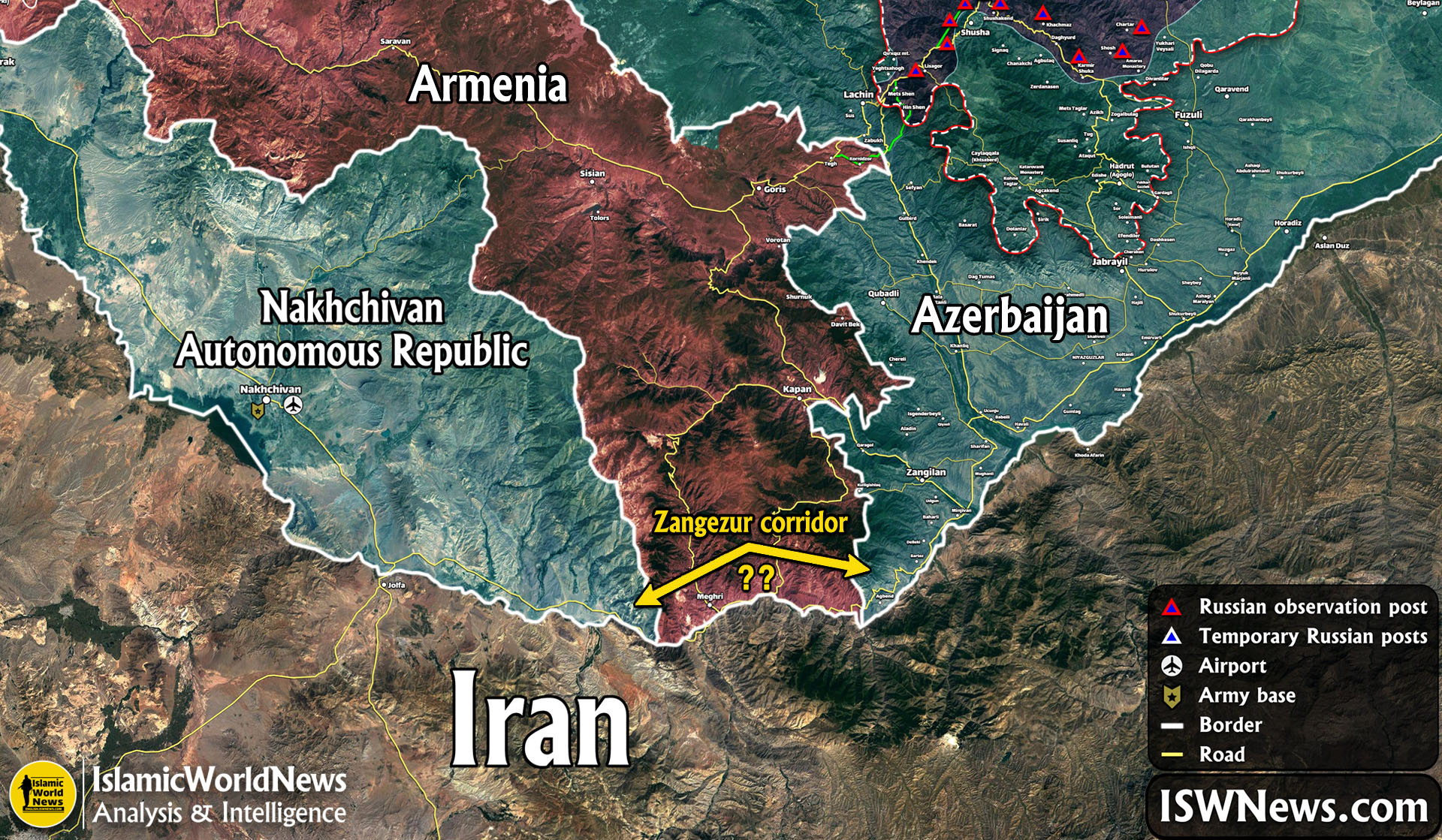
    Before the Second Karabakh War, Tehran was not particularly concerned about its border with Armenia. After the war, Iran’s main concern became Azerbaijan’s hopes to realize the Zangezur Corridor by force, in such a way that the 40-km border between Iran and Armenia could be compromised or blocked. In truth, Iran has no objection to the implementation of the ninth clause of the 2020 Karabakh ceasefire agreement, which includes granting Azerbaijan communication access to Nakhchivan. During the past three decades, communication between Baku and this region only took place via Iran. While Tehran does not object to this arrangement, it strongly opposes the change of international borders in the Caucasus, the blocking of the Iranian-Armenian border and the possibility of renewed conflict between Armenia and Azerbaijan.

    For this reason, the massive maneuvers of Iran’s army and the Islamic Revolutionary Guard Corps (IRGC) on its northwestern border in September and October 2021, unprecedented in the three decades since the collapse of the Soviet Union, signals the level and depth of Iran’s concerns about recent developments in the South Caucasus. Indeed, the outbreaks of violence between Armenia and Azerbaijan, the repeated threats of Baku to open the Zangezur Corridor by force, Turkey’s ongoing support of Azerbaijan and Russia’s silence and ambiguous position regarding the region have further exacerbated Tehran’s concerns. On the sidelines of the 7th Summit of the Astana Peace Process in Tehran, Supreme Leader Ayatollah Ali Khamenei met with Turkish President Recep Tayyip Erdoğan and clearly delineated that “if there is a policy to block the Iranian-Armenian border, the Islamic Republic will oppose it because this border has been a communication route for thousands of years.”

    Recent fighting between Armenia and Azerbaijan in September 2022 resulted in nearly 300 deaths and dozens of injuries on both sides, further aggravating Iran’s concerns. Some news sources even announced that Tehran had deployed 50,000 troops to the Armenian border. Indeed, Mohammad Pakpour, commander of the IRGC’s ground forces, on September 16, visited the units located on the border with Armenia, Azerbaijan and Nakhichevan, stating that their readiness level is high. Additionally, the chief of staff of the Iranian Armed Forces, Mohammad Bagheri, during a military parade on the anniversary of the Iran-Iraq War (1980–1988), declared, “Iran will not tolerate any change in the borders in the region and call on Azerbaijan and Armenia to solve the issues between them peacefully, through dialogue. We do not seek conflicts and wars, but we do not remain silent when it is necessary to resist them.”

    Several reasons underline Iran’s concerns regarding the possible blocking or destruction of its border with Armenia. If this border is destroyed, all of Iran’s northwestern regions will border Azerbaijan and Nakhchivan—and the number of Iran’s neighbors will decrease from 15 to 14. Iran will also lose one of its most crucial transit routes to the Caucasus, as the land route through Iran and Armenia that reaches Georgia is a main part of the Persian Gulf–Black Sea Corridor. The Iranian government’s decision to open a consulate in Kapan, the administrative center of Armenia’s Syunik Province bordering the Islamic Republic and the reciprocal decision of the Armenian government to open a consulate in the northwestern Iranian city of Tabriz clearly indicate Tehran’s desire to preserve and strengthen this transit route. Indeed, in terms of diversifying transit routes, Iran hopes to maintain this corridor (Iran-Armenia-Georgia) parallel to the North-South Corridor (Iran-Azerbaijan-Russia).

    Additionally, in terms of water resources in the Aras river basin, Turkey and Armenia are “upstream” countries, while Iran and Azerbaijan are “downstream” countries. Therefore, if Baku captures the southern part of Syunik Province along the Zangezur Corridor, then Azerbaijan will become an “upstream” country, leaving Iran as the only “downstream” country with limited control over the water supply.

    In a wider sense, Iran also has deeper concerns about geopolitical change and the balance of power in the region. In this context, Tehran considers the regional roles of Turkey, Israel, the United States and the North Atlantic Treaty Organization as extremely influential. From this point of view, Iran, unlike Russia and others, does not view the tensions in the South Caucasus merely as a “border clash” between Yerevan and Baku. In truth, opening the Zangezur Corridor would also provide direct military access for Turkey as a NATO member in the Caucasus.

    Indeed, a significant number of Iranian elites and experts believe that Azerbaijani President Ilham Aliyev’s emphasis on “uniting the geography of Turkic world” via the Zangezur Corridor and the expansion of Turkey’s presence in the South Caucasus will strengthen Pan-Turkism in the region, which could incite ethnic and separatist sentiments. In addition, considering the close relations between Azerbaijan and Israel, Tehran is worried that, if Baku does capture the southern part of Syunik Province, this will bolster Israel’s intelligence, espionage and security presence vis-à-vis Iran.

    As a result, although, among Iran’s 15 neighbors, its border with Armenia is the shortest, this 40-km border is of the utmost strategic importance for Tehran. Although the Azerbaijani authorities have stated many times that there is no real threat to the Iranian-Armenian border, Tehran’s reactions in the past two years and after the Second Karabakh War clearly show that Iran is extremely worried about the realization of the Zangezur Corridor by force, especially if this compromises its highly consequential border with Armenia.

    It seems that the new diplomatic developments of the past two months have not reduced Tehran’s worries. In Prague, a quadrilateral meeting between the leaders of Armenia and Azerbaijan together with the presidents of France and the European Council took place, as well as the historic meeting of Armenian Prime Minister Nikol Pashinyan with Turkish President Recent Tayyip Erdogan. Yet, during both the meeting between Iranian President Ebrahim Raisi and Pashinyan on the sidelines of the UN General Assembly and the meeting between the Raisi and Aliyev in Astana, Kazakhstan, Iran’s opposition to changing international borders in the Caucasus was clearly emphasized. As such, Brigadier-General Mohammad Pakpour, commander of the Islamic Revolutionary Guard Corps Ground Forces (IRGC) announced that “the massive exercise dubbed ‘Eghtedar/Power’ of the IRGC ground forces will be held at the northern border in the Aras region at the regional IRGC Ashura military base.”
    Tehran’s decision to hold this military maneuver one year after large-scale military exercises near the Azerbaijani border, clearly shows that “Iran increasingly uneasy about threats to its common border with Armenia”.

    Source: The Jamestown Foundation

  • Latest Updates on Tahrir al-Sham operation in Afrin region (Map Update)

    Latest Updates on Tahrir al-Sham operation in Afrin region (Map Update)

    On the 17th of October, the ceasefire agreement between the Hayat Tahrir al-Sham and the Turkish-backed Syrian National Army (SNA-TFSA) was completely violated and clashes started between the parties. During these clashes, Tahrir al-Sham militants managed to seize several positions of SNA and control the areas of Maryamayn, Innab, Baslahay, Jalbul, Shawarighat al Jowz, Kafr Maz and Marasat Khatib. In addition to these areas, Tahrir Al-Sham also captured the two villages of Kafr Janah and Qatmah.

    But some time later, after the mediation of Turkey, the forces of Tahrir al-Sham withdrew from Kafr Janah and Qatmah, and the SNA forces were stationed in these two settlements.

    The Tahrir al-Sham control over these areas greatly increases the pressure on the city of Azaz from the west, and this issue can ultimately cause the fall of this city.

    On the other hand, Ahrar al-Sham militants also attacked the SNA militants in Baragheetha, Al-Tawaqli and Soran axes located in the east of Azaz. So far, no progress has been made in these areas.

    Currently, most of the Afrin region is under the control of Tahrir al-Sham. It is also reported from the city of Afrin that the security forces of Tahrir al-Sham have launched a new campaign to arrest their opponents in this city.

    Click to view full size
  • Washington Post: Russia has bought Fateh-110 and Zolfaghar missiles from Iran!

    Washington Post: Russia has bought Fateh-110 and Zolfaghar missiles from Iran!

    According to Washington Post, quoting the intelligence officials of one of the allied countries of Ukraine and the United States near Iran, an intelligence estimate shows that the Russian government has purchased several shipments of weapons, including Zolfaghar and Fateh-110 short-range ballistic missiles from Iran, and the arms industry of this country is preparing and delivering the first missile shipment to Russia.

    Read more:
    Military Knowledge: Fateh-110 Ballistic Missile
    Military Knowledge: Zolfaghar Ballistic Missile

    These sources pointed to Russia’s new order to Iran and claimed that Iran is allegedly prepared dozens of Shahed-136 and Mohajer-6 drones for Russia. It is also said that Iranian military advisors have visited the areas controlled by Russia and have provided instructions to the commanders of the Russian army about how to carry out operations with suicide drones.

    As the war in Ukraine has been prolonged and the missile and drone reserves of the Russian army have decreased, the role of Iran in the war in Ukraine has been highlighted as one of the suppliers of Russian weapons. In this regard, Ukrainian authorities and media have claimed Iran’s arms assistance to Russia, and over the past few weeks, they have published various footages of the flying or hitting of Shahed-136 and Shahed-131 suicide drones (a smaller version of Shahed-136) in different regions of Ukraine. They also claimed to have obtained the wreckage of a Mohajer-6 drone.
    Despite all these claims and footages, Iranian authorities deny Iran’s military aid to Russia and insist on Iran’s neutral position in the face of the war between Russia and Ukraine.

    Read more:
    Russian Army Massive Drone Attack on the Capital of Ukraine
    Ukrainian MiG-29 was downed while hunting the Shahed-136 drone!