The first Scan Eagle drone was shot down on June 20, in the same area, in the Sarwah district near the al-Mashjah heights.
The drones are said to belong to the Saudi coalition, but the United States has not yet disclosed the details of the sell deal of this drone to Saudi Arabia or the UAE, and it is possible that the user of these drones in Yemen is the United States itself.
1- Marib: – Clashes between Ansar Allah and the Saudi-led forces continued on the eastern front of Sarwah and Madghal and the western Asdas. – The news about Ansar Allah’s progress in al-Balq mountain and the district of Raghwan and other places is not true. The clashes are as sporadic as in previous days, and there is currently no movement to resume the operation to liberate Marib city.
2- Saudi coalition airstrikes: In the last 48 hours, the Saudi coalition warplanes have bombed Sarwah 35 times, Madghal 2 times, Raghwan 3 times and Maheliyah 2 times in Marib province, Khab and Al-Shaaf 2 times in Al-Jawf province, Al-Boqa’ and Al-Fara’ areas 2 times in Saadah province.
3- Al-Hudaydah: – Saudi coalition forces have violated the ceasefire 214 times in the province in the past 48 hours. – “Essam Mutawakel”, the spokesman of the Yemeni Oil Company, announced the arrival of a ship carrying 23066 tons of fuel oil to Al-Hudaydah port. In recent days, two ships carrying 59966 tons of gasoline and diesel have entered the port of Al-Hudaydah.
4- Saadah: One person was martyred and four others were wounded as a result of the Saudi artillery shelling on the Al-Raqu border area in Munbah.
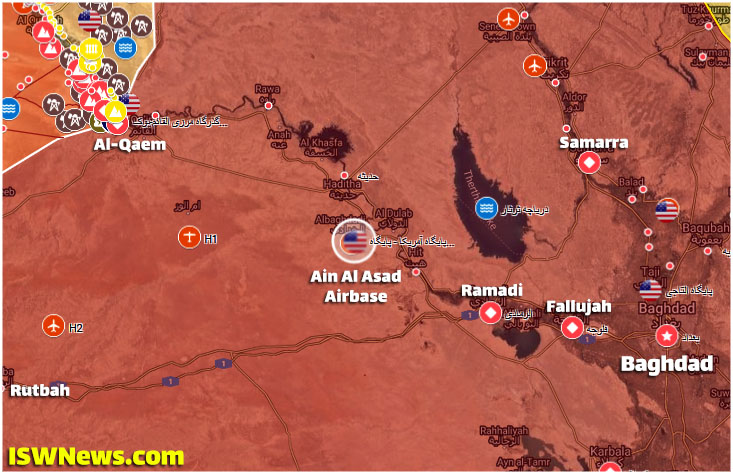
According to preliminary information, the attack was carried out using two suicide drones, and the AN/TWQ-1 and C-RAM defense systems failed to intercept and destroy these drones.
So far, no information is available on the possible casualties of this attack.
This is the third drone strike by Iraqi resistance groups on Camp Victory in the last three months.
According to initial reports, two rockets were fired at the airbase from the al-Baghdadi area, and after the attack, US aircraft flew over the Ain Al Asad airbase and its suburbs to track down the perpetrators.
Col. Wayne Marotto, OIR Spokesman stated the attack did not cause any casualties.
No group has claimed responsibility for the attack so far.
Ain Al Asad Airbase has been targeted six times by rocket and drone strikes by Iraqi resistance groups, the last of which was attacked by two suicide drones on June 6.
It is noteworthy that Ansar Allah Air Defense has carried out more than 1534 operations over the past six years, of which more than 454 operations have resulted in the downing of aircraft, including fighter jets, helicopters and drones of the Saudi coalition.
The moment that AnsarAllah shot down a US Scan Eagle drone over the Mashjah area of Sarwah in Marib province.
Ansar Allah also attacked positions of Saudi coalition in Khamis Mushait in southern Saudi Arabia with two suicide drones. On the other hand, the Saudi coalition claims to shoot down seven Ansar Allah drones in the southern skies of Saudi Arabia.
The attacks come as Mohammed Abdulsalam, Ansar Allah’s spokesman and chief negotiator, said in a recent statement that Oman’s mediation had failed in recent talks with Saudi Arabia.
The exact details of the attack have not yet been announced by a spokesman for the Yemeni Armed Forces. In the coming hours, it will be clear whether the large-scale operation this afternoon is a warning to the Saudi coalition, or whether Ansar Allah is announcing with these attacks that the talks have failed and Saudi Arabia should wait for more widespread attacks.
As a result of Ansar Allah attacks in recent years, flights to Najran, Abha and Jizan airports have been severely reduced, and these airports have practically lost their efficiency. Also, during the Ansar Allah attacks, flights are transferred to Riyadh and Jeddah airports, or delayed or completely canceled.
The situation of flights in southern Saudi Arabia after several Ansar Allah attacks on Saudi coalition airports and air bases in the region.
1- Kirkuk: – Acquiring precise information Iraqi security forces could arrest 10 ISIS terrorists who were hiding. – Troops of Hashad Sha’abi 56th brigade neutralized ISIS terrorists rocket attack in Hawijah area. After searching the area, another anti armor missile was discovered yesterday.
2- Anbar: – Iraqi security forces arrested an ISIS terrorist in Anbar province. – On 16 June an American army logistical convoy was hit. Group ‘International Resistance Faction’ took the responsibility of the attack.
3- Nineveh: – Four IEDs, two detonators, 20 mortars and some ammo were discovered by Samarra. – Iraqi security forces discovered five ready to launch rockets.
4- Maysan: Iraqi police: An officer of Counter Terrorism Service was assassinated in southeast of the province.
5- Qadesiyah: On 17 June, the Resistance groups targeted an American army logistical convoy in Diwaniyah.
6- Baghdad: On 12 June, the Resistance groups attacked the runway in Camp Victory used by US air force using suicide drones.
7- Some American officials told Wall Street journal that US will remove Patriot SAMs from Iraq, Saudi Arabia and some other countries.
8- Counter Terrorism Service received six million dollars of ammo and equipment from international coalition.
9- ISIS took responsibility of bombing three poles of power transmission in Diyala province and claims two are destroyed and the third one is damaged.
10- 14 ISIS terrorists arrested in Kirkuk and Nineveh provinces.
Brigadier General Yahya al-Sari’, spokesman for the Yemeni Armed Forces, called the UAV attacks as the legal response to the continuing siege of Yemen and the crimes of the Saudi coalition against Yemen.
According to field sources, the attack was carried out by Israeli Army tanks. There were no casualties in the incident. So far, the Syrian army and the Israeli army have not responded to the news.
On May 10, an Israeli helicopter targeted a residential house west of the city of Hader in the northern province of Qunaitra, injuring a Syrian army officer named Tahrir Mahmoud, which he was martyred on May 18 due to his wounds.
Brigadier General Yahya al-Sari’, spokesman for the Yemeni Armed Forces, called the UAV attacks as the legal response to the continuing siege of Yemen and the crimes of the Saudi coalition against Yemen.
East of Syria: Recent operations by the Syrian army and Russian warplanes in the desert areas of Deir Ezzor and Homs provinces led to the destruction of many of ISIS hideouts in these areas. However, ISIS guerrilla operations, including ambushes and bombings against Syrian Army forces and allies in the eastern deserts of Syria, have severely affected the security of these areas. ISIS attacks have led to the martyrdom of a number of Syrian Army forces and Iranian advisers on several occasions. As summer approaches, ISIS appears to be stepping up its attacks in the eastern deserts of Syria. Thus, securing the roads and thwarting ISIS attacks remains the main goal of the Syrian army in the east of Syria. According to the latest information, the Syrian army has sent more troops to the eastern deserts of Syria, and the possibility of launching a large-scale clearing operation is not far off.
Northwest of Syria: The frontlines in northwestern Syria have not changed in the past year, and most clashes have been limited to exchanges of artillery fire. The construction of new military posts by the Turkish army in the Idlib region and the withdrawal from a number of observation posts are also among the important developments of the last year in the Idlib region. Over the past year, the Turkish military has withdrawn from a number of military posts and observation posts in the areas controlled by the Syrian army in Idlib and Aleppo; On the other hand, it increased the number of its military posts in the militant-held areas in Idlib. The Turkish military currently has four observation posts and about 50 military posts west of Aleppo and the Idlib region. The Turkish military is expected to build another new military post in the Idlib region in a series of measures to prevent a possible Syrian military operation in the coming months. The construction of a new military post on the outskirts of the town of al-Barah, located in Zawiyah mountain, is one of the newest military posts built by Turkey in the Idlib region.
Another major incident in the Idlib region is the killing of a number of Tahrir al-Sham commanders by Russia. Given Russia’s recent strike on Tahrir al-Sham in southern Idlib and the killing of a number of its top commanders, tensions are likely to rise and there will be a possibility of a limited or widespread ground clashes on the fronts in Idlib and Aleppo provinces. Currently, the exchange of artillery attacks on the conflict lines in Idlib and Aleppo provinces has intensified, and most of this exchange of fire takes place in the areas of Zawiyah mountain and al-Arbaeen mountain.
Northeast of Syria: The most important developments in northeastern Syria are related to the clashes between the Asayish forces and the Syrian army in the city of Qamishli, which finally ended after a few days of clashes and withdrawal of the Syrian army from most of al-Tai neighborhood. Clashes began on April 20, when one of the Asayish commanders, Khalid Haji was killed in an exchange of fire between Asayish and NDF at checkpoint in the city of Qamishli. After this incident, the Asayish forces attacked al-Tai neighborhood and took control of parts of this neighborhood.
Clashes between SDF and Turkish-backed militants around the towns of Ain Issa and Tal Tamar are another major incident in recent months in northeastern Syria. Despite a ceasefire agreement in these areas and the creation of a safe zone, clashes and tensions between the Turkish-backed militants and SDF have continued over the past year in northeastern Syria. Over the past year, Turkish-backed militants have repeatedly attempted to advance and seize the city of Ain Issa, each time being stopped by the SDF. In the last case of these conflicts, with the serious entry of Russia and the agreement with Turkey, the intensity of tensions in the region was reduced. However, the situation in the safe zone is still very fragile and there is a possibility of widespread clashes at any moment.
US, Russian and Turkish military patrols are also continuing in the northeast of Syria.
South of Syria: Terrorist operations in southern Syria remain strong, and this has become a major problem. In the past year, a significant number of ex-rebels who joined the process of national reconciliation and eventually joined the Syrian army or laid down their arms have been assassinated by unknown gunmen. The continuation of assassinations in Daraa province, which recently led to the assassination of five mayors, the attack on the polling station in the presidential election, the Syrian army checkpoint and several ex-rebel commanders, indicates the unstable security situation in southern Syria.