After near 10 years of war against Syria’s people and government the Arabic-Hebrew-Western axis unsuccessful in defeating the resistance axis started economic war against Syria. This economic war, which is not new though, started since the beginning by EU and US sanctions. This time Caesar act targets reconstruction in Syria.
Caesar act; threats and opportunities for Iran’s influence in Syria
Caesar act implemented on 17 June and according to it all parties involving in Syria’s economic and specially the infrastructure are sanctioned by US. This is while the key players in reconstruction of Syria are two strategic allies, i.e., Iran and Russia who do not pay much attention to US unilateral policies and have been under sanction by US already.
Some of Russian companies including Stroytransgaz (STG), which is doing the important project of expanding Tartus harbor and Syria’s mines, are under sanction by US for many years and thus Caesar act does not influence them. In addition, Russian officials have stated clearly that their economic activities in Syria won’t be influenced by sanctions.
Iran is under the most severe sanctions by US for many years and is immune to them. By sending fuel to Venezuela, who is also under severe sanctions, Iran yearns to form an economic league of states under sanctions to minimize the effect of it.
These sanctions rule out big opponents such as India and UAE in reconstructing Syria. UAE tried very hard to have influence on Syria’s economy and hinders Iran’s influence and using opposition of resistance axis weakens Iran’s and Assad’s positions in Syria and even remove them. Caesar act puts an end to this plan.
US two main goals of sanctions on Syria’s reconstruction
US and allies specially Israel after being unsuccessful in defeating Syria and allies in battlefield, try to use the lever of sanctions. By imposing economic leverage and preventing investment in reconstruction of Syria would increase the dissatisfaction leading to protests and pressuring Syrian government. This plan can be defeated if Syria’s allies such as Iran consider the popular economy in reconstruction of Syria.
The second goal is to putting Syrian government to not reclaim lands occupied by terrorists including Idlib an Kurdish controlled in which US is exploiting Syria’s oil.
Category: Syria
-

Opinion: US. trying to defeat Syria’s resistance; this time from reconstruction
-
Breaking: Israel missile attack to Syria + Video
Two people were killed and four others were injured in the airstrikes, according to Syrian media.
Also hours after the first attacks, in a separate attack at 00:45, areas west of Salamiyah in Hama province were targeted by the Israeli regime missile again.
The footage you see are related to targeting of one of the Syrian Army’s ammunition depots in western Salamiya after the Israeli missile strikes: -

Presence of Russian warplanes at Deir Ezzor airport
After the military entry of the Syrian and Russian armies to east of the Euphrates in the last year, the Russian army wants to expand its military influence in east of Syria. According to available information, the Russian army is setting up a new military base in the Maadan region in the east of Syria.
Also, a part of Qamishli airport has been turned into the Russian air base, and the Russian fighter jets presence in Deir Ezzor is also interpreted in this regard. -

Security operations in the eastern deserts of Syria
Liwa al-Quds forces reached point 400 on the Syrian-Iraqi border and cleansed 127 villages and an area of 9,000 km2 from the #ISIS cells.
-
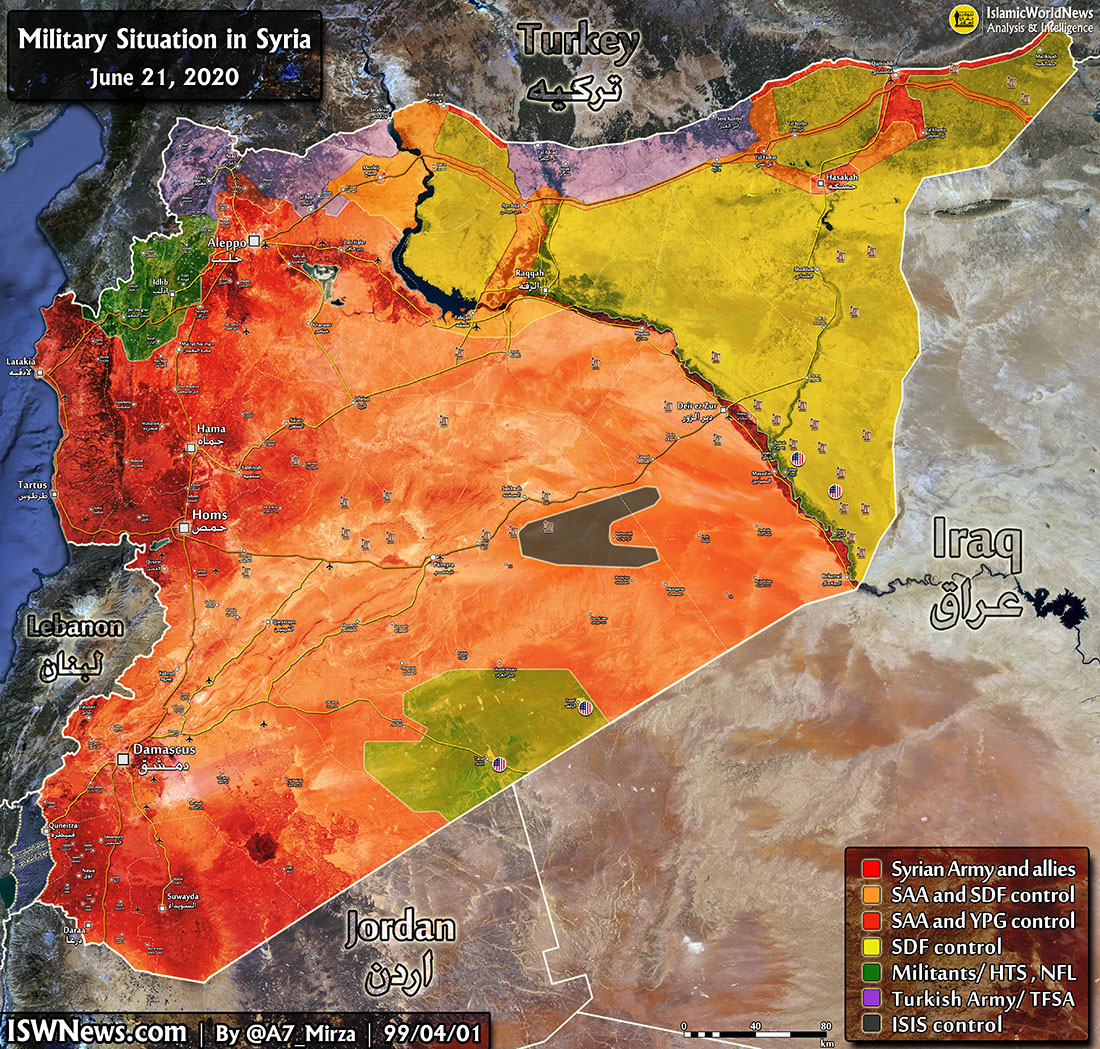
Latest Map of Frontlines in Syria until 21 June 2020
Northwest of Syria
Following the second stage of Syrian Army operation in Idlib area, which was started on 19 December 2019, army troops liberated 2,345 km2 of land from Turkish-backed terrorists until 4 March 2020. 763 km2 of liberated land was in Aleppo province and 1,582 km2 in Idlib province.
In despite that Turkish-back terrorists tried very hard in Idlib area to cut important M5 highway by occupying Saraqeb in the last two weeks of Syrian army operation to give Erdogan winning chips in Idlib ceasefire talks, but they failed and Saraqeb was finally liberated by Syrian army and Erdogan met with Putin empty handed.
Controversial Moscow summit took place and Erdogan and Putin reached a new ceasefire in Idlib area which was imposed since 6 Match in Idlib and M4 highway.
Details of Idlib ceasefire
Since the starting date of ceasefire so far, although the advances stopped and 17th joint Russian-Turkish limited patrols launched in M4 highway, but terrorist groups have not retreated from designated areas in the ceasefire agreement. Patrols have not reached Jisr al-Shoghur yet and artillery fire exchange and daily conflicts continue in Idlib area.
On the other hand in the last three months Syrian and Turkish armies strengthened their positions in Idlib front line and it seems there will be an imminent operation.
East of Syria
– After Turkish operation “Peace Spring” in east of Euphrates and occupying lands between Raas al-Ayn and Tal Abyadh to the depth of 32 km in fall 2019, front lines are unchanged and Turkish operation is halted since 25 November 2019 after announcing ceasefire and DMZ. There is only artillery fire exchange sparsely between SDF and Turkish-backed terrorists.
In recent months, joint Russian-Turkish patrols launched several times in east and west of DMZ and near Syria’s northwest border.
– Russian army took position in Qamishli airport and a large part of it turned into a Russian airbase. Russian warplanes number also increased in Deir Ezzor airport in recent days.
In general, in recent month, Russian and Syrian armies’ presence increased in east of Euphrates. Syrian and Russian armies try to limit US influence in this area by increasing their troops and equipment which resulted in friction with SDF.
– American troops still control oil and gas reservoirs in east of Euphrates even after show retreat from northeast of Syria and it seems they do not intend to leave in near future.
– ISIS hidden cells are still active in deserts of east of Homs and south of Deir Ezzor. Their main activities are in east of Sukhnah, Kabajib and east of Mayadeen including daily and weekly sabotage and hit-and-run operations against Syrian army. Although Syrian army in recent months launched several security and cleansing limited operations, it is unlikely to cleanse the area without an extensive operation.
South of Syria
The front line in south is static and all the area is controlled by Syrian army. However, there are sparse IED operations by remainder of militants and ISIS terrorists from previous cleansing against Syrian army. It has been intensified in the last two months and Syrian army has deployed more troops in the southern areas to subdue these activities. Protests and some political activities have increased against Syrian government and allies in south of Daraa province in the last month.
Click to see the full size map
Read the previous article about Syria here: Latest Map of Fronts in Syria until 22 February 2020 -

U.S. Impose Caesar Act Designations for Syria
According to Caesar act or what USA calls supporting Syrian civilians, Syria’s economy and any allies which are helping in reconstruction of Syria are imposed pressure and sanctions.
The act, which was voted by Congress, imposes economic, financial and bank sanctions on any country or organization which takes part in reconstruction of Syria active from today 17 June 2020 for five years. Syria’s departments and industries active in military, economy and energy are sanctioned as well.
There are six conditions to remove the sanctions:
1. Stopping aerial bombing civilians by Syria and Russia.
2. Syrian, Russian and Iranian, and proxy groups forces obligation to stop bombing health, sanitation and education infrastructure and residential and commercial areas.
3. Lifting limits imposed by Syrian, Russian and Iranian and proxy groups forces on sending humanitarian aids to sieged areas and giving freedom of transport to civilians.
4. Releasing political prisoners and giving permission for human rights organizations to visit Syrian prisons.
5. Providing freedom privilege to refugees to return home.
6. Convicting perpetrators in Syria and starting the talks and national peace.
According to this act, Russia due to providing forces and new warplanes for Syria, Iran due to contracts in energy and Syrian officials due to human rights violation, etc. are imposed with new sanctions.
Trades between Syria and neighbors such as Lebanon and Iraq are included in the act as well. -

Opinion: What is Syria’s new field for Russia and Iran?
The war was over and there were many conflicts in Syria between the opposition and the proponents. The Takfiri and Western media considered merely the cause of Russia and Iran presence material interests, and were considering both of them as the main reason of the chaos in Syria. These days, Syria bears the pressure for reforming its political structure, simultaneous with confronting with remains of ISIS, al-Nusrah, and Ahrar al-Shaam in Idlib, Homs, northwest with Turkey inside the country and foreign countries; and two main allies, Iran and Russia are from the influential components in this field.
Russia; internal difference and Moscow decision for supporting from Syria
After the war with ISIS, many politicians in Russia believed that Russia should withdraw from the Syrian battlefield immediately, so that the Syrian people and protesters to decide about the continuation of Syrian process. They say the Syrian protesters that have now laid down their weapons, will never be destroyed by war and killing; and this gap between the people and the government will finally lead to the fall of Bashar al-Assad. The Russian politicians claim that Russia needs economic cooperation with Syria in the future, so it should act in the way that the next Syrian government does not oppose completely with Russians.
Entering of the Russian researchers into the debate have had made significant progress. Russian researchers in international relations, Antuan Mordasov and Kirill Simonov have published a joint article with significant title of “Russia without Assad.”
This article has done a comprehensive study about the contracts between Moscow and Damascus, and have classified its phases between Russian merchant criticism; that the focus in it was on corruption and available barriers in developing of economic activity between Russia and Syria. This study represents the failure of the Syrian regime in managing of the current step and its inability for facing with the internal terrible situation. So, the suggestion of this article was that Moscow interests are in changing its relations with Syria, or the falling of Bashar al-Assad. But that’s not all. On the other hand, there are politicians and researchers that consider supporting from Bashar al-Assad’s Syria and reinforcement of economic cooperation with it, as the important strategy of Russia in the coming decade, and believe that this interaction should never be distorted.
On Monday, May 25, Vladimir Putin appointed Alexander Yefimov, the ambassador of this country to Damascus, as his special envoy for the development of relations with Syria. This appointment is important, because in addition to the ambassador that is responsible for coordinating internal affairs and communicating between Syrian and Russian officials, the Russian deputy foreign minister Alexander Lavrentyev is his country’s special envoy in Syrian affairs and is supervisor of Russian delegation in peace talks.
Also at a higher level, Mikhail Bogdanov, one of the other Russian deputy foreign minister, is Putin special envoy in the Middle East and North Africa region.
In the section of developing the military presence, on May 29 Putin with signing an instruction, wanted the ministry of defense and foreign affairs that by negotiating with the Syrian government, Moscow can have more access to military facilities in Syria.
So, apart from the lack of internal unity and the analysis that are opponent to Moscow function with Damascus, it seems that Russia has set a long-term perspective, so that beside showing itself as a peacemaker and anti-terrorism country, to keep itself in the western Asia region by cooperating with Syria; and gain the most of interest at the post-war suitable economic market. It is worth mentioning that China is one of the serious economic rivals for Russia in the markets such as Syria and Iraq; and therefore Russia should try to maintain its economic market, beside being successful in repelling the terrorists and keeping Bashar al-Assad.
Will the Islamic Republic of Iran leave the Syria?
We said before that Iran and Russia are two major allies of Syria, and due to the influential role they played in facing with ISIS terrorism, the Syrian government wants the continuation of activities and interactions between these three countries. Recently, there were rumors in the media that it was announcing of an agreement between Iran and Russia for puting aside Bashar al-Assad. The Western and Arab opposition media intensely blackmailed in this space, and some of activists and the Syrian people took a strong stance against this joint decision. Because the independence that they had fought years for it, is now between the foreign actors and they decide.
Seyyed Hassan Nasrallah in his speech on Ramadan 19 called these rumors unrealistic and said: “Iran, Lebanese Hezballah and Resistance groups came and fought in Syria, but Iran does not enter into any conflict with anyone for increasing its infiltrate and has no problem with Russia and has no greed in Syria. Iran’s aim is keeping Syria’s identity and prevent it from accepting the hegemony, and Iran’s firm decision is supporting from the Syrian leadership and its decisions and stability. Also, Iran’s goal in Syria has been preventing the US and Israel from dominating Syria, and this country has never intervened in Syria internal affairs.
The Islamic Republic of Iran cooperation with the Syrian government in the fighting against terrorism and prevention from this religious sedition is clear for everyone. On the other side, Israel wants to pave the way for Iran’s withdrawal, by imposing pressure on the Syrian government. The alliance between Iran and Syria is a strong supporter for defensing of Hezballah against Israel, and the Resistance axis will have serious problems, with cutting the connection with Syria. So, it’s obvious that domination system, with the financial support of the Persian Gulf countries such as Saudi Arabia, the UAE and Qatar to revivr terrorists in Syria, and Israel is trying to achieve its aim that is Iran’s withdrawal from Syria by scattered airstrikes. So, the Islamic Republic of Iran’s ten years effort for failure of the Zionist-American ISIS project will be virtually destroyed.
In the trade section, the Islamic Republic was doing significant exchanges with Syria. In 2010 (before starting of the civil war in Syria), the export range between Iran and Syria reached to 515 dollars million , that with the starting of civil war in Syria and its spreading to most of the country, caused that Iran’s exports to Syria in 2014, be reduced to about 100 thousand of dollars. Although, in 2016, exports between Iran and Syria recorded a little improvement and reached 145 million dollars; but there is still a long distance to reaching the 2010 record.
So, the strategic cooperation between Iran and Syria in the security, political and the economic section will cause the failure of the enemies in the region and the growth of the Resistance axis, and this withdrawal will never occur. -

Hasakah people protesting against SDF
According to local sources, in recent days people of al-Shaddadi town, south of Hasakah, protested against the behavior of SDF, which is supported by USA, which was subdued. In the last march on 4 June a civilian died due to SDF bullet and four injured.
The reasons of protests claimed to be chaos, abduction, murder, exploiting and activities of SDF. In recent months, Hasakah and Deir Ezzor inhabitants protested against SDF and every time they were answered by fire of SDF. -

Video: Blast en route Turkish army convoy in Idlib
The blast went off in Ghassaniyah area, outskirts of Jisr al-Shoghur. The injured moved to a hospital in Rayhaniyah area.
-

Video: The Syrian Army blocked the road on American convoy
According to the SANA, the Syrian army prevented US convoys from entering to Hasakah city, by establishing a checkpoint in the entrance of Um al-Khair; and American forces were forced finally to withdraw.
During the past few months, the American terrorist forces have faced several times with these actions of Syrian army in Hasakah, and finally, have been forced to change their path and return to their starting point.
These actions have restricted the Americans movements, instead the SDF members have arrested the civilians and locals that are trying to block the Americans path.
The US presence in north of Syria has been challenged by the Syrian and Russian armies presence, and the US is trying to stabilize its infiltrate in Syria, by imposing pressure on Kurdish groups. -

Israel’s satellite images of recent attack to al-Bukamal
According to Zionists claims these images show construction of a tunnel near Imam Ali base southern outskirts of al-Bukamal by Iran which can store advanced weapons for resistance forces.
According to Sayyid Hassan Nasrallah recent speech and resistance forces plan in the area such as Syria and Iran oil trade, Lattakia port leasing, etc., it seems these activities are Iran’s massive economic plans for the people of the region and they benefit people of all countries Iran, Syria, Iraq and Lebanon and disarming sanctions by the West.
As secretary of Hezbollah stated, Iran’s and resistance’s mission is to prevent USA and Israel reign on Syria. Therefore one reason behind Israel and USA continuous attacks to resistance forces positions in Syria is to prevent this strategic plan.


