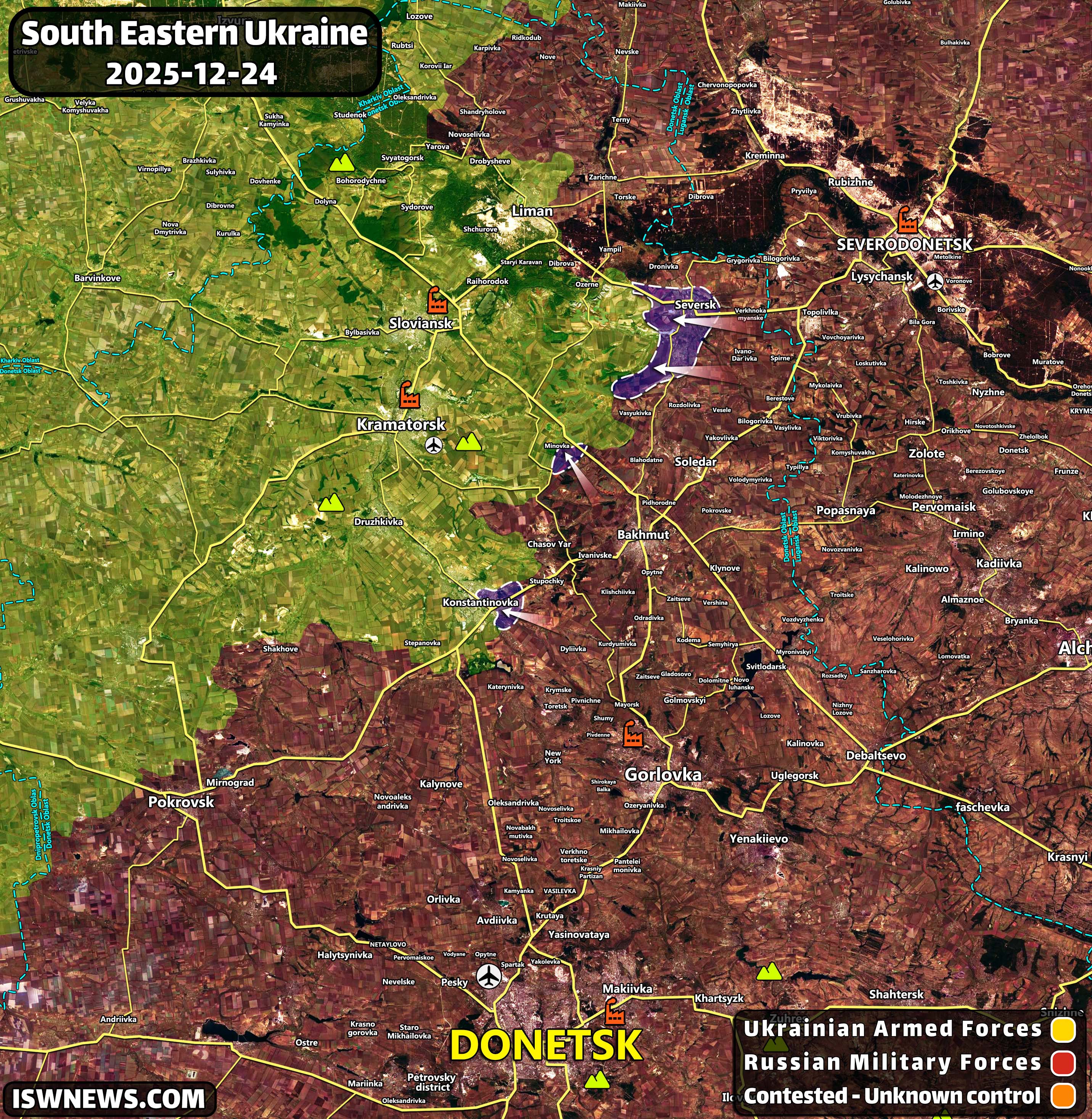
— On the Kostiantynivka axis, Russian troops advanced near Lake Klyban‑Byk and west of Pleshcheyevka, with reports of gains inside Kostiantynivka city. — On the Seversk axis, Russian forces pushed forward between Svyato‑Pokrovske and Pazeno. — On the Sumy axis, Russian units advanced west of Yunakivka. — On the Dnipro region axis, Russian forces secured Andriivka and Zarechnoye, advanced in northern and central Huliaipole, and reportedly moved west of Gerasymiivka. — On the Vovchansk axis, Russian troops took control of Prylypka west of Vovchansk and the village of Vilcha south of Vovchansk. — On the Chasiv Yar axis, Russian forces entered Minkivka village.
Russian airstrikes against Ukraine’s critical infrastructure continue. A series of large‑scale attacks targeted energy facilities and Ukrainian positions across multiple provinces, including: a power station and oil terminal in Odesa; positions in Vasylkivka, Kryvyi Rih, and Pavlohrad in Dnipropetrovsk; warehouses and temporary bases in Sloviansk; the Burshtyn thermal plant in Ivano‑Frankivsk; the Ladyzhyn thermal plant in Vinnytsia; the Kaniiv hydroelectric plant in Cherkasy; and energy facilities in Lviv and Khmelnytskyi provinces.
The most military confrontations in Ukraine are now concentrated in the front-line city of Bakhmut in eastern part of the war-stricken country. The Russian military forces are finalizing the siege of the Ukrainian city by keeping on advancements in the northern, eastern and southern fronts of Bakhmut.
The Russians continue military advancements in the northern Bakhmut battle field, following the seizure of other regions, including the town of Soledar, Sol, Krasnopolivka village, Pidhorodne and Blahodatne village along the Bakhmut-Siversk road, and the Russian military forces seized the village of Sakko i Vantsetti in the north of the road, and the confrontations in the southern areas extended into Krasna Hora and Paraskoviivka regions. The seizure of Krasna Hora and Paraskoviivka regions would be Russians last step to surround Bakhmut from the northern front.
Military situation in the northern front of Bakhmut
In the eastern front of Bakhmut, the fighting continues and the Russian military forces succeeded in making some minor advances in this region. The confrontations continue in the eastern front of the Ukrainian city in vicinity of a meat factory as well as Zabakhmutivka neighborhood.
Clashes in the eastern areas of the city around the meat factory and Zabakhmutivka neighborhood
On the southern front of the Bakhmut city, Russian forces could advance toward the north of Klishchiivka district, and the clashes reached in vicinity of Ivanivske at the western entrance of the besieged city of Bakhmut. Furthermore, as a result of the advancement in the mentioned region, the Russian army took the control of the heights overlooking the Kostyantynivka-Ivanivske-Bakhmut road. Hence, the Russian military forces have fire superiority over the Kostyantynivka-Ivanivske-Bakhmut road, and the Ukrainian army’s logistics route from the western areas to the city of Bakhmut has been blocked; so, the only remaining path is the road from Chasiv Yar town.
The Russian army advances on the southern axis of Bakhmut and fire control on the western route of Bakhmut
In the Lyman battle field and the north of Luhansk Oblast, the military advancements by both sides have actually frozen in several battle axes of the front along the road of Kreminna in the south to Kupyansk in the north, and they have not succeeded in advancing in this front for some weeks and they continue the most clashes in the form of exchanging artillery fires. The focal point of the clashes in the front is the Svatove city on the Krasna river, and if the city is seized by the Ukrainian army, Russia’s defense lines on the eastern front would be wrecked. Thus, the Russian army makes all-out efforts to defend the frontlines of the battle axis strongly. The major conflict lines of the front are marked by arrows.
The military situation in the Lyman front and the north of Luhansk Oblast
In Donetsk’s battle field and its suburbs, the Russian military forces managed to seize the Vodyane district in the north of the city during their latest advancements in the battle axis. The Russian and Ukrainian armies continue sporadic clashes in vicinity of Avdiivka in the north of Donetsk, as well as Pervomaiske, Krasnohorivka and Mariinka districts in the west of the Ukrainian city. In the Vuhledar battle field, the confrontations between the warring sides continue, but the Russian military forces have not succeeded in fully capturing the region so far.
View on the online map
Military situation in Ugledar axis
In the Zaporizhzhia battle field, it seems that the last week’s massive Russian attackson the Orikhiv and Golyapol axes came to an end, and the Ukrainian military forces have almost completely foiled all Russian strikes.
In the Kherson battle field, the contact lines of the warring sides have been maintained along the Dnipro River and the most of the confrontations are largely in the form of exchanging artillery fires. In the last outstanding military operation in this battle field, the Ukrainian forces struggled to move troops by the use of aircraft in south of the city of Kherson, in the Ostriv area in the eastern bank of the Dnipro River, but the operation was thwarted as a result of the Russian forces’ vigilance.
In the last week, the Ukrainian forces, crossing the Siversky Donets river, reached Lyman town from the north and south direction. In south of Lyman, the villages of Staryi Karavan and Brusivka have come under the control of Ukrainian forces. In north of Lyman, the regions of Lozove, Rubtsi, Korovii Iar, Oleksandrivka, and Yarova are under the control of Ukrainian forces.
Currently, heavy clashes continue in south of Lyman and in north in Drobysheve and Novoselivka between Russian and Ukrainian forces. Also, in recent days, Russian forces have repelled the attacks of Ukrainian forces in Karpivka and Ridkodub regions several times.
Due to the fact that the amount of conflicts is higher in the northern front of Lyman, it seems that the Ukrainian forces are trying to encircle the Russian forces from the north side and surround them in Lyman by breaking the defense lines in the mentioned areas.
Also, sporadic clashes continue in the Bilogorivka front. Based on the formation of forces in this area, Bilogorivka is almost not under the control of any of the parties.
Clashes between Russian and Ukrainian forces in other fronts of Donbas continue sporadically, and no specific changes have been made in the field map. The Soledar and South Bakhmut fronts are among the active areas in the last week. The fronts of the city of Donetsk has also remained unchanged in the last week.
According to the latest news from the frontlines, the Russian army has concentrated its attacks on the defense line of the Ukrainian army in the Seversk-Soledar-Bakhmut axis. These attacks in the last week have led to an advance in the east and south of the village of Soledar located on the Bakhmut-Lisychansk road. The ultimate goal of the Russian army in capturing Soledar is to cut off the logistic road and impose a quasi-siege on the cities of Seversk and Bakhmut.
Currently, clashes continue inside Soledar and most of the village is under the control of the Russian army. In Bakhmut, cashes have extended to the eastern entrance of the city, and Bakhmut is under the Russian army artillery fire.
In south of Bakhmut, heavy clashes are going on in Zaitseve and Kodema areas, and the Russians are trying to advance in this axis. It seems that one of the main goals of the Russian army in this axis is to completely capture the villages and areas south of Bakhmut and surround this city from the south.
In the western axis of Donetsk city, the exchange of artillery fire between the sides is still going on. In the last week, Russian and the DPR forces took control of the village of Peski, west of the Donetsk airport. Also, clashes between the Russian and Ukrainian armies continue in the Mariinka area, and the Russian army has gained some ground there.
It is important to mention that the purpose of the Russian forces’ operation in the west of Donetsk is to prevent the AFU ground attacks towards the city of Donetsk and to stop their artillery attacks on the city. And at the moment there is no serious intention by the Russians to advance deep into the west of Donetsk.
In general, it seems that the Russian army is not in a hurry to clear the north of Donetsk Oblast. If the Russian army is successful at this stage on Bakhmut front, the next stage will be the advances towards the important cities of Slavyansk and Kramatorsk.
There are no special activities in other fronts either, and most of the clashes are related to the exchange of artillery fire and airstrikes. The news about the large-scale operation of the Ukrainian army in the southern front or the preparation of the Russian army to launch an operation in the Kharkiv province have been more of a psychological warfare, and despite the claims of the Ukrainian and the Russian media, no specific activities has been observed from the parties in the mentioned areas.
In Donetsk Oblast, on the Mariupol front, on May 30, with the surrender of the last Ukrainian troops to the Russian army in the Azovstal industrial zone south of Mariupol, this important port city came under full control of Russia and its allies. The complete capture of the city would allow the Russian army and its allies to transfer troops from this town to other fronts and increase focus on advancing elsewhere.
In the north of Donetsk, sporadic clashes continue along the Gorlivka and Donetsk front lines. Field changes in this axis are slow. In recent weeks, Russian and Donetsk forces have made minor advances along this axis. The capture of New York near Gorlivka and the capture of Avdiivka near Donetsk are among the main objectives of the Russian military operation on this axis.
In the northeast of Gorlivka, Russian and its allies entered the Donetsk oblast from the Luhansk oblast and the Troitske and took control of the Myronivskyi area. The purpose of advancing on this axis is to capture Svitlodarsk and the surrounding areas of the lake and to secure the city of Gorlyuka from the northeast.
To the west of Donetsk, sporadic clashes continue along the front lines from Mariinka to Velyka Novosilka. Last month, the Russian army and Donetsk (DPR) forces launched an unsuccessful offensive to seize the Mariinka region. Currently, most of the clashes continue on the Mariinka, Novomykhailivka, Ogledar and Velyka Novosilka axes between Russian and Ukrainian forces. It seems that the Russian army and its allies do not have a serious intend to make progress on this axis at the moment, and clashes are taking place on this axis to keep Ukrainian forces busy.
In the Luhansk oblast, clashes and field changes are taking place more intensely, and the completion of work on this oblast seems to be a priority for the Russian army and its allies. Now, 89 days since the start of the war in Ukraine, 95 percent of Luhansk oblast is under the control of the Russian army and its allies, leaving only the city of Severodonetsk and the surrounding area. Hence, the capture of the important and industrial city of Severodonetsk is the main and ultimate goal of the Russian army and Luhansk (LPR) forces in this area.
It should be noted that after the withdrawal of the Russian army from the northern fronts of Ukraine, the Russian army announced its focus on the liberation of the southeastern regions of Ukraine, and in particular the Donbas region. Since then, we have witnessed a change in tactics in the way the Russian army is advancing. Under the new tactic, key areas and areas where face fierce resistance by Ukrainian forces are bypassed by Russian forces and its allies, forcing the defensive forces to retreat from the area by creating an quasi-siege and increasing pressure. This tactic is clearly visible in the northern regions of Donetsk oblast and the Severodonetsk front in areas such as Popasnaya, Zolote, Lyman, etc.
On the Popasnaya front, in recent days and weeks, Russian forces and its allies have been able to expand their contact lines and reach the important town of Soledar from the west. With the advance on this axis, the logistic route of the Ukrainian forces from Bakhmut to the city of Severodonetsk was practically cut off. Ukrainian forces also came under a quasi-siege in the Zolote area. On the Lyman-Izyum axis, progress is slow, but Russian forces have expanded frontlines around Izyum over the course of a few weeks, advancing from village to village. And operations to capture the town of Lyman have also begun. According to the tactics adopted by the Russian army, it seems that all the progress made on these axes is made with the ultimate goal of completing the siege of the city of Severodonetsk.
On the ciity of Severodonetsk front, heavy fighting continues around and at the entrances to the city. In recent weeks, Russian and LPR forces have been able to approach the city from both the northern and southern axes. In south of the city of Severodonetsk, clashes continue in the areas of Metolkine, Voronove and Syrotyne. On the northern front of Severodonetsk, heavy clashes continue at the northern entrances to the city. The Russian offensive is focused on the four main roads leading to the city. The Russian military has also blown up the main bridge between Severodonetsk and Lysychansk, with the aim of cutting off Ukrainian forces in the city of Severodonetsk from outside the city. The complete capture of the city of Severodonetsk plays an important role in determining the future of the battles in the southeastern regions of Ukraine.
According to the progress made until the 89th day of the war, about 55% of Donetsk oblast and 95% of Luhansk oblast have been captured by the Russian army and its allies.
In the early hours of February 24, Russian President, Vladimir Putin announced that Russia had officially launched a special operation to bring peace to Ukraine! According to the Russian president, which was broadcast on official Russian television; The operation was aimed at protecting residents of the Donetsk and Luhansk regions, as well as demilitarizing Ukraine and denazification of the country.
Putin emphasized that the goal of the operation is “is to protect people who have been subjected to abuse, genocide by the Kiev regime for eight years, and for this we will seek to demilitarize and deNazify Ukraine, as well as bring to justice those who committed numerous bloody crimes against peaceful residents, including citizens of the Russian Federation,” Putin said.
Following this statement, the Russian military operation in Ukraine began from the early hours of February 24.
But what is the root cause of this war?
Two days ago, on February 22, following weeks of escalating tensions in eastern Ukraine, Russian President, Vladimir Putin finally recognized the independence of the two separatist republics of Donetsk and Luhansk in southeastern Ukraine, And for the last time demanded Kiev to halt military operations in the Donbas region and hand over all the subdivisions of Donetsk and Luhansk to the people of this region.
Donbass is a historical, economic and cultural region in southeastern Ukraine that was separated from the Soviet Union during the Soviet dissolution with Ukraine. Russia considers the Donbas region, where many Russians live, to be part of its traditional territory.
In the riots of 2014, pro-Russian Ukrainian President Viktor Yanukovych was overthrown and pro-European politicians came to power in the Ukrainian capital, Kiev. After this revolution (or coup), the people of the Crimean peninsula showed their desire to secede from Ukraine, and eventually, after a series of events, it led to the secession of Crimea and its annexation to Russia. The people of Luhansk and Donetsk subsequently demanded secession from Ukraine and accession to Russia. Thus, on May 11, 2014, Donetsk and Luhansk oblasts witnessed a referendum on independence from Ukraine. In Donetsk, more than 89 percent of voters and in Luhansk more than 96 percent of voters voted for autonomy and independence.
But this time, the Ukrainian government, experiencing Crimean secession, cracked down on separatists with swift action and military operations. However, the Ukrainian military operation in the Donbas region did not completely suppress separatism; But it interrupted the process. In the same year, a ceasefire agreement called the “Minsk Agreement” was signed between Ukraine and Russia and the Donetsk and Luhansk separatists. Since then (until 2022) the Donbas region has witnessed daily clashes between the two sides and killing and displacement of the people of the region. Before the war in Donbas, Donbas was the most populated region of Ukraine after Kiev, the capital of the country.
However, over the past eight years, the areas under the control of separatist forces in Donetsk and Luhansk in southeastern Ukraine have become an unresolved challenge between Russia and Ukraine and the site of political conflicts between Russia and the West. The Minsk 1 and 2 agreements also failed to bring about a lasting ceasefire, with each side accusing the other of not adhering to the terms of the agreement.
Over the years, the Ukrainian government, hoping for financial and military assistance from the West and the United States, tried to reclaim its territories; An issue that never materialized, and on the contrary, with increasing US influence in Ukraine, practically turned the country into a place for direct military threats by NATO and the United States against Russia. Recently, the rumors about Ukraine joining NATO and the deployment of NATO defense and missile systems as well as NATO bases in this country led the Russian Federation to conclude that the only way out of this problem is the demilitarization of Ukraine!
And therefore, the Russian military operations began to capture its traditional territories in Donbas and perhaps all of Ukraine!