Tag: Iraq

  • Israel’s Strategic Ambitions Thwarted in Iraqi Kurdistan and Will be in Syria’s Deir ez-Zor

    Israel’s Strategic Ambitions Thwarted in Iraqi Kurdistan and Will be in Syria’s Deir ez-Zor

    We live in extraordinary times. The narrative of the “fight against Islamic State” that holds sway in Western society comes from a fantasy land in which nothing is as it seems; these “certain truths” have as much reality as a rainbow, while reality is distorted or obscured behind it.
    Across the “credibility gulf” we may see everything as it is, but speak a different language; no-one over there in the Western bubble can understand what we say, or even recognise it as language. A declaration that should shock this complacent and self-possessed “civilised world” to the core – that the US is fighting with the Islamic State – simply cannot be understood or accepted, regardless of evidence.

    Since the coordinated operation by Al Qaeda groups in Idlib attempted to kidnap a group of Russian military police on September 17th, it has become evident that the US military really is actively supporting and coordinating with terrorists fighting the Syrian Government. Following further attacks, including particularly the assassination of Lieutenant General Valery Asapov in Deir ez-Zor, Russia now evidently has no remaining doubts about the US “fight against ISIS”; there is no such fight.

    So now we are faced with an intolerable paradox. The US and its coalition partners in Syria are actively engaged in lethal attacks on the Syrian army and its allies within sovereign Syrian territory, both directly and in cooperation with ISIS. At the same time these Western countries’ sole stated pretext for entering Syrian territory without UN authorisation has been to fight ISIS terrorists, while the threat of Wahhabi terrorist attacks at home has been ruthlessly exploited to gain support for these foreign military actions from their domestic audiences.

    Not that this apparent US collaboration with ISIS and Al Qaeda in Syria is anything new, but long-held suspicions – now confirmed – constitute a substantial body of evidence. Events such as the transit of ISIS convoys across the Syrian desert without interference from US coalition planes, or the free pass for the tanker-pipeline taking ISIS Oil out through Turkey can also now be seen as acts of facilitation rather than merely a failure to act.

    But nothing now constitutes clearer proof of collusion than the direct and lethal attack on the Syrian Army outpost protecting Deir ez-Zor airport from ISIS fighters, conducted by both US and Australian planes. This attack of September 17th 2016 has now been revealed as a key part of the US coalition plan, as it is fought out in this same area a year later. What is more, with the strangely coincident events over the border in Iraq, where the plan by the Kurdistan Regional Government to sequester the Kirkuk oilfields out of Baghdad’s control has just been thwarted, another player in the game has come into view – Israel.

    It is almost as if Israel has finally broken, and can no longer contain itself at the sight of its own project for Syria going adrift. And it seems as though the “Kurdistan Project” was a central part of this. Following the Kurdish referendum – which even the US purported to oppose – Israel was the first to voice solidarity with this new “democratic state” in the making, that was presented as sharing its values. Notwithstanding that the ethnically-defined Kurdistan can like Israel only pretend to be democratic.

    Israel’s championing of Kurdistan as the most Western-friendly entity in the region can however be seen chiefly as opportunist, and related to its desire to obstruct Iran’s economic and cultural influence. It also betrays the considerable investment made by Israel into the development of Iraqi Kurdistan, dating back to before the first [Persian] Gulf war. While the original plan to bring oil from Kirkuk via pipeline directly to Israel was thwarted, Israel’s strong presence in Erbil, as well as its close involvement in the handling of Syrian oil stolen by ISIS and exported via Turkey has served the same purpose.

    Allegations that Israel was ‘laundering’ ISIS oil, with the profits being returned as weapons and ammunition for the terrorist Caliphate, were made at the time that Russia bombed the guts out of the IS oil tanker convoys. Natural scepticism that this accusation was just Israel bashing now look too cautious, and instead provide additional evidence of Israel’s criminal involvement and deceptions over the war on Syria.

    But something strange is operating here. So great is Israel’s influence on Western media and perceptions that it is those Western observers who are protesting Israel’s innocence of colluding with terrorist groups in Syria. They fail to notice that neither ISIS nor Al Qaeda never criticise Israel or threaten a campaign to “liberate” Al Quds from its Zionist occupation. Nor do they ever appear upset by Israel’s provision of medical care and sanctuary for terrorists escaping the Syrian Army.

    Even when Israeli leaders proclaim support for these Wahhani mercenaries, including the launching of missile strikes at Syrian army posts that threaten them, Israel is excused. In Western eyes Israel is always the victim.

    Well perhaps this is about to change, as it must. Last month Israeli jets fired missiles at a Syrian factory from Lebanese airspace, which they routinely violate. The vacuous claim that they were targeting a factory producing chemical weapons and missiles for Hezbollah was their justification for this act of war, which took place during major military exercises in Northern Israel. Syria was unable to respond to that provocation, but when Israeli jets flew into Lebanese airspace on the Syrian border on Monday, Syria fired missiles at the planes, forcing them to retreat.

    Proclaiming Israel’s right to self-defence – even when engaged in acts of armed aggression beyond its borders – Israeli jets subsequently bombed the Syrian defensive missile battery. As Netanyahu put it:

    “Today there was an attempt to harm our aircraft — this is unacceptable to us. The air force acted quickly and accurately to destroy what needed to be destroyed,” Netanyahu said.

    The timing is also clear – Russia’s Defence Minister Sergei Shoigu is visiting Israel this week. We would hope that Russia’s patience with Israel is wearing just as thin as it has with the US, and that the next time Israel pushes its luck with Syrian air defences it will be dodging Russia’s feared S400 missiles instead. Not only that of course – Israel’s excuse that it is targeting Iranian infiltration and weapons shipments to Hezbollah can no longer cut any slack with Russia, for whom Iran is now a major military and economic ally.

    The recent “intemperate remarks” about the Iranian Nuclear deal by Donald Trump, echoed immediately by Netanyahu only strengthen these ties; who could not gasp at those delusionary claims from two of the world’s most dangerous nuclear weapons states, whose only real concern is that their stranglehold on global power with the threat of nuclear annihilation might be weakened?

    Well at least Iran is under no misconceptions. As reported by the Guardian – “Ali Akbar Velayati, a senior foreign policy adviser to the Iranian supreme leader, praised the Iraqi army’s move to capture Kirkuk, framing it as a blow to Israel’s strategic ambitions.

    “With the defeat of the Kurds in Kirkuk, Barzani’s conspiracy against the region’s security was foiled. Barzani’s aim and Israel’s covert aim were to seize Kirkuk’s oilfields to serve the Israeli interest. In the Kurdistan region, they raise the flag of Israel and this means if Kurds gain independence in Iraq, we will share a border with Israel,” Velayati said, according to the IRGC-affiliated Tasnim news.

    News that the Iraqi army has retaken control of both Kirkuk and Sinjar and their oil resources, on behalf of all the Iraqi people, is welcome indeed – except in Tel Aviv. We await similar news from Deir ez-Zor.
    Source

  • Summary: Operation of the Federal Government of Iraq in disputed areas with the Iraqi Kurdistan Region

    Summary: Operation of the Federal Government of Iraq in disputed areas with the Iraqi Kurdistan Region

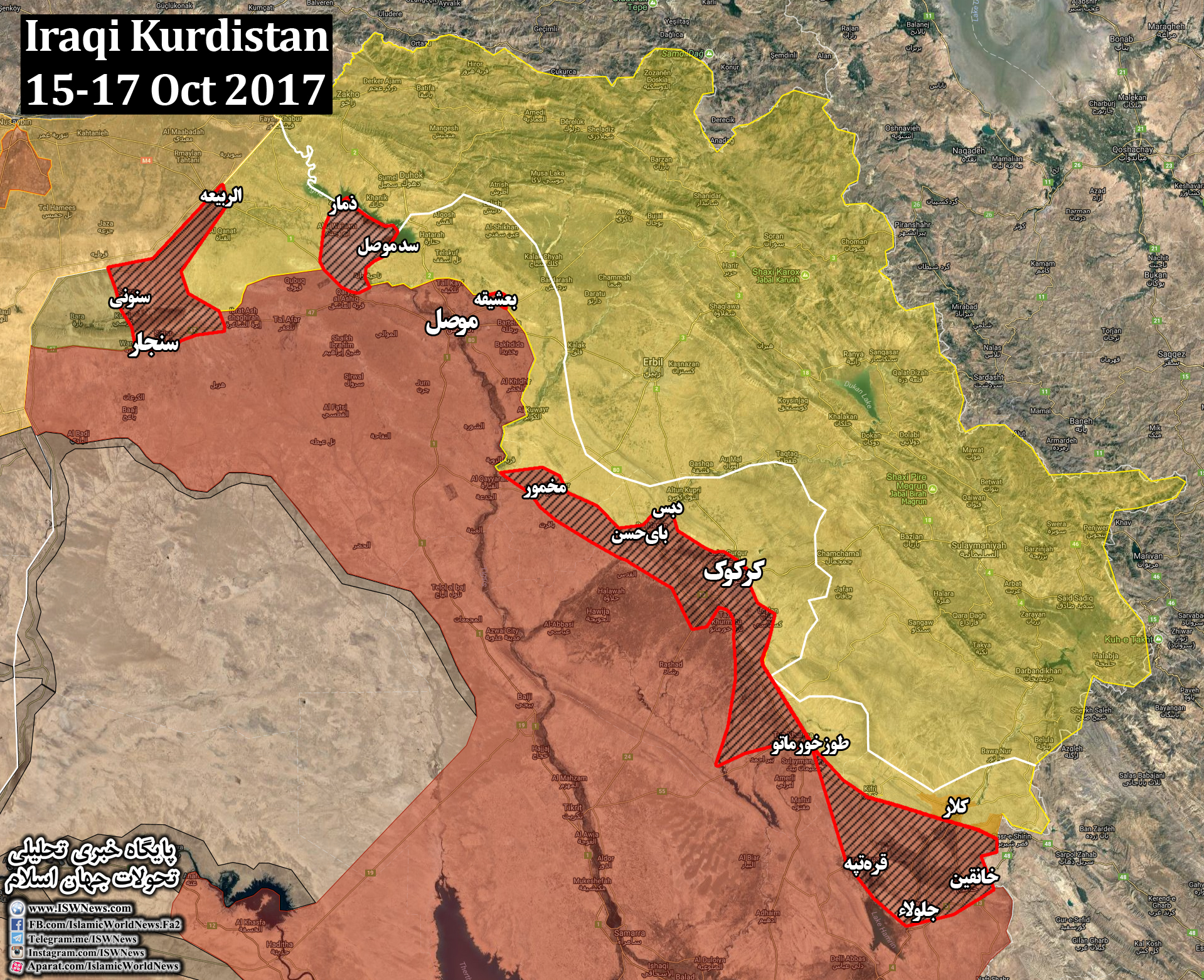
    In the first stage, anti-terrorism forces succeeded in entering and dominating in the general area of ​​the city of Kirkuk following the dispersal conflicts with the Peshmerga and PKK forces. On the same day, other federal police forces managed to dominate the North Oil Refinery.

    The results of the first day are these : the domination of the central government on the city of Kirkuk as well as the oil wells and oil facilities of the region.

    On the second day of the operation, the withdrawal of various forces from various Kurdish parties was obvious. The forces succeeded in domination over the various regions on five axes.

    First axis: Diyala province

    In this axis, the forces managed to dominate the cities of Jalola, Khanaqin and Qarat-Tepa. The Khosrawi border crossing was also controlled by Iraqi central government forces.

    Second axis: Kirkuk province

    In this axis, the forces managed to advance towards the important village of Bai Hassan and Debs. The importance of this village is located on the shore of the Zab River, as well as facilities and oil wells around the area.

    Third axis: Nineveh province, Mosul area

    In this axis, the forces succeeded in dominating the city of Ba`shiqah. The news of the troops’ arrival to Tel Oskof and Betnai is not confirmed.

    Fourth axis: Nineveh Province, Sinjar area

    In this axis, due to the large presence of PKK forces, the forces succeeded in dominating the city of Sinjar and part of its northern mountains, in order to control the important village of Senoni and the central al-Rabi`ah borderway . In this axis, the cooperation between the Izadi(Yazidi) forces and the central government of Iraq was very close and friendly.

    Fifth axis: Ninewa province, Mosul dam area

    In this axis, the Iraqi Army’s 16th Army Corps managed to control the Mosul Dam, the strategic city of Dhamar and  Aski village.

    Now with the withdrawal of various Kurdish forces has spread across the south of Diyala to the north of Sinjar, it must be seen that the forces under the Barzani control(KDP), will accuse PUK(Patriotic Union of Kurdistan) as a traitors! Or just the withdrawal of PUK forces was betrayal,and the retreat of the KDP forces was their tactics to prevent conflict and bloodshed!?


    HD MAP

  • Three main reasons which bind all kurds to Iran

    Three main reasons which bind all kurds to Iran

    An important point in the history of the Kurdish struggles is the remarkable difference between the Kurdish riots in Iran compared to the riots in Turkey and Iraq. The Iraqi Kurds had bloody clashes with the Iraq(central government) for a long time. in Anfal operation , which was launched by the Saddam Hussein against the Kurds.especially in 1988 that 180 thousands Kurds lost their lives.

    The war between the PKK and the Turkish government, which has been taking place in the country since 1984, caused nearly 50 thousand dead.

    But the war between the Iranian government and Kurdish armed groups is far less extensive. This is the result of the less friction(struggle) of the Kurdish society with the government compared to the Kurds of Iraq, Turkey and Syria, which makes the Kurdish insurgent groups unable to attract people’s support like the insurgents in three other countries did. This issue has so many reasons that most notable reasons are these:

    1. Differences in the national identity in Iran with other countries with Kurdish population.

    National identity in Iraq and Turkey is defined by ethnicity. Turkey has based its national identity on Turkism, and Turkey’s name comes from the Turkish word. According to the Turkish Constitution, all citizens of this country are considered to be Turkish. Turkey gave the Kurds the title of “Turk of Mountain” and by 1991, the use of words such as Kurdistan and Kurd in this country was prohibited even in personal life.

    In Iraq, the Ba’ath Party was an Arab nationalist party, which established the country’s identity on Arabs.

    In Syria, the same is true about the Arab Ba’ath Party, and its official name is the Syrian Arab Republic. On the contrary, Iran has not defined its identity on ethnicity.

    In Iran, different ethnic groups have lived together for a long time and have formed kind of historical identity, while Turkey, Iraq, and Syria all founded after the First World War and after the fall of Ottoman caliphate, especially Syria and Iraq have a short historical identity as new founded countries . In addition, from the time of Safavids, Iranian identity has been defined based on the religion of Islam and Shiite religion, not ethnicity. That is why in Iran, the Shiite Kurds have not shown any ethnocentric tendencies, and almost all Kurdish ethnic struggles have occurred in the Sunni areas. However, it should be noted that the root of the ethnocentric struggles of the Sunni does not return to the differences between the two Shiite and Sunni religions. Basically, in the regions with Sunni population in Kurdistan, political Sunni Islam has little power(influence), and the vast majority of Kurdish armed groups follow a leftist(left wing)or nationalist ideology. The cause of the emergence of ethnic identity in the Sunni Kurdistan of Iran is that the people of these areas are not part of Shiite religion, which is one of the most important elements of the unity of the majority of the people of Iran. Of course, this does not mean ignoring other unifying elements of Islam, the Iranian historical identity, and linguistic and ethnic similarities. As we have seen and will see, these factors have made the Kurdish ethnic conflict less in Iran than the neighboring countries.

    2-The close relation of ethnic and racial identities of the Kurds to the rest of Iranians

    The race of Kurds are among the Aryan tribes. Kurdish is also one of the branches of Persian language in linguistic divisions and is similar to Persian language and local languages ​​in Iran. Like other Iranians, the Kurds celebrate Nowruz and also Kurds & Iranians have many common culture and myths .But there are no similarities between Kurdish language, culture, and myths with the language, culture and myths of Arabs and Turks.

    In Turkey and Syria, Nowruz was a political event and a sign of Kurdish ethnic identity. Because of that, for a long time, severe restrictions were imposed by the governments of these countries on this celebration, and in some cases, Kurds were killed by the security forces. But Nowruz throughout Iran is a national celebration that various ethnic groups of Iran celebrate along with the government. Because of these reasons, the sense of belonging to the Iranian identity among Kurds is far more than their solidarity with Turkish and Arab identities.

    3-The Cultural and Political Approach of the Iranian Government towards the Kurds

    Iran has chosen a more liberal cultural and political approach to its ethnic groups, including the Kurds. Unlike Turkey, the use of Kurdish or the use of words had not been forbidden in Kurdistan in Iran. Kurdish language has long been used in local media, and in recent years, the teaching of ethnic languages ​​in schools has also been provided. Also, the Shiite Kurdish politicians did not have any obstacle to reach the highest political and administrative positions. Such conditions have not existed for a long time in Syria, Turkey and Iraq, or still does not exist. Before the Syrian civil war, the government refused even to issue birth certificate for Kurd residents and to recognize their citizenship. There were also obvious discrimination against Kurdish citizens in Turkey and Iraq.

    Although some of the dissatisfaction and independency tendencies in the Sunni regions of Kurdistan of Iran can not be denied, these reasons, plus the political and security problems, except in the first two decades of the revolution, and especially in the early years, the activities of the Kurdish rebel groups were mainly limited scattered attacks on the border areas from inside of the Iraqi Kurdistan and these attacks were stopped at some points.

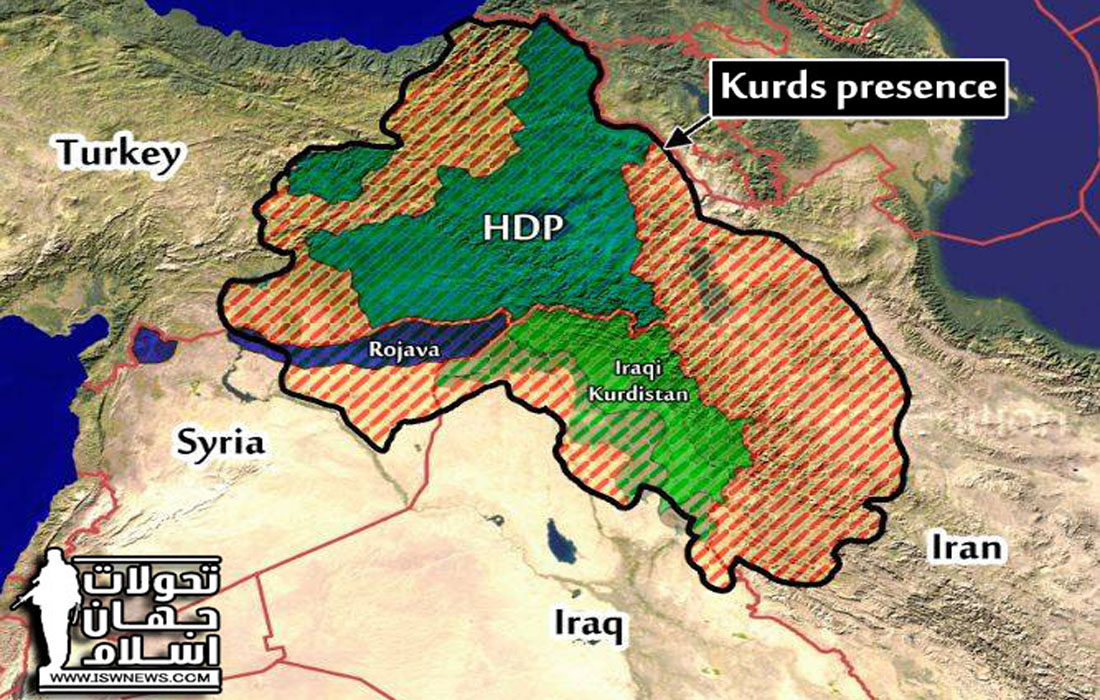
    PS: This map does not represent correct & exact boundaries, and it’s just the hypothetical range of Kurdish presence in region

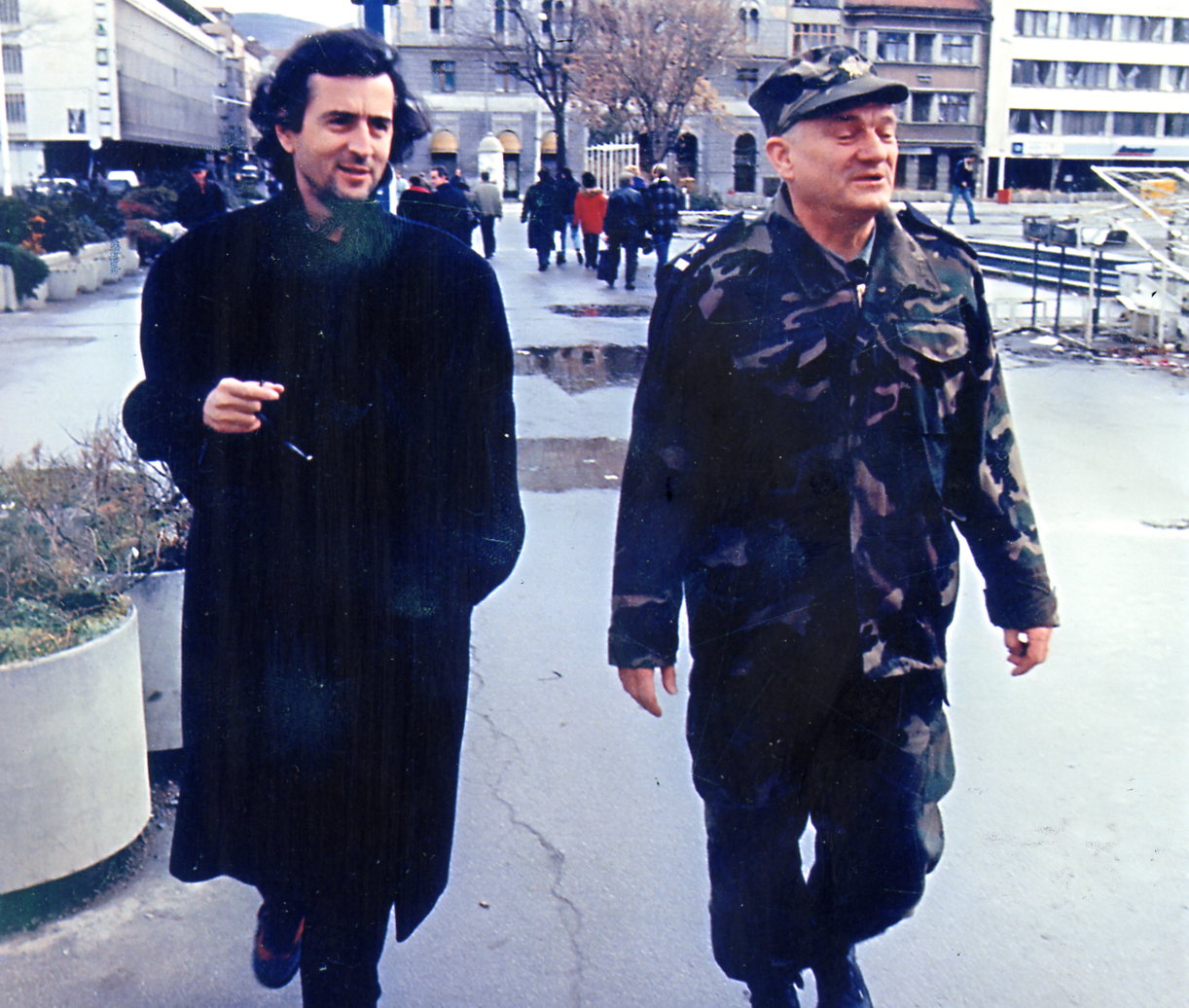
  • Bernard Levy, a mysterious man who was hid in chaos of Iraqi Kurdistan referendum

    Bernard Levy, a mysterious man who was hid in chaos of Iraqi Kurdistan referendum

    Many analysts call him one of the main theoreticians of the “Arab Spring” in the region, and now his presence in Iraq and under such circumstances can not be for no reason!

    Looking at the depths of the sensitive events of the region, you can clearly see the presence of Bernard, from Afghanistan to Sudan, from Egypt to Tunisia and Libya, from Bosnia to Ukraine, and … He is everywhere! in the anti-Muammar Gaddafi rebel room, along with Ahmad Shah Massoud, along with the leader of the South Sudan rebels, … And in his last major presence in the region in the Kurdish region of Iraq on the day of the referendum and meeting with the Barzani family.

    Bernard-Henri Lévy with Massoud Barzani, the Day After the Kurdistan Referendum

    Bernard-Henry Levy introduces himself as a proud Jew. Apart from more than forty years of intellectual and practical work in numerous books and numerous articles in the press with a variety of topics, his work record can be divided into three categories:

    1- Complete opposition to the political and legal manifestations of Islam

    Levy, who was named the forty-fifth most influential Jewish figure in the 2010 Israeli Jerusalem Post, and his followers believed he is the greatest current think-thanker of France

    In one of his latest books, “Left in Dark Times: A Stand Against the New Barbarism” has shown how he thinks of Islamism.

    Critics of the book believe that in this book, he has equated terrorism, Islamism, and Arab mentality to justifying the persistence of colonialist violence in the Middle East.

    In other words, Levy has tried to summarize the resistance of people in the colonized countries as a violence, and  make it irrational and justify its suppression

    Levi, who introduce the veil of Muslim women as a means of desegregation them, introduced their ideal Islam the kind of Islam that is in Kurdish region of Iraq.

    2- Unconditional support for the Israeli regime

    In 1967, when Bernard Henry Levy was 19, when he informed of the war between the Arabs and Israel, quickly went to the embassy in Paris to declare readiness to go to war, but the six-day war lasted less than that Levy couldn’t take the opportunity to go to the occupied territories.

    43 years later, Levy said that he “does not recognize any army more democratic than the Israeli army,” which showed that he still has an indefinite commitment to this regime, which is also apparent from the many images of his meeting with the senior officials of the regime.

    Meeting with Shimon Peres

    3- Constant presence in the bloody chaos of the Islamic world

    Levy wrote his first known book in 1973 two years after the break-up of Pakistan into two parts of Pakistan and Bangladesh about nationalism in Bangladesh and from that day on, not only commented and acted on the riots of the Islamic world but also he has been present in them.

    In the middle of the last decade of the twentieth century, Levy was present in Bosnia, then headed for Afghanistan, and met with Abdul Rashid Dostum and Ahmad Shah Massoud.

    He was present in southern Sudan in the era of separatism;

    In 2008, in Russian-Georgian conflict he supported the west-backed side in Georgia;

    in 2011 with rising conflicts in arab countries he participated in libyan war and convinced his old friend nicola sarkozy to military interfere in Libya; in the same years, he tried many times to justify military intervention in Syria and to overthrow the government of Syria;

    In 2014 and 2015 he pursued the goals of the Russian opposition in Ukraine;

    and his year he started filming to justify her favorite map, “breakdown of countries in region into smaller countries”

    Along with the South Sudanese rebels
    Meeting with South Sudanese rebel leader John Garang
    Meeting with Ahmad Shah Massoud
    In Bosnia
    Bernard Levy In Bamyan, Afghanistan
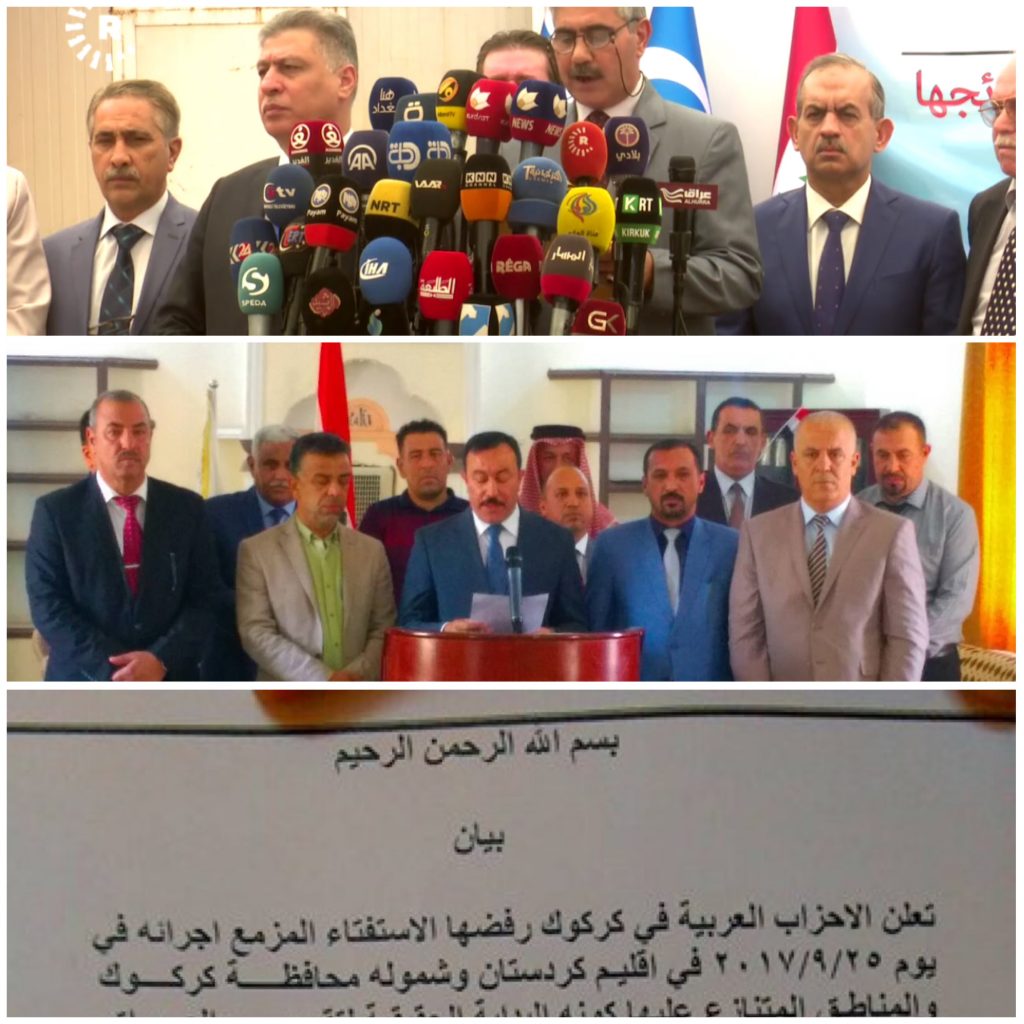
  • 13 Arab and 7 Turkmen Party of Kirkuk boycotted the referendum in Kirkuk due to the illegality

    13 Arab and 7 Turkmen Party of Kirkuk boycotted the referendum in Kirkuk due to the illegality

    In the statement that published by the Turkmen parties and the Kirkuk Arab parties on Saturday it has been mentioned that approving the referendum by the Kirkuk Provincial Council in the absence of the Turkmen and Arab parties of this province on 29/8/2017 is illegal and it is on the contrary to the constitution of Iraq.

    Meanwhile, Mas`oud Barzani has been conducting interviews with television agencies in recent days and interviewed with agencies such as Al Arabiyah, BBC Persian and several other agencies. The words used mostly by Barzani in these interviews was, “Kurdish readiness to use the weapons to hold Kirkuk,” “we want Kirkuk to be the symbol of ethnic and religious coexistence,” and perhaps it is most importantly, “the condition for postponing the referendum” .
    – “Kurdish readiness to use the weapons to hold Kirkuk,”
    These​ conditions and differences between parties and ethnic groups in Kirkuk, and since Kirkuk is now officially affiliated with and part of the central government of the country.
    With Barzani’s threat that they will use weapons to keep Kirkuk and his stubbornness the city will not have appropriate status after this referendum…

    – “We want the kirkuk to be the symbol of ethnic and religious coexistence.”
    The Kirkuk Provincial Council is composed of 41 seats, without the participation of Turkmens and the majority of Arabs on 29/8/2017, the Kurds of this association with 26 seats, were able to vote in a referendum in Kirkuk,  It is also one of the signs of the lack of coexistence and the abuse of being the majority in this province.

    – “The condition for postponing the referendum”
    While Barzani faced with a lack of international support (other than the Israeli, Saudi and Emirati regimes), and faced with the opposition of the central government of Iraq, Turkey, Iran, the United States and other European countries as they say this referendum should not be hold or should be postponed.
    Several times he has asked for a guarantee to postpone referendum to another time on another date, in reply to a journalist asked “how may you accept to postpone the referendum” he said that to approve of not holding a referendum setting another date in the Iraqi parliament can be one of these guarantees.
    *While the referendum has no legitimacy so far, it can be one of the same excuses that many believe is to gain interests like the previous years from the central government.


    Barzani’s-led party, by using Eqlim’s(Iraqi Kurdistan) parliament as a weapon more than two years ago, prevented  from adopting several laws to adjust Eqlim’s department and prevented the entry of the parliament’s chairman from the Guran (change) party into the city of Erbil and the Parliament building and In practice, the doors of this parliament remains closed until today And the government that holds the presidency and its key ministries, manages the parliament without supervision.

    But this time Barzani, in order to legitimize his referendum, is now trying to activate the same parliament that he has shut down, but on one condition that the presidential of the Eqlim should not be voted, which has been opposed by several other parties.

    The latest news is that Barzani intends to use the method used to approve the referendum in Kirkuk, and through the Eqlim’s parliament and by gathering a majority of the members, despite the absence of the chairman and vice president of Parliament, legitimize this referendum.

  • Iraqi Forces Kill Over 20 ISIS Members In Tal Afar Countryside

    Iraqi Forces Kill Over 20 ISIS Members In Tal Afar Countryside

    On Thursday, Iraqi forces surrounded and neotralized over 20 ISIS members, including 5 suicide bombers, near Yuzatbah village southwest of Tal Afar.

    Translation provided by SouthFront

  • 450 ISIS Terrorists Surrendered To Peshmerga Forces North Of Tal Afar

    450 ISIS Terrorists Surrendered To Peshmerga Forces North Of Tal Afar

    ISIS members run away from the Iraqi Army and the Popular Mobilization Units (PMU) and entered the Peshmerga-held area north of Tal Afar where they surrendered themselves to Kurdish fighters. Others that were trying to escape towards Syria via the Peshmerga-held area were eliminated.

    According to Kurdish sources, 170 ISIS militants were killed and 450 ISIS militants surrendered.

    Translation provided by SouthFront


  • Images from the ISIL camera before the attack on resistance positions in Iraq-Syria border & observation with Iranian drone

    Images from the ISIL camera before the attack on resistance positions in Iraq-Syria border & observation with Iranian drone

    In first part of footage, showing pictures that gained from the ISIS’s Camera before attack. Following by Iranian drones reports and reinforcements were poured to the enemy positions, attack was repelled completely.

    In the end, shows ISIS’s dead bodies and their abounded VBIEDs after clashes behind the trenches.
    ISIS dreamed that they were able to attack to this strategic area like previous times such as Jamunah, but their picturing never made a promotion


  • Last Military Situation In Tal Afar In Northern Iraq, operation results till now

    Last Military Situation In Tal Afar In Northern Iraq, operation results till now

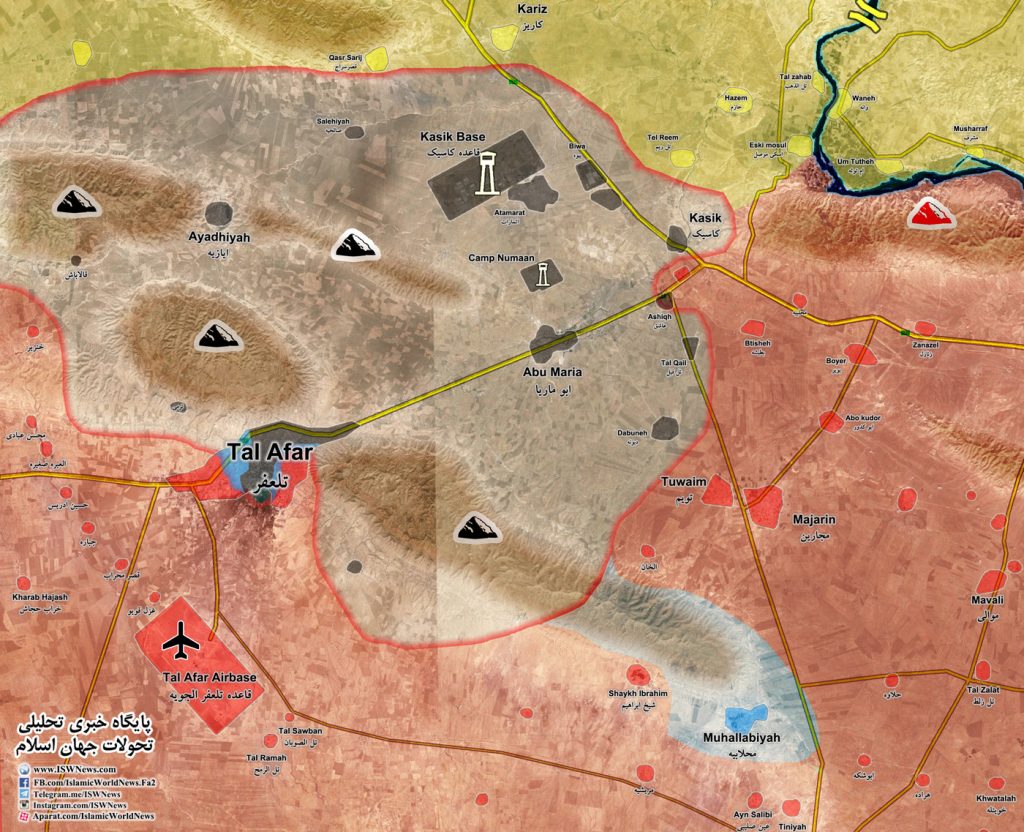
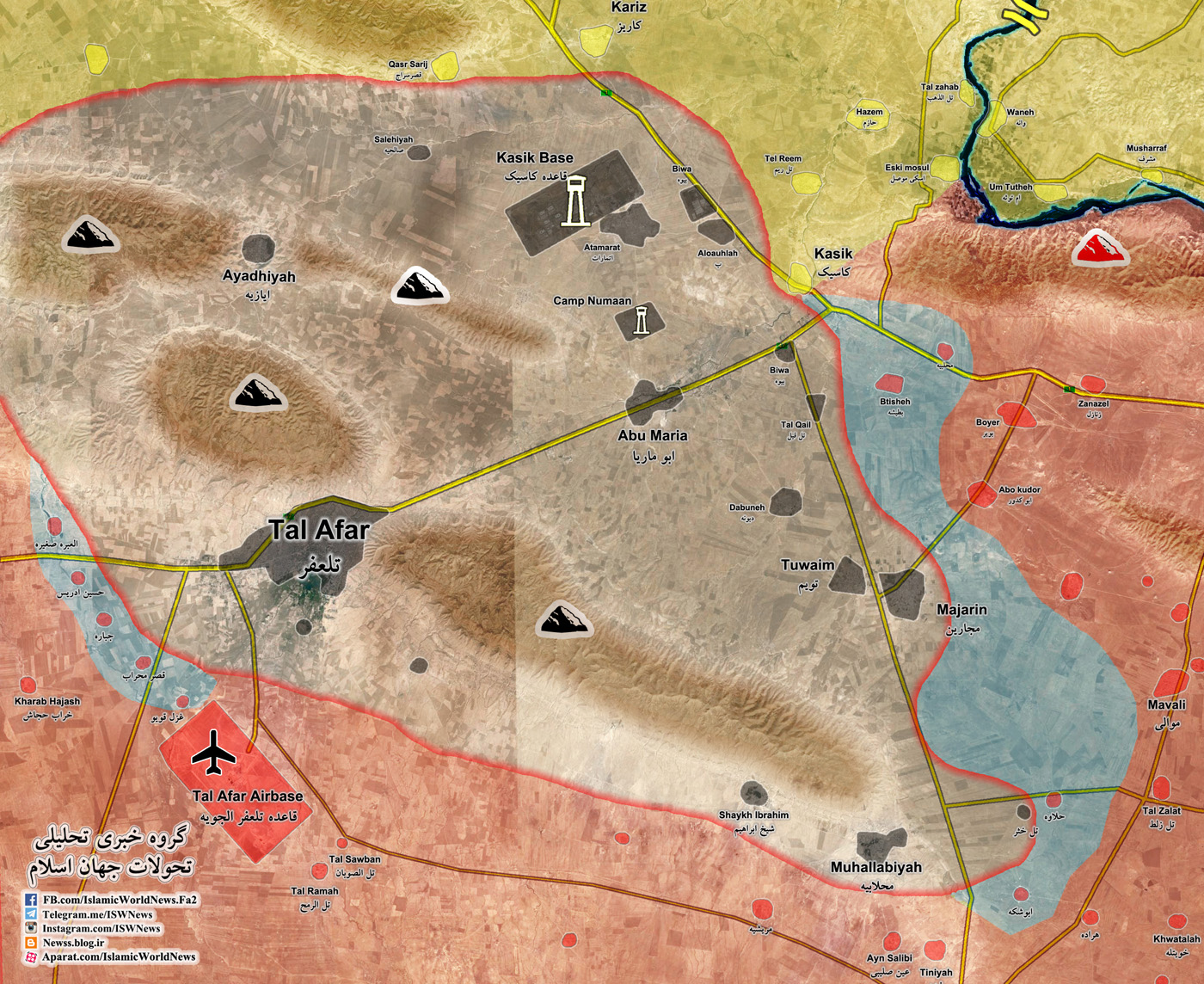
    Pro-government forces have entered Al-Nour neighborhood from the eastern axis and reached the citadel in central Tal Afar. Iraqi forces have also surrounded the industrial district and the silos area.

    Government forces have liberated the neighborhoods of Al-Tanak, northern Kifah, southern Kifah, Al-Jazeera, Al-Noor, Al-Nasr and Al-Mo’allemin and entered the Al-Khada’a, Al-Wahda, and Al-Qal’aa neighborhoods.

    In the Tal Afar countryside, government troops secured Al-‘Asheq and Wiran villages and captured the villages of Sheikh Ibrahim, Ayn alwah and Hamra Alarab.

    HD MAP : Download

    InterActive Map : Here

    نتایج روز ششم عملیات تلعفر

  • Publishing hundreds of thousands of leaflets in ISIL-controlled cities in Iraq

    Publishing hundreds of thousands of leaflets in ISIL-controlled cities in Iraq

    Last night Iraqi forces spreaded out thousands of declarations by the aircrafts upon towns of Havijah , Al-Qaem,Ra’eveh and Akashat to inform people whom are under ISIS control in these areas about Iraqi forces‘s last day onrush in Tal Afar fronts ,also the Islamic state militants warned to surrender or die.

  • TalAfar Operation 1st day results

    TalAfar Operation 1st day results

    Early on Sunday following Commander-in-Chief‎ ‎ Haider al-Abadi ‘s announcement
    Iraqi forces, Federal police, PMU with air-force support , have launched an offensive in several fronts to take back the city of Tal Afar , in west of Mosul .
    After main advance in western and eastern fronts,the troops consist of army ,federal police and PMU liberated at least 7 villages.
    By advances in western front and achieving goals road, there is not any strong barrier to stop forces for entering Tal Afar from the west side
    In the east side that Hash al Sha`bi (PMU) are acting together with 16th corps , 3 village have been cleared and troops have came close to the mount of Zembar.
    The main challenge in the eastern front is capturing Tuwaiym & Majarin.

    in North axis where the Kurds are, likely we wont see any movements towards TalAfar.

    Also 9 VBIED destroyed and 31 ISIS terrorists killed .

    HD Map : Download

  • ISIS Attack And Alleged US-led Airstrikes Against Popular Mobilization Units In al-Jamouna Area At Syrian-Iraqi Border

    ISIS Attack And Alleged US-led Airstrikes Against Popular Mobilization Units In al-Jamouna Area At Syrian-Iraqi Border

    General info

    The desert area between Iraq and Syria has been controlled by radical jihadists for a long time. Both Syria and Iraq have been unable to secure this large area and it has become a foothold used by al-Qaeda and ISIS.

    As the ISIS influence had been growing, the roads in this desert area became an important supply line used by ISIS to transfer infantry, weapons and military equipment.

    With the start of the ISIS decline about a year and a half ago, the terrorist group made a special effort in order to maintain control over the desert. Constant Syrian and Russian airstrikes on ISIS targets and a lack of the support from local tribes were undermining the ISIS power in the area. At the same time, ISIS remained very powerful on the Iraqi side of the border even in 2017 when the key ISIS stronghold of Mosul was liberated in the country.

    The successes of anti-ISIS forces in Mosul, Palmyra, in central Syria and along the Syrian-Iraqi border and the start of the battle for Raqqah, ISIS increased operations in the Akashat desert.

    In genreal, ISIS conducts surprise attacks with one or several  suicide bomber then shell its opponents with heavy gun fire from multiple directions. Then, if the terrorist group wants to capture the area, ISIS infantrymen join the operation.

    The area of ISIS attacks in the Iraqi desert is highlighted (yellow) in the map below. ISIS has conducted at least 7 relatively large attacks the Iraqi army since the Syrian army and its allies reached the borders bypassing the al-Tanf area earlier this year.

    Review: ISIS Attack And Alleged US-led Airstrikes Against Popular Mobilization Units In al-Jamouna Area At Syrian-Iraqi Border

    Click to see the full-size map

    One of the  previous attacks also took place in Al-Jamouna area. Following images show it.

    Review: ISIS Attack And Alleged US-led Airstrikes Against Popular Mobilization Units In al-Jamouna Area At Syrian-Iraqi Border

    Click to see the full-size image

    The US-led coalition bombing

    The map below shows the overall situation in the area.

    According to the PMU statement and local sources the US-led coalition conducted military strikes on fortified positions of the PMU located about 2 kilometers from the Syrian-Iraqi border, inside Iraq. However, the ISIS attack took place in another place in the al-Jamouna area. ISIS repotedly advanced on the newly constructed positions (their exact location is unknown).

    Review: ISIS Attack And Alleged US-led Airstrikes Against Popular Mobilization Units In al-Jamouna Area At Syrian-Iraqi Border

    Click to see the full-size image

    Considering the available photos and videos, it’s possible to suggest that ISIS attacked PMU units working on establishing fortified positions in order to strengthen their presence in the border area.

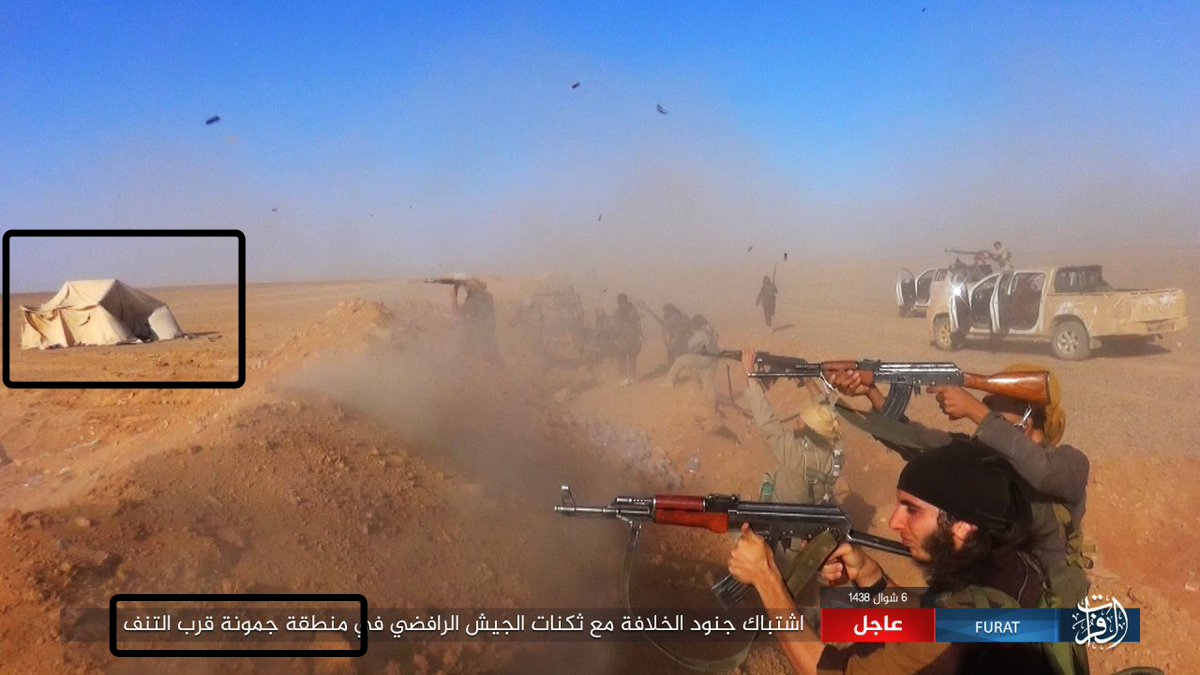
    Pictures of the ISIS attack:

    Review: ISIS Attack And Alleged US-led Airstrikes Against Popular Mobilization Units In al-Jamouna Area At Syrian-Iraqi Border

    Click to see the full-size image

    ISIS photos and videos

    As usual, ISIS did not avoid releasing evidence that could increase the morale of its member. The ISIS video started with showing 15 dead ISIS fighters killed during the attack against the PMU. Thus, the real ISIS casualties could be higher. It’s clear that the ISIS media avoided releasing all info about the group’s casualties.

    In turn, according to various sources, between 40 and 80 PMU members were killed as a result of the ISIS attack and the alleged strikes of the US-led coalition.

    Review: ISIS Attack And Alleged US-led Airstrikes Against Popular Mobilization Units In al-Jamouna Area At Syrian-Iraqi Border

    Click to see the full-size image

    Conclusion

    Despite wide combat expirience, the resistance forces still has some weak points. Their enemies are well aware of these points and know how they can use them. At the same time, the resistance forces face some difficulties because they are composed mainly of voluntary and non-permanent forces.

    The forces gathering in an environment that increase their weakness is the biggest factor in this incident.

    In general, ISIS conducts its attacks when the resistance forces are the least vigilant. For example, a hour before the morning prayers involves the drowsiness of many forces and the provision of the adequate light. ISIS uses the element of surprise and engages with them in a close combat. Furthermore, ISIS has a wide expirience of clashes in desert areas.

    The ISIS video allows to see that the PMU had set up no fortifications to defend its forces. Although, the new base was under constructuion but even the core of the base didn’t have notable fortifications. Many tents were located without any defense.

    There were dozens of vehicles and construction equipment that could easily be used for the construction of temporary trenches and fortifications. However, this was not done.

    ISIS started its attack with heavy caliber fire in the twilight. The video allows to see that many PMU members were not even carrying personal weapons. Despite fact that the video allows to see more than 5 PMU vehicles with high caliber machine guns, no signs were spotted that the PMU was using them.