Tag: Mohamed Hamdan Dagalo

  • Understanding Warring Parties In Sudan; Reviewing Latest Field Situation (Map)

    Understanding Warring Parties In Sudan; Reviewing Latest Field Situation (Map)

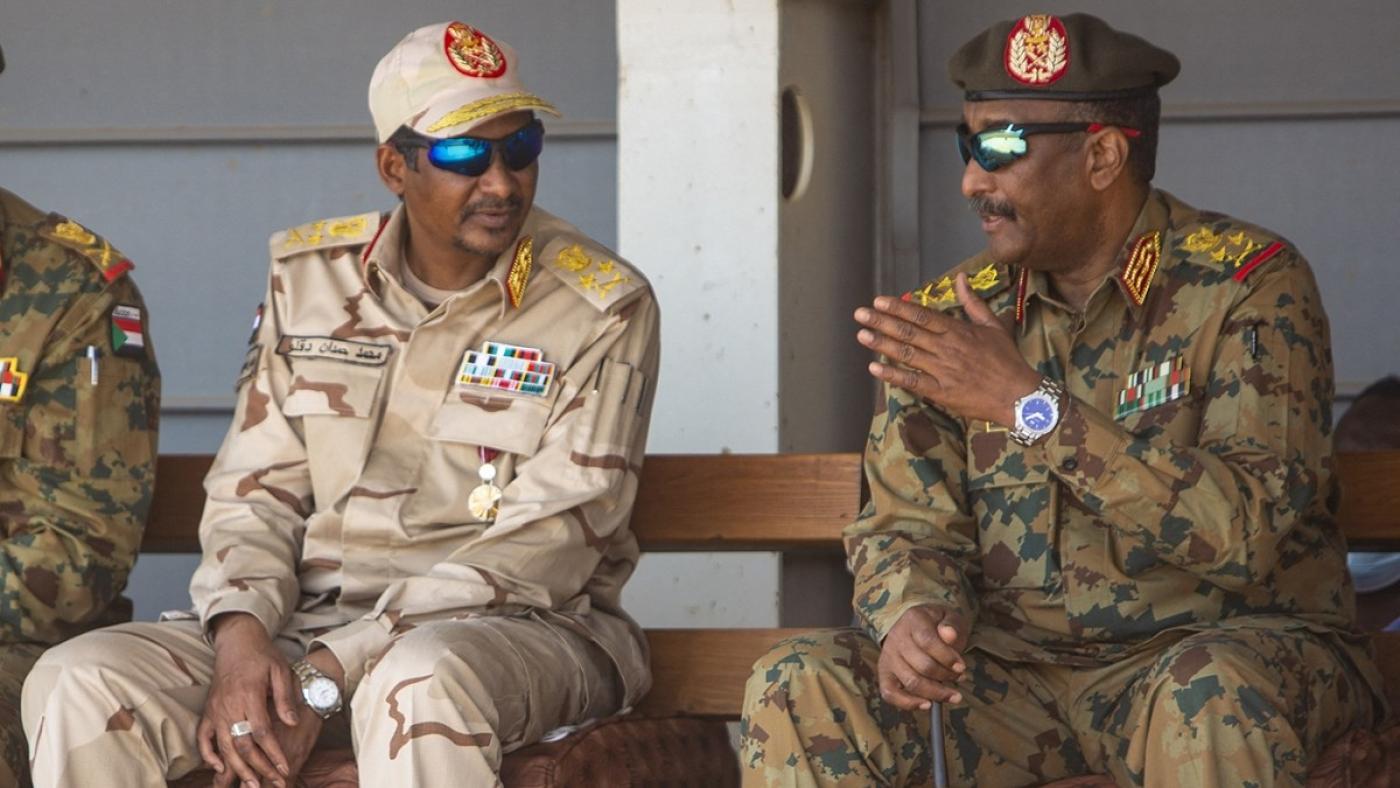
    Recent conflicts in Sudan have occurred as a result of power struggles and disagreements between the Sudanese Armed Forces led by General Abdel Fattah al-Burhan and the Rapid Support Forces led by Mohamed Hamdan Dagalo, also known as Hemeti or Hemedti.

    During the 2019 coup, the Sudanese Armed Forces toppled the country’s then leader Omar al-Bashir, and Abdallah Hamdok was chosen as the prime minister of the transitional government for three years.

    Additionally, a transitional council was also formed, consisting of 11 military and political figures (along with the army), with one seat left empty due to the absence of a representative from eastern Sudan.

    The transitional government of Hamdok was formed in August 2019 with the participation of the army and the political coalition of the Forces Freedom and Change (FFC), but it faced a new military coup in October 2021. Despite the detention of members of the Hamdok government, he continued as prime minister until January 2, 2022, and was succeeded by Osman Hussein as the interim prime minister. The second coup and its aftermath were faced with protests by supporters of the transitional government and political parties, but there was no progress until political and military groups in Sudan agreed to a 24-month transitional period under the leadership of the senior army commanders on December 5, 2022.

    However, the process also faced another power struggle and conflict between Hemeti and Burhan, and the fate of Sudan is still subject to changes.

    Who is Mohamed Hamdan Dagalo (Hemedti)? How were the Rapid Support Forces formed?

    General Mohamed Hamdan Dagalo is one of the powerful individuals of the Rizeigat tribe in the Darfur region of Sudan, who was appointed as the commander of the forces in 2010, which were formed from a group of armed tribal allies with Omar al-Bashir.

    The forces were initially made up of Janjaweed fighters, a Sudanese Arab militia group, and did not have a structured organization, and their organization was resembling a paramilitary group.

    However, in the following years with the help of Omar al-Bashir’s government, they developed and became a regular force under the command of Hemeti. The Rapid Support Forces played an important role in the April 2019 coup and the overthrow of the Omar al-Bashir’s government; then, the RSF commander Hemeti was appointed as the Deputy Chairman of the Transitional Military Council.

    Hemeti collaborated with General Abdel Fattah al-Burhan in the 2021 coup against the government of Abdullah Hamdok, but after a while he opposed General Burhan and ultimately rejected the results of an agreement between civil groups and the military governing council to resolve the political crisis in Sudan on December 5, 2022, especially regarding the integration of the Rapid Support Forces into the Sudanese armed forces; thus, he engaged in conflict and tension with the Sudanese Armed Forces from April 15, 2023.

    Who is Abdel Fattah al-Burhan?

    Abdel Fattah Abdel Rahman al-Burhan is one of the senior generals of the Sudanese Armed Forces, who was appointed as the commander-in-chief of the army in February 2018. He previously held the positions of inspector general of the Sudanese Armed Forces and the Deputy Chief of Staff of the Ground Forces Operations.

    General al-Burhan came to this position and also became the head of the Transitional Military Council following the coup against Omar al-Bashir’s government in 2019, led by Ahmed Awad Ibn Auf, the former Commander-in-Chief of the Sudanese Armed Forces.

    With the cooperation of General Hamidti, he ousted the interim government led by Abdullah Hamdok and removed members of the Sudan’s Transitional Sovereignty Council in 2021, forming a new council with other members. Al-Burhan’s unilateral and self-oriented actions led to conflicts with Hamidti and ultimately triggered recent military clashes.

    Current military situation in Sudan

    According to the latest news stories from the confrontations in Sudan, most cities and military bases in the provinces of Western, Central, Southern, and Eastern Darfur are under the control of the Rapid Support Forces. Parts of the southern North Darfur and parts of the North and West Kordofan provinces are also under the influence of the Rapid Support Forces.

    In capital Khartoum, the precise control lines of each side are unclear due to the ongoing clashes. However, most of the northern areas of Khartoum, such as Al-Juraif, Darduk, Kafouri, Khartoum Bahri (North) and Omdurman are under the influence of the Rapid Support Forces.

    The Sudanese army has also been successful in consolidating its positions in the east and north of the Arab country, and the movements of the Rapid Support Forces have been limited to scattered clashes and harassment attacks. Army bases in the cities of Al-Fashir, Al-Obaid, Al-Junaynah and Merowe have been preserved; therefore, the two warring sides continue the ongoing clashes in these cities.

    In the eastern parts of Sudan, after the occupation of the cities of Kassala, Al-Qadarif, and Port Sudan on April 16, 2023, the Sudanese Armed Forces succeeded in fully stabilizing the situation and the Rapid Support Forces did not have any further advances in the eastern areas of the war-stricken country.

    Read more: Crisis In Sudan; Ceasefire, War In Place!

  • Responses To Key Questions On Latest DevelopmentsIn Sudan And A Coup In The African State

    Responses To Key Questions On Latest DevelopmentsIn Sudan And A Coup In The African State

    Who are the warring parties in Sudan?

    Sudan’s today confrontations erupted between Chairperson of the Sovereign Council and Commander-in-Chief of the Sudanese Army General Abdel Fattah al-Burhan and Deputy Head of Sudan’s ruling Sovereign Council and commander of Sudan’s Rapid Support Forces (RSF) General Mohamed Hamdan Dagalo, generally referred to as Hemetti.

    What is the reason behind the clashes?

    The power struggle and disputes between Hemetti and al-Burhan are the main causes of the conflicts. According to an accord between civil groups and the ruling Sovereign Council in order to resolve the existing political crisis, which was achieved on December 5, 2022, all armed groups especially the Rapid Support Forces should be integrated into armed forces of Sudan in a determined period, and no militia is allowed to be formed in the country.

    Who is ruling Sudan’s government?

    At present, the government of Sudan is under the control of General Abdel Fattah al-Burhan, and the transitional government of Sudan has not had any sort of special might since the second coup by the country’s army.

    What is the root cause of the crisis in Sudan?

    In 2019 coup d’état by Sudan’s Army against the then government of the African country, the then President of Sudan Omar al-Bashir was toppled and Abdalla Hamdok was appointed as the prime minister of the transitional government to take the helm for three years. Furthermore, Sudan’s Transitional Sovereignty Council was formed, consisting of 11 members including military officials and politicians (in cooperation with the Army); of course one of its seats has been empty because of their failure in electing a representative from the eastern Sudan.

    Hamdok’s transitional government, which was formed in 2019 in cooperation with the Army and the Forces of Freedom and Change (FFC) coalition, faced a second coup by the Sudanese Army in October 2021. The second coup d’état was faced with protests by the Sudanese people and pro-government groups; so, the coup doomed to fail; and then on December 5, 2022, political and military groups influenced by top commanders of the army reached a consensus to form a 24-month transitional period, which was accepted to be started from the election of a transitional prime minister. However, the process faced power struggle and clashes between Hemetti and al-Burhan; therefore, the fate of Sudan will still wait for other transformations.

    Read more:
    Protests against the Sudanese Army’s coup
    Another Coup d’état in Sudan

  • Latest Updates on Sudan, 13 November 2021

    Latest Updates on Sudan, 13 November 2021

    Following the October 25th coup d’état in Sudan, the Sudanese Army Commander, General Abdel Fattah al-Burhan reappointed himself as leadership of the transitional council.

    Abdel Fattah al-Burhan has also appointed Mohamed Hamdan Dagalo as his deputy, claiming that as long as Sudan’s political problems persist, the military-led transitional council will run the country. Also, since October 23, more than 100 government officials and political leaders supporting the transitional government have been detained by the Sudanese army.

    Protesters and supporters of the transitional government led by Prime Minister Abdalla Hamdok are still on the streets, and protests ongoing in several Sudanese cities.

    Sudan’s internal situation has deteriorated again since the recent coup, and fuel and food prices have risen sharply as the country’s ports have been closed. UN officials have also, as usual, expressed concern over the developments in Sudan! Human rights activists and UN envoys have also reported that 14 people have been killed by security forces since the beginning of the protests.

    The Sudanese military-led transitional council was formed after the 2019 military coup and the ouster of Omar al-Bashir, with 11 members of military officials and politicians (along with the army).
    The civilian-led transitional government was formed in August 2019 with the participation of the army and the political coalition of Freedom and Change for three years, which was again faced with a military coup. Since then, the people and supporters of the transitional government have begun protesting against the army. In response to popular protests, the commander of the Sudanese army, General al-Burhan, claimed that he would not run for office after the elections and the establishment of the Sudanese government, and that he would hand over power to a civilian government.

    Read more: Another Coup d’état in Sudan

  • Sudanese Army in Yemen

    Sudanese Army in Yemen

    Experiences in Iraq and Syria and at the beginning of war with AnsarAllah gave Saudis and Emirates the lesson they can’t count on Takfiris. Therefore to enrich their ground army they turn to Sudanese who have 20 years of war experience in Darfur and south of Sudan.

    Chaotic situation of Sudan inside and outside forced Omar al-Bashir to form alliance with countries, with which he had great idealogic and political differences.
    Omar al-Bashir thought the situation of Sudan which was result of separation of southern Sudan (with 75% of oil income), tribes protests, foreign sanctions, etc., will be fixed by financial support of Saudi and UAE.

    This coalition, which was formed by attacking Yemen, caused gap inside Sudan. Many parties including Ummah party, National Congress, Communists and People’s Congress showed opposition against Sudan’s participation in this war.

    As Muhamad Ali al-Houthi said in his recent message, Sudanese officials called the goal of their irrelevant participation in assaulting Yemen as defending Islam and holy shrines which was shown as to be absurd after several years of war.

    Now Omar al-Bashir is captured by revolutionists and cruel generals of Military Council who are only after their personal benefits, cannot tolerate a 8 thousand killed and injured persons casualty. Since this heavy casualty imposed enormous domestic pressure on them and they don’t see any solution other than pulling out of Yemen.

    According to Gen Mohamed Hamdan Dagalo(Hamidti)vice president of Military Council, they have returned 10 thousand troops of 30 thousand troops present in Yemen and they will continue the war in Yemen.

    Continuing this wrong move by Sudanese might result in AnsarAllah’s drone and missile reaction. Since AnsarAllah considers Sudan the source of ground force to the coalition and as airport and refineries of Saudi and UAE are sources of financial support for the assault and thus being targeted by AnsarAllah, there are enough strength to attack Sudanese army.

    If the war against AnsarAllah continues in presence of Sudanese, we should see more pressure and weakening imposed on the leaders of Military Council.