Tag: Palestine map

  • Latest Military Developments Of Gaza And Northern Palestine, 6 November 2023 (Map)

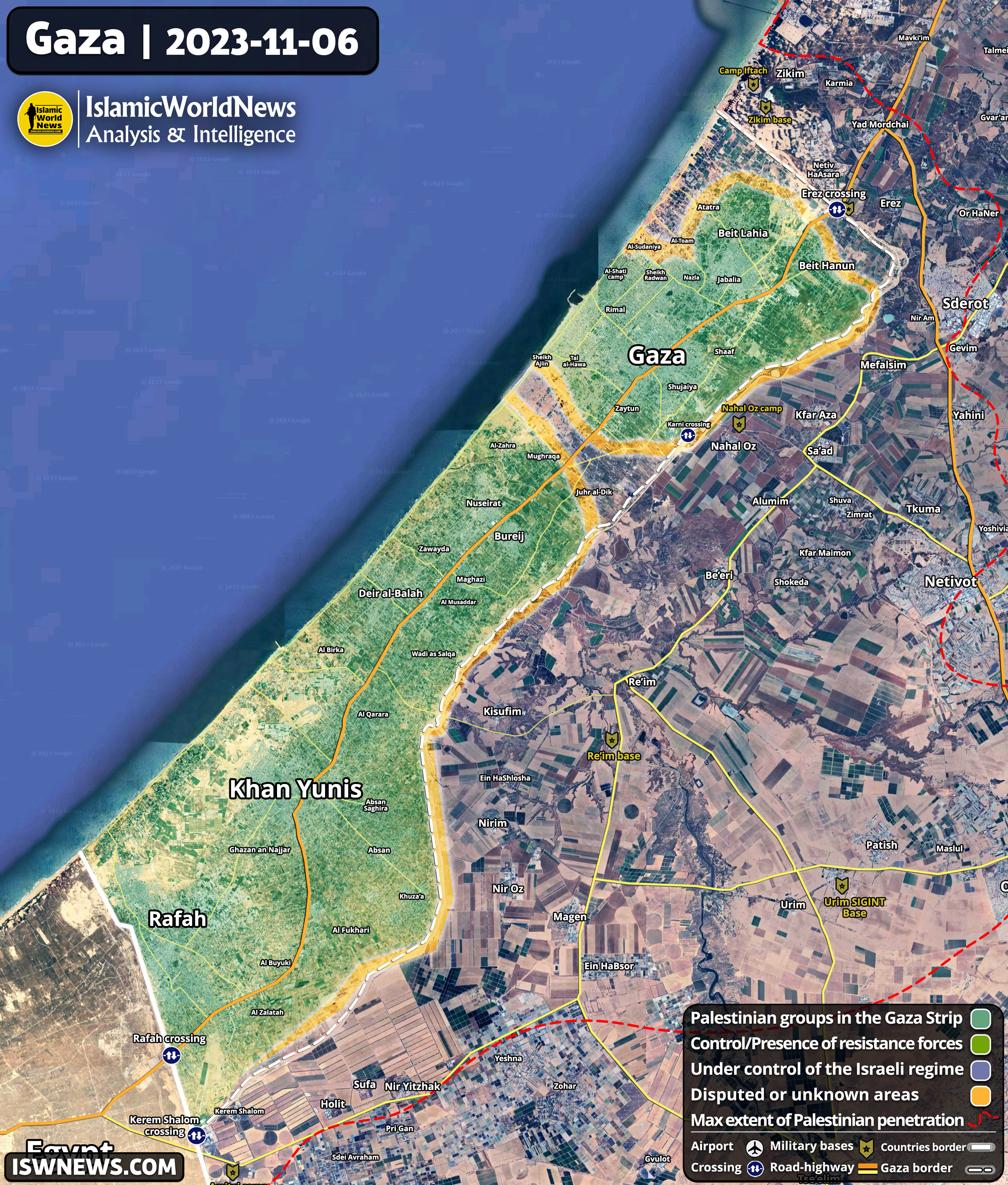
    Latest Military Developments Of Gaza And Northern Palestine, 6 November 2023 (Map)

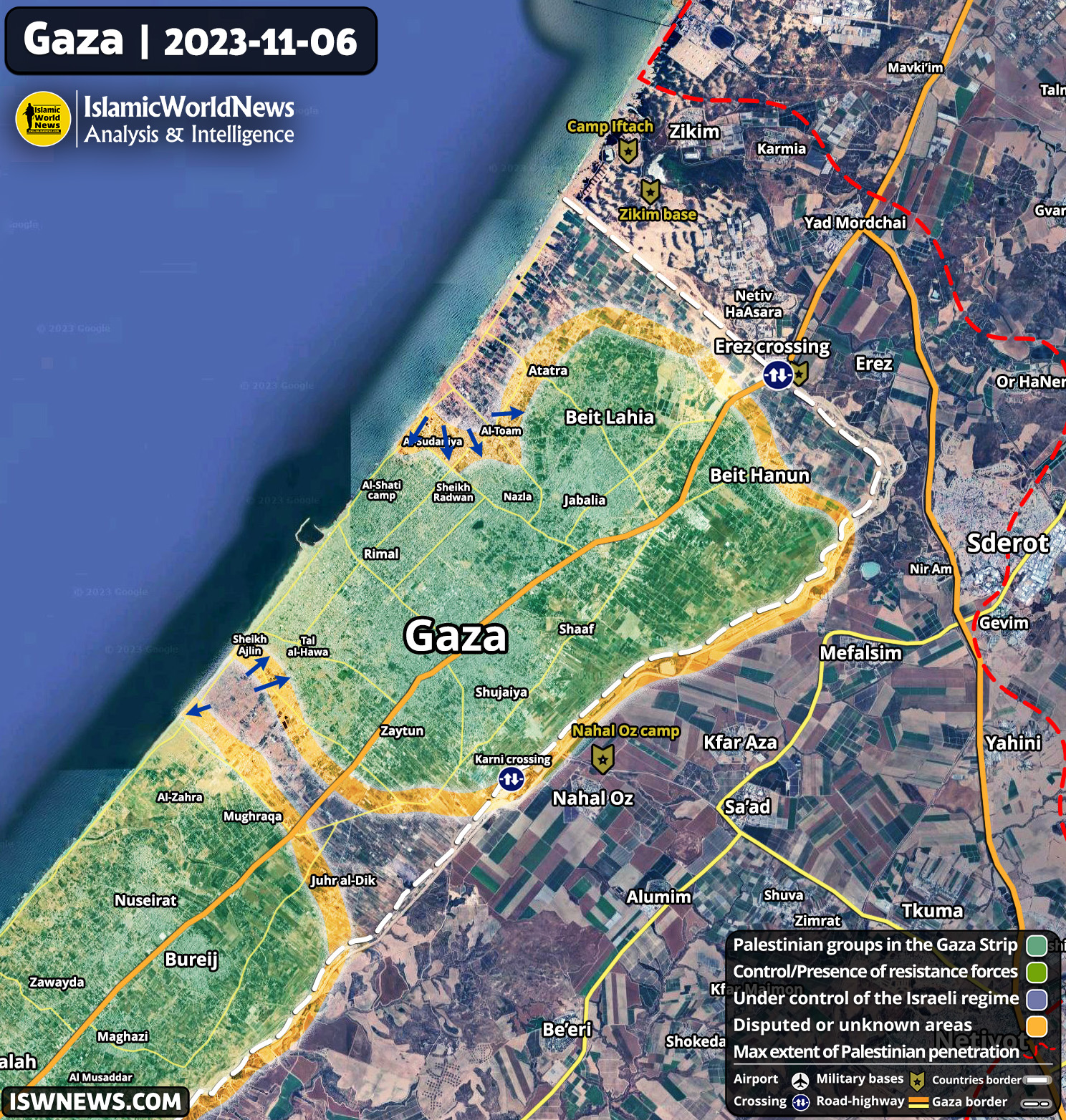
    On the 30th and 31st days of fighting, clashes between Palestinian fighters and Israeli forces continued inside the Gaza Strip. During the last two days, the Israeli army has made advances in the north and south of Gaza City. The amount of these advances is small and limited. Palestinian fighters strongly resist the Israeli attacks.

    In the Beit Hanoun axis, there has been no specific change in the field map. Clashes continue inside Beit Hanoun.

    In the northern axis of Gaza City, Israeli forces have reached the vicinity of al-Shati neighborhood by advancing along the coastline. Also, clashes continue in Al-Tawam, Al-Salatin, Al-Karamah neighborhoods and near Sheikh Radwan.

    In the southern axis of Gaza City, the Israeli regime slightly advanced in the direction of Al-Rashid Street and the coastline. In this axis, clashes continue in the south of Tal Al-Hawa and Sheikh Al-Ajlin neighborhoods, as well as parts of the west of Al-Zaitun neighborhoods.

    As mentioned in the previous articles, the Israeli army has resorted to tanks and armored vehicles to a large extent to prevent human casualties; Thus, the lack of sufficient infantry alongside armored vehicles has made it very difficult to advance in urban areas. Also, for this reason, Israeli tanks and armored vehicles are constantly ambushed by Palestinian fighters and the Israeli army has suffered many losses. It should be noted that 97 Israeli tanks and armored vehicles have been destroyed or seriously damaged by Palestinian militants since the beginning of the Israeli ground attacks on Gaza, and these figures are while the urban war has not yet been activated in all areas.

    In the southern axis of the Gaza Strip and the surrounding areas of Khan Yunis, no special progress has been made.

    The heavy bombardment of different areas of the Gaza Strip continues. The Ministry of Health of Palestine announced that the number of martyrs in Gaza has increased to more than 10,022 people. Also, more than 24,000 people have been injured. 70% of the martyrs and injured of the Israeli aggression against the Gaza Strip are women and children.

    On the northern front, artillery and missile attacks between Hezbollah and Israel continue, and no specific changes have been made in the front lines. During the last two days, Hezbollah has attacked the positions and equipment of the Israeli regime in border areas using artillery fire and anti-armor missiles. The Israeli regime also bombards Hezbollah’s positions and various areas of southern Lebanon using artillery and fighter jets. In one of these attacks, a car was targeted, during which four Lebanese civilians were martyred. In response to this attack, Hezbollah targeted Kiryat Shemona with Grad rockets.

    During the last two days, five members of Hezbollah were martyred.

    Read more: Latest Military Developments Of Gaza And Palestine, 4 November 2023 (Map)
  • What Is Happening In The Northern Front Of Palestine? (Map)

    What Is Happening In The Northern Front Of Palestine? (Map)

    The armed conflicts between Hezbollah and the Israeli regime’s army in the northern Palestinian axis began on October 8, one day after the onset of Operation Al-Aqsa Storm throughout the Gaza Strip. Unlike the heavy ground, air, and sea clashes in the Gaza Strip, the conflicts in this axis have been limited to exchanges of fire and missile attacks. Hezbollah targets Israel’s military build-ups, defensive and army positions such as tanks, armored vehicles, surveillance cameras, and so on; and the Israeli army responds with artillery strikes and incendiary phosphorus bombs. However, these clashes have entered a new phase since this Saturday following the engagement of Israeli fighter jets and drones, and there is a possibility of an escalation in the level of clashes in comparison to the past confrontations.

    The dispatch of Israeli Air Force helicopters to the clashes in the northern Palestinian front is actually an escalation in terms of the level of aggression by Israel; so, the Hezbollah movement can respond by expanding its attacks on all Israeli positions in northern Palestine, increasing joint attacks with the Palestinian resistance groups in the Gaza Strip, and even carrying out extensive rocket and drone attacks to intensify tensions with the Israeli regime.

    As Sheikh Naim Qassem, deputy secretary-general of Hezbollah resistance movement, pointed out in his remarks on Saturday, the current clashes are commensurate with the situation and ongoing conflicts in southern Lebanon, and if necessary, Hezbollah will intensify its attacks. In fact, at this stage, Hezbollah is not seeking to expand the clashes with Israel and does not apparently want to be blamed as the initiator of the war with Israel. This has multiple reasons, including the possibility of the United States involvement in the war, Lebanon’s unstable economic situation, regional tensions, and so on. Moreover, Hezbollah cannot enter into a full-scale war with Israel without considering the regional conditions. The Israeli regime has also managed to get rid of the big shock of the early days following the Operation Al-Aqsa Storm and the Israeli intend to show they can overcome the hard circumstances by expanding their attacks on Lebanon and Syria.

    Another issue is that the Israeli regime is paving the ground for a widespread war in southern Lebanon. In a significant decision made in a cabinet meeting on October 18, the Israeli military ordered the evacuation of settlements and villages along the occupied northern Palestinian border up to five kilometers from the Lebanese border. So far, some 27,000 Israeli settlers have been evacuated from 28 occupied settlements near the Lebanese border. The largest part of the plan to evacuate border settlements is related to the occupied settlement of Kiryat Shmona, which includes the transfer of 23,000 settlers. This evacuation plan is being implemented with the aim of preventing civilian casualties in possible attacks by Hezbollah and Palestinian resistance groups, as well as to open up the Israeli army’s hands for carrying out attacks and using prohibited weapons in occupied northern Palestine and southern Lebanon.

    At this time, there are confrontations and exchanges of fire throughout the border areas between Lebanon and occupied Palestinian territories from Al-Naqoura to Shebaa Farms. The Axis of Resistance has a special coherence and the recent multiple attacks on the United States’ positions in Iraq and Syria testify to the synchronization of the battle between the Israeli-US front and the Gaza-Lebanon axis. The future and outcome of the armed clashes are unpredictable, because Israel has so far rejected any dialogue and mediation regarding the issue of the Gaza Strip and the regime is pursuing high-level aerial attacks (targeting civilians and public places such as hospitals, mosques, schools, markets, churches, and so on). The United States also links the Israeli front with the Ukrainian front and is using these clashes for its political purposes. The United States and the Israeli regime agree on carrying out ground operations in the Gaza Strip and in recent days, many military aids have been shipped from the United States and Europe to the city of Tel Aviv and military bases in other Israeli cities. The Israeli regime intends to destroy Palestinian resistance defense positions in the Gaza Strip with extensive aerial attacks and then enter into ground operations. Unofficial reports of dual-nationality soldiers entering Israel also confirm this issue.

    Taking all these issues into consideration, the current war between the Israeli regime and Palestinian resistance groups in the Gaza Strip and the Lebanese Hezbollah in the north is a regional war in which the United States and other resistance groups are also involved. The Israeli regime’s ground operation in the Gaza Strip is directly related to intensified clashes in the north and resistance attacks in Iraq and Syria, and there is a possibility of it spreading to Yemen and even the Persian Gulf as well as the Sea of Oman.

    Read more: Latest Military Developments Of Gaza And Northern Palestine, 22 October 2023 (Map)

    Map of Northern Palestine and Southern Lebanon – click to view in full size
  • Latest Military Developments Around Gaza Strip, 9 October 2023 (Map)

    Latest Military Developments Around Gaza Strip, 9 October 2023 (Map)

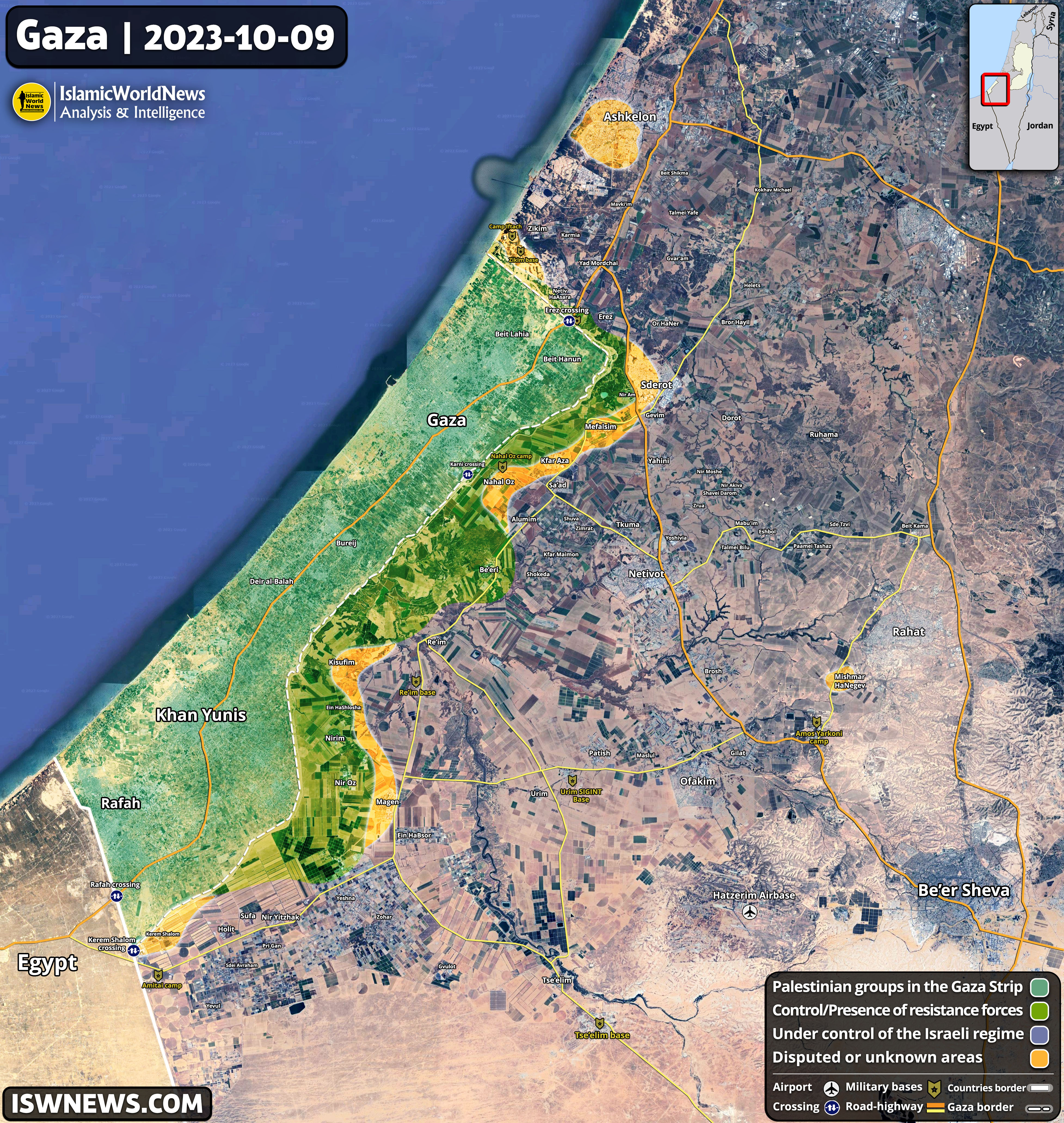
    The Israeli regime’s army announced on the third day of the clashes that it has taken control of all the surrounding neighborhoods of the Gaza Strip. However, the field realities tell a different story, and the battles are still ongoing.

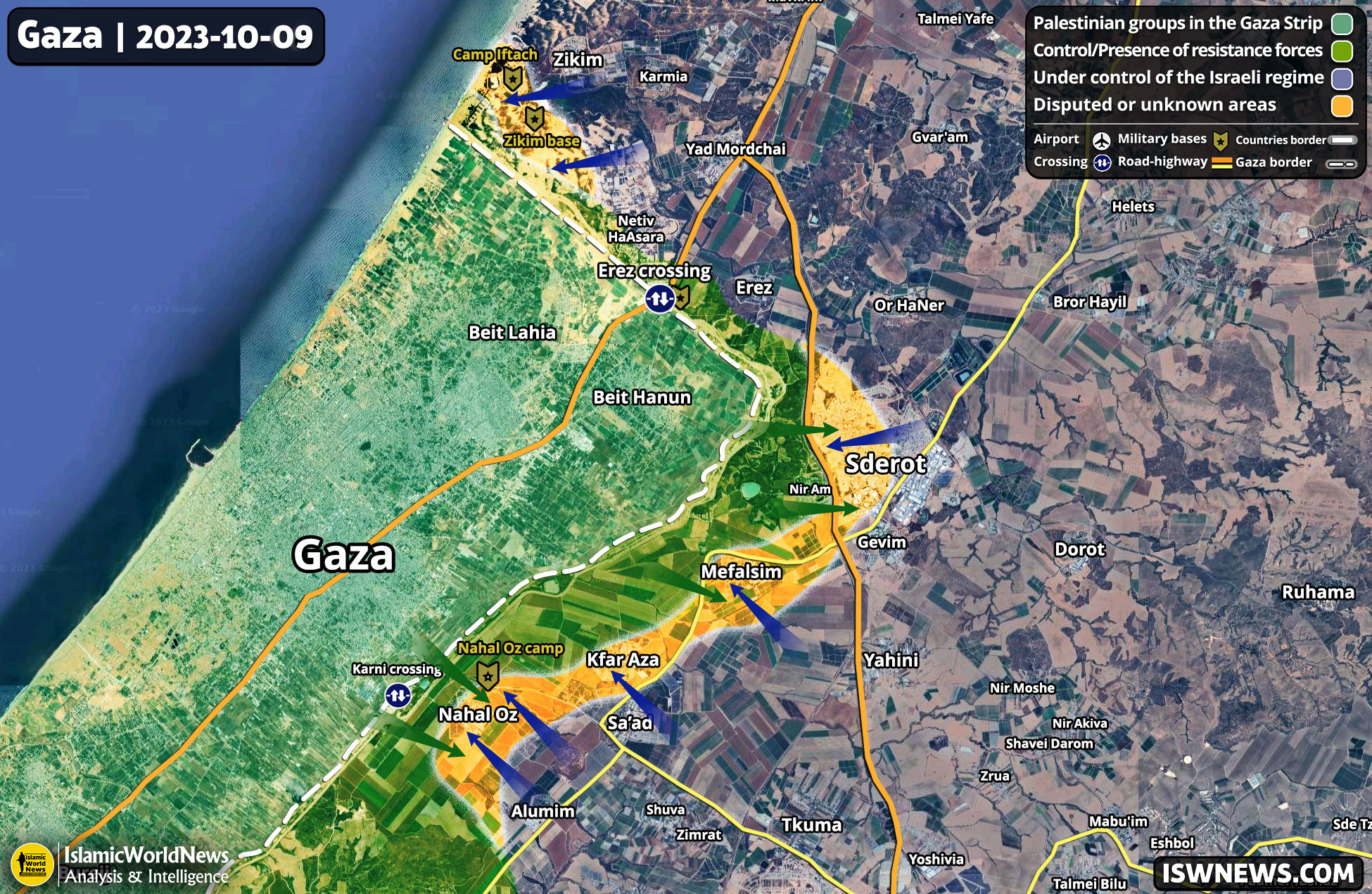
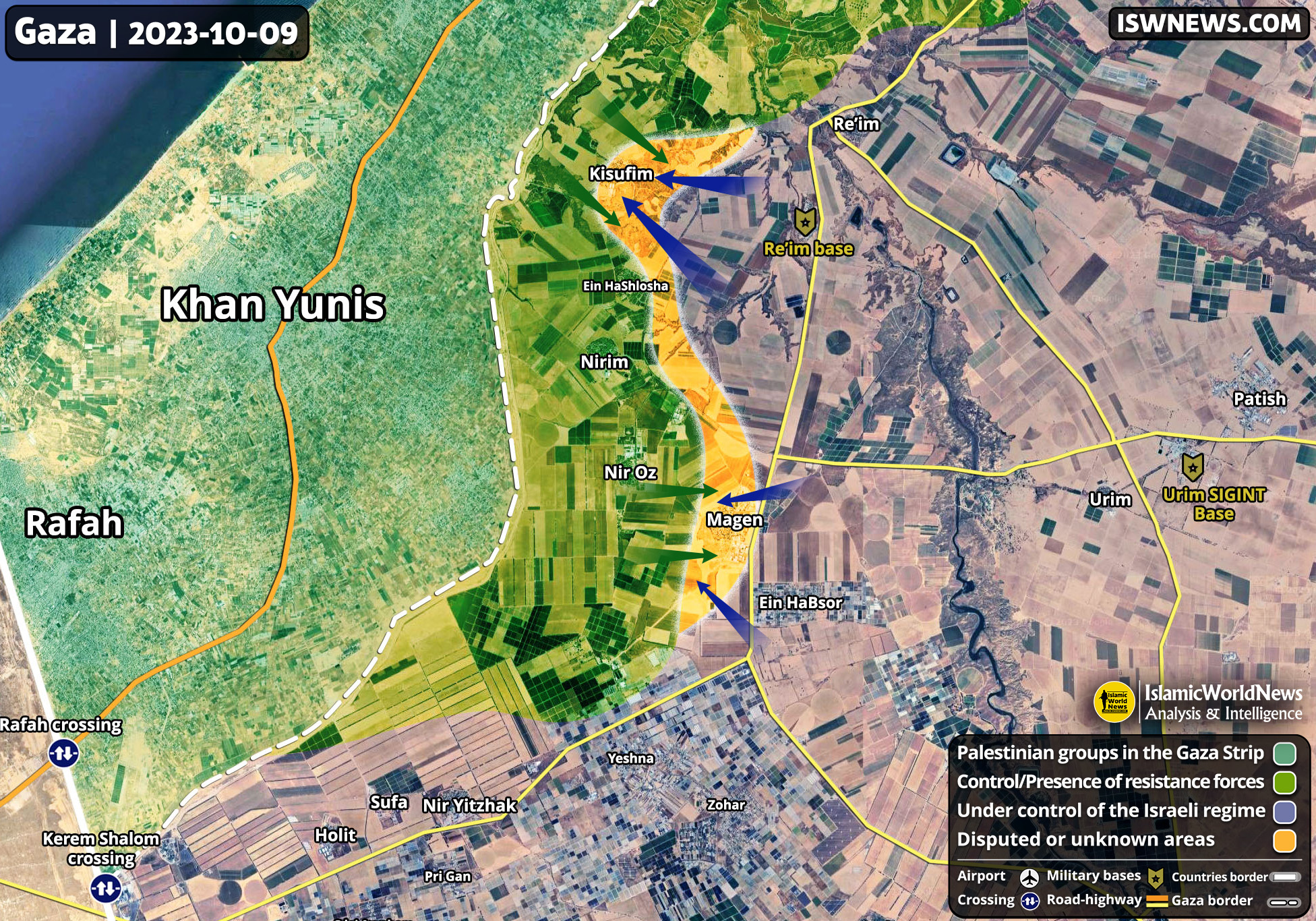
    The only change in the battle lines is related to the Zikim region and the Zikim military base in the north of the Gaza Strip and the Karam Abu Salem crossing and its surrounding areas in the south of the Gaza Strip. The Israeli authorities claim to have regained control of the Zikim military base.

    The clashes also continue along all the conflict lines and especially in the areas of Mafalsim, Kfar Aza, Nahal Oz, the outskirts of Be’eri, Kissufim, and Magen. The clashes continue in the important town of Sderot.

    Spokesman for the Izz ad-Din al-Qassam Brigades Abu Obaida announced that the Al-Qassam Brigades successfully carried out another infiltration operation on the third day of the battle with the aim of displacing Israeli forces in the engaged positions. He added that today we targeted Sderot with several rockets to help our resistance fighters in this town.

    Direction of clashes in the northern areas of Gaza Strip – click to view full size
    Direction of clashes in the southern areas of Gaza Strip – click to view full size

    According to reports, Palestinian resistance fighters once again succeeded in infiltrating into the Mishmar HaNegev settlement 20 kilometers deep into the occupied territories. Also, Palestinian commando forces managed to infiltrate into the city of Ashkelon once more. However, no information is available about the fate of these mentioned clashes.

    The Israeli regime’s army continues to dispatch troops and equipment to southern areas. According to unconfirmed information, the Israeli army has deployed about 100,000 troops to the southern region. Western sources, quoting US officials, also reported that the Israeli regime’s army is likely to launch a large-scale ground operation against Gaza within the next 48 hours.

    Simultaneously with these movements, the savage and relentless bombardment of Gaza continues. According to the Palestinian Ministry of Health, since the beginning of the Operation Al-Aqsa Storm, some 687 Palestinians have been martyred and 3,900 others have been injured.

    Read more: Infographic: Operation Al-Aqsa Storm, Day 3

    Some Israeli sources also reported that the number of Israeli casualties in resistance attacks from the beginning of the Operation Al-Aqsa Storm until now has reached 1,100 dead and 2,741 injured.

    Read more: Latest Military Developments Around Gaza Strip, 8 October 2023 (Map)

    Latest military map of Gaza – click to view full size map