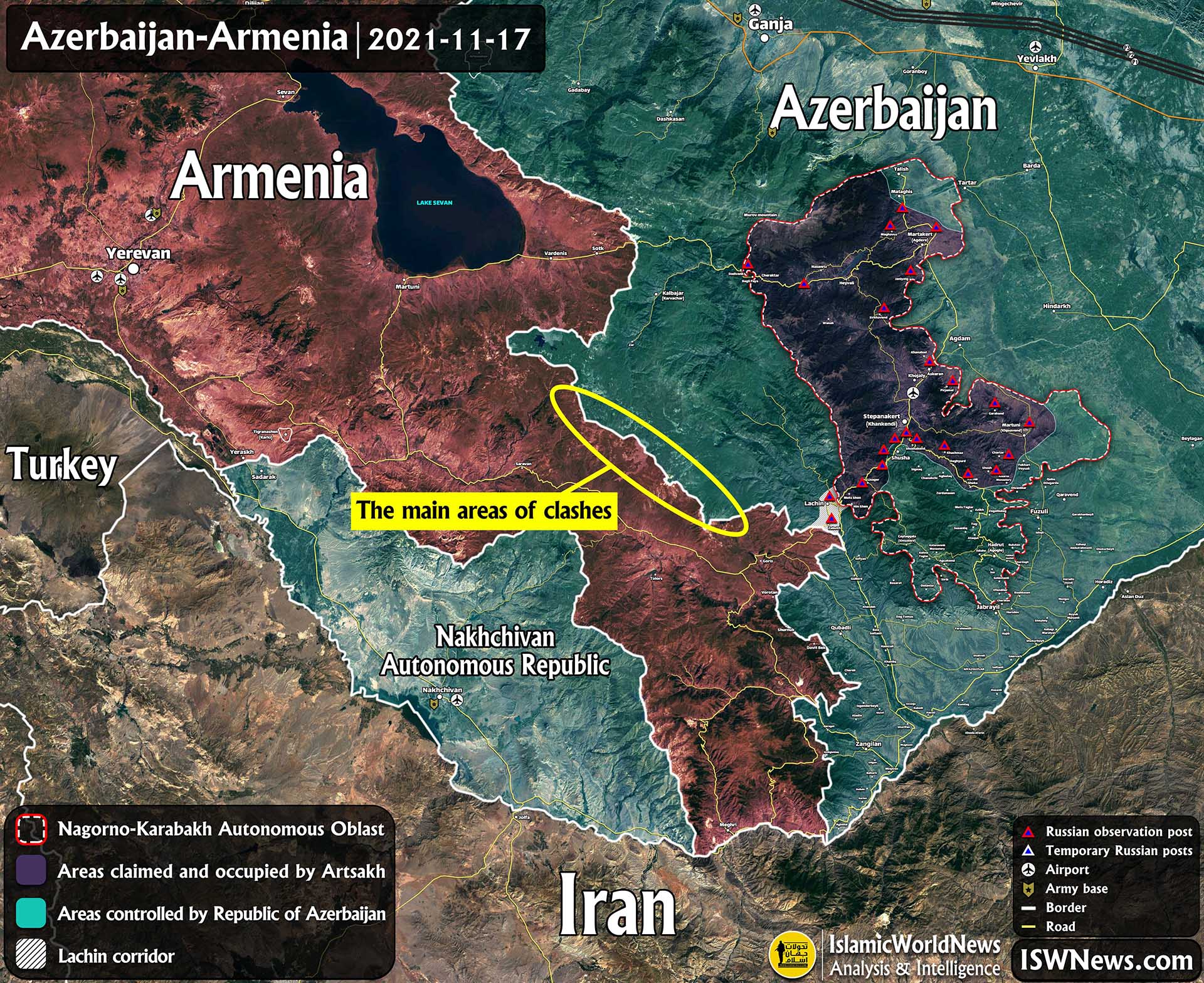
According to the ISWNews field information from the Republic of Azerbaijan, the government and the army of this country are preparing to launch a large-scale military offensive against Armenia and occupy the areas of Syunik, Vayots Dzor and Gegharkunik provinces in the south of Armenia after September 27, i.e. after the anniversary of the start of the second Karabakh war. The main goal of Azerbaijan is to occupy the historical region of Zangezur, which now geographically corresponds to Syunik province of Armenia.
According to the received information, it is very likely that the Azerbaijani army will start its military attacks after September 27 (the end of September or the beginning of October) with the focus on occupying the Zangezur region and connecting the main territory of the Republic of Azerbaijan to the Nakhchivan region.
The historical area of Zangezur is marked in red
During the last two weeks, the Azerbaijani army has sent troops and heavy military equipment to the borders of Armenia and these activities are still ongoing. In one of these cases, about 60 Azerbaijani military trucks have transferred and deployed a significant number of Azerbaijani military forces to Fuzuli area.
The deployment of S300 air defense systems in Baku and its surroundings and the increase of air defense measures are observed in this region more than before.
Also, the people who have just finished their military service have been re-called to the army, and soon a general call will be announced for a certain age range to introduce themselves to the army.
On Turkey’s side, several thousands of troops have been prepared for a possible attack on Armenia from the west, and they will enter the war if necessary.
All these cases and a series of other events show Azerbaijan’s serious intention for a large-scale military attack, and if nothing special happens, this attack will be carried out.
Simultaneously with these activities, the US, British, and French embassies in Armenia have issued statements and maps asking their nationals not to travel to the mentioned areas. In the map published by the French Embassy, the possible areas of Azerbaijan’s operations in Armenia are clearly marked.
Click to view full size
On September 24, Azerbaijan’s Defense Minister, Zakir Hasanov, officially announced in a statement that the country’s army may carry out further military operations against Armenia as they did between 12 and 14 September. Also, the military posts that were recently occupied by Azerbaijan in Armenia will receive supplies and equipment.
In another move, Baku is hosting NATO’s OCC E&F training course from September 26. The Operational Capability Concept Evaluation and Feedback Programme (OCC E&F) is a multipurpose military mechanism designed to develop and establish closer operational relationships between NATO and potential contributor (here Azerbaijan) that are fully interoperable and capable of operating with NATO standards and procedures.
According to the field evidence, on November 16, the Azerbaijani military, in violation of the peace agreement advanced on several border points in the Armenian province of Syunik, But in the aftermath of the aggression, they faced a strong response by the Armenian military.
The clashes between Azerbaijan and Armenia started at about 1 pm and ended with the mediation of Russia and the declaration of a ceasefire at 5:30 pm (local time). During these conflicts, two Armenian military points were occupied by Azerbaijan.
According to a statement from the Armenian Ministry of Defense, one Armenian soldier was killed, 13 captured and 24 others were missing during the clashes. Also, according to the information provided by the Azerbaijan Ministry of Defense, 7 Azerbaijani servicemen were killed and 10 others were wounded.
Following the clashes, the Iranian Foreign Ministry, the Russian Ministry of Defense and the United Nations issued messages calling for restraint on both sides and the de-escalation of the clashes. While emphasizing respect for international borders, the Iranian Foreign Ministry spokesman announced Iran’s readiness to help resolve the disputes between the Republic of Azerbaijan and Armenia peacefully. In this regard, the presidents of Iran and Russia during a telephone conversation stressed the need not to change the political geography of the Caucasus region.
Armenian Security Council Secretary Armen Grigoryan also called for Russia’s protection of Armenian territory under the 1997 agreement in an interview. Grigoryan went on to say that if the crisis is not resolved through Russia and the CSTO, they will ask for help from other international partners.
This afternoon, in order to reduce tensions between Azerbaijan and Armenia, Deputy Commander of the Southern Military District of the Russian Federation and Commander of the Russian Peacekeeping Forces in Nagorno-Karabakh, Lieutenant General Rustam Muradov, transferred the body of the Armenian soldier who was killed in November 16th battles from Baku to Yerevan.
In the autumn of 2020, the Republic of Azerbaijan launched a large-scale military operation with the full support of Turkey and the Israeli regime with the aim of full control over the Karabakh. In a 44-day period from September 27 to November 10, Azerbaijan has managed to control about 50 percent of the territory, including parts of the south (inside) of the Nagorno-Karabakh Autonomous Region, as well as the occupied territories around the Nagorno-Karabakh Autonomous Region. Subsequently, in accordance with the peace agreement reached between Azerbaijan and Armenia, the regions of Aqdam, Kalbajar and Lachin were handed over to the government of Azerbaijan.
The Peace Agreement consists of nine main clauses; However, the different interpretations of Azerbaijan and Armenia from the ninth paragraph of this agreement have prevented the achievement of a lasting peace. By exploiting this clause, the Baku government is also trying to fulfill its illegitimate demands, using this issue as a pretext to create an illegal corridor called the Zangezur Corridor or to occupy the Armenian province of Syunik.
The joint military exercises of the Republic of Azerbaijan with Turkey and Pakistan in the last month, the interruption of the transit route of Iranian trucks and the arrest of their drivers and the sharp statements of the Azerbaijani officials against Iran are important issues in the Caucasus region. What are the goals of Aliyev and his main supporters (Israel and Turkey) in implementing this anti-Iranian project?
The answer to this question is examined in several cases:
1- The success of the Republic of Azerbaijan in the Second Nagorno-Karabakh War was due to the widespread support of Turkey and Israel, the will of the world powers, as well as the inability of the Armenian leaders. This victory has misled Aliyev and other officials in Baku to mistakenly have the illusion and feeling of power against Iran. Therefore, one of the reasons for these anti-Iranian actions of the leaders of the Republic of Azerbaijan is their misunderstanding of regional developments.
2- The confrontation between the Republic of Azerbaijan and Iran is an unequal confrontation. Iran’s military and political power and position are in no way comparable to the Republic of Azerbaijan, even in the case of an alliance with Turkey and Pakistan. On the other hand, the countries of the region will not enter into tension with Iran because of Aliyev, and the harms of this tension far outweigh its benefits. We all know that there is always a political message behind military exercises. Exercise is more of a boast than a military threat, and it is done to prevent military conflict. The Republic of Azerbaijan’s recent exercises with Turkey and Pakistan also served as a warning not to interfere in the Zangezur issue, as well as to announce the support of countries in the region for Aliyev’s government against Iran.
3- Israeli influence on Iran’s borders has always been an important strategy to counter Iran. Aliyev’s government has also entered into closer relations with Israel in recent years, and their debt volume has increased. Hence, the role of Israel in Aliyev’s rhetoric and their tensions cannot be ignored. Therefore, this tension is under the confrontation between the regions of Iran and Israel, and the choice of the name “Khaybar Conquerors” for the Islamic Republic of Iran’s drill on the northwestern borders of Iran is also a proof of this claim.
4- The Republic of Azerbaijan opposes the general policy of Iran in the Caucasus region; And the Iran policy is the policy that pits “unity” against “separatism.” Iran, like Iraq, Yemen, Afghanistan and… opposes any changes in the borders of neighboring countries, including Armenia and the Republic of Azerbaijan. Iran also opposes Azerbaijan plot for the Zangezur area and its Zangezur Corridor, which jeopardize Iran’s economic interests. The detention of Iranian truck drivers on the Armenian border road is also an example of hostage-taking by Turkey and the Republic of Azerbaijan for the Zangezur corridor. In addition, it is said that the Republic of Azerbaijan, in cooperation with Turkey, intended to launch a surprise attack on the southern Armenian province of Syunik, which was thwarted by Iran’s allied policy, and the “Khaybar Conquerors” exercise is in line with this policy.
In this regard, Baku’s actions can be seen as a multidimensional Zionist project, which includes: separatism (emphasis on the separation of Azerbaijani provinces from Iran), ethnicity (Pan-Turkism), security tensions (action against nuclear and political facilities), psychological and media operations, economic issues. (Affecting the economic relations between Iran and Armenia), etc. Given these circumstances, it must be said that if the weakness of Pashinyan and the Armenian authorities in the face of this project continues, their betrayal of Armenia is also certain, and Iran must act alone in the face of the Zionist project. However, considering the recent meetings between the Iranian and Armenian officials, the possibility of such an issue is low, and as the views of Iran and Armenia approach, we will see the opposite front turn to political talks.
Given these circumstances, it should be said that if Armenia acts weakly against this project, Iran will not hesitate to confront the Zionist project and will take more active action. However, considering the recent meetings between the Iranian and Armenian officials and the approaching point of view between the two countries, we are witnessing the opposite front turning to political talks.
The anniversary of the summer clashes of July 14, 2020 and the martyrdom of 11 Azerbaijani servicemen, including Polad Hashimov, has entered the political calendar of the South Caucasus region. The event is considered the beginning of the September 27 military operation of the Azerbaijani coalition in occupied Nagorno-Karabakh against Armenian and Armenian separatists. Although the end of the dispute was signed on November 10 of this year after 44 days between the two parties, disputes over the implementation of the terms of the contract remain.
Hot summer July, Exclaves war!
July is still tense, and can still be considered the start point of another war. Especially since the media once again reported more than three major clashes between Armenian and Azerbaijani forces last week. The first clash on Friday, July 9 on the border of Azerbaijan’s Gadabay district and the northern part of the Nagorno-Karabakh region with Armenia’s Chambarak region was reported by the Ministry of Defense of Azerbaijan and the positions of these forces were shelled in Zamanli village.
The clashes took place near the Artsvashen (Bashkend) area which is Armenia’s exclave inside Azerbaijan. The 40-square-kilometer Artsvashen was occupied by Azerbaijani forces in 1992 after the start of the war between Armenia and Azerbaijan, and its Armenian inhabitants were displaced to Armenia.
The second clash took place on Tuesday July 13 in the town of Shusha in Nagorno-Karabakh (Artsakh) and near the Russian peacekeeping post. A disputed town which was inhabited by a mix of Armenians and Azeris before the Nagorno-Karabakh crisis began. The city was captured from Azerbaijan by Armenians in 1992 and came under Armenian control. Shusha (Shushi) was captured by the Azeri side in the last days of the war last year.
The third clash took place on Wednesday, July 14, coinciding with the anniversary of Hashimov’s death on the northwestern border of Nakhchivan with Armenia and near the town of Sadarak in the Nakhchivan Autonomous Republic. An Azerbaijani soldier was wounded and Azerbaijani Nakhchivan army forces exchanged fire with the Armenian side. This area is located near the borders of Turkey and Karki (Tigranashen) village which is Azerbaijan’s exclave inside Armenia. Karki was occupied by Armenia in 1992 and its Azeri inhabitants were displaced.
The fourth clash also took place on July 19 in the same Sadarak-Yersakh border area between the two sides which led to injury of several people including the head of Yeraskh community of Ararat region Rudik Ogikyan in Yeraskh village.
In addition, the Republic of Azerbaijan has two other exclaves in northern Armenia, which are part of the 1992 occupied territories. Barkhudarly and Sofolu (Barkhudarlu) areas of Rayon Ghazakh (Qazax) with an area of 22 square kilometers are located in the Tavush district , Armenia. Also, the Yukhari Askipara exclave (Azeri: Yuxarı Əskipara – Armenian: Verin Voskepar) is also located inside the Tavush district.
According to the terms of the ceasefire, all these areas shall be returned to their country and the displaced have the right to return to their place of residence.
Azerbaijan: Zangezurbelongs to us!
Establishing a corridor connecting the mainland of Azerbaijan with its exclave territory in Nakhchivan is a major geopolitical challenge. According to the Moscow agreement, the Zangezur (Syunik) corridor between the mainland of Azerbaijan and the outskirts of Nakhchivan is to be established.
Of course, Azerbaijan’s interpretation of this corridor is slightly different, so that in addition to a transport corridor, it has officially made a territorial claim to the southern parts of Armenia. The Zangezur and Goycha regions claimed by Azerbaijan include the Meghri, Kapan, Sisian and Goris, which were ceded to Armenia during the former Soviet Union.
Click to see the full size map The map above shows the military situation before and after the start of the Azerbaijani army operation in Nagorno-Karabakh. The Azerbaijani army took control of more than 50% of the occupied territories in the south of Nagorno-Karabakh in a 44-day period from September 27 to November 10. According to the peace agreement reached between Azerbaijan and Armenia, the regions of Aghdam, Kalbajar and Lachin were handed over to the Azerbaijani government. Armenian forces now control about 55 percent of the “Nagorno-Karabakh Autonomous Region.”
Aliyev’s iron fist in Nagorno-Karabakh!
The President of Azerbaijan on Thursday, July 15, at a ceremony of handing over housing units and cars to the wounded and families affected by last year’s war in the town of Khojavand, Nagorno-Karabakh (Azerbaijani-controlled areas) explained Azerbaijan’s position on territorial policy and the issue of refugees. Elham Aliyev spoke about the return of the Goycha and Zangezur regions to the rule of the Republic of Azerbaijan and the return of the Azeris of Armenia And he mentioned this issue as a necessary condition for the permanent implementation of the peace agreement with Armenia. (About 300,000 Azeris were displaced from Armenia from the Goycha and Zangezur and Yerevan regions between 1988 and 1991, causing Armenian-Azeri tensions. This group is known as the “Yeraz” and is part of the Aliyev family.)
“When all communications are opened, we, the people of Azerbaijan, will return to their ancestral land, of course. The 10 November Trilateral Declaration states: all refugees must return to their homeland. Our native land is Zangezur; our native land is Goycha district, Iravan. We will definitely return there,” Azerbaijan President quoted Aliyev as saying.
He stated that the political solution is the most logical option for this position. Emphasizing his country’s determination to implement these cases, Aliyev warned the Armenian side to implement the terms of the ceasefire agreement before its military action and to hand over the construction of the Zangezur corridor to Azerbaijan. The President of Azerbaijan also claimed the dissolution of Autonomous Republic of Nagorno-Karabakh and creation of the Nagorno-Karabakh Economic Zone. He stressed that the residents of this region must accept Azerbaijani citizenship or go to Armenia forever. Aliyev also said that if the Armenian authorities in Nagorno-Karabakh resist like last year war, he will hit them with an iron fist and will make them runaway like a dog!
Does Aliyevsend a message of war?
Elham Aliyev’s remarks in the Khojavend region, the southeastern territories of Nagorno-Karabakh and the proximity of areas controlled by Armenian forces can be seen as a signal to the other side. The remarks come as Armenia weakens after the war and is in a political and judicial crisis after the parliamentary elections. So another war between Azerbaijan and Armenia is not so unlikely and could happen again. The Caucasus region, with a density of 80 ethnic groups and religions of Islam, Christianity, Jews and Zoroastrians, is one of the most tense military and security regions in the world. This geopolitical disorder is the result of the creation of small ethnic states where races live intertwined.