1- Hadhramaut: – On September 24, supporters of the Southern Transitional Council (STC) protested against the return of Mabkhout Mubarak bin Madi, resigned governor of Hadhramaut Governorate, from Saudi Arabia to the city of Al-Mukalla, in Al-Shahr region, as the people held rallies and gatherings to demand his removal from power. – On September 25, the resigned governor of Hadhramaut, in an emergency meeting with the members of the security committee of the governorate, banned any sort of organizing rallies and gatherings in the city of Al-Mukalla.
2- Aden: Following a bomb explosion targeting the vehicle of security forces between Sheikh Othman and Dar Saad districts, head of the security forces in Dar Saad Mosleh al-Zahrani was injured. Local sources in southern Yemen suspect that this attack may have been carried out by armed members of the Al-Islah (Reform) Party, also known as the Yemeni Congregation for Reform.
3- Abyan: On September 24, as a result of a bomb explosion targeting the vehicle of armed members of the Southern Transitional Council (STC) in the village of Al-Jaln in Mudiyah district of south-western Yemen, four people were killed and one person was injured.
4- Shabwah: – Al-Qaeda militants attacked an ambulance carrying Shabwah Defense Forces in Al-Masinaa village, the center of Al-Saeed district, in Shabwah Governorate. As a result of this attack, four personnel of the Shabwa Defense Forces and the ambulance crew were killed. – On September 25, Al-Qaeda militants attacked Al-Qanah military base on the outskirts of Al-Masina’a village with several rocket-propelled grenades (RPG). Some local sources believe that this attack was carried out by Al-Qaeda’s drones. The Shabwah governor has ordered a halt to school and public places following an escalation in al-Qaeda’s activities in the district of al-Saeed, the provincial official also dispatched reinforcements to clear al-Qaeda positions in the heights around al-Masina’a village.
5- Al-Hudaydah: – Saudi-led coalition forces violated an ongoing ceasefire with Yemen 184 times in the past 48 hours. – Saudi-led coalition drones bombed the areas of Hays and Maqbanah three times in the last 48 hours.
6- Sa’dah: Four Yemeni civilians were wounded as a result of artillery strikes and shelling by the Saudi-led coalition on Shada’a and Monabbih districts in the Sa’dah Governorate.
The military exercise began following the arrival of President of the Supreme Political Council of Yemen Mahdi al-Mashat into Al-Sabeen Square as well as the performance of revolutionary anthems and programs in honor of the Holy Quran. In addition to its previous weaponries and combat equipment, the Yemeni army unveiled new equipment such as Hani armored vehicles, Nadir boats, ground-to-sea Saeqa missiles, Sejjil cruise missiles with a range of 180 kilometers, Aqil ballistic missiles, Tufan ballistic missile system and various radars, and several new air defense missiles.
For the first time since the start of Saudi-led coalition war on Yemen, one of the F-5 fighters performed several maneuvers in this parade alongside Mi-17 helicopters of the Yemeni Air Force.
Images of four Mi-17 helicopters and one F-5 fighter jet in the Yemeni army paradeF-5 fighter maneuver in the September 21 parade in Sana’a city
The extensive collections of missiles as well as reconnaissance and assault drones were another difference in this parade compared to past military maneuvers and parades. The Ansar Allah movement displayed drones such as Waeid 1 and 2 (Shahed 136), Mersad 2, Khatef, and Saqar 2 (known as 358) air defense missile, Qasem missile, Badr 4 and so on in large numbers during this parade.
The grand display of Yemen’s stunning army weapons in this parade once again showed that no military operation or invasion by the Saudi-led coalition or even the US-led coalition can bring the people of Yemen to their knees. The all-out air and sea blockade will not prevent this country’s military advances because Iran and the Axis of Resistance are supporting the Yemeni people.
The people of Yemen were outraged by resigned president Abd Rab Mansour Hadi’s betrayal and his government’s collusion with certain Arab countries, especially Saudi Arabia, in 2014. The Yemeni people held extensive rallies against him in various cities of Yemen. With Ansar Allah’s entry into Sana’a city on September 21, 2014, Hadi resigned from the presidency of Yemen and his government agents were dismissed by the Yemeni parliament. After these developments and Ansar Allah’s success in taking control of the Yemeni government, Saudi Arabia and the United Arab Emirates (UAE) formed a coalition against the people of Yemen and Ansar Allah in support of Mansour Hadi; so, his allies attacked all over Yemen.
Images of the Yemeni army’s grand parade in Sana’a on the occasion of the 9th anniversary of the September 21 People’s Revolution
One interesting point about this year’s parade was the large presence of Hani armored vehicles which are actually updated versions of Al-Shabal 2 light vehicles belonging to Saudi-led coalition that Ansar Allah had seized in various battles. According to released images from the parade, Yemen’s army has managed to update 54 units of these vehicles.
Images of the missiles of the Yemeni army in the grand parade on the occasion of the 9th anniversary of the September 21 Revolution
In this parade, various ballistic missiles were displayed by Yemen’s armed forces. These missiles were displayed in large numbers indicating functionality and high storage number for these missiles in Yemen’s armed forces organization. These ballistic missiles are very similar to some Iranian samples. For example, Karrar missile is similar to Fateh-110 missile; Aqil missile is alike Qiam missile; Tufan missile is similar to Qadr missile. Of course, differences can be seen as well and it cannot be said with 100 percent certainty that all these weapons and equipment have been directly transferred to Yemen.
Saqar 1 and 2 loitering munitions and Barq 2 surface-to-air missile
Among other equipment seen in the parade is an anti-aircraft missile similar to Taer-2B missile named Barq-2. Other anti-aircraft missiles were Saqar-1 and 2, which were recently displayed during Russian Defense Minister’s visit to Iran and they did not yet have a name in Iran’s armed forces collection; therefore, they are more known as Missile 358.
Sejjil anti-ship missile was introduced as the newest member of anti-ship class by Yemen’s armed forces. Anti-ship missiles Al-Mandab-1 & 2 were also displayed alongside Rubij anti-ship missile. The anti-ship Sejjil missile, which was unveiled at this military exercise, is also similar to Iran’s Qadir missile.
Badr-4 missile; Masjoor-2 underwater mine; Quds-4 cruise; anti-ship ballistic Tankil missile were among other equipment unveiled at this military exercise in the Yemeni capital on the anniversary of Ansar Allah’s take-over of the government.
Images of Waeid 1 and 2, Qasef 2k, Rased, Rajum and Khatef 2 dronesA summary of the parade of different units of the Yemeni armed forces in Sana’a
This shows that the claim of complete destruction of the Yemeni army’s air and missile weapons in the early years of the war was a bluff and Yemen has been successful in preserving some of its valuable arms.
It should be noted that during the reign of former president Ali Abdullah Saleh, the Yemeni army had about eleven F-5 fighter jets, including the training and assault type, some of which were destroyed or damaged after the Saudi-led coalition’s attack on Yemen.
Others were transferred to unknown locations by the Ansar Allah movement and were hidden so that the Saudi-led coalition could not identify their locations and destroy them, and today’s operational fighter jets in Yemen are related to those ones, which have remained untouched.
Flight of the Yemeni army fighter jet over the sky of Sana’aFlight of the Yemeni army fighter jet over the sky of Sana’a
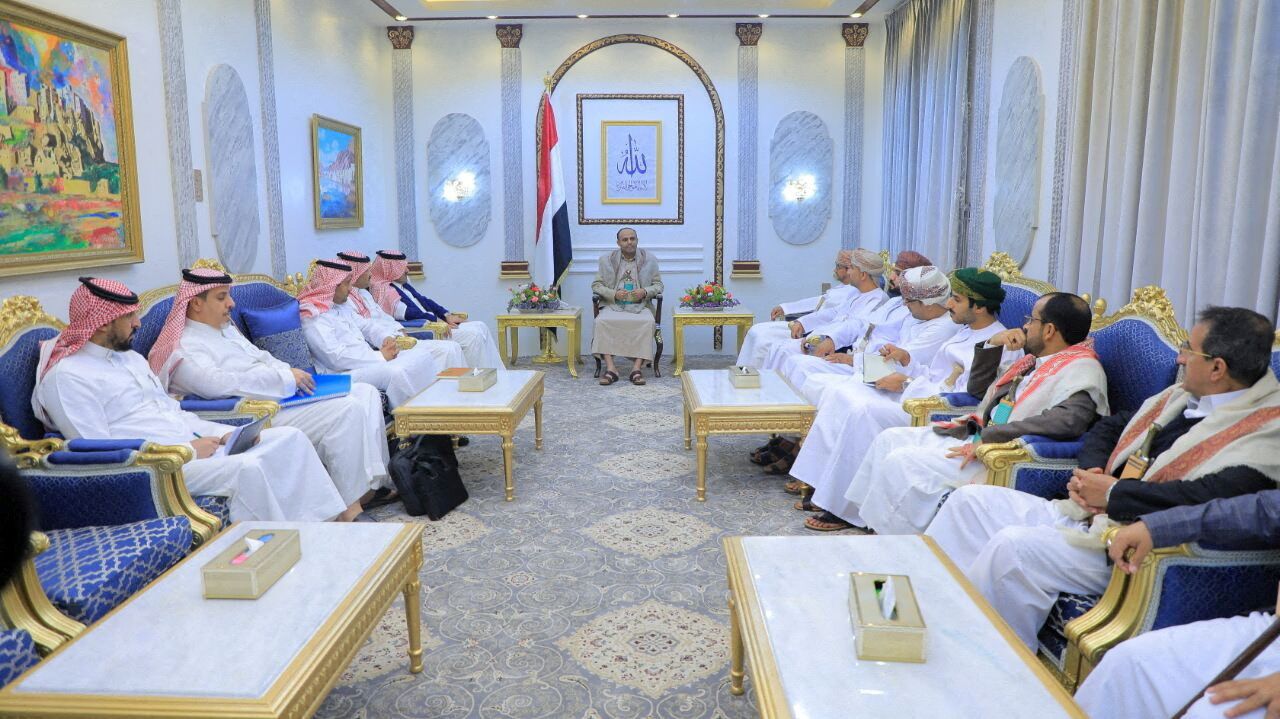
The Yemeni National Salvation Government’s negotiating team, led by Mohammed Abdulsalam, who is also the Ansar Allah movement’s spokesman, traveled to Riyadh, the capital of Saudi Arabia, after Omani representatives consulted officials of the Ansar Allah movement.
Following Oman’s liaison and talks during Mohammad bin Salman’s recent trip to Muscat, Omani representatives entered Sana’a on Friday, September 14. The meeting between the Omani delegation and Ansar Allah officials was held to convey Sultan Haitham bin Tariq’s message to Mahdi Al-Mashat, President of the Supreme Political Council of Yemen.
In general, the negotiation was welcomed by Ansar Allah leaders, and the Yemeni negotiating team, accompanied by Omani representatives, went to Riyadh, the capital of Saudi Arabia on Saturday.
According to Mohammed Abdulsalam’s statements, the priority of this round of negotiations is focused on lifting the siege, opening ports and airports, paying employees’ salaries from oil revenue, as well as prisoner swap.
Other issues such as the withdrawal of foreign forces and the reconstruction of war-torn country for achieving a comprehensive political solution have been raised but they have not yet been confirmed or denied by the other party.
Let’s scrutinize why the nature of the resigned government of Yemen is illegal and the Saudi-led coalition’s operations in Yemen are considered an invasion.
A few days ago, the [Persian] Gulf Cooperation Council, led by Jassim Mohammed Al-Budaiwi, the Secretary-General of the council, traveled to the city of Aden in Yemen. This trip was the first visit by officials of this council to Yemen after 2014. In this meeting, Al-Budaiwi emphasized an issue that is the root cause of the crisis and lack of progress in Yemen’s negotiations, and that issue is nothing but the three references.
The three references include the 2011 [Persian] Gulf Cooperation Council initiative, United Nations Security Council Resolution 2216, and national dialogues recognized by Arab countries as a reference for resolving the Yemeni crisis. However, these references are not solution to the Yemeni crisis but have become a major obstacle to advancing peace negotiations. To clarify the aspects of these three references, we explain them in general:
1- The 2011 [Persian] Gulf Cooperation Council initiative:
This [Persian] Gulf Cooperation Council initiative was presented on April 3, 2011, by the United States and Saudi Arabia to resolve the Yemeni crisis. This initiative is also known as the “Gulf Initiative,” according to which Ali Abdullah Saleh, the then-president of Yemen, was given a 30-day deadline to step down and transfer power to his deputy, Abd Rabbuh Mansur Hadi. Mansur Hadi also had 60 days to form an interim government and prepare the ground for power transfer through elections. This initiative did not end with the resignation of Ali Abdullah Saleh, and Abd Rabbuh Mansur Hadi became the president of Yemen with the support of Arab countries in a one-person election. The seizure of power by the Yemeni revolution and the intervention of Arab countries in the affairs of this country provoked the anger of the Yemenis and led the Ansar Allah movement fighters towards capital Sanaa. Eventually, the Ansar Allah forces entered Sanaa by breaking the defensive lines of Abd Rabbuh Mansur Hadi’s supporters and took control of the government. After the unsuccessful political negotiations between the two sides, Mansur Hadi went to parliament on January 22, 2015 and resigned from his position. A month after his resignation, he was interrogated by intelligence and judicial authorities and finally fled from the presidential palace in Sanaa to Aden on February 21, 2015. This move was followed shortly with an invasion by the Saudi-led coalition, which complicated the political crisis in Yemen with the foreign invasion.
2- United Nations Security Council Resolution 2216:
On April 14, 2015, the United Nations Security Council, without mentioning the Saudi-led coalition’s invasion of Yemen, declared the prohibition of sending any weapons to the Ansar Allah fighters and Ali Abdullah Saleh’s forces in a resolution. This resolution also called on the Ansar Allah movement to hand over power and retreat from Sanaa as well as other cities in Yemen. The UN Security Council also approved the inspection of all ships heading to the war-stricken Arab country. It also banned travel for Abdul-Malik Badruldeen al-Houthi as well as Ahmed, the senior son of Ali Abdullah Saleh.
3- National dialogues:
Following the Saudi-led coalition’s invasion of Yemen, Yemeni national dialogues in Sanaa were halted, and prominent factions such as the al-Islah Party (Yemeni Congregation for Reform), and southern parties and so on, could raise the banner of opposition to the central government in Sanaa due to the support they received from Saudi Arabia, the United Arab Emirates (UAE), and other Arab countries. Following negotiations by the Ansar Allah movement in Sanaa, various political parties that were led by the General People’s Congress under the leadership of Ali Abdullah Saleh united with the Yemeni National Salvation Government. This move weakened the opposition; so, the Ansar Allah movement, after months of heavy defense, was able to repel the Saudi-led coalition’s attacks on Sanaa and Al Hudaydah Governorate in a short period as well as cleanse a large part of the areas under the control of the Yemeni government in Marib, Al Jawf, Saada, and Al Hudaydah governorates.
Over the recent years, many events, such as Ali Abdullah Saleh’s betrayal of the Ansar Allah movement, the Stockholm Agreement, the assassination of Saleh Ali al-Samad, the head of the Supreme Political Council of the National Salvation Government, etc., have changed the course of developments in the Arab country. However, none of these events, like the Ansar Allah’s missile-drone operations against deep areas in both Saudi Arabia and the UAE, had a significant impact on peace negotiations, and ultimately a UN-mediated ceasefire between the Ansar Allah movement and the Saudi-led coalition was established in April 2022.
Despite the establishment of a ceasefire and the Ansar Allah’s efforts to engage in talks with the Islah Party and southern factions in various incidents, intra-Yemeni political dialogue have not been held at any time or place. The main reason for this is the opposition groups’ dependence on Saudi Arabia and the UAE, as well as recent US interventions in Yemen’s developments.
Therefore, the three references are chiefly a hindrance to peace negotiations and the unity of different groups in Yemen rather than a solution to the Yemeni crisis. The [Persian] Gulf Cooperation Council’s initiative can be seen as direct interference in the affairs of an independent country, and UN Security Council Resolution 2216 is interpreted as supporting Arab and Western countries’ goals in Yemen. When a political figure speaks against the three references, it can be inferred that there is no intention to resolve the Yemeni crisis, and some are trying to escalate the war in the country.
In addition to these issues, there are numerous obstacles to Yemeni negotiations that prevent them from reaching a conclusion. These obstacles include US pressure on Saudi Arabia, the United Nations’ involvement in Yemen’s internal affairs, the dependence of Yemeni factions on Saudi Arabia and the UAE, the separatist tendencies of some southern parties with British support, the presence of terrorist groups particularly Al-Qaeda in occupied areas, the disregard of global powers such as Russia and China for Yemen’s developments, internal issues such as the lack of payment of salaries to Yemeni employees from oil revenues, and the ongoing blockade of Yemen.
As a result of preventing the Ansar Allah movement from exporting Yemen’s oil and gas, the resigned government’s budget has reportedly faced a 50% deficit, which will put significant financial pressure on their Saudi and Emirati supporters. International organizations under the auspices of the United Nations, especially the World Food Program, have also significantly reduced their aid to Yemen, forcing UN representatives to hold a special session in New York to collect humanitarian assistance.
Overall, Yemeni peace negotiations, in addition to internal differences and challenges, have become entangled in a more significant regional issue. The success of the Shia Muslims in gaining control of the Yemeni government and the Saudi-led coalition’s invasion of the Arab country with Western support led to Yemen becoming a proxy war between Iran and the United States. Nowadays, this war has entered a new phase with the agreement between Iran and Saudi Arabia, which has led to the resolution of some issues such as the maritime and aerial blockade of Yemen. However, fundamental differences remain, and there is still a long way to go in starting discussions on the formation of a united government and the path to achieving lasting peace.
According to local sources, Tareq Saleh forces have surrounded the western villages of Al-Waziyah and demanded the surrender of armed men loyal to Abu Dhiab Al-Alaqami and the sheikhs who support him.
Al-Wazaiyah tribes have asked for help from their allies in the al-Shamaitin district and from al-Sabiha tribes on the coast of Lahij province.
It is worth mentioning that following Al-Alaqami’s conflict with Tareq Saleh, Al-Waz’iya and Al-Sabiha tribes had declared their support for Al-Alaqami.
1- Shabwah Governorate: On September 5, unidentified armed individuals attacked the positions of Shabwa Defense Forces in the Al-Masina district in Al-Saeed area during an armed attack. During this raid, two of the Shabwa Defense Forces were injured.
2-Abyan Governorate: Following an armed clash in the Joula Tariq neighborhood of Zinjibar coastal town, two civilians were killed and several others were injured.
3-Taiz Governorate: The Eritrean government released 73 Yemeni fishermen, who were detained at Eritrean prisons in Al-Khokha city. According to local sources, 44 other Yemeni fishermen are still imprisoned on Terma Island off the coast of Eritrea.
4-Aden Governorate: On September 6, the supreme council of the “Revolutionary Movement for Freedom and Independence of the South” canceled its contribution to the Southern Transitional Council (STC) led by Major General Aidarous Qassem Abdulaziz Al-Zubaidi after issuing a statement. The party emphasized in its statement that the Southern Transitional Council has no role in advancing the national project in southern of Yemen and is merely a tool for implementing foreign governments’ plans that come at the expense of our people’s dignity and aspirations. The leader of this party is Faysal Baoum, who joined the Southern Transitional Council a few months ago.
5-Al Hudaydah Governorate: Saudi-led coalition forces violated ceasefire 171 times in the Al Hudaydah Governorate over the past 48 hours.
6-Sana’a Governorate: The Sana’a Criminal Court sentenced four convicts of being engaged in Hassan Zaid’s assassination, former Minister of Sports and Youth of the National Salvation Government, to death and other convicts to five to six years in prison. It should be noted that a key member involved in Hassan Zaid’s assassination team was killed by Ansar Allah intelligence forces in Dhamar Governorate.
7-Sa’dah Governorate: The Saudi-led coalition forces targeted border areas in Razih and Shada districts with missile attacks. According to reports that have been released so far, these attacks have not caused any particular casualties or damages.
Saudi coalition artillery attacks on the western areas of Saada province
9- The International Organization for Migration (IOM) reported that more than 90,000 African migrants entered Yemen during the first eight months of the current year.
As a result of the Saudi-led coalition’s artillery and drone attacks on Shada’a, Munbah, Razih, Qatabir, and Al Ghumr in the northwestern and western parts of Saada Governorate during the first four days of September 2023, a Yemeni civilian and an African immigrant were killed, and three other African immigrants were injured.
Meanwhile, the Yemen Executive Mine Action Centre (YEMAC) has also announced that cluster bombs and mine explosions by the Saudi-led coalition in Yemen have killed 37 people, including 12 children, from the beginning of 2023 until now.
Saudis’ scattered attacks, mine explosions, and unexploded bombs from the war in Yemen continue to take civilian lives.
The Saudi-led coalition and the Yemeni government declared a ceasefire in all fronts in an unofficial agreement and are negotiating for peace with the mediation of the United Nations and Oman.
The United Nations has also suspended financial aid to Yemen’s mine clearance executive agencies for the second consecutive month for unknown reasons and it has called for Yemeni cooperation in political cases.
The USS Cole bombing was a suicide attack by al-Qaeda against USS Cole, a guided missile destroyer of the United States Navy, on 12 October 2000, while it was being refueled in Yemen’s Aden harbor. Seventeen US Navy sailors were killed and thirty-seven injured in the deadliest attack against a United States naval vessel since the USS Stark incident in 1987.
After the Al-Qaeda attack on the US ship USS Cole in Aden port, and also the incident of September 11, 2001 in New York City, the then US administration concluded that it should take action against this terrorist group in Yemen as well as Afghanistan.
Following former US president George Bush’s decision to start attacking Al-Qaeda in Yemen, the US military and security agencies in coordination with the then Yemeni government led by Ali Abdullah Saleh began their attacks in this country. These attacks continued after popular protests in Yemen and the downfall of Ali Abdullah Saleh’s government, and after such developments, the eight-year battle between the Ansar Allah movement and the Saudi-led coalition continued.
According to Western media reports, the US has so far carried out 378 attacks, including aerial (by fighter jets and combat drones), missile and ground attacks in this Arab country, which has resulted in the deaths of 1,400 to 1,800 people. So far, a large part of the details and information about these 379 operations have not been published, and the following list has been compiled based on the information available about drone operations that have been reported so far. The operation list is as follows:
1- The US MQ-1 Predator drone attack on the vehicle of al-Qaeda militants in Marib province, November 5, 2002. This attack resulted in the death of six members of al-Qaeda, including the leader Salim Sinan Al-Harethi, known as Abu Ali Al-Harethi (accused of helping to bomb the USS Cole in Aden).
2- The mistaken attack of the American drone on a gathering in Wadi Obayda in Marib province on May 24, 2010. This attack, instead of an al-Qaeda rally, resulted in the death of five people, including Jaber al-Shabwani, the deputy governor of Marib province, who was mediating between the government and the militants. This murder caused the bloodshed of the Shabwani tribes and their conflict with the government forces. They also attacked an oil pipeline in Marib twice.
3- The attack of the American drone on the car of two people suspected of being members of the Al-Qaeda group named Abdullah and Masad Mubarak on May 5, 2011. The aim of this attack was to kill Anwar al-Awlaki, a propaganda member of al-Qaeda, but he was not hit in this attack.
4- The attack of the American fighter jet or drones on the residence of Ali Abdullah Naji al-Harethi, a member of al-Qaeda, and several other suspects, including Ammar Abadah Nasser al-Waili in Zanjibar city on June 3, 2011. Al-Harethi was one of the companions of Abu Musab al-Zarqawi in Iraq and al-Waili was present in the war in Afghanistan and was ordered by Bin Laden to establish a training camp in Saada.
5- The attack of the American fighter jets or drones on a police station in the district of Mudiyah, located in the province of Abyan on July 14, 2011. The media and the Yemeni government at the time reported the casualties of this attack between 6 and 50 dead. Also, on the same day, the American drone targeted the car of Fahad al-Qasso, a senior member of al-Qaeda in Yemen, near the same area, and he survived the attack.
6- The attack of American drones with the participation of Yemeni army fighter jets on Al-Qaeda positions in the areas of Al-Wahda, Al-Amoudi and Al-Khamila in Abyann province on August 1, 2011. As a result of these attacks, 15 militants suspected of being members of Al-Qaeda, including Nasser al-Shadadi, one of the senior members of Al-Qaeda, were killed and 17 others were wounded.
7- American warplanes and drones attack suspected al-Qaeda positions in the outskirts of Zanjibar city in Abyan province on August 24, 2011. This attack killed 30 people and injured 40 others.
8- The American fighter jet attack on a mountain pass in Abyan province on September 21, 2011, which resulted in the death of four Al-Qaeda members. At the same time, seven Al-Qaeda fighters were killed in the coastal city of Shuqra.
9- American drone attack on Anwar al-Awlaki, one of the senior propaganda members of Al-Qaeda in Al-Jawf province on September 30, 2011. In addition to Al-Awlaki, three other people were killed in this attack, including Samir Khan, the American-born editor of Inspire magazine. This attack has been called the first attack in which the US military intentionally attacks its own citizens.
10- American drone attack on al-Qaeda hideouts in the east of Zanjibar, the capital of Abyan province, on October 5, 2011. This attack resulted in the death of five Al-Qaeda members.
11- American fighter jet or drone attack on an unknown mosque in Shabwa province on October 14, 2011. Some American media, quoting the Ministry of Defense of the Yemeni government at the time, claimed that seven Al-Qaeda members were killed in this attack, including Ibrahim Al-Banna, the media officer of Al-Qaeda (Egyptian origin), but this information is not correct, and currently the United States has offered a reward of 5 million to find Al-Banna.
12- In another attack on October 14, 2011, the American drone assassinated the 17-year-old son of Anwar al-Awlaki along with eight other people in Shabwa province.
13- American drone attack on the location of al-Qaeda members in the city of Jaar in Abyan province on December 22, 2011. In this attack, Abdulrahman al-Wahishi, a relative of Nasser al-Wahishi, the leader of al-Qaeda branch in Yemen, was killed along with eight others.
14- American drone attack on the gathering place of Al-Qaeda members near Lowdar city in Abyan province on January 31, 2012. During this attack, 11 al-Qaeda members were killed, including Abdul Moneim al-Fatani, one of the perpetrators of the attack on the USS Cole in October 2000.
15- The American drone attack on al-Qaeda’s hideout near Al-Bayda on March 9, 2012, which led to the death of Abdul Wahab al-Hamiqani, one of the local commanders of al-Qaeda, and 16 others.
16- American drone attack on the gathering of al-Qaeda militants in the city of Jaar in Abyan province between March 9 and 11, 2012. This attack killed 20 people suspected of being members of Al-Qaeda group.
17- American drone attack on Al-Qaeda weapons warehouse in Jaar city, between March 9-11, 2012. Three al-Qaeda members were also killed in this.
18- An American drone attack on a vehicle carrying Al-Qaeda militants in Al-Bayda province on March 14, 2012, which resulted in the death of four Al-Qaeda members.
19- American drone attack on the location of al-Qaeda militants in Lowdar city on April 11, 2012. This attack resulted in 14 deaths.
20- An American drone attack on the residence of Muhammad Saeed Al-Amdeh (Gharib al-Ta’zi), one of the senior members of al-Qaeda, in Al-Samadeh region, between Marib and Al-Jawf provinces on April 22, 2012.
21- American drone attack on the location of Fahd Muhammad Ahmed al-Qasu and another Al-Qaeda member in the south of Shabwah province on May 6, 2012.
22- The attack of an American drone on a wedding ceremony in the Radaa area of Al-Bayda province on December 12, 2013, which led to the death of 15 civilians. The US claims that 9 to 12 Al-Qaeda militants were killed in this attack, and the claim that civilians were killed is not true.
23- American drone attack on a car carrying two Al-Qaeda members in Al-Qatman area of Hadhramout province on January 8, 2014.
24- American drone attack on the car of al-Qaeda militants in Al-Mifaa area in Shabwa province on March 3, 2014. This attack killed three Al-Qaeda members, and it is believed that Mujahid Jaber Saleh al-Shabwani was one of the dead.
25- On April 20 and 21, 2014, American drones attacked al-Qaeda positions in southern Yemen, which, according to the Ministry of Defense of the resigned government of Yemen, led to the death of 22 members of this group.
26- American drone attack on the location of Nasser Abdul Karim Al-Wahishi, one of the leaders of al-Qaeda in Hadhramaut province (probably Al-Mukalla city) on June 12, 2015.
27- The attack of the American fighter or drones on the al-Qaeda camp in the Hajar region of Hadhramaut province on March 22, 2016. This attack led to the death of 40 to 50 members of this group.
28- American drones attacked the government intelligence headquarters in Zanjibar city and other positions of Al-Qaeda members in the areas of Naqeel Al-Haila and Al-Hazan in Abyan province on March 27, 2016. The casualties of al-Qaeda in these attacks have been announced as eight.
29- American fighter or drone attack on al-Qaeda positions in Shabwah province on October 4 and 18, 2016.
30- American fighter or drone attack on the location of Al-Qaeda members in Marib on October 21, 2016. Five Al-Qaeda members were killed in this attack.
31- The attack of American drones on unspecified areas in Al-Bayda province on January 21, 2017, which resulted in the death of three people. This attack was the first US airstrike in Yemen since the beginning of Trump’s presidency. The United States claims that one of the killed people, Abu Anis al-Abi, was one of the field commanders of al-Qaeda and two other members of this group, but local sources called them construction workers.
32- On October 2, 2017, American drones and fighters carried out 30 attacks on al-Qaeda positions in the three provinces of Hadhramaut, Shabwa and Abyan.
33- American drone attack on a car carrying al-Qaeda members in Shabwa province on July 6, 2018. This attack killed seven people.
34- American drone attack on the location of Jamal al-Badawi, one of the agents of the Al-Qaeda attack on the USS Cole in Marib province on January 1, 2019.
35- The attack of three American drones on al-Qaeda positions in Al-Bayda province on June 24, 2019. These attacks led to the death of 5 people suspected of being members of the Al-Qaeda group.
36- The attack of American drones on Jo Al-Nasim area in Wadi Obeidah and an unspecified place in the administration of Obeidah located in Marib province on January 25, 2020. The attack on Obeidah resulted in the death of an unknown person.
37- American drone attack on al-Hazmeh area in Marib province on January 27, 2020. During this attack, Abdullah al-Adani, a member of Al-Qaeda, was killed.
38- An American drone attack on a car at the Al-Qaeda checkpoint in the village of Hassoun al-Mashrif in the administration of Wold Rabi in Al-Bayda province on January 29, 2020. America claims that it killed Qasim Al-Rimi, the leader of al-Qaeda in Yemen, in this attack.
39- American drone attack on the car of al-Qaeda members on the eastern road of Marib on November 13, 2021.
40- American drone attack on the gathering of Al-Qaeda members in a house in Al-Hadba area in the northeast of Marib city on November 30, 2022. This attack led to the death of several people, including Abi al-Khair Abdulwahid al-Najdi, the person in charge of engineering and making explosives of Al-Qaeda group. Also, Hassan al-Hazrami and Ahmad Zaki, other prominent members of al-Qaeda, were also wounded.
41- An American drone attack on a vehicle carrying al-Qaeda militants near the Al-Haira gas station in the Al-Samada region on the Marib-Al-Abar road on January 30, 2023. In this attack, three occupants of the car were killed, including Yasir Abdullah Rashid Al-Amiri from the administration of Wasab Al-Ali in Dhamar province, Hossein Hadbol al-Makni (Hassan al-Hazrami) in charge of making bombs and explosives for al-Qaeda, and his brother Musa Hadbol (Mohed al-Hazrami).
42- American drone attack on a house in Al Jalal area, located in the east of Marib city, on February 26, 2023. This attack led to the death of Hamad bin Hamoud al-Tamimi (Abd al-Aziz al-Adnani), a Sharia official and one of the prominent commanders of al-Qaeda in the Arabian Peninsula, and one of his bodyguards.
43- American drone attack on a bus near Shaqman gas station in Hajba area, located in the south of Marib city on August 30, 2023.
Out of these attacks, one attack was carried out during George W. Bush’s tenure, 185 operations during Barack Obama’s presidency, 188 operations during Donald Trump’s era, and five attacks during the Joseph Biden administration.
It is worth mentioning that the main goal of the US attacks in Yemen was to prevent Al-Qaeda from gaining power in the Arab country. However, these attacks have not had any significant impact on the developments in Yemen, and Al-Qaeda still operates in the governorates of Hadhramaut, Shabwah, and Abyan. In contrast, the operations by Ansar Allah fighters in Saada, the northern governorate of Al-Bayda, Al-Jawf, Marib, and Sanaa have been more effective in combating terrorism in Yemen. Al-Qaeda terrorists’ presence in many of those areas has been eliminated for years.
It should be noted that the decision to use Al-Qaeda terrorists in the war against Ansar Allah was made by Saudi Arabia and the United Arab Emirates (UAE). This shows that the United States had no problem with the decision until the ceasefire between the Saudi-led coalition and Ansar Allah movement was established. Following the developments, they resumed their attacks on Al-Qaeda elements, especially in Marib.
Despite the direct attacks by the US, Al-Qaeda’s activities in Yemen continue, mainly concentrated in the governorates of Hadhramaut, Shabwah, and Abyan. They are heavily engaged in fighting with the militants affiliated to the Southern Transitional Council (STC) in northern Abyan and are trying to recruit more human resources in the Shabwah tribes. They have also disappeared into the desert areas of Hadhramaut. However, unlike their presence and influence in these areas, no area is entirely under their control. This situation has allowed them to maintain their presence in Yemen and keep their Takfiri rivals, especially ISIS, out of competition.
Finally, it should be asserted that unlike southern separatists and other secessionist movements in Yemen, Al-Qaeda has a broader view of this region and aims to control the Arabian Peninsula. However, this issue is limited to threats by their senior officials in speeches and has not yet been practically realized. Perhaps this trend has led the United States to reduce its attention to Al-Qaeda’s presence in Yemen, and their attacks have become more of a security and symbolic measure.
1- Aden: – The Ministry of Defense of the resigned Yemeni government announced that it has auctioned four military boats and several fuel tanks. – On August 31, a delegation from the Persian Gulf Cooperation Council, headed by Jassim Al-Budaiwi, Secretary-General of Persian Gulf Cooperation Council, traveled to the city of Aden, Yemen. This trip is the first visit by officials from the Persian Gulf littoral states to Aden since 2014.
2- Hadhramaut: On August 30, a diplomatic and military advisory delegation from the United States, led by Steven Fagin, US ambassador to Yemen, entered the city of Seiyun. The US delegation visited the city of Seiyun and met with Mabkhout bin Mubarak bin Madi, Governor of Hadhramaut and other local officials of this city and discussed developments in Hadhramaut Governorate. This meeting took place while the US soldiers had entered Al-Gharfa village in western Seiyun in recent days.
3- Taiz: Al-Waziyah tribesmen attacked one of military bases belonging to forces affiliated to Tareq Mohammed Abdullah Saleh, a Yemeni military commander and the nephew of the late President Ali Abdullah Saleh, in Al-Shaqira town, the center of Al-Waziyah district.
4- Al-Hudaydah: – Saudi-led coalition forces violated their ceasefire with Yemen 151 times in the Hudaydah Governorate during the past 48 hours. – Saudi-led coalition drones bombed the Muqbanah District 12 times during the past 48 hours.
5- Al-Bayda: On August 31, as a result of artillery attacks by militants affiliated to the Southern Transitional Council (STC) on the Ansar Allah movement’s positions in the Dhi Amkhashab area in Al-Zahir district, a child was martyred and another kid was injured.
6- Timothy Lenderking, US Special Representative for Yemen Affairs said that we support a permanent cessation of war in Yemen. There are difficult issues that Yemenis themselves must solve. It is not true that the US wants to achieve military interests through a problem in Yemen. We want to find a quick solution to the issue of Yemeni employees’ rights so that we can later go to other issues such as governance in Yemen.
Local sources say that these drones carried out another attack in the east of al-Wadi region.
No news has been published about the results and details of these attacks, but it is likely that the Americans targeted Al-Qaeda members in Marib province.
Based on data analysis, this attack is the 379th air attacks by the US Army in Yemen during the last two decades; And the fifth attack during the presidency of Joseph Biden.
The areas that were attacked by the US aircraft – click to view full size
The US Marine occupying forces were stationed in the town of al-Ghurfa in the western suburbs of the city of Seiyun in Hadhramaut province. They have also taken control of the main streets and roads of this area and have deployed their military vehicles in them.
The US soldiers in the town of Ghurfa in the north of Hadhramout province
According to Ansar Allah officials, the Americans have been stationed in six places in Yemen. Al-Riyan airbase and Ghayl Ba Wazir are among the areas in Hadhramout province that have been under temporary or permanent occupation by the US military.