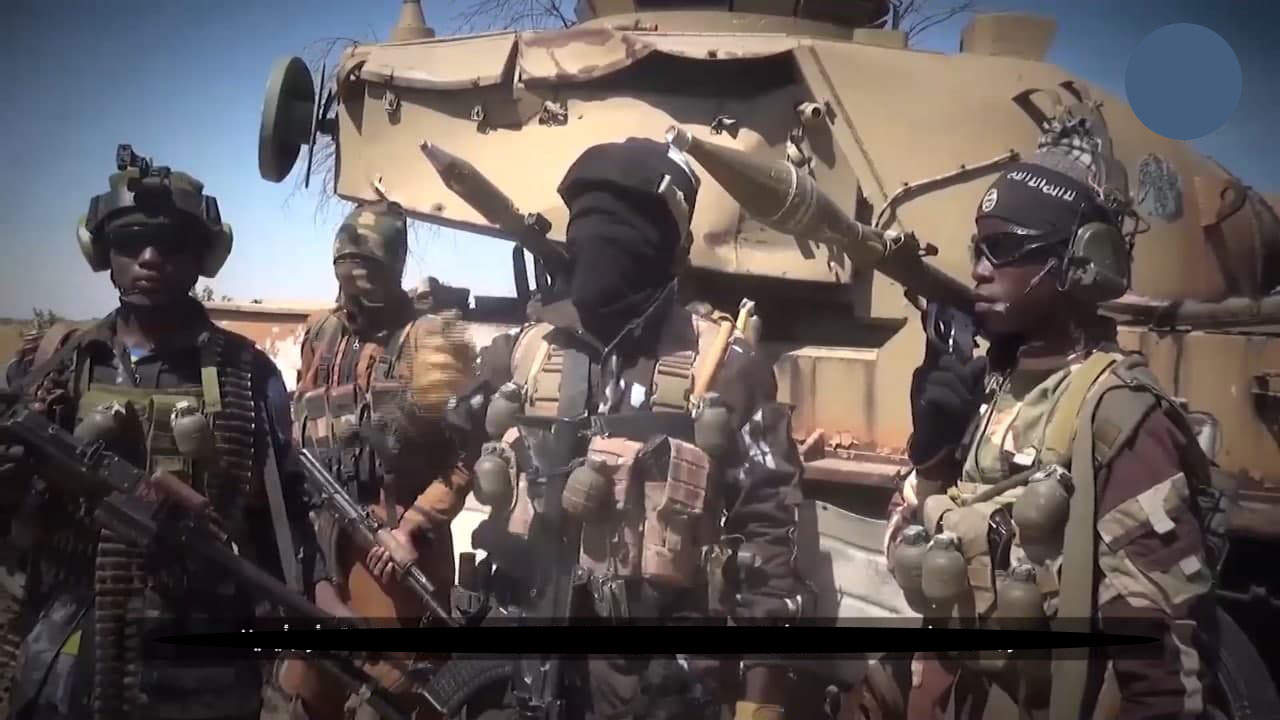
The released video is about the operations of IS branch in the West Africa region (ISWAP) and shows the operations that were mainly carried out in the first half of 2021 in different parts of Nigeria.
The video includes various terrorist operations in the states of Nigeria, including raids on Nigerian military bases, executions, military parades, attacks on villages, looting of Nigerian military weapons and equipment, etc.
Although ISIS has released most parts of the video in the past in the form of image reports.
According to published video, most of the ISIS attacks took place in the northeastern Nigerian states of Borno and Yube; However, parts of this video also include images of the southeastern and southwestern regions of Borno State. The analysis of this video shows that the available weapons have been looted or stolen from the military of Chad, Cameroon and Nigeria. It also appears that the Islamic States West Africa Province (ISWAP) militants are using an APC, like a Mowag Piranha variant in Nigeria.
This video could have been released for two reasons: 1) To show off the power of ISIS in West Africa and announce its presence in these areas. 2) To counter the media war of the Nigerian government and to deny the news of the weakening of the ISIS branch in West Africa.
IS in Africa (ISWAP) is one of the most serious security threats in the center of the continent, especially in Nigeria, and now with the weakening of Boko Haram and the intensification of the activities of the official branch of ISIS in this country, the danger to the countries around Nigeria is felt more than ever. The published images and actions of ISWAP should not be underestimated, and if the necessary decisions are not taken, the situation in West Africa will get out of control more than ever. Currently, the security situation in West Africa with the presence of various terrorist groups is so dire that there is no need for a deeper and more dangerous challenge!
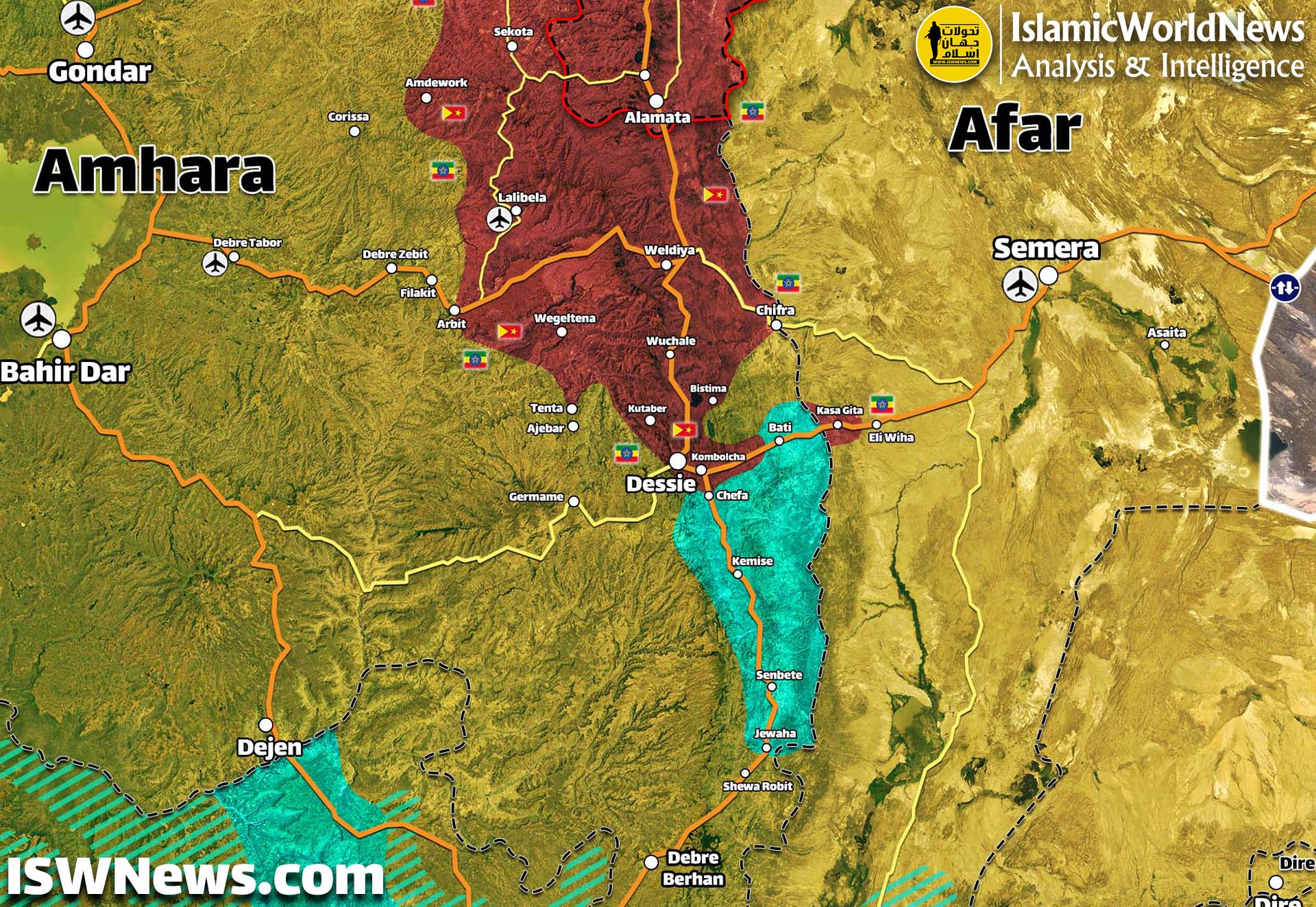
According to the latest news, the Tigray Defence Forces (TDF) have captured the towns of Dessie and Kombolcha in the Amhara region. Clashes are currently raging between militants and Ethiopian military (ENDF) in the suburbs of Kombolcha. There are also reports of Tigray forces advancing south and capturing Were Ilu.
Oromo Liberation Army (OLA) militants, on the other hand, managed to take control of the town of Kemise, 45 km south of Kombolcha, and advanced north to reach the Tigray forces. In recent statements, the Tigray and OLA militants have stated their intention to overthrow the government of Abiy Ahmed and seize the Ethiopian capital Addis Ababa.
Until recently, the Oromo Liberation Army (OLA) were considered the military branch of the Oromo Liberation Front (OLF) political party. In 2018, a peace agreement was reached between the Ethiopian federal government and the Oromo Liberation Front (OLF) to end the conflict in Oromia; But the Oromo Liberation Army (OLA) split from the (OLF) in opposition to the agreement. Since then, OLA militants have continued their attacks on Ethiopian military forces in the region.
On August 11, Kumsa Diriba, the leader of Oromo Liberation Army announced that the group had formed an alliance with the Tigray Defense Forces (TDF) and was in talks with other insurgent groups to form a “grand coalition” to overthrow Ethiopian Prime Minister, Abiy Ahmed.
Regarding the newly captured areas by the TDF and OLA militants, it is noteworthy that these towns have hosted thousands of war refugees in the Amhara region in recent months. The towns of Dessie and Kombolcha are about 255 kilometers from the Ethiopian capital Addis Ababa, and their capture by the militants poses a serious threat to the Ethiopian capital. TDF militants also entered Afar province from Chifra and Kasa Gita areas. The ultimate goal seems to be to cut off the A1 highway and weaken one of the Ethiopian government’s logistics routes. The A1 Highway is the access route from Addis Ababa to the port of Djibouti or the port of Assab and access to open water.
The latest clashes in Ethiopia began on November 3, 2020, after the Tigray Liberation Front (TPLF) attacked the Ethiopian Army headquarters in Mekele, the capital of Tigray State, and finally after a few weeks of Ethiopian military operations and the capture of a number of important areas in the Tigray region, the battles ended with the announcement of the liberation of the city of Mekele and the end of the operation by Abiy Ahmed on November 28, 2020.
But that was not the end, and the Tigray forces gradually regained their strength and regained control of many lost areas by forming a new military structure called the Tigray Defense Forces (TDF). Tigray Defense Forces came into existence during the Tigray War in the fall of 2020 from the merger of the Special Forces of the Tigray Regional government, soldiers that have defected from the federal forces, local militia, members of Tigrayan political parties such as the TPLF, National Congress of Great Tigray, Salsay Weyane Tigray, Tigray Independence Party and others together with numerous youth who fled to the mountains.
Coinciding with the military and field developments in northern Ethiopia, several peace meetings have been held by international organizations and African countries to resolve the Tigray crisis and the Ethiopian civil war, but all efforts have been fruitless. On the other hand, the Tigray front, which is very dissatisfied with the current situation and the unequal behavior of the Ethiopian federal government towards the Tigray people, recaptured the city of Mekele on June 28, 2021 and vowed to continue their offensive and drive into Eritrea or the Amhara Region if necessary.
Therefore, on July 6, the TDF militants launched an operation called “Operation Tigrayan Mothers” with the aim of retaking the occupied territories in the Tigray state, and then dragged the war into the state of Amhara, and tensions between Tigray and the Ethiopian government have risen more than ever.
It is noteworthy that over the past year, there have been numerous and contradictory reports of war crimes and massacres of civilians and unarmed individuals by groups involved in the Ethiopian war. According to available information, at least 10,000 civilians have been victims of war crimes and genocide, rape, looting and etc.
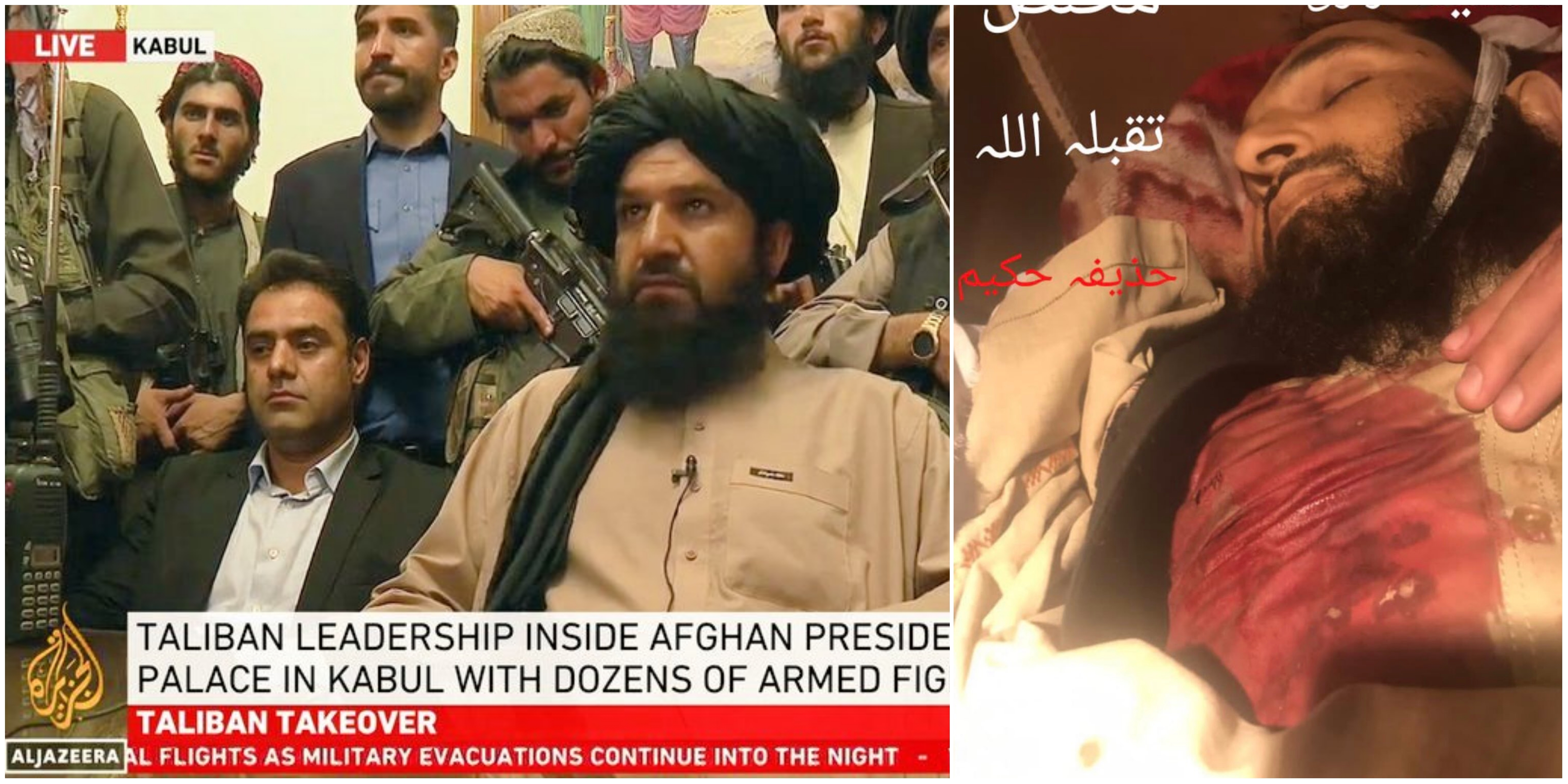
Hamdullah Mokhles, a Taliban field commander was killed in the attack. Mokhles is said to have been the commander of the Kabul Corps and was one of the first troops to enter the Afghan presidential palace during the Taliban occupation of Kabul.
According to available information, two explosions took place at the entrance of Sardar Mohammad Daoud Khan Hospital and its vicinity, after which ISIS operatives clashed with Taliban militants.
This is the fourth major ISIS attack in Afghanistan since the Taliban took control of the country. ISIS has previously targeted Kabul Airport, the Kunduz Shiite Mosque and the Kandahar Shiite Mosque, killing and injuring hundreds of Afghans.
– On November 2, the UK troops deployed to Mali as part of the UN Peacekeeping mission have detained three suspected ISIS terrorists and seized their weapons.
– According to local sources, discussions between the Mali military and Russian Private Military Contractors is ongoing despite the continuous effort by France to block the move.
– On October 30, in two separate attacks in west and center of Mali, seven soldiers killed and three wounded, according to Mali’s Armed Forces media.
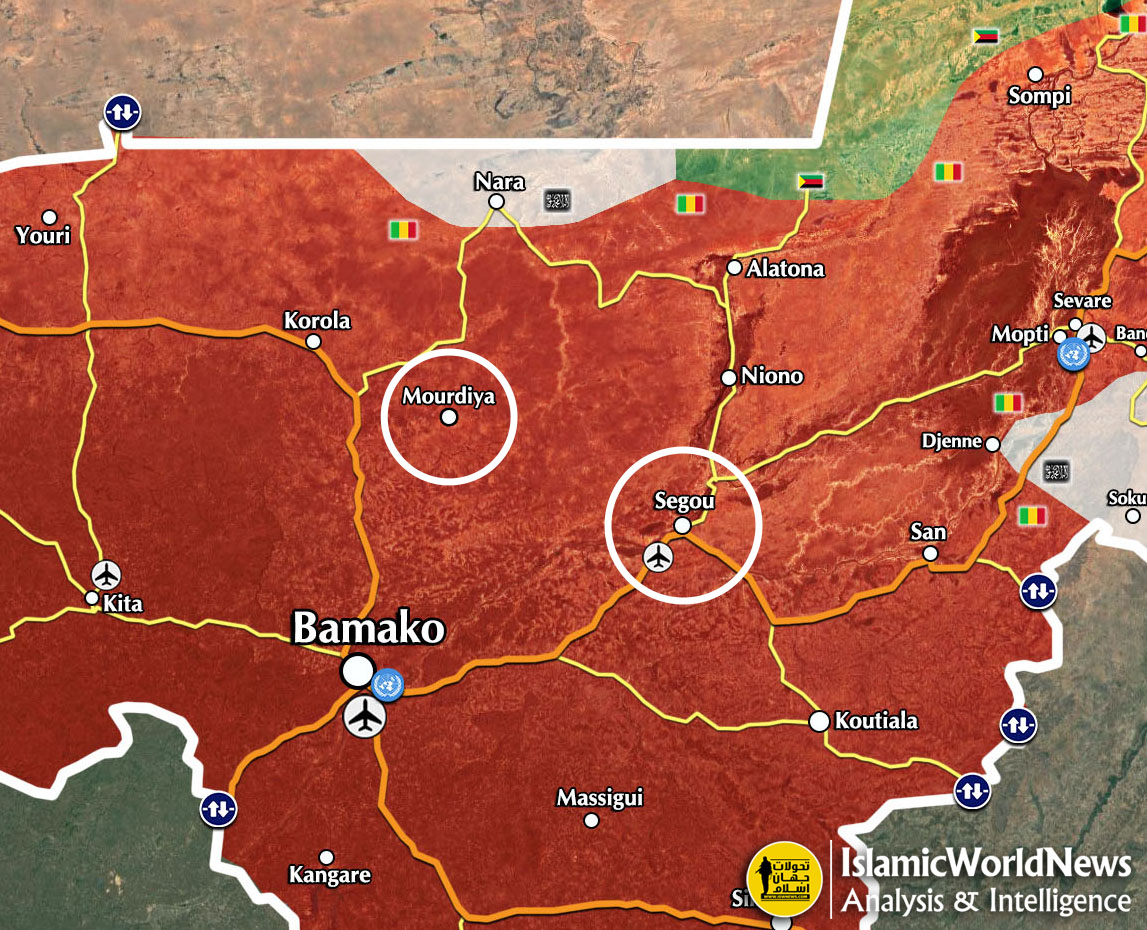
– On October 30, two Malian Army personnel were killed in a militant ambush near the town of Mourdiah
– On October 30, a Malian Army vehicle was attacked by a mine in Segou town. Five soldiers were killed. Mali’s armed forces reported that all five passengers killed and investigating for the two individuals who were responsible for the attack.
Segou and Mourdiyah in western Mali
Previously Mali’s Army endured two deadly attacked in October: 1- Army’s checkpoint in Acharan area, Timbuktu , north of Mali was attacked by terrorists which killed one soldier and four terrorists. It happened on October 17. 2- Terrorists attacked a caravan of the army in Kuru-Bandiagara road in the center of Mali, in which 16 soldiers killed and 9 wounded. In this conflict 15 terrorists killed and 20 motorbikes were destroyed or confiscated by the army.
Timbuktu and Bandiagara in center of Mali
Given the nature of the attacks and the location of the various groups in Mali, all four recent attacks in Mali appear to have been carried out by militants of the Jama’at Nasr al-Islam wal Muslimin (JNIM).
Mali has severe security, political and economical crises since 2012. Uprisings for independence, Jihadi groups attacks and violence in presence of UN, French and European forces caused thousands killed and hundreds of thousands misplaced in Sahel region.
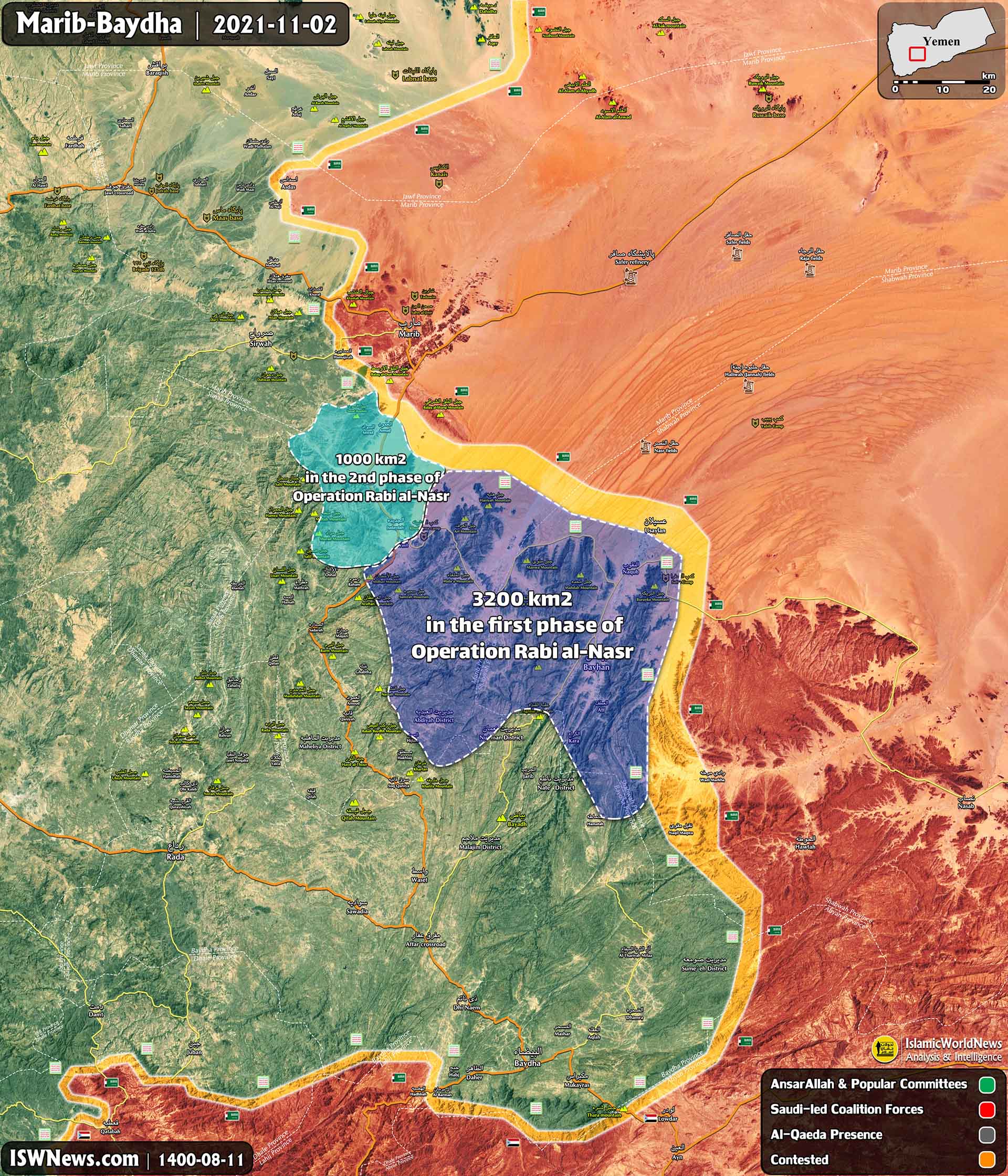
Yemeni Armed Forces spokesman Brigadier General Yahya al-Sari explained the details of the second phase of Ansar Allah operation in the southern province of Marib, entitled Operation Rabi al-Nasr.
Brigadier General Yahya al-Sari’ said during the press conference:
“Our forces, with the support of the tribes, continue to operate to achieve the freedom and independence of the country. Al-Juba and Jabal Murad districts in Ma’rib province with an area of 1,100 square kilometers were liberated in the second phase of Operation Rabi al-Nasr. Our forces have also liberated the Al-Amoud area and have taken up positions near the “Falaj” point at the entrance to the city of Marib.
The foreign enemies suffered a lot of damage, especially those who insisted on fighting, but those who left the war, our forces allowed them to leave.
Enemy warplanes carried out 159 airstrikes and could not stop the advance of our warriors. In the second phase of Operation Rabi al-Nasr, our air defense systems managed to carry out 86 operations against enemy warplanes. The missile force carried out 47 operations against enemy positions, 31 in the occupied territories and 16 deep in Saudi territory. The Air Force has carried out 141 operations, including 128 operations in the occupied territories and 13 operations deep in Saudi territory. During the second phase of Operation Rabi al-Nasr, more than 200 militants were killed and more than 550 were injured.
We are proud to record the prominent role of the elders and heroes of the free Marib tribes in liberating and securing their territories. The free people of Jabal Murad district enjoyed an honorable position to accompany their country and people in the face of the aggressors and agents of Washington and Tel Aviv.
The armed forces warn the remaining mercenaries in Marib to react quickly to stop the clashes immediately. We will defend our people and our country if the hostility and aggression continue.
Addressing the Saudi regime, we say: We do not say that your war is just absurd, but it is a crime, aggression, humiliation, disgrace and also a defeat for you. The struggle of the free people is until independence, an inevitable struggle for freedom; This battle will not be postponed or changed.”
It should be noted that the first phase of Operation Rabi al-Nasr was carried out in the south of Marib province and the west of Shabwa province, which eventually led to the liberation of an area of nearly 3,200 square kilometers from September 21 to October 17 from the occupation of Saudi-led forces. In the mentioned operation, the districts of Beyhan, Ain and parts of Usaylan in Shabwah province and Harib and Abdiyah and parts of Juba and Jabal Murad were liberated.
Therefore, so far, during the first and second phases of Operation Rabi al-Nasr, a total area of nearly 4,200 kilometers has been liberated.
According to a Syrian military source, at around 00:56 a.m. local time, the Zionist enemy fired several missiles from the occupied northern Palestine into the Zakiya area on the outskirts of Damascus, causing material damage.
On October 30, the Israeli army also targeted Syrian army positions in the al-Dimas area, west of Damascus, with surface-to-surface missiles.
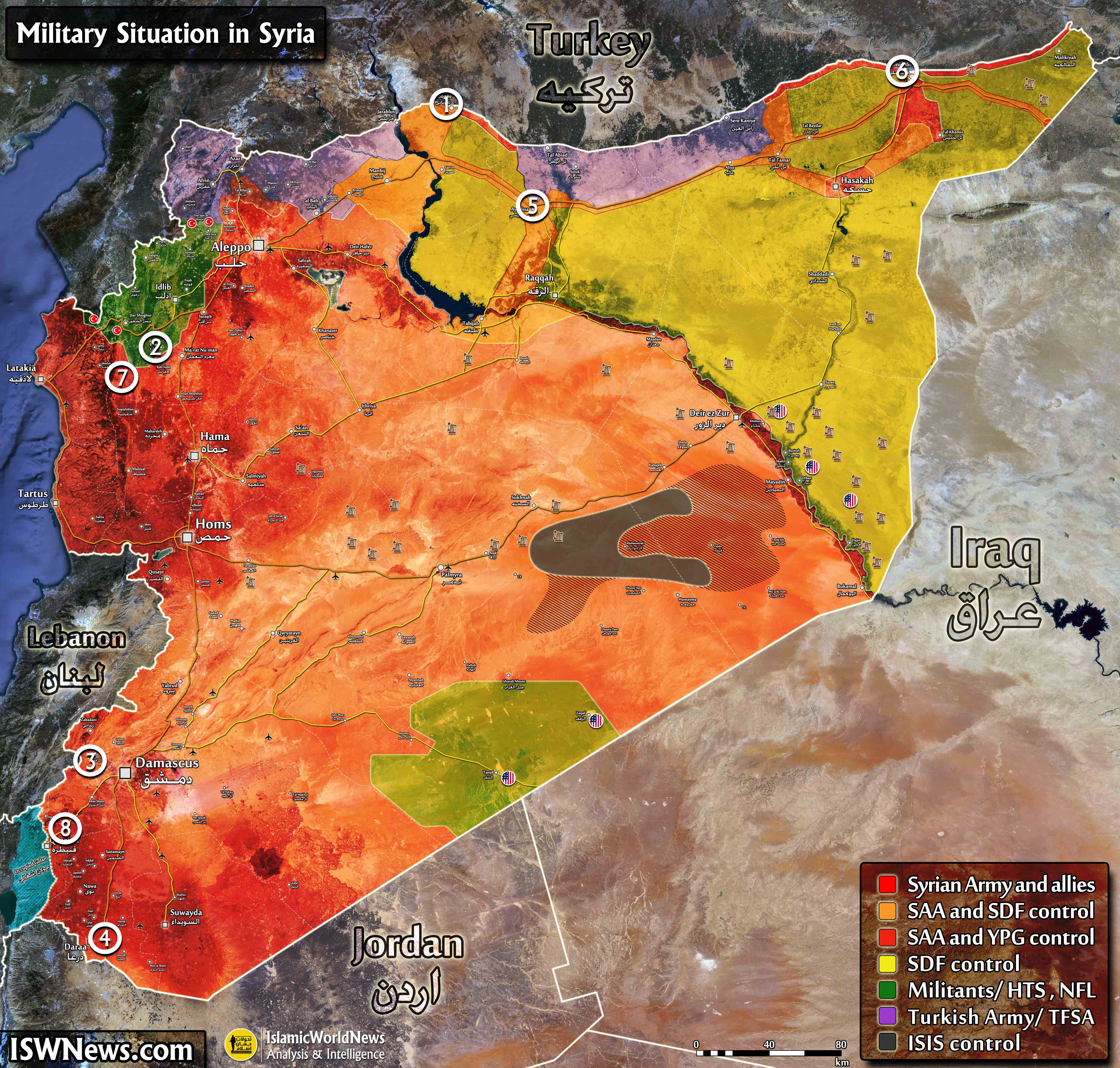
1- Aleppo: On October 24, a Turkish military drone targeted a vehicle belonging to the Syrian Democratic Forces (SDF) at the entrance to the city of Ain al-Arab, killing three SDF members.
2- Idlib: – Russian fighter jets attacked militant positions on the outskirts of the town of Al-Barah, south of Idlib. – On October 28, a Turkish military convoy entered Idlib through the Kafr Lusin crossing. – One of the Syrian army forces who was wounded on the Idlib front, was martyred yesterday due to his injuries. – Russian fighter jets attacked militant positions on the outskirts of Tadil and Kafar Ameh.
3- Damascus: On October 30, the Israeli army targeted the Syrian army positions in the west of Damascus with several missiles. The attack injured two Syrian army soldiers and caused material damage.
4- Daraa: – One of the Syrian army forces was assassinated on the Nafaa-Shajrah road by unknown gunmen. – On October 25, a Russian military police vehicle was targeted by a roadside bomb on the Sayda-Umm al-Mayazin road in eastern Daaraa, injuring its occupants. – A Syrian army colonel and his wife were injured in an explosion on a car on the Sanamayn-Jabab road.
5- Raqqa: – Turkish-backed artillery attacked SDF positions on the outskirts of Ain Issa. – Following the escalation of tensions in northern Syria, on October 27, a Turkish military convoy entered the city of Tal Abyad in the northern province of Raqqa. – Russian fighter jets attacked ISIS hideouts in the Rasafa area, southwest of Raqqa. – On October23, an American MQ-9 drone attacked a target on the outskirts of the village of Saluk, north of Raqqa, and assassinated an al-Qaeda field commander named Abdul Hamid Matar.
6- Hasakah: On October 31, SAA and Russian forces carried out Joint military exercises in the countryside of Tal Tamar
7- Hama: A civilian was martyred and two children were wounded in an artillery attack by Turkish-backed militants on the village of Jurin in the Al-Ghab plain.
8- Quneitra: On October 25, Israeli helicopters targeted a Syrian military point in the village of Al-Kroum, on the outskirts of Al-Baath, and two other points in Quneitra province.
9- On October 26, the Turkish Parliament agreed to continuation of Turkey military presence in Iraq and Syria for another two years.
10- According to the Russian Reconciliation Center in Syria, the militants violated the ceasefire nine times in the Idlib region, of which 2 are in Aleppo province, 2 are in Latakia province and 5 are in Idlib province.
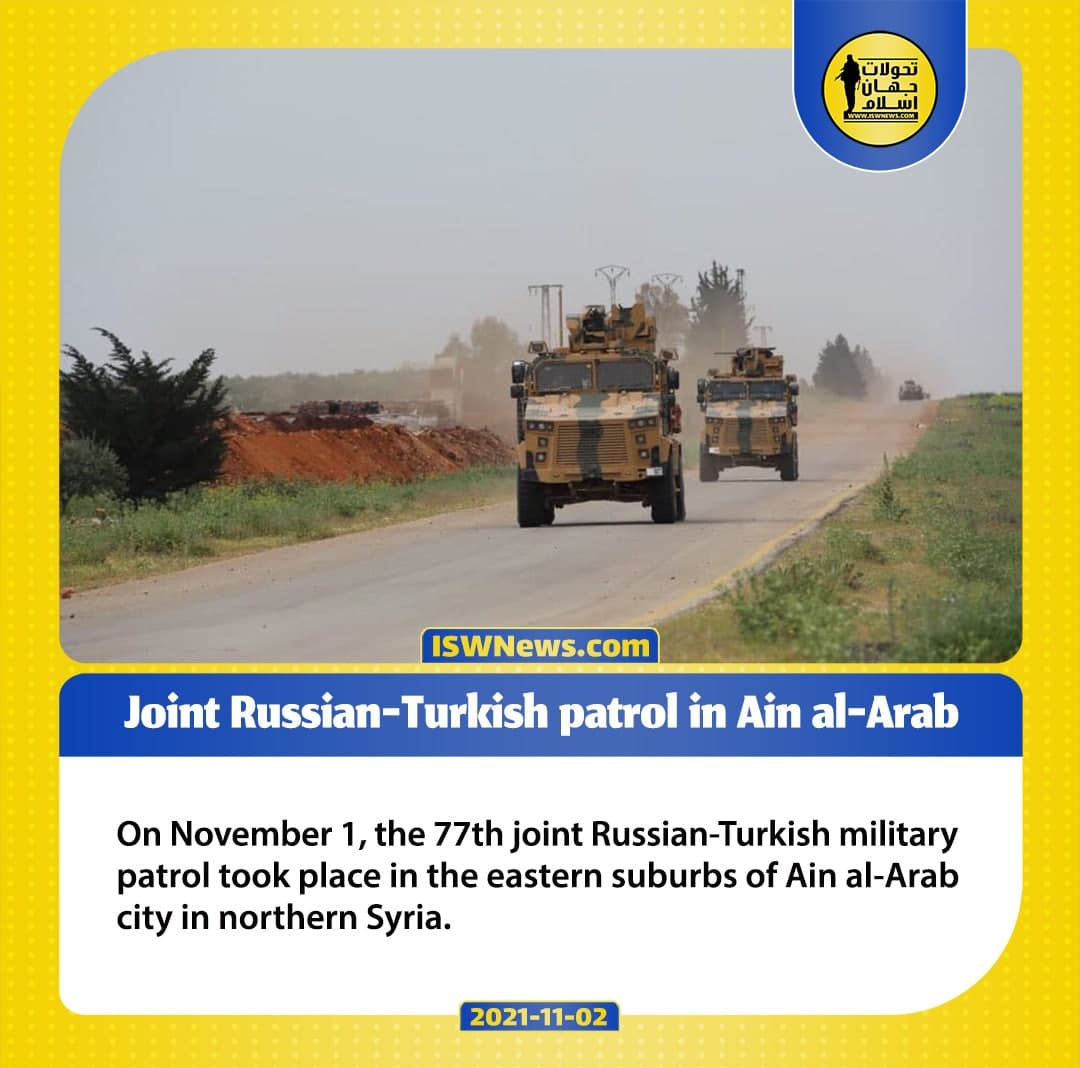
The convoy, consisting of eight Russian and Turkish military vehicles, began patrolling the village of Gharib, 15 km east of Ain al-Arab (Kobani), escorted by two Russian helicopters.
On October 25, the Russian military police canceled a joint patrol with the Turkish military due to protests of residents of the city of Ain al-Arab because of Turkish airstrikes on the city and Russia’s non-compliance with its obligations to maintain security and protection of the city of Ain al-Arab. .
The last (seventy-sixth) joint Turkish-Russian military patrol also took place on October 18 in the eastern suburbs of Ain al-Arab.
According to the Iranian Navy media, the naval escort team of the army stationed on the Iranian tanker this morning on the way to the Gulf of Aden, before entering the Bab al-Mandeb Strait, clashed with pirates. The attack was carried out by four pirate boats approaching an Iranian tanker. The pirates then came under fire from the army and eventually fled.
This attack is the second pirate attack in recent days against tankers and navy of the Islamic Republic of Iran in the Gulf of Aden.