On February 6th, at 21:30 local time, a US military logistical convoy was attacked by the “International Resistance” group in Samawah, in the Muthanna province. Earlier on January 26th, another US logistical convoy was attacked by the same group in the Baghdad’s Yousufiya area.
It is worth mentioning that this attack was the fourth attack on American convoys in Iraq since the beginning of 2023.
Last year, in 2022, Iraqi resistance groups carried out 102 IED, drone and rocket attacks against positions, logistical and military convoys of the American occupiers in Iraq.
Over the past 300 days, the United States and European countries have sent dozens of military, financial and economic aid packages to prevent Ukraine from falling under Russia’s control, but these aids have not resulted in any specific results for the Ukrainian government and they are still under the fire of Russia’s heavy attacks. Now, one of the solutions proposed by senior Ukrainian generals to change the balance of the war is to obtain at least 300 battle tanks.
Recently, this proposal has been approved by the United States and most European countries, and the Americans have announced that they will send 31 Abrams tanks to Ukraine in the coming months to encourage the Europeans to send more of their tanks to Ukraine.
German Chancellor Olaf Scholz, after avoiding sending advanced German weapons to Ukraine for some time, finally on January 25, while announcing his agreement to issue a license to send Leopard tanks from other countries to Ukraine, announced that this country will provide Ukraine with 14 Leopard tanks in the first phase. This German decision has paved the way for other countries, including Poland, Canada, Norway, etc. Therefore, the supply of Leopard tanks to Ukraine has started by sending four Leopard 2 tanks from Halifax airport in Canada on February 5.
Canada sends Leopard tanks to Ukraine
In this regard, the UK has also announced the transfer of 14 Challenger 2 battle tanks (the main tank of its army), self-propelled artillery and thousands of rounds of ammunition to Ukraine, and other European countries have also announced the preparation of similar measures.
The Leopard 2 tank is one of the effective weapons made by Germany, and in the past years, 3,000 units of it were sold to Austria, Canada, Chile, Denmark, Finland, Greece, Holland, Norway, Poland, Portugal, Singapore, Switzerland, Sweden, Spain and Turkey. Therefore, its equipment and ammunition are available to the Ukrainians, and it is a more suitable option than the Abrams tank, which has a smaller number in Europe.
Western analysts believe that sending 300 battle tanks to Ukraine in the current situation is not possible and cannot completely change the outcome of the war, however, it may temporarily affect the course of the war and prolong the resistance of Ukrainians against Russia for a while. The southern and eastern regions of Ukraine are often composed of flat and hilly terrain, and the Ukrainian army needs a lot of tanks to carry out offensive operations and recapture these areas. Of course, the goal of the Westerners in sending these weapons is to prevent the defeat of Ukraine and the erosion of the war. The higher the cost and losses of Russia in this war, the weaker their eastern rival will be.
The most military confrontations in Ukraine are now concentrated in the front-line city of Bakhmut in eastern part of the war-stricken country. The Russian military forces are finalizing the siege of the Ukrainian city by keeping on advancements in the northern, eastern and southern fronts of Bakhmut.
The Russians continue military advancements in the northern Bakhmut battle field, following the seizure of other regions, including the town of Soledar, Sol, Krasnopolivka village, Pidhorodne and Blahodatne village along the Bakhmut-Siversk road, and the Russian military forces seized the village of Sakko i Vantsetti in the north of the road, and the confrontations in the southern areas extended into Krasna Hora and Paraskoviivka regions. The seizure of Krasna Hora and Paraskoviivka regions would be Russians last step to surround Bakhmut from the northern front.
Military situation in the northern front of Bakhmut
In the eastern front of Bakhmut, the fighting continues and the Russian military forces succeeded in making some minor advances in this region. The confrontations continue in the eastern front of the Ukrainian city in vicinity of a meat factory as well as Zabakhmutivka neighborhood.
Clashes in the eastern areas of the city around the meat factory and Zabakhmutivka neighborhood
On the southern front of the Bakhmut city, Russian forces could advance toward the north of Klishchiivka district, and the clashes reached in vicinity of Ivanivske at the western entrance of the besieged city of Bakhmut. Furthermore, as a result of the advancement in the mentioned region, the Russian army took the control of the heights overlooking the Kostyantynivka-Ivanivske-Bakhmut road. Hence, the Russian military forces have fire superiority over the Kostyantynivka-Ivanivske-Bakhmut road, and the Ukrainian army’s logistics route from the western areas to the city of Bakhmut has been blocked; so, the only remaining path is the road from Chasiv Yar town.
The Russian army advances on the southern axis of Bakhmut and fire control on the western route of Bakhmut
In the Lyman battle field and the north of Luhansk Oblast, the military advancements by both sides have actually frozen in several battle axes of the front along the road of Kreminna in the south to Kupyansk in the north, and they have not succeeded in advancing in this front for some weeks and they continue the most clashes in the form of exchanging artillery fires. The focal point of the clashes in the front is the Svatove city on the Krasna river, and if the city is seized by the Ukrainian army, Russia’s defense lines on the eastern front would be wrecked. Thus, the Russian army makes all-out efforts to defend the frontlines of the battle axis strongly. The major conflict lines of the front are marked by arrows.
The military situation in the Lyman front and the north of Luhansk Oblast
In Donetsk’s battle field and its suburbs, the Russian military forces managed to seize the Vodyane district in the north of the city during their latest advancements in the battle axis. The Russian and Ukrainian armies continue sporadic clashes in vicinity of Avdiivka in the north of Donetsk, as well as Pervomaiske, Krasnohorivka and Mariinka districts in the west of the Ukrainian city. In the Vuhledar battle field, the confrontations between the warring sides continue, but the Russian military forces have not succeeded in fully capturing the region so far.
View on the online map
Military situation in Ugledar axis
In the Zaporizhzhia battle field, it seems that the last week’s massive Russian attackson the Orikhiv and Golyapol axes came to an end, and the Ukrainian military forces have almost completely foiled all Russian strikes.
In the Kherson battle field, the contact lines of the warring sides have been maintained along the Dnipro River and the most of the confrontations are largely in the form of exchanging artillery fires. In the last outstanding military operation in this battle field, the Ukrainian forces struggled to move troops by the use of aircraft in south of the city of Kherson, in the Ostriv area in the eastern bank of the Dnipro River, but the operation was thwarted as a result of the Russian forces’ vigilance.
In the past decade, Britain was one of the most determining ultra-regional players in the crises and developments in the West Asia region. They have resorted to the crises in Syria, Iraq, Yemen and so on in line with their multilayered policy and actively intervened in that region. In the meantime, Yemen is of significant importance for the British rulers because of its key role in linking the waters of the Asia to Africa and Europe. They sold arms and provided Saudi Arabia and Iraq with military training by the use of exerting political pressures, misused diplomatic ties, and even played a mediator role in the early years of the conflicts in Yemen, Iraq, and Syria to pursue their own agenda silently. However, the policy changed in recent months and their military advisers played more active role in the region particularly in Yemen war.
What are Britain’s multifaceted policies?
– Political and Military Tools: Britain’s foreign policy is based on internationalism and contribution to allies or regional and ultra-regional powers, and it pursued the same policy in the face of the Yemen crisis. The Saudi-led coalition has time and again conducted air raids on Yemen’s cities by the use of Britain-manufactured arms, from the Euro Typhoon and Tornado fighter jets to different bombs and missiles in the war on Yemen. Furthermore, more than 280 military advisers of the Royal Air Force (RAF) are involved in training and assisting the Saudi military personnel in the Arab country. Britain continued the supports in spite of the violation of human rights (the manslaughter of Saudi journalist Jamal Khashoggi) as well as the arms embargo by certain European states on Saudi Arabia; so, the cooperation turned the Saudi kingdom into the largest purchaser of Britain’s weaponries.
– Field Military Presence in Yemen: On the other hand, the British military advisers and diplomats are actively present in the usurped regions of Yemen in particular in Al Mahrah and Aden governorates, and they overtly make decisions or influence the internal affairs of the Arab country. One of the most crucial issues that occurred recently and Britain played a key role was the 50% hike of the customs tariffs for the import of commodities in ports that are under the control of the Saudi-led coalition. The decision has been seemingly taken by the Supreme Economic Council of the so-called resigned Yemeni government, and British Ambassador to Yemen Richard Oppenheim embraced and supported the decision. Obviously, the decision was a response to Ansar Allah movement’s measures in hindering the illegal export of Yemen’s oil and the movement’s stress on the payment of the salaries of all Yemeni employees during the negotiations mediated by Oman and the United Nations; and the Ansar Allah movement amplified the resigned government’s taxes in order to respond to the proposal of 50% discount for the import of commodities from Al Hudaydah Port. The consequences of the next measures of the two sides are not clear in the economic war, and possibly the rivalry would be extended to the confiscation of fuel tankers and even a naval confrontation.
– The Control of the Asian Waterways to Africa and Europe: Britain follows up an internationalist policy and cooperates an international coalition in the Red Sea and the Gulf of Aden, which is known as “153 forces”, to control the regional waters. They contribute to the occupation of the Yemeni islands (Socotra, Mayun, Abd al- Kuri and so on) in cooperation with the UAE in a bid to benefit from the collaboration. The contribution to the coalition and mutual collaborations provides them with the opportunity to respond to the Ansar Allah’s strikes from the western coast of Yemen and also hinder the Iranians’ infiltration and the dispatch of Iran’s aid to the Arab country.
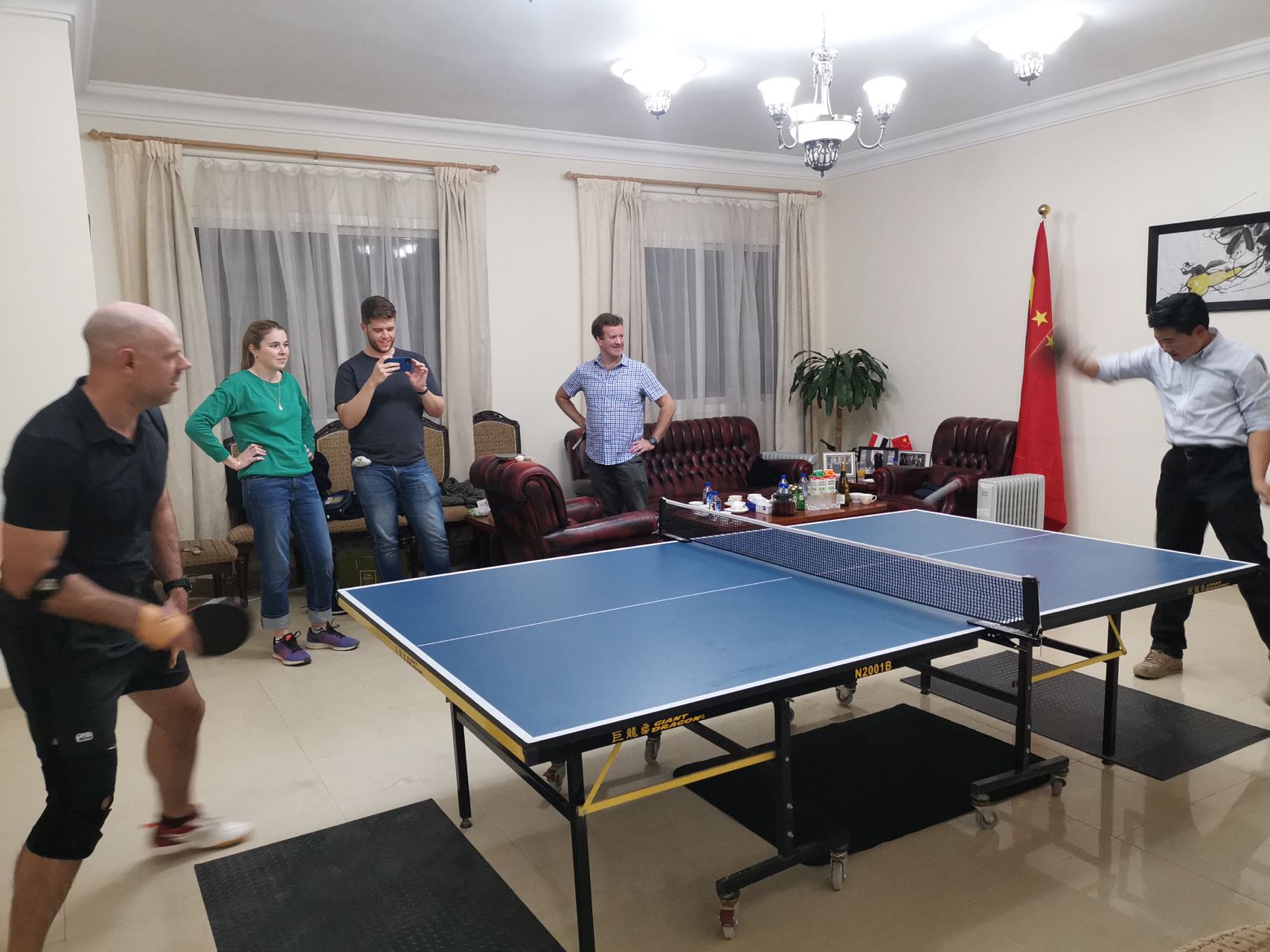
Britain also enters into a deal with ultra-regional powers in a bid to advance the multi-layered policy. For instance, the resigned Yemeni government faced a strict budget deficit following Ansar Allah prevented illegal export of Yemen’s oil by resorting to three drone attacks on Al-Dhabbah and Qena ports on the southern shores of the Arab nation. The British ambassador started consultations with his Chinese counterpart Shao Zheng to finance the resigned government via the oil sale and supply Yemen with basic commodities. The British and Chinese sides displayed the talks as they were playing ping pong (referring to the ping pong diplomacy between the US and China in the 1970s) at China’s diplomatic mission in Aden Governorate.
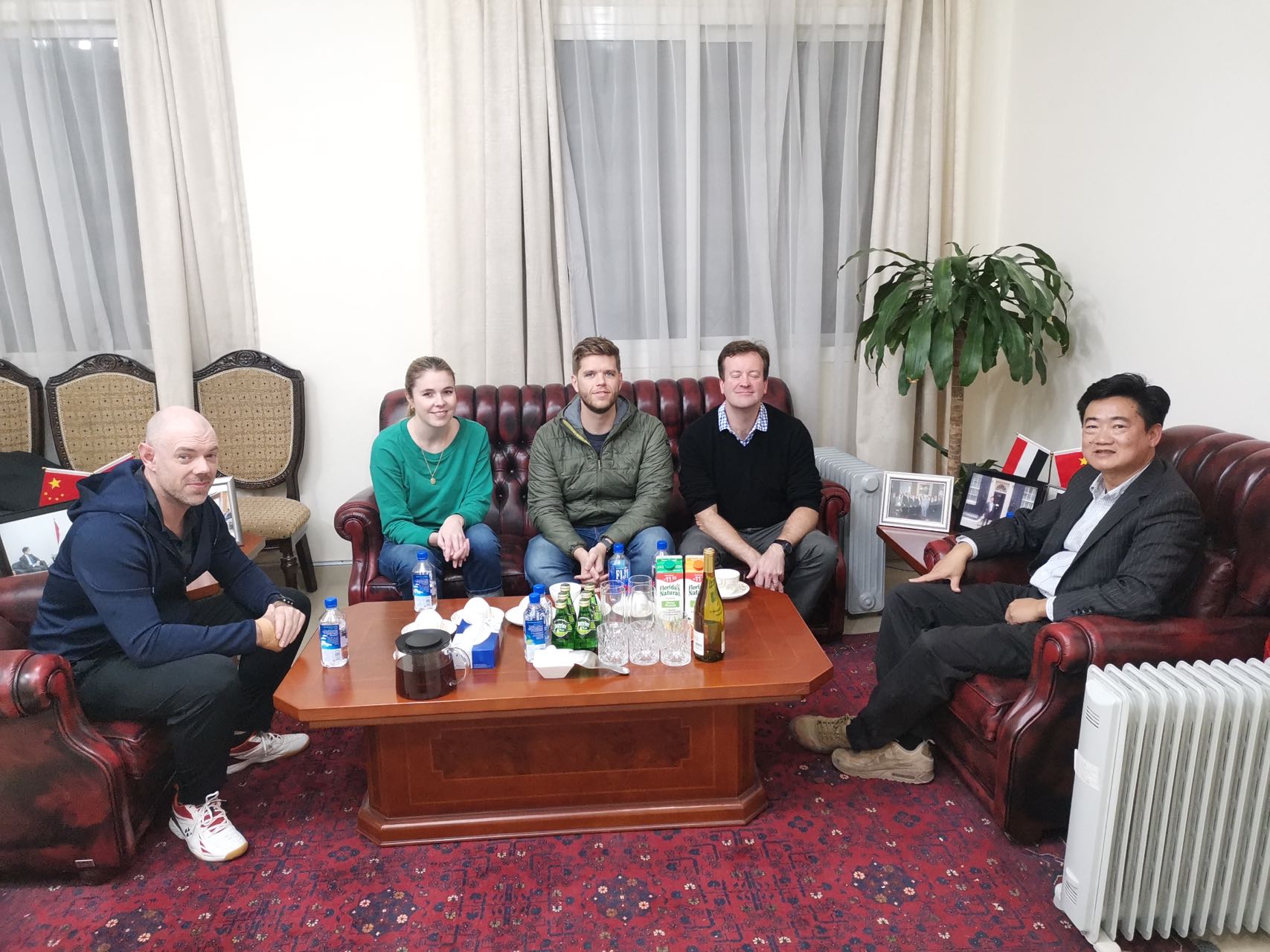
Richard Oppenheim and Shao Zheng meeting and playing ping pong at the Chinese Embassy in Yemen
As a whole, Britain is misusing and exploiting the crises created in the regional states particularly in the West Asia region through pursuing a multi-layered policy. The British policy-makers are fanning the flame of conflict by selling arms and dispatching military advisors to Arab countries, and they also loot the oil resources and wealth of a state under the pretext of being a mediating and peacemaking player. Britain’s actions in Yemen are a good instance of their dirty policy.
PS. “Ping-pong diplomacy” is a meaningful phrase in politics, which refers to the secret negotiations between the United States and China in the 1970s which resulted in opening the U.S.-PRC relationship, leading the U.S. to lift the embargo against China and the normalization of relations.
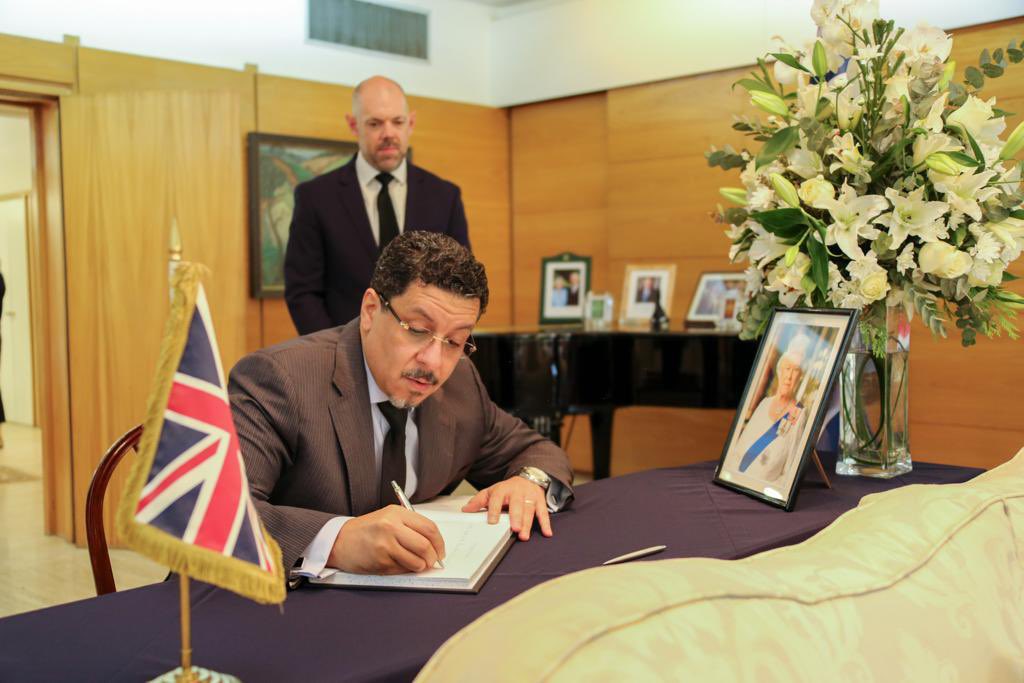
Image: The presence of Ahmed bin Awad Mubarak, the foreign minister of the resigned government of Yemen, at the British Embassy in Yemen to offer condolences on the occasion of the death of Queen Elizabeth II.
Last night, on January 25, the Russian army using several Shahed-136 suicide drones attacked several targets including an industrial center in Dnipropetrovsk and Odesa oblasts. The flight of Shahed-136 suicide drones has also been observed over the sky of Zaporizhzhia, Kherson and Mykolaiv oblasts, but so far no report or picture of the attack in these areas has been published.
Simultaneously with these attacks, the Russian army’s artillery also bombarded the positions of the Ukrainian forces in Chernihiv, Kharkiv, Donetsk and Zaporizhzhia.
As usual, the Ukrainian army, by presenting unrealistic statistics claims that their air defense systems has shot down 24 Shahed-136 suicide drones in different areas of Ukraine.
Following the drone and rocket attacks, this morning on January 26, the Ukrainian media reported the flights of Russian Tu-22 and 95 strategic bombers in eastern regions of Ukraine. Shortly after, air alert was issued in different regions of Ukraine and the Russian missile attacks began.
In these wave of attacks, Russian bombers using dozens of cruise missiles attacked various targets including a power plant in the city of Kyiv, an electric substation near Svatove and other targets in the cities of Odesa and Vinnytsia.
Click to view full sizeShahed-136 drone hit in DnipropetrovskShahed-136 drone hit in DnipropetrovskShahed-136 drone hit in DnipropetrovskShahed-136 drone hit in DnipropetrovskShahed-136 drone hit in DnipropetrovskImages attributed to Shahed-136 suicide drone strikes in DnipropetrovskRussian missiles hit the city of KyivRussian missiles hit the city of OdesaRussian missiles hit the city of Zaporizhzhia
This is the third time in the last two weeks that US logistics convoys have been targeted by resistance groups in Iraq. This morning at 00:50 local time, a military logistical convoy belonging to the American occupiers was attacked by the “International Resistance Faction” group in the Yusufiya area of Baghdad.
This attack was the third attack on American convoys in Iraq since the beginning of 2023. Earlier, on January 19, a US logistical convoy was attacked in Al-Taji area, north of Baghdad.
This attack took place while on January 24, Qassem al-Araji, Iraq’s national security advisor, in a meeting with General Stuart Munsch, commander of NATO joint forces, emphasized that the Iraqi government is serious about strengthening relations with NATO in order to develop the skills and capabilities of its security forces!
These words, together with the statements of other senior Iraqi officials, including the Prime Minister of this country, Mohammed Shia al-Sudani, show that despite the demands and warnings of the resistance groups, the Iraqi authorities have no desire to expel foreign military forces from Iraq. Therefore, it seems that the expulsion of Americans through political methods is not possible; And the military solution is the only way for the resistance groups to expel the US from Iraq and maintain the security and stability of the country.
It is noteworthy that in 2022, Iraqi resistance groups carried out 102 IED, drone and rocket attacks against positions, logistical and military convoys of the American occupiers in Iraq.
The terrorist headquarters of the US in West Asia – United States Central Command (USCENTCOM or CENTCOM) – issued a statement to announce the beginning of the naval, land and air drills of the American and Israeli military forces in the occupied territories of Palestine and the Eastern Mediterranean codenamed “Juniper Oak” aimed at increasing the readiness of the military forces of both sides as well as enhancing regional stability and security.
The drills are scheduled to continue until January 27. The joint military exercise is being held with the participation of 6,400 US troops, 1100 Israeli soldiers, more than 140 fighter jets (100 US aircraft, including four B-52 strategic bombers, two MQ-9 Reaper drones and 42 Israeli aircraft), 12 marine units, missile systems and US’s aircraft carrier George HW Bush.
According to the Israeli regime army, the US and Israeli air forces will practice different scenarios to cooperate and participate in applying various sorts of fighter jets, transport planes and drones. The drills are planned to gauge the joint preparedness of the Israeli and the US forces as well as expand operational ties between the two armies.
Simultaneous with the onset of the drills, the US TV channel CNBC quoted an American military commander as saying that the objective of the drills is to tell foes like Iran that the Russian attack on Ukraine, and Beijing’s threats on accumulating a large military force, would not distract the United States.
The drills started in a situation that the tensions between Washington and Tehran mounted severely in recent weeks because of the Joe Biden administration’s support for the recent unrest in Iran as well as the imposition of new sanctions on Iranian individuals, firms and entities. Moreover, after new Israeli Prime Minister Benjamin Netanyahu took office, the firebrand Zionist official claimed that he would foil what he said is Iran’s attempt to attain nuclear weapons through taking strict stances against the Islamic Republic.
Following the seizure of Krasnopolivka in northern Sol, the Russian armed forces focused their assaults on the areas in Rozdolivka and Mykolaivka along the Siversk road.
The heavily clashes continue from place to place in Blahodatne and Krasna Gora, and the Ukrainian military forces are attempting to repel the Russian strikes by carrying out artillery attacks and dispatching large armored vehicles in southern Soledar region.
The Russians have intensified their air strikes on the eastern and southern fronts of Bakhmut city. Seemingly, the Russian forces plan to advance in the north and west areas of Klishchiivka in a bid to tighten the siege of Bakhmut from the southern front. Moreover, there are some news stories claiming that the Russians embarked attacks on Ivanivske region. It is worth mentioning that the Russians’ success in capturing Ivanivske would block Bakhmut’s western road.
According to the Russian media outlets, the Russian army forces succeeded in seizing the northern heights of Vodyane in the northern outskirts of Donetsk city following a heavy battle between the Russian and Ukrainian forces.
The sporadic clashes between Russian and Ukrainian forces continue in Mariinka, Krasnohorivka, Nevelske and Pervomaiske in the western Donetsk as well. The Ukrainian forces are showing good resistance in Mariinka.
Eventually, the Russian forces entered the southern half of the strategic village of Kamyanske on the bank of the Dnipro River. The severity of the Russians’ strikes in other fronts of Zaporizhzhia frontlines forced the Ukrainian forces to pull out from the northern half of the Kamyanske village.
Certain Russian media outlets alleged that the Russian military forces entered the northern half of Kamyanske and succeeded in completely capturing the village; however, the news reports from the battle field show that the northern districts of Kamyanske village have not been entirely cleared so far.
The Ukrainian armed forces succeeded in repelling the Russians’ raids on the southern front of Orikhiv and maintaining the Novodanylivka-Shcherbaky war zone. Ukraine keeps on artillery strikes on the rearmost of Russian military forces in that front, which led to a decline in Russians’ ability to go ahead with their strikes.
The clashes go on in the eastern and southern regions of Goliapole, and no changes took place in the battle grounds as well as areas under the control of each side.
The circumstances in the various fronts of Kupyansk, Svatove and Kreminna in the north of Luhansk Oblast remained untapped for a long period. The major attacker in that front is the Ukrainian army. The Ukrainian forces have tried in several occasions to break the Russian front in this war zone, but the Ukrainians failed each time. The hub of the front is the town of Svatove, and if the town is taken by Ukrainians, Russia’s defense lines on the eastern front will be dismantled. Thus, the Russian army sturdily defends the lines of this front. The most important conflict lines of the front have been marked with arrows.
Click to view full size
Border regions of Russia:
After the Ukrainian military forces’ artillery strikes on the village of Volfyne in the Kursk oblast in western Russia, the power networks in the region were damaged, which caused power outages in several villages of the province. Correspondingly, the Russian army’s air defense shot down a Tochka-U missile of the Ukrainian army over Kazinka village in border province of Belgorod.
The Russian armed forces have intensified attacks on the fronts in Zaporizhzhia since January 20 And according to the latest information has managed to advance in several points. The conflicts on this front are concentrated in the two main axes of Goliapole and Orikhiv.
In the Orikhiv axis, conflicts are going on in all the eastern, western and southern axes of the Orikhiv town. According to the latest information, the village of Mali Shcherbaky in west of Orikhiv has been captured by Russia and the conflicts have been transferred to the adjacent village named Shcherbaky. Also, the Russian army claims to occupy the regions of Novodanylivka and Malaya Tokmachka in south and southeast of Orikhiv.
In the Goliapole axis, artillery attacks on the Goliapole front have been stepped up. Most of the clashes are directed to east of Goliapole and the villages of Chervone and Malynivka. The Russian army claims to have captured a strategic hill near Malynivka.
According to the local officials in Zaporizhzhia province, the Russian army has significantly amplified the intensity of the air and artillery strikes on the Zaporozhye front, and the Russians carried out 224 air and artillery attacks on the conflict zones with the Ukrainian army merely over the last 24 hours.
If the Russian army succeeds in capturing Orikhiv and Goliapole counties, the front line of the Ukrainian army in defending the city of Zaporizhzhia will collapse.
It is worth mentioning that after the retreat of the Russian army from the west bank of the Dnieper river, this axis (Zaporizhzhia) is one of the most important axes active in the southern front of Ukraine. In the past few months, the western media reported on the preparation and equipping of the Ukrainian army to carry out a major operation in this axis with the aim of recapturing the southern regions of Zaporizhzhia and Kherson oblasts in southern Ukraine. Considering the fragile situation of the Bakhmut front and the possibility of the defeat of the Ukrainian army, and the recent statements of Western officials and their advice to Ukraine to carry out military operations in other more important and sensitive fronts (such as Zaporizhzhia), it seems that the Russian army knowing about this issue and the possibility of the start of Ukrainian operations in this axis, has somehow preempted and by advancing in this axis, it intends to neutralize the plans of the Ukrainian army and NATO.
The Al-Shaddadi strategic base, which is located near the Al-Jabsa oil fields in the southern outskirts of Al-Hasakah Governorate, is considered one of the most vital weaponry and fuel depots of the US-led coalition.
Within recent weeks and following Turkiye’s threats to initiate ground military operations in northern areas of Syria, the number of joint drills by the US-led coalition and the SDF militants has significantly amplified. The training of the SDF militants is carried out by the US-led coalition trainers, who focus on Tactics of urban warfare as well as the usage of anti-tank arms, including the TOW guided missiles.
It is noteworthy to mention that the military drills are the second joint exercises between the US-led coalition and the SDF militants in Al-Haskah Governorate in the past week. The US-led coalition and the Syrian Democratic Forces held another joint military exercise in the neighborhood of “Ghuwairan” in the south of the capital city of Hasakah in the Al-Hasakah Governorate a few days ago.
Jaysh Suriya al-Hurra (Syrian Free Army) militants AKA Maghaweir al-Thowra, have a common base with the American occupying forces in the Tanf region. As a result of this attack, two Jaysh al-Hurra militants were injured.
In this regard, the US terrorist headquarters in West Asia (CENTCOM) issued a statement confirming the drone attack on Al-Tanf base and announced:
“This morning, three one-way attack drones attacked the At Tanf Garrison in Syria. Two of the drones were shot down by Coalition Forces while one struck the compound, injuring two members of the Syrian Free Army partner force who received medical treatment. No US forces were injured.”
Jaysh al-Hurra militants also published pictures and claimed that a medical center in Al-Tanf base was targeted and serious damage was done to it.
Pictures of the effects of the drone attack on al-Tanf base
So far, no group has claimed responsibility for this attack, but considering the history of attacks by the resistance forces on the positions of the American coalition and the Maghaweir al-Thowra militants in al-Tanf region, it is possible that this attack was also carried out by resistance groups.
It is worth mentioning that on the 15th of August, positions of the US forces and its militants in Al-Tanf base were targeted with a drone attack by the Iraqi “International Resistance Faction” group. The al-Tanf region in the southeast of Syria has been occupied by American forces for years, and the Syrian army and resistance forces are not allowed to approach the 55-kilometer radius of this area.
P.S. On January 21, the Iraqi resistance group “Tashkil al-Warithinn” published a statement and claimed responsibility for the drone attack on the US base in al-Tanf area.
According to local sources, the attack was carried out at around 1 a.m. local time. So far, no information has been released about the amount of damage caused by this attack. This attack was the second attack on American convoys in Iraq since the beginning of 2023. Earlier, on January 12, a US logistical convoy was attacked in Al-Taji area, north of Baghdad.
This attack took place while a few days ago, “Mohammed Shia al-Sudani”, the Prime Minister and Commander-in-Chief of the Iraqi Armed Forces, in an interview with the “Wall Street Journal” stated that foreign forces are still needed and defended the presence of American forces in Iraq and did not set a timetable for their withdrawal.
It seems that if Iraqi officials and senior officials do not seriously pursue the issue of the expelling of foreign troops, especially American troops, the resistance groups will increase their attacks against American military positions and convoys in Iraq.
It is noteworthy that in 2022, Iraqi resistance groups carried out 102 IED, drone and rocket attacks against positions, logistical and military convoys of the American occupiers in Iraq.