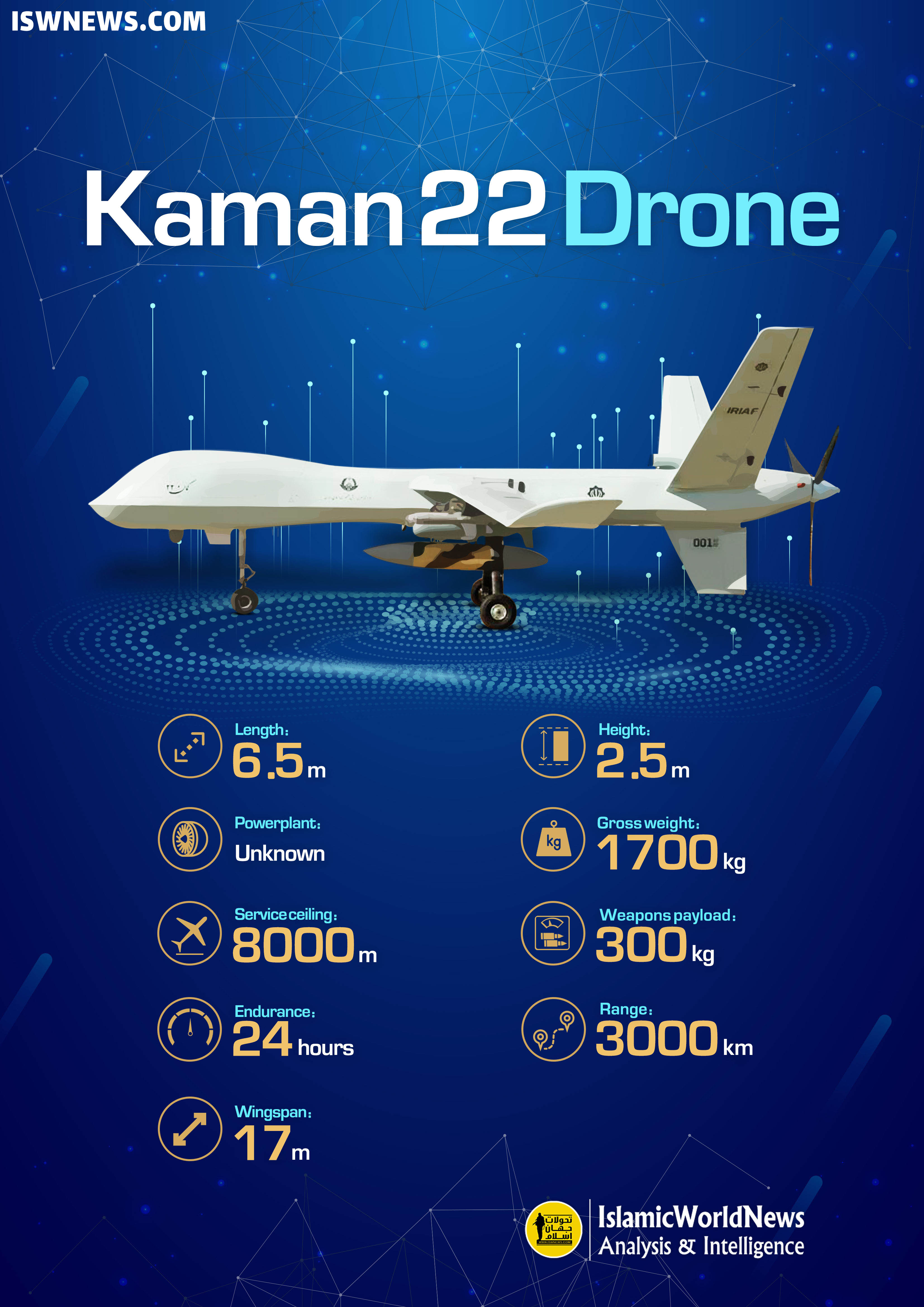
“Kaman 22” is a new reconnaissance combat drone of the Iranian Air Force, equipped with various combat, optical and electronic warfare systems. This drone has the ability to identify, monitor and collect information and photograph distant targets and is designed based on the operational needs of the Iranian Air Force and is in the final stages of production.
The Kaman 22 drone with a range of 3,000 km and a 24-hour flight duration and carrying a variety of smart ammunition will bring a high combat capability to the Iranian army.
The Kaman 22 drone uses a design almost identical to the US MQ-9B drone and has seven pylons for carrying weapons, with six pylons under the two wings and one pylon under the fuselage.
In the position under the wing, four Qaem smart bomb, two unidentified glider bombs and below the fuselage an electronic warfare pod can be seen. Next to the drone is the Sattar-4 laser guidance bomb and the Shahin electronic warfare pod (AN / ALQ-101).
Specifications: Length: 6.5 m Wingspan: 17 m Height: 2.5 m Gross weight: 1,700 kg Powerplant: Unknown Service ceiling: 8,000 m Weapons payload: 300 kg Range: 3,000 km Endurance: 24 hours
The missile was presented by Brigadier General Hossein Dehghan on 11 October 2015.
Emad is a single stage liquid propelled with a detaching warhead which was expanded from Qadr missile. It has a range of 1,500 to 1,700 km and can carry up to 750 kg of HE.
Detaching warhead with canard based guidance system increases the hitting accuracy significantly.
Specifications: Range: 1,700 km Weight: 17,500 kg Length: 15,5 m Diameter: 125 cm Propellant: liquid Warhead weight: 750 kg Speed: 11 Mach Flight profile: Ballistic Accuracy: 10 m
According to information provided by ISIS, in 2020, 593 attacks were carried out against the Syrian Democratic Forces, the Syrian Army and other Syrian militants, and a total of 1327 people lost their lives or were injured in these attacks. Also, 292 armored, military and transport vehicles were destroyed or damaged by ISIS.
Statistics from 2020 have been released while since the beginning of 2021, the ISIS group has significantly increased its activities, including ambushes, booby traps and limited operations in the Syrian desert.
It seems that this terrorist group does not seek to occupy government-controlled positions and areas, but with these limited and surprising operations, it seeks casualties from the Syrian army and wants to continue its presence and guarantee its future presence in these areas.
Since the beginning of 2021, at least 44 Syrian troops have been killed in ISIS attacks in the Syrian desert, most of them in the eastern desert of Hama, and Russian fighter jets have bombed ISIS positions in the Syrian desert more than 400 times.
According to this information, Ansar Allah forces and popular committees:
– In 2020, Saudi coalition warplanes carried out more than 8888 airstrikes and 410 drone strikes on 13 Yemeni provinces. Airstrikes have been carried out on Marib province more than 3,621 times, 1981 times in Al-Jawf province and 726 times in Saada province.
– More than 974 military operations have been carried out by Ansar Allah forces in 2020, the most prominent of which are Operations “Fa’amkan Minhom”, “Bonyan Al-Marsous” and liberation of “Qifah district”.
– Enemy casualties in 2020 were more than 15,366 killed and wounded, of which 6,467 were killed and 8,899 were wounded.
– More than 1090 tanks, armored and military vehicles, etc. of Saudi coalition were destroyed.
– Ansar Allah missile force has fired more than 253 ballistic and winged missiles in dozens of operations against the enemy, targeting 178 missiles at enemy positions and bases in Yemen and 75 deep in Saudi Arabia territory.
– More than 20 Badr-P missiles, 30 Badr-1 missiles, 12 unveiled missiles, 7 Quds winged missiles and 6 Zulfiqar missiles were fired deep into Saudi Arabia territory.
– More than 5,613 reconnaissance operations and drone attacks were conducted during 2020. 267 offensive operations have been carried out by drones, of which 180 offensive operations have been carried out against enemy positions and bases inside Yemen.
– In 2020, the Air Defense Forces conducted more than 730 defensive actions against enemy aircraft. 67 combat and spy drones and fighter jets were shot down during 2020, these include a Tornado fighter jet and two CH4 UAVs in the Nihm and Majzar areas.
– The anti-armoured units has carried out more than 678 operations this year, targeting more than 100 military vehicles.
– The artillery units has carried out more than 13881 operations against the enemy, of which 231 operations have been carried out jointly with the UAV forces.
– The engineering units has carried out more than 3030 operations, of which 2298 operations have been carried out against enemy gatherings. More than 635 operations have targeted enemy equipment and 97 operations have targeted enemy fortifications and headquarters.
– More than 15,481 operations have been carried out by sniper units on the border area and inside Yemen, among the achievements of the sniper units is the downing of 7 UAVs and disabling 213 vehicles.
Statistics of the Saudi coalition aggression on Yemen after 2100 days: – Total martyrs and wounded: 43,397 people – 17,042 martyrs, including 2,389 children and 3,804 women – 26,355 people were injured, including 4,128 children and 2,801 women
– The total number of destroyed and damaged facilities and infrastructures is 9,526 – Destroyed or damaged 15 airports, 16 ports, 304 power plants and generators and 547 communication networks – Destroyed or damaged 2,181 warehouses and water supply network and 1974 government centers and 4,490 roads and bridges – The total number of damaged and destroyed houses is 569,283 – The total number of damaged and destroyed commercial centers is 11,365 – Destroyed or damaged 177 universities – Destroyed or damaged 1393 mosques, 366 tourist centers and 389 hospitals and medical centers – Destroyed or damaged 1099 schools and educational centers and 7005 agricultural lands, 133 sports centers, 245 ancient centers and 47 media centers
– The total number of destroyed and damaged economic centers is 22,913 – Destroyed or damaged 393 factories, 289 fuel trucks, 11,365 commercial centers and 411 poultry and livestock
– Destroyed or damaged 7,229vehicles, 463 fishing boats, 889 food depots, 392 fuel stations, 678 markets and 794 food trucks
This statistic is now presented while during the battles, the government of Azerbaijan refused to provide accurate statistics of its casualties in the battles of Nagorno-Karabakh; But estimates put the death toll at 2,000 to 3,000 for each side in the war.
On the other hand, the latest statistics provided by the Armenian authorities on the casualties of the Armenian forces are 2425, which seems to be incorrect. The death toll of Armenian forces in Nagorno-Karabakh is estimated around 3,500.
In any case, as is clear from the published casualties, the Nagorno-Karabakh war, despite its short duration, is one of the bloodiest wars in the region. During the battles, there were many independent reports of the intensity and casualties of the war and the brutal battles; to the extent that some Syrian mercenaries ignored the continuation of the fighting and receiving its benefits and returned to their country.
Also, despite the absolute air superiority of the Republic of Azerbaijan in the Nagorno-Karabakh war and inflicting deadly casualties on the Armenian forces, the losses of Azerbaijan show that this war was not an easy one for Azerbaijan and the Armenian forces despite obvious military weaknesses in air defense, were not been an easy opponent for Azerbaijan army and have inflicted heavy losses on the Azerbaijani manpower; The difference is that Azerbaijan has won the media war in this part by publishing aerial images of the targeting of Armenian forces and equipment, and on the contrary, the Armenian war media failed to document and present the Azerbaijani casualties. This once again demonstrates the importance of media warfare in achieving the ultimate goal.
Yemeni Armed Forces spokesman Yahya al-Sari said on his Twitter page: “Yemeni people, the armed forces and popular committees were steadfast during 2,000 days of aggression against our country, certainly those who stood steadfast at this period are able, with God’s help, to withstand 4,000 days and even more. The situation during the first 100 days of aggression is different about the situations during 1,000 days of aggression and what it is today after 2,000 days of aggression is completely differnt ?! Let Yemen be an independent dignity.”
Saudi aggression against Yemen continues while so far no effective efforts have been made by the so-called international organizations and UN to stop Saudi Arabia’s war and crimes against Yemen, and this is negligence while even European countries and the United States continue to send various weapons and armaments to Saudi Arabia to kill Yemenis.
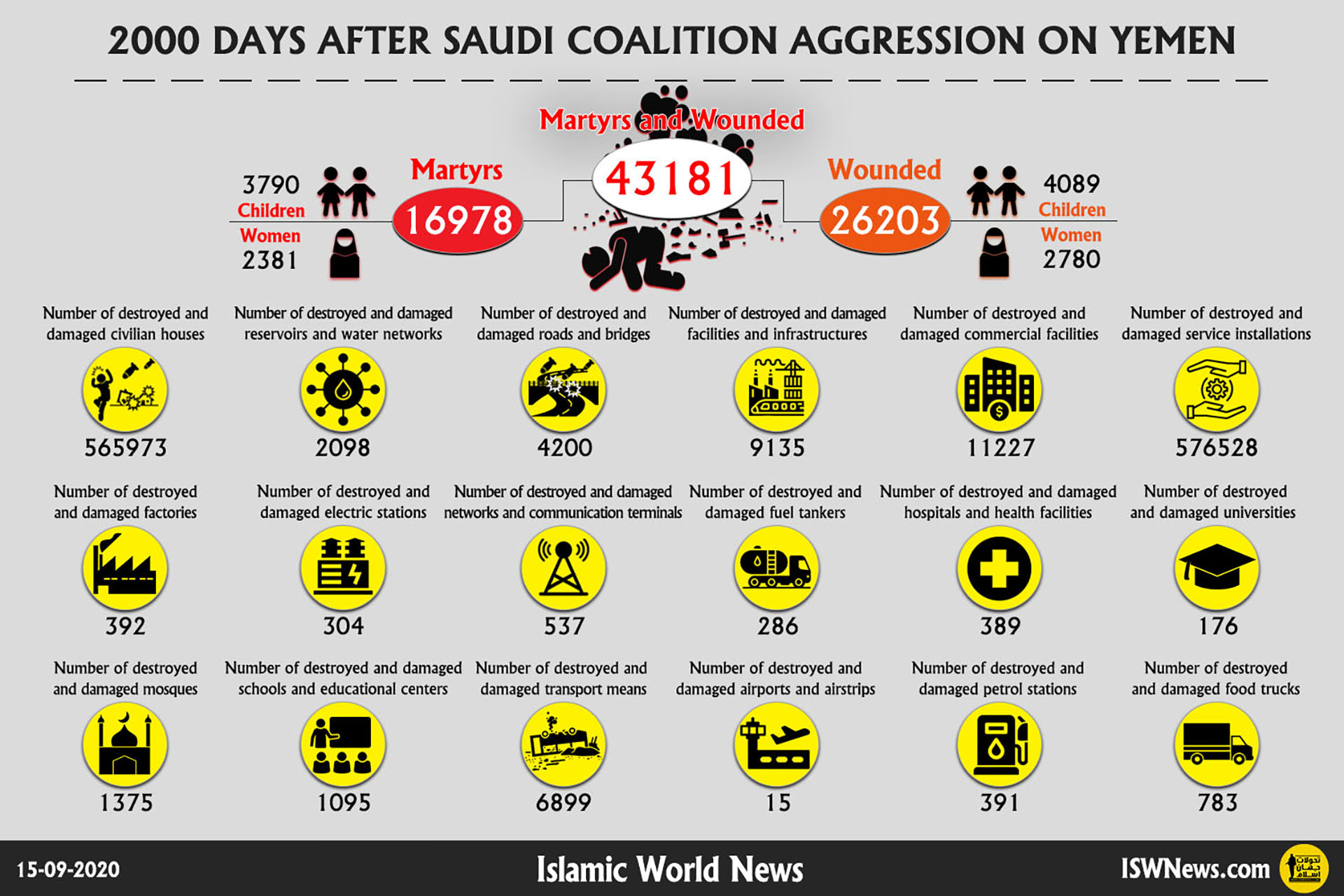
Statistics of the Saudi coalition aggression on Yemen after 2000 days: – Total martyrs and wounded: 43,181 people – 16,978 martyrs, including 3,790 children and 2,381 women – 26,203 people were injured, including 4,089 children and 2,780 women
– The total number of destroyed and damaged facilities and infrastructures is 9,135 – Destroyed or damaged 15 airports, 16 ports, 304 power plants and generators and 547 communication networks – Destroyed or damaged 2,098 warehouses and water supply network and 1965 government centers and 4,200 roads and bridges – The total number of damaged and destroyed houses is 565,973 – The total number of damaged and destroyed service centers is 576,528 – Destroyed or damaged 176 universities – Destroyed or damaged 1375 mosques, 356 tourist centers and 389 hospitals and medical centers – Destroyed or damaged 1095 schools and educational centers and 6732 agricultural lands, 132 sports centers, 244 ancient centers and 47 media centers
– The total number of destroyed and damaged economic centers is 22,404 – Destroyed or damaged 393 factories, 286 fuel trucks, 11,227 commercial centers and 407 poultry and livestock
Specifications: – Carrier-based air superiority fighter and multirole fighter – Origin: Soviet Union / Russia – Design group: Sukhoi – Built by Sukhoi, Komsomolsk-on-Amur Aircraft Production Association – First flight: 17 August 1987 – Produced: 1987–1999 – Status: In service – Number built: Approx. 35 – Crew: 2-seat, 1-seat – Length: 22 meters – Wingspan: 14.7 meters – Height: 5.93 meters – Empty weight: 18400 kg – Max takeoff weight: 33000 kg – Powerplant: 2 × Saturn AL-31F3 afterburning turbofan engines
Performance: – Maximum speed: 2300 km/h – Range: 3000 km – Service ceiling: 17000 m – Rate of climb: 246 m/s
Armament: – Hardpoints: 12 external pylons with a capacity of up to 6500 kg – Cannon: 1 × 30 mm Gryazev-Shipunov GSh-30-1 autocannon with 150 rounds
– Missiles: Air-to-air missiles: R-27R/ER/T/ET and R-73E Anti-ship missiles: Kh-31A and Kh-41 Anti-radiation missiles: Kh-25MP and Kh-31P
– Rockets: S-8KOM/BM/OM S-13T/OF S-25OFM-PU
– Bombs: RBK-500 cluster bomb
Click to see the full size image
The Sukhoi Su-33, NATO reporting name: Flanker-D is an all-weather carrier-based twin-engine air superiority fighter designed by Sukhoi and manufactured by Komsomolsk-on-Amur Aircraft Production Association, derived from the Su-27 and initially known as the Su-27K. The aircraft has been principally designed and developed to meet the requirements of the Russian Navy.
Compared with the Su-27, the Su-33 has a strengthened undercarriage and structure, folding wings and stabilators, all for carrier operations. The Su-33 has canards and its wings are larger than the Su-27 for increased lift. The Su-33 has upgraded engines and a twin nose wheel, and is air refuelable.
Su-33 aircraft design The aircraft was designed by Russia’s Sukhoi Design Bureau. The design phase began in 1984 and was finalised in 1985. The aircraft is equipped with sports canards to reduce the take-off distance and enhance manoeuvrability, and has power-aided folding wings. The aircraft is also fitted with an air-refuelling probe to increase its range. The wings are fitted with a two-piece, single-slotted flap, an aileron and a larger leading-edge flap to decrease speed when landing.
Variants – Su-27K: Carrier-based version of the Su-27 designed for Project 11435 and Project 1160 aircraft carriers (heavy aircraft cruisers in Soviet classification). – Su-27KI: Project of a carrier-based version of the Su-27 designed for Project 11435 and Project 1153 aircraft carriers (heavy aircraft cruisers in Soviet classification). – Su-27KPP: Project of a two-seat carrier-based electronic-warfare aircraft. – – Su-27KRS: Project of a two-seat carrier-based reconnaissance and target designation aircraft. – Su-27KT/Su-27KTZ: Project of a carrier-based tanker aircraft. – Su-27KU: Project of a two-seat carrier-based trainer. – Su-27KSH: Project of a carrier-based attack aircraft. – Su-28K: Project of a two-seat carrier-based attack aircraft. – Su-28KRS: Project of a carrier-based reconnaissance and target designation aircraft based on the Su-28K. – Su-29K: Project of a carrier-based interceptor aircraft with a possibility to carry the long-range R-33 air-to-air missiles. – Su-33: Designation for the Su-27K after its introduction into service with the Russian Naval Aviation on 31 August 1998. – Su-27KUB/Su-33UB: Two-seat training-and-combat version based on the Su-27K and Su-27KU with side-by-side seating for crew of two. One prototype built.
It’s designed to be used as a surveillance and aerial reconnaissance and precision strike platform. The combat drone has a long range strike capability thanks to a satellite link.
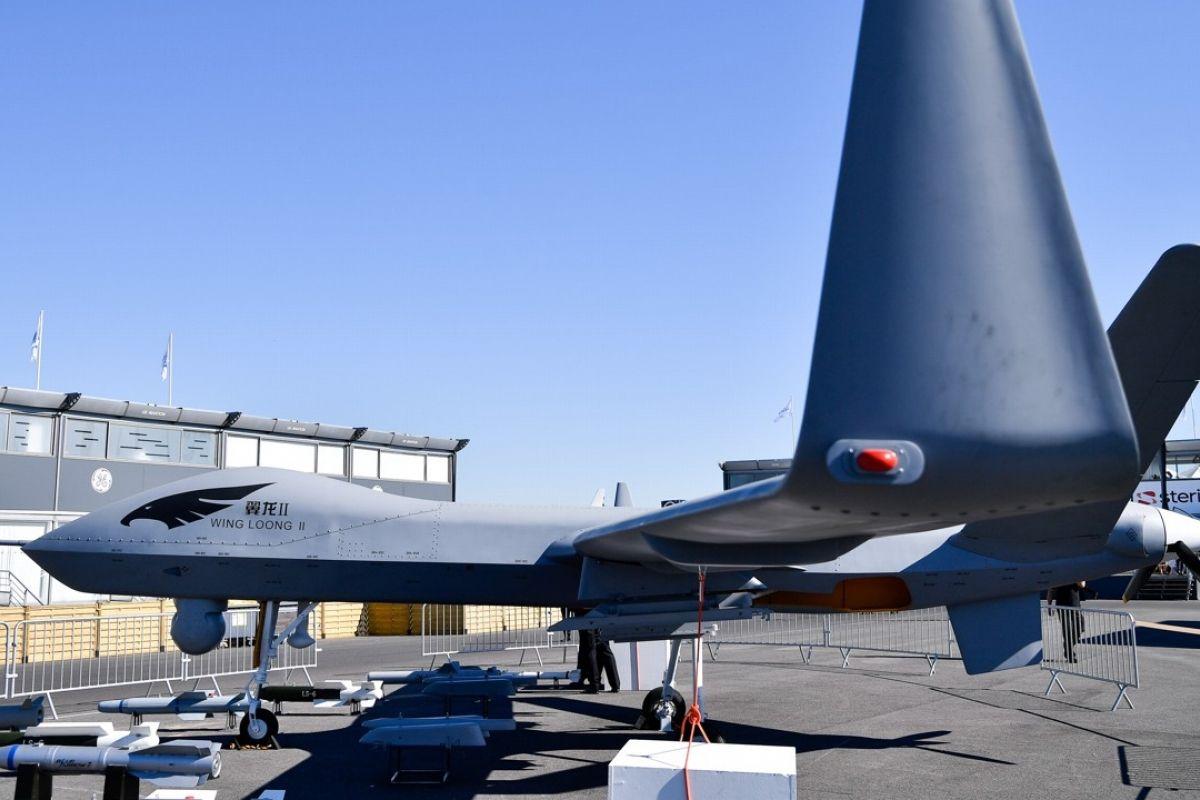
The Company unveiled the concept of Wing Loong II at the Aviation Expo China in Beijing in September 2015 and a prototype of the Wing Loong II was presented for the first time to the public during the Airshow China exhibition, held in Zhuhai from 1-6 November, 2016. It was also presented for the first time in Europe during the Paris Air Show in June 2017.
The design of the Wing Loong II UAV MALE is based to the Wing Loong I But it is longer and higher. It has monoplane slender fuselage and empennage with a prominent V-tail and ventral fin. Each wing incorporates three underwing hardpoints able to carry 12 bombs, rockets or air-to-surface missiles. A satellite communications antenna is mounted on the bulge at the top front surface of the fuselage, offering data transmission between the UAV and the ground control station. The Wing Loong II has a length of 11 meters, a wingspan of 20.5 meters and a height of 4.1 m.
The Wing Loong II UAV is powered by a WJ-9A turboprop 500kW (670 shp) engine. It can fly during 20 hours and has a maximum speed of 370 km per hour. The Wing Loong II has an operational radius of 1,500 km and that it is equipped with a satellite communications system.
The Wing Loong II UAV is able of carrying up to 12 laser-guided bombs or missiles with a total weight of 480 kilogram’s. The electro-optical payload pod, fitted under the forward section of the fuselage, is integrated with day light and infrared cameras and sensors to collect surveillance and targeting data in both day and night and low-light conditions.
Like the Wing Loong 1, the Wing Loong 2 has a much lower manufacturing cost than its American rivals, the MQ-1 and MQ-9, and this has made other countries welcome to buy and use the drone.
Specifications: Length: 11 m Wingspan: 20.5 m Height: 4.1 m Max takeoff weight: 4,200 kg
Powerplant: 1 × WJ-9A turboprop 500kW (670 shp) Maximum speed: 370 km/h Endurance: 20 hours Service ceiling: 9,000 m
Carrying capacity: 480 kg laser-guided bombs and missiles Bombs: FT-10, FT-9, FT-7, GB7, GB4 Missiles: BRM1, AKD-10, BA-7
Wing Loong 1 experienced its first flight in 2009 and has been serving in the Chinese military since 2011. Due to its capabilities and low cost compared to similar American MQ-1 and MQ-9 models, it has had successful exports.
The UAV is developed primarily for the People’s Liberation Army Air Force and is intended for surveillance and aerial reconnaissance missions.
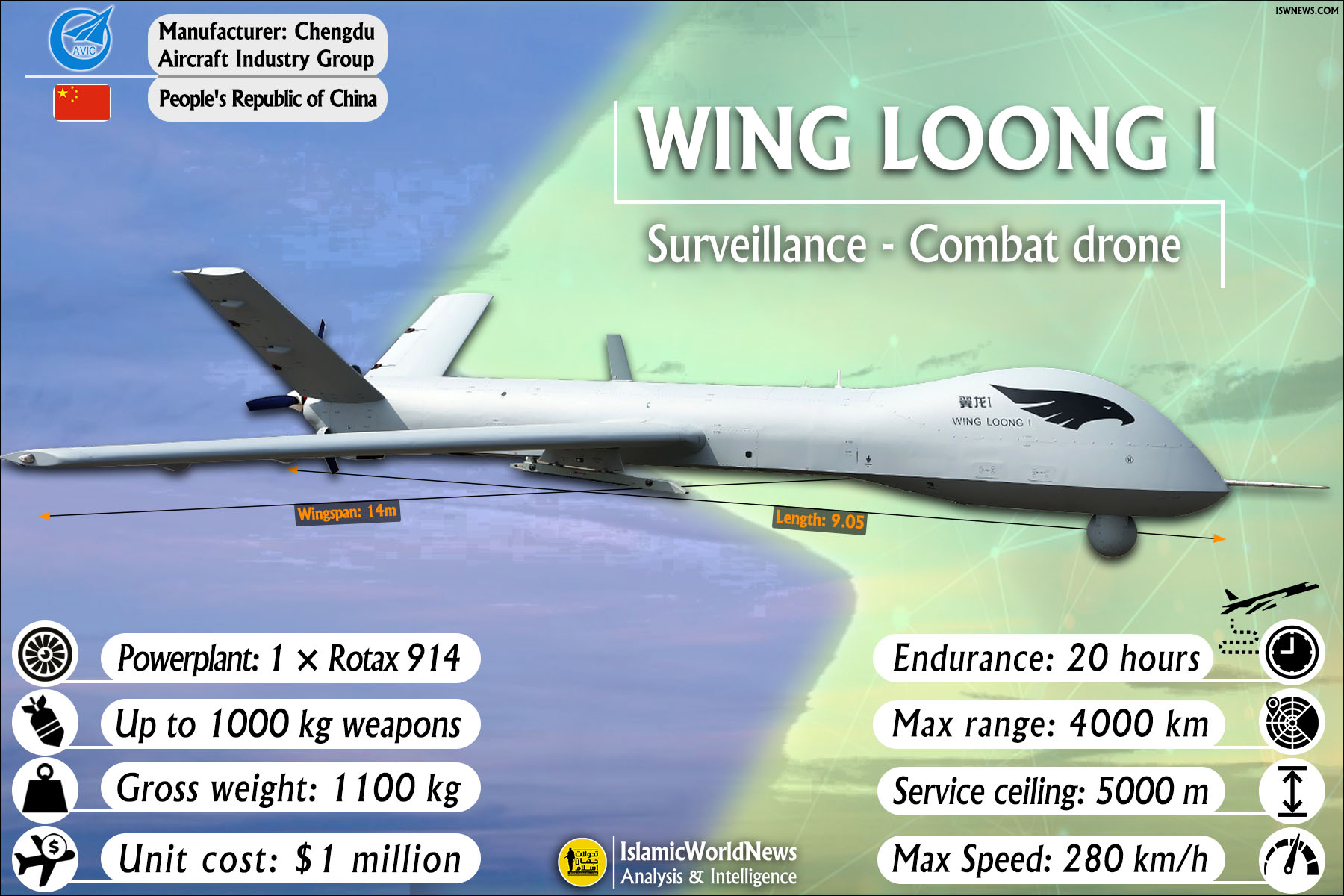
The UAV has a length of 9.05m, a wing span of 14m and a height of 2.77m. It has a maximum take-off weight of 1,100kg. The Wing Loong has a maximum flight speed of 280km/h, can operate over a range of 4,000km, and fly up to a maximum height of approximately 5km.
A satellite communications antenna, mounted on the bulge at the top front surface of the fuselage, facilitates data transmission between the UAV and the ground control station.
The weaponry options include AKD-10 air-to-surface anti-tank missile, BRMI-90 90mm guided rocket, FT-7/130 small 130kg bomb with planar wing, FT-9/50 50kg bomb for drones, FT-10/25 25kg bomb, GB-7/50 50kg precision-guided munition (PGM), and GB-4/100 PGM.
The base version has two hardpoints under the wings, while the Wing Loong II has six hardpoints. Wing Loong II, is an upgraded version of the Wing Loong and was unveiled at the Beijing Aviation Expo held in September 2015. Also Wing Loong II was presented in 2017 at the Dubai Exhibition. There are rumors of a contract between China and Saudi Arabia for 300 Wing Loong IIs.
There are 6 variants of Wing Loong 1 drones, the Sky Saker version of which is for the export market and serves in the armies of many countries such as Egypt, Nigeria, Saudi Arabia, Serbia, UAE, Kazakhstan, Algeria, etc. It is worth mentioning that the Wing Loong ID sample was exported to Egypt.
Specifications: Length: 9.05 m Wingspan: 14 m Height: 2.77 m Gross weight: 1,100 kg
Maximum speed: 280 km/h Range: 4,000 km Endurance: 20 hours Service ceiling: 5,000 m
Carrying capacity: 1,000 kg surface-to-air weapons including bombs and missiles Bombs: FT-10, FT-10, FT-9, FT-7, GB7, GB4 Missiles: BRM1, AKD-10
Click to see the full size image
YOUR SUPPORT IS CRITICAL TO KEEP ISWNews ALIVE!
I’d like to thank readers for their confidence and support. Thanks to your support we can continue to perform our duty on reporting the important events in the region. So If you like our contents, please don’t feel embarrassed to contribute and help our project, for as little as 1 Dollar. Your contribution, however small, will help ensure our project continuity. Thank you.
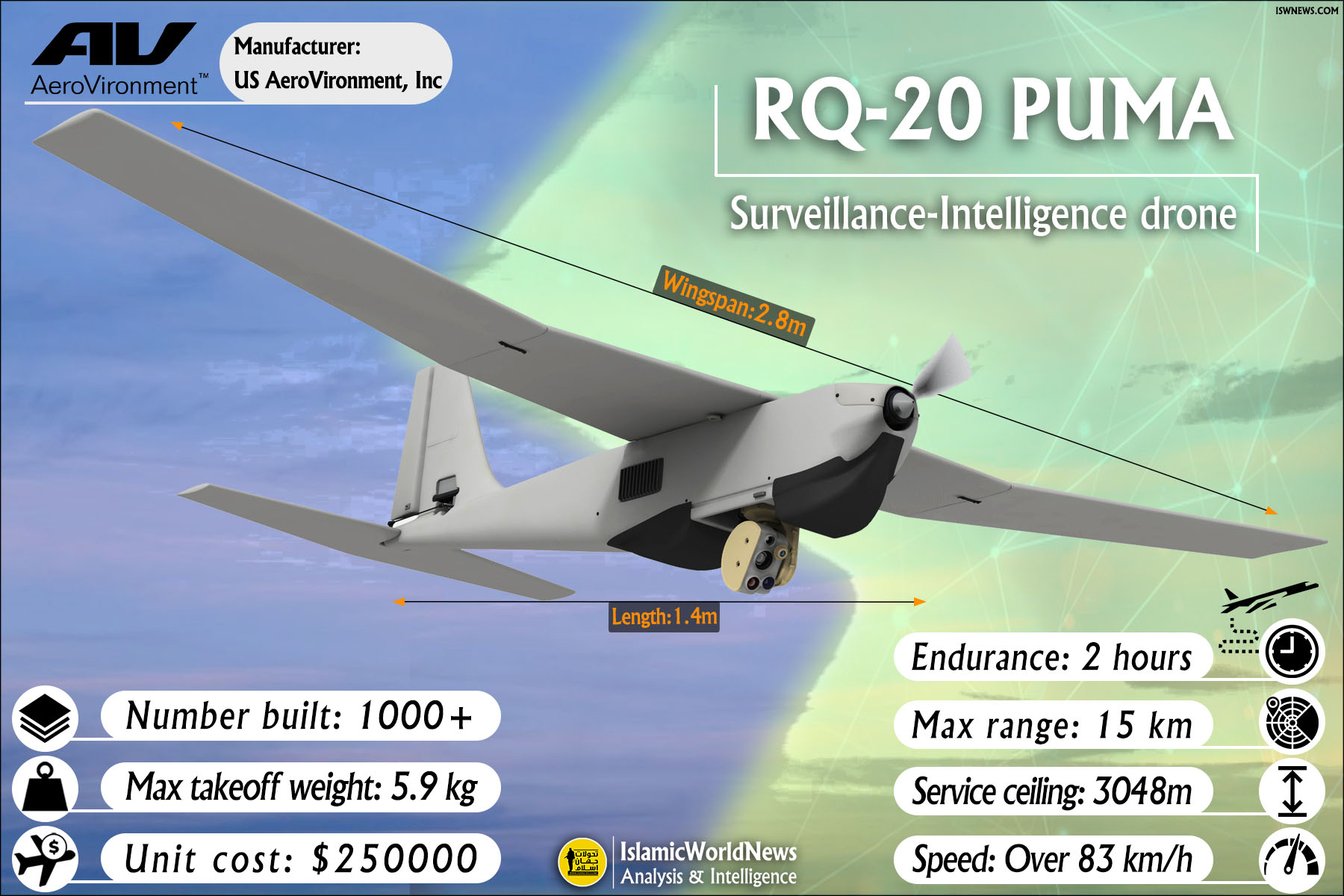
The RQ-20 Puma is designed for missions such as tactical intelligence, surveillance, reconnaissance and targeting (ISRT), maritime patrol, search-and-rescue, and counter-illicit trafficking.
The Puma All Environment model (AE) can operate under extreme weather conditions including temperatures ranging from −20 to 120 °F (−29 to 49 °C), wind speeds up to 25 knots (29 mph; 46 km/h), and an inch of rain per hour. The UAV is designed for land based and maritime operations and is capable of landing in the water or on land.
Equipped with both an electro-optical (EO) and infrared (IR) camera and illuminator, Puma AE keeps the operator’s “eyes on target”. Its precision navigation system with secondary GPS insures positional accuracy up to its 15 km range. An optional under wing transit bay easily integrates third party payloads such as communication relay, geo-location, or laser marker to meet the diverse needs of military or civilian applications. Puma AE can deliver 3.5+ hours of flight endurance while versatile smart battery options support diverse mission requirements.
RQ-20B (Block 2 Puma AE) includes a more powerful and lighter propulsion system, lighter and stronger airframe, long endurance battery, precision inertial navigation system an improved user interface, and the new, all environment Mantis i45 gimbal sensor suite.
Specifications: Length: 1.4 m Wingspan: 2.8 m Max takeoff weight: 5.9 kg Maximum speed: 83 km/h Range: 15 km Endurance: 2 hours Service ceiling: 3048 m
Click to see the full size image
YOUR SUPPORT IS CRITICAL TO KEEP ISWNews ALIVE!
I’d like to thank readers for their confidence and support. Thanks to your support we can continue to perform our duty on reporting the important events in the region. So If you like our contents, please don’t feel embarrassed to contribute and help our project, for as little as 1 Dollar. Your contribution, however small, will help ensure our project continuity. Thank you.