Israeli warplanes have also carried out more than 2000 airstrikes on various parts of Gaza Strip.

Israeli warplanes have also carried out more than 2000 airstrikes on various parts of Gaza Strip.

1- Izz ad-Din al-Qassam Brigades:
Martyr Izz ad-Din al-Qassam Brigades are military branch of Hamas which established in 1992 and has between 10 to 40 thousand troops. They usually manage the conflicts of the Resistance with the Zionist regime under command of Mohammed Deif.
2- Al-Quds Brigades:
The military branch of Palestinian Islamic Jihad which is active from 1981 and has more than 12 thousand troops. Al-Quds Brigades launched rocket and guerilla warfare attacks against Zionist regime since 2002 which imposed high casualties on the regime. That’s why Zionists claim that the movement is supported by Iran entirely.
3- Abu Ali Mustafa Brigades:
The military branch of the Popular Front for the Liberation of Palestine which is active since 1999 and named after martyr Abu Ali Mustafa, the secretary of the front.
Zionist regime minister of tourism after martyrdom of Abu Ali Mustafa, attacking British base in Gaza in March 2006, numerous attacks to Zionist regime bases and martyrdom seeking attacks are among the activities of Abu Ali Mustafa Brigades.
4- Nasser Salah al-Deen Brigades:
The military branch of Popular Resistance Committees activated since 2000 in operations of abduction and ground conflicts with Zionist army.
5- Palestinian National Resistance Brigades:
The military branch of Democratic Front for the Liberation of Palestine activated since 2000 which launched many guerilla warfare attacks against the Zionist soldiers and towns in occupied Palestine.
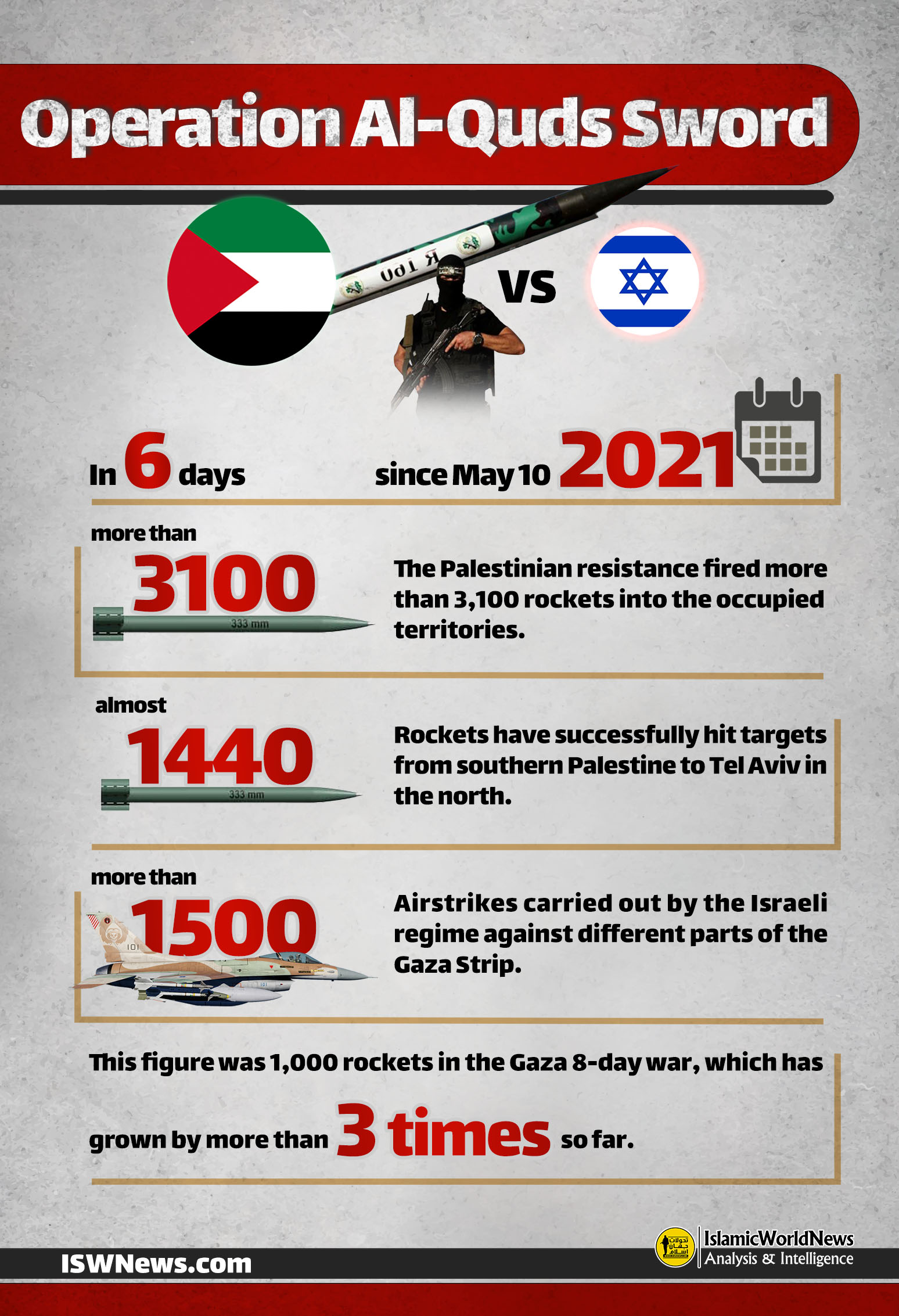
Israeli warplanes have also carried out more than 1,500 airstrikes on various parts of Gaza Strip.
It is worth noting that during the 8-day war in Gaza in 2012, about 1,000 rockets were fired by the Palestinian resistance groups in eight days; During the recent operation, 6 days after the battle, more than 3,100 rockets were fired at the occupied territories. This indicates a significant increase in the rocket power of Palestinian resistance groups.
Read more: Ceasefire began in Palestine after 11 days!
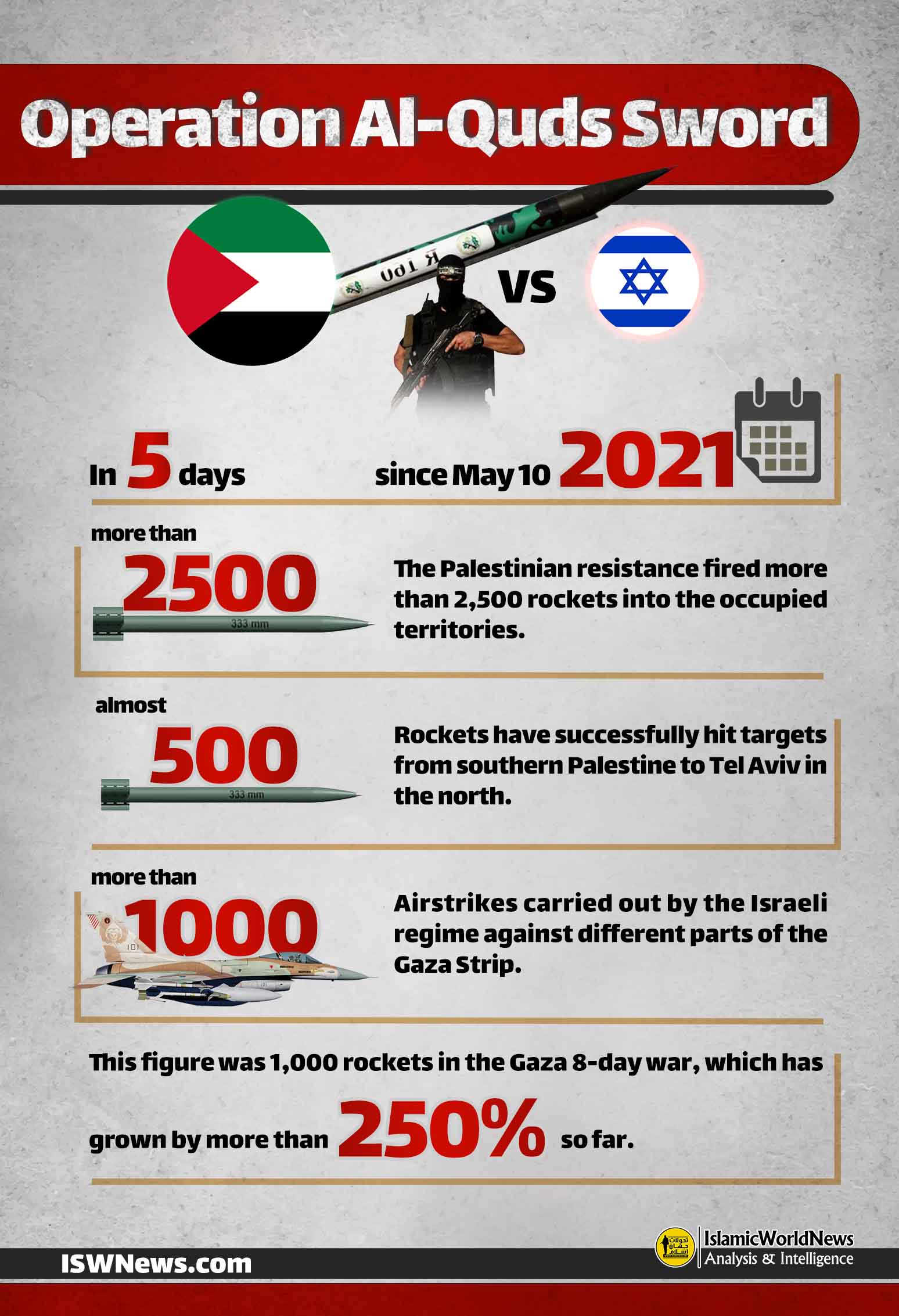
Israeli warplanes have also carried out more than 1,000 airstrikes on various parts of Gaza Strip.
It is worth noting that during the 8-day war in Gaza in 2012, about 1,000 rockets were fired by the Palestinian resistance groups in eight days; During the recent operation, 5 days after the battle, more than 2,500 rockets were fired at the occupied territories. This indicates a significant increase in the rocket power of Palestinian resistance groups.

Martyr Haj Qassem Soleimani’s message to Palestine: “Assure everyone that no matter how much the pressure on Iran increases and its siege tightens, Iran will not leave Palestine, this jewel of the Islamic world and the first qibla of Muslims and the place of ascension of the Prophet. We will never give up this religious obligation of “supporting Palestine” in exchange for the splendor and carcass of this world. Defending Palestine is a real example of defending Islam and the Quran, and anyone who hears your call and does not rush to your aid is not a Muslim.”

Sayyed Abdul-Malik Badreddin al-Houthi, leader of Ansar Allah movement: “The name “Al-Houthi” is not a name that we call ourselves. Rather, enemies and some friends call it for us, and we do not want it because it is relative to the city of “Houth”, and our project is not limited to a city but rather a Quranic path.”
Read more: Audience Question: Houthis or Ansar Allah?

Despite Israel sabotages actions in Syria and while many Israeli attacks in Syria have gone unanswered, Iran has refused to withdraw its forces from Syria, and the Israeli regime’s efforts to drive Iran out of Syria have been virtually fruitless. This issue reached its peak in the last two years after the failure of the plan to prevent the export of Iranian oil and to reduce the sales of Iranian oil to zero, and we witnessed the culmination of this story in the case of sending Iranian tankers to Venezuela. This has once again led to the intensification of an intensified intelligence-security war against Iran, and the difference from previous years is that Israeli military strikes coincide with this intelligence war.
List of actions of Israel and its allies after the assassination of Martyr Haj Qasem Soleimani in turning military war into intelligence war:
1- Explosion in centrifuge montage hall of Natanz nuclear facility in north of Isfahan province on July 2, 2020.
2- Attacking Iran’s oil tanker “Sabiti” in the Red Sea and 60 miles away from Jeddah harbor on October 10, 2019.
3- Cyber attack to Shahid Rajaei harbor in Bandar Abbas on October 13, 2020.
4- Assassination of Iranian top scientist, martyr Mohsen Fakhrizadeh in Absard area, east of Tehran province on November 27, 2020.
5- Attacking Iran’s oil tanker “Shahre Kurd” at Syria’s shore on March 11, 2021.
6- Unsuccessful assassination of Rostam Qasemi, Quds Force economic deputy in Lebanon on March 2021.
7- Attacking Saviz ship in the Red Sea on April 6, 2021.
8- Second explosion in electricity network of Natanz nuclear facility on April 11, 2021.
Alleged Iran attacks on Israeli interest also are as follows:
1- Cyber attack to electric power company of occupied palestine towns Tel Aviv, Ashdod, Or Akiva, Haifa, Netanya, Rahofut on October 30, 2020.
2- Attacking Helios Ray ship in the Oman Sea on February 26, 2021.
3- Attacking Lory container ship in north of the Arab Sea on March 25, 2021.
4- Attacking Hyperion Ray ship near the UAE’s Fujairah port on April 13, 2021.
Regarding the statistics provided, it is noteworthy that this information includes information that has been made publicly available, and obviously many other operations have been carried out by the parties that have not been made public so far, or that the parties preferred not to speak publicly about it.
Given the trend of these developments, it seems that in the coming days we will see more confrontation between Iran and Israel in the field of maritime, cyber and especially intelligence-security. The scale of this war could also be extended to other countries, especially Syria, which makes the confrontation between Iran and Israel more difficult. Despite the political and economic hardships and constraints that the United States and the West have imposed on Iran during the difficult times of coronavirus, Iran will certainly not be immobile in the face of Israeli attacks and sabotage and will respond to Israel.

Pakistan’s missile arsenal consists mainly of short-range and medium-range ballistic missiles, and important steps have been taken in the production of cruise missiles. Pakistan has received significant technical assistance from China in its nuclear and missile programs, and in addition to China, it has also benefited from military cooperation with Iran and North Korea.
The culmination of Pakistan’s missile program is reflected in the Shaheen 3 (Shaheen-III) missile project, which was successfully tested in the waters of the Arabian Sea on January 20, 2021, after modifying its technical design and carrying capacity.
Pakistan also has two prominent examples of cruise missiles, classified as “Babur” and “Ra’ad”. Babur is fired from land and sea at the target, and the Ra’ad can be fired from the warplane.
Pakistan has been building ballistic missiles since the 1980s under the Hatf project, which has continued unabated to this day with the support of the Pakistan government and military, and has achieved many goals for Pakistan.
Pakistan short-range missiles:
1- Hatf-1 missile:
Hatf-1 short-range ballistic missile, which is made in four types. The missile weight is 1,500 kilograms, 6 meters long and 0.56 meters in diameter, the warhead weight is 500 kilograms and has a range of 70 to 100 kilometers.
2- Abdali missile:
Hatf-2 or Abdali short-range ballistic missile (named after Ahmad Khan Abdali), the missile weight is 1750 kg, 9.75 meters long and 0.56 meters in diameter, with warhead weight of 500 kg. Range 280 km (with a load of 500 kg) up to 450 km (with a load of 300 kg) and accuracy of 100 to 150 meters.
3- Ghaznavi missile:
Hatf-3 or Ghaznavi short-range ballistic missile (named after the Ghaznavid dynasty), the missile weight is 5,256 kg, 9.64 m long and 0.88 m in diameter, with warhead weight of 700 kg and with a range of 290 to 320 km, capable of carrying nuclear warhead.
4- Shaheen 1 missile:
Hatf-4 or Shaheen 1 short-range ballistic missile (taken from Iqbal Lahori poem) is a missile with a weight of 9.5 to 10 tons, 12 meters long and 1 meter in diameter, with warhead weight of 1000 kg, and with 750 to 1000 km range, And has a high accuracy.
5- Nasr missile:
Hatf-9 or Nasr short-range ballistic missile is a missile with a weight of 1,200 kg, with warhead weight of 400 kg, with range of 70 km and accuracy of 1 meter.
Pakistan medium-range ballistic missiles:
6- Ababeel missile:
The Ababil medium-range ballistic missile is a missile with a length of 21.5 meters and a diameter of 1.7 meters, with warhead weight of 500 kg, and range of 2200 km, which is also capable of carrying nuclear warhead.
7- Ghauri missile:
The Hatf-5 or Ghauri medium-range ballistic missile (named after Sultan Shahabuddin Mohammad Ghauri) is a missile with weigh of 15850 kg, 15.9 m long and 1.35 m in diameter, with a range of 1350 to 1500 km.
8- Ghauri 2 missile:
The Hatf-5A or Ghauri 2 medium-range ballistic missile is a missile with a weight of 17,800 kg, 18 meters long and 1.35 meters in diameter, with warhead weight of 1,200 kilograms, and with range of 1,800 to 2,000 kilometers and is capable of carrying nuclear warhead.
9- Ghauri 3 missile:
The Hatf-8 medium-range ballistic missile, or Ghauri 3, was a 3,000 km missile which did not reach the production stage and its design was stopped. After the halt of Ghauri 3 project, Pakistan claimed to have built another ballistic missile called Tipu missile with a range of 4000 km, about which no information has been released yet.
10- Shaheen 2 missile:
The Hatf-6 or Shaheen 2 medium-range ballistic missile is a missile with a weight of 25,000 kg, 17.5 meters in length and 1.4 meters in diameter, with a range of 2500 km, which is also capable of carrying nuclear warhead.
11- Shaheen 3 missile:
The Shaheen 3 medium-range ballistic missile is a missile with a length of 19.3 meters and a diameter of 1.4 meters, with a range of 2750 kilometers.
The missile is capable of targeting all of India, including its islands, from positions south of Islamabad, as well as targeting Israeli if deployed in Balochistan province.

Qasef 2K was unveiled in Yemeni Armed Forces military exhibition entitled as martyr Salih al-Sammad on 7 July 2019. The drone was used against Saudi coalition commanders gatherings in al-Anad Airbase, Lahij province, which killed a number of high rank Saudi coalition officers.
Qasef 2K when introduced showed the usefulness of a operational air force. Without an efficient air force it’s difficult to impose high casualties to or have accurate information on the enemy. Drones can help significantly to survey and attack the targets accurately.
Qasef 2K was built on the same necessity of the Yemeni army and popular committees and is a fearsome in the class of suicide drones. Qasef 2K high explosive warhead explodes at elevation of 10-20 meter above the ground which shoots deadly shrapnels in a radius of 30 to 80 m and impose high casualties in the mentioned radius.
Qasef 2K Loitering Munition Specifications:
Length: 1.2 m
Small wingspan: 1.45 m
Large wingspan: 2.2 m
Height: 0.5 m
Powerplant: Piston engine
Service ceiling: up to 5,000 m
Warhead: up to 30 kg
Operational radius: 100 km
Endurance: 100 minutes
Max. speed: 250 km/h
Qasef 2K operational records: (until April 6, 2021)
1- The attack on al-Anad Airbase in Lahij province on January 10, 2019, which resulted in the death of more than 9 Saudi-led forces personnel and wounding of 15 other. Among those killed were Mohammad Saleh Tamah, head of the intelligence service of the (resigned) Mansour Hadi government, Saleh al-Zandani, deputy chief of staff, and Nasser Barvis, head of the army’s military operations department.
2- Attack on the gatherings of the Saudi coalition forces in Asir province on January 11, 2019.
3- Attack on the gatherings of the Saudi coalition forces in the Al-Khuba area in Jizan on January 11, 2019.
4- Attack on the gatherings of the Saudi coalition forces in Asir province on January 18, 2019.
5- Attack on Al-Suwiqa base in Al-Jawf province on January 18, 2019.
6- Attack on the gatherings of the Saudi coalition forces at Al-Darb base in Jizan on March 7, 2019.
7- Attack on the gatherings of the Saudi coalition forces in the Al-Ruba’a area, located in the province of Asir (southern Saudi Arabia) on April 24, 2019.
8- Attack on the headquarters of the STC in the Al-Bariqa area, located in Aden, on April 25, 2019.
9- Attack on the gatherings of the Saudi coalition forces in Al-Rubu’a area on May 12, 2019.
10- Attack on the hangars of the Saudi coalition warplanes at Najran Airport, on May 21, 2019.
11- Attack on the hangars of the Saudi coalition warplanes at Najran Airport on May 22, 2019.
12- Attack on the patriot system of the Saudi coalition at Najran Airport, on May 23, 2019.
13- Attack on the hangars of Saudi coalition warplanes at Najran Airport on May 26, 2019.
14- Attack on a gathering of Saudi coalition forces at Ras Abbas base in Aden on June 3, 2019.
15- Attack on the hangar and UAV station of the Saudi coalition at Jizan Airport on June 9, 2019.
16- Attack on weapons storage, advanced radars and command rooms of King Khalid Airbase in Khamis Mushait on June 11, 2019.
17- Attack on Abha Airport on June 14, 2019.
18- Attack on the command room of the Saudi coalition drones at Jizan Airport and the fuel station of Abha Airport on June 15, 2019.
19- The attack of five Qasef 2K drones on the hangars of warplanes, weapons storage and other military targets in Khamis Mushait on June 16, 2019.
20- The attack of three Qasef 2K drones on Abha Airport in Asir Province on June 17, 2019.
21- Attack on the hangars of the Saudi coalition drones and other military targets at Jizan Airport on June 20, 2019.
22- Attack on Jizan and Abha Airports on June 23, 2019.
23- Attack on the hangars of Saudi coalition warplanes at Jizan and Abha airports on June 25, 2019.
24- Attack on the hangars of Saudi coalition warplanes at Jizan airports on June 30, 2019.
25- Attack on military positions at Jizan Airport on July 4, 2019.
26- Attack on military positions at Abha Airport on July 5, 2019.
27- Attack on the hangars of Saudi coalition warplanes at Jizan Airport on July 6, 2019.
28- Attack on military targets at Abha Airport on July 6, 2019.
** Unveiled at the Martyr Salih al-Sammad Military Industries Exhibition on July 7, 2019 **
29- Attack on the airport and power station of Abha city on July 9, 2019.
30- Attack on the King Khalid airbase in Khamis Mushait on July 15, 2019.
31- Attack on the hangars of the Saudi coalition drones at Jizan Airport on July 16, 2019.
32- Attack on the King Khalid airbase in Khamis Mushait on July 16, 2019.
33- Attack on Jizan Airport on July 17, 2019.
34- Attack on radars and other military positions at King Khalid Airbase in Khamis Mushait on July 20, 2019.
35- Attack on radars and other military positions at King Khalid Airbase in Khamis Mushait on July 23, 2019.
36- Attack on the hangars of Saudi coalition warplanes and storage and equipment facilities at the King Khalid Airbase in Khamis Mushait and the hangars of Saudi coalition warplanes at the Abha airport on July 25, 2019.
37- The attack of two Qasef 2K drones on the command room of the Saudi coalition drones at Najran Airport on July 28, 2019.
38- Attack on Abha Airport and King Khalid Airbase on July 29, 2019.
39- Joint attack with a missile force on a military exercise at Al-Jalaa base on August 1, 2019.
40- Attack on Abha Airport, King Khalid Airbase in Khamis Mushait and Najran Airport on August 5, 2019.
40- Attack on Abha Airport on August 8, 2019.
42- Attack on the fuel station and watchtower at Abha Airport on August 10, 2019.
43- Attack on the King Khalid airbase in Khamis Mushait on August 11, 2019.
44- Attack on Abha Airport on August 13, 2019.
45- Attack on Abha Airport on August 16, 2019.
46- Attack on the King Khalid airbase in Khamis Mushait on August 22, 2019.
47- Attack on the fighters’ hangar and the runway of the King Khalid Airbase in Khamis Mushait on August 24, 2019.
48- Attack on the watchtower of Abha Airport and King Khalid Airbase on August 25, 2019.
49- Attack on the hangars of the Saudi coalition at the King Khalid Airbase in Khamis Mushait on August 26, 2019.
50- The attack on the military communication system and the hangar of the Saudi coalition warplanes at the King Khalid Airbase in Khamis Mushait on August 27, 2019.
51- Attack on the positions of the Saudi coalition in Najran and the base of the coalition under construction in Jizan on August 28, 2019.
52- Attack on the hangars of Saudi coalition warplanes at Najran Airport on August 29, 2019.
53- Attack on the gatherings of the Saudi coalition forces in the north of Hardh in Al-Hajjah province on September 2, 2019.
54- Attack on the King Khalid Airbase in Khamis Mushait on September 3, 2019.
55- Attack on the King Khalid Airbase in Khamis Mushait on September 5, 2019.
56- Attack on an important military target in Khamis Mushait on September 6, 2019.
57- Attack on an important military target in Khamis Mushait on September 7, 2019.
58- Attack on Abha Airport on September 9, 2020.
59- During a large-scale Ansar Allah operation on March 29, 2020, the military and economic targets of the Saudi coalition in Jizan, Najran and Asir were attacked.
60- Attack on the hangars of warplanes and weapons storage in Khamis Mushait on June 16, 2020.
61- Attack on the operating room of Najran Airport and the weapons storage and hangars of the Saudi coalition warplanes at the King Khalid Airbase in Khamis Mushait on July 3, 2020.
62- Three Qasef 2K drones attacked Abha, Jizan Airport and Malik Khalid Airbase in Khamis Mushait on October 24, 2020.
63- Attack of two Qasef 2K drones on King Khalid Airbase in Khamis Mushait on October 25, 2020.
64- Two Qasef 2K drones attacked Abha Airport on October 26, 2020.
65- Attack on Abha Airport on October 27, 2020.
66- Two Qasef 2K drones attack the Saudi coalition warplanes at Abha Airport on February 10, 2021.
67- Attack of Three Qasef 2K drones on Abha Airport on February 12, 2021.
68- Attack on Abha Airport on February 14, 2021.
69- Attack on Abha Airport on February 15, 2021.
70- Six Qasef 2K drones attacked the positions of the Saudi coalition in Abha and Khamis Mushait on February 28, 2021.
71- Attack on the hangars of the Saudi coalition warplanes at Abha Airport on March 2, 2021.
72- Attack on the King Khalid Airbase in Khamis Mushait on March 4, 2021.
73- Attack on Abha Airport and King Khalid Airbase in Khamis Mushait on March 5, 2021.
74- Attack of five Qasef 2K drones on King Khalid Airbase in Khamis Mushait on March 5, 2021.
75- Four Qasef 2K drones attack Saudi coalition positions in Asir and Jizan provinces on March 7, 2021.
76- Three Qasef 2K drones attacked Abha Airport and King Khalid Airbase on March 15, 2021.
77- Attack on the King Khalid Airbase in Khamis Mushait on March 16, 2021.
78- Attack on Abha Airport on March 18, 2021.
79- Two Qasef 2K drones attack King Khalid Airbase in Khamis Mushait on March 19, 2021.
80- Attack on Abha Airport on March 20, 2021.
81- Attack on Abha Airport on March 23, 2021.
82- During Ansar Allah operation against the positions of the Saudi coalition in Najran and Asir on March 26, 2021, six Qasef 2K drone were used.
83- Attack on the King Khalid Airbase in Khamis Mushait on April 2, 2021.

Sammad-3 drone (or Samad 3) was built by Yemeni Army amid savage war in Yemen. It is named after martyr Saleh al-Sammad, former head of political high council of Yemen who was martyred in drone attack of Saudi coalition.
This achievement was due to Ansar Allah necessary to have a deterrence against Saudi coalition air raids.
Sammad-3 was used in three attacks to UAE before unveiling which caught Saudi coalition in great surprise. Sammad-3 was announced in a military industry exhibition by Ansar Allah called martyr Saleh al-Sammad on July 7, 2019.
Sammad-3 has been a vital part of deterrent operations since “Second Deterrent Balance Operation” till now as of its nest is Abha airport! It is a successful weapon in the hands of Ansar Allah drone unit and imposed heavy damages to the coalition. Sammad-3 was used in two attacks to Aramco facilities and in both cases it interrupted the oil production.
Operational history of Sammad-3 drone:
1- Attacking Abu Dhabi airport, UAE, on July 26, 2018.
2- Attacking Dubai airport, UAE, on August 27, 2018.
3- Attacking military targets in Riyadh, Saudi Arabia, on August 26, 2019.
4- Attacking Buqayq and Khurais refineries during Second Deterrent Balance Operation, on September 18, 2019.
5- Attacking Aramco oil facilities, Yanbu harbor, by 12 drones during Third Deterrent Balance Operation, on February 21, 2020.
6- Attacking Saudi coalition positions in Riyadh, Jizan, Najran and Asir, during Ansar Allah operation, on March 28, 2020.
7- Attacking Saudi Arabia’s defense and intelligence facilities and King Salman airport in Riyadh, Jizan, Najran, during Fourth Deterrent Balance Operation, on June 23, 2020.
8- Attacking Abha airport, on September 8, 2020.
9- Attacking Abha airport, on September 9, 2020.
10- Attacking Saudi coalition positions in Riyadh with 4 drones, on September 10, 2020.
11- Attacking Abha airport, on September 17, 2020.
12- Attacking Abha airport, on October 25, 2020.
13- Attacking Abha airport with 2 drones, on February 10, 2021.
14- Attacking Abha airport, on February 13, 2021.
15- Attacking Abha airport, on February 14, 2021.
16- Attacking Jaddah airport, on February 15, 2021.
17- Attacking Saudi coalition positions in Abha airport and King Khalid in Khamis Mushait, on March 5, 2021.
18- Attacking Saudi coalition positions in Khamis Mushait, on March 6, 2021.
19- Attacking Aramco oil facilities in Raas Tanurah and military targets in Dammam area, by 10 drones during Sixth Deterrent Balance Operation, on March 7, 2021.
Specifications:
Length: 3 m
Wingspan: 5 m
Height: 1.5 m
Service ceiling: 8,000 m
Weapons payload: 40 kg
Range: 1,600 km
Endurance: 5 hours

The spokesman for the Yemeni Armed Forces, Brigadier General Yahya al-Sari’, on the occasion of National Resistance Day presented the statistics of six years of fighting with the Saudi coalition.
General Yahya al-Sari’:
– The total number of airstrikes carried out by the aggressor (Saudi) coalition against Yemen is more than 266510, which has been nearly a 1000 attacks since the beginning of year 2021.
– The total number of military operations of our forces against the enemies during the last 6 years has reached 12366 operations.
– More than 6192 offensive operations, including 167 operations carried out by our forces in the last two months.
– The number of defensive operations against enemy attacks is more than 6,174, of which 113 operations have been carried out in the last two months.
One of the most prominent military offensive operations of our forces is Operation “Nasr Min Allah” in three stages and a large and unannounced military operation.
Other prominent military offensive operations by our forces include Operation Bonyan al-Marsous and Fa’amkana Minhom, clearing areas in al-Baydha of Takfiri elements, and a military operation in al-Dhale province.
Also, one of the most prominent military offensive operations of our forces is the “Deterrent balance operation”, and in addition, there are about 10 other undeclared military operations.
– The sniper unit has carried out more than 54025 shooting operations on various battlefields, of which 2502 have been carried out in the past two months, killing and wounding thousands of mercenaries, including Sudanese and the Saudi army personnel.
– The engineering unit has targeted equipment, military and armored vehicles and enemy gatherings in more than 10560 operations.
– The anti-tank unit has targeted enemy vehicles, armor, personnel carriers, bulldozers, etc. in more than 6,385 operations.
– The artillery unit has carried out more than 59,852 operations to support, target and repel enemy attacks, of which 638 operations have been carried out jointly with the drone unit.
The artillery unit has used various types of Zilzal missile in its operations, and the number of missiles used has reached more than 10,000 missiles.
– The Air Defense has conducted more than 1,534 operations against warplanes, destroying, confronting, and forcing them to flee the battlefield.
The Air Defense Force has shot down more than 454 aircraft belonging to the aggressor (Saudi) coalition, including warplanes, helicopters and reconnaissance drones.
– The Navy and Coast Guard have conducted more than 34 military operations. In addition to enemy ports and facilities, the Navy and Coast Guard have also targeted enemy ships, warships, frigates and boats.
The Navy and Coast Guard have seized a number of violator ships that entered Yemeni waters illegally.
Among the most prominent naval and coastal defense operations have been the Medinah Frigate, the Saudi-owned Dammam Frigate, and the UAE HSV-2 Swift warship.
– The missile force, with the help of God Almighty, has carried out more than 1348 operations, during which 1348 fired ballistic missiles. Of these, 499 ballistic missiles targeted military and vital facilities belonging to the Saudi enemy and others to the Emirati enemy.
– 849 ballistic missiles target enemy gatherings, facilities, headquarters and centers and its mercenaries inside Yemen. In the past two months, the missile force has fired 54 ballistic missiles at Saudi military targets in Saudi Arabia.
– With God’s help, the drone unit has carried out 12,623 operations, including 1,150 offensive operations against enemies.
The number of drone strikes against enemy targets outside Yemen has reached more than 572 And has targeted 578 enemy operations inside Yemen.
The number of reconnaissance operations has reached more than 11,473 operations.
Since the beginning of this year, the total number of UAV operations has reached 1464 operations, including 1340 reconnaissance operations and 124 offensive operations.
– The Saudi enemy army has suffered more than 1,0403 dead and wounded since the beginning of the aggression.
Since the beginning of this year, 403 Saudi personnel have been killed and injured.
– As of March 23, 2021, more than 1,240 UAE army personnel had been killed and wounded.
– The casualties of Sudanese mercenaries has risen to more than 8,634, with 4,416 killed and 4,218 wounded.
– The casualties among the (Yemeni) mercenaries and traitors are more than 226615 killed and wounded.
Over the past few days, the enemy has acknowledged that in 2020 alone, 18,000 mercenaries were killed and 50,000 wounded on the Ma’rib front.
– More than 14,527 vehicles including armored vehicles, tanks, personnel carriers, bulldozers were destroyed from the beginning of the aggression, of which 9859 operations have been documented by audio and video.

Ansar Allah has launched seven Zulfaqar missiles against Saudi coalition in six operations, details are as follows,
– Third Deterrence operation against Aramco oil infrastructure on Yanbu harbor on February 21, 2020, one missile.
– Nasr Min Allah operation, unknown date, two missiles.
– Missile operation against Saudi coalition in Riyadh on March 29, 2020, one missile.
– Fourth Deterrence operation against Saudi coalition in Riyadh, Jizan and Najran on June 23, 2020, one missile.
– Missile and drone operation against Saudi coalition in Riyadh on September 10, 2020, one missile.
– Fifth Deterrence operation against Saudi coalition on February 27, 2021, one missile.