Category: Opinion

  • Mista’arvim; the entangled knot of Palestinian Intifada

    Mista’arvim; the entangled knot of Palestinian Intifada

    Several reason can be counted but the main reason or entangled knot of it is the special unit in Israeli Police called Mista’arvim (transformed to Arab).

    These units which have different names consist of elite Israeli officers who speak Arabic like Palestinians and live in a specific village to learn their culture and traditions.


    Their task is to blend in the Intifada and support them but this is no the end. Each unit which consists of more than two or three officers arrest Palestinians from inside and bring them to an unknown place. Before Israel retreat from Gaza strip in 2004, they were responsible to diffuse, recognize and assassinate leaders of Moghawemat (movement of Palestinians to fight with Israeli forces).


    The history of these groups dates back to before establishment of Israel and Haganah paramilitary group is considered to be their start point. According to Israel, these units assassinated 442 Palestinians between 1988 to 2004.

    It is worthy to mention that these units do not have an easy task all the time; in 2005 when Palestinians were protesting and gathering near a separation barrier some of these officers could blend in but before action, Palestinians found out and they had to flee. Israel army had to fire and attack Palestinians to rescue their officers.


    One method Palestinians use to identify these officers is to be top naked or have only underwear, since these officers must carry pistols, they cannot do this, however this method only works in summer and in winter, it is too cold to be naked, so this problem is still unsolved.


    These units were silent for one year and half but by rising the new Intifada, they show up and are acting.

    We should wait and see if Mista’arvim unit can extinguish the fire of Intifada by frightening and assassins again?

    We will find out soon…


    Some examples of arrests performed by Mista’arvim:


  • Hariri’s Resignation and More Plans for War

    Hariri’s Resignation and More Plans for War

    As Hariri is a Saudi-US asset, the ‘forced’ resignation seems more like the sacking of a company executive who has not lived up to expectations. Told to step out of office Hariri did what he was told, following through by issuing a Saudi-scripted statement accusing Hezbollah and Iran of sowing discord across the region, and talking of a plot to assassinate him.


    In fact, it was Saudi Arabia sowing discord, by blaming Hezbollah and Iran for Hariri’s resignation, with the apparent aim of throwing Lebanon into chaos. Predictably, Netanyahu jumped in immediately, saying the resignation was a call to the ‘international community’ to take action against Iranian aggression but no-one else bought it, not even Lebanon’s Sunni Muslims. Hezbollah reacted calmly and if anyone came out of it badly it was Saudi Arabia. In the Iranian view the removal of Hariri was a plot cooked up by Trump and Crown Prince Muhammad bin Salman.


    Hariri himself did not return to Lebanon where he could have defied the Saudis and resumed his position but moved on to France, where he was welcomed by President Macron at the Elysee Palace. Soon after talking to Hariri, Macron was on the phone to Trump, discussing the Iranian ‘threat’ and how to deal with it. According to Lebanon’s President Michel Aoun, Hariri told him he would return to Beirut by Independence Day, November 22, marking the end of the French mandate. The Lebanese parties, including Hezbollah, still regard Hariri as the country’s Prime Minister so how all of this plays after Hariri’s return will be interesting to see.


    What lies behind all this?

    What is the connection between Hariri’s resignation (forced or otherwise) and the other events running concurrently in Saudi Arabia, namely the arrest of some of the most powerful figures in the kingdom and the confiscation of their assets, estimated at about $800 billion? One has to assume there is a connection. It seems far too much of a coincidence for there not to be one.


    The claim that the purge of the princes was part of an anti-corruption drive is bunk, seeing that corruption is intrinsic to how the Saudi government operates, domestically and in its foreign policy. If corruption is a cover story, why were these princes removed? Could it be their opposition to Saudi Arabia’s policy failures, in Syria and Yemen, and their opposition to what is now clearly being moved from the drawing board to implementation, a war on Iran, involving the US, Israel and Saudi Arabia? They would hardly be alone in seeing Crown Prince Muhamad bin Salman as reckless, foolhardy and lethally dangerous to the stability of the Saudi kingdom: his accession to the throne they would regard, literally, as a crowning act of folly.


    That another war is on the horizon is clear from all the signals coming out of Israel in the past six months. That not just the US but Saudi Arabia will be part of it is obvious. Intermittently, Israel and Saudi Arabia have been pushing for war on Iran for a decade. With the US refusing to bite, to the extent of launching an open military attack, Syria was chosen as the next best target: if the government in Damascus could be destroyed, the strategic alliance between Iran, Syria and Hezbollah would collapse at its central arch. This plan B was partly foiled by the refusal of the UN Security Council, thanks to the vetoes of Russia and China, to sanction an aerial war on Syria along the lines of the assault on Libya. Plan C had to come into effect, reliance on a war of attrition fought by takfiri proxies organised, financed and armed mainly by the US, Saudi Arabia, Qatar, Israel, Britain and France, and coordinated with the assistance of governments ranging from the Balkans to Central Asia. Seven years later Plan C has now ground to a halt. The ‘axis of reaction’ (the US, Israel and Saudi Arabia) has suffered a crushing defeat at the hands of the ‘axis of resistance’ (Iran, Syria and Hezbollah). Russian intervention has been critical, so the victory is Russia’s as well, and a particular humiliation for the US.


    This does not end the list of defeats suffered by the ‘axis of reaction.’ Another severe blow has been suffered through the collapse of the Kurdish drive for independence in northern Iraq. Both the US and Israel have assiduously cultivated the Kurds for decades, seeing northern Iraq as a new strategic centre for military and intelligence operations across the Middle East. The US and British ‘no fly’ zone and ‘safe haven’ initiatives of 1990/91 were the first steps in the planned breakup of an Iraq that no longer suited imperial purposes. The invasion of 2003 and the imposition of a constitution dictated by the US, weakening the authority of the central government, led to Kurdish autonomy which, in time, would have been expected to end in independence and a new base for US/Israeli operations across the Middle East.

    Even the US was against the referendum called by Masoud Barzani: seeing that it was already getting what it wanted, the referendum would be premature and cause more trouble than it was worth.


    This proved to be the case. Turkey and Iran reacted viscerally, ending flights and closing border crossings: the Iraqi army retook Kirkuk and all the territory conquered by the Peshmerga in 2014. Barzani stepped down as president of the KRG: Jalal Talabani, the head of the Patriotic Union of Kurdistan (PUK), had died only recently, leaving the Kurds leaderless and at each other’s throats over who was responsible for this debacle. Iraq is now being reconstituted as a unitary state. The largely Shia Popular Mobilization Forces (PMF) has developed into a powerful annex to the regular army. Moreover, the government in Baghdad has a close working relationship with the government of the Islamic Republic in Tehran.

    The paradox of these defeats is that they increase to a critical level the danger of a new attack by the ‘axis of reaction’ on the ‘axis of resistance.’ Russia, Iran, Syria and Hezbollah cannot be allowed to get away with these victories. The Israeli chief of staff, Gabi Eisenkot, hardly needed to say, as he did recently, that there is ‘complete agreement between us and the Kingdom of Saudi Arabia’ on the question of Iran’s spreading influence across the Middle East, or ‘control’ of the region as he put it. Unable to impose its will on one of the poorest countries in the world, Yemen, Saudi Arabia would be of little help on the front line in a war against dangerous targets such as Hezbollah and Iran. But it has money and according to Hasan Nasrallah, has offered to pay Israel billions of dollars for a new war on Hezbollah.


    As Israel always has the next war on the drawing board, the central question is ‘when’ rather than ‘if’ it will be launched. In recent months it has held some of the largest-scale land and air exercises in its recent history in preparation for a new war on Hezbollah, including training for fighting in tunnels. It has warned repeatedly over the years that the next time around the ‘Dahiyeh strategy’ will be applied across Lebanon and is busy selling the propaganda package that there really is no Lebanon any more but only a Hezbollah enclave controlled by Iran.

    Dahiyeh, of course, is the largely Shia Beirut suburb and urban HQ of Hezbollah that was pulverised from the air in 2006. Given the huge civilian casualties Israel is willing to inflict in the next war, Iran and Syria would be hard pressed to stay out but the moment they intervene, Israel, the US and Saudi Arabia will have their three primal enemies directly in their line of fire. The refusal of the US to withdraw its forces and dismantle its air bases in Syria now that the Islamic State has been ‘defeated’ (if still being used as an American tool) is probably connected with preparation for the coming conflict.

    Israel’s existential struggle in the Middle East since 1948 has now reached the point of crisis. Israel may think it has all the time it needs to completely engorge the West Bank but it does not have such a luxury on the regional front. If Iran is stronger now than before the wars on Iraq and Syria, it will be even stronger in two or three years’ time. It has a large standing army, fought an extremely destructive war against Iraq (1980-89), has been deeply involved at the planning and combat level in the defence of Syria and has built up a large arsenal of locally developed short and long-range missiles.

    By comparison, Israel has not even fought a regular army since 1973: in 2000 it was driven out of Lebanon by a guerrilla force and when it attempted to retrieve lost ground by launching a new war in 2006 its ground troops proved incapable of taking villages even a few kilometres from the armistice line. Its attacks on Gaza have been onslaughts on a largely defenceless civilian population.

    Given that since 1948 its security/insecurity situation has ultimately been based not on diplomacy but on full spectrum military domination from the possession of nuclear weapons down to conventional warfare, Israel cannot allow the current situation of strengthening enemies to continue. Hostile to any kind of diplomatic settlement that would generate a real peace, Israel must go to war. It says it is much stronger and better prepared than in 2006 but so are Hezbollah and Iran. Hezbollah alone has a large stockpile of missiles able to reach any corner of occupied Palestine: Israel’s Iron Dome anti-missile system will stop some of them but not all.

    If it does go to war Israel is certainly going to suffer civilian casualties unprecedented in its history but the politicians and generals around Netanyahu will argue that its existential situation will demand these sacrifices. The US would come in behind Israel, but Russia could not be expected to sit by while its diplomatic alliances and strategic assets in the Middle East are destroyed. The commentator Abd al Bari Atwan has warned that such a war would be the most destructive in the region’s history, developing into a global conflict, and has raised the question of whether Israel, having started it, could survive it. This is a truly apocalyptic scenario.


    As usual the Palestinians find themselves caught in the middle. Mahmud Abbas is being told to go along with the Trump-Kushner-Israel ‘peace initiative’ or else, even by Saudi Arabia. This would involve Abbas publicly sharing the anti-Iranian, anti-Hezbollah and anti-Shia views of the Saudis at a time he is engaged in a reconciliation process with Hamas, which has refused to take a stand against Hezbollah. Furthermore, several of its senior leaders have recently been in Tehran. For the moment all eyes are on Hariri as he returns to Beirut: how will he explain himself, will he resume his position as Prime Minister and on what terms?


    Source

  • BBC Confirms the US-led Coalition Is Part of the Problem in Syria Rather than any Solution

    BBC Confirms the US-led Coalition Is Part of the Problem in Syria Rather than any Solution

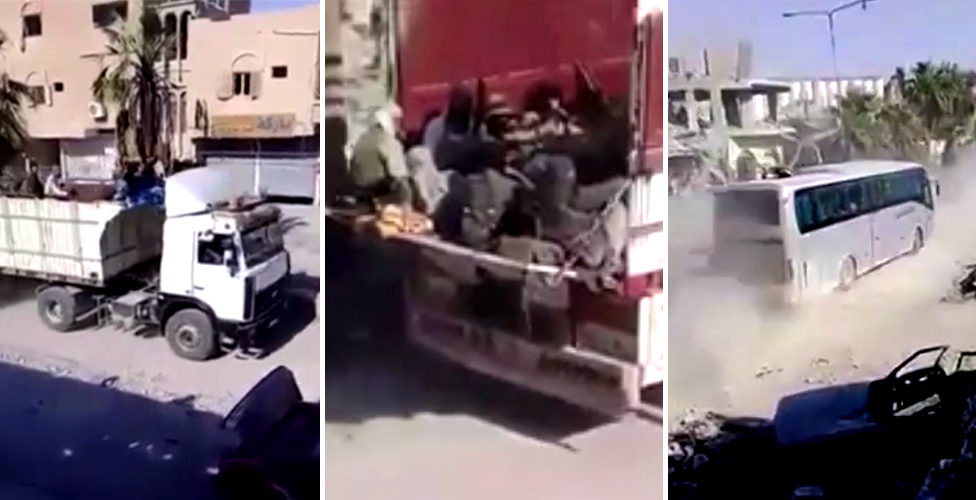
    The revelations carried in a recent BBC report, concerning a deal that was struck between the US-led coalition that has been engaged in the battle to retake the Syrian city of Raqqa in recent months and the Daesh fighters occupying the city – a deal allowing hundreds of said fighters to be evacuated along with their families and weaponry – could not be more scandalous. More than opportunism, it exposes the oft-proclaimed commitment of Washington and its allies to destroying Daesh as hollow.

    According to the BBC the deal “enabled many hundreds of IS [Daesh] fighters to escape…At the time, neither the US and British-led coalition, nor the SDF, which it backs, wanted to admit their part.” According to the personal testimony of some of the drivers employed to evacuate the fighters and their families out of Raqqa, “the convoy was six to seven kilometres long. It included almost 50 trucks,13 buses and more than 100 of the Islamic State group’s own vehicles.” We also learn that despite “an agreement to take only personal weapons, IS fighters took everything they could carry. Ten trucks were loaded with weapons and ammunition.”

    No one should be in any doubt when it comes to the gravity of seriousness involved in allowing hundreds of Daesh fighters to escape and fan out across Syria with some, according to the BBC, making it across the border into Turkey. The burning question is whether the deal and subsequent evacuation was undertaken with the express purpose of diverting them to parts of Syria controlled by the Syrian Army and its allies?

    What is certain is that it brings the US-led coalition into disrepute, confirming that it is part of the problem in Syria and wider region rather than any solution. When we add to this sordid picture the recent sentiments of US Secretary of State Rex Tillerson, asserting that there is no future for Assad in Syria, it is clear that regime change in Damascus remains Washington’s overarching objective.

    When it comes to regime change in Syria, exactly who would benefit? Certainly not the Syrian people after the inordinate suffering and sacrifice they have endured in the process of first withstanding then defeating a concerted attempt to destroy the country and its non-sectarian character.

    A dirty war has been waged in Syria these past six year not by Daesh, per say, but by the US, UK, and their Persian Gulf allies. Add to this motley crew Israel’s repeated violations of Syrian airspace and you identify an axis which constitutes a threat to human progress and development such as the world hasn’t seen since the Second World War.

    As for the Syrian Kurds, fighting under the banner of the SDF (Syrian Democratic Forces), they now have a critical role to play when it comes to the trajectory the conflict takes upon the liberation of Raqqa. Indeed upon their next move will depend whether it will be accurate to describe the removal of Daesh from the city as liberation or whether it will be more akin to a re-occupation.

    It has never been more important for the Kurds not to make the mistake of confusing self-determination with treachery. Their part in defeating Daesh has undoubtedly been a courageous one. However with this secret deal to allow hundreds of Daesh militants to leave the city with their weapons and ammunition, it is impossible to avoid pondering if they are now preparing for a post-Daesh confrontation with the Syrian Army, which has just liberated Deir Ezzor 145km southeast of Raqqa.

    The point bears repeating: the presence of US military forces in Syria constitutes a clear violation of international law. It bears repeating when we have key US officials, such as Defense Secretary James Matthis, claiming UN sanction for this presence. As Russia Deputy Foreign Minister Gennady Gatilov pointed out in reponse to the US Defense Secretary’s false claim, “Syria is a sovereign independent state,” going on to remind Mr Matthis that “only the Syrian government can invite armed forces of third countries onto its territory. The UN has no such right,” he went on, before emphasizing that “the fight against terrorism does not give any states or coalitions a free hand to establish their presence on Syrian territory.”

    There is no doubt, surveying the contours of this struggle in Syria, that driving it has been the ongoing attempt not only to destroy Syria’s sovereignty and independence, but to neuter Iran’s independence also. This is why Trump’s recent unhinged and uninformed bellicose statements, directed at Iran, should come as no surprise. What with the purge unleashed by crown Prince Mohammad bin Salman in the Riyadh recently, along with the detention and forced resignation of Lebanon’s Prime Minister Saad Hariri, though the battle for Syria draws to a close, the wider struggle between the axis of sectarianism and regime change – comprising Washington, Saudi Arabia, and Israel – and the axis of resistance to it – comprising Russia, Iran, Syria and Hezbollah .


    Source

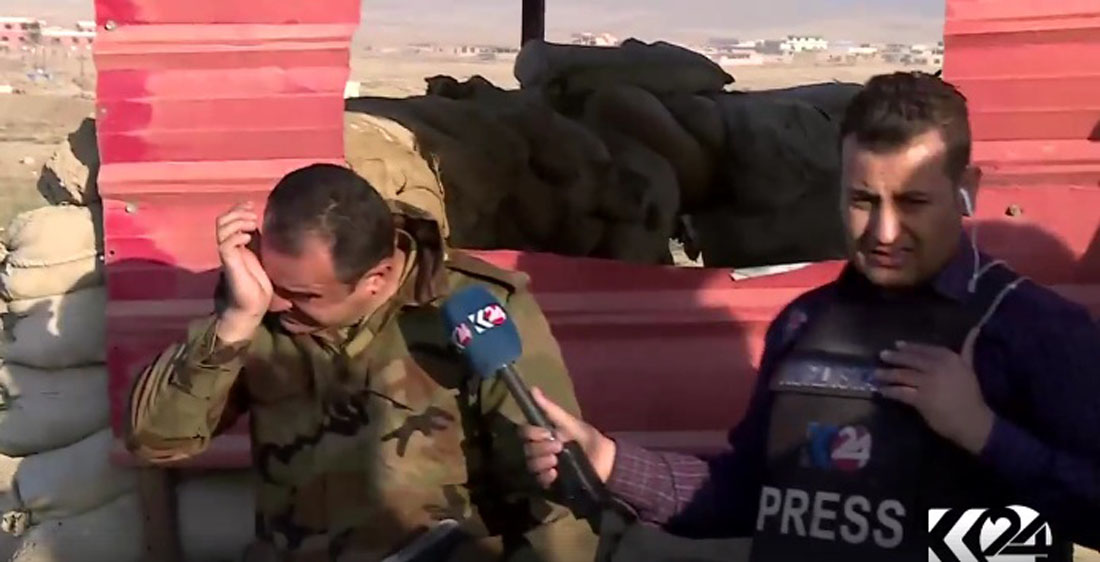
  • How Barzani regime’s media ridiculed itself during the Kirkuk Crisis: the case of Rudaw and Kurdistan24

    How Barzani regime’s media ridiculed itself during the Kirkuk Crisis: the case of Rudaw and Kurdistan24

    The political circus received relatively wide coverage in the Western media, but many people find it easier to follow the English-language regional media whose teams of professional journalists reported from the field and published articles more frequently. Beside the well established news networks like the Qatar-based Al-Jazeera, the Saudi-owned Al-Arabiya and the Iranian Press TV, several new actors have emerged on various social media platforms, notably Rudaw and Kurdistan24. In this October, the first one has recorded more than 94,000 shares and 480,000 comments on Facebook posts, as well as over 20 million impressions on Twitter, reaching over 90 million people in total. Rudaw has over 3.2 million Facebook followers, compared to Kurdistan24 which has less than half.

    Media of tribal enterprise

    The ownership background and the differences between two networks are quite astonishing. In the authoritarian countries, the national media presents one-sided view, and in totalitarian systems, all outlets are owned by the ruling party. However, in the tribal enterprise of the Barzani clan, called Iraqi Kurdistan, they have gone even further. Rudaw and Kurdistan24 therefore do not only present a single view and propagate policies that support the Kurdistan Democratic Party (KDP), but they’re also owned by the same family. Rudaw was established in 2008 for the purpose of serving interests of current Kurdish prime minister Nechirvan Barzani, and competitive Kurdistan24 (K24) was launched in 2015 by his cousin Masrour Barzani, a son of president Masoud Barzani. That’s the concept of, as Kurdophiles like to say, a Western-minded flourishing democracy and its free press.

    In the mid 2000s, there was a brief period of the independent media in local languages, emerged in political chaos rather than a pluralistic environment. Information monopoly of ruling party was temporary staggered, so regional authorities quickly moved to stifle it. The first step of undermining was establishing a number of allegedly independent outlets, but de facto subservient to the regime. The second step was the severe repression of individuals and organizations. In 2008, journalist Soran Mama Hama was killed by unknown armed men, and later the same fate befell Sardasht Osman and Kawa Garmeyani. All were writing critically on the political situation and corruption in Iraqi Kurdistan. Numerous other independent reporters received death threats for reporting on corruption and discrimination. In 2011, a free satellite TV-station NRT was established, but was set on fire by armed men only three days after its official launch.

    Both Rudaw and Kurdistan24 do not enjoy popularity among neighboring countries and their Kurdish groups. Rudaw has been banned in PYD-led Syrian Kurdistan for conducing a ‘smear campaign’ against them, while the Turkey’s Kurdistan Communities Union also called for the boycott and accused the media group as being founded by Turkish Intelligence Organization. Turkey itself has removed both Rudaw and Kurdistan24 from its TurkSat satellite, due to broadcasting violations during the independence referendum. Both channels are also banned in Iran, and even Baghdad issued statements threatening to revoke their television license in Iraq. Neither the US Department of State has any words of praise for Rudaw, describing it as the KDP affiliated outlet rather than objective media. On the other hand, among very few of their foreign admirers is Bernard-Henri Levy who recently spoke against proposed Baghdad’s ban and stated that “every friend of freedom in the world should support Rudaw.” His objectivity is already well known, as we’re speaking about the same person who called Israeli forces as “the most democratic army in the world.”

    Referendum coverage

    By analyzing coverage during the thirty days following the referendum, it’s easy to conclude that Rudaw’s and Kurdistan24’s strategic and tactical approach was almost identical. The personal rivalries between Nechirvan and Masrour were set aside, as well as various economic issues. There was not a single word about disputed oil exports (illegal over-exploitation against constitution and an OPEC agreement), the KRG’s major customers (Italy and Israel), a few months’ delay in payment of salaries, or the region’s debt which may be upwards of $20 billion. For a region with population comparable to that of Croatia, oil reserves/exports larger than those of Libya, that’s truly an amazing achievement. Still, they happily pointed out and exaggerated Iraqi debts, and all their financial hardships were attributed to Baghdad. Duo published over a thousand articles during a month, subordinating everything to the positive outcome of the referendum and desperately desired international recognition.

    Their position regarding the referendum choices can be hardly described as a black-and-white dichotomy, since “no” vote option was not even considered possible. According to their reports, stances among participants could be divided only into “yes” and “not yet” categories. When it comes to specific political actors, the contrast between good and bad was more clear. On one side there’s the light forces, “One Leader, One Party, One Choice, One Country,” and on other side there are the dark forces of the inconvenient Gorran Movement, the traitorous Patriotic Union of Kurdistan (PUK), oppressive Baghdad and the regional bullies Turkey and Iran. In the hundreds of articles, there is not a single statement against separatism, either from an average citizen or some high-ranking politician. Counter-views obviously weren’t worth even of disproportionate treatment.

    Opposing arguments given by numerous international leaders were also ignored, and the Kurdish media instead rushed to find and present any publicly available support. The results are invaluable, as they gave us a clear picture of the nature of their apologists. Those ‘freedom lovers,’ in alphabetical order, include Ralph Abraham, Stephane Bergeron, Marsha Blackburn, Richard Blumenthal, John Bolton, Ted Cruz, Trent Franks, Peter Galbraith, Mike Gallagher, Jay Garner, Newt Gingrich, Franklin Graham, Lindsey Graham, Glenn Grothman, Fuad Hussein, Jim Inhofe, Jack Keane, Zalmay Khalilzad, Bernard Kouchner, Bernard-Henri Levy, John McCain, Benjamin Netanyahu, Jared Polis, Vesna Pusić, Marco Rubio, Chuck Schumer, and the Wilson Center. Beside a few energy lobbyists and conspiracy theorists, virtually all of them are Zionist extremists and the neoconservative warmongers. Thus, the alleged Iranian-Turkish ‘accusation’ or a ‘conspiracy theory’ of Zionist role in the referendum, turned out to be a verified fact.

    From heroes to victims

    Rudaw’s and Kurdistan24’s coverage has reached peak absurdity during the Kirkuk Crisis, when they clumsily balanced between the narratives of heroism and victimhood. Four days prior to the start of military operation, they reported that region’s Security Council is expecting a ‘major attack’ by the Iraqi Security Forces and Popular Mobilization Forces (Hashd Al-Shaabi), and in the following days numerous reports about Kurdish heroism appeared. President Barzani told to Baghdad that referendum won’t be annulled at any price, Peshmerga also rejected all Iraqi warnings and stood prepared to face them, the Kurdish authorities were allegedly united, and thousands of volunteers took up arms. They even published bizarre videos of children and old ladies carrying rifles, claiming “they would rather die than allow occupation.” According to such reports, a decisive battle was supposed to happen, the cataclysmic conflict between the forces of good and evil, between Peshmerga as the finest soldiers ever and the cowardly Iraqi army, with Glorious Leader declaring ‘not a step back’ order, and courageous civilian support. A new Stalingrad battle.

    The reality proved to be quite different. On 15 October 2017, the Iraqi military started a major operation and restored full control of Kirkuk City in just about 15 hours, with very little violence since Kurds mostly retreated without fighting. This fact passed unreported as both Rudaw and Kurdistan24 continued to report about minor skirmishes between smaller groups of disobedient soldiers, and phrase ‘fall of Kirkuk’ appeared only three days later. In the meanwhile, the desperate need for heroic scenes resulted in flooding their websites and social media by fake pictures and stories, intentionally posted to increase hatred and escalate tensions. They presented Saudi army vehicles burned in Yemen as ‘Iraqi’ equipment, killed Daesh terrorists in Fallujah as ‘Shia militia’ in Kurdistan, a controlled demolition of the bridge in Kansas as the ‘Peshmerga’s scorched-earth policy’ in Altun Kupri, etc. One rumor said that Abu Azrael, a famous Shia figher against Daesh, had been killed in fighting in northern Iraq, but the lie was refuted by himself who posted a YouTube video to show he was still alive and well. They also published unconfirmed and highly dubious data of ‘180 killed’ Iraqis, ‘400 killed’ Kurdish civilians and ‘200 missing’ in Kirkuk.

    A sudden shift in the reporting strategy has rigorously transformed the Peshmerga soldiers and the Kurdish people. On Sunday night, they were ‘fearless warriors’ who never retreat, but it was already Monday morning when they became ‘betrayed and abandoned,’ blubbering incoherently for help. The bitter confession about real outcome required shame and humility, denial that true heroes never fail, and for Rudaw and Kurdistan24 that was out of the question. Instead, they found the main reason for failure in a ‘treacherous elements’ within the rival PUK party, claiming their leaders ordered a retreat, while the second reason was role of merciless foreign powers, notably Iran. During the first day of operation, Kurdistan24 showed several videos of weeping Peshmerga members who allegedly wanted to fight, but commanders ordered to pull back. The Kurdish narrative of victimhood became fashionable once again. First they managed to convince own population that there’s a total war going on, and after many fled from Kirkuk, they showed crowded roads and claimed people are escaping due to persecution.

    Non-combatant Kurdish citizens also reportedly suffered ‘tremendous crimes,’ as the Kurdish language was barred from the Iraqi organized press conference in Kirkuk, and someone even put Iranian Khamenei’s photos inside governorate building. Such ‘horrors’ might remind us of Saddam’s al-Anfal campaign and the times when tens of thousands of the Kurds when gassed. It was Iran who helped Peshmerga and gave refugee to over 1.5 million Kurds, and it was the United States who supported Saddam’s regime and continued to aid it after receiving reports of chemical attacks. Still, in the perspective of Barzani ruling thugs, Iran is a major enemy, and the US should intervene in the KRG favor. Beside equalizing Iraqi prime minister Haider al-Abadi to Saddam, the Kurdish media also tried to present Iraqi Shia militias as no different than Daesh. A recently published video by Rudaw shows women with totally covered faces and smiling boys, claiming they have witnessed a beheading of a 12-year-old son and house burning. The footage shows no dead bodies, no destroyed houses, only empty stories. Perhaps Kurdish soldiers are not the bravest in the World, but Kurdish journalists definitely are. Not because they are not afraid of anything, but because they are not ashamed of anything.


    Source

  • A look of the Kurdistan Democratic Party media game on making tensions between Kurds, Hashd al-Shabi and the Iranian Revolutionary Guards

    A look of the Kurdistan Democratic Party media game on making tensions between Kurds, Hashd al-Shabi and the Iranian Revolutionary Guards

    In recent days, KDP affiliated media have claimed in widespread and false propaganda that the Iranian Revolutionary Guard and general Soleimani have a major role in making the Iraqi government and Hashd al-Shabi(PMU) attack Kirkuk. While the intensive meetings and ongoing consultations of general Soleimani and other Iranian representatives with the authorities of all parties of regional Kurdistan government indicate that the policy and objectives of Iran and the Revolutionary Guards have been avoiding conflicts and bloodshed between the two sides.

    There were concerns that civilian lives in Kirkuk could be threatened by getting into conflicts and the situation worse, but this did not happen with the rational and logical management of the Iraqi government, the army and the Hashd al-shabi and the elders of Iraq and, of course Kurds, including the authorities of the Patriotic Union party(PUK).

    The killing of Kurdish people in Iraq could have been a good option for gaining legitimacy for unlawful referendum for separation of Kurdistan.

    The Democratic-affiliated media deliberately by mentioning Hashd al-shabi and Revolutionary Guards as the main parts of the operation of Kirkuk is trying to divide and break the unity in Iraq and they highly counted on the support of the Western countries but the responses of western governments to the events of today indicate that they did not achieved their goal.

    A sample of these efforts was the tweet of Hemen Abdulla, the well-known correspondent of the Rodaw Network, who that by referring to Iranian anonymous media, showed the old image of general Soleimani’s presence in operation against ISIS in Iraq as his presence around Kirkuk for commanding the military attack on the regional Kurdistan government.

    In addition, the amateur and fake films that were produced and published as they have been called the shooting of the Hashd al-Shabi forces against the people of Kirkuk and similar titles like that had nothing but invalidity for these media.

  • Israel’s Strategic Ambitions Thwarted in Iraqi Kurdistan and Will be in Syria’s Deir ez-Zor

    Israel’s Strategic Ambitions Thwarted in Iraqi Kurdistan and Will be in Syria’s Deir ez-Zor

    We live in extraordinary times. The narrative of the “fight against Islamic State” that holds sway in Western society comes from a fantasy land in which nothing is as it seems; these “certain truths” have as much reality as a rainbow, while reality is distorted or obscured behind it.
    Across the “credibility gulf” we may see everything as it is, but speak a different language; no-one over there in the Western bubble can understand what we say, or even recognise it as language. A declaration that should shock this complacent and self-possessed “civilised world” to the core – that the US is fighting with the Islamic State – simply cannot be understood or accepted, regardless of evidence.

    Since the coordinated operation by Al Qaeda groups in Idlib attempted to kidnap a group of Russian military police on September 17th, it has become evident that the US military really is actively supporting and coordinating with terrorists fighting the Syrian Government. Following further attacks, including particularly the assassination of Lieutenant General Valery Asapov in Deir ez-Zor, Russia now evidently has no remaining doubts about the US “fight against ISIS”; there is no such fight.

    So now we are faced with an intolerable paradox. The US and its coalition partners in Syria are actively engaged in lethal attacks on the Syrian army and its allies within sovereign Syrian territory, both directly and in cooperation with ISIS. At the same time these Western countries’ sole stated pretext for entering Syrian territory without UN authorisation has been to fight ISIS terrorists, while the threat of Wahhabi terrorist attacks at home has been ruthlessly exploited to gain support for these foreign military actions from their domestic audiences.

    Not that this apparent US collaboration with ISIS and Al Qaeda in Syria is anything new, but long-held suspicions – now confirmed – constitute a substantial body of evidence. Events such as the transit of ISIS convoys across the Syrian desert without interference from US coalition planes, or the free pass for the tanker-pipeline taking ISIS Oil out through Turkey can also now be seen as acts of facilitation rather than merely a failure to act.

    But nothing now constitutes clearer proof of collusion than the direct and lethal attack on the Syrian Army outpost protecting Deir ez-Zor airport from ISIS fighters, conducted by both US and Australian planes. This attack of September 17th 2016 has now been revealed as a key part of the US coalition plan, as it is fought out in this same area a year later. What is more, with the strangely coincident events over the border in Iraq, where the plan by the Kurdistan Regional Government to sequester the Kirkuk oilfields out of Baghdad’s control has just been thwarted, another player in the game has come into view – Israel.

    It is almost as if Israel has finally broken, and can no longer contain itself at the sight of its own project for Syria going adrift. And it seems as though the “Kurdistan Project” was a central part of this. Following the Kurdish referendum – which even the US purported to oppose – Israel was the first to voice solidarity with this new “democratic state” in the making, that was presented as sharing its values. Notwithstanding that the ethnically-defined Kurdistan can like Israel only pretend to be democratic.

    Israel’s championing of Kurdistan as the most Western-friendly entity in the region can however be seen chiefly as opportunist, and related to its desire to obstruct Iran’s economic and cultural influence. It also betrays the considerable investment made by Israel into the development of Iraqi Kurdistan, dating back to before the first [Persian] Gulf war. While the original plan to bring oil from Kirkuk via pipeline directly to Israel was thwarted, Israel’s strong presence in Erbil, as well as its close involvement in the handling of Syrian oil stolen by ISIS and exported via Turkey has served the same purpose.

    Allegations that Israel was ‘laundering’ ISIS oil, with the profits being returned as weapons and ammunition for the terrorist Caliphate, were made at the time that Russia bombed the guts out of the IS oil tanker convoys. Natural scepticism that this accusation was just Israel bashing now look too cautious, and instead provide additional evidence of Israel’s criminal involvement and deceptions over the war on Syria.

    But something strange is operating here. So great is Israel’s influence on Western media and perceptions that it is those Western observers who are protesting Israel’s innocence of colluding with terrorist groups in Syria. They fail to notice that neither ISIS nor Al Qaeda never criticise Israel or threaten a campaign to “liberate” Al Quds from its Zionist occupation. Nor do they ever appear upset by Israel’s provision of medical care and sanctuary for terrorists escaping the Syrian Army.

    Even when Israeli leaders proclaim support for these Wahhani mercenaries, including the launching of missile strikes at Syrian army posts that threaten them, Israel is excused. In Western eyes Israel is always the victim.

    Well perhaps this is about to change, as it must. Last month Israeli jets fired missiles at a Syrian factory from Lebanese airspace, which they routinely violate. The vacuous claim that they were targeting a factory producing chemical weapons and missiles for Hezbollah was their justification for this act of war, which took place during major military exercises in Northern Israel. Syria was unable to respond to that provocation, but when Israeli jets flew into Lebanese airspace on the Syrian border on Monday, Syria fired missiles at the planes, forcing them to retreat.

    Proclaiming Israel’s right to self-defence – even when engaged in acts of armed aggression beyond its borders – Israeli jets subsequently bombed the Syrian defensive missile battery. As Netanyahu put it:

    “Today there was an attempt to harm our aircraft — this is unacceptable to us. The air force acted quickly and accurately to destroy what needed to be destroyed,” Netanyahu said.

    The timing is also clear – Russia’s Defence Minister Sergei Shoigu is visiting Israel this week. We would hope that Russia’s patience with Israel is wearing just as thin as it has with the US, and that the next time Israel pushes its luck with Syrian air defences it will be dodging Russia’s feared S400 missiles instead. Not only that of course – Israel’s excuse that it is targeting Iranian infiltration and weapons shipments to Hezbollah can no longer cut any slack with Russia, for whom Iran is now a major military and economic ally.

    The recent “intemperate remarks” about the Iranian Nuclear deal by Donald Trump, echoed immediately by Netanyahu only strengthen these ties; who could not gasp at those delusionary claims from two of the world’s most dangerous nuclear weapons states, whose only real concern is that their stranglehold on global power with the threat of nuclear annihilation might be weakened?

    Well at least Iran is under no misconceptions. As reported by the Guardian – “Ali Akbar Velayati, a senior foreign policy adviser to the Iranian supreme leader, praised the Iraqi army’s move to capture Kirkuk, framing it as a blow to Israel’s strategic ambitions.

    “With the defeat of the Kurds in Kirkuk, Barzani’s conspiracy against the region’s security was foiled. Barzani’s aim and Israel’s covert aim were to seize Kirkuk’s oilfields to serve the Israeli interest. In the Kurdistan region, they raise the flag of Israel and this means if Kurds gain independence in Iraq, we will share a border with Israel,” Velayati said, according to the IRGC-affiliated Tasnim news.

    News that the Iraqi army has retaken control of both Kirkuk and Sinjar and their oil resources, on behalf of all the Iraqi people, is welcome indeed – except in Tel Aviv. We await similar news from Deir ez-Zor.

    Source

  • Summary: Operation of the Federal Government of Iraq in disputed areas with the Iraqi Kurdistan Region

    Summary: Operation of the Federal Government of Iraq in disputed areas with the Iraqi Kurdistan Region

    In the first stage, anti-terrorism forces succeeded in entering and dominating in the general area of ​​the city of Kirkuk following the dispersal conflicts with the Peshmerga and PKK forces. On the same day, other federal police forces managed to dominate the North Oil Refinery.

    The results of the first day are these : the domination of the central government on the city of Kirkuk as well as the oil wells and oil facilities of the region.

    On the second day of the operation, the withdrawal of various forces from various Kurdish parties was obvious. The forces succeeded in domination over the various regions on five axes.

    First axis: Diyala province

    In this axis, the forces managed to dominate the cities of Jalola, Khanaqin and Qarat-Tepa. The Khosrawi border crossing was also controlled by Iraqi central government forces.

    Second axis: Kirkuk province

    In this axis, the forces managed to advance towards the important village of Bai Hassan and Debs. The importance of this village is located on the shore of the Zab River, as well as facilities and oil wells around the area.

    Third axis: Nineveh province, Mosul area

    In this axis, the forces succeeded in dominating the city of Ba`shiqah. The news of the troops’ arrival to Tel Oskof and Betnai is not confirmed.

    Fourth axis: Nineveh Province, Sinjar area

    In this axis, due to the large presence of PKK forces, the forces succeeded in dominating the city of Sinjar and part of its northern mountains, in order to control the important village of Senoni and the central al-Rabi`ah borderway . In this axis, the cooperation between the Izadi(Yazidi) forces and the central government of Iraq was very close and friendly.

    Fifth axis: Ninewa province, Mosul dam area

    In this axis, the Iraqi Army’s 16th Army Corps managed to control the Mosul Dam, the strategic city of Dhamar and  Aski village.

    Now with the withdrawal of various Kurdish forces has spread across the south of Diyala to the north of Sinjar, it must be seen that the forces under the Barzani control(KDP), will accuse PUK(Patriotic Union of Kurdistan) as a traitors! Or just the withdrawal of PUK forces was betrayal,and the retreat of the KDP forces was their tactics to prevent conflict and bloodshed!?


    HD MAP

  • The latest situation of contact lines around the al-Tanf border crossing

    The latest situation of contact lines around the al-Tanf border crossing

    The Syrian Army and allies over the last few months, especially in the last month of the summer when other Syrian fronts were very active, began to slowly clear the borders of Jordan with the least amount of tension, and by liberating border posts one after the other they moved to the nearest point of the Al-Tanf border crossing.

    The progress in this area made while the Badia(dessert) armed forces and their masters, the United States and Jordan, lost the upper hand in the Al-Tanf crossroad when the Resistance forces, and the Syrian Army turned around it so they made the best use of this opportunity. They blocked large areas and routes that were considered as the main ways for supplying armed forces from Jordan to Syria in the past.

    At the same time as the advancements that were mentioned, the pressure for negotiations was also applied by Russia on the United States and Jordan to speed up the process of solving the problem of the al-Tanf area and liberating the southeastern regions of Syria. Therefore, as we said earlier, talks were held in Jordan during the summer (the quality and quantity of the talks are unclear) and the latest (unconfirmed) news of the decision of the United States and Jordan is to give the control of the Al-Tanf bordercorssing to the Syrian government.

    Basically, in the current situation and with considerable successes of the Syrian army and the resistance forces in Syria, the Badiah armed forces will not do anything and their presence will not help the armed forces and their goals, unless the Americans and Jordan directly enter into battle and declare war against Syria.

    Therefore, now it is the most logical way to give the region to the Syrian army.

    “The border between Syria and Jordan near the US base in al-Tanf has become a 100-kilometer” black hole, “said the Russian Defense Ministry’s deputy Igor Konashnokov, The Representative of Pentagon has repeatedly said that new Syrian forces are being trained under the supervision of the United States, Britain and Norway. Along with the new Syrian forces, ISIL forces emerge from that point, like the devil. ”

    These are sarcastic expressions to the recent attacks of ISIL on al-Qaryatain, or the Syrian-Iraqi military posts around the Al-Tanf border crossing, and according to the Russian Defense Ministry, these attacks could not be possible without American guidance or without allowing ISIS terrorists to pass.

  • Al-Qaeda Leader Criticizes Syrian Militants For Attempts To Distance Themselves al-Qaeda Name

    Al-Qaeda Leader Criticizes Syrian Militants For Attempts To Distance Themselves al-Qaeda Name

    In this message entitled “We will fight you so that there will be no Fitnah (sedition), God willing”, Al-Zawahiri even had to reiterate the religious nature of the allegiance to al-Qaeda leaders.

    Al-Zawahiri’s message came amid rumors that he was unable to control and manage various al-Qaeda branches.

    Sbelieve that Osama bin Laden’s son’s son, Hamza bin Laden, could be a serious competitor to Al-Zawahiri. Some supporters of the terrorist group believe that Hamza will be able to restore Al-Qaeda’s previous prestige.

    In particular, Hamza has recently called on militant groups in Syria to unite against their enemies and to avoid disagreements.

    Translate provided by SouthFront

  • Three main reasons which bind all kurds to Iran

    Three main reasons which bind all kurds to Iran

    An important point in the history of the Kurdish struggles is the remarkable difference between the Kurdish riots in Iran compared to the riots in Turkey and Iraq. The Iraqi Kurds had bloody clashes with the Iraq(central government) for a long time. in Anfal operation , which was launched by the Saddam Hussein against the Kurds.especially in 1988 that 180 thousands Kurds lost their lives.

    The war between the PKK and the Turkish government, which has been taking place in the country since 1984, caused nearly 50 thousand dead.

    But the war between the Iranian government and Kurdish armed groups is far less extensive. This is the result of the less friction(struggle) of the Kurdish society with the government compared to the Kurds of Iraq, Turkey and Syria, which makes the Kurdish insurgent groups unable to attract people’s support like the insurgents in three other countries did. This issue has so many reasons that most notable reasons are these:

    1. Differences in the national identity in Iran with other countries with Kurdish population.

    National identity in Iraq and Turkey is defined by ethnicity. Turkey has based its national identity on Turkism, and Turkey’s name comes from the Turkish word. According to the Turkish Constitution, all citizens of this country are considered to be Turkish. Turkey gave the Kurds the title of “Turk of Mountain” and by 1991, the use of words such as Kurdistan and Kurd in this country was prohibited even in personal life.

    In Iraq, the Ba’ath Party was an Arab nationalist party, which established the country’s identity on Arabs.

    In Syria, the same is true about the Arab Ba’ath Party, and its official name is the Syrian Arab Republic. On the contrary, Iran has not defined its identity on ethnicity.

    In Iran, different ethnic groups have lived together for a long time and have formed kind of historical identity, while Turkey, Iraq, and Syria all founded after the First World War and after the fall of Ottoman caliphate, especially Syria and Iraq have a short historical identity as new founded countries . In addition, from the time of Safavids, Iranian identity has been defined based on the religion of Islam and Shiite religion, not ethnicity. That is why in Iran, the Shiite Kurds have not shown any ethnocentric tendencies, and almost all Kurdish ethnic struggles have occurred in the Sunni areas. However, it should be noted that the root of the ethnocentric struggles of the Sunni does not return to the differences between the two Shiite and Sunni religions. Basically, in the regions with Sunni population in Kurdistan, political Sunni Islam has little power(influence), and the vast majority of Kurdish armed groups follow a leftist(left wing)or nationalist ideology. The cause of the emergence of ethnic identity in the Sunni Kurdistan of Iran is that the people of these areas are not part of Shiite religion, which is one of the most important elements of the unity of the majority of the people of Iran. Of course, this does not mean ignoring other unifying elements of Islam, the Iranian historical identity, and linguistic and ethnic similarities. As we have seen and will see, these factors have made the Kurdish ethnic conflict less in Iran than the neighboring countries.

    2-The close relation of ethnic and racial identities of the Kurds to the rest of Iranians

    The race of Kurds are among the Aryan tribes. Kurdish is also one of the branches of Persian language in linguistic divisions and is similar to Persian language and local languages ​​in Iran. Like other Iranians, the Kurds celebrate Nowruz and also Kurds & Iranians have many common culture and myths .But there are no similarities between Kurdish language, culture, and myths with the language, culture and myths of Arabs and Turks.

    In Turkey and Syria, Nowruz was a political event and a sign of Kurdish ethnic identity. Because of that, for a long time, severe restrictions were imposed by the governments of these countries on this celebration, and in some cases, Kurds were killed by the security forces. But Nowruz throughout Iran is a national celebration that various ethnic groups of Iran celebrate along with the government. Because of these reasons, the sense of belonging to the Iranian identity among Kurds is far more than their solidarity with Turkish and Arab identities.

    3-The Cultural and Political Approach of the Iranian Government towards the Kurds

    Iran has chosen a more liberal cultural and political approach to its ethnic groups, including the Kurds. Unlike Turkey, the use of Kurdish or the use of words had not been forbidden in Kurdistan in Iran. Kurdish language has long been used in local media, and in recent years, the teaching of ethnic languages ​​in schools has also been provided. Also, the Shiite Kurdish politicians did not have any obstacle to reach the highest political and administrative positions. Such conditions have not existed for a long time in Syria, Turkey and Iraq, or still does not exist. Before the Syrian civil war, the government refused even to issue birth certificate for Kurd residents and to recognize their citizenship. There were also obvious discrimination against Kurdish citizens in Turkey and Iraq.

    Although some of the dissatisfaction and independency tendencies in the Sunni regions of Kurdistan of Iran can not be denied, these reasons, plus the political and security problems, except in the first two decades of the revolution, and especially in the early years, the activities of the Kurdish rebel groups were mainly limited scattered attacks on the border areas from inside of the Iraqi Kurdistan and these attacks were stopped at some points.

    PS: This map does not represent correct & exact boundaries, and it’s just the hypothetical range of Kurdish presence in region

  • 13 Arab and 7 Turkmen Party of Kirkuk boycotted the referendum in Kirkuk due to the illegality

    13 Arab and 7 Turkmen Party of Kirkuk boycotted the referendum in Kirkuk due to the illegality

    In the statement that published by the Turkmen parties and the Kirkuk Arab parties on Saturday it has been mentioned that approving the referendum by the Kirkuk Provincial Council in the absence of the Turkmen and Arab parties of this province on 29/8/2017 is illegal and it is on the contrary to the constitution of Iraq.

    Meanwhile, Mas`oud Barzani has been conducting interviews with television agencies in recent days and interviewed with agencies such as Al Arabiyah, BBC Persian and several other agencies. The words used mostly by Barzani in these interviews was, “Kurdish readiness to use the weapons to hold Kirkuk,” “we want Kirkuk to be the symbol of ethnic and religious coexistence,” and perhaps it is most importantly, “the condition for postponing the referendum” .
    – “Kurdish readiness to use the weapons to hold Kirkuk,”
    These​ conditions and differences between parties and ethnic groups in Kirkuk, and since Kirkuk is now officially affiliated with and part of the central government of the country.
    With Barzani’s threat that they will use weapons to keep Kirkuk and his stubbornness the city will not have appropriate status after this referendum…

    – “We want the kirkuk to be the symbol of ethnic and religious coexistence.”
    The Kirkuk Provincial Council is composed of 41 seats, without the participation of Turkmens and the majority of Arabs on 29/8/2017, the Kurds of this association with 26 seats, were able to vote in a referendum in Kirkuk,  It is also one of the signs of the lack of coexistence and the abuse of being the majority in this province.

    – “The condition for postponing the referendum”
    While Barzani faced with a lack of international support (other than the Israeli, Saudi and Emirati regimes), and faced with the opposition of the central government of Iraq, Turkey, Iran, the United States and other European countries as they say this referendum should not be hold or should be postponed.
    Several times he has asked for a guarantee to postpone referendum to another time on another date, in reply to a journalist asked “how may you accept to postpone the referendum” he said that to approve of not holding a referendum setting another date in the Iraqi parliament can be one of these guarantees.
    *While the referendum has no legitimacy so far, it can be one of the same excuses that many believe is to gain interests like the previous years from the central government.


    Barzani’s-led party, by using Eqlim’s(Iraqi Kurdistan) parliament as a weapon more than two years ago, prevented  from adopting several laws to adjust Eqlim’s department and prevented the entry of the parliament’s chairman from the Guran (change) party into the city of Erbil and the Parliament building and In practice, the doors of this parliament remains closed until today And the government that holds the presidency and its key ministries, manages the parliament without supervision.

    But this time Barzani, in order to legitimize his referendum, is now trying to activate the same parliament that he has shut down, but on one condition that the presidential of the Eqlim should not be voted, which has been opposed by several other parties.

    The latest news is that Barzani intends to use the method used to approve the referendum in Kirkuk, and through the Eqlim’s parliament and by gathering a majority of the members, despite the absence of the chairman and vice president of Parliament, legitimize this referendum.

  • The AbuZayd-Pinheiro Committee: Systematic Misinformation on Syria

    The AbuZayd-Pinheiro Committee: Systematic Misinformation on Syria

    In mid 2012, as foreign jihadists poured into Syria, UN Secretary General Ban Ki Moon authorised replacement of the Special Mission on Syria (UNSMIS) with a Geneva-based ‘Independent International Commission of Inquiry on Syria’ (IICOIOS), co-chaired by US diplomat Karen Koning AbuZayd and Brazilian Paolo Pinheiro.

    Unlike UNSMIS, led by Norwegian General Robert Mood and based in Syria, the IICOIOS was based in Geneva, never visited Syria and was deeply compromised by its link to US diplomacy and its reliance on jihadist sources. The US Government, by then, was arming anti-government jihadist groups in Syria. Ban had thus embedded a deep conflict of interest in a nominally ‘independent’ UN agency.

    The Abuzayd-Pinheiro group, joined by Italian lawyer Carla del Ponte, issued a series of distant reports which echoed western war propaganda against Syria. Notable amongst these were reports on the 2012 Houla massacre, a report on the 2016 liberation of Aleppo, and a recent report which seeks to blame a series of chemical weapons attacks in 2017 on the Syrian Government. Carla del Ponte, in a better moment, revealed in mid 2013 that the first use of sarin gas in Syria was by Jabhat al Nusra. But none of this appeared in the group’s reports.

    In a pretence at even handedness, the group has made criticism of the terrorist groups and the US-led bombardment of Syrian cities. However when it comes to accusations against the Syrian Government it pays literally no attention to genuinely independent evidence, such as that from Syrian civilians who have blamed jihadists for ‘false flag’ massacres, and reports from the US military forensic expert Professor Ted Postol.

    The result is what we might expect of a US-embedded organ: a partisan adjunct to official war propaganda, vilifying the Syrian Government and the soldiers of the Syrian Arab Army, as they struggle to defend their country. The UN group’s systematically distorted misinformation, during a war, most likely constitutes a war crime, as propaganda for war is prohibited. Let’s look at three key reports.

    The Abuzayd-Pinheiro’s first report, on the May 2012 Houla massacre, set a standard for low grade but well timed war propaganda. As I document in chapter eight of my book The Dirty War on Syria (Anderson 2016), 15 independent witnesses gave great detail about the massacre of over 100 villagers in rural Homs by members of the Farouq Brigade (FSA) and several named local collaborators. The jihadists, expelled from Homs city by the Syrian Army, took revenge on families in Houla who had participated in recent elections, violating the jihadists’ call for a boycott.

    UNSMIS head General Robert Mood had recognised conflicting reports coming from Houla, which was then under Farouq-FSA control. However UNSMIS was rapidly disbanded and the Abuzayd-Pinheiro group issued a report which unambiguously blamed pro-army civilian militia (‘shabiha’). Based on a few long-distance interviews, arranged by the Farouq brigade, they IICOIOS tried to blame the atrocity on the Syrian Government. However, unlike the local eyewitnesses (reported by Syrian, European and Russian media), they could provide no names, little detail and no motive (HRC 2012: 20).

    Their report came before a UN Security Council meeting in which the US sought authorisation for Libyan-style attacks on Syria in the name of ‘civilian protection’ (a ‘no fly zone’). The manoeuvre failed and the report was strongly criticised at the UNSC, with Russia, China and India refusing to accept it as a basis for action. However it was used as a pretext for many other countries to downgrade their relations with Syria.

    Almost five years later the AbuZayd-Pinheiro group tried to portray as a ‘crime’ the liberation of the city of Aleppo from al Qaeda aligned groups. They paid no attention to the thousands of relieved and celebrating civilians who had been rescued from al Qaeda held East Aleppo. Once again the assertions were reckless and partisan. The group falsely claimed that the liberation of the city had involved ‘daily air strikes’ on the eastern part of Aleppo city (HRC 2017: 19). Yet it was reported widely in foreign media that air strikes on the east part of the city were suspended on 18 October (BBC 2016; Xinhua 2016). NPR’s Merrit Kennedy (2016) reported ‘several weeks of relative calm’ during the ‘humanitarian pause, aimed at evacuating civilians. The ‘resumption’ of airstrikes almost one month later was aimed at the armed groups in rural Aleppo, not on the shrinking parts of the city held by the jihadists (Pestano 2016; Graham-Harrison 2016). Of course, al Qaeda aligned ‘media activists’ did claim the city was being continuously bombed (CNN 2016). However the UN commission, as Gareth Porter pointed out, ‘did not identify sources for its narrative … [but rather] accepted the version of the events provided by the ‘White Helmets’’, a jihadist auxiliary funded by the US and UK governments (Porter 2017). This report seemed to belatedly support calls by the UN Secretary General’s representative, Stefan di Mistura, for the Syrian Government to allow jihadist groups to maintain control of a lage part of the country’s second city. Syria would never allow that to happen.

    In its most recent report of September 2017 the AbuZayd-Pinheiro group criticised terrorist groups and the US air strikes, in a pretence at impartiality. But it added a remarkable claim that had no basis in independent evidence: that ‘government forces continued the pattern of using chemical weapons against civilians in opposition held areas’. Abuzayd-Pinheiro claimed that 20 of 25 chemical weapons attacks in 2017 ‘were perpetrated by government forces’, referring to incidents at Khan Sheikhoun, al Latamneh and East Ghouta (HRC 2017b: 1, 14). Yet critical, independent evidence from US Professor Ted Postol had disproved the notion that the Khan Sheikhoun incident came from an air strike (Postol 2017). Indeed, the Syrian Government says the Army never once used chemical weapons during the 2011-2017 conflict, and no independent evidence contradicts this position. For example, in chapter nine of my book (Anderson 2016) I document the catalogue of independent evidence that discredited the ‘chemical weapons ‘false flag’ in the East Ghouta, of August 2013.

    So, on what evidence were AbuZayd-Pinheiro’s claims based? They refer to interviews with victims and aid providers in jihadist controlled areas, some satellite images, a report of the UN’s OPCW (which did not attribute blame) and a non-response from the Syrian Government (HRC 2017b: 14-16). Clearly Damascus refuses to cooperate with AbuZayd-Pinheiro because of their previous propaganda activity. In the case of Khan Sheikhoun incident, the OPCW refused Russian invitation to visit and investigate, preferring to rely on information and samples provided by jihadist groups and their auxiliaries, such as the US-UK funded ‘White Helmets’. Once again, virtually all evidence cited by the Abuzayd-Pinheiro group came from US-backed and jihadist sources – al Nusra aka Hayat Tahrir al Sham, Ahrar al Sham, Jaish al Islam and Faylaq al Rahman (HRC 2017b: 14-16).

    This latest AbuZayd-Pinheiro report came as the Syrian Army broke a three-year ISIS siege on the eastern City of Deir Ezzor. Fake chemical weapons claims at this time might briefly distract from this latest Syrian victory over the NATO-Saudi proxy armies, but they carry less import than before. Nevertheless, this US-led ‘independent’ group showed itself partisan and propagandist to the end.

    Source: Ahtribune