Category: Opinion

  • Fire Exchange between Syrian Army and Israel Regime; What Happened in Occupied Golan and South of Syria Last Night?

    Fire Exchange between Syrian Army and Israel Regime; What Happened in Occupied Golan and South of Syria Last Night?

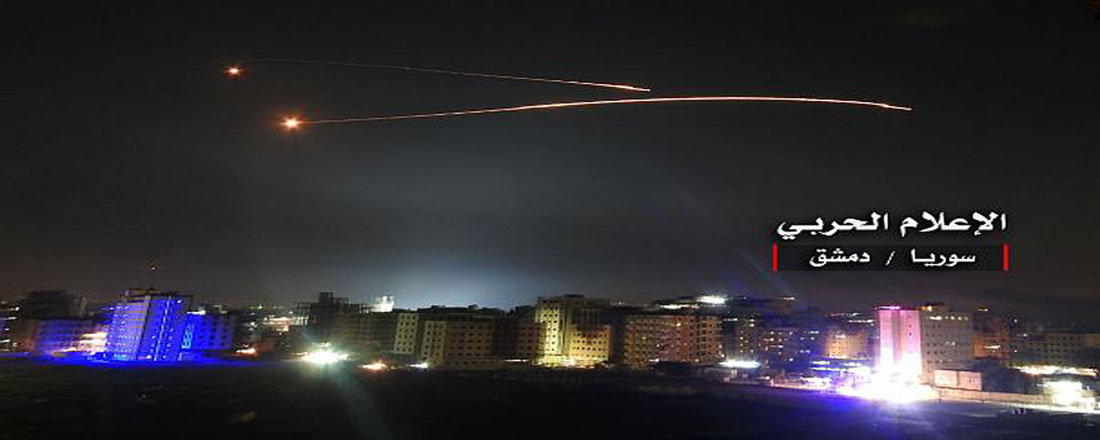
    In early hours of Thursday Israeli tanks attacked town al-Ba`th in Quneitra province from occupied Golan.

    Also Israeli warplane attacked Syrian Army’s positions inQuneitra province.


    To retaliate these attacks and also attacks of Wednesday evening to Syria in region al-Kaswah in south of Damascus, Syrian Army attacked critical points of Zionist regime in occupied Golan.

    There is no accurate news of numbers of missiles fired toward occupied Golan but according to unofficial sources between 20 to 50 missiles are fired.


    These positions have been attacked by Syrian Army:

    Military center of electronic and eavesdrop

    Secret center of information and surveillance 9900

    Military center of electronic counter attack

    Military center of eavesdropping of networks in west of Golan

    Center of relaying

    Center of observation for pinpoint weapons

    Military airbase of helicopters

    Military base of unit 810 of Israel Army

    Military base in Harmoun

    Ashtoy military base for special units of winter war


    After these attacks, Israel accused Quds Corps of Islamic Revolutionary Guard Corps immediately. This accusation was declined by Iran and announced that if Iran attacks anywhere, similar to attack to ISIS in Deir al Zur, will be officially claimed.


    After that Israeli fighters which were flying actively in Golan airspace on Wednesday, performed a new wave of missile attack to Syrian Army positions in south of Syria.

    Russian Ministry of Defense claimed that Israel used 28 fighters of F-16 and F-15 to attack Syria and 60 missiles were fired toward Syrian Army positions.

    Israel did not reveal the coordinates of positions which were attacked in Syria.


    On the other side, Syrian Missile Defense units intercepted Israeli fighters and missiles.

    According to unofficial sources, between 60-75% of fired missiles were intercepted by Syrian Army. After intercepting Israeli fighters and their retreat to the depth of occupied Palestine airspace, Syrian Army’s missiles reached occupied Palestine and Israeli Missile Defense Unit fired 15-20 Patriot missiles.


    The severity of engagement and missile firings reduced as approaching the morning and ended by morning.


  • Latest Updates On Yemen 5 May 2018; The US Official Presence in the War Against Yemen

    Latest Updates On Yemen 5 May 2018; The US Official Presence in the War Against Yemen

    1. The joint meeting of Iran and European countries (Britain, Germany, France and Italy) in Rome in order to examine the Yemen political solution ended with no specific result.

    Subsequent sessions were postponed to the following months.


    2. Emirati forces after entering Socotra island and capturing the port and the airport, did not allow the flight and departure of Mansour Hadi’s government members.

    Lately, political disputes between the Southerners (backed by the UAE) and the Mansour Hadi forces (backed by Saudi) have led to military conflicts in southern Yemen.

    Hadi’s forces also claim that the island is being seized by UAE. In this regard, Saudi crown prince Ben Salman has sent a committee to Socotra to investigate the recent conflict.

    The Emirates now controls the island by sending troops and fighters.


    3. The US Official Presence in the War Against Yemen.

    The United States Department of Defense In addition to its military presence in Yemen along with the Saudis and the exchange of information, etc… stated: “The purpose of the presence of US troops alongside the Saudis is not for military or conflict engagement, but for guidance and training for the Saudi Army to destroy Iranian missiles!”


    4. The disagreement between the parliament and the Sudanese government regarding Yemen.

    Sudanese MPs have recently called for limiting interference in Yemen.

    They criticized Sudan’s heavy losses for the battles and demanded for Sudan foreign interests and stop interfering in Yemen conflict and support the peace in Yemen.

    But the commander of Sudanese military forces in the Saudi coalition announced that the country’s military will remain in Yemen to achieve all goals!


    P.S:

    But so far, it’s generally possible to say that the US claim for Yemeni missiles, is in line with the pressure on Iran to begin another layer of talks (regional or missile, or both).

    The Americans, with the Cold War illusion (especially the Cuban Missile Crisis), are trying to induce a new threat for the world and their allies, this time, Iran is their best option.

    But keep in mind that the US is gradually withdrawing from the West Asia region and filling its place with the Saudi coalition, and this is just like the formation of “NATO” against the “Soviet Union”!


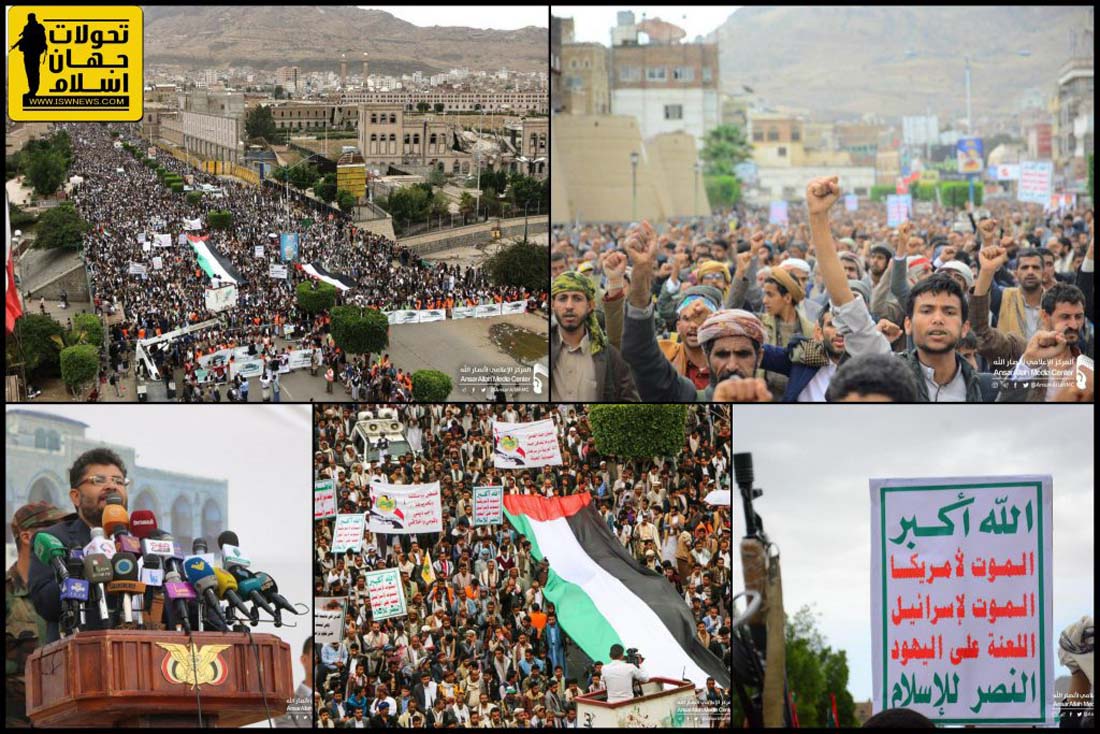
    Image: The rally of the Yemeni people in Sanaa, titled “Qods is the land and the first Qibla of Muslims”

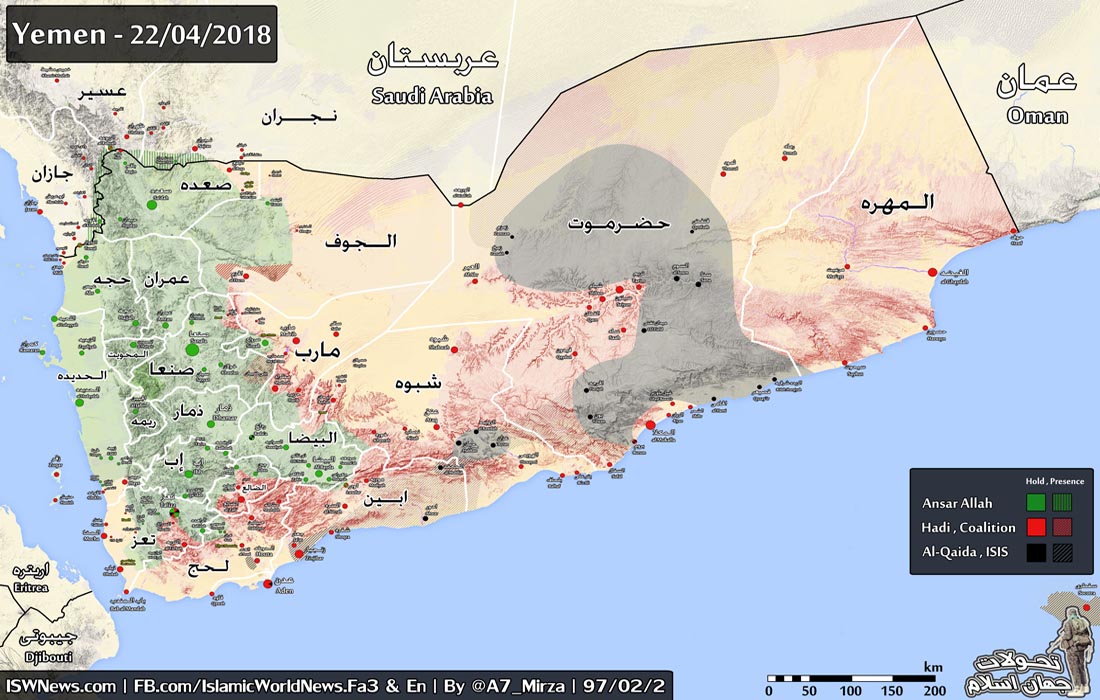
  • Monthly Report on Yemen’s developments 22 April 2018; Map Update

    Monthly Report on Yemen’s developments 22 April 2018; Map Update

    In this regard, the UAE, with help of Tariq Saleh(nephew of Ali Abdullah Saleh) and organizing his troops, wants to achieve full control over the south of Yemen.


    This goal follows two purposes:

    1- Attack on Sana’a and bring power to one of the Saleh’s family member
    2. The separation of southern Yemen (Perhaps this is the main reason for the southerners to welcome the war with AnsarAllah).


    For this purpose, on the other hand, another operation is under way to seize al-Hudaydah, which will cut off Ansarullah’s access to the sea and will lead to complete siege.

    AnsarAllah has recently shown the green light to the UN representatives to resume talks, but they have some concerns. AnsarAllah preconditions for negotiations is the cease-fire and end of Saudi bombardment on Yemen. But so far, the results of these consultations have been nothing but just expression of the optimism from the United Nations representatives.


    About the Sa’adah and Sana’a fronts, due to the unstable and slow progress of the Saudi coalition, there are no conclusive results. But with the time passing and the prolongation of the war with these conditions (the siege and spreading of diseases and bombardment of residential areas, etc.) it is not in favor of AnsarAllah.


    In the last month, attacks by the Yemeni Army and Ansarallah (aimed at deterring and responding to Saudi-led coalition airstrikes) have entered in a new and wider stage with missile and drone operations, which will surely lead to heavier consequences for the Saudis.

    Undoubtedly, insecurity ends with heavy losses for the Saudi economy. Including the need of deploying security systems such as Patriot and S-400, which the Saudis paid (or will pay) a great amount of money for that to Americans and the Russians. While the Yemen missile power is native and have no special cost to them, and also now they are done more precisely.


    The Saudis and UAE with hiring soldiers from Sudan and Uganda and even Afghanistan and luring Morocco and Pakistan airforce into Yemen war, trying to fulfill their goals and cover their defeats in Yemen.

    But this situation will definitely lead to the collapse of the economy and the end of Saudi financial power one day; If AnsarAllah does not succeed in the negotiating field and the Saudi bombardment continue, they may target Saudi tankers and display multi layer missile attacks which the Patriot defense systems do not have the ability to deal with it.


    ? Last changes:
    1- Hays in Hudaydah province captured by coalition.
    2- The conflict line reached to the north and northeast of al-Bayda province with the fall of the Bayhan in Shabwa province.
    3- The conflict line reached to al-Motoun and Al-Maslub district in Jawf province.
    4- The Alab passageway in north of Sa’ada captured by Saudis.
    5- Midi in the northwest of al-Hijah captured by Saudis.


    ▪️ Note:
    – There are minor changes or unstable situation in the Nehem and Taiz and other areas.
    – When the southerner situation become more distinct, their controlled areas like Aden, Ataq, Dhala`, Mukalla and etc will be added to the map.


    Download HD MAP

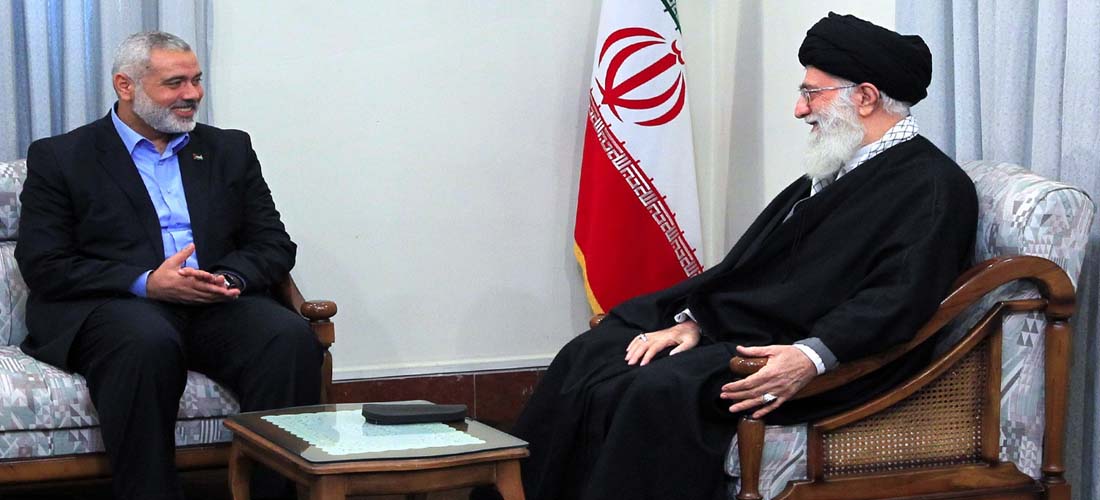
  • Imam Khamenei’s response to Hamas leader’s letter on Arab states’ betraying Palestine

    Imam Khamenei’s response to Hamas leader’s letter on Arab states’ betraying Palestine

    In the Name of God, the Most Beneficent, the Most Merciful:

    All praise is due to Allah, the Lord of the Worlds; peace and greetings be upon our Master and Prophet, Ab-al-Qassem Al-Mustafa Muhammad, and upon his pure, immaculate and chosen household, especially the one remaining with Allah on earth.


    Dear brother, resistance activist Dr. Ismail Haniyeh,

    I start my letter with this verse from the holy Quran, which seems as if it was meant for us during our time, addressed to you and all of us: “Do not be faint of heart in pursuing the enemy: if you happen to suffer harm they too are suffering just as you are, while you may hope from God what they cannot hope for. God is All-Knowing, All-Wise.[Quran, 4:104]” In other words, He is aware of your victory through God’s permission and advises you to refrain from frailty and infirmness.


    At a time when aggravation of oppression and animosity, led by the Zionist enemy in Gaza, has made the enthusiasts of Palestine sad and angry, I insist on the Islamic Republic’s enduring position regarding Palestine, which is also an important issue of the Islamic Ummah.


    No doubt, resistance is the only way to free an oppressed Palestine, and it is the only cure for wounds on the body of that brave and proud nation. In your affectionate letter, your excellency has indicated some of the main challenges of the Islamic Ummah: you have referred to the conspiracy and hypocrisy of some Arab countries in the [South West Asia] region and their vicious plots, following the Great Satan (the US); you have also reminded us of the resistance in Palestine—the fighters on the front line before the enemy’s pressure, oppression, and cruelty. Your remarks are absolutely true and we confirm them. We feel it is our responsibility to support you, in any manner as needed.


    This [support of Palestine] is a religious duty and a humane responsibility that goes beyond political events and changes; we will, God willing, continue to perform this duty, like before. All Muslim governments, Muslim nations, and Islamic movements are obligated to fulfill this great task [support of Palestine] and should try to carry on with it.


    Today, the return to dignity and authority of the Islamic Ummah relies upon resistance against the Front of Arrogance and its vicious plots; the matter of Palestine is at the heart of all international challenges that the Islamic Ummah faces while fighting against the Front of Arrogance. Moving towards negotiations with the cunning, usurper, and untruthful regime is an irreversible mistake that would delay the victory of the Palestinian nation; and it will bring about nothing other than detriment for the oppressed nation.


    Act of Betrayal by some Arab leaders, which is gradually revealing itself, pursues the same goal [as delaying the victory of the Palestinian nation]. The only cure is strengthening the resistance within the Muslim World, reinforcing the fight against the usurper Zionist regime and its allies.


    Nations, especially zealous youth in Muslim and Arab countries, as well as governments that feel responsible towards Palestine, should seriously consider this as their duty:

    repelling the enemy to the point of annihilation, through strategic and vigorous action. I ask Allah the Almighty to bestow success upon you and all resistance forces; I beseech closeness towards the day of your victory, which is a certain destiny.


    And Peace be upon you
    Sayyid Ali Khamenei
    April 4, 2018


    Imam Khamenei Official Website

  • Turkey’s Erdogan mobilizing China’s Muslims for jihadist campaign + Clip

    Turkey’s Erdogan mobilizing China’s Muslims for jihadist campaign + Clip

    The clandestine web of networks that was set up by Turkey’s National Intelligence Organization (MİT) among Uyghurs and other Muslim groups from Central Asian countries involves not only transporting and facilitating jihadist fighters from China’s Xinxiang region, some of the fiercest and most battle-hardened militants who can only be compared to Russian’s Chechens on the field, but also mobilization of larger diaspora Uyghur groups in Turkey and abroad for a public relations campaign. It is quite a dangerous pattern in that Erdogan and his associates have been sowing the seeds of a jihadist mindset among Uyghurs with the support of state resources which at times manifested itself with the issuance of passports and travel documents and at other times with providing arms and logistical supplies.


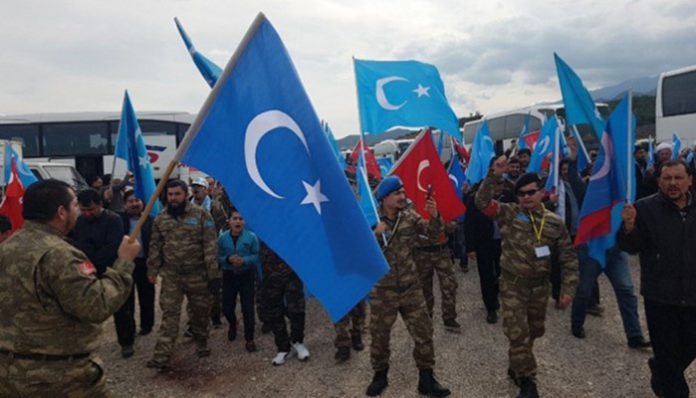
    Last week we saw serious indications of how the radicalization of Uyghur communities in Turkey has already taken a toll, coming on the heels of war-frenzy campaign that was sanctioned and encouraged by the Turkish government with heavy doses of religious references repeatedly made by Erdogan himself. On March 10, 2018 some 700 Muslims from China visited the southeastern border city of Hatay near Syria and made an appearance in the provincial headquarters of Erdogan’s ruling Justice and Development Party (AKP) to deliver the message that they wanted to join the battle in Afrin. Speaking on behalf of the group, Seyit Tümtürk, the chairman of the Eastern Turkistan Association for Culture and Solidarity (Doğu Türkistan Kültür ve Dayanışma Derneği in Turkish), said, “We want to fight in Afrin shoulder-to-shoulder with Turkish troops.”


    Sitting next to İbrahim Güler, the provincial chairman of the AKP and Erdogan’s man in Hatay, Tümtürk said, “The hearts of hundreds of thousands of people from Eastern Turkistan who live in Turkey today as well as 35 million in Eastern Turkistan [China’s Xinjiang Uygur Autonomous Region] are beating in sync with Turkey, the Turkish army and Turkish troops.” He asked AKP stooge Güler to convey the message to Erdogan that they are ready enlist in the Turkish army and fight alongside Turkish troops in Syria. He made clear that Muslims from Eastern Turkistan made the trip to the border city to send a message that China’s Muslims were putting themselves under the orders of commander-in-chief Erdogan and they were ready to sacrifice their lives for God and the Turkish nation once the signal is given by the Turkish president. The group later participated in a blood drive for the wounded in the Afrin offensive and visited the police special operations headquarters in Hatay.


    Another development that took place was in Istanbul on March 4, 2018 when a nationalist group called Alperenler, the youth wing of the Grand Unity Party (BBP), which is closely aligned with the Turkish president, held a rally with Uyghurs to display their support for the government. Appearing at the rally was Hidayet Oğuzhan, chairman of the Eastern Turkistan Education Association (Doğu Türkistan Maarif Derneği in Turkish), who vowed that “300,000 people from Eastern Turkistan will confront the evil axis that is attacking Turkey.” Underlining that China’s Muslims support the Turkish military offensive in Syria’s Afrin region, Oğuzhan stated that Turkey is the last bastion of the Islamic world and that all people from Eastern Turkistan are ready to sacrifice their lives to protect Turkey. “We do not want to be merely a voice for the more than 40-million-strong nation of ours that is being oppressed in Eastern Turkistan. That is, of course, our duty. But we are conscious of the most important goal today, which is to protect and preserve the Turkish state, a beacon of hope for the whole Muslim Ummah and the Turkish Islamic world and the last stronghold of Islam,” Oğuzhan told rally participants.


    All these protests and speeches were carried by Turkey’s state-run news agency Anadolu and covered by pro-Erdogan media outlets that help spread these messages to a broader audience. This looks like part of a well-planned public relations campaign orchestrated by Erdogan and his associates to imbue every segment of Turkish society with the extremist Islamist ideology that serves as a catalyst for jihadist networks in Turkey and abroad. No wonder China’s Muslims constitute the largest group of jihadist fighters in nominal terms who crossed into Syria and Iraq through Turkish territory with the help of Turkish intelligence.


    In fact, when the Turkish Meydan newspaper broke a story on April 9, 2015 about how a secret operation to provide Turkish passports to Uyghurs was run from a building in Istanbul’s Zeytinburnu district, apparently a covert operation of Turkish intelligence, it irritated the Erdogan government. The police raided the offices of the newspaper in July 2016, and the newspaper was later unlawfully shut down by the Erdoğan regime. Editor-in-Chief Levent Kenez was detained only to be released pending charges the next day. He fled Turkey before the government issued a fresh warrant for his arrest. The entire archive of the Meydan daily was removed by the government to get rid of any record and evidence of this nasty business with Uyghur jihadists.


    Turkish president Erdogan’s war-mongering narrative in public speeches in recent weeks and months reflects his tendency to describe his government’s proxy battles as religious holy wars. Perhaps this can only compare, to some degree, to what we hear and read from the leadership of al-Qaeda, the Islamic State in Iraq and the Levant (ISIL, ISIS or Daesh by its Arabic acronym). First, he repeatedly said the name of the military operation, “Olive Branch,” was inspired by references from the Muslim holy book, the Quran. For example, on Feb. 9, 2018 he told neighborhood leaders (muhtars) in his own palace that he was inspired to name the Afrin military offensive Operation Olive from the Quran and recited verse 95:1, which mentions “olive.”  On March 10 he repeated the same claim and even went further by reciting the rest of the verses of Chapter 95, which mentioned the secure city, a reference to the Saudi Arabian city of Makkah. He said his troops are marching toward the secure city with God’s permission, which would certainly disturb Saudi Arabian rulers.


    On March 7 Erdogan again recited Quran verses from Chapter 61 and said: “Know this. We were ordered to wage a [war] campaign [by God], the victory belongs to Allah. And don’t forget this. What is Allah saying in His [Quran] verses? Help from Allah and imminent victory.” The next day, in a speech delivered on the occasion of International Women’s Day, Erdogan vowed to acquire advanced military hardware including nuclear missiles while comparing Turkish military capabilities to those of the US military. He claimed Turkey has God on its side and that his people march for martyrdom, unlike Americans. He asked women to have at least three children to make Turkey more powerful and said that “the West will scramble to find a hiding place if we increase our young population.” The West is in decline, we need to gain more strength, he added.


    It is obvious that the world is confronted with a dangerous and fanatical leader who has set his sights on the caliph position of embattled ISIL leader Abu Bakr al-Baghdadi and is set to destabilize his neighbors and other countries using proxy Islamist groups. This is not just poisonously anti-Western but in fact is anti-Asian as well because of threats that risk undermining social cohesion in the communities of Russia, China and other Asian countries. Not only the narrative but also the policy choices of Erdogan in the current government of Turkey increasingly reflect his ambitions to portray himself as the leader of all Muslims in the world. The only difference is that Erdogan, unlike Baghdadi, commands NATO’s largest army after the US and enjoys the considerable resources of the Turkish state.


    Unfortunately, the checks and balances against his autocratic rule have all but collapsed, while the opposition is in disarray. Scrutiny by the national media no longer exists as some 200 media outlets were shuttered and 250 journalists jailed. The criminal justice system fails to prosecute jihadist groups thanks but no thanks to pressure from the Erdogan government, which has purged one-third of all judges and prosecutors since 2016. Credit is due to the government’s helper, Doğu Perinçek, who leads a neo-nationalist group in empowering Erdogan’s rule and in aiding and abetting the unprecedented crackdown on Erdogan’s critics, especially members of the Gülen movement, who unwaveringly stood firm against his oppressive rule despite bearing the brunt of the unrelenting repression. Incidentally, it is quite ironic to see Perinçek ostensibly cozying up to the Chinese Communist Party leadership in Beijing when in fact his own clandestine group in the intelligence and military has been organizing Uyghurs to join jihadist causes.


    By Abdullah Bozkurt

    Turkishminute.com

  • “Everyone knows that the Turks do not leave easily from where they entered”

    “Everyone knows that the Turks do not leave easily from where they entered”


    Threatened with death by salafi jihadists, Fehim Taştekin also undergoes several prosecutions in Turkey for his articles on the Syrian crisis and on president Erdoğan, who he carefully follows since the 1990’s from within the Islamic movement. He now lives in exile, where I met him.


    • Since 20th January, the Turkish army is conducting a vast ground and air offensive in the region of Afrin, one of the Rojava’s three autonomous region. Why?

    This is related to the Kurdish question and to the Turkish government’s obessionnal plan for Syria. Since 2011, Erdoğan  has made many mistakes because of which many jihadist groups haves emerged and established themselves in our region. Moreover, he failed in overthrowing Assad and installing the Muslim Brotherhood. He had to intervene to stay in the game and prevent the formation of a Kurdish-lead autonomous region in north Syria (Rojava), of which Afrin is the most western part.


    Already in 2016, while the “Euphrates Shield operation”, the Turkish army halted the advance of the People’s Protection Units (YPG), the defense force of the ‘de facto’ autonomous region (Rojava)  who sought to link Kobane and Afrin. This success allowed  Erdoğan to gain influence on the Syrian chessboard. Russia, Iran, the United States understood that they had to take Turkey into account.

    By launching the “Olive Branch” operation in early 2018, the Turkish President is pursuing the same logic: The consolidation of his influence on the negotiation process. He also wants to break down the alliance between the USA and the YPG.


    If Turkish troops succeed in Afrin, the next step will be an offensive on Manbij, where there are american units. This was at the center of discussions between Secretary of State Rex Tillerson and President  Erdoğan during their meeting  on Thursday 15 February in Ankara.


    • In the past, the Afrin authorities seem to have avoided any confrontation with Turkey. Why is the Turkish government aiming this region precisely?       

     Afrin is a Kurdish area, inhabited mostly by Kurds since at least a thousand years. After 1980, while Abdullah Öcalan, the leader of the PKK [detained by Turkey since 1999], lived in Syria, he was very active in the Kobane, Aleppo (Sheikh Maksud area) and Afrin regions, where Kurds became mostly “Öcalanists”. Here one must be careful: Being an Öcalanist does not mean automatically being member of the PKK. Nevertheless Afrin’s Kurds adhered to many of Öcalan’s ideas.


    In cooperation with some members of the Assad family and the regime, Öcalan has created many collectivist cooperatives in Afrin, for example for the cultivation of olives, making olive oil and soap, and setting up transportation chains around Syria. These cooperatives helped local communities work together. The region of Afrin became a sort of applied laboratory of Öcalan’s ideas. This is also what the Turkish government is targeting. While having problems with other Kurdish parties Öcanalist movement had good contacts with ethnic or religious communities in the region like Arabs, Circassians, Chechens, Armenians or Yezidis (Kurds).


    Afrin is a strong base of the Öcalanist movement and of the Democratic Union Party (PYD), it is why Turkey will face a fierce resistance. The government says: “We are not fighting against Kurds but a terrorist organization”. But the fact is that the local population supports widely the PYD and its allies in the autonomous project. And even those who do not support this party, take up arms to protect their land. This is why one should not compare the PYD and the Islamic State (IS). The Kurds are fighting for defending their land, their homes, while most of the IS jihadists were foreigners, it is very different. People are aware that they have faced two projects which are absolutely opposite each other. So the one is bringing darkness back with its all forms, the other is offering to share powers, participating to democratic processes, getting women into social and political spheres, securing all ethnic and religious identities. Since 20th January, 31 Turkish soldiers and 194 fighters of the Free Syrian Army died. Things are not going as well as Erdoğan had announced.


    • On the ground, the remaining forces of the Free Syrian Army (FSA) fight on the side of Turkey. A British newspaper reported that many of its soldiers were former IS jihadists… Has Turkey got jihadist partners?

    Many different groups are taking part in this military operation. Some of those include former Al-Qaeda members, Salafi jihadists and a variety of Islamists such as the Muslim Brotherhood, mercenaries and some volunteers. What unites them is their unfavorable attitudes and ideologies towards the Kurds.


    Besides this, the Islamic-nationalist power of Erdoğan has created its own militia. There is a private security company, called SADAT, which trains, equips and advises fighters who fight on behalf of Turkey.


    SADAT, composed of former Turkish soldiers, gained in prominence during the Syrian crisis. The budget and weapons that are devolved to this organization is top secret. We do not know how it is financed.


    Last month, we saw a picture of Adnan Tanriverdi, former Turkish officer and owner of SADAT, beside Turkish generals in the National Security Council meeting for the Afrin operation. He participated to this meeting without having any official status. This is unusual and very problematic for the orientation given to the national security  and to the state tradition of Turkey.


    • You mentioned links between the Kurdish PKK and the Assad regime. What about them?

    In 1990, the PKK succeeded in sending six “independent” deputies to the Syrian parliament. All came from Afrin. Some of those were directly members of the PKK, others were only “patriots” (Yurtsever) who are not member of PKK but supporting it indirectly. In that election the number of seats had left for independents increased from 18 to 40 percent. This assumed an ‘olive branch’ for Kurds by the regime that time. With this system a total of 15 Kurds could enter the parliament. With the fear of losing control, the old system was re-established at the 1994 election. The Afrin Kurds were essentially “patriots” (Yurtsever) and have always been close to Damascus.


    However, in Jazeere the relations between the Kurds and the Syrian regime were getting more tense. Because of the Arab Belt Project (1962), the land of many Kurds was confiscated and civil rights of 120.000 Kurds were revoked after the 1961 census. Because of that some 350.000 Kurds did not have any identity card or passport until 2011.

    Otherwise, the Syrian regime tolerated the PKK as long as they fought for the Bakur [Turkish part of Kurdistan], as this was a weapon that the Damascus regime could use against Turkey.


    Things changed only after the Adana Agreement of 1998 and the deportation of Öcalan out of Syria [he was arrested in 1999 by Turkish and Israeli services in Nairobi].


    In Syria, the Democratic Union Party (PYD) emerged in 2003. Influenced by Öcalan’s ideas (establishment of self-governed communities, emancipation of women…), the PYD presents himself as a party fighting for democracy in Syria. Hence a less tolerant stance of the Syrian government towards it.


    Quickly, after the 2011 uprising, the Syrian government withdrew from the northern part of the country or directly gave the control of some provinces to the PYD. There are several reasons for that. First, the PYD is an organized and known structure with which one can anticipate and negotiate. Second, this kept Kurds outside the uprising, and Damascus wanted to focus on the central hubs of contestations which where strategically more important. Third, it was also a message to Turkey: ““If you support Islamist groups against me, you will have to face a Kurdish autonomous region on your border”.


    • At the beginning, until 2015, things were not going so badly between Ankara and the PYD – its copresident, Salih Muslim, visited Turkey several times…

     Yes, he was invited in Istanbul and Ankara many times. Even more amazingly, a couple of leaders of YPG exchanged in Ankara with Turkish generals. They prepared a joint operation together to move the Suleyman Shah Tomb Tomb to the Eshme, a closer point to  the Turkish frontier. This was a unique relationship, and some believed that it would have a positive impact on the peace negotiations between Ankara and the PKK. But after that, Ankara named the PYD a “terrorist organisation” and placed a bounty of 4 millions of TL (more than 850.000 euros) for the arrest of Salih Muslim.


    To understand this sudden change, one must take account of the broader peace negotiations with Öcalan. The Turkish authorities made of Rojava issue a pre-condition of the peace process. Through Öcalan, Ankara asked three things to the Syrian Kurds: To end the Rojava as ‘de facto autonomy’; to cooperate with the Free Syrian Army and to fight the Assad regime. Öcalan refused these conditions making Rojava his “red line” too.


    The attitude of Erdoğan during the siege of Kobane (autumn 2014) repeating that Kobane was to the point of falling in Daish hands, the fact he didn’t close the roads to the Daish militants, and close his eyes on the militants or materials transfer, legal or illegal: All these led to an outburst of anger in the Turkish Kurdistan, in which dozens of people lost their lives.


    After that, the Peoples’ Democratic Party (HDP) [the Turkish and Kurdish pro-autonomy party] declared that it would oppose the presidential dreams of Erdoğan. This is why, in summer 2015, Erdoğan launched a war against Kurds: in Turkey and in Syria.


    • Didn’t the Kurdish HDP leaders in Turkey, or the PKK leaders in Qandil (Irak) share some of the responsibility for the failure of these negotiations? Do you believe that the PKK has provoked this uprising?

    Of course, the Kurdish movement made some mistakes and provided excellent arguments to Erdoğan. In some cities like Diyarbakır, Kurdish youths dug trenches and closed streets. Some HDP mayors declared the democratic autonomy.


    But there was no massive popular uprising. Some youths gave a pretext to Erdoğan which was looking for launching a strong operation on the Kurdish movement, its municipalities and NGO.  Some HDP deputies were even not happy at all with the youth’s behavior in the streets for it happened these youths had arrested some deputies to control their identity!


    On the 22d of July 2015, two policemen were killed. The PKK first claimed it in retaliation to the massacre conducted by the Islamic State two days before in Suruç (30 people killed). Later on PKK denied.

    It was the perfect pretext for Erdoğan to launch his operation against the Kurdish towns. Some neighborhoods were fully or partly torn to the ground, hundreds of thousands of people were displaced. The goal was to completely paralyze and destroy the HDP (who had 80 MP in June 2015, 59 five months later). Thousands of officials and volunteers of the party were arrested. Erdoğan acted with a terrifying brutality.


    The Kurdish movement did not expect such a reaction. Öcalan could have dissuaded young people of going into the streets as he did in 2013, but the state isolated Öcalan during the crisis and did not let him address his people. The PKK leaders decided not to intervene, saying that the “youths are acting on their initiative”. They probably believed that if they diverted the attention of the government to the north, it would leave Rojava alone. It was a mistake.

    In 2016, the Kurdistan Freedom Hawks (TAK), a PKK affiliate according to the Turkish State, conducted terror attacks in Istanbul, Ankara, Izmir and Bursa to take revenge of the massacres and destructions by the Turkish security forces in the south-east of Turkey since July 2015.


    • According to Turkish authorities, the PYD in Syria and the PKK, forbidden in Turkey, is the same thing: two terrorist organizations…

    In Syrian, the Democratic Union Party (PYD) follows the ideas of Öcalan. The core leaders of the PYD are linked to the PKK. However, one cannot say that it is the same thing. Most of the youths which fight in the YPG didn’t come from PKK and didn’t participate to the PKK camps. Many PYD members do not have any  organizational  links with the PKK.


    On many points, the PYD looks closer to the  Peoples’ Democratic Party (HDP). HDP was also founded on the ideas on Öcalan. Their strategy is the same: they believe that in order to guarantee rights for the minorities, it is necessary to democratize the whole country.


    However, the HDP is less monolithic than the PYD. The HDP is a coalition of many movements: around the Kurdish Democratic Region Party (DBP) more than thirty left wing and ecological organizations are agglomerated, while on the other hand, thought the PYD has a few minor partners, it is accused of imposing a “single party regime”.


    • The Turkish government wants to break the alliance between the PYD and the USA and make sure that the de facto Kurdish autonomy will never be recognized de jure. What are its chances of success?

    Turkey can disturb calculations of other players up to a point but at the end of the day it will gain nothing except enmity between Kurds and Turks.

    The aggressive policy of Turkey in Syria strongly affects Turkish Kurds who have very strong ties with Syrian Kurds. Turkish Kurds are as shocked by the attack of Afrin as they would if Diyarbakir itself was attacked. The Turkish government will not be able to erase the enmity that it has itself created. While, by supporting an autonomous Kurdish zone in Syria, he could have more easily solved the Kurdish problem, since the PKK and the PYD are interlinked.


    Moreover,  Erdoğan  does not hide that he wants to send back a few thousand of the three millions million Syrian Arab refugees that Turkey has welcomed. This would overturn the demographic balance at the expense of Kurds. This ethnic cleansing will be perceived as a “genocide” by all Kurds.


    • Regarding “ethnic cleansing”, YPG-PYD Kurds also have been deporting Arab populations and confiscating their land…

    Yes, they have been accused of “ethnic cleansing” during the Operation against IS in Tel Abyad (Rakka province). YPG have made mistakes by destroying houses used as shelters by IS soldiers and demanding some villagers to evacuate of their houses. But I would not say that any intentional ethnic cleansing took place…

    Some measures were temporary bases and after securing areas people started to come back if they have not links to the ISIS. During the war thousands settlements were destroyed because of bombings and their settlers fled in Syria.


    Erdoğan has used a report of Amnesty International (2015), very critical on YPG-PYD Kurds, but it was grounded on unreliable and hastily collected information in early stage of the case…  After the victory over IS, Kurds of Tel Abyad have established a civil council to govern the town with Arabs and Turkmens. It means they didn’t exclude Arabs and Turkmens as Turkey insisted.


    • What is the position of Russia and the USA on the Turkish military offensive in Afrin, and more broadly, on the Kurdish problem?

    Russia hopes that thanks to this operation, the YPG will turn away from the United States and cooperate with the Syrian regime. In exchange of Afrin, Russia is expecting a strong cooperation from Turkey to neutralize Islamist and jihadist groups in Idlib.  But what Erdoğan is going to do is unclear. He tends to protect fighters in Idlib that are one of the main targets of Russia.


    If Turkey takes the control of Afrin it will connect Idlib to the Azez-Cerablus-Al Bab triangle under the control of the Turkish and Free Syrian Army (FSA), which represents another leverage in the hands of Erdoğan and will help the militants against Assad in Idlib. Russia will probably not appreciate it.

    However, Moscow, which is always keen to weaken NATO, would not be displeased to see Erdoğan evoke an extension of operations to Manbij, which will push the Americans (allied to the YPG-PYD against Daish) to choose their side: “The Kurds or us”.


    It seems that in Ankara, 15 February, Tillerson and Erdoğan discussed the withdrawal of YPG troops from Manbij. In exchange for this city, the USA could try transforming the east of the Euphrates into a secured autonomous Kurdish zone. But this is the opposite of the end of Rojava that Erdoğan promised to his electorate. I do not know how he will defend this deal in front of his people.

    • Iranian Shiite militias are now strongly established in Iraq, Syria and Lebanon… but what are the relations between Tehran and the PYD-PKK ?

    At the beginning of the Syrian crisis, the Kurdistan Free Life Party (PJAK, PKK’s Iranian branch) and Iran concluded a ceasefire. Iran saw the Kurdish potential in Syria and the necessity of “neutralizing” them to prevent them to take part in the conflict.

    Iran does not object a form of Kurdish autonomy in Syria as long as it does not distort the territorial integrity of the country. As Russians, Iranians foremost desire to see Kurds collaborate with Damascus and stay far from Americans. If Kurds line up with the American ambitions in the region, Iranian proxy forces will probably join the Syrian forces which fight them.


    In addition, Iran is concerned with the Turkish intervention in Syria. It is well known that Turks don’t get out easily from where they enter. As for Moscow, it is unacceptable for Teheran to see Turkey support radical groups fighting the regime in Idlib. On 11th January 2018, Turkish backed groups started an operation against the Syrian army and the Hezbollah around the Abu Duhur airbase for instance.


    To make things more complex, while Turkey, Iran and Russia are partners in the Astana process, it happens on the ground that some groups supported by the Iranians sided with the Kurds. For Iran try to persuade the Kurds not to align with the United States. Otherwise “We’ll leave the Turks to crush you” tells Tehran. Russia and Iran could give Kurds a autonomy status in Syria as for Kurds forget the United States.


    The red line of Russia and Iran is the American presence alongside the Kurds. And the Kurds crossed this line at Raqqa, Deir al Zor and when the Americans wanted to build a Kurdish border army. This immediately led Russia to allow Turkey to intervene on Afrin to try to hinder the Americans.


    • While many commentators evoke the perspective of the next presidential election of Novembre 2019 to explain  Erdoğan’s  military activism in Syria, you seem to minimize this motivation…

    I do not exclude the internal factors. Of course, Erdoğan must consolidate his base and secure votes from nationalist circles for the 2019 election and for this, nothing is better than a victory over Kurdish “terrorists”.

    But reducing this operation to internal policy considerations is irrelevant. Erdoğan did not abandon his Syrian dream, his neo-Ottoman dream. He sees himself not only as the President of Turkey but as the President of the Islamic world, and he acts in this way. This dream does not make sense if you do not have Damascus with you. Without Damascus you cannot do anything in the Arab world.


    It reminds me of the Conference of the Syrian Opposition in Exile held in Istanbul in 2011 to which I was invited to speak. Ahmet Ağırakça, a Turkish academic took the floor. “Inshallah” he said, “After the liberation of Damascus, will come the turn of Jerusalem and ‘The Term First Erdoğan’  will come”. This was ridiculous and totally disproportionate, no one in the Arab world is waiting for a new Ottoman Sultan. But it shows the existence of such a neo-Ottoman project for many Turks. This academic is now the dean of Mardin Artuklu University.


    • You left Turkey like more than a hundred of your colleagues, according to Reporters sans frontières…

    Unfortunately, Turkey became an unsafe country for many journalists and writers. I am in an uneasy situation because of my articles and books on the Syrian crises. I have received some death threats from Turkish and Syrian jihadist groups. Besides, one of my books (Rojava: Time of Kurds) was confiscated as a criminal evidence against several defendants who have been arrested for participating to peace demonstrations or sending messages on social media.


    Finally, last summer, a Turkish court banned Rojava: Time of Kurds. The court called my book a “terrorist organisation” in its judgment. How can a juridical system consider a book as a “terrorist organisation” ?


    The two opposition parties, the Republican People’s Party (CHP) and People’s Democratic Party (HDP) have submitted parliamentary questions on this ban. And I am under investigation for my articles, books and social messages about the state and  Erdoğan. Message of threats against me and my family never cease. This means that we are not in security anymore in our own country.


    Interview with Fehim Taştekin conducted by Ariane Bonzon
  • Ahrar al Sham and Nour al-Din al-Zenki fighting against Tahrir al Sham; rejection of Tahrir al Sham from west of Aleppo

    Ahrar al Sham and Nour al-Din al-Zenki fighting against Tahrir al Sham; rejection of Tahrir al Sham from west of Aleppo

    On 18 February Nour al-Din Zenki group and Ahrar al Sham by releasing a statement announce a new group “Syrian Islamic Liberation Front”.

    After it they fight against Tahrir al Sham group (Al-Nusra Front); heavy and sanguinary engagements which cover all Idlib and southwest of Aleppo.


    In these advances, the main units of Tahrir al Sham such as Jaish al Malahim(Jund al Aqsa) and Turkistan Islamic Party do not show much resistance.


    The pace of advances is so high that during a few days vast areas of Idlib and Aleppo governorates are out of control of Tahrir al Sham or some of groups which were allies of them, separate due to harsh situation of Tahrir al Sham.


    Some of important regions occupied by SILF(or SLF) are including Ma`rat al Numan, Ariha, Mastuma, Khan al Sobol, Many villages in  Zawiyah Mountain, Khan al Asal, Kafr Naha, 111th regiment, Ma`rat Misrin, Darat Izza, Atmah, Deir Semeon, …


    In recent advances by SILF all western parts of Aleppo governorates are occupied by them and militia groups in Andan, Kafr Hamra, Hayyan, Bayanun and Huraytan separate from Tahrir al Sham keeping their frontline with Syrian Army in Nubl and al Zahraa axis.


    Mediations by Abdullah al Muhaysini, the Saudi religious judge, between Zanky group and Tahrir al Sham are fruitless so far.


    Since Zanky group and Ahrar al Sham have better relations with Turkey than Tahrir al Sham and their figure is better than Tahrir al Sham (al Qaeda), SILF by occupying Tahrir al Sham’s lands are paving Turkey’s advances in northwest of Syria in future and reducing political pressure over Turkey due to alliance with al Qaeda.


    Is it possible that Turkey started this inter-militia fights to achieve their own goals?!


    Statement of “Syrian Islamic Liberation Front” establishment.


  • Are AnsarAllah’s Missiles Made in Iran?

    Are AnsarAllah’s Missiles Made in Iran?

    … after almost three years from the start of Yemen war, Yemeni Borkan, Qaher, Zelzal and etc. missiles are hitting targets up to 1000 km from Riyadh to Abu Dhabi by penetrating advanced defensive missile systems such as Patriot.

    During this war every time a Yemeni missile is fired, media close to Saudi and their allies crying that they are made in Iran and make everyone to ask it.


    There are three possibilities:


    1. They are made in Iran! (According to Saudis and Americans)

    Yemen is heavily surrounded from air and AnsarAllah does not have access to southern coasts which denies sending any kind of weapons to them from any country. Western coast is also out of usage after Bab al-Mandab Strait is controlled by Saudis.

    Even if we assume they received missiles before the war started, their resource should finish after they have fired tens of missiles in the last three years.


    1. Missiles are provided by Ali Abdullah Saleh (according to Ali Abdullah Saleh)

    This is contradicting Saudi’s claim of destroying their arsenals first and second they will corrupt over time and cannot be used. Third is that even if we accept Saleh’s claim, it is unlikely that AnsarAllah has access to them and arises so many questions: Did Saleh and AnsarAllah agree over missiles? Have the missiles been found and confiscated by AnsarAllah after Saleh’s government fell? Did Saleh willingly give AnsarAllah the missiles?


    1. They are made by missile units of Yemen Army (according to Yemen officials)

    This is the most likely possibility.

    First that the knowledge of manufacturing missile has been transferred to Moghawemah in Gaza strip so transferring it to Yemen is not harder.

    Second some Saleh’s missiles might have been found by AnsarAllah and Yemen Army and they inverse engineer them.

    In conclusions, answering this question (where the missiles come from?) is not easy and there are many factors. (In the same context some Saudi intellectuals believe Iran transported weapons via Somalia which is creative!)


    What we can conclude is that Yemen missile power is indigenous with or without Iran’s help and this dissuasive power is a privilege for them in negotiation and a response to air raids by Saudi Alliance but not a revolution in battlefield!

    As the battle fronts recently due to siege performed by Saudi Alliance, USA and Emirates’ recent seduction (Saleh’s deception and Sana engagements) are not in good situation for AnsarAllah and Yemeni officials are buying time with their forces sacrifice to keep the tribal and political alliance of Yemen to start attacking operations later.

  • About the negotiation between Afrin Kurds and Syrian Government; military support of Afrin

    About the negotiation between Afrin Kurds and Syrian Government; military support of Afrin

    A title which is used many times by Syrian media and social media and every time it ends with the news of failed negotiation or denial of two sides…

    After Turkish Army’s attack to Syria in Afrin, a series of chain incidents take place in northwest of Syria and meaningful happenings for Kurds of Syria primarily which is resourceful …


    On one side passive reaction of US about Afrin Kurds proves again that US only enters or has interests in situations which have benefit for them and issues such as fighting against terrorism or helping oppressed people are lies. With current situation US double standard in reacting to incidents of middle east is obvious again but this time Kurds are tasting the bitterness of this double standard!


    By equipping Kurds, forming Syrian Democratic Forces (SDF) and adding anti-government militia to this group as a backup plan(Safety valve!) around Euphrates river in northeast of Syria according to their benefits, Americans take over vast lands and Kurds play the role of American foot soldier very well; but when Afrin is under attack by Turkey, US only condemns the attack and shows off some negotiations with Turkey.


    Nevertheless, Resistance (Moghawemah) and Syrian government are not such betrayers to forget the helps of Afrin Kurds in sending supplies to civilian people when they were besieged in Nubl and al Zahraa or even worse to ignore a foreign country attack their land.

    In fact, Afrin Kurds have shown their true spirit better than Kurds in other areas during all these years of war in the region and showed a distinct behavior different from others and now is the time to decide correctly before it gets too late..


    Therefor Moghawemah and Syrian Army tried continuously to find a solution for Afrin with negotiation but every time a group who still seeks help from non-local powers (!) break the negotiations.

    The surprise is that the leadership of Afrin is in the hand of those who do not do anything without US permission although they know US would not do anything to help them even if Afrin is occupied entirely…


    There are many lessons in history and people in Afrin should just look at their counterparts in Iqlim Kurdistan in Iraq to know who is leading them…


    This does not mean to stop helping people in Afrin, as there are food, medicine and basic military helps such as some ammunition and vehicle are given to people in Afrin to defend their land but heavy military helps or something that can stop Turkish military need agreements and more considerations.


    It was rumored that Russia has influences in Afrin but apparently it is not correct or at least they are going by “running with the hare and hunting with the hounds” policy in Afrin.

    Russia negotiated with Afrin Kurds before and at the beginning of the “Operation Olive Branch” but were not fruitful however everyone knows that Turkey would not attack to Afrin without Russia silence or green light due to the power of Russia.


    Considering current situation, the best option for Afrin Kurds is to get along and negotiate with Syrian Government to avoid occupation of Afrin by Turkey.

    In battlefield although the advance of forces led by Turkey is slow,but after a few more step the way to Afrin will be easy for them and they will be at the gates of Afrin, thus Kurds should decide faster.


    In the last few weeks media close to Moghawemah released news of successful negotiation of Kurds with Syrian Army but every time it was denied by Kurds.

    In fact there were negotiations from the first day so far but it was not completely successful and the news of agreement is a trick to prepare people for the agreement which is only a media trick and it is Iran’s diplomatic system duty to enter the situation and finishes it.


    P.S. for pan-Kurdish and pan-Turkish nationalists

    Independent stand of Islamic World News Analysis Group toward the happenings in region and its people from the beginning is obvious and it is recommended for new readers of our website to refer to the archive and read articles about previous similar incidents before commenting specially those “pan-“ nationalists.

    Oppression is oppression and oppressed is oppressed, there is no difference between people and time and we have tried to support oppressed and against oppression. In the last several months after the conflict raised between Kurds and Turks in north of Syria, this issue is increasing and we are observing the increasing activities of pan-Kurds and pan-Turks.

    If our website elaborates about Turkey attacking Kurds of north of Syria, it is not due to enmity with Turks or to support Kurds but to tell the truth. For example, our stand about PKK which makes the western borders of Iran to be unsafe is that they are a terrorist group! But it does not mean to ignore the truth about Turkey attacking north of Syria or pan-Kurds think we are supporting them!

    As during the time that ISIS attacked Kobani, we supported Kobani now we are supporting Afrin people and we will be supporting oppressed Turks! if  PKK terrorists attack Turkey’s lands or sabotage…

  • Russian game, Turkish opportunism and Iranian passivity in the north of Syria

    Russian game, Turkish opportunism and Iranian passivity in the north of Syria

    It is nearly three months ago in the article “The new level in Syrian war/ emphasize on Kurds’ situation and end of ISIS” that with finishing war against ISIS in east of Syria, it is Kurds’ turn to see how their lands are divided between fighting sides in Syria.

    It is still observable that political agreements are shaping the military confront. Same as several months ago that the competition between east and west of Euphrates river in Deir al Zur is based on agreement between US and Russia.


    Today the story of Abu Dohur confront is to fulfil Astana 6 agreement. So the final border of forces in “Idlib De-escalation zones” will be the Hijaz railway (which is the current border) or at most Aleppo-Damascus highway.

    At this border inspection posts of all sides (Turkish-Russian-Iranian) are going to be established and a “Idlib De-escalation zones” will be sustained.


    Recent incidents in Al Eis area in south of Aleppo which includes the artillery fire exchange between Moghawemat and Turkey, is caused by a nuance disagreement in details that Turkey wants to erect watch posts in Al Eis and east of Aleppo-Damascus highway but Moghawemat front is against it; the reason is that Al Eis is very close to Fuah Kafrya and to liberate Fuah & Kafrya the forces should pass through Al Eis.

    This does not mean a determination or plan to reach Fuah & Kafarya in near future necessarily; but a pressure point and replacement plan to tell terrorists that occupying Fuah & Kafrya is expensive for them or consider it as Moghawemat reaching Idlib walls..


    The fact that Turkish Army enters Al Eis again even with warning shots is due to green light from Russia, otherwise it would not be possible.


    Nevertheless, the latest news approves Turkish watch post establishment in Al Eis. On the other side, during the last few days Suhail Hassan’s forces famous as “Tigers” are transported to east of Hama from Saraqeb front to finish the remaining ISIS militia in besieged region and liberate it entirely. This is also another sign of harmony between Russia and Turkey specially if we know that Hassan’s forces act under Russians’ complete intelligence.


    On the other side, Turkey attacks Afrin and some observers consider it as a taken of Astana 6 and Sochi summits (Abu Dohur for Afrin). This Turkish occupation although not very unlikely but also was not agreed on in any summit (not in Astana nor in Sochi) and such audacity from Turkey would not happen without other sides’ (Iran and Russia) confirmation.

    But the main reason that Turkey did such a move is nothing except the Russians’ game of power and passivity and indifference of Iran.


    In simple words, Russia expects that by increasing the seriousness of Turkey’s attack, Kurds would give some privileges in other areas (such as Deir al Zur, Tabaqa, Raqa and Manbij…) and on the other hand Russia would prevent Turkey’s attack and Russian and Syrian flags in Afrin would be raised.


    Iran and Syria did not dislike the plan or at least did not feel bad about it, since if Russians could not convince the Kurds to raise the central government, at least the load on the fronts in Idlib and Aleppo by forces led by Turkey would be reduced.

    But the predictions were not correct. US pressures Kurds’ politicians in Syria and SDF commanders to oppose Syrian flag to be raised.

    US objection was also very natural, since US doctoring is to divide and destabilize the region (specially using the Kurdish race) and in Syria to weaken Iran’s influence and Assad’s government, who is an ally of Iran.


    Syrian Kurdistan also looks at US as their benefactor and is natural to order to fight back in Afrin and to call it a brave and epic resistance, even though they know it is doomed to be defeated !!


    US political oppositions end when Turkey claim the operation is limited to Afrin only.

    Another prediction which proved to be false is the reaction of Tahrir al Sham, who are in complete alliance with Turkey.


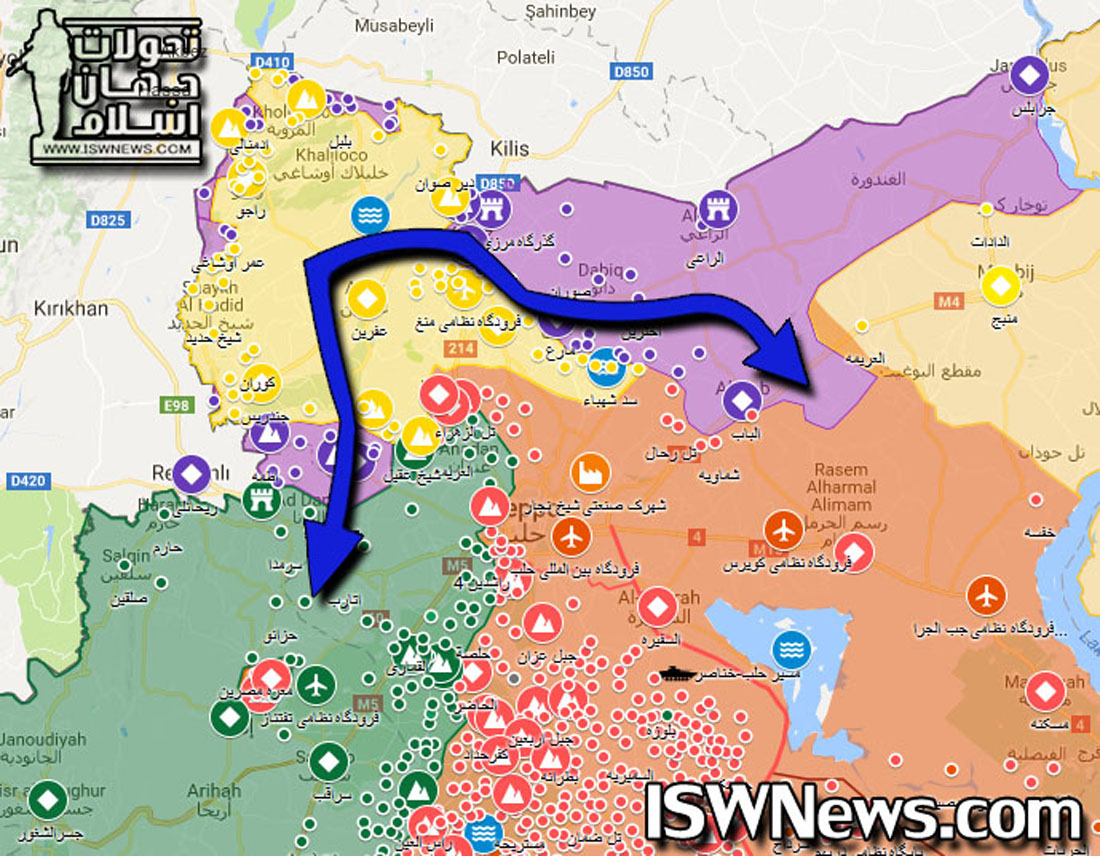
    Now we just can sit and see how it goes, Does Turkey satisfy to a border band or wants to occupy Afrin completely and become neighbor of Aleppo, Nubl and Zahra (where is Iran’s base) or even to make a way between Azaz (Al Bab region) and Idlib?

    It seems that the second plan to be more plausible which causes Iran to react and demand to stop the Operation Olive Branch and to get more serious by Turkish advances and on the other side Kurds in Afrin will get more logistic supports to stop Turkish Army…

  • Turkey’s Afrin campaign; high risk of conflict in northwestern Syria; US establishes army entitled “Syrian Border Security Force”

    Turkey’s Afrin campaign; high risk of conflict in northwestern Syria; US establishes army entitled “Syrian Border Security Force”

    In the last few days that USA announces that they are going to establish a new military unit entitles “Syrian Border Security Force” to defend northern borders, Erdogan announces that he will activate Afrin front again.


    Ryan Dillon, Spokesman for Combined Joint Task Force led by USA regarding Syrian Border Security Force says that this unit consists of 30,000 troops, from which half are Syrian Democratic Forces (SDF) will settle not only in northern borders but also in all borders such as border between Iraq and Syria and in Euphrates valley and in neighboring of Syrian Army.

    This clearly shows US plan to set borders for a new self-rule region in Syria.


    Publicization of this plan makes strong reactions of Russia and Turkey and Erdogan announces clearly that Turkish Army will attack Afrin and clear this area from PYD/PKK soon.


    The issue of Kurds in northern Syria and US supports and establishment of SDF whose main troops are from PYD/PKK is a big disagreement between USA and Turkey which is getting more severe every day and affects the relations between two countries.


    After the latest Syrian Peace Talks in Astana which took place with representatives of engaged groups in Syria and Russian, Turkish and Iranian officials to determine the situation of some less critical in Syria, some of Turkish troops based on this agreement settle in Aleppo governorate and south of Afrin from last month.


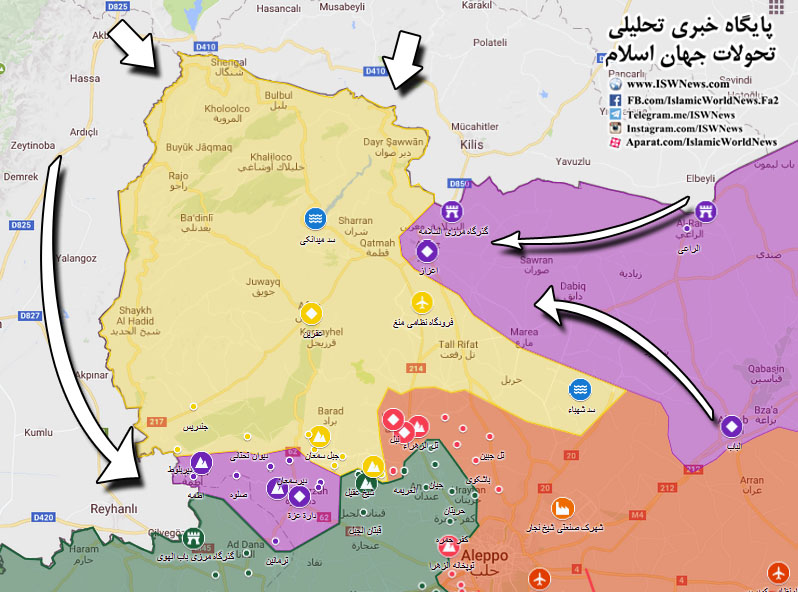
    From yesterday and after Erdogan claims new operation in Afrin, Turkish troops in Al Ra’i and Al Bab are transported toward Afrin fronts and according to news, more Turkish troops and armored vehicles are sent to Hatay and borders north of Afrin.

    All the evidences show more activities by Turkish Army near Afrin to operate soon.

    There are news that Turkish artilleries fire on PYD positions in southern Afrin from last night.

  • What is happening in Iran?

    What is happening in Iran?

    Yesterday, in continuation of rallies protesting economic situation, in some cities people gather and opposing the current economic situation, in some of which, extreme slogans can be heard.


    Opposition is not deniable and there are rational reasons for it but the dangerous issue is US obvious and secret interferences in Iran’s affairs to deviate the rallies.


    The (main stream)media covering the rallies by showing them in exaggerated way to promote them and on the other hand to censor that many people in Iran are against these rallies try to deceive the world that everyone in Iran is in rallies.


    Wall Street Journal in the same sense, writes an article entitled “New Protests in Iran” showing Hassan Rouhani, Iran’s president. In this article, they try to show that these rallies are biggest after election protests in 2009.


    BBC bolds some slogans which point to Iran’s presence in Syria or Yemen and tries to relate the protests to these issues.


    But the real joke is when Donald Trump, US president, with threatening language tweets “Many reports of peaceful protests by Iranian citizens fed up with regime’s corruption & its squandering of the nation’s wealth to fund terrorism abroad. Iranian govt should respect their people’s rights, including right to express themselves. The world is watching! ”


    This is while most of bad economic situation in Iran are resulted from unfair sanctions performed by US and their allies. Sanctions which include vital needs such as medications. Now they try to support people against government… !


    After revolution in 1979 and establishing Islamic Republic government, Iran have always seen such behaviors from western countries who try to tense or even help to overthrow the government with smallest unrest in Iran.

    This is not a small issue and there are tons of documents showing evil intentions of some western countries against Iran in the last four decades.


    This is a long story which includes but not limited to supporting the coup against Mosaddegh’s government in 1953 to supporting terrorist People’s Mujahedin in Iran who killed thousands of innocent people in Iran and are still active under US supports.


    But what is really happening in Iran?

    With the corruption in administrative system (which exists in every country) and economic pressure on people which is caused by some western countries’ unfair financial sanctions made supreme leader of Iran and some politicians to pretest.

    Ayatullah Khamenei, supreme leader of Iran, in his latest speech, mentioning internal problems says that why some officials who had all the facilities yesterday or even those who have power now are protesting today? But they have to be responsible for their functions, considering that people are smart and monitor their behaviors and won’t be deceived.


    Or even GholamHossein Karbaschi, the general Secretary of Executives of Construction Party, which is in the same shoe as current government, especially since the Vice President of Iran, Eshaq Jahangiri is from same party, says: “I am very unhappy with VP’s claims that we have some Abusive officials. If there are abusive officials, then fire them and as leader said you should not be like oppositions.”


    These are some examples of speeches and truth inside Iran and show that government and politicians in the same sense with people request the fight against corruptions and firing abusive officials. But these truths are never covered by mainstream media in western countries and inversely they try to show an unreal wrong picture from Iran.


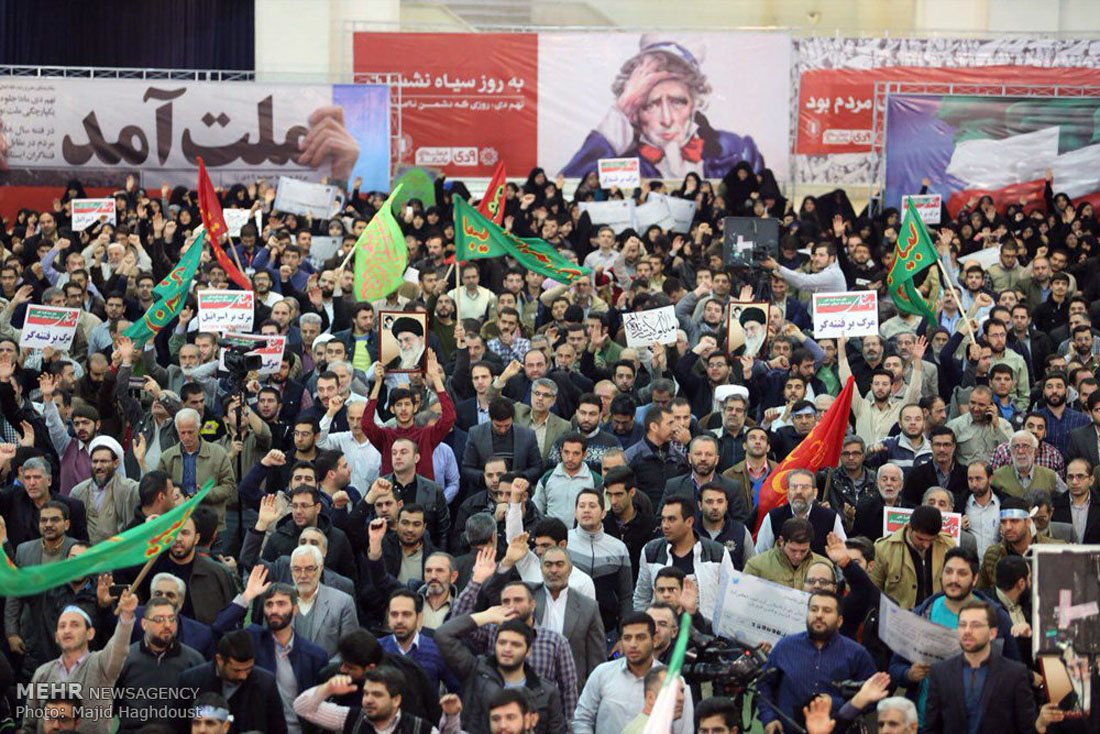
    Today, 30 December 2017, majority of people in the anniversary of the epic 30 December 2009 show their support for Islamic Republic by rallies which is also censored by mainstream media . On the other hand, they covered some protesting rallies against economy and claim it is against government!


    Some of today`s pictures showing people’s support of Islamic Republic of Iran which did not covered by mainstream media: