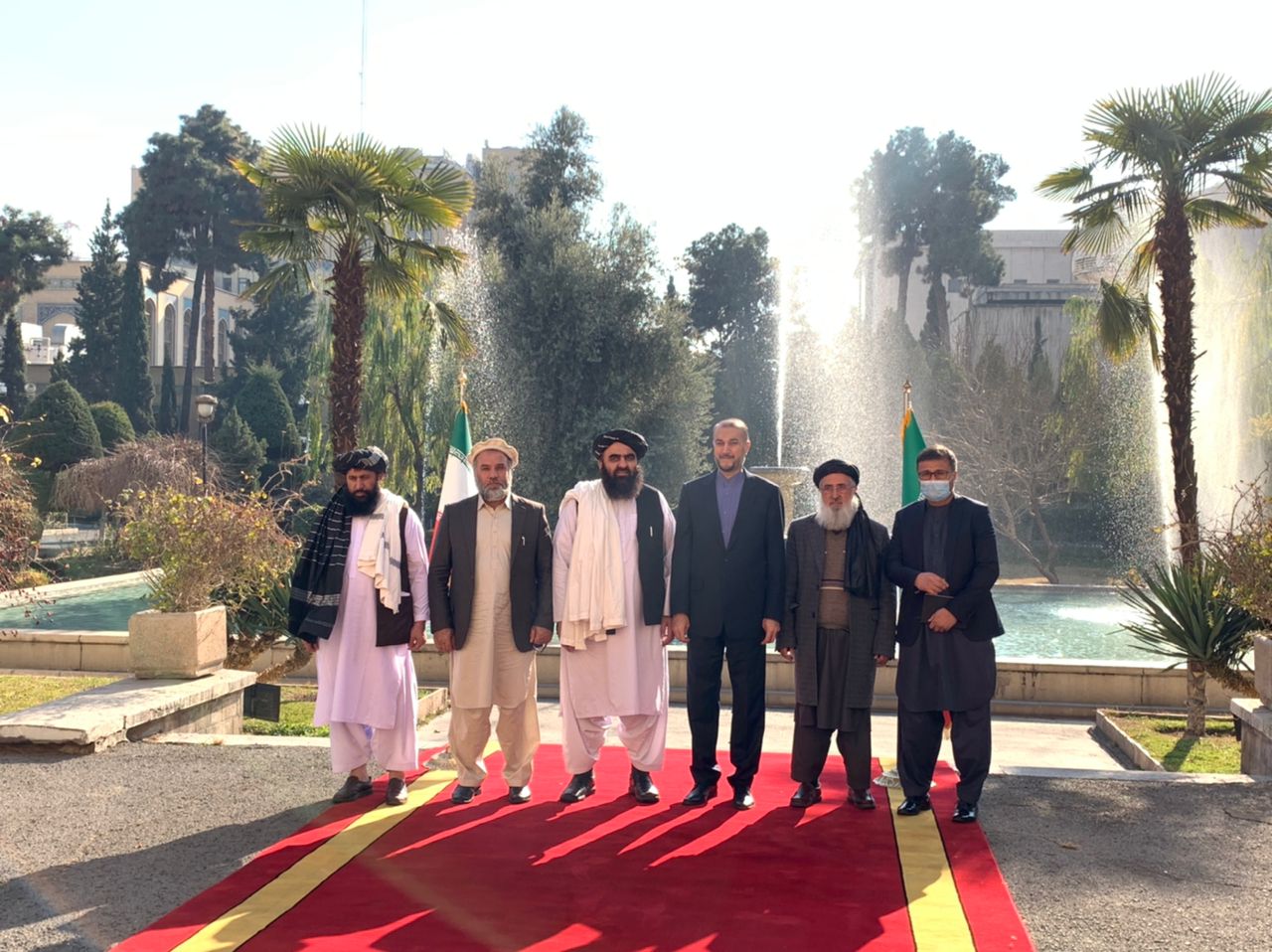
Tag: Hossein Amir-Abdollahian

  • Iranian Foreign Minister To United Nations Security Council: Iran’s Response To Israel’s Aggression Will Be Immediate, Decisive, And Strong

    Iranian Foreign Minister To United Nations Security Council: Iran’s Response To Israel’s Aggression Will Be Immediate, Decisive, And Strong

    Some excerpts from Hossein Amirabdollahian’s speech at the UN Security Council are as follows:

    – We will not tolerate any aggression against our national security, the country’s interests, and the collective security of the sensitive region of West Asia by any party.

    – The UN Security Council has held numerous meetings to address the war crimes and genocide committed by the Israeli regime, which, despite the adoption of three resolutions and one statement, has had ‘no practical result.’

    – No government will remain silent in the face of such brazen missile attacks on its embassy, which is considered a symbol of sovereignty, and the killing of its legal forces.

    – Iran’s legitimate defense and proportionate action have come to an end. Therefore, the Israeli regime must be compelled to refrain from any further military adventurism against Iran’s interests.

    Certainly, if the Israeli regime uses force and violates Iran’s interests, Iran will not hesitate for a moment to give an immediate, decisive, and strong response and make the regime regret its actions.

    Amirabdollahian also stated at the United Nations Security Council session that it is expected that the council will take action on the following matters by adopting a comprehensive and decisive resolution under Chapter VII of the United Nations Charter:

    1- Immediate, complete, unconditional, and permanent ceasefire in all Gaza areas, including Rafah, and even the western border.

    2- Complete lifting of the humanitarian blockade of Gaza.

    3- Humanitarian prisoners swap.

    4- Compelling the regime to immediately, completely, and unconditionally withdraw all military forces, equipment, and weapons from Gaza and ensuring the safe return of people to their areas and places.

    5- Imposition of comprehensive and immediate sanctions against the Israeli regime.

    6- Supporting the binding temporal jurisdiction of the International Court of Justice (ICJ) and paving the ground for the trial and punishment of all perpetrators, agents, and supporters of Israel’s crimes for committing genocide, targeted killings of journalists, staff of public service institutions, repeated use of unconventional weapons such as phosphorus bombs, and repeated threats by Israeli regime officials to use nuclear bombs in the Gaza Strip.

  • Iran Foreign Minister, Secretary-General Of Hezbollah Meet In Lebanon

    Iran Foreign Minister, Secretary-General Of Hezbollah Meet In Lebanon

    The Iranian foreign minister and the secretary-general of the Lebanese resistance movement held talks in capital Beirut on February 10.

    According to the public relations department of Hezbollah, the Secretary-General of this movement and the Iranian foreign minister discussed the latest political and security developments in the West Asia region, especially the events in the Gaza Strip, southern Lebanon, and issues related to other resistance fronts. The two sides also talked about the current situation in Lebanon.

    In this meeting, Ambassador of the Islamic Republic of Iran to Beirut Mojtaba Amani was also present.

  • Iranian Foreign Minister: Iran Respect The Sovereignty And Territorial Integrity Of Pakistan

    Iranian Foreign Minister: Iran Respect The Sovereignty And Territorial Integrity Of Pakistan

    Hossein Amir-Abdollahian:

    We have a security agreement with Iraq that obligates Baghdad and Erbil to protect the borders. In Erbil, we bombed Mossad members as part of Iran’s response.

    We targeted an Iranian terrorist group in Pakistan called Jaish ul-Adl. None of Pakistani citizens have been attacked by Iranian missiles and drones. We respect the sovereignty and territorial integrity of Pakistan and Iraq, but we do not allow our national security to be threatened.

    What we have done is consistent with the security of Iraq, Pakistan and the entire region

    What we did against the Mossad base in Kurdistan and the Jaish ul-Adl terrorist group in Pakistan has nothing to do with the situation in Gaza.

  • Iran’s Foreign Minister Warned: Stop the Genocide In Gaza! (Video)

    Iran’s Foreign Minister Warned: Stop the Genocide In Gaza! (Video)

    Hossein Amir-Abdollahian said in parts of his speech about the war of the Zionist regime and the Palestinian resistance at the meeting of the United Nations General Assembly:

    • The genocide of the Palestinian people in Gaza by the Zionist regime must be stopped immediately. The US and European countries see and support the killing of 7,000 civilians in Gaza by Israel.
    • This is our home and West Asia is our region. We will not deal with any party or country that endangers the security of our region.
    • We do not welcome the expansion of the war in the region, but if the war in Gaza continues, we cannot stop the fire. If this war continues, the US will not be spared from the fire.
    • The Islamic Republic of Iran has proposed holding a referendum among all the residents of Palestine.
    • Hamas is ready to release civilian prisoners and the world should support the release of 6,000 Palestinian prisoners too.
  • Iranian Foreign Minister: The Resistance In The Region Are “Fully Ready” To Respond To Any Move By Israel

    Iranian Foreign Minister: The Resistance In The Region Are “Fully Ready” To Respond To Any Move By Israel

    Amir-Abdollahian said that the Resistance Front will give a decisive response at a proper time if the international community delays stopping the Zionists from committing war crimes.

    I found out in conversation with the leaders of Resistance that the resistance response will be decisive and regret-inducing, and will change the current map of the occupied territories (Palestine).” he said.

    Amir-Abdollahian added: “A political decision can be made before the situation gets out of control, but it may be too late. If war crimes stop and the parties agree on a ceasefire, then it will be the forces of “resistance” (Palestinian) that will determine its terms.”

    “We are in constant consultation with allies in the region, but do not interfere in their plans and actions. The resistance has the ability to defend itself, and we will take all necessary diplomatic measures to stop the aggression and lift the blockade of Gaza.”

    In response to a question about Iran filing a complaint against crimes against humanity by the Zionist regime, the foreign minister said: “We have proposed holding an extraordinary meeting of the Organization of Islamic Cooperation and we are ready to hold this meeting in Tehran. The Secretary General of this organization is going to choose a special representative to follow up on issues related to the Palestinian area, and the documents of the war crimes of this regime will be collected for presentation in the national and international courts of the countries. In the history of the past seven decades, many legal complaints have been filed by the legal centers associated with Palestine, but they have not been resolved due to unfair treatment.”

  • Amir-Abdollahian Says Iran Suggested Plan For Turkish Withdrawal From Syria

    Amir-Abdollahian Says Iran Suggested Plan For Turkish Withdrawal From Syria

    Speaking to the Iranian Arabic-language newspaper, the minister revealed that Tahran “proposed that Turkey commit, first, to withdrawing its military forces from Syrian territory, and second, that Syria commit to deploying its forces on the border so that Turkish territory is not threatened.”

    Iran and Russia will both act as guarantors, according to Amir-Abdollahian, who didn’t provide any further details on the plan.

    Ankara is still the main backer of Syrian rebels. The Turkish military controls vast parts of Syria’s northern and eastern region. It also maintains a large presence in the northwestern region of Greater Idlib, which is ruled by an al-Qaeda offshoot.

    Iran and Russia have been leading efforts to restore relations between Turkey and Syria. The foreign ministers of the two countries met in Moscow last May. Since then, the normalization process has seen very little progress.

    In July, Turkish President Recep Tayyip Erdogan told reporters that he is open to talks with his Syrian counterpart, Bashar al-Assad, but would not meet him if a withdrawal of Turkish troops from Syria were set as a condition. Later in August, al-Assad blamed Turkey for terrorism in his war-torn country and insisted on the withdrawal of the Turkish military from Syria in an interview with Sky News Arabia.

    Amir-Abdollahian’s remarks indicate that Iran and Russia are making much efforts to bring Turkey and Syria together away from the media. Still, the serious disagreements between Erdogan and al-Assad means that a normalization agreement may still be far.

    Originally posted on SouthFront

  • Iranian Foreign Minister’s Visit To Syria

    Iranian Foreign Minister’s Visit To Syria

    Hossein Amir-Abdollahian, Minister of Foreign Affairs of the Islamic Republic of Iran, met and discussed with Prime Minister Hossein Arnous and Faisal Mekdad, Foreign Minister of this country, during a trip to the capital of Syria on August 30.

    At the beginning of the meeting with the Syrian Prime Minister, Amir-Abdollahian conveyed the greetings and respect of Mohammad Mokhber, the first vice president of Iran, to the Syrian Prime Minister. And invited Faisal al-Maqdad to travel to Tehran and hold the 15th meeting of the High Commission of the two countries.

    Amir-Abdollahian called Syria a friend, brother and ally of Iran and Iran a friend of Syria’s difficult times and emphasized the need to strengthen brotherly ties between the two countries.

    In this meeting, the Syrian Prime Minister pointed out that the government and people of Syria appreciate Iran’s support to Syria and said:

    The relations between the two countries are deep-rooted, friendly and brotherly, and we are proud of these relations. Syria won after 12 years of pressure and war, and now the enemies of the Syrian nation are trying to continue to put pressure on the government and the Syrian nation by imposing sanctions and economic pressure on Syria.

    After this meeting, the Iranian Foreign Minister met with his Syrian counterpart and in a joint press conference with Al-Mekdad stated:

    Regarding the movements of terrorist groups and the efforts of the Americans to organize terrorists and the continuation of their occupying presence in Syria under the pretext of fighting ISIS, We advise the American soldiers to return home and we advise the American authorities to leave the region to the people of the region.

    He added:

    The security of Syria and the security of the region is our serious and common concern. We continue our strong support to the Syrian leadership, army, government and nation in order to achieve a safe, stable and developed region. We believe that friendly and brotherly relations between Syria and Turkey are in the interest of both countries and the region. We emphasize on respecting the sovereignty and territorial integrity of countries, including Syria and Turkey. Iran will continue its efforts to resolve misunderstandings between Turkey and Syria and to establish peace and security on the common border between Syria and Turkey.

    It should be noted that Nasser Kanani, Spokesperson of the Ministry of Foreign Affairs, Mehdi Shushtri, Assistant Minister and Director General of West Asia and North Africa, Mohammad Sadiq Fazli, Advisor to the Minister and Ministerial Director General of the Ministry of Foreign Affairs, and Ali Asghar Khaji, Senior Advisor to the Minister of Foreign Affairs on Special Political Affairs, accompanied Iran’s foreign minister in this trip.

  • Iran, Saudi FMs Meet In Riyadh; President Raisi To Visit Saudi Arabia

    Iran, Saudi FMs Meet In Riyadh; President Raisi To Visit Saudi Arabia

    ISWNews Analysis Group – During the meeting, the Saudi foreign minister expressed Saudi Arabia’s serious intention to pave the way for signing an agreement between the two nations and follow up previous agreements in the fields of security and economy.

    Given the development of bilateral relations and the strengthening of regional stability, the representatives of the two countries have begun their work, and the start of the ambassadors’ work will be towards establishing new relations between the two countries, bin Farhan argued.

    Amirabdollahian, for his part, announced Iran’s intention to execute existing agreements between the two states in the economic, commercial and security fields.
    The top Iranian diplomat also said that Tehran has established important relationships with Saudi Arabia and other Arab countries in the West Asia region, including Iraq, Kuwait, Qatar and the United Arab Emirates, and that the Islamic Republic believes regional security and development are in the interest of all regional nations.

    The Iranian FM further referred to the fact that Saudi King Salman bin Abdulaziz Al Saud has officially invited Iranian President Ebrahim Raisi to visit the kingdom, and that Raisi’s trip to Saudi Arabia will take place at an appropriate time.

    Preparations for negotiations aimed at reconstructing relations between Iran and Saudi Arabia kicked off last year and the talks were finalized with an agreement between representatives of the two countries in Beijing, China, on March 6, 2023, and a trilateral statement was also signed to restore relationship between the two neighboring nations.
    As a result of the resumption of diplomatic relations between Iran and Saudi Arabia, peace negotiations in Yemen also resumed and negotiations between the Ansar Allah movement and the Saudis continued with Oman’s mediation.

    However, Yemen is one of the regional disputes between Iran and Saudi Arabia, and the two countries have also differences over other issues such as Iran’s nuclear capability, the dispute over the three Iranian islands (Abu Musa, Greater and Lesser Tunbs), joint gas fields in the Persian Gulf, regional security issues, Saudi support for opposition media outlets, Arab countries’ relations with the Zionist regime, as well as the United States’ military presence in the West Asia region. It seems that the two countries are determined to solve these problems!

  • Iran Not To Recognize Taliban: FM Amirabdollahian

    Iran Not To Recognize Taliban: FM Amirabdollahian

    Amirabdollahian made the remarks in a meeting between Iran’s Foreign Ministry officials and heads of its diplomatic missions abroad with the custodian of Imam Khomeini’s holy shrine Hassan Khomeini in Tehran on May 25.

    The foreign minister said we are dissatisfied that an inclusive government has not been formed in Afghanistan and we have also announced the issue to the current rulers of Afghanistan; so, we do not recognize the current governing body of Afghanistan and we emphasize the need for the formation of an inclusive government in the neighboring state. Moreover, the Taliban group is just a fraction of the political reality in Afghanistan, but it is not the whole reality.

    The foreign minister further referred to the neighborliness of Iran and Afghanistan as well as the long borders between the two countries, saying the scattered border clashes that have occasionally happened on the Afghanistan- Iran borderlines in recent months are a source of concern.

    According to the top diplomat, there is no way but interaction between the two neighboring countries, and that we do not want the bitter incident of Mazar-i-Sharif to be repeated, but we want to help realize peace and security in Afghanistan and we also have expectations from the current rulers of the neighboring state.

    Amirabdollahian pointed to Iran’s water rights from the Helmand River, adding that we have had talks with Afghan officials on the issue and we are of the opinion that the legal path should be considered in this regard on the basis of water-sharing treaty, which was signed in 1973. We told Afghan officials that the water rights issue cannot be resolved through a political statement and must be pursued within the framework of legal actions, he noted.

    The Iranian foreign minister also described the Taliban caretaker government’s policy in facing women and girls as inhumane and emphasized that Iran considers the policy contrary to the teachings of the Prophet of Islam (PBUH).

    Rhetorical tensions between Taliban and Iran escalated after the Taliban rulers replied negatively Iran’s repeated diplomatic requests for the implementation of the 1973 treaty on Iran’s water rights from the Helmand River, claiming that the Afghans are facing drought and lack of water in the Kajaki Dam, which is an earth and rock-fill embankment type dam located on the Helmand River in the Kajaki District of Helmand Province in Afghanistan.

    The Taliban rulers also rejected Iran’s request to dispatch a technical delegation to verify the amount of water in the Kajaki Dam.

    Video: Iran Warns Taliban On Water Rights

  • Latest Updates On Yemen, 31 December 2022

    Latest Updates On Yemen, 31 December 2022

    1- Al-Hudaydah:
    The Saudi-led forces violated the ceasefire 270 times in the last 48 hours in the al-Hudaydah province.

    2 Hajjah:
    The Saudi coalition arrested three Yemeni fishermen on the shores of Bahis region in Midi administration and confiscated their boats.

    3- Saadah:
    On December 23, one person was martyred and 12 people were injured, including several African immigrants, as a result of the Saudi coalition’s artillery attack on al-Raqo border region.

    4- Shabwah:
    – On December 24, Shabwah defense forces and the Southern Transitional Council (STC) militants clashed in al-Rawdha area located in the city of Ataq. As a result of this clashes, at least four militia members from both sides were wounded.
    – On December 28, as a result of clashes between the STC militants and the armed tribesmen of the Ayadh region, in the north of the city of Ataq, several militia members from both sides were killed and wounded.

    5- Hadhramaut:
    – On December 26, the resigned government of Yemen, in response to the help request of Mabkhout Bin Madi, the governor of Hadhramaut, sent a large convoy of Amaliqa forces to the city of al-Mukalla, the capital of this province. Mabkhout Bin Madi has recently asked for help from the resigned government due to the increase of threats of Islah party militants in north of Hadhramaut province and also the unprecedented gathering of supporters of the Southern Transitional Council in the city of al-Mukalla.
    – On December 27, Mabkhout Bin Madi, the governor of the resigned government in Hadhramaut, approved the deployment of Tareq Saleh’s forces in al-Dhabah port and al-Rayan coast.

    6- Abyan:
    – On December 26, two STC members were killed and several others were injured due to a roadside bomb explosion in the al-Mahfad district in Abyan province. Considering the increase of activities of the terrorist group Ansar al-Sharia in Abyan province, it is possible that this attack was carried out by this group.
    – On December 28, at least seven STC members were killed and injured due to a roadside bomb explosion in Mudiyah district in Abyan province.

    7- Aden:
    – The Sudanese army denied the rumor of the withdrawal of its forces from Yemen and confirmed that the forces that left the Al-Anad base retreated to the city of Aden a few days ago. This withdrawal has been done with purpose of replacing the forces and settling the Sudanese in another part of Yemen.
    – On January 29, local sources reported the transfer of Sudanese mercenaries from the southwest coast of Yemen to Perim (Mayyun) Island. This deployment was carried out by the order of Saudi Arabia and with the coordination of the UAE and Egypt.

    Read more:
    Saudi Arabia Took Control of Al-Anad Airbase From the STC
    Who Occupied The Mayyun Island?

    8- Abdul Qadir Al-Murtada, head of the National Committee for Prisoners Affairs of the Yemeni Salvation Government:
    “The prisoners’ file has been blocked since last March and no progress has been made in it. Despite the signing of the agreement on the exchange of more than 2,200 prisoners from both sides under the supervision of the United Nations, the aggressive mercenaries refused to implement it and prevented its implementation by the order of the Saudi regime. The responsibility for this delay and this deliberate obstruction lies with the Saudi regime.

    9- Iran’s Foreign Minister Hossein Amir-Abdollahian met with Muhammad Abdul Salam, the spokesman of Yemen’s Ansar Allah movement and the head of the negotiating team of the country’s national salvation government, in Muscat, the capital of Oman, and discussed domestic and regional political developments. While emphasizing Iran’s support for Yemen, Amir-Abdollahian considered removing the blockade of Yemen as a humanitarian right of the people of this country.

  • Iranian Foreign Minister arrives in Damascus

    Iranian Foreign Minister arrives in Damascus

    Discussions on bilateral cooperation, regional and international developments are among the topics of the meeting.

    Upon arrival of Hossein Amir-Abdollahian in Damascus, the Iranian Foreign Minister was received by Syrian Foreign Minister Faisal Mekdad. Faisal Mekdad said: “We emphasize on strengthening relations with countries in the region, including relations with Iran and Arab countries. Coordination between Syria and Iran continues at both the regional and international levels. We emphasize our stand by Iran.”

    It is worth mentioning that this is Amir Abdullahian’s third visit to Syria. He also traveled to Syria twice in 2021.

    The plane carrying the Minister of Foreign Affairs of the Islamic Republic of Iran to Damascus
  • Iran looking for convergence between Taliban and Ahmad Massoud

    Iran looking for convergence between Taliban and Ahmad Massoud

    Taliban committee led by Amir Khan Muttaqi, Taliban FM, met with Ahmad Massoud, leader, and Ismail Khan, an official of Jamiat-e Islami party, met in Tehran with mediation of Islamic Republic of Iran.

    No details have been released regarding the meeting but Taliban claims that they assure that Ahmad Massoud and Ismail Khan can come back to Afghanistan without any problem or threats.

    These meetings took place during the trip of Amir Khan Muttaqi, Taliban FM, to Iran and his talk with Hossein Amir-Abdollahian, Iran FM. Both sides stressed on cooperations such as counter terrorism, drug trafficking, Iranian goods transit to middle Asia, humanitarian aids to Afghanistan, etc.

    In summary, Iran is the closest and most reliable neighbor of Afghanistan and thus Afghanistan groups always welcome and appreciate efforts of their neighbor.
    According to Iranian officials, Iran’s policy in Afghanistan is to help form a inclusive government which can hold peace and stability in Afghanistan. Considering the situation in Kazakhstan and serious threats in middle Asia, unity and cooperation of these countries including Afghanistan seems necessary.

    Read more: Investigation of Afghanistan Major Problems, From Ahmad to Taliban!