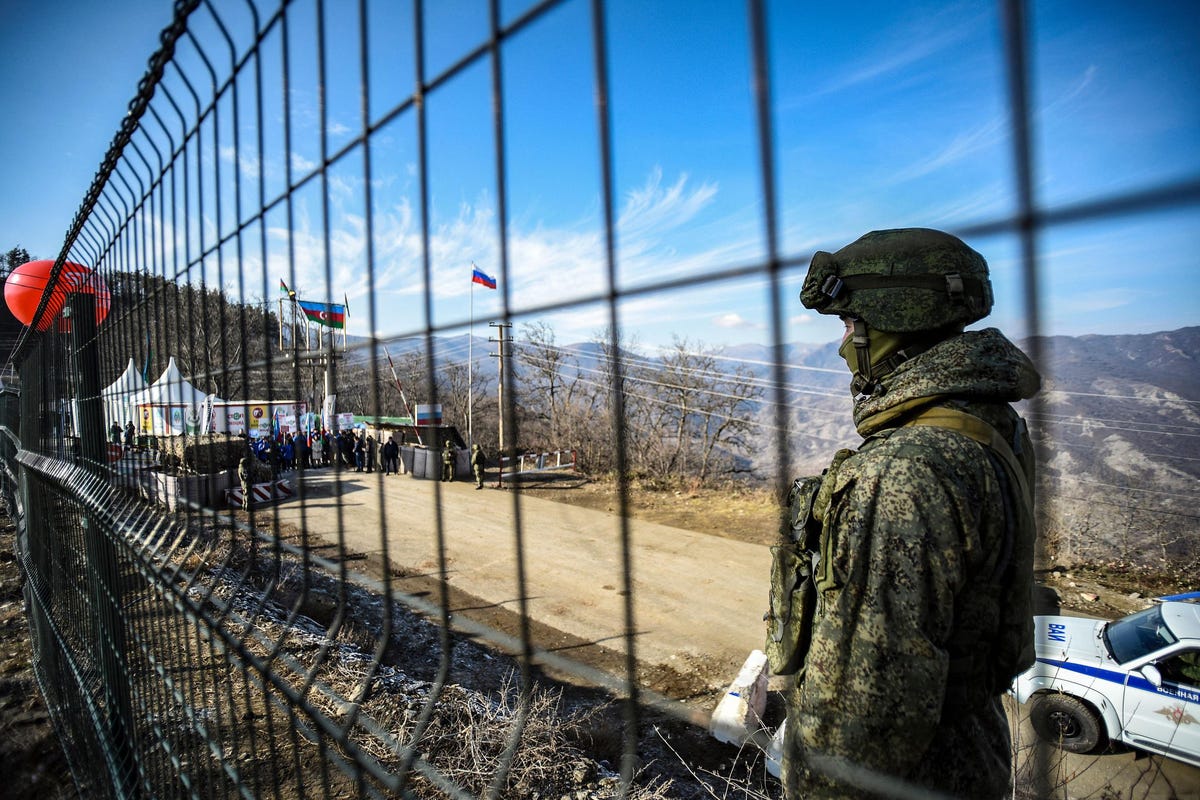
With the official decree of Samvel Shahramanyan, President of the government known as Artsakh, the Republic of Artsakh will no longer exist from January 1, 2024. Shahramanyan signed the decree for measures emerging from the ongoing circumstances.
After September 19, 2023, and the current difficult military and political conditions, ensuring the physical security and vital interests of the people of Artsakh have turned into a serious priority.
According to the agreement reached with the mediation of the Russian peacekeeping forces, along with the presence of representatives of the Republic of Azerbaijan, free and voluntary travel without obstacles for the residents of Nagorno-Karabakh region, including military personnel who have laid down their weapons, is guaranteed along the Lachin corridor, while moving their belongings and vehicles. According to Article 93 of the Constitution of Nagorno-Karabakh, the following decisions have been made:
1. All government institutions and organizations will dissolve their subordinate offices by January 1, 2024, and the Republic of Nagorno-Karabakh (Artsakh) will no longer exist.
2. The population of Nagorno-Karabakh, including residents outside the Artsakh Republic, will become familiar with the conditions for reintegration presented by the Republic of Azerbaijan in order to make an independent and individual decision regarding the acceptance of Azerbaijani citizenship and the possibility of returning to Nagorno-Karabakh.
This resolution is immediately binding after publication, and no decision has been made yet regarding the dissolution of the separatist parliament.
Contradictory news is also being published by the Nagorno-Karabakh media center. The Artsakh Information Center (official media of the separatists) continues its activities and it claims that Samuel Shahramanian was forced to take the decision to dissolve the Artsakh government; so, they do not comply with the decision. This media center had also published images of police cars and Azerbaijani army trucks entering the city of Khankendi or Stepanakert.
This media outlet has also reported that a truck carrying fuel for Russian forces collided with passing vehicles on the Shushi-Berdzor highway, and two vehicles belonging to Armenian people who were leaving Artsakh region were burned down. Independent reports on the casualties and damages of the incident have not been published so far.
From 13:00 local time on September 20, a temporary ceasefire was established as a result of Russian mediation between the Republic of Azerbaijan and the forces of the Republic of Artsakh or the Nagorno-Karabakh Republic. However, this ceasefire has been established at the repeated request of the Armenians of Nagorno-Karabakh, while the Azerbaijani army forces did not have much desire for it.
After the Azerbaijani army launched a widespread operation from land and air against Nagorno-Karabakh on Tuesday, the so-called Artsakh forces came under severe pressure and many of their military and defensive positions were destroyed. Also, the ground units of the Azerbaijani army easily captured new areas of Nagorno-Karabakh.
In the second Karabakh war, despite the air superiority of the Republic of Azerbaijan, the Azerbaijani army suffered very high casualties of about 2,700 people and on the other side about 3,700 people were killed. Azerbaijan learned from this.
In fact, after the second Karabakh war and due to the delivery of vast areas of western Nagorno-Karabakh and also Lachin corridor to Baku government, all logistical routes from Armenian soil to Nagorno-Karabakh region were cut off and Artsakh forces were completely besieged and became very weak in terms of logistics and forces. Therefore, it was predicted that in the future war, Nagorno-Karabakh would have no chance against a new onslaught and Azerbaijani army casualties would also be negligible.
This issue was clearly seen on the ground and during 24 hours of military operations of Azerbaijani army in Nagorno-Karabakh, significant areas came under Baku government control. In western Nagorno-Karabakh and on Kalbajar district, Azerbaijani army easily took control of Charektar and Getavan areas and advanced near Heyvali in central northern areas. In eastern Nagorno-Karabakh and on Agdam axis, Kashen mine came under control of Azerbaijani forces. On Fuzuli axis, the Amaras and its monastery came under control of Azerbaijani forces as well.
The latest military situation in Nagorno-Karabakh after the advance of the Azerbaijani army in the western, eastern and southern axis of Nagorno-Karabakh – click to view in full size
Therefore, before losing all areas in the Nagorno-Karabakh region with high casualties, Artsakh forces requested a ceasefire.
Now government in Baku has upper hand in negotiations. In these negotiations, Armenian government of Nagorno-Karabakh must be dissolved, its military forces must be disarmed and move to the Armenian mainland and deliver all their positions to Russian peacekeeping forces. And ultimately in continuation of this process, all Nagorno-Karabakh region must be annexed to mainland of Republic of Azerbaijan.
It is noteworthy that Iran and Russia also consider Nagorno-Karabakh region as part of Republic of Azerbaijan and support its annexation to Azerbaijani soil while respecting citizenship rights of Armenians in Nagorno-Karabakh.
At noon today, the Azerbaijani Ministry of Defense, by publishing a statement, officially announced the beginning of a “local anti-terrorist operation” against the Nagorno-Karabakh government. The government of Baku stated that the purpose of this operation is to disarm and drive out the Armenian armed forces present in Nagorno-Karabakh and restore security to the region. In this statement, it is stated that the operation was carried out with the coordination and information of Russia and Turkey.
The operation follows weeks of clashes and after three years of tension between Azerbaijan and Armenia over the Nagorno-Karabakh, also known as Artsakh. Azerbaijan has announced a new offensive in the breakaway region of Nagorno-Karabakh, a major escalation which could turn the simmering dispute into all-out war.
In the field and based on the available visual information, the artillery of the Republic of Azerbaijan Army targeted the Nagorno-Karabakh (Artsakh) air defense systems in Stepanakert (Khankendi) the center of Nagorno-Karabakh with several Israeli LORA missiles.
The targeting of Artsakh air defense systems in Stepanakert with the Lora missileThe launch of the Lora missile by the Republic of Azerbaijan towards Karabakh
At the same time as this attack, the drones of the Republic of Azerbaijan were also seen over the region; According to the sound of drones, it seems that the Azerbaijani army has carried out another attack against the Armenian positions using Israeli Harop suicide drones.
Suicide drones over Nagorno-Karabakh
Also, scattered clashes continue on the contact lines between the parties. There are also reports that some civilians were wounded in the exchange of fire near the contact lines.
Actually, a new war and the battles in the Karabakh region were a clear and expected event. After the Second Nagorno-Karabakh War, which was left with a chaotic situation and a vague ceasefire agreement and somehow became a bone within a wound, it was clear that the situation in the region would move towards a new war. During the past three years, Armenia has been involved in various internal chaos and wrong decisions, and on the other hand, the government of Baku was preparing for another war by strengthening its military and political ties with others and planning coherently.
Considering the current situation of Russia and the war in Ukraine and the differences that exist on the Armenian front, undoubtedly the Armenians of Nagorno-Karabakh will have nothing to say against the Azerbaijan threats, And its is clear that after the occupation of Nagorno-Karabakh by Azerbaijan, the so-called Zangezur corridor and the ambitious plans for the occupation of the southern regions of Armenia will be more on the agenda of the Baku government.
Military situation in Karabakh – click to view full size
In a statement, Armenia’s National Security Service said that a group of Azerbaijani border guards had attempted to cross a bridge over the Hakari river, which marks the internationally-recognized border between the two countries, and hoist a flag on Armenian territory. The service added that the attempt had been thwarted.
The bridge lies at the start of the Lachin corridor, the last remaining route linking Armenia with Nagorno-Karabakh, which is mainly inhabited by ethnic Armenians. The key corridor is policed by Russian peacekeepers.
Footage that surfaced online showed Azerbaijani border guards coming under fire while attempting to hoist their flag. The border guards were accompanied by a number of Russian peacekeepers.
After the Armenian attack, Azerbaijan closed the Lachin corridor, preventing Armenians from leaving or entering Nagorno-Karabakh.
TASS cited Azerbaijan’s border service as saying one of its guards was wounded in the attack. Later, the Russian news agency quoted the Armenian border service as saying that one of its guards had been wounded during Azerbaijani shelling of a village close to the bridge.
The Lachin corridor has been blocked to most traffic since December, after Azerbaijani civilians identifying themselves as environmental activists began a blockade.
Tension remained high between Armenia and Azerbaijan after the Nagorno-Karabakh war of 2020. The deployment of Russian peacekeepers helped prevent any further escalation. However, the two countries are yet to reach a settlement and end the conflict.
Armenia’s Hraparak daily, the media outlet affiliated to the opposition of the government in Yerevan, has reported a shocking news story for the Azerbaijan Republic. According to the newspaper, the Russian government has made a decision to replace Major General Andrey Volkov, who was the Commander of the Russian peacekeeping contingent in Nagorno-Karabakh, and recall him to capital Moscow.
The new commander of the peacekeeping forces is a skillful lieutenant general, who took part in Russia’s wars. He is considered as a competent military commander among the staff of the Ministry of Defense of the Russian Federation. He is trusted by Minister of Defense of the Russian Federation Sergei Shoigu, and is cooperating with the minister for a long period. The new commander comes to organize the circumstances and Volkov is getting ready to leave Nagorno-Karabakh in the coming days.
The news story of the Armenian daily has been published on the prominent website of Sputnik, which is the media outlet of the Ministry of Defense of the Russian Federation.
Andrey Volkov, the former commander of the Russian peacekeeping forces in Karabakh
New commander of Karabakh peacekeeping forces
The skillful military commander is named Colonel General Alexander Ivanovich Lentsov, who is also an advisor to the current minister of defense in Russia. Lentsov played the roles of being a member of military service as well as commanding Russian wars in Afghanistan, Chechnya, Bosnia and Syria.
The colonel general was deputy commander of the Russian air forces from 2009 to 2013 and he served from 2013 to 2020 as deputy commander of the Russian Ground Forces. He was promoted to Lieutenant General in 2011 and Colonel General in 2014. Since 2020, he has served as an advisor to the Minister of Defense. On April 25, Lentsov was appointed commander of the Russian peacekeeping forces in Nagorno-Karabakh region.
Alexander Lentsov, the new commander of the Russian peacekeeping forces in Karabakh
The speculations on the 4th commander
Colonel General Alexander Ivanovich Lentsov is the fourth commander of the Russian peacekeeping contingent, which has been deployed in Nagorno-Karabakh region since 2020 up to now. Prior to the commander, three lieutenant generals named Rustam Muradov, Gennady Anashkin and Andrey Volkov have not been so much successful in carrying out their mission to implement truce in Nagorno-Karabakh region.
The Russian government is determined to use the powerful commander with the aim of force all sides to implement the provisions of the tripartite Nagorno-Karabakh ceasefire agreement, which was signed in Moscow on November 9, 2020, and regain the Russians’ lost influence in the region following the blockage of Lachin Corridor, a mountain road that links Armenia and Nagorno-Karabakh.
The challenges of Volkov’s tenure
Major General Andrey Volkov’s tenure as commander has been full of tension. He could not get in the way of the violation of ceasefire as well as military advances by Azerbaijan’s armed forces in eastern, western and southwestern lines of contact, where he was tasked to observe the peacekeeping mission.
The major challenge during his tenure was the gatherings by environmental activists, who are supporters of Azerbaijan Republic’s President Ilham Aliyev, as well as the closure of Lachin Corridor in Shusha, the advances by Azerbaijan’s armed forces, the blockage of roads to alternative routes under the pretext of fighting arms smuggling, and the construction of a checkpoint in borderline with Armenia, which is located in the start of the path to the Lachin Corridor.
A number of so-called environmental activists, who support Azerbaijan’s President Ilham Aliyev, stopped transit of Armenians in Shusha city towards the center of Nagorno-Karabakh (Artsakh) region. Azerbaijan’s armed forces, from March 25, have started advancing in some parts of northern corridor of Lachin and seized control of heights overlooking side roads from Lisagor (Turssu) village to Stepanakert (Khankendi) city, the center of Nagorno-Karabakh region. Therefore, residents of six villages of Lisagor (Turssu), Yeghtsahogh (Saribaba), Mets Shen (Buyuk Galadarasi), Hen Shen (Kichik Galadarasi), Kanach Tala (Goytala) and Tasy Verst that are Armenian settlements have been besieged, and the side roads, which are their last chance to maintain their connection with the center of the Nagorno-Karabakh have been blocked.
Challenge of living in Line of Contact
Radio Liberty of Armenia has prepared a report on regions that are near the Line of Contact and witnessing a hard situation following the closure of transportation ways. Lisagor in this region is the only residential area, where the Armenians have been resided in following the end of First Nagorno-Karabakh War from February 1988 to May 1994.
Qajik Nasibyan, head of Lisagor council, told a reporter of the radio that the village with 73 Armenian people has been situated in vicinity of the Line of Contact after the end of the Second Nagorno-Karabakh War (September 27, 2020 – November 10, 2020). Their presence zone on the road is 8 to 10 kilometers near Shusha. Now, the village comes under the fire of the observation post of the Azerbaijan Republic’s army. The Azerbaijan armed forces plan to control the only remained road for their connection to Stepanakert; so, they took it.
Artak Hakobyan, head of Saribaba council, explained the hardships of living under this condition, saying that aside from healthcare issues, other problems have happened. Students cannot commute to Stepanakert. The Azerbaijan army personnel have been deployed 500 meters away from the Saribaba village. The residents of the village can farm only near their houses. In August 2022, Azerbaijan Republic retook Lachin District, and the Azeri Army controlled heights around the village. Azerbaijanis have stolen 17 cows so far; so, if we neglect for only five minutes, our cattle would be stolen.
Azerbaijan does not intend to retreat
Siran Ayraptian, representative of the Armenian separatists of Artsakh, in an interview with Radio Liberty pointed to the inconclusive negotiations by Russian peacekeepers to urge Azerbaijan Republic to retreat from the heights overlooking Lisagor village, saying that Azerbaijan resorted to blocking the only transportation road in a bid to force the Armenian community there to stop their demand for independence. On one hand, the Azeri authorities speak of peace, and on the other hand, they resort to enforcing pressure in order to force us to do something else, but the performance would not bring positive result.
Pro-Aliyev environmental activists present in Shusha sit-in accuse Armenian people of illegal excavation of mines in Karabakh and pollution in that mountainous region; therefore, they resort to the excuse to block the road even for routine traffic. The authorities in Azerbaijan Republic say that the side roads are being applied for delivery of arms and military equipment. Thus, all roads should be closed for residents of central parts of the mountainous Karabakh region!
From checkpoint to border police station
Azerbaijan Republic is saying that they should build a border police station in Lachin Corridor. The Azeri officials first announced that an checkpoint should be erected in Shusha city, but now they say the post should be constructed in the borderline between Azerbaijan and Armenia.
It is worth mentioning that the Azerbaijan Army trespassed on Armenian soil, when they attempted to cut the old route of Tegh to Lachin Corridor, and they occupied hundreds of hectares of Armenian territories in east and northeast of Tegh. (Map below)
Checkpoint is contrary to Moscow statement
Russian foreign ministry spokesperson Maria Zakharova underlined the need for implementing provisions of the Nagorno-Karabakh ceasefire agreement, which is a tripartite statement signed by Russia, Azerbaijan and Armenia on November 9, 2020, saying that the establishment of a checkpoint is not among the provisions of the statement, but Moscow will observe the option.
Challenges of new path of Lachin Corridor
The Lachin Corridor links Armenians living in the Nagorno-Karabakh region to Armenia; so, the residents of the region can only meet their needs through this path.
The developments of the Lachin Corridor are also of importance. According to the Nagorno-Karabakh ceasefire agreement, the old route from Tegh village should be closed from April 1, 2023 and a new path towards the south should be used, which has a boundary of five kilometers. Azerbaijan constructed parts of the road, which is under its control prior to the end of last year (2022), and it has blocked the old route totally.
The substitute route, which passes across Kornidzor village in southern Tegh village, has not been completed yet by Armenia. 200 meters of the road near Kornidzor village is under construction; so, transport through the piece of road is hard. Armenia’s hesitance to construct the route seems to be a weird gesture!
Detailed map of the new and old routes of the southern part of Lachine Corridor
The information headquarters (de-facto government) of Artsakh, belonging to the Nagorno-Karabakh Armenians, announced the registration of a new aggression by the Azerbaijani army forces at 9:00 a.m. local time on Monday, March 27. According to this statement, a unit of the army of the Republic of Azerbaijan has tried to capture another height that overlooks the Khankendi(Stepanakert) – Xelfeli – Turssu(Lisagor) road. But the Nagorno-Karabakh forces, which are stationed in this area and are on standby, prevented them from advancing and a report related to this incident was sent to the command of the Russian peacekeeping forces.
According to information obtained by Islamic World News, Azerbaijani forces are now stationed on the heights east of the road in the heights of Saribaba. The government of Baku has given the Armenians until April 9 to leave this area! It seems that Baku’s withdrawal from occupying this road is related to Israel’s busyness due to recent unrest in Tel Aviv and other cities in the occupied Palestine; Also, it seems that the government of Baku has postponed all major military actions until after the Turkish elections.
History of ceasefire violations
Earlier, on March 25, the Azerbaijani forces had cut off the dirt road (alternative road for Lachin Corridor) to the center of Nagorno-Karabakh by advancing in the north of Turssu (Lisagor). The government of Baku stated the reason for this action was to prevent the sending of military forces, weapons, ammunition, and military equipment from Armenia to the Armenians of Nagorno-Karabakh; But the NK officials announced the use of this dirt road as an alternative to the blocked Shusha road, which has long been blocked by the Baku government and the so-called environmental activists of Aliyev.
Artsakh Information Headquarters has informed about the firing of Azerbaijani forces with light weapons near the contact lines to Armenian farmers in Martakert pomegranate orchards (Aghdara) and northeast of Nagorno-Karabakh. No one was injured in this incident. Razmik Harotonian and Yervand Balasanian were shot with light weapons at around 10:10 local time on Saturday, March 25, in the agricultural lands of Sos village, Karmir Shuka Martuni region (Khojavend). On the same day, Veva Khachatryan and Ruben Alavardian, residents of Taghavard village, near Farrukh (Parux) heights, were shot by Azerbaijani soldiers while doing agricultural work in a wheat field around 11:05. There were no casualties in this shooting either, but the agricultural work was stopped. These cases have also been reported to the peacekeeping command through the local police and the Ministry of Defense of the Armenians of Karabakh.
Azerbaijan Ministry of Defense excuses!
The Ministry of Defense of Azerbaijan states that these shootings are aimed at preventing the construction of trenches and the digging of canals for military purposes!
Push for integration
These tensions occur while the Azerbaijani government has invited the Armenian Karabakh officials to travel to Baku to discuss the implementation of construction projects in accordance with the terms of the tripartite statement of Moscow (November 9, 2020) and integration into the composition of this country. In a pre-determined plan, the Baku statesmen increase the pressure on the Armenians by offering incentives, pitting the Armenian people and authorities against each other and finally forcing them to surrender to their demands and refrain from claiming independence.
On March 24, the Ministry of Defense of Azerbaijan published a statement announcing the illegal transfer of military equipment of Russian peacekeepers and Armenian forces in Nagorno-Karabakh on the Khankendi (Stepanakert)-Xelfeli-Turssu (Lisagor) route. The Republic of Azerbaijan called this a violation of the agreements by the Russian peacekeeping forces and their inability to perform their duties in relation to the implementation of the provisions of the tripartite declaration.
According to the information provided by the Ministry of Defense of Azerbaijan, the Armenian engineering forces are building a new road in north of the Khankendi (Stepanakert)-Xelfeli-Turssu (Lisagor) road (the northern section of Lachin Corridor), which passes through the Khankendi-Kosalar-Mirzeler-Turssu route.
Construction of new road in north of the northern road of Lachin Corridor by the Armenians of Karabakh
Following these tensions, on March 25, Baku government forces violated the 2020 ceasefire agreement in Nagorno-Karabakh by crossing the contact lines of Nagorno-Karabakh in northern Lachin. Following this progress, the Ministry of Defense of the Republic of Azerbaijan published another statement and announced that it has taken the necessary measures to prevent the smuggling of weapons and ammunition to the Nagorno-Karabakh Autonomous Region through the northern road of the Lachin Corridor.
According to the information obtained by the Islamic World News, after the blocking of the Khankendi road by the so-called environmental activists of Ilham Aliev near Shusha, the Armenian forces, with the support of Russia, began the construction of a new and alternative route in the north of the Khankendi-Xelfeli-Turssu road. The government of Baku knows very well that if this road is built and completed, practically all the efforts and achievements of the so-called environmental activists will be wasted; therefore, in order to take the initiative of the Nagorno-Karabakh entering/exiting route, they violated the ceasefire agreement and advanced in this direction.
After these events, the Ministry of Defense of Russia published a statement accusing Azerbaijan of violating clause 1 of the Nagorno-Karabakh ceasefire agreement. It is stated in this statement that the forces of the Republic of Azerbaijan have deployed engineering equipment in the Shusha region at an altitude of 2054.0 (2.9 km northeast of Saribaba mountain) after crossing the contact line. The statement emphasized the Azerbaijani side was informed about the necessity of complying with the provisions of the tripartite agreements of the heads of states, stopping the engineering and technical operations and withdrawing from the occupied positions.
It seems that the purpose of the advances made and the occupation of this point by the government of Baku is to establish military points and increase fire control over the newly established Armenian route or routes in the Khankendi-Kosalar-Mirzeler-Trussu line.
This morning around 09:30 local time, several people from Khojavand (Martuni) region who were working in one of the vineyards of Klazin-Dzor were attacked by Azerbaijani forces.
This is not the first time that the Azerbaijani forces shoot at the Armenians of Nagorno-Karabakh. According to local reports, Nagorno-Karabakh Armenians near the lines of contact with Baku forces are always attacked and shot by Azerbaijani forces.
The incident happened this morning in the Khojavend region while the tension in the border areas of Armenia and the Republic of Azerbaijan is at its highest level during the past few days with the bellicose statements of Ilham Aliev, the head of the government of Baku, And the occurrence of any armed conflict and casualties can sparkle a massive war in the Caucasus region.
Representatives of Azerbaijan and the de-facto government of Artsakh met with each other in Khojaly on Wednesday, March 1, and discussed several technical issues. It was reported that Lachin Corridor and environmental monitoring issues were discussed at the meeting. Artsakh political officials stated that political and security issues were not discussed in this meeting.
This is the second meeting of its kind after the removal of Ruben Vardanyan, the state minister of Artsakh from his position on February 23.
It is said that Azerbaijan’s precondition for this meeting was the dismissal of Artsakh government minister Ruben Vardanyan. The Baku government and Ilham Aliyev conveyed this demand to the Armenian authorities of Nagorno-Karabakh through Armenian Prime Minister Nikol Pashinyan. Also, according to speculations, Armenia has played its mediating role.
It should be noted that last week, Arayik Harutyunyan, the president of Artsakh, dismissed Ruben Vardanyan, the state minister of Artsakh. Ruben Vardanyan, who is a dual citizen of Armenia and Russia, returned to Nagorno-Karabakh last year and it was said that he was supposed to smooth the process of Nagorno-Karabakh’s accession to the Russian Federation.
At the meeting, the issues of restoration of unhindered traffic through the Lachin corridor and purposeful use of the Lachin corridor were discussed. This was reported by the command of the Russian peacekeeping contingent to “Artsakhpress” agency.
The parties also discussed issues of regular electricity and gas supply.
In addition, within the framework of the meeting, the possibility of environmental monitoring of the representatives of the Azerbaijani side in the Drmbon and Kashen mines was discussed.
Lusine Avanesyan, spokesperson of the Nagorno-Karabakh president, called the meeting “constructive” in her statement to the Armenpress publication.
According to information provided by Karabakh Information Department, the DKR (Nagorno Karabagh Republic) President, Arayik Harutyunyan said at the government cabinet meeting on March 1 that “any integration process with Azerbaijan is excluded.”
“I want to emphasize once again that we will remain loyal to the Artsakh movement, despite the difficulties and pressures we are subjected to. I want to declare with full responsibility that any integration process with Azerbaijan is excluded. However, this does not mean that we will avoid contacts aimed at solving infrastructure and humanitarian problems. As I said in my address dated February 23, certain conditions and an international format should be provided for the negotiations on the settlement of the conflict”, Arayik Harutyunyan said in his speech.
The first meeting between the representatives of Azerbaijan and Nagorno-Karabakh took place on February 25, after Ruben Vardanyan, the state minister of state of Nagorno-Karabakh was removed from his post. On that time, the news of the first negotiation between the government of Baku and the de facto government of Artsakh was made public by the authorities of Nagorno-Karabakh, but the official authorities of Azerbaijan refused to announce it.
It is important to note that, although Arayik Harutyunyan, the president of Artsakh, which holds the power of Nagorno-Karabakh, was forced to oust Ruben Vardanyan from his position, he scored a point for the region in doing so. The negotiations between the government of Baku and the authorities of Nagorno-Karabakh mean recognition of the independent existence of Armenians in Nagorno-Karabakh. Since 32 years ago, when the Armenians of Nagorno-Karabakh and the Shahumyan region in the north of this region held a referendum on independence, the authorities of Azerbaijan, while dissolving the autonomous region of Nagorno-Karabakh in the divisions of the country, rejected any meeting and dialogue with the Armenian government known as Artsakh, and basically they did not recognize them. Therefore, recognizing Artsakh and negotiating with them is considered a win for the Armenian of Nagorno-Karabakh. Also, despite the dismissal of Ruben Vardanyan, Vardanyan is still in the Nagorno-Karabakh region and still maintains shadow power due to his relations with Russia and ensuring the security of Armenian officials and the needs of the people of this region.
A picture of the second meeting between representatives of the government of Baku and the government of Artsakh with the presence of Russian peacekeepers
Ousting of state minister of Nagorno-Karabakh region
The first event was that President of Republic of Artsakh Arayik Harutyunyan, which is De Facto Armenian government of the Nagorno-Karabakh Region also dubbed Artsakh, issued a decree to oust State Minister of Artsakh Ruben Vardanyan. Independent sources believe that the ousting happened as a result of the intervention and pressure by Prime Minister of Armenia Nikol Pashinyan. Vardanyan, who possesses double nationality of Armenia and Russia, returned Karabakh last year and renounced his Russian citizenship. It is said that Vardanyan was to pave the way for the accession of the Nagorno-Karabakh region to the Russian Federation.
The Republic of Azerbaijan claims that Vardanyan is the root cause of crisis in Karabakh’s mines; the illegal excavation, the Baku government alleges, denies the rights of Azerbaijan people as well as causes environmental pollution. The recent protest by environmental activists in Shusha or Shushi, organized by the Baku government, has happened due to the reason.
Conviction of Aliyev’s environmental activists in ICJ
The second event of the past week was the failure of legal efforts by the Republic of Azerbaijan and the victory of Armenia in the International Court of Justice (ICJ) regarding the closure of the corridor between Lachin and Khankendi (Stepanakert), which is the de facto capital of Republic of Artsakh.
On February 22, The Hague Court of Justice found the Azerbaijan government guilty due to acts committed by so-called environmental activists, who closed the connection of the corridor to outside world, ruling that Azerbaijan must open Lachin Corridor. The verdict translates into the violation of human rights of Armenians by the Baku government.
The two governments of Armenia and Azerbaijan had filed lawsuits with the ICJ. The court issued the verdict in the 72nd day of the closure of the road.
The authorities of the government in Baku, including President of Azerbaijan Republic Ilham Aliyev, claimed that the environmental activists have not closed the corridor and the vehicles of the Russian peace-keepers and the Red Cross can transit there. But the Red Cross personnel confirmed statements by the Armenian officials of the Karabakh region on the difficult circumstances of the people there as well as all-out economic siege and the lack of electricity and gas in the region. The blockade kicked off on December 12, 2022 as a result of the presence of hundreds of people in the checkpoint of the north of Shusha city and it still underway. It is not clear, when the government of Aliyev will carry out the verdict of the ICJ.
Control of Karabakh by limiting transit
Orxan Məmmədov, an Azerbaijani analyst, told ISWNews that the point, where the environmental activists have gathered, is an area of 200 meters in the north of Shusha city in a crossroad, where the two roads of Lachin-Shusha and Khankendi-Armenia is located. The Russian peace-keeping forces have two checkpoints there and two other sides are controlled by Azerbaijan Republic. The peace-keeping forces and Azerbaijanis can use the crossroad, and the legal condition is so that the peace-keeping forces cannot uproot tents erected by the environmental activists.
Now, the government in Baku could create an unofficial checkpoint there by the use of the environmental activists in order to avoid the transit of the Armenians of the Karabakh region to Armenia and vice versa without the supervision of Azerbaijan Republic.
The next step by the Aliyev government is a negotiation to set up a customs office and a checkpoint in the area of about 200 meters in a bid to dominate the road, which is the only corridor of the Karabakh region with the outside world.
According to the available information, from last night until this morning, the artillery of the Azerbaijani army has bombarded the areas of Sotk, Jermuk, Vardenis and Goris. It is also said that the Azerbaijani army attacked a target in the city of Martuni inside the territory of Armenia using a suicide drone.
There are also news about the entry of the Azerbaijani army into the territory of Armenia, which is not true and cannot be confirmed.
Last night, the Azerbaijani media reported the violation of ceasefire by Armenia on the border lines between the two countries and the Karabakh region. Following this news, some Azerbaijani social networks announced the implementation of the construction of the new Zangzor corridor from Nakhchivan and the sending of 12 military cargo planes full of equipment from Turkey to the Azerbaijani armed forces.
In a statement, the Ministry of Defense of the Republic of Azerbaijan announced the destruction of an Armenian military unit, a radar station and two S300 anti-aircraft missile systems.
On the other hand, Armenia accuses the Azerbaijani army of violating the ceasefire. Armenia has announced that the drones of the Azerbaijani army attacked the Zangzor military unit in Armenia. Armenian Prime Minister Nikol Pashinyan said that at least 49 Armenians were killed in the conflict with Azerbaijan.
Azerbaijan fired Katyusha rockets against Armenia
Armenian media reports the evacuation of a number of villages in Kapan and Goris regions. According to the information of the media of both sides, the Azerbaijani army and the Armenian army have mobilized their forces on the border lines and there is a possibility of more battles.
In this regard, the Armenian government has announced that Nikol Pashinyan, the Prime Minister of this country, has announced the details of last night’s clashes with the Republic of Azerbaijan to Russian President Vladimir Putin over the phone.
Although the Ministry of Defense of Russia announced the beginning of the ceasefire between Armenia and Azerbaijan at 9:00 am today, tensions in Karabakh are still high. France has asked the UN Security Council for an urgent meeting regarding the tension on the border between Azerbaijan and Armenia.